Bihar Board Class 9 Science TextBook
Finished viewing? Save it for later —
Download Bihar Board Class 9 Science TextBook (PDF · 215 pages)About Bihar Board Class 9 Science TextBook
Bihar Board Class 9 Science TextBook is available here for free download. Published by Bihar Board for Class 9, this books can be viewed online or downloaded as a PDF (215 pages). Candidates preparing for Class 9 can use Bihar Board Class 9 Science TextBook to understand the exam pattern, the type of questions asked, and the overall difficulty level.
Frequently Asked Questions
How can I download Bihar Board Class 9 Science TextBook?
Open this page and click the Download button to save Bihar Board Class 9 Science TextBook as a PDF. It is completely free on AglaSem Docs.
Is Bihar Board Class 9 Science TextBook free to download?
Yes. Bihar Board Class 9 Science TextBook can be viewed online and downloaded as a PDF free of cost on AglaSem Docs.
How many pages does Bihar Board Class 9 Science TextBook have?
Bihar Board Class 9 Science TextBook contains 215 pages, which you can read online or download together as a single PDF.
Where can I find more Class 9 study material?
You can find more Class 9 question papers, sample papers, syllabus, and answer keys on AglaSem Docs.
Bihar Board Class 9 Science TextBook – Text
Read the full text of this books below — useful to quickly search, copy and reference the content online without downloading the PDF.
📄 View text version (1 page)
Page 1
MATTER IN OUR SURROUNDINGS
As we look at our surroundings, we see a large Activity ______________ 1.1
variety of things with different shapes, sizes
and textures. Everything in this universe is • Take a 100 mL beaker.
• Fill half the beaker with water and
made up of material which scientists have
mark the level of water.
named “matter”. The air we breathe, the food
• Dissolve some salt/ sugar with the help
we eat, stones, clouds, stars, plants and of a glass rod.
animals, even a small drop of water or a • Observe any change in water level.
particle of sand – every thing is matter. We • What do you think has happened to
can also see as we look around that all the the salt?
things mentioned above occupy space and • Where does it disappear?
have mass. In other words, they have both • Does the level of water change?
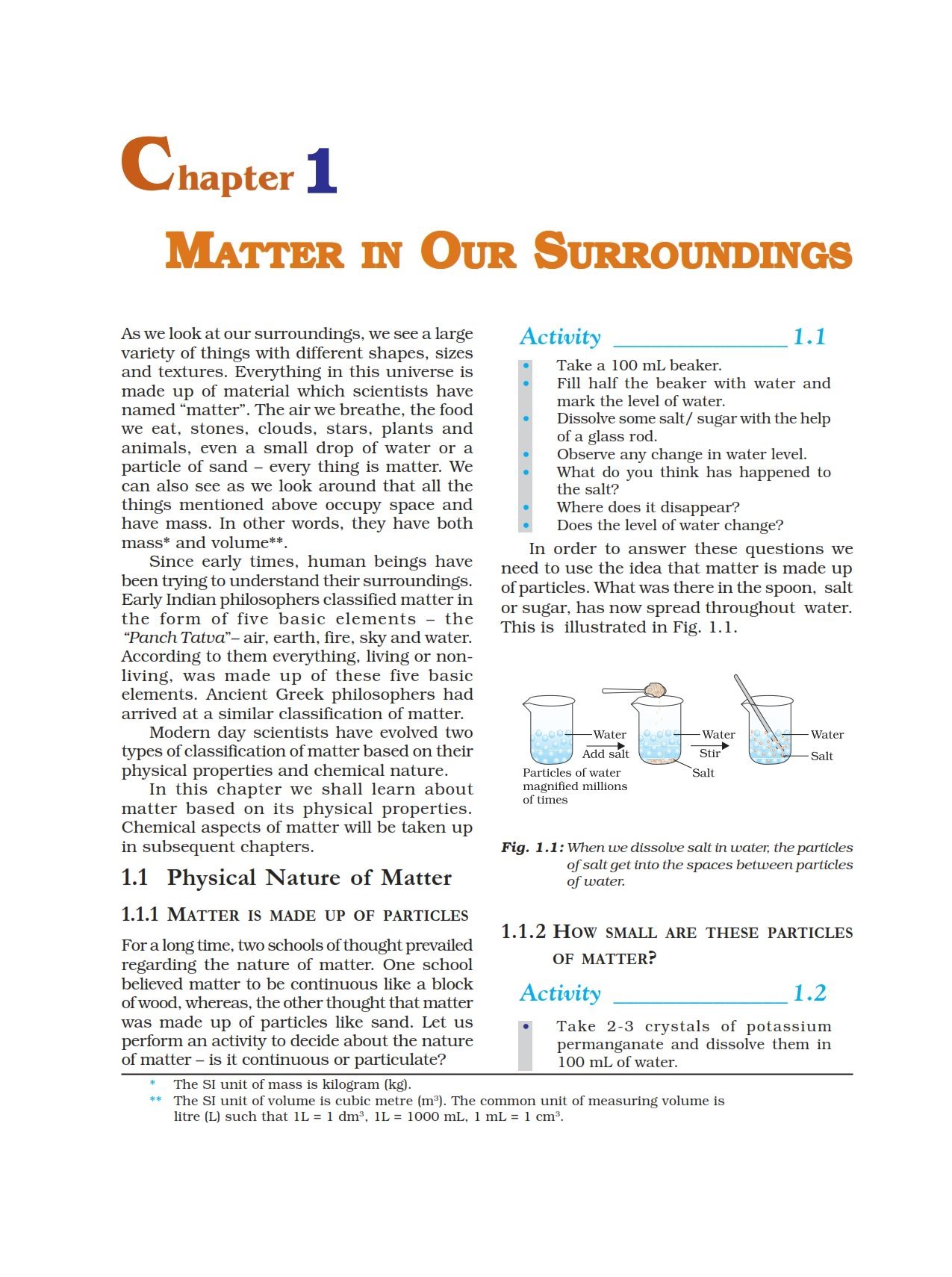
mass* and volume**. In order to answer these questions we
Since early times, human beings have need to use the idea that matter is made up
been trying to understand their surroundings. of particles. What was there in the spoon, salt
Early Indian philosophers classified matter in or sugar, has now spread throughout water.
the form of five basic elements – the
This is illustrated in Fig. 1.1.
“Panch Tatva”– air, earth, fire, sky and water.
According to them everything, living or non-
living, was made up of these five basic
elements. Ancient Greek philosophers had
arrived at a similar classification of matter.
Modern day scientists have evolved two
types of classification of matter based on their
physical properties and chemical nature.
In this chapter we shall learn about
matter based on its physical properties.
Chemical aspects of matter will be taken up
in subsequent chapters. Fig. 1.1: When we dissolve salt in water, the particles
of salt get into the spaces between particles
1.1 Physical Nature of Matter of water.
1.1.1 MATTER IS MADE UP OF PARTICLES
1.1.2 HOW SMALL ARE THESE PARTICLES
For a long time, two schools of thought prevailed
regarding the nature of matter. One school OF MATTER?
believed matter to be continuous like a block
of wood, whereas, the other thought that matter Activity ______________ 1.2
was made up of particles like sand. Let us • T ake 2-3 crystals of potassium
perform an activity to decide about the nature permanganate and dissolve them in
of matter – is it continuous or particulate? 100 mL of water.
* The SI unit of mass is kilogram (kg).
** The SI unit of volume is cubic metre (m3). The common unit of measuring volume is
litre (L) such that 1L = 1 dm3 , 1L = 1000 mL, 1 mL = 1 cm3.
Showing the first page only. Download the PDF above for the complete document.