ISC Class 12 Question Paper 2020 for Western Music
Finished viewing? Save it for later —
Download ISC Class 12 Question Paper 2020 for Western Music (PDF · 5 pages)About ISC Class 12 Question Paper 2020 for Western Music
ISC Class 12 Question Paper 2020 for Western Music is available here for free download. Published by CISCE for Class 12, this question paper can be viewed online or downloaded as a PDF (5 pages). Candidates preparing for Class 12 can use ISC Class 12 Question Paper 2020 for Western Music to understand the exam pattern, the type of questions asked, and the overall difficulty level.
Frequently Asked Questions
How can I download ISC Class 12 Question Paper 2020 for Western Music?
Open this page and click the Download button to save ISC Class 12 Question Paper 2020 for Western Music as a PDF. It is completely free on AglaSem Docs.
Is ISC Class 12 Question Paper 2020 for Western Music free to download?
Yes. ISC Class 12 Question Paper 2020 for Western Music can be viewed online and downloaded as a PDF free of cost on AglaSem Docs.
How many pages does ISC Class 12 Question Paper 2020 for Western Music have?
ISC Class 12 Question Paper 2020 for Western Music contains 5 pages, which you can read online or download together as a single PDF.
Where can I find more Class 12 study material?
You can find more Class 12 question papers, sample papers, syllabus, and answer keys on AglaSem Docs.
ISC Class 12 Question Paper 2020 for Western Music – Text
Read the full text of this question paper below — useful to quickly search, copy and reference the content online without downloading the PDF.
📄 View text version (5 pages)
Page 1
PAPER 1 (THEORY)
(Maximum Marks: 70)
(Time allowed: Three hours)
(Candidates are allowed additional 15 minutes for only reading the paper.
They must NOT start writing during this time.)
Answer five questions in all, choosing two questions from Section A, two from Section B
and one from either Section A or B.
The intended marks for questions or parts of questions are given in brackets [ ].
SECTION A
(Harmony)
Question 1 [14]
Either
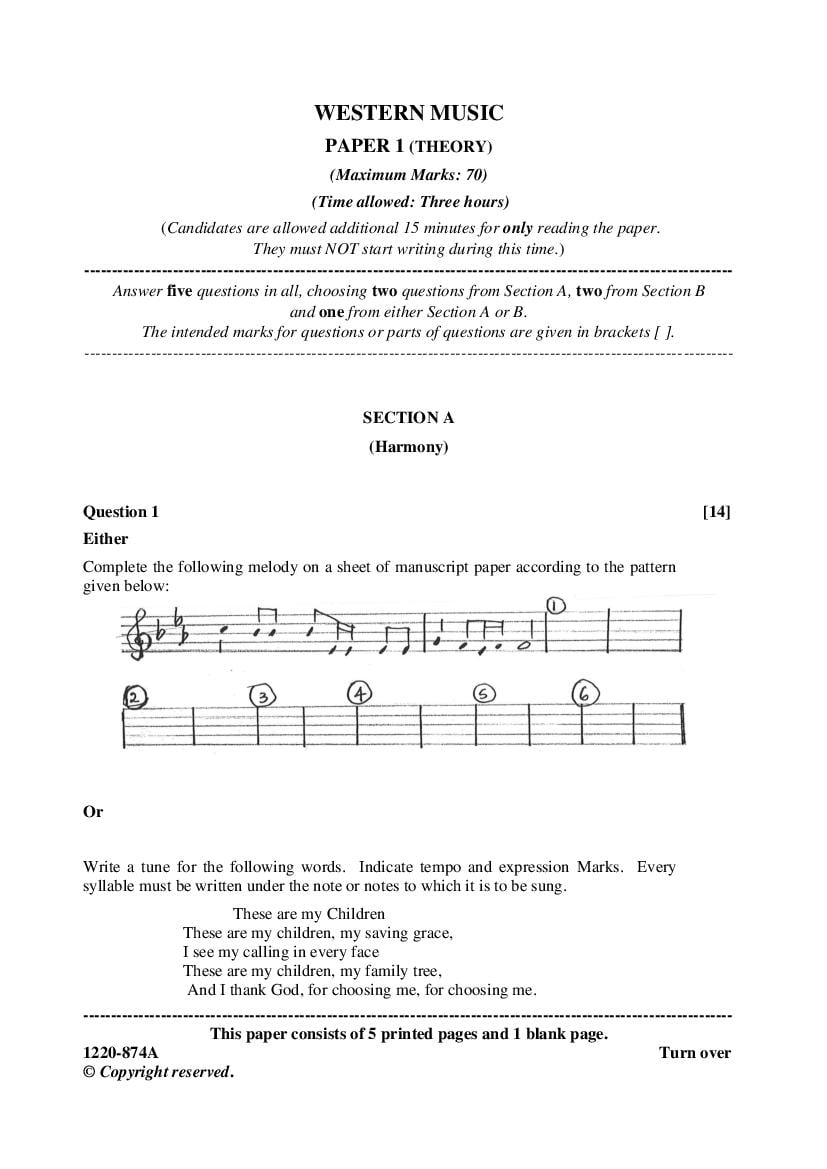
Complete the following melody on a sheet of manuscript paper according to the pattern
given below:
Or
Write a tune for the following words. Indicate tempo and expression Marks. Every
syllable must be written under the note or notes to which it is to be sung.
These are my Children
These are my children, my saving grace,
I see my calling in every face
These are my children, my family tree,
And I thank God, for choosing me, for choosing me.
This paper consists of 5 printed pages and 1 blank page.
1220-874A Turn over
© Copyright reserved.
Page 2
Either
Add Soprano, Alto and Tenor to the following Bass line on the manuscript paper provided.
Or
Add Alto, Tenor and Bass to the following melody:
Question 3 [14]
Two part Harmony.
Either
Add a lower part to the following melody:
Or
Add a suitable upper part to the following:
2
1220-874A
Page 3
Study the extract given below and answer the questions that follow: [14]
--------------------------------------------------------------------------------------------------------------------
3
1220-874A Turn over
Page 4
(i) Largo means……………………
(ii) In bar 3 – 4 there is modulation to the key of ………………..
(iii) The phrase lengths are …………………………… bars and ……………
(iv) The keyboard instrument most likely to have harmonized the figured bass
is a …………………….
(v) Two differences between bars 13 – 14 and 15 – 16 are:
1………………………………………………………..
2……………………………………………………….
(b) Write the flute part for bars 12 and 19 as you think it should be played.
(c) State true or false for each of the following statements:
(i) The flute and violin I parts are identical.
(ii) Apart from the modulation in bars 3 – 4 the piece is entirely in A major.
(iii) In Bar 17, there is imitation between violin II and bass.
(iv) There is no supertonic chord with 7th in the extract.
(v) The D in bar 18 of the flute part is an unaccented passing note.
SECTION B
Question 5 [14]
Which are the four movements of Beethoven’s Symphony No. 2 in D Major? Critically
analyse the 4th movement of the symphony bringing out the themes, the instruments, the
great depth and its harmonic complexity.
Question 6 [14]
What do you understand by Sonata form? How does Beethoven employ this form in
1st movement of his Symphony No. 2 in D major? How do the themes of Part one
stimulate incredible vigour and joyful fanfare?
Question 7 [14]
Briefly explain what a prelude is. How is it different from a fugue? What are the
elements of a Fugue? Illustrate by close reference to Bach’s Prelude and Fugue No. 16
in G minor.
4
1220-874A
Page 5
What is the story of Earlking by F. Schubert? What does Earlking symbolize? Explain
the various stages of the journey to its tragic end.
Question 9 [14]
Caesar Frank’s Sonata for Violin and Piano is the first and purest model of the cyclical
use of themes in Sonata form. Illustrate the above statement by referring closely to the
last movement of the Sonata.
Question 10 [14]
Write short notes on the life, works and enduring popularity of any two of the following
composers:
(a) Beethoven
(b) J. S. Bach
(c) Frank Schubert
(d) Caesar Frank
--------------------------------------------------------------------------------------------------------------------
5
1220-874A Turn over
Document Details
| Board / Org | CISCE |
| Exam | Class 12 |
| Type | Question Paper |
| Pages | 5 |
| Language | english |
| Updated | 22 Jul 2026 |