Finished viewing? Save it for later —
Download NCERT Book Class 10 Social Science (Economics) Chapter 2 Sectors of Indian Economy (PDF · 20 pages)About NCERT Book Class 10 Social Science (Economics) Chapter 2 Sectors of Indian Economy
NCERT Book Class 10 Social Science (Economics) Chapter 2 Sectors of Indian Economy is available here for free download. Published by NCERT for Class 10, this books can be viewed online or downloaded as a PDF (20 pages). Candidates preparing for Class 10 can use NCERT Book Class 10 Social Science (Economics) Chapter 2 Sectors of Indian Economy to understand the exam pattern, the type of questions asked, and the overall difficulty level.
Frequently Asked Questions
How can I download NCERT Book Class 10 Social Science (Economics) Chapter 2 Sectors of Indian Economy?
Open this page and click the Download button to save NCERT Book Class 10 Social Science (Economics) Chapter 2 Sectors of Indian Economy as a PDF. It is completely free on AglaSem Docs.
Is NCERT Book Class 10 Social Science (Economics) Chapter 2 Sectors of Indian Economy free to download?
Yes. NCERT Book Class 10 Social Science (Economics) Chapter 2 Sectors of Indian Economy can be viewed online and downloaded as a PDF free of cost on AglaSem Docs.
How many pages does NCERT Book Class 10 Social Science (Economics) Chapter 2 Sectors of Indian Economy have?
NCERT Book Class 10 Social Science (Economics) Chapter 2 Sectors of Indian Economy contains 20 pages, which you can read online or download together as a single PDF.
Where can I find more Class 10 study material?
You can find more Class 10 question papers, sample papers, syllabus, and answer keys on AglaSem Docs.
NCERT Book Class 10 Social Science (Economics) Chapter 2 Sectors of Indian Economy – Text
Read the full text of this books below — useful to quickly search, copy and reference the content online without downloading the PDF.
📄 View text version (1 page)
Page 1
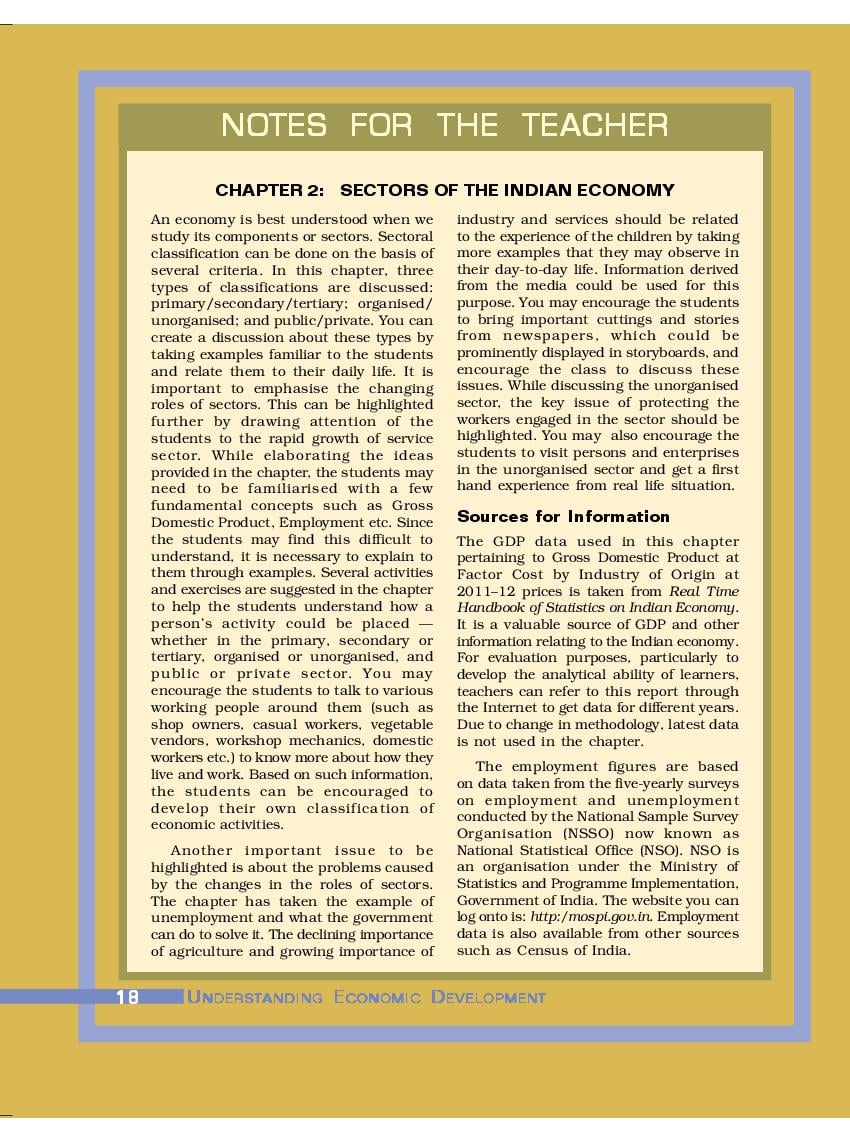
CHAPTER 2: SECTORS OF THE INDIAN ECONOMY
An economy is best understood when we industry and services should be related
study its components or sectors. Sectoral to the experience of the children by taking
classification can be done on the basis of more examples that they may observe in
several criteria. In this chapter, three their day-to-day life. Information derived
types of classifications are discussed: from the media could be used for this
primary/secondary/tertiary; organised/ purpose. You may encourage the students
unorganised; and public/private. You can to bring important cuttings and stories
create a discussion about these types by from newspapers, which could be
taking examples familiar to the students prominently displayed in storyboards, and
and relate them to their daily life. It is encourage the class to discuss these
important to emphasise the changing issues. While discussing the unorganised
roles of sectors. This can be highlighted sector, the key issue of protecting the
further by drawing attention of the workers engaged in the sector should be
students to the rapid growth of service highlighted. You may also encourage the
sector. While elaborating the ideas students to visit persons and enterprises
provided in the chapter, the students may in the unorganised sector and get a first
need to be familiarised with a few hand experience from real life situation.
fundamental concepts such as Gross
Domestic Product, Employment etc. Since Sources for Information
the students may find this difficult to The GVA data used in this chapter
understand, it is necessary to explain to pertaining to Real Gross Value Added at
them through examples. Several activities Basic Prices by Industry of Origin at
and exercises are suggested in the chapter 2011–12 prices is taken from Economic
to help the students understand how a Survey. It is a valuable source of GVA and
person’s activity could be placed — other information relating to the Indian
whether in the primary, secondary or economy. For evaluation purposes,
tertiary, organised or unorganised, and particularly to develop the analytical
public or private sector. You may ability of learners, teachers can refer to
encourage the students to talk to various this report through the Internet to get data
working people around them (such as for different years. Due to change in
shop owners, casual workers, vegetable methodology, latest data is not used in the
vendors, workshop mechanics, domestic chapter.
workers etc.) to know more about how they
The employment figures are based
live and work. Based on such information,
on data taken from the five-yearly surveys
the students can be encouraged to
on employment and unemployment
develop their own classification of
conducted by the National Sample Survey
economic activities.
Organisation (NSSO) now known as
Another important issue to be National Statistical Office (NSO). NSO is
highlighted is about the problems caused an organisation under the Ministry of
by the changes in the roles of sectors. Statistics and Programme Implementation,
The chapter has taken the example of Government of India. The website you can
unemployment and what the government log onto is: Employment
can do to solve it. The declining importance data is also available from other sources
of agriculture and growing importance of such as Census of India.
18 U NDERST ANDING E CONOMIC D EVEL
NDERSTANDING OPMENT
EVELOPMENT
Showing the first page only. Download the PDF above for the complete document.
Document Details
| Board / Org | NCERT |
| Exam | Class 10 |
| Type | Books |
| Pages | 20 |
| Language | english |
| Updated | 29 Aug 2026 |