MBOSE Class 12 Question Paper 2021 for Music
Finished viewing? Save it for later —
Download MBOSE Class 12 Question Paper 2021 for Music (PDF · 8 pages)About MBOSE Class 12 Question Paper 2021 for Music
MBOSE Class 12 Question Paper 2021 for Music is available here for free download. Published by Meghalaya Board for Class 12, this question paper can be viewed online or downloaded as a PDF (8 pages). Candidates preparing for Class 12 can use MBOSE Class 12 Question Paper 2021 for Music to understand the exam pattern, the type of questions asked, and the overall difficulty level.
Frequently Asked Questions
How can I download MBOSE Class 12 Question Paper 2021 for Music?
Open this page and click the Download button to save MBOSE Class 12 Question Paper 2021 for Music as a PDF. It is completely free on AglaSem Docs.
Is MBOSE Class 12 Question Paper 2021 for Music free to download?
Yes. MBOSE Class 12 Question Paper 2021 for Music can be viewed online and downloaded as a PDF free of cost on AglaSem Docs.
How many pages does MBOSE Class 12 Question Paper 2021 for Music have?
MBOSE Class 12 Question Paper 2021 for Music contains 8 pages, which you can read online or download together as a single PDF.
Where can I find more Class 12 study material?
You can find more Class 12 question papers, sample papers, syllabus, and answer keys on AglaSem Docs.
MBOSE Class 12 Question Paper 2021 for Music – Text
Read the full text of this question paper below — useful to quickly search, copy and reference the content online without downloading the PDF.
📄 View text version (8 pages)
Page 1
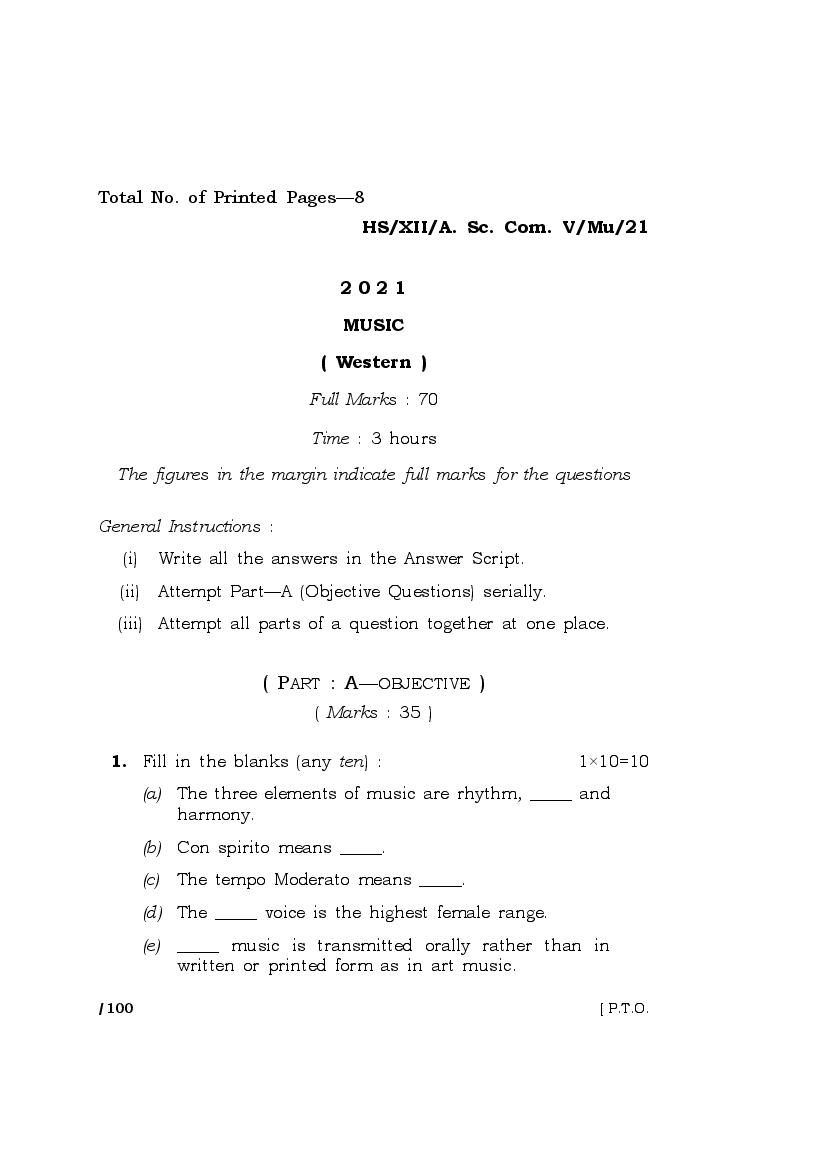
HS/XII/A. Sc. Com. V/Mu/21
2021
MUSIC
( Western )
Full Marks : 70
Time : 3 hours
The figures in the margin indicate full marks for the questions
General Instructions :
(i) Write all the answers in the Answer Script.
(ii) Attempt Part—A (Objective Questions) serially.
(iii) Attempt all parts of a question together at one place.
( PART : A—OBJECTIVE )
( Marks : 35 )
1. Fill in the blanks (any ten) : 1×10=10
(a) The three elements of music are rhythm, _____ and
harmony.
(b) Con spirito means _____.
(c) The tempo Moderato means _____.
(d) The _____ voice is the highest female range.
(e) _____ music is transmitted orally rather than in
written or printed form as in art music.
/100 [ P.T.O.
Page 2
(f) Poco a poco means _____.
(g) The pipe organ is a collection of whistles and _____.
(h) Renaissance means _____.
(i) Monophony is a _____ line of sound.
(j) A supertonic secondary triad is denoted by a Roman
Numeral _____.
(k) Chords may possess one of the four distinct
qualities—major, minor, augmented and _____.
(l) Membrane instruments are made from the skin
of _____.
(m) Irregular rhythmic pattern is known as _____.
(n) The _____ meter is counted as 121212 with accent
on the first beat of each.
(o) Pitch, duration, intensity, quality are the _____ of a
musical tone.
2. State whether the following statements are True or
False (any ten) : 1×10=10
(a) In a major scale, the supertonic (ii) is a diminished
chord.
(b) Piano means slow and steady.
(c) The dominant seventh chord is written as V7.
(d) The xylophone is a pitched idiophone.
HS/XII/A. Sc. Com. V/Mu/21/100 [ Contd.
Page 3
(e) ‘Fugue’ is a Greek word meaning flight.
(f) Art music is the medium that is most commonly
called ‘classical music’.
(g) Popular music reaches a large audience but is
generally heard for only a brief span of time.
(h) Franz Joseph Haydn was born in 1712.
(i) Pentatonic scales are four note scales that are found
in traditional music throughout the world.
(j) A call and response is also known as responsorial
texture.
(k) Chamber music is considered ‘music for musicians’.
(l) Coda section is a structure of sonata form.
(m) Binary form is represented in diagram as ABBA.
(n) A series of measures organized in a repeated pattern
is called meter.
(o) fff means as loud as possible.
3. Choose the correct answer from the choices given
(any five) : 1×5=5
(a) The oboe is a/an
(i) aerophone instrument
(ii) electrophone instrument
(iii) percussion instrument
(iv) chordophone instrument
HS/XII/A. Sc. Com. V/Mu/21/100 [ P.T.O.
Page 4
(b) FAC is a/an
(i) minor triad
(ii) augmented triad
(iii) major triad
(iv) diminished triad
(c) A string quartet is a chamber ensemble of
(i) cello
(ii) viola
(iii) two violins
(iv) All of the above
(d) Recorders are a type of
(i) oboe
(ii) drum
(iii) guitar
(iv) flute
(e) Which of the following is a major triad?
(i) ACE
(ii) CEbG
(iii) EGB
(iv) DF#A
HS/XII/A. Sc. Com. V/Mu/21/100 [ Contd.
Page 5
(f) The number of diminished chords in a major scale
is/are
(i) one
(ii) two
(iii) three
(iv) None of the above
(g) The common language for musical description is
(i) Latin
(ii) Italian
(iii) English
(iv) Spanish
(h) Presto means
(i) fast
(ii) very fast
(iii) as fast as possible
(iv) pause
4. Answer the following questions (any five) : 2×5=10
(a) Name the different secondary triads of F major scale.
(b) Construct a V7 chord in the key of Bb major in the
bass clef.
(c) What is a perfect cadence? Write an example on
G clef.
(d) Name the two style characteristics of the Baroque
period.
HS/XII/A. Sc. Com. V/Mu/21/100 [ P.T.O.
Page 6
(e) What is the meaning of polyphony?
(f) What is metronomic marking?
(g) What is the meaning of symphony?
(h) Name the stringed instruments used in a quartet
during the classical period.
( PART : B—DESCRIPTIVE )
( Marks : 35 )
Answer Question Nos. 5 and 6 or 7 and 8
UNIT—I
5. Write the following four-part chord progressions in the
key of G major : 1×6=6
6. Construct a V7 chord in the key of C major scale in the
bass clef. 3+2=5
OR
7. Using semibreves, write 3-part diatonic secondary triads
of the following. Use a key signature : 3+3=6
(a)
In the key of G major scale.
HS/XII/A. Sc. Com. V/Mu/21/100 [ Contd.
Page 7
(b)
In the key of F major scale.
8. Briefly classify the different types of triads. 5
UNIT—II
Answer Question Nos. 9 and 10 or 11 and 12
9. What are the different sources of musical sound? How
are musical instruments classified? Cite examples for
each classification. 2+2½+2½=7
10. What is sonata? Briefly explain the different structure of
sonata form. 2+5=7
OR
11. Explain any two of the following : 3½×2=7
(a) Rondo
(b) Sonata
(c) Monophony
(d) Heterophony
12. Write short notes on any two of the following : 3½×2=7
(a) Art music
(b) Folk music
(c) Homophony
HS/XII/A. Sc. Com. V/Mu/21/100 [ P.T.O.
Page 8
UNIT—III
Answer Question Nos. 13 and 14 or 15 and 16
13. What are the instrumental musical genres prevalent
during the Renaissance period? Explain any one with
example. 2+3=5
14. Write a brief description about the orchestral music
prevalent during the classical period. 5
OR
15. What are the different characteristics of music in non-
Western culture? Write a note on diaphony. 2+3=5
16. Name the two vocal genres of the Romantic period.
Briefly explain any one of them. 2+3=5
HS/XII/A. Sc. Com. V/Mu/21/100 11-21—120
Document Details
| Board / Org | Meghalaya Board |
| Exam | Class 12 |
| Type | Question Paper |
| Pages | 8 |
| Updated | 30 Apr 2026 |