UGC NET 2021 Question Paper Commerce 25 Nov Shift 1
Finished viewing? Save it for later —
Download UGC NET 2021 Question Paper Commerce 25 Nov Shift 1 (PDF · 82 pages)About UGC NET 2021 Question Paper Commerce 25 Nov Shift 1
UGC NET 2021 Question Paper Commerce 25 Nov Shift 1 is available here for free download. Published by NTA for UGC NET, this question paper can be viewed online or downloaded as a PDF (82 pages). Candidates preparing for UGC NET can use UGC NET 2021 Question Paper Commerce 25 Nov Shift 1 to understand the exam pattern, the type of questions asked, and the overall difficulty level.
Frequently Asked Questions
How can I download UGC NET 2021 Question Paper Commerce 25 Nov Shift 1?
Open this page and click the Download button to save UGC NET 2021 Question Paper Commerce 25 Nov Shift 1 as a PDF. It is completely free on AglaSem Docs.
Is UGC NET 2021 Question Paper Commerce 25 Nov Shift 1 free to download?
Yes. UGC NET 2021 Question Paper Commerce 25 Nov Shift 1 can be viewed online and downloaded as a PDF free of cost on AglaSem Docs.
How many pages does UGC NET 2021 Question Paper Commerce 25 Nov Shift 1 have?
UGC NET 2021 Question Paper Commerce 25 Nov Shift 1 contains 82 pages, which you can read online or download together as a single PDF.
Where can I find more UGC NET study material?
You can find more UGC NET question papers, sample papers, syllabus, and answer keys on AglaSem Docs.
UGC NET 2021 Question Paper Commerce 25 Nov Shift 1 – Text
Read the full text of this question paper below — useful to quickly search, copy and reference the content online without downloading the PDF.
📄 View text version (81 pages)
Page 1
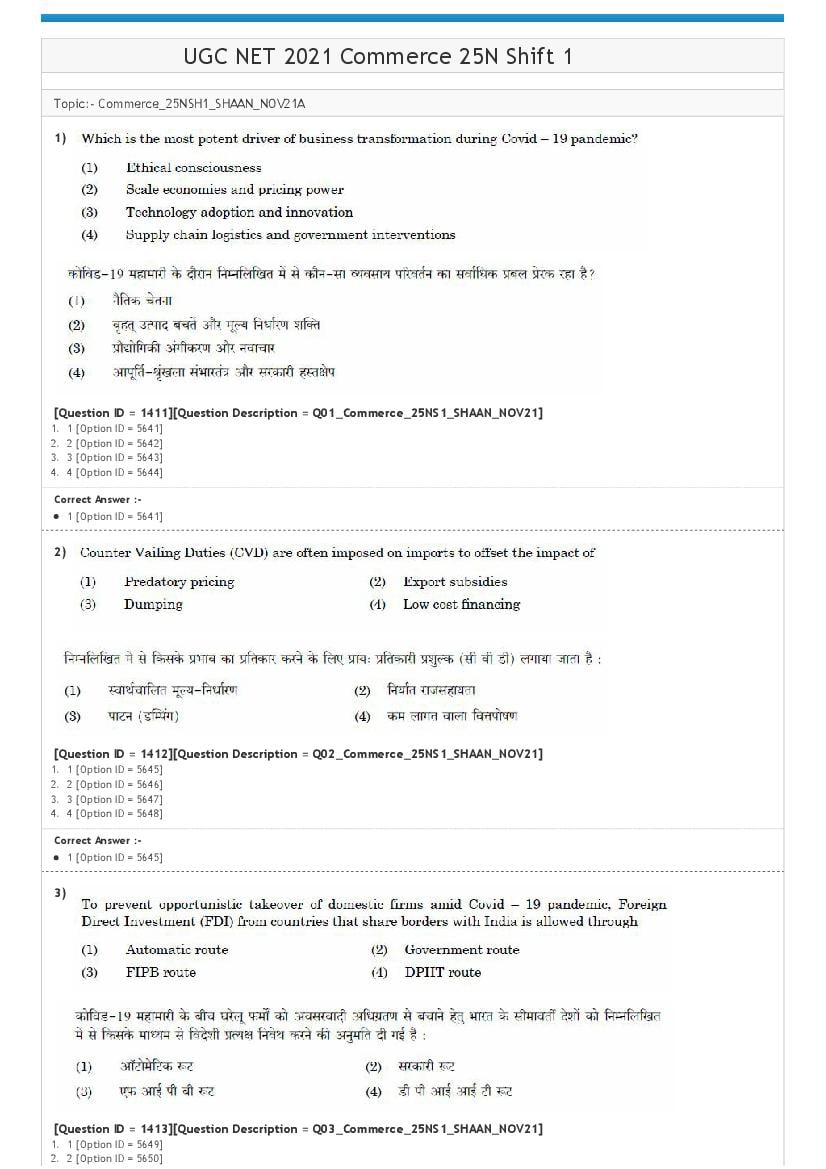
Topic:‐ Commerce_25NSH1_SHAAN_NOV21A
1)
[Question ID = 1411][Question Description = Q01_Commerce_25NS1_SHAAN_NOV21]
1. 1 [Option ID = 5641]
2. 2 [Option ID = 5642]
3. 3 [Option ID = 5643]
4. 4 [Option ID = 5644]
1 [Option ID = 5641]
2)
[Question ID = 1412][Question Description = Q02_Commerce_25NS1_SHAAN_NOV21]
1. 1 [Option ID = 5645]
2. 2 [Option ID = 5646]
3. 3 [Option ID = 5647]
4. 4 [Option ID = 5648]
1 [Option ID = 5645]
3)
[Question ID = 1413][Question Description = Q03_Commerce_25NS1_SHAAN_NOV21]
1. 1 [Option ID = 5649]
2. 2 [Option ID = 5650]
Page 2
4. 4 [Option ID = 5652]
1 [Option ID = 5649]
4)
[Question ID = 1414][Question Description = Q04_Commerce_25NS1_SHAAN_NOV21]
1. 1 [Option ID = 5653]
2. 2 [Option ID = 5654]
3. 3 [Option ID = 5655]
4. 4 [Option ID = 5656]
1 [Option ID = 5653]
5)
[Question ID = 1415][Question Description = Q05_Commerce_25NS1_SHAAN_NOV21]
1. 1 [Option ID = 5657]
2. 2 [Option ID = 5658]
3. 3 [Option ID = 5659]
4. 4 [Option ID = 5660]
1 [Option ID = 5657]
6)
[Question ID = 1416][Question Description = Q06_Commerce_25NS1_SHAAN_NOV21]
1. 1 [Option ID = 5661]
2. 2 [Option ID = 5662]
Page 3
4. 4 [Option ID = 5664]
1 [Option ID = 5661]
7)
[Question ID = 1417][Question Description = Q07_Commerce_25NS1_SHAAN_NOV21]
1. 1 [Option ID = 5665]
2. 2 [Option ID = 5666]
3. 3 [Option ID = 5667]
4. 4 [Option ID = 5668]
1 [Option ID = 5665]
8)
[Question ID = 1418][Question Description = Q08_Commerce_25NS1_SHAAN_NOV21]
1. 1 [Option ID = 5669]
2. 2 [Option ID = 5670]
3. 3 [Option ID = 5671]
4. 4 [Option ID = 5672]
1 [Option ID = 5669]
9)
[Question ID = 1419][Question Description = Q09_Commerce_25NS1_SHAAN_NOV21]
Page 4
2. 2 [Option ID = 5674]
3. 3 [Option ID = 5675]
4. 4 [Option ID = 5676]
1 [Option ID = 5673]
10)
[Question ID = 1420][Question Description = Q10_Commerce_25NS1_SHAAN_NOV21]
1. 1 [Option ID = 5677]
2. 2 [Option ID = 5678]
3. 3 [Option ID = 5679]
4. 4 [Option ID = 5680]
1 [Option ID = 5677]
11)
[Question ID = 1421][Question Description = Q11_Commerce_25NS1_SHAAN_NOV21]
1. 1 [Option ID = 5681]
2. 2 [Option ID = 5682]
3. 3 [Option ID = 5683]
4. 4 [Option ID = 5684]
1 [Option ID = 5681]
12)
[Question ID = 1422][Question Description = Q12_Commerce_25NS1_SHAAN_NOV21]
1. 1 [Option ID = 5685]
2. 2 [Option ID = 5686]
3. 3 [Option ID = 5687]
4. 4 [Option ID = 5688]
1 [Option ID = 5685]
Page 5
[Question ID = 1423][Question Description = Q13_Commerce_25NS1_SHAAN_NOV21]
1. 1 [Option ID = 5689]
2. 2 [Option ID = 5690]
3. 3 [Option ID = 5691]
4. 4 [Option ID = 5692]
1 [Option ID = 5689]
14)
[Question ID = 1424][Question Description = Q14_Commerce_25NS1_SHAAN_NOV21]
1. 1 [Option ID = 5693]
2. 2 [Option ID = 5694]
3. 3 [Option ID = 5695]
4. 4 [Option ID = 5696]
1 [Option ID = 5693]
15)
Page 6
1. 1 [Option ID = 5697]
2. 2 [Option ID = 5698]
3. 3 [Option ID = 5699]
4. 4 [Option ID = 5700]
1 [Option ID = 5697]
16)
[Question ID = 1426][Question Description = Q16_Commerce_25NS1_SHAAN_NOV21]
1. 1 [Option ID = 5701]
2. 2 [Option ID = 5702]
3. 3 [Option ID = 5703]
4. 4 [Option ID = 5704]
1 [Option ID = 5701]
17)
[Question ID = 1427][Question Description = Q17_Commerce_25NS1_SHAAN_NOV21]
1. 1 [Option ID = 5705]
2. 2 [Option ID = 5706]
3. 3 [Option ID = 5707]
4. 4 [Option ID = 5708]
1 [Option ID = 5705]
18)
Page 7
1. 1 [Option ID = 5709]
2. 2 [Option ID = 5710]
3. 3 [Option ID = 5711]
4. 4 [Option ID = 5712]
1 [Option ID = 5709]
19)
[Question ID = 1429][Question Description = Q19_Commerce_25NS1_SHAAN_NOV21]
1. 1 [Option ID = 5713]
2. 2 [Option ID = 5714]
3. 3 [Option ID = 5715]
4. 4 [Option ID = 5716]
1 [Option ID = 5713]
20)
[Question ID = 1430][Question Description = Q20_Commerce_25NS1_SHAAN_NOV21]
1. 1 [Option ID = 5717]
2. 2 [Option ID = 5718]
3. 3 [Option ID = 5719]
4. 4 [Option ID = 5720]
1 [Option ID = 5717]
21)
Page 8
1. 1 [Option ID = 5721]
2. 2 [Option ID = 5722]
3. 3 [Option ID = 5723]
4. 4 [Option ID = 5724]
1 [Option ID = 5721]
22)
[Question ID = 1432][Question Description = Q22_Commerce_25NS1_SHAAN_NOV21]
1. 1 [Option ID = 5725]
2. 2 [Option ID = 5726]
3. 3 [Option ID = 5727]
4. 4 [Option ID = 5728]
1 [Option ID = 5725]
23)
[Question ID = 1433][Question Description = Q23_Commerce_25NS1_SHAAN_NOV21]
1. 1 [Option ID = 5729]
2. 2 [Option ID = 5730]
3. 3 [Option ID = 5731]
4. 4 [Option ID = 5732]
1 [Option ID = 5729]
24)
Page 9
1. 1 [Option ID = 5733]
2. 2 [Option ID = 5734]
3. 3 [Option ID = 5735]
4. 4 [Option ID = 5736]
1 [Option ID = 5733]
25)
[Question ID = 1435][Question Description = Q25_Commerce_25NS1_SHAAN_NOV21]
1. 1 [Option ID = 5737]
2. 2 [Option ID = 5738]
3. 3 [Option ID = 5739]
4. 4 [Option ID = 5740]
1 [Option ID = 5737]
26)
[Question ID = 1436][Question Description = Q26_Commerce_25NS1_SHAAN_NOV21]
1. 1 [Option ID = 5741]
2. 2 [Option ID = 5742]
3. 3 [Option ID = 5743]
4. 4 [Option ID = 5744]
1 [Option ID = 5741]
Page 10
[Question ID = 1437][Question Description = Q27_Commerce_25NS1_SHAAN_NOV21]
1. 1 [Option ID = 5745]
2. 2 [Option ID = 5746]
3. 3 [Option ID = 5747]
4. 4 [Option ID = 5748]
1 [Option ID = 5745]
28)
[Question ID = 1438][Question Description = Q28_Commerce_25NS1_SHAAN_NOV21]
1. 1 [Option ID = 5749]
2. 2 [Option ID = 5750]
3. 3 [Option ID = 5751]
4. 4 [Option ID = 5752]
1 [Option ID = 5749]
29)
Page 11
1. 1 [Option ID = 5753]
2. 2 [Option ID = 5754]
3. 3 [Option ID = 5755]
4. 4 [Option ID = 5756]
1 [Option ID = 5753]
30)
[Question ID = 1440][Question Description = Q30_Commerce_25NS1_SHAAN_NOV21]
1. 1 [Option ID = 5757]
2. 2 [Option ID = 5758]
3. 3 [Option ID = 5759]
4. 4 [Option ID = 5760]
1 [Option ID = 5757]
31)
[Question ID = 1441][Question Description = Q31_Commerce_25NS1_SHAAN_NOV21]
1. 1 [Option ID = 5761]
2. 2 [Option ID = 5762]
3. 3 [Option ID = 5763]
4. 4 [Option ID = 5764]
1 [Option ID = 5761]
32)
Page 12
1. 1 [Option ID = 5765]
2. 2 [Option ID = 5766]
3. 3 [Option ID = 5767]
4. 4 [Option ID = 5768]
1 [Option ID = 5765]
33)
[Question ID = 1443][Question Description = Q33_Commerce_25NS1_SHAAN_NOV21]
1. 1 [Option ID = 5769]
2. 2 [Option ID = 5770]
3. 3 [Option ID = 5771]
4. 4 [Option ID = 5772]
1 [Option ID = 5769]
34)
Page 13
1. 1 [Option ID = 5773]
2. 2 [Option ID = 5774]
3. 3 [Option ID = 5775]
4. 4 [Option ID = 5776]
1 [Option ID = 5773]
35)
[Question ID = 1445][Question Description = Q35_Commerce_25NS1_SHAAN_NOV21]
1. 1 [Option ID = 5777]
2. 2 [Option ID = 5778]
3. 3 [Option ID = 5779]
4. 4 [Option ID = 5780]
1 [Option ID = 5777]
36)
[Question ID = 1446][Question Description = Q36_Commerce_25NS1_SHAAN_NOV21]
1. 1 [Option ID = 5781]
2. 2 [Option ID = 5782]
3. 3 [Option ID = 5783]
4. 4 [Option ID = 5784]
1 [Option ID = 5781]
Page 14
[Question ID = 1447][Question Description = Q37_Commerce_25NS1_SHAAN_NOV21]
1. 1 [Option ID = 5785]
2. 2 [Option ID = 5786]
3. 3 [Option ID = 5787]
4. 4 [Option ID = 5788]
1 [Option ID = 5785]
38)
[Question ID = 1448][Question Description = Q38_Commerce_25NS1_SHAAN_NOV21]
1. 1 [Option ID = 5789]
2. 2 [Option ID = 5790]
3. 3 [Option ID = 5791]
4. 4 [Option ID = 5792]
1 [Option ID = 5789]
39)
[Question ID = 1449][Question Description = Q39_Commerce_25NS1_SHAAN_NOV21]
1. 1 [Option ID = 5793]
2. 2 [Option ID = 5794]
3. 3 [Option ID = 5795]
4. 4 [Option ID = 5796]
1 [Option ID = 5793]
Page 15
[Question ID = 1450][Question Description = Q40_Commerce_25NS1_SHAAN_NOV21]
1. 1 [Option ID = 5797]
2. 2 [Option ID = 5798]
3. 3 [Option ID = 5799]
4. 4 [Option ID = 5800]
1 [Option ID = 5797]
41)
[Question ID = 1451][Question Description = Q41_Commerce_25NS1_SHAAN_NOV21]
1. 1 [Option ID = 5801]
2. 2 [Option ID = 5802]
3. 3 [Option ID = 5803]
4. 4 [Option ID = 5804]
1 [Option ID = 5801]
42)
Page 16
1. 1 [Option ID = 5805]
2. 2 [Option ID = 5806]
3. 3 [Option ID = 5807]
4. 4 [Option ID = 5808]
1 [Option ID = 5805]
43)
Page 17
1. 1 [Option ID = 5809]
2. 2 [Option ID = 5810]
3. 3 [Option ID = 5811]
4. 4 [Option ID = 5812]
1 [Option ID = 5809]
44)
Page 18
1. 1 [Option ID = 5813]
2. 2 [Option ID = 5814]
3. 3 [Option ID = 5815]
4. 4 [Option ID = 5816]
1 [Option ID = 5813]
45)
[Question ID = 1455][Question Description = Q45_Commerce_25NS1_SHAAN_NOV21]
1. 1 [Option ID = 5817]
2. 2 [Option ID = 5818]
3. 3 [Option ID = 5819]
4. 4 [Option ID = 5820]
1 [Option ID = 5817]
46)
Page 19
1. 1 [Option ID = 5821]
2. 2 [Option ID = 5822]
3. 3 [Option ID = 5823]
4. 4 [Option ID = 5824]
1 [Option ID = 5821]
47)
Page 20
1. 1 [Option ID = 5825]
2. 2 [Option ID = 5826]
3. 3 [Option ID = 5827]
4. 4 [Option ID = 5828]
1 [Option ID = 5825]
48)
[Question ID = 1458][Question Description = Q48_Commerce_25NS1_SHAAN_NOV21]
1. 1 [Option ID = 5829]
2. 2 [Option ID = 5830]
3. 3 [Option ID = 5831]
4. 4 [Option ID = 5832]
1 [Option ID = 5829]
49)
Page 21
1. 1 [Option ID = 5833]
2. 2 [Option ID = 5834]
3. 3 [Option ID = 5835]
4. 4 [Option ID = 5836]
1 [Option ID = 5833]
50)
Page 22
1. 1 [Option ID = 5837]
2. 2 [Option ID = 5838]
3. 3 [Option ID = 5839]
4. 4 [Option ID = 5840]
1 [Option ID = 5837]
51)
[Question ID = 1461][Question Description = Q51_Commerce_25NS1_SHAAN_NOV21]
1. 1 [Option ID = 5841]
2. 2 [Option ID = 5842]
3. 3 [Option ID = 5843]
4. 4 [Option ID = 5844]
1 [Option ID = 5841]
Page 23
[Question ID = 1462][Question Description = Q52_Commerce_25NS1_SHAAN_NOV21]
1. 1 [Option ID = 5845]
2. 2 [Option ID = 5846]
3. 3 [Option ID = 5847]
4. 4 [Option ID = 5848]
1 [Option ID = 5845]
53)
Page 24
1. 1 [Option ID = 5849]
2. 2 [Option ID = 5850]
3. 3 [Option ID = 5851]
4. 4 [Option ID = 5852]
1 [Option ID = 5849]
54)
Page 25
1. 1 [Option ID = 5853]
2. 2 [Option ID = 5854]
3. 3 [Option ID = 5855]
4. 4 [Option ID = 5856]
1 [Option ID = 5853]
55)
[Question ID = 1465][Question Description = Q55_Commerce_25NS1_SHAAN_NOV21]
1. 1 [Option ID = 5857]
2. 2 [Option ID = 5858]
3. 3 [Option ID = 5859]
4. 4 [Option ID = 5860]
1 [Option ID = 5857]
56)
Page 26
1. 1 [Option ID = 5861]
2. 2 [Option ID = 5862]
3. 3 [Option ID = 5863]
4. 4 [Option ID = 5864]
1 [Option ID = 5861]
57)
Page 27
1. 1 [Option ID = 5865]
2. 2 [Option ID = 5866]
3. 3 [Option ID = 5867]
4. 4 [Option ID = 5868]
1 [Option ID = 5865]
58)
[Question ID = 1468][Question Description = Q58_Commerce_25NS1_SHAAN_NOV21]
1. 1 [Option ID = 5869]
2. 2 [Option ID = 5870]
3. 3 [Option ID = 5871]
4. 4 [Option ID = 5872]
1 [Option ID = 5869]
59)
Page 28
1. 1 [Option ID = 5873]
2. 2 [Option ID = 5874]
3. 3 [Option ID = 5875]
4. 4 [Option ID = 5876]
1 [Option ID = 5873]
60)
Page 29
1. 1 [Option ID = 5877]
2. 2 [Option ID = 5878]
3. 3 [Option ID = 5879]
4. 4 [Option ID = 5880]
1 [Option ID = 5877]
61)
[Question ID = 1471][Question Description = Q61_Commerce_25NS1_SHAAN_NOV21]
1. 1 [Option ID = 5881]
2. 2 [Option ID = 5882]
3. 3 [Option ID = 5883]
4. 4 [Option ID = 5884]
1 [Option ID = 5881]
62)
Page 30
1. 1 [Option ID = 5885]
2. 2 [Option ID = 5886]
3. 3 [Option ID = 5887]
4. 4 [Option ID = 5888]
1 [Option ID = 5885]
63)
Page 31
1. 1 [Option ID = 5889]
2. 2 [Option ID = 5890]
3. 3 [Option ID = 5891]
4. 4 [Option ID = 5892]
1 [Option ID = 5889]
64)
Page 32
1. 1 [Option ID = 5893]
2. 2 [Option ID = 5894]
3. 3 [Option ID = 5895]
4. 4 [Option ID = 5896]
1 [Option ID = 5893]
65)
[Question ID = 1475][Question Description = Q65_Commerce_25NS1_SHAAN_NOV21]
1. 1 [Option ID = 5897]
2. 2 [Option ID = 5898]
3. 3 [Option ID = 5899]
4. 4 [Option ID = 5900]
1 [Option ID = 5897]
66)
Page 33
1. 1 [Option ID = 5901]
2. 2 [Option ID = 5902]
3. 3 [Option ID = 5903]
4. 4 [Option ID = 5904]
1 [Option ID = 5901]
67)
Page 34
1. 1 [Option ID = 5905]
2. 2 [Option ID = 5906]
3. 3 [Option ID = 5907]
4. 4 [Option ID = 5908]
1 [Option ID = 5905]
68)
Page 35
1. 1 [Option ID = 5909]
2. 2 [Option ID = 5910]
3. 3 [Option ID = 5911]
4. 4 [Option ID = 5912]
1 [Option ID = 5909]
69)
[Question ID = 1479][Question Description = Q69_Commerce_25NS1_SHAAN_NOV21]
1. 1 [Option ID = 5913]
2. 2 [Option ID = 5914]
3. 3 [Option ID = 5915]
4. 4 [Option ID = 5916]
1 [Option ID = 5913]
Page 36
[Question ID = 1480][Question Description = Q70_Commerce_25NS1_SHAAN_NOV21]
1. 1 [Option ID = 5917]
2. 2 [Option ID = 5918]
3. 3 [Option ID = 5919]
4. 4 [Option ID = 5920]
1 [Option ID = 5917]
71)
Page 37
1. 1 [Option ID = 5921]
2. 2 [Option ID = 5922]
3. 3 [Option ID = 5923]
4. 4 [Option ID = 5924]
1 [Option ID = 5921]
72)
Page 38
1. 1 [Option ID = 5925]
2. 2 [Option ID = 5926]
3. 3 [Option ID = 5927]
4. 4 [Option ID = 5928]
1 [Option ID = 5925]
73)
[Question ID = 1483][Question Description = Q73_Commerce_25NS1_SHAAN_NOV21]
Page 39
2. 2 [Option ID = 5930]
3. 3 [Option ID = 5931]
4. 4 [Option ID = 5932]
1 [Option ID = 5929]
74)
[Question ID = 1484][Question Description = Q74_Commerce_25NS1_SHAAN_NOV21]
1. 1 [Option ID = 5933]
2. 2 [Option ID = 5934]
3. 3 [Option ID = 5935]
4. 4 [Option ID = 5936]
1 [Option ID = 5933]
75)
Page 40
1. 1 [Option ID = 5937]
2. 2 [Option ID = 5938]
3. 3 [Option ID = 5939]
4. 4 [Option ID = 5940]
1 [Option ID = 5937]
76)
Page 41
1. 1 [Option ID = 5941]
2. 2 [Option ID = 5942]
3. 3 [Option ID = 5943]
4. 4 [Option ID = 5944]
1 [Option ID = 5941]
77)
Page 42
1. 1 [Option ID = 5945]
2. 2 [Option ID = 5946]
3. 3 [Option ID = 5947]
4. 4 [Option ID = 5948]
1 [Option ID = 5945]
78)
[Question ID = 1488][Question Description = Q78_Commerce_25NS1_SHAAN_NOV21]
1. 1 [Option ID = 5949]
2. 2 [Option ID = 5950]
3. 3 [Option ID = 5951]
4. 4 [Option ID = 5952]
1 [Option ID = 5949]
79)
Page 43
1. 1 [Option ID = 5953]
2. 2 [Option ID = 5954]
3. 3 [Option ID = 5955]
4. 4 [Option ID = 5956]
1 [Option ID = 5953]
80)
Page 44
1. 1 [Option ID = 5957]
2. 2 [Option ID = 5958]
3. 3 [Option ID = 5959]
4. 4 [Option ID = 5960]
1 [Option ID = 5957]
81)
Page 45
1. 1 [Option ID = 5961]
2. 2 [Option ID = 5962]
3. 3 [Option ID = 5963]
4. 4 [Option ID = 5964]
1 [Option ID = 5961]
82)
[Question ID = 1492][Question Description = Q82_Commerce_25NS1_SHAAN_NOV21]
1. 1 [Option ID = 5965]
2. 2 [Option ID = 5966]
3. 3 [Option ID = 5967]
4. 4 [Option ID = 5968]
1 [Option ID = 5965]
83)
Page 46
1. 1 [Option ID = 5969]
2. 2 [Option ID = 5970]
3. 3 [Option ID = 5971]
4. 4 [Option ID = 5972]
1 [Option ID = 5969]
84)
Page 47
1. 1 [Option ID = 5973]
2. 2 [Option ID = 5974]
3. 3 [Option ID = 5975]
4. 4 [Option ID = 5976]
1 [Option ID = 5973]
85)
Page 48
1. 1 [Option ID = 5977]
2. 2 [Option ID = 5978]
3. 3 [Option ID = 5979]
4. 4 [Option ID = 5980]
1 [Option ID = 5977]
86)
[Question ID = 1496][Question Description = Q86_Commerce_25NS1_SHAAN_NOV21]
1. 1 [Option ID = 5981]
2. 2 [Option ID = 5982]
3. 3 [Option ID = 5983]
4. 4 [Option ID = 5984]
1 [Option ID = 5981]
87)
Page 49
1. 1 [Option ID = 5985]
2. 2 [Option ID = 5986]
3. 3 [Option ID = 5987]
4. 4 [Option ID = 5988]
1 [Option ID = 5985]
88)
Page 50
1. 1 [Option ID = 5989]
2. 2 [Option ID = 5990]
3. 3 [Option ID = 5991]
4. 4 [Option ID = 5992]
1 [Option ID = 5989]
89)
[Question ID = 1499][Question Description = Q89_Commerce_25NS1_SHAAN_NOV21]
1. 1 [Option ID = 5993]
2. 2 [Option ID = 5994]
3. 3 [Option ID = 5995]
4. 4 [Option ID = 5996]
Page 51
90)
[Question ID = 1500][Question Description = Q90_Commerce_25NS1_SHAAN_NOV21]
1. 1 [Option ID = 5997]
2. 2 [Option ID = 5998]
3. 3 [Option ID = 5999]
4. 4 [Option ID = 6000]
1 [Option ID = 5997]
Topic:‐ Commerce_25NSH1_SHAAN_NOV21B
1)
Page 53
1. 1 [Option ID = 6001]
2. 2 [Option ID = 6002]
3. 3 [Option ID = 6003]
4. 4 [Option ID = 6004]
1 [Option ID = 6001]
2)
Page 54
1. 1 [Option ID = 6005]
2. 2 [Option ID = 6006]
3. 3 [Option ID = 6007]
4. 4 [Option ID = 6008]
1 [Option ID = 6005]
3)
Page 55
1. 1 [Option ID = 6009]
2. 2 [Option ID = 6010]
3. 3 [Option ID = 6011]
4. 4 [Option ID = 6012]
1 [Option ID = 6009]
4)
Page 56
1. 1 [Option ID = 6013]
2. 2 [Option ID = 6014]
3. 3 [Option ID = 6015]
4. 4 [Option ID = 6016]
1 [Option ID = 6013]
5)
Page 57
1. 1 [Option ID = 6017]
2. 2 [Option ID = 6018]
3. 3 [Option ID = 6019]
Page 58
1 [Option ID = 6017]
Topic:‐ Commerce_25NSH1_SHAAN_NOV21C
1)
[Question ID = 1506][Question Description = Q96_Commerce_25NS1_SHAAN_NOV21]
1. 1 [Option ID = 6021]
2. 2 [Option ID = 6022]
3. 3 [Option ID = 6023]
4. 4 [Option ID = 6024]
1 [Option ID = 6021]
2)
Page 59
1. 1 [Option ID = 6025]
2. 2 [Option ID = 6026]
3. 3 [Option ID = 6027]
4. 4 [Option ID = 6028]
1 [Option ID = 6025]
3)
Page 60
1. 1 [Option ID = 6029]
2. 2 [Option ID = 6030]
3. 3 [Option ID = 6031]
4. 4 [Option ID = 6032]
1 [Option ID = 6029]
4)
[Question ID = 1509][Question Description = Q99_Commerce_25NS1_SHAAN_NOV21]
1. 1 [Option ID = 6033]
2. 2 [Option ID = 6034]
3. 3 [Option ID = 6035]
4. 4 [Option ID = 6036]
1 [Option ID = 6033]
5)
Page 61
1. 1 [Option ID = 6037]
2. 2 [Option ID = 6038]
3. 3 [Option ID = 6039]
4. 4 [Option ID = 6040]
1 [Option ID = 6037]
Topic:‐ GP_25NOV_SH1_A
1)
Page 62
2019 से 2020 तक के यय म िकतने पितशत वृि हई ?
[Question ID = 1261][Question Description = S2_qSNz_PG_GP18_Q01]
1. 6.9/6.9
[Option ID = 5041]
2. 5.3/5.3
[Option ID = 5042]
3. 5.8/5.8
[Option ID = 5043]
4. 7.2/7.2
[Option ID = 5044]
6.9/6.9
[Option ID = 5041]
2)
"></p>
Page 63
िकस वष म याता यय का पितशत यूनतम रहा है ?
[Question ID = 1262][Question Description = S2_qSNz_PG_GP18_Q02]
1. 2017/2017
[Option ID = 5045]
2. 2018/2018
[Option ID = 5046]
3. 2019/2019
[Option ID = 5047]
4. 2020/2020
[Option ID = 5048]
2017/2017
[Option ID = 5045]
3)
What is the average expenditure on Travel and Hospitality during 2016 to 2020?
2016 से 2020 के दौरान याता व आित य पर औसत यय िकतना हआ है ?
[Question ID = 1263][Question Description = S2_qSNz_PG_GP18_Q03]
1. 110.5/110.5
[Option ID = 5049]
2. 109.4/109.4
[Option ID = 5050]
3. 108.3/108.3
[Option ID = 5051]
4. 108.7/108.7
Page 64
110.5/110.5
[Option ID = 5049]
4)
"></p>
In which year is the ratio of Salary to Hospitality maximum?
िकस वष म वेतन व आित य का अनुपात सवािधक रहा है ?
[Question ID = 1264][Question Description = S2_qSNz_PG_GP18_Q04]
1. 2017/2017
[Option ID = 5053]
2. 2018/2018
[Option ID = 5054]
3. 2019/2019
[Option ID = 5055]
4. 2020/2020
[Option ID = 5056]
2017/2017
[Option ID = 5053]
5) The difference between average expenditure on 'Taxes' and average expenditure on 'Interest on Loan' is:
Page 65
[Question ID = 1265][Question Description = S2_qSNz_PG_GP18_Q05]
1. 54.8/54.8
[Option ID = 5057]
2. 55.6/55.6
[Option ID = 5058]
3. 56.4/56.4
[Option ID = 5059]
4. 57.2/57.2
[Option ID = 5060]
54.8/54.8
[Option ID = 5057]
Topic:‐ GP_25NOV_SH1_B
1) The basic free version of 200M web meeting platform allows an online class to be conducted for how many minutes?
200M वेबमीिटंग लेटफाम के बेिसक िनशु क पांतर म िकतने िमनट ऑन लाइन लास चलाने क अनुमित है ?
[Question ID = 1266][Question Description = S2_qSNz_PG_GP18_Q06]
1. 30 minutes/30 िमनट [Option ID = 5061]
2. 40 minutes/40 िमनट [Option ID = 5062]
3. 50 minutes/50 िमनट [Option ID = 5063]
4. 60 minutes/60 िमनट [Option ID = 5064]
30 minutes/30 िमनट [Option ID = 5061]
2) Match List I with List II
List I List II
Content Area Integrating Technology Application
A. Reading/Language Arts I. Software programs to develop basic reading skills
B. Mathematics II. Simulations to explore distant places and times
C. Science III. Graphing calculations to illustrate abstract or hard‐to‐visualize relationships
D. Social Studies IV. Simulations to illustrate complex relationships
Page 66
सूची ‐I को सूची ‐II से सुमेिलत क िजए :
सूची ‐I सूची ‐II
(िवषय व तु
(समेकन पौ ोिगक अनुपयोग)
ेत)
A. पठन /
I. बेिसक पठन कौशल िवकिसत करने के िलए सॉ टवेयर पोगाम
भाषा कलाएं
B. गिणत II. दूर थ थान और काल क गवेषणा करने के िलए अनु पण
III. अमूत अथवा किठनता से साकार क पना कर पाने वाले संबंध को
C. िव ान
प करने के िलए गणनाओं से जूझना
D. समाज
IV. जिटल संबंध को प करने के िलए अनु पण
अ ययन
नीचे िदए गए िवक प म से सही उ र चुिनए :
[Question ID = 1267][Question Description = S2_qSNz_PG_GP18_Q07]
1. A ‐ II, B ‐ I, C ‐ III, D ‐ IV [Option ID = 5065]
2. A ‐ I, B ‐ III, C ‐ IV, D ‐ II [Option ID = 5066]
3. A ‐ III, B ‐ IV, C ‐ II, D ‐ I [Option ID = 5067]
4. A ‐ IV, B ‐ II, C ‐ I, D ‐ III [Option ID = 5068]
A ‐ II, B ‐ I, C ‐ III, D ‐ IV [Option ID = 5065]
3) Given below are two statements:
Statement I: You can make the behaviours you teach, more authentic by changing the irrelevant aspects or context of what
you are teaching as often as possible and in as many different ways as possible.
Statement II: To teach behaviour that is authentic, your lesson need not present content in a way in which it will be used
by your learners on assessments, in subsequent grades, and in the world outside your classroom.
In light of the above statements, choose the most appropriate answer from the options given below
नीचे दो कथन िदए गए ह :
कथन ‐ I : आप यवहार को िश ण ारा, उनके असंगत प या स दभ को यथा संभव बदल कर और यथा संभव िभ न प म प तुत कर, अिधक पामािणक
बना सकते ह
कथन ‐ II : एक यवहार जो पामािणक हो के िश ण के िलए, आपके पाठ क िवषय व तु को उस प म प तुत करने क आव यकता नह है िजस प म आपके
िश ाथ उ रवत ग ेड , और आपक क ा से बाहर क दुिनया म, आकलन के िलए उपयोग करगे
उपरो कथन के आलोक म, नीचे िदए गए िवक प म से सही उ र का चयन क िजए :
[Question ID = 1268][Question Description = S2_qSNz_PG_GP18_Q08]
1. Both Statement I and Statement II are correct/कथन I और II दोन सही ह [Option ID = 5069]
2. Both Statement I and Statement II are incorrect/कथन I और II दोन गलत ह [Option ID = 5070]
3. Statement I is correct but Statement II is incorrect/कथन I सही है, िक तु कथन II गलत है [Option ID = 5071]
4. Statement I is incorrect but Statement II is correct/कथन I गलत है, िक तु कथन II सही है [Option ID = 5072]
Both Statement I and Statement II are correct/कथन I और II दोन सही ह [Option ID = 5069]
4) Which of these decision traps pertains to thinking and planning activities?
A. NOT keeping records
B. Overconfidence
C. Plunging‐in
D. Frame‐blindness
E. Poor frame control
Choose the correct answer from the options given below:
िन निलिखत म से कौन से िनणय ‐ जाल िवचारण और िनयोजन िकयाकलाप से जुड़े ह ?
A. अिभलेख न रखना
B. अित आ मिव ास
C. जोिखम भरा कदम उठाना ( लंिजंग इन)
Page 67
E. िन न फ े म िनयंतण
नीचे िदए गए िवक प म से सही उ र का चयन क िजए :
[Question ID = 1269][Question Description = S2_qSNz_PG_GP18_Q09]
1. A, B and C only/केवल A, B और C [Option ID = 5073]
2. B, C and D only/केवल B, C और D [Option ID = 5074]
3. A, C and E only/केवल A, C और E [Option ID = 5075]
4. C, D and E only/केवल C, D और E [Option ID = 5076]
A, B and C only/केवल A, B और C [Option ID = 5073]
5) Arrange these instructional events for delivering the lesson to students in sequential order from the beginning to the
end.
A. Informing the learner of the objectives
B. Eliciting desired behaviour
C. Gaining attention
D. Presenting the content
E. Providing feedback
Choose the correct answer from the options given below
िव ािथय को पाठ पढ़ाने के िलए इन अनुदेशा मक घटनाओं को पारंभ से अंत के कम म लगाएं :
A. िश ाथ को उ े य क सूचना देना
B. वांिछत यवहार पा करना
C. यान आकिषत करना
D. िवषय व तु प तुत करना
E. पितपुि पदान करना
नीचे िदए गए िवक प म से सही उ र का चयन क िजए :
[Question ID = 1270][Question Description = S2_qSNz_PG_GP18_Q10]
1. A, D, B, C, E [Option ID = 5077]
2. D, C, B, A, E [Option ID = 5078]
3. C, A, D, B, E [Option ID = 5079]
4. B, C, A, E, D [Option ID = 5080]
A, D, B, C, E [Option ID = 5077]
6) Sometimes, subjects who know that they are in a control group may work hard to excel against the experimental group.
Such a phenomenon is known as
कभी कभी पयो य, जो यह जानते ह िक वे िनयंतक समूह म ह, पायोिगक समूह के िव उससे उ कृ िदखाने के िलए मेहनत कर सकते ह इस प रघटना को
िन न प म जाना जाता है :
[Question ID = 1271][Question Description = S2_qSNz_PG_GP18_Q11]
1. Controlled Competition/िनयंितत पित प ा [Option ID = 5081]
2. Motivational Contest/अिभपरे क पितयोिगता [Option ID = 5082]
3. Compensatory Rivalry/ ितपूित पित िं ता [Option ID = 5083]
4. Inspirational Influence/परे णामूलक पभाव [Option ID = 5084]
Controlled Competition/िनयंितत पित प ा [Option ID = 5081]
7) Analytic Induction is a method of
A. Systematic interpretation of events
B. Generating hypothesis
C. Testing hypothesis
D. Freestyle interpretation
E. Testing null hypothesis only
Page 68
िव े णा मक आगमन िन निलिखत म से िकस क िविध है ?
ष
A. घटनाओं क सु यवि थत या या
B. पा क पनाएं सृिजत करना
C. प ा क पनाओं का परी ण करना
D. मु या या
E. केवल िनराकरणीय प ा क पनाओं का परी ण करना
नीचे िदए गए िवक प म से सही उ र का चयन क िजए :
[Question ID = 1272][Question Description = S2_qSNz_PG_GP18_Q12]
1. A, B and C only/केवल A, B और C [Option ID = 5085]
2. B, C and D only/केवल B, C और D [Option ID = 5086]
3. C, D and E only/केवल C, D और E [Option ID = 5087]
4. A, B and E only/केवल A, B और E [Option ID = 5088]
A, B and C only/केवल A, B और C [Option ID = 5085]
8) The characteristics of longitudinal studies are:
A. Limited results
B. Do not need heavy investment
C. Provide alternative choices
D. Allow insight into the time order of variables
E. Focuses on individual or institutional developments
Choose the correct answer from the options given below:
अनुदै य अ ययन क िन निलिखत िविश ताएं ह :
A. सीिमत प रणाम
B. भारी िनवेश क आव यकता नह होती है
C. वैकि पक वरण पदान करता है
D. चर के समय कम म अंत ि क अनुमित देता है
E. वैयि क अथवा सं थागत िवकास पर किदत करता है
नीचे िदए गए िवक प म से सही उ र का चयन क िजए :
[Question ID = 1273][Question Description = S2_qSNz_PG_GP18_Q13]
1. A, B and C only/केवल A, B और C [Option ID = 5089]
2. B, C and D only/केवल B, C और D [Option ID = 5090]
3. C, D and E only/केवल C, D और E [Option ID = 5091]
4. A, D and E only/केवल A, D और E [Option ID = 5092]
A, B and C only/केवल A, B और C [Option ID = 5089]
9) Given below are two statements, one is labelled as Assertion A and the other is labelled as Reason R
Assertion A: A research question should have some connection with an existing theory or research.
Reason R: The research question formulated should be either too broad or too narrow.
In light of the above statements, choose the correct answer from the options given below
नीचे दो कथन िदए गए ह : एक अिभकथन (Assertion A) के प म और दूसरा उसके कारण (Reason R) के पम:
अिभकथन (A) : शोध प का िकसी िव मान िस ांत अथवा शोध से कुछ संबंध होना चािहए
कारण (R) : सूतब शोध प को अ यिधक िव तृत अथवा अ यिधक संक ण होना चािहए
उपरो कथन के आलोक म, नीचे िदए िवक प म से सही उ र का चयन क िजए :
[Question ID = 1274][Question Description = S2_qSNz_PG_GP18_Q14]
Page 69
2. Both A and R are true but R is NOT the correct explanation of A/(A) और (R) दोन स य ह पर तु (R), (A) क सही या या नह है [Option ID = 5094]
3. A is true but R is false/(A) स य है, लेिकन (R) अस य है [Option ID = 5095]
4. A is false but R is true/(A) अस य है, लेिकन (R) स य है [Option ID = 5096]
Both A and R are true and R is the correct explanation of A/(A) और (R) दोन स य ह और (R), (A) क सही या या है [Option ID = 5093]
10) Match List I with List II
List I List II
Artifacts Description
A. History I. Happens when subjects are given similar pre‐tests and post‐tests
B. Maturation II. Subjects' reactions to experimental conditions
C. Testing III. Occurance of various events during a study
D. Demand IV. Biological and psychological characters changing during the course of the study
characteristics
Choose the correct answer from the options given below:
सूची ‐I को सूची ‐II से सुमेिलत क िजए :
सूची ‐I सूची ‐II
(आिटफे ट) (िववरण)
I. घिटत होता है जब पयो य को समान पूव ‐ परी ण और प ‐ परी ण
A. इितहास
िदए जाते ह
B. प रप वता II. पायोिगक ि थितय के पित पयो य क पितकया
C. परी ण III. अ ययन के दौरान िविभ न घटनाओं का घिटत होना
D. मांग
IV. अ ययन के दौरान जैिवक व मनोवै ािनक च रत का प रवतन
िविश ताएं
नीचे िदए गए िवक प म से सही उ र चुिनए :
[Question ID = 1275][Question Description = S2_qSNz_PG_GP18_Q15]
1. A ‐ I, B ‐ II, C ‐ III, D ‐ IV [Option ID = 5097]
2. A ‐ II, B ‐ III, C ‐ IV, D ‐ I [Option ID = 5098]
3. A ‐ III, B ‐ IV, C ‐ I, D ‐ II [Option ID = 5099]
4. A ‐ IV, B ‐ I, C ‐ II, D ‐ III [Option ID = 5100]
A ‐ I, B ‐ II, C ‐ III, D ‐ IV [Option ID = 5097]
11) Which of the following is considered unethical communication?
िन निलिखत म से िकसे अनैितक संपेषण माना जाता है ?
[Question ID = 1276][Question Description = S2_qSNz_PG_GP18_Q16]
1. Use of alternative source of information/सूचना के वैकि पक सोत का पयोग [Option ID = 5101]
2. Not revealing the source of information/सूचना के सोत क जानकारी न देना [Option ID = 5102]
3. Propaganda/दु पचार (पोपेग डा) [Option ID = 5103]
4. Non‐commercial publicity/गैर यावसाियक पचार [Option ID = 5104]
Use of alternative source of information/सूचना के वैकि पक सोत का पयोग [Option ID = 5101]
12) Communication means _______ of information.
A. Suppression
B. Exchange
C. Understanding
D. Contextualisation
E. Abstraction
Choose the correct answer from the options given below:
संपेषण का अथ है सूचना का ______
A. दमन
B. िविनमय
C. समझ
D. संदभ करण
Page 70
नीचे िदए गए िवक प म से सही उ र का चयन क िजए :
[Question ID = 1277][Question Description = S2_qSNz_PG_GP18_Q17]
1. A, B and C only/केवल A, B और C [Option ID = 5105]
2. B, C and D only/केवल B, C और D [Option ID = 5106]
3. C, D and E only/केवल C, D और E [Option ID = 5107]
4. A, B and E only/केवल A, B और E [Option ID = 5108]
A, B and C only/केवल A, B और C [Option ID = 5105]
13) Which of the following are determinants in transactional communication?
A. Social context
B. Cultural context
C. Relational context
D. Legal context
E. Delayed context
Choose the correct answer from the options given below:
सं यवहा रक संपेषण म िन निलिखत म से कौन से िनधारक ह ?
A. सामािजक स दभ
B. सां कृितक स दभ
C. संबध
ं ा मक संदभ
D. िविधक संदभ
E. िवलंिबत संदभ
नीचे िदए गए िवक प म से सही उ र का चयन क िजए :
[Question ID = 1278][Question Description = S2_qSNz_PG_GP18_Q18]
1. A, B and C only/केवल A, B और C [Option ID = 5109]
2. B, C and D only/केवल B, C और D [Option ID = 5110]
3. C, D and E only/केवल C, D और E [Option ID = 5111]
4. A, B and E only/केवल A, B और E [Option ID = 5112]
A, B and C only/केवल A, B और C [Option ID = 5109]
14) Given below are two statements:
Statement I: In communication, language ambiguity takes place because of the incorrect use of words.
Statement II: Informal time terms lead to different interpretations.
In light of the above statements, choose the most appropriate answer from the options given below
नीचे दो कथन िदए गए ह :
कथन ‐ I : संपेषण म भाषा संिध धता श द के गलत पयोग के कारण होती है
कथन ‐ II : अनौपचा रक समय पद के कारण िभ न या या होती है
उपरो कथन के आलोक म, नीचे िदए गए िवक प म से सही उ र का चयन क िजए :
[Question ID = 1279][Question Description = S2_qSNz_PG_GP18_Q19]
1. Both Statement I and Statement II are correct/कथन I और II दोन सही ह [Option ID = 5113]
2. Both Statement I and Statement II are incorrect/कथन I और II दोन गलत ह [Option ID = 5114]
3. Statement I is correct but Statement II is incorrect/कथन I सही है, िक तु कथन II गलत है [Option ID = 5115]
4. Statement I is incorrect but Statement II is correct/कथन I गलत है, िक तु कथन II सही है [Option ID = 5116]
Both Statement I and Statement II are correct/कथन I और II दोन सही ह [Option ID = 5113]
15) Match List I with List II
List I List II
Concept of Power Communication Description of feature
A. Legitimate power I. Specialised knowledge
Page 71
C. Reward power III. When others feel to be like you
D. Expert power IV. Control over what others seek
Choose the correct answer from the options given below:
सूची ‐I को सूची ‐II से सुमेिलत क िजए :
सूची ‐I सूची ‐II
(शि स पेषण क संक पना) (ल ण का िववरण)
A. वै ध शि I. िविश ीकृत ान
B. पतीक शि II. पद हैिसयत के कारण
C. पुर कार शि III. जब दूसरे आप जै स ा होना चाहते ह
D. िवशेष शि IV. उस पर िनयंतण जो दूसरे चाहते ह
नीचे िदए गए िवक प म से सही उ र चुिनए :
[Question ID = 1280][Question Description = S2_qSNz_PG_GP18_Q20]
1. A ‐ I, B ‐ II, C ‐ III, D ‐ IV [Option ID = 5117]
2. A ‐ III, B ‐ IV, C ‐ I, D ‐ II [Option ID = 5118]
3. A ‐ IV, B ‐ I, C ‐ II, D ‐ III [Option ID = 5119]
4. A ‐ II, B ‐ III, C ‐ IV, D ‐ I [Option ID = 5120]
A ‐ I, B ‐ II, C ‐ III, D ‐ IV [Option ID = 5117]
16) Which number comes next in this sequence?
1, 1.5, 2.5, 4, ?
ंृ ला म अगली सं या कौन सी होगी ?
इस शख
1, 1.5, 2.5, 4, ?
[Question ID = 1281][Question Description = S2_qSNz_PG_GP18_Q21]
1. 5/5 [Option ID = 5121]
2. 6.5/6.5 [Option ID = 5122]
3. 5.5/5.5 [Option ID = 5123]
4. 6/6 [Option ID = 5124]
5/5 [Option ID = 5121]
17) How many minutes is it before 12 noon if 48 minutes ago it was three times as many minutes past 9 AM?
अभी दोपहर के 12 बजने म िकतनी िमनट कम ह यिद 48 िमनट पूव 9 बजे के बाद इसक सुई तीन गुने िमनट पर थी ?
[Question ID = 1282][Question Description = S2_qSNz_PG_GP18_Q22]
1. 33 minutes/33 िमनट [Option ID = 5125]
2. 43 minutes/43 िमनट [Option ID = 5126]
3. 40 minutes/40 िमनट [Option ID = 5127]
4. 43.5 minutes/43.5 िमनट [Option ID = 5128]
33 minutes/33 िमनट [Option ID = 5125]
18) The population of a bacteria culture increases at a rate of 4% per annum. There is an additional increase of 1% of
the population due to some reason. The percentage increase in the population after two years is, therefore
एक जीवाणु समूह क जनसं या 4% वािषक क दर से बढ़ती है िकसी कारणवश इस जनसं या म 1% क अित र वािषक वृि होती है अतः 2 वष बाद इस
जनसं या म पितशत वृि िकतनी होगी ?
[Question ID = 1283][Question Description = S2_qSNz_PG_GP18_Q23]
1. 10/10 [Option ID = 5129]
2. 10.5/10.5 [Option ID = 5130]
3. 10.25/10.25 [Option ID = 5131]
4. 10.75/10.75 [Option ID = 5132]
10/10 [Option ID = 5129]
19) Given below are two statements:
Page 72
Statement II: A number is divisible by 3, if and only if the sum of all the digits of the number is divisible by 6.
In light of the above statements, choose the correct answer from the options given below
नीचे दो कथन िदए गए ह :
कथन ‐ I : यिद एक सं या 3 और 4 दोन से िवभा य है, तो यह सं या 12 से िवभा य है
कथन ‐ II : एक सं या 3 से िवभा य है, यिद और केवल यिद उस सं या के सभी अंक का योग 6 से िवभा य है
उपरो कथन के आलोक म, नीचे िदए गए िवक प म से सही उ र का चयन क िजए :
[Question ID = 1284][Question Description = S2_qSNz_PG_GP18_Q24]
1. Both Statement I and Statement II are true/कथन I और II दोन स य ह [Option ID = 5133]
2. Both Statement I and Statement II are false/कथन I और II दोन अस य ह [Option ID = 5134]
3. Statement I is true but Statement II is false/कथन I स य है, िक तु कथन II अस य है [Option ID = 5135]
4. Statement I is false but Statement II is true/कथन I अस य है, िक तु कथन II स य है [Option ID = 5136]
Both Statement I and Statement II are true/कथन I और II दोन स य ह [Option ID = 5133]
20) Which of the following statement/s is/are correct?
A. Yaman crosses a 600m long road in 5 minutes. His speed is 7.2 km/hr
B. Vinod performs 2/15 of his total journey by train; 9/20 by bus and rest 10 km on cycle. His total journey is 24 km
C. Anita can complete a work in 8 days. She can complete 1/8 fraction of the work in two days
Choose the correct answer from the options given below
िन निलिखत म से कौन सा/से कथन सही है /ह :
A. यमन एक 600 मीटर लंबी सड़क को 5 िमनट म पार करता है उसक गित है 7.2 िकमी / घंटा
B. िवनोद अपनी कुल याता का 2 / 15 भाग रेलगाड़ी से पूरा करता है 9/20 भाग बस से और शेष 10 िकमी साइिकल से उसक कुल याता दूरी 24 िकमी है
C. अनीता एक काय को 8 िदन म पूरा करती है वह इस काय के 1 / 8 िह से को दो िदन म पूरा कर सकती है
उपयु कथन म से कौन से कथन सही ह ?
[Question ID = 1285][Question Description = S2_qSNz_PG_GP18_Q25]
1. A only/केवल A [Option ID = 5137]
2. B only/केवल B [Option ID = 5138]
3. A and B only/केवल A और B [Option ID = 5139]
4. A and C only/केवल A और C [Option ID = 5140]
A only/केवल A [Option ID = 5137]
21) Consider 'E' proposition as True and 'I' as False in a square of opposition of proposition and pick the correct answer from
the options given below
तकवा य के िवपरीत के वग म 'E' तकवा य को सही और 'I' को गलत मािनए और सही कूट चुिनए :
[Question ID = 1286][Question Description = S2_qSNz_PG_GP18_Q26]
1. 'A' is True; 'A' is True/'A' सही है; 'A' सही है [Option ID = 5141]
2. 'O' is False; 'E' is False/'O' गलत है; 'E' सही है [Option ID = 5142]
3. 'I' is False; 'E' is True/'I' गलत है; 'E' सही है [Option ID = 5143]
4. 'O' is Undetermined; 'O' is Undetermined/'O' अिनधा रत है; 'O' अिनधा रत है [Option ID = 5144]
'A' is True; 'A' is True/'A' सही है; 'A' सही है [Option ID = 5141]
22) Pick the correct code.
गलत / सही कूट चुिनए :
[Question ID = 1287][Question Description = S2_qSNz_PG_GP18_Q27]
1. Middle term must be distributed at least once in the premises of a syllogistic argument/ यायवा य के आधार वा य म हेतपु द कम से कम एक बार अव य िवत रत होना
चािहए [Option ID = 5145]
2. A valid syllogistic argument cannot have two negative premises/एक वैध याय वा य के दो ऋणा मक आधार वा य नह हो सकते ह [Option ID = 5146]
3. With two particular premises in a syllogistic argument, a universal conclusion can be drawn/एक याय वा य म दो िवशेष आधार वा य से सावितक िन कष िनकाला जा
सकता है [Option ID = 5147]
4. With one negative premise in a syllogistic argument, the conclusion is negative/एक याय वा य म एक ऋणा मक आधारवा य से , िन कष ऋणा मक होता है [Option
ID = 5148]
Page 73
चािहए [Option ID = 5145]
23) Name the fallacy committed in the statements below
"All text books are books intended for careful study.
Some reference books are books intended for careful study.
Therefore, some reference books are text books."
Choose the correct answer from the options given below
तक दोष का नाम बताएं :
सभी पा य पु तक सावधानीपूवक अ ययन के िलए अिभपेत ह कुछ संदभ पु तक सावधानीपूवक अ ययन के िलए अिभपेत ह
अतः कुछ संदभ पु तक पा य पु तक ह
[Question ID = 1288][Question Description = S2_qSNz_PG_GP18_Q28]
1. Existential Fallacy/अि त ववाचक तक दोष [Option ID = 5149]
2. Undistributed Middle/अिवत रत हेतु [Option ID = 5150]
3. Affirmative conclusion from Negative Premise/ऋणा मक आधार वा य से सकारा मक िन कष [Option ID = 5151]
4. Exclusive Premises/अन य आधार वा य [Option ID = 5152]
Existential Fallacy/अि त ववाचक तक दोष [Option ID = 5149]
24) 'I see a piece of fragrant sandalwood' would correctly represent
' म सुगंिधत च दन के एक टुकड़े को देखती हं ' िकसका सही वणन है?
[Question ID = 1289][Question Description = S2_qSNz_PG_GP18_Q29]
1. Samanyalakshna/सामा य ल ण [Option ID = 5153]
2. Jñānalakshana/ ानल ण [Option ID = 5154]
3. Yogaja/योगज [Option ID = 5155]
4. Nirvikalpa Pratyakṣa/िनिवक प प य [Option ID = 5156]
Samanyalakshna/सामा य ल ण [Option ID = 5153]
25) Which of the following is NOT a constituent‐member of the Indian syllogistic argument?
िन निलिखत म से कौन भारतीय यायवा य का संघटक सद य नह है :
[Question ID = 1290][Question Description = S2_qSNz_PG_GP18_Q30]
1. Upanaya/उपनय [Option ID = 5157]
2. Udaharana/उदाहरण [Option ID = 5158]
3. Saṁśaya/सम या [Option ID = 5159]
4. Hetu/हेतु [Option ID = 5160]
Upanaya/उपनय [Option ID = 5157]
26) Which one of the following is a disadvantage of using proprietary software rather than open source software?
मु सोत सॉ टवेयर क बजाय वािम व वाले सॉ टवेयर का पयोग करने क िन निलिखत म से या हािन होगी ?
[Question ID = 1291][Question Description = S2_qSNz_PG_GP18_Q31]
1. Proprietary software can only be accessed with a password/ वािम व वाले सॉ टवेयर तक केवल पासवड से पहच ं हो सकती है [Option ID = 5161]
2. Proprietary software can only be used on proprietary systems/ वािम व वाले सॉ टवेयर को केवल वािम व वाली पणािलय पर ही पयोग िकया जा सकता है [Option ID =
5162]
3. Proprietary software is usually more expensive/ वािम व वाले सॉ टवेयर सामा य तौर पर अिधक महंगे होते ह ? [Option ID = 5163]
4. Proprietary software can only be used with an Internet connection/ वािम व वाले सॉ टवेयर का केवल इंटरनेट कने शन से ही पयोग िकया जा सकता है [Option ID =
5164]
Proprietary software can only be accessed with a password/ वािम व वाले सॉ टवेयर तक केवल पासवड से पहच
ं हो सकती है [Option ID = 5161]
27) Given below are two statements, one is labelled as Assertion A and the other is labelled as Reason R
Assertion A: VisiCalc, the first spreadsheet software application, is a commonly cited example of one of the first killer
applications.
Reason R: VisiCalc helped in bringing PCs into the business realm.
Page 74
नीचे दो कथन िदए गए ह : एक अिभकथन (Assertion A) के प म और दूसरा उसके कारण (Reason R) के पम:
अिभकथन (A) : पथम पेडशीट सॉ टवेयर अनुपयोग िविसका क का आम तौर पर पथम िकलर अनुपयोग के प म उदाहरण िदया जाता है
कारण (R) : िविसका क ने पीसी को यापा रक दुिनया म लाने म सहायता दी
उपरो कथन के आलोक म, नीचे िदए िवक प म से सही उ र का चयन क िजए :
[Question ID = 1292][Question Description = S2_qSNz_PG_GP18_Q32]
1. Both A and R are true and R is the correct explanation of A/(A) और (R) दोन स य ह और (R), (A) क सही या या है [Option ID = 5165]
2. Both A and R are true but R is NOT the correct explanation of A/(A) और (R) दोन स य ह पर तु (R), (A) क सही या या नह है [Option ID = 5166]
3. A is true but R is false/(A) स य है, पर तु (R) अस य है [Option ID = 5167]
4. A is false but R is true/(A) अस य है, पर तु (R) स य है [Option ID = 5168]
Both A and R are true and R is the correct explanation of A/(A) और (R) दोन स य ह और (R), (A) क सही या या है [Option ID = 5165]
28)
With respect to a music teacher who wishes to use a computer to help him to create training material, match List I with List
II
List I List II
Training Material Most Appropriate File Format
A. Printed copies of instructions on how to play his musicI. MP3
B. Sound files of him playing his music II. DOC
C. Video files of him playing his music III. JPEG
D. Images of the instruments he teaches IV. AVI
Choose the correct answer from the options given below:
एक संगीत िश क के स दभ म जो पिश ण सामगी तैयार करने के िलए कं यूटर का पयोग करना चाहता है , सूची ‐I को सूची ‐II से सुमेिलत क िजए :
सूची ‐I सूची ‐II
(पिश ण सामगी) (सवािधक उपयु फाइल फाम ट)
A. ऐसे अनुदेश क मुिदत पितयां क संगीत कैसे कर I. MP3
B. संगीत वादन करते हए उनक विन फाइल II. DOC
C. संगीत वादन करते हए उनक वीिडयो फाइल III. JPEG
D. िजन वा के वह अ यापन करते ह उनक छिवयां IV. AVI
नीचे िदए गए िवक प म से सही उ र चुिनए :
[Question ID = 1293][Question Description = S2_qSNz_PG_GP18_Q33]
1. A ‐ III, B ‐ I, C ‐ IV, D ‐ II [Option ID = 5169]
2. A ‐ I, B ‐ II, C ‐ III, D ‐ IV [Option ID = 5170]
3. A ‐ II, B ‐ I, C ‐ IV, D ‐ III [Option ID = 5171]
4. A ‐ II, B ‐ I, C ‐ III, D ‐ IV [Option ID = 5172]
A ‐ III, B ‐ I, C ‐ IV, D ‐ II [Option ID = 5169]
29) Which of the following statements about internal and external computer memory are true?
A. A portable hard drive is an example of internal memory
B. Magnetic tape is used to store backups of data
C. RAM is an internal memory
D. ROM loses its data when the power is turned off
Choose the correct answer from the options given below:
कं यूटर क आंत रक व बाहरी मेमोरी के संबंध म िन निलिखत म से कौन से कथन सही ह ?
A. पोटबल हाड डाइव आंत रक मेमोरी का उदाहरण है
B. मै नेिटक टेप का डेटा के बैक ‐ अप के िलए पयोग िकया जाता है
C. RAM आंत रक मेमोरी है
D. जब िबजली बंद कर दी जाती है तो ROM डेटा को खो देता है
नीचे िदए गए िवक प म से सही उ र का चयन क िजए :
[Question ID = 1294][Question Description = S2_qSNz_PG_GP18_Q34]
Page 75
2. A and C only/केवल A और C [Option ID = 5174]
3. C and D only/केवल C और D [Option ID = 5175]
4. B and C only/केवल B और C [Option ID = 5176]
A and B only/केवल A और B [Option ID = 5173]
30) Match List I with List II
List I List II
Description Appropriate Technical Term
A. Numerical ID for each device on the Internet I. VOIP
B. Unique ID for a Network Interface Card (NIC) II. URL
C. Use of the Internet to make phone calls III. MAC Address
D. Text used by web browsers to locate a web address on the InternetIV. IP Address
Choose the correct answer from the options given below:
सूची ‐I को सूची ‐II से सुमेिलत क िजए :
सूची ‐I सूची ‐II
(उपयु तकनीक
(िववरण)
श द)
A. इंटरनेट पर प येक िडवाइस के िलए अंक य ID I. VOIP
B. नेटवक इंटरफेस काड के िलए यूनीक ID II. URL
C. फोन कॉल करने के िलए इंटरनेट का पयोग III. MAC एड ेस
D. इंटरनेट वेब ऐड ेस खोजने के िलए वेब बाउजर ारा पयु िवषय
IV. IP एड ेस
वा य
नीचे िदए गए िवक प म से सही उ र चुिनए :
[Question ID = 1295][Question Description = S2_qSNz_PG_GP18_Q35]
1. A ‐ II, B ‐ III, C ‐ I, D ‐ IV [Option ID = 5177]
2. A ‐ IV, B ‐ III, C ‐ II, D ‐ I [Option ID = 5178]
3. A ‐ I, B ‐ III, C ‐ IV, D ‐ II [Option ID = 5179]
4. A ‐ IV, B ‐ III, C ‐ I, D ‐ II [Option ID = 5180]
A ‐ II, B ‐ III, C ‐ I, D ‐ IV [Option ID = 5177]
31) Identify the correct sequence of BRICS countries in relation to their Sustainable Development Goals Index (from highest
to lowest) as per the Sustainable Development Report (2020)
A. China
B. India
C. South Africa
D. Brazil
E. Russian Federation
Choose the correct answer from the options given below
सतत िवकास रपोट (2020) के अनुसार सतत िवकास ल य सूचकांक (उ चतम से िन नतम) के स दभ म BRICS देश के सही अनुकम क पहचान क िजए :
A. चीन
B. भारत
C. दि ण अफीका
D. बाजील
E. सी फेडरेशन
नीचे िदए गए िवक प म से सही उ र का चयन क िजए :
[Question ID = 1296][Question Description = S2_qSNz_PG_GP18_Q36]
1. C > D > E > A > B [Option ID = 5181]
2. E > D > C > A > B [Option ID = 5182]
3. C > E > B > D > A [Option ID = 5183]
4. A > D > E > C > B [Option ID = 5184]
C > D > E > A > B [Option ID = 5181]
Page 76
मांिटयल पोटोकाल म हए िकगाली संशोधन म HFC के उपयोग म 2040 के दशक के उ रा तक िन निलिखत म से िकस सीमा तक कमी करने का िवचार िकया
गया है ?
[Question ID = 1297][Question Description = S2_qSNz_PG_GP18_Q37]
1. 50‐55%/50‐55% [Option ID = 5185]
2. 65‐70%/65‐70% [Option ID = 5186]
3. 80‐85%/80‐85% [Option ID = 5187]
4. 90‐95%/90‐95% [Option ID = 5188]
50‐55%/50‐55% [Option ID = 5185]
33) According to Red list, the percentage of threatened mammals in the world is about
लाल (रेड) सूची के अनुसार िव म लु पायः (थेटंड) तनधा रय का पितशत लगभग िकतना है ?
[Question ID = 1298][Question Description = S2_qSNz_PG_GP18_Q38]
1. 20%/20% [Option ID = 5189]
2. 25%/25% [Option ID = 5190]
3. 40%/40% [Option ID = 5191]
4. 45%/45% [Option ID = 5192]
20%/20% [Option ID = 5189]
34) The permissible limit for Arsenic in drinking water, as per Indian Standards [IS:10500] is
भारतीय मानक [IS:10500] के अनुसार पेय जल म आसिनक क अनुमेय सीमा िकतनी है ?
[Question ID = 1299][Question Description = S2_qSNz_PG_GP18_Q39]
1. 0.05 mg/L/0.05 mg/L [Option ID = 5193]
2. 0.5 mg/L/0.5 mg/L [Option ID = 5194]
3. 1.0 mg/L/1.0 mg/L [Option ID = 5195]
4. 2.0 mg/L/2.0 mg/L [Option ID = 5196]
0.05 mg/L/0.05 mg/L [Option ID = 5193]
35) From the energy security perspective, which of the following energy sources is considered most secure for India?
ऊजा सुर ा प रपे य से भारत के िलए िन निलिखत म से िकस सोत को सवािधक सुरि त माना जाता है ?
[Question ID = 1300][Question Description = S2_qSNz_PG_GP18_Q40]
1. Geothermal/भूतापीय [Option ID = 5197]
2. Solar/सौर [Option ID = 5198]
3. Wind/पवन [Option ID = 5199]
4. Hydro/जल [Option ID = 5200]
Geothermal/भूतापीय [Option ID = 5197]
36) Which of the following are 'deemed to be university'?
A. NCERT
B. NIEPA
C. Jamia Hamdard
D. Jamia Millia Islamia
E. IIIT
Choose the correct answer from the options given below:
िन निलिखत म से कौन ‐ कौन 'समिव िव ालय' ह :
A. एन सी ई आर टी
B. नीपा (एन आई ई पी ए)
C. जािमया हमदद
D. जािमया िमि लया इ लािमया
Page 77
नीचे िदए गए िवक प म से सही उ र का चयन क िजए :
[Question ID = 1301][Question Description = S2_qSNz_PG_GP18_Q41]
1. A and B only/केवल A और B [Option ID = 5201]
2. B and C only/केवल B और C [Option ID = 5202]
3. C and D only/केवल C और D [Option ID = 5203]
4. D and E only/केवल D और E [Option ID = 5204]
A and B only/केवल A और B [Option ID = 5201]
37) The NEP‐2020 recommends that the duration of the B.Ed. programme will be of
A. One year
B. Two years
C. Three years
D. Four years
E. Five years
Choose the correct answer from the options given below:
एन ई पी ‐ 2020 क अनुशंसा है िक बी.एड. कायकम क अविध िन निलिखत होगी :
A. एक वष
B. दो वष
C. तीन वष
D. चार वष
E. पांच वष
नीचे िदए गए िवक प म से सही उ र का चयन क िजए :
[Question ID = 1302][Question Description = S2_qSNz_PG_GP18_Q42]
1. A, B and C only/केवल A, B और C [Option ID = 5205]
2. A, B and D only/केवल A, B और D [Option ID = 5206]
3. B, C and D only/केवल B, C और D [Option ID = 5207]
4. C, D and E only/केवल C, D और E [Option ID = 5208]
A, B and C only/केवल A, B और C [Option ID = 5205]
38) Match List I with List II
List I List II
A. NIEPAI. Promotion of quality in technical education
B.NAAC II. To promote research in social sciences
C. AICTE III. Planning and management of education
D. ICSSR IV. Accreditation of higher education institutions
Choose the correct answer from the options given below:
सूची ‐I को सूची ‐II से सुमेिलत क िजए :
सूची ‐I सूची ‐II
A. एन आई ई पी ए I. तकनीक िश ा म गुणव ा
B. एन ए ए सी II. समाज िव ान म शोध को बढ़ावा देना
C. ए आई सी टी ई III. िश ा िनयोजन व पबंधन
D. आई सी एस एस आर IV. उ च िश ा सं थाओं का प यायन
नीचे िदए गए िवक प म से सही उ र चुिनए :
[Question ID = 1303][Question Description = S2_qSNz_PG_GP18_Q43]
1. A ‐ III, B ‐ IV, C ‐ II, D ‐ I [Option ID = 5209]
2. A ‐ IV, B ‐ III, C ‐ II, D ‐ I [Option ID = 5210]
3. A ‐ III, B ‐ IV, C ‐ I, D ‐ II [Option ID = 5211]
4. A ‐ IV, B ‐ II, C ‐ I, D ‐ III [Option ID = 5212]
A ‐ III, B ‐ IV, C ‐ II, D ‐ I [Option ID = 5209]
Page 78
A. Core courses
B. Environmental education
C. Elective courses
D. Computer courses
E. Ability enhancement courses
Choose the correct answer from the options given below:
सी.बी.सी.एस. अपने िव ािथय को िन निलिखत म से कोस चुनने का अवसर पदान करता है :
A. मूल (कोर) कोस
B. पयावरणीय िश ा
C. ऐि छक कोस
D. कं यूटर कोस
E. यो यता संवधन कोस
नीचे िदए गए िवक प म से सही उ र का चयन क िजए :
[Question ID = 1304][Question Description = S2_qSNz_PG_GP18_Q44]
1. A, B and C only/केवल A, B और C [Option ID = 5213]
2. B, C and D only/केवल B, C और D [Option ID = 5214]
3. C, D and E only/केवल C, D और E [Option ID = 5215]
4. A, C and E only/केवल A, C और E [Option ID = 5216]
A, B and C only/केवल A, B और C [Option ID = 5213]
40) The key objective of RUSA is to improve:
A. Access
B. Equity
C. Quality
D. Infrastructure
E. Curriculum
Choose the correct answer from the options given below:
सा (RUSA) का पमुख उ े य है िन निलिखत का सुधार करना :
A. पहच
ँ
B. सा या
C. गुणव ा
D. आधा रक संरचना
E. पा यचया
नीचे िदए गए िवक प म से सही उ र का चयन क िजए :
[Question ID = 1305][Question Description = S2_qSNz_PG_GP18_Q45]
1. A, B and C only/केवल A, B और C [Option ID = 5217]
2. B, C and D only/केवल B, C और D [Option ID = 5218]
3. C, D and E only/केवल C, D और E [Option ID = 5219]
4. A, B and E only/केवल A, B और E [Option ID = 5220]
A, B and C only/केवल A, B और C [Option ID = 5217]
Topic:‐ GP_25NOV_SH1_C
1) Read the given passage and answer the questions that follow
The social structure of most developing countries no longer consists of a tiny upper class confronting a very large and mainly
rural lower class, as earlier stereotypes had it. Intermediate strata have grown and diversified until they are, in atleast some
respects (recruitment to position of power, control of major political movements) dominant. In almost all of these countries,
Page 79
homogeneity of characteristics and interests to entitle them to the label of class.
The key differences between them and the middle classes in the past of the countries that are now industrialised or
developed seem to be the following: first, the much greater importance of the role of formal education in giving access to
middle (as well as upper) status; second, the much greater importance of salaried employment, particularly in the public
sector, in relation to self‐employment in the professions or in small businesses; third, the presence of the 'demonstration
effect' from the high income countries continually tending to stretch consumption aspirations beyond income capacity.
Independent, frugal, entrepreneurially minded middle groups can still be identified, and some of them are coping resiliently
with economic globalisation and other challenges. However, many factors in the situations in which they have found
themselves‐ technological dependency, the dominance of large‐scale enterprises, the bureaucratisation of the rules of the
game‐ generally restricted them to secondary roles in economic evolution. Their educational aspiration for their children
have been likely to divert most of these into bureaucratic or professional occupations. Moreover, in many cases, they have
belonged to cultural minorities or alien immigrant groups encountering resistance once they become economically
conspicuous.
नीचे िदए गए ग ांश को यानपूवक पिढ़ए व उसके बाद पूछे गए प के उ र दीिजए :
अिधकांश िवकासशील देश क सामािजक संरचना अब पहले के िढ़ब वृ ांत क तरह एक अ यिधक छोटे उ च वग क नह है जो एक बड़े और मु यतः गामीण
िन नवग के सामने खड़ा होता था म यवत तर म संवृि और िविवधीकरण हआ है और अब वह, कम से कम, कुछ ेत म (शि के पद पर भत , पमुख
राजनीितक आ दोलन का नेतृ व) पभावी है तथािप, इनम से लगभग प येक देश म, 'म य तर' अ पसं यक (कभी ‐ कभी अ यिधक लघु अ पसं यक) बना
हआ है और उसने िविश ताओं क उतनी पया एक पता पा नह क है िजससे उसे वग का लेबल , िमल सके
उसम और अतीत म उन देश के म य वग , के म य का अंतर िन निलिखत पतीत होता है, जो अब औ ोगीकृत अथवा िवकिसत हो चुके ह : पथम, म य (और उ च)
दज तक पहच ँ पदान करने म औपचा रक िश ा क भूिमका का कह अिधक मह व; दूसरे, पेश अथवा लघु यवसाय म व रोजगार क अपे ा, िवशेष कर
सावजिनक ेत म वेतनभोगी रोजगार का कह अिधक मह व; तीसरे, उ च आय वाले देश से 'पदशन पभाव' क उपि थित उपभोग ‐ आकां ाओं को लगातार आय
मता से आगे ख चती रहती है वतंत, िमत ययी और उ िमता क मानिसकता वाले म य समूह को िफर भी पहचाना जा सकता है और उनम से कुछ आिथक
वै ीकरण व अ य चुनौितय का समु थान शि पूवक सामना कर रहे ह तथािप िजस ि थित म वे ह उसके अनेक कारक ह जो सामा यतया आिथक िवकास म उ ह
गौण भूिमकाओं तक सीिमत रखते ह ये कारण ह ‐ पौ ोिगक य िनभरता, बड़े उ ोग का पभु व, कायदे ‐ कानून का नौकरशाहीकरण उनक अपने ब च क
े र यवसाय क ओर ले जा सकती है इसके अित र , अनेक मामल म, वे सां कृितक प से
िश ा संबंधी आकां ाएं उनम से अिधकांश को नौकरशाही या पेशव
अ पसं यक समुदाय या बाहरी पवासी समूह से संबंिधत ह िज ह आिथक प से यानाकष होते ही पितरोध का सामना करना पड़ता है
The present‐day social structure in developing countries is punctuated by
िवकसनशील देश म वतमान सामािजक संरचना म या िदखाई देता है ?
[Question ID = 1306][Question Description = S2_qSNz_PG_GP18_Q46]
1. Stereotypical classes/ िढ़ब ( टी रयोिटिपकल) वग [Option ID = 5221]
2. A small group of upper class/उ च वग का एक छोटा समूह [Option ID = 5222]
3. A vast mass of rural class/गामीण वग का एक िवशाल जनसमुदाय [Option ID = 5223]
4. A growing intermediate stratum/एक वृि मान म यवत तर [Option ID = 5224]
Stereotypical classes/ िढ़ब ( टी रयोिटिपकल) वग [Option ID = 5221]
2) Read the given passage and answer the questions that follow
The social structure of most developing countries no longer consists of a tiny upper class confronting a very large and mainly
rural lower class, as earlier stereotypes had it. Intermediate strata have grown and diversified until they are, in atleast some
respects (recruitment to position of power, control of major political movements) dominant. In almost all of these countries,
however, the 'middle strata' remain minorities (sometimes very small minorities) and have not achieved sufficient
homogeneity of characteristics and interests to entitle them to the label of class.
The key differences between them and the middle classes in the past of the countries that are now industrialised or
developed seem to be the following: first, the much greater importance of the role of formal education in giving access to
middle (as well as upper) status; second, the much greater importance of salaried employment, particularly in the public
sector, in relation to self‐employment in the professions or in small businesses; third, the presence of the 'demonstration
effect' from the high income countries continually tending to stretch consumption aspirations beyond income capacity.
Independent, frugal, entrepreneurially minded middle groups can still be identified, and some of them are coping resiliently
with economic globalisation and other challenges. However, many factors in the situations in which they have found
themselves‐ technological dependency, the dominance of large‐scale enterprises, the bureaucratisation of the rules of the
game‐ generally restricted them to secondary roles in economic evolution. Their educational aspiration for their children
have been likely to divert most of these into bureaucratic or professional occupations. Moreover, in many cases, they have
belonged to cultural minorities or alien immigrant groups encountering resistance once they become economically
conspicuous.
नीचे िदए गए ग ांश को यानपूवक पिढ़ए व उसके बाद पूछे गए प के उ र दीिजए :
Page 80
िन नवग के सामने खड़ा होता था म यवत तर म संवृि और िविवधीकरण हआ है और अब वह, कम से कम, कुछ ेत म (शि के पद पर भत , पमुख
राजनीितक आ दोलन का नेतृ व) पभावी है तथािप, इनम से लगभग प येक देश म, 'म य तर' अ पसं यक (कभी ‐ कभी अ यिधक लघु अ पसं यक) बना
हआ है और उसने िविश ताओं क उतनी पया एक पता पा नह क है िजससे उसे वग का लेबल , िमल सके
उसम और अतीत म उन देश के म य वग , के म य का अंतर िन निलिखत पतीत होता है, जो अब औ ोगीकृत अथवा िवकिसत हो चुके ह : पथम, म य (और उ च)
दज तक पहच ँ पदान करने म औपचा रक िश ा क भूिमका का कह अिधक मह व; दूसरे, पेश अथवा लघु यवसाय म व रोजगार क अपे ा, िवशेष कर
सावजिनक ेत म वेतनभोगी रोजगार का कह अिधक मह व; तीसरे, उ च आय वाले देश से 'पदशन पभाव' क उपि थित उपभोग ‐ आकां ाओं को लगातार आय
मता से आगे ख चती रहती है वतंत, िमत ययी और उ िमता क मानिसकता वाले म य समूह को िफर भी पहचाना जा सकता है और उनम से कुछ आिथक
वै ीकरण व अ य चुनौितय का समु थान शि पूवक सामना कर रहे ह तथािप िजस ि थित म वे ह उसके अनेक कारक ह जो सामा यतया आिथक िवकास म उ ह
गौण भूिमकाओं तक सीिमत रखते ह ये कारण ह ‐ पौ ोिगक य िनभरता, बड़े उ ोग का पभु व, कायदे ‐ कानून का नौकरशाहीकरण उनक अपने ब च क
े र यवसाय क ओर ले जा सकती है इसके अित र , अनेक मामल म, वे सां कृितक प से
िश ा संबंधी आकां ाएं उनम से अिधकांश को नौकरशाही या पेशव
अ पसं यक समुदाय या बाहरी पवासी समूह से संबंिधत ह िज ह आिथक प से यानाकष होते ही पितरोध का सामना करना पड़ता है
In the industrialised countries, people attained the status of the middle class because of access to
औ ोगीकृत देश म, िन निलिखत म से िकस तक पहच
ँ के कारण लोग को म यवग का दजा िमला :
[Question ID = 1307][Question Description = S2_qSNz_PG_GP18_Q47]
1. Formal education/औपचा रक िश ा [Option ID = 5225]
2. Employable economic sectors/िनयोजनीय आिथक त े [Option ID = 5226]
3. Areas of self‐employment/ वरोजगार के त े [Option ID = 5227]
4. Special minority tag/िवशेष अ पसं यक लेबल [Option ID = 5228]
Formal education/औपचा रक िश ा [Option ID = 5225]
3) Read the given passage and answer the questions that follow
The social structure of most developing countries no longer consists of a tiny upper class confronting a very large and mainly
rural lower class, as earlier stereotypes had it. Intermediate strata have grown and diversified until they are, in atleast some
respects (recruitment to position of power, control of major political movements) dominant. In almost all of these countries,
however, the 'middle strata' remain minorities (sometimes very small minorities) and have not achieved sufficient
homogeneity of characteristics and interests to entitle them to the label of class.
The key differences between them and the middle classes in the past of the countries that are now industrialised or
developed seem to be the following: first, the much greater importance of the role of formal education in giving access to
middle (as well as upper) status; second, the much greater importance of salaried employment, particularly in the public
sector, in relation to self‐employment in the professions or in small businesses; third, the presence of the 'demonstration
effect' from the high income countries continually tending to stretch consumption aspirations beyond income capacity.
Independent, frugal, entrepreneurially minded middle groups can still be identified, and some of them are coping resiliently
with economic globalisation and other challenges. However, many factors in the situations in which they have found
themselves‐ technological dependency, the dominance of large‐scale enterprises, the bureaucratisation of the rules of the
game‐ generally restricted them to secondary roles in economic evolution. Their educational aspiration for their children
have been likely to divert most of these into bureaucratic or professional occupations. Moreover, in many cases, they have
belonged to cultural minorities or alien immigrant groups encountering resistance once they become economically
conspicuous.
नीचे िदए गए ग ांश को यानपूवक पिढ़ए व उसके बाद पूछे गए प के उ र दीिजए :
अिधकांश िवकासशील देश क सामािजक संरचना अब पहले के िढ़ब वृ ांत क तरह एक अ यिधक छोटे उ च वग क नह है जो एक बड़े और मु यतः गामीण
िन नवग के सामने खड़ा होता था म यवत तर म संवृि और िविवधीकरण हआ है और अब वह, कम से कम, कुछ ेत म (शि के पद पर भत , पमुख
राजनीितक आ दोलन का नेतृ व) पभावी है तथािप, इनम से लगभग प येक देश म, 'म य तर' अ पसं यक (कभी ‐ कभी अ यिधक लघु अ पसं यक) बना
हआ है और उसने िविश ताओं क उतनी पया एक पता पा नह क है िजससे उसे वग का लेबल , िमल सके
उसम और अतीत म उन देश के म य वग , के म य का अंतर िन निलिखत पतीत होता है, जो अब औ ोगीकृत अथवा िवकिसत हो चुके ह : पथम, म य (और उ च)
दज तक पहच ँ पदान करने म औपचा रक िश ा क भूिमका का कह अिधक मह व; दूसरे, पेश अथवा लघु यवसाय म व रोजगार क अपे ा, िवशेष कर
सावजिनक ेत म वेतनभोगी रोजगार का कह अिधक मह व; तीसरे, उ च आय वाले देश से 'पदशन पभाव' क उपि थित उपभोग ‐ आकां ाओं को लगातार आय
मता से आगे ख चती रहती है वतंत, िमत ययी और उ िमता क मानिसकता वाले म य समूह को िफर भी पहचाना जा सकता है और उनम से कुछ आिथक
वै ीकरण व अ य चुनौितय का समु थान शि पूवक सामना कर रहे ह तथािप िजस ि थित म वे ह उसके अनेक कारक ह जो सामा यतया आिथक िवकास म उ ह
गौण भूिमकाओं तक सीिमत रखते ह ये कारण ह ‐ पौ ोिगक य िनभरता, बड़े उ ोग का पभु व, कायदे ‐ कानून का नौकरशाहीकरण उनक अपने ब च क
े र यवसाय क ओर ले जा सकती है इसके अित र , अनेक मामल म, वे सां कृितक प से
िश ा संबंधी आकां ाएं उनम से अिधकांश को नौकरशाही या पेशव
अ पसं यक समुदाय या बाहरी पवासी समूह से संबंिधत ह िज ह आिथक प से यानाकष होते ही पितरोध का सामना करना पड़ता है
What do you understand by 'demonstration effect' as mentioned in the passage?
ग ांश म उि लिखत 'पदशन पभाव' से आप या समझते ह ?
[Question ID = 1308][Question Description = S2_qSNz_PG_GP18_Q48]
Page 81
2. Imitation of consumption aspirations of rich countries beyond one's income/अपनी आय से कह आगे बढ़कर समृ देश क उपभोग आकां ाओं क नक़ल [Option ID =
5230]
3. Control of power positions/शि ‐ पद पर िनयंतण [Option ID = 5231]
4. Mobility from low income group to high income group/िन न आय समूह से उ च आय समूह तक गितशीलता [Option ID = 5232]
Public sector salaried employment as a goal/सावजिनक त
े के वेतनभोगी रोजगार का ल य [Option ID = 5229]
4) Read the given passage and answer the questions that follow
The social structure of most developing countries no longer consists of a tiny upper class confronting a very large and mainly
rural lower class, as earlier stereotypes had it. Intermediate strata have grown and diversified until they are, in atleast some
respects (recruitment to position of power, control of major political movements) dominant. In almost all of these countries,
however, the 'middle strata' remain minorities (sometimes very small minorities) and have not achieved sufficient
homogeneity of characteristics and interests to entitle them to the label of class.
The key differences between them and the middle classes in the past of the countries that are now industrialised or
developed seem to be the following: first, the much greater importance of the role of formal education in giving access to
middle (as well as upper) status; second, the much greater importance of salaried employment, particularly in the public
sector, in relation to self‐employment in the professions or in small businesses; third, the presence of the 'demonstration
effect' from the high income countries continually tending to stretch consumption aspirations beyond income capacity.
Independent, frugal, entrepreneurially minded middle groups can still be identified, and some of them are coping resiliently
with economic globalisation and other challenges. However, many factors in the situations in which they have found
themselves‐ technological dependency, the dominance of large‐scale enterprises, the bureaucratisation of the rules of the
game‐ generally restricted them to secondary roles in economic evolution. Their educational aspiration for their children
have been likely to divert most of these into bureaucratic or professional occupations. Moreover, in many cases, they have
belonged to cultural minorities or alien immigrant groups encountering resistance once they become economically
conspicuous.
नीचे िदए गए ग ांश को यानपूवक पिढ़ए व उसके बाद पूछे गए प के उ र दीिजए :
अिधकांश िवकासशील देश क सामािजक संरचना अब पहले के िढ़ब वृ ांत क तरह एक अ यिधक छोटे उ च वग क नह है जो एक बड़े और मु यतः गामीण
िन नवग के सामने खड़ा होता था म यवत तर म संवृि और िविवधीकरण हआ है और अब वह, कम से कम, कुछ ेत म (शि के पद पर भत , पमुख
राजनीितक आ दोलन का नेतृ व) पभावी है तथािप, इनम से लगभग प येक देश म, 'म य तर' अ पसं यक (कभी ‐ कभी अ यिधक लघु अ पसं यक) बना
हआ है और उसने िविश ताओं क उतनी पया एक पता पा नह क है िजससे उसे वग का लेबल , िमल सके
उसम और अतीत म उन देश के म य वग , के म य का अंतर िन निलिखत पतीत होता है, जो अब औ ोगीकृत अथवा िवकिसत हो चुके ह : पथम, म य (और उ च)
दज तक पहच ँ पदान करने म औपचा रक िश ा क भूिमका का कह अिधक मह व; दूसरे, पेश अथवा लघु यवसाय म व रोजगार क अपे ा, िवशेष कर
सावजिनक ेत म वेतनभोगी रोजगार का कह अिधक मह व; तीसरे, उ च आय वाले देश से 'पदशन पभाव' क उपि थित उपभोग ‐ आकां ाओं को लगातार आय
मता से आगे ख चती रहती है वतंत, िमत ययी और उ िमता क मानिसकता वाले म य समूह को िफर भी पहचाना जा सकता है और उनम से कुछ आिथक
वै ीकरण व अ य चुनौितय का समु थान शि पूवक सामना कर रहे ह तथािप िजस ि थित म वे ह उसके अनेक कारक ह जो सामा यतया आिथक िवकास म उ ह
गौण भूिमकाओं तक सीिमत रखते ह ये कारण ह ‐ पौ ोिगक य िनभरता, बड़े उ ोग का पभु व, कायदे ‐ कानून का नौकरशाहीकरण उनक अपने ब च क
े र यवसाय क ओर ले जा सकती है इसके अित र , अनेक मामल म, वे सां कृितक प से
िश ा संबंधी आकां ाएं उनम से अिधकांश को नौकरशाही या पेशव
अ पसं यक समुदाय या बाहरी पवासी समूह से संबंिधत ह िज ह आिथक प से यानाकष होते ही पितरोध का सामना करना पड़ता है
Which of the following are the restrictive factors for the development of middle groups?
A. Attitude of independence and frugality
B. Technological dependency
C. Secondary role of bureaucracy
D. Powerful and large business houses
Choose the correct answer from the options given below:
म य समूह के िवकास म िन निलिखत म से कौन ‐ कौन से पितबंधक कारक ह ‐
A. वतंतता व िमत ययता क अिभवृि
B. पौ ोिगक य िनभरता
C. नौकरशाही क गौण भूिमका
D. शि शाली और बड़े यापा रक घराने
नीचे िदए गए िवक प म से सही उ र का चयन क िजए :
[Question ID = 1309][Question Description = S2_qSNz_PG_GP18_Q49]
Page 82
2. B and C only/केवल B और C [Option ID = 5234]
3. B and D only/केवल B और D [Option ID = 5235]
4. C and D only/केवल C और D [Option ID = 5236]
A and B only/केवल A और B [Option ID = 5233]
5) Read the given passage and answer the questions that follow
The social structure of most developing countries no longer consists of a tiny upper class confronting a very large and mainly
rural lower class, as earlier stereotypes had it. Intermediate strata have grown and diversified until they are, in atleast some
respects (recruitment to position of power, control of major political movements) dominant. In almost all of these countries,
however, the 'middle strata' remain minorities (sometimes very small minorities) and have not achieved sufficient
homogeneity of characteristics and interests to entitle them to the label of class.
The key differences between them and the middle classes in the past of the countries that are now industrialised or
developed seem to be the following: first, the much greater importance of the role of formal education in giving access to
middle (as well as upper) status; second, the much greater importance of salaried employment, particularly in the public
sector, in relation to self‐employment in the professions or in small businesses; third, the presence of the 'demonstration
effect' from the high income countries continually tending to stretch consumption aspirations beyond income capacity.
Independent, frugal, entrepreneurially minded middle groups can still be identified, and some of them are coping resiliently
with economic globalisation and other challenges. However, many factors in the situations in which they have found
themselves‐ technological dependency, the dominance of large‐scale enterprises, the bureaucratisation of the rules of the
game‐ generally restricted them to secondary roles in economic evolution. Their educational aspiration for their children
have been likely to divert most of these into bureaucratic or professional occupations. Moreover, in many cases, they have
belonged to cultural minorities or alien immigrant groups encountering resistance once they become economically
conspicuous.
नीचे िदए गए ग ांश को यानपूवक पिढ़ए व उसके बाद पूछे गए प के उ र दीिजए :
अिधकांश िवकासशील देश क सामािजक संरचना अब पहले के िढ़ब वृ ांत क तरह एक अ यिधक छोटे उ च वग क नह है जो एक बड़े और मु यतः गामीण
िन नवग के सामने खड़ा होता था म यवत तर म संवृि और िविवधीकरण हआ है और अब वह, कम से कम, कुछ ेत म (शि के पद पर भत , पमुख
राजनीितक आ दोलन का नेतृ व) पभावी है तथािप, इनम से लगभग प येक देश म, 'म य तर' अ पसं यक (कभी ‐ कभी अ यिधक लघु अ पसं यक) बना
हआ है और उसने िविश ताओं क उतनी पया एक पता पा नह क है िजससे उसे वग का लेबल , िमल सके
उसम और अतीत म उन देश के म य वग , के म य का अंतर िन निलिखत पतीत होता है, जो अब औ ोगीकृत अथवा िवकिसत हो चुके ह : पथम, म य (और उ च)
दज तक पहच ँ पदान करने म औपचा रक िश ा क भूिमका का कह अिधक मह व; दूसरे, पेश अथवा लघु यवसाय म व रोजगार क अपे ा, िवशेष कर
सावजिनक ेत म वेतनभोगी रोजगार का कह अिधक मह व; तीसरे, उ च आय वाले देश से 'पदशन पभाव' क उपि थित उपभोग ‐ आकां ाओं को लगातार आय
मता से आगे ख चती रहती है वतंत, िमत ययी और उ िमता क मानिसकता वाले म य समूह को िफर भी पहचाना जा सकता है और उनम से कुछ आिथक
वै ीकरण व अ य चुनौितय का समु थान शि पूवक सामना कर रहे ह तथािप िजस ि थित म वे ह उसके अनेक कारक ह जो सामा यतया आिथक िवकास म उ ह
गौण भूिमकाओं तक सीिमत रखते ह ये कारण ह ‐ पौ ोिगक य िनभरता, बड़े उ ोग का पभु व, कायदे ‐ कानून का नौकरशाहीकरण उनक अपने ब च क
े र यवसाय क ओर ले जा सकती है इसके अित र , अनेक मामल म, वे सां कृितक प से
िश ा संबंधी आकां ाएं उनम से अिधकांश को नौकरशाही या पेशव
अ पसं यक समुदाय या बाहरी पवासी समूह से संबंिधत ह िज ह आिथक प से यानाकष होते ही पितरोध का सामना करना पड़ता है
The passage is focused on
ग ांश िन निलिखत पर किदत है :
[Question ID = 1310][Question Description = S2_qSNz_PG_GP18_Q50]
1. The secondary roles of economic evolution/आिथक िवकास क गौण भूिमकाएं [Option ID = 5237]
2. The rules of bureaucratisation/नौकरशाहीकरण के िनयम [Option ID = 5238]
3. The need for economic globalisation/आिथक वै ीकरण क आव यकता [Option ID = 5239]
4. Developmental options of the intermediate strata/म यवत तर के िवकासा मक िवक प [Option ID = 5240]
The secondary roles of economic evolution/आिथक िवकास क गौण भूिमकाएं [Option ID = 5237]
Document Details
| Board / Org | NTA |
| Exam | UGC NET |
| Type | Question Paper |
| Pages | 82 |
| Updated | 22 Jul 2026 |