NCERT Book Class 10 Social Science (Economics) Chapter 3 Money and Credit
Finished viewing? Save it for later —
Download NCERT Book Class 10 Social Science (Economics) Chapter 3 Money and Credit (PDF · 16 pages)About NCERT Book Class 10 Social Science (Economics) Chapter 3 Money and Credit
NCERT Book Class 10 Social Science (Economics) Chapter 3 Money and Credit is available here for free download. Published by NCERT for Class 10, this books can be viewed online or downloaded as a PDF (16 pages). Candidates preparing for Class 10 can use NCERT Book Class 10 Social Science (Economics) Chapter 3 Money and Credit to understand the exam pattern, the type of questions asked, and the overall difficulty level.
Frequently Asked Questions
How can I download NCERT Book Class 10 Social Science (Economics) Chapter 3 Money and Credit?
Open this page and click the Download button to save NCERT Book Class 10 Social Science (Economics) Chapter 3 Money and Credit as a PDF. It is completely free on AglaSem Docs.
Is NCERT Book Class 10 Social Science (Economics) Chapter 3 Money and Credit free to download?
Yes. NCERT Book Class 10 Social Science (Economics) Chapter 3 Money and Credit can be viewed online and downloaded as a PDF free of cost on AglaSem Docs.
How many pages does NCERT Book Class 10 Social Science (Economics) Chapter 3 Money and Credit have?
NCERT Book Class 10 Social Science (Economics) Chapter 3 Money and Credit contains 16 pages, which you can read online or download together as a single PDF.
Where can I find more Class 10 study material?
You can find more Class 10 question papers, sample papers, syllabus, and answer keys on AglaSem Docs.
NCERT Book Class 10 Social Science (Economics) Chapter 3 Money and Credit – Text
Read the full text of this books below — useful to quickly search, copy and reference the content online without downloading the PDF.
📄 View text version (1 page)
Page 1
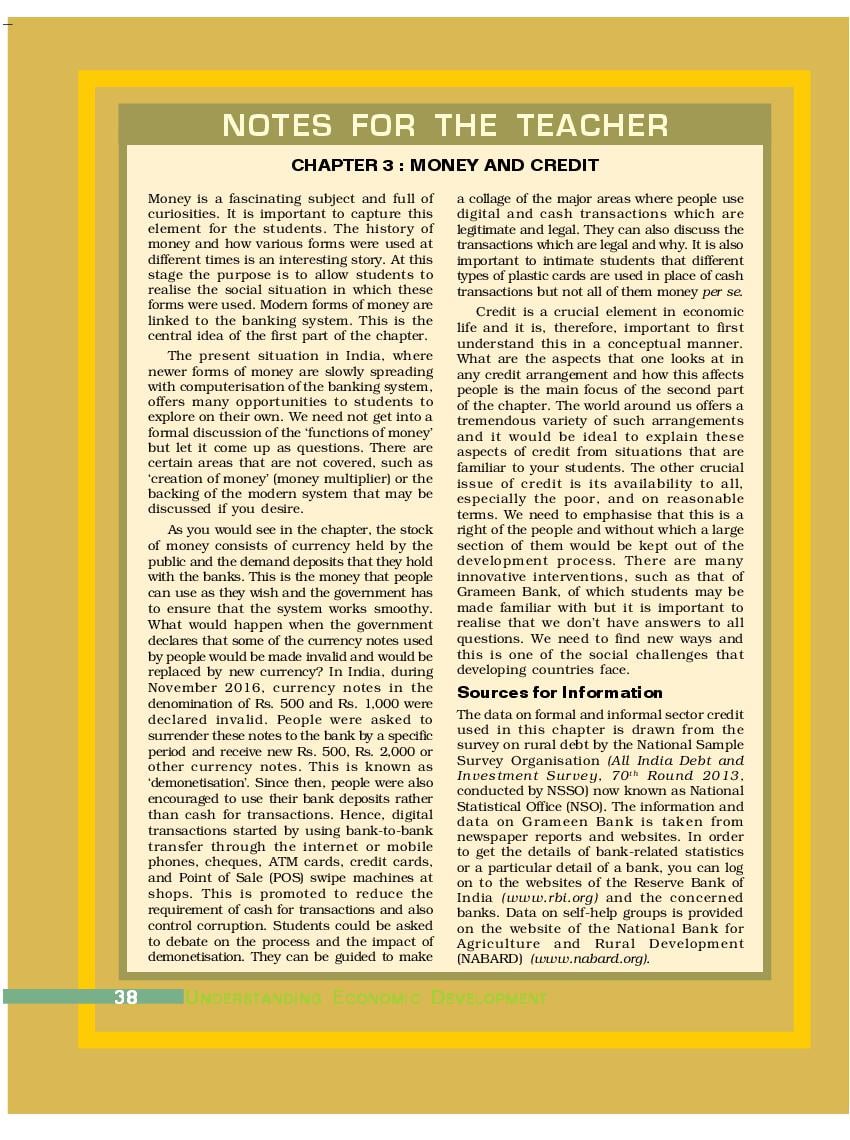
CHAPTER 3 : MONEY AND CREDIT
Money is a fascinating subject and full of legitimate and legal. They can also discuss the
curiosities. It is important to capture this transactions which are legal and why. It is also
element for the students. The history of important to intimate students that different
money and how various forms were used at types of plastic cards are used in place of cash
different times is an interesting story. At this transactions but not all of them money per se.
stage the purpose is to allow students to Credit is a crucial element in economic
realise the social situation in which these
life and it is, therefore, important to first
forms were used. Modern forms of money are
understand this in a conceptual manner.
linked to the banking system. This is the
What are the aspects that one looks at in
central idea of the first part of the chapter.
any credit arrangement and how this affects
The present situation in India, where people is the main focus of the second part
newer forms of money are slowly spreading of the chapter. The world around us offers a
with computerisation of the banking system, tremendous variety of such arrangements
offers many opportunities to students to and it would be ideal to explain these
explore on their own. We need not get into a aspects of credit from situations that are
formal discussion of the ‘functions of money’ familiar to your students. The other crucial
but let it come up as questions. issue of credit is its availability to all,
As you would see in the chapter, the stock especially the poor, and on reasonable
of money consists of currency held by the terms. We need to emphasise that this is a
public and the demand deposits that they hold right of the people and without which a large
with the banks. This is the money that people section of them would be kept out of the
can use as they wish and the government has development process. There are many
to ensure that the system works smoothy. innovative interventions, such as that of
What would happen when the government Grameen Bank, of which students may be
declares that some of the currency notes used made familiar with but it is important to
by people would be made invalid and would be realise that we don’t have answers to all
replaced by new currency? In India, during questions. We need to find new ways and
November 2016, currency notes in the this is one of the social challenges that
denomination of Rs. 500 and Rs. 1,000 were developing countries face.
declared invalid. People were asked to Sources for Information
surrender these notes to the bank by a specific
The data on formal and informal sector credit
period and receive new Rs. 500, Rs. 2,000 or
used in this chapter is drawn from the
other currency notes. This is known as
survey on rural debt by the National Sample
‘demonetisation’. Since then, people were also
Survey Organisation (All India Debt and
encouraged to use their bank deposits rather
Investment Survey, 77 th Round 2019,
than cash for transactions. Hence, digital conducted by NSSO) now known as National
transactions started by using bank-to-bank Statistical Office (NSO). The information and
transfer through the internet or mobile data on Grameen Bank is taken from
phones, cheques, ATM cards, credit cards, newspaper reports and websites. In order
Point of Sale (POS) swipe machines, and to get the details of bank-related statistics
QR codes through UPI system at shops. This or a particular detail of a bank, you can log
is promoted to reduce the requirement of cash on to the websites of the Reserve Bank of
for transactions and also control corruption. India (www.rbi.org) and the concerned
Students could be asked to debate on the banks. Data on self-help groups is provided
process and the impact of demonetisation and on the website of the National Bank for
digitalisation. They can be guided to make a Agriculture and Rural Development
collage of the major areas where people use (NABARD) (www.nabard.org).
digital and cash transactions which are
38 U NDERST ANDING E CONOMIC D EVEL
NDERSTANDING OPMENT
EVELOPMENT
Showing the first page only. Download the PDF above for the complete document.
Document Details
| Board / Org | NCERT |
| Exam | Class 10 |
| Type | Books |
| Pages | 16 |
| Language | english |
| Updated | 29 Aug 2026 |