Finished viewing? Save it for later —
Download NCERT Book Class 10 Social Science (Economics) Chapter 4 Globalisation and The Indian Economy (PDF · 20 pages)About NCERT Book Class 10 Social Science (Economics) Chapter 4 Globalisation and The Indian Economy
NCERT Book Class 10 Social Science (Economics) Chapter 4 Globalisation and The Indian Economy is available here for free download. Published by NCERT for Class 10, this books can be viewed online or downloaded as a PDF (20 pages). Candidates preparing for Class 10 can use NCERT Book Class 10 Social Science (Economics) Chapter 4 Globalisation and The Indian Economy to understand the exam pattern, the type of questions asked, and the overall difficulty level.
Frequently Asked Questions
How can I download NCERT Book Class 10 Social Science (Economics) Chapter 4 Globalisation and The Indian Economy?
Open this page and click the Download button to save NCERT Book Class 10 Social Science (Economics) Chapter 4 Globalisation and The Indian Economy as a PDF. It is completely free on AglaSem Docs.
Is NCERT Book Class 10 Social Science (Economics) Chapter 4 Globalisation and The Indian Economy free to download?
Yes. NCERT Book Class 10 Social Science (Economics) Chapter 4 Globalisation and The Indian Economy can be viewed online and downloaded as a PDF free of cost on AglaSem Docs.
How many pages does NCERT Book Class 10 Social Science (Economics) Chapter 4 Globalisation and The Indian Economy have?
NCERT Book Class 10 Social Science (Economics) Chapter 4 Globalisation and The Indian Economy contains 20 pages, which you can read online or download together as a single PDF.
Where can I find more Class 10 study material?
You can find more Class 10 question papers, sample papers, syllabus, and answer keys on AglaSem Docs.
NCERT Book Class 10 Social Science (Economics) Chapter 4 Globalisation and The Indian Economy – Text
Read the full text of this books below — useful to quickly search, copy and reference the content online without downloading the PDF.
📄 View text version (1 page)
Page 1
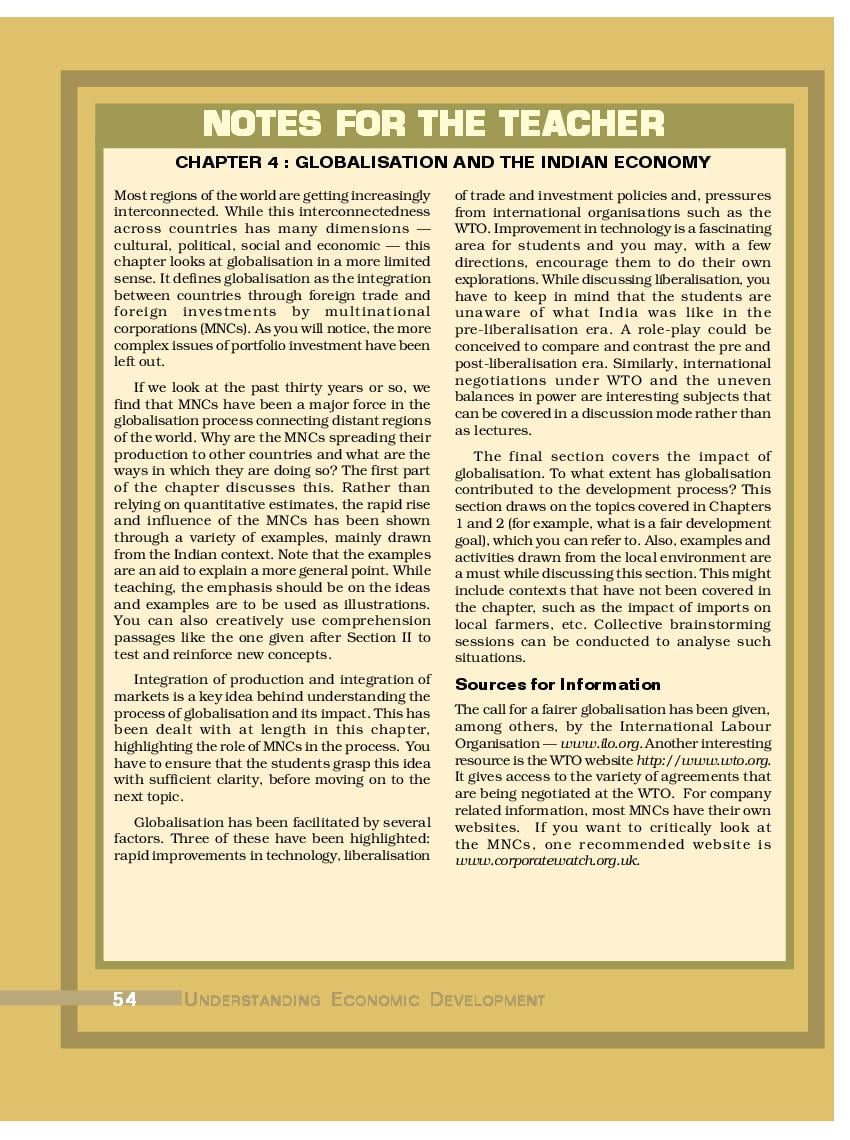
CHAPTER 4 : GLOBALISATION AND THE INDIAN ECONOMY
Most regions of the world are getting increasingly of trade and investment policies and, pressures
interconnected. While this interconnectedness from international organisations such as the
across countries has many dimensions — WTO. Improvement in technology is a fascinating
cultural, political, social and economic — this area for students and you may, with a few
chapter looks at globalisation in a more limited directions, encourage them to do their own
sense. It defines globalisation as the integration explorations. While discussing liberalisation, you
between countries through foreign trade and have to keep in mind that the students are
foreign investments by multinational unaware of what India was like in the
corporations (MNCs). As you will notice, the more pre-liberalisation era. A role-play could be
complex issues of portfolio investment have been conceived to compare and contrast the pre and
left out. post-liberalisation era. Similarly, international
negotiations under WTO and the uneven
If we look at the past thirty years or so, we
balances in power are interesting subjects that
find that MNCs have been a major force in the
can be covered in a discussion mode rather than
globalisation process connecting distant regions
as lectures.
of the world. Why are the MNCs spreading their
production to other countries and what are the The final section covers the impact of
ways in which they are doing so? The first part globalisation. To what extent has globalisation
of the chapter discusses this. Rather than contributed to the development process? This
relying on quantitative estimates, the rapid rise section draws on the topics covered in Chapters
and influence of the MNCs has been shown 1 and 2 (for example, what is a fair development
through a variety of examples, mainly drawn goal), which you can refer to. Also, examples and
from the Indian context. Note that the examples activities drawn from the local environment are
are an aid to explain a more general point. While a must while discussing this section. This might
teaching, the emphasis should be on the ideas include contexts that have not been covered in
and examples are to be used as illustrations. the chapter, such as the impact of imports on
You can also creatively use comprehension local farmers, etc. Collective brainstorming
passages like the one given after Section II to sessions can be conducted to analyse such
test and reinforce new concepts. situations.
Integration of production and integration of Sources for Information
markets is a key idea behind understanding the
process of globalisation and its impact. This has The call for a fairer globalisation has been given,
been dealt with at length in this chapter, among others, by the International Labour
highlighting the role of MNCs in the process. You Organisation — www.ilo.org. Another interesting
have to ensure that the students grasp this idea resource is the WTO website
with sufficient clarity, before moving on to the It gives access to the variety of agreements that
next topic. are being negotiated at the WTO. For company
related information, most MNCs have their own
Globalisation has been facilitated by several websites. If you want to critically look at
factors. Three of these have been highlighted: the MNCs, one recommended website is
rapid improvements in technology, liberalisation www.corporatewatch.org.uk.
54 U NDERST ANDING E CONOMIC D EVEL
NDERSTANDING OPMENT
EVELOPMENT
Showing the first page only. Download the PDF above for the complete document.
Document Details
| Board / Org | NCERT |
| Exam | Class 10 |
| Type | Books |
| Pages | 20 |
| Language | english |
| Updated | 29 Aug 2026 |