Finished viewing? Save it for later —
Download CBSE Class 11 Syllabus 2022-23 Spanish (PDF · 4 pages)About CBSE Class 11 Syllabus 2022-23 Spanish
CBSE Class 11 Syllabus 2022-23 Spanish is available here for free download. Published by CBSE for Class 11, this syllabus can be viewed online or downloaded as a PDF (4 pages). Candidates preparing for Class 11 can use CBSE Class 11 Syllabus 2022-23 Spanish to understand the exam pattern, the type of questions asked, and the overall difficulty level.
Frequently Asked Questions
How can I download CBSE Class 11 Syllabus 2022-23 Spanish?
Open this page and click the Download button to save CBSE Class 11 Syllabus 2022-23 Spanish as a PDF. It is completely free on AglaSem Docs.
Is CBSE Class 11 Syllabus 2022-23 Spanish free to download?
Yes. CBSE Class 11 Syllabus 2022-23 Spanish can be viewed online and downloaded as a PDF free of cost on AglaSem Docs.
How many pages does CBSE Class 11 Syllabus 2022-23 Spanish have?
CBSE Class 11 Syllabus 2022-23 Spanish contains 4 pages, which you can read online or download together as a single PDF.
Where can I find more Class 11 study material?
You can find more Class 11 question papers, sample papers, syllabus, and answer keys on AglaSem Docs.
CBSE Class 11 Syllabus 2022-23 Spanish – Text
Read the full text of this syllabus below — useful to quickly search, copy and reference the content online without downloading the PDF.
📄 View text version (4 pages)
Page 1
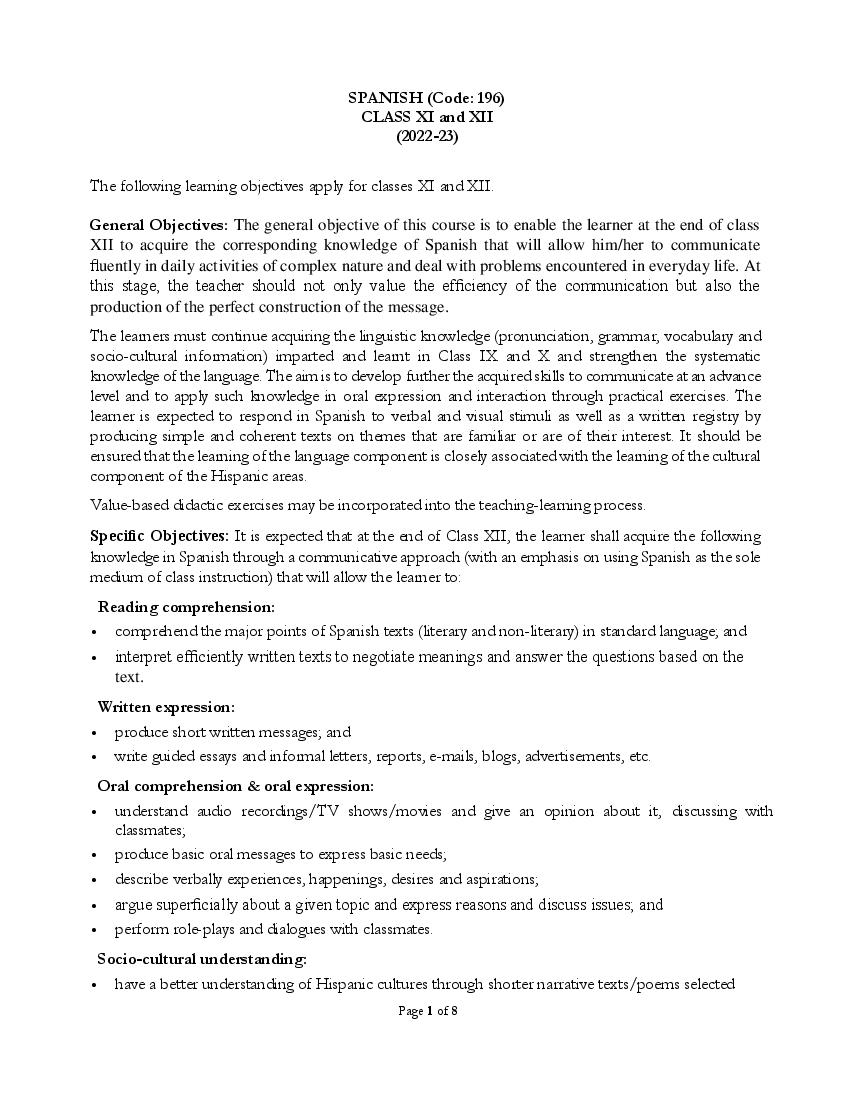
CLASS XI and XII
The following learning objectives apply for classes XI and XII.
General Objectives: The general objective of this course is to enable the learner at the end of class
XII to acquire the corresponding knowledge of Spanish that will allow him/her to communicate
fluently in daily activities of complex nature and deal with problems encountered in everyday life. At
this stage, the teacher should not only value the efficiency of the communication but also the
production of the perfect construction of the message.
The learners must continue acquiring the linguistic knowledge (pronunciation, grammar, vocabulary and
socio-cultural information) imparted and learnt in Class IX and X and strengthen the systematic
knowledge of the language. The aim is to develop further the acquired skills to communicate at an advance
level and to apply such knowledge in oral expression and interaction through practical exercises. The
learner is expected to respond in Spanish to verbal and visual stimuli as well as a written registry by
producing simple and coherent texts on themes that are familiar or are of their interest. It should be
ensured that the learning of the language component is closely associated with the learning of the cultural
component of the Hispanic areas.
Value-based didactic exercises may be incorporated into the teaching-learning process.
Specific Objectives: It is expected that at the end of Class XII, the learner shall acquire the following
knowledge in Spanish through a communicative approach (with an emphasis on using Spanish as the sole
medium of class instruction) that will allow the learner to:
Reading comprehension:
• comprehend the major points of Spanish texts (literary and non-literary) in standard language; and
• interpret efficiently written texts to negotiate meanings and answer the questions based on the
text.
Written expression:
• produce short written messages; and
• write guided essays and informal letters, reports, e-mails, blogs, advertisements, etc.
Oral comprehension & oral expression:
• understand audio recordings/TV shows/movies and give an opinion about it, discussing with
classmates;
• produce basic oral messages to express basic needs;
• describe verbally experiences, happenings, desires and aspirations;
• argue superficially about a given topic and express reasons and discuss issues; and
• perform role-plays and dialogues with classmates.
Socio-cultural understanding:
• have a better understanding of Hispanic cultures through shorter narrative texts/poems selected
Page 1 of 8
Page 2
• acquire basic knowledge about some specific issues of Hispanic geography, history and art.
Class XI
Time: 3 hours Marks: 80
Marks
Section - A: Applied Grammar
(Based on the prescribed textbooks) 35
(i) Revision of elementary grammatical categories like articles, nouns, pronouns (personal,
demonstrative and interrogative), gender, number, adjectives, adverbs, conjunctions of verbs,
auxiliary verbs, possessive, prepositions etc.
(ii) Revision of uses of present tense: “Ser + adjetivo”, “Estar + adjetivo”, “Gustar, molestar +
infinitivo”, Preferir.
ª
(iii) Revision of uses of Se: Se + 3 persona singular.
(iv) Verbs with prepositions: acostumbrarse a, interesarse por, pensar en, ir a, acordarse de, etc.
(v) Verbal parafrases: “Empezar a + infinitivo”, “Seguir + gerundio”, “Me parece/resulta +
adjetivo + infinitivo”, “Creo que /pienso que + presente de indicativo”, “Me hace falta/lo que
necesito es /me gustaría + infinitivo”, “Hace falta /Es necesario /Es importante /Se necesita
/hay que /lo que hay que hacer + infinitivo”, “a lo mejor/quizá (s) + infinitivo”, “Se puede +
infinitivo”, “Es posible + infinitivo”.
(vi) Different forms of past tense (pretérito indefinido/imperfecto), including the perfect tense with
the auxiliary verb 'haber' (pretérito perfecto /pluscuamperfecto).
(vii) Imperative verbal mood -command and entreaties: revision of affirmative and negative
commands.
(viii) Direct and Indirect speech
(ix) Use of very common idiomatic expressions (as contained in the prescribed book)
(x) Future (“Supongo que/ creo que + futuro”, “seguro que + futuro”) and Conditional tenses (“yo en tu lugar
+ conditional”)
(xi) Present Subjunctive mood and the difference between the indicative mood and the subjunctive mood.
Section - B: Reading Comprehension
15
Learners will be expected to read and answer short questions from an unseen passage of about 200 words.
Section - C: Composition and Writing 15
A short composition of about 150-200 words in Spanish based on a topic related to life and its surroundings.
Page 2 of 8
Page 3
• Besides the cultural and civilizational information relating to Spanish-speaking countries acquired
in Class IX and X, learners are expected to have basic information on some aspects of Spanish
history like the Roman Empire, the Moorish domination, the consolidation of the Spanish kingdom
after the reconquest (la reconquista), the Civil War, transition to democracy. Learners are expected
to know simple facts about dates, reason and consequences.
• Learners will also explore different aspects of Spanish customs and traditions.
• The teacher is expected to make choices of texts as per the general competence of the class.
• Learners will learn about some important literary figures from Spain. The following additional
choice of authors is added in addition to the ones prescribed in Classes IX and X:
a) Pedro Calderón de la Barca, works such as El príncipe constante and La vida es sueño
b) Antonio Buero Vallejo, works such as Historia de una escalera and Hoy es fiesta.
Note for the teacher:
1. The above content should be presented and integrated into didactic materials and communicative
activities (related to school environment) inside the classroom in such a way that the learner
develops the following competencies:
Functional competencies:
• describir algo o alguien • narrar en pasado
• hablar de acciones habituales en el • hablar del futuro
presente y el pasado
• hablar de hábitos y costumbres • hacer hipótesis sobre el presente
• comparar situaciones entre el pasado y el • expresar grados de certeza respecto al futuro
presente
• expresar acuerdo y desacuerdo • dar consejos y recomendaciones de forma personal e
impersonal
• expresar necesidad, deseo y • expresar buenos deseos a otras personas
finalidad
• contar experiencias • conceder permiso y denegarlo
2. The following suggested lexicon to be integrated into materials and communicative activities in
such a way that the learner practices the target language in real context with special emphasis on the
aural comprehension and oral expression: saludos y presentaciones, adjetivos de descripción física y de carácter,
profesiones, actividades de ocio, costumbres, informática, medios de prensa (la radio, la prensa y la tele), el deporte,
las dietas y la salud, restaurante, la medicina, enfermedades y remedios, expresiones de deseo, recetas de cocina,
alimentos, etc.
3. Efforts should be made to provide socio-cultural information of Spanish-speaking countries:
costumbres de los países hispánicos, el español en Internet, noticias de periódico, revistas, radio, lugares públicos e
Page 3 of 8
Page 4
importantes de los países hispánicos, etc.
4. The above-mentioned examples are suggestive and the teacher depending on the needs of the
learners may improvise the same within the framework of the prescribed syllabus to facilitate the
teaching and learning process.
Prescribed textbook: Relevant chapters may be referred to for use as per the prescribed syllabus.
• Aula international 3 (CD+ workbook), by Jaime Corpas et.al, Difusión.
Reference textbook:
• Collins Gem Spanish School Dictionary, Collins.
• en acción Curso de español 2, (CD +workbook) by Elena Verdia, Marisa González, et. al., enclave ELE
• Compañeros 3 (CD+workbook) by Francísca Castro, et. al., SGEL.
• En directo, nivel elemental & nivel medio (CD + Workbook) by Aquilino Sánchez Pérez
e-Resources:
• “Mi mundo en palabras”: https://cvc.cervantes.es/ensenanza/mimundo/default.htm
• “Lecturas paso a paso” (lecturas adaptadas con actividades interactivas):
https://cvc.cervantes.es/aula/lecturas/
• “Pasatiempos de Rayuela” (actividades interactivas):
https://cvc.cervantes.es/ensenanza/pasatiempos/default.php
• “En sintonía con el español” (podcast en español):
https://cvc.cervantes.es/ensenanza/ese/default.htm
Page 4 of 8
Document Details
| Board / Org | CBSE |
| Exam | Class 11 |
| Type | Syllabus |
| Pages | 4 |
| Updated | 15 Jul 2026 |