CUSAT CAT 2023 Question Paper Biology UG
Finished viewing? Save it for later —
Download CUSAT CAT 2023 Question Paper Biology UG (PDF · 21 pages)About CUSAT CAT 2023 Question Paper Biology UG
CUSAT CAT 2023 Question Paper Biology UG is available here for free download. Published by Cochin University for CUSAT Common Admission Test, this question paper can be viewed online or downloaded as a PDF (21 pages). Candidates preparing for CUSAT Common Admission Test can use CUSAT CAT 2023 Question Paper Biology UG to understand the exam pattern, the type of questions asked, and the overall difficulty level.
Frequently Asked Questions
How can I download CUSAT CAT 2023 Question Paper Biology UG?
Open this page and click the Download button to save CUSAT CAT 2023 Question Paper Biology UG as a PDF. It is completely free on AglaSem Docs.
Is CUSAT CAT 2023 Question Paper Biology UG free to download?
Yes. CUSAT CAT 2023 Question Paper Biology UG can be viewed online and downloaded as a PDF free of cost on AglaSem Docs.
How many pages does CUSAT CAT 2023 Question Paper Biology UG have?
CUSAT CAT 2023 Question Paper Biology UG contains 21 pages, which you can read online or download together as a single PDF.
Where can I find more CUSAT Common Admission Test study material?
You can find more CUSAT Common Admission Test question papers, sample papers, syllabus, and answer keys on AglaSem Docs.
CUSAT CAT 2023 Question Paper Biology UG – Text
Read the full text of this question paper below — useful to quickly search, copy and reference the content online without downloading the PDF.
📄 View text version (21 pages)
Page 1
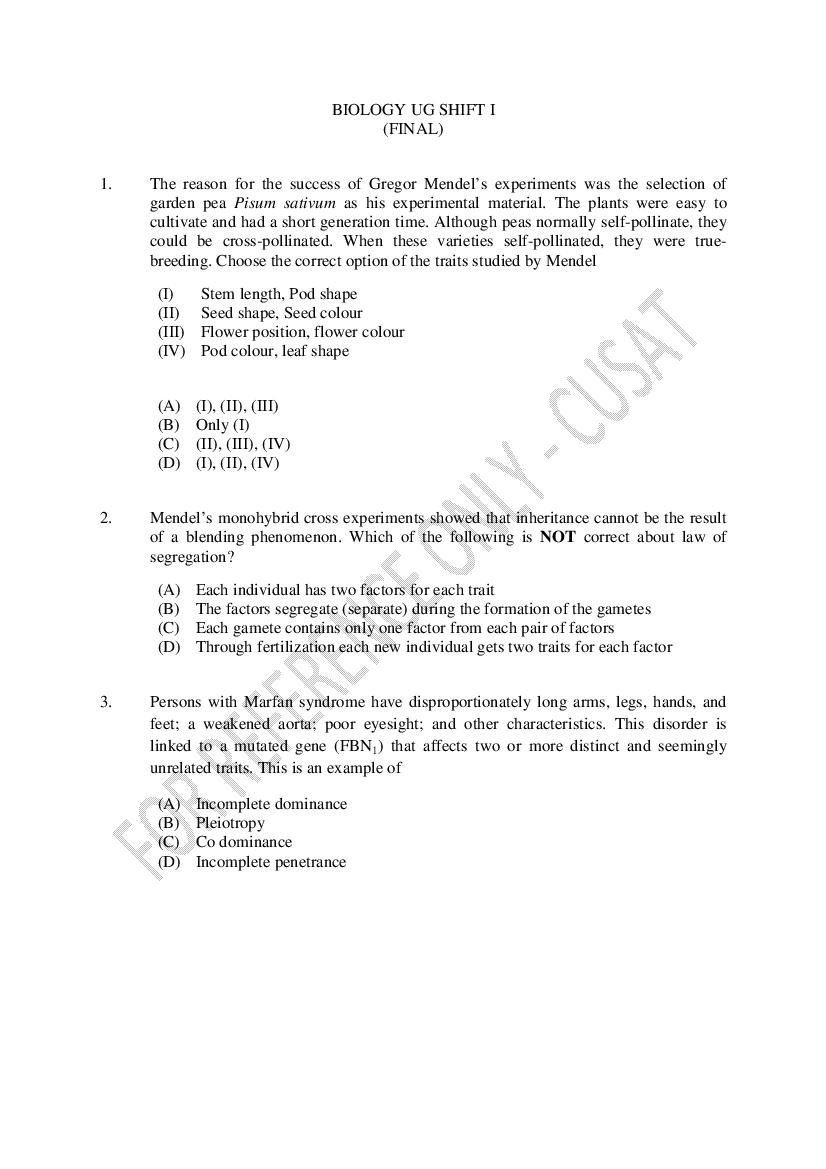
(FINAL)
1. The reason for the success of Gregor Mendel’s experiments was the selection of
garden pea Pisum sativum as his experimental material. The plants were easy to
cultivate and had a short generation time. Although peas normally self-pollinate, they
could be cross-pollinated. When these varieties self-pollinated, they were true-
breeding. Choose the correct option of the traits studied by Mendel
(I) Stem length, Pod shape
(II) Seed shape, Seed colour
(III) Flower position, flower colour
(IV) Pod colour, leaf shape
(A) (I), (II), (III)
(B) Only (I)
(C) (II), (III), (IV)
(D) (I), (II), (IV)
2. Mendel’s monohybrid cross experiments showed that inheritance cannot be the result
of a blending phenomenon. Which of the following is NOT correct about law of
segregation?
(A) Each individual has two factors for each trait
(B) The factors segregate (separate) during the formation of the gametes
(C) Each gamete contains only one factor from each pair of factors
(D) Through fertilization each new individual gets two traits for each factor
3. Persons with Marfan syndrome have disproportionately long arms, legs, hands, and
feet; a weakened aorta; poor eyesight; and other characteristics. This disorder is
linked to a mutated gene (FBN1) that affects two or more distinct and seemingly
unrelated traits. This is an example of
(A) Incomplete dominance
(B) Pleiotropy
(C) Co dominance
(D) Incomplete penetrance
Page 2
semiconservative nature. For that they first grew some bacteria in 15N heavy medium
and then transferred them to 14N light medium. A centrifuge was used to separate
DNA molecules labelled with isotopes of different densities. After two generations on
centrifugation, they found
(A) a single band corresponding with dense DNA
(B) a single band of intermediate density
(C) two equally large DNA bands: one of low density and one of intermediate
density
(D) two equally large DNA bands: one of low density and one of heavy density
5. If the sequence of DNA on the template strand of a gene is TAC, the mRNA codon
produced by transcription will be ………… and will specify the amino acid …………
(A) AUG, tryptophan
(B) AUG, methionine
(C) AUG, lysine
(D) AUG, threonine
6. Under a microscope, one often observes dark-stained fibers within the nucleus of the
cell. These areas within the nucleus represent a more highly compacted form of the
chromosome called heterochromatin. They represent
(A) Active chromatin containing genes that are being transcribed
(B) Inactive chromatin containing genes infrequently transcribed
(C) Highly transcribed nucleolar rRNA gene
(D) Chromatin in which the histone tails tend to be acetylated and have attached
acetyl groups
7. Which of the following is considered as the era of Angiosperms?
(A) Mid cretaceous
(B) Late cretaceous
(C) Late Jurassic
(D) Early Jurassic
Page 3
biology?
(A) The DNA macromolecule stores information that can either be copied
(replicated) or transcribed into RNA.RNA can then be translated into protein
(B) The RNA macromolecule stores information that can either be copied
(replicated) or transcribed into DNA.DNA can then be translated into protein
(C) The DNA macromolecule stores information that can transcribe into mRNA.
DNA can then be translated into protein
(D) The RNA molecule is transcribed into DNA and translated into polypeptide
9. Nondisjunction in meiosis results in aneuploid gametes. When this aneuploid gamete
fuses with normal haploid gamete, aneuploid zygote is formed. The aneuploidy of X
chromosome- monosomy X is called
(A) Down syndrome
(B) Turner syndrome
(C) Klinefelter’s syndrome
(D) Thalassemia
10. A cluster of genes with a single promoter is called an operon. The operon that encodes
the three lactose-metabolizing enzymes in E. coli is called the lac operon. Which of
the following is correct, when lactose is present in a cell?
(A) The repressor protein encoded by gene i prevents transcription by binding to
the operator
(B) Lactose induces transcription by binding to the repressor, which then can bind
to the operator RNA polymerase binds to the promoter
(C) Lactose induces transcription by binding to the repressor, which then cannot
bind to the operator RNA polymerase binds to the promoter
(D) The repressor protein encoded by gene i helps transcription by binding to the
operator
11. Engler and Prantl published the phylogenetic system of classification in the
monograph
(A) Historia plantarum
(B) Species plantarum
(C) Die Naturlichen Pflanzenfamilien
(D) Genera plantarum
Page 4
Column I Column II
A Basidium 1 Diatom
B Ascus 2 Scytonema
C Chrysophytes 3 Aspergillus
D Cyanobacteria 4 Agaricus
(A) A-3, B-4, C-1, D-2
(B) A-2, B-4, C-3, D-1
(C) A-4, B-3, C-1, D-2
(D) A-4, B-3, C-2, D-1
13. Match the items in Column 1 with those in Column II and choose the correct
combination
Column I Column II
A Walking fern 1 Anthoceros
B Hornwort 2 Spirogyra
C Royal fern 3 Adiantum
D Pond silk 4 Osmunda
(A) A-3, B-4, C-1, D-2
(B) A-3, B-1, C-4, D-2
(C) A-4, B-1, C-3, D-2
(D) A-4, B-3, C-2, D-1
14. Name the group of animals having unsegmented, coelomic body and radial symmetry
with distinct oral and aboral surfaces
(A) Echinodermata
(B) Mollusca
(C) Arthropoda
(D) Porifera
15. Choose the correct sequence in the descending order of hierarchical system of
taxonomic classification
(A) Class - division - order - family - genus - species
(B) Species - genus - family - order - class - division
(C) Species - genus - family - order - division - class
(D) Division - class - order - family - genus - species
Page 5
(A) Viroids
(B) Virus
(C) Prions
(D) Virions
17. Type of nucleic acid in COVID 19 virus is
(A) Single stranded RNA
(B) Single stranded DNA
(C) Double stranded DNA
(D) Double stranded RNA
18. The leaves are modified into tendrils, spines, pitcher and bladder respectively in the
following plants. Choose the CORRECT sequence.
(A) Gloriosa, Opuntia, Nepenthes, Utricularia
(B) Pea, Rose, Nepenthes, Utricularia
(C) Gloriosa, Rose, Nepenthes, Utricularia
(D) Pea, Bogainvillae, Nepenthes, Utricularia
19. Which of the following is NOT a characteristic feature of Solanaceae?
A epipetalous and syngenesious anthers
B bicarpellary and sycarpous, superior ovary
C obliue ovary with axile placentation
D bicarpellary syncarpous, inferior ovary
(A) A and B
(B) B and C
(C) A and D
(D) D only
Page 6
combination
Column I Column II
A Monocyte 1 Bilobed nucleus
B Lymphocyte 2 2-7 lobed nucleus
C Neutrophil 3 Single large nucleus
D Eosinophil 4 Kidney shaped nucleus
(A) A-3, B-4, C-2, D-1
(B) A-3, B-4, C-1, D-2
(C) A-4, B-3, C-1, D-2
(D) A-4, B-3, C-2, D-1
21. In a myelinated neuron, two adjacent myelin sheaths are separated by gaps called
(A) Nodes of ranvier
(B) Synaptic knob
(C) Synaptic cleft
(D) Schwann cells
22. Match the items in Column 1 with those in Column II and choose the correct
combination
Column I Column II
A Stellate chloroplast 1 Girdle shaped chloroplast
B Reticulate chloroplast 2 Oedogonium
C Cup shaped chloroplast 3 Ulothrix
D Girdle shaped chloroplast 4 Spirogyra
5 Zygnema
(A) A-2, B-3, C-5, D-4
(B) A-2, B-1, C-5, D-3
(C) A-4, B-1, C-5, D-2
(D) A-4, B-2, C-5, D-1
23. Portuguese man of war is the common name of
(A) Physalia
(B) Aurelia
(C) Nautilus
(D) Cypraea
Page 7
(A) Cockroach-Nephridia
(B) Flatworm-Nephridia
(C) Earthworm-Flame cells
(D) Balanoglossus-Proboscis gland
25. Arrange the following stages of pollen formation and development in the correct order
(1) Pollen mother cell
(2) Pollen tetrad
(3) Pollen grain
(4) Vegetative cell
(5) Generative cell
(A) (1) - (2) - (3) - (4) - (5)
(B) (2) - (5) - (4) - (3) - (1)
(C) (1) - (2) - (3) - (5) - (4)
(D) (1) - (2) - (4) - (3) - (5)
26. Sperms are produced in testis by equational division and reductional division. These
sperms are embedded in the sertoli cells and released. These events take place in the
order of
(1) Spermatozoa
(2) Spermatid
(3) Spermatogonium
(4) Spermiogenesis
(5) Spermiation
(A) (3) - (4) - (2) - (1) - (5)
(B) (3) - (1) - (4) - (2) - (5)
(C) (1) - (5) - (3) - (2) - (4)
(D) (3) - (2) - (4) - (1) - (5)
Page 8
productivity?
(A) Tropical rain forest < Temperate rain forest < Grass land < Tundra < Open
ocean
(B) Grass land < Temperate rain forest < Tropical rain forest < Open ocean <
Tundra
(C) Tropical rain forest > Temperate rain forest > Grass land > Tundra > Open
ocean
(D) Temperate rain forest > Tundra > Grass land > Temperate rain forest > Open
ocean
28. If a double stranded DNA is composed of 15% Thymine (T), find out the
concentrations of the remaining bases
(A) Adenine (A) = 35%, Guanine (G) = 15% and Cytosine (C) = 35%
(B) Adenine (A) = 35%, Guanine (G) = 35% and Cytosine (C) = 15%
(C) Adenine (A) = 15%, Guanine (G) = 15% and Cytosine (C) = 35%
(D) Adenine (A) = 15%, Guanine (G) = 35% and Cytosine (C) = 35%
29. In humans both male and female have different reproductive system. But they are
homologues in nature. Clitoris is homologues to
(A) Scrotum
(B) Glans penis
(C) Cowper's gland
(D) Seminal vesicles
30. Pollinia are the feature of two plant families. Name them
(A) Orchidaceae and Apocyanaceae
(B) Orchidaceae and Poaceae
(C) Amarylidaceae and Asteraceae
(D) Apocyanaceae and Poaceae
31. Sugarcane shows high efficiency of CO2 fixation because it performs
(A) Calvin cycle
(B) EMP Pathway
(C) Hatch and Slack pathway
(D) TCA cycle
Page 9
(A) Walking genes
(B) Elimination genes
(C) Jumping genes
(D) Initiation genes
33. Fertilization of haploid gametes retains diploid character in humans. Correct order of
fertilization in humans is
(1) Release of secondary polar body
(2) Capacitation of sperm
(3) Fimbriae collect secondary oocyte
(4) Change in the membrane that block the entry of other sperms
(5) At ampulla - isthmic junction spermatozoa contact with zona pellucida layer
(A) (1) - (3) - (2) - (5) - (4)
(B) (1) - (3) - (5) - (2) - (4)
(C) (2) - (3) - (5) - (4) - (1)
(D) (2) - (3) - (1) - (5) - (4)
34. To help infertile couples, assisted reproductive technologies are developed under the
control of experts. In which among the following techniques, natural fertilization
takes place?
(A) IVF
(B) ICSI
(C) GIFT
(D) None of the above
35. Sexual diseases like Gonorrhoea, Syphilis, Hepatitis B are commonly known as
(A) STDs (Sexually Transmitted Diseases)
(B) VD (Vinereal Diseases)
(C) RTI (Reproductive Tract Infections)
(D) All of the above
36. What is the ploidy of normal endosperm?
(A) n
(B) 2n
(C) 3n
(D) 4n
37. Glycolate accumulation occurs in chloroplast, when there is
Page 10
(B) Bright light
(C) Low temperature
(D) Low CO2
38. What is the transfer method of the fatty acids into and out of mitochondria?
(A) Active transport
(B) Facilitated transfer
(C) Non-facilitated transfer
(D) None of the above
39. Which among the following statements about glycoproteins are correct?
(I) In glycoproteins, presence of carbohydrates on protein molecule protects them
from denaturation
(II) Gangliosides are glycoproteins
(III) Blood clotting factors, hormones such as FSH, Na+-K+ ATPase and MHC are
glycoproteins
(IV) Components of the glycocalyx are responsible for cell adhesion
(V) Blood group antigens A and B are glycoproteins
(A) (I), (II), (III) and (IV) only
(B) (I), (III) and (IV) only
(C) (I), (III), (IV) and (V) only
(D) (III), (IV) and (V) only
40. Which of the following statements is correct about membrane cholesterol?
(A) The hydrocarbon chain of cholesterol projects into the extracellular fluid
(B) Most of the cholesterol is in the form of cholesterol ester
(C) The hydroxyl group is located near the centre of the lipid layer
(D) The steroid nucleus forms a rigid, planar structure
41. The enzyme lysozyme kills bacteria by hydrolyzing the β (1→4) glycosidic bond
between
(A) N-acetyl glucosamine and N-acetyl neuraminic acid
(B) N-acetyl neuraminic acid and N-acetyl muramic acid
(C) N-acetyl glucosamine and N-acetyl muramic acid
(D) N-acetyl galactosamine and N-acetyl neuraminic acid
Page 11
(I) The net charge on an amino acid is a function of the pH of the solution
(II) R- group of the amino acids play important role in solubility
(III) Peptide bonds are planar and partially ionic
(IV) Amino acids are soluble in water at their isoelectric point
Which of the following combinations is CORRECT?
(A) (I) and (II) only
(B) (I), (II) and (III) only
(C) (II), (III) and (IV) only
(D) (I), (II), (III) and (IV)
43. Release of free fatty acids from adipose tissue is increased by all of the following
except,
(A) Glucagon
(B) Insulin
(C) Epinephrine
(D) Growth hormone
44. Isomeric forms of monosaccharides that differ only in their configuration about the
hemiacetal or hemiketal carbon atoms are called
(A) Enantiomers
(B) Anomers
(C) Epimers
(D) Diastereo isomers
45. Coconut oil contains only a very small amount of unsaturated fatty acids. How can it
still have a low melting point?
(A) It has only a few hydrogen bonds per fatty acid chain
(B) It has numerous hydrogen bonds per fatty acid chain
(C) It contains mostly short chain fatty acids
(D) It contains a lot of long chain fatty acids
46. Pick the INCORRECT one
(A) A+T = G+C
Page 12
(C) A/G = T/C
(D) A+G/C+T = 1
47. All the following have 18 carbon atoms except,
(A) Linoleic acid
(B) Linolenic acid
(C) Arachidonic acid
(D) Stearic acid
48. How do double bonds and chain length influence the melting temperature of a fatty
acid?
(A) Increases with double bonds and increasing chain length
(B) Decreases with double bonds and increasing chain length
(C) Increases with double bonds and decreases with increasing chain length
(D) Decreases with double bonds and increases with increasing chain length
49. Which of the following is NOT a digestive enzyme?
(A) Trypsin
(B) Chymotrypsin
(C) Carboxy peptidase
(D) Carbonyl anhydrase
50. The cell cycle is an ordered series of events by which cell duplicates and it is
controlled by which all of the following?
(I) Cyclin synthesis and degradation
(II) Phosphorylation of CDKs
(III) Binding of CDK inhibitor proteins
(IV) Dephosphorylation of CDKs
(A) (I), (II) and (III)
(B) (I), (III) and (IV)
(C) (I) and (III)
(D) (I), (II), (III) and (IV)
Page 13
(I) Catalase activity
(II) Lipid biosynthesis
(III) Degradation of very long-chain fatty acids
(IV) Produce dihydrogen
(A) (I) and (III)
(B) (I) and (II)
(C) (III) and (II)
(D) (II) and (IV)
52. Never dividing cells such as neurons can be explained as being in the …………….
stage of cell cycle
(A) G0
(B) G1
(C) G2
(D) M
53. Name the Cyclin which plays a role in M phase of cell cycle
(A) Cyclin E
(B) Cyclin M
(C) Cyclin A
(D) Cyclin B
54. Which of the following family of kinesins is incapable of movement along the
microtubules?
(A) kinesin-1
(B) kinesin-3
(C) kinesin-13
(D) kinesin-14
55. The drug colchicine promotes the ………….. of microtubules
(A) disassembly
(B) assembly
Page 14
(D) condensation
56. What is the name of the drug which inhibits Na+/K+ pump across the cell membrane?
(A) Taxol
(B) Vinblastine
(C) Quinone
(D) Ouabain
57. Which of the following amino sugar is present in the bacterial cell wall?
(A) N-acetylmuramic acid
(B) Sialic acid
(C) Aminoglycoside
(D) Azide
58. Which of the following is the CORRECT statement regarding Histidine?
(A) Histidine is a polar essential amino acid having imidazole ring
(B) Histidine is a polar non-essential amino acid having imidazole ring
(C) Histidine is a non-polar essential amino acid having guanidium ring
(D) Histidine is a polar essential amino acid having guanidium ring
59. Which of the following glycosidic linkages is found in maltose?
(A) Glucose (α-1 – 2β) Fructose
(B) Glucose (α1 – 4) Glucose
(C) Galactose (β1 – 4) Glucose
(D) Glucose (β1 – 4) Glucose
60. Beta-oxidation of fatty acids occurs in which organelle/organelles?
(A) Peroxisome
(B) Peroxisome and Mitochondria
(C) Mitochondria
(D) Peroxisome, Mitochindria and ER
61. Which of the following reactions is an example of oxidative decarboxylation ?
(A) Conversion of succinate to fumarate
(B) Conversion of fumarate to malate
Page 15
(D) Conversion of citrate to isocitrate
62. Give the reason for the rancidity of lipids of lipid-rich foodstuffs
(A) Reduction of fatty acids
(B) Hydrogenation of unsaturated fatty acids
(C) Dehydrogenation of saturated fatty acids
(D) Oxidation of fatty acids
63. Which of the following portions of a longer duplex DNA segment are likely to be
recognition sequences of a restriction enzyme?
(A) 5’-AGTC-3’ and 3’-TCAG-5’
(B) 5’-ATCG-3’ and 3’-TAGC-5’
(C) 5’-ACCT-3’ and 3’-TGGA-5’
(D) 5’-ACGT-3’ and 3’-TGCA-5’
64. Name the technique which is used to enhance the shelf life of tomato?
(A) Antisense technology
(B) In vitro gene transfer
(C) Ex vivo gene transfer
(D) Molecular farming
65. The chromosomes which determine the gender of an organism are called sex
chromosomes. Which of the following is the CORRECT representation of
chromosomes for sex determination in birds?
(A) Female ZW, males ZZ
(B) Females XX, males X0
(C) Females XX, males XY
(D) Females ZZ, males ZW
66. The enzyme employed for amplification of DNA during PCR is commercially
obtained from
(A) Trichoderma reesei
(B) Bacillus licheniformis
(C) Streptococcus pyogenes
(D) Thermus aquaticus
Page 16
(A) ER
(B) Mitochondrial matrix
(C) Cytoplasm
(D) Inner membrane of mitochondria
68. Artificial seeds refer to
(A) Seeds of a plant with desired characteristics synthesized with recombinant
DNA technology
(B) Somatic embryos encapsulated in a gel
(C) Seeds of synthetic plants
(D) All of the above
69. Which of the following can be used for transferring DNA into the host cells?
A Transformation
B Sonification
C Transfection
D Electroporation
(A) Only A
(B) Both A and B
(C) Only B, C and D
(D) Only A, B and C
70. Name the strategy where ‘two-plasmid system’ is used for the introduction of the
gene
(A) Binary vector system
(B) Co-integration vector strategy
(C) Agrobacterium
(D) Selectable marker strategy
71. Choose the right combination of components required to set up a PCR, from the
following
(A) Template DNA, 2 primers, dNTPS and DNA polymerase
(B) Template DNA, 2 primers, dNTPS and DNA ligase
(C) Template DNA, 2 primers, NTPS and DNA ligase
(D) Template RNA, 2 primers, dNTPS and DNA polymerase
72. Name the first transgenic virus resistant plant
Page 17
(B) Cotton
(C) Tobacco
(D) Tomato
73. Name the enzyme which has been silenced in order to delay the fruit ripening process
(A) Polygalacturonase
(B) Glyphosate
(C) ADA
(D) P53
74. How human insulin is synthesized using recombinant DNA technology?
(A) By using chemically synthesized DNA sequences for the two chains separately
(B) By isolating DNA from the islets of Langerhans of pancreas
(C) By using cDNA for insulin
(D) By using chemically synthesized DNA sequences for the complete insulin
protein
75. Which of the following viruses is NOT used in gene therapy?
(A) Papillomavirus
(B) Retrovirus
(C) Adenovirus
(D) Herpes simplex virus
76. Which of the following reactions take(s) place at the pulmonary capillaries?
(A) Hb + O2 → HbO2
(B) CO2 + H2O → H+ + HCO3
−
(C) Hb + CO2 → HbCO2
(D) Hb + H1 → HbH
77. What happens during sympathetic stimulation of the heart?
(A) increases the heart rate
(B) increases the contractility of the heart muscle
(C) shifts the Frank–Starling curve to the left
(D) All of the above
78. Which of the following compounds is generally translocated through the phloem?
Page 18
(B) Mannose
(C) Glucose
(D) Fructose
79. Which of the following filtered substances is normally NOT present in the urine?
+
(A) Na
3
(B) PO4 −
(C) urea
(D) glucose
80. What happens during the corpus luteum degeneration?
(A) Circulating levels of estrogen and progesterone rapidly decline
(B) FSH and LH secretion start to rise as the inhibitory effects of the gonadal
steroids are withdrawn
(C) the endometrium sloughs off
(D) All of the above
81. Which of the following are mucus-producing glands located on each side of the
vaginal opening?
(A) Adrenal
(B) Bartholin's
(C) Bulbourethral
(D) Corpus luteum
82. Which of the following conditions is characterized by incompetence of the esophageal
sphincter?
(A) Crohn's disease
(B) Esophageal varices
(C) Gastroesophageal reflux disease
(D) Pyloric stenosis
83. Which of the following statements regarding membrane transport is FALSE?
(A) Polar and charge solutes will not cross cell membranes effectively without
specific protein carriers
(B) Each protein carrier will only bind and transport one (or a few very similar)
type of solute
(C) Sugars such as glucose are always transported by active transport than by
facilitated diffusion carriers
Page 19
84. Which one is the test for gibberellin?
(A) Bolting in cabbage
(B) Morphogenesis in tobacco callus
(C) Rapid division in carrot cells
(D) Elongation of oat coleoptile
85. What happens if a growing plant is decapitated?
(A) axillary buds are inactivated
(B) axillary buds are activated
(C) leaves become yellow and have tendency to fall down
(D) growth stops
86. Which of the following is NOT a characteristic property of carotenoid?
(A) They possess complex porphyrin ring
(B) They are integral constituent of thylakoid membrane
(C) They are also called accessory pigment
(D) They protect the plants from damages caused by light
87. Which of the following plants is NOT an example for roots with adventitious buds?
(A) Murraya
(B) Solanum
(C) Dalbergia
(D) Millingtonia
88. The innermost layer of the anther wall is called
(A) Endodermis
(B) Endothecium
(C) Tapetum
(D) Stomium
89. The upper portion of a plant that is grafted onto the base of another plant is known as
(A) Scion
(B) Stalk
(C) Stock
Page 20
90. Which of the following is NOT a part of the ovule?
(A) Nucellus
(B) Chalaza
(C) Pollinium
(D) Embryo sac
Page 21
Subject Name: MSc BIOLOGY
SI No. Key SI No. Key SI No. Key
1 A 31 C 61 A
2 D 32 C 62 D
3 B 33 C 63 D
4 C 34 C 64 A
5 B 35 D 65 A
6 B 36 C 66 D
7 B 37 D 67 C
8 A 38 B 68 B
9 B 39 B 69 C
10 C 40 D 70 A
11 C 41 C 71 A
12 C 42 B 72 C
13 B 43 B 73 A
14 A 44 B 74 A
15 D 45 A 75 A
16 C 46 A 76 A
17 A 47 C 77 D
18 A 48 D 78 A
19 C 49 D 79 D
20 D 50 D 80 D
21 A 51 B 81 B
22 C 52 A 82 C
23 A 53 D 83 C
24 D 54 C 84 A
25 A 55 A 85 B
26 D 56 D 86 A
27 C 57 A 87 B
28 D 58 A 88 C
29 B 59 B 89 A
30 A 60 C 90 C
Document Details
| Board / Org | Cochin University |
| Exam | CUSAT Common Admission Test |
| Type | Question Paper |
| Pages | 21 |
| Updated | 22 Jul 2026 |