CUSAT CAT 2023 Question Paper Bioethics
Finished viewing? Save it for later —
Download CUSAT CAT 2023 Question Paper Bioethics (PDF · 35 pages)About CUSAT CAT 2023 Question Paper Bioethics
CUSAT CAT 2023 Question Paper Bioethics is available here for free download. Published by Cochin University for CUSAT Common Admission Test, this question paper can be viewed online or downloaded as a PDF (35 pages). Candidates preparing for CUSAT Common Admission Test can use CUSAT CAT 2023 Question Paper Bioethics to understand the exam pattern, the type of questions asked, and the overall difficulty level.
Frequently Asked Questions
How can I download CUSAT CAT 2023 Question Paper Bioethics?
Open this page and click the Download button to save CUSAT CAT 2023 Question Paper Bioethics as a PDF. It is completely free on AglaSem Docs.
Is CUSAT CAT 2023 Question Paper Bioethics free to download?
Yes. CUSAT CAT 2023 Question Paper Bioethics can be viewed online and downloaded as a PDF free of cost on AglaSem Docs.
How many pages does CUSAT CAT 2023 Question Paper Bioethics have?
CUSAT CAT 2023 Question Paper Bioethics contains 35 pages, which you can read online or download together as a single PDF.
Where can I find more CUSAT Common Admission Test study material?
You can find more CUSAT Common Admission Test question papers, sample papers, syllabus, and answer keys on AglaSem Docs.
CUSAT CAT 2023 Question Paper Bioethics – Text
Read the full text of this question paper below — useful to quickly search, copy and reference the content online without downloading the PDF.
📄 View text version (35 pages)
Page 1
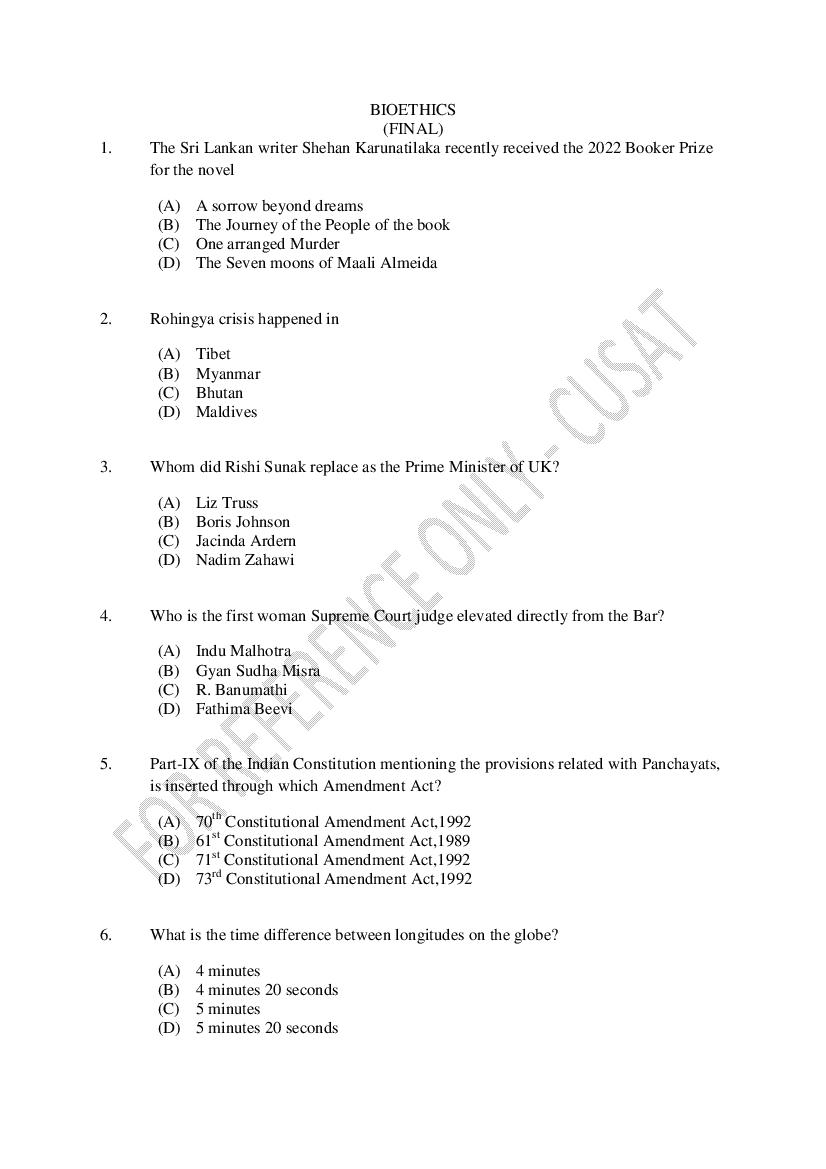
(FINAL)
1. The Sri Lankan writer Shehan Karunatilaka recently received the 2022 Booker Prize
for the novel
(A) A sorrow beyond dreams
(B) The Journey of the People of the book
(C) One arranged Murder
(D) The Seven moons of Maali Almeida
2. Rohingya crisis happened in
(A) Tibet
(B) Myanmar
(C) Bhutan
(D) Maldives
3. Whom did Rishi Sunak replace as the Prime Minister of UK?
(A) Liz Truss
(B) Boris Johnson
(C) Jacinda Ardern
(D) Nadim Zahawi
4. Who is the first woman Supreme Court judge elevated directly from the Bar?
(A) Indu Malhotra
(B) Gyan Sudha Misra
(C) R. Banumathi
(D) Fathima Beevi
5. Part-IX of the Indian Constitution mentioning the provisions related with Panchayats,
is inserted through which Amendment Act?
(A) 70th Constitutional Amendment Act,1992
(B) 61st Constitutional Amendment Act,1989
(C) 71st Constitutional Amendment Act,1992
(D) 73rd Constitutional Amendment Act,1992
6. What is the time difference between longitudes on the globe?
(A) 4 minutes
(B) 4 minutes 20 seconds
(C) 5 minutes
(D) 5 minutes 20 seconds
Page 2
(A) 15th August 1947
(B) 22nd July 1947
(C) 26th January 1950
(D) 26th January 1948
8. Which of the following Vitamin helps in blood clotting?
(A) Vitamin A
(B) Vitamin K
(C) Vitamin D
(D) Vitamin E
9. Keoladeo National Park is located in the state of
(A) Gujarat
(B) Madhya Pradesh
(C) Himachal Pradesh
(D) Rajasthan
10. Yakshagana is a …………… form of ……………
(A) folk theatre, Andhra Pradesh and Telangana
(B) classical music, Kerala
(C) classical theatre, Tamil Nadu
(D) traditional theatre, Karnataka
11. “Cultural hegemony” is a social theory formulated by the writings of
(A) Antonio Gramsci
(B) Bertrand Russell
(C) Bertolt Brecht
(D) Louis Althusser
12. "Historical Materialism" was expounded by …………… as theoretical approach to
study politics and societies
(A) Charles Darwin
(B) Adam Smith
(C) Karl Marx
(D) Francis Bacon
Page 3
(A) A.R. Rahman
(B) Anouska Shankar
(C) Ricky Kej
(D) Resul Pookutty
14. The President's Rule in a State can be continued for a maximum period of
(A) 2 years
(B) 1 year
(C) 6 months
(D) 10 months
15. The Venture Capital Assistance Scheme in India has been floated by
(A) Ministry of Agriculture and Farmers Welfare
(B) Ministry of Finance
(C) Ministry of Transport
(D) Ministry of Commerce
16. MGNREGA was launched in
(A) 2005
(B) 2006
(C) 2007
(D) 2008
17. According to IQAir pollution rankings, which city has the worst Air Quality Index?
(A) Bangalore
(B) Kolkatta
(C) Mumbai
(D) New Delhi
18. MS Office and Adobe Photoshop are
(A) Hardware
(B) Operating System
(C) External storage devices
(D) Application Software
Page 4
(A) Brazil, Russia, India, China and South Africa
(B) Brazil, Romania, India, China and South Africa
(C) Brazil, Russia, Indonesia, China and South Africa
(D) Brazil, Russia, India, China and Sudan
20. The International Court of Justice is located at
(A) Peace Palace in the Hague
(B) Peace Palace in Geneva
(C) New York City, USA
(D) Sydney, Australia
21. Laughing gas is
(A) Carbon Monoxide
(B) Carbon Dioxide
(C) Nitic Oxide
(D) Nitrous Oxide
22. Which of the following is used to filter water?
(A) Potassium Permanganate
(B) Potassium Sulphate
(C) Potassium Dioxide
(D) Potassium Nitrate
23. Sound is measured in
(A) Joules
(B) Decibels
(C) Waves
(D) Oscillations
24. The ratio of width to length of our National Flag is
(A) 1:2
(B) 2:3
(C) 3:4
(D) 4:5
Page 5
(A) Indian Hockey team
(B) Indian Football team
(C) Indian Cricket team
(D) Indian Bridge team
26. Direction: Fill in the blanks.
Would anybody……….. a mother have risked her life for the baby?
(A) rather
(B) but
(C) than
(D) however
27. Direction: Fill in the blanks.
We shall fail………………we are industrious
(A) until
(B) unless
(C) though
(D) whether
28. Direction: Fill in the blanks.
The doctor advised him to go………..several medical tests
(A) through
(B) into
(C) about
(D) under
29. Directions: Read the sentence to find out whether there is any error in it. If there is
no error; the answer is (D). (Ignore errors of Punctuation, if any)
My father is (A)/ in bad mood (B)/today. (C)/No error (D)
(A) My father is
(B) in bad mood
(C) today
(D) No error
Page 6
no error; the answer is (D). (Ignore errors of Punctuation, if any)
A person I met (A)/ in the theatre (B)/was the actor himself. (C)/No error (D)
(A) A person I met
(B) in the theatre
(C) was the actor himself
(D) No error
31. Direction: Fill in the blanks.
………….. at all is doubtful
(A) Whether he will come
(B) If he will come
(C) He will come
(D) His coming
32. Choose the correct word for forming a grammatically correct statement
The Navajo language is complex, with a structure and sounds that makes them
unintelligible to anyone without extensive exposure to it
(A) NO CHANGE
(B) makes it
(C) make it
(D) make them
33. Find the correctly spelt word
(A) Adulation
(B) Adlation
(C) Aduletion
(D) Addulation
34. Find the SYNONYM of the following word
FOSTERING
(A) Safeguarding
(B) Neglecting
(C) Ignoring
(D) Nurturing
Page 7
Listen an announcement …………… to cancel all the flights due to heavy snowfall
(A) making
(B) is making
(C) is being made
(D) is made
Direction: Read the following passage and answer the given questions
Philosophy of Education is a label applied to the study of the purpose, process, nature
and ideals of education. It can be considered a branch of both philosophy and
education. Education can be defined as the teaching and learning of specific skills,
and the imparting of knowledge, judgment and wisdom, and is something broader
than the societal institution of education we often speak of.
Many educationalists consider it a weak and woolly field, too far removed from the
practical applications of the real world to be useful. But philosophers dating back to
Plato and the Ancient Greeks have given the area much thought and emphasis, and
there is little doubt that their work has helped shape the practice of education over the
millennia.
Plato is the earliest important educational thinker, and education is an essential
element in “The Republic” (his most important work on philosophy and political
theory, written around 360 B.C.). In it, he advocates some rather extreme methods:
removing children from their mothers’ care and raising them as wards of the state, and
differentiating children suitable to the various castes, the highest receiving the most
education, so that they could act as guardians of the city and care for the less able. He
believed that education should be holistic, including facts, skills, physical discipline,
music and art. Plato’s beliefs regarding education was very democratic in that he
believed that talent and intelligence are not distributed genetically and thus is to be
found in children born to all classes; however, his proposed system of selective public
education for an educated minority of the population does not really follow a
democratic model.
Aristotle considered human nature, habit and reason to be equally important forces to
be cultivated in education, the ultimate aim of which should be to produce good and
virtuous citizens. He proposed that teachers lead their students systematically, and
that repetition be used as a key tool to develop good habits, unlike Socrates’ emphasis
on questioning his listeners to bring out their own ideas. He emphasized the balancing
of the theoretical and practical aspects of subjects taught, among which he explicitly
mentions reading, writing, mathematics, music, physical education, literature, history,
and a wide range of sciences, as well as play, which he also considered important.
Page 8
Thomas Aquinas in his work “De Magistro”. Perennialism holds that one should teach
those things deemed to be of everlasting importance to all people everywhere, namely
principles and reasoning, not just facts (which are apt to change over time), and that
one should teach first about people, not machines or techniques. It was originally
religious in nature, and it was only much later that a theory of secular perennialism
developed.
During the Renaissance, the French skeptic Michel de Montaigne (1533 - 1592) was
one of the first to critically look at education. Unusually for his time, Montaigne was
willing to question the conventional wisdom of the period, calling into question the
whole edifice of the educational system, and the implicit assumption that university-
educated philosophers were necessarily wiser than uneducated farm workers, for
example.
36. What is the difference between the approaches of Socrates and Aristotle?
(A) Aristotle felt the need for repetition to develop good habits in students;
Socrates felt that students need to be constantly questioned
(B) Aristotle felt the need for rote-learning; Socrates emphasized on dialogic
learning
(C) There was no difference
Aristotle emphasized on the importance of paying attention to human nature;
(D)
Socrates emphasized upon science
37. Why do educationists consider philosophy a ‘weak and woolly’ field?
(A) It is not practically applicable
(B) Its theoretical concepts are easily understood
(C) It is irrelevant for education
(D) None of the above
38. What do you understand by the term ‘Perennialism’, in the context of the given
comprehension passage?
(A) It refers to something which is of ceaseless importance
(B) It refers to something which is quite unnecessary
(C) It refers to something which is abstract and theoretical
(D) It refers to something which existed in the past and no longer exists now
39. Were Plato’s beliefs about education democratic?
(A) He believed that only the rich have the right to acquire education
(B) Plato’s beliefs were democratic but not his suggested practices
(C) He believed that only a select few are meant to attend schools
(D) He believed that all pupils are not talented
Page 9
facts?
(A) Facts are not important
(B) Facts do not lead to holistic education
(C) Facts change with the changing times
(D) Facts are frozen in time
41. Read the below dialogue and answer the question
Mani: Hassan has become calm since he started meditation.
Nyaya: Not possible. Keeping quite is the reason for his calmness.
Mani’s statement reflects her belief that
(A) Meditation tends to make a person calm
(B) Hassan would not have been meditating had he been calm
(C) Hassan was a talkative person who was also not calm
(D) All people who are not calm should meditate like Hassan
42. Direction: Fill in the blanks.
The patriotic General died fighting …………… behalf of the country ……………
individual difference …………… opinion with the Ruler.
(A) at, in spite of, of
(B) on, of, of
(C) on, in spite of , of
(D) on, in spite of , in
43. Choose the correct meaning of the idiom.
To walk on egg shell
(A) Boiling with emotions
(B) Feelings of happiness
(C) To be extremely cautious
(D) Flame with anger
44. Choose the ANTONYM for the word.
FLIGHTY
(A) Responsible
(B) Capricious
(C) Mercurial
(D) Weary
Page 10
column B.
Column A Column B
(a) pass out (1) affinity
(b) put off (2) achieve
(c) take to (3) postpone
(d) pull off (4) faint
(A) (a) - (1), (b) - (2), (c) - (3), (d) - (4)
(B) (a) - (3), (b) - (2), (c) - (1), (d) - (4)
(C) (a) - (4), (b) - (3), (c) - (1), (d) - (2)
(D) (a) - (4), (b) - (2), (c) - (3), (d) - (1)
46. Match words in column A with their antonyms under column B and select the correct
answer from the codes given below:
Column A Column B
(a) persevere (1) superficial
(b) hermetic (2) upset
(c) desolate (3) quit
(d) sangfroid (4) populous
(A) (a) - (2), (b) - (3), (c) - (4), (d) - (1)
(B) (a) - (3), (b) - (1), (c) - (4), (d) - (2)
(C) (a) - (1), (b) - (3), (c) - (2), (d) - (4)
(D) (a) - (2), (b) - (1), (c) - (4), (d) - (3)
47. Choose the correct verb
The United States …………… a big navy.
(A) have
(B) has
(C) are
(D) will be
Page 11
from the codes given below:
Homophones Meanings
(a) Piece (1) Calm, undisturbed
(b) Peace (2) Light in colour
(c) Pail (3) A portion of an object
(d) Pale (4) A bucket
(A) (a) - (3), (b) - (1), (c) - (4), (d) - (2)
(B) (a) - (1), (b) - (3), (c) - (4), (d) - (2)
(C) (a) - (4), (b) - (1), (c) - (3), (d) - (2)
(D) (a) - (2), (b) - (1), (c) - (4), (d) - (3)
49. Which of the following plural forms is NOT correct?
(A) Daughters-in-law
(B) Step-daughters
(C) Commanders-in-chiefs
(D) Strata
50. Match the words under Column A with the suffixes under Column B :
Column A Column B
(a) anchor (1) ling
(b) murder (2) lette
(c) hire (3) age
(d) novel (4) ous
(A) (a) - (3), (b) - (4), (c) - (1), (d) - (2)
(B) (a) - (4), (b) - (3), (c) - (2), (d) - (1)
(C) (a) - (1), (b) - (2), (c) - (4), (d) - (3)
(D) (a) - (2), (b) - (1), (c) - (3), (d) - (4)
51. There are seven persons up on a ladder. “A’ is further up than ‘E’ but is lower than
‘C’. ‘B’ is in the middle. ‘G’ is between ‘A’ and ‘B’ while ‘E’ is between ‘B’ and ‘F’.
If ‘F’ is between ‘B’ and ‘D’, the person on the top of the ladder is
(A) E
(B) C
(C) D
(D) A
Page 12
How is RAIL written in that code?
(A) 8429
(B) 8124
(C) 8247
(D) 8412
53. Six friends are sitting on a round table facing towards the centre of the table. Sameer
is left to Atul. Rakesh is between Sameer and Ashish. Ankush is between Atul and
Rishi. Who is sitting between Ankush and Sameer?
(A) Atul
(B) Rakesh
(C) Ashish
(D) Rishi
54. A man from point X walks 100 m to the north direction. Then he walks 60 m to the
South and then walks 30 m to the East and reaches point Y. Find the distance point X
to point Y.
(A) 50 m
(B) 70 m
(C) 60 m
(D) 90 m
55. If the difference between the four times and nine times of a number is 45, then the
number is
(A) 4
(B) 6
(C) 8
(D) 9
Page 13
numbered I and II. You have to assume everything in the statement to be true, then
consider the two conclusions together and decide which of them logically follows
beyond a reasonable doubt from the information given in the statement.
Statements: In India, more emphasis should be placed on agricultural engineering
and technological fields rather than pure and basic science.
Conclusions: I In the field of basic and pure science, India has made sufficient
progress
II In the past, India's agricultural engineering and technological
fields was overlooked.
(A) Only conclusion I follows
(B) Only conclusion II follows
(C) Both conclusions I and II follow
(D) Neither conclusion I nor II follows
57. Frank is two years older than Amarinder who is twice as old as Nirmal. If the total of
the ages of Frank, Amarinder and Nirmal is 27, then how old is Amarinder?
(A) 11
(B) 9
(C) 12
(D) 10
58. Yard is to Inch as Quart is to
(A) Gallon
(B) Ounce
(C) Cubic litre
(D) Liquid
59. Window is to Pane as Book is to
(A) Novel
(B) Cover
(C) Page
(D) Glass
60. Elated is to Despondent as Enlightened is to
(A) Aware
(B) Ignorant
(C) Miserable
(D) Tolerable
Page 14
will represent which word out of given alternatives?
(A) MEAN
(B) BOOK
(C) BOX
(D) BELL
62. Five years ago the average age of A, B, C, D, was 45 years. By including M the
present average of all the five is 49 years. Then the present age of M is
(A) 64 years
(B) 48 years
(C) 45 years
(D) 40 years
63. Find the percentage increase in the area of a triangle if its each side is doubled.
(A) 100%
(B) 200%
(C) 300%
(D) 400%
64. Vivek prefers Economics to Mathematics, English to Social science, and Political
Science to History. If he prefers Mathematics to History, and Social Science to
Mathematics, which is Vivek’s least preferred subject?
(A) History
(B) Economics
(C) Mathematics
(D) Social Science
65. Find the missing number in the following series
1, 8, 9, 64, 25, ?, 49
(A) 210
(B) 212
(C) 214
(D) 216
Page 15
A % ^ B C D1 I 7 E 0 & 2 9 F G H I 4 * $ J! K
What is the second element from the right of 7th element from left?
(A) 7
(B) *
(C) $
(D) I
67. Consider the following statements:
S1: A ≥ B;
S2: C > D;
S3: A ≥ E;
S4: B ≥ C;
S5: F == B
Which of the following conclusions is/are true?
Conclusions:
Q1: C > E
Q2: E > B
Q3: F > D
Q4: A > D
(A) Only Q3
(B) Q2 and Q3
(C) Q3 and Q4
(D) Q1, Q3 and Q4
68. A and B start running in opposite directions from a point P. A runs at 5 km/hour and
B runs at 4 km/hour. What could be the distance between them after three hours?
(A) 3 km
(B) 21 km
(C) 18 km
(D) 27 km
69. A bus starts from city A. The number of women in the bus is half of the number of
men. In city B, 10 men left the bus and five women entered. Now number of men and
women is equal. In the beginning how many passengers entered the bus?
(A) 15
(B) 30
(C) 36
(D) 45
Page 16
and II. You have to consider the statement and the following assumptions and decide
which of the assumptions is implicit in the statement
Statement: The Finance Minister called upon the officers of the L.I.C, their
field staffs and the insurance agents to make insurance business
popular, particularly in rural and semi-urban areas
Assumptions:
I The officers and agents of L.I.C are capable of making
insurance business popular
II The officers and agents of L.I.C have not made concerted efforts to
popularize insurance business
(A) Only assumption I is implicit
(B) Only assumption II is implicit
(C) Either I or II is implicit
(D) Neither I nor II is implicit
71. Direction: In the question below, a statement followed by assumptions numbered I
and II. You have to consider the statement and the following assumptions and decide
which of the assumptions is implicit in the statement
Statement: One of the opposition leaders said that the time had come for like-
minded opposition parties to unite and dislodge the
corrupt government
Assumptions:
I Like minded opposition parties should unite only when they have to
dislodge a corrupt government.
II Opposition parties are not corrupted.
(A) Only assumption I is implicit
(B) Only assumption II is implicit
(C) Either I or II is implicit
(D) Neither I nor II is implicit
Page 17
II. You have to consider the statement and the following assumptions and decide
which of the assumptions is implicit in the statement
Statement: "You are hereby appointed as an engineer with a probation period
of one year and your performance will be reviewed at the end of the
period for confirmation." - A line in an appointment letter.
Assumptions:
I The performance of an individual generally is not known at the
time of appointment offer.
II Generally, an individual tries to prove his worth during the
probation period.
(A) Only assumption I is implicit
(B) Only assumption II is implicit
(C) Both assumptions I and II are implicit
(D) Neither assumption I nor II is implicit
73. Direction: In the question below, a statement followed by assumptions numbered I, II
and III. You have to consider the statement and the following assumptions and decide
which of the assumptions is implicit in the statement
Statement: “The Asian Development Bank has promised to contribute 500
million dollars with involvement of development of
Environment to see that the Taj Mahal was not spoiled by
pollution”- a news item
Assumptions:
I Most of the money from the fund will go into the pockets of
ministers, officials and engineers
II The ADB is concerned about saving great monuments of the
continent
III Pollution is spoiling the Taj Mahal
(A) Only I is implicit
(B) Only II and III are implicit
(C) Only I and II are implicit
(D) Either II or III is implicit
Page 18
(A) 36 triangles, 7 squares
(B) 38 triangles, 9 squares
(C) 40 triangles, 7 squares
(D) 42 triangles, 9 squares
75. Count the number of parallelogram
pa in the given figure
(A) 8
(B) 11
(C) 12
(D) 15
76. What is the minimum number of straight lines that is needed to construct the figure?
(A) 11
(B) 13
(C) 15
(D) 22
77. Find the minimum number of straight lines required to make the given figure
(A) 15
(B) 19
(C) 17
(D) 11
Page 19
(A) 17
(B) 24
(C) 27
(D) 19
79. Find the number off triangles in the given figure
(A) 10
(B) 18
(C) 20
(D) 14
80. A train running at the speed of 60 km/hr crosses a pole in 9 seconds. What is the
length of the train?
(A) 150 metres
(B) 170 metres
(C) 330 metres
(D) 140 metres
81. Two trains are moving in opposite directions at the rate of 60 km/hr and 90 km/hr.
Their lengths are 1.10 km and 0.9 km respectively. The time taken by the slower train
to cross the faster train in seconds is
(A) 34
(B) 44
(C) 48
(D) 50
Page 20
396, 462, 572, 427, 671, 264
(A) 396
(B) 427
(C) 671
(D) 264
83. Indentify the number that doesn’t belong with the others
2, 5, 10, 17, 26, 37, 50, 64
(A) 50
(B) 26
(C) 37
(D) 64
84. A hall is 15 m long and 12 m broad. If the sum of the areas of the floor and the ceiling
is equal to the sum of the areas of four walls, the volume of the hall is
(A) 720
(B) 900
(C) 1200
(D) 1800
85. A father said to his son, "I was as old as you are at the present at the time of your
birth". If the father's age is 38 years now, the son's age five years back was
(A) 14 years
(B) 19 years
(C) 33 years
(D) 38 years
86. The present ages of three persons in proportions 4 : 7 : 9. Eight years ago, the sum of
their ages was 56. Find their present ages (in years)
(A) 8, 20, 28
(B) 16, 28, 36
(C) 20, 35, 45
(D) 15, 20, 35
Page 21
The actual distance travelled by him is
(A) 50 km
(B) 56 km
(C) 70 km
(D) 80 km
88. In a mixture 60 litres, the ratio of milk and water 2 : 1. If this ratio is to be 1 : 2, then
the quantity of water to be further added is
(A) 20 litres
(B) 30 litres
(C) 40 litres
(D) 60 litres
89. Three times the first of three consecutive odd integers is 3 more than twice the third.
The third integer is
(A) 9
(B) 11
(C) 13
(D) 15
90. The product of two numbers is 9375 and the quotient, when the larger one is divided
by the smaller, is 15. The sum of the numbers is
(A) 380
(B) 395
(C) 400
(D) 425
91. Two pipes can fill a tank in 20 and 24 minutes respectively and a waste pipe can
empty 3 gallons per minute. All the three pipes working together can fill the tank in
15 minutes. The capacity of the tank is
(A) 60 gallons
(B) 100 gallons
(C) 120 gallons
(D) 180 gallons
Page 22
mother." How is Suresh related to that boy?
(A) Brother
(B) Uncle
(C) Cousin
(D) Father
93. Pointing towards a man, a woman said, "His mother is the only daughter of my
mother." How is the woman related to the man?
(A) Mother
(B) Grandmother
(C) Sister
(D) Daughter
94. Look at this series.
20, 20, 19, 16, 17, 13, 14, 11, ?, ?
What numbers should replace the question mark?
(A) 10, 10
(B) 10, 11
(C) 13, 14
(D) 13, 16
95. Which of the following will NOT be a number of the series?
1, 8, 27, 64, 125,.....?
(A) 256
(B) 512
(C) 729
(D) 1000
Page 23
are followed by two conclusions numbered (1) and (2). You have to take the given
two statements to be true even if they seem to be at variance from commonly known
facts. Read the conclusions and then decide which of the given conclusions logically
follows from the two given statements, disregarding commonly known facts.
Statements: All the windows are doors.
No door is a wall.
Conclusions: (1) Some windows are walls.
(2) No wall is a door.
(A) Only conclusion (1) follows
(B) Only conclusion (2) follows
(C) Either conclusion (1) or conclusion (2) follows
(D) Neither conclusion (1) nor conclusion (2) follow
97. Direction: In the following question, two statements are given and these statements
are followed by two conclusions numbered (1) and (2). You have to take the given
two statements to be true even if they seem to be at variance from commonly known
facts. Read the conclusions and then decide which of the given conclusions logically
follows from the two given statements, disregarding commonly known facts
Statements: All cups are books.
All books are shirts.
Conclusions: (1) Some cups are not shirts.
(2) Some shirts are cups.
(A) Only conclusion (1) follows
(B) Only conclusion (2) follows
(C) Either conclusion (1) or conclusion (2) follow
(D) Neither conclusion (1) nor conclusion (2) follow
Page 24
are followed by two conclusions numbered (1) and (2). You have to take the given
two statements to be true even if they seem to be at variance from commonly known
facts. Read the conclusions and then decide which of the given conclusions logically
follows from the two given statements, disregarding commonly known facts.
Statements: All the trucks are flies.
Some scooters are flies.
Conclusions: (1) All the trucks are scooters.
(2) Some scooters are trucks.
(A) Only conclusion (1) follows
(B) Only conclusion (2) follows
(C) Either conclusion (1) or conclusion (2) follow
(D) Neither conclusion (1) nor conclusion (2) follow
99. Direction: Complete the analogy
MO : 13 11 :: HJ : ?
(A) 19 17
(B) 18 16
(C) 8 10
(D) 16 18
100. Direction: Complete the analogy
335 : 216 :: 987 : ?
(A) 868
(B) 867
(C) 872
(D) 888
101. The defence of Double jeopardy in law means
(A) punishing two persons for the same crime
(B) punishing a person for the same crime twice
(C) punishing a person for different crimes twice
(D) punishing two persons for the same crime twice
Page 25
(A) avuncular
(B) moral
(C) fiduciary
(D) non legal
103. An eye for an eye, a tooth for a tooth is related to which theory of Punishment in
Jurisprudence?
(A) Retributive
(B) Reformative
(C) Rejuvenated
(D) Preventive
104. The Vice-President of India may be removed from his office by
(A) Resolution of the House of the People and duly approved by President
(B) Resolution of the Council of States and agreed to by the House of the People
(C) Resolution of the Council of States only
(D) The President of India upon the advice of the Council of Ministers
105. Which provision of the Constitution of India vests the executive powers of the Union
on the President?
(A) Article 53
(B) Article 73
(C) Article 139
(D) Article 59
106. In which year did the United Nations General Assembly adopt a declaration calling
upon Member States to ban all forms of human cloning on the grounds of “being
incompatible with human dignity and protection of life”
(A) 2002
(B) 2003
(C) 2005
(D) 2006
107. Under the Indian Penal Code whoever dishonestly uses any movable property to his
own advantage has committed the offence of
(A) Breach of trust
(B) Wrongful gain
(C) Misappropriation
(D) None of the above
Page 26
Table-A Table-B
(a) The first generation of (1) Idealistic Theory of
Human Rights Law
(b) The second generation of (2) Collective Rights
Human Rights
(c) The third generation of (3) Civil and Political
Human Rights Rights
(d) Theoretical approach to (4) Economic, Social and
Human Rights Cultural Rights
(A) (a) - (1), (b) - (3), (c) - (2), (d) - (4)
(B) (a) - (3), (b) - (4), (c) - (2), (d) - (1)
(C) (a) - (4), (b) - (3), (c) - (2, (d) - (1)
(D) (a) - (3), (b) - (4), (c) - (1), (d) - (2)
109. Which one of the following sets correctly identifies the specific defence available in
an action for defamation?
(A) Privilege, Truth, Fair comment
(B) Privilege, Mistake, Fair comment
(C) Truth, Mistake, Fair comment
(D) Truth, Privilege, Mistake
110. According to Austin …………… alone induces man to obey laws
(A) Duty
(B) Sanction
(C) Right
(D) Morality
111. “Ab initio” denotes
(A) in continuation with
(B) from the beginning
(C) in defence of a comment
(D) bonafide action
112. Under Cr.P.C (1973) the provisions relating to anticipatory bail is contained in section
(A) 139
(B) 138
(C) 140
(D) 438
Page 27
(A) Lok Adalat’s functioning is based on ADR System
(B) LokAdalats’s awards are final and binding
(C) LokAdalats’s entertain the cases at pre litigation stage only
(D) LokAdalats’s have the powers like Civil Courts
114. The fundamental duty of a parent to provide opportunities for education to his child or
ward inserted in Indian Constitution through
(A) 86th Amendment Act
(B) 85th Amendment Act
(C) 87th Amendment Act
(D) 88th Amendment Act
115. Direction: In the question given below are two statements labeled as Assertion (A)
and Reason (R). In the context of the two statements, which of the following is
correct?
Assertion (A) Law is the aggregate of the rule set by men as a political subject.
Reason (R) Law of the nature related to will of superior.
(A) Both (A) and (R) are true and (R) is the correct explanation of (A)
(B) Both (A) and (R) are true and (R) is not the correct explanation of (A)
(C) (A) is true, but (R) is false
(D) (A) is false, but (R) is true
116. Direction: In the question given below are two statements labeled as Assertion (A)
and Reason (R). In the context of the two statements, which of the following is
correct?
Assertion (A) Law is the social mediator of the society
Reason (R) In a complex society, conflicts are bound to create
(A) Both (A) and (R) are true and (R) is the correct explanation of (A)
(B) Both (A) and (R) are true and (R) is not the correct explanation of (A)
(C) (A) is true, but (R) is false
(D) (A) is false, but (R) is true
Page 28
and Reason (R). In the context of the two statements, which of the following is
correct?
Assertion (A) Divine law is always related to God
Reason (R) Man in the state of society is governed by divine law of God in
ancient society
(A) Both (A) and (R) are true and (R) is the correct explanation of (A)
(B) Both (A) and (R) are true and (R) is not the correct explanation of (A)
(C) (A) is true, but (R) is false
(D) (A) is false, but (R) is true
118. Direction: In the question given below are two statements labeled as Assertion (A)
and Reason (R). In the context of the two statements, which of the following is
correct?
Assertion (A) The source of law is traced from judicial pronouncement
Reason (R) It ensures that previous court’s decision is followed by another court
(A) Both (A) and (R) are true and (R) is the correct explanation of (A)
(B) Both (A) and (R) are true and (R) is not the correct explanation of (A)
(C) (A) is true, but (R) is false
(D) (A) is false, but (R) is true
119. Direction: In the question given below are two statements labeled as Assertion (A)
and Reason (R). In the context of the two statements, which of the following is
correct?
Assertion (A) The Indian Constitution was adopted on 26th November, 1949
Reason (R) Law Day is celebrated in India on 26th November every year
(A) Both (A) and (R) are true and (R) is the correct explanation of (A)
(B) Both (A) and (R) are true and (R) is not the correct explanation of (A)
(C) (A) is true, but (R) is false
(D) (A) is false, but (R) is true
120. Homicide means killing of a human being by
(A) a human being
(B) by accident
(C) by natural disaster
(D) by some kind of animal
Page 29
office which he is not legally entitled to hold?
(A) Quo warranto
(B) Prohibition
(C) Mandamus
(D) Certiorari
122. Who presides over the joint sitting of both Houses of the Parliament?
(A) Speaker of Lok Sabha
(B) President
(C) Chairman of Rajya Sabha
(D) Prime Minister
123. Who becomes the Chairman of the National Human Rights Commission?
(A) Retired Chief Justice of India
(B) Chief Justice of India
(C) Chief Justice of High Courts
(D) Attorney General
124. A sentence of death by a lower court
(A) must be confirmed by High Court
(B) must be confirmed by Supreme Court
(C) is operational if no appeal is made to higher courts
(D) must be confirmed by the President
125. ‘No - fault liability’ means
(A) liability for damage caused through negligence
(B) liability for damage caused through fault
(C) absolute liability even without any negligence or fault
(D) freedom from liability
126. The Golgi complex
(A) synthesizes proteins
(B) produces ATP
(C) provides pathway for transporting chemicals
(D) forms glycoproteins
Page 30
(A) Plasmosol
(B) Plasmagel
(C) Nucleoplasm
(D) Protoplasm
128. Which of the following does NOT lead to genetic variability?
(A) Random fertilization
(B) Crossing over during meiosis
(C) Division of chromosomes during anaphase of mitosis
(D) Orientation of chromosomes during metaphase I of meiosis
129. Beauveria bassiana is commercially useful as a
(A) Biofertilizer
(B) Bioinsectiside
(C) Phosphate solubilizer
(D) Fermenting agent
130. Homology search and screening is used for
(A) DNA sequencing
(B) Gene isolation
(C) Gene therapy
(D) DNA fingerprinting
131. Sickle cell anemia is a
(A) Viral disease
(B) Bacterial disease
(C) Fungal disease
(D) Congenital disorder
132. The mechanism of intake of DNA fragments from the surrounding medium by a
prokaryotic cell is called
(A) Transfection
(B) Transduction
(C) Conjugation
(D) Transformation
Page 31
(A) Urea cycle
(B) Fatty acid elongation
(C) Fatty acid glycosylation
(D) Secretary protein synthesis
134. Which is the fundamental unit of Collagen?
(A) Tricollagen
(B) Tropocollagen
(C) Glycine
(D) Glucosamine
135. Which one of the following is NOT an example of a weak acid?
(A) Lactic acid
(B) Carbonic acid
(C) Sulphuric acid
(D) Pyruvic acid
136. In heterosporous members of the pteridophyta
(A) Development of embryo takes place within the female gametophyte
(B) Zygote produces a multicellular and undifferentiated sporophyte
(C) Gametophyte is monoeciuos
(D) Spore germination is exosporic
137. Inverted omega-shaped organization of vascular bundles is seen in
(A) Cycas root
(B) Cycas stem
(C) Cycas leaflet
(D) Cycas rachis
138. Pollen intine is made up of
(A) Sporopollenin
(B) Cellulose and Pectin
(C) Ergosterol
(D) Phospholipids and Cholesterol
Page 32
(A) M-phase
(B) G-phase
(C) G1-phase
(D) S-phase
140. A man whose father was colour blind marries a woman who had a colour blind
mother and normal father. What percentage of male children of this couple would be
colour blind?
(A) 25%
(B) 50%
(C) 0%
(D) 75%
141. The common name for Faciolopsis buski is
(A) Giant intestinal fluke
(B) Sheep liver fluke
(C) Lung fluke
(D) Tape worm
142. Which of the following is a specific test for detecting anti-treponemal antibodies?
(A) VDRL
(B) RPR
(C) TPH
(D) Widal Test
143. The CO2 fixation mechanism in maize plant is known as
(A) CAM pathway
(B) C3 – C4 intermediate
(C) C3 pathway
(D) C4 pathway
144. Reaction center of photosystem-I in green plants is
(A) P680
(B) P700
(C) P690
(D) P780
Page 33
(A) Platelets
(B) Plasma
(C) Hormones
(D) Lymph
146. Fusion of morphologically different gametes is known as
(A) Isogamy
(B) Anisogamy
(C) Merogamy
(D) Paedogamy
Page 34
(A) Porifera
(B) Coelentrata
(C) Hydrozoa
(D) Annelida
148. Which one of the following is a living fossil?
(A) Unio
(B) Dentalium
(C) Nautilus
(D) Pecten
149. Excretory product in insects is
(A) Uric acid
(B) Urea
(C) Ammonia
(D) Guanine
150. Which of the following has a lobed nucleus?
(A) Lymphocyte
(B) Thrombocyte
(C) Erythrocyte
(D) Neutrophil
Page 35
Subject Name: BIOETHICS
SI No. Key SI No. Key SI No. Key SI No. Key SI No. Key
1 D 31 A 61 B 91 C 121 A
2 B 32 C 62 C 92 D 122 A
3 A 33 A 63 D 93 A 123 A
4 A 34 D 64 A 94 A 124 A
5 D 35 C 65 D 95 A 125 C
6 A 36 A 66 A 96 B 126 D
7 C 37 A 67 C 97 B 127 B
8 B 38 A 68 D 98 D 128 C
9 D 39 B 69 D 99 B 129 B
10 D 40 C 70 A 100 A 130 B
11 A 41 A 71 B 101 B 131 D
12 C 42 C 72 C 102 C 132 D
13 C 43 C 73 B 103 A 133 A
14 C 44 A 74 C 104 B 134 B
15 A 45 C 75 D 105 A 135 C
16 B 46 B 76 B 106 C 136 A
17 D 47 B 77 C 107 C 137 D
18 D 48 A 78 B 108 B 138 B
19 A 49 C 79 D 109 A 139 D
20 A 50 A 80 A 110 B 140 C
21 D 51 B 81 C 111 B 141 A
22 A 52 C 82 B 112 D 142 C
23 B 53 A 83 D 113 C 143 D
24 B 54 A 84 C 114 A 144 B
25 A 55 D 85 A 115 B 145 C
26 B 56 B 86 B 116 A 146 C
27 B 57 D 87 A 117 B 147 B
28 A 58 A 88 D 118 A 148 C
29 B 59 C 89 D 119 A 149 A
30 A 60 B 90 C 120 A 150 D
Document Details
| Board / Org | Cochin University |
| Exam | CUSAT Common Admission Test |
| Type | Question Paper |
| Pages | 35 |
| Updated | 09 Jun 2026 |