MBOSE Class 11 Question Paper 2020 for Education
Finished viewing? Save it for later —
Download MBOSE Class 11 Question Paper 2020 for Education (PDF · 5 pages)About MBOSE Class 11 Question Paper 2020 for Education
MBOSE Class 11 Question Paper 2020 for Education is available here for free download. Published by Meghalaya Board for Class 11, this question paper can be viewed online or downloaded as a PDF (5 pages). Candidates preparing for Class 11 can use MBOSE Class 11 Question Paper 2020 for Education to understand the exam pattern, the type of questions asked, and the overall difficulty level.
Frequently Asked Questions
How can I download MBOSE Class 11 Question Paper 2020 for Education?
Open this page and click the Download button to save MBOSE Class 11 Question Paper 2020 for Education as a PDF. It is completely free on AglaSem Docs.
Is MBOSE Class 11 Question Paper 2020 for Education free to download?
Yes. MBOSE Class 11 Question Paper 2020 for Education can be viewed online and downloaded as a PDF free of cost on AglaSem Docs.
How many pages does MBOSE Class 11 Question Paper 2020 for Education have?
MBOSE Class 11 Question Paper 2020 for Education contains 5 pages, which you can read online or download together as a single PDF.
Where can I find more Class 11 study material?
You can find more Class 11 question papers, sample papers, syllabus, and answer keys on AglaSem Docs.
MBOSE Class 11 Question Paper 2020 for Education – Text
Read the full text of this question paper below — useful to quickly search, copy and reference the content online without downloading the PDF.
📄 View text version (5 pages)
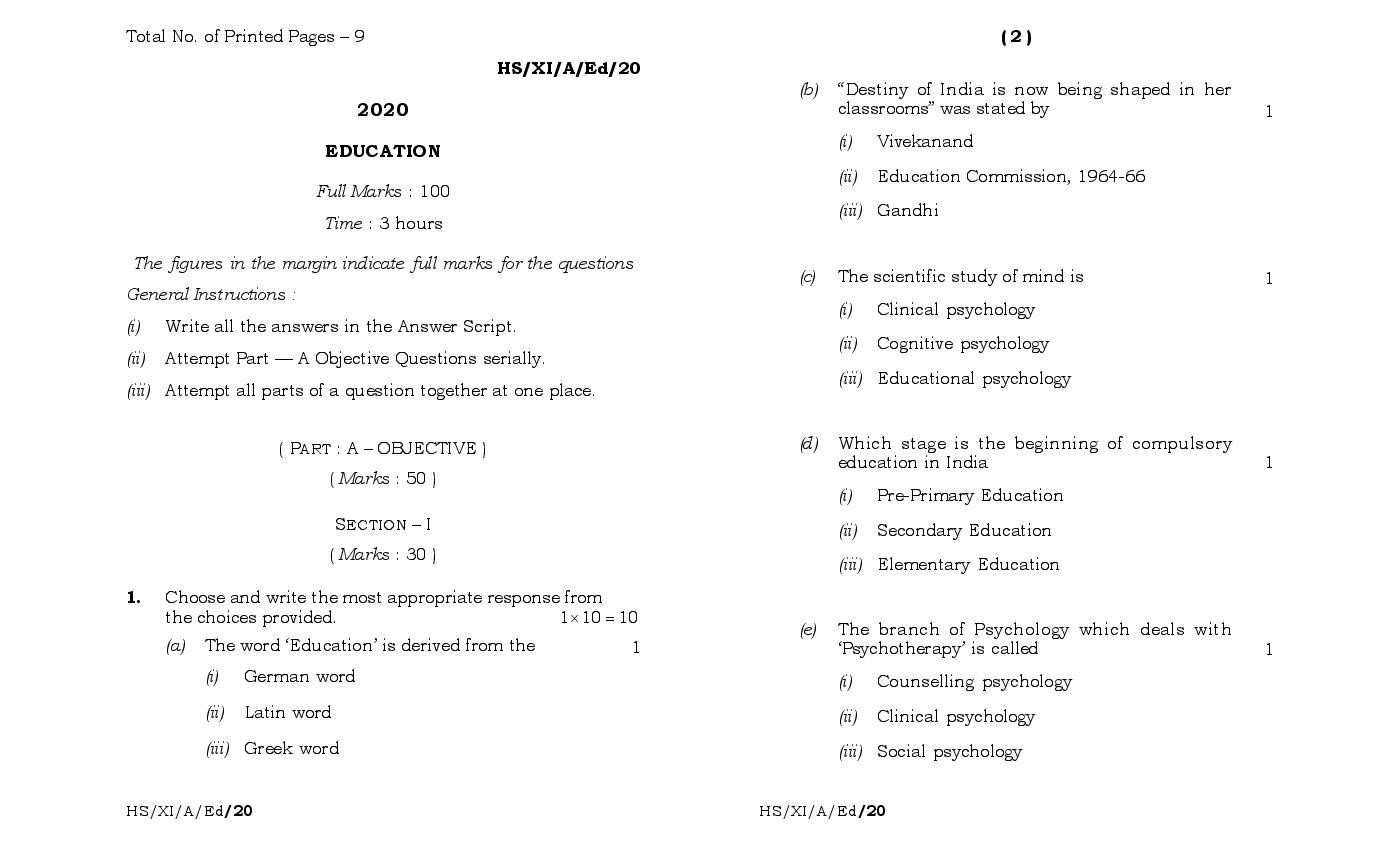
Page 1
HS/XI/A/Ed/20
(b) “Destiny of India is now being shaped in her
2020 classrooms” was stated by 1
(i) Vivekanand
EDUCATION
(ii) Education Commission, 1964-66
Full Marks : 100
(iii) Gandhi
Time : 3 hours
The figures in the margin indicate full marks for the questions
(c) The scientific study of mind is 1
General Instructions :
(i) Clinical psychology
(i) Write all the answers in the Answer Script.
(ii) Cognitive psychology
(ii) Attempt Part –– A Objective Questions serially.
(iii) Educational psychology
(iii) Attempt all parts of a question together at one place.
( PART : A – OBJECTIVE ) (d) Which stage is the beginning of compulsory
education in India 1
( Marks : 50 )
(i) Pre-Primary Education
SECTION – I (ii) Secondary Education
( Marks : 30 )
(iii) Elementary Education
1. Choose and write the most appropriate response from
the choices provided. 1 10 10
(e) The branch of Psychology which deals with
(a) The word ‘Education’ is derived from the 1 ‘Psychotherapy’ is called 1
(i) German word (i) Counselling psychology
(ii) Latin word (ii) Clinical psychology
(iii) Greek word (iii) Social psychology
HS/XI/A/Ed/20 HS/XI/A/Ed/20
Page 2
(f) Who defined “Education is the manifestation of (j) The theory of Psycho-social development of
perfection already in man”. 1 human beings was propounded by 1
(i) Vivekanand (i) Piaget
(ii) Tagore (ii) Thorndike
(iii) Krishnamurti
(iii) Erikson
(g) Systematic sociology of education can be traced
to 1
2. Indicate whether the following statements are True
(i) Emile Durkheim or False: 1 5 5
(ii) George Payne
(a) In a narrow sense, the purpose of education is to
(iii) Auguste Comte develop mental faculties and scientific attitude. 1
(h) A transitory phase between childhood and (b) Early Childhood Care and Education in our
adulthood is known as 1 country caters to the needs of children in the
(i) Childhood age group of 0-6 years. 1
(ii) Adolescence
(iii) Infancy (c) The rate of development does not vary from
individual to individual. 1
(i) “A University stands for humanism, for tolerance,
(d) Universalisation of Education in India is now a
for reason, for the adventure of ideas and for the
Constitutional mandate and commitment. 1
search of truth” was spoken by 1
(i) Tagore
(ii) Nehru (e) Situational interests are the more enduring
aspects of an individual. 1
(iii) Gandhi
HS/XI/A/Ed/20 HS/XI/A/Ed/20
Page 3
3. Match the items in Column ‘A’ with those in (c) “Education is not merely acquiring knowledge,
Column ‘B’. 1 5 5 gathering and correlating facts; it is to see the
significance of life as a whole”. 1
Column ‘A’ Column ‘B’
(d) “Secondary education is generally at a crossroad
(a) Article 351 (i) Thorndike within the structure of educational systems, and
for the youth, it comes at the time of transition
in life, when important decisions and choices
(b) Behaviourism (ii) A. Maslow have to be made, which have far reaching impacts
on their personal life and future academic and
career orientations”. 1
(c) Article 46 (iii) Development of
Hindi language
(e) “Educational psychology describes and explains
the learning experiences of an individual from
(d) The Law of Readiness (iv) Promotion of the
interest of weaker birth to old age”. 1
section
(e) Hierarchy of Needs (v) J. B. Watson 5. Fill in the blanks : 1 5 5
(a) The period of conception to birth is called the
_______ period. 1
4. Who gave the following statements: 1 5 5
(b) proposed that education should be self-
(a) “Perhaps one of the most obvious contributions supporting. 1
of sociology to the general education is the way it
can help students to develop a world view”. 1
(c) In ancient India, the education for an eight year
(b) “Our first teachers are our nose, ears, feet, hands old boy or girl started with the _______ ceremony. 1
and eyes. To substitute books for them does not
teach us to reason, it teaches us to use the reason
of others rather than our own, it teaches us to (d) _______ is what an individual strives to accomplish. 1
believe much and to know little”. 1
HS/XI/A/Ed/20 HS/XI/A/Ed/20
Page 4
(e) Different approaches to learning and studying are (i) What are self -schemas? 2
called_______. 1
(j) What is motivation? 2
SECTION ––II
( PART : B – DESCRIPTIVE )
( Marks : 20 )
( Marks : 50 )
Answer question No.7 and any two from the rest.
6. Answer the following questions in 2 or 3 sentences
only. 2 10 20
7. Write short notes on any 3 (three) of the following:
3 6 18
(a) What do you understand by ‘education’ in the
wider sense? 2 (a) National Curriculum Framework [NCF] and its
guiding principles. 6
(b) State any two educational aims for national
development. 2 (b) Relationship between Education and Psychology. 6
(c) Thorndike’s Laws of Learning. 6
(c) What is Universalisation of Education in India? 2
(d) Non-formal agencies of education and their
(d) What is Educational Sociology? 2 contribution. 6
(e) What are the learning activities at the Pre-Primary (e) Characteristics of Human development. 6
level? 2
(f) Educational system in India before Independence. 6
(f) Give two characteristics of Educational
Psychology. 2
8. What are the criteria for sound educational aims?
(g) Mention the major stages of human development. 2 Write on the Individual and Social aims of education.
4 + 6 + 6 = 16
(h) Write any two points of differences between formal
9. Write briefly the concept of Higher Education in India.
and non-formal agencies of education. 2
Mention its objectives. 8 + 8 = 16
HS/XI/A/Ed/20 HS/XI/A/Ed/20
Page 5
10. Describe the physical, cognitive, social and emotional
development during adolescence. 16
11. What is Psychology? Explain the nature and scope of
Educational Psychology. 4 + 6 + 6 = 16
12. Distinguish between growth and development.
Describe the factors influencing growth and
development. 4 + 12 = 16
13. What is the concept of learning? Write on Gestalt
theory of Insightful Learning. 4 + 12 = 16
HS/XI/A/Ed/20
Document Details
| Board / Org | Meghalaya Board |
| Exam | Class 11 |
| Type | Question Paper |
| Pages | 5 |
| Updated | 30 Apr 2026 |