MAHA SET 2024 Paper II Sociology Set A Question Paper
Finished viewing? Save it for later —
Download MAHA SET 2024 Paper II Sociology Set A Question Paper (PDF · 44 pages)About MAHA SET 2024 Paper II Sociology Set A Question Paper
MAHA SET 2024 Paper II Sociology Set A Question Paper is available here for free download. Published by Maharashtra Exams for MAHA SET, this question paper can be viewed online or downloaded as a PDF (44 pages). Candidates preparing for MAHA SET can use MAHA SET 2024 Paper II Sociology Set A Question Paper to understand the exam pattern, the type of questions asked, and the overall difficulty level.
Frequently Asked Questions
How can I download MAHA SET 2024 Paper II Sociology Set A Question Paper?
Open this page and click the Download button to save MAHA SET 2024 Paper II Sociology Set A Question Paper as a PDF. It is completely free on AglaSem Docs.
Is MAHA SET 2024 Paper II Sociology Set A Question Paper free to download?
Yes. MAHA SET 2024 Paper II Sociology Set A Question Paper can be viewed online and downloaded as a PDF free of cost on AglaSem Docs.
How many pages does MAHA SET 2024 Paper II Sociology Set A Question Paper have?
MAHA SET 2024 Paper II Sociology Set A Question Paper contains 44 pages, which you can read online or download together as a single PDF.
Where can I find more MAHA SET study material?
You can find more MAHA SET question papers, sample papers, syllabus, and answer keys on AglaSem Docs.
MAHA SET 2024 Paper II Sociology Set A Question Paper – Text
Read the full text of this question paper below — useful to quickly search, copy and reference the content online without downloading the PDF.
📄 View text version (45 pages)
Page 1
MAHA SET 2024 Paper
II Sociology Set A
Question Paper
EXAM YEAR TYPE
MAHA SET 2024 Question Paper
Notes · Sample Papers · Previous Year Papers · Mock Tests
Page 2
m .co
m .co s e m
se g l a
a
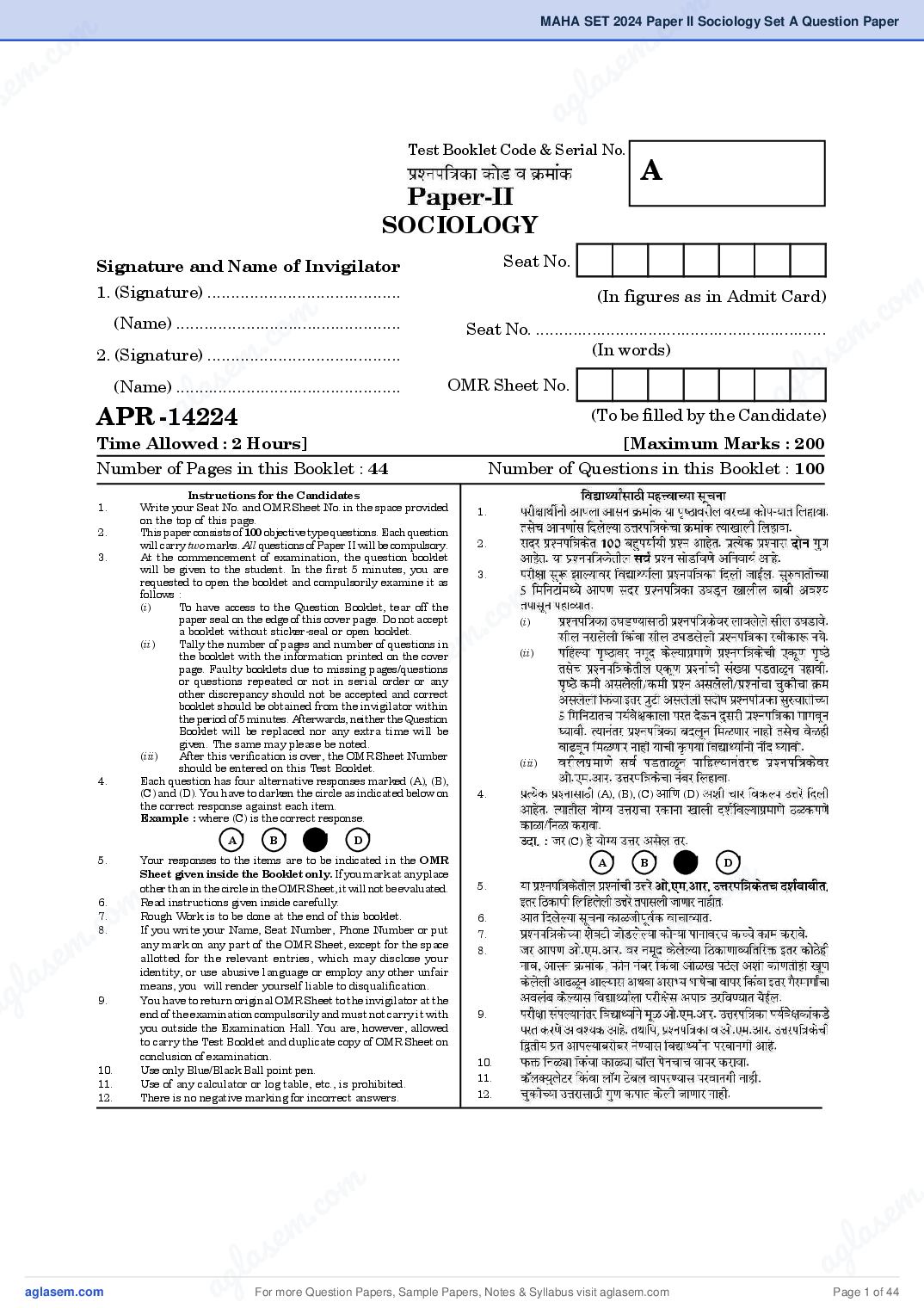
Test Booklet Code & Serial No.
A
SOCIOLOGY
Signature and Name of Invigilator Seat No.
m
.co
1. (Signature) ......................................... (In figures as in Admit Card)
o m m
c
(Name) ................................................
. e
Seat No. ..............................................................
e m
2. (Signature) ......................................... (In words)
l as
l a s
(Name) ................................................ OMR Sheet No.
a g
a
APR -14224 g (To be filled by the Candidate)
Time Allowed : 2 Hours] [Maximum Marks : 200
Number of Pages in this Booklet : 44 Number of Questions in this Booklet : 100
Instructions for the Candidates
1. Write your Seat No. and OMR Sheet No. in the space provided 1.
on the top of this page.
2. This paper consists of 100 objective type questions. Each question
will carry two marks. All questions of Paper II will be compulsory. 2.
3. At the commencement of examination, the question booklet
will be given to the student. In the first 5 minutes, you are 3.
m
requested to open the booklet and compulsorily examine it as
.co
follows :
(i) To have access to the Question Booklet, tear off the
paper seal on the edge of this cover page. Do not accept (i)
a booklet without sticker-seal or open booklet.
e m
s
(ii) Tally the number of pages and number of questions in
la
the booklet with the information printed on the cover (ii)
page. Faulty booklets due to missing pages/questions
ag
or questions repeated or not in serial order or any
other discrepancy should not be accepted and correct
booklet should be obtained from the invigilator within
the period of 5 minutes. Afterwards, neither the Question
Booklet will be replaced nor any extra time will be
given. The same may please be noted.
(iii) After this verification is over, the OMR Sheet Number
(iii)
should be entered on this Test Booklet.
4. Each question has four alternative responses marked (A), (B),
(C) and (D). You have to darken the circle as indicated below on 4. (A), (B), (C) (D)
the correct response against each item.
Example : where (C) is the correct response.
A B D (C)
5. Your responses to the items are to be indicated in the OMR
m
A B D
.co
Sheet given inside the Booklet only. If you mark at any place
5.
m
other than in the circle in the OMR Sheet, it will not be evaluated.
.co
6. Read instructions given inside carefully.
7. Rough Work is to be done at the end of this booklet. 6.
e m
m s
8. If you write your Name, Seat Number, Phone Number or put 7.
s e
any mark on any part of the OMR Sheet, except for the space
allotted for the relevant entries, which may disclose your
8.
g l a
la a
identity, or use abusive language or employ any other unfair
ag 9.
means, you will render yourself liable to disqualification.
You have to return original OMR Sheet to the invigilator at the
end of the examination compulsorily and must not carry it with 9.
you outside the Examination Hall. You are, however, allowed
to carry the Test Booklet and duplicate copy of OMR Sheet on
conclusion of examination.
10.
10. Use only Blue/Black Ball point pen.
11.
11. Use of any calculator or log table, etc., is prohibited.
12. There is no negative marking for incorrect answers. 12.
m .
.co s e m
s em l a
g la ag
a For more Question Papers, Sample Papers, Notes & Syllabus visit Page 1 of 44
Page 3
For more Question Papers, Sample Papers, Notes & Syllabus visit Page 2 of 44
Page 4
m .co
m .co s e m
se g l a
a
Sociology
Paper II
m
o m .co
c [Maximum Marks : 200 em
II
Time Allowed : .120 Minutes]
emcontains Hundred (100) multiple choice questions. Each question
l as
l as
Note : This paper
a g
ag
carrying Two (2) marks. Attempt All questions.
(100) (2)
1. Weber saw bureaucracy as the 1.
classic example of the process of .........
m
(A) Feminization
c. o (A)
e m
(B) Rationalization
las (B)
ag (C)
(C) Democratization
(D) Individualisation (D)
2. The book ‘The Elementary Structure 2.
m
of Kinship’ is associated with :
m
c. o (A) R.K. Merton m.co
m
(A)
s e
s e g l a
g la (B) Radcliffe Brown (B)
a
a (C) Levi-Strauss (C)
(D) G.H. Mead (D)
3 [P.T.O.
m .
.co s e m
s em l a
g la ag
a For more Question Papers, Sample Papers, Notes & Syllabus visit Page 3 of 44
Page 5
best exposition of :
(A) Structure-functional approach (A)
(B) Conflict approach (B)
(C) Middle-range theory building (C)
(D) Micro-sociological approach (D)
4. According to whom ‘the existence of 4.
different social classes is the source
of conflict’ ?
(A)
(A) Karl Marx
(B)
(B) R. Collins
(C)
(C) L. Coser
(D) R. Dahrendorf (D)
5. Erving Goffman is best known for 5.
his ........................ theory.
(A) Symbolic (A)
(B) Dramaturgical (B)
(C) Phenomenological (C)
(D) Exchange (D)
4
For more Question Papers, Sample Papers, Notes & Syllabus visit Page 4 of 44
Page 6
m .co
m .co s e m
se g l a
a
6. ...................... is best known for his 6.
distinction between two idea
m
m .co
systems–ideology and utopia.
m
(A) Karl Manheim .co (A)
s e m
s e l a
l
(B) Karl
g a Marx (B)
ag
(C) aMax Weber (C)
(D) Herbert Spencer (D)
7. Who formulated the idea of 7.
‘‘informational capitalism’’ in the
light of the emergence of a new
m
society, culture and economy based
m .co
s e
la
on informational technology ? (A)
(A) Richard Emerson ag
(B)
(B) Manuel Castells
(C)
(C) Jeffrey C. Alexander
(D) Frantz Fanon (D)
8. .................. has been labelled as ‘‘the 8.
m
mhigh priest of modernity’’. .co
m .co s e m
s e (A) Talcott Parsons (A)
g l a
g la a
a (B) Anthony Giddens (B)
(C) Peter M. Blau (C)
(D) Randall Collins (D)
5 [P.T.O.
m .
.co s e m
s em l a
g la ag
a For more Question Papers, Sample Papers, Notes & Syllabus visit Page 5 of 44
Page 7
understanding Indian National
Movement ?
(A)
(A) Andre Beteille
(B)
(B) Surjit Sinha
(C) A.R. Desai (C)
(D) D.P. Mukherji (D)
10. Who established participant 10.
observation as the most appropriate
methodological choice for the
practice of Social Anthropology and
Sociology in India ?
(A)
(A) G.S. Ghurye
(B) Iravati Karve (B)
(C) M.N. Srinivas (C)
(D) A.R. Desai (D)
11. Which of the following is not the 11.
method of research ?
(A)
(A) Survey
(B)
(B) Historical
(C) Observation (C)
(D) Field study method (D)
6
For more Question Papers, Sample Papers, Notes & Syllabus visit Page 6 of 44
Page 8
m .co
m .co s e m
se g l a
a
12. According to Kothleen McKinney, 12.
how many types of ethical issues are
m
m .co
.co
in research ?
(A)
e m
(A) One
em l as
l as (B)
ag
ag
(B) Two
(C)
(C) Three
(D) Four (D)
13. Which of the following an element 13.
m
provides a blueprint ?
c. o (A)
(A) Research Problem
e m
las (B)
(B) Research design
ag
(C) Research tools (C)
(D) Research methods (D)
14. Which type of the following is set 14.
of two hypotheses, which states the
m
m opposite of the null hypothesis ?
c. o (A) Scientific hypothesis m.co
e
(A)
e m l as
las (B)
ag
ag (B) Alternative hypothesis
(C)
(C) Statistical hypothesis
(D) Null hypothesis (D)
7 [P.T.O.
m .
.co s e m
s em l a
g la ag
a For more Question Papers, Sample Papers, Notes & Syllabus visit Page 7 of 44
Page 9
describing a case in terms of a single
variable-specifically ?
(A) Univariate analysis (A)
(B) Bivariate analysis (B)
(C) Multivariate analysis (C)
(D) Cross analysis (D)
16. Which one of the element is not 16.
relevant to stages in analysis ?
(A) Categorization (A)
(B) Frequency distribution (B)
(C) Measurement (C)
(D) Graph (D)
17. Which of the following is not a 17.
method of average calculation ?
(A) Mean (A)
(B) Mode (B)
(C) Correlation (C)
(D) Medium (D)
8
For more Question Papers, Sample Papers, Notes & Syllabus visit Page 8 of 44
Page 10
m .co
m .co s e m
se g l a
a
18. A Report writing is : 18.
(A) Data analysis
m
.co
(A)
m
.co
(B) Fact finding process
m
(B)
s e m
s e l a
la
(C) Interpretation
g
(C) ag
a
(D) Achievement (D)
19. Which one of the following methods 19.
is a phenomenon studied through an
in-depth analysis of the case ?
m
c. o (A)
m
(A) Survey method
s e
(B) Case Study method
g la (B)
a
(C) Historical method (C)
(D) Oral history method (D)
20. Which one of the following is not 20.
criteria for evaluating measurement ?
m
m
c. o (A) Reliability m.co
m
(A)
s e
s e g l a
g la (B) Validity (B) a
a (C) Sensitivity (C)
(D) Dependence (D)
9 [P.T.O.
m .
.co s e m
s em l a
g la ag
a For more Question Papers, Sample Papers, Notes & Syllabus visit Page 9 of 44
Page 11
(A) Forcible cultural conversion
(A)
(B) Complete merger of one culture
(B)
in the other
(C) Coming of two cultures just
(C)
near each other
(D) Appreciation of two cultures by
each other (D)
22. ‘‘A person’s status is his group 22.
standing or ranking in relation to
others was said by :
(A) Sheriff and Sheriff (A)
(B) Ginsberg (B)
(C) Ogburn and Nimkoff (C)
(D) Kingsley Davis (D)
23. Who has given the concept of ‘‘Role 23.
set’’ ?
(A) Linton (A)
(B) Merton (B)
(C) MacIver
(C)
(D) Tylor
(D)
10
For more Question Papers, Sample Papers, Notes & Syllabus visit Page 10 of 44
Page 12
m .co
m .co s e m
se g l a
a
24. Find out the incorrect match : 24.
(A) Spencer — organic view of (A)
m
society
c o m m .co
(B) Durkheim. — organic solidarity s e
e m (B)
l a
s
anda mechanical solidarity
l ag
g
(C) aRedcliffe Brown —Allocation of (C) —
roles
(D) Sorokin — Sensate, Ideational (D) —
and Idealistic
25. Norms can be placed under the 25.
m
category of :
m .co
s e
la
(A) Idealism (A)
(B) Liberalism ag (B)
(C)
(C) Neutralism
(D)
(D) Realism
26. Kinship is : 26.
(A) Biological and cultural
m
m
c. o (B) Biological relationship of sexual
relationship only (A)
m.co
m s e
s e (B)
g l a
g la union
a
a (C) Relationship with sexual union
(C)
(D) Unrelated to biological
relationship (D)
11 [P.T.O.
m .
.co s e m
s em l a
g la ag
a For more Question Papers, Sample Papers, Notes & Syllabus visit Page 11 of 44
Page 13
not required to marry within the
group to which he belongs is known
as :
(A)
(A) Kinship marriage
(B)
(B) Hypergamy
(C) Endogamy (C)
(D) Exogamy (D)
28. Without ....................... behaviour 28.
would be unpredictable.
(A) Norms (A)
(B) Development (B)
(C) Values (C)
(D) Biology (D)
29. Which three broad types of cultures 29.
succeeding each other have been
analysed by P.A. Sorokin in his
cyclical theory of social change ?
(A)
(A) Ideational, Instrumental and
Ethical
(B)
(B) Ideational, Idealist and Sensate
(C) Idealist, Moral and Sensate (C)
(D) Idealist, Ethical and Modern (D)
12
For more Question Papers, Sample Papers, Notes & Syllabus visit Page 12 of 44
Page 14
m .co
m .co s e m
se g l a
a
30. Who said that, ‘‘Marriage is a socially 30.
m
m
approved way of establishing a
.co
.co s e m
s em
family of procreation’’.
l a
g la ag
(A) aWestermark (A)
(B) Malinowski (B)
(C) Robert Lawie (C)
m
c. o (D)
em
(D) Gillin and Gillin
s
a 31.
lnot
ag
31. Which of the following cities was
studied by Saskia Sassen for her
work on global city ?
(A)
m
.co
(A) London
m
c. o (B) New York s e m
e m (B)
l a
las ag
ag (C) Tokyo (C)
(D) Paris (D)
13 [P.T.O.
m .
.co s e m
s em l a
g la ag
a For more Question Papers, Sample Papers, Notes & Syllabus visit Page 13 of 44
Page 15
labelled as Assertion (A) and the
(A) (R) :
other is Reason (R) :
(A) :
Assertion (A) : Economic
Liberalisation widened regional
disparity in agricultural
development in India.
(R) :
Reason (R) : Public investment in
agricultural declined significantly
during post-liberalisation period.
In the context of the above two
statements, which among the
following is correct ?
(A) (A) (R)
(A) Both (A) and (R) are true and (R)
is the correct explanation of (A) (R) (A)
(B) Both (A) and (R) are true but (B) (A) (R)
(R) is not the correct explanation (R) (A)
of (A)
(C) (A) (R)
(C) (A) is true but (R) is false
(D) (A) is false but (R) is true (D) (A) (R)
33. According to census of India 2011, 33. 2011 10
a city with a population of more than
10 million is known as ...................
(A) Global city (A)
(B) Mega city (B)
(C) Metropolitan city (C)
(D) Smart city (D)
14
For more Question Papers, Sample Papers, Notes & Syllabus visit Page 14 of 44
Page 16
m .co
m .co s e m
se g l a
a
34. The concept of ‘‘depeasantisation’’ is 34.
associated with :
m
.co
(A)
m
(A) Karl Marx
.co
(B) Alexander Chayanov (B)
s e m
s em l a
la
(C) Vladimir Lenin
g
(C)
ag
(D) aFriedrich Engels (D)
35. Who has authored the book, ‘‘The 35.
Urban Question’’ ?
(A) Paul Harrison (A)
(B) U.Beck (B)
m
(C) R.E. Park c. o (C)
s em (D)
la 36.
(D) M.Castells
ag
36. Consider the following peasant
movements and identify the correct
chronological, sequence :
(1)
(1) Tebhaga movement
(2)
(2) Champaran movement
(3)
m
.co
(3) Naxalbari movement
m
c. o (4) Kheda movement m
(4)
m (A) (4), (2), (3)as
e
s e g l (1)
la
(A) (4), (2), (3) and (1)
g a (1)
a (B) (2), (4), (1) and (3) (B) (2), (4), (3)
(C) (2), (3), (4) and (1) (C) (2), (3), (4) (1)
(D) (1), (3), (2) and (4) (D) (1), (3), (2) (4)
15 [P.T.O.
m .
.co s e m
s em l a
g la ag
a For more Question Papers, Sample Papers, Notes & Syllabus visit Page 15 of 44
Page 17
Tax (GST) was introduced ?
(A) 2017
(A) 2017
(B) 2015
(B) 2015
(C) 2019
(C) 2019
(D) 2016
(D) 2016
38. Match List I with List II and mark
38. I II
the correct code given below :
List I
I
(Books)
(a) Caste, Class and Power
(a)
(b) The Agrarian Prospect in India
(b)
(c) Peasant Movements in India
(c)
(d) Caste and Economic Frontier
(d)
List II
II
(Authors)
(i) Daniel Thorner (i)
(ii) D.N. Dhanagare (ii)
(iii) F.G. Bailey (iii)
(iv) Andre Beteille (iv)
Codes :
(a) (b) (c) (d) (a) (b) (c) (d)
(A) (iv) (i) (ii) (iii) (A) (iv) (i) (ii) (iii)
(B) (iv) (i) (iii) (ii) (B) (iv) (i) (iii) (ii)
(C) (iii) (iv) (i) (ii) (C) (iii) (iv) (i) (ii)
(D) (ii) (i) (iii) (iv) (D) (ii) (i) (iii) (iv)
16
For more Question Papers, Sample Papers, Notes & Syllabus visit Page 16 of 44
Page 18
m .co
m .co s e m
se g l a
a
39. Who of the following authored the 39.
book, ‘‘Liquid Times : Living in an
m
c o m
Age of Uncertainty’’ ?
m .co
(A) S. Lowem
. s e
s e (A)
l a
g a
l Bauman ag
a
(B) Z. (B)
(C) Arjun Appadurai (C)
(D) R. Fisher (D)
40. Which school of thought is related 40.
to urbanity ?
m
c. o (A)
(A) Conflict School
m
(B) Social Interactionist Schoolla
se
g
(B)
(C) Frankfurt School
a (C)
(D) Chicago School (D)
41. Who among the following perceived 41.
the dimension of pressure group in
m
m caste ?
c. o (A) Robert Hardgrave m.co
e
(A)
e m l as
las (B)
ag
ag (B) Milton Singer
(C)
(C) Joan Mencher
(D) Satish Saberwal (D)
17 [P.T.O.
m .
.co s e m
s em l a
g la ag
a For more Question Papers, Sample Papers, Notes & Syllabus visit Page 17 of 44
Page 19
about ‘Ad Dharm’ movement in
Punjab ?
(A)
(A) It was a direct product of new
economic opportunities opened
up by the British colonial rule
(B) Introduction of secular (B)
education by the colonial rulers
helped upward mobile Dalits in
developing new political outlook
(C) Mangoo Ram, leader of the (C)
movement argued that
untouchables were a distinct
religious community
(D)
(D) Demand for separate electorate
by Dalit Chamars was accepted
by colonial rulers.
43. ‘Dalit Panthers’ was established in 43.
the year ...................
(A) 1971 (A) 1971
(B) 1974 (B) 1974
(C) 1972 (C) 1972
(D) 1970 (D) 1970
18
For more Question Papers, Sample Papers, Notes & Syllabus visit Page 18 of 44
Page 20
m .co
m .co s e m
se g l a
a
44. Which of the following is not true
44.
about backward class movements in
m
India ?
c o m m .co
m . backward class s e
a
(A) Origin of
s e began in colonial (A)
l
l a
movements
g ag
aperiod
(B) It was led by agrarian castes (B)
who were in middle region of
caste hierarchy
(C) Backward class movements
o m
(C)
criticised caste hierarchy and . c
e m
Brahmin’s supremacy
las
ag
(D) Backward class movements (D)
prevented the emergence of
Dalit movements
45. Who among the following is 45.
associated with new social
m
m movements ?
c. o (A) Samir Amin m.co
m
(A)
s e
s e g l a
g la (B) Rudolph Heberle
(B)
a
a (C)
(C) Paul Wilkinson
(D) Joseph Gusfield (D)
19 [P.T.O.
m .
.co s e m
s em l a
g la ag
a For more Question Papers, Sample Papers, Notes & Syllabus visit Page 19 of 44
Page 21
the year ............................
(A) 1857
(A) 1857
(B) 1858
(B) 1858
(C) 1859
(C) 1859
(D) 1855 (D) 1855
47. Match the names of sociologists 47. I
given in List-I with the types of II
movements identified by them in
List-II :
I
List I
(a)
(a) Herbert Blumer
(b)
(b) B. Barber
(c)
(c) N.J. Smelser
(d) R. Linton (d)
List II II
(i) Messianic Movements (i)
(ii) Social Movements (ii)
(iii) Nativistic Movements (iii)
(iv) Norm and values oriented (iv)
movements
Codes :
(a) (b) (c) (d)
(a) (b) (c) (d)
(A) (i) (iv) (iii) (ii) (A) (i) (iv) (iii) (ii)
(B) (iv) (iii) (i) (ii) (B) (iv) (iii) (i) (ii)
(C) (ii) (i) (iv) (iii) (C) (ii) (i) (iv) (iii)
(D) (i) (iii) (iv) (ii) (D) (i) (iii) (iv) (ii)
20
For more Question Papers, Sample Papers, Notes & Syllabus visit Page 20 of 44
Page 22
m .co
m .co s e m
se g l a
a
48. Who classified social movements as 48.
reformist, transformative and
revolutionary ?
m
(A) Ganshyam Shah
c o m (A)
m .co
(B) M.S.A. m . s e
s e Rao (B)
l a
g l
(C) T.K. a Oommen (C)
ag
(D) aD.N. Dhanagare (D)
49. Who viewed Indian peasantry as 49.
docile and not capable for
independent action ?
(A)
(A) A.R. Desai
(B)
m
c. o (C)
(B) Teodor Shanin
em (D)
(C) Barrington Moore Jr.
(D) Partha Mukheerjee
la s
g
50. Surajith Sinha has classifiedatribal 50.
movements into :
(A) Reactionary, Conservative,
Revisionary (A)
(B) Ethnic rebellion, reform (B)
movements, political autonomy
m
m .co
movements, secessionist
m .co movements and agrarian unrest
s e m
s e (C) Religious movements, insurgent
g l a
la
(C)
g movements and reform a
a movements
(D) Reformist, Revolutionary and (D)
Reactionary
21 [P.T.O.
m .
.co s e m
s em l a
g la ag
a For more Question Papers, Sample Papers, Notes & Syllabus visit Page 21 of 44
Page 23
practiced by indigenous people in the
pacific north-west coast of Canada
and the United States of America.
(A) Kula (A)
(B) Potlatch (B)
(C) Koha (C)
(D) Pow Wow (D)
52. What is meant by ‘Take off stage’ 52.
in an economy ?
(A) It means steady growth begins
(A)
(B) It means economy is stagnant
(C) It means all controls are (B)
removed
(C)
(D) It means economy is about to
collapse (D)
53. A.G. Frank (1967) made the claim that 53.
‘underdeveloped’ societies were ..........
(A) Insufficiently involved in the
(A)
international capitalist economy
(B) Reluctant to surrender their
traditional ways of life (B)
(C) Economically dependent on the
wealthy countries that exploit
(C)
them
(D) The ‘metropoles’ to which
‘satellite’ countries were (D)
attached
22
For more Question Papers, Sample Papers, Notes & Syllabus visit Page 22 of 44
Page 24
m .co
m .co s e m
se g l a
a
54. ‘‘Globalization means getting closer 54.
m
and closer to the world and realizing
m .co
.co m
that we are all one.’’ Such an
s e
s em
explanation was given by ..............
l a
g l a
(A) aRobert Park (A)
ag
(B) Amartya Sen (B)
(C) Harlambos (C)
(D) Roland Robertson (D)
m
55. .............. means even though the
m .co
55.
s e
la
workers have got jobs, their full
a g
productivity is not being utilized.
Therefore, even if some workers are
removed from such work, the total
production will not decrease
m
.co
significantly.
m
c. o (A) Footloose labour (A)
s e m
e m l a
las (B) Precarious unemployment
(B)
ag
ag
(C) Disguised unemployment (C)
(D) Immersive labour (D)
23 [P.T.O.
m .
.co s e m
s em l a
g la ag
a For more Question Papers, Sample Papers, Notes & Syllabus visit Page 23 of 44
Page 25
Immanual Wallerstein ?
(A) Modernisation theory (A)
(B) World system theory (B)
(C) Dependency theory (C)
(D) Globalisation theory (D)
57. The term Social Capital’ refers to 57.
..........................
(A) Network reciprocity and trust
(A)
(B) Economic resources owned by
(B)
social groups
(C) State owned capital
(C)
(D) Capital through market based
trade (D)
58. An important debate between A. G. 58.
Frank and Ernesto Laclau in the
mode of production was ...............
(A) South Asia (A)
(B) Latin America
(B)
(C) Eastern Europe
(C)
(D) North America
(D)
24
For more Question Papers, Sample Papers, Notes & Syllabus visit Page 24 of 44
Page 26
m .co
m .co s e m
se g l a
a
59. Removing barriers or restrictions set 59.
by the government is called ........
m
m .co
.co
(A) Liberalization (A)
e m
em (B)
l as
las
(B) Investment
ag
ag
(C) Favorable trade (C)
(D) Free trade (D)
60. The development that meets the 60.
needs of the present without
compromising the needs of the
m
future generation is called ...........
m .co
s e (A)
(A) Sustainable development
g la
(B) Social development
a (B)
(C)
(C) Human development
(D) Economic development (D)
61. Which of the following is an 61.
m
m Ecofeminist ?
c. o (A) Beena Agarwal (A)
m.co
m s e
s e g l a
la
(B)
g (B) Vandana Shiva a
a (C)
(C) Medha Patkar
(D) Neera Desai (D)
25 [P.T.O.
m .
.co s e m
s em l a
g la ag
a For more Question Papers, Sample Papers, Notes & Syllabus visit Page 25 of 44
Page 27
limited to the arena of treating
disease, but it includes ...................
(A) Religious aspects (A)
(B) Socio-cultural aspects (B)
(C) Economic aspects (C)
(D) Religious, Socio-cultural and (D)
Economic aspects
63. Gases that trap heat in the 63.
atmosphere are called ...................
(A) Polluting gases (A)
(B) Greenhouse gases (B)
(C) Hot gases (C)
(D) Whitehouse gases (D)
64. The strategic policy for air quality 64.
improvement in India is hampered
by ......................................
(A) Lack of adequate inventories on
(A)
emissions
(B)
(B) National pressure
(C) International pressure (C)
(D) Lack of funds (D)
26
For more Question Papers, Sample Papers, Notes & Syllabus visit Page 26 of 44
Page 28
m .co
m .co s e m
se g l a
a
65. ..................... refers to the ability to 65.
introduce novel traits into a species
m
m
of plant, animal, bacterium or virus
.co
.co s e m
em
by inserting alternative genetic
s l a
la
material.
g ag
(A) aEugenics
(A)
(B)
(B) Euthenics
(C) Genetic modification (C)
(D) Sociobotany (D)
m
.co
66. The book ‘Risk Society’ is written 66.
by .......................
e m
las
(A) Ulrich Back
ag (A)
(B) Catton and Dunlap (B)
(C) Robert Park (C)
(D) Samir Amin (D)
m
67. The idea of ‘environmental justice’ 67.
m
c. o (A) Digital Divide dimension
is associated with ........................
m.co
m s e
s e (A)
g l a
g la a
a
(B) Social equality dimension (B)
(C) North-South divide dimension (C)
(D) Preservation of forests
(D)
27 [P.T.O.
m .
.co s e m
s em l a
g la ag
a For more Question Papers, Sample Papers, Notes & Syllabus visit Page 27 of 44
Page 29
central Himalayas was around in .....
(A) 1950s (A) 1950s
(B) 1970s (B) 1970s
(C) 1980s (C) 1980s
(D) 1990s (D) 1990s
69. Who coined the term Eco-feminism ? 69.
(A) Vandana Shiva
(A)
(B) Francoise d’Eaubonne
(B)
(C) Maria Mies (C)
(D) Carolyn Merchant (D)
70. Match the environmental 70. I II
movements in List-I with the year
of their emergence given in List-II
List I
I
(a) Chipko Movement
(a)
(b) Silent Valley Movement
(b)
(c) Narmada Bachao Andolan
(c)
(d) Appiko Movement
(d)
List II
II
(i) 1983 (i)
(ii) 1985 (ii)
(iii) 1973 (iii)
(iv) 1978 (iv)
Codes :
(a) (b) (c) (d) (a) (b) (c) (d)
(A) (iv) (ii) (i) (iii) (A) (iv) (ii) (i) (iii)
(B) (ii) (iii) (i) (iv) (B) (ii) (iii) (i) (iv)
(C) (iii) (iv) (ii) (i) (C) (iii) (iv) (ii) (i)
(D) (ii) (iv) (i) (iii) (D) (ii) (iv) (i) (iii)
28
For more Question Papers, Sample Papers, Notes & Syllabus visit Page 28 of 44
Page 30
m .co
m .co s e m
se g l a
a
71. A practice where a woman is said 71.
to have brought shame on her
m
.co
family for having a disapproved
m
.co
partner is called as following :
s e m
s em l a
ag
Choose the correct option :
la of dishonour
(A)
ag
(A) Case
(B)
(B) Violence against women
(C) Honour killing (C)
(D) Caste based murder (D)
72. Establishment of Family Courts by
m
.co
72.
the State Governments for :
e m
(A) Passing judgements on the
s
lain
ag
cases pertaining to disputes
(A)
family
(B) Decisions on cases of divorce (B)
and domestic violence
(C) To promote conciliation and
speedy settlement of disputes (C)
m
m .co
.co m
related to marriage and family
m s e
s e
affairs
g l a
g la (D) To pass judgements related to a
a disputes related to honour
(D)
killing, divorces and other cases
of violence
29 [P.T.O.
m .
.co s e m
s em l a
g la ag
a For more Question Papers, Sample Papers, Notes & Syllabus visit Page 29 of 44
Page 31
which of the following ?
(A) Functionalism (A)
(B) Cultural Sociology (B)
(C) Structural-Functionalism (C)
(D) Structuralism (D)
74. The following are the two 74.
statements, one is Assertion (A) and
(A) (R)
another is the Reason (R) which one
is correct ?
(A) Looking at recent literature and (A)
films there is a shift in the ways
the disabled are being
portrayed in contemporary
societies. (R)
(R) Changing nature of social care,
welfare state and social
protection has helped in
reducing the stigmatising of
disabled.
Choose the correct answer using the
codes given below :
(A) (A) (R)
(A) Both (A) and (R) are correct and
(R) (A)
(R) is the correct explanation
of (A)
(B) Both (A) and (R) are correct but (B) (A) (R)
(R) is not the correct explanation
(R) (A)
of (A)
(C) Both (A) and (R) are false (C) (A) (R)
(D) Both (A) and (R) are true (D) (A) (R)
30
For more Question Papers, Sample Papers, Notes & Syllabus visit Page 30 of 44
Page 32
m .co
m .co s e m
se g l a
a
75. Changes in the family structure and 75.
m
.co
gender roles because of
o m m
c
. in India are s e
m
modernisation
e l a
l as ag
ag
demonstrated in which studies ?
(A)
(A) Empirical research studies
(B)
(B) Longitudinal research studies
(C)
(C) Action research studies
m
c. o (D)
(D) Causal research studies
s em
g la
a
76. Which of the following factors 76.
contributes to high maternal
mortality rate in India ?
(A)
m
.co
(A) Bad health of women
m
m .co (B)
s e m
s e (B) Early marriage
g l a
g la a
a (C) Women’s employment
(C)
(D) Antenatal care (D)
31 [P.T.O.
m .
.co s e m
s em l a
g la ag
a For more Question Papers, Sample Papers, Notes & Syllabus visit Page 31 of 44
Page 33
List I I
(a) Child soldiers (a)
(b) Sex selective abortion (b)
(c) Respect, reverence to elderly
(c)
(d) One of the highest old age
(d)
population
II
List II
(i)
(i) Asian countries
(ii)
(ii) Africa
(iii)
(iii) Japan
(iv)
(iv) Tibet
Codes :
(a) (b) (c) (d)
(a) (b) (c) (d)
(A) (iv) (ii) (iii) (i) (A) (iv) (ii) (iii) (i)
(B) (ii) (i) (iv) (iii) (B) (ii) (i) (iv) (iii)
(C) (iii) (iv) (ii) (i) (C) (iii) (iv) (ii) (i)
(D) (i) (ii) (iii) (iv) (D) (i) (ii) (iii) (iv)
32
For more Question Papers, Sample Papers, Notes & Syllabus visit Page 32 of 44
Page 34
m .co
m .co s e m
se g l a
a
78. Match List-I of the work/
78. I II
contribution with List-II of Authors
m
.co
and select the correct answer from
m
.co m
the codes given below :
s e
em a
I
s l
ag
List I
g la (Books)
a (a)
(a) The Politics of the Family
(b)
(b) The Runway World
(c)
(c) The Future of the Family
(d)
(d) The Dialect of Sex
m
.co
II
List II
e m
(Authors)
las
(i) Jessie Bernard ag (i)
(ii)
(ii) Shulasmith Firestone
(iii)
(iii) Edmund Leach
(iv)
(iv) R.D. Laing
Codes :
m
m .co
.co
(a) (b) (c) (d)
em(iv)
(a) (b) (c) (d)
e m (A) (iii) (ii)
las (i)
s
(A) (iii) (ii) (i) (iv)
la g
a (ii) (i)
ag (B) (iv) (iii) (ii) (i) (B) (iv) (iii)
(C) (ii) (i) (iii) (iv) (C) (ii) (i) (iii) (iv)
(D) (iv) (iii) (i) (ii) (D) (iv) (iii) (i) (ii)
33 [P.T.O.
m .
.co s e m
s em l a
g la ag
a For more Question Papers, Sample Papers, Notes & Syllabus visit Page 33 of 44
Page 35
that culture as the determinant of
gender roles ?
(A) Anna Wanka (A)
(B) Ann Oakley (B)
(C) Hunt S.A. (C)
(D) Bernardes, J. (D)
80. According to Irawati Karve, what is 80.
important factor in joint family ?
(A) Marriage (A)
(B) Kinship (B)
(C) Co-residentiality (C)
(D) Blood relations (D)
34
For more Question Papers, Sample Papers, Notes & Syllabus visit Page 34 of 44
Page 36
m .co
m .co s e m
se g l a
a
81. ................... is the socio-economic
81.
m
difference between people in their
m .co
.co m
access to Information and
s e
s em
Communication Technologies (ICT).
l a
g l a
(A) aDigital divide
(A) ag
(B)
(B) Class divide
(C)
(C) Digital gap
(D)
(D) Digital struggle
m
82. Which one of the following is not the
m .co
82.
s e
la
reason for the digital divide ?
a g
(A) The non-availability of a reliable
(A)
ICT infrastructure to access the
ICT
internet
(B) There is a lack of resources to (B)
m
m .co
invest in information
m .co infrastructure
s e m
s e (C)
g l a
g la (C) There are problems in accessing a
a the internet regularly
(D) The intergenerational gap (D)
35 [P.T.O.
m .
.co s e m
s em l a
g la ag
a For more Question Papers, Sample Papers, Notes & Syllabus visit Page 35 of 44
Page 37
projects was launched by the
Government of India to reduce the
rural digital gap aiming to connect
ICT
2.5 Lakh gram panchayats with
optical fiber ? (A)
(A) BharatNet project
(B)
(B) E-Bharath project
(C)
(C) GramNet project
(D)
(D) Gramsanchar project
84. In order to improve digital literacy 84.
which of the following initiatives has
been launched by the Government
of India ?
(A) ‘‘National Digital Education
Mission’’
(A)
(B) ‘‘National Digital Literacy
Mission’’
(B)
(C) ‘‘Indian Digital Saksharta
Mission’’ (C)
(D) ‘‘Indian Digital Learning
Mission’’ (D)
36
For more Question Papers, Sample Papers, Notes & Syllabus visit Page 36 of 44
Page 38
m .co
m .co s e m
se g l a
a
85. The Kerala High Court, in Faheema 85.
Shirin V. The State of Kerala case,
m
m
in 2019 declared the right to
.co
.co s e m
em
Internet access as a fundamental
s l a
a ag
right forming a part of the right to
g l
a and the right to education
privacy
under Article ..................... of the
Constitution. (A) 45
(A) 45
(B) 21
(B) 21
o m
(C) 51
(C) 51
. c
e m (D) 11
(D) 11 s
a 86.
l‘an
a g
86. What term is used to define
environment in which one’s
exposure to news, entertainment,
social media, etc, represents only one
ideological or cultural perspective
m
.co
and excludes or misrepresents other
m
c. o points of view’ ? s e m
e m (A)
l a
las (A) Media Hype
ag
ag (B) Media Puzzle
(B)
(C) Media Bubble (C)
(D) Media Idiom (D)
37 [P.T.O.
m .
.co s e m
s em l a
g la ag
a For more Question Papers, Sample Papers, Notes & Syllabus visit Page 37 of 44
Page 39
changing health care ?
(A) Biology; bytes; bandwidth (A)
(B) Biology; biography; bandwidth (B)
(C) Body; bytes; bandwidth (C)
(D) Biology; biostat; bitcare (D)
88. ............... is a telemedicine healthcare 88.
app that provides around 24 Hours 24
multi-speciality services to you.
(A) DigiDoctor (A)
(B) DigiHealth (B)
(C) TeleDoctor (C)
(D) DigiDoc (D)
38
For more Question Papers, Sample Papers, Notes & Syllabus visit Page 38 of 44
Page 40
m .co
m .co s e m
se g l a
a
89. Concerning Cyber Crime, Section 89.
m
.co
................ provides for the
m
c. oof disputes for s e m
em
adjudication
s l a
g la compensation.
awarding ag
a (A) 46
(A) 46
(B) 51
(B) 51
(C) 63
(C) 63
m
c. o (D) 21
em
(D) 21
s
la 90. OTT
90. Provide the expanded form of g
a
OTT,
which refers to media services
delivered directly to viewers over the
internet ?
(A)
m
m .co
.co
(A) Over the time
e m
e m (B)
l as
las (B) Over the top
ag
ag (C) Over the TV
(C)
(D) Over the text (D)
39 [P.T.O.
m .
.co s e m
s em l a
g la ag
a For more Question Papers, Sample Papers, Notes & Syllabus visit Page 39 of 44
Page 41
is ‘Glocalization’ ?
(A) The dominance of global
(A)
cultures over local ones
(B) The integration of local and
global influences in various (B)
aspects of life
(C) The exclusion of local cultures
(C)
from global interactions
(D) The promotion of global trade
agreements (D)
92. Sociologically .................. is a key 92.
resource for mitigating and adapting
to climate change.
(A) Culture (A)
(B) Infrastructural Development (B)
(C) Welfare (C)
(D) Technology (D)
40
For more Question Papers, Sample Papers, Notes & Syllabus visit Page 40 of 44
Page 42
m .co
m .co s e m
se g l a
a
93. Who criticised naive pluralism in 93.
media politics relating to
m
m .co
diversity ?
m
(A) C. Hamelink .co (A)
s e m
s e l a
(B) R. a
g l Johnson (B)
ag
(C) aM. Jay (C)
(D) K. Karppingen (D)
94. Which one of the following 94.
perspectives argues that the
expansion of education will reduce
m
inequality in society ?
m .co
s e (A)
(A) Socialist perspective
g la
(B) Liberal perspective a (B)
(C) Conflict perspective (C)
(D) Functionalist perspective (D)
95. Who sees that the continuing vitality 95.
of sects as evidence of a secular
m
msociety ? .co
m .co (A)
s e m
s e (A) Peter Worsley
g l a
g la (B) a
a (B) Peter Berger
(C)
(C) Max Weber
(D) Max Muller (D)
41 [P.T.O.
m .
.co s e m
s em l a
g la ag
a For more Question Papers, Sample Papers, Notes & Syllabus visit Page 41 of 44
Page 43
is called ..............................
(A) Hermeneutics (A)
(B) Semiotics (B)
(C) Amniocentesis (C)
(D) Psychotics (D)
97. According to ........................., the 97.
postmodern world is ‘‘the age of
simulation’’.
(A)
(A) Patricia Hill Collins
(B)
(B) Jean Baudrillard
(C) Richard Emerson (C)
(D) W.E.B. DuBois (D)
98. Who defined culture as ‘that complex 98.
whole which includes knowledge,
belief, art, morals, law, custom and
any other capabilities and habits
acquired by man as a member of
society’ ?
(A)
(A) E. B. Tylor
(B)
(B) Robert Biersteat
(C)
(C) B. Malinowski
(D) Graham Wallas (D)
42
For more Question Papers, Sample Papers, Notes & Syllabus visit Page 42 of 44
Page 44
m .co
m .co s e m
se g l a
a
99. The rise of the Arya Samaj and the 99.
Brahmo Samaj movements in India
m
m .co
.co
in the 19th century was a response
s e m
s em l a
la ag
to ...........................
g
(A) aBritish fundamentalism (A)
(B) British Atheism (B)
(C) British Revivalism
(C)
(D) The growing British presence in
m
c. o (D)
India and the British challenge
e m
las
to Hindu traditions
ag
100. Which of the following movements 100.
reveal a close relationship between
social conditions and religious
activity ?
m
m
c. o (A) Women
(A)
m.co
m s e
s e (B)
g l a
g la (B) Millenarian
a
a (C) Caste
(C)
(D) Dalit (D)
43 [P.T.O.
m .
.co s e m
s em l a
g la ag
a For more Question Papers, Sample Papers, Notes & Syllabus visit Page 43 of 44
Page 45
44
For more Question Papers, Sample Papers, Notes & Syllabus visit Page 44 of 44
Document Details
| Board / Org | Maharashtra Exams |
| Exam | MAHA SET |
| Type | Question Paper |
| Pages | 44 |
| Updated | 17 Nov 2026 |