UGC NET 2021 Question Paper Comparative Literature Shift 2
Finished viewing? Save it for later —
Download UGC NET 2021 Question Paper Comparative Literature Shift 2 (PDF · 84 pages)About UGC NET 2021 Question Paper Comparative Literature Shift 2
UGC NET 2021 Question Paper Comparative Literature Shift 2 is available here for free download. Published by NTA for UGC NET, this question paper can be viewed online or downloaded as a PDF (84 pages). Candidates preparing for UGC NET can use UGC NET 2021 Question Paper Comparative Literature Shift 2 to understand the exam pattern, the type of questions asked, and the overall difficulty level.
Frequently Asked Questions
How can I download UGC NET 2021 Question Paper Comparative Literature Shift 2?
Open this page and click the Download button to save UGC NET 2021 Question Paper Comparative Literature Shift 2 as a PDF. It is completely free on AglaSem Docs.
Is UGC NET 2021 Question Paper Comparative Literature Shift 2 free to download?
Yes. UGC NET 2021 Question Paper Comparative Literature Shift 2 can be viewed online and downloaded as a PDF free of cost on AglaSem Docs.
How many pages does UGC NET 2021 Question Paper Comparative Literature Shift 2 have?
UGC NET 2021 Question Paper Comparative Literature Shift 2 contains 84 pages, which you can read online or download together as a single PDF.
Where can I find more UGC NET study material?
You can find more UGC NET question papers, sample papers, syllabus, and answer keys on AglaSem Docs.
UGC NET 2021 Question Paper Comparative Literature Shift 2 – Text
Read the full text of this question paper below — useful to quickly search, copy and reference the content online without downloading the PDF.
📄 View text version (84 pages)
Page 1
Topic:‐ GP_Set2_C
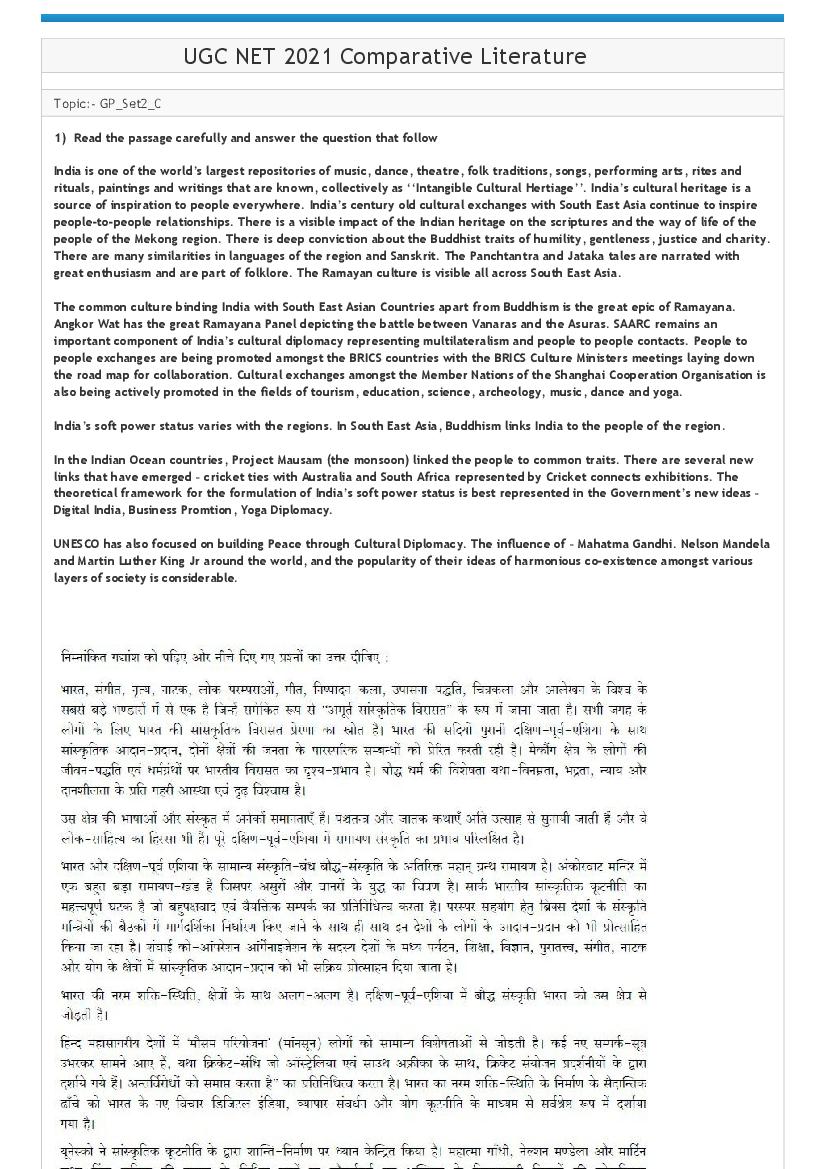
1) Read the passage carefully and answer the question that follow
India is one of the world’s largest repositories of music, dance, theatre, folk traditions, songs, performing arts, rites and
rituals, paintings and writings that are known, collectively as ‘‘Intangible Cultural Hertiage’’. India’s cultural heritage is a
source of inspiration to people everywhere. India’s century old cultural exchanges with South East Asia continue to inspire
people‐to‐people relationships. There is a visible impact of the Indian heritage on the scriptures and the way of life of the
people of the Mekong region. There is deep conviction about the Buddhist traits of humility, gentleness, justice and charity.
There are many similarities in languages of the region and Sanskrit. The Panchtantra and Jataka tales are narrated with
great enthusiasm and are part of folklore. The Ramayan culture is visible all across South East Asia.
The common culture binding India with South East Asian Countries apart from Buddhism is the great epic of Ramayana.
Angkor Wat has the great Ramayana Panel depicting the battle between Vanaras and the Asuras. SAARC remains an
important component of India’s cultural diplomacy representing multilateralism and people to people contacts. People to
people exchanges are being promoted amongst the BRICS countries with the BRICS Culture Ministers meetings laying down
the road map for collaboration. Cultural exchanges amongst the Member Nations of the Shanghai Cooperation Organisation is
also being actively promoted in the fields of tourism, education, science, archeology, music, dance and yoga.
India’s soft power status varies with the regions. In South East Asia, Buddhism links India to the people of the region.
In the Indian Ocean countries, Project Mausam (the monsoon) linked the people to common traits. There are several new
links that have emerged – cricket ties with Australia and South Africa represented by Cricket connects exhibitions. The
theoretical framework for the formulation of India’s soft power status is best represented in the Government’s new ideas –
Digital India, Business Promtion, Yoga Diplomacy.
UNESCO has also focused on building Peace through Cultural Diplomacy. The influence of – Mahatma Gandhi. Nelson Mandela
and Martin Luther King Jr around the world, and the popularity of their ideas of harmonious co‐existence amongst various
layers of society is considerable.
Page 2
(A) Ramayan
(B) Multilateral engagements
(C) Business Promotion
(D) People to people contacts
Choose the correct answer from the options given below :
(1) (A) and (D) only (2) (A), (C) and (D) only
(3) (B), (C) and (D) only (4) (B) and (D) only
[Question ID = 3557][Question Description = Q46_GP_20NOV_S2_SHAAN_Shift2]
1. 1
[Option ID = 13691]
2. 2
[Option ID = 13692]
3. 3
[Option ID = 13693]
4. 4
[Option ID = 13694]
2) Read the passage carefully and answer the question that follow
India is one of the world’s largest repositories of music, dance, theatre, folk traditions, songs, performing arts, rites and
rituals, paintings and writings that are known, collectively as ‘‘Intangible Cultural Hertiage’’. India’s cultural heritage is a
source of inspiration to people everywhere. India’s century old cultural exchanges with South East Asia continue to inspire
people‐to‐people relationships. There is a visible impact of the Indian heritage on the scriptures and the way of life of the
Page 3
There are many similarities in languages of the region and Sanskrit. The Panchtantra and Jataka tales are narrated with
great enthusiasm and are part of folklore. The Ramayan culture is visible all across South East Asia.
The common culture binding India with South East Asian Countries apart from Buddhism is the great epic of Ramayana.
Angkor Wat has the great Ramayana Panel depicting the battle between Vanaras and the Asuras. SAARC remains an
important component of India’s cultural diplomacy representing multilateralism and people to people contacts. People to
people exchanges are being promoted amongst the BRICS countries with the BRICS Culture Ministers meetings laying down
the road map for collaboration. Cultural exchanges amongst the Member Nations of the Shanghai Cooperation Organisation is
also being actively promoted in the fields of tourism, education, science, archeology, music, dance and yoga.
India’s soft power status varies with the regions. In South East Asia, Buddhism links India to the people of the region.
In the Indian Ocean countries, Project Mausam (the monsoon) linkded the people to common traits. There are several new
links that have emerged – cricket ties with Australia and South Africa represented by Cricket connects exhibitions. The
theoretical framework for the formulation of India’s soft power status is best represented in the Government’s new ideas –
Digital India, Business Promtion, Yoga Diplomacy.
UNESCO has also focused on building Peace through Cultural Diplomacy. The influence of – Mahatma Gandhi. Nelson Mandela
and Martin Luther King Jr around the world, and the popularity of their ideas of harmonious co‐existence amongst various
layers of society is considerable.
The common thread binding India and South East Asian Countries is/are
(A) Buddist tenets
(B) Yoga
(C) Cricket
(D) Ramayan
(E) Sanskrit
Choose the correct answer from the options given below :
Page 4
(3) (A) and (D) only (4) (A), (B), (D) and (E) only
[Question ID = 3558][Question Description = Q47_GP_20NOV_S2_SHAAN_Shift2]
1. 1 [Option ID = 13695]
2. 2 [Option ID = 13696]
3. 3 [Option ID = 13697]
4. 4 [Option ID = 13698]
3) Read the passage carefully and answer the question that follow
India is one of the world’s largest repositories of music, dance, theatre, folk traditions, songs, performing arts, rites and
rituals, paintings and writings that are known, collectively as ‘‘Intangible Cultural Hertiage’’. India’s cultural heritage is a
source of inspiration to people everywhere. India’s century old cultural exchanges with South East Asia continue to inspire
people‐to‐people relationships. There is a visible impact of the Indian heritage on the scriptures and the way of life of the
people of the Mekong region. There is deep conviction about the Buddhist traits of humility, gentleness, justice and charity.
There are many similarities in languages of the region and Sanskrit. The Panchtantra and Jataka tales are narrated with
great enthusiasm and are part of folklore. The Ramayan culture is visible all across South East Asia.
The common culture binding India with South East Asian Countries apart from Buddhism is the great epic of Ramayana.
Angkor Wat has the great Ramayana Panel depicting the battle between Vanaras and the Asuras. SAARC remains an
important component of India’s cultural diplomacy representing multilateralism and people to people contacts. People to
people exchanges are being promoted amongst the BRICS countries with the BRICS Culture Ministers meetings laying down
the road map for collaboration. Cultural exchanges amongst the Member Nations of the Shanghai Cooperation Organisation is
also being actively promoted in the fields of tourism, education, science, archeology, music, dance and yoga.
India’s soft power status varies with the regions. In South East Asia, Buddhism links India to the people of the region.
In the Indian Ocean countries, Project Mausam (the monsoon) linkded the people to common traits. There are several new
links that have emerged – cricket ties with Australia and South Africa represented by Cricket connects exhibitions. The
theoretical framework for the formulation of India’s soft power status is best represented in the Government’s new ideas –
Digital India, Business Promtion, Yoga Diplomacy.
UNESCO has also focused on building Peace through Cultural Diplomacy. The influence of – Mahatma Gandhi. Nelson Mandela
and Martin Luther King Jr around the world, and the popularity of their ideas of harmonious co‐existence amongst various
layers of society is considerable.
Page 5
(1) Digital India (2) Skill India
(3) Business Promotion (4) Yoga Diplomacy
[Question ID = 3559][Question Description = Q48_GP_20NOV_S2_SHAAN_Shift2]
1. 1 [Option ID = 13699]
2. 2 [Option ID = 13700]
3. 3 [Option ID = 13701]
4. 4 [Option ID = 13702]
4) Read the passage carefully and answer the question that follow
India is one of the world’s largest repositories of music, dance, theatre, folk traditions, songs, performing arts, rites and
rituals, paintings and writings that are known, collectively as ‘‘Intangible Cultural Hertiage’’. India’s cultural heritage is a
source of inspiration to people everywhere. India’s century old cultural exchanges with South East Asia continue to inspire
people‐to‐people relationships. There is a visible impact of the Indian heritage on the scriptures and the way of life of the
people of the Mekong region. There is deep conviction about the Buddhist traits of humility, gentleness, justice and charity.
There are many similarities in languages of the region and Sanskrit. The Panchtantra and Jataka tales are narrated with
great enthusiasm and are part of folklore. The Ramayan culture is visible all across South East Asia.
The common culture binding India with South East Asian Countries apart from Buddhism is the great epic of Ramayana.
Angkor Wat has the great Ramayana Panel depicting the battle between Vanaras and the Asuras. SAARC remains an
important component of India’s cultural diplomacy representing multilateralism and people to people contacts. People to
people exchanges are being promoted amongst the BRICS countries with the BRICS Culture Ministers meetings laying down
the road map for collaboration. Cultural exchanges amongst the Member Nations of the Shanghai Cooperation Organisation is
also being actively promoted in the fields of tourism, education, science, archeology, music, dance and yoga.
India’s soft power status varies with the regions. In South East Asia, Buddhism links India to the people of the region.
In the Indian Ocean countries, Project Mausam (the monsoon) linkded the people to common traits. There are several new
links that have emerged – cricket ties with Australia and South Africa represented by Cricket connects exhibitions. The
theoretical framework for the formulation of India’s soft power status is best represented in the Government’s new ideas –
Digital India, Business Promtion, Yoga Diplomacy.
UNESCO has also focused on building Peace through Cultural Diplomacy. The influence of – Mahatma Gandhi. Nelson Mandela
and Martin Luther King Jr around the world, and the popularity of their ideas of harmonious co‐existence amongst various
layers of society is considerable.
Page 6
(A) Archeology
(B) Folklore
(C) Tourism
(D) Yoga
(E) Education
Choose the correct answer from the options given below :
(1) (A), (C), (D) and (E) only (2) (A), (B), (C) and (E) only
(3) (A), (B) and (E) only (4) (B), (C), (D) and (E) only
[Question ID = 3560][Question Description = Q49_GP_20NOV_S2_SHAAN_Shift2]
Page 7
2. 2 [Option ID = 13704]
3. 3 [Option ID = 13705]
4. 4 [Option ID = 13706]
5) Read the passage carefully and answer the question that follow
India is one of the world’s largest repositories of music, dance, theatre, folk traditions, songs, performing arts, rites and
rituals, paintings and writings that are known, collectively as ‘‘Intangible Cultural Hertiage’’. India’s cultural heritage is a
source of inspiration to people everywhere. India’s century old cultural exchanges with South East Asia continue to inspire
people‐to‐people relationships. There is a visible impact of the Indian heritage on the scriptures and the way of life of the
people of the Mekong region. There is deep conviction about the Buddhist traits of humility, gentleness, justice and charity.
There are many similarities in languages of the region and Sanskrit. The Panchtantra and Jataka tales are narrated with
great enthusiasm and are part of folklore. The Ramayan culture is visible all across South East Asia.
The common culture binding India with South East Asian Countries apart from Buddhism is the great epic of Ramayana.
Angkor Wat has the great Ramayana Panel depicting the battle between Vanaras and the Asuras. SAARC remains an
important component of India’s cultural diplomacy representing multilateralism and people to people contacts. People to
people exchanges are being promoted amongst the BRICS countries with the BRICS Culture Ministers meetings laying down
the road map for collaboration. Cultural exchanges amongst the Member Nations of the Shanghai Cooperation Organisation is
also being actively promoted in the fields of tourism, education, science, archeology, music, dance and yoga.
India’s soft power status varies with the regions. In South East Asia, Buddhism links India to the people of the region.
In the Indian Ocean countries, Project Mausam (the monsoon) linkded the people to common traits. There are several new
links that have emerged – cricket ties with Australia and South Africa represented by Cricket connects exhibitions. The
theoretical framework for the formulation of India’s soft power status is best represented in the Government’s new ideas –
Digital India, Business Promtion, Yoga Diplomacy.
UNESCO has also focused on building Peace through Cultural Diplomacy. The influence of – Mahatma Gandhi. Nelson Mandela
and Martin Luther King Jr around the world, and the popularity of their ideas of harmonious co‐existence amongst various
layers of society is considerable.
The passage highlights
Page 8
(2) The role of culture for peace and harmonious relations with other countries
(3) India’s cultural hegemony
(4) India’s relations with BRICS countries
[Question ID = 3561][Question Description = Q50_GP_20NOV_S2_SHAAN_Shift2]
1. 1 [Option ID = 13707]
2. 2 [Option ID = 13708]
3. 3 [Option ID = 13709]
4. 4 [Option ID = 13710]
Topic:‐ GP_Set2_A
1)
Page 9
company?
(1) 119 : 145 (2) 116 : 135
(3) 119 : 135 (4) 119 : 130
[Question ID = 3562][Question Description = Q01_GP_20NOV_S2_SHAAN_Shift2]
1. 1 [Option ID = 13711]
2. 2 [Option ID = 13712]
3. 3 [Option ID = 13713]
4. 4 [Option ID = 13714]
2)
If 35% of the PCs sold by Company HP during November were sold at a discount, then how many PCs of Company HP during
that month were sold without a discount?
(1) 882 (2) 1635
(3) 1638 (4) 885
Page 10
1. 1 [Option ID = 13715]
2. 2 [Option ID = 13716]
3. 3 [Option ID = 13717]
4. 4 [Option ID = 13718]
3)
If the dealer earned a profit of Rs. 433 on each PC sold of Company DELL during October, then what was his total profit
earned on the PCs of that company during the same month?
(1) 6,49,900 (2) 6,45,900
(3) 6,49,400 (4) 6,49,500
[Question ID = 3564][Question Description = Q03_GP_20NOV_S2_SHAAN_Shift2]
Page 11
2. 2 [Option ID = 13720]
3. 3 [Option ID = 13721]
4. 4 [Option ID = 13722]
4)
The number of PCs sold of Company HP during July is approximately what percent (%) of the number of PCs sold of Company
HP during December?
(1) 110% (2) 140%
(3) 150% (4) 130%
[Question ID = 3565][Question Description = Q04_GP_20NOV_S2_SHAAN_Shift2]
1. 1 [Option ID = 13723]
2. 2 [Option ID = 13724]
3. 3 [Option ID = 13725]
4. 4 [Option ID = 13726]
5)
Page 12
(1) 10000 (2) 15000
(3) 10500 (4) 9500
[Question ID = 3566][Question Description = Q05_GP_20NOV_S2_SHAAN_Shift2]
1. 1
[Option ID = 13727]
2. 2
[Option ID = 13728]
3. 3
[Option ID = 13729]
4. 4
[Option ID = 13730]
Page 13
1) In which level of teaching promotion of critical thinking is the hall mark?
(1) Memory level (2) Understanding level
(3) Reflective level (4) Autonomous development level
[Question ID = 3567][Question Description = Q06_GP_20NOV_S2_SHAAN_Shift2]
1. 1 [Option ID = 13731]
2. 2 [Option ID = 13732]
3. 3 [Option ID = 13733]
4. 4 [Option ID = 13734]
2) The key behaviour of an effective teacher is marked by which of the following features? (A) Structuring (B) Teacher
task orientation (C) Instructional Variety (D) Lesson clarity (E) Probing Choose the correct answer from the options given
below :
(1) (A), (B) and (C) only (2) (A), (C) and (D) only
(3) (B), (C) and (D) only (4) (C), (D) and (E) only
[Question ID = 3568][Question Description = Q07_GP_20NOV_S2_SHAAN_Shift2]
1. 1
[Option ID = 13735]
2. 2
[Option ID = 13736]
3. 3
[Option ID = 13737]
4. 4
[Option ID = 13738]
3) Match List I with List II gives their characteristic features.
List I List II
(Modes of Evaluation) (Characteristic Features)
(A) Formative Evaluation (I) Compares one student with another student
(B) Summative Evaluation (II) Compares the progress of a student against prespecified standards
(C) Criterion‐referenced Evaluation (III) Used primarily for motivational and monitoring purposes of learning
(D) Norm‐referenced Evaluation (IV) Used primarily for gradation of progress made
Choose the correct answer from the options given below :
(1) (A)‐(IV), (B)‐(III), (C)‐(I), (D)‐(II) (2) (A)‐(III), (B)‐(IV), (C)‐(II), (D)‐(I)
Page 14
[Question ID = 3569][Question Description = Q08_GP_20NOV_S2_SHAAN_Shift2]
1. 1 [Option ID = 13739]
2. 2 [Option ID = 13740]
3. 3 [Option ID = 13741]
4. 4 [Option ID = 13742]
4) Given below are two statements :
Statement I : One of the basic principles of progressive view of teaching is that education should be life itself rather than a
preparation for living.
Statement II : According to reconstructionist view of education the new social order must be ‘genuinely democratic’.
In the light of the above statements, Choose the correct answer from the options given below :
(1) Both Statement I and Statement II are true. (2) Both Statement I and Statement II are false.
(3) Statement I is true but Statement II is false. (4) Statement I is false but Statement II is true.
[Question ID = 3570][Question Description = Q09_GP_20NOV_S2_SHAAN_Shift2]
1. 1 [Option ID = 13743]
2. 2 [Option ID = 13744]
3. 3 [Option ID = 13745]
4. 4 [Option ID = 13746]
5) Given below are two statements : One is labeled as Assertion A and the other is labeled as Reason R.
Assertion (A) : ‘Teaching’ involves critical and creative interchanges between teacher and learner and hence it is different
from ‘instruction’ and ‘training’.
Page 15
In the light of the above statements, Choose the most appropriate answer from the options given below :
(1) Both (A) and (R) are correct and (R) is the correct explanation of (A). (2) Both (A) and (R) are correct but (R) is NOT
the correct explanation of (A).
(3) (A) is correct but (R) is not correct. (4) (A) is not correct but (R) is correct.
[Question ID = 3571][Question Description = Q10_GP_20NOV_S2_SHAAN_Shift2]
1. 1 [Option ID = 13747]
2. 2 [Option ID = 13748]
3. 3 [Option ID = 13749]
4. 4 [Option ID = 13750]
6) In which of the following researches, attempts are made to establish context‐free generalizations?
(1) Phenomenology (2) Grounded theory
(3) Symbolic interactionism (4) Experimental Studies
[Question ID = 3572][Question Description = Q11_GP_20NOV_S2_SHAAN_Shift2]
1. 1 [Option ID = 13751]
2. 2 [Option ID = 13752]
3. 3 [Option ID = 13753]
4. 4 [Option ID = 13754]
7) Identify the main features of ‘qualitative research’ from the following :
(A) It is concerned with understanding the phenomena from the participant’s perspective
(B) It assumes that there are social facts with a single objective reality
(C) Researcher becomes immersed in the situation, present or past
(D) Researcher is detached from the study to avoid bias
(E) There is greater flexibility in both the methods and research process
Choose the correct answer from the options given below :
(1) (A), (C) and (E) only (2) (A), (B) and (C) only
(3) (B), (C) and (D) only (4) (C), (D) and (E) only
Page 16
1. 1 [Option ID = 13755]
2. 2 [Option ID = 13756]
3. 3 [Option ID = 13757]
4. 4 [Option ID = 13758]
8) Match List I with List II :
List I List II
Methods of research Features emphasized
(A) Experimental (I) Primary and secondary sources tapped with emphasis on internal criticism
(B) ExPost Facto (II) Status of facts and conditions are ascertained
(C) Descriptive (III) A variable is manipulated to see its effect on other variable
(D) Historical (IV) The differences are noted and factors causal or otherwise are determined
Choose the correct answer from the options given below :
(1) (A)‐(I), (B)‐(II), (C)‐(III), (D)‐(IV) (2) (A)‐(II), (B)‐(I), (C)‐(IV), (D)‐(III)
(3) (A)‐(III), (B)‐(IV), (C)‐(II), (D)‐(I) (4) (A)‐(IV), (B)‐(III), (C)‐(I), (D)‐(II)
[Question ID = 3574][Question Description = Q13_GP_20NOV_S2_SHAAN_Shift2]
1. 1 [Option ID = 13759]
2. 2 [Option ID = 13760]
3. 3 [Option ID = 13761]
4. 4 [Option ID = 13762]
9) Given below are two statements :
Statement I : Data analysis in research being a technical job, ‘research ethics’ does not matter.
Statement II : ICT is helpful almost at all stages of research.
In the light of the above statements, Choose the correct answer from the options given below :
(1) Both Statement I and Statement II are true. (2) Both Statement I and Statement II are false.
(3) Statement I is true but Statement II is false. (4) Statement I is false but Statement II is true.
Page 17
1. 1 [Option ID = 13763]
2. 2 [Option ID = 13764]
3. 3 [Option ID = 13765]
4. 4 [Option ID = 13766]
10) Given below are two statements : One is labeled as Assertion A and the other is labeled as Reason R.
Assertion (A) : When Null Hypothesis (H0) is rejected, researcher’s hypothesis (H1) is accepted.
Reason (R) : Null Hypothesis (H0) is a chance hypothesis and as such (H1) being true, the researcher’s hypothesis lies in the
domain of acceptability.
In the light of the above statements, Choose the most appropriate answer from the options given below :
(1) Both (A) and (R) are correct and (R) is the correct explanation of (A). (2) Both (A) and (R) are correct but (R) is NOT
the correct explanation of (A).
(3) (A) is correct but (R) is not correct. (4) (A) is not correct but (R) is correct.
[Question ID = 3576][Question Description = Q15_GP_20NOV_S2_SHAAN_Shift2]
1. 1 [Option ID = 13767]
2. 2 [Option ID = 13768]
3. 3 [Option ID = 13769]
4. 4 [Option ID = 13770]
11) Which of the following is an exclusive example of Non‐verbal cue that includes the pitch, rate, volume and use of
pauses?
(1) Linear Model of Communication (2) Interactional Model
(3) Non‐Verbal Cues (4) Para‐Language
[Question ID = 3577][Question Description = Q16_GP_20NOV_S2_SHAAN_Shift2]
1. 1 [Option ID = 13771]
2. 2 [Option ID = 13772]
3. 3 [Option ID = 13773]
4. 4 [Option ID = 13774]
Page 18
Assertion (A) : In the context of communication, the perceptual process creates, semantic‐noise also called word‐noise.
Reason (R) : The various meanings either cannotative or denotative are sources of semantic noise.
In the light of the above statements, Choose the most appropriate answer from the options given below :
(1) Both (A) and (R) are correct and (R) is the correct explanation of (A).
(2) Both (A) and (R) are correct but (R) is NOT the correct explanation of (A).
(3) (A) is correct but (R) is not correct.
(4) (A) is not correct but (R) is correct.
[Question ID = 3578][Question Description = Q17_GP_20NOV_S2_SHAAN_Shift2]
1. 1
[Option ID = 13775]
2. 2
[Option ID = 13776]
3. 3
[Option ID = 13777]
4. 4
[Option ID = 13778]
13) Given below are two statements :
Statement I : Appropriate word choice is an essential of effective oral communication.
Statement II : Facial expression and postures fall under visual communication.
In the light of the above statements, Choose the correct answer from the options given below :
(1) Both Statement I and Statement II are true. (2) Both Statement I and Statement II are false.
(3) Statement I is true but Statement II is false. (4) Statement I is false but Statement II is true.
Page 19
1. 1 [Option ID = 13779]
2. 2 [Option ID = 13780]
3. 3 [Option ID = 13781]
4. 4 [Option ID = 13782]
14) Identify the barriers to communication from the list given below :
(A) Time and distance
(B) By‐passed instructions
(C) Encoding of thoughts and ideas
(D) Decoding of thoughts and ideas
(E) Logical sequence
Choose the correct answer from the options given below :
(1) (A) and (B) only (2) (B) and (C) only
(3) (C) and (D) only (4) (D) and (E) only
[Question ID = 3580][Question Description = Q19_GP_20NOV_S2_SHAAN_Shift2]
1. 1
[Option ID = 13783]
2. 2
[Option ID = 13784]
3. 3
[Option ID = 13785]
4. 4
[Option ID = 13786]
15) Match List I with List II :
List I List II
Types of Communication Main features
(A) Downward Communication (I) Grows primarily to meet organizational/member’s need for communication
(B) Upward Communication (II) It forms a useful link in decision making for task coordination
(C) Horizontal Communication (III) Provides management with feedback about current issues and problems
(D) Grapevine Communication (IV) It is the most common communication system in an organization
Choose the correct answer from the options given below :
(1) (A)‐(I), (B)‐(II), (C)‐(IV), (D)‐(III) (2) (A)‐(II), (B)‐(I), (C)‐(III), (D)‐(IV)
(3) (A)‐(III), (B)‐(IV), (C)‐(I), (D)‐(II) (4) (A)‐(IV), (B)‐(III), (C)‐(II), (D)‐(I)
Page 20
1. 1 [Option ID = 13787]
2. 2 [Option ID = 13788]
3. 3 [Option ID = 13789]
4. 4 [Option ID = 13790]
16) If the cost price is 25% of selling price, then what is the profit percentage?
(1) 100 (2) 200
(3) 300 (4) 400
[Question ID = 3582][Question Description = Q21_GP_20NOV_S2_SHAAN_Shift2]
1. 1 [Option ID = 13791]
2. 2 [Option ID = 13792]
3. 3 [Option ID = 13793]
4. 4 [Option ID = 13794]
17) A seller mixes 26 kg rice of a price of Rs. 20/kg, with 30 kg of different variety rice of a price of Rs. 36/kg. He sells
both the mixed rices at Rs. 30/kg. What will be the profit in percentage?
(1) 5% (2) 10%
(3) 15% (4) 20%
[Question ID = 3583][Question Description = Q22_GP_20NOV_S2_SHAAN_Shift2]
1. 1 [Option ID = 13795]
2. 2 [Option ID = 13796]
3. 3 [Option ID = 13797]
4. 4 [Option ID = 13798]
18) A milk man purchases milk at Rs. X per litre and sells it at Rs. 2X per litre. Still he mixes 2 litres of water with every 6
litre of pure milk. What is his profit percentage?
(1) 33.33 (2) 66.66
(3) 133.33 (4) 166.66
[Question ID = 3584][Question Description = Q23_GP_20NOV_S2_SHAAN_Shift2]
1. 1 [Option ID = 13799]
2. 2 [Option ID = 13800]
3. 3 [Option ID = 13801]
Page 21
19) The average monthly income of P and Q is Rs. 5,050/‐. The average montly income of Q and R is Rs. 6,250/‐ and that
of P and R is Rs. 5,200. What will be the monthly income of P?
(1) Rs. 3,000/‐ (2) Rs. 3,500/‐
(3) Rs. 4,000/‐ (4) Rs. 4,500/‐
[Question ID = 3585][Question Description = Q24_GP_20NOV_S2_SHAAN_Shift2]
1. 1 [Option ID = 13803]
2. 2 [Option ID = 13804]
3. 3 [Option ID = 13805]
4. 4 [Option ID = 13806]
20) The average of 4 terms is 20, and the first term is 1/3rd of sum of the remaining 3 terms. What will be the value of
first term?
(1) 15 (2) 20
(3) 25 (4) 30
[Question ID = 3586][Question Description = Q25_GP_20NOV_S2_SHAAN_Shift2]
1. 1 [Option ID = 13807]
2. 2 [Option ID = 13808]
3. 3 [Option ID = 13809]
4. 4 [Option ID = 13810]
21)
Page 22
1. 1 [Option ID = 13811]
2. 2 [Option ID = 13812]
3. 3 [Option ID = 13813]
4. 4 [Option ID = 13814]
22)
[Question ID = 3588][Question Description = Q27_GP_20NOV_S2_SHAAN_Shift2]
1. 1 [Option ID = 13815]
2. 2 [Option ID = 13816]
Page 23
4. 4 [Option ID = 13818]
23)
[Question ID = 3589][Question Description = Q28_GP_20NOV_S2_SHAAN_Shift2]
1. 1 [Option ID = 13819]
2. 2 [Option ID = 13820]
3. 3 [Option ID = 13821]
4. 4 [Option ID = 13822]
24) ‘‘All radically egalitarian societies are societies that do not preserve individual liberties’’.
Which of the following statements is true with reference to the above statement?
(1) ‘‘No radically egalitarian societies are societies that preserve individual liberties’’ is obverse of the given statement and
it is logically equivalent.
(2) ‘‘No radically egalitarian societies are societies that preserve individual liberties’’ is obverse of the given statement and
it is not logically equivalent.
(3) ‘‘Some radically egalitarian societies are societies that preserve individual liberties’’ is converse of the given statement
and it is logically equivalent.
(4) ‘‘Some radically egalitarian societies are not societies that preserve individual liberties’’ is converse of the given
statement and it is logically equivalent.
Page 24
1. 1 [Option ID = 13823]
2. 2 [Option ID = 13824]
3. 3 [Option ID = 13825]
4. 4 [Option ID = 13826]
25) Two propositions are contradictories if :
(1) One is denial or negation of the other
(2) If they can both be true but cannot both be false
(3) If they have different subject and predicate term and differ from each other in both quality and quantity
(4) If they have the same subject and predicate terms but differ from each other only in quantity but not in quality
[Question ID = 3591][Question Description = Q30_GP_20NOV_S2_SHAAN_Shift2]
1. 1 [Option ID = 13827]
2. 2 [Option ID = 13828]
3. 3 [Option ID = 13829]
4. 4 [Option ID = 13830]
26) What is the binary equivalent of the decimal number 67.625?
(1) 1000010.110 (2) 1000011.110
(3) 1000010.101 (4) 1000011.101
[Question ID = 3592][Question Description = Q31_GP_20NOV_S2_SHAAN_Shift2]
1. 1
[Option ID = 13831]
2. 2
[Option ID = 13832]
3. 3
[Option ID = 13833]
4. 4
[Option ID = 13834]
27) Identify the correct order of the following different types of computer components ranked from fastest to slowest in
terms of access time.
(A) RAM
(B) Optical Drive
(C) CPU Cache
(D) SSD
Choose the correct answer from the options given below :
(1) (B), (D), (A), (C) (2) (C), (D), (A), (B)
(3) (A), (B), (C), (D) (4) (C), (A), (D), (B)
Page 25
1. 1 [Option ID = 13835]
2. 2 [Option ID = 13836]
3. 3 [Option ID = 13837]
4. 4 [Option ID = 13838]
28) Given below are two statements :
Statement I : The abbreviation ‘MOOC’ stands for ‘Massive Open Online Courses’.
Statement II : The abbreviation ‘SWAYAM’ stands for ‘Study Webs of Active‐Learning for Young Academic Minds’,
In the light of the above statements, Choose the correct answer from the options given below :
(1) Both Statement I and Statement II are true. (2) Both Statement I and Statement II are false.
(3) Statement I is true but Statement II is false. (4) Statement I is false but Statement II is true.
[Question ID = 3594][Question Description = Q33_GP_20NOV_S2_SHAAN_Shift2]
1. 1 [Option ID = 13839]
2. 2 [Option ID = 13840]
3. 3 [Option ID = 13841]
4. 4 [Option ID = 13842]
29) Which of the following statements are related to the role of ICT in citizen services?
(A) Access to public documents
(B) On‐line payments
(C) Better medical education across the country
Choose the correct answer from the options given below :
(1) (A), (B) and (C) (2) (A) and (C) only
(3) (B) and (C) only (4) (A) and (B) only
Page 26
1. 1 [Option ID = 13843]
2. 2 [Option ID = 13844]
3. 3 [Option ID = 13845]
4. 4 [Option ID = 13846]
30) Match List I with List II :
List I List II
(Computer Terms) (Description)
(A) HTML (I) Semantic Web
(B) Web 2.0 (II) Use of Internet to make phone calls
(C) Web 3.0 (III) Language used to create web pages
(D) VOIP (IV) Collaborative web
Choose the correct answer from the options given below :
(1) (A)‐(III), (B)‐(IV), (C)‐(I), (D)‐(II) (2) (A)‐(III), (B)‐(I), (C)‐(IV), (D)‐(II)
(3) (A)‐(II), (B)‐(IV), (C)‐(I), (D)‐(III) (4) (A)‐(IV), (B)‐(III), (C)‐(I), (D)‐(II)
[Question ID = 3596][Question Description = Q35_GP_20NOV_S2_SHAAN_Shift2]
1. 1 [Option ID = 13847]
2. 2 [Option ID = 13848]
3. 3 [Option ID = 13849]
4. 4 [Option ID = 13850]
31) Given below are two statements :
Statement I : Noise Pollution has an adverse impact on hearing ability as well as psychological well being of a person.
Statement II : Human perception of noise levels is linear.
In the light of the above statements, Choose the correct answer from the options given below :
(1) Both Statement I and Statement II are true. (2) Both Statement I and Statement II are false.
(3) Statement I is true but Statement II is false. (4) Statement I is false but Statement II is true.
Page 27
1. 1 [Option ID = 13851]
2. 2 [Option ID = 13852]
3. 3 [Option ID = 13853]
4. 4 [Option ID = 13854]
32) Which country is in the process of setting up the largest integrated solar‐wind energy park of 30 GW capacity?
(1) China (2) India
(3) Australia (4) Saudi Arabia
[Question ID = 3598][Question Description = Q37_GP_20NOV_S2_SHAAN_Shift2]
1. 1 [Option ID = 13855]
2. 2 [Option ID = 13856]
3. 3 [Option ID = 13857]
4. 4 [Option ID = 13858]
33) Given below are two statements : One is labeled as Assertion A and the other is labeled as Reason R.
Assertion (A) : There has to be an integrated approach to achieve the targets of Sustainable Development Goals (SDGs).
Reason (R) : Many of the SDGs are interconnected.
In the light of the above statements, Choose the most appropriate answer from the options given below :
(1) Both (A) and (R) are correct and (R) is the correct explanation of (A).
(2) Both (A) and (R) are correct but (R) is NOT the correct explanation of (A).
(3) (A) is correct but (R) is not correct.
(4) (A) is not correct but (R) is correct.
[Question ID = 3599][Question Description = Q38_GP_20NOV_S2_SHAAN_Shift2]
1. 1
[Option ID = 13859]
2. 2
Page 28
3. 3
[Option ID = 13861]
4. 4
[Option ID = 13862]
34) Given below are two statements : One is labeled as Assertion A and the other is labeled as Reason R.
Assertion (A) : Mankind’s interaction with Earth has led to a highly complex and diverse ecosystem to an increasingly
degraded environment.
Reason (R) : Many of the changes taking place in Earth’s environment are irreversible.
In the light of the above statements, Choose the most appropriate answer from the options given below :
(1) Both (A) and (R) are true and (R) is the correct explanation of (A).
(2) Both (A) and (R) are true but (R) is NOT the correct explanation of (A).
(3) (A) is true but (R) is false.
(4) (A) is false but (R) is true.
[Question ID = 3600][Question Description = Q39_GP_20NOV_S2_SHAAN_Shift2]
1. 1
[Option ID = 13863]
2. 2
[Option ID = 13864]
3. 3
[Option ID = 13865]
4. 4
[Option ID = 13866]
35) What percentage of India’s land is vulnerable to earthquakes?
(1) ~ 57% (2) ~ 42%
(3) ~ 37% (4) ~ 28%
[Question ID = 3601][Question Description = Q40_GP_20NOV_S2_SHAAN_Shift2]
1. 1 [Option ID = 13867]
2. 2 [Option ID = 13868]
3. 3 [Option ID = 13869]
4. 4 [Option ID = 13870]
Page 29
(1) Monocultural values (2) Multicultural values
(3) Regionalisation (4) Self centredness
[Question ID = 3602][Question Description = Q41_GP_20NOV_S2_SHAAN_Shift2]
1. 1 [Option ID = 13871]
2. 2 [Option ID = 13872]
3. 3 [Option ID = 13873]
4. 4 [Option ID = 13874]
37) CBCS stands for
(1) Choice Based Central Schemes (2) Choice Based Credit System
(3) Central Board of Credit Schemes (4) Credit Board of Central Sponsors
[Question ID = 3603][Question Description = Q42_GP_20NOV_S2_SHAAN_Shift2]
1. 1 [Option ID = 13875]
2. 2 [Option ID = 13876]
3. 3 [Option ID = 13877]
4. 4 [Option ID = 13878]
38) COVID‐19 acronym stands for
(1) Corona Virus Disease 2019
(2) Corona Virus Disease strain 19
(3) Corona Virus Disaster 2019
(4) Corona Virus Disease 2020
[Question ID = 3604][Question Description = Q43_GP_20NOV_S2_SHAAN_Shift2]
1. 1
[Option ID = 13879]
2. 2
[Option ID = 13880]
3. 3
[Option ID = 13881]
4. 4
[Option ID = 13882]
39) NITI Aayog is
(1) National Institution for Transforming India (2) National Institute of Technology Integration
(3) National Institute of Technological Innovation (4) National Institute of Transformation and Innovation
Page 30
1. 1 [Option ID = 13883]
2. 2 [Option ID = 13884]
3. 3 [Option ID = 13885]
4. 4 [Option ID = 13886]
40) Match List I with List II :
List I List II
(Days Celebrated) (When)
(A) Earth Day (I) 24 January
(B) UNO Day (II) 5th June
(C) Environment Day (III) 24th October
(D) International Day of Education (IV) 22nd April
Choose the correct answer from the options given below :
(1) (A)‐(I), (B)‐(III), (C)‐(II), (D)‐(IV) (2) (A)‐(IV), (B)‐(III), (C)‐(I), (D)‐(II)
(3) (A)‐(II), (B)‐(IV), (C)‐(I), (D)‐(III) (4) (A)‐(IV), (B)‐(III), (C)‐(II), (D)‐(I)
[Question ID = 3606][Question Description = Q45_GP_20NOV_S2_SHAAN_Shift2]
1. 1 [Option ID = 13887]
2. 2 [Option ID = 13888]
3. 3 [Option ID = 13889]
4. 4 [Option ID = 13890]
Topic:‐ 72CompLit_A
1) Read the following passage and answer the question that follow:
The distinction between language and discourse is readily apparent to anyone who reflects on the nature of language.
Language exists in the abstract; it has a lexicon and grammatical rules as its input and sentences as its output. Discourse is a
concrete manifestation of language, and it is produced, necessarily, in a specific context that involves not only linguistic
elements but also the circumstances of their production: the interlocutors, the time and place, the relations prevailing
among these extralinguistic elements. We are no longer concerned with sentences as such, but with sentences that have
been produced, or, to put it more succinctly, with utterances.
Page 31
(A) Language is apparently different from discourse.
(B) Language is system and discourse is its display.
(C) Language is ability and discourse, application.
(D) Language is not different from discourse.
Choose the correct answer from the options given below:
(1) B and D only (2) B and C only
(3) C and D only (4) A and D only
[Question ID = 3607][Question Description = Q01_CompLit_SHAAN_NOV21_S1_Shift2]
1. 1 [Option ID = 13891]
2. 2 [Option ID = 13892]
3. 3 [Option ID = 13893]
4. 4 [Option ID = 13894]
2) Read the following passage and answer the question that follow:
The distinction between language and discourse is readily apparent to anyone who reflects on the nature of language.
Language exists in the abstract; it has a lexicon and grammatical rules as its input and sentences as its output. Discourse is a
concrete manifestation of language, and it is produced, necessarily, in a specific context that involves not only linguistic
elements but also the circumstances of their production: the interlocutors, the time and place, the relations prevailing
among these extralinguistic elements. We are no longer concerned with sentences as such, but with sentences that have
been produced, or, to put it more succinctly, with utterances.
Given below are two statements :
Page 32
Statement II : The sentences of a language are propositions that can be correct without being true.
Choose the most appropriate answer from the options given below:
(1) Both Statement I and Statement II are correct. (2) Both Statement I and Statement II are incorrect.
(3) Statement I is correct but Statement II is incorrect. (4) Statement I is incorrect but Statement II is correct.
[Question ID = 3608][Question Description = Q02_CompLit_SHAAN_NOV21_S1_Shift2]
1. 1
[Option ID = 13895]
2. 2
[Option ID = 13896]
3. 3
[Option ID = 13897]
4. 4
Page 33
3) Read the following passage and answer the question that follow:
The distinction between language and discourse is readily apparent to anyone who reflects on the nature of language.
Language exists in the abstract; it has a lexicon and grammatical rules as its input and sentences as its output. Discourse is a
concrete manifestation of language, and it is produced, necessarily, in a specific context that involves not only linguistic
elements but also the circumstances of their production: the interlocutors, the time and place, the relations prevailing
among these extralinguistic elements. We are no longer concerned with sentences as such, but with sentences that have
been produced, or, to put it more succinctly, with utterances.
Which of the following is correct?
(1) Language is context‐bound. (2) Discourse is context‐bound.
(3) Both language and discourse are context‐bound. (4) Neither language nor discourse is context‐bound.
[Question ID = 3609][Question Description = Q03_CompLit_SHAAN_NOV21_S1_Shift2]
1. 1
[Option ID = 13899]
2. 2
[Option ID = 13900]
3. 3
[Option ID = 13901]
4. 4
[Option ID = 13902]
4) Read the following passage and answer the question that follow:
Page 34
Language exists in the abstract; it has a lexicon and grammatical rules as its input and sentences as its output. Discourse is a
concrete manifestation of language, and it is produced, necessarily, in a specific context that involves not only linguistic
elements but also the circumstances of their production: the interlocutors, the time and place, the relations prevailing
among these extralinguistic elements. We are no longer concerned with sentences as such, but with sentences that have
been produced, or, to put it more succinctly, with utterances.
Which two are correct options?
(A) Sentence is contingent on extralinguistic elements.
(B) Discourse is not contingent on extralinguistic elements.
(C) Discourse is contingent on extralinguistic elements.
(D) Sentence is not contingent on extralinguistic elements.
Choose the correct answer from the options given below:
(1) A and B only (2) B and C only
(3) C and D only (4) A and C only
[Question ID = 3610][Question Description = Q04_CompLit_SHAAN_NOV21_S1_Shift2]
Page 35
[Option ID = 13903]
2. 2
[Option ID = 13904]
3. 3
[Option ID = 13905]
4. 4
[Option ID = 13906]
5) Read the following passage and answer the question that follow:
The distinction between language and discourse is readily apparent to anyone who reflects on the nature of language.
Language exists in the abstract; it has a lexicon and grammatical rules as its input and sentences as its output. Discourse is a
concrete manifestation of language, and it is produced, necessarily, in a specific context that involves not only linguistic
elements but also the circumstances of their production: the interlocutors, the time and place, the relations prevailing
among these extralinguistic elements. We are no longer concerned with sentences as such, but with sentences that have
been produced, or, to put it more succinctly, with utterances.
‘Utterance’ differs from ‘Sentence’:
(1) In being vocal (2) In being written
(3) In being logical (4) In being referential
[Question ID = 3611][Question Description = Q05_CompLit_SHAAN_NOV21_S1_Shift2]
1. 1
[Option ID = 13907]
2. 2
[Option ID = 13908]
3. 3
[Option ID = 13909]
Page 36
[Option ID = 13910]
Topic:‐ 72CompLit_B
1) Read the following passage and answer the questions that follow:
Abhinavagupta speaks of four distinct functions of words, abhidhā, lakṣaṇā and vyanjanā, and arranges them under four
separate classes: abhidhā is the power of the words to signify the primary meaning; this primary meaning refers only to the
universal and not to the particular. In a sentence the individual words by their primary definition of abhidhā refer only to
the isolated word‐meanings. The syntactic relation for these is conveyed by the tātparyaśakti of the words. The intention
of the speaker, or the general purport of the utterance, is obviously to give a unified purposeful sentence‐meaning. Hence
the words are considered to have a power to convey the syntactic relation among the various isolated word‐meanings. This
power is called tātparyaśakti. Lakṣaṇā is the third power recognized according to this theory; it is accepted only when the
primary meanings cannot be syntactically connected to give a meaning. Abhinavagupta says that even according to this
theory vyanjanā or suggestion will have to be accepted as the fourth function of words.
‐ K. Kunjunni Raja, Indian Theories of Meaning
Which linguistic functions are denoted by the word ‘functions’ in the phrase ‘four functions of words’?
(1) Grammatical (2) Lexical
(3) Syntactic (4) Semantic
[Question ID = 3622][Question Description = Q06_CompLit_SHAAN_NOV21_S1_Shift2]
1. 1 [Option ID = 13951]
2. 2 [Option ID = 13952]
3. 3 [Option ID = 13953]
4. 4 [Option ID = 13954]
2) Read the following passage and answer the questions that follow:
Abhinavagupta speaks of four distinct functions of words, abhidhā, lakṣaṇā and vyanjanā, and arranges them under four
separate classes: abhidhā is the power of the words to signify the primary meaning; this primary meaning refers only to the
universal and not to the particular. In a sentence the individual words by their primary definition of abhidhā refer only to
the isolated word‐meanings. The syntactic relation for these is conveyed by the tātparyaśakti of the words. The intention
of the speaker, or the general purport of the utterance, is obviously to give a unified purposeful sentence‐meaning. Hence
the words are considered to have a power to convey the syntactic relation among the various isolated word‐meanings. This
power is called tātparyaśakti. Lakṣaṇā is the third power recognized according to this theory; it is accepted only when the
primary meanings cannot be syntactically connected to give a meaning. Abhinavagupta says that even according to this
theory vyanjanā or suggestion will have to be accepted as the fourth function of words.
Page 37
Tātparyaśakti is the product of
(1) secondary meanings of individual words in a sentence (2) primary meanings of all words in a sentence
(3) collective meaning arising from the meanings of words (4) collective meaning arising from the sentential meaning
[Question ID = 3623][Question Description = Q07_CompLit_SHAAN_NOV21_S1_Shift2]
1. 1 [Option ID = 13955]
2. 2 [Option ID = 13956]
3. 3 [Option ID = 13957]
4. 4 [Option ID = 13958]
3) Read the following passage and answer the questions that follow:
Abhinavagupta speaks of four distinct functions of words, abhidhā, lakṣaṇā and vyanjanā, and arranges them under four
separate classes: abhidhā is the power of the words to signify the primary meaning; this primary meaning refers only to the
universal and not to the particular. In a sentence the individual words by their primary definition of abhidhā refer only to
the isolated word‐meanings. The syntactic relation for these is conveyed by the tātparyaśakti of the words. The intention
of the speaker, or the general purport of the utterance, is obviously to give a unified purposeful sentence‐meaning. Hence
the words are considered to have a power to convey the syntactic relation among the various isolated word‐meanings. This
power is called tātparyaśakti. Lakṣaṇā is the third power recognized according to this theory; it is accepted only when the
primary meanings cannot be syntactically connected to give a meaning. Abhinavagupta says that even according to this
theory vyanjanā or suggestion will have to be accepted as the fourth function of words.
‐ K. Kunjunni Raja, Indian Theories of Meaning
Page 38
(A) primary meaning of the word does not make sense.
(B) primary meaning of the word is applicable in a given context.
(C) primary meaning does not cohere in the sentence.
(D) primary meaning of the word coheres in the sentence.
Choose the correct answer from the options given below:
(1) A and D only (2) B and C only
(3) A and C only (4) C and D only
[Question ID = 3624][Question Description = Q08_CompLit_SHAAN_NOV21_S1_Shift2]
1. 1 [Option ID = 13959]
2. 2 [Option ID = 13960]
3. 3 [Option ID = 13961]
4. 4 [Option ID = 13962]
4) Read the following passage and answer the questions that follow:
Abhinavagupta speaks of four distinct functions of words, abhidhā, lakṣaṇā and vyanjanā, and arranges them under four
separate classes: abhidhā is the power of the words to signify the primary meaning; this primary meaning refers only to the
universal and not to the particular. In a sentence the individual words by their primary definition of abhidhā refer only to
the isolated word‐meanings. The syntactic relation for these is conveyed by the tātparyaśakti of the words. The intention
of the speaker, or the general purport of the utterance, is obviously to give a unified purposeful sentence‐meaning. Hence
the words are considered to have a power to convey the syntactic relation among the various isolated word‐meanings. This
power is called tātparyaśakti. Lakṣaṇā is the third power recognized according to this theory; it is accepted only when the
primary meanings cannot be syntactically connected to give a meaning. Abhinavagupta says that even according to this
theory vyanjanā or suggestion will have to be accepted as the fourth function of words.
‐ K. Kunjunni Raja, Indian Theories of Meaning
Page 39
(1) an object (2) a class of objects
(3) both an object and the class (4) neither an object nor a class
Vyanjanā, the suggestive meaning, is a
(1) lexical property (2) figurative property
(3) grammatical property (4) semantic property
[Question ID = 3625][Question Description = Q09_CompLit_SHAAN_NOV21_S1_Shift2]
1. 1 [Option ID = 13963]
2. 2 [Option ID = 13964]
3. 3 [Option ID = 13965]
4. 4 [Option ID = 13966]
5) Read the following passage and answer the questions that follow:
Abhinavagupta speaks of four distinct functions of words, abhidhā, lakṣaṇā and vyanjanā, and arranges them under four
separate classes: abhidhā is the power of the words to signify the primary meaning; this primary meaning refers only to the
universal and not to the particular. In a sentence the individual words by their primary definition of abhidhā refer only to
the isolated word‐meanings. The syntactic relation for these is conveyed by the tātparyaśakti of the words. The intention
of the speaker, or the general purport of the utterance, is obviously to give a unified purposeful sentence‐meaning. Hence
the words are considered to have a power to convey the syntactic relation among the various isolated word‐meanings. This
power is called tātparyaśakti. Lakṣaṇā is the third power recognized according to this theory; it is accepted only when the
primary meanings cannot be syntactically connected to give a meaning. Abhinavagupta says that even according to this
theory vyanjanā or suggestion will have to be accepted as the fourth function of words.
‐ K. Kunjunni Raja, Indian Theories of Meaning
Page 40
(1) lexical property (2) figurative property
(3) grammatical property (4) semantic property
[Question ID = 3626][Question Description = Q10_CompLit_SHAAN_NOV21_S1_Shift2]
1. 1 [Option ID = 13967]
2. 2 [Option ID = 13968]
3. 3 [Option ID = 13969]
4. 4 [Option ID = 13970]
Topic:‐ 72CompLit_C
1) To which of the following theorists is the idea of 'literature as system' credited ?
(1) Ortega y Gasset (2) Dinoyz Durisin
(3) Claudio Guillen (4) Rene Wellek
[Question ID = 3627][Question Description = Q11_CompLit_SHAAN_NOV21_S1_Shift2]
1. 1 [Option ID = 13971]
2. 2 [Option ID = 13972]
3. 3 [Option ID = 13973]
4. 4 [Option ID = 13974]
2) To which of the following theorists can you attribute the idea of 'contactual relations'?
(1) Erich Auerbach (2) Edward Said
(3) Gayatri Spivak (4) Dionyz Durisin
[Question ID = 3628][Question Description = Q12_CompLit_SHAAN_NOV21_S1_Shift2]
1. 1 [Option ID = 13975]
2. 2 [Option ID = 13976]
3. 3 [Option ID = 13977]
4. 4 [Option ID = 13978]
3) To which school of Indian philosophy is the idea of Anekantavad attributed?
(1) Nyaya (2) Vedanta
(3) Buddhist (4) Jain
Page 41
1. 1 [Option ID = 13979]
2. 2 [Option ID = 13980]
3. 3 [Option ID = 13981]
4. 4 [Option ID = 13982]
4) To whom is the idea of 'sedimentation' attributed ?
(1) Sigmund Freud (2) Maurice Merleau Ponty
(3) Michael Oakeshott (4) Raymond Williams
[Question ID = 3630][Question Description = Q14_CompLit_SHAAN_NOV21_S1_Shift2]
1. 1 [Option ID = 13983]
2. 2 [Option ID = 13984]
3. 3 [Option ID = 13985]
4. 4 [Option ID = 13986]
5) To which theorist is attributed the formulation 'third world literature as national allegory'?
(1) Fredric Jameson (2) Homi Bhabha
(3) Haun Saussy (4) Susan Bassnett
[Question ID = 3631][Question Description = Q15_CompLit_SHAAN_NOV21_S1_Shift2]
1. 1 [Option ID = 13987]
2. 2 [Option ID = 13988]
3. 3 [Option ID = 13989]
4. 4 [Option ID = 13990]
6) Which of the following statements describes Edward Said's idea of 'secular criticism'?
(1) It is a rejection of religious literature (2) It is a rejection of foundationalism
(3) It asserts that every text has a single meaning (4) It asserts that only postcolonial texts are secular
Page 42
1. 1 [Option ID = 13991]
2. 2 [Option ID = 13992]
3. 3 [Option ID = 13993]
4. 4 [Option ID = 13994]
7) Which of the following statements is common to all the dance forms in this group : Chchau, Bhaona, Kathakali,
Kummatikkali ?
(1) They form part of the ritual worship of Shiva. (2) The performers wear masks
(3) Their themes are taken from local tales (4) They are temple performances
[Question ID = 3633][Question Description = Q17_CompLit_SHAAN_NOV21_S1_Shift2]
1. 1 [Option ID = 13995]
2. 2 [Option ID = 13996]
3. 3 [Option ID = 13997]
4. 4 [Option ID = 13998]
8) Which of the following forms part of a ghazal?
(1) Matla (2) Churnak
(3) Marsiya (4) Qasida
[Question ID = 3634][Question Description = Q18_CompLit_SHAAN_NOV21_S1_Shift2]
1. 1 [Option ID = 13999]
2. 2 [Option ID = 14000]
3. 3 [Option ID = 14001]
4. 4 [Option ID = 14002]
9) Which of the following statements contains the core beliefs of Anekantavad?
(A) The world is non‐teleological
(B) The infinite and finite depend on one’s perspective
(C) There are many religions in the world
(D) Truth can be expressed in an infinite number of ways
Choose the correct answer from the options given below:
(1) B and D (2) A and C
(3) C and D (4) A and D
Page 43
1. 1 [Option ID = 14003]
2. 2 [Option ID = 14004]
3. 3 [Option ID = 14005]
4. 4 [Option ID = 14006]
10) Which of the following statements describe the theory of Nayavad?
(A) It is a theory of standpoints
(B) It states that standpoints are partial
(C) Any standpoint reveals the whole of reality
(D) All standpoints are unconditioned
Choose the correct answer from the options given below:
(1) A and B (2) B and D
(3) A and C (4) C and D
[Question ID = 3636][Question Description = Q20_CompLit_SHAAN_NOV21_S1_Shift2]
Page 44
2. 2 [Option ID = 14008]
3. 3 [Option ID = 14009]
4. 4 [Option ID = 14010]
11) Which of the following works contain historical characters?
(A) Rajtarangini
(B) Prithviraj Raso
(C) Damarucarit
(D) Manimekhalai
Choose the correct answer from the options given below:
(1) A and B (2) B and C
(3) C and D (4) A and C
[Question ID = 3637][Question Description = Q21_CompLit_SHAAN_NOV21_S1_Shift2]
1. 1 [Option ID = 14011]
2. 2 [Option ID = 14012]
3. 3 [Option ID = 14013]
4. 4 [Option ID = 14014]
12) Which of the following formulations can be attributed to Sheldon Pollock?
(A) Comparative Literature from below
(B) Literarisation of the vernacular
(C) The Sanskrit cosmopolis
(D) Plurality of durations
Choose the correct answer from the options given below:
(1) A and B (2) B and C
(3) A and D (4) C and D
Page 45
1. 1 [Option ID = 14015]
2. 2 [Option ID = 14016]
3. 3 [Option ID = 14017]
4. 4 [Option ID = 14018]
13) Match List I with List II
List I List II
Theorist Concepts
(A) Mikhail Bakhtin (I) hermeneutics of suspicion
(B) Jacques Derrida (II) chronotope
(C) Paul Ricoeur (III) intertextuality
(D) Julia Kristeva (IV) mise en abime
Choose the correct answer from the options given below:
(1) (A)‐(IV), (B)‐(III), (C)‐(II), (D)‐(I)
(2) (A)‐(II), (B)‐(I), (C)‐(IV), (D)‐(III)
(3) (A)‐(II), (B)‐(IV), (C)‐(I), (D)‐(III)
(4) (A)‐(IV), (B)‐(I), (C)‐(II), (D)‐(III)
Page 46
1. 1
[Option ID = 14019]
2. 2
[Option ID = 14020]
3. 3
[Option ID = 14021]
4. 4
[Option ID = 14022]
14) Match List I with List II
List I List II
Book Author
(A) Akbarnama (I) Akbar Ilahabadi
(B) Humayun Namah (II) Abul Fazl
(C) Gandhinama (III) Qurrutulain Haider
(D) Zindaginama (IV) Gulbadan Begum
Choose the correct answer from the options given below:
(1) (A)‐(II), (B)‐(IV), (C)‐(III), (D)‐(I)
(2) (A)‐(II), (B)‐(I), (C)‐(III), (D)‐(IV)
(3) (A)‐(IV), (B)‐(I), (C)‐(II), (D)‐(III)
(4) (A)‐(II), (B)‐(IV), (C)‐(I), (D)‐(III)
[Question ID = 3640][Question Description = Q24_CompLit_SHAAN_NOV21_S1_Shift2]
1. 1
[Option ID = 14023]
2. 2
[Option ID = 14024]
3. 3
[Option ID = 14025]
4. 4
[Option ID = 14026]
15) Arrange the following writers in chronological order
(A) Bharatendu Harischandra
(B) Nirmal Verma
(C) Munshi Premchand
Page 47
Choose the correct answer from the options given below:
(1) A,B,C,D
(2) C,B,D,A
(3) A,C,D,B
(4) D,C,B,A
[Question ID = 3641][Question Description = Q25_CompLit_SHAAN_NOV21_S1_Shift2]
1. 1
[Option ID = 14027]
2. 2
[Option ID = 14028]
3. 3
[Option ID = 14029]
4. 4
[Option ID = 14030]
16) Arrange the following works in the order of their publication
(A) Discourse on Colonialism
(B) Decolonising the Mind
(C) Wretched of the Earth
(D) Hind Swaraj
Choose the correct answer from the options given below:
(1) A,B,C,D
(2) C,A,B,D
(3) D,C,A,B
(4) D,A,C,B
Page 48
1. 1
[Option ID = 14031]
2. 2
[Option ID = 14032]
3. 3
[Option ID = 14033]
4. 4
[Option ID = 14034]
17) Arrange the following dramatists in chronological order
(A) Racine
(B) Lessing
(C) Calderon
(D) Shaw
Choose the correct answer from the options given below:
(1) B,C,D,A
(2) A,D,C,B
(3) C,A,B,D
(4) A,D,B,C
[Question ID = 3643][Question Description = Q27_CompLit_SHAAN_NOV21_S1_Shift2]
1. 1
[Option ID = 14035]
2. 2
Page 49
3. 3
[Option ID = 14037]
4. 4
[Option ID = 14038]
18) Given below are two statements
Statement I: 'Indian literature ' is a unified homogenous whole
Statement II: The construct 'Indian literature' becomes valid only after a certain point of time.
In light of the above statements, choose the most appropriate answer from the options given below :
(1) Both Statement I and Statement II are correct
(2) Both Statement I and Statement II are incorrect
(3) Statement I is correct but Statement II is incorrect
(4) Statement I is incorrect but Statement II is correct
[Question ID = 3644][Question Description = Q28_CompLit_SHAAN_NOV21_S1_Shift2]
1. 1
[Option ID = 14039]
2. 2
[Option ID = 14040]
3. 3
[Option ID = 14041]
4. 4
[Option ID = 14042]
19) Match List I with List II
List I List II
(Critic) (Concept)
(A) JW von Goethe (I) études binaires
(B) Rabindranath Tagore (II) visvasahitya
(C) Amiya Dev (III) vastutattwa
(D) Paul van Tieghem (IV) weltliterature
Choose the correct answer from the options given below:
(1) (A)‐(IV), (B)‐(II), (C)‐(III), (D)‐(I)
(2) (A)‐(III), (B)‐(II), (C)‐(I), (D)‐(IV)
(3) (A)‐(I), (B)‐(II), (C)‐(IV), (D)‐(III)
(4) (A)‐(II), (B)‐(IV), (C)‐(I), (D)‐(III)
Page 50
1. 1
[Option ID = 14043]
2. 2
[Option ID = 14044]
3. 3
[Option ID = 14045]
4. 4
[Option ID = 14046]
20) Which of the following genres are generally associated with the Nepali language?
(A) Tamang Selo
(B) Lepcha Sangeet
(C) Madaley Geet
(D) Bonbibi Pala
Select the correct answer from the options given below:
(1) A and B only
(2) B and C only
(3) C and D only
(4) A and C only
Page 51
1. 1
[Option ID = 14047]
2. 2
[Option ID = 14048]
3. 3
[Option ID = 14049]
4. 4
[Option ID = 14050]
21) Arrange the following chronologically on the basis of when they were first published:
(A) Rassundari Devi’s Amar Jibon
(B) Amrita Pritam’s Raseedi Ticket
(C) Temsula Ao’s Once upon a Life: Burnt Curry and Bloody Rags
(D) Bama’s Karukku
Choose the correct answer from the options given below:
(1) A, B, C, D
(2) A, B, D, C
(3) A, C, B, D
(4) B, A, C, D
[Question ID = 3647][Question Description = Q31_CompLit_SHAAN_NOV21_S1_Shift2]
1. 1
[Option ID = 14051]
2. 2
[Option ID = 14052]
3. 3
[Option ID = 14053]
4. 4
[Option ID = 14054]
Page 52
Literature in India?
(1) Ayyappa Panikker (2) K M George
(3) Buddhadeva Bose (4) Rabindranath Tagore
[Question ID = 3648][Question Description = Q32_CompLit_SHAAN_NOV21_S1_Shift2]
1. 1 [Option ID = 14055]
2. 2 [Option ID = 14056]
3. 3 [Option ID = 14057]
4. 4 [Option ID = 14058]
23) Which of the following recommendations of the Bernheimer Commission may be said to have been anticipated many
decades ago by Buddhadeva Bose?
(1) that CL mitigates hostilities to reading in translation
(2) that CL steers clear of reading in translation
(3) that CL veer closer to the study of National Literature
(4) that CL steers clear of the study of literary theory
[Question ID = 3649][Question Description = Q33_CompLit_SHAAN_NOV21_S1_Shift2]
1. 1
[Option ID = 14059]
2. 2
[Option ID = 14060]
3. 3
[Option ID = 14061]
4. 4
[Option ID = 14062]
24) Which of the following is implied by Sisir Kumar Das’ idea of a pre‐history of Comparative Literature in India?
(1) that the spirit of multilingualism, so important for Comparative Literature, was part of the Indian ethos long
before Comparative Literature emerged as a subject in India
(2) that Comparative Literature is National Literature in India
(3) that India borrowed the idea of Comparative Literature from the British as a result of colonial
impact
(4) that ancient scholars of Tamil and Sanskrit regularly studied their literatures in relation to each other
decades before Comparative Literature emerged as a subject in India
Page 53
1. 1
[Option ID = 14063]
2. 2
[Option ID = 14064]
3. 3
[Option ID = 14065]
4. 4
[Option ID = 14066]
25) Which of the following constituted a thrust area of early Comparative Literature when it was first introduced in India?
(A) English Literature
(B) Bangla Literature
(C) Sanskrit Literature
(D) Latin American Literature
Choose the correct answer from the options given below:
(1) A and B only
(2) B and C only
(3) C and D only
(4) A and D only
[Question ID = 3651][Question Description = Q35_CompLit_SHAAN_NOV21_S1_Shift2]
1. 1
[Option ID = 14067]
2. 2
[Option ID = 14068]
3. 3
Page 54
4. 4
[Option ID = 14070]
26) Which of the following does Mary Louise Pratt’s essay in response to the Bernheimer Report focus on?
(1) Local citizenship (2) Regional citizenship
(3) Global citizenship (4) Interplanetary citizenship
[Question ID = 3652][Question Description = Q36_CompLit_SHAAN_NOV21_S1_Shift2]
1. 1 [Option ID = 14071]
2. 2 [Option ID = 14072]
3. 3 [Option ID = 14073]
4. 4 [Option ID = 14074]
27) Which of the following is true of the Levin Report?
(A) it distinguishes between courses in Comparative Literature and courses in translation
(B) it identifies and defends an elitist slant within Comparative Literature
(C) it identifies and critiques an elitist slant within Comparative Literature
(D) it suggested ways to open up the Comparative Literature undergraduate major to more students
Choose the correct answer from the options given below:
(1) A and B only
(2) A and C only
(3) B and C only
(4) C and D only
[Question ID = 3653][Question Description = Q37_CompLit_SHAAN_NOV21_S1_Shift2]
1. 1
[Option ID = 14075]
2. 2
Page 55
3. 3
[Option ID = 14077]
4. 4
[Option ID = 14078]
28) Which of these bodies merged to form the Comparative Literature Association of India?
(A) Indian Comparative Literature Association
(B) World Literature Association of India
(C) Indian National Comparative Literature Association
(D) Comparative Indian Literature Association
Choose the correct answer from the options given below:
1) A and B only
(2) B and C only
(3) C and D only
(4) A and D only
[Question ID = 3654][Question Description = Q38_CompLit_SHAAN_NOV21_S1_Shift2]
1. 1
[Option ID = 14079]
2. 2
[Option ID = 14080]
3. 3
[Option ID = 14081]
4. 4
[Option ID = 14082]
29) Which of these best applies to Rabindranath Tagore’s stance as evidenced in his lecture on Comparative Literature at
the National Council of Education?
(1) Marxist (2) Universalist
(3) Structuralist (4) Regionalist
Page 56
1. 1 [Option ID = 14083]
2. 2 [Option ID = 14084]
3. 3 [Option ID = 14085]
4. 4 [Option ID = 14086]
30) Which of the following does Susan Bassnett indicate about the study of ‘post‐colonial’ literature in her book
Comparative Literature: A Critical Introduction?
(1) It is just another name for Comparative Literature
(2) It is an older version of Comparative Literature
(3) It is another name for Comparative Religion
(4) It is another name for weltanschaaung
[Question ID = 3656][Question Description = Q40_CompLit_SHAAN_NOV21_S1_Shift2]
1. 1
[Option ID = 14087]
2. 2
[Option ID = 14088]
3. 3
[Option ID = 14089]
4. 4
[Option ID = 14090]
31) Which of these best defines Thomas Babington Macaulay’s attitude in his statement that a single shelf of a good
European library was worth the whole native literature of India?
(1) Universalism (2) Imperialism
(3) Resistance (4) Post‐colonialism
[Question ID = 3657][Question Description = Q41_CompLit_SHAAN_NOV21_S1_Shift2]
1. 1 [Option ID = 14091]
2. 2 [Option ID = 14092]
3. 3 [Option ID = 14093]
4. 4 [Option ID = 14094]
32) Which of these does Comparative Literature properly comprise, according to Paul van Tieghem?
(A) the debt of modern literature to ancient literature
Page 57
(C) the mutual relations between Sanskrit and Tamil
(D) folklore
Choose the correct answer from the options given below:
(1) A and B only
(2) B and C only
(3) A and C only
(4) B and D only
[Question ID = 3658][Question Description = Q42_CompLit_SHAAN_NOV21_S1_Shift2]
1. 1
[Option ID = 14095]
2. 2
[Option ID = 14096]
3. 3
[Option ID = 14097]
4. 4
[Option ID = 14098]
33) Which of the Tintin adventures, created by Herge, was re‐done by the author years later in a version which sought to
censor the racism of the original work?
(1) Tintin in the Land of the Soviets (2) Tintin in the Congo
(3) Red Rackham’s Treasure (4) The Seven Crystal Balls
[Question ID = 3659][Question Description = Q43_CompLit_SHAAN_NOV21_S1_Shift2]
1. 1 [Option ID = 14099]
2. 2 [Option ID = 14100]
3. 3 [Option ID = 14101]
4. 4 [Option ID = 14102]
34) Which of the following does Roman Jakobson discuss with regard to translation in his essay, "On Linguistic Aspects of
Translation"?
(A) intralingual translation
(B) intrametaphoric translation
(C) intersemiotic translation
Page 58
Choose the correct,/i> answer from the options given below:
(1) A and B only
(2) C and D only
(3) A and C only
(4) B and D only
[Question ID = 3660][Question Description = Q44_CompLit_SHAAN_NOV21_S1_Shift2]
1. 1
[Option ID = 14103]
2. 2
[Option ID = 14104]
3. 3
[Option ID = 14105]
4. 4
[Option ID = 14106]
35) Which of these categories are mentioned by Dryden as types of translation?
(A) metaphrase
(B) paraphrase
(C) dataphrase
(D) imitation
Choose the correct answer from the options given below:
(1) A, B and C only
(2) A, B and D only
(3) B, C and D only
(4) A, C and D only
Page 59
1. 1
[Option ID = 14107]
2. 2
[Option ID = 14108]
3. 3
[Option ID = 14109]
4. 4
[Option ID = 14110]
36) Which of these are associated with thematology?
(A) motif
(B) genre
(C) situation
(D) form
Choose the correct,/i> answer from the options given below:
(1) A, B and C only
(2) A, B and D only
(3) B, C and D only
(4) A, C and D only
[Question ID = 3662][Question Description = Q46_CompLit_SHAAN_NOV21_S1_Shift2]
Page 60
[Option ID = 14111]
2. 2
[Option ID = 14112]
3. 3
[Option ID = 14113]
4. 4
[Option ID = 14114]
37) Which of these best describes “A Letter from India” created by Mahmood Farooqui and Fariha Rehman and based on
Intezar Husain's short story, "Hindustan se Ek Khat"?
(1) intralingual translation (2) intermedial translation
(3) intramedial translation (4) metaphrase
[Question ID = 3663][Question Description = Q47_CompLit_SHAAN_NOV21_S1_Shift2]
1. 1 [Option ID = 14115]
2. 2 [Option ID = 14116]
3. 3 [Option ID = 14117]
4. 4 [Option ID = 14118]
38) Which of the following may be classified directly under Applied Translation Studies following the Holmes‐Toury map?
(A) Intralingual translation
(B) Translation training
(C) Translation aids
(D) Intersemiotic translation
Choose the correct answer from the options given below:
(1) A and B only
(2) B and C only
(3) B and D only
(4) A and D only
[Question ID = 3664][Question Description = Q48_CompLit_SHAAN_NOV21_S1_Shift2]
1. 1
[Option ID = 14119]
Page 61
[Option ID = 14120]
3. 3
[Option ID = 14121]
4. 4
[Option ID = 14122]
39) Match List I with List II
List I List II
(Critic) (Concept)
(A) Theo Hermans (I) Translation and gender
(B) Sherry Simon (II) Manipulation school
(C) Tejaswini Niranjana (III) Polysystem
(D) Itamar Even‐Zohar (IV) Translation and postcolonialism
Choose the correct answer from the options given below:
(1) (A)‐(IV), (B)‐(II), (C)‐(III), (D)‐(I)
(2) (A)‐(III), (B)‐(II), (C)‐(I), (D)‐(IV)
(3) (A)‐(I), (B)‐(II), (C)‐(IV), (D)‐(III)
(4) (A)‐(II), (B)‐(I), (C)‐(IV), (D)‐(III)
[Question ID = 3665][Question Description = Q49_CompLit_SHAAN_NOV21_S1_Shift2]
1. 1
[Option ID = 14123]
2. 2
[Option ID = 14124]
3. 3
[Option ID = 14125]
4. 4
[Option ID = 14126]
40) Arrange the following texts chronologically:
(A) Aeschylus’ Agamemnon
(B) Plautus’ Pseudolus
(C) Terence’s Adelphoe
Page 62
Choose the correct answer from the options given below:
(1) A, D, B, C
(2) A, B, D, C
(3) D, A, C, B
(4) D, A, B, C
[Question ID = 3666][Question Description = Q50_CompLit_SHAAN_NOV21_S1_Shift2]
1. 1
[Option ID = 14127]
2. 2
[Option ID = 14128]
3. 3
[Option ID = 14129]
4. 4
[Option ID = 14130]
41) Who among the following distinguish between Comparative Literature and General Literature?
(1) Rene Wellek (2) Paul Van Tieghem
(3) Erich Auerbach (4) Raymond Troussan
[Question ID = 3667][Question Description = Q51_CompLit_SHAAN_NOV21_S1_Shift2]
1. 1 [Option ID = 14131]
2. 2 [Option ID = 14132]
3. 3 [Option ID = 14133]
4. 4 [Option ID = 14134]
42) Which of the following term can describe numerous permutations and combinations of same tale?
(1) Motif (2) Situation
(3) Theme (4) Retelling
Page 63
1. 1 [Option ID = 14135]
2. 2 [Option ID = 14136]
3. 3 [Option ID = 14137]
4. 4 [Option ID = 14138]
43) In which languageTripura Burunji was written?
(1) Assamese (2) Meitei
(3) Kokborok (4) Bengali
[Question ID = 3669][Question Description = Q53_CompLit_SHAAN_NOV21_S1_Shift2]
1. 1 [Option ID = 14139]
2. 2 [Option ID = 14140]
3. 3 [Option ID = 14141]
4. 4 [Option ID = 14142]
44) What is the term for unrequited love in Akam Poetry?
(1) Kaikkilai (2) Peruntinai
(3) Korravai (4) Palai
[Question ID = 3670][Question Description = Q54_CompLit_SHAAN_NOV21_S1_Shift2]
1. 1 [Option ID = 14143]
2. 2 [Option ID = 14144]
3. 3 [Option ID = 14145]
4. 4 [Option ID = 14146]
45) Who among the following writers is the first Sahitya Academi awardees among women from Manipur?
(1) Chongtham Jamini Devi (2) Sanjembam Bhanumati
(3) Maharaj Kumari Binodini (4) Haobam Satyabati
[Question ID = 3671][Question Description = Q55_CompLit_SHAAN_NOV21_S1_Shift2]
1. 1 [Option ID = 14147]
2. 2 [Option ID = 14148]
3. 3 [Option ID = 14149]
4. 4 [Option ID = 14150]
46) In which language Molla Ramayana was written?
(1) Tamil (2) Malayalam
(3) Telugu (4) Kannada
Page 64
1. 1 [Option ID = 14151]
2. 2 [Option ID = 14152]
3. 3 [Option ID = 14153]
4. 4 [Option ID = 14154]
47) Which of the following is the Persian translation of the Mahabharata ? (1) Danasahacarita (2) Kirtisamullasa
(3) Khanakhancarita (4) Razmnamah
[Question ID = 3673][Question Description = Q57_CompLit_SHAAN_NOV21_S1_Shift2]
1. 1 [Option ID = 14155]
2. 2 [Option ID = 14156]
3. 3 [Option ID = 14157]
4. 4 [Option ID = 14158]
48) Who among the following was associated with Hindi Bhavana, Visva Bharati?
(1) Hariharnivas Dwivedi (2) Hazari Prasad Dwivedi
(3) Ramdhari Singh Dinkar (4) Yashpal
[Question ID = 3674][Question Description = Q58_CompLit_SHAAN_NOV21_S1_Shift2]
1. 1 [Option ID = 14159]
2. 2 [Option ID = 14160]
3. 3 [Option ID = 14161]
4. 4 [Option ID = 14162]
49) Which of the following is a shadow puppet show of Malaysia?
(1) Khon (2) Dalang
(3) Terukottu (4) Wayang Kulit
[Question ID = 3675][Question Description = Q59_CompLit_SHAAN_NOV21_S1_Shift2]
1. 1 [Option ID = 14163]
2. 2 [Option ID = 14164]
3. 3 [Option ID = 14165]
4. 4 [Option ID = 14166]
50) Who among the following is a Bhakti Poet from Maharastra ?
(1) Andal (2) Lalded
(3) Janabai (4) Mahadevi Akka
Page 65
1. 1 [Option ID = 14167]
2. 2 [Option ID = 14168]
3. 3 [Option ID = 14169]
4. 4 [Option ID = 14170]
51) Among the following who are related to myth studies in French tradition of Comparative Literature?
(A) Raymond Trousson
(B) Jean Marie Carre
(C) Pierre Brunel
(D) Marius Francois Guyard
Choose the correctanswer from the options given below:
(1) A and B
(2) B and C
(3) A and C
(4) C and D
[Question ID = 3677][Question Description = Q61_CompLit_SHAAN_NOV21_S1_Shift2]
1. 1
[Option ID = 14171]
2. 2
[Option ID = 14172]
3. 3
[Option ID = 14173]
4. 4
[Option ID = 14174]
52) In Akam poetics which two elements’ correlation with landscape have been described as ullurai uvamam ?
(A) marutam
(B) uri
Page 66
(D) karu
Choose the correct answer from the options given below:
(1) A and B
(2) B and D
(3) A and C
(4) C and D
[Question ID = 3678][Question Description = Q62_CompLit_SHAAN_NOV21_S1_Shift2]
1. 1
[Option ID = 14175]
2. 2
[Option ID = 14176]
3. 3
[Option ID = 14177]
4. 4
[Option ID = 14178]
53) Which of the following texts are written by Malik Muhammad Jayasi ?
(A) Kanhavat
(B) Akhravat
(C) Paiman
(D) Jot Niranjan
Choose the correct answer from the options given below:
(1) A and B
(2) B and D
(3) A and C
(4) C and D
Page 67
1. 1
[Option ID = 14179]
2. 2
[Option ID = 14180]
3. 3
[Option ID = 14181]
4. 4
[Option ID = 14182]
54) Who among the following are associated with the anthology Angarey ?
(A) Rashid Jahan
(B) Muhammed Sherani
(C) Sajjad Zahir
(D) Samira Sheikh
Choose the correct answer from the options given below:
(1) A and D
(2) B and D
(3) A and C
(4) B and C
Page 68
1. 1
[Option ID = 14183]
2. 2
[Option ID = 14184]
3. 3
[Option ID = 14185]
4. 4
[Option ID = 14186]
55) Who among the followings are related to Chayavad Movement in Hindi Literature?
(A) Yashpal
(B) Jayshankar Prasad
(C) Mahadevi Verma
(D) Manu Sharma
Choose the correct answer from the options given below:
(1) A and B
(2) A and C
(3) B and C
(4) C and D
[Question ID = 3681][Question Description = Q65_CompLit_SHAAN_NOV21_S1_Shift2]
1. 1
[Option ID = 14187]
2. 2
[Option ID = 14188]
3. 3
[Option ID = 14189]
4. 4
[Option ID = 14190]
56) Match List I with List II
List I List II
(Text) (Author)
(A) Kamala (I) Dharamveer Bharati
Page 69
(C) Adhe Adhure (III) Habib Tanvir
(D) Charandas Chor (IV) Mohan Rakesh
Choose the correct answer from the options given below:
(1) (A)‐(II), (B)‐(I), (C)‐(IV), (D)‐(III)
(2) (A)‐(III), (B)‐(IV), (C)‐(I), (D)‐(II)
(3) (A)‐(IV), (B)‐(III), (C)‐(II), (D)‐(I)
(4) (A)‐(II), (B)‐(IV), (C)‐(I), (D)‐(III)
[Question ID = 3682][Question Description = Q66_CompLit_SHAAN_NOV21_S1_Shift2]
1. 1
[Option ID = 14191]
2. 2
[Option ID = 14192]
3. 3
[Option ID = 14193]
4. 4
[Option ID = 14194]
57) Match List I with List II
List I List II
(Writer) (Language)
(A) Ranganayakamma (I) Malayalam
(B) Ningombam Surma (II) Tamil
(C) K.B. Sreedevi (III) Telugu
(D) Ranganayaki Thatham (IV) Manipuri
Choose the correct answer from the options given below:
(1) (A)‐(II), (B)‐(I), (C)‐(IV), (D)‐(III)
(2) (A)‐(III), (B)‐(IV), (C)‐(I), (D)‐(II)
(3) (A)‐(IV), (B)‐(III), (C)‐(II), (D)‐(I)
(4) (A)‐(IV), (B)‐(I), (C)‐(II), (D)‐(III)
Page 70
1. 1
[Option ID = 14195]
2. 2
[Option ID = 14196]
3. 3
[Option ID = 14197]
4. 4
[Option ID = 14198]
58) Match List I with List II
List I List II
(Poet) (Literature)
(A) Arinimal (I) Punjabi
(B) Gangasati (II) Kashmiri
(C) Warris Shah (III) Kannada
(D) Basavanna (IV) Gujrati
Choose the correct answer from the options given below:
(1) (A)‐(III), (B)‐(I), (C)‐(IV), (D)‐(II)
(2) (A)‐(II), (B)‐(IV), (C)‐(I), (D)‐(III)
(3) (A)‐(IV), (B)‐(III), (C)‐(II), (D)‐(I)
(4) (A)‐(III), (B)‐(II), (C)‐(IV), (D)‐(I)
[Question ID = 3684][Question Description = Q68_CompLit_SHAAN_NOV21_S1_Shift2]
1. 1
[Option ID = 14199]
Page 71
[Option ID = 14200]
3. 3
[Option ID = 14201]
4. 4
[Option ID = 14202]
59) Arrange the following translators of One Thousand and one Nights chronologically according to the publication dates of
their translations –
(A) J.C Mardus
(B) Richard Francis Burton
(C) Jean Antoine Galland
(D) Edward Lane
Choose the correct answer from the options given below:
1) A, D, C, B
(2) C, B, A, D
(3) D, A, B, C
(4) B, A, D, C
[Question ID = 3685][Question Description = Q69_CompLit_SHAAN_NOV21_S1_Shift2]
1. 1
[Option ID = 14203]
2. 2
[Option ID = 14204]
3. 3
[Option ID = 14205]
4. 4
[Option ID = 14206]
60) Arrange the following texts chronologically according to the publication dates ‐
(A) Madame Bovary
(B) The Sorrows of Young Werther
(C) Lazarillo de Torms
Page 72
Choose the correct answer from the options given below:
(1) A, C, B, D
(2) B, A, C, D
(3) B, D, A, C
(4) C, B, A, D
[Question ID = 3686][Question Description = Q70_CompLit_SHAAN_NOV21_S1_Shift2]
1. 1
[Option ID = 14207]
2. 2
[Option ID = 14208]
3. 3
[Option ID = 14209]
4. 4
[Option ID = 14210]
61) Arrange the following texts chronologically according to the publication dates ‐
(A) Godaan
(B) Ponniyin Selvan
(C) Durgeshnandini
(D) Marthandavarma
Choose the correct answer from the options given below:
(1) D, B, C, A
(2) B, D, C, A
(3) C, D, A, B
(4) A, C, D, B
<img data‐cke‐saved‐src="/QuestionRepository/1/72_20Nov_shift2_S1_COLI_HIN_071.JPG"
src="/QuestionRepository/1/72_20Nov_shift2_S1_COLI_HIN_071.JPG" "="">
[Question ID = 3687][Question Description = Q71_CompLit_SHAAN_NOV21_S1_Shift2]
1. 1
[Option ID = 14211]
2. 2
[Option ID = 14212]
3. 3
Page 73
4. 4
[Option ID = 14214]
62) Given below are two statements, one is labelled as Assertion A and the other is labelled as Reason R
Assertion (A) : There is no complete corelation between language and the literature composed in that language.
Reasons (R) : The language being an indefinable category can have variations along several dimensions.
In light of the above statements, choose the correct answer from the options given below:
(1) Both A and R are true and R is the correct explanation of A
(2) Both A and R are true but R is NOT the correct explanation of A
(3) A is true but R is false
(4) A is false but R is true
[Question ID = 3688][Question Description = Q72_CompLit_SHAAN_NOV21_S1_Shift2]
1. 1
[Option ID = 14215]
2. 2
[Option ID = 14216]
3. 3
[Option ID = 14217]
4. 4
[Option ID = 14218]
63) Which of the following is considered to be the first periodical in the Assamese language?
(1) Tattwabodhini Patrika (2) Arunodoi
(3) Paschimodoi (4) Axomodoi
[Question ID = 3689][Question Description = Q73_CompLit_SHAAN_NOV21_S1_Shift2]
1. 1 [Option ID = 14219]
2. 2 [Option ID = 14220]
3. 3 [Option ID = 14221]
4. 4 [Option ID = 14222]
Page 74
(1) Amiya Dev (2) KR Srinivasa Iyengar
(3) K Ayyappa Panikker (4) Swapan Majumdar
[Question ID = 3690][Question Description = Q74_CompLit_SHAAN_NOV21_S1_Shift2]
1. 1 [Option ID = 14223]
2. 2 [Option ID = 14224]
3. 3 [Option ID = 14225]
4. 4 [Option ID = 14226]
65) Which of these folk performative traditions is most easily associated with Girish Karnad’s theatre?
(1) Jatra (2) Yakshagana
(3) Koodiyattam (4) Ramlila
[Question ID = 3691][Question Description = Q75_CompLit_SHAAN_NOV21_S1_Shift2]
1. 1 [Option ID = 14227]
2. 2 [Option ID = 14228]
3. 3 [Option ID = 14229]
4. 4 [Option ID = 14230]
66) Who, among these scholars, are associated with eco‐translatology?
(A) Gengshen Hu
(B) Susan Bassnett
(C) Michael Cronin
(D) Itamar Even Zohar
Choose the correct answer from the options given below:
(1) A and B only
(2) A and C only
(3) B and C only
(4) B and D only
<img data‐cke‐saved‐src="/QuestionRepository/1/72_20Nov_shift2_S1_COLI_HIN_076.JPG"
src="/QuestionRepository/1/72_20Nov_shift2_S1_COLI_HIN_076.JPG" "="">
[Question ID = 3692][Question Description = Q76_CompLit_SHAAN_NOV21_S1_Shift2]
1. 1
[Option ID = 14231]
2. 2
[Option ID = 14232]
3. 3
[Option ID = 14233]
4. 4
[Option ID = 14234]
67) Who, among the following, is generally studied within Sri Lankan literature?
Page 75
(B) Kutti Revathy
(C) Ediriweera Sarachchandra
(D) Jean Arasanayagam
Choose the correct answer from the options given below:
(1) A and B only
(2) B and C only
(3) C and D only
(4) A and D only
<img data‐cke‐saved‐src="/QuestionRepository/1/72_20Nov_shift2_S1_COLI_HIN_077.JPG"
src="/QuestionRepository/1/72_20Nov_shift2_S1_COLI_HIN_077.JPG" "="">
[Question ID = 3693][Question Description = Q77_CompLit_SHAAN_NOV21_S1_Shift2]
1. 1
[Option ID = 14235]
2. 2
[Option ID = 14236]
3. 3
[Option ID = 14237]
4. 4
[Option ID = 14238]
68) Match List I with List II
List I List II
(Author) (Language)
(A) Manoranjan Byapari (I) Bengali
(B) P Sivakami (II) Telugu
(C) Baburao Bagul (III) Marathi
(D) Gogu Shyamala (IV) Tamil
Choose the correct answer from the options given below:
(1) (A)‐(I), (B)‐(IV), (C)‐(III), (D)‐(II)
(2) (A)‐(II), (B)‐(I), (C)‐(III), (D)‐(IV)
(3) (A)‐(III), (B)‐(IV), (C)‐(II), (D)‐(I)
(4) (A)‐(IV), (B)‐(II), (C)‐(III), (D)‐(I)
Page 76
1. 1
[Option ID = 14239]
2. 2
[Option ID = 14240]
3. 3
[Option ID = 14241]
4. 4
[Option ID = 14242]
69) Match List I with List II
List I List II
(Play) (Adaptation by)
(A) Sophocles’ Oedipus Rex (I) Jean Paul Sartre
(B) Sophocles’ Antigone (II) Jean Anouilh
(C) Aeschylus’ Oresteia (III) Pier Paolo Passolini
(D) Aristophanes’ Lysistrata (IV) Ralf Konig
Choose the correct answer from the options given below:
(1) (A)‐(I), (B)‐(IV), (C)‐(III), (D)‐(II)
(2) (A)‐(II), (B)‐(I), (C)‐(III), (D)‐(IV)
(3) (A)‐(III), (B)‐(II), (C)‐(I), (D)‐(IV)
(4) (A)‐(IV), (B)‐(II), (C)‐(III), (D)‐(I)
<img data‐cke‐saved‐src="/QuestionRepository/1/72_20Nov_shift2_S1_COLI_HIN_079.JPG"
src="/QuestionRepository/1/72_20Nov_shift2_S1_COLI_HIN_079.JPG" "="">
[Question ID = 3695][Question Description = Q79_CompLit_SHAAN_NOV21_S1_Shift2]
1. 1
[Option ID = 14243]
2. 2
[Option ID = 14244]
3. 3
[Option ID = 14245]
4. 4
[Option ID = 14246]
70) Which of the following correctly describes Catachresis ?
(1) Semantic misuse or error
(2) Projecting life onto an inanimate object
(3) A narrative strategy
(4) The climax of tragedy
<img data‐cke‐saved‐src="/QuestionRepository/1/72_20Nov_shift2_S1_COLI_HIN_080.JPG"
src="/QuestionRepository/1/72_20Nov_shift2_S1_COLI_HIN_080.JPG" "="">
[Question ID = 3696][Question Description = Q80_CompLit_SHAAN_NOV21_S1_Shift2]
1. 1
[Option ID = 14247]
2. 2
[Option ID = 14248]
3. 3
[Option ID = 14249]
4. 4
[Option ID = 14250]
71) Which of the following literary theorists is correctly paired with his critical formulation ?
(1) Anandavardhan, rasanispattih
Page 77
(3) Dandin. ramaniyta
(4) Bharata, aucitya
<img data‐cke‐saved‐src="/QuestionRepository/1/72_20Nov_shift2_S1_COLI_HIN_081.JPG"
src="/QuestionRepository/1/72_20Nov_shift2_S1_COLI_HIN_081.JPG" "="">
[Question ID = 3697][Question Description = Q81_CompLit_SHAAN_NOV21_S1_Shift2]
1. 1
[Option ID = 14251]
2. 2
[Option ID = 14252]
3. 3
[Option ID = 14253]
4. 4
[Option ID = 14254]
72) Which of the following statements correctly describe the parts of a ghazal?
(A) The last word of the second line is called the matla
(B) The first part of the first line is called sadr
(C) The last word of the second line is called maqta
(D) The second part of the first line is called the urooz
Choose the correct answer from the options given below:
(1) A and B only
(2) B and C only
(3) B and D only
(4) A and C only
<img data‐cke‐saved‐src="/QuestionRepository/1/72_20Nov_shift2_S1_COLI_HIN_082.JPG"
src="/QuestionRepository/1/72_20Nov_shift2_S1_COLI_HIN_082.JPG" "="">
[Question ID = 3698][Question Description = Q82_CompLit_SHAAN_NOV21_S1_Shift2]
1. 1
[Option ID = 14255]
2. 2
[Option ID = 14256]
3. 3
[Option ID = 14257]
4. 4
[Option ID = 14258]
73) Arrange chronologically
(A) Euripedes
(B) Aeschylus
(C) Plautus
(D) Seneca
Choose the correct answer from the options given below:
(1) A, C, B, D
(2) B, A, C, D
(3) C, D, B, A
(4) D, C, A, B
<img data‐cke‐saved‐src="/QuestionRepository/1/72_20Nov_shift2_S1_COLI_HIN_083.JPG"
src="/QuestionRepository/1/72_20Nov_shift2_S1_COLI_HIN_083.JPG" "="">
Page 78
1. 1
[Option ID = 14259]
2. 2
[Option ID = 14260]
3. 3
[Option ID = 14261]
4. 4
[Option ID = 14262]
74) Match List I with List II
List I List II
Writer Idea
(A) Hart Crane (I) “derangement of the senses”
(B) Stéphane Mallarmé (II) “logic of metaphor”
(C) John Keats (III) “all art is quite useless”
(D) Oscar Wilde (IV) “negative capability”
Choose the correct answer from the options given below:
(1) (A)‐(II), (B)‐(I), (C)‐(IV), (D)‐(III)
(2) (A)‐(III), (B)‐(IV), (C)‐(II), (D)‐(I)
(3) (A)‐(II), (B)‐(IV), (C)‐(I), (D)‐(III)
(4) (A)‐(IV), (B)‐(III), (C)‐(II), (D)‐(I)
<img data‐cke‐saved‐src="/QuestionRepository/1/72_20Nov_shift2_S1_COLI_HIN_084.JPG"
src="/QuestionRepository/1/72_20Nov_shift2_S1_COLI_HIN_084.JPG" "="">
[Question ID = 3700][Question Description = Q84_CompLit_SHAAN_NOV21_S1_Shift2]
1. 1
[Option ID = 14263]
2. 2
[Option ID = 14264]
3. 3
[Option ID = 14265]
4. 4
[Option ID = 14266]
75) Among the following which region is associated with Kutiyattam ?
(1) Karnataka (2) Andhra Pradesh
(3) Kerala (4) Tamilnadu
[Question ID = 3701][Question Description = Q85_CompLit_SHAAN_NOV21_S1_Shift2]
1. 1 [Option ID = 14267]
2. 2 [Option ID = 14268]
3. 3 [Option ID = 14269]
4. 4 [Option ID = 14270]
76) From Which Shakespearean play Habib Tanvir adopted his play Kamdeo ka Apna Basant Ritu ka Sapna ?
(1) Twelfth Night (2) A Midsummer Night’s Dream
(3) As You Like It (4) The Tempest
Page 79
1. 1 [Option ID = 14271]
2. 2 [Option ID = 14272]
3. 3 [Option ID = 14273]
4. 4 [Option ID = 14274]
77) Who is the author of Kiratarjuniyam ?
(1) Magha (2) Bhatti
(3) Bharavi (4) Bilhana
[Question ID = 3703][Question Description = Q87_CompLit_SHAAN_NOV21_S1_Shift2]
1. 1 [Option ID = 14275]
2. 2 [Option ID = 14276]
3. 3 [Option ID = 14277]
4. 4 [Option ID = 14278]
78) Who among the following were associated with ‘abhanga’ ?
(A) Eknath
(B) Ravidas
(C) Namdev
(D) Surdas
Choose the correct answer from the options given below:
1) A and B only
(2) C and D only
(3) A and C only
(4) B and D only
<img data‐cke‐saved‐src="/QuestionRepository/1/72_20Nov_shift2_S1_COLI_HIN_088.JPG"
src="/QuestionRepository/1/72_20Nov_shift2_S1_COLI_HIN_088.JPG" "="">
[Question ID = 3704][Question Description = Q88_CompLit_SHAAN_NOV21_S1_Shift2]
1. 1
[Option ID = 14279]
2. 2
[Option ID = 14280]
3. 3
[Option ID = 14281]
4. 4
[Option ID = 14282]
79) Among the following plays by Bhasa, which have derived their plots from The Ramayana ?
(A) Balacarita
Page 80
(C) Pratima
(D) Pancaratra
Choose the correct answer from the options given below:
(1) A and B only
(2) B and C only
(3) A and C only
(4) A and D only
<img data‐cke‐saved‐src="/QuestionRepository/1/72_20Nov_shift2_S1_COLI_HIN_089.JPG"
src="/QuestionRepository/1/72_20Nov_shift2_S1_COLI_HIN_089.JPG" "="">
[Question ID = 3705][Question Description = Q89_CompLit_SHAAN_NOV21_S1_Shift2]
1. 1
[Option ID = 14283]
2. 2
[Option ID = 14284]
3. 3
[Option ID = 14285]
4. 4
[Option ID = 14286]
80) Match List I with List II
List I List II
Folk Literature Region
(A) Yakshagana (I) Uttar Pradesh
(B) Nautanki (II) West Bengal
(C) Jatra (III) Gujarat
(D) Bhavai (IV) Karnataka
Choose the correct answer from the options given below:
(1) (A)‐(III), (B)‐(IV), (C)‐(I), (D)‐(II)
(2) (A)‐(III), (B)‐(I), (C)‐(IV), (D)‐(II)
(3) (A)‐(IV), (B)‐(I), (C)‐(II), (D)‐(III)
(4) (A)‐(I), (B)‐(IV), (C)‐(III), (D)‐(II)
<img data‐cke‐saved‐src="/QuestionRepository/1/72_20Nov_shift2_S1_COLI_HIN_090.JPG"
src="/QuestionRepository/1/72_20Nov_shift2_S1_COLI_HIN_090.JPG" "="">
[Question ID = 3706][Question Description = Q90_CompLit_SHAAN_NOV21_S1_Shift2]
1. 1
[Option ID = 14287]
2. 2
[Option ID = 14288]
3. 3
[Option ID = 14289]
4. 4
[Option ID = 14290]
81) Given below are two statements, one is labelled as Assertion A and the other is labelled as Reason R
Assertion (A) : We are always listening to the city inside us.
Reasons (R) : Cities are not just geographical locations but psychic spaces of existential melancholy and desire.
In light of the above statements, choose the most appropriate answer from the options given below:
(1) Both A and R are correct and R is the correct explanation of A.
(2) Both A and R are correct but R is NOT the correct explanation of A.
Page 81
(4) A is not correct but R is correct.
<img data‐cke‐saved‐src="/QuestionRepository/1/72_20Nov_shift2_S1_COLI_HIN_091.JPG"
src="/QuestionRepository/1/72_20Nov_shift2_S1_COLI_HIN_091.JPG" "="">
[Question ID = 3707][Question Description = Q91_CompLit_SHAAN_NOV21_S1_Shift2]
1. 1
[Option ID = 14291]
2. 2
[Option ID = 14292]
3. 3
[Option ID = 14293]
4. 4
[Option ID = 14294]
82) Given below are two statements
Statement I: A pun is a play on words, depending on similarity of sound and difference in meaning.
Statement II: Francois Rabelais was prudent enough not to employ punning in serious contexts.
In light of the above statements, choose the correct answer from the options given below:
(1) Both Statement I and Statement II are true.
(2) Both Statement I and Statement II are false.
(3) Statement I is true but Statement II is false.
(4) Statement I is false but Statement II is true.
<img data‐cke‐saved‐src="/QuestionRepository/1/72_20Nov_shift2_S1_COLI_HIN_092.JPG"
src="/QuestionRepository/1/72_20Nov_shift2_S1_COLI_HIN_092.JPG" "="">
[Question ID = 3708][Question Description = Q92_CompLit_SHAAN_NOV21_S1_Shift2]
1. 1
[Option ID = 14295]
2. 2
[Option ID = 14296]
3. 3
[Option ID = 14297]
4. 4
[Option ID = 14298]
83) Arrange the following works in their chronological order:
(A) Yamuna Paryatan
(B) Godaan
(C) Cemmin
(D) Kadambari
Choose the correct answer from the options given below:
(1) B, D, C, A
(2) D, A, B, C
(3) D, B, A, C
(4) A, C, D, B
Page 82
1. 1
[Option ID = 14299]
2. 2
[Option ID = 14300]
3. 3
[Option ID = 14301]
4. 4
[Option ID = 14302]
84) Match List I with List II
List I List II
(Adaptation) (Director)
(A) A Day in the Country (I) Rainer Werner Fassbinder
(B) The House of Mirth (II) Jean Renoir
(C) Hail Mary (III) Terence Davies
(D) Effi Briest (IV) Jean‐Luc Godard
Choose the correct answer from the options given below:
(1) (A)‐(I), (B)‐(III), (C)‐(IV), (D)‐(II)
(2) (A)‐(III), (B)‐(IV), (C)‐(II), (D)‐(I)
(3) (A)‐(II), (B)‐(III), (C)‐(IV), (D)‐(I)
(4) (A)‐(IV), (B)‐(I), (C)‐(II), (D)‐(III)
<img data‐cke‐saved‐src="/QuestionRepository/1/72_20Nov_shift2_S1_COLI_HIN_094.JPG"
src="/QuestionRepository/1/72_20Nov_shift2_S1_COLI_HIN_094.JPG" "="">
[Question ID = 3710][Question Description = Q94_CompLit_SHAAN_NOV21_S1_Shift2]
1. 1
[Option ID = 14303]
2. 2
[Option ID = 14304]
3. 3
[Option ID = 14305]
4. 4
[Option ID = 14306]
85) Who among the following is the source of Ernest Hemingway’s title, For Whom the Bell Toll?
(1) John Donne (2) Emily Dickinson
(3) S.T. Coleridge (4) Walt Whitman
Page 83
1. 1 [Option ID = 14307]
2. 2 [Option ID = 14308]
3. 3 [Option ID = 14309]
4. 4 [Option ID = 14310]
86) Who among the following wrote a story entitled “Lolita” that arguably led to Nabokov’s celebrated novel of the same
name ?
(1) Alfred Doblin (2) Theodor Fontane
(3) Heinz von Lichberg (4) Ernst August Friedrich Klingemann
[Question ID = 3712][Question Description = Q96_CompLit_SHAAN_NOV21_S1_Shift2]
1. 1 [Option ID = 14311]
2. 2 [Option ID = 14312]
3. 3 [Option ID = 14313]
4. 4 [Option ID = 14314]
87) What kind of reading prevailed among the readers after the introduction of printing press in colonial India?
(1) community reading (2) cursory reading
(3) private reading (4) distant reading
[Question ID = 3713][Question Description = Q97_CompLit_SHAAN_NOV21_S1_Shift2]
1. 1 [Option ID = 14315]
2. 2 [Option ID = 14316]
3. 3 [Option ID = 14317]
4. 4 [Option ID = 14318]
88) Match List I with List II
List I List II
(Novel) (Novelist)
(A) Durgeshnandini (I) A. Madhaviah
(B) Padmavathi Charitram (II) O. Chandu Menon
(C) Indulekha (III) Ramashankar Ray
(D) Saudamini (IV) Bankim Chandra Chatterjee
Choose the correct answer from the options given below:
(1) (A)‐(IV), (B)‐(III), (C)‐(II), (D)‐(I)
(2) (A)‐(III), (B)‐(IV), (C)‐(II), (D)‐(I)
(3) (A)‐(II), (B)‐(III), (C)‐(IV), (D)‐(I)
(4) (A)‐(IV), (B)‐(I), (C)‐(II), (D)‐(III)
<img data‐cke‐saved‐src="/QuestionRepository/1/72_20Nov_shift2_S1_COLI_HIN_098.JPG"
src="/QuestionRepository/1/72_20Nov_shift2_S1_COLI_HIN_098.JPG" "="">
[Question ID = 3714][Question Description = Q98_CompLit_SHAAN_NOV21_S1_Shift2]
1. 1
Page 84
2. 2
[Option ID = 14320]
3. 3
[Option ID = 14321]
4. 4
[Option ID = 14322]
89) Whose life is depicted in Shivaji Sawant’s Mrityunjay?
(1) Karna (2) Arjuna
(3) Yudhisthira (4) Bhima
[Question ID = 3715][Question Description = Q99_CompLit_SHAAN_NOV21_S1_Shift2]
1. 1 [Option ID = 14323]
2. 2 [Option ID = 14324]
3. 3 [Option ID = 14325]
4. 4 [Option ID = 14326]
90) Who has rewritten Defoe’s Robinson Crusoe as Foe?
(1) Margaret Atwood (2) Andre Brink
(3) Graham Greene (4) J. M. Coetzee
[Question ID = 3716][Question Description = Q100_CompLit_SHAAN_NOV21_S1_Shift2]
1. 1 [Option ID = 14327]
2. 2 [Option ID = 14328]
3. 3 [Option ID = 14329]
4. 4 [Option ID = 14330]
Document Details
| Board / Org | NTA |
| Exam | UGC NET |
| Type | Question Paper |
| Pages | 84 |
| Updated | 22 Jul 2026 |