Class 7 Science Notes for Light
Finished viewing? Save it for later —
Download Class 7 Science Notes for Light (PDF · 9 pages)About Class 7 Science Notes for Light
Class 7 Science Notes for Light is available here for free download. Published by AglaSem for Class 7, this notes can be viewed online or downloaded as a PDF (9 pages). Candidates preparing for Class 7 can use Class 7 Science Notes for Light to understand the exam pattern, the type of questions asked, and the overall difficulty level.
Frequently Asked Questions
How can I download Class 7 Science Notes for Light?
Open this page and click the Download button to save Class 7 Science Notes for Light as a PDF. It is completely free on AglaSem Docs.
Is Class 7 Science Notes for Light free to download?
Yes. Class 7 Science Notes for Light can be viewed online and downloaded as a PDF free of cost on AglaSem Docs.
How many pages does Class 7 Science Notes for Light have?
Class 7 Science Notes for Light contains 9 pages, which you can read online or download together as a single PDF.
Where can I find more Class 7 study material?
You can find more Class 7 question papers, sample papers, syllabus, and answer keys on AglaSem Docs.
Class 7 Science Notes for Light – Text
Read the full text of this notes below — useful to quickly search, copy and reference the content online without downloading the PDF.
📄 View text version (6 pages)
Page 1
CLASS 7
SCIENCE
Study Material
DOWNLOAD PDF
Page 2
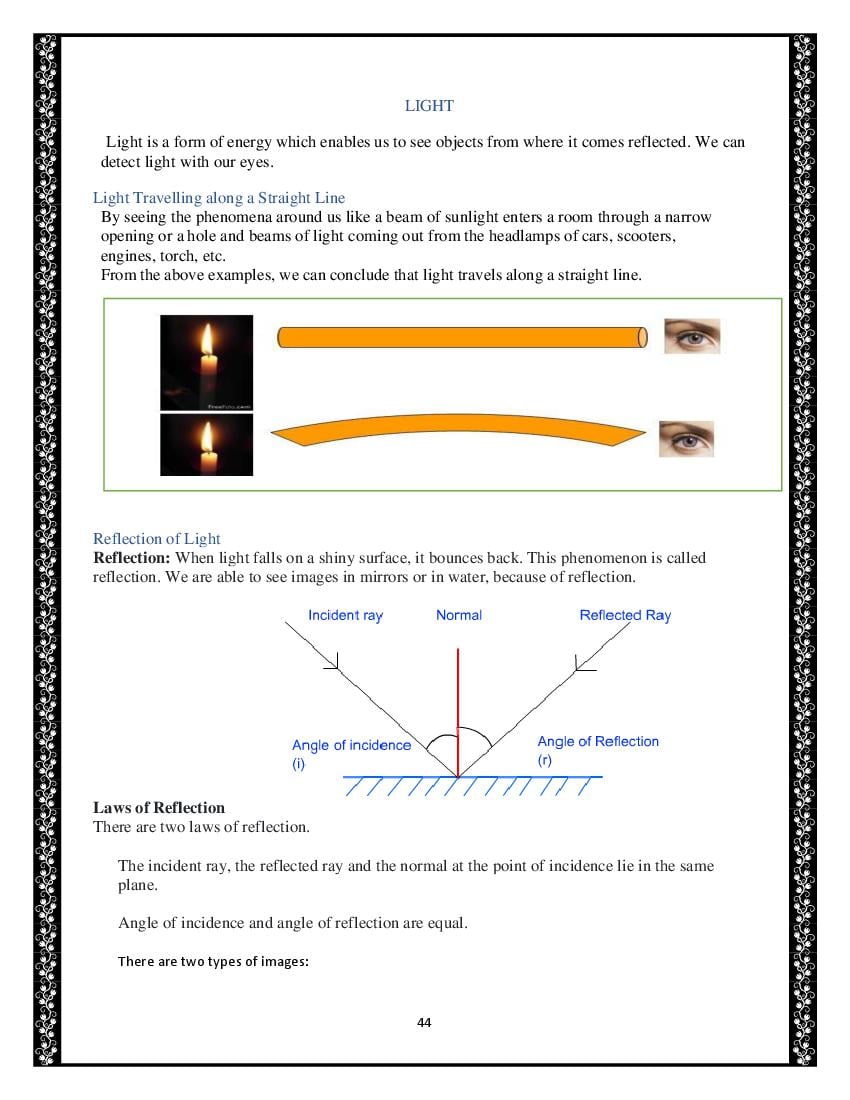
Light is a naturally occurring substance that enhances vision and makes objects visible.
Light follows a straight path.
A mirror can be made out of any polished or gleaming surface.
A true image is one that can be obtained on a computer screen. It's made up of light rays
that pass through the screen.
A virtual image is an image that cannot be obtained on a screen. It's made up of light rays
that appear to travel right through the screen.
A planar mirror produces an erect picture. It's a virtual object that's the same size as the
real thing. The picture behind the mirror is the same size as the object in front of it.
KVS ZIET CHD Class VII-Science 2023-24 Page 63
Page 3
right side of the object appears on the left side of the picture.
A true and inverted image can be created via a concave mirror. The picture generated
when the object is put very close to the mirror is virtual, erect, and enlarged.
A convex mirror is one that curves outwards and has a convex reflecting surface. The
image that is created is virtual, upright, and shrunk. A convex mirror creates an image
that is upright, virtual, and smaller in size than the object.
A concave lens is one that has a thinner centre than it has at the edges. It's a convergent
lens. The resulting image is imaginary, erect, and shrunken.
A convex lens can create both a true and a distorted image. The image generated when
the object is put very close to the lens is virtual, erect, and enlarged. The convex lens is
known as a magnifying glass when it is used to magnify objects.
White light is made up of seven different colours.
Properties of Light:
1. Rectilinear Propagation of Light: The quality of light that allows it to move in a straight
line in any direction. The direction in which light travels to form a ray.
2. Light Reflection: This is the phenomenon of light rebounding back after striking an
object's surface. Smooth, gleaming surfaces reflect nearly all of the light.
3. Dispersion: The breaking of white light into its seven colours is referred to as dispersion.
Violet, Indigo, Blue, Green, Yellow, Orange, and Red (VIBGYOR) hues make up white
light.
KVS ZIET CHD Class VII-Science 2023-24 Page 64
Page 4
FOREST OUR LIFE LINE
Deforestation
Clearing of forests and trees eventually using that land for other purposes like agriculture and
other human activities. The main causes for deforestation are:
(i) agricultural expansion
(ii) livestock grazing
(iii) Illegal logging, which is cutting, processing of trees in prohibited land.
(iv) human infrastructure expansion
(v) overpopulation
Consequences of Deforestation
(i) The source of conversion of carbon dioxide to oxygen is reduced. Plants use photosynthesis to
convert carbon dioxide to oxygen. This process leads to Global Warming.
(ii) Pollution increases as there is a decrease of plants, which give out fresh air to breathe.
(ii) Ground water level also gets lowered. Desertification and droughts are the results of
deforestation.
Wildlife Conservation
Conservation of forest and wildlife
Many NGO’s are working towards creating public awareness for conserving depleting
forest cover and vanishing wildlife.
Central and state governments in India have set up national parks and wildlife sanctuaries
to protect forests and endangered species in wildlife.
Species
Species is a group of populations, which are capable of interbreeding (reproducing fertile
offspring).
Flora and fauna
The plants and animals observed in a specific region are referred to as flora and fauna of that
region.
Biosphere Reserves
Biosphere and Biodiversity
Biosphere is that part of the earth in which living organisms exist and is a sum of all the
ecosystems.
Biodiversity, refers to the variety of organisms existing on the earth, their
interrelationships and their relationship with the environment.
Endemic species
Endemic species are species of plants and animals that are exclusively found only in a particular
region or area.
KVS ZIET CHD Class VII-Science 2023-24 Page 65
Page 5
(i) Biosphere Reserve- Large areas which conserve biodiversity and civilization of that region.
They preserve and protect tribal groups in addition to wildlife. Eg: Pachmarhi Biosphere
Reserve.
(ii) Zoo- Wild animals are kept for research, preservation and also for public exhibition and
tourism. Eg: Mysore zoo, Indira Gandhi zoological park.
(iii) National Park- Reserved habitats for both flora and fauna especially endangered species.
National parks cover large areas where animals can freely move around. E.g. Gir forest national
park, Periyar national park.
(iv) Sanctuary- Sanctuaries are largely protected habitats for animals. E.g. Krishna wildlife
sanctuary.
Recycling of Paper
Paper is recycled so that more trees do not have to be cut down to create more paper. It is
important that we conserve trees and reduce the use of paper as much as possible.
Reforestation
Reforestation is restoring of the cleared or destroyed forests by planting new trees.
Extinction
Extinction is the dying out or death of all members of a species.
Human intervention (either directly or indirectly) has become the leading cause of species
extinction.
Eg: Animals like the Dodo bird, Tasmanian wolf are extinct.
Endangered animals
Animals whose count is reducing to an extent that they might face extinction are known as the
endangered animals. Eg: Giant panda, tiger. Red Data Book is a source (reference) book, keeping
a record of all the plant and animals that are endangered.
Ecosystem
Ecosystem is the region consisting of all the living plants, animals and microorganisms in an area
along with non-living components such as climate, soil, river deltas, etc.
Migration
Migration is defined as the movement of organisms in large numbers from one place to another.
KVS ZIET CHD Class VII-Science 2023-24 Page 66
Page 6
Notes
Model Papers Class 6 Notes
Sample Papers Class 7 Notes
Half Yearly Sample Papers Class 8 Notes
Class 9 Notes
Important Resources
Class 10 Notes
Periodic Table
Class 11 Notes
Writing Skills / Formats
Maps of India / World Class 12 Notes
Books and Solutions
NCERT Books
NCERT Book Solutions
HC Verma Chapter Wise Solutions
RD Sharma Solutions
CGBSE Solutions
Document Details
| Board / Org | Aglasem |
| Exam | Class 7 |
| Type | Notes |
| Pages | 9 |
| Language | english |
| Updated | 30 Apr 2026 |