MBOSE Class 12 Question Paper 2021 for Physics
Finished viewing? Save it for later —
Download MBOSE Class 12 Question Paper 2021 for Physics (PDF · 23 pages)About MBOSE Class 12 Question Paper 2021 for Physics
MBOSE Class 12 Question Paper 2021 for Physics is available here for free download. Published by Meghalaya Board for Class 12, this question paper can be viewed online or downloaded as a PDF (23 pages). Candidates preparing for Class 12 can use MBOSE Class 12 Question Paper 2021 for Physics to understand the exam pattern, the type of questions asked, and the overall difficulty level.
Frequently Asked Questions
How can I download MBOSE Class 12 Question Paper 2021 for Physics?
Open this page and click the Download button to save MBOSE Class 12 Question Paper 2021 for Physics as a PDF. It is completely free on AglaSem Docs.
Is MBOSE Class 12 Question Paper 2021 for Physics free to download?
Yes. MBOSE Class 12 Question Paper 2021 for Physics can be viewed online and downloaded as a PDF free of cost on AglaSem Docs.
How many pages does MBOSE Class 12 Question Paper 2021 for Physics have?
MBOSE Class 12 Question Paper 2021 for Physics contains 23 pages, which you can read online or download together as a single PDF.
Where can I find more Class 12 study material?
You can find more Class 12 question papers, sample papers, syllabus, and answer keys on AglaSem Docs.
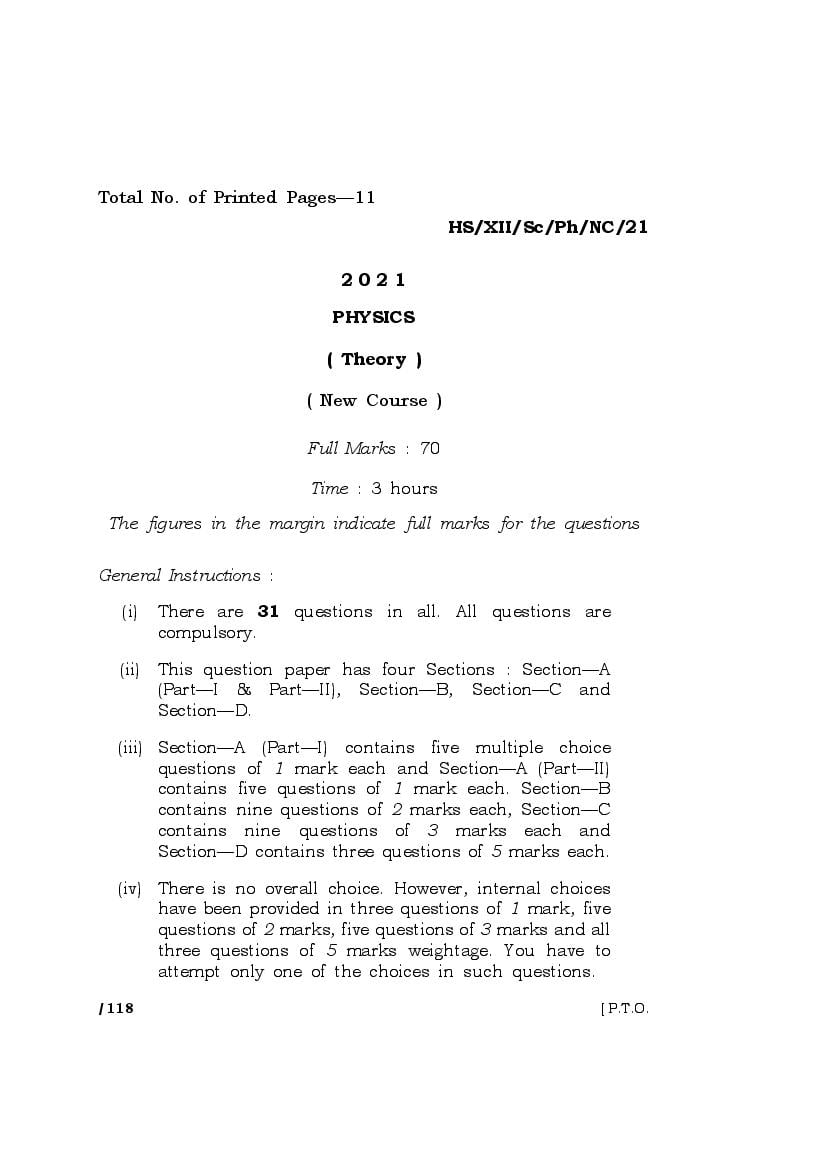
MBOSE Class 12 Question Paper 2021 for Physics – Text
Read the full text of this question paper below — useful to quickly search, copy and reference the content online without downloading the PDF.
📄 View text version (23 pages)
Page 1
HS/XII/Sc/Ph/NC/21
2021
PHYSICS
( Theory )
( New Course )
Full Marks : 70
Time : 3 hours
The figures in the margin indicate full marks for the questions
General Instructions :
(i) There are 31 questions in all. All questions are
compulsory.
(ii) This question paper has four Sections : Section—A
(Part—I & Part—II), Section—B, Section—C and
Section—D.
(iii) Section—A (Part—I) contains five multiple choice
questions of 1 mark each and Section—A (Part—II)
contains five questions of 1 mark each. Section—B
contains nine questions of 2 marks each, Section—C
contains nine questions of 3 marks each and
Section—D contains three questions of 5 marks each.
(iv) There is no overall choice. However, internal choices
have been provided in three questions of 1 mark, five
questions of 2 marks, five questions of 3 marks and all
three questions of 5 marks weightage. You have to
attempt only one of the choices in such questions.
/118 [ P.T.O.
Page 2
(v) You may use the following values of physical constants,
wherever necessary :
c = 3 ×10⁸ m/s
h = 6·63 × 10–34 J s
e = 1·6 × 10–19 C
0 = 4 × 10⁻⁷ T m A–1
0 = 8·854 × 10–12 C2 N–1 m–2
me = 9·1 × 10–31 kg
Mass of neutron = 1·675 × 10–27 kg
Mass of proton = 1·673 × 10–27 kg
Avogadro’s number = 6·023 × 1023 per gram mole
Boltzmann constant = 1·38 × 10–23 J K–1
SECTION—A
PART—I
( Multiple choice type questions )
Choose the correct option from the following : 1×5=5
1. A soap bubble is given some charge. Its radius
(A) increases
(B) increases if the charge is positive
(C) decreases if the charge is negative
(D) is not affected 1
HS/XII/Sc/Ph/NC/21/118 [ Contd.
Page 3
2. Drift velocity of free electrons, when current passes
through the conductor, is of the order of
(A) 10 mm/s
(B) 10 m/s
(C) 10 km/s
(D) 106 m/s 1
3. A charged particle is projected along the magnetic field
line. Magnetic force on the particle is
(A) perpendicular to the velocity only
(B) perpendicular to the magnetic field only
(C) perpendicular to both the velocity and magnetic
field
(D) zero 1
4. The energy of a photon of wavelength is
(A) hc
(B) hc /
(C) h / c 2
(D) h 1
5. The energy required to remove an electron from the
n = 2 state of hydrogen atom is
(A) 27·2 eV
(B) 13·6 eV
(C) 6·8 eV
(D) 3·4 eV 1
HS/XII/Sc/Ph/NC/21/118 [ P.T.O.
Page 4
PART—II
( Very short answer type questions )
Answer each of the following questions in 1 sentence/step :
1×5=5
6. Either
What is the cause of internal resistance of a cell? 1
Or
Why is a slide wire bridge also called meter bridge? 1
7. Induced e.m.f. is sometimes known as back e.m.f.
Why? 1
8. Either
Draw a ray diagram to show that a totally reflecting
prism deviates a ray through 180°. 1
Or
Draw the ray diagram showing the formation of primary
rainbow with the total internal reflection and refraction
of a ray of light inside a water drop. 1
9. Either
Calculate the frequency associated with a photon of
energy 3·3 1020 J . 1
Or
The threshold frequency of a material is 2 1014 Hz.
What is its work function? 1
10. What would happen, if the electrons in an atom were
stationary? 1
HS/XII/Sc/Ph/NC/21/118 [ Contd.
Page 5
SECTION—B
( Short answer type–I questions )
Answer each of the following questions within 20 to 30 words,
wherever applicable : 2×9=18
11. Calculate the resistivity of the material of a wire 1·0 m
long, 0·4 mm in diameter and having a resistance
of 2·0 . 2
12. Either
Using Ampere’s circuital theorem, calculate the
magnetic field due to an infinitely long wire carrying a
current I. 2
Or
Write an expression for the force per unit length
between two infinitely long straight parallel current
carrying wires. Hence define 1 ampere. 1+1=2
13. Either
What are eddy currents and how can they be
minimised? 1+1=2
Or
What is a transformer? State its principle. 1+1=2
14. Name the part of the electromagnetic spectrum whose
wavelength lies in the range 10–10 m. Give its one use.
1+1=2
HS/XII/Sc/Ph/NC/21/118 [ P.T.O.
Page 6
15. Either
The amplitude of the magnetic field of a harmonic
electromagnetic wave in vacuum is B0 = 510 nT. What is
the amplitude of the electric field part of the wave? 2
Or
Electromagnetic waves travel in a medium with a speed
of 2 108 m/s . The relative permeability of the medium
is 1. Find the relative permittivity. 2
16. Either
What are the conditions necessary for total internal
reflection to take place? 2
Or
State the assumptions on which Huygens’ principle of
secondary wavelets is based. 2
17. Either
Prove that the nuclear density is same for all nuclei and
is independent of its mass number A. 2
Or
Define atomic mass unit (a.m.u.). Show that
1 a.m.u. = 931 MeV. ½+1½=2
18. Differentiate between intrinsic and extrinsic semi-
conductors. 2
19. With the help of a circuit diagram, explain the use of
junction diode as a half-wave rectifier. 1+1=2
HS/XII/Sc/Ph/NC/21/118 [ Contd.
Page 7
SECTION—C
( Short answer type–II questions )
Answer each of the following questions within 30 to 40 words,
wherever applicable : 3×9=27
20. Either
Deduce the expression for the electric potential due to
a point charge. 3
Or
Obtain the expression for the electric field at any point
on the axial line of an electric dipole. 3
21. State and explain Kirchhoff’s laws. 3
22. Either
Apply Biot-Savart law to derive an expression for
the magnetic field at the centre of a current carrying
circular loop. 3
Or
Derive an expression for the magnetic dipole moment
of an electron revolving around a nucleus. 3
23. (a) Why are pole pieces of a magnet within a
galvanometer made concave? 1
(b) Name the elements of earth’s magnetic field. 1
(c) Write the expression for Lorentz force. 1
HS/XII/Sc/Ph/NC/21/118 [ P.T.O.
Page 8
24. Either
1 1 1
For a concave lens, show that , the symbols
v u f
having their usual meanings. 3
Or
Derive the laws of reflection of light on the basis of
Huygens’ wave theory of light. 3
25. Either
Refractive indices of water and glass are 4/3 and 3/2
respectively. A ray of light travelling in water is incident
on the water-glass interface at 30°. Calculate the angle
of refraction. 3
Or
A ray of light suffers minimum deviation while passing
through a prism of refractive index 1·5 and refracting
angle 60°. Calculate—(a) the angle of deviation and
(b) the angle of incidence. 2+1=3
26. A metal has a threshold wavelength of 6000 Å.
Calculate—
(a) threshold frequency;
(b) the work function. 1½+1½=3
27. Differentiate between nuclear fission and nuclear fusion
with examples. 3
HS/XII/Sc/Ph/NC/21/118 [ Contd.
Page 9
28. Either
What is meant by the term ‘doping’? Mention the
various methods of doping and explain them in brief.
1+2=3
Or
What is dark current? Explain the working principle of
a photodiode. Give two important uses of photodiodes.
1+1+1=3
SECTION—D
( Long answer type questions )
Answer each of the following questions within 70 to 80 words,
wherever applicable : 5×3=15
29. Either
(a) Obtain the expression for the energy stored in a
charged parallel-plate capacitor. 2
(b) The graph shows the variation of voltage V across
the plates of two capacitors A and B versus increase
of charge Q stored on them. Which of the two
capacitors has higher capacitance? Give reason for
your answer : 2
HS/XII/Sc/Ph/NC/21/118 [ P.T.O.
Page 10
(c) Explain the meaning of the statement “electric
charge is quantised”. 1
Or
(a) Obtain the expression for the capacitance of a
parallel-plate capacitor when the space between
the plates is filled with a medium of dielectric
constant k. 3
(b) Why two electric lines of force cannot intersect
each other? 1
(c) What does q1 q 2 0 signify in electrostatics? 1
30. Either
(a) Define r.m.s. value or virtual value of an alternating
current. Derive a relation between r.m.s. value and
its peak value. 1+3=4
(b) An electrical device has the following ratings printed
on it :
60 W, 220 V, 50 Hz.
What is the meaning of these numbers? 1
Or
Using the phasor diagram, derive an expression for the
impedance of a series LCR circuit. What is the resonant
condition in series LCR circuit? 4+1=5
HS/XII/Sc/Ph/NC/21/118 [ Contd.
Page 11
31. Either
Obtain an expression for the refractive index of the
material of the prism in terms of the angle of the prism
and the angle of minimum deviation. 5
Or
Show that the fringe width is given by
D
d
where D is the distance between the source and the
screen, is the wavelength of light and d is the distance
between the two sources. 5
HS/XII/Sc/Ph/NC/21/118 11-21—5350
Page 12
HS/XII/Sc/Ph/OC/21
2021
PHYSICS
( Theory )
( Old Course )
Full Marks : 70
Time : 3 hours
The figures in the margin indicate full marks for the questions
General Instructions :
(i) All questions are compulsory.
(ii) All the answers are to be written in the Answer Script.
(iii) Internal choices have been provided for one question
of 1 mark, five questions of 2 marks, five questions of
3 marks and all questions of 5 marks.
(iv) Use of non-programmable ordinary scientific calculator
and/or logarithmic table is allowed.
(v) Use of Mobile Phones, Pagers and such other
electronic gadgets is not allowed in the Examination
Hall.
/119 [ P.T.O.
Page 13
(vi) Use the following values of physical constants,
wherever necessary :
Speed of light in vacuum, c 3 108 m s 1
Planck’s constant, h 6 63 1034 J s
Permittivity of free space,
0 8 86 1012 C2 N1 m2
Permeability of free space, 0 4 10 7 T m A 1
Mass of electron, me 9 11 10 31 kg
Mass of proton, m p 1 67 1027 kg
Electronic charge, e 1 6 1019 C
GROUP—A
( Multiple choice type questions )
Choose and write the correct option for the following : ½×8=4
1. Force between two stationary charges, when placed in
free space is 10 N. If they are placed in a medium of
relative permittivity 5, the force between them is
(A) 50 N
(B) 2 N
(C) 0·5 N
(D) 10 N
HS/XII/Sc/Ph/OC/21/119 [ Contd.
Page 14
2. A 900 pF capacitor is charged by a 100 V battery. How
much electrostatic energy is stored by the capacitor?
(A) 9 10 8 J
(B) 4 5 106 J
(C) 2 2 106 J
(D) 9 10 10 J
3. At the poles, the angle of dip is
(A) 45º
(B) 30º
(C) 0º
(D) 90º
4. An example of ferromagnetic material is
(A) aluminium
(B) nickel
(C) gold
(D) copper
HS/XII/Sc/Ph/OC/21/119 [ P.T.O.
Page 15
5. The fringe width () in a typical Young’s double-slit
experiment varies with the wavelength of light () as
(A)
(B) 2
1
(C)
1
(D) 2
6. Which of the following phenomena is used in optical
fibres?
(A) Total internal reflection
(B) Scattering
(C) Diffraction
(D) Dispersion
7. In an LCR-circuit, capacitance is changed from C to 2C.
For the resonant frequency to remain unchanged, the
inductance should be changed from L to
(A) 4L
(B) 2L
L
(C)
2
L
(D)
4
HS/XII/Sc/Ph/OC/21/119 [ Contd.
Page 16
8. In an a.c. circuit, the voltage applied is E E 0 sin t .
The resulting current in the circuit is I I 0 sin t .
2
The power consumption in the circuit is given by
(A) p 2E0I 0
I E
(B) p 0 0
2
(C) p 0
I E
(D) p 0 0
2
GROUP—B
( Very short answer type questions )
Answer the following questions in one sentence/step each :
1×8=8
9. Either
For a cell, the terminal potential difference is 2·2 V when
the circuit is open and reduces to 1·8 V when the cell
is connected to a resistor of resistance 5. What is the
internal resistance of the cell? 1
Or
A current of 3·0 A flows through a 5 resistor. What is
the rate at which heat is produced in the resistor? 1
10. State the principle of a Wheatstone bridge. 1
11. What is dark current? 1
HS/XII/Sc/Ph/OC/21/119 [ P.T.O.
Page 17
12. Name the device used for data transmission from one
computer to another. 1
13. Write two uses of optical fibres. 1
14. Mention two advantages of optical communication. 1
15. Distinguish between analog and digital signals. 1
16. Define work function of a metal. 1
GROUP—C
( Short answer type–I questions )
Answer the following questions within 30 words each,
wherever applicable : 2×8=16
17. Either
What is copper loss in a transformer? How can you
minimize copper loss? 1+1=2
Or
State Faraday’s laws of electromagnetic induction. 2
18. Either
If the rate of change of current of 4 A/s induces an e.m.f
of 20 mV in a solenoid, what is self-inductance of the
solenoid? 2
Or
What is the self-inductance of an air-core solenoid,
50 cm long and of 2 cm radius if it has 500 turns? 2
HS/XII/Sc/Ph/OC/21/119 [ Contd.
Page 18
19. Either
Two point charges of 5 1019 C and 20 1019 C are
separated by a distance of 2 m. Find the point on the
line joining them at which the electric field intensity is
zero. 2
Or
Four capacitors are connected as shown in the figure :
Calculate the equivalent capacitance between the points
X and Y. 2
20. Either
Show that the volume of a nucleus is directly
proportional to its mass number. 2
Or
Find the binding energy of an -particle in MeV.
(take, 1 a.m.u. = 931·5 MeV);
Given that—
mass of 2He4 = 4·00150 a.m.u.
mass of proton = 1·00728 a.m.u.
mass of neutron = 1·00867 a.m.u. 2
21. What is magnetic moment? Write the expression for the
magnetic moment when an electron revolves at a speed
v around an orbit of radius r in hydrogen atom. 1+1=2
22. Write the truth table of NOR gate. 2
HS/XII/Sc/Ph/OC/21/119 [ P.T.O.
Page 19
23. Either
What is amplitude modulation? Represent the same
graphically. 1+1=2
Or
Explain briefly any two reasons that make modulation
necessary for communication. 1+1=2
24. Draw a circuit diagram of a common-emitter transistor
amplifier. 2
GROUP—D
( Short answer type–II questions )
Answer the following questions within 30 to 40 words each,
wherever applicable : 3×9=27
25. Either
State the two Kirchhoff’s laws. With the help of a neat
diagram, deduce the condition for balance in a Wheat-
stone’s bridge by applying Kirchhoff’s laws. 1+2=3
Or
State the principle of potentiometer. With the help of a
neat diagram, explain how a potentiometer is used to
find the internal resistance of a cell. 1+2=3
26. (a) Using the expression of drift velocity (v d ) , and
me
current (I ), show that R , where the
ne2A
symbols have their usual meanings. 2
(b) How does conductivity vary with relaxation time? 1
HS/XII/Sc/Ph/OC/21/119 [ Contd.
Page 20
27. Either
(a) What are electromagnetic waves? 1
(b) How are electromagnetic waves produced? 1
(c) Write one important characteristic of electro-
magnetic waves. 1
Or
(a) Write the expression of the speed of electro-
magnetic waves in free space. 1
(b) Using the expression of the speed of electro-
magnetic waves, show that it is equal to the speed
of light in vacuum. 1
(c) Write two uses of X-rays. 1
28. Either
Write down the condition of resonance in a series
L-C-R circuit and hence find an expression for the
resonant frequency. Also draw the resonance curve in
L-C-R circuit for two values of R. 1+1+1=3
Or
Explain the principle and working theory of A.C.
generator. 3
29. Either
In Young’s double-slit experiment, show that the fringe
D
width for interference fringes is , where the
d
symbols have their usual meanings. 3
Or
Draw a labelled diagram to show the image formation at
the least distance of distinct vision due to a compound
microscope and hence calculate its magnifying power.
1+2=3
HS/XII/Sc/Ph/OC/21/119 [ P.T.O.
Page 21
30. (a) Show that the de Broglie wavelength of an electron
of kinetic energy E is given by
h
,
2mE
where m is the mass of the electron and h is
Planck’s constant. 2
(b) You are given a proton and an electron with same
kinetic energy E. Which one has more de Broglie
wavelength? 1
31. Either
(a) Define the terms ‘depletion layer’ and ‘potential
barrier’ of a p-n junction diode. ½+½=1
(b) With the help of a circuit diagram, explain how a
Zener diode can be used as a voltage regulator. 2
Or
(a) What is a rectifier? What is the principle of a
rectifier? ½+½=1
(b) With the help of a circuit diagram, explain the
working of a p-n junction diode as a half-wave
rectifier. 2
32. Obtain an expression for the radius of the nth orbit of
a revolving electron from Bohr’s theory. 3
33. Write a mathematical expression for radioactive decay
law. Hence derive an expression for number of nuclei in
a radioactive sample at a time t in terms of the original
number at time, t = 0. 1+2=3
HS/XII/Sc/Ph/OC/21/119 [ Contd.
Page 22
GROUP—E
( Long answer type questions )
Answer the following questions in 70 to 80 words each,
wherever applicable : 5×3=15
34. Either
Applying Gauss’s law in electrostatics, obtain an
expression for the electric field intensity at a point near
an infinitely large plane sheet. Use the same to derive
an expression for the capacitance of a parallel-plate
capacitor. 3+2=5
Or
Derive an expression for the electric potential due to a
dipole at a point on the line
making an angle with the
electric dipole moment p . Hence, find the potential if
the point lies on—
(a) axial line;
(b) equatorial line. 4+½+½=5
35. Either
Write Biot-Savart law in scalar form. Use this law to find
the magnitude of the magnetic field due to a circular coil
carrying current (I ) at a point along its axis. How does
a circular loop carrying current (I ) behave as a
magnet? 1+3+1=5
Or
State Ampere’s circuital law. Use the law to find the
magnitude of the magnetic field inside a long, straight,
air-cored solenoid. Also write the expressions for the
magnitude of magnetic field (a) at the points near the
ends of the solenoid and (b) inside the solenoid when it
is iron-cored. 1+3+1=5
HS/XII/Sc/Ph/OC/21/119 [ P.T.O.
Page 23
36. Either
Using the relation for refraction at a single spherical
refracting surface, derive the lense-maker’s formula. 5
Or
Given that i and e are the angles of incidence and
emergence respectively for rays refracted through a
prism of angle A, obtain the condition for minimum
deviation in terms of i and e. Using the same, show that
the refractive index of the material of the prism is
given by
A m
sin
2
A
sin
2
where m is the angle of minimum deviation. 5
HS/XII/Sc/Ph/OC/21/119 11–21—1020
Document Details
| Board / Org | Meghalaya Board |
| Exam | Class 12 |
| Type | Question Paper |
| Pages | 23 |
| Updated | 30 Apr 2026 |