MBOSE Class 12 Question Paper 2021 for Political Science
Finished viewing? Save it for later —
Download MBOSE Class 12 Question Paper 2021 for Political Science (PDF · 11 pages)About MBOSE Class 12 Question Paper 2021 for Political Science
MBOSE Class 12 Question Paper 2021 for Political Science is available here for free download. Published by Meghalaya Board for Class 12, this question paper can be viewed online or downloaded as a PDF (11 pages). Candidates preparing for Class 12 can use MBOSE Class 12 Question Paper 2021 for Political Science to understand the exam pattern, the type of questions asked, and the overall difficulty level.
Frequently Asked Questions
How can I download MBOSE Class 12 Question Paper 2021 for Political Science?
Open this page and click the Download button to save MBOSE Class 12 Question Paper 2021 for Political Science as a PDF. It is completely free on AglaSem Docs.
Is MBOSE Class 12 Question Paper 2021 for Political Science free to download?
Yes. MBOSE Class 12 Question Paper 2021 for Political Science can be viewed online and downloaded as a PDF free of cost on AglaSem Docs.
How many pages does MBOSE Class 12 Question Paper 2021 for Political Science have?
MBOSE Class 12 Question Paper 2021 for Political Science contains 11 pages, which you can read online or download together as a single PDF.
Where can I find more Class 12 study material?
You can find more Class 12 question papers, sample papers, syllabus, and answer keys on AglaSem Docs.
MBOSE Class 12 Question Paper 2021 for Political Science – Text
Read the full text of this question paper below — useful to quickly search, copy and reference the content online without downloading the PDF.
📄 View text version (11 pages)
Page 1
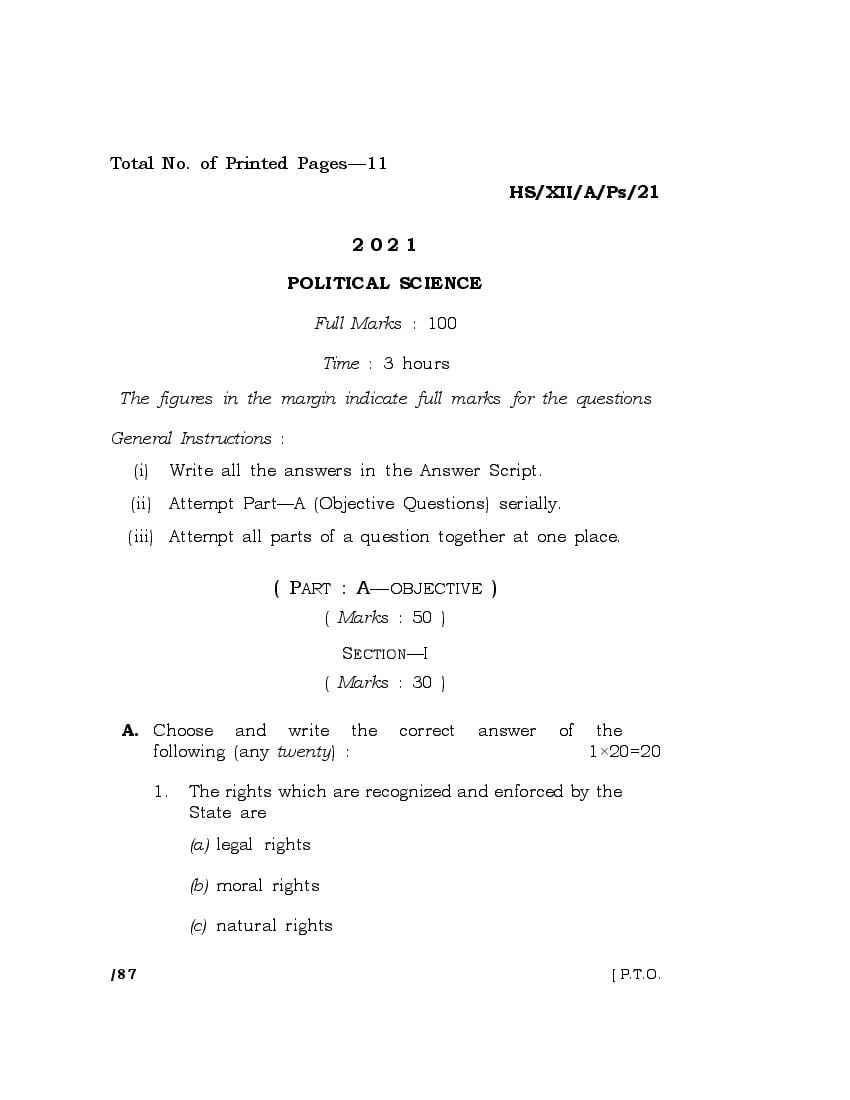
HS/XII/A/Ps/21
2021
POLITICAL SCIENCE
Full Marks : 100
Time : 3 hours
The figures in the margin indicate full marks for the questions
General Instructions :
(i) Write all the answers in the Answer Script.
(ii) Attempt Part—A (Objective Questions) serially.
(iii) Attempt all parts of a question together at one place.
( PART : A—OBJECTIVE )
( Marks : 50 )
SECTION—I
( Marks : 30 )
A. Choose and write the correct answer of the
following (any twenty) : 1×20=20
1. The rights which are recognized and enforced by the
State are
(a) legal rights
(b) moral rights
(c) natural rights
/87 [ P.T.O.
Page 2
2. The rights which are essential conditions of a
civilized social life are
(a) economic rights
(b) civil rights
(c) political rights
3. The right to vote is a
(a) civil right
(b) political right
(c) social right
4. The term ‘liberty’ was drawn from the original word
taken from
(a) Latin
(b) English
(c) Greek
5. Freedom from fear of starvation implies
(a) political liberty
(b) social liberty
(c) economic liberty
HS/XII/A/Ps/21/87 [ Contd.
Page 3
6. The equality before law falls in the category of
(a) legal equality
(b) political equality
(c) economic equality
7. Which one of the following is not a source of law?
(a) Custom
(b) Religion
(c) Superstition
8. Which of the following is regarded as the supreme
law of the land?
(a) Ordinary law
(b) Constitutional law
(c) Natural law
9. Adult suffrage is a system of franchise where
(a) all adult male citizens have the right to vote
(b) all adult female citizens have the right to vote
(c) all adult male and female citizens have the right
to vote
HS/XII/A/Ps/21/87 [ P.T.O.
Page 4
10. One of the features of Marxism is
(a) class struggle
(b) class cohesion
(c) class organization
11. Which one of the following is not the theory of
Karl Marx?
(a) Theory of Dialectical Materialism
(b) Theory of Surplus Value
(c) Theory of Separation of Powers
12. The UN was launched on
(a) 24th August, 1945
(b) 24th October, 1945
(c) 25th October, 1945
13. The deliberative organ of the United Nations is the
(a) UN General Assembly
(b) UN Security Council
(c) UN Secretariat
HS/XII/A/Ps/21/87 [ Contd.
Page 5
14. The Fundamental Rights in the Indian Constitution
is found in
(a) Part III
(b) Part IV
(c) Part V
15. Which Article of the Constitution deals with
‘protection of life and personal liberty’?
(a) Article 20
(b) Article 21
(c) Article 22
16. The Indian Fundamental Duties are
(a) justiciable
(b) enforceable
(c) non-enforceable
17. The objective of the Directive Principles of State
Policy is to establish a
(a) welfare State
(b) socialist State
(c) totalitarian State
HS/XII/A/Ps/21/87 [ P.T.O.
Page 6
18. If the Office of the President of India falls vacant,
who becomes the acting President?
(a) The Chief Justice of India
(b) The Vice President of India
(c) The Speaker of the Lok Sabha
19. The oath of Office to the President is administered
by the
(a) Prime Minister of India
(b) Vice President of India
(c) Chief Justice of India
20. The Union Council of Ministers holds Office as long
as it enjoys the
(a) confidence of the Lok Sabha
(b) confidence of the Rajya Sabha
(c) confidence of the President
21. The Prime Minister of India is the
(a) head of the State
(b) head of the Government
(c) head of the Rajya Sabha
HS/XII/A/Ps/21/87 [ Contd.
Page 7
22. A Money Bill can be introduced only in
(a) the Lok Sabha
(b) the Rajya Sabha
(c) both the Houses
23. The Quorum in the Sessions of the Lok Sabha or
the Rajya Sabha should be
1
(a)
10
1
(b)
12
1
(c)
3
24. The disputes between two States in the Indian
Union is covered by the Supreme Court’s
(a) advisory jurisdiction
(b) appellate jurisdiction
(c) original jurisdiction
25. India’s main issue for reforms of the United Nations
is related to
(a) reconstruction of the Security Council
(b) reconstruction of the General Assembly
(c) expansion of the Secretary-General’s role
HS/XII/A/Ps/21/87 [ P.T.O.
Page 8
B. Write whether the following statements are True or
False (any ten) : 1×10=10
1. Every right has its corresponding duty.
2. Liberty means freedom of doing anything.
3. Political equality means that all the citizens who
have attained the prescribed age limit has the right
to vote.
4. A law passed by the legislature deals only with the
external human conduct.
5. Marxism advocated the abolition of private property.
6. The headquarters of the International Court of
Justice is in the Hague.
7. The Fundamental Rights are absolute.
8. The Directive Principles need legislation for their
application.
9. The Indian President can dissolve the Rajya Sabha.
10. The Indian Parliament is a bicameral legislature.
11. A judge of the Supreme Court of India retires at the
age of 62.
12. Non-Aligned Movement was launched in the
year 1961.
SECTION—II
( Marks : 20 )
C. Answer the following questions in about 2 or 3
sentences each (any ten) : 2×10=20
1. What are the two characteristics of rights?
HS/XII/A/Ps/21/87 [ Contd.
Page 9
2. Give two reasons why people obey laws.
3. What is the negative and positive meaning of
liberty?
4. What is meant by political liberty?
5. What is the view of Karl Marx about the State?
6. Name at least four States enjoying Veto Power in the
Security Council.
7. Give only two aims of the UN Charter.
8. Mention the two Writs issued by the Supreme Court
for the enforcement of Fundamental Rights.
9. State two differences between the Fundamental
Rights and the Directive Principles.
10. Indicate only two Fundamental Duties of the Indian
citizens.
11. What are the three types of Emergency proclaimed
by the President of India?
12. What are the two main powers and functions of
the Speaker of the Lok Sabha?
13. Mention only two qualifications required for a judge
of the Supreme Court of India.
14. Name only two States who founded the Non-Aligned
Movement.
15. Give the full form of SAARC.
HS/XII/A/Ps/21/87 [ P.T.O.
Page 10
( PART : B—DESCRIPTIVE )
( Marks : 50 )
GROUP—A
( Political Theory )
Answer any three of the following questions : 10×3=30
1. Define rights. Explain the various kinds of rights.
2+8=10
2. What is the negative and positive meaning of
equality? Describe the kinds of equality. 2+8=10
3. Define law. Explain the kinds of law. 2+8=10
4. What is universal adult franchise? Elaborate
arguments for and arguments against universal
adult franchise. 2+8=10
5. Briefly explain the main features or tenets of
Marxism. 10
6. Describe the organization, powers and functions
either of the UN Security Council or the UN General
Assembly. 10
7. Write short notes on any two of the following :
5×2=10
(a) Relationship between Rights and Duties
(b) Relationship between Liberty and Equality
(c) Five basic principles of the United Nations
(d) Custom
(e) International Court of Justice
HS/XII/A/Ps/21/87 [ Contd.
Page 11
GROUP—B
( The Indian Constitution and the Political
System in Operation )
Answer any two of the following questions : 10×2=20
8. Enumerate the Fundamental Rights of the citizens
of India. 10
9. Describe the powers and functions of the Prime
Minister of India. 10
10. Explain the powers and functions of the
Rajya Sabha. 10
11. Describe the composition, powers and functions
of the Supreme Court of India. 2+8=10
12. Give an assessment of India’s relation with the
United Nations. 10
13. Write short notes on any two of the following :
5×2=10
(a) Gandhian Principles
(b) Legislative Powers of the President of India
(c) The Vice President of India
(d) Formation of the Union Council of Ministers
(e) The role of India in the NAM
HS/XII/A/Ps/21/87 11-21—27880
Document Details
| Board / Org | Meghalaya Board |
| Exam | Class 12 |
| Type | Question Paper |
| Pages | 11 |
| Updated | 30 Apr 2026 |