UGC NET 2021 Question Paper Comparative Study of Religions Shift 1
Finished viewing? Save it for later —
Download UGC NET 2021 Question Paper Comparative Study of Religions Shift 1 (PDF · 90 pages)About UGC NET 2021 Question Paper Comparative Study of Religions Shift 1
UGC NET 2021 Question Paper Comparative Study of Religions Shift 1 is available here for free download. Published by NTA for UGC National Eligibility Test, this question paper can be viewed online or downloaded as a PDF (90 pages). Candidates preparing for UGC National Eligibility Test can use UGC NET 2021 Question Paper Comparative Study of Religions Shift 1 to understand the exam pattern, the type of questions asked, and the overall difficulty level.
Frequently Asked Questions
How can I download UGC NET 2021 Question Paper Comparative Study of Religions Shift 1?
Open this page and click the Download button to save UGC NET 2021 Question Paper Comparative Study of Religions Shift 1 as a PDF. It is completely free on AglaSem Docs.
Is UGC NET 2021 Question Paper Comparative Study of Religions Shift 1 free to download?
Yes. UGC NET 2021 Question Paper Comparative Study of Religions Shift 1 can be viewed online and downloaded as a PDF free of cost on AglaSem Docs.
How many pages does UGC NET 2021 Question Paper Comparative Study of Religions Shift 1 have?
UGC NET 2021 Question Paper Comparative Study of Religions Shift 1 contains 90 pages, which you can read online or download together as a single PDF.
Where can I find more UGC National Eligibility Test study material?
You can find more UGC National Eligibility Test question papers, sample papers, syllabus, and answer keys on AglaSem Docs.
UGC NET 2021 Question Paper Comparative Study of Religions Shift 1 – Text
Read the full text of this question paper below — useful to quickly search, copy and reference the content online without downloading the PDF.
📄 View text version (90 pages)
Page 1
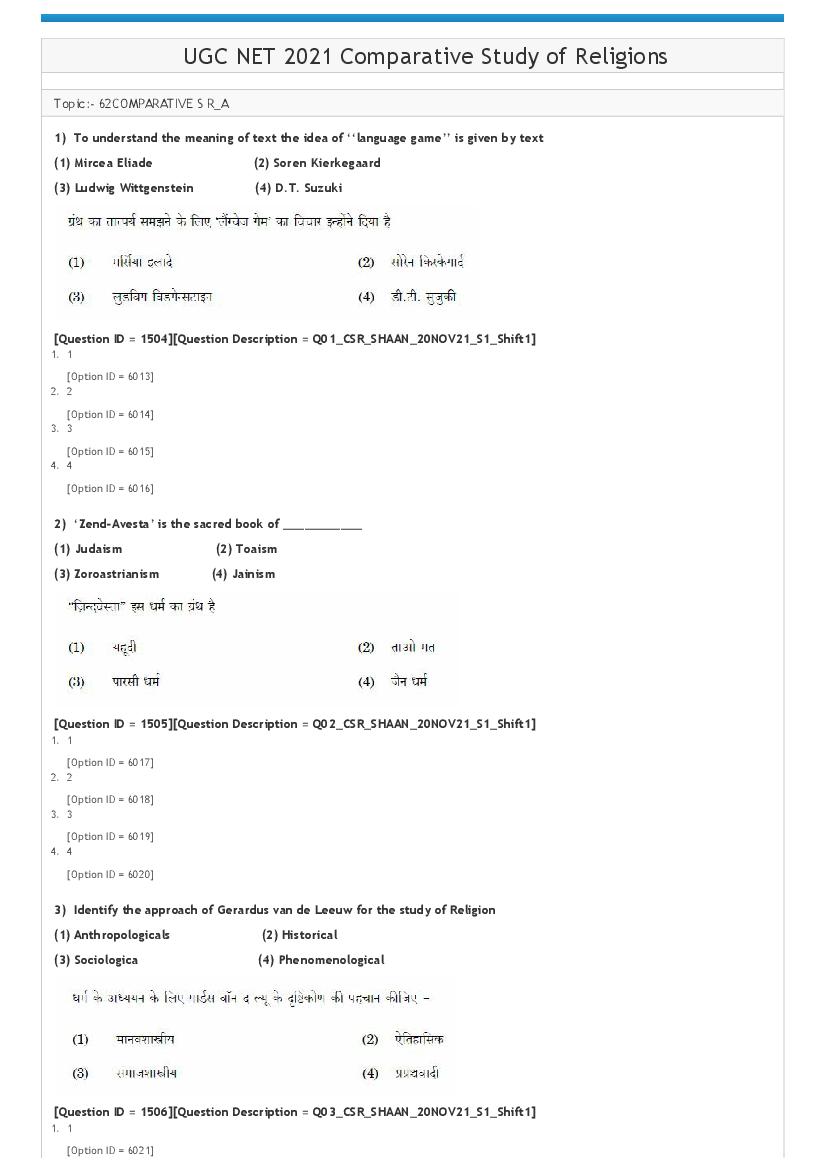
Topic:‐ 62COMPARATIVE S R_A
1) To understand the meaning of text the idea of ‘‘language game’’ is given by text
(1) Mircea Eliade (2) Soren Kierkegaard
(3) Ludwig Wittgenstein (4) D.T. Suzuki
[Question ID = 1504][Question Description = Q01_CSR_SHAAN_20NOV21_S1_Shift1]
[Option ID = 6013]
[Option ID = 6014]
[Option ID = 6015]
[Option ID = 6016]
2) ‘Zend‐Avesta’ is the sacred book of ___________
(1) Judaism (2) Toaism
(3) Zoroastrianism (4) Jainism
[Question ID = 1505][Question Description = Q02_CSR_SHAAN_20NOV21_S1_Shift1]
[Option ID = 6017]
[Option ID = 6018]
[Option ID = 6019]
[Option ID = 6020]
3) Identify the approach of Gerardus van de Leeuw for the study of Religion
(1) Anthropologicals (2) Historical
(3) Sociologica (4) Phenomenological
[Question ID = 1506][Question Description = Q03_CSR_SHAAN_20NOV21_S1_Shift1]
[Option ID = 6021]
Page 2
[Option ID = 6023]
[Option ID = 6024]
4) Idea of ‘Creative hermeneutics’ introduced by
(1) Friedrich Schleiemacher (2) Friedrich Nietzsche
(3) Mircea Eliade (4) Claude‐Levi‐Strauss
[Question ID = 1507][Question Description = Q04_CSR_SHAAN_20NOV21_S1_Shift1]
[Option ID = 6025]
[Option ID = 6026]
[Option ID = 6027]
[Option ID = 6028]
5)
[Question ID = 1508][Question Description = Q05_CSR_SHAAN_20NOV21_S1_Shift1]
[Option ID = 6029]
[Option ID = 6030]
[Option ID = 6031]
[Option ID = 6032]
6)
Page 3
[Option ID = 6033]
[Option ID = 6034]
[Option ID = 6035]
[Option ID = 6036]
7)
[Question ID = 1510][Question Description = Q07_CSR_SHAAN_20NOV21_S1_Shift1]
[Option ID = 6037]
[Option ID = 6038]
[Option ID = 6039]
[Option ID = 6040]
8)
[Question ID = 1511][Question Description = Q08_CSR_SHAAN_20NOV21_S1_Shift1]
[Option ID = 6041]
[Option ID = 6042]
[Option ID = 6043]
[Option ID = 6044]
9)
Page 4
[Option ID = 6045]
[Option ID = 6046]
[Option ID = 6047]
[Option ID = 6048]
10) ‘Nirjarā’’ is included in this group of Jain principles
(1) Six substances (2) Five vows
(3) Seven elements (4) Three jewels
[Question ID = 1513][Question Description = Q10_CSR_SHAAN_20NOV21_S1_Shift1]
[Option ID = 6049]
[Option ID = 6050]
[Option ID = 6051]
[Option ID = 6052]
11) The meaning of ‘‘Pudgala substance’’ in Jainism is
(1) Matter substance (2) Medium of rest
(3) Medium of motion (4) Jīva substance
[Question ID = 1514][Question Description = Q11_CSR_SHAAN_20NOV21_S1_Shift1]
[Option ID = 6053]
[Option ID = 6054]
[Option ID = 6055]
[Option ID = 6056]
12) Khajuraho is famous for –
(1) Jain manuscripts (2) Birth place of Neminātha
(3) Jain education centre (4) Architecture of ancient Jain temples
Page 5
[Option ID = 6057]
[Option ID = 6058]
[Option ID = 6059]
[Option ID = 6060]
13)
[Question ID = 1516][Question Description = Q13_CSR_SHAAN_20NOV21_S1_Shift1]
[Option ID = 6061]
[Option ID = 6062]
[Option ID = 6063]
[Option ID = 6064]
14)
[Question ID = 1517][Question Description = Q14_CSR_SHAAN_20NOV21_S1_Shift1]
[Option ID = 6065]
[Option ID = 6066]
[Option ID = 6067]
Page 6
15)
[Question ID = 1518][Question Description = Q15_CSR_SHAAN_20NOV21_S1_Shift1]
[Option ID = 6069]
[Option ID = 6070]
[Option ID = 6071]
[Option ID = 6072]
16) Identify the name of country having Mahayana tradition of Buddhism in practice
(1) Cambodia (2) Myanmar
(3) Bhutan (4) Sri Lanka
[Question ID = 1519][Question Description = Q16_CSR_SHAAN_20NOV21_S1_Shift1]
[Option ID = 6073]
[Option ID = 6074]
[Option ID = 6075]
[Option ID = 6076]
17) Identify the realisation or achievement of a buddhist monk after the end of the meditations
while leading to the final initiation of the four noble truths
(1) end of rebirth (2) realisation of truth
(3) death is inevitable (4) victory over the samsara
[Question ID = 1520][Question Description = Q17_CSR_SHAAN_20NOV21_S1_Shift1]
[Option ID = 6077]
Page 7
[Option ID = 6079]
[Option ID = 6080]
18) Identify the second of five aggregates in Buddhism
(1) Sanskāra (2) Rupa
(3) Vedanā (4) Vijñāna
[Question ID = 1521][Question Description = Q18_CSR_SHAAN_20NOV21_S1_Shift1]
[Option ID = 6081]
[Option ID = 6082]
[Option ID = 6083]
[Option ID = 6084]
19) The earliest epigraphic evidence mentioning the birth place of Sakyamuni Buddha
is obtained from
(1) Sarnath (2) Sravasti
(3) Kausambi (4) Rummindei
[Question ID = 1522][Question Description = Q19_CSR_SHAAN_20NOV21_S1_Shift1]
[Option ID = 6085]
[Option ID = 6086]
[Option ID = 6087]
[Option ID = 6088]
20) Identify the option that is NOT correct about the book ‘‘Gospel of Buddha’’
(1) the book tells us the story of the Buddha through parables
(2) this book was meant to introducing Buddhism to the Western World
(3) this book has only one edition in print format
(4) the translation of some of the verses of Dhammapada are found in this book
Page 8
[Option ID = 6089]
[Option ID = 6090]
[Option ID = 6091]
[Option ID = 6092]
21) Identify from the following options that is NOT included in five precepts in Buddhism
(1) not to harm or kill any living being (2) not to lie
(3) not to have food at improper times (4) not to indulge into sexual misconduct
[Question ID = 1524][Question Description = Q21_CSR_SHAAN_20NOV21_S1_Shift1]
[Option ID = 6093]
[Option ID = 6094]
[Option ID = 6095]
[Option ID = 6096]
22) Identify the day on which the Sabbath, according to the judaism, is celebrated
(1) Thursday (2) Sunday
(3) Friday (4) Saturday
[Question ID = 1525][Question Description = Q22_CSR_SHAAN_20NOV21_S1_Shift1]
[Option ID = 6097]
[Option ID = 6098]
[Option ID = 6099]
[Option ID = 6100]
23) The ‘Shema’ prayer of the jews for the great confession of faith is found in the book of
(1) Genesis (2) Leviticus
(3) Denteronomy (4) Exodus
Page 9
[Option ID = 6101]
[Option ID = 6102]
[Option ID = 6103]
[Option ID = 6104]
24) The place where the translation of jewish scriptures into Greek, known as Septuagint, was begun
(1) Bethlehem in Judea (2) Alexandria in Egypt
(3) Nazereth in Galilee (4) Cana in Galilee
[Question ID = 1527][Question Description = Q24_CSR_SHAAN_20NOV21_S1_Shift1]
[Option ID = 6105]
[Option ID = 6106]
[Option ID = 6107]
[Option ID = 6108]
25) Joshua, son of Sirach, composed the book of old testament, commonly called
(1) Ecclesiasticus (2) Ecclesiastes
(3) Nehemiah (4) Lamentations
[Question ID = 1528][Question Description = Q25_CSR_SHAAN_20NOV21_S1_Shift1]
[Option ID = 6109]
[Option ID = 6110]
[Option ID = 6111]
[Option ID = 6112]
26) Identify the two main strata of Talmud
(1) Gospels and epistles (2) Synoptic and Johannine
(3) Acts and letters (4) Mishnah and Gemara
Page 10
[Option ID = 6113]
[Option ID = 6114]
[Option ID = 6115]
[Option ID = 6116]
27) Identify the person who was sent to Jerusalem to be educated under Gamaliel
(1) St.Peter (2) St.Paul
(3) St.Thomas (4) St. Mathew
[Question ID = 1530][Question Description = Q27_CSR_SHAAN_20NOV21_S1_Shift1]
[Option ID = 6117]
[Option ID = 6118]
[Option ID = 6119]
[Option ID = 6120]
28) Identify the leader of the Jewish school who stood for the strictly literal interpretation of the oral laws of the jews.
(1) Hillel (2) Pauline
(3) Shammai (4) Petrine
[Question ID = 1531][Question Description = Q28_CSR_SHAAN_20NOV21_S1_Shift1]
[Option ID = 6121]
[Option ID = 6122]
[Option ID = 6123]
[Option ID = 6124]
29) Identify the celebration on which the birth of Jesus is remembered:
(1) Easter (2) Christmas
(3) Good Friday (4) Epiphany
Page 11
[Option ID = 6125]
[Option ID = 6126]
[Option ID = 6127]
[Option ID = 6128]
30) A book on Hadith terminology entitled ‘al‐Kifayah fi ilm‐al‐Riwayah’ was written by
(1) Imam Zahabi (2) Khatib al‐Baghdadi
(3) Ibn Hajar al‐Asqalani (4) Imam Bukhari
[Question ID = 1533][Question Description = Q30_CSR_SHAAN_20NOV21_S1_Shift1]
[Option ID = 6129]
[Option ID = 6130]
[Option ID = 6131]
[Option ID = 6132]
31) The name ‘Jami’ is given to the collection of Hadith by
(1) Ibn Majah (2) Al‐Nasai
(3) Tirmidhi (4) Abu Daud
[Question ID = 1534][Question Description = Q31_CSR_SHAAN_20NOV21_S1_Shift1]
[Option ID = 6133]
[Option ID = 6134]
[Option ID = 6135]
[Option ID = 6136]
32) Imam Ghazali was a strict follower of
(1) Mu'tazilism (2) Asha'rism
(3) Zahirism (4) Maturidism
Page 12
[Option ID = 6137]
[Option ID = 6138]
[Option ID = 6139]
[Option ID = 6140]
33) According to the Ithna Asharis the seventh Imam was
(1) Ismail (2) Ali‐al‐Rida
(3) Musa al‐Kazim (4) Jafar al‐Sadiq
[Question ID = 1536][Question Description = Q33_CSR_SHAAN_20NOV21_S1_Shift1]
[Option ID = 6141]
[Option ID = 6142]
[Option ID = 6143]
[Option ID = 6144]
34) 'Khalq‐i‐Quran’ is the belief of
(1) Jabarites (2) Mu'tazilites
(3) Asharites (4) Maturidis
[Question ID = 1537][Question Description = Q34_CSR_SHAAN_20NOV21_S1_Shift1]
[Option ID = 6145]
[Option ID = 6146]
[Option ID = 6147]
[Option ID = 6148]
35) Kal taran Gur Nanak e aia is written by
(1) Guru Gobind singh (2) Guru Amardass
(3) Bhai Gurdass (4) Bhai Nand lal
Page 13
[Option ID = 6149]
[Option ID = 6150]
[Option ID = 6151]
[Option ID = 6152]
36) “Mahān Kosh” book is written by
(1) Bhai Kahan Singh Nabha (2) Gyani Gurdit Singh
(3) Bhai Jodh Singh (4) Sirdar Kapur Singh
[Question ID = 1539][Question Description = Q36_CSR_SHAAN_20NOV21_S1_Shift1]
[Option ID = 6153]
[Option ID = 6154]
[Option ID = 6155]
[Option ID = 6156]
37) ‘Sacha Soda Sakhi’ related with Guru Nanak contains
(1) Vaaran Bhai Gurdass (2) Puratan Janam Sakhi
(3) Guru Nanak Bani (4) Janam Sakhi Bhai Bala
[Question ID = 1540][Question Description = Q37_CSR_SHAAN_20NOV21_S1_Shift1]
[Option ID = 6157]
[Option ID = 6158]
[Option ID = 6159]
[Option ID = 6160]
38) ‘Prachin Panth Parkash’ is written by
(1) Gyani Gyan Singh (2) Rattan Singh Bhangu
(3) Bhai Gurdass (4) Bhai Nand Lal
[Question ID = 1541][Question Description = Q38_CSR_SHAAN_20NOV21_S1_Shift1]
Page 14
[Option ID = 6162]
[Option ID = 6163]
[Option ID = 6164]
39) Identify a bani that is not included in Adi Granth –
(1) Bawan Akhri (2) Patti
(3) Sidh Gosti (4) Jap Sahib
[Question ID = 1542][Question Description = Q39_CSR_SHAAN_20NOV21_S1_Shift1]
[Option ID = 6165]
[Option ID = 6166]
[Option ID = 6167]
[Option ID = 6168]
40) Sikh hero Baba Banda Singh Bahadur was born at
(1) Rajouri (2) Nanded
(3) Lahore (4) Anandpur
[Question ID = 1543][Question Description = Q40_CSR_SHAAN_20NOV21_S1_Shift1]
[Option ID = 6169]
[Option ID = 6170]
[Option ID = 6171]
[Option ID = 6172]
41) Identify the Kingdoms associated with the life of the Buddha
(A) Avanti
(B) Gandhara
(C) Koshala
(D) Magadha
(E) Vajji
Choose the correct answer from the options given below:
(1) (A), (C), (E) only
(2) (A), (B), (C) only
(3) (B), (C), (D) only
(4) (C), (D), (E) only
Page 15
[Option ID = 6173]
[Option ID = 6174]
[Option ID = 6175]
[Option ID = 6176]
42) Identify the leaders of religious authority
(A) Preacher
(B) Magician
(C) Totem
(D) Prophet
(E) Saint
Choose the most appropriate answer from the options given below:
(1) (A), (C), (E) only
(2) (B), (D), (E) only
(3) (C), (D), (E) only
(4) (A), (B), (C) only
Page 16
[Option ID = 6177]
[Option ID = 6178]
[Option ID = 6179]
[Option ID = 6180]
43) Indentify the correct combination from the statements given below:
(A) “Religion is belief in spiritual beings”‐E.B.Tylor
(B) “Religion is a rational phenomenon”– Rudolf Otto
(C) “Religion is the sigh of the oppressed creature, the heart of heartless” –Karl Marx
(D) “Religion would thus be the universal obsessional neurosis of humanity”– Sigmund Freud
(E) “Religion is not belief in Magic” – J.G. Frazer
Choose the correct answer from the options given below:
(1) (A), (D), (E) only
(2) (A), (C), (D) only
(3) (B), (C), (E) only
(4) (A), (B), (E) only
[Question ID = 1546][Question Description = Q43_CSR_SHAAN_20NOV21_S1_Shift1]
[Option ID = 6181]
[Option ID = 6182]
[Option ID = 6183]
[Option ID = 6184]
Page 17
(A) other
(B) Id
(C) ego
(D) self
(E) super ego
Choose the correct answer from the options given below:
(1) (B), (C), (E) only
(2) (B), (C), (D) only
(3) (A), (C), (D) only
(4) (C), (D), (E) only
[Question ID = 1547][Question Description = Q44_CSR_SHAAN_20NOV21_S1_Shift1]
[Option ID = 6185]
[Option ID = 6186]
[Option ID = 6187]
[Option ID = 6188]
45) Philosophy of religion deals with
(A) Manifestation of Religio
(B) Metaphysics
(C) Ethics
(D) Meditation
(E) Epistemology
Page 18
(1) (B), (D), (E) only
(2) (A), (B), (C) only
(3) (C), (D), (E) only
(4) (B), (C), (E) only
[Question ID = 1548][Question Description = Q45_CSR_SHAAN_20NOV21_S1_Shift1]
[Option ID = 6189]
[Option ID = 6190]
[Option ID = 6191]
[Option ID = 6192]
46) Read the following statements and identify correct answers :
(A) Satpatha Brāhmana is the basic commentary of Yajuryeda
(B) The concept of Purusa element is philosophical reality in Nyāyadarśana
(C) ‘Karmanyevādhikāraste mā phalesu kadācana’ is the famous concept of the Bhagawadgītā
(D) ‘Tantrāloka’ is the basic text of
(E) Vālmīki is recognised as Ādikavi of Sanskrit literature
Choose the coreect answer from the options given below:
(1) (B), (C), (D) only
(2) (A), (C), (E) only
(3) (A), (B), (D) only
(4) (A), (B), (E) only
Page 19
[Option ID = 6193]
[Option ID = 6194]
[Option ID = 6195]
[Option ID = 6196]
47) Read the following statements and identify correct answer :
(A) ‘Vasudhaiva Kutumbakaṁ’ is the declaration of vedic culture
(B) Sixteen Padārthas (topics) are explained in Nyāyadarśan
(C) Chaitanya Mahaprabhu was preacher of Śaivamata
(D) Preaching of the Bhagavadgitā is disinterested action
(E) Tulsidas was strong opponent of Idol worship
Choose the most appropriate answer from the options given below:
(1) (B), (C), (E) only
(2) (A), (C), (D) only
(3) (A), (B), (C) only
(4) (A), (B), (D) only
Page 20
[Option ID = 6197]
[Option ID = 6198]
[Option ID = 6199]
[Option ID = 6200]
48) Read the following statements and identify correct answer:
(A) The word "Vedānta" is also used for upanisads
(B) "Svādhyāyānmā pramadh" this vedic denies for reading books
(C) Śańkarācārya has used the word māyā and avidyā in same sense
(D) The concept of " Brahma" explained by Ramānuja
(E) ‘Geetārahasya’ commentary was written by Balgangadhar Tilak
Choose the most appropriate answer from the options given below:
(1) (A), (C), (E) only
(2) (B), (C), (D) only
(3) (A), (B), (D) only
(4) (A), (B), (E) only
[Question ID = 1551][Question Description = Q48_CSR_SHAAN_20NOV21_S1_Shift1]
Page 21
[Option ID = 6202]
[Option ID = 6203]
[Option ID = 6204]
49)
[Question ID = 1552][Question Description = Q49_CSR_SHAAN_20NOV21_S1_Shift1]
[Option ID = 6205]
[Option ID = 6206]
[Option ID = 6207]
[Option ID = 6208]
Page 22
(A) Jīva
(B) Ajīva
(C) Āśrava
(D) Nirjarā
(E) Kāla
Choose the correct answer from the options given below:
(1) (A), (B) and (D) only
(2) (A), (B) and (E) only
(3) (C), (D) and (E) only
(4) (B), (C) and (D) only
[Question ID = 1553][Question Description = Q50_CSR_SHAAN_20NOV21_S1_Shift1]
[Option ID = 6209]
[Option ID = 6210]
[Option ID = 6211]
[Option ID = 6212]
51)
Page 23
[Option ID = 6213]
[Option ID = 6214]
[Option ID = 6215]
[Option ID = 6216]
52)
Page 24
[Option ID = 6217]
[Option ID = 6218]
[Option ID = 6219]
[Option ID = 6220]
53) Identify the following statements with reference to Anagarika Dharmapala
(A) Foundation of Mahabodhi society of India
(B) Foundation of Brahmo Samaj
(C) Foundation of Asiatic society
(D) A citizen of Srilanka Don David Havavitarane changed his name in 1881
(E) Foundation of Bengal Buddhist Assciation in 1892
Codes:
(1) (A),(B) only
(2) (A), (D) only
(3) (B),(C) only
(4) (D), (E) only
Page 25
[Option ID = 6221]
[Option ID = 6222]
[Option ID = 6223]
[Option ID = 6224]
54) Identify the Buddhist canonical literature categorized in vinayapitaka
(A) Khandhaka
(B) Dhamma Sangani
(C) Parivara
(D) Mahavagga
(E) Yamaka
Choose the correct answer from the options given below :
(1) (A), (B), (C) only
(2) (A), (B), (D) only
(3) (A), (C), (D) only
(4) (A), (B), (E) only
[Question ID = 1557][Question Description = Q54_CSR_SHAAN_20NOV21_S1_Shift1]
[Option ID = 6225]
[Option ID = 6226]
Page 26
[Option ID = 6228]
55) Read and find out the first group of the pre‐exilic Hebrew prophets before 700 B.C.
(A) Amos
(B) St. Paul
(C) St. Jacob
(D) Hosea
(E) Isiah
Choose the correct answer from the options given below :
(1) (A), (D), (E) only
(2) (A), (B), (C) only:
(3) (B), (C), (D) only
(4) (C), (D), (E) only:
[Question ID = 1558][Question Description = Q55_CSR_SHAAN_20NOV21_S1_Shift1]
[Option ID = 6229]
[Option ID = 6230]
[Option ID = 6231]
[Option ID = 6232]
56) Identify the chief festivals of Judaism.
(A) Festival of Unleavened bread
(B) Easter
(C) Festival of Harvest
(D) Bakrid
(E) Festival of Shelters
Choose the correct answer from the option given below :
(1) (A), (B) and (D) only
Page 27
(3) (B), (C) and (E) only
(4) (A), (B) and (C) only
[Question ID = 1559][Question Description = Q56_CSR_SHAAN_20NOV21_S1_Shift1]
[Option ID = 6233]
[Option ID = 6234]
[Option ID = 6235]
[Option ID = 6236]
57) Identify some of the old Testament Canon
(A) Romans
(B) Acts
(C) Deuteronomy
(D) Joshua
(E) Psalms
Choose the correct answer from the options given below :
(1) (A), (B) and (C) only
(2) (C), (D) and (E) only
(3) (B), (C) and (D) only
(4) (A), (C) and (E) only
Page 28
[Option ID = 6237]
[Option ID = 6238]
[Option ID = 6239]
[Option ID = 6240]
58) Identify the disciples who witnessed the transfiguration of Jesus on Mount Tabore:
(A) St. Thomas Apostle
(B) St. Peter Apostle
(C) St. James Apostle
(D) St. John Apostle
(E) St. Francis Assisi
Choose the correct answer from the option given below :
(1) (A), (B), (C) only
(2) (B), (C), (D) only
(3) (C), (D), (E) only
(4) (B), (D), (E) only
Page 29
[Option ID = 6241]
[Option ID = 6242]
[Option ID = 6243]
[Option ID = 6244]
59) Identify the two great religious leaders of the Jewish exile period (586‐539 B.C.)
(A) David
(B) Solomon
(C) Rehoboam
(D) Ezekiel
(E) Isiah
Choose the most appropriate answer from the options given below :
(1) (A) and (B) only
(2) (B) and (C) only
(3) (C) and (D) only
(4) (D) and (E) only
[Question ID = 1562][Question Description = Q59_CSR_SHAAN_20NOV21_S1_Shift1]
[Option ID = 6245]
[Option ID = 6246]
[Option ID = 6247]
[Option ID = 6248]
60) Identify the chief Christian churches
(A) Shia
(B) Catholic
Page 30
(D) Orthodox
(E) Protestant
Choose the most appropriate answer from the options given below :
(1) (A), (B), (C) only
(2) (B), (C), (D) only
(3) (B), (D), (E) only
(4) (C), (D), (E) only
[Question ID = 1563][Question Description = Q60_CSR_SHAAN_20NOV21_S1_Shift1]
[Option ID = 6249]
[Option ID = 6250]
[Option ID = 6251]
[Option ID = 6252]
61) Of the following statements find the correct ones
(A) The most brilliant period of Baghdad was during the caliphate of Harun al‐Rashid
(B) Hunayn ibn Ishaq was a Nestorian Christian and was the Sheikh of Translators
(C) The third caliph of the Abbasids was al‐Hadi
(D) Imam Abu Yusuf died in the year 788 A.D.
Choose the correct answer from the options given below :
(1) (A) and (B) only
(2) (A), (B) and (C) only
(3) (C) and (D) only
(4) (A) and (C) only
Page 31
[Option ID = 6253]
[Option ID = 6254]
[Option ID = 6255]
[Option ID = 6256]
62) The following are some famous personalities along with their year of death. Select the incorrect ones
(A) al‐Nasai – d.815
(B) Abu Dawud – d.888
(C) al‐Tirmidhi – d.892
(D) Ibn Majah – d.915
(E) Ismail al‐Bukhari – d.810
Choose the correct answer from the options given below :
(1) (A) and (B) only
(2) (A), (B) and (C) only
(3) (A), (D) and (E) only
(4) (C) and (D) only
Page 32
[Option ID = 6257]
[Option ID = 6258]
[Option ID = 6259]
[Option ID = 6260]
63) Consider the following statements and identify the correct ones.
(A) Murji’ites arose in the Umayyad period. They did not declare as infidels those believers who committed sins
(B) Of the six Canonical books of Hadith the number of Sahih books are two
(C) The commentary of the Quran ‘Tafsir al‐Quran’ was written by Maulana Abul Kalam Azad.
(D) Shah Waliullah died in the year 1791 A.D.
Choose the most appropriate answer from the options given below :
(1) (A) and (B) only
(2) (A), (B) and (C) only
(3) (A), (C) and (D) only
(4) (C) and (D) only
[Question ID = 1566][Question Description = Q63_CSR_SHAAN_20NOV21_S1_Shift1]
[Option ID = 6261]
[Option ID = 6262]
[Option ID = 6263]
[Option ID = 6264]
64) From the following statements identify correct ones.
(A) Puratan janam Sakhi is related to Guru Nanak
(B) Sachi Sakhi is related to Guru Nanak
(C) Janam Sakhi Bhai Bala is related to Guru Nanak
(D) Bhai Mani Singh Wali Janam Sakhi is related to Guru Nanak
Page 33
Choose the correct answer from the options given below :
(1) (A), (C), (D) only
(2) (A), (B), (D) only
(3) (A), (C), (E) only
(4) (A), (B), (C) only
[Question ID = 1567][Question Description = Q64_CSR_SHAAN_20NOV21_S1_Shift1]
[Option ID = 6265]
[Option ID = 6266]
[Option ID = 6267]
[Option ID = 6268]
65) As per Rahit maryada a sikh is person who believes in
(A) One God
(B) Ten Gurus
(C) Worships of gods
(D) Guru Granth Sahib
(E) Believe in any other religion
Choose the correct answer from the options given below :
(1) (A), (B), (E) only
(2) (A), (B), (D) only
(3) (B), (C), (D) only
(4) (C), (D), (E) only
Page 34
[Option ID = 6269]
[Option ID = 6270]
[Option ID = 6271]
[Option ID = 6272]
66) Match List I with List II
List I List II
(A) Paul Tillich (I) Patterns in Comparative Religion
(B) Mircea Eliade (II) Faith and Knowledge
(C) W. Cantwell Smith (III) Dynamics of Faith
(D) John Hick (IV) The Meaning and End of Religion
Choose the correct answer from the option given below :
(1) (A)‐(III), (B)‐(II), (C)‐(IV), (D)‐(I)
(2) (A)‐(IV), (B)‐(III), (C)‐(I), (D)‐(II)
(3) (A)‐(II), (B)‐(III), (C)‐(I), (D)‐(IV)
(4) (A)‐(III), (B)‐(I), (C)‐(IV), (D)‐(II)
Page 35
[Option ID = 6273]
[Option ID = 6274]
[Option ID = 6275]
[Option ID = 6276]
67) Match List I with List II
List I List II
(A) The Idea of Holy (I) William James
(B) Primitive Culture (II) James G. Frazer
(C) The Varieties of Religious
(III) E.B. Tylor
Experience
(D) The Golden Bough (IV) Rudolf Otto
Choose the correct answer from the option given below :
(1) (A)‐(II), (B)‐(I), (C)‐(IV), (D)‐(III)
(2) (A)‐(IV), (B)‐(III), (C)‐(I), (D)‐(II)
(3) (A)‐(IV), (B)‐(III), (C)‐(II), (D)‐(I)
(4) (A)‐(I), (B)‐(IV), (C)‐(III), (D)‐(II)
[Question ID = 1570][Question Description = Q67_CSR_SHAAN_20NOV21_S1_Shift1]
[Option ID = 6277]
[Option ID = 6278]
[Option ID = 6279]
[Option ID = 6280]
Page 36
[Question ID = 1571][Question Description = Q68_CSR_SHAAN_20NOV21_S1_Shift1]
[Option ID = 6281]
[Option ID = 6282]
[Option ID = 6283]
[Option ID = 6284]
69)
Page 37
[Option ID = 6285]
[Option ID = 6286]
[Option ID = 6287]
[Option ID = 6288]
70) Match List I with List II
List I List II
(A) Dhammapada (I) U‐Chan
(B) Tibetan Script (II) Sanskrit
(C) Ashokan Edicts (III) Pali
(D) Saddharmapundarika (IV) Brahmi
Choose the correct answer from the options given below :
(1) (A)‐(II), (B)‐(IV), (C)‐(III), (D)‐(I)
(2) (A)‐(III), (B)‐(I), (C)‐(IV), (D)‐(II)
(3) (A)‐(IV), (B)‐(II), (C)‐(III), (D)‐(I)
(4) (A)‐(I), (B)‐(II), (C)‐(III), (D)‐(IV)
Page 38
[Option ID = 6289]
[Option ID = 6290]
[Option ID = 6291]
[Option ID = 6292]
71) Match List I with List II
List I List II
(A) Constantine (I) Goa
(B) Pope John XXIII (II) Hyppo
(C) St. Augustine (III) 2n d Vaticon Council
(D) St. Francis Xavier (IV) Nicea Council
Choose the correct answer from the options given below :
(1) (A)‐(I), (B)‐(II), (C)‐(III), (D)‐(IV)
(2) (A)‐(II), (B)‐(III), (C)‐(IV), (D)‐(I)
(3) (A)‐(IV), (B)‐(III), (C)‐(II), (D)‐(I)
(4) (A)‐(III), (B)‐(IV), (C)‐(I), (D)‐(II)
Page 39
[Option ID = 6293]
[Option ID = 6294]
[Option ID = 6295]
[Option ID = 6296]
72) Match List I with List II
List I List II
(A) Thomas A Kempis (I) Spiritual Exercises
(B) St. John (II) Confessions
(C) St. Augustine (III) Book of Revelation
(D) St. Ignatius Loyala (IV) Imitation of Christ
Choose the correct answer from the option given below :
(1) (A)‐(I), (B)‐(II), (C)‐(III), (D)‐(IV)
(2) (A)‐(IV), (B)‐(III), (C)‐(II), (D)‐(I)
(3) (A)‐(II), (B)‐(III), (C)‐(IV), (D)‐(I)
(4) (A)‐(III), (B)‐(IV), (C)‐(I), (D)‐(II)
[Question ID = 1575][Question Description = Q72_CSR_SHAAN_20NOV21_S1_Shift1]
[Option ID = 6297]
[Option ID = 6298]
[Option ID = 6299]
[Option ID = 6300]
Page 40
List I List II
(A) Mount Gerisim (I) Transfiguration of Jesus
(B) Mount Sinai (II) Crucifixion of Jesus
(C) Mount Calvary (III) Ten commandments
(D) Mount Tabore (IV) Samaritan temple
Choose the correct answer from the option given below :
(1) (A)‐(I), (B)‐(II), (C)‐(III), (D)‐(IV)
(2) (A)‐(II), (B)‐(III), (C)‐(IV), (D)‐(I)
(3) (A)‐(III), (B)‐(IV), (C)‐(I), (D)‐(II)
(4) (A)‐(IV), (B)‐(III), (C)‐(II), (D)‐(I)
[Question ID = 1576][Question Description = Q73_CSR_SHAAN_20NOV21_S1_Shift1]
[Option ID = 6301]
[Option ID = 6302]
[Option ID = 6303]
[Option ID = 6304]
74) Match List I with List II
List I List II
(A) Ahkam‐al‐Sultaniyya (I) Nizam ul‐mulk Tusi
(B) Siyar ul‐Muluk (II) Mir Sayyid Ali Hamadani
(C) Adab‐ul‐Muluk (III) Sadid ud‐Din Muhammad Aufi
(D) Zakhirat‐ul‐Muluk (IV) Abu al‐Hasan al‐Mawardi
Choose the correct answer from the options given below :
(1) (A)‐(I), (B)‐(II), (C)‐(III), (D)‐(IV)
(2) (A)‐(III), (B)‐(II), (C)‐(IV), (D)‐(I)
(3) (A)‐(IV), (B)‐(I), (C)‐(III), (D)‐(II)
Page 41
[Question ID = 1577][Question Description = Q74_CSR_SHAAN_20NOV21_S1_Shift1]
[Option ID = 6305]
[Option ID = 6306]
[Option ID = 6307]
[Option ID = 6308]
75) Match List I with List II
List I List II
(A) Guru Nanak (I) Bibi Bhani
(B) Guru Ramdas (II) Mata Gujri
(C) Guru Arjan (III) Mata Sulakhani
(D) Guru Tegh Bahadur (IV) Mata Ganga
Choose the correct answer from the options given below :
(1) (A)‐(III), (B)‐(I), (C)‐(IV), (D)‐(II)
(2) (A)‐(II), (B)‐(IV), (C)‐(I), (D)‐(III)
(3) (A)‐(I), (B)‐(II), (C)‐(III), (D)‐(IV)
(4) (A)‐(III), (B)‐(II), (C)‐(I), (D)‐(IV)
Page 42
[Option ID = 6309]
[Option ID = 6310]
[Option ID = 6311]
[Option ID = 6312]
76) Arrange how R.N. Bellah identifies five stages of human civilization from earlier to latest
(A) Historic
(B) Archaic
(C) Primitive
(D) Early modern
(E) Modernv Choose the correct answer from the options given below :
(1) (C), (B), (A), (D), (E)
(2) (A), (B), (D), (C), (E)
(3) (B), (C), (A), (D), (E)
(4) (A), (C), (B), (D), (E)
[Question ID = 1579][Question Description = Q76_CSR_SHAAN_20NOV21_S1_Shift1]
[Option ID = 6313]
Page 43
[Option ID = 6315]
[Option ID = 6316]
77)
[Question ID = 1580][Question Description = Q77_CSR_SHAAN_20NOV21_S1_Shift1]
[Option ID = 6317]
[Option ID = 6318]
[Option ID = 6319]
[Option ID = 6320]
78)
Page 44
[Option ID = 6321]
[Option ID = 6322]
[Option ID = 6323]
[Option ID = 6324]
79)
Page 45
[Option ID = 6325]
[Option ID = 6326]
[Option ID = 6327]
[Option ID = 6328]
80) Arrange the following in chronological order from earlier to later
(A) Discovery of Sarnath Pillar by Oertel
(B) Discovery of Ajanta caves
(C) Discovery of First rock edict in Girnar by James Todd
(D) Discovery of Sanchi stupa by Alaxander Cunningham
(E) Discovery of Small rock edict by Carlylle
Choose the correct answer from the options given below :
(1) (B), (C), (D), (E), (A)
(2) (A), (B), (C), (D), (E)
(3) (D), (B), (C), (E), (A)
(4) (E), (A), (C), (B), (D)
Page 46
[Option ID = 6329]
[Option ID = 6330]
[Option ID = 6331]
[Option ID = 6332]
81) Arrange the Christian saints in chronological order (from early to later)
(A) St. Chavara Kurikose Elias
(B) St. Ignatius Loyala
(C) St. Thomas Aquinas
(D) St. Augustine
(E) St. Paul the apostle
Choose the correct answer from the options given below :
(1) (A), (B), (C), (D), (E)
(2) (E), (D), (C), (B), (A)
(3) (B), (C), (D), (E), (A)
(4) (C), (D), (E), (A), (B)
[Question ID = 1584][Question Description = Q81_CSR_SHAAN_20NOV21_S1_Shift1]
Page 47
[Option ID = 6334]
[Option ID = 6335]
[Option ID = 6336]
82) Arrange the ecumenical council in chronological order:
(A) First council of Constantinople D
(B) Council of Calcedon
(C) First council of Nicea
(D) Council at Ephesus
(E) Second council of Nicea
Choose the correct answer from the options given below :
(1) (A), (B), (C), (D), (E)
(2) (B), (C), (D), (E), (A)
(3) (C), (A), (D), (B), (E)
(4) (D), (E), (A), (B), (C)
[Question ID = 1585][Question Description = Q82_CSR_SHAAN_20NOV21_S1_Shift1]
[Option ID = 6337]
[Option ID = 6338]
[Option ID = 6339]
[Option ID = 6340]
83) Arrange the old Testament personalities in the chronological order (from early to later)
(A) Moses
(B) David
(C) Isaac
Page 48
(E) Abraham
Choose the correct answer from the options given below :
(1) (A), (B), (C), (D), (E)
(2) (B), (C), (D), (E), (A)
(3) (C), (D), (E), (A), (B)
(4) (E), (C), (D), (A), (B)
[Question ID = 1586][Question Description = Q83_CSR_SHAAN_20NOV21_S1_Shift1]
[Option ID = 6341]
[Option ID = 6342]
[Option ID = 6343]
[Option ID = 6344]
84) Arrange the following Umayyad caliphs, chronologically according to their rule
(A) Yazid I
(B) Muawiyah II
(C) Muawiyah I
(D) Abd al‐Malik
(E) Marwan I
Choose the correct answer from the options given below :
(1) (A), (B), (C), (D), (E)
(2) (C), (A), (B), (E), (D)
(3) (C), (A), (D), (B), (E)
(4) (A), (C), (D), (B), (E)
Page 49
[Option ID = 6345]
[Option ID = 6346]
[Option ID = 6347]
[Option ID = 6348]
85) Find out a correct sequence on the basis of Jap Ji
(A) Gyan Khand
(B) Dharm Khand
(C) Saram Khand
(D) Karam Khand
(E) Sach Khand
Choose the correct answer from the options given below :
(1) (B), (A), (D), (C), (E)
(2) (A), (C), (D), (B), (E)
(3) (A), (B), (C), (D), (E)
(4) (A), (C), (B), (D), (E)
Page 50
[Option ID = 6349]
[Option ID = 6350]
[Option ID = 6351]
[Option ID = 6352]
86) Given below are two statements: One is labelled as Assertion A and the other is labelled as
Reason R
Assertion (A) : An object known as totem, usually an animal or plant or its symbol, that a
clan or tribe views as a sacred ancestor
Reason (R) : Even in modern society some people worship their ancestors
In the light of the above statements, choose the correct answer from the options given below
(1) Both (A) and (R) are true and (R) is the correct explanation of (A)
(2) Both (A) and (R) are true but (R) is NOT the correct explanation of (A)
(3) (A) is true but (R) is false
(4) (A) is false but (R) is true
[Question ID = 1589][Question Description = Q86_CSR_SHAAN_20NOV21_S1_Shift1]
[Option ID = 6353]
[Option ID = 6354]
Page 51
[Option ID = 6356]
87) Given below are two statements: One is labelled as Assertion A and the other is labelled as
Reason R
Assertion (A) : One who knows ‘Brahma’, he knows every thing.
Reason (R) : Knowing the cause, effects are known
In the light of the above statements, choose the most appropriate answer from the options given below
(1) Both (A) and (R) are correct and (R) is the correct explanation of (A)
(2) Both (A) and (R) are correct but (R) is NOT the correct explanation of (A)
(3) (A) is correct but (R) is not correct
(4) (A) is not correct but (R) is correct
[Question ID = 1590][Question Description = Q87_CSR_SHAAN_20NOV21_S1_Shift1]
[Option ID = 6357]
[Option ID = 6358]
[Option ID = 6359]
[Option ID = 6360]
88) Given below are two statements
Statement (I) : All tirthankaras of Jainism were human beings.
Statements (II) : As according to Jainism the supreme knowledge can be achieved in human birth only
Page 52
(1) Both Statement (I) and Statement II are true
(2) Both Statement (I) and Statement II are false
(3) Statement (I) is true but Statement (II) is false
(4) Statement (I) is false but Statement (II) is true
[Question ID = 1591][Question Description = Q88_CSR_SHAAN_20NOV21_S1_Shift1]
[Option ID = 6361]
[Option ID = 6362]
[Option ID = 6363]
[Option ID = 6364]
89) Given below are two statements: One is labelled as Assertion A and the other is labelled as
Reason R
Assertion (A) : The gospels of St. Mathew, St. Mark and St. Luke are called “Synoptic gospels”.
Reasons (R) : These first three gospels of the Bible have more or less common contents
In the light of the above statements, choose the most appropriate answer from the options given below
(1) Both (A) and (R) are correct and (R) is the correct explanation of (A)
(2) Both (A) and (R) are correct but (R) is NOT the correct explanation of (A)
(3) (A) is correct but (R) is not correct
(4) (A) is not correct but (R) is correct
Page 53
[Option ID = 6365]
[Option ID = 6366]
[Option ID = 6367]
[Option ID = 6368]
90) Given below are two statements
Statement (I) : The experience of Holy is a experience of dread
Statements (II) : Truth will never be known till we do not exercise our right to believe in it.
In the light of the above statements, choose the correct answer from the options given below
(1) Both Statement (I) and Statement II are true
(2) Both Statement (I) and Statement II are false
(3) Statement (I) is true but Statement (II) is false
(4) Statement (I) is false but Statement (II) is true
Page 54
[Option ID = 6369]
[Option ID = 6370]
[Option ID = 6371]
[Option ID = 6372]
Topic:‐ 62COMPARATIVE S R_B
1) Read the passage carefully and answer the following question that follows:
In order to practice complete non‐violence, the lay follower enters the monastic life and, thus
progresses further on the scale of (Spiritual) virtue stations or gunasthanas. The monastic
life is the practice of five great vows of complete non‐violence, complete truth, complete non stealing,
complete sexual abstinence and practice of godliness and complete lack of possessiveness.
To practice great vows is to observe the vows mentioned earlier with greater fineness.
In order to protect his great vows the monks also practice eight subsidiary vows knows as Samitis and Guptis.
Being restrained and careful in walking; restrained and careful use of monastic necessities such as
books, etc; restrained and careful in speaking the beneficial, brief and soft speech, restrained
and careful in taking food, and restrained and careful in doing one’s daily chores is called observing five
samiti or comportment. To be restrained in one’s mental, verbal and physical activities is the observance of
hree guptis.
Beside observing five great vows and five Samitis and three guptis, the Monk also practices internal and
external forms of penance. Through the practice of these forms of penanace, the monk overcomes sleep,
becomes streadfast in Meditation.
According to the passage the monks win by penances the following
(1) word (2) sleep
(3) death (4) enemies
[Question ID = 1594][Question Description = Q91_CSR_SHAAN_20NOV21_S1_Shift1]
[Option ID = 6373]
[Option ID = 6374]
[Option ID = 6375]
Page 55
2) Read the passage carefully and answer the following question that follows:
In order to practice complete non‐violence, the lay follower enters the monastic life and, thus progresses
further on the scale of (Spiritual) virtue stations or gunasthanas. The monastic life is the practice of five
great vows of complete non‐violence, complete truth, complete non stealing, complete sexual abstinence
and practice of godliness and complete lack of possessiveness. To practice great vows is to observe the vows
mentioned earlier with greater fineness. In order to protect his great vows the monks also practice eight
subsidiary vows knows as Samitis and Guptis. Being restrained and careful in walking; restrained and careful
use of monastic necessities such as books, etc; restrained and careful in speaking the beneficial, brief and
soft speech, restrained and careful in taking food, and restrained and careful in doing one’s daily chores is
called observing five samiti or comportment. To be restrained in one’s mental, verbal and physical activities
is the observance of three guptis.
Beside observing five great vows and five Samitis and three guptis, the Monk also practices internal and
external forms of penance. Through the practice of these forms of penanace, the monk overcomes sleep,
becomes streadfast in Meditation.
[Question ID = 1595][Question Description = Q92_CSR_SHAAN_20NOV21_S1_Shift1]
[Option ID = 6377]
[Option ID = 6378]
[Option ID = 6379]
[Option ID = 6380]
3) Read the passage carefully and answer the following question that follows:
In order to practice complete non‐violence, the lay follower enters the monastic life and, thus progresses
further on the scale of (Spiritual) virtue stations or gunasthanas. The monastic life is the practice of five
great vows of complete non‐violence, complete truth, complete non stealing, complete sexual abstinence
and practice of godliness and complete lack of possessiveness. To practice great vows is to observe the vows
mentioned earlier with greater fineness. In order to protect his great vows the monks also practice eight
subsidiary vows knows as Samitis and Guptis. Being restrained and careful in walking; restrained and careful
use of monastic necessities such as books, etc; restrained and careful in speaking the beneficial, brief and
soft speech, restrained and careful in taking food, and restrained and careful in doing one’s daily chores is
called observing five samiti or comportment. To be restrained in one’s mental, verbal and physical activities
is the observance of three guptis.
Page 56
external forms of penance. Through the practice of these forms of penanace, the monk overcomes sleep,
becomes streadfast in Meditation.
According to the passage the types of penances are
(1) 2 (2) 8
(3) 10 (4) 14
[Question ID = 1596][Question Description = Q93_CSR_SHAAN_20NOV21_S1_Shift1]
[Option ID = 6381]
[Option ID = 6382]
[Option ID = 6383]
[Option ID = 6384]
4) Read the passage carefully and answer the following question that follows:
In order to practice complete non‐violence, the lay follower enters the monastic life and, thus progresses
further on the scale of (Spiritual) virtue stations or gunasthanas. The monastic life is the practice of five
great vows of complete non‐violence, complete truth, complete non stealing, complete sexual abstinence
and practice of godliness and complete lack of possessiveness. To practice great vows is to observe the vows
mentioned earlier with greater fineness. In order to protect his great vows the monks also practice eight
subsidiary vows knows as Samitis and Guptis. Being restrained and careful in walking; restrained and careful
use of monastic necessities such as books, etc; restrained and careful in speaking the beneficial, brief and
soft speech, restrained and careful in taking food, and restrained and careful in doing one’s daily chores is
called observing five samiti or comportment. To be restrained in one’s mental, verbal and physical activities
is the observance of three guptis.
Beside observing five great vows and five Samitis and three guptis, the Monk also practices internal and
external forms of penance. Through the practice of these forms of penanace, the monk overcomes sleep,
becomes streadfast in Meditation.
The types of Mahāvratas, samitis and guptis accordingly are
(1) 7, 5, 5 (2) 3, 5, 2
(3) 5, 5, 3 (4) 6, 4, 4
Page 57
[Option ID = 6385]
[Option ID = 6386]
[Option ID = 6387]
[Option ID = 6388]
5) Read the passage carefully and answer the following question that follows:
In order to practice complete non‐violence, the lay follower enters the monastic life and, thus progresses
further on the scale of (Spiritual) virtue stations or gunasthanas. The monastic life is the practice of five
great vows of complete non‐violence, complete truth, complete non stealing, complete sexual abstinence
and practice of godliness and complete lack of possessiveness. To practice great vows is to observe the vows
mentioned earlier with greater fineness. In order to protect his great vows the monks also practice eight
subsidiary vows knows as Samitis and Guptis. Being restrained and careful in walking; restrained and careful
use of monastic necessities such as books, etc; restrained and careful in speaking the beneficial, brief and
soft speech, restrained and careful in taking food, and restrained and careful in doing one’s daily chores is
called observing five samiti or comportment. To be restrained in one’s mental, verbal and physical activities
is the observance of three guptis.
Beside observing five great vows and five Samitis and three guptis, the Monk also practices internal and
external forms of penance. Through the practice of these forms of penanace, the monk overcomes sleep,
becomes streadfast in Meditation.
Identify the correct statements in the light of the passage :
(1) The life of monks in practice of
(2) Monk does not regulate the actions of triyoga
(3) A monk practices the penance with the mahavratas, Samitis, Guptis
(4) A monk does not observe great vows like samiti and gupti
Page 58
[Option ID = 6389]
[Option ID = 6390]
[Option ID = 6391]
[Option ID = 6392]
Topic:‐ 62COMPARATIVE S R_C
1) Read the passage carefully and answer the question that follows:
Monks, there are two extremes that you should avoid when you have taken oridnation.
First, do not follow self‐indulgence, which is shallow, worldly, ordinary, unworthy of a
noble one, and attended by undesired consequences. In the long run it will prevent
you from practicing your religion. You will become distracted and unable to develop
nonattachment, you will not enter into the state of cessation nor develop higher knowledge,
nor attain the perfect awakening of . On the other hand, straying from the middle way,
you will not pass beyond suffering. If you mistreat your body so that it suffers and is harmed,
you will face difficulties as can be observed right now and in the future even further misery
will fall on you.
Monks, the bliss‐Gone teaches the Dharma by showing the middle way that does not fall into
either of two extremes. The Dharma that he teaches is one of correct view, intention, speech,
action, livelihood, effort, mindfulness and concentration.
What is the path that leads to the cessation of suffering? It is exclusively the eightfold path of
the noble ones. This is the path that starts with correct view and ends with correct concentration.
It is called the path that leads to the cessation of suffering – a noble truth.
Identify the practice that makes a practitioner distracted and prevents from practicing one’s religion
(1) Noble truth (2) Avoiding two extremes
(3) Self‐indulgence (4) Middle‐path
[Question ID = 1599][Question Description = Q96_CSR_SHAAN_20NOV21_S1_Shift1]
Page 59
[Option ID = 6394]
[Option ID = 6395]
[Option ID = 6396]
2) Read the passage carefully and answer the question that follows:
Monks, there are two extremes that you should avoid when you have taken oridnation.
First, do not follow self‐indulgence, which is shallow, worldly, ordinary, unworthy of a
noble one, and attended by undesired consequences. In the long run it will prevent
you from practicing your religion. You will become distracted and unable to develop
nonattachment, you will not enter into the state of cessation nor develop higher knowledge,
nor attain the perfect awakening of . On the other hand, straying from the middle way,
you will not pass beyond suffering. If you mistreat your body so that it suffers and is harmed,
you will face difficulties as can be observed right now and in the future even further misery
will fall on you.
Monks, the bliss‐Gone teaches the Dharma by showing the middle way that does not fall into
either of two extremes. The Dharma that he teaches is one of correct view, intention, speech,
action, livelihood, effort, mindfulness and concentration.
What is the path that leads to the cessation of suffering? It is exclusively the eightfold path of
the noble ones. This is the path that starts with correct view and ends with correct concentration.
It is called the path that leads to the cessation of suffering – a noble truth.
Identify the practice that is NOT desirable in developing higher knowledge
(1) Develop non attachment (2) Follow eight fold path
(3) Straying from the middle way (4) Avoid two extremes
[Question ID = 1600][Question Description = Q97_CSR_SHAAN_20NOV21_S1_Shift1]
[Option ID = 6397]
[Option ID = 6398]
[Option ID = 6399]
Page 60
3) Read the passage carefully and answer the question that follows:
Monks, there are two extremes that you should avoid when you have taken oridnation.
First, do not follow self‐indulgence, which is shallow, worldly, ordinary, unworthy of a
noble one, and attended by undesired consequences. In the long run it will prevent
you from practicing your religion. You will become distracted and unable to develop
nonattachment, you will not enter into the state of cessation nor develop higher knowledge,
nor attain the perfect awakening of . On the other hand, straying from the middle way,
you will not pass beyond suffering. If you mistreat your body so that it suffers and is harmed,
you will face difficulties as can be observed right now and in the future even further misery
will fall on you.
Monks, the bliss‐Gone teaches the Dharma by showing the middle way that does not fall into
either of two extremes. The Dharma that he teaches is one of correct view, intention, speech,
action, livelihood, effort, mindfulness and concentration.
What is the path that leads to the cessation of suffering? It is exclusively the eightfold path of
the noble ones. This is the path that starts with correct view and ends with correct concentration.
It is called the path that leads to the cessation of suffering – a noble truth.
Identify the path that is forbidden by the bliss‐gone to the monks who has taken ordination
(1) the path that leads to cessation of suffering – a noble truth
(2) the path that starts with correct view and ends with correct concentration
(3) the path of two extremes
(4) the eightfold path exclusively of the noble ones
[Question ID = 1601][Question Description = Q98_CSR_SHAAN_20NOV21_S1_Shift1]
[Option ID = 6401]
[Option ID = 6402]
Page 61
[Option ID = 6404]
4) Read the passage carefully and answer the question that follows:
Monks, there are two extremes that you should avoid when you have taken oridnation.
First, do not follow self‐indulgence, which is shallow, worldly, ordinary, unworthy of a
noble one, and attended by undesired consequences. In the long run it will prevent
you from practicing your religion. You will become distracted and unable to develop
nonattachment, you will not enter into the state of cessation nor develop higher knowledge,
nor attain the perfect awakening of . On the other hand, straying from the middle way,
you will not pass beyond suffering. If you mistreat your body so that it suffers and is harmed,
you will face difficulties as can be observed right now and in the future even further misery
will fall on you.
Monks, the bliss‐Gone teaches the Dharma by showing the middle way that does not fall into
either of two extremes. The Dharma that he teaches is one of correct view, intention, speech,
action, livelihood, effort, mindfulness and concentration.
What is the path that leads to the cessation of suffering? It is exclusively the eightfold path of
the noble ones. This is the path that starts with correct view and ends with correct concentration.
It is called the path that leads to the cessation of suffering – a noble truth.
Identify the qualities of the path of extremes
(A) unworthy
(B) extra ordinary
(C) shallow
(D) enlightened
(E) worldly
Choose the correct answer from the options given below :
(1) (A), (D), (E) only (2) (B), (C), (D) only
(3) (A), (C), (E) only (4) (A), (B), (C) only
Page 62
[Option ID = 6405]
[Option ID = 6406]
[Option ID = 6407]
[Option ID = 6408]
5) Read the passage carefully and answer the question that follows:
Monks, there are two extremes that you should avoid when you have taken oridnation.
First, do not follow self‐indulgence, which is shallow, worldly, ordinary, unworthy of a
noble one, and attended by undesired consequences. In the long run it will prevent
you from practicing your religion. You will become distracted and unable to develop
nonattachment, you will not enter into the state of cessation nor develop higher knowledge,
nor attain the perfect awakening of . On the other hand, straying from the middle way,
you will not pass beyond suffering. If you mistreat your body so that it suffers and is harmed,
you will face difficulties as can be observed right now and in the future even further misery
will fall on you.
Monks, the bliss‐Gone teaches the Dharma by showing the middle way that does not fall into
either of two extremes. The Dharma that he teaches is one of correct view, intention, speech,
action, livelihood, effort, mindfulness and concentration.
What is the path that leads to the cessation of suffering? It is exclusively the eightfold path of
the noble ones. This is the path that starts with correct view and ends with correct concentration.
It is called the path that leads to the cessation of suffering – a noble truth.
Given below are two statements : One is labelled as Assertain A and the other is labelled as
Reason R.
Assertion (A) : The eightfold path is within two extremes
Reason (R) : Following anyone of two extremes will prevent, a practitioner passing beyond the suffering.
In the light of the above statements, choose the correct answer from the options given below :
(1) Both (A) and (R) are true and (R) is the correct explanation of (A)
(2) Both (A) and (R) are true but (R) is NOT the correct explanation of (A)
(3) (A) is true but (R) is false
(4) (A) is false but (R) is true
Page 63
[Option ID = 6409]
[Option ID = 6410]
[Option ID = 6411]
[Option ID = 6412]
Topic:‐ General Paper_Set1_A
1)
Page 64
(1) 6.39 lakhs (2) 4.69 lakhs
(3) 5.96 lakhs (4) 7.48 lakhs
[Question ID = 2007][Question Description = Q01_GP_20NOV_S1_SHAAN]
1. 1 [Option ID = 8025]
2. 2 [Option ID = 8026]
3. 3 [Option ID = 8027]
4. 4 [Option ID = 8028]
2)
Page 65
sector?
(1) 330% (2) 318%
(3) 320% (4) 80%
[Question ID = 2008][Question Description = Q02_GP_20NOV_S1_SHAAN]
1. 1 [Option ID = 8029]
2. 2 [Option ID = 8030]
3. 3 [Option ID = 8031]
4. 4 [Option ID = 8032]
3)
Page 66
workforce in PT sector?
(1) 82% (2) 87%
(3) 89% (4) 85%
[Question ID = 2009][Question Description = Q03_GP_20NOV_S1_SHAAN]
1. 1 [Option ID = 8033]
2. 2 [Option ID = 8034]
3. 3 [Option ID = 8035]
4. 4 [Option ID = 8036]
4)
The difference in the number of female workforce in SA and MA sectors put together and the number of female workforce
in PT sector is :
(1) 5.1 lakhs (2) 7.5 lakhs
(3) 5.7 lakhs (4) 13.2 lakhs
Page 67
1. 1 [Option ID = 8037]
2. 2 [Option ID = 8038]
3. 3 [Option ID = 8039]
4. 4 [Option ID = 8040]
5)
What is the ratio of the number of female workforce in CM sector compared to the number of male workforce in PR and OT
sectors put together?
(1) 17 : 39 (2) 16 : 37
(3) 16 : 35 (4) 16 : 39
[Question ID = 2011][Question Description = Q05_GP_20NOV_S1_SHAAN]
1. 1 [Option ID = 8041]
2. 2 [Option ID = 8042]
Page 68
4. 4 [Option ID = 8044]
Topic:‐ General Paper_Set1_B
1) In which level of teaching, the main focus is laid on capturing and systematic presentation of ideas and information?
(1) Memory level (2) Understanding level
(3) Reflective level (4) Autonomous development level
[Question ID = 2012][Question Description = Q06_GP_20NOV_S1_SHAAN]
[Option ID = 8045]
[Option ID = 8046]
[Option ID = 8047]
[Option ID = 8048]
2) The following is a list of some basic teaching competencies identified through various researches on teaching. Which
among of them fall in the domain of behavioural competencies?
(A) Self efficacy
(B) Planning
(C) Locus of control
(D) Communicating
(E) Flexibility
Choose the correct answer from the options given below :
(1) (A) and (B)
(2) (B) and (C)
(3) (D) and (E)
(4) (B) and (D)
[Question ID = 2013][Question Description = Q07_GP_20NOV_S1_SHAAN]
[Option ID = 8049]
[Option ID = 8050]
Page 69
[Option ID = 8052]
3) Match List I with List II
. List I gives the methods of teaching in Institutions of higher learning while List II provides the techniques of increasing
effectiveness of the method.
List I List II
Methods of teaching Techniques for increasing effectiveness
(A) Face to face interactive method (I) Using Swayam and Moocs
(B) Open and distance learning method (II) Programmed instructional packages
(C) Individualized method of teaching (III) Modular instructional material
(D) Online methods of teaching (IV) Reflective questions coupled with discussion
Choose the correct answer from the option given below :
(1) (A)‐(I), (B)‐(II), (C)‐(III), (D)‐(IV)
(2) (A)‐(III), (B)‐(IV), (C)‐(I), (D)‐(II)
(3) (A)‐(IV), (B)‐(III), (C)‐(II), (D)‐(I)
(4) (A)‐(II), (B)‐(I), (C)‐(IV), (D)‐(III)
[Question ID = 2014][Question Description = Q08_GP_20NOV_S1_SHAAN]
1. 1 [Option ID = 8053]
2. 2 [Option ID = 8054]
3. 3 [Option ID = 8055]
4. 4 [Option ID = 8056]
4) Given below are two statements
Statement (I) : Achievement and aptitude tests are designed to assess the upper limits of the examinees’ knowledge and
abilities.
Statement (II) : Objective personality tests and projective personality tests are designed to measure the typical behaviour
and characteristics of examinees.
In the light of the above statements, choose the most appropriate answer from the options given below:
(1) Both Statement (I) and Statement (II) are correct
(2) Both Statement (I) and Statement (II) are incorrect
(3) Statement (I) is correct but Statement (II) is incorrect
(4) Statement (I) is incorrect but Statement (II) is correct
Page 70
1. 1 [Option ID = 8057]
2. 2 [Option ID = 8058]
3. 3 [Option ID = 8059]
4. 4 [Option ID = 8060]
5) Given below are two statements : One is labelled as Assertion (A) and the other is labelled as Reason (R).
Assertion (A) : The purpose underlying modern and ICT based support system in teaching is to optimise learning outcomes.
Reasons (R) : An effective instructional support system has to be linked with enhancement of learning conditions.
In the light of the above statements, choose the correct answer from the options given below
(1) Both (A) and (R) are true and (R) is the correct explanation of (A)
(2) Both (A) and (R) are true but (R) is NOT the correct explanation of (A)
(3) (A) is true but (R) is false
(4) (A) is false but (R) is true
[Question ID = 2016][Question Description = Q10_GP_20NOV_S1_SHAAN]
1. 1 [Option ID = 8061]
2. 2 [Option ID = 8062]
3. 3 [Option ID = 8063]
4. 4 [Option ID = 8064]
6) Which type of research encourages participant's perspective?
(1) Ethnographic method (2) Historical research
(3) Exegetic research (4) Experimental research
[Question ID = 2017][Question Description = Q11_GP_20NOV_S1_SHAAN]
1. 1 [Option ID = 8065]
2. 2 [Option ID = 8066]
3. 3 [Option ID = 8067]
4. 4 [Option ID = 8068]
7) Hypothesis testing which results into either affirmation or disaffirmation is the explicit concern in which methods of
Page 71
(A) Descriptive method
(B) Experimental method
(C) Ex Post Facto method
(D) Historical method
(E) Exegetical method
Choose the correct answer from the options given below :
(1) (A) and (B)
(2) (B) and (C)
(3) (C) and (D)
(4) (D) and (E)
[Question ID = 2018][Question Description = Q12_GP_20NOV_S1_SHAAN]
1. 1 [Option ID = 8069]
2. 2 [Option ID = 8070]
3. 3 [Option ID = 8071]
4. 4 [Option ID = 8072]
8) Match List I with List II. List I gives steps of research while List II provides techniques used.
List I List II Steps of research Techniques used
(A) Problem formulation (I) Tabular and graphical representation of data
(B) Hypothesis making (II) Drawing a subset from a larger set
(C) Selecting a sampling procedure (III) Raising pivotal question in a field of enquiry
(D) Data Analysis (IV) Setting up relationship among variables of research
Choose the correct answer from the option given below :
(1) (A)‐(III), (B)‐(IV), (C)‐(II), (D)‐(I)
(2) (A)‐(I), (B)‐(II), (C)‐(III), (D)‐(IV)
(3) (A)‐(II), (B)‐(III), (C)‐(I), (D)‐(IV)
(4) (A)‐(III), (B)‐(I), (C)‐(II), (D)‐(IV)
Page 72
1. 1 [Option ID = 8073]
2. 2 [Option ID = 8074]
3. 3 [Option ID = 8075]
4. 4 [Option ID = 8076]
9) Given below are two statements
Statement (I) : There is no difference between format and styles of writing and referencing in a thesis and a research
article.
Statement (II) : Research ethics and its observance is mandatory for all researches.
In the light of the above statements, choose the correct answer from the options given below:
(1) Both Statement (I) and Statement (II) are true
(2) Both Statement (I) and Statement (II) are false
(3) Statement (I) is true but Statement (II) is false
(4) Statement (I) is false but Statement (II) is true
[Question ID = 2020][Question Description = Q14_GP_20NOV_S1_SHAAN]
1. 1 [Option ID = 8077]
2. 2 [Option ID = 8078]
3. 3 [Option ID = 8079]
4. 4 [Option ID = 8080]
10) Given below are two statements : One is labelled as Assertion (A) and the other is labelled as Reason (R).
Assertion (A) : A research hypothesis (H1), has to be tested with the help of a Null hypothesis called (H0).
Reasons (R) : Tenability of research hypothesis (H1) cannot be directly affirmed.
In the light of the above statements, choose the most appropriate answer from the options given below
(1) Both (A) and (R) are correct and (R) is the correct explanation of (A)
(2) Both (A) and (R) are correct but (R) is NOT the correct explanation of (A)
(3) (A) is correct but (R) is not correct
(4) (A) is not correct but (R) is correct
Page 73
1. 1 [Option ID = 8081]
2. 2 [Option ID = 8082]
3. 3 [Option ID = 8083]
4. 4 [Option ID = 8084]
11) Every year Press Council of India celebrates the National Press‐Day on :
(1) January 30 (2) May 30
(3) October 15 (4) November 15
[Question ID = 2022][Question Description = Q16_GP_20NOV_S1_SHAAN]
1. 1 [Option ID = 8085]
2. 2 [Option ID = 8086]
3. 3 [Option ID = 8087]
4. 4 [Option ID = 8088]
12) Which Newspaper logo bears ‘‘Let Truth prevail’’?
(1) The Statesman (2) Times of India
(3) The Tribune (4) The Hindu
[Question ID = 2023][Question Description = Q17_GP_20NOV_S1_SHAAN]
1. 1 [Option ID = 8089]
2. 2 [Option ID = 8090]
3. 3 [Option ID = 8091]
4. 4 [Option ID = 8092]
13) Given below are two statements : One is labelled as Assertion (A) and the other is labelled as Reason (R).
Assertion (A) : The more performative broadcast is also more cohesive and popular, but owing to new media its effect is
decreasing.
Reasons (R) : Internet is tending to eclipse broadcast media.
In the light of the above statements, choose the most appropriate answer from the options given below
(1) Both (A) and (R) are correct and (R) is the correct explanation of (A)
(2) Both (A) and (R) are correct but (R) is NOT the correct explanation of (A)
(3) (A) is correct but (R) is not correct
(4) (A) is not correct but (R) is correct
Page 74
1. 1 [Option ID = 8093]
2. 2 [Option ID = 8094]
3. 3 [Option ID = 8095]
4. 4 [Option ID = 8096]
14) For emerging field of mass communication researcher Paul Lazarsfeld proved to be seminal thinker and researcher in
what way?
(A) For exploring the potential of Social Science methods.
(B) For providing training with a high level of entrepreneurial skill.
(C) For raising the standard of American Education System.
(D) For making assumptions that media have limited direct effect.
Choose the most appropriate answer from the options given below :
(1) (A) and (B) only
(2) (B) and (C) only
(3) (C) and (D) only
(4) (A) and (D) only
[Question ID = 2025][Question Description = Q19_GP_20NOV_S1_SHAAN]
1. 1 [Option ID = 8097]
2. 2 [Option ID = 8098]
3. 3 [Option ID = 8099]
4. 4 [Option ID = 8100]
15) From the list given below, identify the Psychological barriers to communication
(A) Noise
(B) Invisibility
(C) Prejudice
(D) Disinterest
(E) Inattention
Choose the most appropriate answer from the options given below :
(1) (A), (B) and (C) only
(2) (B), (C) and (D) only
(3) (C), (D) and (E) only
(4) (A), (C) and (D) only
Page 75
1. 1 [Option ID = 8101]
2. 2 [Option ID = 8102]
3. 3 [Option ID = 8103]
4. 4 [Option ID = 8104]
16) The average monthly expenditure of a family was Rs. 4,000/‐ for the first 3 months; Rs. 4,500/‐ for the next 4 months
and Rs. 5,000/‐ for the last 5 months of a year. If the total saving during the year was Rs. 5,000, find the average monthly
income of the family
(1) Rs. 3,000/‐ (2) Rs. 4,000/‐
(3) Rs. 5,000/‐ (4) Rs. 6,000/‐
[Question ID = 2027][Question Description = Q21_GP_20NOV_S1_SHAAN]
1. 1 [Option ID = 8105]
2. 2 [Option ID = 8106]
3. 3 [Option ID = 8107]
4. 4 [Option ID = 8108]
17) Find the average of all prime numbers between 70 to 90
(1) 76.5 (2) 98.25
(3) 55.75 (4) 56.75
[Question ID = 2028][Question Description = Q22_GP_20NOV_S1_SHAAN]
1. 1 [Option ID = 8109]
2. 2 [Option ID = 8110]
3. 3 [Option ID = 8111]
4. 4 [Option ID = 8112]
18) By selling 33 litres of milk, one gains the selling price of 11 litres. Find the gain in percentage :
(1) 25% (2) 50%
(3) 70% (4) 80%
[Question ID = 2029][Question Description = Q23_GP_20NOV_S1_SHAAN]
1. 1 [Option ID = 8113]
Page 76
3. 3 [Option ID = 8115]
4. 4 [Option ID = 8116]
19) If the cost price is 95% of the selling price, then what is the profit in percentage?
(1) 4.26% (2) 5.26%
(3) 5% (4) 7.2%
[Question ID = 2030][Question Description = Q24_GP_20NOV_S1_SHAAN]
1. 1 [Option ID = 8117]
2. 2 [Option ID = 8118]
3. 3 [Option ID = 8119]
4. 4 [Option ID = 8120]
20) If someone sells an item at a cost of Rs. 1,200/‐ with a loss of 25%, at what cost she/he should have sold it to get a
profit of 30%?
(1) Rs. 1,600/‐ (2) Rs. 2,000/‐
(3) Rs. 2,080/‐ (4) Rs. 1,560/‐
[Question ID = 2031][Question Description = Q25_GP_20NOV_S1_SHAAN]
1. 1 [Option ID = 8121]
2. 2 [Option ID = 8122]
3. 3 [Option ID = 8123]
4. 4 [Option ID = 8124]
21) Which one of the following sources of knowledge (pramāna) in classical Indian Philosophy is based on similarity of the
unobserved object with a known object?
(1) Arthāpatti (2) Anumāna
(3) Upamāna (4) Unuplabdhi
[Question ID = 2032][Question Description = Q26_GP_20NOV_S1_SHAAN]
1. 1 [Option ID = 8125]
2. 2 [Option ID = 8126]
3. 3 [Option ID = 8127]
4. 4 [Option ID = 8128]
22) What is the correct sequence of steps in case of inference according to Indian Logic?
(A) Statement of similarity/applicability of the example to case in consideration (upanaya)
(B) Statement of Reason (hetu)
(C) Affirmation of the thesis as proved (nigmana)
(D) Statement of thesis (Pratijñā)
(E) Giving an example of the underlying rule (udāharana)
Choose the correct answer from the options given below :
(1) (D), (E), (A), (C), (B)
(2) (D), (C), (B), (A), (E)
(3) (D), (B), (E), (A), (C)
(4) (D), (E), (A), (B), (C)
Page 77
1. 1 [Option ID = 8129]
2. 2 [Option ID = 8130]
3. 3 [Option ID = 8131]
4. 4 [Option ID = 8132]
23)
Page 78
1. 1 [Option ID = 8133]
2. 2 [Option ID = 8134]
3. 3 [Option ID = 8135]
4. 4 [Option ID = 8136]
24) Given below are two statements
Statement (I) : According to classical Indian Logic the psychological sequence also corresponds to the logical sequence.
Statement (II) : The logical structure represents not how we ought to infer, but how, as a matter of fact, we do infer.
In the light of the above statements, choose the correct answer from the options given below:
(1) Both Statement (I) and Statement (II) are true
(2) Both Statement (I) and Statement (II) are false
(3) Statement (I) is true but Statement (II) is false
(4) Statement (I) is false but Statement (II) is true
[Question ID = 2035][Question Description = Q29_GP_20NOV_S1_SHAAN]
[Option ID = 8137]
[Option ID = 8138]
[Option ID = 8139]
[Option ID = 8140]
25) Match List I with List II
List I List II
Steps of Argument Propositions
(A) Affirmation of the thesis as proven (I) Wherever there is smoke, there is fire as in the kitchen
(B) Statement of reason (II) There is fire on the hill
(C) Giving an example of underlying rule (III) Therefore there is fire on the hill
(D) Statement of thesis to be established (IV) Becuase there is smoke
Page 79
1. 1 [Option ID = 8141]
2. 2 [Option ID = 8142]
3. 3 [Option ID = 8143]
4. 4 [Option ID = 8144]
26) An IT Company has recently produced a new laptop model that uses less power, is smaller in size and weighs less than
previous laptop models.
The technology that has been used to accomplish this, is :
(1) Faster RAM (2) Blu‐Ray Drive
(3) Solid State Hard Drive (4) LCD Technology
[Question ID = 2037][Question Description = Q31_GP_20NOV_S1_SHAAN]
1. 1 [Option ID = 8145]
2. 2 [Option ID = 8146]
3. 3 [Option ID = 8147]
4. 4 [Option ID = 8148]
27) Given below are two statements : One is labelled as Assertion (A) and the other is labelled as Reason (R).
Assertion (A) : Every general‐purpose computer must have an Operating System (OS) installed on it.
Reasons (R) : Man and Computer cannot communicate directly.
In the light of the above statements, choose the correct answer from the options given below
(1) Both (A) and (R) are true and (R) is the correct explanation of (A)
(2) Both (A) and (R) are true but (R) is NOT the correct explanation of (A)
(3) (A) is true but (R) is false
(4) (A) is false but (R) is true
[Question ID = 2038][Question Description = Q32_GP_20NOV_S1_SHAAN]
1. 1 [Option ID = 8149]
2. 2 [Option ID = 8150]
3. 3 [Option ID = 8151]
4. 4 [Option ID = 8152]
28) Identify the correct order of the following storage capacities ranked from largest to smallest capacity
Page 80
(B) 5 K Bytes
(C) 1 G Bytes
(D) 2 T Bytes
Choose the correct answer from the option given below :
(1) (D), (A), (C), (B)
(2) (A), (D), (C), (B)
(3) (A), (B), (C), (D)
(4) (D), (C), (A), (B)
[Question ID = 2039][Question Description = Q33_GP_20NOV_S1_SHAAN]
1. 1 [Option ID = 8153]
2. 2 [Option ID = 8154]
3. 3 [Option ID = 8155]
4. 4 [Option ID = 8156]
29) Given below are two statements regarding a smartphone that has both Bluetooth and Wi‐Fi technology :
Statement (I) : Wi‐Fi has a shorter range than Bluetooth.
Statement (II) : Wi‐Fi can transmit data at a faster rate than Bluetooth.
In the light of the above statements, choose the correct answer from the options given below:
(1) Both Statement (I) and Statement (II) are true
(2) Both Statement (I) and Statement (II) are false
(3) Statement (I) is true but Statement (II) is false
(4) Statement (I) is false but Statement (II) is true
Page 81
1. 1 [Option ID = 8157]
2. 2 [Option ID = 8158]
3. 3 [Option ID = 8159]
4. 4 [Option ID = 8160]
30) Match List I with List II :
[Question ID = 2041][Question Description = Q35_GP_20NOV_S1_SHAAN]
[Option ID = 8161]
[Option ID = 8162]
[Option ID = 8163]
[Option ID = 8164]
31) Which of the following is an ozone depleting substance?
(1) Sulphur dioxide (2) Methyl chloride
(3) Carbon dioxide (4) Methane
Page 82
1. 1 [Option ID = 8165]
2. 2 [Option ID = 8166]
3. 3 [Option ID = 8167]
4. 4 [Option ID = 8168]
32) Which of the following sources of energy is not a form of solar power?
(1) Tidal Power (2) Wind Power
(3) Coal (4) Hydro Power
[Question ID = 2043][Question Description = Q37_GP_20NOV_S1_SHAAN]
1. 1 [Option ID = 8169]
2. 2 [Option ID = 8170]
3. 3 [Option ID = 8171]
4. 4 [Option ID = 8172]
33) Which of the following natural hazards is characterized by progressive occurrence and multicausality?
(1) Earthquake (2) Volcanic eruption
(3) Epidemic (4) Storm
[Question ID = 2044][Question Description = Q38_GP_20NOV_S1_SHAAN]
1. 1 [Option ID = 8173]
2. 2 [Option ID = 8174]
3. 3 [Option ID = 8175]
4. 4 [Option ID = 8176]
34) The abbreviation NMSHE, in the context of Climate Action Plan of Govt. of India, stands for
(1) National Mission on Solar‐Hydro Energy
(2) National Mission on Sustaining Himalayan Ecosystem
(3) National Mission on Sustainable Hydrogen Energy
(4) National Mission on Survey of Himalayan Ecosystem
[Question ID = 2045][Question Description = Q39_GP_20NOV_S1_SHAAN]
1. 1 [Option ID = 8177]
2. 2 [Option ID = 8178]
3. 3 [Option ID = 8179]
4. 4 [Option ID = 8180]
35) Which of the following pollutants have adverse implications for human health as well as climate change?
(A) Nitrogen dioxide
(B) Particulate matter (PM2.5)
(C) Ozone
(D) Methane
(E) Nitrous oxide
Choose the correct answer from the options given below :
(1) (B), (C) and (D) only
(2) (A), (B) and (C) only
(3) (B) and (D) only
(4) (B) and (C) only
Page 83
1. 1 [Option ID = 8181]
2. 2 [Option ID = 8182]
3. 3 [Option ID = 8183]
4. 4 [Option ID = 8184]
36) In context of Higher Education, Hon’ble Supreme Court directed which of the following national body/organisation to
frame and prescribe a course in Environment Education?
(1) UGC ; ; (2) NCTE
(3) NCERT ; ; (4) AICTE
[Question ID = 2047][Question Description = Q41_GP_20NOV_S1_SHAAN]
1. 1 [Option ID = 8185]
2. 2 [Option ID = 8186]
3. 3 [Option ID = 8187]
4. 4 [Option ID = 8188]
37) Match List I with List II. List I names various organizations while List II gives their location :
List I ; ; ; ; List II
(A) NAAC ; ; (I) Delhi
(B) NIEDA ; ; (II) Bengaluru
(C) NDRI ; ; (III) Lucknow
(D) CDRI ; ; (IV) Karnal
[Question ID = 2048][Question Description = Q42_GP_20NOV_S1_SHAAN]
Page 84
2. 2 [Option ID = 8190]
3. 3 [Option ID = 8191]
4. 4 [Option ID = 8192]
38) NEP‐2020 proposes to establish NETF. What are the stipulated functions of this body?
(A) Articulate new directions for research and innovation in technology.
(B) Provide a platform for free exchange of ideas on use of technology to understand learning.
(C) Engage multilingual experts to help promotion of all Indian Languages.
(D) Advancing international research efforts to address global challenges in healthcare agriculture and climate change using
AI (Artificial Intelligence).
(E) Build intellectual and institutional capacities in Educational technology.
Choose the correct answer from the options given below :
(1) (A), (D), (E) only
(2) (A), (B), (E) only
(3) (B), (D), (E) only
(4) (A), (C), (D) only
[Question ID = 2049][Question Description = Q43_GP_20NOV_S1_SHAAN]
1. 1 [Option ID = 8193]
2. 2 [Option ID = 8194]
3. 3 [Option ID = 8195]
4. 4 [Option ID = 8196]
39) Which of the following are e‐learning platforms?
(A) SWAYAM
(B) PARAKH
(C) SWAYAMPRABHA
(D) DIKSHA
(E) MOOC
Choose the correct answer from the options given below :
(1) (A), (B), (E) only
(2) (A), (C), (D) only
(3) (B), (C), (D) only
(4) (C), (D), (E) only
Page 85
1. 1 [Option ID = 8197]
2. 2 [Option ID = 8198]
3. 3 [Option ID = 8199]
4. 4 [Option ID = 8200]
40) Which among the following goals adopted by the UN member States in 2015 is related to SDG‐4?
(1) Good health and well being (2) Quality education
(3) Poverty alleviation (4) Industry innovation and infrastructure
[Question ID = 2051][Question Description = Q45_GP_20NOV_S1_SHAAN]
1. 1 [Option ID = 8201]
2. 2 [Option ID = 8202]
3. 3 [Option ID = 8203]
4. 4 [Option ID = 8204]
Topic:‐ General Paper_Set1_C
1)
Page 86
(1) Industrial (2) Technological
(3) Communication (4) Health
[Question ID = 2052][Question Description = Q46_GP_20NOV_S1_SHAAN]
1. 1 [Option ID = 8205]
2. 2 [Option ID = 8206]
3. 3 [Option ID = 8207]
4. 4 [Option ID = 8208]
2)
Page 87
(1) Social (2) Economic
(3) Travel and tourism (4) Telecommunication
[Question ID = 2053][Question Description = Q47_GP_20NOV_S1_SHAAN]
1. 1 [Option ID = 8209]
2. 2 [Option ID = 8210]
3. 3 [Option ID = 8211]
4. 4 [Option ID = 8212]
3)
Page 88
(1) Asia (2) North America
(3) Australia (4) Antarctica
[Question ID = 2054][Question Description = Q48_GP_20NOV_S1_SHAAN]
1. 1 [Option ID = 8213]
2. 2 [Option ID = 8214]
3. 3 [Option ID = 8215]
4. 4 [Option ID = 8216]
4)
Which of the following organization has given technical lead in the UN's socio‐economic recovery plan?
(1) UNDP (2) UNICEF
Page 89
[Question ID = 2055][Question Description = Q49_GP_20NOV_S1_SHAAN]
1. 1 [Option ID = 8217]
2. 2 [Option ID = 8218]
3. 3 [Option ID = 8219]
4. 4 [Option ID = 8220]
5)
In the wake of COVID‐19 which of the following organisations/establishments will have least chances of closure?
(1) Tourism industry (2) Health care centres
(3) Industrial establishments (4) Educational institutions
Page 90
1. 1 [Option ID = 8221]
2. 2 [Option ID = 8222]
3. 3 [Option ID = 8223]
4. 4 [Option ID = 8224]
Document Details
| Board / Org | NTA |
| Exam | UGC National Eligibility Test |
| Type | Question Paper |
| Pages | 90 |
| Updated | 22 Jul 2026 |