CUSAT CAT 2023 Question Paper Biotechnology
Finished viewing? Save it for later —
Download CUSAT CAT 2023 Question Paper Biotechnology (PDF · 27 pages)About CUSAT CAT 2023 Question Paper Biotechnology
CUSAT CAT 2023 Question Paper Biotechnology is available here for free download. Published by Cochin University for CUSAT Common Admission Test, this question paper can be viewed online or downloaded as a PDF (27 pages). Candidates preparing for CUSAT Common Admission Test can use CUSAT CAT 2023 Question Paper Biotechnology to understand the exam pattern, the type of questions asked, and the overall difficulty level.
Frequently Asked Questions
How can I download CUSAT CAT 2023 Question Paper Biotechnology?
Open this page and click the Download button to save CUSAT CAT 2023 Question Paper Biotechnology as a PDF. It is completely free on AglaSem Docs.
Is CUSAT CAT 2023 Question Paper Biotechnology free to download?
Yes. CUSAT CAT 2023 Question Paper Biotechnology can be viewed online and downloaded as a PDF free of cost on AglaSem Docs.
How many pages does CUSAT CAT 2023 Question Paper Biotechnology have?
CUSAT CAT 2023 Question Paper Biotechnology contains 27 pages, which you can read online or download together as a single PDF.
Where can I find more CUSAT Common Admission Test study material?
You can find more CUSAT Common Admission Test question papers, sample papers, syllabus, and answer keys on AglaSem Docs.
CUSAT CAT 2023 Question Paper Biotechnology – Text
Read the full text of this question paper below — useful to quickly search, copy and reference the content online without downloading the PDF.
📄 View text version (27 pages)
Page 1
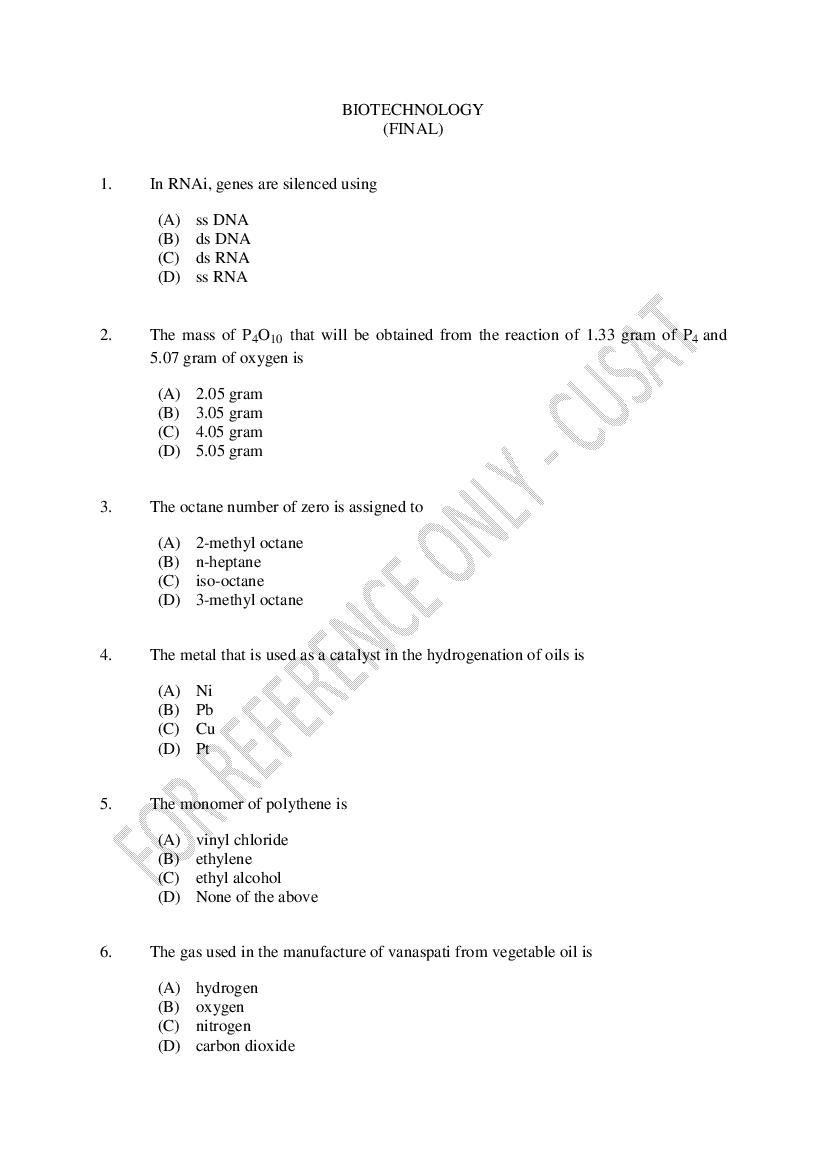
(FINAL)
1. In RNAi, genes are silenced using
(A) ss DNA
(B) ds DNA
(C) ds RNA
(D) ss RNA
2. The mass of P4O10 that will be obtained from the reaction of 1.33 gram of P4 and
5.07 gram of oxygen is
(A) 2.05 gram
(B) 3.05 gram
(C) 4.05 gram
(D) 5.05 gram
3. The octane number of zero is assigned to
(A) 2-methyl octane
(B) n-heptane
(C) iso-octane
(D) 3-methyl octane
4. The metal that is used as a catalyst in the hydrogenation of oils is
(A) Ni
(B) Pb
(C) Cu
(D) Pt
5. The monomer of polythene is
(A) vinyl chloride
(B) ethylene
(C) ethyl alcohol
(D) None of the above
6. The gas used in the manufacture of vanaspati from vegetable oil is
(A) hydrogen
(B) oxygen
(C) nitrogen
(D) carbon dioxide
Page 2
(A) Its high electro negativity
(B) Small size of fluorine atom
(C) Availability of d-orbitals
(D) Strong f – f bond
8. The main chemical constituent of clay is
(A) Silicon oxide
(B) Aluminium borosilicate
(C) Zeolites
(D) Aluminium silicate
9. Bar eye character of Drosophila is due to
(A) duplication in region of 16A of X chromosome
(B) deletion in region of 16A of X chromosome
(C) due to the presence of additional X-chromosome
(D) due to a point mutation in eye-lcous
10. Transmission of a gene from male parent to female child and male grand child is
known as
(A) holandric inheritance
(B) quantitative inheritance
(C) criss-cross inheritance
(D) maternal inheritance
11. Using Bovine Papilloma Virus (BPV) derived vectors, permanent cell lines can be
obtained carrying a recombinant DNA
(A) episomally only
(B) integrated only
(C) either episomally or integrated at high copy number
(D) either episomally or integrated at low copy number
12. Yeast Episomal plasmids (YEP) were constructed using
(A) 2µm yeast plasmid, fragments of yeast nuclear DNA and E coli vector pMB 9
(B) 2µm yeast plasmid, fragments of yeast nuclear DNA and E coli vector pBR
322
(C) 2µm yeast plasmid and E coli vector pBR 9
(D) 2µm yeast plasmid and E coli vector pBR 322
Page 3
(A) with the DNA mediated transfection
(B) without the DNA mediated transfection
(C) with the RNA mediated transfection
(D) without the RNA mediated transfection
14. Any system that is NOT at equilibrium
(A) is thermodynamically unstable, although it may be kinetically stable
(B) is kinetically unstable, although it may be thermodynamically stable
(C) is rushing toward equilibrium at a very rapid rate
(D) requires an enzyme to reach equilibrium
15. Which is NOT true about a photon?
(A) It is a packet of light energy
(B) The shorter the wavelength, the greater the energy of the photons
(C) It is trapped by photosynthetic unit
(D) It donates electron to reduce carbon dioxide to glucose
16. Why do some redox reactions in cells result in the transfer of electrons from a
reductant with higher standard redox potential to an oxidant with a lower standard
redox potential?
(A) Redox potentials are defined under standard conditions, and cellular condtions
are typically not standard conditions
(B) The rule governing oxidation and reduction apply only in vitro, and not in vivo
(C) Electrons always go from reductants with high redox potentials to oxidants
with low redox potentials
(D) None of the above
17. Pine, fir, spruce, cedar, larch and cypress are famous timber-yielding plants, of which
several are found widely in the hilly regions of India. All these belong to
(A) Angiosperms
(B) Gymnosperms
(C) Monocotyledons
(D) Dicotyledons
18. Pollination is best defined as
(A) transfer of pollen from anther to stigma
(B) germination of pollen grains
(C) growth of pollen tube in ovule
(D) visiting flowers by insects
Page 4
(A) the outer mitochondrial membrane
(B) the cell’s plasma membrane
(C) some bacterial plasma membrane
(D) the nuclear membrane
20. N2 content is kept constant in the biosphere due to
(A) N2 fixation
(B) industrial pollution
(C) nitrogen cycle
(D) absorption of N2
21. Which molecule serves as a carrier of fatty acids in mitochondria?
(A) Acetyl-CoA
(B) Carnitine
(C) Dolichol
(D) Malonyl-CoA
22. Osmosis is the flow of solution from higher concentration to a solution of lower
concentration through a semi permeable membrane. What is INCORRECT in this
statement?
(A) Exact concentration of solution is not given
(B) Character of semi permeable membrane is not given
(C) The flow of solution is not possible through semi permeable membrane
(D) All are incorrect
23. Photo-oxidation is
(A) Photorespiration
(B) Photolysis
(C) Light and oxygen induced breakdown
(D) All of the above
24. Neurospora is used as an experimental material in genetic studies because
(A) it has short life cycle of 10 days
(B) the product of single meiosis can be easily analysed
(C) meiotic products are linearly arranged in the form of ordered tetrads
(D) it is a diploid fungus
Page 5
(A) Xylem is surrounded by phloem
(B) Phloem is surrounded by xylem
(C) Xylem and phloem occur on the same radius
(D) Xylem and phloem occur on different radii
26. Which of the following is NOT a function of the large central vacuole present in plant
cells?
(A) Storage of food
(B) Support
(C) Locomotion
(D) Waste disposal
27. Which of the following experimental results does NOT support Mitchell’s
chemiosmosis theory?
(A) Electron transport in isolated mitochondria was shown to result in acidification
of the medium
(B) Addition of dinitrophenol to isolated mitochondria was shown to inhibit
electron transport, but had no effect on ATP synthesis
(C) Addition of dinitrophenol to isolated mitochondria during electron transport
was shown to inhibit acidification of the medium
(D) An artificial proton gradient across the inner mitochondrial membrane drives
ATP synthesis in the absence of electron transport
2+
28. The number of d-electron in Fe (Z = 26) is NOT equal to that of
(A) p-electrons in Ne (Z = 10)
(B) s-electrons in Mg (Z = 12)
(C) d-electrons in Fe (Z = 26)
(D) p-electrons in CI (Z = 17)
29. The half life period of an isotope is 2 hours. After 6 hours what fraction of the initial
quantity of the isotope will be left behind?
(A) 1/6
(B) 1/3
(C) 1/8
(D) 1/4
Page 6
as the molecules in
(A) 108 gram of H2O
(B) 12 moles of KMnO4
(C) 0.6 N H2SO4
(D) 4.6 gram of C2H5OH
31. Equal masses of oxygen, hydrogen and methane are kept under identical conditions.
The ratio of the volumes of gases will be
(A) 2 : 16 : 2
(B) 2 : 16 : 1
(C) 1 : 16 : 2
(D) 1:1:1
32. The mass number of an atom is equal to the number of
(A) protons
(B) protons and electrons
(C) nucleons
(D) neutrons
33. The method of concentrating the ore which makes use of the difference in density
between ore and impurities is called
(A) liquation
(B) leaching
(C) levigation
(D) magnetic separation
− − − +
34. The ionic radii of N3 , O2 , F and Na follow the order
(A) N3− > O2− > F− > Na+
(B) N3− > Na+ > O2− > F−
(C) Na+ > O2− > N3− > F−
(D) O2− > F− > Na+ > N3−
35. The graphite rods in the nuclear reactor
(A) react with U to release energy
(B) produce neutrons
(C) undergo combustion which triggers the nuclear fission
(D) convert fast moving neutrons into thermal neutrons
Page 7
(A) 2-methyl octane
(B) n-heptane
(C) iso-octane
(D) 3-methyl octane
37. Montocot root differs from dicot root in having
(A) open vascular bundles
(B) scattered vascular bundles
(C) well developed pith
(D) radially arranged vascular bundles
38. A deficiency of the enzyme Hypoxanthine Guanine Phosphoribosyl Transferase
(HGPRT) may cause
(A) Gaucher’s disease
(B) Ehlers-Danlos syndrome
(C) Lesch-Nyhan syndrome
(D) Kleinefelter’s syndrome
39. The Southern blotting technique depends on
(A) similarities between the sequences of probe DNA and experimental DNA
(B) similarities between the sequences of probe RNA and experimental RNA
(C) similarities between the sequences of probe protein and experimental protein
(D) the molecular mass of proteins
40. Which of the following triggers the division of activated T lymphocytes?
(A) FGF
(B) Interlukin 2
(C) PDGF
(D) Erythroprotein
41. Which of the following is semi-continuous (diploid) cell line?
(A) HeLa
(B) HEp-2
(C) WI-38
(D) KB
Page 8
replacement therapy for individuals at risk from emphysema is
(A) Plasminogen activator (tPA)
(B) α-anti trypsin (AAT)
(C) Casein
(D) Amyloid precursor proteins
43. The success of embryo transplantation depends upon the ability to obtain an increased
number of embryos from animals of superior genetic qualities. This can be achieved
by the use of
(A) exogenous gonadotrophic hormones
(B) endogenous gonadotrophic hormones
(C) both (A) and (B)
(D) FSH (Follicle Stimulating Hormone)
44. Which of the following established cell lines originate from a mouse embryo?
(A) 3T3
(B) BHK
(C) HeLa
(D) BTK
45. Which of the following vir genes are constitutively expressed and control the plant
induced activation of other vir genes?
(A) vir A and vir G
(B) vir C and vir D
(C) vir B and vir E
(D) vir A and vir B
46. The left segment of octopine T-DNA (TL) is necessary for
(A) enzymes involved in agropine biosynthesis
(B) tumour formation
(C) conjugative transfer
(D) All of the above
47. A transgenic event is characterized by
(A) copy number and site of integration
(B) presence of a transgene
(C) production of transgene mRNA
(D) translation into protein
Page 9
(A) DNA sequence
(B) Amino acid sequence
(C) RNA sequence
(D) cDNA sequence
49. Ac transposon is a
(A) Non-autonomous element
(B) Autonomous element
(C) Retrotransposon
(D) Intron
50. An expression vector will have
(A) Suppressor
(B) Mutator
(C) Enhancer
(D) Promoter
51. npt II gene imparts resistance to
(A) Ampicillin
(B) Hygromycin
(C) Kanamycin
(D) Chloramphenicol
52. Most commonly used technique for proteomics is
(A) 2-D Gel electrophoresis
(B) RACE
(C) SAGE
(D) In vitro pull down assay
53. Most commonly used promoter for expression of transgenes in plants is
(A) CaMv 35S
(B) npt II
(C) nos
(D) prrn
Page 10
(A) Deletion
(B) Duplication
(C) Linkage
(D) Translocation
55. The microarray analysis is NOT appropriate for
(A) monitoring individual gene expression
(B) tentatively assigning gene functions
(C) observing patterns of gene expression
(D) determining phylogenetic relationships
56. The technique used to identify genes which are transcribed in a particular cell line is
(A) Gene expression profiling
(B) DNA variation screening
(C) Microarray comparative genomic hybridization
(D) Transcription-mediated amplification
57. AGO proteins are associated with
(A) Histone complex
(B) RNAi effector complex
(C) SOS mechanisms
(D) Tryptophan operon
58. Fusion between protoplasts can be enhanced by
(A) subjecting to high temperature
(B) low temperature
(C) high intensity of electric current
(D) high light intensity
59. Agrobacterium mediated transformation of monocots require the use of ……………
for the induction of Vir genes
(A) Agarose
(B) Acetophenone
(C) Acetosyringone
(D) Cefatoxime
Page 11
(A) RAPD
(B) SSR
(C) RFLP
(D) STS
61. Sanger’s method of sequencing involves the use of
(A) Chemicals to cleave DNA
(B) ddNTP
(C) Pyridine
(D) Pyridoxine
62. A representative collection of all the DNA fragments from a given source cloned in
vectors, is described as
(A) DNA library
(B) cDNA library
(C) Subcloning
(D) Cloning
63. Seed dormancy is mainly controlled by the hormone
(A) Giberellic acid
(B) Abscissic acid
(C) Cytokinin
(D) Ethylene
64. A genetic unit that codes a complete functional polypeptide is termed as
(A) Intron
(B) Exon
(C) Cistron
(D) Recon
65. Which of the following properties is NOT associated with DNA polymerase –I ?
(A) 5’-3’ exonuclease activity
(B) 3’-5’ exonuclease activity
(C) 5’-3’ endonuclease activity
(D) 5’-3’ polymerase activity
Page 12
(A) Chain termination
(B) Degenerate oligonucleotides
(C) VNTR loci
(D) RFLPs
67. Genes whose product are constantly needed for cellular activity are called
(A) Regulator genes
(B) Structural genes
(C) Housekeeping genes
(D) Smart genes
68. Translation occurs in the
(A) Nucleus
(B) Nucleolus
(C) Cytoplasm
(D) Lysosomes
69. In genetic engineering, a chimera is
(A) a plasmid that contains foreign DNA
(B) an enzyme that links DNA molecules
(C) a virus that infects bacteria
(D) a fungus
70. The vectors commonly used for sequencing human genome is
(A) YAC
(B) Plasmids
(C) M13
(D) PAC
71. CRISPR refers to repeated sequences located in the
(A) Viral DNA
(B) Bacterial DNA
(C) Fungal DNA
(D) Viral RNA
Page 13
(A) Glucose-6-phosphate
(B) Fructose-1,6-bisphosphate
(C) Glycerol-3-phosphate
(D) Fructose-6-phosphate
73. The effectiveness of many chemical preservatives on food depends primarily on
(A) pH
(B) Temperature
(C) Water content
(D) Acidity
74. Chromosome movement during cell division is regulated by
(A) Microfilaments
(B) Microtubules
(C) Intermediate filaments
(D) All of the above
75. Flowers in the members of the family Asteraceae are NOT
(A) ebracteate
(B) pentamerous
(C) actinomorphic
(D) hypogenous
76. Inflorescence of the family Asteraceae is called as
(A) Verticillaster
(B) Capitulum
(C) Cyathium
(D) Catkin
77. Alternation of generations is exhibited by
(A) Bryophytes
(B) Pteridophytes
(C) Gymnosperms
(D) All plants
Page 14
(A) Cycas
(B) Marchantia
(C) Selaginella
(D) Angiosperms
79. Vascular bundles in a dicot stem are
(A) open, collateral, exarch
(B) closed, collateral, exarch
(C) open, collateral, endarch
(D) closed, collateral, endarch
80. Light reaction of photosynthesis occurs in
(A) Grana
(B) Thylakoids
(C) Stroma
(D) Mitochondria
81. Sclerenchymatous bundle sheath is present in
(A) Grass
(B) Mango
(C) Banyan
(D) Brinjal
82. The fruit of plants in the family Fabaceae is
(A) Siliqua
(B) Etaerio
(C) Nut
(D) Pod
83. The lateral roots generally originate from
(A) Cork cambium
(B) Cortex
(C) Pericycle cells lying against protoxylem
(D) Endodermal cells lying against protoxylem
Page 15
(A) Tracheids, vessels, fibres and parenchyma
(B) Tracheids, vessels and companion cells
(C) Tracheids, fibres and parenchyma
(D) Tracheids, vessels, sieve cells and companion cells
85. The dominant generation in Pteridophytes is
(A) Haploid
(B) Diploid
(C) Triploid
(D) Gametophytic
86. Chlorosis in plants occurs due to the deficiency of
(A) Zn
(B) Ca
(C) Cl
(D) B
87. The most advanced order in gymnosperms is
(A) Coniferales
(B) Gnetales
(C) Cycadales
(D) Taxales
88. Nodulated roots are characteristic of the family
(A) Fabaceae
(B) Poaceae
(C) Asteraceae
(D) Solanaceae
89. In cyclic photophosphorylation, the high-energy electrons are driven out from
(A) P700
(B) P870
(C) Chlorophyll a 673
(D) Chlorophyll a 683
Page 16
(A) Xerophytes
(B) Succulents
(C) Mesophytes
(D) Hydrophytes
91. Dark reaction is traced by
14
(A) CO2
(B) X-rays
(C) P32
(D) O19
92. How many distinct body sections do Crustaceans have?
(A) One
(B) Two
(C) Three
(D) Four
93. Nereis is commonly called as
(A) Earthworm
(B) Ringworm
(C) Roundworm
(D) Clamworm
94. Bipinnaria larva is found in the development of
(A) Sea-star
(B) Starfish
(C) Sea-cucumber
(D) Sea lily
95. Parasitic protozoan are
(A) Holozoic
(B) Holophytic
(C) Coprozoic
(D) Saprozoic
Page 17
(A) moulting
(B) mating
(C) walking
(D) feeding
97. The excretory organ of Ascaris is
(A) Ectoderm
(B) Mesoderm
(C) Endoderm
(D) Meso-endoderm
98. Placoid scales are present in
(A) Salmons
(B) Lamprey
(C) Sharks
(D) Hag fishes
99. Which of the following is referred to as the Peanut Worm?
(A) Sipuncula
(B) Annelida
(C) Echiura
(D) Hirudina
100. Tricholygasorbillans (Uzi fly) is a
(A) Predator of silkworms
(B) Pest of silkworms
(C) Parasite in the silkworms
(D) None of the above
101. Soto is caused by
(A) Beauveria
(B) Streptococcus
(C) Bacillus
(D) Aspergillus
Page 18
(A) Phosphorus
(B) Fluorine
(C) Fatty acid
(D) Potassium
103. Foot and mouth disease in bovids is caused by
(A) Phytoreo virus
(B) Picorna virus
(C) Una virus
(D) Adenovirus
104. Sahiwal is a breed of
(A) Buffalo
(B) Cow
(C) Goat
(D) Sheep
105. Atoms having the same mass number and different atomic numbers are known as
(A) Isotopes
(B) Isotones
(C) Isomers
(D) Isobars
106. The atomic theory was proposed by
(A) John Dalton
(B) Neils Bohr
(C) Robert Millikan
(D) J. J. Thomson
107. The octet rule is observed in
(A) PCI5
(B) CO2
(C) BCI3
(D) SF6
Page 19
(A) square planar
(B) pyramidal
(C) rhombic
(D) tetrahedral
109. Which of the following is the poorest conductor of heat?
(A) Lead
(B) Mercury
(C) Silver
(D) Copper
110. Which among the following is an example of an alicyclic compound?
(A) Cyclohexane
(B) Cyclohexene
(C) Tetrahydrofuran
(D) All of the above
111. Identify the chiral molecule among the following
(A) 2-pentanol
(B) Isopropyl alcohol
(C) 1-bromo 3-butene Isobutyl alcohol
(D) Isobutyle alcohol
112. A water drop is spherical in shape due to
(A) Surface tension
(B) Poise
(C) Reflection
(D) Viscosity
113. The unit of rate constant of zero-order reactions is
(A) s−1
(B) L mol−1 s−1
(C) L2 mol−2 s−1
(D) mol L−1 s−1
Page 20
halved, then the rate of the reaction will
(A) increase 2 times
(B) increase 3 times
(C) increase 4 times
(D) remain the same
115. The catalyst used in the Haber-Bosch process is
(A) iron with molybdenum as a promoter
(B) platinized asbestos
(C) alumina
(D) copper oxide
116. A catalyst alters
(A) Entropy
(B) Enthalpy
(C) Internal energy
(D) Activation energy
117. Which of the following is a natural rubber?
(A) Lexan
(B) Silk
(C) Kevler
(D) Bakelite
118. The primary substance used for vulcanizing rubber is
(A) Sulphur
(B) Ammonium hydroxide
(C) Isoprene
(D) Zinc oxide
119. Aniline is separated from a mixture by
(A) Fractional crystallization
(B) Fractional distillation
(C) Vacuum distillation
(D) Steam distillation
Page 21
(A) Deamination
(B) Transamination
(C) Nitrogen transfer
(D) Oxidation
121. Compounds with same name and chemical structure but with different optical
properties are called
(A) Isomers
(B) Epimers
(C) Anomers
(D) Enantiomers
122. Which one of the following immune cells produces antibodies?
(A) Killer cells
(B) T-Lymphocytes
(C) B-Lymphocytes
(D) Thymocytes
123. A conical mass of cells developed at the wound of the regenerating organ is called as
(A) Blastema
(B) Blastoderm
(C) Blastodisc
(D) Balfour’s cyst
124. An insect hormone secreted by corpus allatum is
(A) Juvenile hormone
(B) Ecdysone
(C) Moulting hormone
(D) Estrogen
125. A relatively small discarded nucleus of the maturing oocyte is
(A) Pronucleus
(B) Epiblast
(C) Otocyst
(D) Polar body
Page 22
(A) Discoidal cleavage
(B) Bilateral cleavage
(C) Radial cleavage
(D) Spiral cleavage
127. The outermost membrane surrounding the foetus is
(A) Columella
(B) Allantois
(C) Choroid fissure
(D) Chorion
128. Spindle fibres formed during cell division are made up of
(A) Microfilaments
(B) Actin
(C) Microtubules
(D) Myosin
129. Distal saccules of Golgi complex give rise to
(A) Lysosomes
(B) Mitochondria
(C) Nucleus
(D) Endoplasmic reticulum
130. Polytene chromosomes are found in the salivary glands of
(A) Coleopteran insects
(B) Amphibians
(C) Hemipteran insects
(D) Dipteran insects
131. Any cell that undergoes meiosis is called
(A) Meiosome
(B) Meiocyte
(C) Meioblast
(D) Plastid
Page 23
(A) Neurospora and bacteria
(B) Neurospora and Drosophila melanogaster
(C) Bacteria
(D) Bacteria and bacterial viruses
133. The vir region of t-DNA comprises
(A) 2 operons
(B) 4 operons
(C) 6 operons
(D) 8 operons
134. Which one of the following is a dominant trait?
(A) Blood group O
(B) Rh+ blood group
(C) Rh− blood group
(D) AB blood group
135. Molecular pathology of beta-thalassaemia does NOT involve
(A) point mutation
(B) deletion
(C) inversion
(D) insertion
136. Generally, SRY gene activates
(A) RSP01
(B) SOX9
(C) Fgf9
(D) Wnt
137. Which one of the following protozoans has the ability to synthesise long chain fatty
acid?
(A) Perkin susmarinus
(B) Podophyra
(C) Toxoplasma gondii
(D) Giadria lamblia
Page 24
(A) Trypanosomal form
(B) Crithidaial form
(C) Leptomonad form
(D) Leishmanial form
139. In Taenia saginata
(A) Rostellum and hooks are absent
(B) Rostellum and hooks are present
(C) Head is absent
(D) Neck is absent
140. The infective stage of a liver fluke is
(A) Miracidium
(B) Redia
(C) Cercaria
(D) Metacercaria
141. Which was absent in the atmosphere at the time of origin of life?
(A) Oxygen
(B) Ammonia
(C) Methane
(D) Hydrogen
142. The random change in the frequency of alleles in a population is called
(A) Genetic drift
(B) Genetic polymorphism
(C) Genetic load
(D) Genetic variation
143. Which of the following Salamanders does NOT possess hind legs?
(A) Proteus
(B) Siren
(C) Triton
(D) Amphiuma
Page 25
(A) Cu+Zn
(B) Cu+Sn
(C) Cu+Ni
(D) Cu+Al
145. Which one is Rock salt?
(A) KCl
(B) NaCl
(C) LiCl
(D) CsCl
146. Which one of the following halogens is solid at room temperature?
(A) Fluorine
(B) Chlorine
(C) Bromine
(D) Iodine
147. Kjeldahl’s method is used in the estimation of
(A) Nitrogen
(B) Carbon
(C) Sulphur
(D) Oxygen
148. Polymer of chloroethylene is
(A) PVC
(B) Teflon
(C) Terrylene
(D) Nylon
149. Fats and oils are
(A) Esters
(B) Acids
(C) Alcohols
(D) Ethers
Page 26
(A) NaOH against (COOH)2
(B) NaOH against HCl
(C) NaOH against H2SO4
(D) FeSO4 against KMnO4
Page 27
Subject Name: 601 BIOTECHNOLOGY
SI No. Key SI No. Key SI No. Key SI No. Key SI No. Key
1 C 31 C 61 B 91 A 121 A
2 B 32 C 62 A 92 C 122 C
3 B 33 C 63 B 93 D 123 A
4 A 34 A 64 C 94 B 124 A
5 B 35 D 65 C 95 D 125 D
6 A 36 B 66 C 96 A 126 A
7 A 37 C 67 C 97 B 127 D
8 D 38 C 68 C 98 C 128 C
9 A 39 A 69 A 99 A 129 A
10 C 40 B 70 A 100 B 130 D
11 C 41 C 71 B 101 C 131 B
12 A 42 B 72 C 102 B 132 D
13 B 43 A 73 A 103 B 133 C
14 A 44 A 74 B 104 B 134 B
15 D 45 A 75 D 105 A 135 C
16 A 46 B 76 B 106 A 136 B
17 B 47 A 77 D 107 B 137 A
18 A 48 B 78 A 108 D 138 D
19 C 49 B 79 C 109 A 139 A
20 C 50 D 80 A 110 D 140 D
21 B 51 C 81 A 111 D 141 B
22 A 52 A 82 D 112 A 142 A
23 D 53 A 83 C 113 D 143 B
24 A 54 A 84 A 114 A 144 A
25 D 55 D 85 B 115 A 145 B
26 C 56 A 86 A 116 D 146 D
27 B 57 B 87 A 117 B 147 A
28 D 58 C 88 A 118 A 148 A
29 C 59 C 89 A 119 D 149 A
30 B 60 C 90 B 120 A 150 A
Document Details
| Board / Org | Cochin University |
| Exam | CUSAT Common Admission Test |
| Type | Question Paper |
| Pages | 27 |
| Updated | 22 Jul 2026 |