UGC NET 2021 Question Paper Comparative Study of Religions Shift 2
Finished viewing? Save it for later —
Download UGC NET 2021 Question Paper Comparative Study of Religions Shift 2 (PDF · 59 pages)About UGC NET 2021 Question Paper Comparative Study of Religions Shift 2
UGC NET 2021 Question Paper Comparative Study of Religions Shift 2 is available here for free download. Published by NTA for UGC NET, this question paper can be viewed online or downloaded as a PDF (59 pages). Candidates preparing for UGC NET can use UGC NET 2021 Question Paper Comparative Study of Religions Shift 2 to understand the exam pattern, the type of questions asked, and the overall difficulty level.
Frequently Asked Questions
How can I download UGC NET 2021 Question Paper Comparative Study of Religions Shift 2?
Open this page and click the Download button to save UGC NET 2021 Question Paper Comparative Study of Religions Shift 2 as a PDF. It is completely free on AglaSem Docs.
Is UGC NET 2021 Question Paper Comparative Study of Religions Shift 2 free to download?
Yes. UGC NET 2021 Question Paper Comparative Study of Religions Shift 2 can be viewed online and downloaded as a PDF free of cost on AglaSem Docs.
How many pages does UGC NET 2021 Question Paper Comparative Study of Religions Shift 2 have?
UGC NET 2021 Question Paper Comparative Study of Religions Shift 2 contains 59 pages, which you can read online or download together as a single PDF.
Where can I find more UGC NET study material?
You can find more UGC NET question papers, sample papers, syllabus, and answer keys on AglaSem Docs.
UGC NET 2021 Question Paper Comparative Study of Religions Shift 2 – Text
Read the full text of this question paper below — useful to quickly search, copy and reference the content online without downloading the PDF.
📄 View text version (59 pages)
Page 1
Topic:‐ GP_20NOV_A_SH1
1) Read the given passage and answer the questions that follow
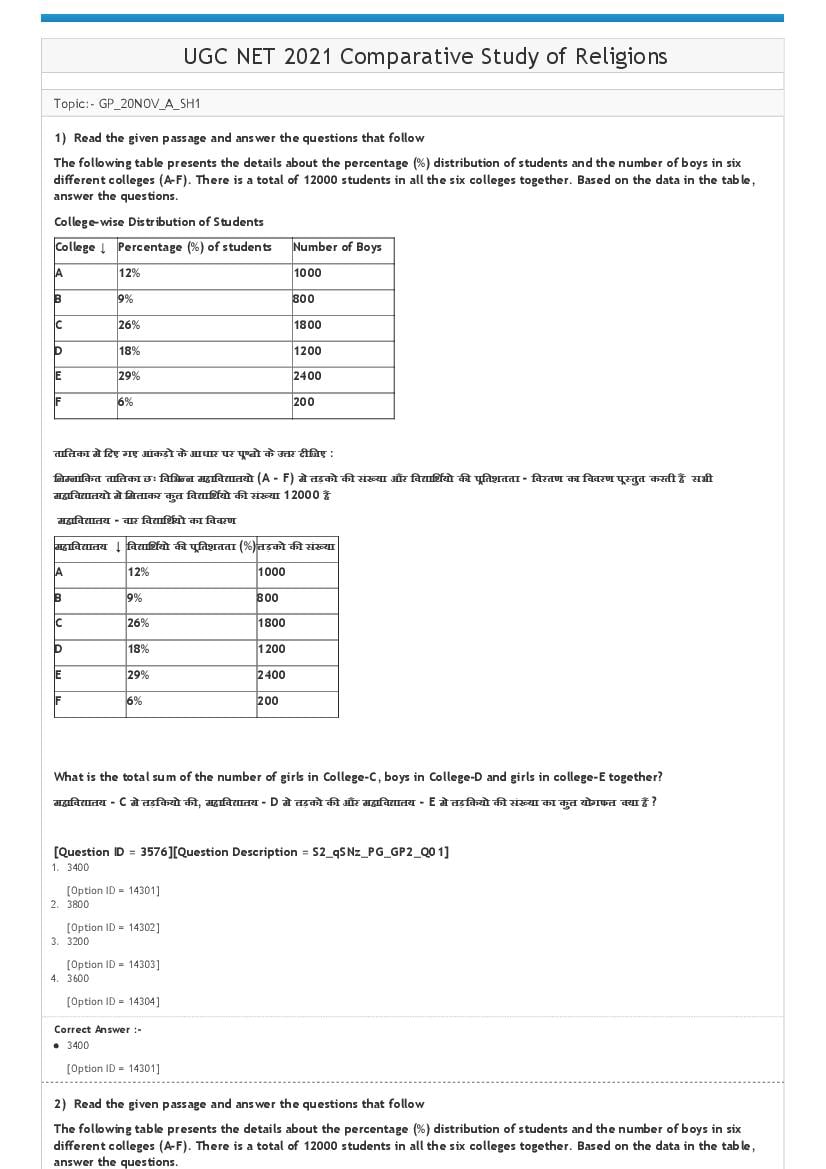
The following table presents the details about the percentage (%) distribution of students and the number of boys in six
different colleges (A‐F). There is a total of 12000 students in all the six colleges together. Based on the data in the table,
answer the questions.
College‐wise Distribution of Students
College Percentage (%) of students Number of Boys
A 12% 1000
B 9% 800
C 26% 1800
D 18% 1200
E 29% 2400
F 6% 200
तािलका म िदए गए आंकड़ के आधार पर प के उ र दीिजए :
िन नांिकत तािलका छः िविभ न महािव ालय (A ‐ F) म लड़क क सं या और िव ािथय क पितशतता ‐ िवरतण का िववरण प तुत करती है सभी
महािव ालय म िमलाकर कुल िव ािथय क सं या 12000 है
महािव ालय ‐ वार िव ािथय का िववरण
महािव ालय िव ािथय क पितशतता (%)लड़क क सं या
A 12% 1000
B 9% 800
C 26% 1800
D 18% 1200
E 29% 2400
F 6% 200
What is the total sum of the number of girls in College‐C, boys in College‐D and girls in college‐E together?
महािव ालय ‐ C म लड़िकय क , महािव ालय ‐ D म लड़क क और महािव ालय ‐ E म लड़िकय क सं या का कुल योगफल या है ?
[Question ID = 3576][Question Description = S2_qSNz_PG_GP2_Q01]
1. 3400
[Option ID = 14301]
2. 3800
[Option ID = 14302]
3. 3200
[Option ID = 14303]
4. 3600
[Option ID = 14304]
3400
[Option ID = 14301]
2) Read the given passage and answer the questions that follow
The following table presents the details about the percentage (%) distribution of students and the number of boys in six
different colleges (A‐F). There is a total of 12000 students in all the six colleges together. Based on the data in the table,
answer the questions.
Page 2
College Percentage (%) of students Number of Boys
A 12% 1000
B 9% 800
C 26% 1800
D 18% 1200
E 29% 2400
F 6% 200
तािलका म िदए गए आंकड़ के आधार पर प के उ र दीिजए :
िन नांिकत तािलका छः िविभ न महािव ालय (A ‐ F) म लड़क क सं या और िव ािथय क पितशतता ‐ िवरतण का िववरण प तुत करती है सभी
महािव ालय म िमलाकर कुल िव ािथय क सं या 12000 है
महािव ालय ‐ वार िव ािथय का िववरण
महािव ालय िव ािथय क पितशतता (%)लड़क क सं या
A 12% 1000
B 9% 800
C 26% 1800
D 18% 1200
E 29% 2400
F 6% 200
What is the respective ratio of the number of boys in College‐C, the number of girls in College‐B and the total number of
students in College‐E?
महािव ालय ‐ C म लड़क क सं या, महािव ालय ‐ B म लड़िकय क सं या और महािव ालय ‐ E म कुल िव ािथय क सं या का कमशः अनुपात या है ?
[Question ID = 3577][Question Description = S2_qSNz_PG_GP2_Q02]
1. 45:7:97
[Option ID = 14305]
2. 43:9:97
[Option ID = 14306]
3. 45:7:87
[Option ID = 14307]
4. 43:9:87
[Option ID = 14308]
45:7:97
[Option ID = 14305]
3) Read the given passage and answer the questions that follow
The following table presents the details about the percentage (%) distribution of students and the number of boys in six
different colleges (A‐F). There is a total of 12000 students in all the six colleges together. Based on the data in the table,
answer the questions.
College‐wise Distribution of Students
College Percentage (%) of students Number of Boys
A 12% 1000
B 9% 800
C 26% 1800
D 18% 1200
E 29% 2400
F 6% 200
Page 3
तािलका म िदए गए आंकड़ के आधार पर प के उ र दीिजए :
िन नांिकत तािलका छः िविभ न महािव ालय (A ‐ F) म लड़क क सं या और िव ािथय क पितशतता ‐ िवरतण का िववरण प तुत करती है सभी
महािव ालय म िमलाकर कुल िव ािथय क सं या 12000 है
महािव ालय ‐ वार िव ािथय का िववरण
महािव ालय िव ािथय क पितशतता (%)लड़क क सं या
A 12% 1000
B 9% 800
C 26% 1800
D 18% 1200
E 29% 2400
F 6% 200
What is the difference between the number of boys in College‐E and the total number of students in College‐F?
महािव ालय ‐ E म लड़क क सं या और महािव ालय ‐ F म कुल िव ािथय क सं या के बीच या अंतर है ?
[Question ID = 3578][Question Description = S2_qSNz_PG_GP2_Q03]
1. 1640
[Option ID = 14309]
2. 1760
[Option ID = 14310]
3. 1720
[Option ID = 14311]
4. 1680
[Option ID = 14312]
1640
[Option ID = 14309]
4) Read the given passage and answer the questions that follow
The following table presents the details about the percentage (%) distribution of students and the number of boys in six
different colleges (A‐F). There is a total of 12000 students in all the six colleges together. Based on the data in the table,
answer the questions.
College‐wise Distribution of Students
College Percentage (%) of students Number of Boys
A 12% 1000
B 9% 800
C 26% 1800
D 18% 1200
E 29% 2400
F 6% 200
तािलका म िदए गए आंकड़ के आधार पर प के उ र दीिजए :
िन नांिकत तािलका छः िविभ न महािव ालय (A ‐ F) म लड़क क सं या और िव ािथय क पितशतता ‐ िवरतण का िववरण प तुत करती है सभी
महािव ालय म िमलाकर कुल िव ािथय क सं या 12000 है
महािव ालय ‐ वार िव ािथय का िववरण
महािव ालय िव ािथय क पितशतता (%)लड़क क सं या
A 12% 1000
Page 4
B 9% 800
C 26% 1800
D 18% 1200
E 29% 2400
F 6% 200
In which of the following colleges is the total number of students equal to the number of girls in College‐E?
िन नांिकत िकस महािव ालय म िव ािथय क कुल सं या, महािव ालय ‐ E क लड़िकय क सं या के बराबर है ?
[Question ID = 3579][Question Description = S2_qSNz_PG_GP2_Q04]
1. A
[Option ID = 14313]
2. B
[Option ID = 14314]
3. C
[Option ID = 14315]
4. D
[Option ID = 14316]
A
[Option ID = 14313]
5) Read the given passage and answer the questions that follow
The following table presents the details about the percentage (%) distribution of students and the number of boys in six
different colleges (A‐F). There is a total of 12000 students in all the six colleges together. Based on the data in the table,
answer the questions.
College‐wise Distribution of Students
College Percentage (%) of students Number of Boys
A 12% 1000
B 9% 800
C 26% 1800
D 18% 1200
E 29% 2400
F 6% 200
तािलका म िदए गए आंकड़ के आधार पर प के उ र दीिजए :
िन नांिकत तािलका छः िविभ न महािव ालय (A ‐ F) म लड़क क सं या और िव ािथय क पितशतता ‐ िवरतण का िववरण प तुत करती है सभी
महािव ालय म िमलाकर कुल िव ािथय क सं या 12000 है
महािव ालय ‐ वार िव ािथय का िववरण
महािव ालय िव ािथय क पितशतता (%)लड़क क सं या
A 12% 1000
B 9% 800
C 26% 1800
D 18% 1200
E 29% 2400
F 6% 200
The number of girls in College‐A is approximately what percentage of the total number of students in College‐B?
महािव ालय ‐ A म लड़िकय क सं या, महािव ालय ‐ B म िव ािथय क कुल सं या का लगभग िकतना पितशत है ?
Page 5
1. 50
[Option ID = 14317]
2. 35
[Option ID = 14318]
3. 45
[Option ID = 14319]
4. 40
[Option ID = 14320]
50
[Option ID = 14317]
Topic:‐ GP_20NOV_B_SH1
1) Which parenting style is the one in which parents seem cool and controlling their interactions with their children (low
warmth, high control):
िन निलिखत म से वह कौन सी पैतृक (पेरटल) शैली है िजसम माता ‐ िपता अपने ब च के साथ अपनी अंतःिकया म भाव ‐ शू य और िनयंतक पतीत होते ह :
(िन न गमजोशी, उ च िनयंतण) :
[Question ID = 3581][Question Description = S2_qSNz_PG_GP2_Q06]
1. Authoritative parents/पािधका रक माता ‐ िपता [Option ID = 14321]
2. Authoritarian parents/आिधका रक माता ‐ िपता [Option ID = 14322]
3. Permissive parents/अनु ापक माता ‐ िपता [Option ID = 14323]
4. Rejecting/Neglecting/Uninvolved parents/अ वीकार करने वाले / उपे ा करने वाले / अंतभािवत न होने वाले माता ‐ िपता [Option ID = 14324]
Authoritative parents/पािधका रक माता ‐ िपता [Option ID = 14321]
2) Which of the following assessment methods provides feedback, that is non‐evaluative, occurs before or during
instruction, and guides teachers in planning and improving instruction?
िन निलिखत िकस मू यांकन प ित म फ डबैक पदान िकया जाता है, जो गैर ‐ मू यांकन परक होती है, अनुदेशन से पूव या उसके दौरान घिटत होती है और
अनुदेशन संबंधी योजना बनाने और इसम सुधार लाने म अ यापक का मागदशन करती है :
[Question ID = 3582][Question Description = S2_qSNz_PG_GP2_Q07]
1. Summative/योगा मक [Option ID = 14325]
2. Criterion‐referenced/संदिभत कसौटी [Option ID = 14326]
3. Formative/िनमाणा मक [Option ID = 14327]
4. Norm referenced/संदिभत मानक [Option ID = 14328]
Summative/योगा मक [Option ID = 14325]
3) Given below are two statements
Statement I: Parents and teachers have a highly significant impact on the maturation aspect of cognitive development
Statement II: Schemes are an organised system of actions or thought that allow us to mentally represent or "think about" the
objects and events in our world
In light of the above statements, choose the correct answer from the options given below
नीचे दो कथन िदए गए ह :
कथन ‐ I : सं ाना मक िवकास के प रप वन पहलू पर माता ‐ िपता और िश क का बहत ही मह वपूण पभाव पड़ता है
कथन ‐ II : योजनाएं िक याओं या िवचार क संगिठत यव थाएं होती ह जो हम हमारी दुिनया क व तु ओ ं और घटनाओं को मानिसक प से पितिनिध व करने या
''सोचने'' क अनुमित देता है
उपरो कथन के आलोक म, नीचे िदए गए िवक प म से सही उ र का चयन क िजए :
[Question ID = 3583][Question Description = S2_qSNz_PG_GP2_Q08]
1. Both Statement I and Statement II are true/कथन I और II दोन स य ह [Option ID = 14329]
2. Both Statement I and Statement II are false/कथन I और II दोन अस य ह [Option ID = 14330]
3. Statement I is true but Statement II is false/कथन I स य है , िक तु कथन II अस य है [Option ID = 14331]
4. Statement I is false but Statement II is true/कथन I अस य है, िक तु कथन II स य है [Option ID = 14332]
Page 6
4) Identify the types of cognitive load that make demands during learning
A. Intrinsic
B. Gestalt
C. Extraneous
D. Extinction
E. Germane
Choose the correct answer from the options given below:
उस सं ाना मक भार के पकार क पहचान कर जो अिधगम के समय मांग रखते ह :
A. आतं रक
B. ग टॉ ट
C. बा
D. िवलोप
E. संगत
नीचे िदए गए िवक प म से सही उ र का चयन क िजए :
[Question ID = 3584][Question Description = S2_qSNz_PG_GP2_Q09]
1. A, B and C only/केवल A, B और C [Option ID = 14333]
2. B, C and D only/केवल B, C और D [Option ID = 14334]
3. A, C and E only/केवल A, C और E [Option ID = 14335]
4. C, D and E only/केवल C, D और E [Option ID = 14336]
A, B and C only/केवल A, B और C [Option ID = 14333]
5) Match List I with List II
List I List II
Erik's stages of Psychosocial Approximate
Development Age
I. Young
A. Basic trust versus Basic mistrust
adulthood
II. Late
B. Initiative versus Guilt
adulthood
C. Intimacy versus Isolation III. 3 to 6 years
IV. Birth to 12‐
D. Ego integrity versus Despair
18 months
Choose the correct answer from the options given below:
सूची ‐I को सूची ‐II से सुमेिलत क िजए :
सूची ‐I सूची ‐II
(ए रक के मनोसामािजक िवकास के चरण) (सि नकट आयु )
A. मौिलक िव ास बनाम मौिलक अिव ास I. पूव वय कता
B. पहल बनाम दोष II. बाद क वय कता
C. अतरंगता बनाम एकाक करण III. 3 से 6 वष
D. अहम् स यिन ा बनाम भ नाशा IV. ज म के 12 ‐ 18 महीने
नीचे िदए गए िवक प म से सही उ र चुिनए :
[Question ID = 3585][Question Description = S2_qSNz_PG_GP2_Q10]
1. A ‐lV, B ‐lll, C ‐l, D ‐ll
[Option ID = 14337]
2. A ‐lll, B ‐l, C ‐ll, D ‐lV
Page 7
3. A ‐l, B ‐ll, C ‐lV, D ‐lll
[Option ID = 14339]
4. A ‐ll, B ‐lV, C ‐lll, D ‐l
[Option ID = 14340]
A ‐lV, B ‐lll, C ‐l, D ‐ll
[Option ID = 14337]
6) When we design the experiment in such a way that the variations caused by extraneous factors can all be combined
under the general concept of "chance", it represents which principle?
जब हम िकसी परी ण (ए सपे रमट) का िनमाण इस पकार करते ह िक बा कारक ारा उ प न िविभ नताओं (वे रएशंस) को संयोग (चांस) क सामा य
अवधारणा के अंतगत संयोिजत िकया जा सकता है, तो यह िकस िस ांत का िन पण करता है ?
[Question ID = 3586][Question Description = S2_qSNz_PG_GP2_Q11]
1. Principle of randomization/या ि छक करण का िस ांत (िपिं सपल ऑफ रे डमाइझेशन) [Option ID = 14341]
2. Principle of replication/पुनरावृि का िस ांत (िपिं सपल ऑफ रे लीकेशन) [Option ID = 14342]
3. Principle of local control/ थानीय िनयंतण का िस ांत (िपिं सपल ऑफ लोकल कंटोल) [Option ID = 14343]
4. Principle of operational control/संिकया मक िनयंतण का िस ांत (िपिं सपल ऑफ ऑपरेशन कंटोल) [Option ID = 14344]
Principle of randomization/या ि छक करण का िस ांत (िपिं सपल ऑफ रे डमाइझेशन) [Option ID = 14341]
7) Positivism as an epistemological program is characteristic of
ानमीमांसा कायकम के प म प य वाद िकसक िवशेषता है ?
[Question ID = 3587][Question Description = S2_qSNz_PG_GP2_Q12]
1. Social sciences/सामािजक िव ान [Option ID = 14345]
2. Performing Arts/पदशन कलाय [Option ID = 14346]
3. Natural sciences/पाकृितक िव ान [Option ID = 14347]
4. Legal studies/िविधक अ ययन [Option ID = 14348]
Social sciences/सामािजक िव ान [Option ID = 14345]
8) Identify the CORRECT sequence of empirical steps in the linear model of the research process
शोध पिकया के रैिखक पितमान म आनुभािवक चरण के सही अनुकम क पहचान क िजए :
[Question ID = 3588][Question Description = S2_qSNz_PG_GP2_Q13]
1. Sampling → theory → interpretation → collection → validation → hypotheses/पितचयन → िस ांत → िनवचन → संगहण → पमाणीकरण → पा क पना [Option ID
= 14349]
2. Theory → hypotheses → sampling → collection → interpretation → validation/िस ांत → पा क पना → पितचयन → संगहण → िनवचन → पमाणीकरण [Option ID
= 14350]
3. Validation → theory → hypotheses → collection → sampling → interpretation/पमाणीकरण → िस ांत → पा क पना → संगहण → पितचयन → िनवचन [Option ID =
14351]
4. Collection → sampling → hypotheses → theory → interpretation → operationalization/संगहण → पितचयन → पा क पना → िस ांत → िनवचन →
सिकया मक करण (आपरेशनलाइजेशन) [Option ID = 14352]
Sampling → theory → interpretation → collection → validation → hypotheses/पितचयन → िस ांत → िनवचन → संगहण → पमाणीकरण → पा क पना [Option ID
= 14349]
9) Which of the below mentioned approaches fall under the Quantitative Approach?
A. Simulation approach
B. Projective technique
C. Inferential approach
D. Depth interview
E. Experimental approach
Choose the correct answer from the options given below:
िन निलिखत म से कौन से अिभगम माता मक अिभगम के अंतगत ह ?
A. अनुकरण अिभगम (साइमुलेशन एपोच)
B. प ेपी तकनीक (पोजेि टव टे नीक)
C. आनुमािनक अिभगम (इ फेरेनिशयल एपोच)
Page 8
E. पायोिगक अिभगम
नीचे िदए गए िवक प म से सही उ र का चयन क िजए :
[Question ID = 3589][Question Description = S2_qSNz_PG_GP2_Q14]
1. A, C and E only/केवल A, C और E [Option ID = 14353]
2. B, C and E only/केवल B, C और E [Option ID = 14354]
3. B, C and D only/केवल B, C और D [Option ID = 14355]
4. A, B and C only/केवल A, B और C [Option ID = 14356]
A, C and E only/केवल A, C और E [Option ID = 14353]
10) Match List I with List II
List I List II
A. Ex post facto I. Finding a solution for an immediate problem facing a society or an industrial/business
Research organisation
B. Applied Research II. Related to some abstract idea(s) or theory
C. Conceptual Research III. Development of hypotheses rather than their testing
D. Exploratory Research IV. No control over variables, reports only what has happened or what is happening
Choose the correct answer from the options given below:
सूची ‐I को सूची ‐II से सुमेिलत क िजए :
सूची ‐I सूची ‐II
A. काय र I. िकसी समाज अथवा औ ोिगक / यावसाियक संगठन के सम
शोध उपि थत ता कािलक सम या का समाधान ढूंढना
B. अनुपयु
II. िकसी अपूत िवचार (िवचार ) अथवा िस ांत से स बंिधत
शोध
C.
संप यया मक III. परी ण के थान पर पा क पना का िवकास
शोध
D. सम वेषी IV. चर पर कोई िनयंतण नह , केवल उसी क जानकारी देता है जो हो चुका
शोध है अथवा हो रहा है
नीचे िदए गए िवक प म से सही उ र चुिनए :
[Question ID = 3590][Question Description = S2_qSNz_PG_GP2_Q15]
1. A ‐lV, B ‐l, C ‐lll, D ‐ll [Option ID = 14357]
2. A ‐III, B ‐II, C ‐I, D ‐IV [Option ID = 14358]
3. A ‐IV, B ‐I, C ‐II, D ‐III [Option ID = 14359]
4. A ‐I, B ‐III, C ‐II, D ‐IV [Option ID = 14360]
A ‐lV, B ‐l, C ‐lll, D ‐ll [Option ID = 14357]
11) Peer‐to‐peer communication is
समक से समक का स पेषण है :
[Question ID = 3591][Question Description = S2_qSNz_PG_GP2_Q16]
1. Horizontal/ िै तज
[Option ID = 14361]
2. Convoluted/संविलत
[Option ID = 14362]
3. Non‐transactional/गैर ‐ सं यवहा रक
[Option ID = 14363]
4. Authoritarian/अिधकारवादी
[Option ID = 14364]
Horizontal/ िै तज
[Option ID = 14361]
12) The main challenges of grapevine communication are:
A. Its formal nature
B. Distortion
C. Misunderstanding
Page 9
E. Conformity
Choose the correct answer from the options given below:
जनपवाद स पेषण क मु य चुनौितयां ह ?
A. इसक औपचा रक पवृि
B. िव पण
C. गलतफहमी
D. सोत अनाम व
E. अनु पता
नीचे िदए गए िवक प म से सही उ र का चयन क िजए :
[Question ID = 3592][Question Description = S2_qSNz_PG_GP2_Q17]
1. A, B and C only/केवल A, B और C [Option ID = 14365]
2. B, C and D only/केवल B, C और D [Option ID = 14366]
3. C, D and E only/केवल C, D और E [Option ID = 14367]
4. A, C and D only/केवल A, C और D [Option ID = 14368]
A, B and C only/केवल A, B और C [Option ID = 14365]
13) Given below are two statements, one is labelled as Assertion A and the other is labelled as Reason R
Assertion A: Students do not form part of the media audience
Reason R: Due to the all‐pervasive digital technology, students have become interactive media users
In light of the above statements, choose the correct answer from the options given below
नीचे दो कथन िदए गए ह : एक अिभकथन (Assertion A) के प म और दूसरा उसके कारण (Reason R) के पम:
अिभकथन (A) : िव ाथ , मीिडया ‐ शोता के भाग नह ह
कारण (R) : सव ‐ यापक िडिजटल पौ ोिगक के फल व प िव ाथ अ तः िकयाशील मीिडया पयोगकता बन गए ह
उपरो कथन के आलोक म, नीचे िदए िवक प म से सही उ र का चयन क िजए :
[Question ID = 3593][Question Description = S2_qSNz_PG_GP2_Q18]
1. Both A and R are true and R is the correct explanation of A/(A) और (R) दोन स य ह और (R), (A) क सही या या है [Option ID = 14369]
2. Both A and R are true but R is NOT the correct explanation of A/(A) और (R) स य सही ह पर तु (R), (A) क सही या या नह है [Option ID = 14370]
3. A is true but R is false/(A) स य है, लेिकन (R) अस य है [Option ID = 14371]
4. A is false but R is true/(A) अस य है, लेिकन (R) स य है [Option ID = 14372]
Both A and R are true and R is the correct explanation of A/(A) और (R) दोन स य ह और (R), (A) क सही या या है [Option ID = 14369]
14) Identify the CORRECT sequence of the following communication forms:
A. Mass
B. Public
C. Group
D. Inter‐personal
E. Intra‐personal
Choose the correct answer from the options given below
िन नांिकत स पेषण ‐ व प के सही अनुकम क पहचान क िजए :
A. जन ‐ समूह
B. जनता
C. समूह
D. अंतर ‐ वैयि क
E. अ तः ‐ वैयि क
नीचे िदए गए िवक प म से सही उ र का चयन क िजए :
Page 10
1. A, D, E, B, C [Option ID = 14373]
2. D, E, B, C, A [Option ID = 14374]
3. E, D, C, B, A [Option ID = 14375]
4. B, C , A, D, E [Option ID = 14376]
A, D, E, B, C [Option ID = 14373]
15) Match List I with List II
List I List II
Types of noise in communicationCharacteristic feature
A. Physical I. Barriers within the sender or receiver
B. Physiological II. Wandering thoughts
C. Psychological III. Use of jargon
D. Semantic IV. Mechanical distortion
Choose the correct answer from the options given below:
सूची ‐I को सूची ‐II से सुमेिलत क िजए :
सूची ‐I सूची ‐II
(स पेषण म शोर के पकार) (अिभला िणक िवशेषताएं)
A. शारी रक I. पेषक या गहणकता के म य अवरोध
B. शरीर िकया मक II. भमणशील िवचार
C. मनोिव ािनक III. िविश ‐ श दावली का पयोग
D. श दाथिव ान IV. याि तक िव पण
नीचे िदए गए िवक प म से सही उ र चुिनए :
[Question ID = 3595][Question Description = S2_qSNz_PG_GP2_Q20]
1. A ‐IV, B ‐I, C ‐II, D ‐III [Option ID = 14377]
2. A ‐I, B ‐II, C ‐III, D ‐IV [Option ID = 14378]
3. A ‐III, B ‐IV, C ‐I, D ‐II [Option ID = 14379]
4. A ‐II, B ‐III, C ‐IV, D ‐I [Option ID = 14380]
A ‐IV, B ‐I, C ‐II, D ‐III [Option ID = 14377]
16) The incomes of Ravi and Kavita are in the ratio 2:3 and their expenditures are in the ratio 3:5. If each saves ₹ 100,
then Ravi's income is
रिव और किवता क आय 2 : 3 के अनुपात म है और उनके यय का अनुपात 3 : 5 है अगर प येक ₹ 100 बचत करते ह तो रिव क आय है :
[Question ID = 3596][Question Description = S2_qSNz_PG_GP2_Q21]
1. ₹ 200
[Option ID = 14381]
2. ₹ 600
[Option ID = 14382]
3. ₹ 400
[Option ID = 14383]
4. ₹ 100
[Option ID = 14384]
₹ 200
[Option ID = 14381]
17) The new cost of a mobile which has been discounted by 15% is ₹ 3230. What was the cost of the mobile originally?
15 पितशत क छूट के साथ मोबाइल का नया मू य ₹ 3230 है मोबाइल का पारंिभक मू य या था ?
[Question ID = 3597][Question Description = S2_qSNz_PG_GP2_Q22]
1. ₹ 3675
[Option ID = 14385]
2. ₹ 3650
[Option ID = 14386]
3. ₹ 3600
[Option ID = 14387]
4. ₹ 3800
[Option ID = 14388]
Page 11
[Option ID = 14385]
18) The product of two positive consecutive odd integers is 1 less than six times their sum. One of the integers is
दो घना मक कमागत िवषय पूणाक का गुणनफल, उनके योगफल के 6 ‐ गुणा से 1 कम है दोन म से एक पूणाक है :
[Question ID = 3598][Question Description = S2_qSNz_PG_GP2_Q23]
1. 7
[Option ID = 14389]
2. 9
[Option ID = 14390]
3. 15
[Option ID = 14391]
4. 13
[Option ID = 14392]
7
[Option ID = 14389]
19) Given below are two statements
Statement I: A number that has factors other than 1 and itself is called a composite number
Statement II: 23 is the only odd prime number
In light of the above statements, choose the correct answer from the options given below
नीचे दो कथन िदए गए ह :
कथन ‐ I : एक सं या, िजसका 1 और वहसं या वयं ही अपवतक होते ह, एक यौिगक सं या या संयु सं या कही जाती है
कथन ‐ II : केवल 23 ही एकमात िवषम ढ़ सं या है
उपरो कथन के आलोक म, नीचे िदए गए िवक प म से सही उ र का चयन क िजए :
[Question ID = 3599][Question Description = S2_qSNz_PG_GP2_Q24]
1. Both Statement I and Statement II are true/कथन I और II दोन स य ह
[Option ID = 14393]
2. Both Statement I and Statement II are false/कथन I और II दोन अस य ह
[Option ID = 14394]
3. Statement I is true but Statement II is false/कथन I स य है, लेिकन कथन II अस य है
[Option ID = 14395]
4. Statement I is false but Statement II is true/कथन I अस य है, लेिकन कथन II स य है
[Option ID = 14396]
Both Statement I and Statement II are true/कथन I और II दोन स य ह
[Option ID = 14393]
20) Match List I with List II
List I List II
Three numbers Their average
A. 40, 32, 33 I. 38
B. 35, 36, 40 II. 36
C. 33, 36, 39 III. 35
D. 30, 38, 46 IV. 37
Choose the correct answer from the options given below:
सूची ‐I को सूची ‐II से सुमेिलत क िजए :
सूची ‐I सूची ‐II
(तीन सं याएं) (उनका औसत (सं या))
A. 40, 32, 33 I. 38
B. 35, 36, 40 II. 36
C. 33, 36, 39 III. 35
D. 30, 38, 46 IV. 37
Page 12
[Question ID = 3600][Question Description = S2_qSNz_PG_GP2_Q25]
1. A ‐ IV, B ‐ I, C ‐ II, D ‐ III
[Option ID = 14397]
2. A ‐ II, B ‐ IV, C ‐ I, D ‐ III
[Option ID = 14398]
3. A ‐ III, B ‐ IV, C ‐ II, D ‐ I
[Option ID = 14399]
4. A ‐ IV, B ‐ II, C ‐ III, D ‐ I
[Option ID = 14400]
A ‐ IV, B ‐ I, C ‐ II, D ‐ III
[Option ID = 14397]
21) Advertising "Testimonials" are frequent instances of this fallacy
'पमाण' का िव ापन करना िन निलिखत म से िकस दोष के बहदा होने वाले उदाहरण ह ?
[Question ID = 3601][Question Description = S2_qSNz_PG_GP2_Q26]
1. Argumentum ad ignorantiam (ignorance)/आ यूमे टम एड इ नोरेि टअम (अ ानता)
[Option ID = 14401]
2. Argumentum ad Misericordiam (appeal to pity)/आ यूमे टम एड िमज रकािडयन (दया का आगह)
[Option ID = 14402]
3. Argumentum ad Populum/आ यूमे टम एड पापूलम
[Option ID = 14403]
4. Argumentum ad Verecundiam (authority)/आ यूमे टम एड वेरक
े ि डयम (पािधकार)
[Option ID = 14404]
Argumentum ad ignorantiam (ignorance)/आ यूमे टम एड इ नोरेि टअम (अ ानता)
[Option ID = 14401]
22) If 'some women are writers is true, which of the following codes are CORRECT
A. 'All women are writers' false
B. 'All women are writers' is true
C. 'No women are writers' is false
D. 'Some women are not writers' is undetermined
Choose the correct answer from the options given below:
यिद ' कुछ मिहलाएं लेिखकाएं ह' स य है, तो िन निलिखत म से कौन से कूट सही ह ?
A. 'सभी मिहलाएं लेिखकाएं ह' अस य है
B. 'सभी मिहलाएं लेिखकाएं ह' स य है
C. 'कोई मिहला लेिखका नह ह' अस य है
D. 'कुछ मिहलाएं लेिखकाएं नह ह' अिनधा रत है
नीचे िदए गए िवक प म से सही उ र का चयन क िजए :
[Question ID = 3602][Question Description = S2_qSNz_PG_GP2_Q27]
1. A and B only/केवल A और B
[Option ID = 14405]
2. B and C only/केवल B और C
[Option ID = 14406]
3. C and D only/केवल C और D
[Option ID = 14407]
4. B and D only/केवल B और D
[Option ID = 14408]
A and B only/केवल A और B
[Option ID = 14405]
Page 13
No musicians are Italians
All barbers are Musicians
Therefore, No barbers are Italians
Choose the correct answer from the options given below
िन निलिखत म से कौन सा कूट तक के आकार तथा पकार का सही िन पण करता है?
कोई संगीतकार इटली का नह है
सभी नाई संगीतकार ह
अतः कोई नाई इटली का नह है
[Question ID = 3603][Question Description = S2_qSNz_PG_GP2_Q28]
1. E A E ‐ I/ई ए ई ‐ I
[Option ID = 14409]
2. E A E ‐ II/ई ए ई ‐ II
[Option ID = 14410]
3. E A E ‐ III/ई ए ई ‐ III
[Option ID = 14411]
4. E A E ‐ IV/ई ए ई ‐ IV
[Option ID = 14412]
E A E ‐ I/ई ए ई ‐ I
[Option ID = 14409]
24) If a jar is temporarily removed from its locus the non‐existence of the jar on the floor is
यिद िकसी मतबान (जार) को अ थाई पसे अपने थान (लोकस) से हटा िदया जाए तो फश पर मतबान का अनि त व है :
[Question ID = 3604][Question Description = S2_qSNz_PG_GP2_Q29]
1. Upamana (Comparison)/उपमान (तुलना) (क पे रजन)
[Option ID = 14413]
2. Arthapatti (Implication)/अथापि (िनिहताथ) (इ लीकेशन)
[Option ID = 14414]
3. Anumana (Inference)/अनुमान (इ फ़ेरस)
[Option ID = 14415]
4. Anuplabdhi (Non‐cognition)/अनुपलि ध (नन ‐ कि नशन)
[Option ID = 14416]
Upamana (Comparison)/उपमान (तुलना) (क पे रजन)
[Option ID = 14413]
25) The knowing self knows objects through the instrumentality of the Indriyas and the existence of the Indriya, is proved
by
ाता ारा व तु ओ ं को इि दय के साधन ारा जाना जाता है और इि दय का अि त व पमािणत िकया जाता है
[Question ID = 3605][Question Description = S2_qSNz_PG_GP2_Q30]
1. Arthapatti/अथापि ारा
[Option ID = 14417]
2. Anuplabdhi/अनुपलि ध ारा
[Option ID = 14418]
3. Anumana/अनुमान ारा
[Option ID = 14419]
4. Upamana/उपमान ारा
[Option ID = 14420]
Arthapatti/अथापि ारा
[Option ID = 14417]
26) Match List I with List II
List I List II
Page 14
A. Recording a song to play on an iPod I. .zip
B. Saving a video II. .mp3
C. Sending a photo to someone using your mobileIII. .mp4
D. Compressing a folder of files IV. .jpeg
Choose the correct answer from the options given below:
सूची ‐I को सूची ‐II से सुमेिलत क िजए :
सूची ‐I सूची ‐II
(िकया ‐ कलाप) (फाइल के पकार)
A. एक आई पॉड पर गीत बजाने के िलए रकॉड करता I. .जेड आई पी
B. एक वीिडयो रि त करना II. .एम पी 3
C. अपने मोबाइल का पयोग करते हए िकसी को फोटो भेजना III. .एम पी 4
D. एक फाईल के फो डर को क पेस करना IV. .जे पी इ जी
नीचे िदए गए िवक प म से सही उ र चुिनए :
[Question ID = 3606][Question Description = S2_qSNz_PG_GP2_Q31]
1. A ‐ II, B ‐ III, C ‐ I, D ‐ IV
[Option ID = 14421]
2. A ‐ IV, B ‐ III, C ‐ II, D ‐ I
[Option ID = 14422]
3. A ‐ III, B ‐ II, C ‐ IV, D ‐ I
[Option ID = 14423]
4. A ‐ II, B ‐ III, C ‐ IV, D ‐ I
[Option ID = 14424]
A ‐ II, B ‐ III, C ‐ I, D ‐ IV
[Option ID = 14421]
27) Kavita uses a Wifi adapter to connect the computer to an interactive whiteboard.
Which one of these statements is false?
किवता एक वाई ‐ फाई एडै टर का पयोग क यूटर को एक अ यो यिकयाशील ाइटबोड से जोड़ने म करती है िन नांिकत कथन म से कौन अस य है ?
[Question ID = 3607][Question Description = S2_qSNz_PG_GP2_Q32]
1. Wifi has a greater range than Bluetooth/ ाइट बोड का रज लू टूथ से यादा होता है
[Option ID = 14425]
2. Wifi signals are capable of passing through solid objects/वाई फाई के िस नल ठोस पदाथ के बीच से भी पार करने म समथ ह
[Option ID = 14426]
3. Bluetooth has a greater range than Wifi/ लूटूथ का रज वाई ‐ फाई से यादा होता है
[Option ID = 14427]
4. Bluetooth signals are capable of passing through solid objects/ लू टूथ के िस नल ठोस पदाथ के बीच से भी पार करते म समथ ह
[Option ID = 14428]
Wifi has a greater range than Bluetooth/ ाइट बोड का रज लू टूथ से यादा होता है
[Option ID = 14425]
28) Given below are two statements, one is labelled as Assertion A and the other is labelled as Reason R
Assertion A: The Internet is very beneficial to students in all aspects
Reason R: The Internet opens doorways to a wealth of information, knowledge and educational resources thereby increasing
opportunities for learning in and beyond the classroom
In light of the above statements, choose the correct answer from the options given below
नीचे दो कथन िदए गए ह : एक अिभकथन (Assertion A) के प म और दूसरा उसके कारण (Reason R) के पम:
अिभकथन (A) : इंटरनेट िव ाथ य के िलए सभी ि कोण से बहत यादा लाभकारी है
कारण (R) : इंटरनेट सूचनाओं, ान और शै िणक ‐ संसाधन क पचुरता का ार उ ािटत करता है िजससे क ा के अंदर या उससे परे अिधगम के बढ़ने के
अवसर पा होते ह
उपरो कथन के आलोक म, नीचे िदए िवक प म से सही उ र का चयन क िजए :
Page 15
1. Both A and R are true and R is the correct explanation of A/(A) और (R) दोन स य ह और (R), (A) क सही या या है
[Option ID = 14429]
2. Both A and R are true but R is NOT the correct explanation of A/(A) और (R) दोन स य ह पर तु (R), (A) क सही या या नह है
[Option ID = 14430]
3. A is true but R is false/(A) स य है, लेिकन (R) अस य है
[Option ID = 14431]
4. A is false but R is true/(A) अस य है, लेिकन (R) स य है
[Option ID = 14432]
Both A and R are true and R is the correct explanation of A/(A) और (R) दोन स य ह और (R), (A) क सही या या है
[Option ID = 14429]
29) Identify the CORRECT order of the following data transfer rates measured in bits per second (bps) ranked from largest
to smallest
A. 1500 kbps
B. 1500 Mbps
C. 1 Mbps
D. 1 Gbps
Choose the correct answer from the options given below
िब स पित सेकड (बी पी एस) म मापे गए डेटा ‐ अ तरण ‐ दर के बड़े से छोटे सही कम क पहचान क िजए :
A. 1500 के बी पी एस
B. 1500 एम बी पी एस
C. 1 एम बी पी एस
D. 1 जी बी पी एस
नीचे िदए गए िवक प म से सही उ र का चयन क िजए :
[Question ID = 3609][Question Description = S2_qSNz_PG_GP2_Q34]
1. B, D, A, C
[Option ID = 14436]
2. D, B, A, C
[Option ID = 14433]
3. B, D, C, A
[Option ID = 14434]
4. B, A, D, C
[Option ID = 14435]
D, B, A, C
[Option ID = 14433]
30) Given below are two statements
Statement I: You can add attachments of any file size to an email.
Statement II: You can only send emails from a laptop computer.
In light of the above statements, choose the correct answer from the options given below
नीचे दो कथन िदए गए ह :
कथन ‐ I : आप िकसी भी फाईल साइज को इमेल म अटैचम ट के प म जोड़ सकते ह
कथन ‐ II : आप केवल लै प ‐ टॉप क यूटर से ही इमेल भेज सकते ह
उपरो कथन के आलोक म, नीचे िदए िवक प म से सही उ र का चयन क िजए :
[Question ID = 3610][Question Description = S2_qSNz_PG_GP2_Q35]
1. Both Statement I and Statement II are true/कथन I और II दोन स य ह
[Option ID = 14437]
2. Both Statement I and Statement II are false/कथन I और II दोन अस य ह
[Option ID = 14438]
Page 16
[Option ID = 14439]
4. Statement I is false but Statement II is true/कथन I अस य है, लेिकन कथन II स य है
[Option ID = 14440]
Both Statement I and Statement II are true/कथन I और II दोन स य ह
[Option ID = 14437]
31) What are essential for the formation of photochemical smog?
A. Oxides of sulphur
B. Oxides of Nitrogen
C. Volatile Organic Compounds
D. Water Vapour
E. Sunlight
Choose the correct answer from the options given below:
पकाश ‐ रासायिनक धूम ‐ कोहरे के बनने के िलए कौन से आव यक ह ?
A. स फर के ऑ साइड
B. नाइटोजन के ऑ साइड
C. बा पशील काबिनक यौिगक
D. जलवा प
E. सूय ‐ पकाश
नीचे िदए गए िवक प म से सही उ र का चयन क िजए :
[Question ID = 3611][Question Description = S2_qSNz_PG_GP2_Q36]
1. A, B and C only/केवल A, B और C
[Option ID = 14441]
2. A, B, C and D only/केवल A, B, C और D
[Option ID = 14442]
3. B, C, D and E only/केवल B, C, D और E
[Option ID = 14443]
4. B, C and E only/केवल B, C और E
[Option ID = 14444]
A, B and C only/केवल A, B और C
[Option ID = 14441]
32) What is the CORRECT sequence of occurrence of various atmospheric layers from earth's surface?
A. Thermosphere
B. Stratosphere
C. Mesosphere
D. Troposphere
Choose the correct answer from the options given below
ं लीय परत क उपि थित का सही कम या है ?
पृ वी क सतह से ऊपर िविभ न वायुमड
A. तापम डल
B. समतापम डल
C. म यम डल
D. ोभम डल
नीचे िदए गए िवक प म से सही उ र का चयन क िजए :
[Question ID = 3612][Question Description = S2_qSNz_PG_GP2_Q37]
1. D, B, A, C
[Option ID = 14445]
Page 17
[Option ID = 14446]
3. B, D, C, A
[Option ID = 14447]
4. C, B, D, A
[Option ID = 14448]
D, B, A, C
[Option ID = 14445]
33) Which one of the following climate change proxies is not the terrestrial biotic climatic proxy?
िन निलिखत म से कौन जलवायु प रवतन पितपती, पािथव जैव जलवायु पितपती नह है ?
[Question ID = 3613][Question Description = S2_qSNz_PG_GP2_Q38]
1. Boreholes/िब ‐ िछद (बोर ‐ हो स)
[Option ID = 14449]
2. Leaf physiology/पत ‐ काियक
[Option ID = 14450]
3. Tree ring/वृ ‐ वलय
[Option ID = 14451]
4. Pollen and spore analysis/परागकण एवं बीजाणु िव ेषण
[Option ID = 14452]
Boreholes/िब ‐ िछद (बोर ‐ हो स)
[Option ID = 14449]
34) A high amount of BOD (Biochemical Oxygen Demand) in a water body represents
A. Highly Polluted Water
B. Presence of a large amount of organic materials
C. Presence of good amount dissolved oxygen
D. Severely limited aquatic life
Choose the correct answer from the options given below:
एक जलाशय म बी ओ डी (जैवरासायिनक ‐ ऑ सीजन ‐ माँग) क अिधक माता पदिशत करती है :
A. अ यिधक पदूिषत जल
B. काबिनक पदाथ क यादा माता क उपि थित
C. िवलियत ऑ सीजन क अ छी माता क उपि थित
D. अ यिधक सीिमत जलीय जीवन
नीचे िदए गए िवक प म से सही उ र का चयन क िजए :
[Question ID = 3614][Question Description = S2_qSNz_PG_GP2_Q39]
1. A, B, C and D only/A, B, C और D
[Option ID = 14453]
2. B, C and D only/केवल B, C और D
[Option ID = 14454]
3. A, C and D only/केवल A, C और D
[Option ID = 14455]
4. A, B and D only/केवल A, B और D
[Option ID = 14456]
A, B, C and D only/A, B, C और D
[Option ID = 14453]
35) Which one of the following is a component of a Sewage Treatment Plant (STP)?
िन निलिखत म से कौन एक मलजल ‐ िन पण ‐ संयंत (एस टी पी) का एक घटक है ?
[Question ID = 3615][Question Description = S2_qSNz_PG_GP2_Q40]
1. UV source/यू . वी. सोत
Page 18
2. Ion exchanger/आयन ए सचजर
[Option ID = 14458]
3. Grit chamber/बालुकण ‐ पको
[Option ID = 14459]
4. Cyclone/साइ लॉन
[Option ID = 14460]
UV source/यू . वी. सोत
[Option ID = 14457]
36) According to the NEP‐ 2020, a Master's Programme may be of:
A. one‐year duration
B. two‐year duration
C. three‐year duration
D. four‐year duration
E. five‐year duration
Choose the correct answer from the options given below:
एन. इ. पी. ‐ 2020 के अनुसार, नातको र पा यकम हो सकता है :
A. एक वष क अविध का
B. दो वष क अविध का
C. तीन वष क अविध का
D. चार वष क अविध का
E. पाँच वष क अविध का
नीचे िदए गए िवक प म से सही उ र का चयन क िजए :
[Question ID = 3616][Question Description = S2_qSNz_PG_GP2_Q41]
1. A, B and E only/केवल A, B और E
[Option ID = 14461]
2. A, B and C only/केवल A, B और C
[Option ID = 14462]
3. B, C and E only/केवल B, C और E
[Option ID = 14463]
4. B and D only/केवल B और D
[Option ID = 14464]
A, B and E only/केवल A, B और E
[Option ID = 14461]
37) According to NEP‐2020, the Higher Education Commission of India (HECI) will be set up:
A. to replace the UGC for maintaining quality and standard in higher education institutions
B. as an umbrella institution to look into regulation accreditation, funding and academic standard
C. as a regulatory authority to maintain quality and standard
D. to maintain academic standard of higher education institutions
Choose the correct answer from the options given below:
एन. इ. पी. 2020 के अनुसार, भारत का उ च िश ा आयोग थािपत िकया जाएगा :
A. यू.जी.सी. का उ च शै िणक सं थाओं म गुणव ा एवं तर बनाए रखने के िलए पित थापन
B. िविनयमन, प यायन, िनिधयन और शै िणक तर क देखभाल हेतु छतक सं था के पम
C. एक िविनयामक स ा के प म गुणव ा एवं तर बनाए रखने के िलए
D. उ च शै िणक सं थाओं के शै िणक तर को बनाए रखने के िलए
नीचे िदए गए िवक प म से सही उ र का चयन क िजए :
Page 19
1. A and B only/केवल A और B
[Option ID = 14465]
2. B, C and D only/केवल B, C और D
[Option ID = 14466]
3. A, C and D only/केवल A, C और D
[Option ID = 14467]
4. A, B, C and D/A, B, C और D
[Option ID = 14468]
A and B only/केवल A और B
[Option ID = 14465]
38) Match List I with List II
List I List II
Regulatory institutions as per NEP‐2020 Responsibilities
A. NHERC I. Academic standards
B. NAC II. Accreditation
C. HEGC III. Regulation
D. GEC IV. Financing
Choose the correct answer from the options given below:
सूची ‐I को सूची ‐II से सुमेिलत क िजए :
सूची ‐I सूची ‐II
(एन. इ. पी. के अनुसार िविनया मक सं थाय) (दािय व)
A. एन.एच.इ.आर.सी. I. शै िणक ‐ तर
B. एन.ए.सी. II. प यायन
C. एच.इ.जी.सी. III. िविनयमन
D. जी.इ.सी IV. िनिधयन
नीचे िदए गए िवक प म से सही उ र चुिनए :
[Question ID = 3618][Question Description = S2_qSNz_PG_GP2_Q43]
1. A ‐ III, B ‐ II, C ‐ I, D ‐ IV
[Option ID = 14469]
2. A ‐ II, B ‐ III, C ‐ IV, D ‐ I
[Option ID = 14470]
3. A ‐ III, B ‐ II, C ‐ IV, D ‐ I
[Option ID = 14471]
4. A ‐ IV, B ‐ II, C ‐ III, D ‐ I
[Option ID = 14472]
A ‐ III, B ‐ II, C ‐ I, D ‐ IV
[Option ID = 14469]
39) According to NEP‐2020, National Research Foundation (NRF) may be established to
एन.इ.पी. 2020 के अनुसार, रा ीय अनुस धान पित ान (एन.आर.एफ.) थािपत िकया जा सकता है :
[Question ID = 3619][Question Description = S2_qSNz_PG_GP2_Q44]
1. Promote doctoral/post‐doctoral research/डॉ टरेट और पो ट डॉ टरेट शोध के पो साहन हेतु
[Option ID = 14473]
2. Promote fundamental scientific research/आधारभूत वै ािनक शोध को पो सािहत करना
[Option ID = 14474]
3. Enable universities to establish research laboratories/िव िव ालय को शोध ‐ पयोगशालाओं क थापना के यो य बनाने म
[Option ID = 14475]
4. Enable a culture of research to permeate through universities/िव िव ालय म शोध सं कृित के या होने के िलए उ ह स म बनाना
[Option ID = 14476]
Promote doctoral/post‐doctoral research/डॉ टरेट और पो ट डॉ टरेट शोध के पो साहन हेतु
[Option ID = 14473]
40) Given below are two statements, one is labelled as Assertion A and the other is labelled as Reason R
Page 20
Reason R: The research and innovation investment in India is only 0.69% of GDP
In light of the above statements, choose the most appropriate answer from the options given below
नीचे दो कथन िदए गए ह : एक अिभकथन (Assertion A) के प म और दूसरा उसके कारण (Reason R) के पम:
अिभकथन (A) : भारत म उ च ‐ िश ा क सीिमत पहच
ँ है िवशेषकर सामािजक ‐ आिथक वंिचत ेत म
कारण (R) : भारत म शोध और नवाचार िनवेश सकल घरेलु उ पाद (जी.डी.पी.) का केवल 0.69% है
उपरो कथन के आलोक म, नीचे िदए िवक प म से सही उ र का चयन क िजए :
[Question ID = 3620][Question Description = S2_qSNz_PG_GP2_Q45]
1. Both A and R are correct and R is the correct explanation of A/(A) और (R) दोन सही ह और (R), (A) क सही या या है
[Option ID = 14477]
2. Both A and R are correct but R is NOT the correct explanation of A/(A) और (R) दोन सही ह पर तु (R), (A) क सही या या नह है
[Option ID = 14478]
3. A is correct but R is not correct/(A) सही है पर तु (R) सही नह है
[Option ID = 14479]
4. A is not correct but R is correct/(A) सही नह है पर तु (R) सही है
[Option ID = 14480]
Both A and R are correct and R is the correct explanation of A/(A) और (R) दोन सही ह और (R), (A) क सही या या है
[Option ID = 14477]
Topic:‐ GP_20NOV_C_SH1
1)
Read the given passage and answer the questions that follow
Early feminist theory had emphasised the commonalities of women's oppression, neglecting profound differences between
women in terms of class, age, religion, race and nation. As its exclusionary nature became evident, the collective 'we' of
feminism was called into question. The inadequacies of feminist theorising that conflated the condition of white, middle
class women with the condition of all women were highlighted in North America by black and Latin feminists, and in Britain
by black and Asian feminists. Such critiques evoked the concepts of 'inter‐locking identities' and inter‐locking oppressions'.
Related and more radical analyses came from feminist scholars in the Third world, where quite different agendas were
called for. These critiques heightened the irrelevance of western feminism's analytical frameworks to the lives of most
women around the world and attempted to reposition feminist debate within broader social, economic and cultural
contexts of analysis advocated by scholars such as Janus. Such critiques spoke from a post‐colonial position, in which the
self‐assumed authority of western feminists to speak about or indeed for others was disputed and decentered. Influential
accounts of the tendencies of masculinist imperialist ideological formation to construct a 'monolithic Third world' woman',
discursively constituted as the universal victim of Third world patriarchy, challenged feminists to "unlearn" their privilege
and to deconstruct their own authority as intellectuals. These positions appeared to question the legitimacy of outside
intervention of any kind, whether intellectual or political. Although subsequently attempted by the Third world scholars
anxious to move beyond standpoints that threatened to mark all feminist politics as either inauthentic or unnecessary,
they were enduringly influential in highlighting the questions identity and authority in feminist studies.
नीचे िदए गए ग ांश को यानपूवक पढ़ और प के उ र द :
पारंिभक नारीवादी िस ांत म वग, आयु, धम, पजाित और रा क ि से मिहलाओं के बीच गहरी िभ नताओं को नजरअंदाज करते हए मिहलाओं के दमन क
सामा यताओं पर बल िदया गया था जब इसक अपवजक पकृित प हो गई तो नारीवाद के सामूिहक 'हम' पर प िच लग गया नारीवादी िस ांत क
अपया ताओं, िज ह ने त े , म यमवग य मिहलाओं क ि थित को सभी मिहलाओं क ि थित से िमला िदया था, को उ री अमे रका म अ ेत और लातीनी
नारीवािदय ने उजागर िकया तथा िबटेन म अ ेत और एिशयाई नारीवािदय ने उजागर िकया ऐसे आलोचक ने 'इंटरलॉिकंग आइिडंिटटीज' और 'इंटरलॉिकंग'
ऑपरेशंस' क िवचारधाराओं का पितपादन िकया इससे संबंिधत और अिधक अितवादी िव ष े ण तीसरी दुिनया के नारीवादी िव ान ारा िकया गया जहाँ िब कुल ही
िभ न एजडा क मांग हई इन आलोचक ने दुिनया क अिधकांश मिहलाओं के जीवन के संबंध म पा ा य नारीवािदय के िव ष े णा मक ढांच क अपासंिगकता को
उजागर िकया तथा जॉनस जैसे िव ान ारा समिथत िव ष े ण के यापक सामािजक, आिथक और सां कृितक संदभ के दायरे म नारीवादी बहस को पुनः थािपत
करने का पयास िकया ऐसे आलोचक ने उ र ‐ औपिनवेिशक ि थित म आवाज को मुखर िकया, िजसम पि मी नारीवािदय के दूसर के बारे म बोलने के वघोिषत
अिधकार का िवरोध और िवके दीकरण िकया गया पु षवादी सामा यवादी पवृितय क िवचारधारा के पभावी वृ ांत म एक ''अख डा मक 'तीसरी' दुिनया क
मिहला'' संबंधी िवचार का िनमाण करने के िलए यह तक िदया गया िक तीसरी दुिनया क सभी मिहलाएं िपतृस ा से पीिड़त ह इनम नारीवािदय को अपने
िवशेषािधकार को ''भूलने'' और बुि जीिवय के प म अपने अिधकार को छोड़ने क चुनौती दी इन ि थितय से िकसी पकार के बा ह त ेप, बौि क या
राजनीितक वैधता को चुनौती िमलने लगी हालांिक कालांतर म तीसरी दुिनया के िव ान उन ि कोण से परे जाने को उ सुक थे िज ह ने संपूण नारीवादी राजनीित
को अपामािणक और अनाव यक बताया था इस पकार के नारीवादी अ ययन क पहचान और अिधकार से संबंिधत सवाल को लगातार उजागर कर रहे थे
Page 21
पारंिभक नारीवाद के िस ांत म मिहलाओं के िन निलिखत म से िकस मु े को नजरंदाज कर िदया गया ?
[Question ID = 3621][Question Description = S2_qSNz_PG_GP2_Q46]
1. Enduring commonalities/सतत सामा यताएँ
[Option ID = 14481]
2. Significant differences/मह वपूण िभ नताय
[Option ID = 14482]
3. Inclusive factors/समावेशी कारक
[Option ID = 14483]
4. Oppressive elements/दमनकारी त व
[Option ID = 14484]
Enduring commonalities/सतत सामा यताएँ
[Option ID = 14481]
2)
Read the given passage and answer the questions that follow
Early feminist theory had emphasised the commonalities of women's oppression, neglecting profound differences between
women in terms of class, age, religion, race and nation. As its exclusionary nature became evident, the collective 'we' of
feminism was called into question. The inadequacies of feminist theorising that conflated the condition of white, middle
class women with the condition of all women were highlighted in North America by black and Latin feminists, and in Britain
by black and Asian feminists. Such critiques evoked the concepts of 'inter‐locking identities' and inter‐locking oppressions'.
Related and more radical analyses came from feminist scholars in the Third world, where quite different agendas were
called for. These critiques heightened the irrelevance of western feminism's analytical frameworks to the lives of most
women around the world and attempted to reposition feminist debate within broader social, economic and cultural
contexts of analysis advocated by scholars such as Janus. Such critiques spoke from a post‐colonial position, in which the
self‐assumed authority of western feminists to speak about or indeed for others was disputed and decentered. Influential
accounts of the tendencies of masculinist imperialist ideological formation to construct a 'monolithic Third world' woman',
discursively constituted as the universal victim of Third world patriarchy, challenged feminists to "unlearn" their privilege
and to deconstruct their own authority as intellectuals. These positions appeared to question the legitimacy of outside
intervention of any kind, whether intellectual or political. Although subsequently attempted by the Third world scholars
anxious to move beyond standpoints that threatened to mark all feminist politics as either inauthentic or unnecessary,
they were enduringly influential in highlighting the questions identity and authority in feminist studies.
नीचे िदए गए ग ांश को यानपूवक पढ़ और प के उ र द :
पारंिभक नारीवादी िस ांत म वग, आयु, धम, पजाित और रा क ि से मिहलाओं के बीच गहरी िभ नताओं को नजरअंदाज करते हए मिहलाओं के दमन क
सामा यताओं पर बल िदया गया था जब इसक अपवजक पकृित प हो गई तो नारीवाद के सामूिहक 'हम' पर प िच लग गया नारीवादी िस ांत क
अपया ताओं, िज ह ने त े , म यमवग य मिहलाओं क ि थित को सभी मिहलाओं क ि थित से िमला िदया था, को उ री अमे रका म अ ेत और लातीनी
नारीवािदय ने उजागर िकया तथा िबटेन म अ ेत और एिशयाई नारीवािदय ने उजागर िकया ऐसे आलोचक ने 'इंटरलॉिकंग आइिडंिटटीज' और 'इंटरलॉिकंग'
ऑपरेशंस' क िवचारधाराओं का पितपादन िकया इससे संबंिधत और अिधक अितवादी िव ष े ण तीसरी दुिनया के नारीवादी िव ान ारा िकया गया जहाँ िब कुल ही
िभ न एजडा क मांग हई इन आलोचक ने दुिनया क अिधकांश मिहलाओं के जीवन के संबंध म पा ा य नारीवािदय के िव ष े णा मक ढांच क अपासंिगकता को
उजागर िकया तथा जॉनस जैसे िव ान ारा समिथत िव ष े ण के यापक सामािजक, आिथक और सां कृितक संदभ के दायरे म नारीवादी बहस को पुनः थािपत
करने का पयास िकया ऐसे आलोचक ने उ र ‐ औपिनवेिशक ि थित म आवाज को मुखर िकया, िजसम पि मी नारीवािदय के दूसर के बारे म बोलने के वघोिषत
अिधकार का िवरोध और िवके दीकरण िकया गया पु षवादी सामा यवादी पवृितय क िवचारधारा के पभावी वृ ांत म एक ''अख डा मक 'तीसरी' दुिनया क
मिहला'' संबंधी िवचार का िनमाण करने के िलए यह तक िदया गया िक तीसरी दुिनया क सभी मिहलाएं िपतृस ा से पीिड़त ह इनम नारीवािदय को अपने
िवशेषािधकार को ''भूलने'' और बुि जीिवय के प म अपने अिधकार को छोड़ने क चुनौती दी इन ि थितय से िकसी पकार के बा ह त ेप, बौि क या
राजनीितक वैधता को चुनौती िमलने लगी हालांिक कालांतर म तीसरी दुिनया के िव ान उन ि कोण से परे जाने को उ सुक थे िज ह ने संपूण नारीवादी राजनीित
को अपामािणक और अनाव यक बताया था इस पकार के नारीवादी अ ययन क पहचान और अिधकार से संबंिधत सवाल को लगातार उजागर कर रहे थे
Initially, the feminist theory veered around the problems of
आरंभ म नारीवादी िस ांत िन निलिखत म से िकस सम या के इद िगद घूम रहा था ?
Page 22
1. Feminists around the world/िव भर के नारीवादी
[Option ID = 14485]
2. North‐American middle class white women/उ री अमे रका के म यम वग क त
े मिहलाएं
[Option ID = 14486]
3. Blacks and Latinos/अ त
े और लातीनी मिहलाय
[Option ID = 14487]
4. Identified women groups in different places/िभ न ‐ िभ न थान पर िचि त मिहला समूह
[Option ID = 14488]
Feminists around the world/िव भर के नारीवादी
[Option ID = 14485]
3)
Read the given passage and answer the questions that follow
Early feminist theory had emphasised the commonalities of women's oppression, neglecting profound differences between
women in terms of class, age, religion, race and nation. As its exclusionary nature became evident, the collective 'we' of
feminism was called into question. The inadequacies of feminist theorising that conflated the condition of white, middle
class women with the condition of all women were highlighted in North America by black and Latin feminists, and in Britain
by black and Asian feminists. Such critiques evoked the concepts of 'inter‐locking identities' and inter‐locking oppressions'.
Related and more radical analyses came from feminist scholars in the Third world, where quite different agendas were
called for. These critiques heightened the irrelevance of western feminism's analytical frameworks to the lives of most
women around the world and attempted to reposition feminist debate within broader social, economic and cultural
contexts of analysis advocated by scholars such as Janus. Such critiques spoke from a post‐colonial position, in which the
self‐assumed authority of western feminists to speak about or indeed for others was disputed and decentered. Influential
accounts of the tendencies of masculinist imperialist ideological formation to construct a 'monolithic Third world' woman',
discursively constituted as the universal victim of Third world patriarchy, challenged feminists to "unlearn" their privilege
and to deconstruct their own authority as intellectuals. These positions appeared to question the legitimacy of outside
intervention of any kind, whether intellectual or political. Although subsequently attempted by the Third world scholars
anxious to move beyond standpoints that threatened to mark all feminist politics as either inauthentic or unnecessary,
they were enduringly influential in highlighting the questions identity and authority in feminist studies.
नीचे िदए गए ग ांश को यानपूवक पढ़ और प के उ र द :
पारंिभक नारीवादी िस ांत म वग, आयु, धम, पजाित और रा क ि से मिहलाओं के बीच गहरी िभ नताओं को नजरअंदाज करते हए मिहलाओं के दमन क
सामा यताओं पर बल िदया गया था जब इसक अपवजक पकृित प हो गई तो नारीवाद के सामूिहक 'हम' पर प िच लग गया नारीवादी िस ांत क
अपया ताओं, िज ह ने त े , म यमवग य मिहलाओं क ि थित को सभी मिहलाओं क ि थित से िमला िदया था, को उ री अमे रका म अ ेत और लातीनी
नारीवािदय ने उजागर िकया तथा िबटेन म अ ेत और एिशयाई नारीवािदय ने उजागर िकया ऐसे आलोचक ने 'इंटरलॉिकंग आइिडंिटटीज' और 'इंटरलॉिकंग'
ऑपरेशंस' क िवचारधाराओं का पितपादन िकया इससे संबंिधत और अिधक अितवादी िव ष े ण तीसरी दुिनया के नारीवादी िव ान ारा िकया गया जहाँ िब कुल ही
िभ न एजडा क मांग हई इन आलोचक ने दुिनया क अिधकांश मिहलाओं के जीवन के संबंध म पा ा य नारीवािदय के िव ष े णा मक ढांच क अपासंिगकता को
उजागर िकया तथा जॉनस जैसे िव ान ारा समिथत िव ष े ण के यापक सामािजक, आिथक और सां कृितक संदभ के दायरे म नारीवादी बहस को पुनः थािपत
करने का पयास िकया ऐसे आलोचक ने उ र ‐ औपिनवेिशक ि थित म आवाज को मुखर िकया, िजसम पि मी नारीवािदय के दूसर के बारे म बोलने के वघोिषत
अिधकार का िवरोध और िवके दीकरण िकया गया पु षवादी सामा यवादी पवृितय क िवचारधारा के पभावी वृ ांत म एक ''अख डा मक 'तीसरी' दुिनया क
मिहला'' संबंधी िवचार का िनमाण करने के िलए यह तक िदया गया िक तीसरी दुिनया क सभी मिहलाएं िपतृस ा से पीिड़त ह इनम नारीवािदय को अपने
िवशेषािधकार को ''भूलने'' और बुि जीिवय के प म अपने अिधकार को छोड़ने क चुनौती दी इन ि थितय से िकसी पकार के बा ह त ेप, बौि क या
राजनीितक वैधता को चुनौती िमलने लगी हालांिक कालांतर म तीसरी दुिनया के िव ान उन ि कोण से परे जाने को उ सुक थे िज ह ने संपूण नारीवादी राजनीित
को अपामािणक और अनाव यक बताया था इस पकार के नारीवादी अ ययन क पहचान और अिधकार से संबंिधत सवाल को लगातार उजागर कर रहे थे
The analytical frameworks of western feminists were critiqued by Third world scholars as:
पा ा य नारीवािदय के िव ष
े णा मक ढांच क समी ा तीसरी दुिनया के िव ान ारा िकस प म क गई ?
[Question ID = 3623][Question Description = S2_qSNz_PG_GP2_Q48]
1. they had different societal agendas/िभ न ‐ िभ न समाज संबध
ं ी कायकम
[Option ID = 14489]
2. radical and irrelevant/अितवादी और अपासंिगक प म
Page 23
3. they had to be repositioned in different contexts/िविभ न संदभ म पुनः थापन करने के िलए
[Option ID = 14491]
4. they had to fit in a discursive discourse/िववेकशील पवचन के यो य
[Option ID = 14492]
they had different societal agendas/िभ न ‐ िभ न समाज संबध
ं ी कायकम
[Option ID = 14489]
4)
Read the given passage and answer the questions that follow
Early feminist theory had emphasised the commonalities of women's oppression, neglecting profound differences between
women in terms of class, age, religion, race and nation. As its exclusionary nature became evident, the collective 'we' of
feminism was called into question. The inadequacies of feminist theorising that conflated the condition of white, middle
class women with the condition of all women were highlighted in North America by black and Latin feminists, and in Britain
by black and Asian feminists. Such critiques evoked the concepts of 'inter‐locking identities' and inter‐locking oppressions'.
Related and more radical analyses came from feminist scholars in the Third world, where quite different agendas were
called for. These critiques heightened the irrelevance of western feminism's analytical frameworks to the lives of most
women around the world and attempted to reposition feminist debate within broader social, economic and cultural
contexts of analysis advocated by scholars such as Janus. Such critiques spoke from a post‐colonial position, in which the
self‐assumed authority of western feminists to speak about or indeed for others was disputed and decentered. Influential
accounts of the tendencies of masculinist imperialist ideological formation to construct a 'monolithic Third world' woman',
discursively constituted as the universal victim of Third world patriarchy, challenged feminists to "unlearn" their privilege
and to deconstruct their own authority as intellectuals. These positions appeared to question the legitimacy of outside
intervention of any kind, whether intellectual or political. Although subsequently attempted by the Third world scholars
anxious to move beyond standpoints that threatened to mark all feminist politics as either inauthentic or unnecessary,
they were enduringly influential in highlighting the questions identity and authority in feminist studies.
नीचे िदए गए ग ांश को यानपूवक पढ़ और प के उ र द :
पारंिभक नारीवादी िस ांत म वग, आयु, धम, पजाित और रा क ि से मिहलाओं के बीच गहरी िभ नताओं को नजरअंदाज करते हए मिहलाओं के दमन क
सामा यताओं पर बल िदया गया था जब इसक अपवजक पकृित प हो गई तो नारीवाद के सामूिहक 'हम' पर प िच लग गया नारीवादी िस ांत क
अपया ताओं, िज ह ने त े , म यमवग य मिहलाओं क ि थित को सभी मिहलाओं क ि थित से िमला िदया था, को उ री अमे रका म अ ेत और लातीनी
नारीवािदय ने उजागर िकया तथा िबटेन म अ ेत और एिशयाई नारीवािदय ने उजागर िकया ऐसे आलोचक ने 'इंटरलॉिकंग आइिडंिटटीज' और 'इंटरलॉिकंग'
ऑपरेशंस' क िवचारधाराओं का पितपादन िकया इससे संबंिधत और अिधक अितवादी िव ष े ण तीसरी दुिनया के नारीवादी िव ान ारा िकया गया जहाँ िब कुल ही
िभ न एजडा क मांग हई इन आलोचक ने दुिनया क अिधकांश मिहलाओं के जीवन के संबंध म पा ा य नारीवािदय के िव ष े णा मक ढांच क अपासंिगकता को
उजागर िकया तथा जॉनस जैसे िव ान ारा समिथत िव ष े ण के यापक सामािजक, आिथक और सां कृितक संदभ के दायरे म नारीवादी बहस को पुनः थािपत
करने का पयास िकया ऐसे आलोचक ने उ र ‐ औपिनवेिशक ि थित म आवाज को मुखर िकया, िजसम पि मी नारीवािदय के दूसर के बारे म बोलने के वघोिषत
अिधकार का िवरोध और िवके दीकरण िकया गया पु षवादी सामा यवादी पवृितय क िवचारधारा के पभावी वृ ांत म एक ''अख डा मक 'तीसरी' दुिनया क
मिहला'' संबंधी िवचार का िनमाण करने के िलए यह तक िदया गया िक तीसरी दुिनया क सभी मिहलाएं िपतृस ा से पीिड़त ह इनम नारीवािदय को अपने
िवशेषािधकार को ''भूलने'' और बुि जीिवय के प म अपने अिधकार को छोड़ने क चुनौती दी इन ि थितय से िकसी पकार के बा ह त ेप, बौि क या
राजनीितक वैधता को चुनौती िमलने लगी हालांिक कालांतर म तीसरी दुिनया के िव ान उन ि कोण से परे जाने को उ सुक थे िज ह ने संपूण नारीवादी राजनीित
को अपामािणक और अनाव यक बताया था इस पकार के नारीवादी अ ययन क पहचान और अिधकार से संबंिधत सवाल को लगातार उजागर कर रहे थे
Post‐colonial, western feminists were asked to
उ र ‐ औपिनवेिशक पा ा य नारीवािदय से या कहा गया ?
[Question ID = 3624][Question Description = S2_qSNz_PG_GP2_Q49]
1. Free themselves from masculinist ideologies/पु षवादी िस ांत से वयं को मु करने के िलए
[Option ID = 14493]
2. Disengage themselves from the idea of 'Third world woman'./ वयं को तीसरी दुिनया क मिहलाओं से अलग करने के िलए
[Option ID = 14494]
3. Challenge the Third world patriarchy/तीसरी दुिनया क िपतृस ा मकता को चुनौती देने के िलए
[Option ID = 14495]
4. Deconstruct their status as intellectuals/बुि जीवी के प म अपनी ि थित को समा करने के िलए
[Option ID = 14496]
Page 24
[Option ID = 14493]
5)
Read the given passage and answer the questions that follow
Early feminist theory had emphasised the commonalities of women's oppression, neglecting profound differences between
women in terms of class, age, religion, race and nation. As its exclusionary nature became evident, the collective 'we' of
feminism was called into question. The inadequacies of feminist theorising that conflated the condition of white, middle
class women with the condition of all women were highlighted in North America by black and Latin feminists, and in Britain
by black and Asian feminists. Such critiques evoked the concepts of 'inter‐locking identities' and inter‐locking oppressions'.
Related and more radical analyses came from feminist scholars in the Third world, where quite different agendas were
called for. These critiques heightened the irrelevance of western feminism's analytical frameworks to the lives of most
women around the world and attempted to reposition feminist debate within broader social, economic and cultural
contexts of analysis advocated by scholars such as Janus. Such critiques spoke from a post‐colonial position, in which the
self‐assumed authority of western feminists to speak about or indeed for others was disputed and decentered. Influential
accounts of the tendencies of masculinist imperialist ideological formation to construct a 'monolithic Third world' woman',
discursively constituted as the universal victim of Third world patriarchy, challenged feminists to "unlearn" their privilege
and to deconstruct their own authority as intellectuals. These positions appeared to question the legitimacy of outside
intervention of any kind, whether intellectual or political. Although subsequently attempted by the Third world scholars
anxious to move beyond standpoints that threatened to mark all feminist politics as either inauthentic or unnecessary,
they were enduringly influential in highlighting the questions identity and authority in feminist studies.
नीचे िदए गए ग ांश को यानपूवक पढ़ और प के उ र द :
पारंिभक नारीवादी िस ांत म वग, आयु, धम, पजाित और रा क ि से मिहलाओं के बीच गहरी िभ नताओं को नजरअंदाज करते हए मिहलाओं के दमन क
सामा यताओं पर बल िदया गया था जब इसक अपवजक पकृित प हो गई तो नारीवाद के सामूिहक 'हम' पर प िच लग गया नारीवादी िस ांत क
अपया ताओं, िज ह ने त े , म यमवग य मिहलाओं क ि थित को सभी मिहलाओं क ि थित से िमला िदया था, को उ री अमे रका म अ ेत और लातीनी
नारीवािदय ने उजागर िकया तथा िबटेन म अ ेत और एिशयाई नारीवािदय ने उजागर िकया ऐसे आलोचक ने 'इंटरलॉिकंग आइिडंिटटीज' और 'इंटरलॉिकंग'
ऑपरेशंस' क िवचारधाराओं का पितपादन िकया इससे संबंिधत और अिधक अितवादी िव ष े ण तीसरी दुिनया के नारीवादी िव ान ारा िकया गया जहाँ िब कुल ही
िभ न एजडा क मांग हई इन आलोचक ने दुिनया क अिधकांश मिहलाओं के जीवन के संबंध म पा ा य नारीवािदय के िव ष े णा मक ढांच क अपासंिगकता को
उजागर िकया तथा जॉनस जैसे िव ान ारा समिथत िव ष े ण के यापक सामािजक, आिथक और सां कृितक संदभ के दायरे म नारीवादी बहस को पुनः थािपत
करने का पयास िकया ऐसे आलोचक ने उ र ‐ औपिनवेिशक ि थित म आवाज को मुखर िकया, िजसम पि मी नारीवािदय के दूसर के बारे म बोलने के वघोिषत
अिधकार का िवरोध और िवके दीकरण िकया गया पु षवादी सामा यवादी पवृितय क िवचारधारा के पभावी वृ ांत म एक ''अख डा मक 'तीसरी' दुिनया क
मिहला'' संबंधी िवचार का िनमाण करने के िलए यह तक िदया गया िक तीसरी दुिनया क सभी मिहलाएं िपतृस ा से पीिड़त ह इनम नारीवािदय को अपने
िवशेषािधकार को ''भूलने'' और बुि जीिवय के प म अपने अिधकार को छोड़ने क चुनौती दी इन ि थितय से िकसी पकार के बा ह त ेप, बौि क या
राजनीितक वैधता को चुनौती िमलने लगी हालांिक कालांतर म तीसरी दुिनया के िव ान उन ि कोण से परे जाने को उ सुक थे िज ह ने संपूण नारीवादी राजनीित
को अपामािणक और अनाव यक बताया था इस पकार के नारीवादी अ ययन क पहचान और अिधकार से संबंिधत सवाल को लगातार उजागर कर रहे थे
The passage speaks of
यह ग ांश िकससे संबंिधत है ?
[Question ID = 3625][Question Description = S2_qSNz_PG_GP2_Q50]
1. Identity issues in feminist studies/नारीवादी अ ययन म पहचान संबध
ं ी मु े
[Option ID = 14497]
2. Authority of western feminist scholars/पा ा य नारीवादी िव ान का पािधकार
[Option ID = 14498]
3. Experience of Third world feminists/तीसरी दुिनया के नारीवािदय का अनुभव
[Option ID = 14499]
4. Ideological constructs all over the world/पूरी दुिनया म वैचा रक िनिमितयां
[Option ID = 14500]
Identity issues in feminist studies/नारीवादी अ ययन म पहचान संबध
ं ी मु े
[Option ID = 14497]
Topic:‐ 62CSR_A
1) Hermeneutics is a discipline that deals with
Page 25
[Question ID = 3776][Question Description = S2_qSNz_PG_CSR_Q01]
1. Study of society/समाज का अ ययन [Option ID = 15101]
2. Study of religion/धम का अ ययन [Option ID = 15102]
3. Interpretation of sacred texts/धमग थ क या या [Option ID = 15103]
4. Interpretation of rituals/कमका ड क या या [Option ID = 15104]
Study of society/समाज का अ ययन [Option ID = 15101]
2) Identify the approach of Gerardus van der Leeuw to the study of Religion
'गेरा स वान डे ली' क धम के अ ययन के पित ि को पहचान ‐
[Question ID = 3777][Question Description = S2_qSNz_PG_CSR_Q02]
1. Anthropological/मानवशा तीय [Option ID = 15105]
2. Historical/ऐितहािसक [Option ID = 15106]
3. Sociological/सामािजक [Option ID = 15107]
4. Phenomenological/पपंचवै ािनक [Option ID = 15108]
Anthropological/मानवशा तीय [Option ID = 15105]
3) A statement of poet Goethe, "He who knows one, knows none" was applied for the study of religion by
किव गोटे के इस कथन को िक 'जो एक को जनता है, वह कुछ नह जानता' इ ह ने धम के अ ययन के िलए अपनाया था ‐
[Question ID = 3778][Question Description = S2_qSNz_PG_CSR_Q03]
1. Sigmund Freud/िस मंड फायड [Option ID = 15109]
2. Mircea Eliade/मिशया इलाडे [Option ID = 15110]
3. Martin Buber/मािटन बूबर [Option ID = 15111]
4. F. Max Muller/एफ. मे समूलर [Option ID = 15112]
Sigmund Freud/िस मंड फायड [Option ID = 15109]
4) The statement "Religion is an ultimate concern" is given by
'धम अंितम सहारा है' यह कथन इनके ारा िकया गया है ‐
[Question ID = 3779][Question Description = S2_qSNz_PG_CSR_Q04]
1. David Hume/डेिवड म ू [Option ID = 15113]
2. F. Max Müller/एफ मे स मूलर [Option ID = 15114]
3. James G. Frazer/जे स जी. फ े ज र [Option ID = 15115]
4. Paul Tillich/पॉल िटिलख [Option ID = 15116]
David Hume/डेिवड ू [Option ID = 15113]
म
5) Identify the main feature of a pluralistic society.
बहलतावादी समाज क पमुख िवशेषताएं पहचान :
[Question ID = 3780][Question Description = S2_qSNz_PG_CSR_Q05]
1. A society in which people of different faiths do not live a good social life./ऐसा समाज, िजसम अनेक मतावलंबी यि अ छा सामािजक जीवन यतीत नह करते ह [Option
ID = 15117]
2. A society in which people worship one God./ऐसा समाज, िजसम लोग एक ई र क पूजा करते ह [Option ID = 15118]
3. A society in which people of different faiths live in a peaceful manner./ऐसा समाज, िजसम िविभ न मतावल बी यि शांितपूण ढंग से रहते ह [Option ID = 15119]
4. A society in which people are atheists./ऐसा समाज, िजसके लोग नाि तक ह [Option ID = 15120]
A society in which people of different faiths do not live a good social life./ऐसा समाज, िजसम अनेक मतावलंबी यि अ छा सामािजक जीवन यतीत नह करते ह [Option
ID = 15117]
6) Identify a concept from the following which was used by Arnold Van Gennep for the study of rituals
कमका ड के अ ययन के िलए अरना ड वन गेनेप ने िन न म से िकस िस ा त का पयोग िकया था उसक पहचान क िजए :
[Question ID = 3781][Question Description = S2_qSNz_PG_CSR_Q06]
Page 26
2. Life circle/जीवन वृ [Option ID = 15122]
3. Religious ceremonies/धािमक अनु ान [Option ID = 15123]
4. Religious customs/धािमक रीित‐ रवाज [Option ID = 15124]
Rites of passage/राइ स ऑफ़ पैसज
े [Option ID = 15121]
7) "King of the Wood" concept was used by which scholar?
"िकंग ऑफ़ वुड" क संक पना का पयोग इस िव ान ने िकया :
[Question ID = 3782][Question Description = S2_qSNz_PG_CSR_Q07]
1. Max Weber/मै स वेबर [Option ID = 15125]
2. F. Max Muller/एफ. मै स मुलर [Option ID = 15126]
3. Soren Kierkegaard/सोरेन िककगाड [Option ID = 15127]
4. James G. Frazer/जे स जी. फ ै ज र [Option ID = 15128]
Max Weber/मै स वेबर [Option ID = 15125]
8) Yama‐Yami dialogue is found in the
यम‐यमी संवाद इसम पा है ‐
[Question ID = 3783][Question Description = S2_qSNz_PG_CSR_Q08]
1. Viṣṇupurāṇa/िव णुपरु ाण [Option ID = 15129]
2. Samaved/सामवेद [Option ID = 15130]
3. Yogasūtra/योगसूत [Option ID = 15131]
4. Rigveda/ऋ वेद [Option ID = 15132]
Viṣṇupurāṇa/िव णुपरु ाण [Option ID = 15129]
9) 'Satkāryavāda' is closely related to
'स कायवाद' इससे घिन प से स ब है ‐
[Question ID = 3784][Question Description = S2_qSNz_PG_CSR_Q09]
1. Vedānta/वेदा त [Option ID = 15133]
2. Sāṅkhya/सां य [Option ID = 15134]
3. Nyāya/ याय [Option ID = 15135]
4. Yoga/योग [Option ID = 15136]
Vedānta/वेदा त [Option ID = 15133]
10) Composer (poet) of the Mahābharata is:
महाभारत के का यकार ह ‐
[Question ID = 3785][Question Description = S2_qSNz_PG_CSR_Q10]
1. Vālmīki/वा मीिक [Option ID = 15137]
2. Kapila/किपल [Option ID = 15138]
3. Iṡvarakṛṣna/ई रकृ ण [Option ID = 15139]
4. Kṛṣna Dvaipāyana/कृ ण पै ायन [Option ID = 15140]
Vālmīki/वा मीिक [Option ID = 15137]
11) Birthplace of founder of Arya‐Samaj is
आयसमाज के सं थापक का ज म थल है ‐
[Question ID = 3786][Question Description = S2_qSNz_PG_CSR_Q11]
1. Tankara/टंकार [Option ID = 15141]
2. Ajmer/अजमेर [Option ID = 15142]
3. Ujjain/उ जैन [Option ID = 15143]
4. Lahore/लाहौर [Option ID = 15144]
Tankara/टंकार [Option ID = 15141]
12) 'Ramakṛishna mission, was founded in the year:
Page 27
[Question ID = 3787][Question Description = S2_qSNz_PG_CSR_Q12]
1. 1902 CE/1902 ई वी [Option ID = 15145]
2. 1897 CE/1897 ई वी [Option ID = 15146]
3. 1863 CE/1863 ई वी [Option ID = 15147]
4. 1836 CE/1836 ई वी [Option ID = 15148]
1902 CE/1902 ई वी [Option ID = 15145]
13) The meaning of 'Aparigraha' in Jainism is:
जैनधम म 'अप रगह' का अथ है :
[Question ID = 3788][Question Description = S2_qSNz_PG_CSR_Q13]
1. Non‐attachment/संगहवृि नह रखना [Option ID = 15149]
2. Non‐absolutism/एकाि तक िषकोण नह रखना [Option ID = 15150]
3. Not telling lies/झूठ नह बोलना [Option ID = 15151]
4. Not killing/ह या नह करना [Option ID = 15152]
Non‐attachment/संगहवृि नह रखना [Option ID = 15149]
14) Indrasabhā and Jagannāthasabhā are located in a cave‐temple at:
इंदसभा और जग नाथसभा यहाँ के गुहा मंिदर म अवि थत है :
[Question ID = 3789][Question Description = S2_qSNz_PG_CSR_Q14]
1. Terāpura/तेरापुर [Option ID = 15153]
2. Aihole/ऐहोल [Option ID = 15154]
3. Ankāi‐Tammaī/अंकाई ‐ तंमाई [Option ID = 15155]
4. Ellorā/एलोरा [Option ID = 15156]
Terāpura/तेरापुर [Option ID = 15153]
15) The language of Jain Aṅga Canons is:
जैन अंग आगम क भाषा है :
[Question ID = 3790][Question Description = S2_qSNz_PG_CSR_Q15]
1. Apabhraṅśa/अपभंश [Option ID = 15157]
2. Ardhamāgadhī/अ मागधी [Option ID = 15158]
3. Māgadhī/मागधी [Option ID = 15159]
4. Śaurasenī/शौरसेनी [Option ID = 15160]
Apabhraṅśa/अपभंश [Option ID = 15157]
16) According to Jainism 'Syādvāda' is also known as
जैनधम के अनुसार '' या ाद'' को इस नाम से भी जाना जाता है :
[Question ID = 3791][Question Description = S2_qSNz_PG_CSR_Q16]
1. Cāturyāma Dharma/चातुयाम धम [Option ID = 15161]
2. Ratnatraya/र नतय [Option ID = 15162]
3. Anekānta/अनेका त [Option ID = 15163]
4. Saptabhaṅgī/स भंगी [Option ID = 15164]
Cāturyāma Dharma/चातुयाम धम [Option ID = 15161]
17) Identify the period of the oldest Jain Idol found at Lohānīpura
लोहानीपुर से पा पाचीनतम जैन मूित इस काल क है :
[Question ID = 3792][Question Description = S2_qSNz_PG_CSR_Q17]
1. Maurya kāla/मौयकाल [Option ID = 15165]
2. Gupta kāla/गु काल [Option ID = 15166]
3. Pālavaṅśa/पालवंश [Option ID = 15167]
4. Hoyyaśalavaṅśa/हो यशलवंश [Option ID = 15168]
Page 28
18) Identify the person who discovered Sarnath Pillar in 1905?
उस यि क पहचान कर िजसने 1905 ई म सारनाथ त भ क खोज क थी :
[Question ID = 3793][Question Description = S2_qSNz_PG_CSR_Q18]
1. George Turner/जाज टनर [Option ID = 15169]
2. Oertel/ओरटेल [Option ID = 15170]
3. Moriz Winternitz/मौ रस िव टरिन ज़ [Option ID = 15171]
4. Hermann Oldenberg/हेरमन ओ डनबग [Option ID = 15172]
George Turner/जाज टनर [Option ID = 15169]
19) Identify the most appropriate option that is correct regarding the expansion of Buddhism in Indian Sub Continent:
भारतीय उपमहा ीप म बौ धम के पसार के संबंध म सवािधक उपयु िवक प क पहचान कर :
[Question ID = 3794][Question Description = S2_qSNz_PG_CSR_Q19]
1. Suffering was the first noble truth/दुःख को पथम आय स य बताना [Option ID = 15173]
2. No soul theory was propogated by the Buddha/बु ारा अना मवाद क पित थापना [Option ID = 15174]
3. Buddhism was devoid of Caste and Class system/बौ धम का जाित और वण से रिहत होना [Option ID = 15175]
4. The authority of sacred books was challenged/धमग थ को चुनौती िमली [Option ID = 15176]
Suffering was the first noble truth/दुःख को पथम आय स य बताना [Option ID = 15173]
20) Identify the sect of Tibetan Buddhism that has Lojong as an important practice:
ित बती बौ धम के उस संपदाय क पहचान क िजए िजसम लो ‐ जोङ क साधना मह वपूण मानी जाती है :
[Question ID = 3795][Question Description = S2_qSNz_PG_CSR_Q20]
1. Nying Ma/ञी ा [Option ID = 15177]
2. Kargyud/का युद [Option ID = 15178]
3. Gelug/गेलग
ु [Option ID = 15179]
4. Sakya/सा या [Option ID = 15180]
Nying Ma/ञी ा [Option ID = 15177]
21) Identify the correct option given on the basis of 'Dependent Origination' in Buddhism:
बौ धम म पती यसमु पाद के आधार पर सही िवक प क पहचान क िजए :
[Question ID = 3796][Question Description = S2_qSNz_PG_CSR_Q21]
1. From becoming rises birth/भव से जाित उ प न होती है [Option ID = 15181]
2. From feeling rises becoming/वेदना से भव क उ पि होती है [Option ID = 15182]
3. From contact rises name and form/ पश से नाम प क उ पि होती है [Option ID = 15183]
4. From birth rises becoming/जाित से भव क उ पि होती है [Option ID = 15184]
From becoming rises birth/भव से जाित उ प न होती है [Option ID = 15181]
22) Identify the name of scholar who translated the Dhammapada in Latin for the first time
उस िव ान क पहचान क िजए िजसने पहली बार ध मपद का लैिटन भाषा म अनुवाद िकया :
[Question ID = 3797][Question Description = S2_qSNz_PG_CSR_Q22]
1. James Prinsep/जे स िप सेप [Option ID = 15185]
2. Viggo Fausboll/वूगी फॉसवेल [Option ID = 15186]
3. Moriz Winternitz/मौ रस िव टरिन ज़ [Option ID = 15187]
4. Sir Walter Elliot/सर वा टर इिलयट [Option ID = 15188]
James Prinsep/जे स िप सेप [Option ID = 15185]
23) The Sacred Scriptures of Judaism were all mostly written in this language
यहदी धम के सभी धमगंथ अिधकांशतः इस भाषा म िलखे गए थे ‐
[Question ID = 3798][Question Description = S2_qSNz_PG_CSR_Q23]
1. Greek/गीक [Option ID = 15189]
2. Hebrew/िहबू [Option ID = 15190]
3. Aramaic/अरामियक [Option ID = 15191]
4. Latin/लैिटन [Option ID = 15192]
Page 29
24) The first five books of the Jewish Religious Literature are attributed to:
यहदी धािमक सािह य के पथम पांच पमुख ग थ िकसके ारा ह ?
[Question ID = 3799][Question Description = S2_qSNz_PG_CSR_Q24]
1. Abraham/अबाहम [Option ID = 15193]
2. David/डेिवड [Option ID = 15194]
3. Solomon/सोलोमन [Option ID = 15195]
4. Moses/मोसेस [Option ID = 15196]
Abraham/अबाहम [Option ID = 15193]
25) Identify the great religious leaders of the Jews in exile in Babylonia:
बेिबलोिनया म िनवािसत यहिदय के महान धम पदेशक क पहचान क िजए :
[Question ID = 3800][Question Description = S2_qSNz_PG_CSR_Q25]
1. St.Peter and Paul/सट पीटर और पॉल [Option ID = 15197]
2. St.Jacob and John/सट जैकब और जॉन [Option ID = 15198]
3. Ezekiel and Isiah/एजेिकयल और आइिसया [Option ID = 15199]
4. Moses and David/मोसेस और डेिवड [Option ID = 15200]
St.Peter and Paul/सट पीटर और पॉल [Option ID = 15197]
26) Identify the place where Jesus Christ was born
ईसा मसीह का ज म ‐ थान है :
[Question ID = 3801][Question Description = S2_qSNz_PG_CSR_Q26]
1. Bethlehem/बेथे हेम [Option ID = 15201]
2. Galilee/गेिलली [Option ID = 15202]
3. Samaria/सम रया [Option ID = 15203]
4. Jerusalem/जे सलेम [Option ID = 15204]
Bethlehem/बेथे हेम [Option ID = 15201]
27) The Bible is generally divided into:
बाइिबल को सामा यतः इनम िवभािजत िकया गया है ‐
[Question ID = 3802][Question Description = S2_qSNz_PG_CSR_Q27]
1. Old Testament and New Testament/पाचीन धम िवधान और नवीन धम िवधान [Option ID = 15205]
2. Gospels and Epistles/सुसमाचार और एिपसे स [Option ID = 15206]
3. Acts and Prophecies/ए स और भिव यवािणयां (पोफेसीज) [Option ID = 15207]
4. Revelation and Writings/आिवभा व और लेख (राइिट स) [Option ID = 15208]
Old Testament and New Testament/पाचीन धम िवधान और नवीन धम िवधान [Option ID = 15205]
28) Identify the name of the king to whose lineage Jesus Christ belonged to:
उस राजा क पहचान क िजए िजसक वंश परंपरा से ईसा मसीह संबंिधत थे ‐
[Question ID = 3803][Question Description = S2_qSNz_PG_CSR_Q28]
1. Asoka/अशोक [Option ID = 15209]
2. Akbar/अकबर [Option ID = 15210]
3. Constantine/कां टटाइन [Option ID = 15211]
4. David/डेिवड [Option ID = 15212]
Asoka/अशोक [Option ID = 15209]
29) Emperor Constantine convened the first council of the entire Christian Church in 325 C.E. at:
समाट कां टेटाइन ने िकस थान पर 325 ई वी सन म संपूण ईसाई चच क पहली प रषद् बुलाई ?
[Question ID = 3804][Question Description = S2_qSNz_PG_CSR_Q29]
1. Ephesus/एफेशस [Option ID = 15213]
2. Calcedon/के सेडान [Option ID = 15214]
3. Nicea/िनिसया [Option ID = 15215]
4. Rome/रोम [Option ID = 15216]
Page 30
30) The battle that led to emergence of the Khawarij was
वह लड़ाई, िजसके बाद खवा रज का ज म हआ ‐
[Question ID = 3805][Question Description = S2_qSNz_PG_CSR_Q30]
1. Nihawand/िनहावंद [Option ID = 15217]
2. Qadisiyya/क़ािदिसया [Option ID = 15218]
3. Jamal/जमल [Option ID = 15219]
4. Siffin/िस फ न [Option ID = 15220]
Nihawand/िनहावंद [Option ID = 15217]
31) 'Dar al‐Nadwah' was situated in
'दार अल नदवा' ि थत यहाँ पर था ‐
[Question ID = 3806][Question Description = S2_qSNz_PG_CSR_Q31]
1. Makkah/म का [Option ID = 15221]
2. Jeddah/ज ा [Option ID = 15222]
3. Taif/तायफ [Option ID = 15223]
4. Ukaz/उकाज [Option ID = 15224]
Makkah/म का [Option ID = 15221]
32) "Hayy ibn Yaqzan" is the philosophical work of
'हई इ ने यकज़ान' क दाशिनक पु तक है ‐
[Question ID = 3807][Question Description = S2_qSNz_PG_CSR_Q32]
1. Inb Bajjah/इ ने बा जा [Option ID = 15225]
2. Ibn Rushd/इ ने द [Option ID = 15226]
3. Al‐Farabi/अल फ़ाराबी [Option ID = 15227]
4. Ibn Tufayl/इ ने तुफल
ै [Option ID = 15228]
Inb Bajjah/इ ने बा जा [Option ID = 15225]
33) The battle of Qadisiyya was fought during the caliphate of
क़ािदिसया क जंग िकसक िख़लाफ़त म लड़ी गयी ?
[Question ID = 3808][Question Description = S2_qSNz_PG_CSR_Q33]
1. Hazrat Abu Bakr/हज़रत अबू बक [Option ID = 15229]
2. Hazrat Ali/हज़रत अली [Option ID = 15230]
3. Hazrat Umar/हज़रत उमर [Option ID = 15231]
4. Hazrat Uthman/हज़रत उथमान [Option ID = 15232]
Hazrat Abu Bakr/हज़रत अबू बक [Option ID = 15229]
34) Of the following philosophers, which one belonged to the Mu'tazili rationalist school?
िन निलिखत दाशिनक म से एक मोतािजला तक स पदाय से संबं है :
[Question ID = 3809][Question Description = S2_qSNz_PG_CSR_Q34]
1. Yaqub al‐Kindi/याकूब अलिक दी [Option ID = 15233]
2. Abu Nasr al‐Farabi/अबू नस अल फ़ाराबी [Option ID = 15234]
3. Abu Zakariyya al‐Razi/अबू ज़क रया अल राज़ी [Option ID = 15235]
4. Ali al‐Tabari/अली अल तबरी [Option ID = 15236]
Yaqub al‐Kindi/याकूब अलिक दी [Option ID = 15233]
35) Identify the birthplace of Guru Tegh Bahadur Ji
गु तेग बहादुर जी के ज म थान क पहचान क िजए :
[Question ID = 3810][Question Description = S2_qSNz_PG_CSR_Q35]
Page 31
2. Anandpur Sahib/आन द पुर सािहब [Option ID = 15238]
3. Patna Sahib/पटना सािहब [Option ID = 15239]
4. Amritsar Sahib/अमृतसर सािहब [Option ID = 15240]
Baba Bakala/बाबा बाकला [Option ID = 15237]
36) ModiKhana of Guru Nanak was situated at
गु नानक का मोदीखाना यहाँ पर ि थत था ‐
[Question ID = 3811][Question Description = S2_qSNz_PG_CSR_Q36]
1. Nankana Sahib/नानकाना सािहब [Option ID = 15241]
2. Kartarpur Sahib/करतारपुर सािहब [Option ID = 15242]
3. Sultanpur Lodhi/सु तानपुर लोधी [Option ID = 15243]
4. Amritsar/अमृतसर [Option ID = 15244]
Nankana Sahib/नानकाना सािहब [Option ID = 15241]
37) The statement, "When all peaceful means have been tried and do not succeed, it becomes lawful to make use of the
sword" was given by
''जब सभी शांितपूण तरीके अपनाये जा चुके ह और सफलता नह िमली हो तब यह िविधस मत होगा िक तलवार का पयोग िकया जाए'' यह कथन इनका है ‐
[Question ID = 3812][Question Description = S2_qSNz_PG_CSR_Q37]
1. Guru Nanak Dev Ji/गु नानक दे व जी [Option ID = 15245]
2. Bhagat Kabir Ji/भगत कबीर जी [Option ID = 15246]
3. Baba Banda Singh Bahadur Ji/बाबा ब दा िसंह बहादुर जी [Option ID = 15247]
4. Guru Gobind Singh Ji/गु गोिबंद िसंह जी [Option ID = 15248]
Guru Nanak Dev Ji/गु नानक दे व जी [Option ID = 15245]
38) Gurudwara reform movement started on 5th October 1920 from this Gurudwara‐
गु ारा सुधार आंदोलन क शु आत 5 अ ूबर 1920 को इस गु ारा से हई ‐
[Question ID = 3813][Question Description = S2_qSNz_PG_CSR_Q38]
1. Babe Ke Ber Sahib/बाबे के बेर सािहब [Option ID = 15249]
2. Nankana Sahib/नानकाना सािहब [Option ID = 15250]
3. Kartarpur Sahib/करतारपुर सािहब [Option ID = 15251]
4. Amritsar Sahib/अमृतसर सािहब [Option ID = 15252]
Babe Ke Ber Sahib/बाबे के बेर सािहब [Option ID = 15249]
39) Identify the bani which is included in the Guru Granth Sahibji.
गु ग थ सािहब म शािमल बानी क पहचान क िजए ‐
[Question ID = 3814][Question Description = S2_qSNz_PG_CSR_Q39]
1. Akal Ustat/अकाल उ तत [Option ID = 15253]
2. Anand Sahib/आनंद सािहब [Option ID = 15254]
3. Jap Sahib/जप सािहब [Option ID = 15255]
4. Shabad Hazare/शबद हजारे [Option ID = 15256]
Akal Ustat/अकाल उ तत [Option ID = 15253]
40) The scripture of the Sikhs, Guru Granth Sahibji was edited by
िसख धम ग थ 'गु ग थ सािहब' का स पादन इ ह ने िकया है ‐
[Question ID = 3815][Question Description = S2_qSNz_PG_CSR_Q40]
1. Guru Nanak/गु नानक [Option ID = 15257]
2. Guru Amardas/गु अमरदास [Option ID = 15258]
3. Guru Arjan/गु अजन [Option ID = 15259]
4. Bhai Nand Lal/भाई नंदलाल [Option ID = 15260]
Page 32
41) Identify the primitive forms of religion from the following
A. Animism
B. Jainism
C. Mana
D. Buddhism
E. Totemism
Choose the correct answer from the options given below:
िन निलिखत म से धम के पाचीन व प क पहचान क िजए :
A. जीवा मा
B. जैन धम
C. मन
D. बौ धम
E. टोटेमवाद
नीचे िदए गए िवक प म से सही उ र का चयन क िजए :
[Question ID = 3816][Question Description = S2_qSNz_PG_CSR_Q41]
1. A, C and E only/केवल A, C और E [Option ID = 15261]
2. A, B and D only/केवल A, B और D [Option ID = 15262]
3. B, C and E only/केवल B, C और E [Option ID = 15263]
4. C, D and E only/केवल C, D और E [Option ID = 15264]
A, C and E only/केवल A, C और E [Option ID = 15261]
42) Read the following
A. Theory of the origin of religion introduced by E. B. Tylor
B. Theory of evolution first proposed by Charles Darwin
C. Theory of the origin of religion is given by Karl Marx
D. Theory of the evolution adopted by J. G. Frazer
E. Theory of the evolution of the religion adopted by Max Weber
Choose the correct answer from the options given below:
िनि निलिखत को पढ़ :
A. 'धम के उ पि ' का िस ांत ई. बी. टेलर ारा प तुत िकया गया
B. 'िवकास' के िस ांत को सवपथम चा स डािवन ने प तुत िकया
C. 'धम के उ पि ' का िस ांत काल मा स ने िदया
D. 'िवकास' के िस ांत को जे. जी. फ े ज र ारा अपनाया गया
E. 'धम के िवकास' के िस ांत को मै स वेबर ारा अपनाया गया
नीचे िदए गए िवक प म से सही उ र का चयन क िजए :
[Question ID = 3817][Question Description = S2_qSNz_PG_CSR_Q42]
1. A, B and D only/केवल A, B और D [Option ID = 15265]
2. A, B and C only/केवल A, B और C [Option ID = 15266]
3. C, D and E only/केवल C, D और E [Option ID = 15267]
4. A, C and D only/केवल A, C और D [Option ID = 15268]
A, B and D only/केवल A, B और D [Option ID = 15265]
43) Read the following
A. Chāndogyopaniṣad explains the Atharvaveda
B. The Brahmaṇa texts are recognized as epics
Page 33
D. Sāyaṇacārya is a commentator on the four Vedas
E. Kabiradasa was associated with the Bhakti movement
Choose the correct answer from the options given below:
िन निलिखत को पढ़ :
A. छांदो योपिनषद् अथववेद क या या करता है
B. बा ण ग थ महाका य के प म जाने जाते ह
C. योगदशन के सं थापक ई रकृ ण ह
D. चार वेद के या याकार सायणाचाय ह
E. कबीरदास भि ‐आंदोलन से स ब थे
नीचे िदए गए िवक प म से सही उ र का चयन क िजए :
[Question ID = 3818][Question Description = S2_qSNz_PG_CSR_Q43]
1. A and D only/केवल A और D [Option ID = 15269]
2. B and D only/केवल B और D [Option ID = 15270]
3. A and E only/केवल A और E [Option ID = 15271]
4. B and E only/केवल B और E [Option ID = 15272]
A and D only/केवल A और D [Option ID = 15269]
44) Read the following statements and identify the correct answers.
A. Satapatha Brahmana text contains 12000 Sutras
B. Yama‐Yami Sūkta describes the theme of equality
C. Maharsi Kapila is a main preacher of Vaishnavism
D. 'The Life Divine' book is written by Arvindo
E. The total number of texts of Hindu Paurān is ten
Choose the correct answer from the options given below:
िन नांिकत कथन को पढ़ और सही उ र को पहचान :
A. सतपथ बा ण म 12000 सूत ह
B. यम ‐ यमी सू समानता का वणन करता है
C. महिष किपल वै णवधम के पमुख उपदेशक ह
D. 'द लाईफ िडवान' पु तक के लेखक अरिब दो ह
E. िह दुपुराण क कुल सं या दस है
नीचे िदए गए िवक प म से सही उ र का चयन क िजए :
[Question ID = 3819][Question Description = S2_qSNz_PG_CSR_Q44]
1. B, C and E only/केवल B, C और E [Option ID = 15273]
2. C, D and E only/केवल C, D और E [Option ID = 15274]
3. A, B and D only/केवल A, B और D [Option ID = 15275]
4. A, B and C only/केवल A, B और C [Option ID = 15276]
B, C and E only/केवल B, C और E [Option ID = 15273]
45) Read the following statements and identify the correct answer:
A. Mahabhārata epic has been written before Valmīki Rāmāyana
B. Eightfold yoga has been explained in Mīmāmsā darśana
C. The first word of Rigveda is Agni
D. Rāmānuja explained that meditation, worship and knowledge are synonyms of Bhakti
Choose the correct answer from the options given below:
िन नांिकत कथन को पढ़ और सही उ र पहचान :
Page 34
B. अ ांिगकयोग क या या मीमांसादशन म हई है
C. ऋ वेद का पथम श द अि न है
D. रामानुज ने या या क है िक यान, पूजा और ान भि के पयायवाची ह
नीचे िदए गए िवक प म से सही उ र का चयन क िजए :
[Question ID = 3820][Question Description = S2_qSNz_PG_CSR_Q45]
1. A and C only/केवल A और C [Option ID = 15277]
2. B and D only/केवल B और D [Option ID = 15278]
3. A and D only/केवल A और D [Option ID = 15279]
4. C and D only/केवल C और D [Option ID = 15280]
A and C only/केवल A और C [Option ID = 15277]
46) Identify the places where the Jain Tirthankaras attained salvation
A. Pātaliputra
B. Giranāra
C. Pāvāpurī
D. Vaiśālī
E. Sammedaśikhara
Choose the correct answer from the options given below:
जैन तीथकार के िनवाण ‐ थल को पहचािनए :
A. पाटिलपुत
B. िगरनार
C. पावापुरी
D. वैशाली
E. स मेद िशखर
नीचे िदए गए िवक प म से सही उ र का चयन क िजए :
[Question ID = 3821][Question Description = S2_qSNz_PG_CSR_Q46]
1. A, D and E only/केवल A, D और E [Option ID = 15281]
2. A, C and D only/केवल A, C और D [Option ID = 15282]
3. B, C and E only/केवल B, C और E [Option ID = 15283]
4. B, C and D only/केवल B, C और D [Option ID = 15284]
A, D and E only/केवल A, D और E [Option ID = 15281]
47) Identify the correct pairs with reference to 3rd council of Jain Canonical Literature.
A. Place of the council ‐ Mathura
B. President of the council ‐ Deverdhigaṇikṣamāśramaṇa
C. Duration of the council ‐ 50 years
D. Period of the council ‐ 5th Century C.E
Choose the correct answer from the options given below:
जैन आगम सािह य क तृतीय प रषद के स दभ म सही यु म क पहचान कर :
A. प रषद् का थान‐ मथुरा
B. प रषद् के अ य ‐ देविधगिव माशमण
C. प रषद् क अविध ‐ 50 वष
D.प रषद् का समयकाल ‐ 5 व शता दी ई वी
नीचे िदए गए िवक प म से सही उ र का चयन क िजए :
[Question ID = 3822][Question Description = S2_qSNz_PG_CSR_Q47]
Page 35
2. B and C only/केवल B और C [Option ID = 15286]
3. B and D only/केवल B और D [Option ID = 15287]
4. A and D only/केवल A और D [Option ID = 15288]
A and B only/केवल A और B [Option ID = 15285]
48) Nagarjuna propounded in Shunyatasaptati that the cause of suffering as per twelve Nidanas may be ceased by:
A. Seeing or realizing Svabhavashunyata (void of intrinsic nature) of things
B. Hearing of four noble truths and performing Dāna
C. Doing penances as Anapana meditation
D. Cessation of ignorance
E. Generating Bodhicitta and remembering the words of the Buddha
Choose the correct answer from the options given below:
शू यता स ित म नागाजुन ने पितपािदत िकया है िक दुःख के कारण का िनरोध िन न से होता है :
A. वभावशू य के स यग् दशन से
B. चार आय स य के शवण और दान करने से
C. तप और आनापान समािध से
D. अिव ा के िनरोध से
E. बोिधिच ो पाद और बौ वचन के शवण से
नीचे िदए गए िवक प म से सही उ र का चयन क िजए :
[Question ID = 3823][Question Description = S2_qSNz_PG_CSR_Q48]
1. A and B only/केवल A और B [Option ID = 15289]
2. A and D only/केवल A और D [Option ID = 15290]
3. A and C only/केवल A और C [Option ID = 15291]
4. B and E only/केवल B और E [Option ID = 15292]
A and B only/केवल A और B [Option ID = 15289]
49) Identify three marks of existence from the options given below, as per Buddhism.
A. Nirvana
B. Suffering
C. No‐Self
D. Impermanence
E. Four Noble Truths
Choose the correct answer from the options given below:
बौ धम के अनुसार िदए गए िवक प म से ितल ण क पहचान कर :
A. िनवाण
B. दुःख
C. अन ा
D. अिन य
E. चार आय स य
नीचे िदए गए िवक प म से सही उ र का चयन क िजए :
[Question ID = 3824][Question Description = S2_qSNz_PG_CSR_Q49]
1. A, B and D only/केवल A, B और D [Option ID = 15293]
2. B, C and D only/केवल B, C और D [Option ID = 15294]
3. C, D and E only/केवल C, D और E [Option ID = 15295]
4. B, D and E only/केवल B, D और E [Option ID = 15296]
A, B and D only/केवल A, B और D [Option ID = 15293]
Page 36
A. Jainism, Buddhism, Ājivak, Veda, Vaisheshika
B. Buddhism, Jainism, Cārvāk, Ājivak
C. Ājivak, Advaitavāda, Samkhya, Yoga, Mimāmsā, Buddhism
D. Atomism, Buddhism, Cārvāk, Jainism, Ājivak
E. Buddhism, Advaita Vedanta, Mimamsaka, Ājivak Nyaya
Choose the correct answer from the options given below:
भारत के शमण परंपरा म िन निलिखत सि मिलत है :
A. जैन, बौ , आजीवक, वेद, वैशेिषक
B. बौ , जैन, चावाक, आजीवक
C. आजीवक, अ ैतवादी, सां य, योग, मीमांसक
D. अणुवादी, बौ , चावाक, जैन, आजीवक
E. बौ , अ ैतवेदा त, मीमांसक, आजीवक, याय
नीचे िदए गए िवक प म से सही उ र का चयन क िजए :
[Question ID = 3825][Question Description = S2_qSNz_PG_CSR_Q50]
1. A and B only/केवल A और B [Option ID = 15297]
2. B and D only/केवल B और D [Option ID = 15298]
3. C and D only/केवल C और D [Option ID = 15299]
4. D and E only/केवल D और E [Option ID = 15300]
A and B only/केवल A और B [Option ID = 15297]
51) According to Christian dogma, the Holy Trinity comprises of these following persons‐
A. Father
B. Brother
C. Son
D. Mother
E. Holy Spirit
Choose the correct answer from the options given below:
ईसाई धमिस ांत के अनुसार पिवत तयी म कौन शािमल ह ?
A. िपता
B. भाई
C. पुत
D. माता
E. पिवत आ मा
नीचे िदए गए िवक प म से सही उ र का चयन क िजए :
[Question ID = 3826][Question Description = S2_qSNz_PG_CSR_Q51]
1. A, C and E only/केवल A, C और E [Option ID = 15301]
2. B, D and E only/केवल B, D और E [Option ID = 15302]
3. A, B and C only/केवल A, B और C [Option ID = 15303]
4. C, D and E only/केवल C, D और E [Option ID = 15304]
A, C and E only/केवल A, C और E [Option ID = 15301]
52) Identify the chief protestant churches of Christianity
A. Anglican
B. Syro Malabar
C. Syro Malankara
D. Lutheran
Page 37
Choose the correct answer from the options given below:
ईसाई धम के पमुख पोटे टट चच क पहचान क िजए :
A. एंि लकन
B. साइरो मालाबार
C. साइरो मालंकारा
D. लुथेरन
E. पेि बटे रयन
नीचे िदए गए िवक प म से सही उ र का चयन क िजए :
[Question ID = 3827][Question Description = S2_qSNz_PG_CSR_Q52]
1. A, D and E only/केवल A, D और E [Option ID = 15305]
2. B, C and D only/केवल B, C और D [Option ID = 15306]
3. C, D and E only/केवल C, D और E [Option ID = 15307]
4. A, C and E only/केवल A, C और E [Option ID = 15308]
A, D and E only/केवल A, D और E [Option ID = 15305]
53) Identify from among these, those of ten commandments:‐
A. Respect your father and mother
B. Don't steal
C. Don't commit adultery
D. Don't travel extensively
E. Don't eat voraciously
Choose the correct answer from the options given below:
इनम से इस धमादेश (कमांडमटस) क पहचान क िजए :
A. अपने माता और िपता का स मान कर
B. चोरी न कर
C. यिभचार न कर
D. बहत अिधक याता न कर
E. बहत अिधक न खाएं
नीचे िदए गए िवक प म से सही उ र का चयन क िजए :
[Question ID = 3828][Question Description = S2_qSNz_PG_CSR_Q53]
1. B, C and E only/केवल B, C और E [Option ID = 15309]
2. C, D and E only/केवल C, D और E [Option ID = 15310]
3. A, D and E only/केवल A, D और E [Option ID = 15311]
4. A, B and C only/केवल A, B और C [Option ID = 15312]
B, C and E only/केवल B, C और E [Option ID = 15309]
54) Identify the books of Torah (Pentateuch)
A. Leviticus
B. Malachi
C. Exodus
D. Proverbs
E. Genesis
Choose the correct answer from the options given below:
तोराह (पंच गंथी) पु तक क पहचान क िजए :
A. लेिविटकस
Page 38
C. ए सोडस
D. पोव स
E. जेनेिसस
नीचे िदए गए िवक प म से सही उ र का चयन क िजए :
[Question ID = 3829][Question Description = S2_qSNz_PG_CSR_Q54]
1. A, B and C only/केवल A, B और C [Option ID = 15313]
2. B, C and D only/केवल B, C और D [Option ID = 15314]
3. A, C and D only/केवल A, C और D [Option ID = 15315]
4. A, C and E only/केवल A, C और E [Option ID = 15316]
A, B and C only/केवल A, B और C [Option ID = 15313]
55) Identify the Deuterocamomical books (Apocrypha) from among the following:
A. Sirach (Ecclesiasticus)
B. Amos
C. Maccabees
D. Ezra
E. Baruch
Choose the correct answer from the options given below
िन निलिखत म से यूटरे ोकेनोिमकल पु तक (अपामािणक ग थ) क पहचान क िजए :
A. िसराख (ए लेिसयाि टकस)
B. आमोस
C. मेकब
े ीज
D. एज़रा
E. बा ख
नीचे िदए गए िवक प म से सही उ र का चयन क िजए :
[Question ID = 3830][Question Description = S2_qSNz_PG_CSR_Q55]
1. A, B and C only/केवल A, B और C [Option ID = 15317]
2. A, C and E only/केवल A, C और E [Option ID = 15318]
3. B, C and D only/केवल B, C और D [Option ID = 15319]
4. A, B and E only/केवल A, B और E [Option ID = 15320]
A, B and C only/केवल A, B और C [Option ID = 15317]
56) Which of the following statements are correct?
A. Ibn Sina was an Arab
B. Ibn Rushd was a Persian
C. Al‐Kindi was a Hispano‐Arab
D. Al‐Farabi was a Turk
E. Al‐Zahrawi was an Arab
Choose the correct answer from the options given below:
िन निलिखत म से कौन से कथन सही ह
A. इ ने सीना एक अरब था
B. इ ने द एक फारसी था
C. अलिकंदी एक पेनी अरब था
D. अल फ़ाराबी एक तुक था
E. अल जहरावी एक अरब था
नीचे िदए गए िवक प म से सही उ र का चयन क िजए :
Page 39
1. A, B and D only/केवल A, B और D [Option ID = 15321]
2. A and B only/केवल A और B [Option ID = 15322]
3. D and E only/केवल D और E [Option ID = 15323]
4. C and D only/केवल C और D [Option ID = 15324]
A, B and D only/केवल A, B और D [Option ID = 15321]
57) Some famous Indian personalities along with the places of their birth are given below. Which of these are correctly
matched?
A. Shah Waliullah‐Delhi
B. Shaykh Ahmad Sirhindi‐Sirhind
C. Sir Sayyid Ahmad Khan‐Delhi
D. Sayyid Abul Ala Maududi‐Aurangabad
E. Abul Kalam Azad‐Calcutta
Choose the correct answer from the options given below:
कुछ भारतीय यि व और उनके ज म थान िदए गए ह, कौन ‐ से यु म सही ह ?
A. शाह वलीउ लाह ‐ देहली
B. शैख़ अहमद सरिहंदी ‐ सरिहंद
C. सर सैयद अहमद खान ‐ देहली
D. सैयद अबुल अला मौदूदी ‐ औरंगाबाद
E. अबुल कलाम आजाद ‐ कलक ा
नीचे िदए गए िवक प म से सही उ र का चयन क िजए :
[Question ID = 3832][Question Description = S2_qSNz_PG_CSR_Q57]
1. A and B only/केवल A और B [Option ID = 15325]
2. A and E only/केवल A और E [Option ID = 15326]
3. B and D only/केवल B और D [Option ID = 15327]
4. B, C and D only/केवल B, C और D [Option ID = 15328]
A and B only/केवल A और B [Option ID = 15325]
58) Consider the validity of the following statements‐
A. Ibn Arabi was born in Murcia
B. Ibn Rushd was born in Tunis
C. Abul Qasim al‐Zahrawi was a great surgeon of the Arabs
D. Al‐Bakri was an Arab scientist
E. Ibn Khaldun was born in Spain
Choose the correct answer from the options given below:
िन निलिखत कथन क वैधता पर िवचार क िजए :
A. इ ने अरबी मुिसया म पैदा हए
B. इ ने द तूिनस म पैदा हए
C. अबुल कािसम अल जहराबी अरब के बड़े सजन थे
D. अल बकरी एक अरब वै ािनक थे
E. इ ने ख दून पेन म पैदा हआ था
नीचे िदए गए िवक प म से सही उ र का चयन क िजए :
[Question ID = 3833][Question Description = S2_qSNz_PG_CSR_Q58]
1. C and E only/केवल C और E [Option ID = 15329]
2. A and C only/केवल A और C [Option ID = 15330]
3. A and B only/केवल A और B [Option ID = 15331]
4. B and D only/केवल B और D [Option ID = 15332]
Page 40
59) Read the following:
A. Bebe Nanaki was younger sister of Guru Nanak
B. Bebe Nanaki lived at Sultanpur Lodhi after her marriage
C. Mata Sahib Kaur was the wife of Guru Gobind Singh
D. Mai Bhago fought for Guru Gobind Singh
E. Hola Mohalla is not a Sikh festival
Choose the correct answer from the options given below:
िन निलिखत को पढ़ :
A. बेबे नानक गु नानक देव क छोटी बहन थ
B. बेबे नानक शादी के प ात सु तानपुर लोधी म रहती थ
C. गु गोिबंद िसंह क प नी माता सािहब कौर थ
D. गु गोिबंद िसंह के िलए माई भगो ने लड़ाई लड़ी
E. होला मोह ला िसख का यौहार नह है
नीचे िदए गए िवक प म से सही उ र का चयन क िजए :
[Question ID = 3834][Question Description = S2_qSNz_PG_CSR_Q59]
1. A, B and E only/केवल A, B और E [Option ID = 15333]
2. B, C and E only/केवल B, C और E [Option ID = 15334]
3. A, D and E only/केवल A, D और E [Option ID = 15335]
4. B, C and D only/केवल B, C और D [Option ID = 15336]
A, B and E only/केवल A, B और E [Option ID = 15333]
60) Read the following:
A. Bhai Dayala was arrested with Guru Tegh Bahadur Ji
B. Bhai Deep Singh lived his life in the true saint‐soldierly spirit and laid down his life
C. Bhai Mani Singh was a writer of Adi Granth at Amritsar
D. Baba Dayal Singh was the founder of the Nirankari movement
E. Guru Gobind Singh was the founder of Sikh Sangat
Choose the correct answer from the options given below:
िन निलिखत को पढ़ :
A. गु तेग बहादुर जी के साथ भाई दयाल बंदी बनाए गए थे
B. भाई दीप िसंह एक स चे संत ‐ यो ा भाव के साथ िजए और अपना जीवन बिलदान कर िदया
C. अमृतसर म आिद ग थ के लेखक भाई मनी िसंह थे
D. िनरंकारी आंदोलन के पणेता बाबा दयाल िसंह थे
E. गु गोिव द िसंह ने सच संगत क शु आत क थी
नीचे िदए गए िवक प म से सही उ र का चयन क िजये :
[Question ID = 3835][Question Description = S2_qSNz_PG_CSR_Q60]
1. A, B and E only/केवल A, B और E [Option ID = 15337]
2. A, D and E only/केवल A, D और E [Option ID = 15338]
3. A, B and D only/केवल A, B और D [Option ID = 15339]
4. B, C and D only/केवल B, C और D [Option ID = 15340]
A, B and E only/केवल A, B और E [Option ID = 15337]
61) Which of the following statements are correct?
A. Maharshi Dayanand has said that Vedas are Apauruṣeya
B. Cultural data are not found in Hindu Purānas
Page 41
D. Vedantadarśana does not hold the principle of Jivanmukti
E. Upaniṣadas is also known as Brahmavidyā
Choose the correct answer from the options given below:
िन निलिखत कथन को पढ़ और सही उ र पहचान :
A. महिष दयान द ने कहा है िक वेद 'अपौ षेय' ह
B. िह दू पुराण म सां कृितक त य नह िमलते ह
C. िववेकानंद ने अ ैत वेदांत क वै ािनक या या क है
D. वेदा तदशन म 'जीवनमुि ' का िस ांत नह है
E. उपिनषद् 'ब िव ा' के प म भी जाने जाते ह
नीचे िदए गए िवक प म से सही उ र का चयन क िजए :
[Question ID = 3836][Question Description = S2_qSNz_PG_CSR_Q61]
1. B, D and E only/केवल B, D और E [Option ID = 15341]
2. A, C and E only/केवल A, C और E [Option ID = 15342]
3. A, B and D only/केवल A, B और D [Option ID = 15343]
4. B, C and D only/केवल B, C और D [Option ID = 15344]
B, D and E only/केवल B, D और E [Option ID = 15341]
62) Identify the apostles of Jesus
A. St. Peter
B. St. Paul
C. St Bartholomew
D. St. Francis Assissi
E. St. John
Choose the correct answer from the options given below:
िन निलिखत म से ईसा मसीहा के पिश य क पहचान क िजए :
A. स ट पीटर
B. स ट पॉल
C. स ट अथ लोिमया
D. स ट फांिसस अिससी
E. स ट जॉन
नीचे िदए गए िवक प म से सही उ र का चयन क िजए :
[Question ID = 3837][Question Description = S2_qSNz_PG_CSR_Q62]
1. A, B and E only/केवल A, B और E [Option ID = 15345]
2. A, C and E only/केवल A, C और E [Option ID = 15346]
3. B, D and E only/केवल B, D और E [Option ID = 15347]
4. B, C and E only/केवल B, C और E [Option ID = 15348]
A, B and E only/केवल A, B और E [Option ID = 15345]
63) Read the following carefully:‐
A. Religious exclusivism is a bigger challenge to religious co‐existence
B. Religious pluralism is the view that there are many paths to salvation
C. Religious experience is not a personal experience
D. Inter‐religious understanding demands dialogue
E. Religious fundamentalism is good for social harmony
Choose the correct answer from the options given below:
Page 42
A. धािमक सह ‐ अि त व के िलए वयं के धम क धम शे ता बड़ी चुनौती है
B. धािमक बहलतावाद के अनुसार मुि हेतु एकािधक माग ह
C. धािमक अनुभव यि गत अनुभव नह है
D. अंतरधािमक समझ संवाद क मांग करती है
E. धािमक मूलत ववाद सामािजक सौहाद के िलए अ छा है
नीचे िदए गए िवक प म से सही उ र का चयन क िजए :
[Question ID = 3838][Question Description = S2_qSNz_PG_CSR_Q63]
1. A, B and C only/केवल A, B और C [Option ID = 15349]
2. A, B and D only/केवल A, B और D [Option ID = 15350]
3. A, C and E only/केवल A, C और E [Option ID = 15351]
4. B, C and E only/केवल B, C और E [Option ID = 15352]
A, B and C only/केवल A, B और C [Option ID = 15349]
64) Identify the Components of Dependent origination
A. Consciousness
B. Craving
C. Cessation of suffering
D. Feeling
E. Way to Cessation of suffering
Choose the correct answer from the options given below:
पती यसमु पाद के अंग क पहचान क िजए :
A. िव ान
B. तृ णा
C. दुःख िनरोध
D. वेदना
E. दुःख िनरोध माग
नीचे िदए गए िवक प म से सही उ र का चयन क िजए :
[Question ID = 3839][Question Description = S2_qSNz_PG_CSR_Q64]
1. A, B and C only/केवल A, B और C [Option ID = 15353]
2. A, B and D only/केवल A, B और D [Option ID = 15354]
3. B, C and D only/केवल B, C और D [Option ID = 15355]
4. C, D and E only/केवल C, D और E [Option ID = 15356]
A, B and C only/केवल A, B और C [Option ID = 15353]
65) Identify the types of knowledge in Jain tradition
A. Mati
B. Avadhi
C. Samgraha
D. Keval
E. Śabda
Choose the correct answer from the options given below:
जैन पर परानुसार ान के भेद को पहचान :
A. मित
B. अविध
C. संगह
D. केवल
Page 43
नीचे िदए गए िवक प म से सही उ र का चयन क िजए :
[Question ID = 3840][Question Description = S2_qSNz_PG_CSR_Q65]
1. A, B and D only/केवल A, B और D [Option ID = 15357]
2. A, C and E only/केवल A, C और E [Option ID = 15358]
3. A, D and E only/केवल A, D और E [Option ID = 15359]
4. C, D and E only/केवल C, D और E [Option ID = 15360]
A, B and D only/केवल A, B और D [Option ID = 15357]
66) Match List I with List II
List I List II
A. Belief in the existence of the soul I. Mana
B. Terms used for force, power, or essence that endows
people, animals, other living things and possibly inanimate II.Syncretism
objects with a special quality of powers
C. Groups of related people or kin networks to worship
III. Animism
their own particular deity
IV.Totemism
D. Blending of two religions to form a new one
Choose the correct answer from the options given below:
सूची ‐I को सूची ‐II से सुमेिलत क िजए :
सूची ‐I सूची ‐II
A. आ मा म िव ास I. माना
B. शि , साम य और त व के िलए पयोग िकए गए श द जो यि य ,
II.
जानवर , अ य जीव और संभवतः िनज व व तु ओ ं को िवशेष पकार क शि
सम वयवाद
पदान करते ह
C. एक साथ जुड़े यि य अथवा सगे ‐ संबंिधय का समूह जो अपने िवशेष III.
देवता क आराधना करते ह जीवा मा
IV.
D. दो धम को िमलाकर एक बनाना
टोटेमवाद
नीचे िदए गए िवक प म से सही उ र चुिनए :
[Question ID = 3841][Question Description = S2_qSNz_PG_CSR_Q66]
1. A ‐ II, B ‐ III, C ‐ IV, D ‐ I
[Option ID = 15361]
2. A ‐ III, B ‐ I, C ‐ IV, D ‐ II
[Option ID = 15362]
3. A ‐ I, B ‐ II, C ‐ III, D ‐ IV
[Option ID = 15363]
4. A ‐ IV, B ‐ I, C ‐ II, D ‐ III
[Option ID = 15364]
A ‐ II, B ‐ III, C ‐ IV, D ‐ I
[Option ID = 15361]
67) Match List I with List II
List I List II
A. E. B. Tylor I. Totem
B. J. G. Frazer II. Sacred Archetypes
C. Emile Durkheim III. Animism
D. Mircea Eliade IV. Magic
Choose the correct answer from the options given below:
Page 44
सूची ‐I सूची ‐II
A. ई. बी. टेलर I. टोटेम
B. जे. जी. फ े ज र II. से क े ड आक टाइप
C. एमील दुख म III. जीवा मा
D. मिसया इलादे IV. जादू
नीचे िदए गए िवक प म से सही उ र चुिनए :
[Question ID = 3842][Question Description = S2_qSNz_PG_CSR_Q67]
1. A ‐ III, B ‐ I, C ‐ II, D ‐ IV [Option ID = 15365]
2. A ‐ I, B ‐ II, C ‐ III, D ‐ IV [Option ID = 15366]
3. A ‐ III, B ‐ I, C ‐ IV, D ‐ II [Option ID = 15367]
4. A ‐ III, B ‐ IV, C ‐ I, D ‐ II [Option ID = 15368]
A ‐ III, B ‐ I, C ‐ II, D ‐ IV [Option ID = 15365]
68) Match List I with List II
List I List II
A. Brahmana Granthas I. Brahmosamaj
B. Vālmīki II. Śikṣā
C. Ṣaḍvedānga III. Rāmāyaṇa
D. Raja Rammohan RoyIV. Vedasaṁhitas
Choose the correct answer from the options given below:
सूची ‐I को सूची ‐II से सुमेिलत क िजए :
सूची ‐I सूची ‐II
A. बा ण ग थ I. ब समाज
B. वा मीिक II. िश ा
C. ष वेदांग III. रामायण
D. राजा राममोहन राय IV. वेदसंिहता
नीचे िदए गए िवक प म से सही उ र चुिनए :
[Question ID = 3843][Question Description = S2_qSNz_PG_CSR_Q68]
1. A ‐ IV, B ‐ III, C ‐ II, D ‐ I [Option ID = 15369]
2. A ‐ II, B ‐ IV, C ‐ I, D ‐ III [Option ID = 15370]
3. A ‐ III, B ‐ I, C ‐ IV, D ‐ II [Option ID = 15371]
4. A ‐ I, B ‐ II, C ‐ III, D ‐ IV [Option ID = 15372]
A ‐ IV, B ‐ III, C ‐ II, D ‐ I [Option ID = 15369]
69) Match List I with List II
List I List II
A. Sammeda Śikhara I. Non‐stealing
B. Ḵevalajñāna II. Ajantā‐Ellorā caves
C. Mahārāstra III. Nirvāna Place of Pārśvanātha
D. Asteyavrata IV. Supreme knowledge
Choose the correct answer from the options given below:
सूची ‐I को सूची ‐II से सुमेिलत क िजए :
सूची ‐I सूची ‐II
A. स मेद िशखर I. चोरी नह करना
B. केवल ान II. अजंता ‐ एलोरा गुफाएं
C. महारा III. पा नाथ का िनवाण थान
D. अ तेयवत IV. सव म ान
नीचे िदए गए िवक प म से सही उ र चुिनए :
[Question ID = 3844][Question Description = S2_qSNz_PG_CSR_Q69]
1. A ‐ I, B ‐ II, C ‐ III, D ‐ IV [Option ID = 15373]
2. A ‐ III, B ‐ IV, C ‐ II, D ‐ I [Option ID = 15374]
3. A ‐ IV, B ‐ III, C ‐ II, D ‐ I [Option ID = 15375]
4. A ‐ II, B ‐ I, C ‐ IV, D ‐ III [Option ID = 15376]
A ‐ I, B ‐ II, C ‐ III, D ‐ IV [Option ID = 15373]
Page 45
List I List II
A. Sammaisuttaṃ I. Jīvamajīvaṃdavvaṃ
B. Pavayaṇasāro II. Anekāntakāṇḍa
C. Davvasangaho III. Dhammo mangalamukkiṭṭhaṃ
D. Dasaveāliyam IV. Cāritrādhikāra
Choose the correct answer from the options given below:
सूची ‐I को सूची ‐II से सुमेिलत क िजए :
सूची ‐I सूची ‐II
A. स मइसु ं I. जीवमजीवं द वं
B. पवयणसारो II. अनेका तका ड
C. द वसंगहो III. ध मो मंगलमुिक ं
D. दसवेआिलयं IV. चा रतािधकार
नीचे िदए गए िवक प म से सही उ र चुिनए :
[Question ID = 3845][Question Description = S2_qSNz_PG_CSR_Q70]
1. A ‐ I, B ‐ III, C ‐ IV, D ‐ II [Option ID = 15377]
2. A ‐ II, B ‐ IV, C ‐ I, D ‐ III [Option ID = 15378]
3. A ‐ III, B ‐ I, C ‐ II, D ‐ IV [Option ID = 15379]
4. A ‐ IV, B ‐ III, C ‐ II, D ‐ I [Option ID = 15380]
A ‐ I, B ‐ III, C ‐ IV, D ‐ II [Option ID = 15377]
71) Match List I with List II
List I List II
A. Asanga I. Ishwara Kartṛtvanirākaraṇa
B. Vasubandhu II. Carya Praṇidhānārtha
C. Nagarjuna III. Saptaguṇavarṇanākathā
D. Dignaga IV. Buddhānusmitivritti
Choose the correct answer from the options given below:
सूची ‐I को सूची ‐II से सुमेिलत क िजए :
सूची ‐I सूची ‐II
A. अस ग I. ई रकतृ विनराकरण
B. वसुब धु II. चयापिणधानाथ
C. नागाजुन III. स गुणवणनाकथा
D. िद नाग IV. बु ानु मृितवृि
नीचे िदए गए िवक प म से सही उ र चुिनए :
[Question ID = 3846][Question Description = S2_qSNz_PG_CSR_Q71]
1. A ‐ II, B ‐ I, C ‐ IV, D ‐ III [Option ID = 15381]
2. A ‐ III, B ‐ II, C ‐ I, D ‐ IV [Option ID = 15382]
3. A ‐ IV, B ‐ III, C ‐ I, D ‐ II [Option ID = 15383]
4. A ‐ I, B ‐ II, C ‐ III, D ‐ IV [Option ID = 15384]
A ‐ II, B ‐ I, C ‐ IV, D ‐ III [Option ID = 15381]
72) Match List I with List II
List I List II
A. Moses I. The Wise King
B. Abraham II. Psalms
C. David III. Father of the Faithful
D. Solomon IV. Organizer of Jehovah Worship
Choose the correct answer from the options given below:
सूची ‐I को सूची ‐II से सुमेिलत क िजए :
सूची ‐I सूची ‐II
A. मोसेस I. द वाइज िकंग
B. अबाहम II. सा स
Page 46
D. सोलोमन IV. ऑगनाइज़र ऑफ जेहोवा वािशप
नीचे िदए गए िवक प म से सही उ र चुिनए :
[Question ID = 3847][Question Description = S2_qSNz_PG_CSR_Q72]
1. A ‐ I, B ‐ II, C ‐ III, D ‐ IV [Option ID = 15385]
2. A ‐ IV, B ‐ III, C ‐ II, D ‐ I [Option ID = 15386]
3. A ‐ II, B ‐ III, C ‐ IV, D ‐ I [Option ID = 15387]
4. A ‐ III, B ‐ IV, C ‐ I, D ‐ II [Option ID = 15388]
A ‐ I, B ‐ II, C ‐ III, D ‐ IV [Option ID = 15385]
73) Match List I with List II
List I List II
A. Martin Luther I. Kerala
B. St. Mother Theresa II. Kolkatta
C. St. Francis Assissi III. Italy
D. St. Alphonsa IV. Germany
Choose the correct answer from the options given below:
सूची ‐I को सूची ‐II से सुमेिलत क िजए :
सूची ‐I सूची ‐II
A. मािटन लूथर I. केरल
B. स ट मदर टेरेसा II. कोलकाता
C. स ट फांिसस एिससी III. इटली
D. स ट ए फ सा IV. जमनी
नीचे िदए गए िवक प म से सही उ र चुिनए :
[Question ID = 3848][Question Description = S2_qSNz_PG_CSR_Q73]
1. A ‐ I, B ‐ II, C ‐ III, D ‐ IV [Option ID = 15389]
2. A ‐ II, B ‐ III, C ‐ IV, D ‐ I [Option ID = 15390]
3. A ‐ IV, B ‐ II, C ‐ III, D ‐ I [Option ID = 15391]
4. A ‐ III, B ‐ IV, C ‐ I, D ‐ II [Option ID = 15392]
A ‐ I, B ‐ II, C ‐ III, D ‐ IV [Option ID = 15389]
74) Match List I with List II
List I List II
A. Ashraf Ali Thanvi I. Tafhim al‐Quran
B. Ameen Ahsan Islahi II. Bayan al‐Quran
C. Abul Ala Maududi III. Tadabbur‐e‐Quran
D. Abul Kalam Azad IV. Tarjuman al‐Quran
Choose the correct answer from the options given below:
सूची ‐I को सूची ‐II से सुमेिलत क िजए :
सूची ‐I सूची ‐II
A. अशरफ अली थानवी I. तफ़हीम अल कुरान
B. अमीन अहसन इ लाही II. बयान अल कुरान
C. अबुल अला मौदूदी III. तद बुर ए कुरान
D. अबुल कलाम आजाद IV. तजुमान अल कुरान
नीचे िदए गए िवक प म से सही उ र चुिनए :
[Question ID = 3849][Question Description = S2_qSNz_PG_CSR_Q74]
1. A ‐ I, B ‐ II, C ‐ III, D ‐ IV [Option ID = 15393]
2. A ‐ II, B ‐ III, C ‐ I, D ‐ IV [Option ID = 15394]
3. A ‐ III, B ‐ II, C ‐ I, D ‐ IV [Option ID = 15395]
4. A ‐ IV, B ‐ II, C ‐ III, D ‐ I [Option ID = 15396]
A ‐ I, B ‐ II, C ‐ III, D ‐ IV [Option ID = 15393]
75) Match List I with List II
List I List II
Son Father
Page 47
B. Guru Arjan II. Guru Arjan
C. Guru Hargobind III. Guru Ramdas
D. Guru Tegh Bahadur IV. Guru Hargobind
Choose the correct answer from the options given below:
सूची ‐I को सूची ‐II से सुमेिलत क िजए :
सूची ‐I सूची ‐II
A. गु नानक I. बाबा कालू (क याण राय)
B. गु अजन II. गु अजन
C. गु हरगोिबंद III. गु रामदास
D. गु तेग बहादुर IV. गु हरगोिबंद
नीचे िदए गए िवक प म से सही उ र चुिनए :
[Question ID = 3850][Question Description = S2_qSNz_PG_CSR_Q75]
1. A ‐ I, B ‐ II, C ‐ IV, D ‐ III [Option ID = 15397]
2. A ‐ I, B ‐ II, C ‐ III, D ‐ IV [Option ID = 15398]
3. A ‐ IV, B ‐ II, C ‐ III, D ‐ I [Option ID = 15399]
4. A ‐ I, B ‐ III, C ‐ II, D ‐ IV [Option ID = 15400]
A ‐ I, B ‐ II, C ‐ IV, D ‐ III [Option ID = 15397]
76) Arrange the following texts in chronological order (Later to earlier period)
A. Bhagavadgītā
B. Tantraloka
C. Atharvaveda
D. Satyārtha Prakāṡa
E. Ṡānkarabhāṣya
Choose the correct answer from the options given below
िन नांिकत गंथ को कालकमानुसार बाद से पार भ के कम म यवि थत कर ‐
A. भगवद् गीता
B. तंतालोक
C. अथववेद
D. स याथपकाश
E. शांकरभा य
नीचे िदए गए िवक प म से सही उ र का चयन क िजए :
[Question ID = 3851][Question Description = S2_qSNz_PG_CSR_Q76]
1. A, C, D, E, B [Option ID = 15401]
2. C, A, B, D, E [Option ID = 15402]
3. B, E, A, C, D [Option ID = 15403]
4. D, B, E, A, C [Option ID = 15404]
A, C, D, E, B [Option ID = 15401]
77) Arrange the following Indian philosophical systems chronologically, from earlier to later
A. Mīmānsā
B. Sāṅkhya
C. Nyāya
D. Vaiśeṣika
E. Vedānt
Choose the correct answer from the options given below
िन निलिखत भारतीय दाशिनक मत को कालकमानुसार पार भ से बाद के कम म रख :
A. मीमांसा
Page 48
C. याय
D. वैशेिषक
E. वेदा त
नीचे िदए गए िवक प म से सही उ र का चयन क िजए :
[Question ID = 3852][Question Description = S2_qSNz_PG_CSR_Q77]
1. D, A, E, C, B [Option ID = 15405]
2. A, B, C, E, D [Option ID = 15406]
3. C, D, B, A, E [Option ID = 15407]
4. E, C, D, B, A [Option ID = 15408]
D, A, E, C, B [Option ID = 15405]
78) Arrange the events of Bible history in chronological order, earlier to later
A. Abraham's sacrifice
B. Babylonian Exile
C. Joshua and Judges in Canaan
D. Reign of King David
E. Flood and Noah's ark
Choose the correct answer from the options given below
बाइिबल म विणत ऐितहािसक घटनाओं को (पहले से लेकर बाद के) कालकमानुसार यवि थत कर :
A. अबाहम का बिलदान
B. बेिबलोिनया म िनवासन
C. केनान म यायाधीश और जोशुआ
D. िकंग डेिवड का शासन
E. जलपलय और नूह क नाव
नीचे िदए गए िवक प म से सही उ र का चयन क िजए :
[Question ID = 3853][Question Description = S2_qSNz_PG_CSR_Q78]
1. A, B, C, D, E [Option ID = 15409]
2. B, C, A, D, E [Option ID = 15410]
3. C, D, A, E, B [Option ID = 15411]
4. E, A, C, D, B [Option ID = 15412]
A, B, C, D, E [Option ID = 15409]
79) Arrange the following scholars chronologically on the basis of their theories of religion:
A. Max Weber
B. J. G. Frazer
C. E. Durkheim
D. Mircea Eliade
E. E. B. Tylor
Choose the correct answer from the options given below
धम के िस ांत के आधार पर इन िव ान का सही कम म बताइए :
A. मै स वेबर
B. जे.जी. फ े ज र
C. ई. दुख म
D. मिसया इलादे
E. ई. बी. टेलर
नीचे िदए गए िवक प म से सही उ र का चयन क िजए :
Page 49
1. A, B, D, E, C [Option ID = 15413]
2. E, B, C, A, D [Option ID = 15414]
3. E, C, B, D, A [Option ID = 15415]
4. E, B, C, D, A [Option ID = 15416]
A, B, D, E, C [Option ID = 15413]
80) Arrange the following texts chronologically, early to later period
A. Vīṣnupurāṇa
B. Satyartha Prakāsha
C. Sāmaveda
D. Vedāntasāra
E. The Life Divine
Choose the correct answer from the options given below
िन नांिकत गंथ को कालानुकम से पार भ से बाद के कम म यवि थत कर ‐
A. िव णुपुराण
B. स याथपकाश
C. सामवेद
D. वेदा तसार
E. द लाइफ िडवाइन
नीचे िदए गए िवक प म से सही उ र का चयन क िजए :
[Question ID = 3855][Question Description = S2_qSNz_PG_CSR_Q80]
1. A, D, B, E, C [Option ID = 15417]
2. C, A, D, B, E [Option ID = 15418]
3. E, C, A, D, B [Option ID = 15419]
4. D, B, E, C, A [Option ID = 15420]
A, D, B, E, C [Option ID = 15417]
81) Arrange the following incidents or personalities in chronological order of their appearance, from earlier to later:
A. Shantideva and Dharmakirti
B. Madhyamika of Nagarjuna
C. Rise of Mahasanghika
D. Reign of Vattagaman in Ceylon
E. Logical School of Dignaga
Choose the correct answer from the options given below
िन निलिखत यि व को कालकमानुसार पहले से लेकर बाद म होने के कम म यवि थत क िजए :
A. शाि तदेव और धमक ित
B. नागाजुन का म यिमक
C. महासंिधक का उदय
D. सीलोन के व गामनी का शासन
E. िद नाग का याय
नीचे िदए गए िवक प म से सही उ र का चयन क िजए :
[Question ID = 3856][Question Description = S2_qSNz_PG_CSR_Q81]
1. A, B, C, D, E [Option ID = 15421]
2. B, C, D, E, A [Option ID = 15422]
3. C, D, B, E, A [Option ID = 15423]
4. D, E, A, B, C [Option ID = 15424]
A, B, C, D, E [Option ID = 15421]
Page 50
A. St. Thomas, the Apostle
B. St. Francis Xavier
C. St. Alphonsa
D. St. Chavara Kuriakose Elias
E. St. Mother Theresa of Kolkatta
Choose the correct answer from the options given below
भारत से संब ईसाई संत को पहले से बाद के काल कमानुसार यवि थत क िजए :
A. स ट थॉमस द एपोसल
B. स ट फांिसस जेिवयर
C. स ट ए फ सा
D. स ट चावरा कु रयाकोस एिलयास
E. स ट मदर टेरेसा आफ कोलकाता
नीचे िदए गए िवक प म से सही उ र का चयन क िजए :
[Question ID = 3857][Question Description = S2_qSNz_PG_CSR_Q82]
1. C, D, E, A, B [Option ID = 15425]
2. D, E, A, B, C [Option ID = 15426]
3. E, D, C, B, A [Option ID = 15427]
4. A, B, D, C, E [Option ID = 15428]
C, D, E, A, B [Option ID = 15425]
83) Arrange the major events of Christianity in chronological order, earlier to later
A. World Council of Churches‐formation
B. Martin Luther's Reformation
C. Jerusalem Council
D. IIn d Vatican Council
E. Crusades
Choose the correct answer from the options given below
ईसाई धम क पमुख घटनाओं को कालकमानुसार (पहले से बाद के) कम म यवि थत क िजए :
A. चच क िव प रषद् का गठन
B. मािटन लूथर िकंग के सुधार
C. जे सलम प रषद्
D. ि तीय वेिटकन प रषद्
E. धमयु
नीचे िदए गए िवक प म से सही उ र का चयन क िजए :
[Question ID = 3858][Question Description = S2_qSNz_PG_CSR_Q83]
1. A, B, C, D, E [Option ID = 15429]
2. C, E, B, A, D [Option ID = 15430]
3. B, C, D, E, A [Option ID = 15431]
4. D, E, A, B, C [Option ID = 15432]
A, B, C, D, E [Option ID = 15429]
84) Arrange the following Caliphs chronologically in order of their rule
A. Ali ibn Abi Talib
B. Umar ibn al‐Khattab
C. Abu Bakr Siddiq
Page 51
Choose the correct answer from the options given below
िन निलिखत खलीफाओं को उनके शासन के कालकमानुसार यवि थत क िजए :
A. अली इ न अबी तािलब
B. उमर इ न अल ख ाब
C. अबू बक िस ीक
D. उ मान इ न अ फान
नीचे िदए गए िवक प म से सही उ र का चयन क िजए :
[Question ID = 3859][Question Description = S2_qSNz_PG_CSR_Q84]
1. A, B, C, D [Option ID = 15433]
2. B, C, D, A [Option ID = 15434]
3. D, C, A, B [Option ID = 15435]
4. C, B, D, A [Option ID = 15436]
A, B, C, D [Option ID = 15433]
85) Arrange the following chronologically, from the earliest to the latest
A. Bhai Vir Singh
B. Bhai Mani Singh
C. Bhai Santokh Singh
D. Bhai Gurdas
E. Bhai Nand Lal
Choose the correct answer from the options given below
पूव से बाद के कम म सही कालकम बताइए :
A. भाई वीर िसंह
B. भाई मनी िसंह
C. भाई स तोष िसंह
D. भाई गु दास
E. भाई न दलाल
नीचे िदए गए िवक प म से सही उ र का चयन क िजए :
[Question ID = 3860][Question Description = S2_qSNz_PG_CSR_Q85]
1. A, B, D, E, C [Option ID = 15437]
2. C, E, A, B, D [Option ID = 15438]
3. D, E, B, C, A [Option ID = 15439]
4. D, E, C, A, B [Option ID = 15440]
A, B, D, E, C [Option ID = 15437]
86) Given below are two statements
Statement I: Vedic Literature is also known as 'Sruti'
Statement II: The essence of Upanishads is explained in the Brahmas
tra
In light of the above statements, choose the most appropriate answer from the options given below
नीचे दो कथन िदए गए ह :
कथन ‐ I : वैिदक सािह य को 'शुित' के प म भी जाना जाता है
कथन ‐ II : 'ब सूत' म उपिनषद के सार क या या क गई है
उपरो कथन के आलोक म, नीचे िदए गए िवक प म से सबसे उपयु उ र का चयन क िजए :
Page 52
1. Both Statement I and Statement II are correct/कथन I और II दोन सही ह [Option ID = 15441]
2. Both Statement I and Statement II are incorrect/कथन I और II दोन गलत ह [Option ID = 15442]
3. Statement I is correct but Statement II is incorrect/कथन I सही है, िक तु कथन II गलत है [Option ID = 15443]
4. Statement I is incorrect but Statement II is correct/कथन I गलत है, िक तु कथन II सही है [Option ID = 15444]
Both Statement I and Statement II are correct/कथन I और II दोन सही ह [Option ID = 15441]
87) Given below are two statements
Statement I: One of the goals of a practitioner is to develop non‐attachment
Statement II: Staying away from the middle way, one will pass from suffering
In light of the above statements, choose the correct answer from the options given below
नीचे दो कथन िदए गए ह :
कथन ‐ I : साधक के उ े य म से एक का रागमु होना
कथन ‐ II : म यम माग से हट जाने पर दुःख से िनवृि हो जाती है
उपरो कथन के आलोक म, नीचे िदए गए िवक प म से सबसे उपयु उ र का चयन क िजए :
[Question ID = 3862][Question Description = S2_qSNz_PG_CSR_Q87]
1. Both Statement I and Statement II are true/कथन I और II दोन स य ह [Option ID = 15445]
2. Both Statement I and Statement II are false/कथन I और II दोन अस य ह [Option ID = 15446]
3. Statement I is true but Statement II is false/कथन I स य है, िक तु कथन II अस य है [Option ID = 15447]
4. Statement I is false but Statement II is true/कथन I अस य है, िक तु कथन II स य है [Option ID = 15448]
Both Statement I and Statement II are true/कथन I और II दोन स य ह [Option ID = 15445]
88) Given below are two statements
Statement I: Moses Ben Maimon is often called the second Moses by the Jews
Statement II: Moses Ben Menahem‐Mendel is counted by the Jews as Moses, the third or Moses, the emancipator
In light of the above statements, choose the most appropriate answer from the options given below
नीचे दो कथन िदए गए ह :
कथन ‐ I : मोसेस बेन मैमोन को यहदी पायः ि तीय मोसेस कहते ह
कथन ‐ II : मोसेस बेन मेनहेम ‐ मडेल यहदी मोसेस तृतीय अथवा िवमोचक मोसेस मानते ह
उपरो कथन के आलोक म, नीचे िदए गए िवक प म से सबसे उपयु उ र का चयन क िजए :
[Question ID = 3863][Question Description = S2_qSNz_PG_CSR_Q88]
1. Both Statement I and Statement II are correct/कथन I और II दोन सही ह [Option ID = 15449]
2. Both Statement I and Statement II are incorrect/कथन I और II दोन गलत ह [Option ID = 15450]
3. Statement I is correct but Statement II is incorrect/कथन I सही है , िक तु कथन II गलत है [Option ID = 15451]
4. Statement I is incorrect but Statement II is correct/कथन I गलत है, िक तु कथन II सही है [Option ID = 15452]
Both Statement I and Statement II are correct/कथन I और II दोन सही ह [Option ID = 15449]
89) Given below are two statements, one is labelled as Assertion A and the other is labelled as Reason R
Assertion A: Among Muhammad's companions were the Ahl al Suffa who dwelt in the Madina mosque and practised poverty
and self‐mortification
Reason R: Sufism is not so much a set of doctrines as it is a mode of thinking
In light of the above statements, choose the most appropriate answer from the options given below
नीचे दो कथन िदए गए ह : एक अिभकथन (A) के प म िलिखत है तो दूसरा उसके कारण (R) के पम:
अिभकथन (A) : महल अल सू फा मौह मद के साथी थे जो मदीना क मि जद म रहते थे और गरीब तथा आ म तप वी थे
कारण (R) : सूफ यत बहत अिधक िस ांत का यु म उतना नह था िजतना िक सोच का तरीका था
उपरो कथन के आलोक म, नीचे िदए गए िवक प म से सबसे उपयु उ र का चयन क िजए :
Page 53
1. Both A and R are correct and R is the correct explanation of A/(A) और (R) दोन सही ह और (R), (A) क सही या या है [Option ID = 15453]
2. Both A and R are correct but R is NOT the correct explanation of A/(A) और (R) दोन सही ह पर तु (R), (A) क सही या या नह है [Option ID = 15454]
3. A is correct but R is not correct/(A) सही है पर तु (R) सही नह है [Option ID = 15455]
4. A is not correct but R is correct/(A) सही नह है पर तु (R) सही है [Option ID = 15456]
Both A and R are correct and R is the correct explanation of A/(A) और (R) दोन सही ह और (R), (A) क सही या या है [Option ID = 15453]
90) Given below are two statements, one is labelled as Assertion A and the other is labelled as Reason R
Assertion A: As per Janam Sakhi Literature, a pandit came to offer a Janew for Guru Nanak, but Guru Nanak rejected his
offer
Reason R: Guru Nanak gives new meaning to Janew in his Gurbani
In light of the above statements, choose the correct answer from the options given below
नीचे दो कथन िदए गए ह : एक अिभकथन (A) के प म िलिखत है तो दूसरा उसके कारण (R) के पम:
अिभकथन (A) : जनम साखी सािह य के अनुसार गु नानक के िलए जनेऊ का प ताव लेकर पंिडत आए िक तु उ ह ने उसे अ वीकार कर िदया
कारण (R) : गु नानक देवजी ने अपनी गु वानी म जनेऊ को नयी प रभाषा दी
उपरो कथन के आलोक म, नीचे िदए गए िवक प म से सबसे उपयु उ र का चयन क िजए :
[Question ID = 3865][Question Description = S2_qSNz_PG_CSR_Q90]
1. Both A and R are true and R is the correct explanation of A/(A) और (R) दोन स य ह और (R), (A) क सही या या है [Option ID = 15457]
2. Both A and R are true but R is NOT the correct explanation of A/(A) और (R) दोन स य ह पर तु (R), (A) क सही या या नह है [Option ID = 15458]
3. A is true but R is false/(A) स य है, लेिकन (R) अस य है [Option ID = 15459]
4. A is false but R is true/(A) अस य है, लेिकन (R) स य है [Option ID = 15460]
Both A and R are true and R is the correct explanation of A/(A) और (R) दोन स य ह और (R), (A) क सही या या है [Option ID = 15457]
Topic:‐ 62CSR_B
1) Read the given paragraph carefully and answer the questions that follow
The religion of the Jewish people was first organised out of a momentous religious experience. Moses, a Hebrew in Egypt
who had risen to a remarkably high position at the court, killed an Egyptian who had abused a Hebrew and fled to the
wilderness. There he felt that Jehovah was calling him to help deliver his people from their oppression (Exodus chapters
2&3). Thereupon, Moses appeared as a champion of Hebrew liberty in the name of the "I am that I am". This special name
for the deity in Judaism has long been known as "Jehova", though the original form‐probably was "Jahweh" or "Yahveh".
Through various vicissitudes, Moses succeeded in leading the children of Israel out of their servitude in Egypt, and then
through forty years to the borders of their promised land in Palestine. At Mount Horeb (Sinai) amid impressive natural
phenomena of clouds and thundering, the ten commandments were delivered by God himself.
अनु छेद को सावधानीपूवक पढ़ और प के उ र द :
यहदी लोग का धम सवपथम मह वपूण धािमक अनुभव से गिठत िकया गया िमस का एक िहबू मोसेस, िजसने यायालय म उ लेखनीय पद पा कर िलया, वह
िहबू को गाली देने वाले एक िमसी नाग रक का वध करके जंगल म भाग गया
उसने वहाँ अनुभव िकया िक जेहोवा अपने नाग रक को दमन से मु करने म ऊपरी सहायता के िलए उसे बुला रहा है (ए सोडस अ याय 2 + 3) उसके बाद मोसेस
' म हँ जो म हँ' के नाम पर िहबू वाधीनता के नायक के प म पकट हआ ई र के िलए यह िवशेष नाम यहदी धम म बहत लंबे समय से जेहोवा के प म जाना
जाता रहा है हालांिक मूल नाम संभवतः जाहवेह अथवा याहवेह था
िविभ न तरह के उतार ‐ चढ़ाव के बाद मोसेस को इजराइल के ब च को िमस म उनक दासता से मु करने और चालीस वष क याता करने फल तीन म वादा क
हई उनक जमीन तक पहच ं ने म सफलता िमली माउंट होरेब (िसनाई) म बादल क आकषक पाकृितक संघटना और िबजली क चमक के बीच वयं ई र ारा दस
धमादेश िदए गए
Find out the reason for killing Egyptian by Moses
मोसेस ारा िमसी नाग रक के मारे जाने का कारण है ‐
[Question ID = 3866][Question Description = S2_qSNz_PG_CSR_Q91]
1. Moses appeared as a champion of liberty/मोसेस वाधीनता के नामक के प म पकट हआ [Option ID = 15461]
2. Out of Moses' religious experience/मोसेस के धािमक अनुभव के कारण [Option ID = 15462]
3. Yahweh told him to do so/याहवेह ने उससे ऐसा कहा [Option ID = 15463]
4. An Egyptian had abused a Hebrew/िमसी नाग रक ने िहबू को गाली दी थी [Option ID = 15464]
Page 54
2) Read the given paragraph carefully and answer the questions that follow
The religion of the Jewish people was first organised out of a momentous religious experience. Moses, a Hebrew in Egypt
who had risen to a remarkably high position at the court, killed an Egyptian who had abused a Hebrew and fled to the
wilderness. There he felt that Jehovah was calling him to help deliver his people from their oppression (Exodus chapters
2&3). Thereupon, Moses appeared as a champion of Hebrew liberty in the name of the "I am that I am". This special name
for the deity in Judaism has long been known as "Jehova", though the original form‐probably was "Jahweh" or "Yahveh".
Through various vicissitudes, Moses succeeded in leading the children of Israel out of their servitude in Egypt, and then
through forty years to the borders of their promised land in Palestine. At Mount Horeb (Sinai) amid impressive natural
phenomena of clouds and thundering, the ten commandments were delivered by God himself.
अनु छेद को सावधानीपूवक पढ़ और प के उ र द :
यहदी लोग का धम सवपथम मह वपूण धािमक अनुभव से गिठत िकया गया िमस का एक िहबू मोसेस, िजसने यायालय म उ लेखनीय पद पा कर िलया, वह
िहबू को गाली देने वाले एक िमसी नाग रक का वध करके जंगल म भाग गया
उसने वहाँ अनुभव िकया िक जेहोवा अपने नाग रक को दमन से मु करने म ऊपरी सहायता के िलए उसे बुला रहा है (ए सोडस अ याय 2 + 3) उसके बाद मोसेस
' म हँ जो म हँ' के नाम पर िहबू वाधीनता के नायक के प म पकट हआ ई र के िलए यह िवशेष नाम यहदी धम म बहत लंबे समय से जेहोवा के प म जाना
जाता रहा है हालांिक मूल नाम संभवतः जाहवेह अथवा याहवेह था
िविभ न तरह के उतार ‐ चढ़ाव के बाद मोसेस को इजराइल के ब च को िमस म उनक दासता से मु करने और चालीस वष क याता करने फल तीन म वादा क
हई उनक जमीन तक पहच ं ने म सफलता िमली माउंट होरेब (िसनाई) म बादल क आकषक पाकृितक संघटना और िबजली क चमक के बीच वयं ई र ारा दस
धमादेश िदए गए
Find out the apt word for the phrase/event of "leading the children of Israel out of servitude in Egypt"
'िमस म इजराइली ब च क दासता से मुि म नेतृ व करने के िलए' श द / घटना के िलए उपयु श द है ‐
[Question ID = 3867][Question Description = S2_qSNz_PG_CSR_Q92]
1. Moses/मोसेस [Option ID = 15465]
2. Exodus/ए सोडस [Option ID = 15466]
3. Yahweh/याहवेह [Option ID = 15467]
4. Hebrew/िहबू [Option ID = 15468]
Moses/मोसेस [Option ID = 15465]
3) Read the given paragraph carefully and answer the questions that follow
The religion of the Jewish people was first organised out of a momentous religious experience. Moses, a Hebrew in Egypt
who had risen to a remarkably high position at the court, killed an Egyptian who had abused a Hebrew and fled to the
wilderness. There he felt that Jehovah was calling him to help deliver his people from their oppression (Exodus chapters
2&3). Thereupon, Moses appeared as a champion of Hebrew liberty in the name of the "I am that I am". This special name
for the deity in Judaism has long been known as "Jehova", though the original form‐probably was "Jahweh" or "Yahveh".
Through various vicissitudes, Moses succeeded in leading the children of Israel out of their servitude in Egypt, and then
through forty years to the borders of their promised land in Palestine. At Mount Horeb (Sinai) amid impressive natural
phenomena of clouds and thundering, the ten commandments were delivered by God himself.
अनु छेद को सावधानीपूवक पढ़ और प के उ र द :
यहदी लोग का धम सवपथम मह वपूण धािमक अनुभव से गिठत िकया गया िमस का एक िहबू मोसेस, िजसने यायालय म उ लेखनीय पद पा कर िलया, वह
िहबू को गाली देने वाले एक िमसी नाग रक का वध करके जंगल म भाग गया
उसने वहाँ अनुभव िकया िक जेहोवा अपने नाग रक को दमन से मु करने म ऊपरी सहायता के िलए उसे बुला रहा है (ए सोडस अ याय 2 + 3) उसके बाद मोसेस
' म हँ जो म हँ' के नाम पर िहबू वाधीनता के नायक के प म पकट हआ ई र के िलए यह िवशेष नाम यहदी धम म बहत लंबे समय से जेहोवा के प म जाना
जाता रहा है हालांिक मूल नाम संभवतः जाहवेह अथवा याहवेह था
िविभ न तरह के उतार ‐ चढ़ाव के बाद मोसेस को इजराइल के ब च को िमस म उनक दासता से मु करने और चालीस वष क याता करने फल तीन म वादा क
हई उनक जमीन तक पहच ं ने म सफलता िमली माउंट होरेब (िसनाई) म बादल क आकषक पाकृितक संघटना और िबजली क चमक के बीच वयं ई र ारा दस
धमादेश िदए गए
Provide the most appropriate title to this passage
इस अनु छेद के िलए सवािधक उपयु शीषक है ‐
[Question ID = 3868][Question Description = S2_qSNz_PG_CSR_Q93]
Page 55
2. Palestine settlement/फल तीनी ब ती [Option ID = 15470]
3. Moses, the orginiser of Yahweh worship/याहवेह ‐ पूजा का संगठनक ा मोसेस [Option ID = 15471]
4. Hebrew language/िहबू भाषा [Option ID = 15472]
Egyptian civilization/िमसी स यता [Option ID = 15469]
4) Read the given paragraph carefully and answer the questions that follow
The religion of the Jewish people was first organised out of a momentous religious experience. Moses, a Hebrew in Egypt
who had risen to a remarkably high position at the court, killed an Egyptian who had abused a Hebrew and fled to the
wilderness. There he felt that Jehovah was calling him to help deliver his people from their oppression (Exodus chapters
2&3). Thereupon, Moses appeared as a champion of Hebrew liberty in the name of the "I am that I am". This special name
for the deity in Judaism has long been known as "Jehova", though the original form‐probably was "Jahweh" or "Yahveh".
Through various vicissitudes, Moses succeeded in leading the children of Israel out of their servitude in Egypt, and then
through forty years to the borders of their promised land in Palestine. At Mount Horeb (Sinai) amid impressive natural
phenomena of clouds and thundering, the ten commandments were delivered by God himself.
अनु छेद को सावधानीपूवक पढ़ और प के उ र द :
यहदी लोग का धम सवपथम मह वपूण धािमक अनुभव से गिठत िकया गया िमस का एक िहबू मोसेस, िजसने यायालय म उ लेखनीय पद पा कर िलया, वह
िहबू को गाली देने वाले एक िमसी नाग रक का वध करके जंगल म भाग गया
उसने वहाँ अनुभव िकया िक जेहोवा अपने नाग रक को दमन से मु करने म ऊपरी सहायता के िलए उसे बुला रहा है (ए सोडस अ याय 2 + 3) उसके बाद मोसेस
' म हँ जो म हँ' के नाम पर िहबू वाधीनता के नायक के प म पकट हआ ई र के िलए यह िवशेष नाम यहदी धम म बहत लंबे समय से जेहोवा के प म जाना
जाता रहा है हालांिक मूल नाम संभवतः जाहवेह अथवा याहवेह था
िविभ न तरह के उतार ‐ चढ़ाव के बाद मोसेस को इजराइल के ब च को िमस म उनक दासता से मु करने और चालीस वष क याता करने फल तीन म वादा क
हई उनक जमीन तक पहच ं ने म सफलता िमली माउंट होरेब (िसनाई) म बादल क आकषक पाकृितक संघटना और िबजली क चमक के बीच वयं ई र ारा दस
धमादेश िदए गए
Identify the feeling of Moses about his vocation
अपने ई रीय आदेश (वोकेशन) के बारे म मोसेस क अनुभिू त है ‐
[Question ID = 3869][Question Description = S2_qSNz_PG_CSR_Q94]
1. Killing the Egyptians/िमसी नाग रक को मारने [Option ID = 15474]
2. Settling in Egypt/िमस म बसने [Option ID = 15475]
3. Settling in Mount Horeb/माउंट होरेब म बसने [Option ID = 15476]
4. To help deliver his people from their oppression/दमन िकए जा रहे अपने लोग क मुि म मदद करना [Option ID = 15473]
To help deliver his people from their oppression/दमन िकए जा रहे अपने लोग क मुि म मदद करना [Option ID = 15473]
5) Read the given paragraph carefully and answer the questions that follow
The religion of the Jewish people was first organised out of a momentous religious experience. Moses, a Hebrew in Egypt
who had risen to a remarkably high position at the court, killed an Egyptian who had abused a Hebrew and fled to the
wilderness. There he felt that Jehovah was calling him to help deliver his people from their oppression (Exodus chapters
2&3). Thereupon, Moses appeared as a champion of Hebrew liberty in the name of the "I am that I am". This special name
for the deity in Judaism has long been known as "Jehova", though the original form‐probably was "Jahweh" or "Yahveh".
Through various vicissitudes, Moses succeeded in leading the children of Israel out of their servitude in Egypt, and then
through forty years to the borders of their promised land in Palestine. At Mount Horeb (Sinai) amid impressive natural
phenomena of clouds and thundering, the ten commandments were delivered by God himself.
अनु छेद को सावधानीपूवक पढ़ और प के उ र द :
यहदी लोग का धम सवपथम मह वपूण धािमक अनुभव से गिठत िकया गया िमस का एक िहबू मोसेस, िजसने यायालय म उ लेखनीय पद पा कर िलया, वह
िहबू को गाली देने वाले एक िमसी नाग रक का वध करके जंगल म भाग गया
उसने वहाँ अनुभव िकया िक जेहोवा अपने नाग रक को दमन से मु करने म ऊपरी सहायता के िलए उसे बुला रहा है (ए सोडस अ याय 2 + 3) उसके बाद मोसेस
' म हँ जो म हँ' के नाम पर िहबू वाधीनता के नायक के प म पकट हआ ई र के िलए यह िवशेष नाम यहदी धम म बहत लंबे समय से जेहोवा के प म जाना
जाता रहा है हालांिक मूल नाम संभवतः जाहवेह अथवा याहवेह था
िविभ न तरह के उतार ‐ चढ़ाव के बाद मोसेस को इजराइल के ब च को िमस म उनक दासता से मु करने और चालीस वष क याता करने फल तीन म वादा क
हई उनक जमीन तक पहच ं ने म सफलता िमली माउंट होरेब (िसनाई) म बादल क आकषक पाकृितक संघटना और िबजली क चमक के बीच वयं ई र ारा दस
धमादेश िदए गए
Page 56
यहिदय क वादा क हई भूिम है ‐
[Question ID = 3870][Question Description = S2_qSNz_PG_CSR_Q95]
1. Egypt/िमस [Option ID = 15477]
2. Sinai/िसनाई [Option ID = 15478]
3. Babylonia/बेिबलोन [Option ID = 15479]
4. Palestine/फल तीन [Option ID = 15480]
Egypt/िमस [Option ID = 15477]
Topic:‐ 62CSR_C
1) Read the given passage carefully and answer the questions that follow
Great Britain continued to dominate Transjordan between World Wars I and II, largely through annual financial support to
Abdullah, support which increased from about $500,000 a year in the 1920's to $1000,000 in 1939. Britain had two military
forces in Transjordan. First, there was the Arab Legion organised in 1921 by Captain Peake of the Egyptian Camel Corps. It
was planned as a police force, but it defended the frontiers from Beduin infiltration. Originally it had no desert section and
no airplanes; but after 1930 it expanded and blossomed into one of the most significant military forces in the Middle East.
Although under the command of the Prince of Transjordan, it received five‐sixths of its financial requirements direct from
the British treasury. In the treaty of 1920, provision was made for the formation of the Transjordan Frontier Force under
the direct control of the high commissioner, since he was responsible for Transjordanian foreign affairs and protection of her
frontiers. Both armies were instruments of the British government in the Middle East. They served to protect the frontiers
of Palestine, Transjordan and Iraq from raids by Ibn Saud and to maintain and police the corridor between Iraq and
Transjordan through which ran the oil pipeline from Kirkuk to Haifa. Transjordan not only was an anchor for the British
position in the Middle East but also stood as an important link in her empire. Prince Abdullah performed well for the British
and they sustained him in a dignified manner.
िन निलिखत ग ांश को पढ़ और प के उ र द :
दोन महायु के बीच म उदुन (टांसजाडन) पर िबटेन का पभु व रहा खासतौर से उस िव ीय सहायता क वजह से जो वह अ दु ला को देता था यह सहायता 1920
के दशक म $500,000 अमरीक डालर थी जो 1939 म बढ़कर $1000,000 हो गयी िबटेन क दो सै य शि याँ उदुन म थ पहली अरब लेजन (Arab
Legion) िजसे िमसी ऊंट क सेना के कै टन पीक (Peake) ने 1971 म संगिठत िकया था यह पुिलस बल के प म संगिठत थी यह सीमाओं पर ब ु ओ ं क
घुसपैठ को रोकती थी दरअसल इसके पास न कोई रेिग तानी भूभाग था और न ही हवाई जहाज लेिकन 1930 के बाद इसका िव तार हआ और यह म य एिशया
क सवािधक मह वपूण सै य शि बन गयी य िप इसक बागडोर उदुन के िपंस के हाथ म थी इसक िव ीय ज रत को 6 म से 5 भाग अंगेजी राजकोष से आता
था 1928 क संिध म सीधे उ च आयु के नेतृ व म उदुन सीमा बल के िनमाण का पबंध िकया गया य िक वही उदून के िवदेशी मामल और उस क सीमाओं क
सुर ा के िलए िज मेदार था
यह दोन ही सेनाएं िबिटश सरकार क म यपूव म साधन थ और उ ह ने िफिल तीन, उदुन और इराक क सीमाओं क इ ने सऊद के छाप से र ा और इराक और
उदुन के बीच से गुजरने वाले उस कोरीडोर क भी र ा क िजससे िकरकूक से हाएफा जानेवाली तेल पाइप लाइन गुजरती थी उदुन म यपूव म िबटेन के िलए न िसफ
बहत मह वपूण था बि क उसके सामा य क एक बहत मह वपूण कड़ी थी िपंस अ दु ला ने अंगेज के िलए अ छी भूिमका िनभायी और उ ह ने भी स मानपूवक
उनक पित ा क
The above passage gives an account of
उपयु अनु छेद इसका लेखा जोखा देता है ‐
[Question ID = 3871][Question Description = S2_qSNz_PG_CSR_Q96]
1. Britain's Russia Policy/िबटेन स नीित [Option ID = 15481]
2. Britain's hatred of the Arabs/िबटेन क अरब के पित घृणा [Option ID = 15482]
3. Britain's financial aid to Transjordan/टांसजोडन को िबटेन क आिथक सहायता [Option ID = 15483]
4. Britain's involvement in the cold war/शीतयु म िबटेन क भागीदारी [Option ID = 15484]
Britain's Russia Policy/िबटेन स नीित [Option ID = 15481]
2) Read the given passage carefully and answer the questions that follow
Great Britain continued to dominate Transjordan between World Wars I and II, largely through annual financial support to
Abdullah, support which increased from about $500,000 a year in the 1920's to $1000,000 in 1939. Britain had two military
forces in Transjordan. First, there was the Arab Legion organised in 1921 by Captain Peake of the Egyptian Camel Corps. It
was planned as a police force, but it defended the frontiers from Beduin infiltration. Originally it had no desert section and
no airplanes; but after 1930 it expanded and blossomed into one of the most significant military forces in the Middle East.
Although under the command of the Prince of Transjordan, it received five‐sixths of its financial requirements direct from
the British treasury. In the treaty of 1920, provision was made for the formation of the Transjordan Frontier Force under
the direct control of the high commissioner, since he was responsible for Transjordanian foreign affairs and protection of her
frontiers. Both armies were instruments of the British government in the Middle East. They served to protect the frontiers
of Palestine, Transjordan and Iraq from raids by Ibn Saud and to maintain and police the corridor between Iraq and
Page 57
position in the Middle East but also stood as an important link in her empire. Prince Abdullah performed well for the British
and they sustained him in a dignified manner.
िन निलिखत ग ांश को पढ़ और प के उ र द :
दोन महायु के बीच म उदुन (टांसजाडन) पर िबटेन का पभु व रहा खासतौर से उस िव ीय सहायता क वजह से जो वह अ दु ला को देता था यह सहायता 1920
के दशक म $500,000 अमरीक डालर थी जो 1939 म बढ़कर $1000,000 हो गयी िबटेन क दो सै य शि याँ उदुन म थ पहली अरब लेजन (Arab
Legion) िजसे िमसी ऊंट क सेना के कै टन पीक (Peake) ने 1971 म संगिठत िकया था यह पुिलस बल के प म संगिठत थी यह सीमाओं पर ब ु ओ ं क
घुसपैठ को रोकती थी दरअसल इसके पास न कोई रेिग तानी भूभाग था और न ही हवाई जहाज लेिकन 1930 के बाद इसका िव तार हआ और यह म य एिशया
क सवािधक मह वपूण सै य शि बन गयी य िप इसक बागडोर उदुन के िपंस के हाथ म थी इसक िव ीय ज रत को 6 म से 5 भाग अंगेजी राजकोष से आता
था 1928 क संिध म सीधे उ च आयु के नेतृ व म उदुन सीमा बल के िनमाण का पबंध िकया गया य िक वही उदून के िवदेशी मामल और उस क सीमाओं क
सुर ा के िलए िज मेदार था
यह दोन ही सेनाएं िबिटश सरकार क म यपूव म साधन थ और उ ह ने िफिल तीन, उदुन और इराक क सीमाओं क इ ने सऊद के छाप से र ा और इराक और
उदुन के बीच से गुजरने वाले उस कोरीडोर क भी र ा क िजससे िकरकूक से हाएफा जानेवाली तेल पाइप लाइन गुजरती थी उदुन म यपूव म िबटेन के िलए न िसफ
बहत मह वपूण था बि क उसके सामा य क एक बहत मह वपूण कड़ी थी िपंस अ दु ला ने अंगेज के िलए अ छी भूिमका िनभायी और उ ह ने भी स मानपूवक
उनक पित ा क
The passage describes:
अनु छेद म या या क गयी है ‐
[Question ID = 3872][Question Description = S2_qSNz_PG_CSR_Q97]
1. The role of Britain in the formation and training of the Transjordanian Army/टांस जोडिनयन फ़ौज के गठन और पिश ण म िबटेन क भूिमका [Option ID = 15485]
2. Britain's dislike of Ibn Saud/इ न सऊद के पित िबटेन क नापसंदगी [Option ID = 15486]
3. Abdullah's hatred for Britain/िबटेन के पित अ दु ला क नफ़रत [Option ID = 15487]
4. Economic interests of Britain in Russia/ स म िबटेन के आिथक िहत [Option ID = 15488]
The role of Britain in the formation and training of the Transjordanian Army/टांस जोडिनयन फ़ौज के गठन और पिश ण म िबटेन क भूिमका [Option ID = 15485]
3) Read the given passage carefully and answer the questions that follow
Great Britain continued to dominate Transjordan between World Wars I and II, largely through annual financial support to
Abdullah, support which increased from about $500,000 a year in the 1920's to $1000,000 in 1939. Britain had two military
forces in Transjordan. First, there was the Arab Legion organised in 1921 by Captain Peake of the Egyptian Camel Corps. It
was planned as a police force, but it defended the frontiers from Beduin infiltration. Originally it had no desert section and
no airplanes; but after 1930 it expanded and blossomed into one of the most significant military forces in the Middle East.
Although under the command of the Prince of Transjordan, it received five‐sixths of its financial requirements direct from
the British treasury. In the treaty of 1920, provision was made for the formation of the Transjordan Frontier Force under
the direct control of the high commissioner, since he was responsible for Transjordanian foreign affairs and protection of her
frontiers. Both armies were instruments of the British government in the Middle East. They served to protect the frontiers
of Palestine, Transjordan and Iraq from raids by Ibn Saud and to maintain and police the corridor between Iraq and
Transjordan through which ran the oil pipeline from Kirkuk to Haifa. Transjordan not only was an anchor for the British
position in the Middle East but also stood as an important link in her empire. Prince Abdullah performed well for the British
and they sustained him in a dignified manner.
िन निलिखत ग ांश को पढ़ और प के उ र द :
दोन महायु के बीच म उदुन (टांसजाडन) पर िबटेन का पभु व रहा खासतौर से उस िव ीय सहायता क वजह से जो वह अ दु ला को देता था यह सहायता 1920
के दशक म $500,000 अमरीक डालर थी जो 1939 म बढ़कर $1000,000 हो गयी िबटेन क दो सै य शि याँ उदुन म थ पहली अरब लेजन (Arab
Legion) िजसे िमसी ऊंट क सेना के कै टन पीक (Peake) ने 1971 म संगिठत िकया था यह पुिलस बल के प म संगिठत थी यह सीमाओं पर ब ु ओ ं क
घुसपैठ को रोकती थी दरअसल इसके पास न कोई रेिग तानी भूभाग था और न ही हवाई जहाज लेिकन 1930 के बाद इसका िव तार हआ और यह म य एिशया
क सवािधक मह वपूण सै य शि बन गयी य िप इसक बागडोर उदुन के िपंस के हाथ म थी इसक िव ीय ज रत को 6 म से 5 भाग अंगेजी राजकोष से आता
था 1928 क संिध म सीधे उ च आयु के नेतृ व म उदुन सीमा बल के िनमाण का पबंध िकया गया य िक वही उदून के िवदेशी मामल और उस क सीमाओं क
सुर ा के िलए िज मेदार था
यह दोन ही सेनाएं िबिटश सरकार क म यपूव म साधन थ और उ ह ने िफिल तीन, उदुन और इराक क सीमाओं क इ ने सऊद के छाप से र ा और इराक और
उदुन के बीच से गुजरने वाले उस कोरीडोर क भी र ा क िजससे िकरकूक से हाएफा जानेवाली तेल पाइप लाइन गुजरती थी उदुन म यपूव म िबटेन के िलए न िसफ
बहत मह वपूण था बि क उसके सामा य क एक बहत मह वपूण कड़ी थी िपंस अ दु ला ने अंगेज के िलए अ छी भूिमका िनभायी और उ ह ने भी स मानपूवक
उनक पित ा क
As per the above passage, the correct statement regarding Prince Abdullah is:
उपयु अनु छेद के अनुसार िपंस अ दु लाह के बारे म सही कथन है ‐
[Question ID = 3873][Question Description = S2_qSNz_PG_CSR_Q98]
Page 58
2. He had cordial relations with Ibn Saud/इ न सऊद के साथ उसके अ छे संबध ं थे [Option ID = 15490]
3. He served the British well/उसने अ छी तरह िबटेन क सेवा क [Option ID = 15491]
4. He fought the British/वह िबटेन के िव लड़ा [Option ID = 15492]
He was in touch with his exiled father/वह िनवािसत िपता के संपक म था [Option ID = 15489]
4) Read the given passage carefully and answer the questions that follow
Great Britain continued to dominate Transjordan between World Wars I and II, largely through annual financial support to
Abdullah, support which increased from about $500,000 a year in the 1920's to $1000,000 in 1939. Britain had two military
forces in Transjordan. First, there was the Arab Legion organised in 1921 by Captain Peake of the Egyptian Camel Corps. It
was planned as a police force, but it defended the frontiers from Beduin infiltration. Originally it had no desert section and
no airplanes; but after 1930 it expanded and blossomed into one of the most significant military forces in the Middle East.
Although under the command of the Prince of Transjordan, it received five‐sixths of its financial requirements direct from
the British treasury. In the treaty of 1920, provision was made for the formation of the Transjordan Frontier Force under
the direct control of the high commissioner, since he was responsible for Transjordanian foreign affairs and protection of her
frontiers. Both armies were instruments of the British government in the Middle East. They served to protect the frontiers
of Palestine, Transjordan and Iraq from raids by Ibn Saud and to maintain and police the corridor between Iraq and
Transjordan through which ran the oil pipeline from Kirkuk to Haifa. Transjordan not only was an anchor for the British
position in the Middle East but also stood as an important link in her empire. Prince Abdullah performed well for the British
and they sustained him in a dignified manner.
िन निलिखत ग ांश को पढ़ और प के उ र द :
दोन महायु के बीच म उदुन (टांसजाडन) पर िबटेन का पभु व रहा खासतौर से उस िव ीय सहायता क वजह से जो वह अ दु ला को देता था यह सहायता 1920
के दशक म $500,000 अमरीक डालर थी जो 1939 म बढ़कर $1000,000 हो गयी िबटेन क दो सै य शि याँ उदुन म थ पहली अरब लेजन (Arab
Legion) िजसे िमसी ऊंट क सेना के कै टन पीक (Peake) ने 1971 म संगिठत िकया था यह पुिलस बल के प म संगिठत थी यह सीमाओं पर ब ु ओ ं क
घुसपैठ को रोकती थी दरअसल इसके पास न कोई रेिग तानी भूभाग था और न ही हवाई जहाज लेिकन 1930 के बाद इसका िव तार हआ और यह म य एिशया
क सवािधक मह वपूण सै य शि बन गयी य िप इसक बागडोर उदुन के िपंस के हाथ म थी इसक िव ीय ज रत को 6 म से 5 भाग अंगेजी राजकोष से आता
था 1928 क संिध म सीधे उ च आयु के नेतृ व म उदुन सीमा बल के िनमाण का पबंध िकया गया य िक वही उदून के िवदेशी मामल और उस क सीमाओं क
सुर ा के िलए िज मेदार था
यह दोन ही सेनाएं िबिटश सरकार क म यपूव म साधन थ और उ ह ने िफिल तीन, उदुन और इराक क सीमाओं क इ ने सऊद के छाप से र ा और इराक और
उदुन के बीच से गुजरने वाले उस कोरीडोर क भी र ा क िजससे िकरकूक से हाएफा जानेवाली तेल पाइप लाइन गुजरती थी उदुन म यपूव म िबटेन के िलए न िसफ
बहत मह वपूण था बि क उसके सामा य क एक बहत मह वपूण कड़ी थी िपंस अ दु ला ने अंगेज के िलए अ छी भूिमका िनभायी और उ ह ने भी स मानपूवक
उनक पित ा क
The purpose of the Transjordan Army was
टांसजोडन फ़ौज का उ े य था ‐
[Question ID = 3874][Question Description = S2_qSNz_PG_CSR_Q99]
1. To prevent the expansion of Jews in Palestine/िफिल तीन म यहिदय के िव तार को रोकना [Option ID = 15493]
2. To protect Britain's economic/oil interests as well as the frontiers from raids by Ibn Saud/इ न सऊद के आकमण से सीमा सुर ा और िबटेन के आिथक / तेल वाथ से
बचाना [Option ID = 15494]
3. To check the rise of communism in the Arab world/अरब दुिनयाँ म सा यवाद के उभार को रोकना [Option ID = 15495]
4. To accomodate the USA in the Middle East/म य एिशया म अमे रका को हािसल करना [Option ID = 15496]
To prevent the expansion of Jews in Palestine/िफिल तीन म यहिदय के िव तार को रोकना [Option ID = 15493]
5) Read the given passage carefully and answer the questions that follow
Great Britain continued to dominate Transjordan between World Wars I and II, largely through annual financial support to
Abdullah, support which increased from about $500,000 a year in the 1920's to $1000,000 in 1939. Britain had two military
forces in Transjordan. First, there was the Arab Legion organised in 1921 by Captain Peake of the Egyptian Camel Corps. It
was planned as a police force, but it defended the frontiers from Beduin infiltration. Originally it had no desert section and
no airplanes; but after 1930 it expanded and blossomed into one of the most significant military forces in the Middle East.
Although under the command of the Prince of Transjordan, it received five‐sixths of its financial requirements direct from
the British treasury. In the treaty of 1920, provision was made for the formation of the Transjordan Frontier Force under
the direct control of the high commissioner, since he was responsible for Transjordanian foreign affairs and protection of her
frontiers. Both armies were instruments of the British government in the Middle East. They served to protect the frontiers
of Palestine, Transjordan and Iraq from raids by Ibn Saud and to maintain and police the corridor between Iraq and
Transjordan through which ran the oil pipeline from Kirkuk to Haifa. Transjordan not only was an anchor for the British
position in the Middle East but also stood as an important link in her empire. Prince Abdullah performed well for the British
and they sustained him in a dignified manner.
Page 59
दोन महायु के बीच म उदुन (टांसजाडन) पर िबटेन का पभु व रहा खासतौर से उस िव ीय सहायता क वजह से जो वह अ दु ला को देता था यह सहायता 1920
के दशक म $500,000 अमरीक डालर थी जो 1939 म बढ़कर $1000,000 हो गयी िबटेन क दो सै य शि याँ उदुन म थ पहली अरब लेजन (Arab
Legion) िजसे िमसी ऊंट क सेना के कै टन पीक (Peake) ने 1971 म संगिठत िकया था यह पुिलस बल के प म संगिठत थी यह सीमाओं पर ब ु ओ ं क
घुसपैठ को रोकती थी दरअसल इसके पास न कोई रेिग तानी भूभाग था और न ही हवाई जहाज लेिकन 1930 के बाद इसका िव तार हआ और यह म य एिशया
क सवािधक मह वपूण सै य शि बन गयी य िप इसक बागडोर उदुन के िपंस के हाथ म थी इसक िव ीय ज रत को 6 म से 5 भाग अंगेजी राजकोष से आता
था 1928 क संिध म सीधे उ च आयु के नेतृ व म उदुन सीमा बल के िनमाण का पबंध िकया गया य िक वही उदून के िवदेशी मामल और उस क सीमाओं क
सुर ा के िलए िज मेदार था
यह दोन ही सेनाएं िबिटश सरकार क म यपूव म साधन थ और उ ह ने िफिल तीन, उदुन और इराक क सीमाओं क इ ने सऊद के छाप से र ा और इराक और
उदुन के बीच से गुजरने वाले उस कोरीडोर क भी र ा क िजससे िकरकूक से हाएफा जानेवाली तेल पाइप लाइन गुजरती थी उदुन म यपूव म िबटेन के िलए न िसफ
बहत मह वपूण था बि क उसके सामा य क एक बहत मह वपूण कड़ी थी िपंस अ दु ला ने अंगेज के िलए अ छी भूिमका िनभायी और उ ह ने भी स मानपूवक
उनक पित ा क
The Arab Legion was raised in 1921 by
अरब लीिजअन 1921 म उनके ारा उभारा गया ‐
[Question ID = 3875][Question Description = S2_qSNz_PG_CSR_Q100]
1. Army experts from the USA/अमरीका के सेना िवशेष ारा [Option ID = 15497]
2. An Arab general from Egypt/िमस के अरब जनरल ारा [Option ID = 15498]
3. Captain Peake/क ान पीक ारा [Option ID = 15499]
4. The Jews, to extract political favours from Jordan in future/यहिदय से भिव य म जोडन से राजनीितक लाभ लेना है [Option ID = 15500]
Army experts from the USA/अमरीका के सेना िवशेष ारा [Option ID = 15497]
Document Details
| Board / Org | NTA |
| Exam | UGC NET |
| Type | Question Paper |
| Pages | 59 |
| Updated | 22 Jul 2026 |