Class 7 Science Notes for Forest Our Lifeline
Finished viewing? Save it for later —
Download Class 7 Science Notes for Forest Our Lifeline (PDF · 5 pages)About Class 7 Science Notes for Forest Our Lifeline
Class 7 Science Notes for Forest Our Lifeline is available here for free download. Published by AglaSem for Class 7, this notes can be viewed online or downloaded as a PDF (5 pages). Candidates preparing for Class 7 can use Class 7 Science Notes for Forest Our Lifeline to understand the exam pattern, the type of questions asked, and the overall difficulty level.
Frequently Asked Questions
How can I download Class 7 Science Notes for Forest Our Lifeline?
Open this page and click the Download button to save Class 7 Science Notes for Forest Our Lifeline as a PDF. It is completely free on AglaSem Docs.
Is Class 7 Science Notes for Forest Our Lifeline free to download?
Yes. Class 7 Science Notes for Forest Our Lifeline can be viewed online and downloaded as a PDF free of cost on AglaSem Docs.
How many pages does Class 7 Science Notes for Forest Our Lifeline have?
Class 7 Science Notes for Forest Our Lifeline contains 5 pages, which you can read online or download together as a single PDF.
Where can I find more Class 7 study material?
You can find more Class 7 question papers, sample papers, syllabus, and answer keys on AglaSem Docs.
Class 7 Science Notes for Forest Our Lifeline – Text
Read the full text of this notes below — useful to quickly search, copy and reference the content online without downloading the PDF.
📄 View text version (7 pages)
Page 1
CLASS 7
SCIENCE
Study Material
DOWNLOAD PDF
Page 2
Forest: An area with high density of trees is called a forest. A forest is a system which is
composed of plants, animals and microorganisms.
Forest as Habitat: Forest is the habitat for a variety of living beings. Many plants, animals and
microbes live in the forest.
A typical tree forest is composed of two distinct layers, viz. overstory (or canopy) and understory.
A tree can be divided into two parts: trunk and branches. The branches of a tree make its crown.
Crowns of several trees (in the forest) make the canopy. In dense forests, the canopy looks like the
roof of the forest. There are many animals and creatures which live only on the canopy, e.g.
monkeys.
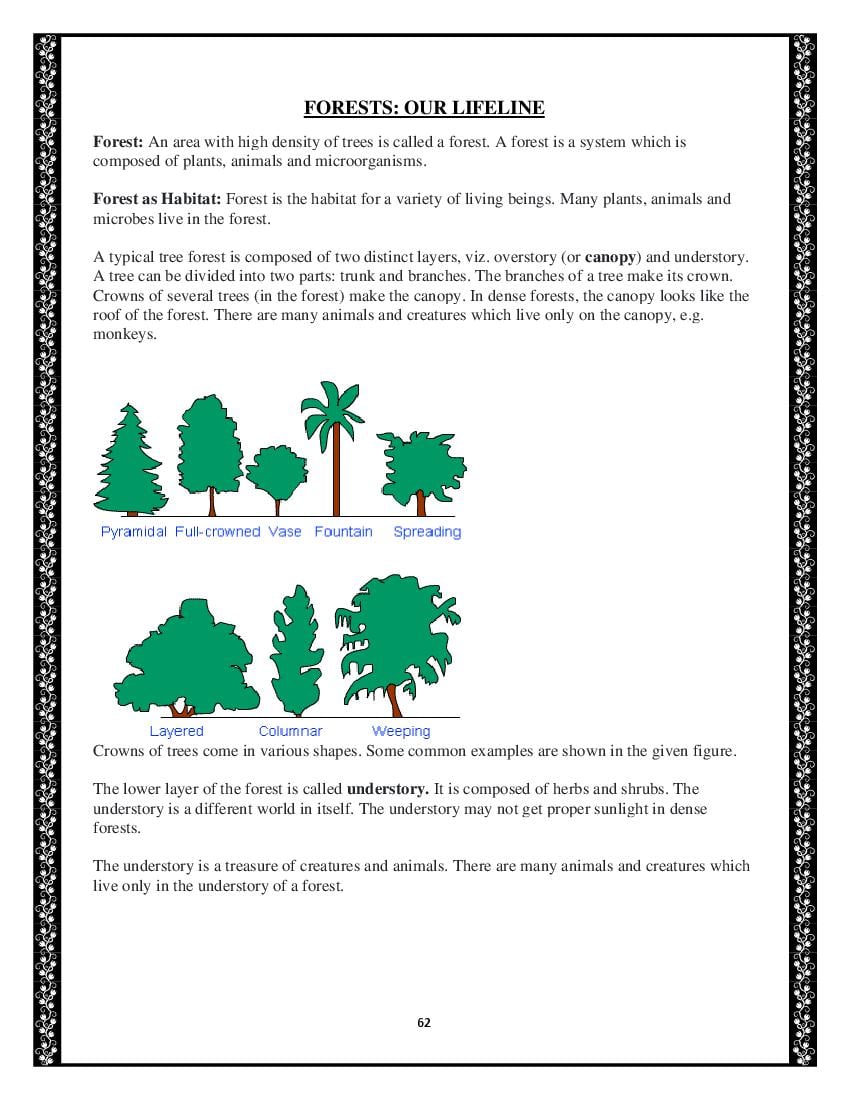
Crowns of trees come in various shapes. Some common examples are shown in the given figure.
The lower layer of the forest is called understory. It is composed of herbs and shrubs. The
understory is a different world in itself. The understory may not get proper sunlight in dense
forests.
The understory is a treasure of creatures and animals. There are many animals and creatures which
live only in the understory of a forest.
62
Page 3
Many important forest produce are useful for us. Some examples are given below:
• Firewood and dry leaves are used as kitchen fuel in villages which are close to a forest.
• Timber is an important raw material, for construction activities and for making furniture
and artifacts.
• Wood pulp is used in manufacturing paper.
• Honey, kendu leaves, catechu, lac, raisin, etc. are important forest produce.
• Many medicinal plants and herbs are found in forests.
Forest as a System:
Every part of the forest contributes in making a self-sustaining system. The green plants prepare
food through photosynthesis. The herbivores directly take food from the green plants. The
carnivores take food from the herbivores. This makes a food chain, which can be shown by
following example:
Grass → Deer → Lion
When an animal or a plant dies, its dead remains rot in due course of time and turn into soil-like
thing. The process is called decomposition and microorganisms carry out this process.
Decomposition is the process by which all the raw materials are returned to the nature. The soil-
like thing made after decomposition is called humus. It makes the soil highly fertile. The top soil
of forest is fertile because of presence of humus.
Role of Forest in Preserving the Environment: Forest plays an important role in preserving the
environment. Green plants take solar energy and convert it into chemical energy while making
food. Thus, solar energy is transferred to other living beings through the green plants. Green plants
utilize carbon dioxide during photosynthesis and release oxygen. That is how the green plants
maintain the balance of carbon dioxide and oxygen in the environment.
Role of Forest in Water Cycle: The roots of the trees make the soil porous. Rainwater seeps
through these pores and recharge groundwater. Forests prevent wastage of rainwater in the form of
runoff. Forests also prevent flash floods by slowing down the movement of water.
Role of Forest in Soil Conservation: The roots of the trees hold the top soil in place. This
prevents soil erosion by wind or by running water.
Deforestation and its Effect: Large scale cutting of trees to clear land for human use is called
deforestation. Due to growing human population, vast tracts of forest have been removed. This has
created many problems. Some of them are given below:
63
Page 4
• Reduced forest cover has disturbed the natural process of recharging of groundwater. This
has resulted in shortage of drinking water at many places.
• Reduced forest cover means there is loss of habitat for many animals. Existence of most of
the animals is in danger because of this.
• Reduced forest cover means there is higher percentage of carbon dioxide in the
atmosphere. This is leading to global warming. The average temperature of the earth is on
the rise.
MUTIPLE CHOICE QUESTIONS:
1-Which one of the following is an animal product?
(a) Gum (b) Catechu (c) Honey (d) Rubber
2- Roof of the forest made by the branches of the tall trees is called
(a) canopy (b) crown (c) understoreys (d) none of these
3- Understoreys are formed due to
(a) different types of crowns (b) different sizes of crown
(c) different heights of trees (d) all of these
4- Decomposers convert the dead plant and animal tissues into
(a) clay (b) humus (c) inorganic debris (d) soil
5- Which one of the following is a role of forests?
(a) Provide food, shelter, water and medicines (b) Prevent soil erosion
(c) Prevent flood (d) All the above
6-Which of the following serve as green lungs?
(a) Green pigment of the plants (b) Forests (c) Kitchen Gardens (d) Greenhouses gases
7- Consider the following statements and choose the correct one:
(a) A forest is a large area of land covered mainly with trees and other plants.
(b)Due to different climates and soils, there are various types of trees and other plants found in
various forests.
(c) The forest floor provides favourable conditions for seeds to germinate into seedlings and
saplings.
(d) All the above.
8- Micro-organism act upon the dead plants to produce:
(a) Sand (b) Mushroom (c) Humus (d)Wood
64
Page 5
(a) Gum (b) Plywood (c) Sealing wax (d)Kerosene
10- Which of the following has the strongest stem?
(a) A tree (b) A creeper (c) A climber (d) A bush
HOTS (HIGH ORDER THINKING SKILL) QUESTIONS:
1- While going inside a forest, it becomes darker. Why?
Ans- In a forest, big trees, shrubs and other plants are found. They trap solar radiation for
photosynthesis. So, the sunlight does not reach at the forest floor, thus making it dark.
2- A bunch of seedlings were seen sprouting on a heap of animal dropping in a forest. How do you
think is the seedling benefited from the animal dung?
Ans- The seedling was being benefited from the animal dung as the decaying animal dung
provided nutrients to the growing seedlings.
3- Deforestation may lead to floods. Why?
Ans- Deforestation leads to floods as lesser number of trees will be available due to deforestation.
In the absence of trees, the soil will not hold water leading to floods.
4- All the needs of animals living in a forest are fulfilled. Justify this statement in a few sentences.
Ans- Forest provides home (shelter), food and water to the animals living there. Thus, all the needs
of animals living in a forest are fulfilled.
5- Plants help in maintaining O2-CO2 cycle. Explain it in the light of photosynthesis and
respiration.
Ans- Photosynthesis is the process during which CO2 is used by the plants and O2 is released as a
product. This O2 is used by the animals for their respiration and CO2 is released during it which is
again used for photosynthesis by plants. In this way, O2-CO2 cycle is balanced by plants.
65
Page 6
66
Page 7
Notes
Model Papers Class 6 Notes
Sample Papers Class 7 Notes
Half Yearly Sample Papers Class 8 Notes
Class 9 Notes
Important Resources
Class 10 Notes
Periodic Table
Class 11 Notes
Writing Skills / Formats
Maps of India / World Class 12 Notes
Books and Solutions
NCERT Books
NCERT Book Solutions
HC Verma Chapter Wise Solutions
RD Sharma Solutions
CGBSE Solutions
Document Details
| Board / Org | Aglasem |
| Exam | Class 7 |
| Type | Notes |
| Pages | 5 |
| Language | english |
| Updated | 30 Apr 2026 |