MAT 2027 Sample Paper
Finished viewing? Save it for later —
Download MAT 2027 Sample Paper (PDF · 25 pages)About MAT 2027 Sample Paper
MAT 2027 Sample Paper is available here for free download. Published by AIMA for MAT, this sample paper can be viewed online or downloaded as a PDF (25 pages). Candidates preparing for MAT can use MAT 2027 Sample Paper to understand the exam pattern, the type of questions asked, and the overall difficulty level.
Frequently Asked Questions
How can I download MAT 2027 Sample Paper?
Open this page and click the Download button to save MAT 2027 Sample Paper as a PDF. It is completely free on AglaSem Docs.
Is MAT 2027 Sample Paper free to download?
Yes. MAT 2027 Sample Paper can be viewed online and downloaded as a PDF free of cost on AglaSem Docs.
How many pages does MAT 2027 Sample Paper have?
MAT 2027 Sample Paper contains 25 pages, which you can read online or download together as a single PDF.
Where can I find more MAT study material?
You can find more MAT question papers, sample papers, syllabus, and answer keys on AglaSem Docs.
MAT 2027 Sample Paper – Text
Read the full text of this sample paper below — useful to quickly search, copy and reference the content online without downloading the PDF.
📄 View text version (25 pages)
Page 1
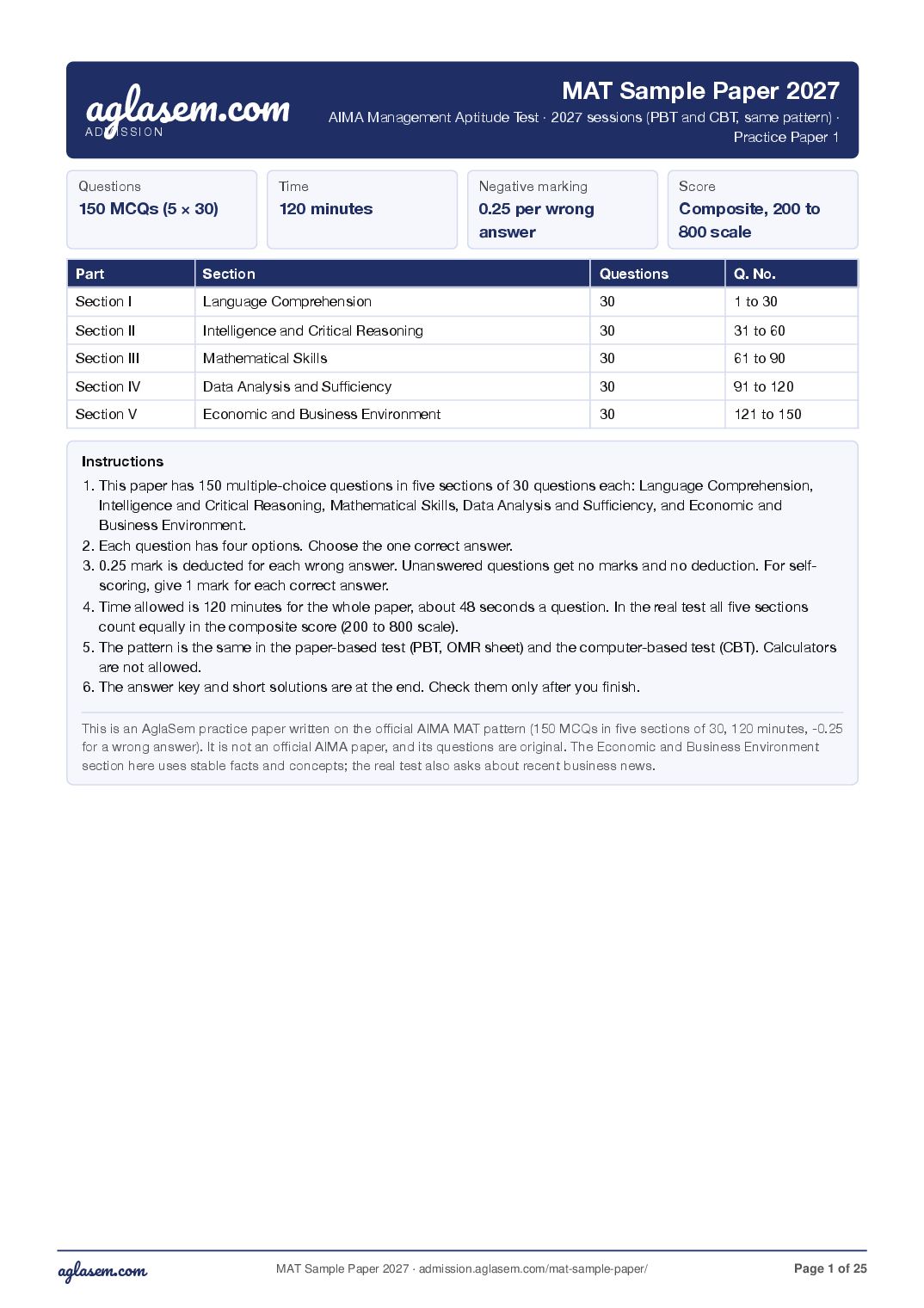
AIMA Management Aptitude Test · 2027 sessions (PBT and CBT, same pattern) ·
ADMISSION
Practice Paper 1
Questions Time Negative marking Score
150 MCQs (5 × 30) 120 minutes 0.25 per wrong Composite, 200 to
answer 800 scale
Part Section Questions Q. No.
Section I Language Comprehension 30 1 to 30
Section II Intelligence and Critical Reasoning 30 31 to 60
Section III Mathematical Skills 30 61 to 90
Section IV Data Analysis and Sufficiency 30 91 to 120
Section V Economic and Business Environment 30 121 to 150
Instructions
1. This paper has 150 multiple-choice questions in five sections of 30 questions each: Language Comprehension,
Intelligence and Critical Reasoning, Mathematical Skills, Data Analysis and Sufficiency, and Economic and
Business Environment.
2. Each question has four options. Choose the one correct answer.
3. 0.25 mark is deducted for each wrong answer. Unanswered questions get no marks and no deduction. For self-
scoring, give 1 mark for each correct answer.
4. Time allowed is 120 minutes for the whole paper, about 48 seconds a question. In the real test all five sections
count equally in the composite score (200 to 800 scale).
5. The pattern is the same in the paper-based test (PBT, OMR sheet) and the computer-based test (CBT). Calculators
are not allowed.
6. The answer key and short solutions are at the end. Check them only after you finish.
This is an AglaSem practice paper written on the official AIMA MAT pattern (150 MCQs in five sections of 30, 120 minutes, -0.25
for a wrong answer). It is not an official AIMA paper, and its questions are original. The Economic and Business Environment
section here uses stable facts and concepts; the real test also asks about recent business news.
MAT Sample Paper 2027 · admission./mat-sample-paper/ Page 1 of 25
Page 2
Language Comprehension
Read the passage given below and answer the next six questions on the basis of what is stated or
implied in it:
Before the railways, every town kept its own time. Noon was the moment the sun stood highest over the
local church tower or market square, and since the sun crosses the sky from east to west, noon in a town
a few hundred kilometres to the east arrived several minutes earlier than in one to the west. For centuries
this hardly mattered. A traveller on horseback moved so slowly that a difference of ten or fifteen minutes
between towns was lost in the length of the journey.
The railway changed this. A train could cover in an afternoon a distance that had once taken days, and a
timetable that listed departures in dozens of local times was a recipe for confusion and, worse, for
collisions on single-track lines. Railway companies began to run their trains on a single reference time,
usually that of their headquarters or of a national observatory, and station clocks were set to it. For a while
many towns displayed two clocks, one showing local time and the other 'railway time'.
What began as a convenience for engineers slowly became the time of everyone. Factories, schools and
law courts found it easier to follow the clock that the trains obeyed, and governments eventually made a
standard time official. The world was later divided into time zones, most of them a whole number of hours
apart, measured from the meridian at Greenwich.
The change was not welcomed everywhere. Some people objected that a time fixed by a distant authority
was artificial, since it no longer matched the sun overhead. They were right in a narrow sense, but they
missed the larger point. A shared time is a kind of agreement, and like a common language or a common
currency, its value lies less in its accuracy than in the fact that everyone uses it.
1. Which of the following best states the main idea of the passage?
(A) Railway collisions were caused mainly by faulty clocks at country stations
(B) Railways turned standard time from a technical convenience into a shared agreement
(C) Time zones were created by observatories chiefly to help astronomers
(D) Local solar time was more accurate and ought to have been kept in every town and city
2. Why did differences in local time not matter before the railways?
(A) Travel was so slow that a few minutes' gap made no practical difference
(B) Clocks of that period were too crude to show such small differences in time
(C) Hardly anyone travelled from one town to another
(D) Every town set its clock by the same church tower
3. According to the passage, local noon in a town arrives:
(A) At the same moment as in every other town
(B) Only when the railway clock shows twelve
(C) Earlier than in a town lying to its west
(D) Later than in a town lying to its west
4. Towns that displayed two clocks show that, for a time:
(A) Stations could not agree on a reference time
(B) Local time had been completely given up
(C) Local time and railway time existed side by side
(D) Railway time had already been made official by law
MAT Sample Paper 2027 · admission./mat-sample-paper/ Page 2 of 25
Page 3
(A) They were wrong in every respect about local time
(B) They were right in a narrow sense but missed its larger value
(C) They forced governments to drop standard time in many countries
(D) They were mostly engineers working for the railways
6. As used in the passage, 'a recipe for confusion' means:
(A) A carefully written method for clearing up confusion
(B) Something likely to lead to confusion
(C) A way of removing confusion
(D) A formal complaint about confusion
Read the passage given below and answer the next five questions:
When a shop marks a jacket 'Was ₹6,000, now ₹3,500', it is not only announcing a discount. It is planting
a number in the buyer's mind. Psychologists call this anchoring: the first figure we see on a question
tends to pull our later judgements towards it, even when we know the figure is arbitrary. In a well-known
kind of experiment, people who are first asked whether a product is worth more or less than a high price
go on to name a higher fair price than people first shown a low one.
Anchoring is useful to sellers, but it is not simply a trick. In many decisions we have no clear idea of what
something should cost, and a reference point, even a rough one, helps us start. The trouble begins when
the anchor is chosen by someone whose interests differ from ours. A salary negotiation that opens with
the employer's figure, or a property sale that begins with an inflated asking price, often ends closer to that
opening number than the facts alone would justify.
The defence is not to ignore all reference points, which is impossible, but to bring our own. A buyer who
has checked the prices of similar items, or a job seeker who knows what comparable roles pay, carries an
anchor of their own into the conversation. Research on negotiation also suggests that the side that names
a well-prepared first figure often gains an advantage, which is why experienced negotiators prepare their
opening offer carefully rather than waiting to react.
7. Anchoring, as described in the passage, is:
(A) A refusal to pay more than the market rate
(B) A seller's legal duty to display the original price on every label
(C) The pull that a first figure exerts on our later judgements
(D) The habit of always choosing the cheapest item
8. Which statement best reflects the author's attitude to anchoring?
(A) It can help decisions, but is risky when the anchor serves the other side
(B) It stops working once we know that the first figure is arbitrary
(C) It affects only people who are weak in mathematics
(D) It is a dishonest trick that ought to be banned
9. Which piece of advice follows from the passage?
(A) Always wait for the other side to name the first figure in a deal
(B) Accept the first offer so as to save time
(C) Find out what comparable items cost before you negotiate
(D) Ignore every price shown on a label
MAT Sample Paper 2027 · admission./mat-sample-paper/ Page 3 of 25
Page 4
(A) An employer opening salary talks with its own figure
(B) A job seeker studying the pay offered for comparable roles elsewhere
(C) A buyer checking the prices of similar items
(D) A psychologist describing an experiment
11. As used in the passage, 'inflated' most nearly means:
(A) Filled with air
(B) Fixed by law
(C) Set higher than is justified
(D) Lowered sharply to attract quick buyers
12. Find the part of the sentence that has an error: Between you and I, / the revised policy / seems unfair to
new employees.
(A) Between you and I, (B) the revised policy
(C) seems unfair to new employees. (D) No error
13. Find the part of the sentence that has an error: The choir sang / very sweet / at the annual function.
(A) The choir sang (B) very sweet
(C) at the annual function. (D) No error
14. Find the part of the sentence that has an error: By the time the guests arrived, / we already finished /
cooking the dinner.
(A) By the time the guests arrived,
(B) we already finished
(C) cooking the dinner.
(D) No error
15. Find the part of the sentence that has an error: Not only did he finish the report / but he also / presented
it to the board.
(A) Not only did he finish the report
(B) but he also
(C) presented it to the board.
(D) No error
16. Choose the one word for: a person who stays calm and unaffected by pleasure or pain.
(A) Hedonist (B) Optimist
(C) Stoic (D) Egoist
17. Choose the one word for: a person who lends money at an unfairly high rate of interest.
(A) Miser (B) Usurer
(C) Debtor (D) Auditor
18. Choose the one word for: handwriting that cannot be read.
(A) Inaudible (B) Invisible
(C) Ineligible (D) Illegible
19. Fill in the blank: The new scheme is aimed at ___ the gap between rural and urban incomes.
(A) lifting (B) crossing
(C) breaking (D) bridging
MAT Sample Paper 2027 · admission./mat-sample-paper/ Page 4 of 25
Page 5
fined.
(A) observe (B) flaunt
(C) flout (D) uphold
21. Fill in the blank: The two firms agreed to ___ their resources to develop the new product.
(A) pole (B) poll
(C) pull (D) pool
22. Fill in the blank: His ___ remarks about the client's product embarrassed the whole sales team.
(A) diplomatic (B) courteous
(C) tactless (D) tactful
23. Choose the word most similar in meaning to TENACIOUS.
(A) Indifferent (B) Forgetful
(C) Generous (D) Persistent
24. Choose the word most similar in meaning to DEARTH.
(A) Abundance (B) Expense
(C) Scarcity (D) Decline
25. Choose the word most nearly OPPOSITE in meaning to LETHARGIC.
(A) Apathetic (B) Sluggish
(C) Exhausted (D) Energetic
26. Choose the word most nearly OPPOSITE in meaning to PROLIFIC.
(A) Fruitful (B) Barren
(C) Rich (D) Abundant
27. Choose the meaning of the idiom: to go back to the drawing board
(A) To return to one's school for a visit
(B) To take up painting or sketching as a new hobby
(C) To copy someone else's design
(D) To start planning again after an idea fails
28. Choose the meaning of the idiom: the lion's share
(A) A risky business investment (B) A reward given for bravery
(C) A share that is shared equally (D) The largest part of something
29. Arrange the sentences in a logical order:
P: As a result, many of them close within their first few years.
Q: Most small businesses in India begin with very little capital.
R: They therefore find it hard to survive a bad season or a sudden rise in costs.
S: Access to cheap and timely credit could change this pattern.
(A) SQRP (B) QPRS
(C) RQPS (D) QRPS
30. Arrange the sentences in a logical order:
P: The water is then passed through layers of sand and gravel to remove fine particles.
Q: In a typical treatment plant, river water is first held in large tanks so that heavy particles settle.
R: Finally, a disinfectant such as chlorine is added before the water is supplied to homes.
S: Chemicals may be added at this stage to make smaller particles clump together and settle.
(A) QPSR (B) SQPR
(C) QPRS (D) QSPR
MAT Sample Paper 2027 · admission./mat-sample-paper/ Page 5 of 25
Page 6
Intelligence and Critical Reasoning
Study the information below and answer the next three questions:
A committee of five is to be chosen from five men, A, B, C, D and E, and four women, P, Q, R and S,
under these conditions:
1. A and P must be chosen together or not at all.
2. B cannot be in a committee with Q.
3. C and D cannot both be chosen.
4. If E is chosen, R must also be chosen.
5. The committee must have at least two women.
31. If A is not chosen, which of the following must be true?
(A) C is chosen (B) R and S are both chosen
(C) Q is chosen (D) B is chosen
32. If B, E and P are all chosen, the committee is:
(A) A, B, E, P, S (B) A, B, E, P, R
(C) A, B, E, P, Q (D) B, E, P, R, S
33. Which of the following is an acceptable committee?
(A) B, C, E, Q, R (B) A, C, D, P, S
(C) A, B, E, P, S (D) A, C, E, P, R
34. Statement: All candidates who scored above 90 in the written test were called for the interview. Rohan
was not called for the interview.
Conclusions: I. Rohan did not score above 90 in the written test. II. Rohan failed the written test.
(A) Only conclusion I follows (B) Only conclusion II follows
(C) Neither I nor II follows (D) Both I and II follow
35. Statement: Some of the company's best-selling products were launched in the last two years, a period
in which it spent heavily on research.
Conclusions: I. Spending on research always produces best-selling products. II. All the products the
company launched in the last two years are best-sellers.
(A) Neither I nor II follows (B) Only conclusion I follows
(C) Only conclusion II follows (D) Both I and II follow
36. Statement: Every employee of the firm has signed a non-compete agreement, and no employee works
for a competitor. Meera is an employee of the firm. Arjun works for a competitor.
Conclusions: I. Meera does not work for a competitor. II. Arjun is not an employee of the firm.
(A) Neither I nor II follows (B) Both I and II follow
(C) Only conclusion I follows (D) Only conclusion II follows
37. Assertion (A): During a storm we usually see the lightning before we hear the thunder.
Reason (R): Light travels much faster than sound.
Choose the correct option.
(A) A is true, but R is false
(B) Both A and R are true, but R does not explain A
(C) A is false, but R is true
(D) Both A and R are true, and R explains A
MAT Sample Paper 2027 · admission./mat-sample-paper/ Page 6 of 25
Page 7
Reason (R): Petrol is the only fuel used by goods vehicles in India.
Choose the correct option.
(A) A is true, but R is false
(B) Both A and R are true, and R explains A
(C) Both A and R are true, but R does not explain A
(D) A is false, but R is true
39. In a code, 'A + B' means A is the father of B, 'A − B' means A is the wife of B, and 'A × B' means A is
the brother of B. If P + Q − R, how is P related to R?
(A) Uncle (B) Father-in-law
(C) Brother-in-law (D) Father
40. In a family, M and N are a married couple, and N is the mother of O and P. Q is the wife of O. How is Q
related to M?
(A) Sister-in-law (B) Daughter-in-law
(C) Daughter (D) Niece
41. Find the next number in the series: 3, 8, 18, 38, 78, ?
(A) 156 (B) 148
(C) 160 (D) 158
42. Find the next number in the series: 1, 4, 27, 256, ?
(A) 1024 (B) 625
(C) 3125 (D) 3025
43. Find the next letter in the series: A, C, G, M, ?
(A) V (B) T
(C) U (D) S
44. Find the next number in the series: 6, 11, 21, 36, 56, ?
(A) 80 (B) 76
(C) 81 (D) 86
45. Painter : Brush :: Surgeon : ?
(A) Hospital (B) Doctor
(C) Scalpel (D) Patient
46. 7 : 50 :: 9 : ?
(A) 90 (B) 82
(C) 80 (D) 81
47. If PENCIL is written as QFODJM in a certain code, how is ERASER written in that code?
(A) FTBTFS (B) FSBTFS
(C) FSBUFS (D) DQZRDQ
48. If MANAGER is written as REGANAM, how is MARKET written in that code?
(A) TEKMAR (B) KETRAM
(C) TEKRAM (D) TERKAM
49. In a code language, 'tik bo ran' means 'sales are rising', 'ran pel mu' means 'costs are falling' and 'mu
bo zed' means 'sales keep falling'. What is the code for 'costs'?
(A) zed (B) ran
(C) mu (D) pel
MAT Sample Paper 2027 · admission./mat-sample-paper/ Page 7 of 25
Page 8
Conclusions: I. Some pilots are not careless. II. All careless people are pilots.
Which conclusion(s) follow?
(A) Only I follows (B) Only II follows
(C) Both I and II follow (D) Neither I nor II follows
51. Statements: All apps are software. Some software is free.
Conclusions: I. Some apps are free. II. Some software is apps.
Which conclusion(s) follow?
(A) Neither I nor II follows (B) Both I and II follow
(C) Only I follows (D) Only II follows
52. Statements: All laptops are devices. All devices are products.
Conclusions: I. All laptops are products. II. Some products are laptops.
Which conclusion(s) follow?
(A) Neither I nor II follows (B) Only I follows
(C) Both I and II follow (D) Only II follows
53. A company found that branches giving staff a weekly half-day off reported higher sales than its other
branches. Management concluded that the half-day off raises sales. Which of the following most
weakens this conclusion?
(A) Only branches in busy city markets, which already sold more, got the half-day off
(B) The company plans to extend the half-day off to all its branches
(C) Staff at these branches said that they liked having the half-day off
(D) Sales across the whole company rose slightly last year
54. A supermarket chain will charge ₹10 for each plastic carry bag in order to reduce plastic waste. The
plan assumes that:
(A) Some shoppers will bring their own bags rather than pay
(B) Every supermarket in the city will do the same
(C) Shoppers pay no attention to the price of bags
(D) Plastic bags are cheaper to make than paper bags
55. A city claims that its new bus lanes have cut the average travel time of bus riders. Which of the
following most strengthens this claim?
(A) Bus journey times fell after the lanes opened, while traffic volume stayed the same
(B) The bus lanes were painted red so that drivers could see them
(C) Bus fares were raised in the same month the lanes opened
(D) Car owners complained that the roads had become narrower
Read the information below and answer the next three questions:
Six friends, J, K, L, M, N and O, sit in a row facing north. K sits third from the left end. L sits immediately
to the right of K. M sits second to the right of L. J sits at one of the ends. O sits immediately to the left of
M.
56. Who sits at the right end of the row?
(A) O (B) M
(C) J (D) L
57. Who sits between K and O?
(A) J (B) M
(C) L (D) N
MAT Sample Paper 2027 · admission./mat-sample-paper/ Page 8 of 25
Page 9
(A) 4 (B) 3
(C) 2 (D) 1
59. From his house, Kabir drives 15 km west, then 5 km south, then 3 km east. How far is he from his house
in a straight line?
(A) 13 km (B) 17 km
(C) 12 km (D) 23 km
60. In a queue, Arun is 17th from the front and Bela is 9th from the back. Five people stand between them,
and Arun is ahead of Bela. How many people are in the queue?
(A) 30 (B) 29
(C) 32 (D) 31
Section III
Mathematical Skills
61. The sum of the digits of a two-digit number is 11. When the digits are reversed, the number increases
by 27. What is the number?
(A) 56 (B) 74
(C) 38 (D) 47
62. What is the remainder when 1! + 2! + 3! + ... + 50! is divided by 12?
(A) 0 (B) 9
(C) 3 (D) 5
63. How many numbers from 100 to 400 (both included) are divisible by 7?
(A) 43 (B) 42
(C) 41 (D) 44
64. In a test, 65% of the candidates passed in English, 70% passed in Maths and 15% failed in both. If 450
candidates passed in both subjects, how many took the test?
(A) 900 (B) 750
(C) 850 (D) 1,000
65. A's income is 20% more than B's, and B's income is 25% less than C's. A's income is what percentage
of C's?
(A) 95% (B) 85%
(C) 90% (D) 105%
66. By selling an article for ₹1,380, a trader gains 15%. What would be his gain or loss percentage if he sold
it for ₹1,140?
(A) 5% loss (B) 6% loss
(C) 4% loss (D) 5% gain
67. A shopkeeper sells two shirts for ₹990 each, gaining 10% on one and losing 10% on the other. What is
the overall result?
(A) No gain, no loss (B) Loss of ₹10
(C) Loss of ₹20 (D) Gain of ₹20
MAT Sample Paper 2027 · admission./mat-sample-paper/ Page 9 of 25
Page 10
rate of interest per annum?
(A) 10% (B) 12%
(C) 9% (D) 15%
69. The difference between the compound interest and the simple interest on a sum for 2 years at 10% per
annum is ₹65. What is the sum?
(A) ₹6,500 (B) ₹7,500
(C) ₹6,000 (D) ₹5,500
70. 12 workers can finish a job in 15 days. After they have worked for 5 days, 3 more workers join them. In
how many more days will the job be finished?
(A) 8 days (B) 12 days
(C) 9 days (D) 10 days
71. Pipes A and B can fill a tank in 10 hours and 15 hours. Pipe C can empty the full tank in 12 hours. If all
three are opened together on an empty tank, in how many hours will it be full?
(A) 20 hours (B) 12 hours
(C) 10 hours (D) 15 hours
72. A train running at 63 km/h passes a man standing on a platform in 16 seconds. What is the length of the
train?
(A) 300 m (B) 252 m
(C) 280 m (D) 260 m
73. Two cyclists start at the same time from towns A and B, 90 km apart, and ride towards each other at 12
km/h and 18 km/h. When and where do they meet?
(A) After 3.5 hours, 42 km from A (B) After 3 hours, 54 km from A
(C) After 3 hours, 36 km from A (D) After 2.5 hours, 30 km from A
74. A boat covers 24 km upstream in 6 hours and the same distance downstream in 4 hours. What is the
speed of the boat in still water?
(A) 6 km/h (B) 4 km/h
(C) 4.5 km/h (D) 5 km/h
75. ₹7,200 is divided among A, B and C so that A gets half of what B and C together get, and B gets one-
third of what A and C together get. What is C's share?
(A) ₹2,400 (B) ₹3,200
(C) ₹1,800 (D) ₹3,000
76. A can holds 60 litres of milk. 6 litres are taken out and replaced with water, and the same is done once
more. How much milk is now in the can?
(A) 48 litres (B) 48.6 litres
(C) 49.2 litres (D) 50.4 litres
77. The average weight of 8 people rises by 2.5 kg when one of them, who weighs 56 kg, is replaced by a
new person. What does the new person weigh?
(A) 76 kg (B) 58.5 kg
(C) 78.5 kg (D) 66 kg
78. Five years ago, the ratio of A's age to B's age was 3 : 4. Five years from now it will be 5 : 6. What is A's
present age?
(A) 25 years (B) 20 years
(C) 18 years (D) 15 years
MAT Sample Paper 2027 · admission./mat-sample-paper/ Page 10 of 25
Page 11
q?
(A) 49 (B) 12
(C) 49/4 (D) 7/2
80. 3 pens and 5 notebooks cost ₹170, and 5 pens and 3 notebooks cost ₹150. What is the cost of one
notebook?
(A) ₹15 (B) ₹30
(C) ₹25 (D) ₹20
81. The 4th term of an arithmetic progression is 14 and its 9th term is 29. What is the sum of its first 20
terms?
(A) 640 (B) 700
(C) 610 (D) 670
82. In triangle ABC, D lies on AB and E on AC such that DE is parallel to BC. If AD = 4 cm, DB = 6 cm and
AE = 5 cm, what is EC?
(A) 6.5 cm (B) 7.5 cm
(C) 8 cm (D) 6 cm
83. A right-angled triangle has a perimeter of 60 cm and a hypotenuse of 25 cm. What is its area?
(A) 150 cm² (B) 300 cm²
(C) 175 cm² (D) 120 cm²
84. A point P is 10 cm from the centre of a circle of radius 6 cm. What is the length of the tangent from P to
the circle?
(A) 7 cm (B) 9 cm
(C) 4 cm (D) 8 cm
85. A closed cylinder has a radius of 7 cm and a height of 10 cm. What is its total surface area? (Take π =
22/7.)
(A) 748 cm² (B) 1,540 cm²
(C) 594 cm² (D) 440 cm²
86. A metal sphere of radius 6 cm is melted and recast into small spheres of radius 2 cm each. How many
small spheres are made?
(A) 18 (B) 27
(C) 3 (D) 9
87. A boy whose eyes are 1.5 m above the ground stands 28.5 m from a tower on level ground. He sees the
top of the tower at an angle of elevation of 45°. How tall is the tower?
(A) 31.5 m (B) 30 m
(C) 27 m (D) 28.5 m
88. If sin θ = 3/5 and θ is acute, what is the value of tan θ + sec θ?
(A) 1/2 (B) 7/4
(C) 5/3 (D) 2
89. A bag has 4 red, 5 blue and 6 green balls. One ball is drawn at random. What is the probability that it is
not blue?
(A) 3/5 (B) 4/15
(C) 1/3 (D) 2/3
MAT Sample Paper 2027 · admission./mat-sample-paper/ Page 11 of 25
Page 12
(A) 8 (B) 11
(C) 9 (D) 10
Section IV
Data Analysis and Sufficiency
Study the table and answer the next five questions:
Units sold by a company (in thousands)
Region 2023 2024 2025
North 120 135 150
South 90 108 117
East 60 66 81
West 150 144 162
Central 80 87 90
91. What was the total number of units sold in 2024?
(A) 560 thousand (B) 500 thousand
(C) 520 thousand (D) 540 thousand
92. Which region had the highest percentage growth in sales from 2023 to 2025?
(A) East (B) South
(C) Central (D) North
93. By what percentage did the company's total sales rise from 2023 to 2025?
(A) 20% (B) 18%
(C) 16.7% (D) 25%
94. What was the West region's approximate share of total sales in 2024?
(A) 28.6% (B) 26.7%
(C) 24.0% (D) 30.0%
95. In how many regions did sales rise in both 2024 and 2025?
(A) 5 (B) 3
(C) 2 (D) 4
A company's total expenditure in 2025 was ₹50 crore, shared as below. Answer the next four
questions:
Head Share of expenditure
Salaries 30%
Raw material 25%
Marketing 18%
Rent 10%
Taxes 9%
Others 8%
96. How much did the company spend on raw material in 2025?
(A) ₹12.5 crore (B) ₹25 crore
(C) ₹15 crore (D) ₹10 crore
MAT Sample Paper 2027 · admission./mat-sample-paper/ Page 12 of 25
Page 13
(A) 135° (B) 150°
(C) 120° (D) 144°
98. By how much did spending on Salaries exceed spending on Taxes?
(A) ₹12 crore (B) ₹21 crore
(C) ₹10.5 crore (D) ₹9 crore
99. If total expenditure rises by 10% next year while the rent stays the same in rupees, what will rent's
share of expenditure be?
(A) 10% (B) About 9.1%
(C) 11% (D) About 8.3%
Read the information below and answer the next four questions:
A school has 1,200 students, of whom 45% are girls. 40% of the girls play basketball. 150 girls play
football, and 60 of these also play basketball. 30% of the boys play basketball, and 165 boys play both
basketball and football.
100. How many students in all play basketball?
(A) 380 (B) 414
(C) 432 (D) 396
101. How many girls play neither basketball nor football?
(A) 324 (B) 264
(C) 174 (D) 234
102. How many boys play basketball but not football?
(A) 45 (B) 33
(C) 198 (D) 165
103. Girls who play only football form what percentage of all students in the school?
(A) 7.5% (B) 12.5%
(C) 5% (D) 9%
The table gives the monthly output (in tonnes) of two plants, P and Q. Answer the next five
questions:
Month Plant P Plant Q
January 400 350
February 450 380
March 420 440
April 480 460
May 500 520
104. In how many of the five months did Plant Q produce more than Plant P?
(A) 3 (B) 4
(C) 2 (D) 1
105. What was the average monthly output of Plant P?
(A) 440 tonnes (B) 460 tonnes
(C) 450 tonnes (D) 430 tonnes
MAT Sample Paper 2027 · admission./mat-sample-paper/ Page 13 of 25
Page 14
(A) 32.7% (B) 52.0%
(C) 45.0% (D) 48.6%
107. What was the combined output of the two plants in April?
(A) 940 tonnes (B) 900 tonnes
(C) 960 tonnes (D) 920 tonnes
108. What is the ratio of Plant P's total output to Plant Q's total output over the five months?
(A) 9 : 8 (B) 45 : 43
(C) 15 : 14 (D) 43 : 45
Data sufficiency: each of the next eight questions is followed by two statements, I and II. Decide
whether the data in the statements are sufficient to answer the question, and choose the matching
option.
109. What is the ratio of A's salary to B's salary?
I. A earns ₹8,000 a month more than B.
II. B's salary is 60% of A's salary.
(A) Both together are not sufficient
(B) Statement II alone is sufficient
(C) Statement I alone is sufficient
(D) Both statements together are needed
110. Is the product abc negative? (a, b and c are non-zero numbers.)
I. ab > 0
II. c < 0
(A) Both together are not sufficient
(B) Both statements together are needed
(C) Statement I alone is sufficient
(D) Statement II alone is sufficient
111. What is the area of a square?
I. Its perimeter is 28 cm.
II. Its side is longer than 5 cm.
(A) Statement I alone is sufficient
(B) Both together are not sufficient
(C) Both statements together are needed
(D) Statement II alone is sufficient
112. What is Ravi's present age?
I. Five years from now, Ravi's age will be twice his age ten years ago.
II. Ravi's father is 30 years older than Ravi.
(A) Statement II alone is sufficient
(B) Both together are not sufficient
(C) Both statements together are needed
(D) Statement I alone is sufficient
MAT Sample Paper 2027 · admission./mat-sample-paper/ Page 14 of 25
Page 15
I. Ria is 14th from the top in the class.
II. Ria is 22nd from the bottom in the class.
(A) Both together are not sufficient
(B) Both statements together are needed
(C) Statement II alone is sufficient
(D) Statement I alone is sufficient
114. What is the cost price of an article?
I. It was sold at a profit of 20%.
II. Its marked price was 50% above its selling price.
(A) Statement II alone is sufficient
(B) Both statements together are needed
(C) Both together are not sufficient
(D) Statement I alone is sufficient
115. Is A the tallest of three friends A, B and C?
I. B is shorter than C.
II. C is taller than A.
(A) Both together are not sufficient
(B) Statement I alone is sufficient
(C) Both statements together are needed
(D) Statement II alone is sufficient
116. What is the area of a circle?
I. Its circumference is more than 44 cm.
II. Its diameter is less than 15 cm.
(A) Statement I alone is sufficient
(B) Statement II alone is sufficient
(C) Both statements together are needed
(D) Both together are not sufficient
Quantity comparison: in each of the next four questions, compare Quantity I and Quantity II and
choose the correct relation.
117. Quantity I: 30% of 250
Quantity II: 25% of 300
(A) Quantity I = Quantity II (B) Quantity I < Quantity II
(C) Relation cannot be established (D) Quantity I > Quantity II
118. Quantity I: x, where x² = 49
Quantity II: 7
(A) Relation cannot be established (B) Quantity I < Quantity II
(C) Quantity I > Quantity II (D) Quantity I = Quantity II
119. Quantity I: Simple interest on ₹4,000 at 5% a year for 2 years
Quantity II: Compound interest (compounded yearly) on ₹4,000 at 5% a year for 2 years
(A) Relation cannot be established (B) Quantity I < Quantity II
(C) Quantity I > Quantity II (D) Quantity I = Quantity II
MAT Sample Paper 2027 · admission./mat-sample-paper/ Page 15 of 25
Page 16
Quantity II: Area of a rectangle measuring 12 cm by 6.5 cm
(A) Quantity I > Quantity II (B) Quantity I = Quantity II
(C) Quantity I < Quantity II (D) Relation cannot be established
Section V
Economic and Business Environment
121. Which of the following is NOT a function of the Reserve Bank of India?
(A) Collecting income tax from individuals
(B) Acting as banker to the Government
(C) Acting as lender of last resort to banks
(D) Issuing currency notes
122. Open market operations by the RBI refer to:
(A) Buying and selling government securities to manage liquidity
(B) Fixing the exchange rate of the rupee against the dollar each morning
(C) Lending to exporters at specially reduced rates
(D) Selling shares of public sector banks to investors
123. To bring down high inflation, the RBI is most likely to:
(A) Lower the interest it pays to banks
(B) Raise the policy repo rate
(C) Buy government securities in the market
(D) Cut the cash reserve ratio
124. Which of these is recorded in the capital (financial) account of India's balance of payments, not the
current account?
(A) Import of crude oil
(B) Export of software services
(C) Money sent home by Indian workers living and working abroad
(D) Foreign direct investment in an Indian company
125. A tax whose rate rises as the taxable income rises is called a:
(A) Proportional tax (B) Specific tax
(C) Regressive tax (D) Progressive tax
126. Which of the following is a non-tax revenue receipt of the Union Government?
(A) Customs duty
(B) Corporation tax
(C) Dividends from public sector enterprises
(D) Goods and services tax collected by the Centre (CGST)
127. OPEC is an organisation of:
(A) Gold-producing countries
(B) Petroleum-exporting countries
(C) Leading steel- and iron-producing countries
(D) Oil-importing countries
MAT Sample Paper 2027 · admission./mat-sample-paper/ Page 16 of 25
Page 17
(A) Net factor income from abroad
(B) Indirect taxes minus subsidies on products
(C) Customs duties on imports
(D) Depreciation
129. The demand for a basic necessity such as salt is usually:
(A) Highly price elastic (B) Perfectly elastic
(C) Price inelastic (D) Unitary elastic
130. Which of the following is the best example of a public good?
(A) A private car (B) A packet of biscuits
(C) A cinema ticket (D) Street lighting
131. Inflation caused by rising costs of production, such as wages and raw materials, is called:
(A) Demand-pull inflation (B) Cost-push inflation
(C) Galloping inflation (D) Creeping inflation
132. Which of these best describes disguised unemployment?
(A) Educated people cannot find jobs that match their training and skills
(B) People are out of work only during certain seasons of the year
(C) More people work on a task than needed, so some add nothing to output
(D) Workers lose their jobs because of new technology
133. Which of the following best describes GST in India?
(A) An origin-based tax collected only by the producing state
(B) A tax on wealth
(C) A destination-based tax on consumption
(D) A direct tax on income
134. The Government of India announces Minimum Support Prices (MSP) for crops on the recommendation
of:
(A) CACP (B) NITI Aayog
(C) NABARD (D) FCI
135. The Unified Payments Interface (UPI) was developed by:
(A) NPCI (B) SEBI
(C) SBI (D) IRDAI
136. A company's shares are said to be 'listed' when they are:
(A) Admitted for trading on a recognised stock exchange
(B) Held only by the company's promoters
(C) Bought back from the market and then cancelled by the company
(D) Given free to employees as a bonus
137. The financial year of the Government of India runs from:
(A) 1 July to 30 June (B) 1 October to 30 September
(C) 1 April to 31 March (D) 1 January to 31 December
138. How many major commercial banks were nationalised in India in July 1969?
(A) 10 (B) 20
(C) 6 (D) 14
MAT Sample Paper 2027 · admission./mat-sample-paper/ Page 17 of 25
Page 18
(A) Licensing, Privatisation and Growth
(B) Liberalisation, Privatisation and Globalisation
(C) Liberalisation, Public investment and Globalisation
(D) Licensing, Planning and Growth
140. Which of these is a debt instrument rather than a share in the ownership of a company?
(A) Debenture (B) Bonus share
(C) Sweat equity share (D) Equity share
141. Which organisation publishes the World Economic Outlook?
(A) WTO (B) World Bank
(C) OECD (D) IMF
142. In a company's balance sheet, which of these is a current asset?
(A) Land and factory building (B) Plant and machinery
(C) Stock of finished goods (D) Patents
143. Which form of business organisation gives its owners limited liability?
(A) General partnership firm (B) Unregistered partnership firm
(C) Sole proprietorship (D) Private limited company
144. Which curve shows the relation between tax rates and the total tax revenue collected?
(A) Laffer curve (B) Engel curve
(C) Phillips curve (D) Lorenz curve
145. The Gini coefficient is used to measure:
(A) The share of exports in a country's GDP
(B) The rate of inflation
(C) Inequality of income or wealth
(D) The growth of GDP
146. In the stock market, what does IPO stand for?
(A) International Price Option (B) Initial Private Ownership
(C) Initial Public Offering (D) Indian Primary Offering
147. Devaluation of a country's currency is most likely to:
(A) Make its exports cheaper for foreign buyers
(B) Reduce the demand for its exports
(C) Make its imports cheaper for home buyers
(D) Raise the foreign-currency value of its currency
148. The Monetary Policy Committee that fixes the policy repo rate in India has how many members?
(A) 9 (B) 5
(C) 6 (D) 7
149. Who chairs the GST Council?
(A) RBI Governor (B) Chief Economic Adviser
(C) Prime Minister (D) Union Finance Minister
MAT Sample Paper 2027 · admission./mat-sample-paper/ Page 18 of 25
Page 19
(A) Fiscal discipline and limits on government deficits
(B) Management of foreign exchange transactions
(C) Protection of consumers' rights
(D) Licensing, inspection and regulation of commercial banks
MAT Sample Paper 2027 · admission./mat-sample-paper/ Page 19 of 25
Page 20
1 B 2 A 3 C 4 C 5 B 6 B 7 C 8 A 9 C 10 A
11 C 12 A 13 B 14 B 15 D 16 C 17 B 18 D 19 D 20 C
21 D 22 C 23 D 24 C 25 D 26 B 27 D 28 D 29 D 30 D
31 B 32 B 33 D 34 A 35 A 36 B 37 D 38 A 39 B 40 B
41 D 42 C 43 C 44 C 45 C 46 B 47 B 48 C 49 D 50 A
51 D 52 C 53 A 54 A 55 A 56 B 57 C 58 B 59 A 60 D
61 D 62 B 63 A 64 A 65 C 66 A 67 C 68 B 69 A 70 A
71 B 72 C 73 C 74 D 75 D 76 B 77 A 78 B 79 C 80 C
81 D 82 B 83 A 84 D 85 A 86 B 87 B 88 D 89 D 90 C
91 D 92 A 93 A 94 B 95 D 96 A 97 D 98 C 99 B 100 B
101 D 102 B 103 A 104 C 105 C 106 D 107 A 108 B 109 B 110 B
111 A 112 D 113 B 114 C 115 D 116 D 117 A 118 A 119 B 120 A
121 A 122 A 123 B 124 D 125 D 126 C 127 B 128 A 129 C 130 D
131 B 132 C 133 C 134 A 135 A 136 A 137 C 138 D 139 B 140 A
141 D 142 C 143 D 144 A 145 C 146 C 147 A 148 C 149 D 150 A
Solutions
Language Comprehension
1. (B) The passage traces how railway time spread to factories, courts and governments, and ends by calling shared
time an agreement whose value lies in common use.
2. (A) Paragraph 1: a traveller on horseback moved so slowly that a gap of ten or fifteen minutes was lost in the length
of the journey.
3. (C) The sun crosses the sky from east to west, so noon in a town to the east comes earlier than in one to the west.
4. (C) Paragraph 2: one clock showed local time and the other 'railway time', so the two were used together for a
while.
5. (B) The last paragraph: 'They were right in a narrow sense, but they missed the larger point.'
6. (B) 'A recipe for' something means a situation that is likely to produce it; dozens of local times in one timetable
would cause confusion.
7. (C) Paragraph 1: the first figure we see tends to pull our later judgements towards it.
8. (A) The author says anchoring 'is not simply a trick' and helps us start, but 'trouble begins' when someone with
different interests chooses the anchor. The last option contradicts the passage.
9. (C) Paragraph 3: the defence is to bring our own anchor by checking prices of similar items. The passage says
naming a prepared first figure is often an advantage, so waiting is not advised.
10. (A) The passage gives the employer's opening figure and an inflated asking price as examples of anchors set by
the other party.
11. (C) An 'inflated asking price' is one pushed above what the facts would justify.
12. (A) A preposition takes the object form of a pronoun: 'Between you and me'.
13. (B) 'Sang' needs an adverb, not an adjective: 'sang very sweetly'.
14. (B) The earlier of two past actions takes the past perfect: 'we had already finished cooking'.
15. (D) The sentence is correct: 'Not only' at the start takes inversion ('did he finish'), and 'but he also' completes the
pair.
MAT Sample Paper 2027 · admission./mat-sample-paper/ Page 20 of 25
Page 21
17. (B) A usurer charges excessive interest. A miser hoards money; a debtor owes money.
18. (D) Illegible means impossible to read. Ineligible means not qualified; inaudible means impossible to hear.
19. (D) To 'bridge a gap' is to reduce the difference between two things.
20. (C) To flout a rule is to openly disregard it; 'despite warnings' and 'fined' show disobedience. To flaunt is to show
off.
21. (D) To pool resources is to put them together for a common purpose.
22. (C) Remarks that embarrass the team must be tactless (lacking sensitivity). The other three words are positive.
23. (D) Tenacious means holding firmly to a purpose and not giving up easily.
24. (C) A dearth is a shortage or lack of something.
25. (D) Lethargic means sluggish and lacking energy; its opposite is energetic.
26. (B) Prolific means producing a great deal (a prolific writer, a prolific orchard); its opposite is barren, producing
nothing.
27. (D) When a plan fails and you must begin again from the start, you go back to the drawing board.
28. (D) The lion's share is the biggest portion, as in 'the lion's share of the profits'.
29. (D) Q introduces small businesses and little capital; R gives the consequence (hard to survive shocks); P the result
(many close); S the remedy.
30. (D) Q (first, settling) is followed by S ('at this stage', still in the tanks), then P ('then', filtration) and R ('finally',
disinfection).
Intelligence and Critical Reasoning
31. (B) Without A, P is out. Only Q, R, S remain as women and at most three men (B, one of C/D, E) are possible. With
B, Q is out, so R, S and E are needed: B, C/D, E, R, S. Without B, the five must be C/D, E, Q, R, S. Every valid
committee has E, R and S.
32. (B) P needs A; E needs R. A, B, E, P, R makes five with two women. The second lacks A, the third lacks R with E,
and the fourth puts B with Q.
33. (D) A, C, E, P, R meets every rule. The second has both C and D, the third puts B with Q, and the fourth has E
without R.
34. (A) If Rohan had scored above 90 he would have been called, so I follows. Not scoring above 90 does not mean he
failed, so II does not follow.
35. (A) 'Always' in I goes far beyond one company's experience, and 'some' best-sellers does not mean 'all' new
products are best-sellers.
36. (B) No employee works for a competitor, so Meera (an employee) does not, and Arjun (who does) cannot be an
employee.
37. (D) Lightning and thunder happen together, but light (about 3 × 10⁸ m/s) reaches us almost at once while sound
(about 340 m/s) takes longer. R explains A.
38. (A) Fuel is a major transport cost, so A is true. R is false: most trucks in India run on diesel, and CNG and electric
vehicles are also used.
39. (B) P is the father of Q, and Q is the wife of R. So P is the father of R's wife, that is, R's father-in-law.
40. (B) N is a mother, so her husband M is the father of O. O has a wife, so O is M's son, and Q is M's daughter-in-law.
41. (D) Each term is twice the previous term plus 2: 78 × 2 + 2 = 158.
42. (C) The terms are 1¹, 2², 3³, 4⁴, so the next is 5⁵ = 3125.
43. (C) Positions 1, 3, 7, 13 rise by 2, 4, 6; the next rise is 8, giving 21, which is U.
44. (C) Differences are 5, 10, 15, 20, so the next difference is 25: 56 + 25 = 81.
45. (C) A painter works with a brush; a surgeon works with a scalpel.
46. (B) 7² + 1 = 50, so 9² + 1 = 82.
47. (B) Each letter moves one place forward: E→F, R→S, A→B, S→T, E→F, R→S.
MAT Sample Paper 2027 · admission./mat-sample-paper/ Page 21 of 25
Page 22
49. (D) 'are' = ran (common to the first two), 'falling' = mu (common to the last two), so in 'ran pel mu' the code for
'costs' is pel.
50. (A) The pilots who are engineers cannot be careless, so some pilots are not careless (I). Nothing links careless
people to pilots, so II does not follow.
51. (D) Since every app is software, some software is apps (II). The free software need not include any app, so I is not
certain.
52. (C) Laptops ⊂ devices ⊂ products gives I; and since all laptops are products, some products are laptops (II).
53. (A) If the scheme was given only to branches that already had higher sales, the sales gap has another cause, so
the conclusion is weakened.
54. (A) A charge can cut waste only if it changes behaviour, so the plan assumes some customers will avoid paying by
carrying their own bags.
55. (A) Shorter bus journeys with traffic unchanged point to the lanes as the cause, which supports the claim.
56. (B) K is 3rd and L 4th from the left; M is second to the right of L, so 6th. J must take the other end, 1st. O is just left
of M (5th), leaving N at 2nd: J, N, K, L, O, M.
57. (C) In the order J, N, K, L, O, M, L sits between K and O.
58. (B) J, N and K sit to the left of L.
59. (A) He ends 12 km west and 5 km south of his house. Distance = √(12² + 5²) = 13 km.
60. (D) Bela is 17 + 5 + 1 = 23rd from the front and 9th from the back, so the queue has 23 + 9 − 1 = 31 people.
Mathematical Skills
61. (D) Let the number be 10a + b. a + b = 11 and 9(b − a) = 27, so b − a = 3. Then b = 7, a = 4: the number is 47.
62. (B) From 4! = 24 onwards every term is a multiple of 12. So the remainder is that of 1 + 2 + 6 = 9.
63. (A) Multiples of 7 up to 400: 57. Up to 99: 14. So 57 − 14 = 43 (from 105 to 399).
64. (A) Passed in at least one = 85%. Passed in both = 65% + 70% − 85% = 50%, which is 450. Total = 900.
65. (C) Take C = 100. B = 75 and A = 1.2 × 75 = 90, so A's income is 90% of C's.
66. (A) Cost price = 1,380/1.15 = ₹1,200. At ₹1,140 the loss is ₹60, which is 5% of 1,200.
67. (C) Cost prices: 990/1.1 = ₹900 and 990/0.9 = ₹1,100, total ₹2,000. Selling total ₹1,980, so a loss of ₹20.
68. (B) Interest for 3 years = 12,005 − 9,800 = ₹2,205, so ₹735 a year. Principal = 9,800 − 5 × 735 = ₹6,125. Rate =
735/6,125 × 100 = 12%.
69. (A) For 2 years, CI − SI = P(r/100)² = P × 0.01 = 65, so P = ₹6,500.
70. (A) The job is 12 × 15 = 180 worker-days. After 5 days, 60 are done and 120 remain. 15 workers need 120/15 = 8
days.
71. (B) Net rate = 1/10 + 1/15 − 1/12 = (6 + 4 − 5)/60 = 1/12, so 12 hours.
72. (C) 63 km/h = 63 × 5/18 = 17.5 m/s. Length = 17.5 × 16 = 280 m.
73. (C) They close the gap at 30 km/h, so they meet after 90/30 = 3 hours, when the first cyclist has ridden 12 × 3 = 36
km from A.
74. (D) Upstream speed = 4 km/h, downstream = 6 km/h. Speed in still water = (4 + 6)/2 = 5 km/h.
75. (D) A = (B + C)/2 means A is 1/3 of the total = ₹2,400. B = (A + C)/3 means B is 1/4 of the total = ₹1,800. C = 7,200
− 4,200 = ₹3,000.
76. (B) Each step keeps 54/60 = 0.9 of the milk. After two steps: 60 × 0.9 × 0.9 = 48.6 litres.
77. (A) The total rises by 8 × 2.5 = 20 kg, so the new person weighs 56 + 20 = 76 kg.
78. (B) Ages five years ago: 3x and 4x. (3x + 10)/(4x + 10) = 5/6 gives 18x + 60 = 20x + 50, so x = 5. A is now 15 + 5 =
20.
79. (C) 16 + 4p + 12 = 0 gives p = −7. Equal roots need p² = 4q, so q = 49/4.
80. (C) Adding: 8(p + n) = 320, so p + n = 40. Subtracting: 2(n − p) = 20, so n − p = 10. Hence n = ₹25.
81. (D) 5d = 29 − 14 = 15, so d = 3 and a = 14 − 9 = 5. S₂₀ = 20/2 × (2 × 5 + 19 × 3) = 10 × 67 = 670.
MAT Sample Paper 2027 · admission./mat-sample-paper/ Page 22 of 25
Page 23
83. (A) The other sides satisfy a + b = 35 and a² + b² = 625, so 2ab = 35² − 625 = 600 and ab = 300. Area = ab/2 = 150
cm² (sides 15 and 20).
84. (D) The radius is perpendicular to the tangent: √(10² − 6²) = √64 = 8 cm.
85. (A) TSA = 2πr(r + h) = 2 × 22/7 × 7 × 17 = 748 cm². (440 cm² is the curved surface only.)
86. (B) Volumes scale as r³: (6/2)³ = 27.
87. (B) tan 45° = 1, so the top is 28.5 m above eye level. Height = 28.5 + 1.5 = 30 m.
88. (D) cos θ = 4/5, so tan θ = 3/4 and sec θ = 5/4. Sum = 8/4 = 2.
89. (D) Balls that are not blue: 10 out of 15, so 10/15 = 2/3.
90. (C) Total = 60; new total = 60 − 20 + 5 = 45; new mean = 45/5 = 9.
Data Analysis and Sufficiency
91. (D) 135 + 108 + 66 + 144 + 87 = 540 thousand.
92. (A) Growth: North 25%, South 30%, East 21/60 = 35%, West 8%, Central 12.5%. East is highest.
93. (A) Totals: 2023 = 500, 2025 = 150 + 117 + 81 + 162 + 90 = 600 thousand. Rise = 100/500 = 20%.
94. (B) 144/540 × 100 ≈ 26.7%.
95. (D) North, South, East and Central rose each year; West fell in 2024 (150 to 144). So 4 regions.
96. (A) 25% of ₹50 crore = ₹12.5 crore.
97. (D) 30% + 10% = 40% of 360° = 144°.
98. (C) (30% − 9%) of ₹50 crore = 21% of 50 = ₹10.5 crore.
99. (B) Rent = ₹5 crore; new total = ₹55 crore. 5/55 × 100 ≈ 9.1%.
100. (B) Girls = 540, boys = 660. Basketball: 40% of 540 = 216 girls and 30% of 660 = 198 boys. Total 414.
101. (D) Girls playing at least one game = 216 + 150 − 60 = 306. Neither = 540 − 306 = 234.
102. (B) Boys playing basketball = 198, of whom 165 also play football. 198 − 165 = 33.
103. (A) Girls playing only football = 150 − 60 = 90. 90/1,200 × 100 = 7.5%.
104. (C) Q exceeded P only in March (440 > 420) and May (520 > 500).
105. (C) (400 + 450 + 420 + 480 + 500)/5 = 2,250/5 = 450 tonnes.
106. (D) (520 − 350)/350 × 100 = 170/350 × 100 ≈ 48.6%. (32.7% wrongly divides by the May figure.)
107. (A) 480 + 460 = 940 tonnes.
108. (B) P total = 2,250; Q total = 350 + 380 + 440 + 460 + 520 = 2,150. Ratio = 2,250 : 2,150 = 45 : 43.
109. (B) II gives A : B = 100 : 60 = 5 : 3. I gives only the difference, which does not fix the ratio.
110. (B) I alone leaves the sign of c open; II alone leaves the sign of ab open. Together, a positive ab times a negative c
is negative.
111. (A) I gives side = 7 cm and area = 49 cm². II only gives a lower limit.
112. (D) I: R + 5 = 2(R − 10), so R = 25. II relates Ravi's age to his father's but gives no number.
113. (B) Together: 14 + 22 − 1 = 35 students. Either rank alone says nothing about the total.
114. (C) Both statements give only percentages; with no rupee amount the cost price cannot be found.
115. (D) II shows that C is taller than A, so A is not the tallest: a definite 'No'. I says nothing about A.
116. (D) Together they say only that the diameter lies between 14 cm and 15 cm, so the area is not fixed.
117. (A) 30% of 250 = 75 and 25% of 300 = 75.
118. (A) x can be 7 or −7, so x may equal 7 or be less than it.
119. (B) SI = ₹400; CI = 4,000 × (1.1025 − 1) = ₹410.
120. (A) 81 cm² against 78 cm².
MAT Sample Paper 2027 · admission./mat-sample-paper/ Page 23 of 25
Page 24
121. (A) Income tax is collected by the Income Tax Department under the Ministry of Finance (CBDT). The other three
are core RBI functions.
122. (A) When the RBI buys securities it injects money into the system; when it sells them it absorbs money.
123. (B) A higher repo rate makes borrowing dearer and cools demand. The other steps add money to the system and
would push prices up.
124. (D) The current account covers trade in goods and services, income and transfers such as remittances.
Investment flows such as FDI go in the capital and financial account.
125. (D) Under a progressive tax, higher incomes pay a higher rate. A proportional tax has one rate for all; a regressive
tax takes a larger share from lower incomes.
126. (C) Dividends, profits, interest receipts, fees and fines are non-tax revenue. The other three are taxes.
127. (B) OPEC is the Organization of the Petroleum Exporting Countries, founded in 1960 and based in Vienna.
128. (A) GNP = GDP + net factor income from abroad. Depreciation separates gross from net values, and net indirect
taxes separate market prices from factor cost; neither is the GNP-GDP gap.
129. (C) People buy about the same amount of salt even when its price changes, and it is a small part of the budget,
so demand is inelastic.
130. (D) A public good is non-rival and non-excludable: one person's use of street lighting does not reduce another's,
and no one can easily be kept from it.
131. (B) When input costs rise, producers raise prices: cost-push inflation. Demand-pull inflation comes from excess
demand.
132. (C) Disguised unemployment, common on small family farms, means removing some workers would not reduce
output. The others are seasonal, technological and educated unemployment.
133. (C) GST is levied at each stage of supply with input tax credit, and the revenue goes to the state where the goods
or services are consumed.
134. (A) The Commission for Agricultural Costs and Prices (CACP) recommends MSPs; the Union Cabinet approves
them.
135. (A) UPI was developed and launched in 2016 by the National Payments Corporation of India (NPCI).
136. (A) Listing means a stock exchange has admitted the shares for trading, so the public can buy and sell them
there.
137. (C) India's financial (fiscal) year runs from 1 April to 31 March.
138. (D) Fourteen major banks were nationalised in 1969; six more followed in 1980.
139. (B) The 1991 reforms opened the economy through liberalisation, privatisation and globalisation.
140. (A) A debenture is a loan to the company that earns fixed interest. Equity, bonus and sweat equity shares all give
ownership.
141. (D) The World Economic Outlook is the IMF's flagship report, usually released twice a year.
142. (C) Current assets are expected to turn into cash within a year, as inventory does. Buildings, machinery and
patents are long-term (non-current) assets.
143. (D) Shareholders of a company can lose at most what they invested. A sole proprietor and the partners of a
general partnership are personally liable for all business debts.
144. (A) The Laffer curve shows revenue rising and then falling as tax rates rise. The Phillips curve links inflation and
unemployment.
145. (C) The Gini coefficient runs from 0 (perfect equality) to 1 (perfect inequality) and is derived from the Lorenz curve.
146. (C) An IPO is the first sale of a company's shares to the public.
147. (A) After devaluation each unit of foreign currency buys more home currency, so the country's goods become
cheaper abroad and imports dearer at home.
148. (C) Under the amended RBI Act, the MPC has six members: three from the RBI, including the Governor, and three
appointed by the Government.
MAT Sample Paper 2027 · admission./mat-sample-paper/ Page 24 of 25
Page 25
150. (A) The FRBM Act set targets to reduce the fiscal and revenue deficits. Foreign exchange is covered by FEMA,
1999.
MAT Sample Paper 2027 · admission./mat-sample-paper/ Page 25 of 25
Document Details
| Board / Org | AIMA |
| Exam | MAT |
| Type | Sample Paper |
| Pages | 25 |
| Language | english |
| Updated | 27 Oct 2026 |