CUSAT CAT 2023 Question Paper Botany
Finished viewing? Save it for later —
Download CUSAT CAT 2023 Question Paper Botany (PDF · 26 pages)About CUSAT CAT 2023 Question Paper Botany
CUSAT CAT 2023 Question Paper Botany is available here for free download. Published by Cochin University for CUSAT Common Admission Test, this question paper can be viewed online or downloaded as a PDF (26 pages). Candidates preparing for CUSAT Common Admission Test can use CUSAT CAT 2023 Question Paper Botany to understand the exam pattern, the type of questions asked, and the overall difficulty level.
Frequently Asked Questions
How can I download CUSAT CAT 2023 Question Paper Botany?
Open this page and click the Download button to save CUSAT CAT 2023 Question Paper Botany as a PDF. It is completely free on AglaSem Docs.
Is CUSAT CAT 2023 Question Paper Botany free to download?
Yes. CUSAT CAT 2023 Question Paper Botany can be viewed online and downloaded as a PDF free of cost on AglaSem Docs.
How many pages does CUSAT CAT 2023 Question Paper Botany have?
CUSAT CAT 2023 Question Paper Botany contains 26 pages, which you can read online or download together as a single PDF.
Where can I find more CUSAT Common Admission Test study material?
You can find more CUSAT Common Admission Test question papers, sample papers, syllabus, and answer keys on AglaSem Docs.
CUSAT CAT 2023 Question Paper Botany – Text
Read the full text of this question paper below — useful to quickly search, copy and reference the content online without downloading the PDF.
📄 View text version (26 pages)
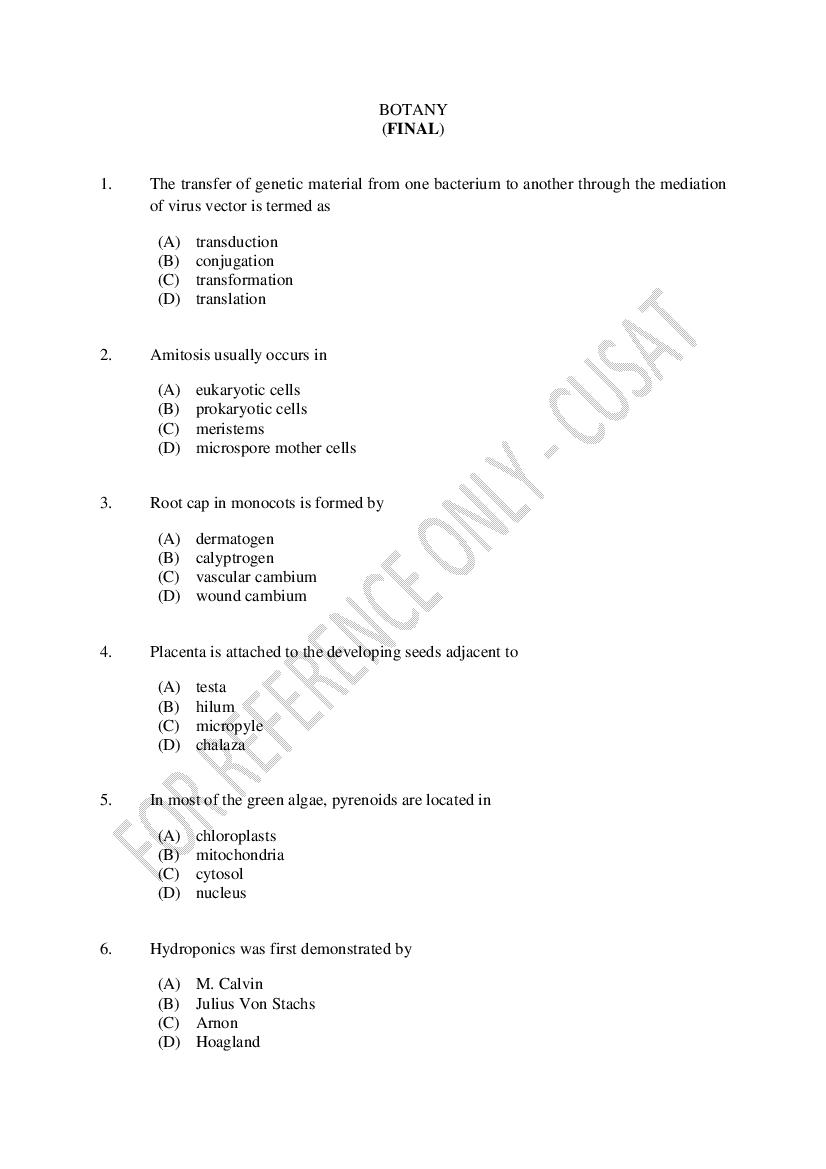
Page 1
(FINAL)
1. The transfer of genetic material from one bacterium to another through the mediation
of virus vector is termed as
(A) transduction
(B) conjugation
(C) transformation
(D) translation
2. Amitosis usually occurs in
(A) eukaryotic cells
(B) prokaryotic cells
(C) meristems
(D) microspore mother cells
3. Root cap in monocots is formed by
(A) dermatogen
(B) calyptrogen
(C) vascular cambium
(D) wound cambium
4. Placenta is attached to the developing seeds adjacent to
(A) testa
(B) hilum
(C) micropyle
(D) chalaza
5. In most of the green algae, pyrenoids are located in
(A) chloroplasts
(B) mitochondria
(C) cytosol
(D) nucleus
6. Hydroponics was first demonstrated by
(A) M. Calvin
(B) Julius Von Stachs
(C) Arnon
(D) Hoagland
Page 2
than the egg. This phenomenon is termed as
(A) apospory
(B) apogamy
(C) parthenogenesis
(D) parthenocarpy
8. Fungi producing eight spores in special sacs belong to the class
(A) Phycomycetes
(B) Ascomycetes
(C) Basidiomycetes
(D) Deuteromycetes
9. Seed setting takes place in ………… even in the absence of pollination
(A) Commelina
(B) Zostera
(C) Salvia
(D) Fig
10. A tobacco plant heterozygous for a recessive character is self-pollinated and 1200
seeds are subsequently germinated. How many seedlings would have the parental
genotype?
(A) 1250
(B) 600
(C) 300
(D) 2250
11. While isolating DNA from bacteria, which one among the following enzymes is NOT
used?
(A) Lysozyme
(B) Ribonuclease
(C) Deoxyribonuclease
(D) Protease
12. Growth of pollen tube towards embryo sac is
(A) Thermotactic
(B) Phototactic
(C) Chemotactic
(D) Thigmotactic
Page 3
(A) Bacillus thuringiensis
(B) Azospirillum
(C) Saccharomyces cerevisiae
(D) Spirulina sp.
14. Totipotency is exhibited by
(A) Gymnosperms
(B) All plant cells
(C) Only bacterial cells
(D) All eukaryotic cells
15. The insecticidal protein synthesized by Bt cotton binds to the
(A) foregut epithelial cells
(B) midgut mesothelial cells
(C) midgut epithelial cells
(D) hindgut mesothelial cells
16. The term used to refer to the use of bio-resource(s) by MNC’s, corporate sector and
other organisations without proper authorisation from the countries and without a
clause for inbuilt compensatory payment is
(A) Bioprospecting
(B) Biopiracy
(C) Biofortification
(D) Bioinformatics
17. Global agreement to reduce Ozone Depletion in the Stratosphere (ODS) is
(A) Vienna convention
(B) Rio de Janeiro Conference
(C) Kyoto protocol
(D) Montreal protocol
18. Marginal placentation is generally found in the family
(A) Leguminosae
(B) Cucurbitaceae
(C) Malvaceae
(D) Brassicaceae
Page 4
(A) Protein metabolism
(B) Carbohydrate metabolism
(C) Fat metabolism
(D) Protein synthesis
20. Primers are
(A) Chemically synthesised oligonucleotides that are complementary to the regions
of DNA
(B) Chemically synthesised oligonucleotides that are not complementary to the
regions of DNA
(C) Chemically synthesised, autonomously replicating circular DNA molecules
(D) Specific sequences present on recombinant DNA
21. In pBR322, tetracycline resistance gene has recognition site for which of the
following restriction endonucleases?
(A) Hind III
(B) BamHI
(C) EcoRI
(D) PstI
22. The term 'systematics' refers to
(A) Identification and study of organ system
(B) Identification and preservation of plants and animals
(C) Diversity of organisms and their relationship
(D) Study of habitats of organisms and their classification
23. Coralloid roots of which one among the following gymnosperms have symbiotic
association with N2 – fixing cyanobacteria?
(A) Pinus
(B) Cedrus
(C) Cycas
(D) Ginkgo
24. During which phase of the cell cycle does DNA replication take place?
(A) G0
(B) G1
(C) S
(D) G2
Page 5
(A) inhibition of cell division
(B) delay in flowering
(C) death of tissues
(D) falling of leaves
26. Protozoans reproduce by binary fission. Starting with 1 protozoan, what will be the
number of protozoans in its population after six generations?
(A) 128
(B) 24
(C) 64
(D) 32
27. Canada balsam, a mounting agent used in the making of permanent slides, is obtained
from the species of
(A) Abies
(B) Cedrus
(C) Pinus
(D) Juniperus
28. Mass flow hypothesis was proposed by
(A) Swanson
(B) Buchman
(C) Kursanov
(D) Munch
29. Nicotinamide adenine dinucleotide (NAD) contains which one among the
following Vitamins?
(A) Thiamine
(B) Niacin
(C) Riboflavin
(D) Vitamin B
30. Bud dormancy is induced by
(A) IAA
(B) GA3
(C) ABA
(D) C2H4
Page 6
flowering plants?
(A) Asteraceae
(B) Liliaceae
(C) Cruciferae
(D) Malvaceae
32. The bulliform cells of leaves loose their turgidity during excessive
(A) assimilation
(B) transpiration
(C) photosynthesis
(D) respiration
33. Photochemical phase does not include
(A) Light absorption
(B) Water splitting and O2 release
(C) ATP and NADPH formation
(D) CO2 fixation
34. Who is the father of genetic engineering?
(A) Steward Linn
(B) Stanley Cohen
(C) Paul Berg
(D) Kary Mullis
35. In lac operon model, lactose function as
(A) Inducer that binds to operator gene
(B) Repressor that binds to operator gene
(C) Inducer that binds to repressor protein
(D) Co- repressor that binds to repressor protein
36. Flavr Savr tomato possesses increased
(A) productivity
(B) vigour
(C) shelf life
(D) flowering period
Page 7
(A) Jammu and Kashmir
(B) Rajasthan
(C) Kerala and Assam
(D) New Delhi
38. UNEP stands for
(A) United Nations Ecotype Programme
(B) United Nations Ecological Programme
(C) United Nations Education Programme
(D) United Nations Environment Programme
39. Edaphic factor refers to
(A) water
(B) soil
(C) relative humidity
(D) altitude
40. When we homogenize any tissue in acidic medium, the acid soluble fraction
represents
(A) cytoplasm
(B) cell membrane
(C) nucleus
(D) mitochondria
41. Golden rice is yellow in colour due to the presence of
(A) Riboflavins
(B) Beta carotene
(C) Vitamin B1
(D) Complex genetic material
42. Which of the following is a triglyceride?
(A) Wax
(B) Phospholipid
(C) Oil
(D) Steroid
Page 8
(A) kinetin
(B) GA3
(C) IBA
(D) ethephon
44. Father of Indian embryology is
(A) P. Maheshwari
(B) M. S. Swaminathan
(C) Shipra Guha-Mukherjee
(D) J. P. Khurana
45. PEP is primary CO2 acceptor in
(A) C4 plants
(B) C3 plants
(C) C2 plants
(D) Hydrophytes
46. Which light is least effective in driving photosynthesis?
(A) Blue
(B) Green
(C) Red
(D) Violet
47. Best material to study meiosis is
(A) root tip
(B) ovary
(C) young anther
(D) pollen grain
48. Chromosome duplication without nuclear division refers to
(A) mitosis
(B) meiosis
(C) androgenesis
(D) endomitosis
Page 9
(A) remains same
(B) increases
(C) decreases
(D) first decreases then increases
50. The cofactor of nitrate reductase is
(A) Cu
(B) Zn
(C) Ca
(D) Mo
51. During complete metabolism of 1 molecule of glucose, the number of ATP formed is
(A) 2
(B) 12
(C) 36
(D) 44
52. How many fragments will be generated on the digestion of a closed circular DNA
molecule with a restriction enzyme having six recognition sites on the DNA?
(A) 5
(B) 7
(C) 6
(D) 9
53. The prokaryotic cell lacks
(A) Plasma membrane
(B) Cell wall
(C) Nuclear membrane
(D) DNA
54. Nucleolus was discovered by
(A) Robert brown
(B) Fontana
(C) Leeuwenhoek
(D) De Duve
Page 10
(A) Clevage furrow
(B) Cellplate
(C) Nuclear envelop
(D) Mitotic spindle
56. The function of chromosomes in the transmission of hereditary traits was described by
(A) Flemming
(B) Waldeyer
(C) Miller
(D) Morgan
57. “A cell can arise only from a pre existing cell”- is the statement of
(A) Cell theory
(B) Cell linkage theory
(C) Law of heredity
(D) Cell wall theory
58. The movement of solutes against concentration gradient is called
(A) Active transport
(B) Endocytosis
(C) Exocytosis
(D) Osmosis
59. Exarch xylem is a feature of
(A) monocot stem
(B) monocot and dicot root
(C) monocot and dicot stem
(D) dicot leaf
60. Root apex differs from stem apex in having
(A) pleuron
(B) dermatogen
(C) periblem
(D) root cap
Page 11
(A) Oedogonium
(B) Cladophora
(C) Ficus
(D) Diatoms
62. Heterothallism in fungi was discovered by
(A) Watson and Crick
(B) Robert Hook
(C) Saccardo
(D) Blakeslee
63. The chloplast of Ulothrix sp. is
(A) Ribbon shaped
(B) Cup shaped
(C) Reticulate
(D) Fan shaped
64. Fungi which grow on dung are called
(A) Corticolous
(B) Coprophilous
(C) Saxicolous
(D) Xylophilous
65. Peristome teeth is the characteristic feature of the capsule in one among the following
bryophytes. Identify
(A) Riccia
(B) Marchantia
(C) Funaria
(D) Anthoceros
66. Cycas and Adiantum resemble each in having
(A) Seeds
(B) Cambium
(C) Vessels
(D) Motile sperms
Page 12
(A) Watson and Crick
(B) H. Khorana
(C) Lederberg
(D) Meselson and Stahl
68. The mechanism of DNA replication was originally characterized in
(A) Bacteria
(B) Algae
(C) Fungi
(D) Virus
69. Pathogenecity is the
(A) ability to cause disease
(B) degree of disease
(C) virulence
(D) quality of disease
70. Which organelle(s) require(s) intact membrane system for ATP synthesis?
(A) Chloroplast
(B) Mitochondria
(C) Chloroplast and mitochondria
(D) Endoplasmic reticulum
71. Which of the following is not an organic substance?
(A) Water
(B) Glucose
(C) Phospholipid
(D) DNA
72. Which of the following contains thymine?
(A) DNA
(B) rRNA
(C) tRNA
(D) mRNA
Page 13
(A) bidirectional
(B) unidirectional
(C) faster in eukaryotes
(D) slower in prokaryotes
74. What is a codon?
(A) A sequence of 3 deoxyribonucleotides
(B) A sequence of 3 ribonucleotides
(C) A unit of Mutation
(D) A sequence of 4 ribonucleotides
75. The spores of diatoms resulting from syngamy are called
(A) Autospore
(B) Auxospore
(C) Androspore
(D) Zygospore
76. Kelps are
(A) Fresh water algae
(B) Marine algae
(C) Fungi
(D) Lichens
77. The Protonema is a stage in the life cycle of
(A) Riccia
(B) Funaria
(C) Ginko
(D) Cycas
78. In Pteridophytes, reduction division occurs during the formation of
(A) spores
(B) gametes
(C) prothallus
(D) sex organs
Page 14
(A) Plum
(B) Dates
(C) Grape
(D) Apple
80. Besides carbohydrates, a major source of energy in human food is constituted by
(A) Vitamins
(B) Minerals
(C) Phytohormones
(D) Proteins
81. Cuscuta is a
(A) Partial root parasite
(B) Complete root parasite
(C) Partial stem parasite
(D) Complete stem parasite
82. Bio-diesel is mostly produced from the members of
(A) Liliaceae
(B) Malvaceae
(C) Myrtaceae
(D) Euphorbiaceae
83. Protein part of the enzyme is known as
(A) Holoenzyme
(B) Apoenzyme
(C) Isoenzyme
(D) Co-factor
84. Curcumin is isolated from
(A) garlic
(B) turmeric
(C) sunflower
(D) rose flower
Page 15
kingdom are
(A) fungi
(B) algae
(C) ferns
(D) mosses
86. All the progeny obtained from a single plant by vegetative propagation are called
(A) clones
(B) pure line
(C) inbred line
(D) pedigree line
87. The dried flower buds are used as a spice in
(A) Saffron
(B) Cloves
(C) Cinnamon
(D) Cardamom
88. Lichens indicate pollution by
(A) O3
(B) SO2
(C) NO2
(D) CO
89. One among the following is NOT a phytohormone
(A) Acetic acid
(B) Auxins
(C) Gibberellins
(D) Ethylene
90. Cryopreservation is a technique used for
(A) crystallization of food
(B) food packaging
(C) germplasm conservation
(D) preservation of surplus vegetables
Page 16
(A) increased growth of green algae
(B) global warming
(C) in-house vegetable cultivation
(D) development of terrace gardens
92. Most abundant water pollutant is
(A) Detergents
(B) Pesticides
(C) Industrial wastes
(D) Ammonia
93. Photosystem I and Photosystem II are found in
(A) Stroma and chloroplast
(B) Grana of chloroplast
(C) Matrix of mitochondria
(D) Inner membrane of mitochondria
94. Phytochrome is spectrally a chromoprotein with following absorption characteristics
(A) red/far-red
(B) blue/yellow-green
(C) brown/yellow
(D) green /yellow
95. The cell wall in majority of fungi is made of
(A) Chitin
(B) Cellulose
(C) Hemicellulose
(D) Lignin
96. National Park is an example of
(A) In vitro conservation
(B) Ex situ conservation
(C) In situ conservation
(D) Total loss of biodiversity
Page 17
(A) Linnaeus
(B) Bentham and Hooker
(C) A. P. de Candolle
(D) Juliane Huxley
98. The study of a species in relation to its environment is known as
(A) Autecology
(B) Mutualism
(C) Altruism
(D) Tropism
99. Gram staining is performed based on the biochemical composition of one of the
following subcellular constituents
(A) bio membrane
(B) genome
(C) cell wall
(D) ribosomes
100. Which of the following is FALSE with respect to prokaryotes?
(A) They consist of bacteria and archaea
(B) Most are unicellular
(C) They have no cell nucleus
(D) Cell division occurs by mitosis and meiosis
101. Which stage is marked by terminalization of chiasmata?
(A) Zygotene
(B) Pachytene
(C) Diplotene
(D) Diakinesis
102. Synapsis occurs between
(A) two homologous chromosomes
(B) spindle fibre and centromere
(C) nucleus and ribosomes
(D) mRNA and ribosomes
Page 18
(A) Mirabilis
(B) Melandrium
(C) Datura
(D) Rumex
104. Pseudogenes are
(A) non-functional
(B) non-existent
(C) existent in plants only
(D) cannot be sequenced
105. Polyploidy is induced by
(A) irradiation
(B) colchicine
(C) mutagenic chemicals
(D) C2H4
106. What is a nucleoside?
(A) Pyramidine + purine + phosphate
(B) Purine + sugar + phosphate
(C) Purine/ Pyrimidine + phosphate
(D) Purine/ Pyrimidine + Sugar
107. Plant development is influenced by
(A) quality of light only
(B) quality and quantity of light
(C) quality and duration of light
(D) quality, quantity, and duration of light
108. Primary phloem develops from
(A) lateral meristem
(B) protoderm
(C) extrastelar cambium
(D) provascular tissue
Page 19
(A) xerophytes
(B) mesophytes
(C) lithophytes
(D) hydrophytes
110. Monocot root differs from dicot root in having
(A) open vascular bundles
(B) scattered vascular bundles
(C) well-developed pith
(D) radially arranged vascular bundles
111. Which one among the following is a hereditary material in higher organisms and
contains the genetic information which is passed on from one generation to another?
(A) RNA
(B) DNA
(C) mRNA
(D) sRNA
112. Who discovered the nucleus?
(A) Albert Einstein
(B) Isaac Newton
(C) Robert Brown
(D) Robert Hooke
113. The term ethnobotany was coined by
(A) Sir Alexander Fleming
(B) John W. Harshberger
(C) C.J. Alexopoulos
(D) J.W Webster
114. The study of medicinal plants is known as
(A) pharmabryology
(B) pharmamycology
(C) pharmacology
(D) pharmacognosy
Page 20
Identify
(A) Solanaceae
(B) Rosaceae
(C) Poaceae
(D) Fabaceae
116. In higher plants, root cap functions in the perception of gravity due to
(A) mucilage
(B) nitrifying bacteria
(C) amyloplasts
(D) cell wall
117. A food chain describes the pathway of
(A) transformation
(B) energy flow
(C) consumption
(D) regeneration
118. Pseudomonas and Clostridium perform
(A) evaporation
(B) nitrification
(C) denitrification
(D) photorespiration
119. The culture of plant cells in liquid-agitated medium is called
(A) hydroponics
(B) mericloning
(C) micropropagation
(D) suspension culture
120. Plants adapted to low light intensity generally have
(A) extended root system
(B) CAM pathway of photosynthesis
(C) larger size of photosynthetic unit
(D) leaves modified to spines
Page 21
(A) Dutrochet and Overbeek
(B) Bose and Blackman
(C) Went and Paal
(D) Garner and Allard
122. In Gymnosperms, the female gametophyte develops from the
(A) nucellus cells
(B) haploid megaspore mother cell
(C) haploid megaspore
(D) diploid megaspore
123. The enzyme responsible for the reduction of nitrogen into ammonia during biological
nitrogen fixation is
(A) nitrogenase
(B) nitrate reductase
(C) dinitrogenase
(D) hydrogenase
124. Binary fission in bacteria involves all of the following except
(A) DNA duplication
(B) spindle formation
(C) cell elongation
(D) cytokinesis
125. Mendel emasculated garden pea plants during his experiments on heredity.
Emasculation is the
(A) removal of flower buds
(B) removal of anthers before dehiscence
(C) removal of carpels before dehiscence
(D) removal of mature flowers
126. Agrobacterium-based gene transfer is efficient
(A) only with dicots
(B) only with monocots
(C) with both monocots and dicots
(D) with gymnosperms
Page 22
(A) porogamy
(B) chalazogamy
(C) mesogamy
(D) isogamy
128. cDNA is synthesized from
(A) protein chain
(B) tRNA
(C) mRNA
(D) dsDNA
129. The first green plants and fungi appeared on land during the period of
(A) ediacaran
(B) devonian
(C) orosirian
(D) ordovician
130. Mycoplasmas are different from other prokaryotes in the
(A) presence of chitin in cell wall
(B) absence of the cell wall
(C) presence of murein in cell wall
(D) presence of proteins in cell wall
131. Fruits in the members of Solanaceae family are
(A) Capsule or berry
(B) Pod
(C) Drupe
(D) Siliqua
132. The small outgrowth on the adaxial surface of leaf at the junction with the leaf sheath
in grasses is called
(A) Tapetum
(B) Gemmae
(C) Ligule
(D) Sori
Page 23
(A) Suspensor
(B) Epithelium
(C) Coleorhiza
(D) Coleoptile
134. Mushrooms are a good source of
(A) lipids
(B) monosaccharides
(C) protein
(D) disaccharide
135. Who amongst the following is regarded as "Father of Indian Bryology''?
(A) K.C. Mehta
(B) D.D. Pant
(C) S.R. Kashyap
(D) P.N. Mehra
136. The largest bryophyte is
(A) Funaria
(B) Marchantia
(C) Megaceros
(D) Dawsonia
137. Who amongst the following is regarded as “Father of Indian Lichenology”?
(A) D. D. Awasthi
(B) D. Upreti
(C) Sajeeva Nayaka
(D) Gaurav acharya
138. Usnea is a ………… type of lichen
(A) foliose
(B) crustose
(C) filamentous
(D) fruticose
Page 24
(A) algae
(B) fungi
(C) both algae and fungi
(D) bryophytes
140. A characteristic feature of the lysosome is that it has
(A) lower pH than the cytoplasm
(B) reduced hydrolase activity
(C) genetic material
(D) ribosomes
141. Which one among the following pairs do not produce seeds?
(A) Fern and Funaria
(B) Ficus and Chlamydomonas
(C) Punica and Pinus
(D) Funaria and Ficus
142. Ergot is obtained from
(A) Rhizopus
(B) Claviceps
(C) Albugo
(D) Phytomonas
143. The National Herbarium of India is at
(A) Bombay
(B) Kolkata
(C) Chennai
(D) New Delhi
144. The attraction between water molecules is called
(A) Cohesion
(B) Osmosis
(C) Adhesion
(D) Surface Tension
Page 25
(A) RuBp
(B) PEP
(C) IAA
(D) Pyruvate
146. The optimum pH for plant tissue culture medium is
(A) 7.5
(B) 8
(C) 5.7
(D) 8.5
147. Micropropagation involves culture of
(A) small explants used for vegetative multiplication of plants
(B) microbes used for vegetative multiplication of plants
(C) microspores used for vegetative multiplication of plants
(D) megaspores and microspores used for non – vegetative multiplication of plants
148. Preserved embryoids are termed as
(A) Synthetic seeds
(B) Semi-synthetic seeds
(C) Natural seeds
(D) Fermented seeds
149. Solidifying agent employed in plant tissue culture media is
(A) agar
(B) EDTA
(C) Cobaltous chloride
(D) pectin
150. The function of the centrosome is related to
(A) protein synthesis
(B) osmoregulation
(C) secretion
(D) formation of spindle fibres
Page 26
Subject Name: BOTANY
SI No. Key SI No. Key SI No. Key SI No. Key SI No. Key
1 A 31 A 61 A 91 B 121 D
2 B 32 B 62 D 92 C 122 C
3 B 33 D 63 A 93 B 123 A
4 B 34 C 64 B 94 A 124 B
5 A 35 C 65 C 95 A 125 B
6 B 36 C 66 D 96 C 126 A
7 B 37 C 67 A 97 D 127 C
8 B 38 D 68 A 98 A 128 C
9 A 39 B 69 A 99 C 129 D
10 B 40 A 70 C 100 D 130 B
11 C 41 B 71 A 101 D 131 A
12 C 42 C 72 A 102 A 132 C
13 D 43 D 73 A 103 B 133 C
14 B 44 A 74 B 104 A 134 C
15 C 45 A 75 B 105 B 135 C
16 B 46 B 76 B 106 D 136 D
17 D 47 C 77 B 107 D 137 A
18 A 48 D 78 A 108 D 138 D
19 C 49 C 79 D 109 A 139 B
20 A 50 C 80 C 110 C 140 A
21 B 51 C 81 D 111 B 141 A
22 C 52 C 82 D 112 C 142 B
23 C 53 C 83 B 113 B 143 B
24 C 54 B 84 B 114 D 144 C
25 C 55 B 85 A 115 D 145 B
26 C 56 A 86 A 116 C 146 C
27 A 57 A 87 B 117 B 147 A
28 D 58 A 88 B 118 C 148 A
29 B 59 B 89 A 119 D 149 A
30 C 60 D 90 C 120 C 150 D
Document Details
| Board / Org | Cochin University |
| Exam | CUSAT Common Admission Test |
| Type | Question Paper |
| Pages | 26 |
| Updated | 09 Jun 2026 |