NCERT Book Class 12 Maths Chapter 7 Integrals
Finished viewing? Save it for later —
Download NCERT Book Class 12 Maths Chapter 7 Integrals (PDF · 67 pages)About NCERT Book Class 12 Maths Chapter 7 Integrals
NCERT Book Class 12 Maths Chapter 7 Integrals is available here for free download. Published by NCERT for Class 12, this books can be viewed online or downloaded as a PDF (67 pages). Candidates preparing for Class 12 can use NCERT Book Class 12 Maths Chapter 7 Integrals to understand the exam pattern, the type of questions asked, and the overall difficulty level.
Frequently Asked Questions
How can I download NCERT Book Class 12 Maths Chapter 7 Integrals?
Open this page and click the Download button to save NCERT Book Class 12 Maths Chapter 7 Integrals as a PDF. It is completely free on AglaSem Docs.
Is NCERT Book Class 12 Maths Chapter 7 Integrals free to download?
Yes. NCERT Book Class 12 Maths Chapter 7 Integrals can be viewed online and downloaded as a PDF free of cost on AglaSem Docs.
How many pages does NCERT Book Class 12 Maths Chapter 7 Integrals have?
NCERT Book Class 12 Maths Chapter 7 Integrals contains 67 pages, which you can read online or download together as a single PDF.
Where can I find more Class 12 study material?
You can find more Class 12 question papers, sample papers, syllabus, and answer keys on AglaSem Docs.
NCERT Book Class 12 Maths Chapter 7 Integrals – Text
Read the full text of this books below — useful to quickly search, copy and reference the content online without downloading the PDF.
📄 View text version (1 page)
Page 1
Chapter 7
INTEGRALS
v Just as a mountaineer climbs a mountain – because it is there, so
a good mathematics student studies new material because
it is there. — JAMES B. BRISTOL v
7.1 Introduction
Differential Calculus is centred on the concept of the
derivative. The original motivation for the derivative was
the problem of defining tangent lines to the graphs of
functions and calculating the slope of such lines. Integral
Calculus is motivated by the problem of defining and
calculating the area of the region bounded by the graph of
the functions.
If a function f is differentiable in an interval I, i.e., its
derivative f ′exists at each point of I, then a natural question
arises that given f ′at each point of I, can we determine
the function? The functions that could possibly have given
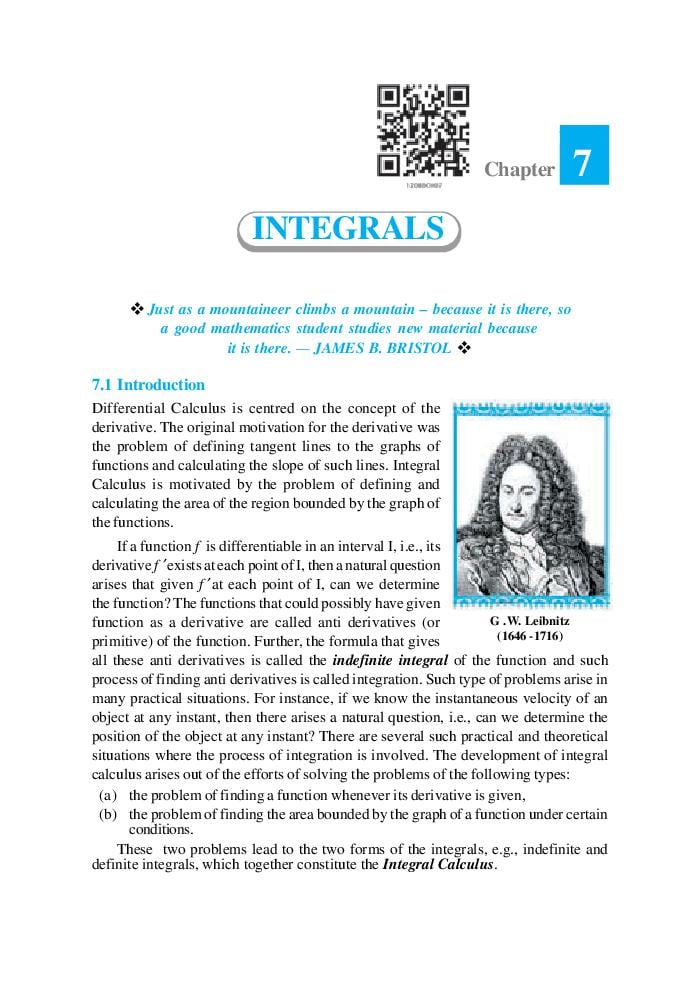
function as a derivative are called anti derivatives (or G .W. Leibnitz
primitive) of the function. Further, the formula that gives (1646 -1716)
all these anti derivatives is called the indefinite integral of the function and such
process of finding anti derivatives is called integration. Such type of problems arise in
many practical situations. For instance, if we know the instantaneous velocity of an
object at any instant, then there arises a natural question, i.e., can we determine the
position of the object at any instant? There are several such practical and theoretical
situations where the process of integration is involved. The development of integral
calculus arises out of the efforts of solving the problems of the following types:
(a) the problem of finding a function whenever its derivative is given,
(b) the problem of finding the area bounded by the graph of a function under certain
conditions.
These two problems lead to the two forms of the integrals, e.g., indefinite and
definite integrals, which together constitute the Integral Calculus.
Showing the first page only. Download the PDF above for the complete document.
Document Details
| Board / Org | NCERT |
| Exam | Class 12 |
| Type | Books |
| Pages | 67 |
| Updated | 29 Aug 2026 |