Goa Board Class 10 Question Paper June 2019 Social Science I History and Civics English
Finished viewing? Save it for later —
Download Goa Board Class 10 Question Paper June 2019 Social Science I History and Civics English (PDF · 6 pages)About Goa Board Class 10 Question Paper June 2019 Social Science I History and Civics English
Goa Board Class 10 Question Paper June 2019 Social Science I History and Civics English is available here for free download. Published by Goa Board for Class 10, this question paper can be viewed online or downloaded as a PDF (6 pages). Candidates preparing for Class 10 can use Goa Board Class 10 Question Paper June 2019 Social Science I History and Civics English to understand the exam pattern, the type of questions asked, and the overall difficulty level.
Frequently Asked Questions
How can I download Goa Board Class 10 Question Paper June 2019 Social Science I History and Civics English?
Open this page and click the Download button to save Goa Board Class 10 Question Paper June 2019 Social Science I History and Civics English as a PDF. It is completely free on AglaSem Docs.
Is Goa Board Class 10 Question Paper June 2019 Social Science I History and Civics English free to download?
Yes. Goa Board Class 10 Question Paper June 2019 Social Science I History and Civics English can be viewed online and downloaded as a PDF free of cost on AglaSem Docs.
How many pages does Goa Board Class 10 Question Paper June 2019 Social Science I History and Civics English have?
Goa Board Class 10 Question Paper June 2019 Social Science I History and Civics English contains 6 pages, which you can read online or download together as a single PDF.
Where can I find more Class 10 study material?
You can find more Class 10 question papers, sample papers, syllabus, and answer keys on AglaSem Docs.
Goa Board Class 10 Question Paper June 2019 Social Science I History and Civics English – Text
Read the full text of this question paper below — useful to quickly search, copy and reference the content online without downloading the PDF.
📄 View text version (6 pages)
Page 1
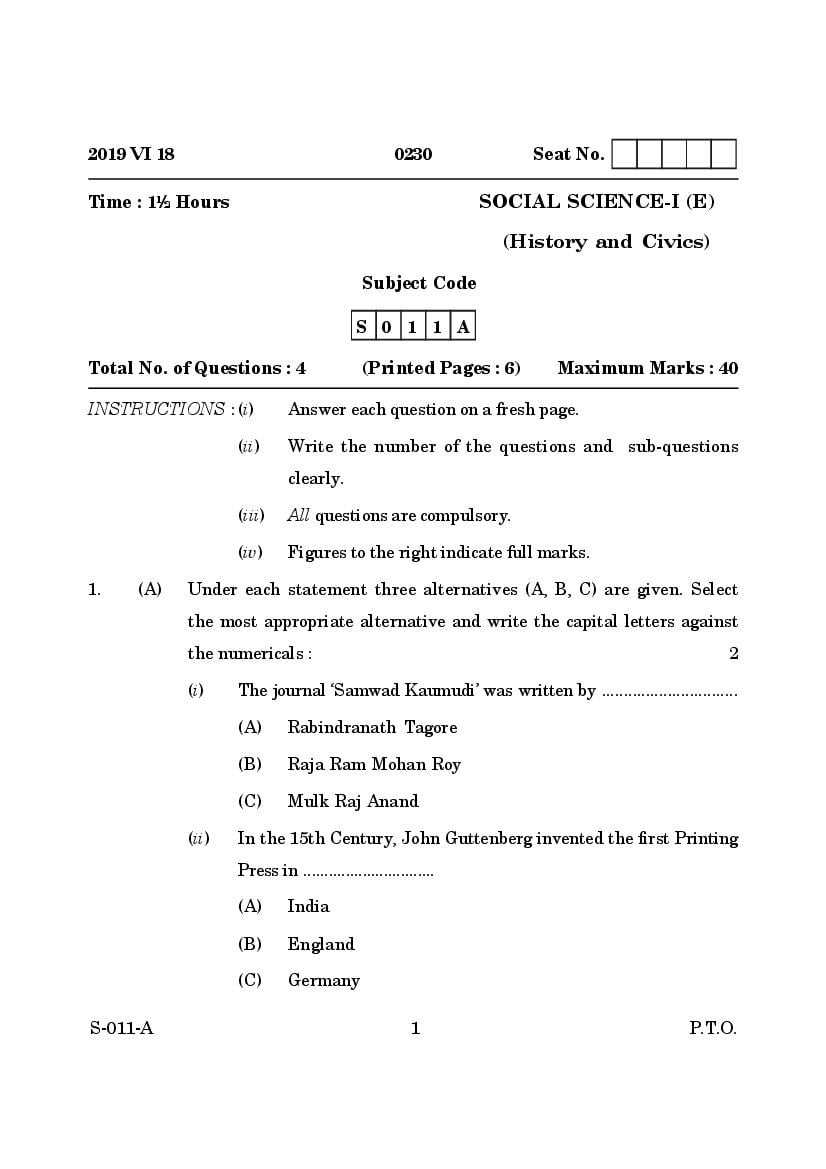
Time : 1½ Hours SOCIAL SCIENCE-I (E)
(History and Civics)
Subject Code
S 0 1 1 A
Total No. of Questions : 4 (Printed Pages : 6) Maximum Marks : 40
INSTRUCTIONS : (i) Answer each question on a fresh page.
(ii) Write the number of the questions and sub-questions
clearly.
(iii) All questions are compulsory.
(iv) Figures to the right indicate full marks.
1. (A) Under each statement three alternatives (A, B, C) are given. Select
the most appropriate alternative and write the capital letters against
the numericals : 2
(i) The journal ‘Samwad Kaumudi’ was written by ...............................
(A) Rabindranath Tagore
(B) Raja Ram Mohan Roy
(C) Mulk Raj Anand
(ii) In the 15th Century, John Guttenberg invented the first Printing
Press in ...............................
(A) India
(B) England
(C) Germany
S-011-A 1 P.T.O.
Page 2
...............................
(A) The Sugar Act
(B) The Stamp Act
(C) The Townshed Act
(iv) The First Continental Congress at Philadelphia was held on
...............................
(A) 5th September 1774
(B) 10th May 1775
(C) 19th October 1781
(B) Answer the following questions in one sentence each : 2
(i) What were the aims of the Portuguese traders ?
(ii) Which war put England into financial crisis to collect more
revenue from her colonies ?
(C) Answer any one of the following in two sentences : 2
(i) In what way did the newspapers play on important role in
Spreading nationalistic ideas in India in the post-industrialized
society ?
(ii) What were the consequences faced by urban areas due to the
Factory System ?
S-011-A 2
Page 3
(i) Why did England witness an increase in population during the
18th Century ?
(ii) How did Industrial Revolution create environmental problems ?
2. (A) In Column ‘A’ are listed certain personalities and in Column ‘B’ are
certain statements. Match the columns correctly and write capital
letters against the numericals : 2
Column ‘A’ Column ‘B’
(i) Montesquieu (A) Summoning of Estates General
(ii) Louis XVI (B) Led the Navjawan Bharat Sabha
(iii) Bal Gangadhar Tilak (C) Advocated the theory of
Separation of Powers
(iv) Bhagat Singh (D) Formed the Forward Bloc
(E) Started celebration of Shivaji
festival
(B) Answer the following questions in one sentence each : 2
(i) Which theory did the Bourbon Monarch believe in ?
(ii) When did the rule of the British East India Company come to an
end ?
S-011-A 3 P.T.O.
Page 4
(i) The Cripps Mission was a failure.
(ii) Mazzini formed a new organization called ‘Young Italy’.
(iii) The National Assembly met in July 1848 at Frankfurt.
3. (A) The words in Column ‘B’ bear particular relationship to the words in
Column ‘A’. Write in Column ‘D’ the words bearing a similar
relationship to those in Column ‘C’ using the numericals : 2
Sr. No. A B C D
(i) 18th June 1946 Goa 19th December
Revolution Day 1961 —
(ii) T.B. Cunha Portugal Divakar Kakodkar —
(iii) House of the People Lok Sabha Council of States —
(iv) Union List 97 Subject Concurrent List —
(B) Answer the following questions in one sentence each : 4
(i) Why did the Indians greet the Simon Commission with the
slogan ‘Simon Go back’ ?
(ii) What was the objective of Goa Vimochan Samiti ?
(iii) When does a bill become an Act ?
(iv) Name a Parliamentary device used by the Parliament to control
the executive ?
S-011-A 4
Page 5
(i) State the repressive measures taken by Dr. Salazar in Goa.
(ii) What powers does the Prime Minister enjoy in relation to the
Council of Ministers ?
4. (A) Under each question three options (A, B, C) are given. Select the
most appropriate option and write the capital letters against the
numericals : 2
(i) Who presides over the meetings of the Gram Sabha ?
(A) Chairperson
(B) Director
(C) Sarpanach
(ii) What is the elected body at the district level in the Goa
Panchayti Raj called ?
(A) Gram Panchayat
(B) Zilla Panchayat
(C) Zilla Parishad
(iii) Where is Goa State Legislative Assembly Complex housed ?
(A) Porvorim
(B) Bicholim
(C) Mapusa
S-011-A 5 P.T.O.
Page 6
(A) 8th June 1962
(B) 9th January 1964
(C) 30th May 1987
(B) Answer the following questions in one sentence each : 2
(i) Why is the Legislative Council called a permanent house ?
(ii) What are the different types of taxes levied by the Panchayats ?
(C) Give two reasons for any one of the following : 2
(i) The Governor exercises executive powers.
(ii) The State Cabinet is the most powerful authority in State
Administration.
(D) Answer the following questions in two sentences each : 4
(i) What are the qualifications of a Judge of the Supreme Court ?
(ii) State the discretionary functions of municipalities.
S-011-A 6
Document Details
| Board / Org | Goa Board |
| Exam | Class 10 |
| Type | Question Paper |
| Pages | 6 |
| Updated | 30 Apr 2026 |