UGC NET 2021 Question Paper Criminology
Finished viewing? Save it for later —
Download UGC NET 2021 Question Paper Criminology (PDF · 74 pages)About UGC NET 2021 Question Paper Criminology
UGC NET 2021 Question Paper Criminology is available here for free download. Published by NTA for UGC NET, this question paper can be viewed online or downloaded as a PDF (74 pages). Candidates preparing for UGC NET can use UGC NET 2021 Question Paper Criminology to understand the exam pattern, the type of questions asked, and the overall difficulty level.
Frequently Asked Questions
How can I download UGC NET 2021 Question Paper Criminology?
Open this page and click the Download button to save UGC NET 2021 Question Paper Criminology as a PDF. It is completely free on AglaSem Docs.
Is UGC NET 2021 Question Paper Criminology free to download?
Yes. UGC NET 2021 Question Paper Criminology can be viewed online and downloaded as a PDF free of cost on AglaSem Docs.
How many pages does UGC NET 2021 Question Paper Criminology have?
UGC NET 2021 Question Paper Criminology contains 74 pages, which you can read online or download together as a single PDF.
Where can I find more UGC NET study material?
You can find more UGC NET question papers, sample papers, syllabus, and answer keys on AglaSem Docs.
UGC NET 2021 Question Paper Criminology – Text
Read the full text of this question paper below — useful to quickly search, copy and reference the content online without downloading the PDF.
📄 View text version (86 pages)
Page 1
Topic:‐ 68Crim_A
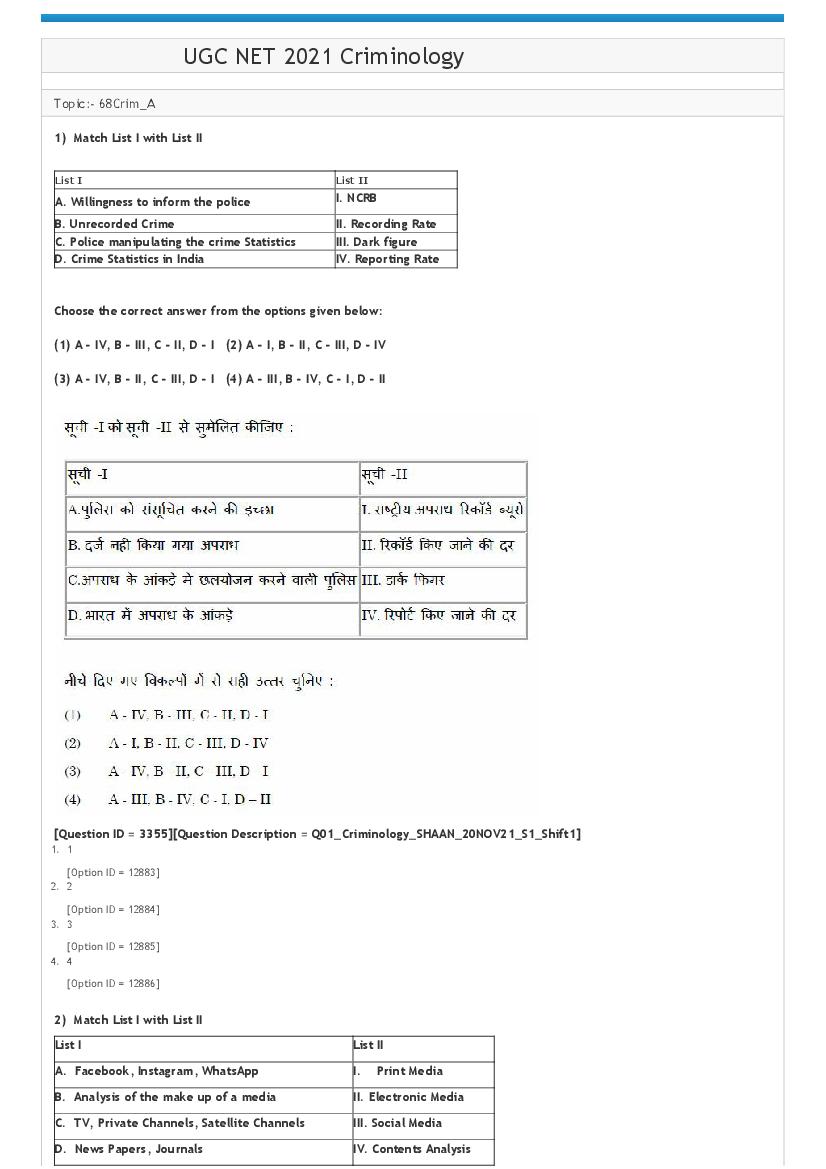
1) Match List I with List II
List I List II
A. Willingness to inform the police I. NCRB
B. Unrecorded Crime II. Recording Rate
C. Police manipulating the crime Statistics III. Dark figure
D. Crime Statistics in India IV. Reporting Rate
Choose the correct answer from the options given below:
(1) A ‐ IV, B ‐ III, C ‐ II, D ‐ I (2) A ‐ I, B ‐ II, C ‐ III, D ‐ IV
(3) A ‐ IV, B ‐ II, C ‐ III, D ‐ I (4) A ‐ III, B ‐ IV, C ‐ I, D ‐ II
[Question ID = 3355][Question Description = Q01_Criminology_SHAAN_20NOV21_S1_Shift1]
1. 1
[Option ID = 12883]
2. 2
[Option ID = 12884]
3. 3
[Option ID = 12885]
4. 4
[Option ID = 12886]
2) Match List I with List II
List I List II
A. Facebook, Instagram, WhatsApp I. Print Media
B. Analysis of the make up of a media II. Electronic Media
C. TV, Private Channels, Satellite Channels III. Social Media
D. News Papers, Journals IV. Contents Analysis
Page 2
(1) A ‐ IV, B ‐ III, C ‐ II, D ‐ I
(2) A ‐ I, B ‐ II, C ‐ III, D ‐ IV
(3) A ‐ III, B ‐ IV, C ‐ II, D ‐ I
(4) A ‐ IV, B ‐ III, C ‐ I, D ‐ II
[Question ID = 3356][Question Description = Q02_Criminology_SHAAN_20NOV21_S1_Shift1]
1. 1
[Option ID = 12887]
2. 2
[Option ID = 12888]
3. 3
[Option ID = 12889]
4. 4
[Option ID = 12890]
3) Match List I with List II
List I List II
A. Association I. Karl Pearson’s Correlation
B. Standard Deviation II. Sequential Equation Modelling (SEM)
C. Coefficient III. Chi‐Square
D. Causal Relationship IV. Univariate Analysis
Choose the correct answer from the options given below:
(1) A ‐ IV, B ‐ III, C ‐ II, D ‐ I
(2) A ‐ I, B ‐ II, C ‐ III, D ‐ IV
(3) A ‐ IV, B ‐ III, C ‐ I, D ‐ II
(4) A ‐ III, B ‐ IV, C ‐ I, D ‐ II
Page 3
1. 1
[Option ID = 12891]
2. 2
[Option ID = 12892]
3. 3
[Option ID = 12893]
4. 4
[Option ID = 12894]
4) Match List I with List II
List I List II
A. Left and Right end points of a class Interval I. Continuous Variable
B. Subjects who do not receive Treatment II. Distance Variable
C. Exact Age, Exact Height temperature III. Class Boundary
D. Aadhar Number, Number of People in familyIV. Control group
Choose the correct answer from the options given below:
(1) A ‐ IV, B ‐ III, C ‐ II, D ‐ I
(2) A ‐ IV, B ‐ I, C ‐ III, D ‐ II
(3) A ‐ III, B ‐ IV, C ‐ I, D ‐ II
(4) A ‐ I, B ‐ IV, C ‐ II, D ‐ III
Page 4
1. 1
[Option ID = 12895]
2. 2
[Option ID = 12896]
3. 3
[Option ID = 12897]
4. 4
[Option ID = 12898]
5) Match List I with List II
List I List II
A. Graphically representing groups of
I. Boxplot data through the Quartiles
Numerical
B. Plot Summarizing how data is distributed
II. Pie Chart
C. XY Graph
III. Histogram
D. Representing data in a Circular graph
IV. Line Graph
Choose the correct answer from the options given below:
(1) A ‐ I, B ‐ II, C ‐ III, D ‐ IV
(2) A ‐ I, B ‐ III, C ‐ IV, D ‐ II
(3) A ‐ III, B ‐ IV, C ‐ I, D ‐ II
(4) A ‐ III, B ‐ I, C ‐ II, D ‐ IV
[Question ID = 3359][Question Description = Q05_Criminology_SHAAN_20NOV21_S1_Shift1]
1. 1
[Option ID = 12899]
2. 2
[Option ID = 12900]
3. 3
[Option ID = 12901]
4. 4
[Option ID = 12902]
6) Match List I with List II
Page 5
A. The Crime of obtaining key pieces of Personal Information I. Misogyny
B. Murder of Son or Daughter II. Stalking
C. Unwanted contact that communicates threat/fear III. Identify theft
D. Hatred for Women IV. Filicide
Choose the correct answer from the options given below:
(1) A ‐ IV, B ‐ II, C ‐ III, D ‐ I
(2) A ‐ III, B ‐ IV, C ‐ II, D ‐ I
(3) A ‐ I, B ‐ II, C ‐ III, D ‐ IV
(4) A ‐ IV, B ‐ III, C ‐ II, D – I
[Question ID = 3360][Question Description = Q06_Criminology_SHAAN_20NOV21_S1_Shift1]
1. 1
[Option ID = 12903]
2. 2
[Option ID = 12904]
3. 3
[Option ID = 12905]
4. 4
[Option ID = 12906]
7) Match List I with List II
List I List II
A. 24*7 telephone service for Children I. 1098
B. Housing related support services to victims II. Children Home
C. Housing related to juvenile in conflict with law III. Shelter/safe house
D. Housing related to neglected Children IV. Juvenile Home
Choose the correct answer from the options given below:
(1) A ‐ I, B ‐ III, C ‐ IV, D ‐ II
(2) A ‐ I, B ‐ II, C ‐ III, D ‐ IV
(3) A ‐ IV, B ‐ III, C ‐ II, D ‐ I
(4) A ‐ III, B ‐ I, C ‐ II, D ‐ IV
Page 6
1. 1
[Option ID = 12907]
2. 2
[Option ID = 12908]
3. 3
[Option ID = 12909]
4. 4
[Option ID = 12910]
8)
Page 7
1. 1
[Option ID = 12911]
2. 2
[Option ID = 12912]
3. 3
[Option ID = 12913]
4. 4
[Option ID = 12914]
9) Match List I with List II
List I List II
A. Symptoms on Cessation of Psychoactive Substance I. Withdrawal Symptom
B. Advance effect of Drug use II. Addiction
C. Repeated use of Psychoactive substance III. Aversion Therapy
D. Suppressing undesirable behavior associating
IV. Bad trip
it With a painful experience
Choose the correct answer from the options given below:
(1) A ‐ I, B ‐ IV, C ‐ II, D ‐ III
(2) A ‐ IV, B ‐ I, C ‐ III, D ‐ II
(3) A ‐ I, B ‐ II, C ‐ III, D ‐ IV
(4) A ‐ IV, B ‐ III, C ‐ II, D ‐ I
[Question ID = 3363][Question Description = Q09_Criminology_SHAAN_20NOV21_S1_Shift1]
1. 1
[Option ID = 12915]
2. 2
[Option ID = 12916]
3. 3
[Option ID = 12917]
4. 4
[Option ID = 12918]
Page 8
List I List II
A. Endocrine Glands I. Animism
B. Demonology II. Reality Principle
C. Freud III. Hormones
D. Eysenck IV. Personality
Choose the correct answer from the options given below:
(1) A ‐ I, B ‐ III, C ‐ IV, D ‐ II
(2) A ‐ I, B ‐ II, C ‐ III, D ‐ IV
(3) A ‐ IV, B ‐ III, C ‐ II, D ‐ I
(4) A ‐ III, B ‐ I, C ‐ II, D ‐ IV
[Question ID = 3364][Question Description = Q10_Criminology_SHAAN_20NOV21_S1_Shift1]
1. 1
[Option ID = 12919]
2. 2
[Option ID = 12920]
3. 3
[Option ID = 12921]
4. 4
[Option ID = 12922]
11) Match List I with List II
List I List II
A. Policy I. Quantitative Research
B. Words II. Plagiarism
C. Academic Fraud III. Translative Criminology
D. Numbers IV. Qualitative Research
Choose the correct answer from the options given below:
(1) A ‐ IV, B ‐ III, C ‐ II, D ‐ I
(2) A ‐ III, B ‐ IV, C ‐ II, D ‐ I
(3) A ‐ IV, B ‐ III, C ‐ I, D ‐ II
Page 9
[Question ID = 3365][Question Description = Q11_Criminology_SHAAN_20NOV21_S1_Shift1]
1. 1
[Option ID = 12923]
2. 2
[Option ID = 12924]
3. 3
[Option ID = 12925]
4. 4
[Option ID = 12926]
12) Match List I with List II
List I List II
A. Psychic Anomaly I. Garofalo
B. Father of Modern Penology II. Lombroso
C. Law of Saturation III. Beccaria
D. Father of Scientific Criminology IV. Ferri
Choose the correct answer from the options given below:
(1) A ‐ III, B ‐ I, C ‐ IV, D ‐ II
(2) A ‐ I, B ‐ II, C ‐ III, D ‐ IV
(3) A ‐ I, B ‐ III, C ‐ IV, D ‐ II
(4) A ‐ IV, B ‐ III, C ‐ II, D ‐ I
Page 10
1. 1
[Option ID = 12927]
2. 2
[Option ID = 12928]
3. 3
[Option ID = 12929]
4. 4
[Option ID = 12930]
13) Match List I with List II
List I List II
A. Arrest Guidelines
I. Vishaka case
B. Juveniles related Guidelines II. Charles Shobraj cases
C. Gender Harassment Guidelines III. D.K. Basu case
D. Prison Reforms IV. Sheela Barse case
Choose the correct answer from the options given below:
(1) A ‐ III, B ‐ IV, C ‐ I, D ‐ II
(2) A ‐ IV, B ‐ III, C ‐ II, D ‐ I
(3) A ‐ I, B ‐ II, C ‐ III, D – IV
(4) A ‐ IV, B ‐ I, C ‐ II, D ‐ III
[Question ID = 3367][Question Description = Q13_Criminology_SHAAN_20NOV21_S1_Shift1]
1. 1
[Option ID = 12931]
2. 2
[Option ID = 12932]
Page 11
[Option ID = 12933]
4. 4
[Option ID = 12934]
14) Match List I with List II
List I List II
A. A total created from small units I. Correlation
B. A theoretical creation that cannot be directly observed II. Aggregate
C. A relationship between variables III. Construct
D. The degree to which two variables are related IV. Association
Choose the correct answer from the options given below:
(1) A ‐ II, B ‐ III, C ‐ IV, D ‐ I
(2) A ‐ I, B ‐ II, C ‐ III, D ‐ IV
(3) A ‐ IV, B ‐ III, C ‐ II, D ‐ I
(4) A ‐ III, B ‐ II, C ‐ I, D – IV
[Question ID = 3368][Question Description = Q14_Criminology_SHAAN_20NOV21_S1_Shift1]
1. 1
[Option ID = 12935]
2. 2
[Option ID = 12936]
3. 3
[Option ID = 12937]
4. 4
[Option ID = 12938]
15) Match List I with List II
List I List II
A. Average, middle and most common score of a
I. Causal relationship
frequency distribution
B. Relationship between cause of effect estimation
II. Variance
in survey
C. A intensive investigation of current and past III. Central Tendency
D. Boot strapping IV. Case Study
Page 12
(1) A ‐ I, B ‐ II, C ‐ IV, D ‐ III
(2) A ‐ I, B ‐ II, C ‐ III, D ‐ IV
(3) A ‐ IV, B ‐ III, C ‐ II, D ‐ I
(4) A ‐ III, B ‐ I, C ‐ IV, D ‐ II
[Question ID = 3369][Question Description = Q15_Criminology_SHAAN_20NOV21_S1_Shift1]
1. 1
[Option ID = 12939]
2. 2
[Option ID = 12940]
3. 3
[Option ID = 12941]
4. 4
[Option ID = 12942]
16) Given below are two statements, one is labelled as Assertion A and the other is labelled as Reason R
Assertion A : Positivism in Criminology is associated with writers like Cesare Lombroso.
Reason R : Cesare Lombroso was referred to as the ‘father of Modern Criminology’
In light of the above statements, choose the most appropriate answer from the options given below
(1) Both A and R are correct and R is the correct explanation of A
(2) Both A and R are correct but R is NOT the correct explanation of A
(3) A is correct but R is not correct
(4) A is not correct but R is correct
Page 13
1. 1
[Option ID = 12943]
2. 2
[Option ID = 12944]
3. 3
[Option ID = 12945]
4. 4
[Option ID = 12946]
17) Given below are two statements, one is labelled as Assertion A and the other is labelled as Reason R
Assertion A : Cyberspace is monitored by Internet Service provider(s) and indeed, Police.
Reason R : The Challenge to Police is that of Jurisdiction. There may be many problems faced by police in enforcing
domestic criminal laws across international boundaries.
In light of the above statements, choose the most appropriate answer from the options given below
(1) Both A and R are correct and R is the correct explanation of A
(2) Both A and R are correct but R is NOT the correct explanation of A
(3) A is correct but R is not correct
(4) A is not correct but R is correct
[Question ID = 3371][Question Description = Q17_Criminology_SHAAN_20NOV21_S1_Shift1]
1. 1
[Option ID = 12947]
2. 2
[Option ID = 12948]
3. 3
Page 14
4. 4
[Option ID = 12950]
18) Given below are two statements, one is labelled as Assertion A and the other is labelled as Reason R
Assertion A : People sometimes decide not to report crimes to police.
Reason R : This happens when the Victim considers the crime to be too trivial (or) when they feel that police will not be
able to do anything.
In light of the above statements, choose the most appropriate answer from the options given below
(1) Both A and R are correct and R is the correct explanation of A
(2) Both A and R are correct but R is NOT the correct explanation of A
(3) A is correct but R is not correct
(4) A is not correct but R is correct
[Question ID = 3372][Question Description = Q18_Criminology_SHAAN_20NOV21_S1_Shift1]
1. 1
[Option ID = 12951]
2. 2
[Option ID = 12952]
3. 3
[Option ID = 12953]
4. 4
[Option ID = 12954]
19) Given below are two statements, one is labelled as Assertion A and the other is labelled as Reason R
Assertion A : The main aim of the Self‐Report studies is to develop a more accurate measure of the extent of crime.
Reason R : Self‐Report studies avoid the problems of non‐reporting and non‐recording, associated with Police‐Recoded
Statistics
In light of the above statements, choose the most appropriate answer from the options given below
(1) Both A and R are correct and R is the correct explanation of A
(2) Both A and R are correct but R is NOT the correct explanation of A
(3) A is correct but R is not correct
(4) A is not correct but R is correct
Page 15
1. 1
[Option ID = 12955]
2. 2
[Option ID = 12956]
3. 3
[Option ID = 12957]
4. 4
[Option ID = 12958]
20) Given below are two statements, one is labelled as Assertion A and the other is labelled as Reason R
Assertion A : Capitalism shapes social institutions, social identities, and social action. Capitalism creates class conflict and
contradictions.
Reason R : Crime is not a response to Capitalism and its contradictious
In light of the above statements, choose the most appropriate answer from the options given below
(1) Both A and R are correct and R is the correct explanation of A
(2) Both A and R are correct but R is NOT the correct explanation of A
(3) A is correct but R is not correct
(4) A is not correct but R is correct
[Question ID = 3374][Question Description = Q20_Criminology_SHAAN_20NOV21_S1_Shift1]
1. 1
Page 16
2. 2
[Option ID = 12960]
3. 3
[Option ID = 12961]
4. 4
[Option ID = 12962]
21) Given below are two statements, one is labelled as Assertion A and the other is labelled as Reason R
Assertion A : Withdrawal Symptoms occurs when the drug use is stopped by the drug dependent.
Reason R : It is associated with pleasant psychological and physiological symptoms.
In light of the above statements, choose the most appropriate answer from the options given below
(1) Both A and R are correct and R is the correct explanation of A
(2) Both A and R are correct but R is NOT the correct explanation of A
(3) A is correct but R is not correct
(4) A is not correct but R is correct
[Question ID = 3375][Question Description = Q21_Criminology_SHAAN_20NOV21_S1_Shift1]
1. 1
[Option ID = 12963]
2. 2
[Option ID = 12964]
3. 3
[Option ID = 12965]
4. 4
[Option ID = 12966]
22) Given below are two statements, one is labelled as Assertion A and the other is labelled as Reason R
Assertion A : Associated with the problems of poverty and unemployment is the problem of beggary which is a social
problem.
Reason R : While poverty, unremunerative agriculture are reasons for beggary, begging is quite often caried out in
organized gangs, especially in case of child beggary.
In light of the above statements, choose the most appropriate answer from the options given below
(1) Both A and R are correct and R is the correct explanation of A
(2) Both A and R are correct but R is NOT the correct explanation of A
Page 17
(4) A is not correct but R is correct
[Question ID = 3376][Question Description = Q22_Criminology_SHAAN_20NOV21_S1_Shift1]
1. 1
[Option ID = 12967]
2. 2
[Option ID = 12968]
3. 3
[Option ID = 12969]
4. 4
[Option ID = 12970]
23) Given below are two statements, one is labelled as Assertion A and the other is labelled as Reason R
Assertion A : LGBTQ is an acronym for Lesbian, Gay, Bisexual, Transgender and Queer
Reason R : These terms are used to describe be a person’s sexual orientation or gender.
In light of the above statements, choose the most appropriate answer from the options given below
(1) Both A and R are correct and R is the correct explanation of A
(2) Both A and R are correct but R is NOT the correct explanation of A
(3) A is correct but R is not correct
(4) A is not correct but R is correct
Page 18
1. 1
[Option ID = 12971]
2. 2
[Option ID = 12972]
3. 3
[Option ID = 12973]
4. 4
[Option ID = 12974]
24) Given below are two statements, one is labelled as Assertion A and the other is labelled as Reason R
Assertion A : Corporate Crimes are committed by big Corporations and are also known as Organizational or Occupational
Crimes
Reason R : Bribery, Counterfeiting, embezzlement, bank fraud and blackmail etc are various types of corporate crimes
In light of the above statements, choose the most appropriate answer from the options given below
(1) Both A and R are correct and R is the correct explanation of A
(2) Both A and R are correct but R is NOT the correct explanation of A
(3) A is correct but R is not correct
(4) A is not correct but R is correct
[Question ID = 3378][Question Description = Q24_Criminology_SHAAN_20NOV21_S1_Shift1]
1. 1
[Option ID = 12975]
2. 2
[Option ID = 12976]
3. 3
[Option ID = 12977]
4. 4
[Option ID = 12978]
25) Given below are two statements, one is labelled as Assertion A and the other is labelled as Reason R
Assertion A: Terrorism provokes deep fear and insecurity more than other forms of violence.
Page 19
In light of the above statements, choose the most appropriate answer from the options given below
(1) Both A and R are correct and R is the correct explanation of A
(2) Both A and R are correct but R is NOT the correct explanation of A
(3) A is correct but R is not correct
(4) A is not correct but R is correct
[Question ID = 3379][Question Description = Q25_Criminology_SHAAN_20NOV21_S1_Shift1]
1. 1
[Option ID = 12979]
2. 2
[Option ID = 12980]
3. 3
[Option ID = 12981]
4. 4
[Option ID = 12982]
26) How can mass media cause crime?
A. Labeling
B. Deviance amplification
C. A political commitment to social change
D. Creation of moral panic
Choose the correct answer from the options given below:
(1) A, B and D only (2) B, C and D only
(3) A, B and C only (4) C and D only
Page 20
1. 1 [Option ID = 12983]
2. 2 [Option ID = 12984]
3. 3 [Option ID = 12985]
4. 4 [Option ID = 12986]
27) The key elements of Feminist scholarship in criminology are
A. Gender is not a natural fact
B. Masculinity and Femineity are not symmetrical
C. Involves motivated offenders
D. Systems of knowledge reflect men’s view
Choose the correct answer from the options given below:
(1) A, B and C only (2) B, C and D only
(3) B and C only (4) A, B and D only
[Question ID = 3381][Question Description = Q27_Criminology_SHAAN_20NOV21_S1_Shift1]
1. 1 [Option ID = 12987]
2. 2 [Option ID = 12988]
Page 21
4. 4 [Option ID = 12990]
28) Which of the following statements are correct in the context committing service of restorative justice?
A. Direct involvement by the victim and offender in a restorative process.
B. Social learning theory emanates from behavior theories of psychology.
C. Involvement of the community.
D. Community members and offender work side by side.
Choose the correct answer from the options given below:
(1) A, B and C only (2) B, C and D only
(3) A, B, C and D only (4) A, C and D only
[Question ID = 3382][Question Description = Q28_Criminology_SHAAN_20NOV21_S1_Shift1]
1. 1 [Option ID = 12991]
2. 2 [Option ID = 12992]
3. 3 [Option ID = 12993]
4. 4 [Option ID = 12994]
29) Focal concerns of lower class culture are
A. Trouble
B. Excitement
C. Toughness
D. Differential Applicability
Choose the correct answer from the options given below:
(1) A, B and C only (2) A, B only
(3) C, D only (4) A,B,C and D only
Page 22
1. 1 [Option ID = 12995]
2. 2 [Option ID = 12996]
3. 3 [Option ID = 12997]
4. 4 [Option ID = 12998]
30) Which among the following are true in the case of Cohen & Felson’s contribution to Criminology?
A. Absence of capable guardian
B. Location of immigrants
C. Motivated offenders
D. Value, portability, and desirability of target.
Choose the correct answer from the options given below:
(1) A, B and C only (2) B, C and D only
(3) B and C only (4) A, C and D only
[Question ID = 3384][Question Description = Q30_Criminology_SHAAN_20NOV21_S1_Shift1]
1. 1
Page 23
2. 2
[Option ID = 13000]
3. 3
[Option ID = 13001]
4. 4
[Option ID = 13002]
Topic:‐ 68Crim_B
1) Read the following passage carefully and then answer the questions that follow.
Raising concern over misleading information and obscene content being shared on popular social media platforms such as
Facebook and YouTube, a Public Interest Litigation petition filed before the court sought a direction to the Centre to
regulate the content and form a panel of members to censor content on social media. The petitioner said that the Centre
must initiate steps to control, monitor, guide and regulate such content shared widely on social media platforms. Terming
the contents as disturbing and has psychological effect, apart from being hateful, misleading and involved cyber bullying.
The raising concern, according to the paragraph is about
(1) Print media (2) Media
(3) Social Media (4) Phishing
[Question ID = 3385][Question Description = Q31_Criminology_SHAAN_20NOV21_S1_Shift1]
1. 1 [Option ID = 13003]
2. 2 [Option ID = 13004]
3. 3 [Option ID = 13005]
4. 4 [Option ID = 13006]
2) Read the following passage carefully and then answer the questions that follow.
Raising concern over misleading information and obscene content being shared on popular social media platforms such as
Facebook and YouTube, a Public Interest Litigation petition filed before the court sought a direction to the Centre to
regulate the content and form a panel of members to censor content on social media. The petitioner said that the Centre
must initiate steps to control, monitor, guide and regulate such content shared widely on social media platforms. Terming
the contents as disturbing and has psychological effect, apart from being hateful, misleading and involved cyber bullying.
Page 24
(1) Explicit crime details (2) Clean news
(3) Misleading information (4) Public interest litigation
[Question ID = 3386][Question Description = Q32_Criminology_SHAAN_20NOV21_S1_Shift1]
1. 1 [Option ID = 13007]
2. 2 [Option ID = 13008]
3. 3 [Option ID = 13009]
4. 4 [Option ID = 13010]
3) Read the following passage carefully and then answer the questions that follow.
Raising concern over misleading information and obscene content being shared on popular social media platforms such as
Facebook and YouTube, a Public Interest Litigation petition filed before the court sought a direction to the Centre to
regulate the content and form a panel of members to censor content on social media. The petitioner said that the Centre
must initiate steps to control, monitor, guide and regulate such content shared widely on social media platforms. Terming
the contents as disturbing and has psychological effect, apart from being hateful, misleading and involved cyber bullying.
Which among the following is a social media platform?
(1) Microsoft Excel (2) Microsoft Word
(3) Facebook (4) PowerPoint
[Question ID = 3387][Question Description = Q33_Criminology_SHAAN_20NOV21_S1_Shift1]
1. 1 [Option ID = 13011]
2. 2 [Option ID = 13012]
3. 3 [Option ID = 13013]
4. 4 [Option ID = 13014]
4) Read the following passage carefully and then answer the questions that follow.
Raising concern over misleading information and obscene content being shared on popular social media platforms such as
Facebook and YouTube, a Public Interest Litigation petition filed before the court sought a direction to the Centre to
regulate the content and form a panel of members to censor content on social media. The petitioner said that the Centre
must initiate steps to control, monitor, guide and regulate such content shared widely on social media platforms. Terming
Page 25
YouTube is a form of
(1) Print Media (2) Magazine
(3) Software (4) Social Media
[Question ID = 3388][Question Description = Q34_Criminology_SHAAN_20NOV21_S1_Shift1]
1. 1 [Option ID = 13015]
2. 2 [Option ID = 13016]
3. 3 [Option ID = 13017]
4. 4 [Option ID = 13018]
5) Read the following passage carefully and then answer the questions that follow.
Raising concern over misleading information and obscene content being shared on popular social media platforms such as
Facebook and YouTube, a Public Interest Litigation petition filed before the court sought a direction to the Centre to
regulate the content and form a panel of members to censor content on social media. The petitioner said that the Centre
must initiate steps to control, monitor, guide and regulate such content shared widely on social media platforms. Terming
the contents as disturbing and has psychological effect, apart from being hateful, misleading and involved cyber bullying.
Who should take steps to censor the contents of social media?
(1) State Governments (2) Government of India
(3) Supreme Court (4) High Court
Page 26
1. 1 [Option ID = 13019]
2. 2 [Option ID = 13020]
3. 3 [Option ID = 13021]
4. 4 [Option ID = 13022]
Topic:‐ 68Crim_C
1) Read the following passage carefully and then answer the questions that follow.
These included deviation in head size and shape from the type common race from which the criminal came. Asymmetry of
the face, excessive dimension of the Jaw of check bones, eye defects and peculiarities; ears of unusual size or occasionally
small; nose twisted; chin receding, excessive length of arms supernumery fingers and toes; imbalance of the hemispheres of
the brain (asymmetry of Cranium).
The characteristics give in the above paragraph refers to which among the following
(1) Animism (2) The Female Offender
(3) Atavist (4) Classical School
[Question ID = 3390][Question Description = Q36_Criminology_SHAAN_20NOV21_S1_Shift1]
1. 1 [Option ID = 13023]
2. 2 [Option ID = 13024]
3. 3 [Option ID = 13025]
4. 4 [Option ID = 13026]
2) Read the following passage carefully and then answer the questions that follow.
These included deviation in head size and shape from the type common race from which the criminal came. Asymmetry of
the face, excessive dimension of the Jaw of check bones, eye defects and peculiarities; ears of unusual size or occasionally
small; nose twisted; chin receding, excessive length of arms supernumery fingers and toes; imbalance of the hemispheres of
the brain (asymmetry of Cranium).
Which among the following refers to the physical characteristics?
(1) Anxiousness (2) Head size and shape
(3) Stress ridden (4) Lack of interest
Page 27
1. 1 [Option ID = 13027]
2. 2 [Option ID = 13028]
3. 3 [Option ID = 13029]
4. 4 [Option ID = 13030]
3) Read the following passage carefully and then answer the questions that follow.
These included deviation in head size and shape from the type common race from which the criminal came. Asymmetry of
the face, excessive dimension of the Jaw of check bones, eye defects and peculiarities; ears of unusual size or occasionally
small; nose twisted; chin receding, excessive length of arms supernumery fingers and toes; imbalance of the hemispheres of
the brain (asymmetry of Cranium).
The person described in the above paragraph, exhibits a variety of
(1) Neutral Characteristics (2) Physical Characteristics
(3) Psychic anomaly (4) Psychiatric illness
[Question ID = 3392][Question Description = Q38_Criminology_SHAAN_20NOV21_S1_Shift1]
1. 1 [Option ID = 13031]
2. 2 [Option ID = 13032]
3. 3 [Option ID = 13033]
4. 4 [Option ID = 13034]
4) Read the following passage carefully and then answer the questions that follow.
These included deviation in head size and shape from the type common race from which the criminal came. Asymmetry of
the face, excessive dimension of the Jaw of check bones, eye defects and peculiarities; ears of unusual size or occasionally
small; nose twisted; chin receding, excessive length of arms supernumery fingers and toes; imbalance of the hemispheres of
the brain (asymmetry of Cranium).
The characteristics prove which among the following
Page 28
(3) Punishment should fit the crime (4) Criminals are born
[Question ID = 3393][Question Description = Q39_Criminology_SHAAN_20NOV21_S1_Shift1]
1. 1 [Option ID = 13035]
2. 2 [Option ID = 13036]
3. 3 [Option ID = 13037]
4. 4 [Option ID = 13038]
5) Read the following passage carefully and then answer the questions that follow.
These included deviation in head size and shape from the type common race from which the criminal came. Asymmetry of
the face, excessive dimension of the Jaw of check bones, eye defects and peculiarities; ears of unusual size or occasionally
small; nose twisted; chin receding, excessive length of arms supernumery fingers and toes; imbalance of the hemispheres of
the brain (asymmetry of Cranium).
Who among the following, in your opinion, has written these ideas originally?
(1) Cesare Beccaria (2) Cesare Lombroso
(3) Jeremy Bentham (4) E H. Sutherland
[Question ID = 3394][Question Description = Q40_Criminology_SHAAN_20NOV21_S1_Shift1]
1. 1 [Option ID = 13039]
2. 2 [Option ID = 13040]
3. 3 [Option ID = 13041]
4. 4 [Option ID = 13042]
Topic:‐ 68Crim_D
1) Who among the following defended the concept of natural crime?
(1) Garofalo (2) Lombroso
(3) Ferri (4) Beccaria
Page 29
1. 1 [Option ID = 13043]
2. 2 [Option ID = 13044]
3. 3 [Option ID = 13045]
4. 4 [Option ID = 13046]
2) What is the name of the conceptual framework in which the research is carried out?
(1) Research hypothesis (2) Synopsis of research
(3) Research paradigm (4) Research design
[Question ID = 3396][Question Description = Q42_Criminology_SHAAN_20NOV21_S1_Shift1]
1. 1 [Option ID = 13047]
2. 2 [Option ID = 13048]
3. 3 [Option ID = 13049]
4. 4 [Option ID = 13050]
3) Which one among the following is not a victimless crime?
(1) Homosexuality (2) Prostitution
(3) Culpabale homicide not amounting to murder (4) Alcoholism
[Question ID = 3397][Question Description = Q43_Criminology_SHAAN_20NOV21_S1_Shift1]
1. 1 [Option ID = 13051]
2. 2 [Option ID = 13052]
3. 3 [Option ID = 13053]
4. 4 [Option ID = 13054]
4) Which among the following is not the technique adopted in computer crime?
(1) The Trojan horse (2) The Salami slice
(3) Impersonation (4) Extortion
[Question ID = 3398][Question Description = Q44_Criminology_SHAAN_20NOV21_S1_Shift1]
1. 1 [Option ID = 13055]
2. 2 [Option ID = 13056]
Page 30
4. 4 [Option ID = 13058]
5) Which one among the following does not come within the purview of Criminology?
(1) Itology of crime (2) Extent of crime
(3) Nature of crime (4) Use of ballistics
[Question ID = 3399][Question Description = Q45_Criminology_SHAAN_20NOV21_S1_Shift1]
1. 1 [Option ID = 13059]
2. 2 [Option ID = 13060]
3. 3 [Option ID = 13061]
4. 4 [Option ID = 13062]
6) In defining Criminology who among the following stated that "Criminology is a body of Knowledge regarding crime as a
social phenomenon. It incluses within its scope the process of making laws, of breaking laws ,and of reaction towards
breaking of laws"?
(1) Shaw and McKay (2) Sutherland and Cressey
(3) Akers and Sellers (4) Cornish and Clarke
[Question ID = 3400][Question Description = Q46_Criminology_SHAAN_20NOV21_S1_Shift1]
1. 1 [Option ID = 13063]
2. 2 [Option ID = 13064]
3. 3 [Option ID = 13065]
4. 4 [Option ID = 13066]
7) Who among the following first introduced the "Crime prevention strategy through Environmental Design"?
(1) Raffaele Garofalo (2) Cesare Lombroso
(3) Emile Durkhiem (4) C.Ray Jefferey
[Question ID = 3401][Question Description = Q47_Criminology_SHAAN_20NOV21_S1_Shift1]
1. 1 [Option ID = 13067]
2. 2 [Option ID = 13068]
3. 3 [Option ID = 13069]
4. 4 [Option ID = 13070]
8) Who among the following exponent studied the family of 'Jukes' to corelate inheredity and criminality as cause of crime?
(1) Edwin H Sutherland (2) Emile Durkheim
Page 31
[Question ID = 3402][Question Description = Q48_Criminology_SHAAN_20NOV21_S1_Shift1]
1. 1 [Option ID = 13071]
2. 2 [Option ID = 13072]
3. 3 [Option ID = 13073]
4. 4 [Option ID = 13074]
9) In India, the first women jail was established in:
(1) Tumkur in Karnataka (2) Yarwada in Maharashtra
(3) Chennai in Tamil Nadu (4) Lucknow in Uttar Pradesh
[Question ID = 3403][Question Description = Q49_Criminology_SHAAN_20NOV21_S1_Shift1]
1. 1
[Option ID = 13075]
2. 2
[Option ID = 13076]
3. 3
[Option ID = 13077]
4. 4
[Option ID = 13078]
10) Who among the following was associated with the Constitutional theory of Criminology?
(1) Raffaele Garofalo (2) Cesar Lombroso
(3) Cesare Beccaria (4) Ernst Kretschmar
[Question ID = 3404][Question Description = Q50_Criminology_SHAAN_20NOV21_S1_Shift1]
1. 1 [Option ID = 13079]
2. 2 [Option ID = 13080]
3. 3 [Option ID = 13081]
4. 4 [Option ID = 13082]
11) According to Prison Statistics 2019, which among the following has the highest number of Central Prisons in India?
(1) Bihar (2) Delhi
(3) Karnataka (4) Tamil Nadu
Page 32
1. 1 [Option ID = 13083]
2. 2 [Option ID = 13084]
3. 3 [Option ID = 13085]
4. 4 [Option ID = 13086]
12) Who is the author of the treatise, The Medical Jurisprudence of Insanity?
(1) Charles Goring (2) Cesare Lombroso
(3) Isaac Ray (4) Gabriel Tarde
[Question ID = 3406][Question Description = Q52_Criminology_SHAAN_20NOV21_S1_Shift1]
1. 1 [Option ID = 13087]
2. 2 [Option ID = 13088]
3. 3 [Option ID = 13089]
4. 4 [Option ID = 13090]
13) Release of an offender by the Court of law after due admonition, is known as :
(1) Parole (2) Furlough
(3) Remission (4) Probation
[Question ID = 3407][Question Description = Q53_Criminology_SHAAN_20NOV21_S1_Shift1]
1. 1 [Option ID = 13091]
2. 2 [Option ID = 13092]
3. 3 [Option ID = 13093]
4. 4 [Option ID = 13094]
14) Who among the following used the terms “outer containment” and “inner containment” to explain crime causation?
(1) Raffaele Garofalo (2) Walter Reckless
(3) David Matza (4) Cesare Beccaria
[Question ID = 3408][Question Description = Q54_Criminology_SHAAN_20NOV21_S1_Shift1]
1. 1 [Option ID = 13095]
2. 2 [Option ID = 13096]
3. 3 [Option ID = 13097]
4. 4 [Option ID = 13098]
Page 33
not covered as ‘children in need of care and protection’?
(1) Incorrigible children (2) Children in conflict with law
(3) uncontrollable children (4) orphan children
[Question ID = 3409][Question Description = Q55_Criminology_SHAAN_20NOV21_S1_Shift1]
1. 1 [Option ID = 13099]
2. 2 [Option ID = 13100]
3. 3 [Option ID = 13101]
4. 4 [Option ID = 13102]
16) Who is the author of the book, Crime Control in Capitalist Society?
(1) William Bonger (2) Charles Goring
(3) Charles Dickens (4) Richard Quinney
[Question ID = 3410][Question Description = Q56_Criminology_SHAAN_20NOV21_S1_Shift1]
1. 1 [Option ID = 13103]
2. 2 [Option ID = 13104]
3. 3 [Option ID = 13105]
4. 4 [Option ID = 13106]
17) According to Juvenile Justice (Care and Protection) Act 2015, the juvenile in conflict with law above the age of 16
years, during the police enquiry and adjudicating proceedings will be sent to
(1) Community services (2) Special home
(3) Place of safety (4) Observation home
[Question ID = 3411][Question Description = Q57_Criminology_SHAAN_20NOV21_S1_Shift1]
1. 1 [Option ID = 13107]
2. 2 [Option ID = 13108]
3. 3 [Option ID = 13109]
4. 4 [Option ID = 13110]
18) If a hangman who hangs the prisoner in pursuant to the order of the court is exempted from the criminal liability by
virtue of:
(1) Section 79 of Indian Penal Code (2) Section 78 of Indian Penal Code
(3) Section 77 of Indian Penal Code (4) Section 76 of Indian Penal Code
Page 34
1. 1 [Option ID = 13111]
2. 2 [Option ID = 13112]
3. 3 [Option ID = 13113]
4. 4 [Option ID = 13114]
19) According to Juvenile Justice (Care and Protection) Act 2015, which one among the following is not suggested as a
measure for the rehabilitation and reintegration of the juveniles/children?
(1) Government Hostel (2) Adoption
(3) Sponsorship (4) Foster care
[Question ID = 3413][Question Description = Q59_Criminology_SHAAN_20NOV21_S1_Shift1]
1. 1 [Option ID = 13115]
2. 2 [Option ID = 13116]
3. 3 [Option ID = 13117]
4. 4 [Option ID = 13118]
20) In D.K.Basu case the supreme court of India has laid down guidelines regarding:
(1) Child rights (2) Women rights
(3) Arrest by police (4) Rape victims
[Question ID = 3414][Question Description = Q60_Criminology_SHAAN_20NOV21_S1_Shift1]
1. 1 [Option ID = 13119]
2. 2 [Option ID = 13120]
3. 3 [Option ID = 13121]
4. 4 [Option ID = 13122]
21) In which of the following Report Law Commission of India has devoted a chapter on Victimology?
Page 35
(3) In 155th law commission report (4) In 156th law commission report
[Question ID = 3415][Question Description = Q61_Criminology_SHAAN_20NOV21_S1_Shift1]
1. 1 [Option ID = 13123]
2. 2 [Option ID = 13124]
3. 3 [Option ID = 13125]
4. 4 [Option ID = 13126]
22) Among the following, which one is not the Random sample?
(1) Cluster sample (2) Quota sample
(3) Systematic sample (4) Stratified sample
[Question ID = 3416][Question Description = Q62_Criminology_SHAAN_20NOV21_S1_Shift1]
1. 1 [Option ID = 13127]
2. 2 [Option ID = 13128]
3. 3 [Option ID = 13129]
4. 4 [Option ID = 13130]
23) Raffaele Garofalo mentioned which of the two following basic sentiments to define crime?
A. Sin
B. Pity
C. Vice
D. Probity
Choose the correct answer from the options given below:
(1) A and C only (2) B and C only
(3) B and D only (4) A and D only
Page 36
1. 1 [Option ID = 13131]
2. 2 [Option ID = 13132]
3. 3 [Option ID = 13133]
4. 4 [Option ID = 13134]
24) Who among the two are associated with 'Pyschological Determinism' in explaination of crime?
A. Charles Goring
B. Isaac Ray
C. Henry H. Goddard
D. Edwin H. Sutherland
Choose the correct answer from the options given below:
(1) A and C only (2) B and C only
(3) B and D only (4) A and D only
[Question ID = 3418][Question Description = Q64_Criminology_SHAAN_20NOV21_S1_Shift1]
1. 1
[Option ID = 13135]
2. 2
Page 37
3. 3
[Option ID = 13137]
4. 4
[Option ID = 13138]
25) Which among the following philosophers' writings had influence on Cesare Beccaria's Treatise?
A. Montesquieu
B. Hume
C. Rousseau
D. Darwin
Choose the correct answer from the options given below:
(1) A and D only (2) B, C and D only
(3) A,B and D only (4) A, B and C only
[Question ID = 3419][Question Description = Q65_Criminology_SHAAN_20NOV21_S1_Shift1]
1. 1 [Option ID = 13139]
2. 2 [Option ID = 13140]
3. 3 [Option ID = 13141]
4. 4 [Option ID = 13142]
26)
Page 38
1. 1
[Option ID = 13143]
2. 2
[Option ID = 13144]
3. 3
[Option ID = 13145]
4. 4
[Option ID = 13146]
27) Among the following, indicate the correct steps in scientific research?
A. Gathering and Analysing the data
B. Formulating the research design
C. Interpreting the results
D. Choosing the research problem and Stating the hypotheses
Choose the correct answer from the options given below:
(1) A, B, C and D only (2) B, C, D and A only
(3) D, B, A and C only (4) C, D, B and A only
Page 39
1. 1 [Option ID = 13147]
2. 2 [Option ID = 13148]
3. 3 [Option ID = 13149]
4. 4 [Option ID = 13150]
28)
[Question ID = 3422][Question Description = Q68_Criminology_SHAAN_20NOV21_S1_Shift1]
1. 1
[Option ID = 13151]
2. 2
[Option ID = 13152]
3. 3
Page 40
4. 4
[Option ID = 13154]
29) According to Prison Statistics 2019, which of the following two states reported the highest female occupancy in India?
A. Kerala
B. Uttarakhand
C. Goa
D. Chhattisgarh
Choose the correct answer from the options given below:
(1) A and B Only (2) A and C Only
(3) B and D Only (4) D and A Only
[Question ID = 3423][Question Description = Q69_Criminology_SHAAN_20NOV21_S1_Shift1]
1. 1 [Option ID = 13155]
2. 2 [Option ID = 13156]
3. 3 [Option ID = 13157]
4. 4 [Option ID = 13158]
30) Which two from the following are considered as ‘Penal Couple’ ?
A. The Police
B. The Victim
C. The Prosecutor
D. The Offender
Choose the correct answer from the options given below:
(1) A and B only (2) A and C only
(3) B and D only (4) D and A only
Page 41
1. 1 [Option ID = 13159]
2. 2 [Option ID = 13160]
3. 3 [Option ID = 13161]
4. 4 [Option ID = 13162]
31) Read the following statements about the Supreme Court Directives of 2006 in the Prakash Singh and Others vs. Union
of India and Others case:
A. Each State must constitute a State Security Commission
B. Police officers on operational duties in the field will have a minimum tenure of three years
C. Investigation and law and order functions must be separated
D. National Security Commission be established at the Union Level
Choose the correct answer from the options given below:
(1) B, C and D only (2) A and C only
(3) A, C and D only (4) A, B and C only
Page 42
1. 1 [Option ID = 13163]
2. 2 [Option ID = 13164]
3. 3 [Option ID = 13165]
4. 4 [Option ID = 13166]
32) Read the following statements about the forms and provisions of Punishment and answer accordingly:
A. Flogging as a mode of punishment was abolished in India in 1955
B. Section 53 of the Indian Penal Code provides forfeiture of property as a form of punishment
C. The provisions relating to solitary confinement are contained in Sections 73 and 74 of the Indian Penal Code
D. Abetment of suicide committed by child or insane is punishable with imprisonment for a term not exceeding seven years
under the Indian Penal Code
Choose the correct answer from the options given below:
(1) A, B and C only (2) A and C only
(3) A and D only (4) A, B and D only
[Question ID = 3426][Question Description = Q72_Criminology_SHAAN_20NOV21_S1_Shift1]
1. 1 [Option ID = 13167]
2. 2 [Option ID = 13168]
3. 3 [Option ID = 13169]
4. 4 [Option ID = 13170]
33) Read the following statements about The Juvenile Justice (Care and Protection of Children) Act, 2015:
A. ‘Special home’ means an institution for housing and providing rehabilitative services to children in conflict with law
B. ‘Aftercare’ is meant for those who have left institutional care and yet to complete eighteen years of age
C. Chapter III of the Act contains provisions for the ‘Juvenile Justice Board’
D. Chapter IV of the Act deals with the ‘Procedure in Relation to Children in Conflict with Law’
Choose the correct answer from the options given below:
(1) A, B and D only (2) A, C and D only
Page 43
[Question ID = 3427][Question Description = Q73_Criminology_SHAAN_20NOV21_S1_Shift1]
1. 1 [Option ID = 13171]
2. 2 [Option ID = 13172]
3. 3 [Option ID = 13173]
4. 4 [Option ID = 13174]
34) Read the following statements about F.I.R. and answer accordingly:
A. Section 154 of the Cr.P.C. deals with information relating to the commission of a cognizable offence
B. If given orally to an officer in charge of a Police Station, information shall be reduced to writing and be read over to the
informant
C. Such information shall be signed by the police person alone and substance thereof shall be entered in a prescribed book
D. A copy of the information as recorded shall be given free of cost to the informant of the FIR
Choose the correct answer from the options given below:
(1) A, B and D only (2) A, C and D only
(3) C and D only (4) A and D only
Page 44
1. 1 [Option ID = 13175]
2. 2 [Option ID = 13176]
3. 3 [Option ID = 13177]
4. 4 [Option ID = 13178]
35) Match List I with List II
List I List II
Acts/Manual/Code Year
A. The Prisons Act I. 1860
B. The Probation of Offenders Act II. 2016
C. The Indian Penal Code III. 1894
D. Model Prison Manual IV. 1958
Choose the correct answer from the options given below:
(1) A ‐ III , B ‐ IV , C ‐ I D ‐ II (2) A ‐ II, B ‐I , C ‐III , D ‐IV
(3) A ‐II , B ‐IV , C ‐III , D ‐ I (4) A ‐I , B ‐III , C ‐ II, D ‐IV
[Question ID = 3429][Question Description = Q75_Criminology_SHAAN_20NOV21_S1_Shift1]
1. 1
[Option ID = 13179]
2. 2
[Option ID = 13180]
3. 3
[Option ID = 13181]
4. 4
[Option ID = 13182]
36) Which of the following is not true about Parole?
(1) Parole is meant for the person who is in the Prison
(2) Parole is granted by the Parole Board
(3) Parole is designed to help the prisoner meet his/her emergent social obligations
(4) Parole is an unconditional release of a Prisoner
Page 45
1. 1
[Option ID = 13183]
2. 2
[Option ID = 13184]
3. 3
[Option ID = 13185]
4. 4
[Option ID = 13186]
37) Match List I with List II
List I List II
Book Author
A. Probation and Parole: Theory and
I. S. S. Srivastava
Practice
B. Criminology, Penology and Victimology II. Ram Ahuja
III. Edwin H. Sutherland and
C. Principles of Criminology Donald
R. Cressey
D. Criminology IV. Howard Abadinsky
Choose the correct answer from the options given below:
(1) A ‐ I , B ‐ II , C ‐ III, D ‐ IV
(2) A‐IV, B ‐I , C ‐III , D ‐ II
(3) A ‐III , B ‐ IV, C ‐ II D ‐I
(4) A ‐II , B ‐III , C IV‐ , D ‐I
[Question ID = 3431][Question Description = Q77_Criminology_SHAAN_20NOV21_S1_Shift1]
1. 1
[Option ID = 13187]
2. 2
[Option ID = 13188]
3. 3
[Option ID = 13189]
4. 4
[Option ID = 13190]
38) Match List I with List II
Page 46
Theory Propounder
A. Culture Conflict Theory I. Albert K. Cohen
B. Labelling Theory II. Thorsten Sellin
C. Delinquent Subculture TheoryIII. Cyril Burt
D. Multiple Factor Theory IV. Howard Becker
Choose the correct answer from the options given below:
(1) A ‐ II , B ‐ I , C ‐ II, D ‐ IV
(2) A ‐ II, B ‐IV , C ‐I , D ‐III
(3) A ‐IV , B ‐II , C ‐III , D ‐ I
(4) A ‐I , B ‐III , C ‐ IV, D – II
[Question ID = 3432][Question Description = Q78_Criminology_SHAAN_20NOV21_S1_Shift1]
1. 1
[Option ID = 13191]
2. 2
[Option ID = 13192]
3. 3
[Option ID = 13193]
4. 4
[Option ID = 13194]
39) Which of the following statements is incorrect about Sin and Crime?
(1) Sin is religious, whereas Crime is legal proposition
(2) Sin concerns itself with violation of rules of religion, whereas Crime involves breach of Law
(3) Sinner is punished by God, whereas Criminal is punished by State
(4) There is direct injury in case of Sin, whereas it is not in case of Crime
Page 47
1. 1
[Option ID = 13195]
2. 2
[Option ID = 13196]
3. 3
[Option ID = 13197]
4. 4
[Option ID = 13198]
40) In the world of Cyber Crime, an unauthorized programme which gains control over another’s system by representing
itself as an authorized programme is known as:
(1) Phishing (2) Spoofing
(3) Stalking (4) Trojan
[Question ID = 3434][Question Description = Q80_Criminology_SHAAN_20NOV21_S1_Shift1]
1. 1 [Option ID = 13199]
2. 2 [Option ID = 13200]
3. 3 [Option ID = 13201]
4. 4 [Option ID = 13202]
41) Read the following statements about the Documentary Evidence under the Indian Evidence Act and answer
accordingly:
A. Primary Evidence means the document itself produced for the inspection of the Court
B. Secondary Evidence means and includes oral accounts of the contents of a document given by certified government
examiner alone
C. Secondary Evidence means and includes copies made from or compared with the original
D. Secondary Evidence means and includes oral accounts of the contents of a document given by some person who has
himself seen it
Choose the correct answer from the options given below:
(1) A, B and C only (2) A, C and D only
(3) A and B only (4) A and C only
Page 48
1. 1 [Option ID = 13203]
2. 2 [Option ID = 13204]
3. 3 [Option ID = 13205]
4. 4 [Option ID = 13206]
42) Match List I with List II as per the Prison Statistics India‐2019
List I List II
Number of Jails State/UT
A. Highest Number of Jails I. Tamil Nadu
B. Highest Number of Central Jails II. Rajasthan
C. Highest Number of District Jails III. Delhi
D. Highest Number of Sub Jails IV. Uttar Pradesh
Choose the correct answer from the options given below:
(1) A ‐ I , B ‐ II , C ‐ III, D ‐ IV (2) A ‐ IV, B ‐ I, C ‐ III, D ‐ II
(3) A ‐ III, B ‐ IV, C ‐ II, D ‐ I (4) A ‐ II, B ‐ III, C ‐ IV, D ‐ I
[Question ID = 3436][Question Description = Q82_Criminology_SHAAN_20NOV21_S1_Shift1]
1. 1
[Option ID = 13207]
2. 2
[Option ID = 13208]
3. 3
[Option ID = 13209]
4. 4
[Option ID = 13210]
43) Who was the famous shoemaker of Boston, with whom the origin of Probation in modern times is closely linked?
(1) Alexander Maconochie (2) Ernest Hemmingway
(3) John Augustus (4) Sir Walter Crofton
Page 49
1. 1 [Option ID = 13211]
2. 2 [Option ID = 13212]
3. 3 [Option ID = 13213]
4. 4 [Option ID = 13214]
44) Arrange the following Prison Reforms Initiatives in correct chronological sequence:
A. National Expert Committee on Women Prisoners
B. All India Committee on Jail Reforms
C. Jail Administration in India
D. All India Jail Manual Committee
Choose the correct answer from the options given below
(1) A, B, C, D
(2) D, C, B, A
(3) A, C, D, B
(4) C, D, B, A
[Question ID = 3438][Question Description = Q84_Criminology_SHAAN_20NOV21_S1_Shift1]
1. 1
[Option ID = 13215]
2. 2
[Option ID = 13216]
3. 3
[Option ID = 13217]
4. 4
[Option ID = 13218]
45) Who among the following classified victims into 13 categories depending on their propensity or risk for victimization?
Page 50
(3) Marvin Wolfgang (4) Hans Von Henting
[Question ID = 3439][Question Description = Q85_Criminology_SHAAN_20NOV21_S1_Shift1]
1. 1
[Option ID = 13219]
2. 2
[Option ID = 13220]
3. 3
[Option ID = 13221]
4. 4
[Option ID = 13222]
46) The number of crimes per 10,000 population is known as:
(1) Crime Division (2) Crime Indicator
(3) Crime Incidence (4) Crime Rate
[Question ID = 3440][Question Description = Q86_Criminology_SHAAN_20NOV21_S1_Shift1]
1. 1
[Option ID = 13223]
2. 2
[Option ID = 13224]
3. 3
[Option ID = 13225]
4. 4
[Option ID = 13226]
47) The ‘Broken Windows theory’ which states that maintaining and monitoring urban environment helps to create
atmosphere of order, thereby preventing more serious crimes from happening was given by:
(1) Matza and Sykes (2) Cloward and Ohlin
(3) Shaw and Mckay (4) Wilson and Kelling
[Question ID = 3441][Question Description = Q87_Criminology_SHAAN_20NOV21_S1_Shift1]
1. 1 [Option ID = 13227]
2. 2 [Option ID = 13228]
Page 51
4. 4 [Option ID = 13230]
48) ‘Prisons, Reformatories, Borstal Institutions and other institutions of like nature’ are listed under which of the following
lists in Seventh Schedule of the Indian Constitution?
(1) Union List (2) State List
(3) Concurrent List (4) Residuary List
[Question ID = 3442][Question Description = Q88_Criminology_SHAAN_20NOV21_S1_Shift1]
1. 1 [Option ID = 13231]
2. 2 [Option ID = 13232]
3. 3 [Option ID = 13233]
4. 4 [Option ID = 13234]
49) Which of the following were part of the Government’s response to 26/11 Terror attacks in India?
A. Establishing National Investigation Agency (NIA)
B. Creation of New NSG Hubs
C. Creation of National Intelligence Grid (NATGRID)
D. Creation of Elite Anti‐Terror Squads (ATS)
Choose the correct answer from the options given below:
(1) B, C and D only (2) A and B only
(3) A, C and D only (4) A, B and C only
[Question ID = 3443][Question Description = Q89_Criminology_SHAAN_20NOV21_S1_Shift1]
1. 1 [Option ID = 13235]
2. 2 [Option ID = 13236]
3. 3 [Option ID = 13237]
4. 4 [Option ID = 13238]
50) Which of the following is true about the Classical School of Criminology?
(1) It explained crime in terms of biological determination
(2) It believed that man commits crime due to influence of some external spirit
Page 52
(4) It laid greater emphasis on personality of the offender rather than his criminal act
[Question ID = 3444][Question Description = Q90_Criminology_SHAAN_20NOV21_S1_Shift1]
1. 1
[Option ID = 13239]
2. 2
[Option ID = 13240]
3. 3
[Option ID = 13241]
4. 4
[Option ID = 13242]
51) The Protection of Women from Domestic Violence Act, 2005 does not include:
(1) Prohibition of Marital Rape
(2) Protection from emotional, physical or economical abuse
(3) Appointment of Protection officers
(4) Prohibition of Trafficking
[Question ID = 3445][Question Description = Q91_Criminology_SHAAN_20NOV21_S1_Shift1]
1. 1
[Option ID = 13243]
2. 2
[Option ID = 13244]
3. 3
[Option ID = 13245]
4. 4
[Option ID = 13246]
52) What is Zero First Information Report (FIR)?
(1) Registration of FIR irrespective of territorial jurisdiction
(2) Registration of FIR in respective jurisdiction
(3) Registration of FIR in selected Police Stations
(4) Registration of FIR in a Rural Police Station
Page 53
1. 1
[Option ID = 13247]
2. 2
[Option ID = 13248]
3. 3
[Option ID = 13249]
4. 4
[Option ID = 13250]
53) The concept of Positivism in criminological theories was first introduced by:
(1) Cesare Beccaria
(2) Cesare Lombroso
(3) Jeremy Bentham
(4) Frederic M. Thrasher
[Question ID = 3447][Question Description = Q93_Criminology_SHAAN_20NOV21_S1_Shift1]
1. 1
[Option ID = 13251]
2. 2
[Option ID = 13252]
3. 3
[Option ID = 13253]
4. 4
[Option ID = 13254]
54) Which among the following criminological theory states that visible sign of crime, anti social behaviour, and civil
disorder create an environment that encourages further crime and disorder including serious crime?
(1) Control Theory
(2) Broken Windows Theory
(3) Routine Activities Theory
(4) Conflict Theory
Page 54
1. 1
[Option ID = 13255]
2. 2
[Option ID = 13256]
3. 3
[Option ID = 13257]
4. 4
[Option ID = 13258]
55) Scope of Criminology does not include:
(1) Process of making laws
(2) Breaking Laws
(3) Societal reactions to laws being broken
(4) Comparative Politics
[Question ID = 3449][Question Description = Q95_Criminology_SHAAN_20NOV21_S1_Shift1]
1. 1
[Option ID = 13259]
2. 2
[Option ID = 13260]
3. 3
[Option ID = 13261]
4. 4
[Option ID = 13262]
56) The overall strategy which constitutes the blue print for the collection, measurement and analysis of data is known as:
(1) Statement of Problem (2) Research Design
(3) Hypothesis (4) Research Ethics
[Question ID = 3450][Question Description = Q96_Criminology_SHAAN_20NOV21_S1_Shift1]
1. 1 [Option ID = 13263]
2. 2 [Option ID = 13264]
3. 3 [Option ID = 13265]
4. 4 [Option ID = 13266]
57) Which among the following statute defines six types of punishment?
(1) The Code of Criminal Procedure
(2) The Indian Penal Code
(3) The Civil Procedure Code
Page 55
[Question ID = 3451][Question Description = Q97_Criminology_SHAAN_20NOV21_S1_Shift1]
1. 1
[Option ID = 13267]
2. 2
[Option ID = 13268]
3. 3
[Option ID = 13269]
4. 4
[Option ID = 13270]
58)
[Question ID = 3452][Question Description = Q98_Criminology_SHAAN_20NOV21_S1_Shift1]
1. 1
[Option ID = 13271]
2. 2
[Option ID = 13272]
3. 3
[Option ID = 13273]
4. 4
[Option ID = 13274]
59) A child stays away from school without permission is known as:
(1) Street child (2) Truant
(3) Vagrant (4) Homeless
[Question ID = 3453][Question Description = Q99_Criminology_SHAAN_20NOV21_S1_Shift1]
1. 1 [Option ID = 13275]
2. 2 [Option ID = 13276]
3. 3 [Option ID = 13277]
4. 4 [Option ID = 13278]
60) Which among the following statute defines victim as 'a person who has suffered any loss or injury caused by reason of
the act or omission for which the accused person has been charged and the expression “victim” includes his or her guardian
or legal heir’?
(1) The Code of Criminal Procedure
Page 56
(3) The Code of Civil Procedure
(4) The Unlawful Activities (Prevention) Act
[Question ID = 3454][Question Description = Q100_Criminology_SHAAN_20NOV21_S1_Shift1]
1. 1
[Option ID = 13279]
2. 2
[Option ID = 13280]
3. 3
[Option ID = 13281]
4. 4
[Option ID = 13282]
Topic:‐ GP_Set2_C
1) Read the passage carefully and answer the question that follow
India is one of the world’s largest repositories of music, dance, theatre, folk traditions, songs, performing arts, rites and
rituals, paintings and writings that are known, collectively as ‘‘Intangible Cultural Hertiage’’. India’s cultural heritage is a
source of inspiration to people everywhere. India’s century old cultural exchanges with South East Asia continue to inspire
people‐to‐people relationships. There is a visible impact of the Indian heritage on the scriptures and the way of life of the
people of the Mekong region. There is deep conviction about the Buddhist traits of humility, gentleness, justice and charity.
There are many similarities in languages of the region and Sanskrit. The Panchtantra and Jataka tales are narrated with
great enthusiasm and are part of folklore. The Ramayan culture is visible all across South East Asia.
The common culture binding India with South East Asian Countries apart from Buddhism is the great epic of Ramayana.
Angkor Wat has the great Ramayana Panel depicting the battle between Vanaras and the Asuras. SAARC remains an
important component of India’s cultural diplomacy representing multilateralism and people to people contacts. People to
people exchanges are being promoted amongst the BRICS countries with the BRICS Culture Ministers meetings laying down
the road map for collaboration. Cultural exchanges amongst the Member Nations of the Shanghai Cooperation Organisation is
also being actively promoted in the fields of tourism, education, science, archeology, music, dance and yoga.
India’s soft power status varies with the regions. In South East Asia, Buddhism links India to the people of the region.
In the Indian Ocean countries, Project Mausam (the monsoon) linked the people to common traits. There are several new
links that have emerged – cricket ties with Australia and South Africa represented by Cricket connects exhibitions. The
theoretical framework for the formulation of India’s soft power status is best represented in the Government’s new ideas –
Digital India, Business Promtion, Yoga Diplomacy.
UNESCO has also focused on building Peace through Cultural Diplomacy. The influence of – Mahatma Gandhi. Nelson Mandela
and Martin Luther King Jr around the world, and the popularity of their ideas of harmonious co‐existence amongst various
layers of society is considerable.
Page 57
(A) Ramayan
(B) Multilateral engagements
(C) Business Promotion
(D) People to people contacts
Choose the correct answer from the options given below :
(1) (A) and (D) only (2) (A), (C) and (D) only
(3) (B), (C) and (D) only (4) (B) and (D) only
Page 58
1. 1
[Option ID = 13691]
2. 2
[Option ID = 13692]
3. 3
[Option ID = 13693]
4. 4
[Option ID = 13694]
2) Read the passage carefully and answer the question that follow
India is one of the world’s largest repositories of music, dance, theatre, folk traditions, songs, performing arts, rites and
rituals, paintings and writings that are known, collectively as ‘‘Intangible Cultural Hertiage’’. India’s cultural heritage is a
source of inspiration to people everywhere. India’s century old cultural exchanges with South East Asia continue to inspire
people‐to‐people relationships. There is a visible impact of the Indian heritage on the scriptures and the way of life of the
people of the Mekong region. There is deep conviction about the Buddhist traits of humility, gentleness, justice and charity.
There are many similarities in languages of the region and Sanskrit. The Panchtantra and Jataka tales are narrated with
great enthusiasm and are part of folklore. The Ramayan culture is visible all across South East Asia.
The common culture binding India with South East Asian Countries apart from Buddhism is the great epic of Ramayana.
Angkor Wat has the great Ramayana Panel depicting the battle between Vanaras and the Asuras. SAARC remains an
important component of India’s cultural diplomacy representing multilateralism and people to people contacts. People to
people exchanges are being promoted amongst the BRICS countries with the BRICS Culture Ministers meetings laying down
the road map for collaboration. Cultural exchanges amongst the Member Nations of the Shanghai Cooperation Organisation is
also being actively promoted in the fields of tourism, education, science, archeology, music, dance and yoga.
India’s soft power status varies with the regions. In South East Asia, Buddhism links India to the people of the region.
In the Indian Ocean countries, Project Mausam (the monsoon) linkded the people to common traits. There are several new
links that have emerged – cricket ties with Australia and South Africa represented by Cricket connects exhibitions. The
theoretical framework for the formulation of India’s soft power status is best represented in the Government’s new ideas –
Digital India, Business Promtion, Yoga Diplomacy.
UNESCO has also focused on building Peace through Cultural Diplomacy. The influence of – Mahatma Gandhi. Nelson Mandela
and Martin Luther King Jr around the world, and the popularity of their ideas of harmonious co‐existence amongst various
layers of society is considerable.
Page 59
(A) Buddist tenets
(B) Yoga
(C) Cricket
(D) Ramayan
(E) Sanskrit
Choose the correct answer from the options given below :
(1) (A) only (2) (A), (B), (C) and (D) only
(3) (A) and (D) only (4) (A), (B), (D) and (E) only
[Question ID = 3558][Question Description = Q47_GP_20NOV_S2_SHAAN_Shift2]
1. 1 [Option ID = 13695]
2. 2 [Option ID = 13696]
3. 3 [Option ID = 13697]
4. 4 [Option ID = 13698]
3) Read the passage carefully and answer the question that follow
India is one of the world’s largest repositories of music, dance, theatre, folk traditions, songs, performing arts, rites and
rituals, paintings and writings that are known, collectively as ‘‘Intangible Cultural Hertiage’’. India’s cultural heritage is a
source of inspiration to people everywhere. India’s century old cultural exchanges with South East Asia continue to inspire
people‐to‐people relationships. There is a visible impact of the Indian heritage on the scriptures and the way of life of the
people of the Mekong region. There is deep conviction about the Buddhist traits of humility, gentleness, justice and charity.
There are many similarities in languages of the region and Sanskrit. The Panchtantra and Jataka tales are narrated with
great enthusiasm and are part of folklore. The Ramayan culture is visible all across South East Asia.
The common culture binding India with South East Asian Countries apart from Buddhism is the great epic of Ramayana.
Angkor Wat has the great Ramayana Panel depicting the battle between Vanaras and the Asuras. SAARC remains an
important component of India’s cultural diplomacy representing multilateralism and people to people contacts. People to
people exchanges are being promoted amongst the BRICS countries with the BRICS Culture Ministers meetings laying down
the road map for collaboration. Cultural exchanges amongst the Member Nations of the Shanghai Cooperation Organisation is
Page 60
India’s soft power status varies with the regions. In South East Asia, Buddhism links India to the people of the region.
In the Indian Ocean countries, Project Mausam (the monsoon) linkded the people to common traits. There are several new
links that have emerged – cricket ties with Australia and South Africa represented by Cricket connects exhibitions. The
theoretical framework for the formulation of India’s soft power status is best represented in the Government’s new ideas –
Digital India, Business Promtion, Yoga Diplomacy.
UNESCO has also focused on building Peace through Cultural Diplomacy. The influence of – Mahatma Gandhi. Nelson Mandela
and Martin Luther King Jr around the world, and the popularity of their ideas of harmonious co‐existence amongst various
layers of society is considerable.
Which of the following is not reflective of India’s soft power status?
(1) Digital India (2) Skill India
(3) Business Promotion (4) Yoga Diplomacy
[Question ID = 3559][Question Description = Q48_GP_20NOV_S2_SHAAN_Shift2]
1. 1 [Option ID = 13699]
2. 2 [Option ID = 13700]
3. 3 [Option ID = 13701]
4. 4 [Option ID = 13702]
4) Read the passage carefully and answer the question that follow
India is one of the world’s largest repositories of music, dance, theatre, folk traditions, songs, performing arts, rites and
rituals, paintings and writings that are known, collectively as ‘‘Intangible Cultural Hertiage’’. India’s cultural heritage is a
Page 61
people‐to‐people relationships. There is a visible impact of the Indian heritage on the scriptures and the way of life of the
people of the Mekong region. There is deep conviction about the Buddhist traits of humility, gentleness, justice and charity.
There are many similarities in languages of the region and Sanskrit. The Panchtantra and Jataka tales are narrated with
great enthusiasm and are part of folklore. The Ramayan culture is visible all across South East Asia.
The common culture binding India with South East Asian Countries apart from Buddhism is the great epic of Ramayana.
Angkor Wat has the great Ramayana Panel depicting the battle between Vanaras and the Asuras. SAARC remains an
important component of India’s cultural diplomacy representing multilateralism and people to people contacts. People to
people exchanges are being promoted amongst the BRICS countries with the BRICS Culture Ministers meetings laying down
the road map for collaboration. Cultural exchanges amongst the Member Nations of the Shanghai Cooperation Organisation is
also being actively promoted in the fields of tourism, education, science, archeology, music, dance and yoga.
India’s soft power status varies with the regions. In South East Asia, Buddhism links India to the people of the region.
In the Indian Ocean countries, Project Mausam (the monsoon) linkded the people to common traits. There are several new
links that have emerged – cricket ties with Australia and South Africa represented by Cricket connects exhibitions. The
theoretical framework for the formulation of India’s soft power status is best represented in the Government’s new ideas –
Digital India, Business Promtion, Yoga Diplomacy.
UNESCO has also focused on building Peace through Cultural Diplomacy. The influence of – Mahatma Gandhi. Nelson Mandela
and Martin Luther King Jr around the world, and the popularity of their ideas of harmonious co‐existence amongst various
layers of society is considerable.
Cultural exchanges amongst the member nations of the Shanghai Cooperation Organisation are in the following fields :
(A) Archeology
(B) Folklore
(C) Tourism
(D) Yoga
(E) Education
Page 62
(1) (A), (C), (D) and (E) only (2) (A), (B), (C) and (E) only
(3) (A), (B) and (E) only (4) (B), (C), (D) and (E) only
[Question ID = 3560][Question Description = Q49_GP_20NOV_S2_SHAAN_Shift2]
1. 1 [Option ID = 13703]
2. 2 [Option ID = 13704]
3. 3 [Option ID = 13705]
4. 4 [Option ID = 13706]
5) Read the passage carefully and answer the question that follow
India is one of the world’s largest repositories of music, dance, theatre, folk traditions, songs, performing arts, rites and
rituals, paintings and writings that are known, collectively as ‘‘Intangible Cultural Hertiage’’. India’s cultural heritage is a
source of inspiration to people everywhere. India’s century old cultural exchanges with South East Asia continue to inspire
people‐to‐people relationships. There is a visible impact of the Indian heritage on the scriptures and the way of life of the
people of the Mekong region. There is deep conviction about the Buddhist traits of humility, gentleness, justice and charity.
There are many similarities in languages of the region and Sanskrit. The Panchtantra and Jataka tales are narrated with
great enthusiasm and are part of folklore. The Ramayan culture is visible all across South East Asia.
The common culture binding India with South East Asian Countries apart from Buddhism is the great epic of Ramayana.
Angkor Wat has the great Ramayana Panel depicting the battle between Vanaras and the Asuras. SAARC remains an
important component of India’s cultural diplomacy representing multilateralism and people to people contacts. People to
people exchanges are being promoted amongst the BRICS countries with the BRICS Culture Ministers meetings laying down
the road map for collaboration. Cultural exchanges amongst the Member Nations of the Shanghai Cooperation Organisation is
also being actively promoted in the fields of tourism, education, science, archeology, music, dance and yoga.
India’s soft power status varies with the regions. In South East Asia, Buddhism links India to the people of the region.
In the Indian Ocean countries, Project Mausam (the monsoon) linkded the people to common traits. There are several new
links that have emerged – cricket ties with Australia and South Africa represented by Cricket connects exhibitions. The
theoretical framework for the formulation of India’s soft power status is best represented in the Government’s new ideas –
Digital India, Business Promtion, Yoga Diplomacy.
UNESCO has also focused on building Peace through Cultural Diplomacy. The influence of – Mahatma Gandhi. Nelson Mandela
and Martin Luther King Jr around the world, and the popularity of their ideas of harmonious co‐existence amongst various
layers of society is considerable.
Page 63
(1) The emergence of India as a super power
(2) The role of culture for peace and harmonious relations with other countries
(3) India’s cultural hegemony
(4) India’s relations with BRICS countries
[Question ID = 3561][Question Description = Q50_GP_20NOV_S2_SHAAN_Shift2]
1. 1 [Option ID = 13707]
2. 2 [Option ID = 13708]
3. 3 [Option ID = 13709]
4. 4 [Option ID = 13710]
Topic:‐ GP_Set2_A
1)
Page 64
company?
(1) 119 : 145 (2) 116 : 135
(3) 119 : 135 (4) 119 : 130
[Question ID = 3562][Question Description = Q01_GP_20NOV_S2_SHAAN_Shift2]
1. 1 [Option ID = 13711]
2. 2 [Option ID = 13712]
3. 3 [Option ID = 13713]
4. 4 [Option ID = 13714]
2)
Page 65
that month were sold without a discount?
(1) 882 (2) 1635
(3) 1638 (4) 885
[Question ID = 3563][Question Description = Q02_GP_20NOV_S2_SHAAN_Shift2]
1. 1 [Option ID = 13715]
2. 2 [Option ID = 13716]
3. 3 [Option ID = 13717]
4. 4 [Option ID = 13718]
3)
Page 66
earned on the PCs of that company during the same month?
(1) 6,49,900 (2) 6,45,900
(3) 6,49,400 (4) 6,49,500
[Question ID = 3564][Question Description = Q03_GP_20NOV_S2_SHAAN_Shift2]
1. 1 [Option ID = 13719]
2. 2 [Option ID = 13720]
3. 3 [Option ID = 13721]
4. 4 [Option ID = 13722]
4)
Page 67
HP during December?
(1) 110% (2) 140%
(3) 150% (4) 130%
[Question ID = 3565][Question Description = Q04_GP_20NOV_S2_SHAAN_Shift2]
1. 1 [Option ID = 13723]
2. 2 [Option ID = 13724]
3. 3 [Option ID = 13725]
4. 4 [Option ID = 13726]
5)
Page 68
(1) 10000 (2) 15000
(3) 10500 (4) 9500
[Question ID = 3566][Question Description = Q05_GP_20NOV_S2_SHAAN_Shift2]
1. 1
[Option ID = 13727]
2. 2
[Option ID = 13728]
3. 3
[Option ID = 13729]
4. 4
[Option ID = 13730]
Topic:‐ GP_Set2_B
1) In which level of teaching promotion of critical thinking is the hall mark?
(1) Memory level (2) Understanding level
(3) Reflective level (4) Autonomous development level
[Question ID = 3567][Question Description = Q06_GP_20NOV_S2_SHAAN_Shift2]
1. 1 [Option ID = 13731]
2. 2 [Option ID = 13732]
3. 3 [Option ID = 13733]
4. 4 [Option ID = 13734]
2) The key behaviour of an effective teacher is marked by which of the following features? (A) Structuring (B) Teacher
task orientation (C) Instructional Variety (D) Lesson clarity (E) Probing Choose the correct answer from the options given
below :
(1) (A), (B) and (C) only (2) (A), (C) and (D) only
(3) (B), (C) and (D) only (4) (C), (D) and (E) only
Page 69
1. 1
[Option ID = 13735]
2. 2
[Option ID = 13736]
3. 3
[Option ID = 13737]
4. 4
[Option ID = 13738]
3) Match List I with List II gives their characteristic features.
List I List II
(Modes of Evaluation) (Characteristic Features)
(A) Formative Evaluation (I) Compares one student with another student
(B) Summative Evaluation (II) Compares the progress of a student against prespecified standards
(C) Criterion‐referenced Evaluation (III) Used primarily for motivational and monitoring purposes of learning
(D) Norm‐referenced Evaluation (IV) Used primarily for gradation of progress made
Choose the correct answer from the options given below :
(1) (A)‐(IV), (B)‐(III), (C)‐(I), (D)‐(II) (2) (A)‐(III), (B)‐(IV), (C)‐(II), (D)‐(I)
(3) (A)‐(II), (B)‐(I), (C)‐(III), (D)‐(IV) (4) (A)‐(I), (B)‐(II), (C)‐(IV), (D)‐(III)
[Question ID = 3569][Question Description = Q08_GP_20NOV_S2_SHAAN_Shift2]
1. 1 [Option ID = 13739]
2. 2 [Option ID = 13740]
3. 3 [Option ID = 13741]
4. 4 [Option ID = 13742]
4) Given below are two statements :
Statement I : One of the basic principles of progressive view of teaching is that education should be life itself rather than a
preparation for living.
Statement II : According to reconstructionist view of education the new social order must be ‘genuinely democratic’.
In the light of the above statements, Choose the correct answer from the options given below :
(1) Both Statement I and Statement II are true. (2) Both Statement I and Statement II are false.
(3) Statement I is true but Statement II is false. (4) Statement I is false but Statement II is true.
Page 70
1. 1 [Option ID = 13743]
2. 2 [Option ID = 13744]
3. 3 [Option ID = 13745]
4. 4 [Option ID = 13746]
5) Given below are two statements : One is labeled as Assertion A and the other is labeled as Reason R.
Assertion (A) : ‘Teaching’ involves critical and creative interchanges between teacher and learner and hence it is different
from ‘instruction’ and ‘training’.
Reason (R) : Both ‘instruction’ and ‘training’ are directed at lower order cognitive interchanges.
In the light of the above statements, Choose the most appropriate answer from the options given below :
(1) Both (A) and (R) are correct and (R) is the correct explanation of (A). (2) Both (A) and (R) are correct but (R) is NOT
the correct explanation of (A).
(3) (A) is correct but (R) is not correct. (4) (A) is not correct but (R) is correct.
[Question ID = 3571][Question Description = Q10_GP_20NOV_S2_SHAAN_Shift2]
1. 1 [Option ID = 13747]
2. 2 [Option ID = 13748]
3. 3 [Option ID = 13749]
4. 4 [Option ID = 13750]
6) In which of the following researches, attempts are made to establish context‐free generalizations?
(1) Phenomenology (2) Grounded theory
(3) Symbolic interactionism (4) Experimental Studies
[Question ID = 3572][Question Description = Q11_GP_20NOV_S2_SHAAN_Shift2]
1. 1 [Option ID = 13751]
2. 2 [Option ID = 13752]
3. 3 [Option ID = 13753]
4. 4 [Option ID = 13754]
7) Identify the main features of ‘qualitative research’ from the following :
(A) It is concerned with understanding the phenomena from the participant’s perspective
Page 71
(C) Researcher becomes immersed in the situation, present or past
(D) Researcher is detached from the study to avoid bias
(E) There is greater flexibility in both the methods and research process
Choose the correct answer from the options given below :
(1) (A), (C) and (E) only (2) (A), (B) and (C) only
(3) (B), (C) and (D) only (4) (C), (D) and (E) only
[Question ID = 3573][Question Description = Q12_GP_20NOV_S2_SHAAN_Shift2]
1. 1 [Option ID = 13755]
2. 2 [Option ID = 13756]
3. 3 [Option ID = 13757]
4. 4 [Option ID = 13758]
8) Match List I with List II :
List I List II
Methods of research Features emphasized
(A) Experimental (I) Primary and secondary sources tapped with emphasis on internal criticism
(B) ExPost Facto (II) Status of facts and conditions are ascertained
(C) Descriptive (III) A variable is manipulated to see its effect on other variable
(D) Historical (IV) The differences are noted and factors causal or otherwise are determined
Choose the correct answer from the options given below :
(1) (A)‐(I), (B)‐(II), (C)‐(III), (D)‐(IV) (2) (A)‐(II), (B)‐(I), (C)‐(IV), (D)‐(III)
(3) (A)‐(III), (B)‐(IV), (C)‐(II), (D)‐(I) (4) (A)‐(IV), (B)‐(III), (C)‐(I), (D)‐(II)
Page 72
1. 1 [Option ID = 13759]
2. 2 [Option ID = 13760]
3. 3 [Option ID = 13761]
4. 4 [Option ID = 13762]
9) Given below are two statements :
Statement I : Data analysis in research being a technical job, ‘research ethics’ does not matter.
Statement II : ICT is helpful almost at all stages of research.
In the light of the above statements, Choose the correct answer from the options given below :
(1) Both Statement I and Statement II are true. (2) Both Statement I and Statement II are false.
(3) Statement I is true but Statement II is false. (4) Statement I is false but Statement II is true.
[Question ID = 3575][Question Description = Q14_GP_20NOV_S2_SHAAN_Shift2]
1. 1 [Option ID = 13763]
2. 2 [Option ID = 13764]
3. 3 [Option ID = 13765]
4. 4 [Option ID = 13766]
10) Given below are two statements : One is labeled as Assertion A and the other is labeled as Reason R.
Assertion (A) : When Null Hypothesis (H0) is rejected, researcher’s hypothesis (H1) is accepted.
Reason (R) : Null Hypothesis (H0) is a chance hypothesis and as such (H1) being true, the researcher’s hypothesis lies in the
domain of acceptability.
In the light of the above statements, Choose the most appropriate answer from the options given below :
(1) Both (A) and (R) are correct and (R) is the correct explanation of (A). (2) Both (A) and (R) are correct but (R) is NOT
the correct explanation of (A).
(3) (A) is correct but (R) is not correct. (4) (A) is not correct but (R) is correct.
Page 73
1. 1 [Option ID = 13767]
2. 2 [Option ID = 13768]
3. 3 [Option ID = 13769]
4. 4 [Option ID = 13770]
11) Which of the following is an exclusive example of Non‐verbal cue that includes the pitch, rate, volume and use of
pauses?
(1) Linear Model of Communication (2) Interactional Model
(3) Non‐Verbal Cues (4) Para‐Language
[Question ID = 3577][Question Description = Q16_GP_20NOV_S2_SHAAN_Shift2]
1. 1 [Option ID = 13771]
2. 2 [Option ID = 13772]
3. 3 [Option ID = 13773]
4. 4 [Option ID = 13774]
12) Given below are two statements : One is labeled as Assertion A and the other is labeled as Reason R.
Assertion (A) : In the context of communication, the perceptual process creates, semantic‐noise also called word‐noise.
Reason (R) : The various meanings either cannotative or denotative are sources of semantic noise.
In the light of the above statements, Choose the most appropriate answer from the options given below :
(1) Both (A) and (R) are correct and (R) is the correct explanation of (A).
(2) Both (A) and (R) are correct but (R) is NOT the correct explanation of (A).
(3) (A) is correct but (R) is not correct.
(4) (A) is not correct but (R) is correct.
[Question ID = 3578][Question Description = Q17_GP_20NOV_S2_SHAAN_Shift2]
1. 1
[Option ID = 13775]
2. 2
[Option ID = 13776]
3. 3
[Option ID = 13777]
4. 4
[Option ID = 13778]
13) Given below are two statements :
Statement I : Appropriate word choice is an essential of effective oral communication.
Statement II : Facial expression and postures fall under visual communication.
Page 74
(1) Both Statement I and Statement II are true. (2) Both Statement I and Statement II are false.
(3) Statement I is true but Statement II is false. (4) Statement I is false but Statement II is true.
[Question ID = 3579][Question Description = Q18_GP_20NOV_S2_SHAAN_Shift2]
1. 1 [Option ID = 13779]
2. 2 [Option ID = 13780]
3. 3 [Option ID = 13781]
4. 4 [Option ID = 13782]
14) Identify the barriers to communication from the list given below :
(A) Time and distance
(B) By‐passed instructions
(C) Encoding of thoughts and ideas
(D) Decoding of thoughts and ideas
(E) Logical sequence
Choose the correct answer from the options given below :
(1) (A) and (B) only (2) (B) and (C) only
(3) (C) and (D) only (4) (D) and (E) only
[Question ID = 3580][Question Description = Q19_GP_20NOV_S2_SHAAN_Shift2]
1. 1
[Option ID = 13783]
2. 2
[Option ID = 13784]
Page 75
[Option ID = 13785]
4. 4
[Option ID = 13786]
15) Match List I with List II :
List I List II
Types of Communication Main features
(A) Downward Communication (I) Grows primarily to meet organizational/member’s need for communication
(B) Upward Communication (II) It forms a useful link in decision making for task coordination
(C) Horizontal Communication (III) Provides management with feedback about current issues and problems
(D) Grapevine Communication (IV) It is the most common communication system in an organization
Choose the correct answer from the options given below :
(1) (A)‐(I), (B)‐(II), (C)‐(IV), (D)‐(III) (2) (A)‐(II), (B)‐(I), (C)‐(III), (D)‐(IV)
(3) (A)‐(III), (B)‐(IV), (C)‐(I), (D)‐(II) (4) (A)‐(IV), (B)‐(III), (C)‐(II), (D)‐(I)
[Question ID = 3581][Question Description = Q20_GP_20NOV_S2_SHAAN_Shift2]
1. 1 [Option ID = 13787]
2. 2 [Option ID = 13788]
3. 3 [Option ID = 13789]
4. 4 [Option ID = 13790]
16) If the cost price is 25% of selling price, then what is the profit percentage?
(1) 100 (2) 200
(3) 300 (4) 400
[Question ID = 3582][Question Description = Q21_GP_20NOV_S2_SHAAN_Shift2]
1. 1 [Option ID = 13791]
2. 2 [Option ID = 13792]
3. 3 [Option ID = 13793]
4. 4 [Option ID = 13794]
17) A seller mixes 26 kg rice of a price of Rs. 20/kg, with 30 kg of different variety rice of a price of Rs. 36/kg. He sells
both the mixed rices at Rs. 30/kg. What will be the profit in percentage?
(1) 5% (2) 10%
(3) 15% (4) 20%
Page 76
1. 1 [Option ID = 13795]
2. 2 [Option ID = 13796]
3. 3 [Option ID = 13797]
4. 4 [Option ID = 13798]
18) A milk man purchases milk at Rs. X per litre and sells it at Rs. 2X per litre. Still he mixes 2 litres of water with every 6
litre of pure milk. What is his profit percentage?
(1) 33.33 (2) 66.66
(3) 133.33 (4) 166.66
[Question ID = 3584][Question Description = Q23_GP_20NOV_S2_SHAAN_Shift2]
1. 1 [Option ID = 13799]
2. 2 [Option ID = 13800]
3. 3 [Option ID = 13801]
4. 4 [Option ID = 13802]
19) The average monthly income of P and Q is Rs. 5,050/‐. The average montly income of Q and R is Rs. 6,250/‐ and that
of P and R is Rs. 5,200. What will be the monthly income of P?
(1) Rs. 3,000/‐ (2) Rs. 3,500/‐
(3) Rs. 4,000/‐ (4) Rs. 4,500/‐
[Question ID = 3585][Question Description = Q24_GP_20NOV_S2_SHAAN_Shift2]
1. 1 [Option ID = 13803]
2. 2 [Option ID = 13804]
3. 3 [Option ID = 13805]
4. 4 [Option ID = 13806]
20) The average of 4 terms is 20, and the first term is 1/3rd of sum of the remaining 3 terms. What will be the value of
first term?
(1) 15 (2) 20
(3) 25 (4) 30
[Question ID = 3586][Question Description = Q25_GP_20NOV_S2_SHAAN_Shift2]
1. 1 [Option ID = 13807]
2. 2 [Option ID = 13808]
3. 3 [Option ID = 13809]
4. 4 [Option ID = 13810]
21)
Page 77
1. 1 [Option ID = 13811]
2. 2 [Option ID = 13812]
3. 3 [Option ID = 13813]
4. 4 [Option ID = 13814]
22)
Page 78
1. 1 [Option ID = 13815]
2. 2 [Option ID = 13816]
3. 3 [Option ID = 13817]
4. 4 [Option ID = 13818]
23)
Page 79
1. 1 [Option ID = 13819]
2. 2 [Option ID = 13820]
3. 3 [Option ID = 13821]
4. 4 [Option ID = 13822]
24) ‘‘All radically egalitarian societies are societies that do not preserve individual liberties’’.
Which of the following statements is true with reference to the above statement?
(1) ‘‘No radically egalitarian societies are societies that preserve individual liberties’’ is obverse of the given statement and
it is logically equivalent.
(2) ‘‘No radically egalitarian societies are societies that preserve individual liberties’’ is obverse of the given statement and
it is not logically equivalent.
(3) ‘‘Some radically egalitarian societies are societies that preserve individual liberties’’ is converse of the given statement
and it is logically equivalent.
(4) ‘‘Some radically egalitarian societies are not societies that preserve individual liberties’’ is converse of the given
statement and it is logically equivalent.
[Question ID = 3590][Question Description = Q29_GP_20NOV_S2_SHAAN_Shift2]
1. 1 [Option ID = 13823]
2. 2 [Option ID = 13824]
3. 3 [Option ID = 13825]
4. 4 [Option ID = 13826]
25) Two propositions are contradictories if :
(1) One is denial or negation of the other
(2) If they can both be true but cannot both be false
(3) If they have different subject and predicate term and differ from each other in both quality and quantity
(4) If they have the same subject and predicate terms but differ from each other only in quantity but not in quality
[Question ID = 3591][Question Description = Q30_GP_20NOV_S2_SHAAN_Shift2]
1. 1 [Option ID = 13827]
2. 2 [Option ID = 13828]
3. 3 [Option ID = 13829]
4. 4 [Option ID = 13830]
26) What is the binary equivalent of the decimal number 67.625?
(1) 1000010.110 (2) 1000011.110
(3) 1000010.101 (4) 1000011.101
[Question ID = 3592][Question Description = Q31_GP_20NOV_S2_SHAAN_Shift2]
1. 1
Page 80
2. 2
[Option ID = 13832]
3. 3
[Option ID = 13833]
4. 4
[Option ID = 13834]
27) Identify the correct order of the following different types of computer components ranked from fastest to slowest in
terms of access time.
(A) RAM
(B) Optical Drive
(C) CPU Cache
(D) SSD
Choose the correct answer from the options given below :
(1) (B), (D), (A), (C) (2) (C), (D), (A), (B)
(3) (A), (B), (C), (D) (4) (C), (A), (D), (B)
[Question ID = 3593][Question Description = Q32_GP_20NOV_S2_SHAAN_Shift2]
1. 1 [Option ID = 13835]
2. 2 [Option ID = 13836]
3. 3 [Option ID = 13837]
4. 4 [Option ID = 13838]
28) Given below are two statements :
Statement I : The abbreviation ‘MOOC’ stands for ‘Massive Open Online Courses’.
Statement II : The abbreviation ‘SWAYAM’ stands for ‘Study Webs of Active‐Learning for Young Academic Minds’,
In the light of the above statements, Choose the correct answer from the options given below :
(1) Both Statement I and Statement II are true. (2) Both Statement I and Statement II are false.
(3) Statement I is true but Statement II is false. (4) Statement I is false but Statement II is true.
Page 81
1. 1 [Option ID = 13839]
2. 2 [Option ID = 13840]
3. 3 [Option ID = 13841]
4. 4 [Option ID = 13842]
29) Which of the following statements are related to the role of ICT in citizen services?
(A) Access to public documents
(B) On‐line payments
(C) Better medical education across the country
Choose the correct answer from the options given below :
(1) (A), (B) and (C) (2) (A) and (C) only
(3) (B) and (C) only (4) (A) and (B) only
[Question ID = 3595][Question Description = Q34_GP_20NOV_S2_SHAAN_Shift2]
1. 1 [Option ID = 13843]
2. 2 [Option ID = 13844]
3. 3 [Option ID = 13845]
4. 4 [Option ID = 13846]
30) Match List I with List II :
List I List II
(Computer Terms) (Description)
(A) HTML (I) Semantic Web
(B) Web 2.0 (II) Use of Internet to make phone calls
(C) Web 3.0 (III) Language used to create web pages
(D) VOIP (IV) Collaborative web
Choose the correct answer from the options given below :
(1) (A)‐(III), (B)‐(IV), (C)‐(I), (D)‐(II) (2) (A)‐(III), (B)‐(I), (C)‐(IV), (D)‐(II)
(3) (A)‐(II), (B)‐(IV), (C)‐(I), (D)‐(III) (4) (A)‐(IV), (B)‐(III), (C)‐(I), (D)‐(II)
Page 82
1. 1 [Option ID = 13847]
2. 2 [Option ID = 13848]
3. 3 [Option ID = 13849]
4. 4 [Option ID = 13850]
31) Given below are two statements :
Statement I : Noise Pollution has an adverse impact on hearing ability as well as psychological well being of a person.
Statement II : Human perception of noise levels is linear.
In the light of the above statements, Choose the correct answer from the options given below :
(1) Both Statement I and Statement II are true. (2) Both Statement I and Statement II are false.
(3) Statement I is true but Statement II is false. (4) Statement I is false but Statement II is true.
[Question ID = 3597][Question Description = Q36_GP_20NOV_S2_SHAAN_Shift2]
1. 1 [Option ID = 13851]
2. 2 [Option ID = 13852]
3. 3 [Option ID = 13853]
4. 4 [Option ID = 13854]
32) Which country is in the process of setting up the largest integrated solar‐wind energy park of 30 GW capacity?
(1) China (2) India
(3) Australia (4) Saudi Arabia
[Question ID = 3598][Question Description = Q37_GP_20NOV_S2_SHAAN_Shift2]
1. 1 [Option ID = 13855]
2. 2 [Option ID = 13856]
3. 3 [Option ID = 13857]
4. 4 [Option ID = 13858]
33) Given below are two statements : One is labeled as Assertion A and the other is labeled as Reason R.
Assertion (A) : There has to be an integrated approach to achieve the targets of Sustainable Development Goals (SDGs).
Reason (R) : Many of the SDGs are interconnected.
In the light of the above statements, Choose the most appropriate answer from the options given below :
(1) Both (A) and (R) are correct and (R) is the correct explanation of (A).
(2) Both (A) and (R) are correct but (R) is NOT the correct explanation of (A).
Page 83
(4) (A) is not correct but (R) is correct.
[Question ID = 3599][Question Description = Q38_GP_20NOV_S2_SHAAN_Shift2]
1. 1
[Option ID = 13859]
2. 2
[Option ID = 13860]
3. 3
[Option ID = 13861]
4. 4
[Option ID = 13862]
34) Given below are two statements : One is labeled as Assertion A and the other is labeled as Reason R.
Assertion (A) : Mankind’s interaction with Earth has led to a highly complex and diverse ecosystem to an increasingly
degraded environment.
Reason (R) : Many of the changes taking place in Earth’s environment are irreversible.
In the light of the above statements, Choose the most appropriate answer from the options given below :
(1) Both (A) and (R) are true and (R) is the correct explanation of (A).
(2) Both (A) and (R) are true but (R) is NOT the correct explanation of (A).
(3) (A) is true but (R) is false.
(4) (A) is false but (R) is true.
[Question ID = 3600][Question Description = Q39_GP_20NOV_S2_SHAAN_Shift2]
1. 1
Page 84
2. 2
[Option ID = 13864]
3. 3
[Option ID = 13865]
4. 4
[Option ID = 13866]
35) What percentage of India’s land is vulnerable to earthquakes?
(1) ~ 57% (2) ~ 42%
(3) ~ 37% (4) ~ 28%
[Question ID = 3601][Question Description = Q40_GP_20NOV_S2_SHAAN_Shift2]
1. 1 [Option ID = 13867]
2. 2 [Option ID = 13868]
3. 3 [Option ID = 13869]
4. 4 [Option ID = 13870]
36) Which of the following is most effectively promoted by Globalisation among the societies?
(1) Monocultural values (2) Multicultural values
(3) Regionalisation (4) Self centredness
[Question ID = 3602][Question Description = Q41_GP_20NOV_S2_SHAAN_Shift2]
1. 1 [Option ID = 13871]
2. 2 [Option ID = 13872]
3. 3 [Option ID = 13873]
4. 4 [Option ID = 13874]
37) CBCS stands for
(1) Choice Based Central Schemes (2) Choice Based Credit System
(3) Central Board of Credit Schemes (4) Credit Board of Central Sponsors
[Question ID = 3603][Question Description = Q42_GP_20NOV_S2_SHAAN_Shift2]
1. 1 [Option ID = 13875]
2. 2 [Option ID = 13876]
3. 3 [Option ID = 13877]
4. 4 [Option ID = 13878]
38) COVID‐19 acronym stands for
(1) Corona Virus Disease 2019
(2) Corona Virus Disease strain 19
(3) Corona Virus Disaster 2019
(4) Corona Virus Disease 2020
Page 85
1. 1
[Option ID = 13879]
2. 2
[Option ID = 13880]
3. 3
[Option ID = 13881]
4. 4
[Option ID = 13882]
39) NITI Aayog is
(1) National Institution for Transforming India (2) National Institute of Technology Integration
(3) National Institute of Technological Innovation (4) National Institute of Transformation and Innovation
[Question ID = 3605][Question Description = Q44_GP_20NOV_S2_SHAAN_Shift2]
1. 1 [Option ID = 13883]
2. 2 [Option ID = 13884]
3. 3 [Option ID = 13885]
4. 4 [Option ID = 13886]
40) Match List I with List II :
List I List II
(Days Celebrated) (When)
(A) Earth Day (I) 24 January
(B) UNO Day (II) 5th June
(C) Environment Day (III) 24th October
(D) International Day of Education (IV) 22nd April
Choose the correct answer from the options given below :
(1) (A)‐(I), (B)‐(III), (C)‐(II), (D)‐(IV) (2) (A)‐(IV), (B)‐(III), (C)‐(I), (D)‐(II)
(3) (A)‐(II), (B)‐(IV), (C)‐(I), (D)‐(III) (4) (A)‐(IV), (B)‐(III), (C)‐(II), (D)‐(I)
Page 86
1. 1 [Option ID = 13887]
2. 2 [Option ID = 13888]
3. 3 [Option ID = 13889]
4. 4 [Option ID = 13890]
Document Details
| Board / Org | NTA |
| Exam | UGC NET |
| Type | Question Paper |
| Pages | 74 |
| Updated | 09 Jun 2026 |