DUET Question Paper 2020 for DU MSc Chemistry
Finished viewing? Save it for later —
Download DUET Question Paper 2020 for DU MSc Chemistry (PDF · 25 pages)About DUET Question Paper 2020 for DU MSc Chemistry
DUET Question Paper 2020 for DU MSc Chemistry is available here for free download. Published by NTA for DUET, this question paper can be viewed online or downloaded as a PDF (25 pages). Candidates preparing for DUET can use DUET Question Paper 2020 for DU MSc Chemistry to understand the exam pattern, the type of questions asked, and the overall difficulty level.
Frequently Asked Questions
How can I download DUET Question Paper 2020 for DU MSc Chemistry?
Open this page and click the Download button to save DUET Question Paper 2020 for DU MSc Chemistry as a PDF. It is completely free on AglaSem Docs.
Is DUET Question Paper 2020 for DU MSc Chemistry free to download?
Yes. DUET Question Paper 2020 for DU MSc Chemistry can be viewed online and downloaded as a PDF free of cost on AglaSem Docs.
How many pages does DUET Question Paper 2020 for DU MSc Chemistry have?
DUET Question Paper 2020 for DU MSc Chemistry contains 25 pages, which you can read online or download together as a single PDF.
Where can I find more DUET study material?
You can find more DUET question papers, sample papers, syllabus, and answer keys on AglaSem Docs.
DUET Question Paper 2020 for DU MSc Chemistry – Text
Read the full text of this question paper below — useful to quickly search, copy and reference the content online without downloading the PDF.
📄 View text version (25 pages)
Page 1
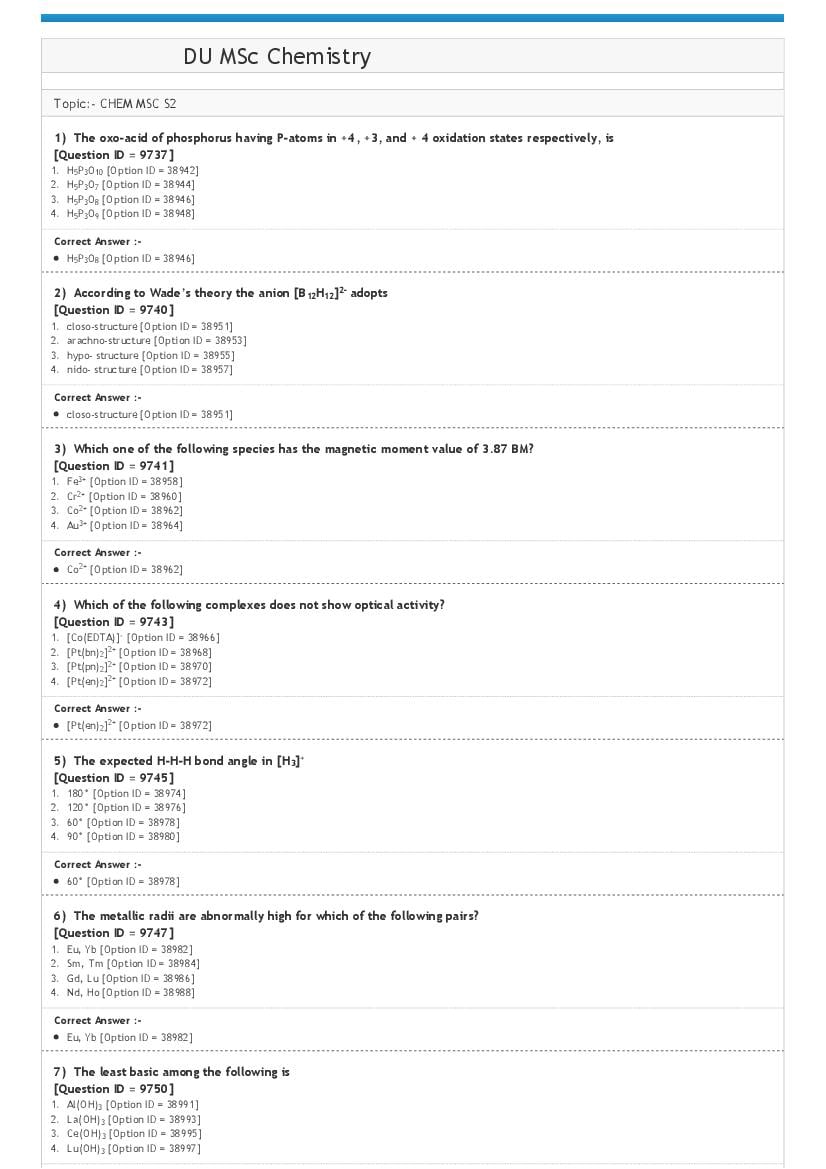
Topic:‐ CHEM MSC S2
1) The oxo‐acid of phosphorus having P‐atoms in +4, +3, and + 4 oxidation states respectively, is
[Question ID = 9737]
1. H 5P3O10 [Option ID = 38942]
2. H 5P3O7 [Option ID = 38944]
3. H 5P3O8 [Option ID = 38946]
4. H 5P3O9 [Option ID = 38948]
H 5P3O8 [Option ID = 38946]
2) According to Wade’s theory the anion [B12H12]2‐ adopts
[Question ID = 9740]
1. closo‐structure [Option ID = 38951]
2. arachno‐structure [Option ID = 38953]
3. hypo‐ structure [Option ID = 38955]
4. nido‐ structure [Option ID = 38957]
closo‐structure [Option ID = 38951]
3) Which one of the following species has the magnetic moment value of 3.87 BM?
[Question ID = 9741]
1. Fe3+ [Option ID = 38958]
2. Cr2+ [Option ID = 38960]
3. Co2+ [Option ID = 38962]
4. Au3+ [Option ID = 38964]
Co2+ [Option ID = 38962]
4) Which of the following complexes does not show optical activity?
[Question ID = 9743]
1. [Co(EDTA)]‐ [Option ID = 38966]
2. [Pt(bn)2]2+ [Option ID = 38968]
3. [Pt(pn)2]2+ [Option ID = 38970]
4. [Pt(en)2]2+ [Option ID = 38972]
[Pt(en)2]2+ [Option ID = 38972]
5) The expected H‐H‐H bond angle in [H3]+
[Question ID = 9745]
1. 180° [Option ID = 38974]
2. 120° [Option ID = 38976]
3. 60° [Option ID = 38978]
4. 90° [Option ID = 38980]
60° [Option ID = 38978]
6) The metallic radii are abnormally high for which of the following pairs?
[Question ID = 9747]
1. Eu, Yb [Option ID = 38982]
2. Sm, Tm [Option ID = 38984]
3. Gd, Lu [Option ID = 38986]
4. Nd, Ho [Option ID = 38988]
Eu, Yb [Option ID = 38982]
7) The least basic among the following is
[Question ID = 9750]
1. Al(OH)3 [Option ID = 38991]
2. La(OH)3 [Option ID = 38993]
3. Ce(OH)3 [Option ID = 38995]
4. Lu(OH)3 [Option ID = 38997]
Page 2
8) According to VSEPR theory, the molecules/ion having ideal tetrahedral shape is
[Question ID = 9751]
1. SO42‐ [Option ID = 38998]
2. SF4 [Option ID = 39000]
3. S 2Cl2 [Option ID = 39003]
4. SO2Cl2 [Option ID = 39005]
SO42‐ [Option ID = 38998]
9) According to MO theory, for the diatomic species, C2
[Question ID = 9754]
1. Bond order is zero and it is diamagnetic [Option ID = 39007]
2. Bond order is two and it is paramagnetic [Option ID = 39009]
3. Bond order is two and it is diamagnetic [Option ID = 39011]
4. Bond order is zero and it is paramagnetic [Option ID = 39013]
Bond order is two and it is diamagnetic [Option ID = 39011]
10) The number of microstates present in 3F term is
[Question ID = 9755]
1. 3 [Option ID = 39014]
2. 21 [Option ID = 39016]
3. 9 [Option ID = 39018]
4. 28 [Option ID = 39020]
21 [Option ID = 39016]
11) Consider the following statements:
According the Werner’s theory
A. Ligands are connected to the metal ions by covalent bonds
B. Secondary valence is have directional properties
C. Secondary valences are non‐ionisable of these statements
Choose the correct answer from the options given below:
[Question ID = 9757]
1. A, B and C only
[Option ID = 39022]
2. B and C only
[Option ID = 39024]
3. A and C only
[Option ID = 39026]
4. A and B only
[Option ID = 39028]
B and C only
[Option ID = 39024]
12) Among the following, the correct order of acidity is?
[Question ID = 9760]
1. HClO < HClO2 < HClO3 < HClO4
[Option ID = 39031]
2. HClO4 < HClO3 < HClO2 < HClO
[Option ID = 39033]
3. HClO < HClO4 < HClO3 < HClO2
[Option ID = 39035]
4. HClO2 < HClO2 < HClO < HClO4
[Option ID = 39036]
HClO < HClO2 < HClO3 < HClO4
Page 3
13) Which of the following non‐aqueous solvents has the longest liquid range?
[Question ID = 9761]
1. H 2SO4 [Option ID = 39038]
2. N2O4 [Option ID = 39040]
3. NH3 [Option ID = 39042]
4. HCl [Option ID = 39044]
H 2SO4 [Option ID = 39038]
14) The following compounds are Pd (C6H5) 2(SCN)2] and [Pd (C6H5) 2(NCS)2]
[Question ID = 9764]
1. Linkage isomers [Option ID = 39046]
2. Co‐ordination isomers [Option ID = 39047]
3. Ionization isomers [Option ID = 39049]
4. Geometrical isomers [Option ID = 39051]
Linkage isomers [Option ID = 39046]
15) Which of the following elements found in native state
[Question ID = 9765]
1. Al [Option ID = 39054]
2. Au [Option ID = 39055]
3. Cu [Option ID = 39056]
4. Na [Option ID = 39058]
Au [Option ID = 39055]
16) Element with outer electronic configuration ns2 np6 are
[Question ID = 9768]
1. Alkaline earth metals [Option ID = 39063]
2. Transition elements [Option ID = 39065]
3. Chalcogens [Option ID = 39067]
4. Noble gases [Option ID = 39069]
Noble gases [Option ID = 39069]
17) Which one of the following elements is least likely to participate in a hydrogen bond?
[Question ID = 9769]
1. O [Option ID = 39070]
2. S [Option ID = 39073]
3. F [Option ID = 39075]
4. N [Option ID = 39077]
S [Option ID = 39073]
18) Which one of the following terms describes a positive and negative charge, which are separated in space within a
molecule?
[Question ID = 9771]
1. Salt bridge [Option ID = 39078]
2. Polar bond [Option ID = 39080]
3. Dipole [Option ID = 39082]
4. Van der Waals interaction [Option ID = 39084]
Dipole [Option ID = 39082]
19) Choose the correct lattice energy order
[Question ID = 9773]
1. LiH < NaH < KH
[Option ID = 39086]
2. MgH2 > CaH2 < SrH2
[Option ID = 39088]
3. MgH2 > CaH2 > SrH2
[Option ID = 39090]
4. LiH < NaH > KH
Page 4
MgH2 > CaH2 > SrH2
[Option ID = 39090]
20) XeF2 is isostructural with
[Question ID = 9775]
1. ICl2– [Option ID = 39094]
2. SbCl3 [Option ID = 39096]
3. BaCl2 [Option ID = 39099]
4. TeF2 [Option ID = 39101]
ICl2– [Option ID = 39094]
21) The pair of species that has the same bond order in the following is
[Question ID = 9778]
1. O2, B2 [Option ID = 39103]
2. CO, NO+ [Option ID = 39105]
3. O2, N2 [Option ID = 39107]
4. NO‐, CN‐ [Option ID = 39109]
CO, NO+ [Option ID = 39105]
22) Total orbital angular momentum of np6 electronic system is (a.u.)
[Question ID = 9779]
1. 0 [Option ID = 39110]
2. 1 [Option ID = 39112]
3. 2 [Option ID = 39113]
4. ½ [Option ID = 39115]
1 [Option ID = 39112]
23) The process of heating the concentrated ore in a limited supply of air or in the absence of air is known as
[Question ID = 9782]
1. Roasting [Option ID = 39119]
2. Leaching [Option ID = 39120]
3. Calcination [Option ID = 39122]
4. Cupellation [Option ID = 39124]
Calcination [Option ID = 39122]
24) Bond order of He molecule is
[Question ID = 9783]
1. 2 [Option ID = 39126]
2. ½ [Option ID = 39128]
3. 1 [Option ID = 39130]
4. 0 [Option ID = 39132]
0 [Option ID = 39132]
25) Which of the following structures represents the conjugate acid of HPO42‐
[Question ID = 9786]
1. H 2PO4‐ [Option ID = 39135]
2. H 3PO4 [Option ID = 39137]
3. H 4PO4+ [Option ID = 39139]
4. PO43 [Option ID = 39141]
H 2PO4‐ [Option ID = 39135]
26) (NH4) 2Cr2O 7 On heating gives a gas which is also given by
[Question ID = 9787]
1. heating NH4NO2 [Option ID = 39142]
2. heating NH4NO3 [Option ID = 39144]
3. Mg3N2 + H2O [Option ID = 39146]
4. Na (comp.) + H2O2 [Option ID = 39148]
Page 5
27) All the metals form oxides of the type MO except
[Question ID = 9790]
1. Copper [Option ID = 39151]
2. Barium [Option ID = 39153]
3. Silver [Option ID = 39155]
4. Lead [Option ID = 39157]
Silver [Option ID = 39155]
28) Which of the following represents the order of the extent of intensity of scattering of X‐rays from the ions Na+, Li+, Cl‐,
Br‐ :
[Question ID = 9791]
1. Li+ < Na+ < Cl‐ < Br‐
[Option ID = 39158]
2. Br‐ < Cl‐ < Na+ < Li+
[Option ID = 39160]
3. Na+ < Li+ < Br‐ < Cl‐
[Option ID = 39162]
4. Li+ < Cl‐ < Na+ < Br‐
[Option ID = 39164]
Li+ < Na+ < Cl‐ < Br‐
[Option ID = 39158]
29) Which ordering correctly shows the variation in rates of water exchange in high‐spin aqua complexes [M(OH2) 6]n+?
[Question ID = 9794]
1. Cr3+ > Fe3+
[Option ID = 39167]
2. Cr2+ > Cr3+
[Option ID = 39169]
3. Co2+ > Cr2+
[Option ID = 39171]
4. V2+ > Co2+
[Option ID = 39172]
Cr2+ > Cr3+
[Option ID = 39169]
30) Which ordering correctly describes the tendency of a ligand to direct ligand substitution in a square planar complex to a
position opposite to itself?
[Question ID = 9795]
1. [CN]– > Br– > NH3 > [NO2]–
[Option ID = 39174]
2. [CN]– > [NO2]– > Br– > NH3
[Option ID = 39176]
3. Br– > [CN]– > NH3 > [NO2]–
[Option ID = 39178]
4. [NO2]– > [CN]– > NH3 > Br–
[Option ID = 39180]
[CN]– > [NO2]– > Br– > NH3
[Option ID = 39176]
31) Identify the wrong statement in the following
[Question ID = 9798]
1. Atomic radius of the elements increases as one moves down the first group of the periodic table [Option ID = 39183]
2. Atomic radius of the elements decreases as one moves across from left to right in the 2nd period of the periodic table [Option ID = 39185]
Page 6
4. Amongst isoelectronic species, greater the negative charge on the anion, larger is the ionic radius [Option ID = 39189]
Amongst isoelectronic species, smaller the positive charge on the cation, smaller is the ionic radius [Option ID = 39187]
32) Rare gases are
[Question ID = 9799]
1. mono atomic
[Option ID = 39190]
2. di atomic
[Option ID = 39191]
3. tri atomic
[Option ID = 39193]
4. All of these
[Option ID = 39196]
mono atomic
[Option ID = 39190]
33) Who proposed first atomic theory?
[Question ID = 9801]
1. E. Rutherford [Option ID = 39198]
2. De Broglie [Option ID = 39199]
3. John Dalton [Option ID = 39200]
4. D.I. Mendeleev [Option ID = 39201]
John Dalton [Option ID = 39200]
34) Which one of the following is the softest?
[Question ID = 9802]
1. sodium [Option ID = 39202]
2. iron [Option ID = 39203]
3. aluminium [Option ID = 39204]
4. lithium [Option ID = 39205]
sodium [Option ID = 39202]
35) In a mixture of the five proteins listed below, which should elute second in size‐exclusion (gel‐filtration)
chromatography?
A. cytochrome c Mr = 13,000
B. immunoglobulin G Mr = 145,000
C. ribonuclease A Mr = 13,700
D. RNA polymerase Mr = 450,000
E. serum albumin Mr = 68,500
Choose the correct answer from the options given below:
[Question ID = 9803]
1. A and B only
[Option ID = 39206]
2. B only
[Option ID = 39207]
3. C and E only
[Option ID = 39208]
4. A and D only
[Option ID = 39209]
B only
[Option ID = 39207]
36) What is X in the following conversion?
Page 7
1.
[Option ID = 39210]
2.
[Option ID = 39211]
3.
[Option ID = 39212]
4.
[Option ID = 39213]
[Option ID = 39212]
37) The correct order of reactivity of p‐halo nitrobenzene in the following reaction is
[Question ID = 9805]
1. p‐chloronitrobenzene> p‐iodonitrobenzene>p‐fluoronitrobenzene>p‐bromonitrobenzene [Option ID = 39214]
2. p‐fluoronitrobenzene > p‐chloronitrobenzene > p‐bromonitrobenzene > p‐iodonitrobenzene [Option ID = 39215]
3. p‐iodonitrobenzene > p‐bromonitrobenzene > p‐chloronitrobenzene > p‐fluoronitrobenzene [Option ID = 39216]
4. p‐bromonitrobenzene > p‐fluoronitrobenzene > p‐iodonitrobenzene > p‐chloronitrobenzene [Option ID = 39217]
p‐fluoronitrobenzene > p‐chloronitrobenzene > p‐bromonitrobenzene > p‐iodonitrobenzene [Option ID = 39215]
38) What is the relationship between the two structures shown?
[Question ID = 9806]
1. Constitutional isomer [Option ID = 39218]
2. Stereoisomers [Option ID = 39219]
3. Different drawing of the same conformation of the same compound [Option ID = 39220]
4. Different conformation of the same compound [Option ID = 39221]
Constitutional isomer [Option ID = 39218]
39) The number of possible stereoisomer’s obtained in the following reaction is
Page 8
1. 4
[Option ID = 39222]
2. 6
[Option ID = 39223]
3. 8
[Option ID = 39224]
4. 10
[Option ID = 39225]
8
[Option ID = 39224]
40) Identify P for the below mentioned reaction
[Question ID = 9808]
1.
[Option ID = 39226]
2.
[Option ID = 39227]
3.
[Option ID = 39228]
4.
[Option ID = 39229]
[Option ID = 39228]
41) The major product M and N formed in the following reactions are
[Question ID = 9809]
1.
[Option ID = 39230]
2.
Page 9
3.
[Option ID = 39232]
4.
[Option ID = 39233]
[Option ID = 39232]
42) When (R)‐cyclohex‐2‐en‐1‐ol is treated with acid below gives
[Question ID = 9810]
1.
[Option ID = 39234]
2.
[Option ID = 39235]
3.
[Option ID = 39236]
4. None of these [Option ID = 39237]
[Option ID = 39235]
43) The intermediate formed in the below reaction is
[Question ID = 9811]
1. Grignard reagent forms dihalobenzene, adds to anthracene, followed by nucleophillic displacement of fluorides anions to forms the product [Option
ID = 39238]
2. Mg reduces anthracene to a reactive dianion that bonds to the dihalobenzene [Option ID = 39239]
Page 10
fluorobenzene [Option ID = 39240]
4. A Grignard reagent forms the dihalobenzene, decompose to benzyne, which then cycloaldols to anthracene [Option ID = 39241]
A Grignard reagent forms the dihalobenzene, decompose to benzyne, which then cycloaldols to anthracene [Option ID = 39241]
44) Deficiency of vitamin H causes
[Question ID = 9812]
1. Skin diseases [Option ID = 39242]
2. Scurvy [Option ID = 39243]
3. Burning of eyes [Option ID = 39244]
4. Anaemia [Option ID = 39245]
Skin diseases [Option ID = 39242]
45) Polymer used in bullet proof glass is
[Question ID = 9813]
1. Lexan [Option ID = 39246]
2. PMMA [Option ID = 39247]
3. Nomex [Option ID = 39248]
4. Kevlar [Option ID = 39249]
Lexan [Option ID = 39246]
46) Structurally a biodegradable detergent should contain a
[Question ID = 9814]
1. Normal alkyl chain [Option ID = 39250]
2. Branched alkyl chain [Option ID = 39251]
3. Phenyl side chain [Option ID = 39252]
4. Cyclohexyl side chain [Option ID = 39253]
Normal alkyl chain [Option ID = 39250]
47) Find the final product (C) in the following reaction is
[Question ID = 9815]
1.
[Option ID = 39254]
2.
[Option ID = 39255]
3.
[Option ID = 39256]
4.
[Option ID = 39257]
[Option ID = 39255]
48) In the presence of a base the compound below cyclises to give a compound Y. Identify the structure of the compound
Page 11
[Question ID = 9816]
1.
[Option ID = 39258]
2.
[Option ID = 39259]
3.
[Option ID = 39260]
4.
[Option ID = 39261]
[Option ID = 39259]
49) The most stable resonating structure of the following compound is
[Question ID = 9817]
1.
[Option ID = 39262]
2.
[Option ID = 39263]
3.
[Option ID = 39264]
4.
[Option ID = 39265]
[Option ID = 39264]
50) What is the major product obtained in the following reaction?
Page 12
1.
[Option ID = 39266]
2.
[Option ID = 39267]
3.
[Option ID = 39268]
4.
[Option ID = 39269]
[Option ID = 39267]
51) Identify major product for the following reaction
[Question ID = 9819]
1.
[Option ID = 39270]
2.
[Option ID = 39271]
3.
[Option ID = 39272]
4.
[Option ID = 39273]
[Option ID = 39271]
52) Which of the following compounds do not have all C‐C bonds of same length?
[Question ID = 9820]
1.
Page 13
2.
[Option ID = 39275]
3.
[Option ID = 39276]
4.
[Option ID = 39277]
[Option ID = 39277]
53) Pericyclic reaction involved in one of the steps of the following reaction sequence is
[Question ID = 9821]
1. [1, 3] sigmatropic shift
[Option ID = 39278]
2. [3, 3] sigmatropic shift
[Option ID = 39279]
3. [1, 5] sigmatropic shift
[Option ID = 39280]
4. [2, 3] sigmatropic shift
[Option ID = 39281]
[2, 3] sigmatropic shift
[Option ID = 39281]
54) Optically pure isomer A and B were heated with NaN3 in DMF. The correct statement from the following is
[Question ID = 9822]
1. A gives optically pure D and B gives optically pure C
[Option ID = 39282]
2. A gives racemic mixture of C and B gives optically pure C
[Option ID = 39283]
3. A give optically pure C and B gives racemic C
[Option ID = 39284]
4. A gives optically pure D and B gives racemic D
[Option ID = 39285]
A gives racemic mixture of C and B gives optically pure C
[Option ID = 39283]
55) Predict the major product of the reaction
Page 14
1.
[Option ID = 39286]
2.
[Option ID = 39287]
3.
[Option ID = 39288]
4.
[Option ID = 39289]
[Option ID = 39289]
56) The absolute configuration at the two chiral centres of (‐)‐camphore is
[Question ID = 9824]
1. 1R, 4R
[Option ID = 39290]
2. 1R, 4S
[Option ID = 39291]
3. 1S, 4R
[Option ID = 39292]
4. 1S, 4S
[Option ID = 39293]
1S, 4S
[Option ID = 39293]
57) The structure of the compound having the following characteristic spectral data,is IR : 1690cm‐1; 1H –NMR: 1.30(3H, t,
J=7.2Hz), 2.41(2H, q, J=7.2Hz), 2.32(3H, s), 7.44(1H, t, J=7.0Hz), 7.57(1H, dt, J=7.0,3.0Hz), 7.77(1H, t, J=3.0Hz),
7.90(1H, dt, J=7.0,3.0Hz) ; EI Mass :m/z 119(100%); 57(80%)
[Question ID = 9825]
1.
[Option ID = 39294]
2.
Page 15
3.
[Option ID = 39296]
4.
[Option ID = 39297]
[Option ID = 39294]
58) Find Major Product of the following reaction
[Question ID = 9826]
1.
[Option ID = 39298]
2.
[Option ID = 39299]
3.
[Option ID = 39300]
4.
[Option ID = 39301]
[Option ID = 39298]
59) Today the concentration of green house gases is very high because of
[Question ID = 9827]
Page 16
[Option ID = 39302]
2. Increase combustion of oil and coal
[Option ID = 39303]
3. Deforestation
[Option ID = 39304]
4. all of these
[Option ID = 39305]
all of these
[Option ID = 39305]
60) Which one of the following is least basic in character?
[Question ID = 9828]
1.
[Option ID = 39306]
2.
[Option ID = 39307]
3.
[Option ID = 39308]
4.
[Option ID = 39309]
[Option ID = 39306]
61) The Product (A) of the reaction is
[Question ID = 9829]
1.
[Option ID = 39310]
2.
[Option ID = 39311]
Page 17
[Option ID = 39312]
4.
[Option ID = 39313]
[Option ID = 39312]
62) The correct match for the compounds in column A with the description in column B is
Choose the correct answer from the options given below:
[Question ID = 9830]
1. A ‐ II, B ‐ III, C ‐ I
[Option ID = 39314]
2. A ‐ III, B ‐ I, C ‐ II
[Option ID = 39315]
3. A ‐ III, B ‐ II, C ‐ I
[Option ID = 39316]
4. A ‐ I, B ‐ III, C ‐ II
[Option ID = 39317]
A ‐ III, B ‐ I, C ‐ II
[Option ID = 39315]
63) The heterocyclic ring present in the amino‐acid histidine is
[Question ID = 9831]
1. pyridine [Option ID = 39318]
2. tetrahydropyrrole [Option ID = 39319]
3. indole [Option ID = 39320]
4. imidazole [Option ID = 39321]
imidazole [Option ID = 39321]
64) The ratio of the relative intensities of the carbon signals in the first order 13C NMR spectrum of CD3Cl is
[Question ID = 9832]
1. 1:4:6:4:1 [Option ID = 39322]
2. 1:3:3:1 [Option ID = 39323]
3. 1:6:15:20:15:6:1 [Option ID = 39324]
4. 1:3:6:7:6:3:1 [Option ID = 39325]
Page 18
65) In the given reaction the main product will be
[Question ID = 9833]
1.
[Option ID = 39326]
2.
[Option ID = 39327]
3.
[Option ID = 39328]
4.
[Option ID = 39329]
[Option ID = 39326]
66) It takes 12 minutes for the concentration of a radioactive species to decay to its 1/16th value of its original
concentration. What is the rate constant of this radioactive decay reaction?
[Question ID = 9834]
1. 180 s‐1 [Option ID = 39330]
2. 0.00289 s‐1 [Option ID = 39331]
3. 0.00385 s‐1 [Option ID = 39332]
4. 0.00231 s‐1 [Option ID = 39333]
0.00385 s‐1 [Option ID = 39332]
67) The unit of rate constant for a second order reaction is
[Question ID = 9835]
1. s ‐1 [Option ID = 39334]
2. mol dm‐3 s‐1 [Option ID = 39335]
3. mol‐1 dm3 s‐1 [Option ID = 39336]
4. mol‐2 dm6 s‐1 [Option ID = 39337]
mol‐1 dm3 s‐1 [Option ID = 39336]
68) In a body‐centered cubic (BCC) type of crystal lattice, the number of atoms belonging exclusively to each unit cell
within the lattice is/are
[Question ID = 9836]
1. 1 [Option ID = 39338]
2. 2 [Option ID = 39339]
3. 3 [Option ID = 39340]
4. 4 [Option ID = 39341]
2 [Option ID = 39339]
69) The number of independent modes of vibration in a non‐liner molecule having N atoms is
[Question ID = 9837]
1. 3N ‐ 5 [Option ID = 39342]
2. 3N – 6 [Option ID = 39343]
3. 3N [Option ID = 39344]
4. 3N – 3 [Option ID = 39345]
Page 19
70) Two isotonic solutions will have same
[Question ID = 9838]
1. Osmotic pressure [Option ID = 39346]
2. Boiling point [Option ID = 39347]
3. Freezing point [Option ID = 39348]
4. Vapour pressure [Option ID = 39349]
Osmotic pressure [Option ID = 39346]
71) Which of the following molecule is linear
[Question ID = 9839]
1. SO2 [Option ID = 39350]
2. NO2+ [Option ID = 39351]
3. NO2‐ [Option ID = 39352]
4. SCl2 [Option ID = 39353]
NO2+ [Option ID = 39351]
72) Match List I with List II:
List I List II
I. A schematic representation of the various types of radiative and non‐radiative transitions that can
A. Phosphorescence
occur in molecules
B.Intersystem
II. Spontaneous emission of radiation arising from transitions between energy states of same multiplicity
Crossing
C. Jablonski
III. Non‐radiative transitions between energy states of different multiplicity
Diagram
IV. Spontaneous emission of radiation arising from transitions between energy states of different
D. Fluorescence
multiplicities
Choose the correct answer from the options given below:
[Question ID = 9840]
1. A ‐ I, B ‐ II, C ‐ III, D ‐ IV
[Option ID = 39354]
2. A ‐ IV, B ‐ III, C ‐ II, D ‐ I
[Option ID = 39355]
3. A ‐ IV, B ‐ III, C ‐ I, D ‐ II
[Option ID = 39356]
4. A ‐ III, B ‐ I, C ‐ II, D ‐ IV
[Option ID = 39357]
A ‐ IV, B ‐ III, C ‐ I, D ‐ II
[Option ID = 39356]
73) The molar weight of MgCO3 is 84. The volume in litres of CO2 at STP on heating 8.4g of MgCO3 would be
[Question ID = 9841]
1. 22.40 [Option ID = 39358]
2. 11.20 [Option ID = 39359]
3. 1.12 [Option ID = 39360]
4. 2.24 [Option ID = 39361]
2.24 [Option ID = 39361]
74) What is the specific resistance (or resistivity) of a conductor with cross‐sectional area 4 cm2, length 2 cm and resistance
8 ohms?
[Question ID = 9842]
1. 4 Siemens‐1 cm [Option ID = 39362]
2. 1 Siemens‐1 cm [Option ID = 39363]
3. 64 Siemens‐1 cm [Option ID = 39364]
4. 16 Siemens‐1 cm [Option ID = 39365]
16 Siemens‐1 cm [Option ID = 39365]
Page 20
[Question ID = 9843]
1. 2.6 mol dm‐3 [Option ID = 39366]
2. 1.3 mol dm‐3 [Option ID = 39367]
3. 1.0 mol dm‐3 [Option ID = 39368]
4. 0.5 mol dm‐3 [Option ID = 39369]
2.6 mol dm‐3 [Option ID = 39366]
76) Which transitions are studied by an Infra‐red spectrometer?
[Question ID = 9844]
1. Rotational [Option ID = 39370]
2. Electronic [Option ID = 39371]
3. Nuclear [Option ID = 39372]
4. Vibrational [Option ID = 39373]
Vibrational [Option ID = 39373]
77) According to Lambert‐Beer’s law, for a solution the transmittance is independent of which following factor?
[Question ID = 9845]
1. Concentration of the solution [Option ID = 39374]
2. Path length of the sample holder [Option ID = 39375]
3. Temperature of the system [Option ID = 39376]
4. Molar extinction coefficient of the solute in solution [Option ID = 39377]
Temperature of the system [Option ID = 39376]
78) For the first‐order Bragg Reflection, if the Bragg angle of incident is 30o , then dhkl is equal to:
[Question ID = 9846]
1. 2 [Option ID = 39378]
2. 1/2 [Option ID = 39379]
3. 1 [Option ID = 39380]
4. 1/4 [Option ID = 39381]
1 [Option ID = 39380]
79) According to the Michaelis Menten equation for unimolecular reactions
[Question ID = 9847]
1. The rate is first order at all substrate concentrations [Option ID = 39382]
2. The rate is second order at all substrate concentrations [Option ID = 39383]
3. The rate is first order at low substrate concentration, but becomes second order at high substrate concentration [Option ID = 39384]
4. The rate is second order at low substrate concentration, but becomes first order at high substrate concentration [Option ID = 39385]
The rate is second order at low substrate concentration, but becomes first order at high substrate concentration [Option ID = 39385]
80) The correct expression for the Freundlich adsorption equation involving ‘x’ mass of gas adsorbed on ‘m’ mass of
adsorbent at pressure ‘p’, with ‘k’ and ‘n’ as constants for the given pair of adsorbate and adsorbent, is
[Question ID = 9848]
1. (x/p) = k m1/n [Option ID = 39386]
2. (x/m) = k p1/n [Option ID = 39387]
3. (x/p) = k mn [Option ID = 39388]
4. (x/m) = k pn [Option ID = 39389]
(x/m) = k p1/n [Option ID = 39387]
81) The equilibrium Constant (K) of a redox reaction is related to the standard potential, E0, by the equation
[Question ID = 9849]
1. ln (K) = ‐(nFE0/RT) [Option ID = 39390]
2. ln (K) = (nFE0/RT) [Option ID = 39391]
3. ln (K) = (RT/nFE0) [Option ID = 39392]
4. ln (K) = ‐ (RT/nFE0) [Option ID = 39393]
ln (K) = (nFE0/RT) [Option ID = 39391]
82) In what type of electrolytic cell, an applied electrical energy drives a chemical reaction?
Page 21
1. Galvanic cell
[Option ID = 39394]
2. Electrolytic cell
[Option ID = 39395]
3. Voltaic cell
[Option ID = 39396]
4. None of these
[Option ID = 39397]
Electrolytic cell
[Option ID = 39395]
83) Which of the following is not a colligative property?
[Question ID = 9851]
1. Elevation of boiling point [Option ID = 39398]
2. Depression of freezing point [Option ID = 39399]
3. Relative increase in vapour pressure [Option ID = 39400]
4. Osmotic pressure [Option ID = 39401]
Relative increase in vapour pressure [Option ID = 39400]
84) Aldehydes can be obtained by the reaction of the Grignard reagent with:
[Question ID = 9852]
1. formaldehyde [Option ID = 39402]
2. ethyl‐ethanoate [Option ID = 39403]
3. methyl cyanide [Option ID = 39404]
4. methyl‐methanoate [Option ID = 39405]
methyl‐methanoate [Option ID = 39405]
85) Consider an electrochemical reaction: Oxidized form + ne‐ = reduced form. If an ion forms a complex with the
oxidized form, then the following happens
[Question ID = 9853]
1. The reduction potential of the system remains the same [Option ID = 39406]
2. The reduction potential of the system is increased [Option ID = 39407]
3. The reduction potential of the system is lowered [Option ID = 39408]
4. The effective concentration of the reduced form is increased [Option ID = 39409]
The reduction potential of the system is lowered [Option ID = 39408]
86) For pure vibrational spectra, selection rule is
[Question ID = 9854]
1. 0 [Option ID = 39410]
2. ±1 [Option ID = 39411]
3. 0, ±1 [Option ID = 39412]
4. ±1, 2 [Option ID = 39413]
±1 [Option ID = 39411]
87) Assign the Bravais lattice type for the following unit‐cell structure
[Question ID = 9855]
1. Cubic I
[Option ID = 39414]
2. Orthorhombic I
Page 22
3. Tetragonal I
[Option ID = 39416]
4. Monoclinic
[Option ID = 39417]
Tetragonal I
[Option ID = 39416]
88) Use the following data to calculate the lattice enthalpy at 298 K of potassium iodide, KI(s). All values refer to a
temperature of 298 K.
Enthalpy of sublimation of K(s): +81 kJ mol‐1
Ionization enthalpy of K(g): +418 kJ mol‐1
Enthalpy of atomization of I2(g): +214 kJ mol‐1
Enthalpy of electron attachment to I(g): ‐295 kJ mol‐1
Enthalpy of formation of KI(s) from K(s) and ½ I2(g): ‐328 kJ mol‐1
[Question ID = 9856]
1. 746 kJ mol‐1
[Option ID = 39418]
2. 680 kJ mol‐1
[Option ID = 39419]
3. 573 kJ mol‐1
[Option ID = 39420]
4. 639 kJ mol‐1
[Option ID = 39421]
639 kJ mol‐1
[Option ID = 39421]
89) Which statement about a catalyst is incorrect?
[Question ID = 9857]
1. The presence of a catalyst speeds up a reaction [Option ID = 39422]
2. The presence of a catalyst changes the rate of a reaction [Option ID = 39423]
3. In some reactions, one of the products acts as a catalyst for the forward reaction [Option ID = 39424]
4. During use, a catalyst may be poisoned [Option ID = 39425]
The presence of a catalyst speeds up a reaction [Option ID = 39422]
90) The atomic radius of an BCC crystal (if a is lattice parameter) is
[Question ID = 9858]
1. a [Option ID = 39426]
2. a/2 [Option ID = 39427]
3. a/(4/√3) [Option ID = 39428]
4. a/(4/√2) [Option ID = 39429]
a/(4/√3) [Option ID = 39428]
91) Given the following reaction at equilibrium N2(g) + 3H2(g) 2NH3 (g). Some inert gas is added at constant volume.
Predict which of the following facts will be affected?
[Question ID = 9859]
1. More of the 2NH3(g) is produced
[Option ID = 39430]
2. Less of the 2NH3(g) is produced
[Option ID = 39431]
3. No affect on the degree of advancement of the reaction at equilibrium
[Option ID = 39432]
4. Kp of the reaction is increased
[Option ID = 39433]
Page 23
[Option ID = 39432]
92) Which of the following statements is correct about the principal moments of inertia of an XY molecule that lies on the A
axis?
[Question ID = 9860]
1. IA > IB, and IB = IC [Option ID = 39434]
2. IA = 0, and IB = IC [Option ID = 39435]
3. IA = IB, and IC = 0 [Option ID = 39436]
4. IA = IB = IC [Option ID = 39437]
IA = 0, and IB = IC [Option ID = 39435]
93) The rise of a liquid in a capillary tube does not depend upon
[Question ID = 9861]
1. Angle of contact [Option ID = 39438]
2. Density of the liquid [Option ID = 39439]
3. Radius of the capillary tube [Option ID = 39440]
4. Atmospheric pressure [Option ID = 39441]
Atmospheric pressure [Option ID = 39441]
94) For a reaction involving two steps given below
First step G ⇌ 2H
Second step G+H P
Assume that the first step attains equilibrium rapidly. The rate of formation of P is proportional to
[Question ID = 9862]
1. [G]1/2
[Option ID = 39442]
2. [G]
[Option ID = 39443]
3. [G]2
[Option ID = 39444]
4. [G]3/2
[Option ID = 39445]
[G]3/2
[Option ID = 39445]
95) If Kc is the equilibrium constant for the formation of NH3, the dissociation constant of ammonia under the same
temperature will be:
[Question ID = 9863]
1. Kc [Option ID = 39446]
2. 1/Kc [Option ID = 39447]
3. K2c [Option ID = 39448]
4. √ Kc [Option ID = 39449]
1/Kc [Option ID = 39447]
96) Which of the following best describes the relationship between Keq and temperature for an endothermic reaction?
[Question ID = 9864]
1.
[Option ID = 39450]
Page 24
[Option ID = 39451]
3.
[Option ID = 39452]
4.
[Option ID = 39453]
[Option ID = 39452]
97) Which of the following statements is NOT true in relation to the triple point on a single component phase diagram?
[Question ID = 9865]
1. The triple point exists at a single temperature and is independent of pressure [Option ID = 39454]
2. The point at which the solid, liquid and gaseous phases for a substance co‐exist [Option ID = 39455]
3. The triple point exists for a substance occurs at a specific temperature and pressure [Option ID = 39456]
4. The system must be enclosed so that no vapour can escape [Option ID = 39457]
The triple point exists at a single temperature and is independent of pressure [Option ID = 39454]
98) Which one of the following is used both as an internal reference element in potentiometric ion‐specific electrodes and
as an external reference electrode half‐cell of constant potential required to complete a potentiometric cell?
[Question ID = 9866]
1. Calomel [Option ID = 39458]
2. Silver/silver chloride [Option ID = 39459]
3. Mercury vapour [Option ID = 39460]
4. Platinum [Option ID = 39461]
Silver/silver chloride [Option ID = 39459]
99) Which one of the following carbocations has the longest half‐life?
[Question ID = 9867]
1.
[Option ID = 39462]
2.
[Option ID = 39463]
3.
[Option ID = 39464]
Page 25
[Option ID = 39465]
[Option ID = 39462]
100) In the following reaction, the intermediate and the major product A is
[Question ID = 9868]
1.
[Option ID = 39466]
2.
[Option ID = 39467]
3.
[Option ID = 39468]
4.
[Option ID = 39469]
[Option ID = 39469]