CUSAT CAT 2023 Question Paper Chemistry PG
Finished viewing? Save it for later —
Download CUSAT CAT 2023 Question Paper Chemistry PG (PDF · 41 pages)About CUSAT CAT 2023 Question Paper Chemistry PG
CUSAT CAT 2023 Question Paper Chemistry PG is available here for free download. Published by Cochin University for CUSAT Common Admission Test, this question paper can be viewed online or downloaded as a PDF (41 pages). Candidates preparing for CUSAT Common Admission Test can use CUSAT CAT 2023 Question Paper Chemistry PG to understand the exam pattern, the type of questions asked, and the overall difficulty level.
Frequently Asked Questions
How can I download CUSAT CAT 2023 Question Paper Chemistry PG?
Open this page and click the Download button to save CUSAT CAT 2023 Question Paper Chemistry PG as a PDF. It is completely free on AglaSem Docs.
Is CUSAT CAT 2023 Question Paper Chemistry PG free to download?
Yes. CUSAT CAT 2023 Question Paper Chemistry PG can be viewed online and downloaded as a PDF free of cost on AglaSem Docs.
How many pages does CUSAT CAT 2023 Question Paper Chemistry PG have?
CUSAT CAT 2023 Question Paper Chemistry PG contains 41 pages, which you can read online or download together as a single PDF.
Where can I find more CUSAT Common Admission Test study material?
You can find more CUSAT Common Admission Test question papers, sample papers, syllabus, and answer keys on AglaSem Docs.
CUSAT CAT 2023 Question Paper Chemistry PG – Text
Read the full text of this question paper below — useful to quickly search, copy and reference the content online without downloading the PDF.
📄 View text version (41 pages)
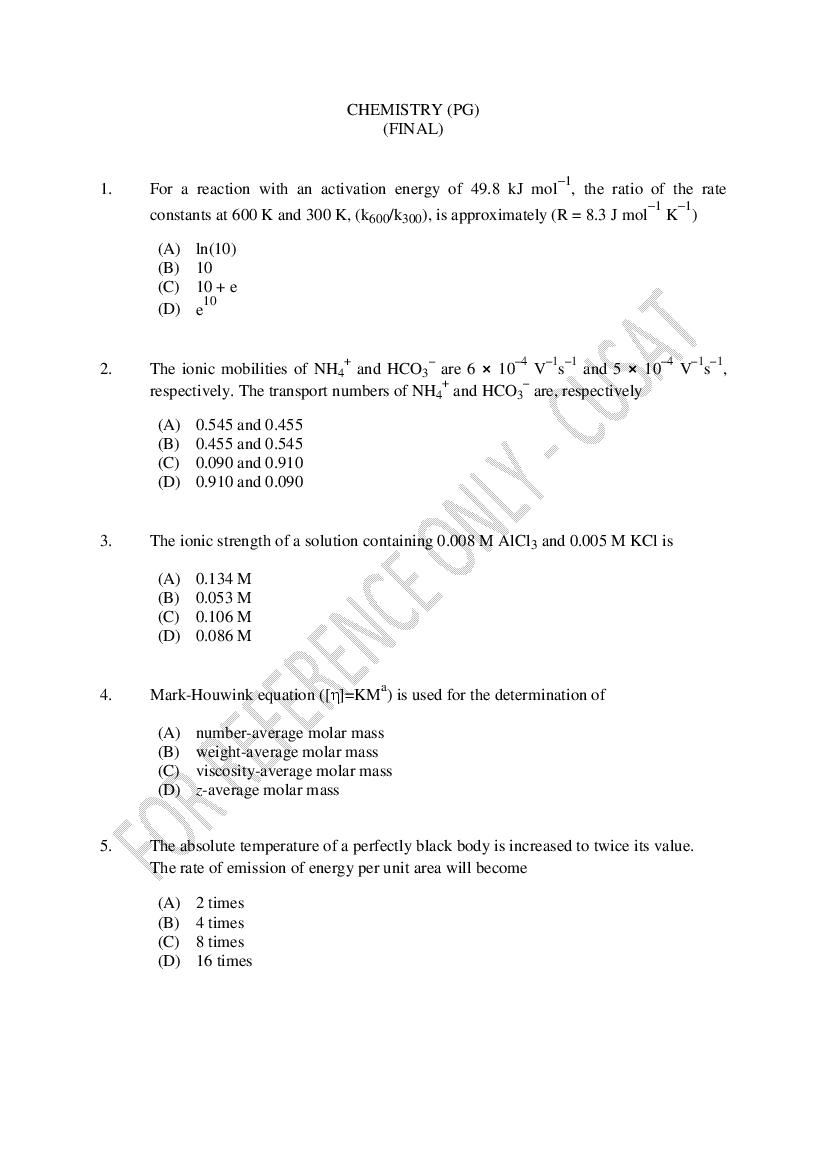
Page 1
(FINAL)
−1
1. For a reaction with an activation energy of 49.8 kJ mol , the ratio of the rate
−1 −1
constants at 600 K and 300 K, (k600/k300), is approximately (R = 8.3 J mol K )
(A) ln(10)
(B) 10
(C) 10 + e
10
(D) e
+ – –4 –1 –1 –4 –1 –1
2. The ionic mobilities of NH4 and HCO3 are 6 ⨯ 10 V s and 5 ⨯ 10 V s ,
+ –
respectively. The transport numbers of NH4 and HCO3 are, respectively
(A) 0.545 and 0.455
(B) 0.455 and 0.545
(C) 0.090 and 0.910
(D) 0.910 and 0.090
3. The ionic strength of a solution containing 0.008 M AlCl3 and 0.005 M KCl is
(A) 0.134 M
(B) 0.053 M
(C) 0.106 M
(D) 0.086 M
a
4. Mark-Houwink equation ([η]=KM ) is used for the determination of
(A) number-average molar mass
(B) weight-average molar mass
(C) viscosity-average molar mass
(D) z-average molar mass
5. The absolute temperature of a perfectly black body is increased to twice its value.
The rate of emission of energy per unit area will become
(A) 2 times
(B) 4 times
(C) 8 times
(D) 16 times
Page 2
6. If the pre-exponential factor in the Arrhenius equation is 1.6 ⨯ 10 s , the value of
the rate constant at extremely high temperature will be close to
–12 –1
(A) 1.6 ⨯ 10 s
–12 –1
(B) 4.2 ⨯ 10 s
–9 –1
(C) 1.2 ⨯ 10 s
–6 –1
(D) 2.4 ⨯ 10 s
7. The degeneracy of an excited state of a particle in 3-dimensional cubic box with
energy 2 times its ground state energy is
(A) 1
(B) 2
(C) 3
(D) 4
d d2
8. Which of the functions below is the common eigen function of and 2
dx dx
operators?
(A) cos x
(B) kx
(C) e – x2
(D) eix
9. Metallic silver crystallizes in an fcc structure with a unit cell of length 40 nm. The
first-order diffraction angle of the X-ray beam from the (2, 1, 0) plane of silver is 30°.
The wavelength of the X-ray used is close to
(A) 11 nm
(B) 18 nm
(C) 25 nm
(D) 32 nm
10. The emf of an electrochemical cell, Cu|CuCl2(a1=0.01)||CuCl2(a2=0.1)|Cu, is close to
(A) 0.059 volts
(B) –0.059 volts
(C) –0.0295 volts
(D) 0.0295 volts
Page 3
2
k[NO] [H2]. If the concentration of NO ([NO]) is doubled, and the concentration of
H2([H2]) is halved, what is the effect on the reaction rate?
(A) Rate will not change
(B) Rate will be doubled
(C) Rate will be halved
(D) Rate will be increased by four times
12. For a reaction A B + C, it is formed that the rate increases by a factor of 2.25 when
the concentration of A is increased by a factor of 1.5 at the same temperature. What is
the order of the reaction with respect to A?
(A) 1
(B) 1.5
(C) 2
(D) 2.25
k
1 → I k
2 → P , the concentration of
13. For a sequence of consecutive reactions, A
I obtained by steady-state approximation is
(A) k1[A]
(B) (k1 + k2)[A]
(C) k1k2[A]
k1
(D) [A]
k2
14. For a reaction 2A + B 3Z, if the rate of consumption of A is 2⨯10–4 mol dm–3 s–1
then the rate of formation of Z (in mol dm–3 s–1) will be
(A) 1⨯10–4 mol dm-3 s-1
(B) 1.5⨯10–4 mol dm-3 s-1
(C) 2⨯10–4 mol dm-3 s-1
(D) 3⨯10–4 mol dm-3 s-1
Page 4
∆
(A) =
∆
(B) =
∆ ∆
∆
(C) =
∆
∆
(D) = ∆
16. A Carnot engine with a low-temperature reservoir of 300K has an efficiency of 50%.
It is desired to increase the efficiency to 70%. By how much should the temperature
of the high-temperature reservoir be increased?
(A) 400K
(B) 600K
(C) 700K
(D) 1000K
1 −iφ
17. Probability density of a wave function,ψ (φ ) = e within 0 ≤ φ ≤ 2π is
2π
1
(A)
2π
1
(B)
2π
(C) 2π
(D) 1
d d
18. The commutators of x, and y, are
dx dx
(A) −1, 0
(B) 0, −1
(C) 0, 0
(D) −1, −1
Page 5
ℏ ∂ ∂
(A) y −x
i ∂x ∂y
ℏ ∂ ∂
(B) y −x
i ∂y ∂x
ℏ ∂ ∂
(C) x − y
i ∂y ∂x
ℏ ∂ ∂
(D) x − y
i ∂x ∂y
1 2
20. A system is represented by the wave function = Φ1 + Φ , where, Φ1 and Φ 2
3 3 2
are orthonormal to each other. If E1 and E2 are the eigenvalues of Φ1 and Φ 2
respectively, then the average energy expression of the system is
1 2
(A) E1 + E
3 3 2
1 2
(B) E1 + E2
3 3
E1 + E2
(C)
3
E1 + E2
(D)
2
Page 6
21. For a particle in a 3-dimensional box with Lx = Ly = z = L , the energy expression
2
for E211 and E112 are
21h 2 3h 2
(A) and , respectively
32mL2 8mL2
6h 2 6h 2
(B) and , respectively
8mL2 8mL2
9h 2 9h 2
(C) and , respectively
32mL2 16mL2
9h 2 3h 2
(D) and , respectively
32mL2 8mL2
22. ∆H of a reaction is equal to slope of the plot
(A) ∆G versus T
(B) ∆G versus (1/T)
(C) (∆G/T) versus T
(D) (∆G/T) versus (1/T)
23. Isothermal reversible expansion (change in volume from V1 to V2, where V2 > V1) of a
(
gas, the change of system entropy ∆S sys is )
(A) nR (V2 − V1 )
(B) nR ( P2 − P1 )
V
(C) nR ln 2
V
1
P
(D) nR ln 2
P
1
Page 7
24. for one mole of Vander Waals gas is
∂V T
1
(A)
(V − b)
(B) (V − b)
a
(C)
V2
V2
(D)
a
25. The rotational spectrum is not observed for
(A) HCl
(B) CH2Cl2
(C) H2O
(D) CH4
26. The energy required for a transition between the rotational levels J=1 and J=2 of a
molecule is (where B is the rotational constant of the molecule)
(A) B cm-1
(B) 2B cm-1
(C) 3B cm-1
(D) 4B cm-1
27. The transition energy expression for the hot band is (ωe and xe are the oscillation
frequency and anharmonicity constant, respectively)
(A) ∆ = (1 − 2 ) cm-1
(B) ∆ = (1 − 4 ) cm-1
(C) ∆ = 2 (1 − 3 ) cm-1
(D) ∆ = 3 (1 − 4 ) cm-1
28. Which of the following statement is CORRECT?
(A) Symmetric stretching mode of vibration of CO2 is IR active and Raman
inactive
(B) Symmetric stretching mode of vibration of CO2 is IR inactive and Raman
active
(C) Bending mode of vibration of CO2 is IR inactive and Raman active
(D) Asymmetric stretching mode of vibration of CO2 is IR inactive and Raman
active
Page 8
1 1
(A) S0 P1
3 3
(B) S1 P2
3 3
(C) S1 P1
3 1
(D) S1 P1
30. On passing monochromatic light through a 0.04 molar solution in a cell of 2 cm
thickness, the intensity of the transmitted light was reduced to 50%. Calculate the
molar extinction coefficient.
(A) 3.76 lit mol-1 cm-1
(B) 4.0 lit mol-1 cm-1
(C) 1.88 lit mol-1 cm-1
(D) 2.0 lit mol-1 cm-1
31. Among the following photophysical processes, which one is the nonradiative process?
(A) Prompt Fluorescence
(B) Intersystem Crossing
(C) Delayed Fluorescence
(D) Phosphorescence
32. Given the equivalent conductances of sodium butyrate, sodium chloride and
hydrochloric acid as 83, 127, and 426 ohm-1cm2 at 25°C, respectively, at infinite
dilution. The equivalent conductance of butyric acid at infinite dilution is
(A) 382 ohm-1cm2
(B) 343 ohm-1cm2
(C) 299 ohm-1cm2
(D) 216 ohm-1cm2
33. In an enzymatic process, obeying the Michaelis-Menten kinetics, at the substrate
concentration extremely low and extremely high conditions, the reaction rate with
respect to substrate concentration will be
(A) zeroth order and first order respectively
(B) zeroth order for both cases
(C) first order and zeroth order respectively
(D) first order for both cases
Page 9
number of microstates in the macrostate (3,7) (3 particles are in one box and 7
particles are in another box) is
(A) 120
(B) 5
(C) 10/21
(D) 120⨯2-10
35. Elementary steps of a reaction are as follows
!
() + →2 , ( ) + ← 2 , ( )2 → ",
if steady state approximation is applicable to C, the rate of the product formation is
([A] and [B] are the concentration of A and B, respectively)
(A) proportional to ([ ][ ])
(B) proportional to [A][B]
(C) proportional to ([ ][ ])%
(D) independent of [A] and [B]
36. At what temperature, with pressure remaining unchanged, the root mean square
velocity of hydrogen will be double of its value at NTP?
(A) 273˚C
(B) 546˚C
(C) 819˚C
(D) 1092˚C
37. The equilibrium constant (Kp) for a reaction, PCl5⇄ PCl3 + Cl2, is 1.8. The pressure
necessary to obtain a 50% dissociation of PCl5 at 250˚C is
(A) 1.5 atm
(B) 1.8 atm
(C) 3.6 atm
(D) 5.4 atm
Page 10
Which of the following equations is correct for the linear operator O ?
(A) OΨ = Ψ ∗
dΨ
(B) OΨ =
dx
(C) OΨ = Φ 2
1
(D) OΨ =
Ψ
39. If the reduced mass of a diatomic molecule is doubled without changing its force
constant, the vibrational frequency of the molecule will be
1
(A) times the original frequency
2
(B) 2 times the original frequency
1
(C) times the original frequency
2
(D) 2 times the original frequency
40. Considering the moment of inertia about the x, y and z axes, the CH4, NH3 and H2O
molecules are
(A) symmetric top, spherical top, and asymmetric top, respectively
(B) spherical top, symmetric top, and asymmetric top, respectively
(C) symmetric top, asymmetric top, and spherical top, respectively
(D) spherical top, asymmetric top, and symmetric top, respectively
41. The lowest possible energy of the simple Harmonic Oscillator is
(A) E0 = ℏω
1
(B) E0 = ℏω
2
(C) E0 = 0
3
(D) E0 = ℏω
2
Page 11
(0.5-0.01 nm to 0.5+0.01 nm) in a one-dimensional box of length 1nm is close to
(A) 0.01
(B) 0.02
(C) 0.04
(D) 0.1
43. The average speed of ideal gas molecules at 27°C is 0.3 ms-1. The average speed at
927°C will be
(A) 0.3 ms-1
(B) 0.6 ms-1
(C) 0.9 ms-1
(D) 3.0 ms-1
44. The edge length of the unit cell of NaCl is 564 pm. If the size of the Cl-1 ion is
181 pm, the size of the Na+ ion would be
(A) 101 pm
(B) 167 pm
(C) 202 pm
(D) 282 pm
45. Given that &'* ( /' = −0.441 volts, and &'* !(/' ( = 0.771 volts. The value of
&'* !( /' is
(A) −0.037 volts
(B) −0.111 volts
(C) −0.33 volts
(D) +0.33 volts
46. The chemical potential is expressed as
∂G
(A) µ = −
∂Ni T , P, N j
∂G
(B) µ =
∂Ni T , P, N j
∂G
(C) µ =
∂T P, N
∂G
(D) µ =
∂P T , N
Page 12
molecules of molar mass 30,000 g/mol, and 30% of molecules of molar mass
,- ) is
60,000 g/mol, then weight average molar mass (+
(A) 1100 g/mol
(B) 36,000 g/mol
(C) 36,666 g/mol
(D) 43,333 g/mol
48. If a unimolecular surface reaction obeys the Langmuir adsorption isotherm at very
high pressure, the rate of the reaction (v) is
(A) independent of the pressure
(B) proportional to the pressure
(C) proportional to the square of the pressure
(D) inversely proportional to the pressure
49. The van’t Hoff equation is
d ln K p ∆H 0
(A) =
dT RT 2
d ln K p ∆G 0
(B) =
dT RT 2
d ln K p ∆H 0
(C) =
dT RT
d ln K p ∆G 0
(D) =
dT RT
50. Which of the following is NOT an intensive property of a system?
(A) Density
(B) Viscosity
(C) Entropy
(D) Temperature
51. Among the following, the compound that forms the strongest hydrogen bonding is
(A) HF
(B) HCl
(C) HBr
(D) HI
Page 13
spectral characteristics:
characteristics
1
H NMR: δ 9.72 (t, 1H), 7.1 (d, 2H), 6.7 (d, 2H), 3.8 (s, 3H), 3.6 (d, 2H)
IR: ~1720 cm‒1
The most probable structure of the compound is
(A)
(B)
(C)
(D)
53. The reaction of 2,4-dinitrofluorobenzene
dinitrofluorobenzene with hydrazine produces a yellow orange
solid X used for the identification of an organic functional group G.
G Then X and G,
respectively, are
(A) and carboxylic acid
(B) and aldehyde
(C) and aldehyde
(D) and carboxylic acid
Page 14
(A) MnO2
(B) DMSO, (COCl)2, Et3N
(C) Al(Oi-Pr)3
(D) Ag2O/NH4OH (Tollens Reagent)
55. The major product formed in the following reaction is
(A)
(B)
(C)
(D)
56. Nitration is an important example for aromatic electrophilic substitution reaction.
Major mononitration products of pyrrole and pyridine are,
are respectively
(Pyrrole) N
(Pyridine)
H N
(A) 2-nitropyrrole
nitropyrrole and 4-nitropyridine
4
(B) 3-nitropyrrole
nitropyrrole and 3-nitropyridine
3
(C) 2-nitropyrrole
nitropyrrole and 2-nitropyridine
2
(D) 2-nitropyrrole and 3-nitropyridine
3
Page 15
I II III IV
(A) II and IV
(B) III and IV
(C) III only
(D) None of the above
58. The major product formed in the following reaction is
(A)
(B)
(C)
(D)
59. For the radical chain reaction below, the correct classification for step 2 and step 3 is,
respectively,
(A) chain propagating, chain terminating
(B) chain branching, chain terminating
(C) chain propagating, chain propagating
(D) chain propagating, chain branching
Page 16
(A)
(B)
(C)
(D)
61. The amino acid with R configuration is
(A)
(B)
(C)
(D)
62. The rate of SN1 solvolysis of I - IV follows
(A) I > II > III > IV
(B) III > I > II > IV
(C) III > II >> I > IV
(D) IV > I > II > III
Page 17
(A) I and IV
(B) I and III
(C) II and IV
(D) II and III
64. Achiral stereoisomer(s) is (are) possible for
(A)
(B)
OH OH
H
(C) HO2C CO2H
OH
Cl
(D)
Page 18
(A)
(B)
(C)
(D)
66. The order of acidity of the given molecules in aqueous media is
(A) IV < I < II < III
(B) II < I < IV < III
(C) II < IV < I < III
(D) IV < II < I < III
67. The compound formed upon fusing an aliphatic amine with sodium metal in
Lassaigne’s test is
(A) NaNH2
(B) NaNO2
(C) NaCN
(D) NaN3
Page 19
(A)
(B)
(C)
(D)
69. “All Altruists Gladly Make Gum in Gallon Tanks”. The C-2 epimer of D-glucose is
(A) D-Mannose
(B) D-Altrose
(C) D-Galactose
(D) L-Glucose
70. The CORRECT order of stability for the following carbocations is
(A) I < III < IV < II
(B) III < II < IV < I
(C) II < IV < III < I
(D) IV < III < I < II
Page 20
compounds is
(A) II < I < III < IV
(B) I < III < II < IV
(C) IV < II < III < I
(D) III < IV < II < I
72. The CORRECT statement about carbene is
(A) Singlet carbenes are negatively charged while triplet carbenes are positively
charged
(B) Carbene is an intermediate in Curtius rearrangement
(C) Carbene can insert into both σ and π-bonds
(D) Carbene is generated from amines on reaction with chloroform and acid
73. In the following sequence of reactions, the overall (%) yield of O is
(A) 61
(B) 85
(C) 74
(D) 68
74. Catalytic hydrogenation of the following compound produces saturated
hydrocarbons(s). The number of stereoisomer(s) formed is/are
(A) 1
(B) 2
(C) 3
(D) 4
Page 21
(A) I and IV
(B) I and III
(C) II and III
(D) III and IV
76. The product R in the following reaction is
(A)
(B)
(C)
(D)
77. The following conversion is carried out using
(A) hydroboration-oxidation followed by Jones oxidation
(B) Wacker oxidation followed by haloform reaction
(C) oxymercuration-demercuration followed by Jones oxidation
(D) ozonolysis followed by haloform reaction
Page 22
(A) tyrosine
(B) methionine
(C) arginine
(D) glutamine
79. The major product formed in the following reaction is
(A)
(B)
(C)
(D)
Page 23
(A)
(B)
(C)
(D)
81. The major product formed in the reaction of butyronitrile (CH3CH2CH2CN) with
phenylmagnesium bromide followed by acidification is
(A)
(B)
(C)
(D)
Page 24
yellow precipitate. It also gives silver mirror on reaction with ammoniacal AgNO3. It
gives an alcohol and sodium salt of a carboxylic acid on reaction with concentrated
NaOH. It yields benzene-1,2-dicarboxylic acid on heating with alkaline KMnO4. The
structure of the compound among the following is
(A)
(B)
(C)
(D)
83. The major product formed in the following reaction is
(A)
(B)
(C)
(D)
Page 25
metal. On treatment with conc. HCl, P gives CH3CH2Cl and CH3CHO. The structure
of P is
(A)
(B)
(C)
(D)
85. Aluminium complex of oxine is a common component in Organic Light Emitting
Diodes (OLEDs). Structure of oxine is
(A)
(B)
(C)
(D)
Page 26
(A)
(B)
(C)
(D)
87. Identify the correct reagents and reaction sequence required for the following
transformation
(A) (i) NaBH4; (ii) H3O+
(B) (i) LiAlH4; (ii) H3O+
(C) (i) HOCH2CH2OH, H+; (ii) LiAlH4; (iii) H3O+
(D) (i) HSCH2CH2SH, H+; (ii) LiAlH4; (iii) H3O+
88. What is the IUPAC name for the compound shown below?
(A) 1-Bromo-3-chlorocyclohexene
(B) 2-Bromo-6-chlorocyclohex-1-ene
(C) 6-Bromo-2-chlorocyclohexene
(D) 3-Bromo-1-chlorocyclohex-1-ene
89. Calculate the λmax for the following diene in hexane solution.
Page 27
(B) 259
(C) 232
(D) 217
90. The major product formed in the following reaction is
(A)
(B)
(C)
(D)
91. The reactivity of the enol derivatives towards benzaldehyde follows the order
(A) I > II > III
(B) III > II > I
(C) II > I > III
(D) I > III > II
Page 28
(A)
(B)
(C)
(D)
93. The correct statement for the following structures is
(A) 1, 2 and 3 are resonance structures
(B) 1 and 2 are resonance structures, whereas 3 is an isomer of 1 and 2
(C) 1 and 3 are resonance structures, whereas 2 is an isomer of 1 and 3
(D) 1, 2 and 3 are constitutional isomers
Page 29
of the labelled protons (HX, HY, HZ) is
(A) HZ > HX > HY
(B) HZ > HY > HX
(C) HX > HZ > HY
(D) HY > HX > HZ
Page 30
(A) heating phthalaldehyde with CuCN at 100°C
(B) heating phthalic anhydrade with acetonitrile in the presence of anhydrous
CuSO4
(C) heating benzonitrile with CuCl at 220-250°C
(D) reaction between a mixture of benzaldehyde and pyrrole in reflexing propionic
acid in the presence of Cu(CN)2
96. The sequence of three steps involved in the following conversion is (respectively)
(A) (i) Friedel-Crafts alkylation; (ii) Reduction; (iii) Friedel-Crafts acylation
(B) (i) Friedel-Crafts acylation; (ii) Friedel-Crafts alkylation; (iii) Reduction
(C) (i) Friedel-Crafts acylation; (ii) Reduction; (iii) Friedel-Crafts alkylation
(D) (i) Friedel-Crafts alkylation; (ii) Friedel-Crafts acylation; (iii) Reduction
Page 31
(A)
(B)
(C)
(D)
98. The mechanism of the following transformation involves
+ Sodium formate
(A) Aldol reaction and Cannizzaro reaction
(B) Aldol reaction and Claisen-Schmidt reaction
(C) Knoevenagel condensation and Cannizzaro reaction
(D) Stobbe condensation and Cannizzaro reaction
99. The appropriate reagents required for carrying out the following transformation are
(A) (i) succinic anhydride, AlCl3; (ii) Zn/Hg, HCl; (iii) polyphosphoric acid
(B) (i) maleic anhydride, AlCl3; (ii) H2N-NH2, KOH; (iii) H2SO4
(C) (i) succinic anhydride, FeCl3; (ii) LiAlH4; (iii) H2SO4
(D) (i) phthalic anhydride, F3B·OEt2; (ii) HS(CH2)2SH, H+; (iii) Raney Ni;
(iv) polyphosphoric acid
Page 32
(A)
(B)
(C)
(D)
101. The CFSE of tetrahedral [CoCl4]2− is 8000 cm−1. The CFSE (in cm−1) for octahedral
[CoCl6]4− will be
(A) 16000
(B) 18000
(C) 20000
(D) 12000
102. The complexes of [Co(NH3)6] [Cr(CN)6] and [Co(NH3)6] [Cr(CN)6] are an example of
(A) linkage isomerism
(B) optical isomerism
(C) polymerisation isomerism
(D) coordination isomerism
103. In a square planar complex with ligands on x and y axes, the highest energy metal
d-orbital is
(A) d yz
(B) d 2
x − y2
(C) d xy
(D) d 2
z
Page 33
(A) Square pyramid
(B) Pentagonal planar
(C) Pentagonal bipyramid
(D) Square planar
105. Which of the following reagent is used in the extraction of aluminum from bauxite
(Bayer’s process)?
(A) NaCl
(B) Na2CO3
(C) Na2SO4
(D) NaOH
106. Producer gas is a mixture of
(A) CO2 + H2
(B) CO2 + N2
(C) CO + H2 + N2
(D) CO + N2
107. The bond angle of NO2+, NO2 and NO2− are respectively
(A) 115°, 180°, 134°
(B) 180°, 134°, 115°
(C) 134°, 115°, 180°
(D) 115°, 134°, 180°
108. Which of the following metal carbonyl will not obey the effective atomic number
(EAN) rule?
(A) Re2(CO)10
(B) W(CO)6
(C) V(CO)6
(D) Cr(CO)6
109. CN− is
(A) Soft acid
(B) Hard acid
(C) Hard base
(D) Soft base
Page 34
(A) Mg
(B) Co
(C) Fe
(D) Zn
111. The noble gas having ionization potential close to that of oxygen is
(A) Neon
(B) Argon
(C) Xenon
(D) Krypton
112. In the species O2, O2+, O2−, O22− the correct decreasing order of bond strength is
(A) O2 > O2+ > O2− > O22−
(B) O2+ > O2 > O2− > O22−
(C) O22− > O2− > O2+ > O2
(D) O2− > O22− > O2 > O2+
113. Zn, Cd, Hg have lower melting points than other d-block elements because of
(A) absence of metallic bonds
(B) presence of strong metallic bonds
(C) presence of completely filled shell
(D) they are not transition elements
114. The IUPAC name of Wilkinson’s catalyst is
(A) Bromotris(triphenylphosphine)rhodium(I)
(B) Chlorotris(triphenylphosphine)rhodium(I)
(C) Chlorotris(triphenylphosphine)palladium(I)
(D) Bromotris(triphenylphosphine)palladium(I)
115. Which among the following is Ziegler-Natta catalyst?
(A) RMgX
(B) RLi
(C) AlR3 + TiCl4
(D) R2Zn
Page 35
(A) Zr and Hf
(B) Nb and Ta
(C) Mo and W
(D) All of the above
117. A brown coloured ring is formed, when ferrous sulphate is added to a solution
containing nitrate. The colour is due to the formation of
(A) [Fe(H2O)5(NO)2]2+
(B) [Fe(H2O)4(NO)2]2+
(C) [Fe(H2O)5NO]2+
(D) [Fe(H2O)4NO]2+
118. Spin-only magnetic moment of Cu+ ion is
(A) 3.88 BM
(B) 2.83 BM
(C) 1.41 BM
(D) 0 BM
119. Ferric alum gives red color with NH4SCN due to formation of
(A) Al(SCN)3
(B) [Fe(SCN)]2+
(C) Fe(SCN)3
(D) [Fe(SCN)3]−
120. Tetraethyllead in petrol act as
(A) Knocking agent
(B) Reducing agent
(C) Anti knocking agent
(D) Oxidising agent
121. Number of atoms in 20 g Ca is equal to number of atoms in
(A) 20 g Mg
(B) 1.7 g NH3
(C) 1.8 g H2O
(D) 1.6 g CH4
Page 36
(A) Magnesium
(B) Silicon
(C) Diamond
(D) Aluminium
123. What among the following are intracellular and extracellular ions respectively?
(A) Na+, Cl−
(B) Na+, Ca2+
(C) Cl−, K+
(D) K+, Na+
124. Hypophosphorous acid contains
(A) one hydrogen attached to P
(B) two hydrogens attached to P
(C) three hydrogens attached to P
(D) no hydrogen attached to P
125. Which of the following statements are correct?
(A) The hybridization in diamond and graphite is sp3
(B) The hybridization in diamond is sp2, graphite is sp3
(C) The hybridization in diamond is sp3, graphite is sp
(D) The hybridization in diamond is sp3, graphite is sp2
126. Which of the following has zero dipole moment?
(A) CO
(B) SO2
(C) SO3
(D) H2O
127. Temporary hardness of water is due to the presence of
(A) HCO3− of Ca2+, Mg2+ and Na+
(B) SO42− and Cl− of Na+ and K+
(C) SO42− and Cl− of Ca2+ and Mg2+
(D) HCO3− of Ca2+ and Mg2+
Page 37
(A) Closo
(B) Arachno
(C) Nido
(D) None of the above
129. Arrange the following element according to electron affinity value.
O, S, Se, Te
(A) O > S > Se > Te
(B) O > Se > S > Te
(C) O > S > Se > Te
(D) S > Se > Te > O
130. Which one of the following molecules will form a linear polymeric structure due to
hydrogen bonding?
(A) NH3
(B) H2O
(C) HCl
(D) HF
131. Which of the following is paramagnetic?
−
(A) NO
+
(B) NO
−
(C) CN
−
(D) O2
2 3
132. In an octahedral structure, the pair of d orbitals involved in d sp hybridization is
(A) d 2 ,d 2
x − y2 z
(B) d xz , d 2
x − y2
(C) d 2 , d xz
z
(D) d xy , d yz
Page 38
133. Crystal field stabilization energy for high spin d octahedral complex is
(A) −1.6∆O+P
(B) −0.6∆O
(C) −1.2 ∆O
(D) −1.8 ∆O
134. Identify the function of hemocyanin and the metal responsible for the function
(A) O2 transport and Fe
(B) O2 transport and Cu
(C) Electron transport and Fe
(D) Electron transport and Cu
135. Which of the following carbonyls will have the strongest C−O bond?
+
(A) [Mn(CO)6]
(B) [Cr(CO)6]
−
(C) [V(CO)6]
(D) [Fe(CO)5]
136. Which of the following oxides will be the least acidic?
(A) As4O6
(B) As4O10
(C) P4O10
(D) P4O6
137. Glass reacts with HF to produce
(A) SiF4
(B) H2SiF6
(C) H2SiO3
(D) Na3AlF6
138. The tendency of BF3, BCl3, and BBr3 to behave as Lewis acid decreases in the
following order:
(A) BCl3 > BF3 > BBr3
(B) BBr3 > BCl3 > BF3
(C) BBr3 > BF3 > BCl3
(D) BF3 > BCl3 > BBr3
Page 39
(A) p-type semiconductor
(B) n-type semi-conductor
(C) insulator
(D) rectifier
140. The number of geometrical isomers for [Pt(NH3)2Cl2] is
(A) 2
(B) 1
(C) 3
(D) 4
141. In neutron activation analysis the radiation commonly detected is
(A) α- rays
(B) β- rays
(C) γ- rays
(D) X-rays
142. Function of myoglobin is
(A) O2 transport
(B) O2 storage
(C) Electron carriers
(D) Iron storage
143. What is the denticity of acetylacetonato(acac) ligand ?
(A) 3
(B) 6
(C) 2
(D) 1
144. The mineral of iron is
(A) Malachite
(B) Cassiterite
(C) Magnetite
(D) Pyrolusite
145. Triclinic crystal system is defined by
(A) a ≠ b ≠ c, α = β = γ = 90°
Page 40
(C) a = b = c, α ≠ β ≠ γ ≠ 90o
(D) a ≠ b ≠ c, α ≠ β ≠ γ ≠ 90o
146. The metal ions involved in nitrogenase are
(A) Fe and Zn
(B) Mo and Fe
(C) Mn and Mg
(D) Mg and Fe
147. Number of radial nodes for 5d orbitals are
(A) 2
(B) 3
(C) 1
(D) 4
148. The angular nodal surfaces for a 3dxy orbital are
(A) YZ and XZ planes
(B) YZ plane
(C) XZ and XY planes
(D) XY plane
149. Number of angular nodes for d and f orbitals are
(A) 2 and 3
(B) 1 and 2
(C) 0 and 1
(D) None of the above
150. The type of hybridization and shape of the molecule in ClF3 are respectively
3
(A) sp , pyramidal
2
(B) sp ,trigonal planer
3
(C) dsp , trigonal bipyramidal
3
(D) sp d, T- shaped
Page 41
Subject Name: CHEMISTRY
SI No. Key SI No. Key SI No. Key SI No. Key SI No. Key
1 D 31 B 61 B 91 D 121 D
2 A 32 A 62 C 92 C 122 C
3 B 33 C 63 B 93 D 123 D
4 C 34 A 64 C 94 D 124 B
5 D 35 B 65 D 95 C 125 D
6 A 36 C 66 C 96 B 126 C
7 C 37 D 67 C 97 C 127 D
8 D 38 B 68 C 98 A 128 C
9 B 39 A 69 A 99 A 129 D
10 D 40 B 70 C 100 C 130 D
11 B 41 B 71 D 101 B 131 D
12 C 42 C 72 C 102 D 132 A
13 D 43 B 73 A 103 B 133 B
14 D 44 A 74 C 104 C 134 B
15 A 45 A 75 B 105 D 135 A
16 A 46 B 76 D 106 C 136 A
17 D 47 D 77 B 107 B 137 B
18 A 48 A 78 C 108 C 138 B
19 C 49 A 79 B 109 D 139 A
20 B 50 C 80 B 110 B 140 A
21 A 51 A 81 A 111 C 141 B
22 D 52 C 82 C 112 B 142 B
23 C 53 B 83 A 113 C 143 C
24 C 54 D 84 B 114 B 144 C
25 D 55 B 85 B 115 C 145 D
26 D 56 D 86 A 116 D 146 B
27 B 57 B 87 C 117 C 147 A
28 B 58 A 88 D 118 D 148 A
29 D 59 C 89 C 119 B 149 A
30 A 60 B 90 A 120 C 150 D
Document Details
| Board / Org | Cochin University |
| Exam | CUSAT Common Admission Test |
| Type | Question Paper |
| Pages | 41 |
| Updated | 22 Jul 2026 |