UGC NET Social Work Question Paper 2018
Finished viewing? Save it for later —
Download UGC NET Social Work Question Paper 2018 (PDF · 48 pages)About UGC NET Social Work Question Paper 2018
UGC NET Social Work Question Paper 2018 is available here for free download. Published by NTA for UGC National Eligibility Test, this question paper can be viewed online or downloaded as a PDF (48 pages). Candidates preparing for UGC National Eligibility Test can use UGC NET Social Work Question Paper 2018 to understand the exam pattern, the type of questions asked, and the overall difficulty level.
Frequently Asked Questions
How can I download UGC NET Social Work Question Paper 2018?
Open this page and click the Download button to save UGC NET Social Work Question Paper 2018 as a PDF. It is completely free on AglaSem Docs.
Is UGC NET Social Work Question Paper 2018 free to download?
Yes. UGC NET Social Work Question Paper 2018 can be viewed online and downloaded as a PDF free of cost on AglaSem Docs.
How many pages does UGC NET Social Work Question Paper 2018 have?
UGC NET Social Work Question Paper 2018 contains 48 pages, which you can read online or download together as a single PDF.
Where can I find more UGC National Eligibility Test study material?
You can find more UGC National Eligibility Test question papers, sample papers, syllabus, and answer keys on AglaSem Docs.
UGC NET Social Work Question Paper 2018 – Text
Read the full text of this question paper below — useful to quickly search, copy and reference the content online without downloading the PDF.
📄 View text version (48 pages)
Page 1
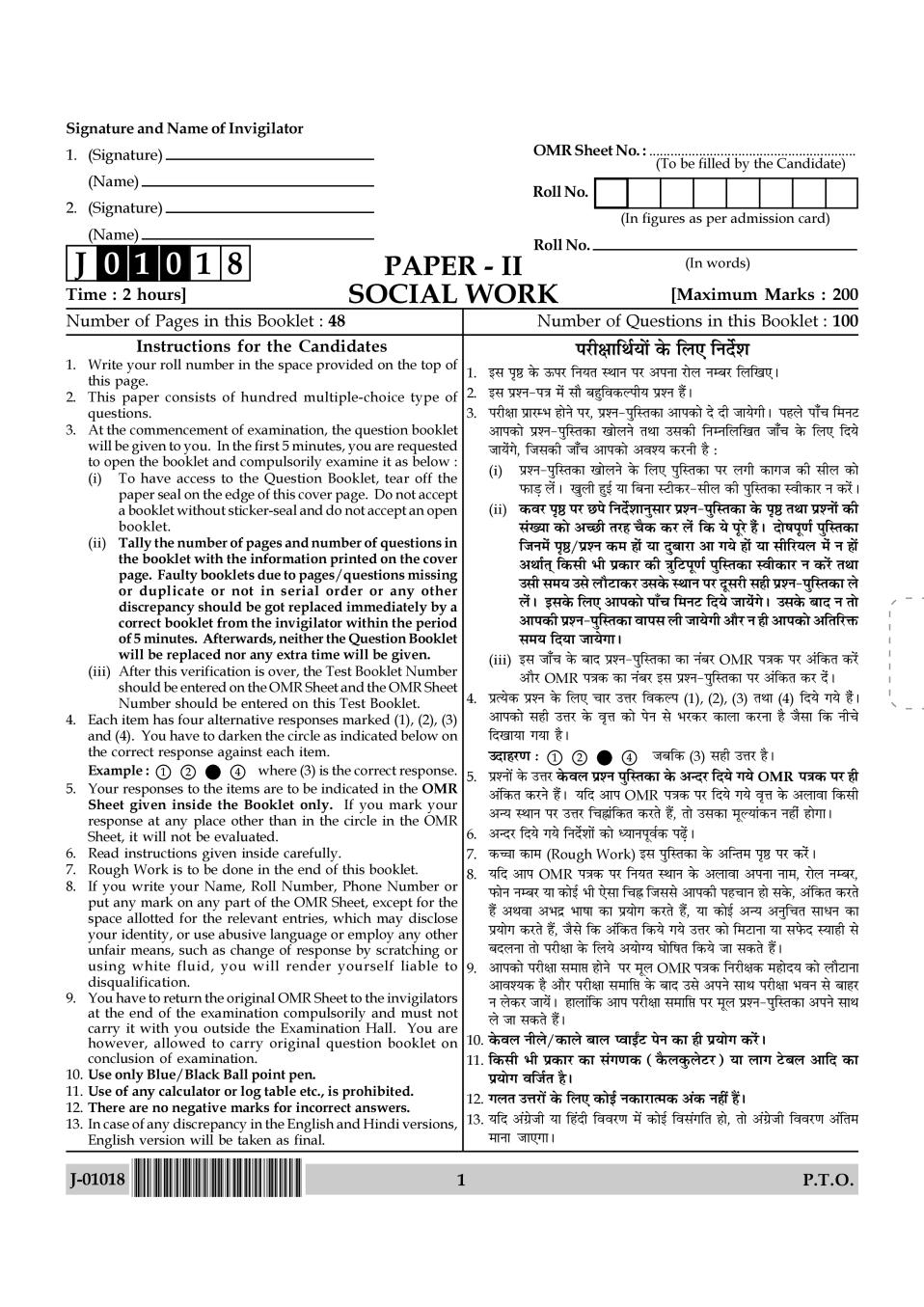
1. (Signature) OMR Sheet No. : ..........................................................
(To be filled by the Candidate)
(Name)
Roll No.
2. (Signature)
(In figures as per admission card)
(Name)
Roll No.
J 0 1 0 1 8 PAPER - II (In words)
Time : 2 hours] SOCIAL WORK [Maximum Marks : 200
Number of Pages in this Booklet : 48 Number of Questions in this Booklet : 100
Instructions for the Candidates ¬⁄UˡÊÊÁÕ¸ÿÙ¢ ∑§ Á‹∞ ÁŸŒ¸‡Ê
1. Write your roll number in the space provided on the top of
1. ß‚ ¬ÎDU ∑§ ™§¬⁄U ÁŸÿà SÕÊŸ ¬⁄U •¬ŸÊ ⁄UÙ‹U Ÿê’⁄U Á‹Áπ∞–
this page.
2. This paper consists of hundred multiple-choice type of 2. ß‚ ¬˝‡Ÿ-¬òÊ ◊¢ ‚ÊÒ ’„ÈÁfl∑§À¬Ëÿ ¬˝‡Ÿ „Ò¥–
questions. 3. ¬⁄UˡÊÊ ¬˝Ê⁄êU÷ „ÙŸ ¬⁄U, ¬˝‡Ÿ-¬ÈÁSÃ∑§Ê •Ê¬∑§Ù Œ ŒË ¡ÊÿªË– ¬„‹U ¬UÊ°ø Á◊Ÿ≈U
3. At the commencement of examination, the question booklet •Ê¬∑§Ù ¬˝‡Ÿ-¬ÈÁSÃ∑§Ê πÙ‹Ÿ ÃÕÊ ©‚∑§Ë ÁŸêŸÁ‹Áπà ¡Ê°ø ∑§ Á‹∞ ÁŒÿ
will be given to you. In the first 5 minutes, you are requested ¡Êÿ¢ª, Á¡‚∑§Ë ¡Ê°ø •Ê¬∑§Ù •fl‡ÿ ∑§⁄UŸË „Ò —
to open the booklet and compulsorily examine it as below :
(i) ¬˝‡Ÿ-¬ÈÁSÃ∑§Ê πÙ‹Ÿ ∑§ Á‹∞ ¬ÈÁSÃ∑§Ê ¬⁄U ‹ªË ∑§Êª¡ ∑§Ë ‚Ë‹ ∑§Ê
(i) To have access to the Question Booklet, tear off the
paper seal on the edge of this cover page. Do not accept »§Ê«∏ ‹¢U– πÈ‹Ë „È߸ ÿÊ Á’ŸÊ S≈UË∑§⁄U-‚Ë‹U ∑§Ë ¬ÈÁSÃ∑§Ê SflË∑§Ê⁄U Ÿ ∑§⁄¢U–
a booklet without sticker-seal and do not accept an open (ii) ∑§fl⁄U ¬ÎDU ¬⁄U ¿U¬ ÁŸŒ¸‡ÊÊŸÈ‚Ê⁄U ¬˝‡Ÿ-¬ÈÁSÃ∑§Ê ∑§ ¬ÎDU ÃÕÊ ¬˝‡ŸÙ¢ ∑§Ë
booklet. ‚¢ÅÿÊ ∑§Ù •ë¿UË Ã⁄U„ øÒ∑§ ∑§⁄U ‹¢U Á∑§ ÿ ¬Í⁄U „Ò¢U– ŒÙ·¬Íáʸ ¬ÈÁSÃ∑§Ê
(ii) Tally the number of pages and number of questions in Á¡Ÿ◊¢ ¬ÎDU/¬˝‡Ÿ ∑§◊ „Ù¢ ÿÊ ŒÈ’Ê⁄UÊ •Ê ªÿ „Ù¢ ÿÊ ‚ËÁ⁄Uÿ‹U ◊¢ Ÿ „Ù¢
the booklet with the information printed on the cover •ÕʸØ Á∑§‚Ë ÷Ë ¬˝∑§Ê⁄U ∑§Ë òÊÈÁ≈U¬Íáʸ ¬ÈÁSÃ∑§Ê SflË∑§Ê⁄U Ÿ ∑§⁄¢U ÃÕÊ
page. Faulty booklets due to pages/questions missing
or duplicate or not in serial order or any other ©‚Ë ‚◊ÿ ©‚ ‹Uı≈UÊ∑§⁄U ©‚∑§ SÕÊŸ ¬⁄U ŒÍ‚⁄UË ‚„Ë ¬˝‡Ÿ-¬ÈÁSÃ∑§Ê ‹
discrepancy should be got replaced immediately by a ‹¢– U ß‚∑§ Á‹∞ •Ê¬∑§Ù ¬Ê°ø Á◊Ÿ≈U ÁŒÿ ¡Êÿ¢ª– ©‚∑§ ’ÊŒ Ÿ ÃÙ
correct booklet from the invigilator within the period •Ê¬∑§Ë ¬˝‡Ÿ-¬ÈÁSÃ∑§Ê flʬ‚ ‹Ë ¡ÊÿªË •ı⁄U Ÿ „Ë •Ê¬∑§Ù •ÁÃÁ⁄UQ§
of 5 minutes. Afterwards, neither the Question Booklet ‚◊ÿ ÁŒÿÊ ¡ÊÿªÊ–
will be replaced nor any extra time will be given. (iii) ß‚ ¡Ê°ø ∑§ ’ÊŒ ¬˝‡Ÿ-¬ÈÁSÃ∑§Ê ∑§Ê Ÿ¥’⁄U OMR ¬òÊ∑§ ¬⁄U •¢Á∑§Ã ∑§⁄¢U
(iii) After this verification is over, the Test Booklet Number
•Uı⁄U OMR ¬òÊ∑§ ∑§Ê Ÿ¥’⁄U ß‚ ¬˝‡Ÿ-¬ÈÁSÃ∑§Ê ¬⁄U •¢Á∑§Ã ∑§⁄U Œ¢–
should be entered on the OMR Sheet and the OMR Sheet
Number should be entered on this Test Booklet. 4. ¬˝ àÿ∑§ ¬˝‡Ÿ ∑§ Á‹∞ øÊ⁄U ©ûÊ⁄U Áfl∑§À¬ (1), (2), (3) ÃÕÊ (4) ÁŒÿ ªÿ „Ò¢–
4. Each item has four alternative responses marked (1), (2), (3) •Ê¬∑§Ù ‚„Ë ©ûÊ⁄U ∑§ flÎûÊ ∑§Ù ¬Ÿ ‚ ÷⁄U∑§⁄U ∑§Ê‹Ê ∑§⁄UŸÊ „Ò ¡Ò‚Ê Á∑§ ŸËø
and (4). You have to darken the circle as indicated below on ÁŒπÊÿÊ ªÿÊ „Ò–
the correct response against each item. ©ŒÊ„⁄UáÊ — ¡’Á∑§ (3) ‚„Ë ©ûÊ⁄U „Ò–
Example : where (3) is the correct response. 5. ¬˝‡ŸÊ¥ ∑§ ©ûÊ⁄U ∑§fl‹ ¬˝‡Ÿ ¬ÈÁSÃ∑§Ê ∑§ •ãŒ⁄U ÁŒÿ ªÿ OMRU ¬òÊ∑§ ¬⁄U „Ë
5. Your responses to the items are to be indicated in the OMR •¥Á∑§Ã ∑§⁄UŸ „Ò¥– ÿÁŒ •Ê¬ OMRU ¬òÊ∑§ ¬⁄U ÁŒÿ ªÿ flÎûÊ ∑§ •‹ÊflÊ Á∑§‚Ë
Sheet given inside the Booklet only. If you mark your
response at any place other than in the circle in the OMR •ãÿ SÕÊŸ ¬⁄U ©ûÊ⁄U ÁøqÊ¢Á∑§Ã ∑§⁄Uà „Ò¥, ÃÙ ©‚∑§Ê ◊ÍÀUÿÊ¢∑§Ÿ Ÿ„Ë¢ „٪ʖ
Sheet, it will not be evaluated. 6. •ãŒ⁄U ÁŒÿ ªÿ ÁŸŒ¸‡ÊÙ¢ ∑§Ù äÿÊŸ¬Ífl¸∑§ ¬…∏¢U–
6. Read instructions given inside carefully. 7. ∑§ìÊÊ ∑§Ê◊ (Rough Work) ß‚ ¬ÈÁSÃ∑§Ê ∑§ •ÁãÃ◊ ¬ÎDU ¬⁄U ∑§⁄¢U–
7. Rough Work is to be done in the end of this booklet. 8. ÿÁŒ •Ê¬ OMR ¬òÊ∑§ ¬⁄U ÁŸÿà SÕÊŸ ∑§ •‹ÊflÊ •¬ŸÊ ŸÊ◊, ⁄UÊ‹ Ÿê’⁄U,
8. If you write your Name, Roll Number, Phone Number or »§ÊŸ Ÿê’⁄U ÿÊ ∑§Ê߸ ÷Ë ∞‚Ê Áøq Á¡‚‚ •Ê¬∑§Ë ¬„øÊŸ „Ê ‚∑§, •¥Á∑§Ã ∑§⁄UÃ
put any mark on any part of the OMR Sheet, except for the
space allotted for the relevant entries, which may disclose „Ò¥ •ÕflÊ •÷Œ˝ ÷Ê·Ê ∑§Ê ¬˝ÿʪ ∑§⁄Uà „Ò¥, ÿÊ ∑§Ê߸ •ãÿ •ŸÈÁøà ‚ÊœŸ ∑§Ê
your identity, or use abusive language or employ any other ¬˝ÿʪ ∑§⁄Uà „Ò¥, ¡Ò‚ Á∑§ •¥Á∑§Ã Á∑§ÿ ªÿ ©ûÊ⁄U ∑§Ê Á◊≈UÊŸÊ ÿÊ ‚»§Œ SÿÊ„Ë ‚
unfair means, such as change of response by scratching or ’Œ‹ŸÊ ÃÊ ¬⁄UˡÊÊ ∑§ Á‹ÿ •ÿÊÇÿ ÉÊÊÁ·Ã Á∑§ÿ ¡Ê ‚∑§Ã „Ò¥–
using white fluid, you will render yourself liable to 9. •Ê¬∑§Ù ¬⁄UˡÊÊ ‚◊Ê# „ÙŸ §¬⁄U ◊Í‹ OMR ¬òÊ∑§ ÁŸ⁄UˡÊ∑§ ◊„ÙŒÿ ∑§Ù ‹Uı≈UÊŸÊ
disqualification. •Êfl‡ÿ∑§ „Ò •ı⁄U ¬⁄UˡÊÊ ‚◊ÊÁ# ∑§ ’ÊŒ ©‚ •¬Ÿ ‚ÊÕ ¬⁄UˡÊÊ ÷flŸ ‚ ’Ê„⁄U
9. You have to return the original OMR Sheet to the invigilators Ÿ ‹∑§⁄U ¡Êÿ¢– „Ê‹Ê¥Á∑§ •Ê¬ ¬⁄UˡÊÊ ‚◊ÊÁ# ¬⁄U ◊Í‹ ¬˝‡Ÿ-¬ÈÁSÃ∑§Ê •¬Ÿ ‚ÊÕ
at the end of the examination compulsorily and must not
carry it with you outside the Examination Hall. You are
‹ ¡Ê ‚∑§Ã „Ò¥–
however, allowed to carry original question booklet on 10. ∑§fl‹ ŸË‹/∑§Ê‹ ’Ê‹U åflÊßZ≈U ¬Ÿ ∑§Ê „Ë ¬˝ÿʪ ∑§⁄¢U–
conclusion of examination. 11. Á∑§‚Ë ÷Ë ¬˝∑§Ê⁄U ∑§Ê ‚¢ªáÊ∑§ (∑Ò§‹∑ȧ‹≈U⁄U) UÿÊ ‹Êª ≈U’‹ •ÊÁŒ ∑§Ê
10. Use only Blue/Black Ball point pen. ¬˝ÿÙª flÁ¡¸Ã „Ò–
11. Use of any calculator or log table etc., is prohibited.
12. ª‹Ã ©ûÊ⁄UÊ¥ ∑§ Á‹∞ ∑§Ê߸ Ÿ∑§Ê⁄UÊà◊∑§ •¥∑§ Ÿ„Ë¥ „Ò¥–
12. There are no negative marks for incorrect answers.
13. In case of any discrepancy in the English and Hindi versions, 13. ÿÁŒ •¥ª˝¡Ë ÿÊ Á„¥ŒË Áflfl⁄UáÊ ◊¥ ∑§Ê߸ Áfl‚¥ªÁà „Ê, ÃÊ •¥ª˝¡Ë Áflfl⁄UáÊ •¥ÁÃ◊
English version will be taken as final. ◊ÊŸÊ ¡Ê∞ªÊ–
J-01018 !J-01018-PAPER-II! 1 P.T.O.
Page 2
PAPER - II
Note : This paper contains hundred (100) objective type questions of two (2) marks each. All
questions are compulsory.
1. The concept of ‘felt needs’ is related to :
(1) Social group work (2) Social case work
(3) Social action (4) Community organisation
2. ‘Evaluation of self-based on reflection or social comparison’ is known as :
(1) Self-esteem (2) Self-awareness
(3) Self-security (4) Self-confidence
3. The process of mutual influence between worker and client is called :
(1) Relationship (2) Understanding (3) Reflexiveness (4) Rapport
4. Which one of the following is a part of Human Development Index ?
(1) More gross national product (2) More industrialisation
(3) Life expectancy (4) Fighting against social exclusion
5. Which among the following is observed as International Day for Natural Disaster
Reduction ?
(1) 13th September (2) 13th October
(3) 13th November (4) 13th December
6. Which one of the following is not a model of Social Group work ?
(1) Social goal model (2) Remedial model
(3) Functional model (4) Reciprocal model
J-01018 !J-01018-PAPER-II! 2 Paper-II
Page 3
¬˝‡Ÿ¬òÊ - II
ÁŸŒ¸‡Ê — ß‚ ¬˝‡Ÿ¬òÊ ◊¥ ‚ÊÒ (100) ’„È-Áfl∑§ÁÀ¬ÿ ¬˝‡Ÿ „Ò¥– ¬˝àÿ∑§ ¬˝‡Ÿ ∑§ ŒÙ (2) •¢∑§ „Ò¥– ‚÷Ë ¬˝‡Ÿ •ÁŸflÊÿ¸ „Ò¥–
1. “◊„‚Í‚ ∑§Ë ¡ÊŸ flÊ‹Ë •Êfl‡ÿ∑§ÃÊ∞°” Á∑§‚‚ ‚¥’¥ÁœÃ „Ò¥?
(1) ‚Ê◊ÊÁ¡∑§ ‚◊Í„ ∑§Êÿ¸ (2) ‚Ê◊ÊÁ¡∑§ flÒÿÁÄàÊ∑§ ∑§Êÿ¸
(3) ‚Ê◊ÊÁ¡∑§ Á∑˝§ÿÊ (4) ‚Ê◊ÈŒÊÁÿ∑§ ‚¥ª∆UŸ
2. “Áø¥ÃŸ ÿÊ ‚Ê◊ÊÁ¡∑§ ÃÈ‹ŸÊ ¬⁄U Sfl-•ÊœÊÁ⁄Uà ◊ÍÀÿÊ¥∑§Ÿ” ∑§Ê Á∑§‚ M§¬ ◊¥ ¡ÊŸÊ ¡ÊÃÊ „Ò?
(1) •Êà◊-‚ê◊ÊŸ (2) Sfl-¡ÊªM§∑§ÃÊ
(3) •Êà◊-⁄UˇÊÊ (4) •Êà◊-Áfl‡flÊ‚
3. ∑§Ãʸ •ÊÒ⁄U ‚flÊÕ˸ ∑§ ’Ëø ¬Ê⁄US¬Á⁄U∑§ ¬˝÷Êfl ∑§„‹ÊÃÊ „Ò —
(1) ‚¥’¥œ (2) ‚◊¤Ê
(3) •Êà◊flÊø∑§ÃÊ (4) ⁄ÒU ¬Ê (ÉÊÁŸc∆UUÃÊ)
4. ◊ÊŸfl Áfl∑§Ê‚ ‚Íø∑§Ê¥∑§ ∑§Ê ÁŸêŸÁ‹Áπà ◊¥ ‚ ∑§ÊÒŸ‚Ê ∞∑§ •¥ª „Ò?
(1) •Áœ∑§ ‚∑§‹ ⁄UÊc≈˛UËÿ ©à¬ÊŒ (2) •Áœ∑§ ©lʪË∑§⁄UáÊ
(3) ¡ËflŸ ¬˝àÿʇÊÊ (4) ‚Ê◊ÊÁ¡∑§ ¬ÎÕÄ∑§⁄UáÊ ∑§ ÁflL§h ‚¥ÉÊ·¸
5. •¥Ã⁄Uʸc≈˛UËÿ ¬˝Ê∑ΧÁÃ∑§ •Ê¬ŒÊ ◊¥ŒŸ ÁŒfl‚ ÁŸêŸÁ‹Áπà ◊¥ ‚ Á∑§‚ ÃÊ⁄UËπ ∑§Ê ◊ŸÊÿÊ ¡ÊÃÊ „Ò?
(1) 13 Á‚Ã¥’⁄U (2) 13 •Ä≈ÍU’⁄U
(3) 13 Ÿfl¥’⁄UU (4) 13 ÁŒ‚¥’⁄U
6. ÁŸêŸÁ‹Áπà ◊¥ ‚ ∑§ÊÒŸ ‚Ê◊ÊÁ¡∑§ ‚◊Í„ ∑§Êÿ¸ ∑§Ê ∞∑§ ◊ÊÚ«U‹ Ÿ„Ë¥ „Ò?
(1) ‚Ê◊ÊÁ¡∑§ ‹ˇÿ ◊ÊÚ«U‹ (2) ©¬øÊ⁄UÊà◊∑§ ◊ÊÚ«U‹
(3) ¬˝∑§Êÿʸà◊∑§ ◊ÊÚ«U‹ (4) ¬Ê⁄US¬Á⁄U∑§ ◊ÊÚ«U‹
J-01018 !J-01018-PAPER-II! 3 Paper-II
Page 4
(a) Conscientiousness
(b) Extroversion/Introversion
(c) Perception
(d) Emotional stability
(e) Discretion
Code :
(1) (a) and (e) only (2) (b) and (d) only
(3) (c) and (e) only (4) (d) and (e) only
8. Developing of feelings/attitude opposite to the anxiety is :
(1) Reaction formation (2) Isolation
(3) Avoidance (4) Confession
9. If conflict between two groups is resolved in such a way that aspirations of both the groups
are met, this situation is called :
(1) Win-Loose situation (2) Loose-Loose situation
(3) Win-Win situation (4) Confusion-Chaos situation
10. The alternative formula for determining mode is :
(1) Mode = 2 Median − 3 Mean (2) Mode = 2 Median + 3 Mean
(3) Mode = 3 Median − 2 Mean (4) Mode = 3 Mean − 2 Median
11. Which one of the following is the type of dream mechanism ?
(1) Sublimation (2) Symbolization (3) Rationalisation (4) Repression
12. A positive correlation is present when __________.
(1) two variables move in opposite direction
(2) two variables move in the same direction
(3) one variable goes up and one goes down
(4) several variables move in multiple pattern
J-01018 !J-01018-PAPER-II! 4 Paper-II
Page 5
(a) •¥ÃÁfl¸fl∑§‡ÊË‹ÃÊ
(b) ’Á„◊ȸπÃÊ / •¥Ã◊¸ÈπÃÊ
(c) ¬˝àÿˇÊáÊ
(d) ‚¥flªÊà◊∑§ ÁSÕ⁄UÃÊ
(e) Áflfl∑§
∑ͧ≈U —
(1) ∑§fl‹ (a) •ÊÒ⁄U (e) (2) ∑§fl‹ (b) •ÊÒ⁄U (d)
(3) ∑§fl‹ (c) •ÊÒ⁄U (e) (4) ∑§fl‹ (d) •ÊÒ⁄U (e)
8. ŒÈÁ‡øãÃÊ ∑§ Áfl¬⁄UËà ÷ÊflŸÊ•Ê¥/•Á÷flÎÁûÊ ∑§Ê Áfl∑§Ê‚ „Ò —
(1) ¬˝ÁÃÁ∑˝§ÿÊ ÁŸ◊ʸáÊ (2) ∞∑§Ê¥ÃÃÊ
(3) ŒÍ⁄U ⁄U„ŸÊ (•flÊÚß«Uã‚) (4) SflË∑§Ê⁄UÊÁÄàÊ
9. ÿÁŒ ŒÊ ‚◊Í„Ê¥ ∑§ ’Ëø ‚¥ÉÊ·¸ ∑§Ê ‚◊ʜʟ ß‚ Ã⁄U„ ‚ Á∑§ÿÊ ¡ÊÃÊ „Ò Á∑§ ŒÊŸÊ¥ ‚◊Í„Ê¥ ∑§Ë •Ê∑§Ê¥ˇÊÊ•Ê¥ ∑§Ë ¬ÍÁø ∑§Ë ¡ÊÃË
„Ò– ß‚ ÁSÕÁà ∑§Ê ∑§„Ê ¡ÊÃÊ „Ò —
(1) ÁflŸ-‹Í¡ Á‚øÈ∞‡ÊŸ (2) ‹Í¡-‹Í¡ Á‚øÈ∞‡ÊŸ
(3) ÁflŸ-ÁflŸ Á‚øÈ∞‡ÊŸ (4) ÷˝◊-•√ÿflSÕÊ ∑§Ë ÁSÕÁÃ
10. ◊Ê«U ∑§ ÁŸœÊ¸⁄UáÊ ∑§Ê flÒ∑§ÁÀ¬∑§ ‚ÍòÊ „Ò —
(1) ◊Ê«U = 2 ◊ÊÁäÿ∑§Ê −3 ◊Êäÿ (2) ◊Ê«U = 2 ◊ÊÁäÿ∑§Ê +3 ◊Êäÿ
(3) ◊Ê«U = 3 ◊ÊÁäÿ∑§Ê −2 ◊Êäÿ (4) ◊Ê«U = 3 ◊Êäÿ −2 ◊ÊÁäÿ∑§Ê
11. ‚¬ŸÊ Ã¥òÊ («˛UË◊ ◊∑§ÁŸí◊) ∑§Ê ÁŸêŸÁ‹Áπà ◊¥ ‚ ∑§ÊÒŸ‚Ê ¬˝∑§Ê⁄U „Ò?
(1) ©ŒÊûÊË∑§⁄UáÊ (2) ¬˝ÃË∑§Ë∑§⁄UáÊ
(3) ÃÊÁ∑¸§∑§Ë∑§⁄UáÊ (4) Œ◊Ÿ
12. ‚∑§Ê⁄UÊà◊∑§ ‚„-‚¥’¥œ Ã’ ©¬ÁSÕà ⁄U„ÃÊ „Ò, ¡’ __________
(1) ŒÊ ø⁄U Áfl¬⁄UËà ÁŒ‡ÊÊ ◊¥ ÉÊÍ◊à „Ò¥–
(2) ŒÊ ø⁄U ‚◊ÊŸ ÁŒ‡ÊÊ ◊¥ ÉÊÍ◊à „Ò¥–
(3) ∞∑§ ø⁄U ™§¬⁄U ¡ÊÃÊ „Ò •ÊÒ⁄U ∞∑§ ŸËø ¡ÊÃÊ „Ò–
(4) •Ÿ∑§ ø⁄U ’„È-¬˝ÁÃ◊ÊŸÊ¥ ◊¥ ÉÊÍ◊à „Ò–
J-01018 !J-01018-PAPER-II! 5 Paper-II
Page 6
(1) Rights which are provided by the constitution of India
(2) Rights which are fundamental
(3) Right provided to all human beings by nature
(4) Rights desired by human beings
14. Schedules V and VI of the Indian constitution are related to :
(1) Decide state boundaries between the states
(2) Decide the powers and responsibilities of Panchayat Raj
(3) Protection of rights of tribals
(4) Protection of minorities in the country
15. The principle of specific objective is a principle of __________.
(1) Social case work (2) Social group work
(3) Community organisation (4) Social Welfare Administration
16. Which among the following is not a model in Urban Structure ?
(1) Sector model (2) Concentric Zone Model
(3) Social inclusive exclusive model (4) Multiple nuclei model
17. Which of the following statements is incorrect with regard to social problems ?
(1) All social problems are deviations from the ideal situation.
(2) Social problems are caused by many factors which are social in origin.
(3) Social problems do not affect all individuals of the society.
(4) Social problems affect different individuals differently.
18. ‘Sansad Adarsh Gram Yojana’ (SAGY) was launched in commemoration of the birth
anniversary of :
(1) Sri. Deendhayal Upadhyaya (2) Sri. Jayaprakash Narayan
(3) Sri. Atal Bihari Vajpayee (4) Mahatma Gandhi
19. __________ propounds that childhood experiences influence the adult behaviour.
(1) Person Centered theory (2) Behaviour Modification theory
(3) Psychoanalytical theory (4) Existential theory
J-01018 !J-01018-PAPER-II! 6 Paper-II
Page 7
(1) fl •Áœ∑§Ê⁄U ¡Ê ÷Ê⁄Uà ∑§ ‚¥ÁflœÊŸ ◊¥ ¬˝ŒÊŸ Á∑§ÿ ªÿ „Ò¥–
(2) fl •Áœ∑§Ê⁄U ¡Ê ◊ÊÒÁ‹∑§ „Ò¥–
(3) fl •Áœ∑§Ê⁄U Á¡ã„¥ ¬˝∑ΧÁà mÊ⁄UÊ ◊ŸÈcÿ ∑§Ê ¬˝ŒÊŸ Á∑§ÿ ªÿ „Ò¥–
(4) fl •Áœ∑§Ê⁄U Á¡Ÿ∑§Ë ßë¿UÊ ◊ŸÈcÿ ⁄Uπà „Ò¥–
14. ÷Ê⁄UÃËÿ ‚¥ÁflœÊŸ ∑§Ë •ŸÈ‚ÍøË V •ÊÒ⁄U VI Á∑§‚‚ ‚¥’¥ÁœÃ „Ò?
(1) ⁄UÊíÿÊ¥ ∑§ ’Ëø ‚Ë◊Ê•Ê¥ ¬⁄U ÁfløÊ⁄U
(2) ¬¥øÊÿÃË ⁄UÊ¡ ∑§Ë ‡ÊÁÄàÊÿÊ¥ ÃÕÊ ŒÊÁÿàflÊ¥ ¬⁄U ÁfløÊ⁄U
(3) ¡Ÿ¡ÊÁÃÿÊ¥ ∑§ •Áœ∑§Ê⁄UÊ¥ ∑§Ë ⁄UˇÊÊ
(4) Œ‡Ê ◊¥ •À¬‚¥Åÿ∑§Ê¥ ∑§Ë ‚È⁄UˇÊÊ
15. ÁflÁ‡Êc≈U ©Œ˜Œ‡ÿ ∑§Ê Á‚hÊãà __________ ∑§Ê Á‚hÊãà „Ò–
(1) flÒÿÁÄàÊ∑§ ‚◊Ê¡ ∑§Êÿ¸ (2) ‚◊Í„ ‚◊Ê¡ ∑§Êÿ¸
(3) ‚Ê◊ÈŒÊÁÿ∑§ ‚¥ª∆UŸ (4) ‚◊Ê¡ ∑§ÀÿÊáÊ ¬˝‡ÊÊ‚Ÿ
16. ÁŸêŸÁ‹Áπà ◊¥ ‚ ∑§ÊÒŸ ‡Ê„⁄UË ‚¥⁄UøŸÊ ∑§Ê ∞∑§ ◊ÊÚ«U‹ Ÿ„Ë¥ „Ò?
(1) ˇÊòÊ (‚ÒÄ≈U⁄U) ◊ÊÚ«U‹ (2) ‚¥∑¥§ÁŒ˝∑§ ¡ÊŸ ◊ÊÚ«U‹
(3) ‚Ê◊ÊÁ¡∑§ ‚◊Êfl‡ÊŸ •¬fl¡¸Ÿ ◊ÊÚ«U‹ (4) ’„È ŸÊÁ÷∑§ ◊ÊÚ«U‹
17. ‚Ê◊ÊÁ¡∑§ ‚◊SÿÊ•Ê¥ ∑§ ’Ê⁄U ◊¥ ÁŸêŸÁ‹Áπà ◊¥ ‚ ∑§ÊÒŸ‚Ê ∑§ÕŸ ª‹Ã „Ò?
(1) ‚÷Ë ‚Ê◊ÊÁ¡∑§ ‚◊SÿÊ∞° •ÊŒ‡Ê¸ ÁSÕÁà ‚ Áflø‹Ÿ „Ò¥–
(2) ‚Ê◊ÊÁ¡∑§ ‚◊SÿÊ∞° •Ÿ∑§ ∑§Ê⁄U∑§Ê¥ ∑§ ∑§Ê⁄UáÊ ©à¬ÛÊ „ÊÃË „Ò, Á¡Ÿ∑§Ê ©Œ˜ª◊ ‚Ê◊ÊÁ¡∑§ „Ò–
(3) ‚Ê◊ÊÁ¡∑§ ‚◊SÿÊ∞° ‚◊Ê¡ ∑§ ‚÷Ë √ÿÁÄàÊÿÊ¥ ∑§Ê ¬˝÷ÊÁflà Ÿ„Ë¥ ∑§⁄UÃË–
(4) ‚Ê◊ÊÁ¡∑§ ‚◊SÿÊ∞° Á÷ÛÊ-Á÷ÛÊ √ÿÁÄàÊÿÊ¥ ∑§Ê Á÷ÛÊ-Á÷ÛÊ Ã⁄UË∑§ ‚ ¬˝÷ÊÁflà ∑§⁄UÃË „Ò¥–
18. ‚Ê¥‚Œ •ÊŒ‡Ê¸ ª˝Ê◊ ÿÊ¡ŸÊ (∞‚∞¡ËflÊ߸) ∑§Ê Á∑§‚∑§ ¡ã◊ ÁŒŸ ∑§Ë fl·¸ªÊ°∆ ¬⁄U ‡ÊÈM§ Á∑§ÿÊ ªÿÊ?
(1) üÊË ŒËŸ ŒÿÊ‹ ©¬ÊäÿÊÿ (2) üÊË ¡ÿ¬˝∑§Ê‡Ê ŸÊ⁄UÊÿáÊ
(3) üÊË •≈U‹ Á’„Ê⁄UË flÊ¡¬ÿË (4) ◊„Êà◊Ê ªÊ¥œË
19. __________ ¬˝ÁìÊÁŒÃ ∑§⁄UÃÊ „Ò Á∑§ ’ø¬Ÿ ∑§Ê •ŸÈ÷fl flÿS∑§ ∑§ √ÿfl„Ê⁄U ∑§Ê ¬˝÷ÊÁflà ∑§⁄UÃÊ „Ò–
(1) √ÿÁÄàÊ ∑¥§ÁŒ˝Ã Á‚hÊãà (2) √ÿfl„Ê⁄U ¬Á⁄Uc∑§⁄UáÊ Á‚hÊãÃ
(3) ◊ŸÊÁfl‡‹·áÊÊà◊∑§ Á‚hÊãà (4) •ÁSÃàflflÊŒË Á‚hÊãÃ
J-01018 !J-01018-PAPER-II! 7 Paper-II
Page 8
Committee formed under the Equal Remuneration Act, 1976 ?
(1) One fourth (2) One Half (3) One Third (4) Full 100%
21. Under Juvenile Justice (Care and Protection of Children) Act, 2015, the State Child Protection
Societies are constituted at __________.
(a) District level (b) State level
(c) National level (d) Tehsil level
Code :
(1) (a) and (b) only (2) (b) and (c) only
(3) (c) and (d) only (4) (a), (b) and (d) only
22. Point out the models in community organisation :
(a) Social Action (b) Social Planning
(c) Locality Development (d) Community Building
Code :
(1) (a), (b) and (c) only (2) (a) and (b) only
(3) (a) and (d) only (4) (a), (b), (c) and (d)
23. Which among the following is/are not the salient feature of current Indian population ?
(a) large size and fast growth
(b) second stage of demographic transition
(c) rapidly rising density
(d) sex ratio composition favourable to female
(e) bottom weak age structure
Code :
(1) (a), (b) and (d) only (2) (a) and (b) only
(3) (b) and (c) only (4) (d) and (e) only
24. Mary Richmond in her book, “Social Diagnosis” described the three basic categories in the
theory of social work practise. Choose those three from the code given.
(a) investigation or fact finding (b) diagnosis
(c) treatment (d) social justice
Code :
(1) (a) and (b) only (2) (a), (b) and (c) only
(3) (b), (c) and (d) only (4) (a), (b), (c) and (d)
J-01018 !J-01018-PAPER-II! 8 Paper-II
Page 9
(1) ∞∑§ øÊÒÕÊ߸ (2) •ÊœÊ (3) ∞∑§ ÁÄÊ߸ (4) ¬Í⁄U 100%
21. Á∑§‡ÊÊ⁄U ãÿÊÿ (’Ê‹∑§Ê¥ ∑§Ë Œπ⁄Uπ •ÊÒ⁄U ‚¥⁄UˇÊáÊ) •ÁœÁŸÿ◊, 2015 ∑§ •¥Ãª¸Ã ⁄UÊíÿ ’ø¬Ÿ ‚¥⁄UˇÊáÊ ‚Ê‚Êß≈UË ∑§Ê
ª∆UŸ __________ ¬⁄U Á∑§ÿÊ ¡ÊÃÊ „Ò–
(a) Á¡‹Ê SÃ⁄U (b) ⁄UÊíÿ SÃ⁄U
(c) ⁄UÊc≈˛UËÿ SÃ⁄U (d) Ä‚Ë‹ SÃ⁄U
∑ͧ≈U —
(1) ∑§fl‹ (a) •ÊÒ⁄U (b) (2) ∑§fl‹ (b) •ÊÒ⁄U (c)
(3) ∑§fl‹ (c) •ÊÒ⁄U (d) (4) ∑§fl‹ (a), (b) •ÊÒ⁄U (d)
22. ‚Ê◊ÈŒÊÁÿ∑§ ‚¥ª∆UŸ ◊¥ ◊ÊÚ«U‹Ê¥ ∑§Ê ¬„øÊÁŸÿ —
(a) ‚Ê◊ÊÁ¡∑§ Á∑˝§ÿÊ (b) ‚Ê◊ÊÁ¡∑§ •ÊÿÊ¡ŸÊ
(c) ¬Á⁄UˇÊòÊ Áfl∑§Ê‚ (d) ‚◊ÈŒÊÿ ÁŸ◊ʸáÊ
∑ͧ≈U —
(1) ∑§fl‹ (a), (b) •ÊÒ⁄U (c) (2) ∑§fl‹ (a) •ÊÒ⁄U (b)
(3) ∑§fl‹ (a) •ÊÒ⁄U (d) (4) (a), (b), (c) •ÊÒ⁄U (d)
23. ÁŸêŸÁ‹Áπà ◊¥ ‚ ∑§ÊÒŸ ÷Ê⁄Uà ∑§Ë flø◊ÊŸ ¡Ÿ‚¥ÅÿÊ ∑§Ë ◊ÈÅÿ Áfl‡Ê·ÃÊ Ÿ„Ë¥ „Ò?
(a) ’«∏Ê •Ê∑§Ê⁄U •ÊÒ⁄U ÃËfl˝ flÎÁh
(b) ¡ŸÊ¥Á∑§∑§Ëÿ ‚¥∑˝§◊áÊ ∑§Ê ŒÍ‚⁄UÊ ø⁄UáÊ
(c) Ã¡Ë ‚ ’…∏ÃÊ ÉÊŸàfl
(d) Á‹¥ªÊŸÈ¬Êà ‚¥⁄UøŸÊ ◊Á„‹Ê•Ê¥ ∑§ ¬ˇÊ ◊¥
(e) ÁŸêŸ ŒÈ’¸‹ •ÊÿÈ ‚¥⁄UøŸÊ
∑ͧ≈U —
(1) ∑§fl‹ (a), (b) •ÊÒ⁄U (d) (2) ∑§fl‹ (a) •ÊÒ⁄U (b)
(3) ∑§fl‹ (b) •ÊÒ⁄U (c) (4) ∑§fl‹ (d) •ÊÒ⁄U (e)
24. ◊⁄UË Á⁄Uø◊¥«U Ÿ •¬ŸË ¬ÈSÃ∑§ ““‚ʇʋ «UÊÿÇãÊÊÁ‚‚”” ◊¥ ‚◊Ê¡ ∑§Êÿ¸ •èÿÊ‚ Á‚hÊãà ∑§Ë ÃËŸ ◊Í‹÷Íà üÊÁáÊÿÊ¥ ∑§Ê
fláʸŸ Á∑§ÿÊ „Ò– ŸËø ÁŒÿ ªÿ ∑ͧ≈U ‚ ߟ ÃËŸÊ¥ ∑§Ê øÈÁŸÿ —
(a) •ãfl·áÊ •ÕflÊ ÃâÿÊãfl·áÊ (b) ÁŸŒÊŸ
(c) ©¬øÊ⁄U (d) ‚Ê◊ÊÁ¡∑§ ãÿÊÿ
∑ͧ≈U —
(1) ∑§fl‹ (a) •ÊÒ⁄U (b) (2) ∑§fl‹ (a), (b) •ÊÒ⁄U (c)
(3) ∑§fl‹ (b), (c) •ÊÒ⁄U (d) (4) (a), (b), (c) •ÊÒ⁄U (d)
J-01018 !J-01018-PAPER-II! 9 Paper-II
Page 10
(1) Tuckman (2) Peter Trucker
(3) H.B. Trecker (4) G. Konopka
26. Which among the following statements is/are true regarding t-test ?
(a) an independent sample t-test compares the means of two groups.
(b) a paired sample t-test compares means from the same group at different times.
(c) the t-score is a ratio between the difference among two groups and the association
within the group.
(d) one sample t-test tests the mean of a single group against a known mean.
Code :
(1) (a) and (b) only (2) (c) and (d) only
(3) (a), (b) and (d) only (4) (a), (b), (c) and (d)
27. Which one of the following will NOT result following the introduction of a more decentralized
system of management ?
(1) Increased motivation amongst those empowered to take decisions.
(2) Greater consistency in the decisions made.
(3) The development of skills amongst the junior members of the management team.
(4) An increase in the speed at which essential decisions are made.
28. According to Zeltman and Duncun, which among the following is not a strategy of social
action ?
(1) Reeducative strategy (2) Persuasive strategy
(3) Facilitative strategy (4) Bargaining strategy
29. Which one of the following act does define a ‘Child’ as a person below the age of 14 ?
(1) Child labour (Prohibition and Regulation) Act
(2) Juvenile Justice (Care and Protection) Act
(3) Protection of Children from Sexual Offences Act
(4) Prohibition of Child Marriage Act
J-01018 !J-01018-PAPER-II! 10 Paper-II
Page 11
(1) ≈U∑§◊ÒŸ (2) ¬Ë≈U⁄U ≈˛U∑§⁄U
(3) ∞ø.’Ë. ≈˛U∑§⁄U (4) ¡Ë. ∑§ÊŸÊå∑§Ê
26. ≈UË-≈US≈U ∑§ ’Ê⁄U ◊¥ ÁŸêŸÁ‹Áπà ◊¥ ‚ ∑§ÊÒŸ‚Ê ∑§ÕŸ ‚„Ë „Ò?
(a) ∞∑§ SflÃ¥òÊ ¬˝ÁÃŒ‡Ê¸ ≈UË-≈US≈U ŒÊ ‚◊Í„Ê¥ ∑§ ◊ÊäÿÊ¥ ∑§Ë ÃÈ‹ŸÊ ∑§⁄UÃÊ „Ò–
(b) ∞∑§ ÿÈÇ◊ ¬˝ÁÃŒ‡Ê¸ ≈UË-≈US≈U ÁflÁ÷ÛÊ ‚◊ÿ ¬⁄U ∞∑§ „Ë ‚◊Í„ ‚ ◊ÊäÿÊ¥ ∑§Ë ÃÈ‹ŸÊ ∑§⁄UÃÊ „Ò–
(c) ≈UË-S∑§Ê⁄U ŒÊ ‚◊Í„Ê¥ ∑§ ◊äÿ •¥Ã⁄U •ÊÒ⁄U ‚◊Í„ ∑§ ÷ËÃ⁄U ∞‚ÊÁ‚∞‡ÊŸ ∑§ ’Ëø ∞∑§ •ŸÈ¬Êà „Ò–
(d) ∞∑§ ¬˝ÁÃŒ‡Ê¸ ≈UË-≈US≈U ∞∑§ ôÊÊà ◊Êäÿ ∑§ ÁflL§h ∞∑§ ∞∑§‹ ‚◊Í„ ∑§ ◊Êäÿ ∑§Ê ¬⁄UˡÊáÊ ∑§⁄UÃÊ „Ò–
∑ͧ≈U —
(1) ∑§fl‹ (a) •ÊÒ⁄U (b) (2) ∑§fl‹ (c) •ÊÒ⁄U (d)
(3) ∑§fl‹ (a), (b) •ÊÒ⁄U (d) (4) (a), (b), (c) •ÊÒ⁄U (d)
27. ¬˝’¥œŸ ∑§Ë ∞∑§ •Áœ∑§ Áfl∑§ÁãŒ˝Ã ¬˝áÊÊ‹Ë ∑§Ê •¬ŸÊŸ ∑§ ’ÊŒ ÁŸêŸÁ‹Áπà ◊¥ ‚ ∑§ÊÒŸ‚Ê ¬Á⁄UáÊÊ◊ Ÿ„Ë¥ „ʪÊ?
(1) ÁŸáʸÿ ‹Ÿ ∑§ Á‹∞ ‚‡ÊÄàÊ √ÿÁÄàÊÿÊ¥ ∑§ ’Ëø ’…∏Ë „È߸ •Á÷¬˝⁄UáÊÊ–
(2) ÁŒ∞ ª∞ ÁŸáʸÿÊ¥ ◊¥ •Áœ∑§ ‚¥ªÁÖ
(3) ¬˝’¥œŸ ≈UË◊ ∑§ ∑§ÁŸc∆U ‚ŒSÿÊ¥ ∑§ ’Ëø ∑§Ê҇ʋ ∑§Ê Áfl∑§Ê‚–
(4) •Êfl‡ÿ∑§ ÁŸáʸÿ ‹Ÿ ∑§Ë ªÁà ◊¥ flÎÁh
28. ¡À≈U◊ÒŸ •ÊÒ⁄U «Uã∑§Ÿ ∑§ •ŸÈ‚Ê⁄U ‚Ê◊ÊÁ¡∑§ Á∑˝§ÿÊ ∑§Ë ÁŸêŸÁ‹Áπà ◊¥ ‚ ∑§ÊÒŸ‚Ë ⁄UáÊŸËÁà Ÿ„Ë¥ „Ò?
(1) ¬ÈŸ—‡ÊÒˇÊÁáÊ∑§ ⁄UáÊŸËÁà (2) ¬˝àÿÊÿË ⁄UáÊŸËÁÃ
(3) ‚Ȫ◊∑§Ê⁄UË ⁄UáÊŸËÁà (4) ‚ÊÒŒÊ∑§Ê⁄UË ⁄UáÊŸËÁÃ
29. ÁŸêŸÁ‹Áπà ◊¥ ‚ ∑§ÊÒŸ‚Ê •ÁœÁŸÿ◊ ∞∑§ “’ìÊ” ∑§Ê 14 fl·¸ ‚ ∑§◊ ©◊˝ ∑§ √ÿÁÄàÊ ∑§ M§¬ ◊¥ ¬Á⁄U÷ÊÁ·Ã ∑§⁄UÃÊ „Ò?
(1) ’Ê‹ üÊ◊ (¬˝Á÷œ •ÊÒ⁄U ÁflÁŸÿ◊Ÿ) •ÁœÁŸÿ◊
(2) Á∑§‡ÊÊ⁄U ãÿÊÿ (’Ê‹∑§Ê¥ ∑§Ë Œπ⁄Uπ •ÊÒ⁄U ‚¥⁄UˇÊáÊ) •ÁœÁŸÿ◊
(3) ’ìÊÊ¥ ∑§ ÿÊÒŸ •¬⁄Uʜʥ ‚ ‚¥⁄UˇÊáÊ •ÁœÁŸÿ◊
(4) ’Ê‹ ÁflflÊ„ ÁŸ·œ •ÁœÁŸÿ◊
J-01018 !J-01018-PAPER-II! 11 Paper-II
Page 12
matched ?
Event Date of observance
(a) Anti Leprosy Day - 24th February
(b) World Water Day - 22nd March
(c) World Health Day - 7th March
(d) World Earth Day - 22nd April
Code :
(1) (a), (b) and (c) only (2) (b), (c) and (d) only
(3) (a) and (c) only (4) (b) and (d) only
31. “Criminal Law falls under ___________ , a theory of justice that considers proportionate
punishment morally acceptable response to crime.
(1) Corrective justice (2) Distributive justice
(3) Procedural justice (4) Retributive justice
32. The interview guide will be used during interview by :
(1) Interviewee (2) Interviewer
(3) Different people (4) Both interviewer and interviewee
33. How many disabilities are listed in the Rights of Persons with Disabilities Act, 2016 ?
(1) 7 (2) 14 (3) 21 (4) 28
34. The 2017 Global Hunger Index (GHI) Report ranked India __________ country out of 118
countries with a serious hunger situation.
(1) 45 th (2) 58 th (3) 97 th (4) 101 st
35. National Policy for Persons with Disability was adopted in India in the year __________.
(1) 2004 (2) 2006 (3) 2008 (4) 2010
36. National Mental Health Policy was adopted in the year :
(1) 2005 (2) 2010 (3) 2014 (4) 2017
J-01018 !J-01018-PAPER-II! 12 Paper-II
Page 13
•ÊÿÊ¡Ÿ ◊ŸÊŸ ∑§Ë ÃÊ⁄UËπ
(a) ∑ȧc∆⁄UÊœË ÁŒfl‚ - 24 »§⁄Ufl⁄UË
(b) Áfl‡fl ¡‹ ÁŒfl‚ - 22 ◊Êø¸
(c) Áfl‡fl SflÊSâÿ ÁŒfl‚ - 7 ◊Êø¸
(d) Áfl‡fl ¬ÎâflË ÁŒfl‚ - 22 •¬Ò˝‹
∑ͧ≈U —
(1) ∑§fl‹ (a), (b) •ÊÒ⁄U (c) (2) ∑§fl‹ (b), (c) •ÊÒ⁄U (d)
(3) ∑§fl‹ (a) •ÊÒ⁄U (c) (4) ∑§fl‹ (b) •ÊÒ⁄U (d)
31. •Ê¬⁄UÊÁœ∑§ ∑§ÊŸÍŸ ___________ ∑§ •¥Ãª¸Ã •ÊÃÊ „Ò, ÿ„ ãÿÊÿ ∑§Ê ∞∑§ Á‚hʥà „Ò, ¡Ê •¬⁄UÊœ ∑§ ¬˝Áà ŸÒÁÃ∑§ M§¬
‚ SflË∑§Êÿ¸ •ÊŸÈ¬ÊÁÃ∑§ Œá«U ¬⁄U ÁfløÊ⁄U ∑§⁄UÃÊ „Ò–
(1) ‚ÈœÊ⁄UÊà◊∑§ ãÿÊÿ (2) ÁflÃ⁄UáÊ∑§Ê⁄UË ãÿÊÿ
(3) ¬˝Á∑˝§ÿʪà ãÿÊÿ (4) ¬˝ÁÃ∑§Ê⁄UÊà◊∑§ ãÿÊÿ
32. Á∑§‚∑§ mÊ⁄UÊ ‚ÊˇÊÊà∑§Ê⁄U ∑§ ŒÊÒ⁄UÊŸ ‚ÊˇÊÊà∑§Ê⁄U ÁŸŒ¸Á‡Ê∑§Ê ∑§Ê ©¬ÿʪ Á∑§ÿÊ ¡Ê∞ªÊ?
(1) ‚ÊˇÊÊà∑§Ê⁄U ŒŸ flÊ‹ ∑§ mÊ⁄UÊ
(2) ‚ÊˇÊÊà∑§Ê⁄U∑§Ãʸ ∑§ mÊ⁄UÊ
(3) ÁflÁ÷ÛÊ √ÿÁÄàÊÿÊ¥ ∑§ mÊ⁄UÊ
(4) ‚ÊˇÊÊà∑§Ê⁄U∑§Ãʸ •ÊÒ⁄U ‚ÊˇÊÊà∑§Ê⁄U ŒŸ flÊ‹ √ÿÁÄàÊÿÊ¥ ŒÊŸÊ¥ ∑§ mÊ⁄UÊ
33. ÁŸ—‡ÊÄàÊ √ÿÁÄàÊ ∑§ •Áœ∑§Ê⁄U •ÁœÁŸÿ◊, 2016 ◊¥ Á∑§ÃŸË ÁŒ√ÿÊ¥ªÃÊ∞° ‚ÍøË’h „Ò¥?
(1) 7 (2) 14 (3) 21 (4) 28
34. fl·¸ 2017 ∑§Ë Ç‹Ê’‹ „¥ª⁄U ßã«UÄ‚ (¡Ë.∞ø.•Ê߸) Á⁄U¬Ê≈¸U ◊¥ ÷Èπ◊⁄UË ∑§Ë ª¥÷Ë⁄U ÁSÕÁà flÊ‹ Œ‡ÊÊ¥ ◊¥ ÷Ê⁄Uà ∑§Ê
__________ ⁄Ò¥U∑§ ∑§ Œ‡Ê ∑§ SÕÊŸ ¬⁄U ⁄UπÊ–
(1) 45 ߴ (2) 58 ߴ (3) 97 ߴ (4) 101 ߴ
35. ÷Ê⁄Uà ◊¥ ÁŒ√ÿÊ¥ª √ÿÁÄàÊÿÊ¥ ∑§ Á‹∞ ⁄UÊc≈˛UËÿ ŸËÁà fl·¸ __________ ◊¥ •¥ªË∑§Ê⁄U ∑§Ë ªß¸–
(1) 2004 (2) 2006 (3) 2008 (4) 2010
36. ⁄UÊc≈˛UËÿ ◊ÊŸÁ‚∑§ SflÊSâÿ ŸËÁà ∑§Ê Á∑§‚ fl·¸ ◊¥ •¥ªË∑§Ê⁄U Á∑§ÿÊ ªÿÊ?
(1) 2005 (2) 2010 (3) 2014 (4) 2017
J-01018 !J-01018-PAPER-II! 13 Paper-II
Page 14
is __________.
(1) 16.6% and 8.6% respectively (2) 18.5% and 7.6% respectively
(3) 19.5% and 9.6% respectively (4) 21% and 8% respectively
38. A manager may delegate any of the following except :
(1) Authority
(2) Workload
(3) Responsibility
(4) Attendance at meetings to represent the department
39. The strongest evidence for causality comes from __________ research method.
(1) Experimental (2) Causal-comparative
(3) Correlation (4) Ethnography
40. “The weapons with which the bourgeoisie felled feudalism to the ground are now turned
against the bourgeoisie itself” are the words of :
(1) Engels (2) Arnold J. Toyenbee
(3) Zorokin (4) Karl Marx
41. What is meant by the term employee empowerment ?
(1) A process of giving employees greater autonomy and decision making powers.
(2) A system that encourages workers to move more freely within the workforce.
(3) The opportunity to share a company’s profits.
(4) A formal system of leadership that relies greatly on control.
42. Maslow, in his triangle of human needs, showed that :
(1) Challenging new tasks is the basic human need.
(2) Money always motivates workers.
(3) Safety and security is a low order human need.
(4) Workers will not give of their best unless they have good social events provided
by the company.
J-01018 !J-01018-PAPER-II! 14 Paper-II
Page 15
(1) ∑˝§◊‡Ê— 16.6 ¬˝ÁÇÊà •ÊÒ⁄U 8.6 ¬˝ÁÇÊà (2) ∑˝§◊‡Ê— 18.5 ¬˝ÁÇÊà •ÊÒ⁄U 7.6 ¬˝ÁÇÊÃ
(3) ∑˝§◊‡Ê— 19.5 ¬˝ÁÇÊà •ÊÒ⁄U 9.6 ¬˝ÁÇÊà (4) ∑˝§◊‡Ê— 21 ¬˝ÁÇÊà •ÊÒ⁄U 8 ¬˝ÁÇÊÃ
38. ∞∑§ ¬˝’¥œ∑§ Á∑§‚∑§Ê ¿UÊ«∏ ∑§⁄U „SÃÊ¥ÃÁ⁄Uà ∑§⁄U ‚∑§ÃÊ „Ò?
(1) ¬˝ÊÁœ∑§Ê⁄U
(2) ∑§Êÿ¸÷Ê⁄U
(3) ©ûÊ⁄UŒÊÁÿàfl
(4) Áfl÷ʪ ∑§Ê ¬˝ÁÃÁŸÁœàfl ∑§⁄UŸ ∑§ Á‹∞ ’Ò∆U∑§Ê¥ ◊¥ ©¬ÁSÕÁÃ
39. ∑§Ê⁄UáÊÊà◊∑§ ∑§Ê ∆UÊ‚ ‚Êˇÿ __________ ‡ÊÊœ ÁflÁœ ‚ ¬˝ÊåàÊ „ÊÃÊ „Ò–
(1) ¬˝ÿʪÊà◊∑§ (2) ∑§Ê⁄UáÊÊà◊∑§-ÃÈ‹ŸÊà◊∑§
(3) ‚„-‚¥’¥œ (4) ◊ÊŸfl ¡ÊÁà ‡ÊÊSòÊ
40. ““’ȡʸ•Ê¡Ë (ŸÊªÁ⁄U∑§Ê¥ ∑§Ê ◊äÿ flª¸) Ÿ Á¡Ÿ ‡ÊSòÊÊ¥ ‚ ‚Ê◊¥ÃflÊŒ ∑§Ê œ⁄UʇÊÊ„Ë ∑§⁄U ÁŒÿÊ ÕÊ, •’ fl„Ë ’ȡʸ•Ê¡Ë ©Ÿ∑§
ÁŸ‡ÊÊŸ ¬⁄U „Ê ª∞ „Ò¥””- ÿ ‡ÊéŒ Á∑§‚∑§ „Ò¥?
(1) ∞¥¡À‚ (2) •⁄UŸÊÀ«U ¡. ≈UÊÚÿŸ’Ë
(3) ¡Ê⁄UÊÁ∑§Ÿ (4) ∑§Ê‹¸ ◊ÊÄ‚¸
41. “∑§◊¸øÊ⁄UË ‚‡ÊÁÄàÊ∑§⁄UáÊ” ¬Œ ∑§Ê ÄÿÊ •Õ¸ „Ò?
(1) ∑§◊¸øÊÁ⁄UÿÊ¥ ∑§Ê •Áœ∑§ SflÊÿûÊÃÊ •ÊÒ⁄U ŸËÁà ÁŸœÊ¸⁄UáÊ ‡ÊÁÄàÊÿÊ° ŒŸ ∑§Ë ∞∑§ ¬˝Á∑˝§ÿÊ–
(2) ∑§Êÿ¸’‹ ∑§ ÷ËÃ⁄U •Áœ∑§ SflÃ¥òÊÃÊ ‚ ªÁÇÊË‹ „ÊŸ ∑§ Á‹∞ üÊÁ◊∑§Ê¥ ∑§Ê ’…∏ÊflÊ ŒŸ ∑§Ë ∞∑§ √ÿflSÕÊ–
(3) ∑¥§¬ŸË ∑§ ◊ÈŸÊ»§ ∑§Ê ‚ʤÊÊ ∑§⁄UŸ ∑§Ê ∞∑§ •fl‚⁄U–
(4) ŸÃÎàfl ∑§Ë ∞∑§ •ÊÒ¬øÊÁ⁄U∑§ ¬˝áÊÊ‹Ë, ¡Ê ÁŸÿ¥òÊáÊ ¬⁄U •àÿÁœ∑§ ÁŸ÷¸⁄U ⁄U„ÃË „Ò–
42. ◊ÒS‹Ê Ÿ ◊ÊŸfl ∑§Ë •Êfl‡ÿ∑§ÃÊ•Ê¥ ‚¥’¥œË •¬Ÿ ÁòÊ∑§ÊáÊ ◊¥ Œ‡ÊʸÿÊ Á∑§ —
(1) Ÿ∞ ∑§Êÿ¸ ∑§Ë øÈŸÊÒÃË ŒŸÊ ◊Í‹ ◊ÊŸfl •Êfl‡ÿ∑§ÃÊ „Ò–
(2) œŸ üÊÁ◊∑§Ê¥ ∑§Ê ‚ŒÒfl ¬˝Á⁄Uà ∑§⁄UÃÊ „Ò–
(3) ‚¥⁄UˇÊÊ •ÊÒ⁄U ‚È⁄UˇÊÊ ÁŸêŸ üÊáÊË ∑§Ë ◊ÊŸfl •Êfl‡ÿ∑§ÃÊ „Ò–
(4) ∑¥§¬ŸË ¡’ Ã∑§ •ë¿U ‚Ê◊ÊÁ¡∑§ •ÊÿÊ¡Ÿ ©¬‹éœ Ÿ„Ë¥ ∑§⁄UflÊÃË, Ã’ Ã∑§ üÊÁ◊∑§ •¬Ÿ üÊc∆U Ã⁄UË∑§ ‚ ∑§Êÿ¸
Ÿ„Ë¥ ∑§⁄¥Uª–
J-01018 !J-01018-PAPER-II! 15 Paper-II
Page 16
(1) Model (2) Perspective (3) Skill (4) Method
44. Which one of the following is not the function of community council in community
organisation ?
(1) Fact finding (2) Fund raising
(3) Promoting public undertaking (4) Coordination of activities
45. Client-worker relationship is essentially :
(1) Personal (2) Purposive
(3) Social (4) Sympathetic
46. Protection against social contingencies is :
(1) Social Welfare (2) Social Service
(3) Social Welfare Service (4) Social Security
47. “Cultural Differences” are emphasised in which year’s Human Development Report ?
(1) Human Development Report - 2002
(2) Human Development Report - 2003
(3) Human Development Report - 2004
(4) Human Development Report - 2006
48. Which of the following approach makes a shift towards channelising social services to needy
people ?
(1) Basic needs approach (2) Unified approach
(3) Equalitarian approach (4) Holistic approach
49. The calculated value of Chi-Square is :
(1) Always Positive (2) Always negative
(3) Both positive and negative (4) Neither positive nor negative
50. Aaron Beck is related to :
(1) Gestalt Therapy (2) Cognitive Therapy
(3) Client-centred Therapy (4) Task-Centred Therapy
J-01018 !J-01018-PAPER-II! 16 Paper-II
Page 17
(1) ◊ÊÚ«U‹ (2) ¬˝àÿˇÊË∑§⁄UáÊ (3) ∑§Ê҇ʋ (4) ÁflÁœ
44. ‚Ê◊ÈŒÊÁÿ∑§ ‚¥ª∆UŸ ◊¥ ‚Ê◊ÈŒÊÁÿ∑§ ¬Á⁄U·Œ ∑§Ê ÁŸêŸÁ‹Áπà ◊¥ ‚ ∑§ÊÒŸ‚Ê ∑§Êÿ¸ Ÿ„Ë¥ „Ò?
(1) ÃâÿÊ¥ ∑§Ê ¬˝ÊåàÊ ∑§⁄UŸÊ (2) ∑§Ê· ¡È≈UÊŸÊ
(3) ‚Êfl¸¡ÁŸ∑§ ‚◊¤Ê ∑§Ê ’…∏ÊflÊ ŒŸÊ (4) Á∑˝§ÿÊ∑§‹Ê¬Ê¥ ∑§Ê ‚◊ãflÿŸ
45. ‚flÊÕ˸-∑§Ãʸ ‚¥’¥œ •ÁŸflÊÿ¸Ã— „Ò —
(1) √ÿÁÄàʪà (2) ©g‡ÿ¬Íáʸ
(3) ‚Ê◊ÊÁ¡∑§ (4) ‚„ÊŸÈ÷ÍÁìÍáʸ
46. ‚Ê◊ÊÁ¡∑§ •Ê∑§ÁS◊∑§ÃÊ•Ê¥ ∑§ ÁflL§h ‚¥⁄UˇÊáÊ „Ò —
(1) ‚◊Ê¡ ∑§ÀÿÊáÊ (2) ‚◊Ê¡ ‚flÊ
(3) ‚◊Ê¡ ∑§ÀÿÊáÊ ‚flÊ (4) ‚Ê◊ÊÁ¡∑§ ‚È⁄UˇÊÊ
47. Á∑§‚ fl·¸ ∑§Ë ◊ÊŸfl Áfl∑§Ê‚ Á⁄U¬Ê≈¸U ◊¥ “‚Ê¥S∑ΧÁÃ∑§ Á÷ÛÊÃÊ•Ê¥” ¬⁄U ’‹ ÁŒÿÊ ªÿÊ ÕÊ?
(1) ◊ÊŸfl Áfl∑§Ê‚ Á⁄U¬Ê≈¸U, 2002 (2) ◊ÊŸfl Áfl∑§Ê‚ Á⁄U¬Ê≈¸U, 2003
(3) ◊ÊŸfl Áfl∑§Ê‚ Á⁄U¬Ê≈¸U, 2004 (4) ◊ÊŸfl Áfl∑§Ê‚ Á⁄U¬Ê≈¸U, 2006
48. ÁŸêŸÁ‹Áπà ◊¥ ‚ ∑§ÊÒŸ‚Ê •Áœª◊ ‚◊Ê¡ ‚flÊ•Ê¥ ∑§Ê ¬Á⁄UflÁøà ∑§⁄U ¡M§⁄UÃ◊¥Œ ‹ÊªÊ¥ ∑§Ë •Ê⁄U ¬„È°øÃÊ „Ò?
(1) ◊Í‹ •Êfl‡ÿ∑§ÃÊ ©¬Êª◊ (2) ‚¥ªÁ∆Uà ©¬Êª◊
(3) ‚◊ÃÊflÊŒË ©¬Êª◊ (4) ¬ÍáʸÃÊflÊŒË ©¬Êª◊
49. ∑§Ê߸-SÄflÿ⁄U ∑§Ë ªáÊŸÊ Á∑§ÿÊ ªÿÊ ◊ÊŸ „Ò —
(1) ‚ŒÒfl ‚∑§Ê⁄UÊà◊∑§ (2) ‚ŒÒfl Ÿ∑§Ê⁄UÊà◊∑§
(3) ‚∑§Ê⁄UÊà◊∑§ •ÊÒ⁄U Ÿ∑§Ê⁄UÊà◊∑§ ŒÊŸÊ¥ (4) Ÿ ÃÊ ‚∑§Ê⁄UÊà◊∑§, Ÿ „Ë Ÿ∑§Ê⁄UÊà◊∑§
50. ∞⁄UŸ ’∑§ Á∑§‚‚ ‚¥’¥ÁœÃ „Ò?
(1) ªS≈UÊÀ≈U ÁøÁ∑§à‚Ê (2) ‚¥ôÊÊŸÊà◊∑§ ÁøÁ∑§à‚Ê
(3) ‚flÊÕ˸-∑§ÁãŒ˝Ã ÁøÁ∑§à‚Ê (4) ∑§Êÿ¸-∑§ÁãŒ˝Ã ÁøÁ∑§à‚Ê
J-01018 !J-01018-PAPER-II! 17 Paper-II
Page 18
(1) Common locality (2) Community sentiment
(3) Common political ideology (4) Common way of life
52. A man refused to marry within his own village, this reflects as :
(1) Endogamy (2) Exogamy (3) Varna (4) Gotra
53. Who is considered as a father of Demography ?
(1) Adam Smith (2) T.R. Malthus
(3) David Hume (4) Achielle Guillard
54. Median can be located by which of the following ?
(1) Frequency Polygon (2) Ogive curve
(3) Frequency curve (4) Histogram
55. Standard deviation is always calculated from :
(a) Mean
(b) Median
(c) Mode
Find the correct answer from the code given below :
(1) (a) and (b) only (2) (a) and (c) only
(3) (a), (b) and (c) (4) (a) only
56. Avoiding anxiety is related to :
(1) Reaction formation (2) Confession
(3) Consultation (4) Isolation
J-01018 !J-01018-PAPER-II! 18 Paper-II
Page 19
(1) ‚◊ÊŸ ˇÊòÊ (2) ‚◊ÈŒÊÿ ∑§Ë ÷ÊflŸÊ
(3) ‚◊ÊŸ ⁄UÊ¡ŸËÁÃ∑§ ÁfløÊ⁄UœÊ⁄UÊ (4) ¡ËflŸ ∑§Ê ‚◊ÊŸ Ã⁄UË∑§Ê
52. ∞∑§ ¬ÈL§· •¬Ÿ ªÊ°fl ∑§ ÷ËÃ⁄U ÁflflÊ„ ∑§⁄UŸ ‚ ߥ∑§Ê⁄U ∑§⁄U ŒÃÊ „Ò; ÿ„ Á∑§‚∑§Ê ¬˝ÁÃÁ’Áê’à ∑§⁄UÃÊ „Ò?
(1) •¥ÃÁfl¸flÊ„ (2) ’Á„Áfl¸flÊ„ (3) fláʸ (4) ªÊòÊ
53. Á∑§‚∑§Ê ¡ŸÊ¥Á∑§∑§Ë ∑§ ∞∑§ Á¬ÃÊ ∑§ M§¬ ◊¥ ◊ÊŸÊ ¡ÊÃÊ „Ò?
(1) ∞«U◊ ÁS◊Õ (2) ≈UË.•Ê⁄U. ◊ÊÀÕ‚
(3) «UÁfl«U sÍ◊ (4) ∞ìÊË‹ ªÈ‹Ò«¸U
54. ◊ÊÁäÿ∑§Ê ∑§Ê ÁŸêŸÁ‹Áπà ◊¥ ‚ Á∑§‚∑§ mÊ⁄UÊ ¬ÃÊ ‹ªÊÿÊ ¡Ê ‚∑§ÃÊ „Ò?
(1) •ÊflÃ˸ ’„ÈÈ÷È¡ (2) •Ê¡Êß fl∑˝§
(3) •ÊflÎÁà fl∑˝§ (4) •ÊÿÃÁøòÊ
55. ◊ÊŸ∑§ Áflø‹Ÿ ∑§Ë ‚ŒÒfl ªáÊŸÊ Á∑§‚‚ ∑§Ë ¡ÊÃË „Ò?
(a) ◊Êäÿ
(b) ◊ÊÁäÿ∑§Ê
(c) ◊Ê«U
ŸËø ÁŒ∞ ª∞ ∑ͧ≈U ◊¥ ‚ ‚„Ë ©ûÊ⁄U ∑§Ê øÈÁŸ∞ —
(1) ∑§fl‹ (a) •ÊÒ⁄U (b) (2) ∑§fl‹ (a) •ÊÒ⁄U (c)
(3) (a), (b) •ÊÒ⁄U (c) (4) ∑§fl‹ (a)
56. ŒÈÁ‡øãÃÊ ‚ ’øŸÊ Á∑§‚‚ ‚¥’¥ÁœÃ „Ò?
(1) ¬˝ÁÃÁ∑˝§ÿÊ ÁŸ◊ʸáÊ (2) SflË∑§Ê⁄UÊÁÄàÊ
(3) ¬⁄UÊ◊‡Ê¸ (4) ∞∑§Ê¥ÃÃÊ
J-01018 !J-01018-PAPER-II! 19 Paper-II
Page 20
understanding of the passage.
Interpersonal skills are generally referred to as the social skills one requires to effectively
communicate with others. These include delegation, persuasion, attentive listening, leadership,
and reflection, verbal and nonverbal communication. Interpersonal skills as the word suggests
are most often used in any given organization to measure a person’s capability to correspond
and convey information through social communication and interactions.
In a conflict situation good interpersonal skills play a pivotal role, as they can help to alleviate
the problem at hand. Interpersonal skills are developed with the interaction individuals
have with family members, attending school, socializing with peer groups etc. Good
interpersonal skills can aid in the reduction of stress, improving of social standing, augmenting
intimacy, resolving arguments, increasing understanding and spreading of joy and good
cheer all around. Some examples of interpersonal skills include communication skills i.e.
both listening and speaking effectively. Assertive skills include expression of thoughts without
violating other people’s rights.
A two-way communication is of prime importance in developing good interpersonal skills.
Listening skills form a vital part in the basis of interpersonal skills. One needs to pay close
attention and hear as to what the other person is saying. He can then only process the
information being relayed, decipher it and formulate a cogent response. The next most
important element is called negotiation. This type of skill is fundamental for business
communication. It literally means that a person has the ability to discuss the matter at hand
and then reach an agreement in a professional way..
Effective communication forms the basis of everything in life, be it business or personal
relationships. It is seen that those who are lacking in interpersonal skills are more incompetent,
less qualified and therefore less attractive personality wise. They are not cut out to be leaders
and will never be able to make progress as a consequence. Interpersonal skills are like tangible
assets that can help people build stronger relationships, rapports and credibility in any
organisation. Furthermore they can help in the attainment of respectability and recognition
amongst peers, and not only that good interpersonal skills can influence and motivate people
to aspire for leadership positions. A person with good interpersonal skills would naturally
have more charisma and therefore he would be able to earn more financial rewards as
compared with someone who lacks such skills.
57. How interpersonal skills as social skills are used for effective functioning of an organisation ?
(1) It facilitates to impose discipline.
(2) It helps an organisation to effectively correspond and convey information through
social communication and interactions.
(3) To develop a better understanding among people.
(4) To expedite the work in the organisation.
J-01018 !J-01018-PAPER-II! 20 Paper-II
Page 21
∑§ •ÊœÊ⁄U ¬⁄U ©ûÊ⁄U ŒËÁ¡∞ —
•ãÃflÒ¸ÿÁÄàÊ∑§ ∑§Ê҇ʋ ∑§Ê •Õ¸ fl ‚Ê◊ÊÁ¡∑§ ∑§Ê҇ʋ „Ò¥ Á¡Ÿ∑§Ë •Êfl‡ÿ∑§ÃÊ ŒÍ‚⁄UÊ¥ ∑§ ‚ÊÕ ¬˝÷ÊflË ‚¥flÊŒ ∑§ Á‹∞ „ÊÃË
„Ò– •ãÃflÒ¸ÿÁÄàÊ∑§ ∑§Ê҇ʋ ◊¥ ¬˝àÿÊÿÊ¡Ÿ, •ŸÈŸÿ, äÿÊŸ¬Ífl¸∑§ üÊfláÊ, ŸÃÎàfl ÃÕÊ •ŸÈÁø¥ÃŸ, flÊÁø∑§ ÃÕÊ •flÊÁø∑§
‚¥¬˝·áÊ ‡ÊÊÁ◊‹ „Ò¥– ¡Ò‚Ê Á∑§ ‡ÊéŒ ‚ ‚¥∑§Ã ¬˝ÊåàÊ „Ê ⁄U„ „Ò¥, •ãÃflÒÿÁÄàÊ∑§ ∑§Ê҇ʋ ∑§Ê •Áœ∑§Ê¥‡Ê ©¬ÿʪ Á∑§‚Ë
¬˝Ê‚¥Áª∑§ ‚¥ª∆UŸ ◊¥ Á∑§ÿÊ ¡ÊÃÊ „Ò ÃÊÁ∑§ ‚Ê◊ÊÁ¡∑§ ‚¥¬˝·áÊ ÃÕÊ •ãÿÊãÿÁ∑˝§ÿÊ mÊ⁄UÊ ¡ÊŸ∑§Ê⁄UË ∑§Ê ÃŒŸÈM§¬ ∑§⁄UŸ ÃÕÊ
ß‚∑§Ê ß¡„Ê⁄U ∑§⁄UŸ ∑§Ë ˇÊ◊ÃÊ ∑§Ê ◊Ê¬Ê ¡Ê ‚∑§–
mãmÊà◊∑§ ÁSÕÁà ◊¥ ©ûÊ◊ •ãÃflÒ¸ÿÁÄàÊ∑§ ∑§Ê҇ʋ ∑§Ë ∞∑§ ◊„ûfl¬Íáʸ ÷ÍÁ◊∑§Ê „ÊÃË „Ò ÄÿÊ¥Á∑§ ß‚‚ „◊¥ ©à¬ÛÊ
‚◊SÿÊ ∑§Ê „‹ …Í°U…∏Ÿ ◊¥ ◊ŒŒ Á◊‹ÃË „Ò– •ãÃflÒ¸ÿÁÄàÊ∑§ ∑§Ê҇ʋ ∑§Ê Áfl∑§Ê‚ √ÿÁÄàÊ ∑§Ê •¬Ÿ ¬Á⁄UflÊ⁄U ∑§ ‚ŒSÿÊ¥, Á¡‚
ÁfllÊ‹ÿ ◊¥ Á‡ÊˇÊÊ ¬˝ÊåàÊ ∑§⁄U ⁄U„Ê „Ò, fl„Ê° ‚¥flÊŒ ÃÕÊ •¬Ÿ ŒÊSÃÊ¥, ‚◊∑§ˇÊÊ¥ ∑§ ‚ÊÕ ‚Ê◊Ê¡Ë∑§⁄UáÊ mÊ⁄UÊ „ÊÃÊ „Ò– ©ûÊ◊
•ãÃflÒ¸ÿÁÄàÊ∑§ ∑§Ê҇ʋ ‚ ßÊfl ∑§◊ ∑§⁄UŸ, ‚Ê◊ÊÁ¡∑§ ÁSÕÁà ◊¥ ‚ÈœÊ⁄U ‹ÊŸ, •ãÃ⁄¥UªÃÊ ’…∏ÊŸ, flÊŒ-ÁflflÊŒ ‚È‹¤ÊÊŸ,
‚◊¤Ê-’Í¤Ê ◊¥ flÎÁh ∑§⁄UŸ ÃÕÊ ‚fl¸òÊ πÈÁ‡ÊÿÊ° Á’π⁄UŸ ◊¥ ◊ŒŒ Á◊‹ÃË „Ò– •ãÃflÒ¸ÿÁÄàÊ∑§ ∑§Ê҇ʋ ∑§ ©ŒÊ„⁄UáÊ „Ò¥ ‚¥¬˝·áÊ
∑§Ê҇ʋ, Á¡‚∑§Ê •Õ¸ „Ò ¬˝÷ÊflË …¥Uª ‚ ‚ÈŸŸÊ ∞fl¥ ’Ê‹ŸÊ– ÁŸ‡øÿÊà◊∑§ ∑§Ê҇ʋ „Ò¥ •ãÿ √ÿÁÄàÊ ∑§ •Áœ∑§Ê⁄UÊ¥ ∑§Ê
©À‹¥ÉÊŸ Á∑§ÿ Á’ŸÊ ÁfløÊ⁄UÊ¥ ∑§Ë •Á÷√ÿÁÄàÊ–
Ám◊ʪ˸ ‚¥¬˝·áÊ ∑§Ê ©ûÊ◊ •ãÃflÒ¸ÿÁÄàÊ∑§ ∑§Ê҇ʋ Áfl∑§Ê‚ ◊¥ ◊„ûfl¬Íáʸ SÕÊŸ „Ò– ∑§Ê҇ʋ •ãÃflÒ¸ÿÁÄàÊ∑§ ∑§Ê҇ʋ
∑§ •ÊœÊ⁄U ∑§Ê ∞∑§ ◊„ûfl¬Íáʸ Á„S‚Ê „Ò– ŒÍ‚⁄UÊ √ÿÁÄàÊ ¡Ê ∑§„ ⁄U„Ê „Ò, ©‚ äÿÊŸ¬Ífl¸∑§ ‚ÈŸŸ ∑§Ë ¡M§⁄Uà „Ò– Ã÷Ë ∑§Ê߸
√ÿÁÄàÊ ©‚ ∑§„Ÿ flÊ‹ ∑§Ë ‚ÍøŸÊ ∑§Ê ‚¥‚ÊœŸ, ©mÊøŸ ∑§⁄U ©‚∑§Ê ÁŸ‡øÊÿ∑§ ©ûÊ⁄U Œ ‚∑§ÃÊ „Ò– ŒÍ‚⁄UÊ ◊„ûfl¬Íáʸ
•flÿfl ‚¥ÁœflÊÃʸ ∑§„‹ÊÃË „Ò– ß‚ ¬˝∑§Ê⁄U ∑§Ê ∑§Ê҇ʋ √ÿÊfl‚Êÿ ‚¥¬˝·áÊ ∑§ Á‹∞ ◊Í‹÷Íà „Ò– ß‚∑§Ê ‡ÊÊÁéŒ∑§ •Õ¸ „Ò
Á∑§ √ÿÁÄàÊ ∑§Ë ¬˝SÃÈà Áfl·ÿ ¬⁄U øøʸ ∑§⁄UŸ ÃÕÊ √ÿÊfl‚ÊÁÿ∑§ ⁄UËÁà ‚ Á∑§‚Ë ‚◊¤ÊÊÒà Ã∑§ ¬„È°øŸ ∑§Ë ˇÊ◊ÃÊ „Ò–
¬˝÷ÊflË ‚¥¬˝·áÊ, ÁŒŸ ¬˝ÁÃÁŒŸ ∑§ ¡ËflŸ, øÊ„ fl„ √ÿÊfl‚ÊÁÿ∑§ „Ê •ÕflÊ √ÿÁÄàʪà ‚¥’¥œ, ∑§Ê •ÊœÊ⁄U „Ò– ÿ„
ŒπÊ ªÿÊ „Ò Á∑§ Á¡‚ √ÿÁÄàÊ ◊¥ •ãÃflÒ¸ÿÁÄàÊ∑§ ∑§Ê҇ʋ ∑§Ê •÷Êfl „ÊÃÊ „Ò fl„ •Áœ∑§ •ˇÊ◊, ∑§◊ •„¸∑§Ê⁄UË (ÿÊÇÿ)
•ÊÒ⁄U ß‚ ∑§Ê⁄UáÊ √ÿÁÄàÊàfl ∑ §Á„‚Ê’ ‚ ∑§◊ •Ê∑§·¸∑§ „Êà „Ò¥– fl ŸÃÊ ’ŸŸ ∑§Ê ◊ÊŒ˜ŒÊ Ÿ„Ë¥ ⁄Uπà •ÊÒ⁄U ¬Á⁄UáÊÊ◊× ∑§÷Ë
©ãŸÁà Ÿ„Ë¥ ∑§⁄U ¬ÊÖ •ãÃflÒ¸ÿÁÄÃ∑§ ∑§Ê҇ʋ flÊSÃÁfl∑§ ‚ê¬ÁûÊ ∑§Ë Ã⁄U„ „Ò¥ Á¡‚‚ √ÿÁÄàÊ ∑§Ê Á∑§‚Ë ‚¥ª∆UŸ ◊¥ ‹ÊªÊ¥
‚ ◊¡’Íà ‚¥’¥œ ’ŸÊŸ, ÉÊÁŸc∆UÃÊ SÕÊÁ¬Ã ∑§⁄UŸ ÃÕÊ Áfl‡fl‚ŸËÿÃÊ ∑§Êÿ◊ ∑§⁄UŸ ◊¥ ◊ŒŒ Á◊‹ÃË „Ò– ß‚∑§ •ÁÃÁ⁄UÄàÊ
•¬Ÿ ‚◊∑§ˇÊÊ¥ ∑§ ’Ëø ‚ê◊ÊŸ ÃÕÊ ¬„øÊŸ „ÊÁ‚‹ ∑§⁄UŸ ◊¥ ÿ„ ‚„Êÿ∑§ „ÊÃÊ „Ò– ¬ÈŸ‡ø, ©ûÊ◊ •ãÃflÒ¸ÿÁÄàÊ∑§ ∑§Ê҇ʋ
Ÿ ∑§fl‹ ‹ÊªÊ¥ ∑§Ê ŸÃÎàfl ∑§Ê ¬Œ ¬˝ÊåàÊ ∑§⁄UŸ ∑§ Á‹ÿ •Á÷¬˝Á⁄Uà ∞fl¥ ¬˝÷ÊÁflà ∑§⁄U ‚∑§ÃÊ „Ò, ’ÁÀ∑§ ß‚ ∑§Ê҇ʋ ‚ ÿÈÄÃ
√ÿÁÄàÊ •àÿÁœ∑§ ∑§Á⁄U‡◊Ê߸ „ÊÃÊ „Ò •ÊÒ⁄U ß‚Á‹ÿ fl„ ©Ÿ √ÿÁÄàÊÿÊ¥ ∑§Ë ÃÈ‹ŸÊ ◊¥ •Áœ∑§ ÁflûÊËÿ ‹Ê÷ •Á¡¸Ã ∑§⁄U
‚∑§ÃÊ „Ò Á¡Ÿ◊¥ ß‚ ∑§Ê҇ʋ ∑§Ê •÷Êfl „ÊÃÊ „Ò–
57. ‚Ê◊ÊÁ¡∑§ ∑§Ê҇ʋ ∑§Ë Ã⁄U„ •ãÃflÒ¸ÿÁÄàÊ∑§ ∑§Ê҇ʋ ∑§Ê Á∑§‚Ë ‚¥ª∆UŸ ∑§ ¬˝÷ÊflË ∑§Êÿ¸∑§⁄UáÊ ◊¥ Á∑§‚ ¬˝∑§Ê⁄U ©¬ÿʪ „Ê
‚∑§ÃÊ „Ò?
(1) ÿ„ •ŸÈ‡ÊÊ‚Ÿ ◊¥ ‚ÈœÊ⁄U ‹ÊŸ ∑§Ê ‚Ȫ◊ ’ŸÊÃÊ „Ò–
(2) ÿ„ ‚Ê◊ÊÁ¡∑§ ‚¥¬˝·áÊ ÃÕÊ •ãÿÊãÿÁ∑˝§ÿÊ mÊ⁄UÊ ‚ÍøŸÊ ∑§ •ŸÈ∑ͧ‹Ÿ ÃÕÊ ‚¥¬˝·áÊ ◊¥ ‚¥ª∆UŸ ∑§Ë ◊ŒŒ ∑§⁄UÃÊ „Ò–
(3) ‹ÊªÊ¥ ∑§ ’Ëø ’„Ã⁄U ‚◊¤Ê’Í¤Ê Áfl∑§Á‚à ∑§⁄UŸÊ
(4) ‚¥ª∆UŸ ◊¥ ∑§Êÿ¸ ∑§Ë ªÁà ◊¥ Ã¡Ë ‹ÊŸÊ–
J-01018 !J-01018-PAPER-II! 21 Paper-II
Page 22
(1) It creates friendly atmosphere in an organisation.
(2) It encourages the employees to perform their duties in a better way.
(3) It helps in reduction of stress, inproving of social standing, augmenting intimacy,
resolving arguments and increasing understanding in the organization.
(4) It gives more profits to the organisation.
59. How interpersonal skills are developed ?
(1) It can be developed by having lot of patience.
(2) It is learnt through practice.
(3) A typical personality is required to develop interpersonal skills.
(4) Interpersonal skills are developed with the interaction individual have with family
members, attending school, socializing with peer groups etc.
60. How does listening skills help developing interpersonal skills ?
(1) One needs to pay close attention and hear as to what other person is saying. He can
then only process the information, decipher it and formulate a cogent response.
(2) Listening skills are different from interpersonal skills.
(3) One should not listen bad things for developing interpersonal skills.
(4) Listening everything is a difficult exercise.
61. Are interpersonal skills tangible assets for leadership roles and positions ?
(1) No they have nothing to do with the leadership positions.
(2) They help people to build stronger relationships, rapports and credibility in any
organisation which helps people to get recognition and responsibility and aspire for
leadership positions and role
(3) Interpersonal skill development is a time consuming process
(4) Interpersonal skill development is not possible with everyone
62. Assertion (A) : Social work is often divided into three broad practice categories : Macro,
Meso and Micro which address the issues of larger communities,
neighbourhoods and individuals respectively.
Reason (R) : These three levels of social work practice seems to be watertight
compartments.
Code :
(1) Both (A) and (R) are true (2) Both (A) and (R) are false
(3) (A) is true and (R) is false (4) (A) is false and (R) is true
J-01018 !J-01018-PAPER-II! 22 Paper-II
Page 23
(1) ß‚‚ ‚¥ª∆UŸ ◊¥ ‚ÊÒ„ÊŒ¸¬Íáʸ ◊Ê„ÊÒ‹ ’ŸÃÊ „Ò–
(2) ÿ„ ∑§◊¸øÊÁ⁄UÿÊ¥ ∑§Ê ’„Ã⁄U …¥Uª ‚ •¬Ÿ ∑§Ã¸√ÿ ÁŸflʸ„ ∑§⁄UŸ ∑§ Á‹∞ ¬˝Êà‚ÊÁ„à ∑§⁄UÃÊ „Ò–
(3) ÿ„ ‚¥ª∆UŸ ◊¥ √ÿÁÄàÊÿÊ¥ ∑§ ßÊfl ∑§◊ ∑§⁄UŸ, ‚Ê◊ÊÁ¡∑§ ÁSÕÁà ◊¥ ‚ÈœÊ⁄U ‹ÊŸ, ‚ÊÒ„ÊŒ¸ ’…∏ÊŸ, flÊŒ-ÁflflÊŒ
‚È‹¤ÊÊŸ ÃÕÊ ‹ÊªÊ¥ ◊¥ ‚◊¤Ê-’Í¤Ê ◊¥ flÎÁh ‹ÊŸ ◊¥ ‚„Êÿ∑§ „ÊÃÊ „Ò–
(4) ÿ„ ‚¥ª∆UŸ ∑§Ê •Áœ∑§ ‹Ê÷ ŒÃÊ „Ò–
59. •ãÃflÒ¸ÿÁÄàÊ∑§ ∑§Ê҇ʋ ∑Ò§‚ Áfl∑§Á‚à „ÊÃÊ „Ò?
(1) ß‚∑§Ê Áfl∑§Ê‚ ∑§Ê»§Ë œÒÿ¸ œÊ⁄UáÊ ∑§⁄U Á∑§ÿÊ ¡Ê ‚∑§ÃÊ „Ò–
(2) ÿ„ •èÿÊ‚ mÊ⁄UÊ ‚ËπÊ ¡Ê ‚∑§ÃÊ „Ò–
(3) •ãÃflÒ¸ÿÁÄàÊ∑§ ∑§Ê҇ʋ ∑§ Á‹ÿ ∞∑§ Áfl‡Ê· ¬˝∑§Ê⁄U ∑§Ê √ÿÁÄàÊàfl •Êfl‡ÿ∑§ „Ò–
(4) •ãÃflÒ¸ÿÁÄàÊ∑§ ∑§Ê҇ʋ ∑§Ê ÁŸ◊ʸáÊ √ÿÁÄàÊ mÊ⁄UÊ •¬Ÿ ¬Á⁄UflÊ⁄U ∑§ ‚ŒSÿÊ¥ ∑§ ‚ÊÕ ’ÊÃøËÃ, ÁfllÊ‹ÿ ¡ÊŸ ∑§ ’ÊŒ
fl„Ê° ’ÊÃøËà ÃÕÊ •¬Ÿ ‚◊∑§ˇÊÊ¥ ∑§ ‚ÊÕ ‚Ê◊Ê¡Ë∑§⁄UáÊ mÊ⁄UÊ „ÊÃÊ „Ò–
60. üÊfláÊ ∑§Ê҇ʋ Á∑§‚ ¬˝∑§Ê⁄U •ãÃflÒ¸ÿÁÄàÊ∑§ ∑§Ê҇ʋ ÁŸ◊ʸáÊ ◊¥ ‚„ÊÿÃÊ ∑§⁄UÃÊ „Ò?
(1) √ÿÁÄàÊ ∑§Ê ∞∑§Êª˝ „Ê∑§⁄U ‚ÈŸŸÊ øÊÁ„∞ Á∑§ ŒÍ‚⁄UÊ √ÿÁÄàÊ ÄÿÊ ∑§„Ê ⁄U„Ê „Ò– Ã÷Ë fl„ ‚ÍøŸÊ ∑§Ê ‚¥‚ÊœŸ, ©mÊøŸ
∑§⁄U ©‚∑§Ê ÁŸ‡øÿÊà◊∑§ ©ûÊ⁄U Œ ‚∑§ÃÊ „Ò–
(2) üÊfláÊ ∑§Ê҇ʋ •ãÃflÒ¸ÿÁÄàÊ∑§ ∑§Ê҇ʋ ‚ Á÷ÛÊ „Ò–
(3) •ãÃflÒ¸ÿÁÄÃ∑§ ∑§Ê҇ʋ Áfl∑§Á‚à ∑§⁄UŸ „ÃÈ „◊¥ ’È⁄UË ’ÊÃ¥ Ÿ„Ë¥ ‚ÈŸŸË øÊÁ„∞–
(4) ‚÷Ë ’ÊÃ¥ ‚ÈŸŸÊ ∞∑§ ∑§Á∆UŸ ∑§Êÿ¸ „Ò–
61. ÄÿÊ •ãÃflÒ¸ÿÁÄàÊ∑§ ∑§Ê҇ʋ ŸÃÎàfl ÷ÍÁ◊∑§Ê ÃÕÊ ¬Œ ∑§ Á‹ÿ flÊSÃÁfl∑§ ‚ê¬ÁûÊ „Ò¥?
(1) Ÿ„Ë¥ ©Ÿ∑§Ê ŸÃÎàfl ¬Œ ‚ ∑§Ê߸ ‚¥’¥œ Ÿ„Ë¥ „Ò–
(2) ß‚‚ Á∑§‚Ë ‚¥ª∆UŸ ◊¥ ‹ÊªÊ¥ ∑§ ‚ÊÕ •Áœ∑§ ◊¡’Íà ‚¥’¥œ ’ŸÊŸ, ÉÊÁŸc∆UÃÊ SÕÊÁ¬Ã ∑§⁄UŸ ÃÕÊ Áfl‡fl‚ŸËÿÃÊ
∑§Êÿ◊ ∑§⁄UŸ ◊¥ ◊ŒŒ Á◊‹ÃË „Ò Á¡‚‚ ŸÃÎàfl ¬Œ ÃÕÊ ÷ÍÁ◊∑§Ê ∑§ Á‹ÿ ¬„øÊŸ ∞fl¥ ŒÊÁÿàfl „ÊÁ‚‹ ∑§⁄UŸ ◊¥
‹ÊªÊ¥ ∑§Ê ◊ŒŒ Á◊‹ÃË „Ò–
(3) •ãÃflÒ¸ÿÁÄàÊ∑§ ∑§Ê҇ʋ Áfl∑§Ê‚ ◊¥ ‚◊ÿ ‹ªÃÊ „Ò–
(4) •ãÃflÒ¸ÿÁÄàÊ∑§ ∑§Ê҇ʋ Áfl∑§Ê‚ ¬˝àÿ∑§ √ÿÁÄàÊ ∑§ ‚ÊÕ ‚¥÷fl Ÿ„Ë¥ „Ò–
62. •Á÷∑§ÕŸ (A) : ‚◊Ê¡ ∑§Êÿ¸ ∑§Ê Áfl÷Ê¡Ÿ ¬˝Êÿ— ÃËŸ ◊ÈÅÿ √ÿfl„Ê⁄U üÊÁáÊÿÊ¥ fl΄Ø, ◊äÿ ÃÕÊ ‚͡◊ ◊¥ Á∑§ÿÊ ¡ÊÃÊ
„Ò Á¡Ÿ◊¥ ∑˝§◊‡Ê— fl΄Ã⁄U ‚◊ÈŒÊÿÊ¥, ¬«∏ÊÁ‚ÿÊ¥ ÃÕÊ √ÿÁÄàÊÿÊ¥ ∑§Ë ‚◊SÿÊ•Ê¥ ∑§Ê ‚È‹¤ÊÊÿÊ ¡ÊÃÊ „Ò–
Ã∑¸§ (R) : ‚◊Ê¡ ∑§Êÿ¸ ∑§ ÿ ÃËŸ SÃ⁄UÊ¥ ∑§Ê ∞∑§ÊÁãÃ∑§ M§¬ ‚ ∑§Êÿ¸ ∑§⁄UŸÊ ¬˝ÃËà „ÊÃÊ „Ò–
∑ͧ≈U —
(1) (A) •ÊÒ⁄U (R) ŒÊŸÊ¥ ‚„Ë „Ò¥– (2) (A) •ÊÒ⁄U (R) ŒÊŸÊ¥ ª‹Ã „Ò¥–
(3) (A) ‚„Ë „Ò •ÊÒ⁄U (R) ª‹Ã „Ò– (4) (A) ª‹Ã „Ò •ÊÒ⁄U (R) ‚„Ë „Ò–
J-01018 !J-01018-PAPER-II! 23 Paper-II
Page 24
involves a hierarchy of social groups.
Reason (R) : All societies are stratified either based on caste or class system.
Code :
(1) (A) and (R) are correct (2) (A) and (R) are wrong
(3) (A) is wrong and (R) is correct (4) (A) is correct and (R) is wrong
64. Assertion (A) : The Department of Empowerment of Persons with Disabilities has the vision
to build an inclusive society.
Reason (R) : The Department acts as a nodal agency for matters pertaining to disability
and persons with disabilities.
Code :
(1) (A) and (R) are correct and (R) is the correct explanation of (A).
(2) (A) and (R) are correct but (R) is not the correct explanation of (A).
(3) (A) is correct and (R) is wrong.
(4) (A) is wrong and (R) is correct.
65. Assertion (A) : To solve social problems, one must know the causes.
Reason (R) : The diagnostic process helps in organizing these causative factors into one
whole, thereby making it more meaningful.
Code :
(1) Both (A) and (R) are true and (R) is the correct explanation of (A).
(2) Both (A) and (R) are true but (R) is not the correct explanation of (A).
(3) (A) is true but (R) is false.
(4) (A) is false but (R) is true.
66. Assertion (A) : Decision making process must take cognizance of the policy statement.
Reason (R) : Policy is the framework for taking decision.
In the context of the two statements which one of the following is correct ?
(1) Both (A) and (R) are not correct.
(2) Both (A) and (R) are correct but, (R) is not the correct explanation of (A).
(3) Both (A) and (R) are correct but (R) is the correct explanation of (A).
(4) (A) is correct but (R) is wrong.
J-01018 !J-01018-PAPER-II! 24 Paper-II
Page 25
∑§Ê ¬ŒÊŸÈ∑˝§◊ „ÊÃÊ „Ò–
Ã∑¸§ (R) : ‚÷Ë ‚◊Ê¡ ¡ÊÁà •ÕflÊ flª¸ ∑§ •ÊœÊ⁄U ¬⁄U SÃ⁄UË∑Χà „Êà „Ò¥–
∑ͧ≈U —
(1) (A) •ÊÒ⁄U (R) ŒÊŸÊ¥ ‚„Ë „Ò¥– (2) (A) •ÊÒ⁄U (R) ŒÊŸÊ¥ ª‹Ã „Ò¥–
(3) (A) ª‹Ã „Ò •ÊÒ⁄U (R) ‚„Ë „Ò– (4) (A) ‚„Ë „Ò •ÊÒ⁄U (R) ª‹Ã „Ò–
64. •Á÷∑§ÕŸ (A) : ÁŸ—‡ÊÄàÊ √ÿÁÄàÊ ‚‡ÊÄÃË∑§⁄UáÊ Áfl÷ʪ ∑§ ¬Ê‚ ‚◊Êfl‡ÊË ‚◊Ê¡ ∑§ ÁŸ◊ʸáÊ ∑§Ê Áfl$¡Ÿ „Ò–
Ã∑¸§ (R) : ÿ„ Áfl÷ʪ ÁŒ√ÿÊ¥ªÃÊ •ÊÒ⁄U ÁŸ—‡ÊÄàÊÃÊ•Ê¥ ‚ ÿÈÄàÊ √ÿÁÄàÊÿÊ¥ ‚ ‚¥’¥ÁœÃ ◊Ê◊‹Ê¥ ◊¥ ∞∑§ ŸÊ«U‹
∞¡¥‚Ë ∑§ M§¬ ◊¥ ∑§Êÿ¸ ∑§⁄UÃÊ „Ò–
∑ͧ≈U —
(1) (A) ∞fl¥ (R) ‚„Ë „Ò¥ •ÊÒ⁄U (R), (A) ∑§Ë ‚„Ë √ÿÊÅÿÊ „Ò–
(2) (A) ∞fl¥ (R) ‚„Ë „Ò¥ ‹Á∑§Ÿ (R), (A) ∑§Ë ‚„Ë √ÿÊÅÿÊ Ÿ„Ë¥ „Ò–
(3) (A) ‚„Ë „Ò •ÊÒ⁄U (R) ª‹Ã „Ò–
(4) (A) ª‹Ã „Ò •ÊÒ⁄U (R) ‚„Ë „Ò–
65. •Á÷∑§ÕŸ (A) : ‚Ê◊ÊÁ¡∑§ ‚◊SÿÊ•Ê¥ ∑§Ê „‹ ∑§⁄UŸ „ÃÈ ∑§Ê⁄UáÊÊ¥ ∑§Ê ¡ÊŸŸÊ •Êfl‡ÿ∑§ „Ò–
Ã∑¸§ (R) : ŸÒŒÊÁŸ∑§ ¬˝Á∑˝§ÿÊ ‚ „ÃÈ∑§ ∑§Ê⁄U∑§Ê¥ ∑§Ê ∞∑§ ¬Íáʸ ◊¥ ‚¥ªÁ∆Uà ∑§⁄UŸ ◊¥ ‚„ÊÿÃÊ Á◊‹ÃË „Ò Á¡‚‚ ÿ„
•Áœ∑§ ‚ÊÕ¸∑§ „ÊÃÊ „Ò–
∑ͧ≈U —
(1) (A) •ÊÒ⁄U (R) ŒÊŸÊ¥ ‚„Ë „Ò¥ •ÊÒ⁄U (R), (A) ∑§Ë ‚„Ë √ÿÊÅÿÊ „Ò–
(2) (A) •ÊÒ⁄U (R) ŒÊŸÊ¥ ‚„Ë¥ „Ò¥ Á∑¥§ÃÈ (R), (A) ∑§Ë ‚„Ë √ÿÊÅÿÊ Ÿ„Ë¥ „Ò–
(3) (A) ‚„Ë „Ò, Á∑¥§ÃÈ (R) ª‹Ã „Ò–
(4) (A) ª‹Ã „Ò Á∑§ãÃÈ (R) ‚„Ë „Ò–
66. •Á÷∑§ÕŸ (A) : ÁŸáʸÿ ‹Ÿ ∑§Ë ¬˝Á∑˝§ÿÊ ◊¥ ŸËÁà ∑§ÕŸ ∑§Ê ÷Ë äÿÊŸ ÁŒÿÊ ¡ÊŸÊ øÊÁ„ÿ–
Ã∑¸§ (R) : ŸËÁà ÁŸáʸÿ ‹Ÿ ∑§Ê ∞∑§ …Ê°øÊ „Ò–
ߟ ŒÊŸÊ¥ ∑§ÕŸÊ¥ ∑§ ‚¥Œ÷¸ ◊¥ ÁŸêŸÁ‹Áπà ◊¥ ‚ ∑§ÊÒŸ ‚„Ë „Ò?
(1) (A) •ÊÒ⁄U (R) ŒÊŸÊ¥ ‚„Ë Ÿ„Ë¥ „Ò¥–
(2) (A) •ÊÒ⁄U (R) ŒÊŸÊ¥ ‚„Ë „Ò¥ Á∑¥§ÃÈ (R), (A) ∑§Ë ‚„Ë √ÿÊÅÿÊ Ÿ„Ë¥ „Ò–
(3) (A) •ÊÒ⁄U (R) ŒÊŸÊ¥ ‚„Ë „Ò¥ Á∑§¥ÃÈ (R), (A) ∑§Ë ‚„Ë √ÿÊÅÿÊ „Ò–
(4) (A) ‚„Ë „Ò Á∑¥§ÃÈ (R) ª‹Ã „Ò–
J-01018 !J-01018-PAPER-II! 25 Paper-II
Page 26
development and self-determination.
Reason (R) : Community Development needs a human rights based framework if it is to
be successful.
Code :
(1) (A) and (R) are correct and (R) is the correct explanation of (A).
(2) (A) and (R) are correct but (R) is not the correct explanation of (A).
(3) (A) is correct and (R) is wrong.
(4) (A) is wrong and (R) is correct.
68. Assertion (A) : Case worker must take all and every fact that taken together, through logical
and inferential reasoning.
Reason (R) : Logical reasoning would reveal the client’s personality and his/her situation
for appropriate action.
Code :
(1) Both (A) and (R) are true and (R) is the correct explanation of (A).
(2) Both (A) and (R) are true but (R) is not the correct explanation of (A).
(3) (A) is true but (R) is false.
(4) (A) is false but (R) is true.
69. Assertion (A) : Diagnosis may be viewed as a fluid, constantly changing assessment of the
clients, their problems, life situations and important relationships.
Reason (R) : As such diagnosis in social case work is not an ongoing process.
Code :
(1) Both (A) and (R) are true and (R) is the correct explanation of (A).
(2) Both (A) and (R) are true but (R) is not the correct explanation of (A).
(3) (A) is true and (R) is false.
(4) (A) is false and (R) is true.
70. Assertion (A) : Psychosocial study is an ongoing process that involves exploration
observation and documentation of both objective and subjective facts from
a variety of sources.
Reason (R) : Mutual engagement of the worker and the client in the process is essential.
Code :
(1) Both (A) and (R) are correct but (R) is not the correct explanation of (A).
(2) Both (A) and (R) are correct and (R) is the correct explanation of (A).
(3) (A) is true but (R) is false.
(4) (A) is false but (R) is true.
J-01018 !J-01018-PAPER-II! 26 Paper-II
Page 27
Ã∑¸§ (R) : ‚Ê◊ÈŒÊÁÿ∑§ Áfl∑§Ê‚ ∑§ Á‹ÿ ◊ÊŸflÊÁœ∑§Ê⁄U •ÊœÊÁ⁄Uà ‚¥⁄UøŸÊ •Êfl‡ÿ∑§ „Ò Ã÷Ë ÿ„ ‚»§‹ „Ê
‚∑§ÃÊ „Ò–
∑ͧ≈U —
(1) (A) •ÊÒ⁄U (R) ŒÊŸÊ¥ ‚„Ë „Ò¥ •ÊÒ⁄U (R), (A) ∑§Ë ‚„Ë √ÿÊÅÿÊ „Ò–
(2) (A) •ÊÒ⁄U (R) ŒÊŸÊ¥ ‚„Ë „Ò¥ Á∑¥§ÃÈ (R), (A) ∑§Ë ‚„Ë √ÿÊÅÿÊ Ÿ„Ë¥ „Ò–
(3) (A) ‚„Ë „Ò •ÊÒ⁄U (R) ª‹Ã „Ò–
(4) (A) ª‹Ã „Ò •ÊÒ⁄U (R) ‚„Ë „Ò–
68. •Á÷∑§ÕŸ (A) : ÃÊÁ∑¸§∑§ ∞fl¥ ‚¥Œ÷ʸà◊∑§ ÃÊÁ∑¸§∑§ÃÊ ∑§ ◊Êäÿ◊ ‚ flÒÿÁÄàÊ∑§ ∑§Êÿ¸∑§Ãʸ ∑§Ê ‚◊Sà ∞fl¥ ¬˝àÿ∑§ Ãâÿ
∞∑§ ‚ÊÕ ‹Ÿ øÊÁ„∞–
Ã∑¸§ (R) : Ã∑¸§ ’ÈÁh ‚ ‚◊ÈÁøà Á∑˝§ÿÊ „ÃÈ ‚flÊÕ˸ ∑§Ê √ÿÁÄàÊàfl •ÊÒ⁄U ©‚∑§Ë ÁSÕÁà ∑§Ê ¬ÃÊ ø‹ªÊ–
∑ͧ≈U —
(1) (A) •ÊÒ⁄U (R) ŒÊŸÊ¥ ‚„Ë „Ò •ÊÒ⁄U (R), (A) ∑§Ë ‚„Ë √ÿÊÅÿÊ „Ò–
(2) (A) •ÊÒ⁄U (R) ŒÊŸÊ¥ ‚„Ë „Ò¥ Á∑§ãÃÈ (R), (A) ∑§Ë ‚„Ë √ÿÊÅÿÊ Ÿ„Ë¥ „Ò–
(3) (A) ‚„Ë „Ò Á∑§ãÃÈ (R) ª‹Ã „Ò–
(4) (A) ª‹Ã „Ò, Á∑§ãÃÈ (R) ‚„Ë „Ò–
69. •Á÷∑§ÕŸ (A) : ÁŸŒÊŸ ‚flÊÁÕ¸ÿÊ¥, ©Ÿ∑§Ë ‚◊SÿÊ•Ê¥, ¡ËflŸ ¬Á⁄UÁSÕÁÃÿÊ¥ ÃÕÊ ©Ÿ∑§ ◊„àfl¬Íáʸ ‚¥’¥œÊ¥ ∑§Ê •ÁSÕ⁄U,
‚Ãà ¬Á⁄UfløŸ‡ÊË‹ ◊ÍÀÿÊ¥∑§Ÿ ∑§ M§¬ ◊¥ ◊ÊŸÊ ¡ÊÃÊ „Ò–
Ã∑¸§ (R) : ß‚Á‹∞ √ÿÁÄàʪà ‚◊Ê¡ ∑§Êÿ¸ ‚Ãà ¬˝Á∑˝§ÿÊ Ÿ„Ë¥ „Ò–
∑ͧ≈U —
(1) (A) •ÊÒ⁄U (R) ŒÊŸÊ¥ ‚„Ë „Ò¥ •ÊÒ⁄U (R), (A) ∑§Ë ‚„Ë √ÿÊÅÿÊ „Ò–
(2) (A) •ÊÒ⁄U (R) ŒÊŸÊ¥ ‚„Ë „Ò¥ Á∑§ãÃÈ (R), (A) ∑§Ë ‚„Ë √ÿÊÅÿÊ Ÿ„Ë¥ „Ò–
(3) (A) ‚„Ë „Ò •ÊÒ⁄U (R) ª‹Ã „Ò–
(4) (A) ª‹Ã „Ò •ÊÒ⁄U (R) ‚„Ë „Ò–
70. •Á÷∑§ÕŸ (A) : ◊ŸÊ ‚Ê◊ÊÁ¡∑§ •äÿÿŸ ∞∑§ ‚Ãà ¬˝Á∑˝§ÿÊ „Ò Á¡‚◊¥ ÁflÁ÷ÛÊ dÊÃÊ¥ ‚ ¬˝ÊåàÊ flSÃÈÁŸc∆U ÃÕÊ
√ÿÁÄàÊÁŸc∆U ÃâÿÊ¥ ∑§Ê ‚◊ãfl·áÊ, ¬˝ˇÊáÊ ÃÕÊ ¬˝‹πŸ ‡ÊÊÁ◊‹ „Ò¥–
Ã∑¸§ (R) : ß‚ ¬˝Á∑˝§ÿÊ ◊¥ ∑§Ãʸ ÃÕÊ ‚flÊÕ˸ ∑§Ë ¬Ê⁄US¬Á⁄U∑§ ‚¥’hÃÊ •ÁŸflÊÿ¸ „Ò–
∑ͧ≈U —
(1) (A) •ÊÒ⁄U (R) ŒÊŸÊ¥ ‚„Ë „Ò¥ Á∑¥§ÃÈ (R), (A) ∑§Ë ‚„Ë √ÿÊÅÿÊ Ÿ„Ë¥ „Ò–
(2) (A) •ÊÒ⁄U (R) ŒÊŸÊ¥ ‚„Ë „Ò¥ •ÊÒ⁄U (R), (A) ∑§Ë ‚„Ë √ÿÊÅÿÊ „Ò–
(3) (A) ‚„Ë „Ò, Á∑¥§ÃÈ (R) ª‹Ã „Ò–
(4) (A) ª‹Ã „Ò, Á∑¥§ÃÈ (R) ‚„Ë „Ò–
J-01018 !J-01018-PAPER-II! 27 Paper-II
Page 28
things from the other person’s point of view.
Reason (R) : Being sensitive to other person’s perspective makes social workers more
empathetic.
Code :
(1) Both (A) and (R) are correct and (R) is the correct explanation of (A).
(2) Both (A) and (R) are correct but (R) is not the correct explanation of (A).
(3) (A) is true but (R) is false.
(4) (A) is false but (R) is true.
72. Assertion (A) : Social action leads to social legislation.
Reason (R) : Existing systematic processes and institution are challenged through social
action.
In the context of two statements, which one of the following is correct ?
(1) Both (A) and (R) are correct
(2) Both (A) and (R) are not correct
(3) (A) is not correct but (R) is correct
(4) (A) is correct but (R) is not correct
73. Assertion (A) : Group interaction should be guided for accomplishment of group goals.
Reason (R) : There is a need for free interaction among group members without any
guidance .
In the context of these two statements, which one of the following is correct ?
Code :
(1) Both (A) and (R) are correct.
(2) (A) is correct but (R) is not correct.
(3) Both (A) and (R) are not correct.
(4) (A) is not correct but (R) is correct.
74. Identify the correct sequence of the stages of social movement.
(1) emerge, bureaucratise, coalesce, success or failure, decline.
(2) emerge, coalesce, bureaucratise, success or failure, decline.
(3) emerge, coalesce, success or failure, bureaucratise, decline.
(4) emerge, bureaucratise, decline, coalesce, success or failure.
J-01018 !J-01018-PAPER-II! 28 Paper-II
Page 29
•¬Ÿ ŒÎÁc≈U∑§ÊáÊ ∑§Ê Œ⁄UÁ∑§ŸÊ⁄U ∑§⁄UŸ ∑§Ë •Êfl‡ÿ∑§ÃÊ Ÿ„Ë¥ „Ò–
Ã∑¸§ (R) : ŒÍ‚⁄UÊ¥ ∑§ ¬Á⁄U¬˝ˇÿ ∑§ ¬˝Áà ‚¥flŒŸ‡ÊË‹ „ÊŸ ‚ ‚◊Ê¡ ∑§Êÿ¸∑§Ãʸ •Áœ∑§ ÃŒŸÈ÷ÍÁÃ∑§ „Êà „Ò¥–
∑ͧ≈U —
(1) (A) •ÊÒ⁄U (R) ŒÊŸÊ¥ ‚„Ë „Ò¥ •ÊÒ⁄U (R), (A) ∑§Ë ‚„Ë √ÿÊÅÿÊ „Ò–
(2) (A) •ÊÒ⁄U (R) ŒÊŸÊ¥ ‚„Ë „Ò Á∑¥§ÃÈ (R), (A) ∑§Ë ‚„Ë √ÿÊÅÿÊ Ÿ„Ë¥ „Ò–
(3) (A) ‚„Ë „Ò Á∑¥§ÃÈ (R) ª‹Ã „Ò–
(4) (A) ª‹Ã „Ò Á∑¥§ÃÈ (R) ‚„Ë „Ò–
72. •Á÷∑§ÕŸ (A) : ‚Ê◊ÊÁ¡∑§ Á∑˝§ÿÊ ‚ ‚Ê◊ÊÁ¡∑§ ÁflœÊŸ ’ŸÃ „Ò¥–
Ã∑¸§ (R) : ‚Ê◊ÊÁ¡∑§ Á∑˝§ÿÊ mÊ⁄UÊ flø◊ÊŸ √ÿflÁSÕà ¬˝Á∑˝§ÿÊ•Ê¥ ÃÕÊ ‚¥SÕÊ•Ê¥ ∑§Ê øÈŸÊÒÃË ŒË ¡ÊÃË „Ò–
©¬⁄UÊÄàÊ ŒÊŸÊ¥ ∑§ÕŸÊ¥ ∑§ ‚¥Œ÷¸ ◊¥ ÁŸêŸÁ‹Áπà ◊¥ ‚ ∑§ÊÒŸ-‚Ê ∑§ÕŸ ‚„Ë „Ò?
(1) (A) •ÊÒ⁄U (R) ŒÊŸÊ¥ ‚„Ë „Ò¥–
(2) (A) •ÊÒ⁄U (R) ŒÊŸÊ¥ ‚„Ë Ÿ„Ë¥ „Ò¥–
(3) (A) ‚„Ë Ÿ„Ë¥ „Ò, Á∑¥§ÃÈ (R) ‚„Ë „Ò–
(4) (A) ‚„Ë „Ò, Á∑¥§ÃÈ (R) ‚„Ë Ÿ„Ë¥ „Ò–
73. •Á÷∑§ÕŸ (A) : ‚◊Í„ •ãÿÊãÿÁ∑˝§ÿÊ ∑§Ê ‚◊Í„-‹ˇÿ ∑§Ë ¬˝ÊÁåàÊ mÊ⁄UÊ ◊ʪ¸ ÁŸŒ¸Á‡Êà „ÊŸÊ øÊÁ„∞–
Ã∑¸§ (R) : ‚◊Í„ ‚ŒSÿÊ¥ ∑§ ’Ëø Á’ŸÊ Á∑§‚Ë ◊ʪ¸Œ‡Ê¸Ÿ ∑§Ë SflÃ¥òÊ-•ãÿÊãÿÁ∑˝§ÿÊ „ÊŸË øÊÁ„∞–
©¬⁄UÊÄàÊ ŒÊ ∑§ÕŸÊ¥ ∑§ ‚¥Œ÷¸ ◊¥ ÁŸêŸÁ‹Áπà ◊¥ ‚ ∑§ÊÒŸ-‚Ê ∑§ÕŸ ‚„Ë „Ò?
∑ͧ≈U —
(1) (A) •ÊÒ⁄U (R) ŒÊŸÊ¥ ‚„Ë „Ò¥–
(2) (A) ‚„Ë „Ò, Á∑¥§ÃÈ (R) ‚„Ë Ÿ„Ë¥ „Ò–
(3) (A) •ÊÒ⁄U (R) ŒÊŸÊ¥ ‚„Ë Ÿ„Ë¥ „Ò¥–
(4) (A) ‚„Ë Ÿ„Ë¥ „Ò, Á∑¥§ÃÈ (R) ‚„Ë „Ò–
74. ‚Ê◊ÊÁ¡∑§ •Ê¥ŒÊ‹Ÿ ∑§ ø⁄UáÊÊ¥ ∑§ ‚„Ë ∑˝§◊ ∑§Ë ¬„øÊŸ ∑§ËÁ¡∞ —
(1) ©Œ˜÷fl, “éÿÍ⁄UÊ∑˝§≈UÊß¡”, “∑§ÊÚÁ‹‚Ë”, ‚»§‹ÃÊ ÿÊ •‚»§‹ÃÊ, Áª⁄Êfl≈U
(2) ©Œ˜÷fl, “∑§ÊÚÁ‹‚Ë”, “éÿÍ⁄UÊ∑˝§≈UÊß¡”, ‚»§‹ÃÊ ÿÊ •‚»§‹ÃÊ, Áª⁄UÊfl≈U
(3) ©Œ˜÷fl, “∑§ÊÚÁ‹‚Ë”, ‚»§‹ÃÊ ÿÊ •‚»§‹ÃÊ, “éÿÍ⁄UÊ∑˝§≈UÊß¡”, Áª⁄UÊfl≈U
(4) ©Œ˜÷fl,“éÿÍ⁄UÊ∑˝§≈UÊß¡”, Áª⁄UÊfl≈U, “∑§ÊÚÁ‹‚Ë”, ‚»§‹ÃÊ ÿÊ •‚»§‹ÃÊ
J-01018 !J-01018-PAPER-II! 29 Paper-II
Page 30
(1) Orientation, Negotiation, Resistance, Intimacy, Termination
(2) Negotiation, Resistance, Orientation, Intimacy, Termination
(3) Orientation, Resistance, Negotiation, Intimacy, Termination
(4) Resistance, Negotiation, Orientation, Intimacy, Termination
76. Identify the correct sequence among following steps given by Kirst Ashman and Hull
regarding use of strengths perspective in macro practice.
(1) Idea, muster support, identify assets, specify goals, implement the plan, neutralise
opposition, evaluate progress
(2) Idea, muster support, specify goals, identify the assets, implement the plan, neutralise
opposition, evaluate progress
(3) Idea, muster support, neutralise the opposition, specify goals, identify assets, implement
the plan, evaluate progress
(4) Idea, neutralise opposition, muster support, specify goals, identify the assets, implement
the plan, evaluate progress
77. Choose the correct sequence of the year of enactment of the following labour legislations in
chronological order.
(a) Trade Union Act (b) Minimum Wages Act
(c) Industrial Disputes Act (d) Payment of Wages Act
Code :
(1) (a), (b), (c), (d) (2) (a), (d), (c), (b)
(3) (d), (b), (c), (a) (4) (b), (c), (a), (d)
78. Arrange the following popular social movements in the sequence of their genesis year :
(a) Nirbhaya movement (b) Chipko movement
(c) Narmada Bachao Andolan (d) Jan Lokpal
Code :
(1) (a), (b), (c) and (d) (2) (b), (c), (d) and (a)
(3) (c), (b), (a) and (d) (4) (d), (b), (c) and (a)
J-01018 !J-01018-PAPER-II! 30 Paper-II
Page 31
(1) •Á÷◊ÈπË∑§⁄UáÊ, flÊÃʸ, ¬˝ÁÃ⁄UÊœ, ÉÊÁŸc∆UÃÊ, ‚◊ʬŸ
(2) flÊÃʸ, ¬˝ÁÃ⁄UÊœ, •Á÷◊ÈπË∑§⁄UáÊ, ÉÊÁŸc∆UÃÊ, ‚◊ʬŸ
(3) •Á÷◊ÈπË∑§⁄UáÊ, ¬˝ÁÃ⁄UÊœ, flÊÃʸ, ÉÊÁŸc∆UÃÊ, ‚◊ʬŸ
(4) ¬˝ÁÃ⁄UÊœ, flÊÃʸ, •Á÷◊ÈπË∑§⁄UáÊ, ÉÊÁŸc∆UÃÊ, ‚◊ʬŸ
76. ‚◊ÁSÃ◊Í‹∑§ •èÿÊ‚ ∑§ •¥Ãª¸Ã ‡ÊÁÄàÊ ¬Á⁄fl‡Ê ∑§ ¬˝ÿʪ ∑§ ‚¥Œ÷¸ ◊¥ Á∑§S≈¸U ∞‡◊ÒŸ •ÊÒ⁄U „‹ mÊ⁄UÊ ’ËÊ∞ ª∞
ÁŸêŸÁ‹Áπà ∑§Œ◊Ê¥ ◊¥ ‚ ‚„Ë ∑˝§◊ ∑§Ë ¬„øÊŸ ∑§ËÁ¡∞ —
(1) ÁfløÊ⁄U, ‚◊Õ¸Ÿ ¡È≈UÊŸÊ, ¬Á⁄U‚ê¬ÁûÊÿÊ¥ ∑§Ë ¬„øÊŸ ∑§⁄UŸÊ, ‹ˇÿ ÁŸÁŒ¸c≈U ∑§⁄UŸÊ, ÿÊ¡ŸÊ ∑§Ê Á∑˝§ÿÊÁãflà ∑§⁄UŸÊ,
Áfl⁄UÊœ ∑§Ê ÁŸc¬˝÷ÊflË ∑§⁄UŸÊ, ¬˝ªÁà ∑§Ê ◊ÍÀÿÊ°∑§Ÿ ∑§⁄UŸÊ–
(2) ÁfløÊ⁄U, ‚◊Õ¸Ÿ ¡È≈UÊŸÊ, ‹ˇÿ ÁŸÁŒ¸c≈U ∑§⁄UŸÊ, ¬Á⁄U‚ê¬ÁûÊÿÊ¥ ∑§Ë ¬„øÊŸ ∑§⁄UŸÊ, ÿÊ¡ŸÊ ∑§Ê Á∑˝§ÿÊÁãflà ∑§⁄UŸÊ,
Áfl⁄UÊœ ∑§Ê ÁŸc¬˝÷ÊflË ∑§⁄UŸÊ, ¬˝ªÁà ∑§Ê ◊ÍÀÿÊ°∑§Ÿ ∑§⁄UŸÊ–
(3) ÁfløÊ⁄U, ‚◊Õ¸Ÿ ¡È≈UÊŸÊ, Áfl⁄UÊœ ∑§Ê ÁŸc¬˝÷ÊflË ∑§⁄UŸÊ, ‹ˇÿ ÁŸÁŒ¸c≈U ∑§⁄UŸÊ, ¬Á⁄U‚ê¬ÁûÊÿÊ¥ ∑§Ë ¬„øÊŸ ∑§⁄UŸÊ,
ÿÊ¡ŸÊ ∑§Ê Á∑˝§ÿÊÁãflà ∑§⁄UŸÊ, ¬˝ªÁà ∑§Ê ◊ÍÀÿÊ°∑§Ÿ ∑§⁄UŸÊ–
(4) ÁfløÊ⁄U, Áfl⁄UÊœ ∑§Ê ÁŸc¬˝÷ÊflË ∑§⁄UŸÊ, ‚◊Õ¸Ÿ ¡È≈UÊŸÊ, ‹ˇÿ ÁŸÁŒ¸c≈U ∑§⁄UŸÊ, ¬Á⁄U‚ê¬ÁûÊÿÊ¥ ∑§Ë ¬„øÊŸ ∑§⁄UŸÊ,
ÿÊ¡ŸÊ ∑§Ê Á∑˝§ÿÊÁãflà ∑§⁄UŸÊ, ¬˝ªÁà ∑§Ê ◊ÍÀÿÊ°∑§Ÿ ∑§⁄UŸÊ–
77. ÁŸêŸÁ‹Áπà üÊ◊ ÁflœÊŸÊ¥ ∑§Ê •ÁœÁŸÿÁ◊à Á∑§ÿ ¡ÊŸ ∑§ fl·¸ ∑§ ∑˝§◊ ◊¥ ∑§Ê‹∑˝§◊ÊŸÈ‚Ê⁄U √ÿflÁSÕà ∑§ËÁ¡ÿ —
(a) üÊÁ◊∑§ ‚¥ÉÊ •ÁœÁŸÿ◊ (b) ãÿÍŸÃ◊ ◊$¡ŒÍ⁄UË •ÁœÁŸÿ◊
(c) •ÊÒlÊÁª∑§ ÁflflÊŒ •ÁœÁŸÿ◊ (d) ◊$¡ŒÍ⁄UË ÷ȪÃÊŸ •ÁœÁŸÿ◊
∑ͧ≈U —
(1) (a), (b), (c), (d) (2) (a), (d), (c), (b)
(3) (d), (b), (c), (a) (4) (b), (c), (a), (d)
78. ÁŸêŸÁ‹Áπà ‹Ê∑§Á¬˝ÿ ‚Ê◊ÊÁ¡∑§ •ÊãŒÊ‹ŸÊ¥ ∑§Ê ©Ÿ∑§ •Ê⁄¥U÷ „ÊŸ ∑§ fl·¸ ∑§ ∑˝§◊ ◊¥ √ÿflÁSÕà ∑§ËÁ¡ÿ —
(a) ÁŸ÷¸ÿÊ •Ê¥ŒÊ‹Ÿ (b) Áø¬∑§Ê •ÊãŒÊ‹Ÿ
(c) Ÿ◊¸ŒÊ ’øÊ•Ê •ÊãŒÊ‹Ÿ (d) ¡Ÿ ‹Ê∑§¬Ê‹
∑ͧ≈U —
(1) (a), (b), (c) •ÊÒ⁄U (d) (2) (b), (c), (d) •ÊÒ⁄U (a)
(3) (c), (b), (a) •ÊÒ⁄U (d) (4) (d), (b), (c) •ÊÒ⁄U (a)
J-01018 !J-01018-PAPER-II! 31 Paper-II
Page 32
(a) Identifying needs
(b) Exploring the resources
(c) Prioritising the needs
(d) Developing programmes
Code :
(1) (a), (b), (c) and (d) (2) (a), (c), (b) and (d)
(3) (b), (a), (c) and (d) (4) (c), (b), (a) and (d)
80. Identify the correct sequence :
(1) Impairment, disease, disability, handicap
(2) Handicap, disease, impairment, disability
(3) Disease, disability, impairment, handicap
(4) Disease, impairment, disability, handicap
81. Arrange the following important days observed in a chronological order in a calendar year :
(1) World Tuberculosis Day, World Kidney Day, World Cancer Day and World Disabled
Day
(2) World Cancer Day, World Kidney Day, World Tuberculosis Day and World Disabled
Day
(3) World Disabled Day, World Tuberculosis Day, World Cancer Day and World Kidney
Day
(4) World Cancer Day, World Disabled Day, World Kidney Day and World Tuberculosis
Day
82. Identify the correct sequence regarding stages of social case work.
(1) Study, intake, social diagnosis, treatment, termination, evaluation
(2) Intake, study, social diagnosis, treatment, evaluation, termination
(3) Intake, study, social diagnosis, treatment, termination and evaluation
(4) Study, social diagnosis, intake, treatment, termination, evaluation
83. Of the following which one is a correct sequence :
(1) Coding, classification, tabulation, editing
(2) Classification, coding, editing, tabulation
(3) Editing, coding, classification, tabulation
(4) Tabulation, classification, coding, editing
J-01018 !J-01018-PAPER-II! 32 Paper-II
Page 33
(a) •Êfl‡ÿ∑§ÃÊ•Ê¥ ∑§Ê ¬„øÊŸŸÊ
(b) ‚¥‚ÊœŸÊ¥ ∑§Ê ¬ÃÊ ‹ªÊŸÊ
(c) •Êfl‡ÿ∑§ÃÊ•Ê¥ ∑§Ë ¬˝ÊÕÁ◊∑§ÃÊ ÁŸœÊ¸Á⁄Uà ∑§⁄UŸÊ
(d) ∑§Êÿ¸∑˝§◊ ’ŸÊŸÊ
∑ͧ≈U —
(1) (a), (b), (c) •ÊÒ⁄U (d) (2) (a), (c), (b) •ÊÒ⁄U (d)
(3) (b), (a), (c) •ÊÒ⁄U (d) (4) (c), (b), (a) •ÊÒ⁄U (d)
80. ‚„Ë ∑˝§◊ ∑§Ê øÈÁŸÿ —
(1) ŒÈ’¸‹ÃÊ, ⁄Uʪ, ÁŸ—‡ÊÄàÊÃÊ, ’ÊœÊ (2) ’ÊœÊ, ⁄Uʪ, ŒÈ’¸‹ÃÊ, ÁŸ—‡ÊÄàÊÃÊ
(3) ⁄Uʪ, ÁŸ—‡ÊÄàÊÃÊ, ŒÈ’¸‹ÃÊ, ’ÊœÊ (4) ⁄Uʪ, ŒÈ’¸‹ÃÊ, ÁŸ—‡ÊÄàÊÃÊ, ’ÊœÊ
81. Á∑§‚Ë ∑§‹¥«U⁄U fl·¸ ◊¥ ◊ŸÊÿ ¡ÊŸ flÊ‹ ÁŸêŸÁ‹Áπà ÁŒfl‚Ê¥ ∑§Ê ©Ÿ∑§ ∑§Ê‹∑˝§◊ÊŸÈ‚Ê⁄U √ÿflÁSÕà ∑§ËÁ¡ÿ —
(1) Áfl‡fl ≈UË.’Ë. ÁŒfl‚, Áfl‡fl ªÈŒÊ¸ ÁŒfl‚, Áfl‡fl ∑Ò¥§‚⁄U ÁŒfl‚ •ÊÒ⁄U Áfl‡fl ÁŸ—‡ÊÄàÊÃÊ ÁŒfl‚
(2) Áfl‡fl ∑Ò¥§‚⁄U ÁŒfl‚, Áfl‡fl ªÈŒÊ¸ ÁŒfl‚, Áfl‡fl ≈UË.’Ë. ÁŒfl‚ •ÊÒ⁄U Áfl‡fl ÁŸ—‡ÊÄàÊÃÊ ÁŒfl‚
(3) Áfl‡fl ÁŸ—‡ÊÄàÊÃÊ ÁŒfl‚, Áfl‡fl ≈UË.’Ë. ÁŒfl‚, Áfl‡fl ∑Ò¥§‚⁄U ÁŒfl‚ •ÊÒ⁄U Áfl‡fl ªÈŒÊ¸ ÁŒfl‚
(4) Áfl‡fl ∑Ò¥§‚⁄U ÁŒfl‚, Áfl‡fl ÁŸ—‡ÊÄàÊÃÊ ÁŒfl‚, Áfl‡fl ªÈŒÊ¸ ÁŒfl‚ •ÊÒ⁄U Áfl‡fl ≈UË.’Ë. ÁŒfl‚
82. √ÿÁÄàʪà ‚◊Ê¡ ∑§Êÿ¸ ∑§ ø⁄UáÊ ∑§ ‚¥’¥œ ◊¥ ‚„Ë ∑˝§◊ ∑§Ë ¬„øÊŸ ∑§ËÁ¡ÿ —
(1) •äÿÿŸ, ¬˝fl‡Ê, ‚Ê◊ÊÁ¡∑§ ÁŸŒÊŸ, ©¬øÊ⁄U, ‚◊ÊÁåàÊ, ◊ÍÀÿÊ¥∑§Ÿ
(2) ¬˝fl‡Ê, •äÿÿŸ, ‚Ê◊ÊÁ¡∑§ ÁŸŒÊŸ, ©¬øÊ⁄U, ◊ÍÀÿÊ¥∑§Ÿ, ‚◊ÊÁåàÊ
(3) ¬˝fl‡Ê, •äÿÿŸ, ‚Ê◊ÊÁ¡∑§ ÁŸŒÊŸ, ©¬øÊ⁄U, ‚◊ÊÁåàÊ, ◊ÍÀÿÊ¥∑§Ÿ
(4) •äÿÿŸ, ‚Ê◊ÊÁ¡∑§ ÁŸŒÊŸ, ¬˝fl‡Ê, ©¬øÊ⁄U, ‚◊ÊÁåàÊ, ◊ÍÀÿÊ¥∑§Ÿ
83. ÁŸêŸÁ‹Áπà ◊¥ ‚ ∑§ÊÒŸ ‚„Ë ∑˝§◊ ◊¥ „Ò?
(1) ‚Ê¥∑§ÁÃ∑§Ë∑§⁄UáÊ, flªË¸∑§⁄UáÊ, ‚Ê⁄UáÊËÿáÊ, ‚¥¬ÊŒŸ
(2) flªË¸∑§⁄UáÊ, ‚Ê¥∑§ÁÃ∑§Ë∑§⁄UáÊ, ‚¥¬ÊŒŸ, ‚Ê⁄UáÊËÿáÊ
(3) ‚¥¬ÊŒŸ, ‚Ê¥∑§ÁÃ∑§Ë∑§⁄UáÊ, flªË¸∑§⁄UáÊ, ‚Ê⁄UáÊËÿáÊ
(4) ‚Ê⁄UáÊËÿáÊ, flªË¸∑§⁄UáÊ, ‚Ê¥∑§ÁÃ∑§Ë∑§⁄UáÊ, ‚¥¬ÊŒŸ
J-01018 !J-01018-PAPER-II! 33 Paper-II
Page 34
(1) Encoding, decoding, recipient, channel
(2) Channel, encoding, recipient, decoding
(3) Channel, decoding, recipient, encoding
(4) Encoding, channel, recipient, decoding
85. Match List-I and List-II and choose the correct answer from the code given.
List-I List-II
(a) Arya Samaj (i) Madame H.P. Blavatsky
(b) Prarthana Samaj (ii) Suddhi movement
(c) Theosophical Society (iii) Henry Vivian Derozio
(d) Young Bengal Movement (iv) Atmaram Pandurang
Code :
(a) (b) (c) (d)
(1) (i) (iii) (ii) (iv)
(2) (ii) (iv) (i) (iii)
(3) (iii) (ii) (iv) (i)
(4) (iv) (i) (iii) (ii)
86. Match List-I and List-II and choose the correct answer from the code given below :
List-I List-II
(Practice Theories) (Focus on Improvement of Social
Functioning by)
(a) Psychodynamic Theory (i) Increasing self understanding and feelings of
self worth
(b) Behavioural Theory (ii) Assisting client to learn more realistic and
positive, ways of perceiving, thinking about
and interpreting their life experiences
(c) Person-centred Theory (iii) Helping individuals to understand better their
inner thoughts and conflicting feelings
(d) Cognitive-Behavioural Theory (iv) Helping individuals to learn new behaviours
and eliminate trouble some ways
Code :
(a) (b) (c) (d)
(1) (iv) (ii) (i) (iii)
(2) (iv) (iii) (ii) (i)
(3) (i) (ii) (iii) (iv)
(4) (iii) (iv) (i) (ii)
J-01018 !J-01018-PAPER-II! 34 Paper-II
Page 35
(1) ∑ͧ≈U‹πŸ, Áfl‚¥∑§ÃŸ, •ÊŒÊÃÊ, øÒŸ‹
(2) øÒŸ‹, ∑ͧ≈U‹πŸ, •ÊŒÊÃÊ, Áfl‚¥∑§ÃŸ
(3) øÒŸ‹, Áfl‚¥∑§ÃŸ, •ÊŒÊÃÊ, ∑ͧ≈‹πŸ
(4) ∑ͧ≈U‹πŸ, øÒŸ‹, •ÊŒÊÃÊ, Áfl‚¥∑§ÃŸ
85. ‚ÍøË-I ∑§Ê ‚ÍøË-II ∑§ ‚ÊÕ ‚È◊Á‹Ã ∑§ËÁ¡∞ •ÊÒ⁄U ©Ÿ∑§ ‚ÊÕ ÁŒÿ ªÿ ∑ͧ≈U ∑§Ë ◊ŒŒ ‚ ‚„Ë ©ûÊ⁄U ∑§Ê øÿŸ
∑§ËÁ¡ÿ —
‚ÍøË-I ‚ÍøË-II
(a) •Êÿ¸ ‚◊Ê¡ (i) ◊Ò«U◊ ∞ø.¬Ë. ’‹ÊflàS∑§Ë
(b) ¬˝ÊÕ¸ŸÊ ‚◊Ê¡ (ii) ‡ÊÈhË •ÊãŒÊ‹Ÿ
(c) ÁÕÿÊ‚ÊÁ»§∑§‹ ‚Ê‚Ê߸≈UË (iii) „Ÿ⁄UË ÁflÁflÿŸ «U⁄UÊÁ¡ÿÊ
(d) ÿ¥ª ’¥ªÊ‹ •Ê¥ŒÊ‹Ÿ (◊Ífl◊ã≈U) (iv) •Êà◊Ê⁄UÊ◊ ¬Ê¥«ÈU⁄¥Uª
∑ͧ≈U —
(a) (b) (c) (d)
(1) (i) (iii) (ii) (iv)
(2) (ii) (iv) (i) (iii)
(3) (iii) (ii) (iv) (i)
(4) (iv) (i) (iii) (ii)
86. ‚ÍøË-I ∑§Ê ‚ÍøË-II ∑§ ‚ÊÕ ‚È◊Á‹Ã ∑§ËÁ¡∞ •ÊÒ⁄U ŸËø ÁŒÿ ªÿ ∑ͧ≈U ‚ ‚„Ë ©ûÊ⁄U ∑§Ê øÿŸ ∑§ËÁ¡∞ —
‚ÍøË-I ‚ÍøË-II
(•èÿÊ‚ Á‚hÊ¥Ã) (Á¡‚∑§ mÊ⁄UÊ ‚◊Ê¡ ∑§Êÿ¸ ∑§ ‚ÈœÊ⁄U ¬⁄U »§Ê∑§‚ ÁŒÿÊ ¡ÊÃÊ „Ò)
(a) ◊Ÿ—ªÁÃ∑§Ë Á‚hÊãà (i) Sflÿ¥ ‚◊¤Ê ∞fl¥ Sflÿ¥ ©¬ÿÊÁªÃÊ ∑§Ë ÷ÊflŸÊ•Ê¥ ∑§Ê ’…∏ÊŸÊ
(b) √ÿfl„Ê⁄UflÊŒË Á‚hÊãà (ii) ‚flÊÁÕ¸ÿÊ¥ ∑§Ê ©Ÿ∑§ ¡ËflŸ ∑§ •ŸÈ÷flÊ¥ ∑§ ’Ê⁄U ◊¥ •Áœ∑§
flÊSÃÁfl∑§ ÃÕÊ ‚∑§Ê⁄UÊà◊∑§ Ã⁄UË∑§Ê¥ ∑§Ê ‚ËπŸ ∞fl¥ ©Ÿ∑§Ë
√ÿÊÅÿÊ ∑§⁄UŸ ◊¥ ◊ŒŒ ∑§⁄UŸÊ
(c) √ÿÁÄàÊ-∑¥§ÁŒ˝Ã Á‚hÊãà (iii) √ÿÁÄàÊÿÊ¥ ∑§Ê •¬Ÿ •Ê¥ÃÁ⁄U∑§ ÁfløÊ⁄UÊ¥ ÃÕÊ mãmÊà◊∑§ ÷ÊflŸÊ•Ê¥
∑§Ê ’„Ã⁄U …¥Uª ‚ ‚◊¤ÊŸ ◊¥ ◊ŒŒ ∑§⁄UŸÊ
(d) ‚¥ôÊÊŸÊà◊∑§ √ÿfl„Ê⁄UflÊŒË Á‚hÊãà (iv) √ÿÁÄàÊÿÊ¥ ∑§Ê Ÿÿ √ÿfl„Ê⁄U ‚ËπŸ ÃÕÊ ∑§c≈U¬˝Œ Ã⁄UË∑§Ê¥ ∑§Ê
‚◊ÊåàÊ ∑§⁄UŸ ◊¥ ‚„ÊÿÃÊ ∑§⁄UŸÊ
∑ͧ≈U —
(a) (b) (c) (d)
(1) (iv) (ii) (i) (iii)
(2) (iv) (iii) (ii) (i)
(3) (i) (ii) (iii) (iv)
(4) (iii) (iv) (i) (ii)
J-01018 !J-01018-PAPER-II! 35 Paper-II
Page 36
List-I List-II
(Focus of social work perspective) (Perspective)
(a) Focus on several levels of investigation (i) The Eco-system Perspective
(b) Focus on the ‘person in environment’ (ii) The Generalist Perspective
context of a practice situation
(c) Focus on the dynamic interplay (iii) The Ethnic-sensitive Perspective
of biological and social systems
(d) Focus on the problems and effects (iv) The General Systems Perspective
of discrimination
Code :
(a) (b) (c) (d)
(1) (ii) (i) (iv) (iii)
(2) (i) (ii) (iii) (iv)
(3) (iv) (iii) (ii) (i)
(4) (iii) (iv) (ii) (i)
88. Match List-I and List-II and choose the correct answer from the code given below :
List-I List-II
(a) Resident at wife’s place (i) Patrilocal
(b) Resident at husband’s place (ii) Matrilocal
(c) Resident of native place (iii) Refugees
(d) Resident at different place because they (iv) Son’s of soil
are forced to leave their native country
Code :
(a) (b) (c) (d)
(1) (i) (ii) (iii) (iv)
(2) (iv) (iii) (ii) (i)
(3) (ii) (i) (iv) (iii)
(4) (i) (iii) (iv) (ii)
J-01018 !J-01018-PAPER-II! 36 Paper-II
Page 37
‚ÍøË-I ‚ÍøË-II
(‚Ê◊ÊÁ¡∑§ ∑§Êÿ¸ ‚¥Œ‡Ê¸ ∑§Ê »§Ê∑§‚) (¬Á⁄U¬˝ˇÿ)
(a) •ãfl·áÊ ∑§ ÁflÁ÷ÛÊ SÃ⁄UÊ¥ ¬⁄U »§Ê∑§‚ (i) ¬ÊÁ⁄UÁSÕÁÃ∑§Ë Ã¥òÊ ¬Á⁄U¬˝ˇÿ
(b) •èÿÊ‚ ÁSÕÁà ∑§ ‚¥Œ÷¸ ◊¥ “flÊÃÊfl⁄UáÊ ◊¥ √ÿÁÄàÊ” ¬⁄U »§Ê∑§‚ (ii) ‚Ê◊ÊãÿÃÊ ∑§Ê ¬Á⁄U¬˝ˇÿ
(c) ¡ÒÁfl∑§ ÃÕÊ ‚Ê◊ÊÁ¡∑§ √ÿflSÕÊ•Ê¥ ∑§ ªÁÃ∑§ ¬Ê⁄US¬Á⁄U∑§ (iii) ŸÎ¡ÊÁÃ-‚¥flŒË ¬Á⁄U¬˝ˇÿ
¬˝÷Êfl ¬⁄U »§Ê∑§‚
(d) ÷Œ÷Êfl ∑§Ë ‚◊SÿÊ•Ê¥ ∞fl¥ ¬˝÷Êfl ¬⁄U »§Ê∑§‚ (iv) ‚Ê◊Êãÿ √ÿflSÕÊ ¬Á⁄U¬˝ˇÿ
∑ͧ≈U —
(a) (b) (c) (d)
(1) (ii) (i) (iv) (iii)
(2) (i) (ii) (iii) (iv)
(3) (iv) (iii) (ii) (i)
(4) (iii) (iv) (ii) (i)
88. ‚ÍøË-I ∑§Ê ‚ÍøË-II ∑§ ‚ÊÕ ‚È◊Á‹Ã ∑§ËÁ¡∞ •ÊÒ⁄U ŸËø ÁŒÿ ªÿ ∑ͧ≈U ∑§Ë ◊ŒŒ ‚ ‚„Ë ©ûÊ⁄U ∑§Ê øÿŸ ∑§ËÁ¡∞ —
‚ÍøË-I ‚ÍøË-II
(a) ¬àŸË ∑§ ÉÊ⁄U ¬⁄U ÁŸflÊ‚ (i) ¬ÁÃSÕÊÁŸ∑§ (¬ÒÁ≈˛U‹Ê∑§‹)
(b) ¬Áà ∑§ ÉÊ⁄U ¬⁄U ÁŸflÊ‚ (ii) ◊ÊÃÎSÕÊÁŸ∑§ (◊ÒÁ≈˛U‹Ê∑§‹)
(c) ¡ã◊SÕÊŸ ¬⁄U ÁŸflÊ‚ (iii) ‡Ê⁄UáÊÊÕ˸
(d) ÁflÁ÷ÛÊ SÕÊŸÊ¥ ¬⁄U ÁŸflÊ‚ ∑§⁄UŸ flÊ‹ ÄÿÊ¥Á∑§ fl •¬ŸÊ (iv) œ⁄UÃË ¬ÈòÊ
Œ‡Ê ¿UÊ«∏Ÿ ∑§ Á‹∞ ’Êäÿ Á∑§∞ ª∞ „Ò
∑ͧ≈U —
(a) (b) (c) (d)
(1) (i) (ii) (iii) (iv)
(2) (iv) (iii) (ii) (i)
(3) (ii) (i) (iv) (iii)
(4) (i) (iii) (iv) (ii)
J-01018 !J-01018-PAPER-II! 37 Paper-II
Page 38
List - I List - II
(Concepts) (Proponents)
(a) Social Distance Scale (i) Sutherland
(b) White Collar Crime (ii) E.S. Bogardus
(c) Dominant Caste (iii) Robert Redfield
(d) Little Community (iv) M.N. Srinivas
Code :
(a) (b) (c) (d)
(1) (ii) (i) (iv) (iii)
(2) (i) (ii) (iii) (iv)
(3) (iv) (iii) (ii) (i)
(4) (iv) (ii) (iii) (i)
90. Match List - I and List - II and choose the correct answer from the code given below :
List - I List - II
(Activities) (Concepts)
(a) Mobilising gross-roots organisations (i) Social reform
(b) Changing basic values in society (ii) Social advocacy
(c) Mass solutions to mass problems (iii) Social action
(d) Development of whole society (iv) Sarvodaya
Code :
(a) (b) (c) (d)
(1) (i) (ii) (iii) (iv)
(2) (ii) (i) (iii) (iv)
(3) (iv) (iii) (ii) (i)
(4) (iii) (ii) (i) (iv)
J-01018 !J-01018-PAPER-II! 38 Paper-II
Page 39
∑§ËÁ¡ÿ —
‚ÍøË - I ‚ÍøË - II
(•flœÊ⁄UáÊÊ) (¬˝flø∑§)
(a) ‚Ê◊ÊÁ¡∑§ •¥Ã⁄U ◊ʬŸË (i) ‚ÍŒ⁄U‹Ò¥«U
(b) ‚»§Œ¬Ê‡Ê •¬⁄UÊœ (ii) ߸.∞‚. ’ʪ«¸˜U‚
(c) ¬˝’‹ ¡ÊÁà (iii) ⁄UÊ’≈¸U ⁄U«U»§ËÀ«U
(d) ¿UÊ≈UÊ ‚◊ÈŒÊÿ (iv) ∞◊.∞Ÿ. üÊËÁŸflÊ‚
∑ͧ≈U —
(a) (b) (c) (d)
(1) (ii) (i) (iv) (iii)
(2) (i) (ii) (iii) (iv)
(3) (iv) (iii) (ii) (i)
(4) (iv) (ii) (iii) (i)
90. ‚ÍøË - I ∑§Ê ‚ÍøË - II ∑§ ‚ÊÕ ‚È◊Á‹Ã ∑§ËÁ¡∞ •ÊÒ⁄U ©Ÿ∑§ ‚ÊÕ ÁŒ∞ ªÿ ∑ͧ≈U ∑§Ë ◊ŒŒ ‚ ‚„Ë ©ûÊ⁄U ∑§Ê øÿŸ
∑§ËÁ¡ÿ —
‚ÍøË - I ‚ÍøË - II
(∑§Êÿ¸∑§‹Ê¬) (•flœÊ⁄UáÊÊ)
(a) ¡◊ËŸË SÃ⁄U ∑§ ‚¥ª∆UŸÊ¥ ∑§Ê ∞∑§¡È≈U ∑§⁄UŸÊ (i) ‚Ê◊ÊÁ¡∑§ ‚ÈœÊ⁄U
(b) ‚◊Ê¡ ◊¥ ◊Í‹÷Íà ◊ÍÀÿÊ¥ ∑§Ê ’Œ‹ŸÊ (ii) ‚Ê◊ÊÁ¡∑§ ¬ˇÊ ‚◊Õ¸Ÿ
(c) ‚Ê◊ÍÁ„∑§ ‚◊SÿÊ•Ê¥ ∑§ ‚Ê◊ÍÁ„∑§ ‚◊ʜʟ (iii) ‚Ê◊ÊÁ¡∑§ Á∑˝§ÿÊ
(d) ‚ê¬Íáʸ ‚◊Ê¡ ∑§Ê Áfl∑§Ê‚ (iv) ‚flʸŒÿ
∑ͧ≈U —
(a) (b) (c) (d)
(1) (i) (ii) (iii) (iv)
(2) (ii) (i) (iii) (iv)
(3) (iv) (iii) (ii) (i)
(4) (iii) (ii) (i) (iv)
J-01018 !J-01018-PAPER-II! 39 Paper-II
Page 40
List - I List - II
(a) Primary Socialization (i) occurs when one learns the attitudes, values and
actions appropriate to individuals as members of a
particular culture.
(b) Secondary Socialization (ii) refers to the processes in which a person rehearses
for future positions, occupations and social
relationships.
(c) Anticipatory Socialization (iii) refers to process of learning what is the appropriate
behaviour as a member of a smaller group within
the larger society.
(d) Re-Socialization (iv) refers to process of discarding former behaviour
patterns and reflexes accepting new ones as part of
a transition in one’s life.
Code :
(a) (b) (c) (d)
(1) (i) (iv) (iii) (ii)
(2) (i) (iii) (ii) (iv)
(3) (ii) (i) (iv) (iii)
(4) (iii) (ii) (i) (iv)
92. Match List - I and List - II and choose the correct answer from the code given.
List - I List - II
(Schemes) (Focus)
(a) NSFDC (i) economic improvement of SC
(b) PMMSK (ii) Rural Housing
(c) SAUBHAGYA (iii) empowerment of Women
(d) PMAY (iv) electricity
Code :
(a) (b) (c) (d)
(1) (ii) (iv) (i) (iii)
(2) (i) (iii) (iv) (ii)
(3) (iv) (ii) (iii) (i)
(4) (iii) (i) (ii) (iv)
J-01018 !J-01018-PAPER-II! 40 Paper-II
Page 41
‚ÍøË - I ‚ÍøË - II
(a) ¬˝ÊÕÁ◊∑§ ‚Ê◊Ê¡Ë∑§⁄UáÊ (i) Ã’ ÉÊÁ≈Uà „ÊÃÊ „Ò, ¡’ √ÿÁÄàÊ ∑§Ê ∞∑§ Áfl‡Ê· ‚¥S∑ΧÁà ∑§
‚ŒSÿÊ¥ ∑§ M§¬ ◊¥ √ÿÁÄàÊÿÊ¥ ∑§ Á‹∞ ©¬ÿÈÄàÊ •Á÷flÎÁûÊÿÊ¥,
◊ÍÀÿÊ¥ •ÊÒ⁄U Á∑˝§ÿÊ•Ê¥ ∑§Ê ¬ÃÊ ø‹ÃÊ „Ò–
(b) •ŸÈ·¥ªË ‚Ê◊Ê¡Ë∑§⁄UáÊ (ii) ©Ÿ ¬˝Á∑˝§ÿÊ•Ê¥ ∑§Ê ‚¥ŒÁ÷¸Ã ∑§⁄UÃÊ „Ò, Á¡‚◊¥ √ÿÁÄàÊ ÷ÊflË
ÁSÕÁÃÿÊ¥, ¬‡ÊÊ¥ •ÊÒ⁄U ‚Ê◊ÊÁ¡∑§ ‚¥’¥œÊ¥ ∑§ Á‹∞ ¬ÍflʸèÿÊ‚
∑§⁄UÃÊ „Ò–
(c) ¬ÍflʸŸÈ◊ÊŸË ‚Ê◊Ê¡Ë∑§⁄UáÊ (iii) •Áœª◊ ∑§Ë ß‚ ¬˝Á∑˝§ÿÊ ∑§Ê ‚¥ŒÁ÷¸Ã ∑§⁄UÃÊ „Ò Á∑§ fl΄ûÊ⁄U
‚◊Ê¡ ∑§ ÷ËÃ⁄U ∞∑§ ‹ÉÊÈûÊ⁄U ‚◊Í„ ∑§ ‚ŒSÿ ∑§ M§¬ ◊¥
∑§ÊÒŸ‚Ê √ÿfl„Ê⁄U ©¬ÿÈÄàÊ „Ò–
(d) ¬ÈŸ‚ʸ◊Ê¡Ë∑§⁄UáÊ (iv) √ÿfl„Ê⁄U ∑§ ¬Ífl¸ ¬˝ÁÃ◊ÊŸÊ¥ ∑§Ê •SflË∑§Ê⁄U ∑§⁄UŸ ∑§Ë ¬˝Á∑˝§ÿÊ
∑§Ê ‚¥ŒÁ÷¸Ã ∑§⁄UÃÊ „Ò •ÊÒ⁄U √ÿÁÄàÊ ∑§ ¡ËflŸ ◊¥ ‚¥∑˝§◊áÊ ∑§
∞∑§ ÷ʪ ∑§ M§¬ Ÿ∞ ¬˝ÁÃ◊ÊŸÊ¥ ∑§Ê SflË∑§Ê⁄U ∑§⁄UŸ ∑§Ê ¬˝ŒÁ‡Ê¸Ã
∑§⁄UÃÊ „Ò–
∑ͧ≈U —
(a) (b) (c) (d)
(1) (i) (iv) (iii) (ii)
(2) (i) (iii) (ii) (iv)
(3) (ii) (i) (iv) (iii)
(4) (iii) (ii) (i) (iv)
92. ‚ÍøË - I ∑§Ê ‚ÍøË - II ∑§ ‚ÊÕ ‚È◊Á‹Ã ∑§ËÁ¡∞ •ÊÒ⁄U ŸËø ÁŒ∞ ª∞ ∑ͧ≈U ∑§Ê ¬˝ÿʪ ∑§⁄Uà „È∞ ‚„Ë ©ûÊ⁄U ŒËÁ¡∞ —
‚ÍøË - I ‚ÍøË - II
(ÿÊ¡ŸÊ∞°) (»§Ê∑§‚ )
(a) ∞Ÿ.∞‚.∞»§.«UË.‚Ë. (i) ∞‚.‚Ë. ∑§Ë •ÊÁÕ¸∑§ ÁSÕÁà ◊¥ ‚ÈœÊ⁄U
(b) ¬Ë.∞◊.∞◊.∞‚.∑§. (ii) ª˝Ê◊ËáÊ •ÊflÊ‚
(c) ‚ÊÒ÷ÊÇÿ (iii) ◊Á„‹Ê ‚‡ÊÁÄàÊ∑§⁄UáÊ
(d) ¬Ë.∞◊.∞.flÊ߸. (iv) Á’¡‹Ë
∑ͧ≈U —
(a) (b) (c) (d)
(1) (ii) (iv) (i) (iii)
(2) (i) (iii) (iv) (ii)
(3) (iv) (ii) (iii) (i)
(4) (iii) (i) (ii) (iv)
J-01018 !J-01018-PAPER-II! 41 Paper-II
Page 42
List-I List-II
(Theories) (Proponent)
(a) Conflict Theory (i) Auguste Comte
(b) Functional Theory (ii) Gerhard lenski. Jr.
(c) Unilinear evolution Theory (iii) Talcott Parsons
(d) Multilinear evolution Theory (iv) Karl Marx
Code :
(a) (b) (c) (d)
(1) (iv) (iii) (i) (ii)
(2) (iv) (ii) (iii) (i)
(3) (ii) (iii) (iv) (i)
(4) (iv) (i) (ii) (iii)
94. Which among the following pair/s is/are correctly matched ?
(a) Bowly (i) Attachment Theory
(b) Piaget (ii) Psycho-social Developmental Theory
(c) Erikson (iii) Cognitive Developmental Theory
(d) Bandura (iv) Social Learning Theory
Code :
(1) (a) and (b) only (2) (b) and (c) only
(3) (a) and (d) only (4) (a), (c) and (d) only
95. Match List-I and List-II and choose the correct answer from the code given.
List-I List-II
(a) Rehabilitation Council of India Act (i) 1995
(b) Persons with Disabilities (Equal Opportunities, (ii) 1992
Protection of Rights and Full Participation) Act
(c) National Trust for the Welfare of the Persons with (iii) 2006
Autism, Cerebral Palsy, Mental Retardation and
Multiple disabilities Act
(d) National Policy for Persons with Disabilities (iv) 1999
Code :
(a) (b) (c) (d)
(1) (ii) (i) (iv) (iii)
(2) (i) (ii) (iii) (iv)
(3) (iii) (iv) (ii) (i)
(4) (iv) (iii) (i) (ii)
J-01018 !J-01018-PAPER-II! 42 Paper-II
Page 43
‚ÍøË-I ‚ÍøË-II
(Á‚hÊ¥Ã) (¬˝flø∑§)
(a) ‚¥ÉÊ·¸ Á‚hʥà (i) •ÊÚªSà ∑§ÊêÃ
(b) ¬˝∑§Êÿʸà◊∑§ Á‚hʥà (ii) ª⁄U„Ê«¸U ‹ãS∑§Ë, ¡ÍÁŸÿ⁄U
(c) ∞∑§⁄UπËÿ Áfl∑§Ê‚ Á‚hʥà (iii) ≈UÊÚ‹∑§ÊÚ≈U ¬Ê‚¸ã‚
(d) ’„È⁄UπËÿ Áfl∑§Ê‚ Á‚hʥà (iv) ∑§Ê‹¸ ◊ÊÄ‚¸
∑ͧ≈U —
(a) (b) (c) (d)
(1) (iv) (iii) (i) (ii)
(2) (iv) (ii) (iii) (i)
(3) (ii) (iii) (iv) (i)
(4) (iv) (i) (ii) (iii)
94. ÁŸêŸÁ‹Áπà ◊¥ ‚ ∑§ÊÒŸ-‚ ÿÈÇ◊ ‚È◊Á‹Ã „Ò¥?
(a) ’Êfl‹Ë (i) •Ê‚ÁÄàÊ Á‚hÊãÃ
(b) Á¬ÿÊ$¡ (ii) ◊ŸÊ-‚Ê◊ÊÁ¡∑§ Áfl∑§Ê‚ Á‚hÊãÃ
(c) ∞Á⁄UÄ‚Ÿ (iii) ‚¥ôÊÊŸÊà◊∑§ Áfl∑§Ê‚ Á‚hÊãÃ
(d) ’¥«ÈU⁄UÊ (iv) ‚Ê◊ÊÁ¡∑§ •Áœª◊ Á‚hÊãÃ
∑ͧ≈U —
(1) ∑§fl‹ (a) •ÊÒ⁄U (b) (2) ∑§fl‹ (b) •ÊÒ⁄U (c)
(3) ∑§fl‹ (a) •ÊÒ⁄U (d) (4) ∑§fl‹ (a), (c) •ÊÒ⁄U (d)
95. ‚ÍøË-I ∑§Ê ‚ÍøË-II ∑§ ‚ÊÕ ‚È◊Á‹Ã ∑§ËÁ¡∞ •ÊÒ⁄U ŸËø ÁŒÿ ∑ͧ≈U ‚ ‚„Ë ©ûÊ⁄ øÈÁŸÿ —
‚ÍøË-I ‚ÍøË-II
(a) ÷Ê⁄UÃËÿ ¬ÈŸflʸ‚ ¬Á⁄U·Œ˜ •ÁœÁŸÿ◊ (i) 1995
(b) ÁŸ—‡ÊÄàÊ √ÿÁÄàÊ (‚◊ÊŸ •fl‚⁄U, •Áœ∑§Ê⁄U ‚¥⁄UˇÊáÊ •ÊÒ⁄U ¬Íáʸ ÷ʪˌÊ⁄UË) (ii) 1992
•ÁœÁŸÿ◊
(c) ⁄UÊc≈˛UËÿ Sfl¬⁄UÊÿáÊÃÊ, ¬˝◊ÁSÃc∑§ ÉÊÊÃ, ◊ÊŸÁ‚∑§ ◊¥ŒÃÊ •ÊÒ⁄U ’„ÈÁŸ— (iii) 2006
‡ÊÄàÊÃʪ˝Sà √ÿÁÄàÊ ∑§ÀÿÊáÊ ãÿÊ‚ •ÁœÁŸÿ◊
(d) ⁄UÊc≈˛UËÿ ÁŸ—‡ÊÄàÊ √ÿÁÄàÊ ŸËÁà (iv) 1999
∑ͧ≈U —
(a) (b) (c) (d)
(1) (ii) (i) (iv) (iii)
(2) (i) (ii) (iii) (iv)
(3) (iii) (iv) (ii) (i)
(4) (iv) (iii) (i) (ii)
J-01018 !J-01018-PAPER-II! 43 Paper-II
Page 44
understanding of passage.
Globalization refers to the international integration of all processes associated with economic
production, distribution, and consumption. The process has been on-going since the period
of the Enlightenment and is most reflected in the market and free trade principles associated
with the economic theories and contemporary neoconservative economists.
Increasingly, globalization has spread beyond the marketplace and now seeks to harmonize
a great variety of social, political, and military systems. A social work based definition of
globalization describes the concept as a process of global integration in which diverse peoples,
economies, cultures and political processes are increasingly subjected to international
influences. Additionally, it was suggested that globalization indicates the emergence of an
inclusive worldwide culture, a global economy, and above all, a shared awareness of the
world as a single place.
Certainly, modernization and globalization have shaped the development contours and
discourse in countries across the globe. These processes and global interdependence have
influenced not only international relations and social, political, and economic environments,
but have also hugely affected how we conduct international social work education and practice.
Although modernization and globalization in nations across the globe have had positive
effects, it has also created a variety of global social challenges. This is particularly the case for
developing countries that are frequently the target of external imposition of development
programs, strategies, and change processes. Through modernization, many countries have
experienced and continue to experience social change and the potential for self-sufficiency.
With the advent of globalization social problems cannot be effectively dealt with by a single
country. Unfortunately, most developing countries are falling outside of the beneficial aura
of globalization. Therefore, a collaborative effort that transcends national boundaries should
be employed in tackling these global social problems.
96. Globalization is an ongoing process associated with :
(a) Production and distribution of goods and services beyond national boundaries
(b) Free trade principles
(c) Tariff barriers
(d) Non-tariff barriers
Code :
(1) (a) and (b) only (2) (b) and (c) only
(3) (c) and (d) only (4) (a), (b) and (d) only
J-01018 !J-01018-PAPER-II! 44 Paper-II
Page 45
∑§ •ÊœÊ⁄U ¬⁄U ©ûÊ⁄U ŒËÁ¡∞ —
flÒ‡flË∑§⁄UáÊ ∑§Ê ÃÊà¬ÿ¸ •ÊÁÕ¸∑§ ©à¬ÊŒŸ, ÁflÃ⁄UáÊ •ÊÒ⁄U ©¬÷ʪ ‚ ‚¥’¥ÁœÃ ‚÷Ë ¬˝Á∑˝§ÿÊ•Ê¥ ∑§Ê •¥Ã⁄Uʸc≈˛UËÿ ∞∑§Ë∑§⁄UáÊ
„Ò– ÿ„ ¬˝Á∑˝§ÿÊ ôÊÊŸÊŒÿ ∑§ ∑§Ê‹ ‚ ‚Ãà M§¬ ‚ ø‹ ⁄U„Ë „Ò •ÊÒ⁄U ’Ê$¡Ê⁄U ÃÕÊ •ÊÁÕ¸∑§ ∞fl¥ ‚◊∑§Ê‹ËŸ Ÿfl-M§Á…∏flÊŒË
•Õ¸‡ÊÊÁSòÊÿÊ¥ ‚ ‚¥’¥ÁœÃ ◊ÈÄàÊ √ÿʬÊ⁄U ∑§ Á‚hÊ¥ÃÊ¥ ◊¥ ‚flʸÁœ∑§ ¬Á⁄U‹ÁˇÊà „ÊÃË „Ò–
flÒ‡flË∑§⁄UáÊ ∑§Ê ’Ê¡Ê⁄U SÕ‹ ∑§ ¬Ê⁄U •Áœ∑§ÊÁœ∑§ »Ò§‹Êfl „ÊÃÊ ªÿÊ „Ò •ÊÒ⁄U ÿ„ •’ ‚Ê◊ÊÁ¡∑§, ⁄UÊ¡ŸËÁÃ∑§ •ÊÒ⁄U ‚ÒÁŸ∑§
¬˝áÊÊÁ‹ÿÊ¥ ∑§Ë ÁflÁ÷ÛÊ Á∑§S◊Ê¥ ∑§ ’Ëø ‚Ê◊¥¡Sÿ Á’∆UÊŸÊ øÊ„ÃÊ „Ò– flÒ‡flË∑§⁄UáÊ ∑§Ë ‚◊Ê¡ ∑§Êÿ¸-•ÊœÊÁ⁄Uà ¬Á⁄U÷Ê·Ê ß‚
•flœÊ⁄UáÊÊ ∑§Ê flÒÁ‡fl∑§ ∞∑§Ë∑§⁄UáÊ ∑§Ë ∞∑§ ∞‚Ë ¬˝Á∑˝§ÿÊ ∑§ M§¬ ◊¥ fláʸŸ ∑§⁄UÃË „Ò, Á¡‚◊¥ ÁflÁflœ ‹Êª, ‚¥S∑ΧÁÃÿÊ° •ÊÒ⁄U
⁄UÊ¡ŸËÁÃ∑§ ¬˝Á∑˝§ÿÊ∞° •Áœ∑§ÊÁœ∑§ M§¬ ‚ •¥Ã⁄Uʸc≈˛UËÿ ¬˝÷ÊflÊ¥ ∑§ •äÿœËŸ „ÊÃË ¡Ê ⁄U„Ë „Ò¥– ß‚∑§ •ÁÃÁ⁄UÄàÊ, ÿ„
‚ȤÊÊfl ÁŒÿÊ ªÿÊ Á∑§ flÒÁ‡fl∑§⁄UáÊ ∞∑§ ‚◊Êfl‡ÊË Áfl‡fl√ÿÊ¬Ë ‚¥S∑ΧÁÃ, ∞∑§ Áfl‡fl√ÿÊ¬Ë •Õ¸√ÿflSÕÊ •ÊÒ⁄U ‚flʸÁœ∑§
◊„àfl¬Íáʸ, ∞∑§ ∞∑§‹ SÕÊŸ ∑§ M§¬ ◊¥ Áfl‡fl ∑§Ë ‚ʤÊÊ ¡ÊªM§∑§ÃÊ ∑§ •èÿÈŒÿ ∑§Ê ‚Íø∑§ „Ò–
•ÊœÈÁŸ∑§Ë∑§⁄UáÊ •ÊÒ⁄U flÒ‡flË∑§⁄UáÊ Ÿ ÁŸ‡øÿ „Ë ¬Í⁄U Áfl‡fl ◊¥ Áfl∑§Ê‚ ∑§Ë M§¬⁄UπÊ•Ê¥ ÃÕÊ Áfl◊‡Ê¸ ∑§Ê •Ê∑§Ê⁄U ÁŒÿÊ „Ò–
ߟ ¬˝Á∑˝§ÿÊ•Ê¥ •ÊÒ⁄U flÒÁ‡fl∑§ •¥Ã⁄U-ÁŸ÷¸⁄UÃÊ Ÿ Ÿ ∑§fl‹ •¥Ã⁄Uʸc≈˛UËÿ ‚¥’¥œÊ¥ ∞fl¥ ‚Ê◊ÊÁ¡∑§, ⁄UÊ¡ŸËÁÃ∑§ •ÊÒ⁄U •ÊÁÕ¸∑§
flÊÃÊfl⁄UáÊ ∑§Ê ¬˝÷ÊÁflà Á∑§ÿÊ „Ò, ’ÁÀ∑§ ß‚∑§Ê ÷Ë •àÿÁœ∑§ ¬˝÷ÊÁflà Á∑§ÿÊ „Ò Á∑§ „◊ Á∑§‚ ¬˝∑§Ê⁄U •¥Ã⁄Uʸc≈˛UËÿ ‚◊Ê¡
∑§Êÿ¸ Á‡ÊˇÊÊ ÃÕÊ •èÿÊ‚ ∑§Ê ‚¥øÊÁ‹Ã ∑§⁄à „Ò¥–
Áfl‡fl ÷⁄U Œ‡ÊÊ¥ ◊¥ •ÊœÈÁŸ∑§Ë∑§⁄UáÊ •ÊÒ⁄U flÒ‡flË∑§⁄UáÊ ∑§ ‚∑§Ê⁄UÊà◊∑§ ¬˝÷Êfl ¬«∏, ‹Á∑§Ÿ ß‚‚ •Ÿ∑§ Ã⁄U„ ∑§Ë flÒÁ‡fl∑§
‚Ê◊ÊÁ¡∑§ øÈŸÊÒÁÃÿÊ° ÷Ë ©à¬ÛÊ „È߸ „Ò¥– ÿ„ Áfl∑§Ê‚‡ÊË‹ Œ‡ÊÊ¥ ∑§ ◊Ê◊‹ ◊¥ Áfl‡Ê· M§¬ ‚ ©À‹πŸËÿ „Ò, ¡Ê Áfl∑§Ê‚
∑§Êÿ¸∑˝§◊Ê¥, ⁄UáÊŸËÁÃÿÊ¥ •ÊÒ⁄U ¬Á⁄UfløŸ-¬˝Á∑˝§ÿÊ•Ê¥ ∑§Ê ’Ês M§¬ ‚ ÕʬŸ ∑§ ’Ê⁄Uê’Ê⁄U ÁŸ‡ÊÊŸÊ ’ŸÃ „Ò¥– •ÊœÈÁŸ∑§Ë∑§⁄UáÊ
∑§ ◊Êäÿ◊ ‚ •Ÿ∑§ Œ‡ÊÊ¥ Ÿ ‚Ê◊ÊÁ¡∑§ ¬Á⁄UfløŸ ∑§Ê ◊„‚Í‚ Á∑§ÿÊ „Ò •ÊÒ⁄U ÿ„ •„‚Ê‚ ¡Ê⁄UË „Ò–
flÒ‡flË∑§⁄UáÊ ∑§ •Êª◊Ÿ ∑§ ‚ÊÕ ∞∑§ ∞∑§‹ Œ‡Ê ‚Ê◊ÊÁ¡∑§ ‚◊SÿÊ•Ê¥ ‚ ¬˝÷ÊflË M§¬ ‚ ÁŸ¬≈U Ÿ„Ë¥ ‚∑§ÃÊ– ŒÈ÷ʸÇÿfl‡Ê,
•Áœ∑§Ê¥‡Ê Œ‡Ê flÒ‡flË∑§⁄UáÊ ∑§ ‹Ê÷¬˝Œ ¬Á⁄Ufl‡Ê ∑§ ’Ê„⁄U „Ê ⁄U„ „Ò¥– ß‚Á‹∞, ߟ flÒÁ‡fl∑§ ‚Ê◊ÊÁ¡∑§ ‚◊SÿÊ•Ê¥ ‚
ÁŸ¬≈UŸ ∑§ Á‹∞ ⁄UÊc≈˛UËÿ ‚Ë◊Ê•Ê¥ ‚ ¬⁄U ∞∑§ ‚„ÿʪÊà◊∑§ ¬˝ÿÊ‚ Á∑§ÿÊ ¡ÊŸÊ øÊÁ„∞–
96. flÒ‡flË∑§⁄UáÊ ∞∑§ ‚Ãà ¬˝Á∑˝§ÿÊ ∑§ M§¬ ◊¥ Á∑§‚‚ ‚¥’¥ÁœÃ „Ò?
(a) ⁄UÊc≈˛UËÿ ‚Ë◊Ê•Ê¥ ∑§ ¬Ê⁄U flSÃÈ•Ê¥ •ÊÒ⁄U ‚flÊ•Ê¥ ∑§Ê ©à¬ÊŒŸ ∞fl¥ ÁflÃ⁄UáÊ
(b) ◊ÈÄàÊ √ÿʬÊ⁄U Á‚hÊ¥Ã
(c) ¬˝‡ÊÈÀ∑§ •fl⁄UÊœ
(d) ªÒ⁄U-¬˝‡ÊÈÀ∑§Ëÿ •fl⁄UÊœ
∑ͧ≈U —
(1) ∑§fl‹ (a) •ÊÒ⁄U (b) (2) ∑§fl‹ (b) •ÊÒ⁄U (c)
(3) ∑§fl‹ (c) •ÊÒ⁄U (d) (4) ∑§fl‹ (a), (b) •ÊÒ⁄U (d)
J-01018 !J-01018-PAPER-II! 45 Paper-II
Page 46
(a) Integration of people
(b) Integration of economics
(c) Preservation of cultures
(d) Preservation of political processes
Code :
(1) (a) and (b) only (2) (c) and (d) only
(3) (a) and (c) only (4) (b) and (d) only
98. The ultimate goal of globalization is :
(a) Developing a global economy
(b) Developing a global market
(c) Developing a global culture
(d) Developing a shared awareness of the world
Code :
(1) (a), (b), (c) and (d) (2) (a), (b) and (c) only
(3) (a) and (b) only (4) (d) only
99. The primary responsibility of Social Work Education in the context of globalization is :
(a) Understanding global economic environment
(b) Understanding global political scenario
(c) Understanding global social context
(d) Understanding international relations
(e) Aligning with international Social Work Education and Practice
Code :
(1) (a), (b), (c), (d) and (e) (2) (a), (b), (c) and (d) only
(3) (a), (b) and (c) only (4) (e) only
100. To benefit most from the globalization by the developing countries, what needed is primarily
is :
(1) External Development programs
(2) Strategies and change processes from international agencies
(3) Social, Political and Military support
(4) Collaborative effort transcending national boundaries
-o0o-
J-01018 !J-01018-PAPER-II! 46 Paper-II
Page 47
(a) ‹ÊªÊ¥ ∑§Ê ∞∑§Ë∑§⁄UáÊ
(b) •Õ¸√ÿflSÕÊ•Ê¥ ∑§Ê ∞∑§Ë∑§⁄UáÊ
(c) ‚¥S∑ΧÁÃÿÊ¥ ∑§Ê ‚¥⁄UˇÊáÊ
(d) ⁄UÊ¡ŸËÁÃ∑§ ¬˝Á∑˝§ÿÊ•Ê¥ ∑§Ê ‚¥⁄UˇÊáÊ
∑ͧ≈U —
(1) ∑§fl‹ (a) •ÊÒ⁄U (b) (2) ∑§fl‹ (c) •ÊÒ⁄U (d)
(3) ∑§fl‹ (a) •ÊÒ⁄U (c) (4) ∑§fl‹ (b) •ÊÒ⁄U (d)
98. flÒ‡flË∑§⁄UáÊ ∑§Ê •¥ÁÃ◊ ‹ˇÿ „Ò —
(a) ∞∑§ flÒÁ‡fl∑§ •Õ¸√ÿflSÕÊ ∑§Ê Áfl∑§Ê‚ ∑§⁄UŸÊ
(b) ∞∑§ flÒÁ‡fl∑§ ’Ê$¡Ê⁄U ∑§Ê Áfl∑§Ê‚ ∑§⁄UŸÊ
(c) ∞∑§ flÒÁ‡fl∑§ ‚¥S∑ΧÁà ∑§Ê Áfl∑§Ê‚ ∑§⁄UŸÊ
(d) Áfl‡fl ∑§Ë ‚ʤÊÊ ¡ÊªM§∑§ÃÊ ∑§Ê Áfl∑§Á‚à ∑§⁄UŸÊ
∑ͧ≈U —
(1) (a), (b), (c) •ÊÒ⁄U (d) (2) ∑§fl‹ (a), (b) •ÊÒ⁄U (c)
(3) ∑§fl‹ (a) •ÊÒ⁄U (b) (4) ∑§fl‹ (d)
99. flÒ‡flË∑§⁄UáÊ ∑§ ‚¥Œ÷¸ ◊¥ ‚◊Ê¡ ∑§Êÿ¸ Á‡ÊˇÊÊ ∑§Ê ◊ÈÅÿ ©ûÊ⁄UŒÊÁÿàfl „Ò —
(a) flÒÁ‡fl∑§ •ÊÁÕ¸∑§ flÊÃÊfl⁄UáÊ ∑§Ê ‚◊¤ÊŸÊ
(b) flÒÁ‡fl∑§ ⁄UÊ¡ŸËÁÃ∑§ flÊÃÊfl⁄UáÊ ∑§Ê ‚◊¤ÊŸÊ
(c) flÒÁ‡fl∑§ ‚Ê◊ÊÁ¡∑§ ‚¥Œ÷¸ ∑§Ê ‚◊¤ÊŸÊ
(d) •¥Ã⁄Uʸc≈˛UËÿ ‚¥’¥œÊ¥ ∑§Ê ‚◊¤ÊŸÊ
(e) •¥Ã⁄Uʸc≈˛UËÿ ‚◊Ê¡ ∑§Êÿ¸ Á‡ÊˇÊÊ •ÊÒ⁄U •èÿÊ‚ ∑§ ‚ÊÕ ¡È«∏ŸÊ
∑ͧ≈U —
(1) (a), (b), (c), (d) •ÊÒ⁄U (e) (2) ∑§fl‹ (a), (b), (c) •ÊÒ⁄U (d)
(3) ∑§fl‹ (a), (b) •ÊÒ⁄U (c) (4) ∑§fl‹ (e)
100. Áfl∑§Ê‚‡ÊË‹ Œ‡ÊÊ¥ mÊ⁄UÊ flÒ‡flË∑§⁄UáÊ ‚ •Áœ∑§Ê¥‡Ê ‹Ê÷ ∑§Ë ¬˝ÊÁåàÊ ◊ÈÅÿ M§¬ ‚ „Ò —
(1) ’Ês Áfl∑§Ê‚ ∑§Êÿ¸∑˝§◊
(2) •¥Ã⁄Uʸc≈˛UËÿ ∞¡¥Á‚ÿÊ¥ ‚ ⁄UáÊŸËÁÃÿÊ° •ÊÒ⁄U ¬Á⁄UfløŸ-¬˝Á∑˝§ÿÊ∞°
(3) ‚Ê◊ÊÁ¡∑§, ⁄UÊ¡ŸËÁÃ∑§ •ÊÒ⁄U ‚ÒÁŸ∑§ ‚◊Õ¸Ÿ
(4) ⁄UÊc≈˛UËÿ ‚Ë◊Ê•Ê¥ ∑§ ¬Ê⁄U ‚„ÿʪÊà◊∑§ ¬˝ÿÊ‚
-o0o-
J-01018 !J-01018-PAPER-II! 47 Paper-II
Page 48
J-01018 !J-01018-PAPER-II! 48 Paper-II
Document Details
| Board / Org | NTA |
| Exam | UGC National Eligibility Test |
| Type | Question Paper |
| Pages | 48 |
| Updated | 30 Apr 2026 |