MBOSE Class 11 Question Paper 2020 for Geography
Finished viewing? Save it for later —
Download MBOSE Class 11 Question Paper 2020 for Geography (PDF · 4 pages)About MBOSE Class 11 Question Paper 2020 for Geography
MBOSE Class 11 Question Paper 2020 for Geography is available here for free download. Published by Meghalaya Board for Class 11, this question paper can be viewed online or downloaded as a PDF (4 pages). Candidates preparing for Class 11 can use MBOSE Class 11 Question Paper 2020 for Geography to understand the exam pattern, the type of questions asked, and the overall difficulty level.
Frequently Asked Questions
How can I download MBOSE Class 11 Question Paper 2020 for Geography?
Open this page and click the Download button to save MBOSE Class 11 Question Paper 2020 for Geography as a PDF. It is completely free on AglaSem Docs.
Is MBOSE Class 11 Question Paper 2020 for Geography free to download?
Yes. MBOSE Class 11 Question Paper 2020 for Geography can be viewed online and downloaded as a PDF free of cost on AglaSem Docs.
How many pages does MBOSE Class 11 Question Paper 2020 for Geography have?
MBOSE Class 11 Question Paper 2020 for Geography contains 4 pages, which you can read online or download together as a single PDF.
Where can I find more Class 11 study material?
You can find more Class 11 question papers, sample papers, syllabus, and answer keys on AglaSem Docs.
MBOSE Class 11 Question Paper 2020 for Geography – Text
Read the full text of this question paper below — useful to quickly search, copy and reference the content online without downloading the PDF.
📄 View text version (4 pages)
Page 1
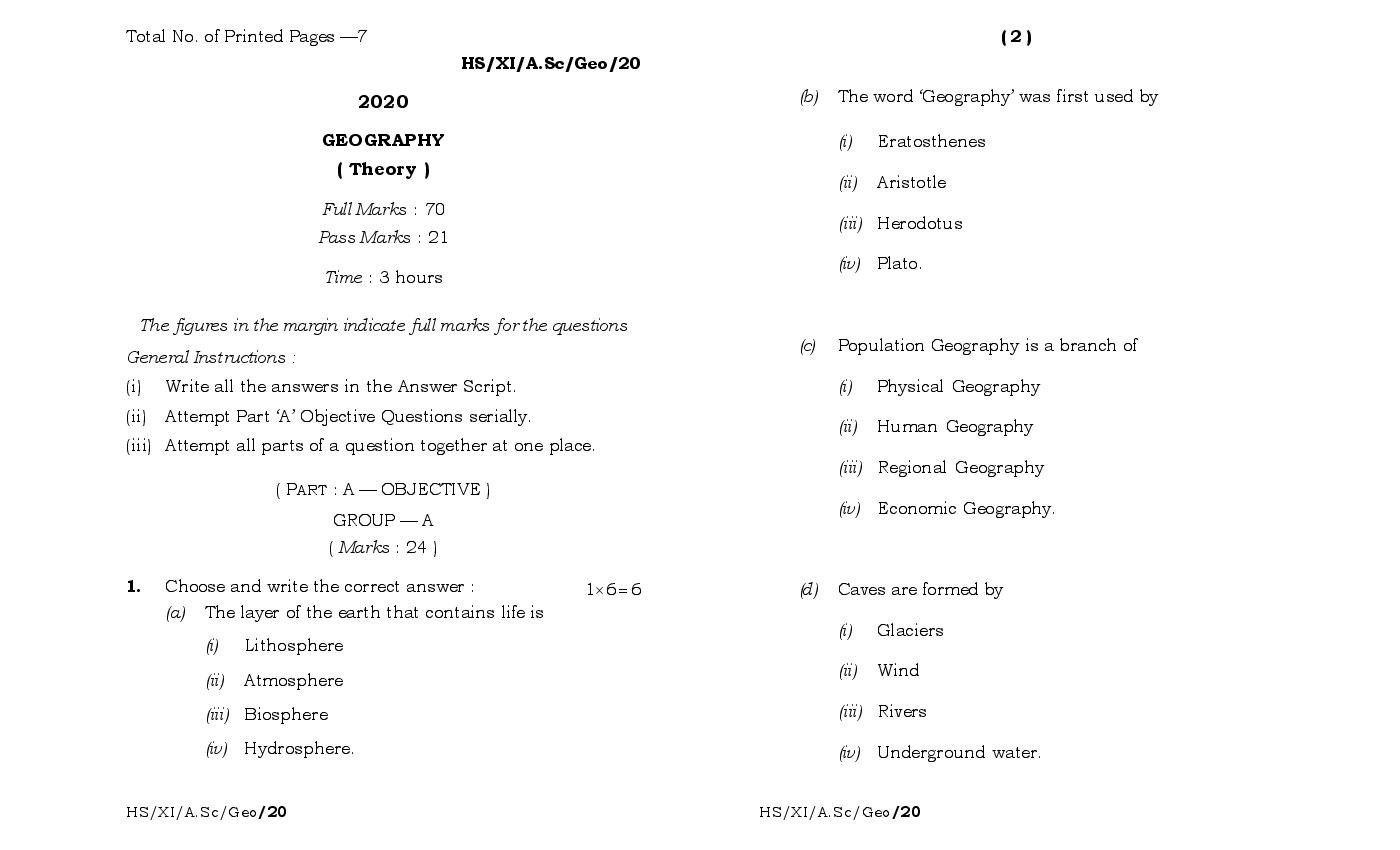
2020 (b) The word ‘Geography’ was first used by
GEOGRAPHY (i) Eratosthenes
( Theory )
(ii) Aristotle
Full Marks : 70
(iii) Herodotus
Pass Marks : 21
(iv) Plato.
Time : 3 hours
The figures in the margin indicate full marks for the questions
(c) Population Geography is a branch of
General Instructions :
(i) Write all the answers in the Answer Script. (i) Physical Geography
(ii) Attempt Part ‘A’ Objective Questions serially.
(ii) Human Geography
(iii) Attempt all parts of a question together at one place.
(iii) Regional Geography
( PART : A –– OBJECTIVE )
(iv) Economic Geography.
GROUP –– A
1. Choose and write the correct answer : 1 6 6 (d) Caves are formed by
(a) The layer of the earth that contains life is
(i) Glaciers
(i) Lithosphere
(ii) Wind
(ii) Atmosphere
(iii) Biosphere (iii) Rivers
(iv) Hydrosphere. (iv) Underground water.
HS/XI/A.Sc/Geo/20 HS/XI/A.Sc/Geo/20
Page 2
(e) The gas that saves us from harmful ultra-violet (iv) The general direction of flow of river Ganga is
radiation is from east to west.
(i) Oxygen (v) Carbon dioxide is an important green house gas.
(ii) Methane (vi) Maximum rainfall in India is received from the
South West Monsoons.
(iii) Ozone
(iv) Helium
3. Fill in the blank spaces by choosing the correct
answers from the options given within the bracket:
(f) Majuli, the largest riverine island is found in the 1 6 6
river
(i) is the description of the earth’s surface.
(i) Indus (Geology/Geography/Geomorphology)
(ii) Ganga
(ii) The most destructive waves are .
(iii) Brahmaputra (S-waves/P-waves/L-waves)
(iv) Godavari.
(iii) The disintegration of rocks is termed as (Erosion/
Deposition/Weathering).
2. Write whether the following statements are True or
False. 1 6 6 (iv) is separated from India by Palk Strait
(Sri Lanka/Myanmar/Bangladesh).
(i) The Aravallis are examples of young fold
mountains.
(v) Cloud formation process is called
(Precipitation/Insolation/Condensation).
(ii) The hardest mineral found on the surface of the
earth is diamond.
(vi) Koppen identified major climatic types
(iii) Isobars are imaginary lines drawn on maps to which are denoted by letter symbols (Five/Eight/
show areas of equal air pressure. Ten).
HS/XI/A.Sc/Geo/20 HS/XI/A.Sc/Geo/20
Page 3
4. Match the following and write the corresponding (iv) Name two tributaries of river Ganga.
number of Column–B against the options of Column–A.
1 6 6 (v) What is an ecosystem?
(vi) What are natural hazards?
Column –– A Column –– B
1. Ten Degree (vii) What is insolation.
(i) Coromandel Coast
Channel (viii) What is a light year.
2. Eight Degree (ii) Bay of Bengal
Channel
3. As (iii) Andaman and Nicobar 6. Distinguish between : 2 7 14
Islands
(i) Human and Physical Geography.
4. Aw (iv) Arabian Sea
(ii) Endogenic and Exogenic forces.
5. Narmada (v) Lakshadweep and
Minicoy Islands (iii) Erosion and Deposition.
6. Mahanadi (vi) Tropical Savannah. (iv) Troposphere and Tropopause.
(v) Himalayan and Peninsular rivers.
GROUP – B (vi) Continental Shelf and Continental Slope.
( Marks : 22 ) (vii) Khadar and Bhangar.
5. Answer the following questions in one or two sentences
only: 1 8 8 ( PART : B –– DESCRIPTIVE )
(i) Name the three types of rocks.
(ii) What are tropical cyclones? 1. What does the theory of Plate Tectonics explain?
(iii) Define precipitation. Describe the three types of plate boundaries with
suitable diagrams. 242 8
HS/XI/A.Sc/Geo/20 HS/XI/A.Sc/Geo/20
Page 4
Or
What are winds? Describe the different types of
planetary winds (i.e., general circulation of
atmosphere). 26 8
2. Describe the factors that affect the distribution of
temperature of the ocean water. 8
Or
Divide India into physiographic divisions. Explain the
Himalayan region in detail. 26 8
3. Give an account on the temperature and rainfall
conditions of India in its four different seasons. 8
Or
What is bio-diversity? Give an account of the ecological
and economic role of biodiversity. 2 33 8
Document Details
| Board / Org | Meghalaya Board |
| Exam | Class 11 |
| Type | Question Paper |
| Pages | 4 |
| Updated | 30 Apr 2026 |