PSEB 12th Sample Paper 2027 Sociology
Finished viewing? Save it for later —
Download PSEB 12th Sample Paper 2027 Sociology (PDF · 5 pages)About PSEB 12th Sample Paper 2027 Sociology
PSEB 12th Sample Paper 2027 Sociology is available here for free download. Published by Punjab Board for Class 12, this sample paper can be viewed online or downloaded as a PDF (5 pages). Candidates preparing for Class 12 can use PSEB 12th Sample Paper 2027 Sociology to understand the exam pattern, the type of questions asked, and the overall difficulty level.
Frequently Asked Questions
How can I download PSEB 12th Sample Paper 2027 Sociology?
Open this page and click the Download button to save PSEB 12th Sample Paper 2027 Sociology as a PDF. It is completely free on AglaSem Docs.
Is PSEB 12th Sample Paper 2027 Sociology free to download?
Yes. PSEB 12th Sample Paper 2027 Sociology can be viewed online and downloaded as a PDF free of cost on AglaSem Docs.
How many pages does PSEB 12th Sample Paper 2027 Sociology have?
PSEB 12th Sample Paper 2027 Sociology contains 5 pages, which you can read online or download together as a single PDF.
Where can I find more Class 12 study material?
You can find more Class 12 question papers, sample papers, syllabus, and answer keys on AglaSem Docs.
PSEB 12th Sample Paper 2027 Sociology – Text
Read the full text of this sample paper below — useful to quickly search, copy and reference the content online without downloading the PDF.
📄 View text version (6 pages)
Page 1
PSEB 12th Sample
Paper 2027 Sociology
EXAM YEAR TYPE SUBJECT
Punjab Class 12 2027 Sample Paper Sociology
Notes · Sample Papers · Previous Year Papers · Mock Tests
Page 2
. e
em las
as ag
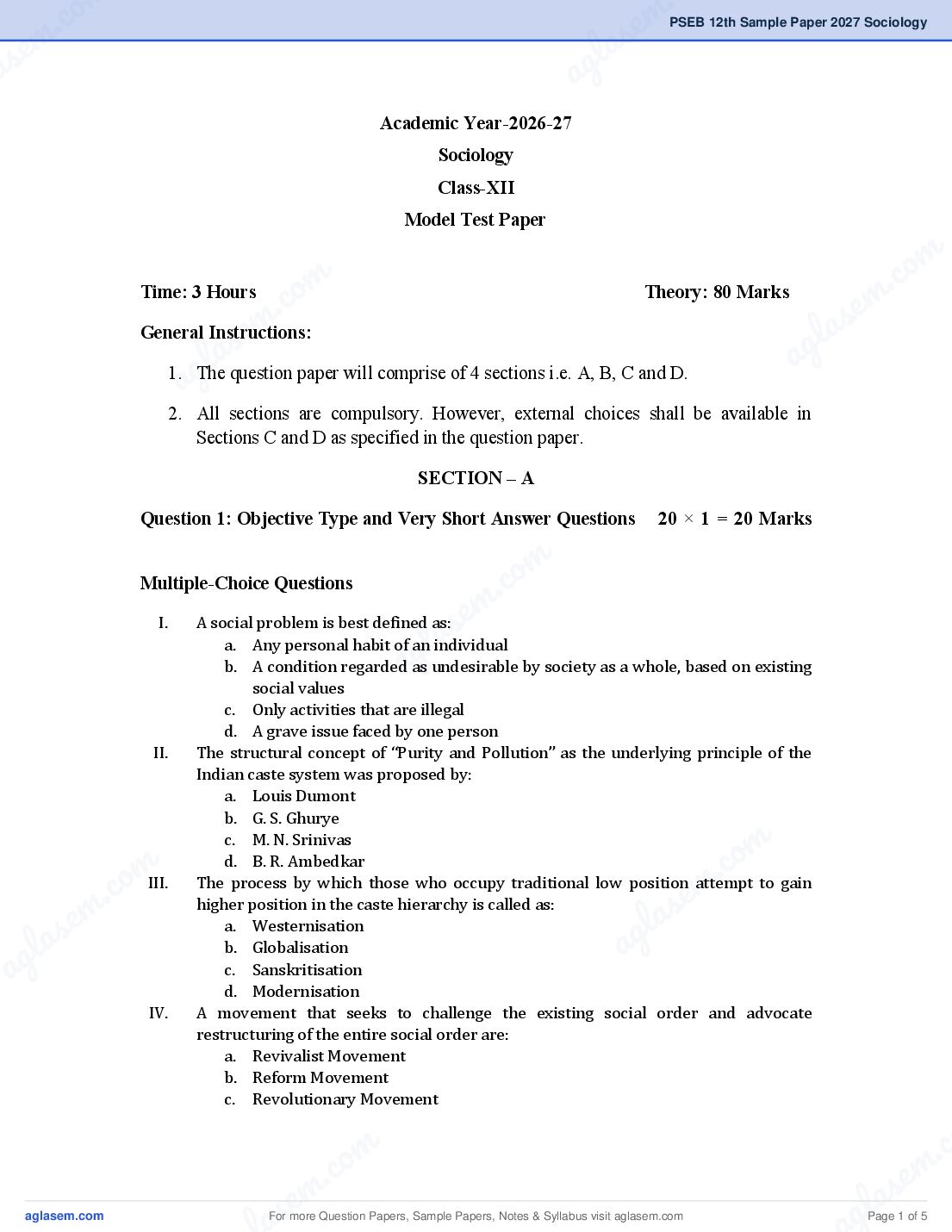
Academic Year-2026-27
Sociology
Class-XII
Model Test Paper
m
om . co
.c e m
s
Time: 3 Hours Theory: 80 Marks
em l a
a s
General Instructions:
l question paper will comprise of 4 sections i.e. A, B, C and D. a g
1. g
a The
2. All sections are compulsory. However, external choices shall be available in
Sections C and D as specified in the question paper.
SECTION – A
Question 1: Objective Type and Very Short Answer Questions 20 × 1 = 20 Marks
m
c. o
m
Multiple-Choice Questions
A social problem is best defined as:se
I.
g a
a. Any personal habit of anlindividual
b. A condition regardedaas undesirable by society as a whole, based on existing
social values
c. Only activities that are illegal
d. A grave issue faced by one person
II. The structural concept of “Purity and Pollution” as the underlying principle of the
Indian caste system was proposed by:
a. Louis Dumont
b. G. S. Ghurye
m
c. o
c. M. N. Srinivas
m
c. o III. m
d. B. R. Ambedkar
s e
The process by which those who occupy traditional low position attempt to gain
s em la
higher position in the caste hierarchy is called as:
la ag
a. Westernisation
ag b. Globalisation
c. Sanskritisation
d. Modernisation
IV. A movement that seeks to challenge the existing social order and advocate
restructuring of the entire social order are:
a. Revivalist Movement
b. Reform Movement
c. Revolutionary Movement
se
g lPage 1 of 5
Page 3
V. An ultrasound clinic secretly reveals the sex of a fetus to parents. This act is an
offence under which legislation?
a. Right to Education Act
b. PCPNDT Act
c. Factory Amendment Act
d. Consumer Protection Act
VI. A young IT worker in Mohali works night shifts serving clients in Canada using
global software platforms. This scenario demonstrates the impact of:
a. Feudalism
b. Economic globalisation and growth of the service sector
c. Subsistence agrarian economy
d. De-urbanisation
VII. Which statement best distinguishes Westernisation from Sanskritisation?
a. Westernisation involves the adoption of Western cultural practices, while
Sanskritisation involves the adoption of practices associated with higher
castes.
b. Westernisation is limited to changes in dress and food, while
Sanskritisation refers only to changes in occupation.
c. Westernisation promotes caste-based practices, while Sanskritisation
promotes Western values.
d. Both Westernisation and Sanskritisation refer to the same process of social
change.
VIII. A teenager starts drinking, mainly because friends pressurise him to be part of the
group. This is best explained by:
a. Genetic factor
b. Peer group influence
c. Occupational factor
d. Ignorance
IX. The mate selection within the group is called:
a. Exogamy
b. Endogamy
c. Monogamy
d. Group marriage
X. Which caste is not considered as twice-born?
a. Brahmin
b. Kshatriya
c. Vaishya
d. Shudra
Fill in the Blanks
XI. Occupational theory is associated with the idea of _____________ thinker.
True or False
For more Question Papers, Sample Papers, Notes & Syllabus visit Page 2 of 5
Page 4
. e
em las
as ag
XII. Inclusive education is an effort to provide equal learning opportunities for all
students including those with disabilities. (True / False)
Match the Following
Column A Column B
m
m . co
XIII. Withdrawal from society a) Economic insecurity
XIV.
c. o
Alcoholism b) Social problem
se m
s em to sustain themselves g l a
la
XV. Unable c) Disengagement theory
g a
a
Very Short Answer Questions.
XVI. What is the full form of SEWA?
XVII. Is violence against women a consequence of patriarchy?
XVIII. Which type of society is characterised by anonymity, division of labour and
specialisation, and individualism?
XIX. The word Tribe is derived from which word?
m
co
XX. Name one process by which cultural change occurs.
.
em
SECTION – B
l a s
g
Question 2: Source-based and Case Study-based Questions 2 × 6 = 12 Marks
(I) Case-Study Based Question a
A tribal village has been located near a forest for generations. Most families depend on
the forest for collecting minor forest produce, agriculture and other livelihood activities.
A large development project is proposed in the area. As a result, the villagers are asked to
move to another location. Although some compensation is provided, the new settlement
is far from the forest and the villagers find it difficult to continue their traditional
m
c. o
occupations.
m
c. o Answer the following questions: s e m
s em g l a
la a
a) Which sociological process is illustrated in this case? (1)
ag
b) Mention one traditional source of livelihood of the villagers. (1)
c) A displaced tribal family struggled to find stable employment in its new location.
Which problem mentioned in the case-study does this situation represent? (1)
d) What broader change in community life can be inferred from the given scenario? (1)
e) How can displacement affect the economic life of the tribal community? (1)
f) Which factor mentioned in the case has caused their displacement? (1)
II) Source-Based Question
se
g lPage 3 of 5
Page 5
younger children, while boys may be encouraged to spend more time on studies and
outdoor activities. Such expectations are learned through family, school, and society.
Over time, these expectations may shape the roles and responsibilities assigned to boys
and girls and may affect the choices they make in education, activities, and future work.
Answer the following questions:
a) What household responsibilities are often assigned to girls? (1)
b) Which activities may boys be encouraged to spend more time on? (1)
c) From which sources do children learn gender-based expectations? (1)
d) What may these expectations shape in the lives of boys and girls? (1)
e) Which areas of life may be affected by gender-based expectations? (1)
f) According to the source, are gender-based expectations learned or natural? (1)
SECTION – C
Question 3: Short Answer Type Questions 6 × 4 = 24 Marks
Instructions: This section comprises 9 sub-questions, out of which 6 sub-questions are to
be attempted. Each question carries 4 marks. Answers should be approximately 50–60
words in length.
I. Identify and explain the factors that have led to the dynamics of caste.
II. Comment on the statement, “A woman is not born, she is made.”
III. Explain how different carriers of Westernisation have influenced changes in Indian
society.
IV. Explain the concept of globalisation and illustrate it with a suitable example.
V. State any five differences in the position of women in pre- and post-Independence
India.
VI. Explain any two major environmental movements in India.
VII. List and explain the major factors that contribute to social problems in India.
VIII. Describe the main features of rural society.
IX. Suggest measures to make your school more disabled-friendly.
SECTION – D
Question No. 4: Long Answer Type Questions 4 × 6 = 24 Marks
Instructions: This section comprises 6 sub-questions, out of which 4 are to be attempted.
Each question carries 6 marks. Answers should be approximately 125–150 words in
length.
I. How do tribal, rural, and urban societies differ in terms of their social organisation,
occupations, and way of life? Explain.
II. Mention any relevant examples that indicate the continued prevalence of the caste
system in Indian society.
For more Question Papers, Sample Papers, Notes & Syllabus visit Page 4 of 5
Page 6
. e
em las
as ag
III. Social class is determined by more than an individual's income or occupation.
Analyse this statement by discussing the major characteristics of social class.
IV. What is meant by the Sanskritisation? Describe its major impact on Indian society.
V. Suggest suitable measures that schools and teachers can adopt to prevent
alcoholism among students and young people.
VI. “Disability need not be an obstacle to success.” Discuss the statement with suitable
m
co
examples.
.c om e m .
e m l a s
l a s a g
ag
m
. co
s em
g l a
a
m
m c. o
c. o s e m
s em la
gla ag
a
se
g lPage 5 of 5
Document Details
| Board / Org | Punjab Board |
| Exam | Class 12 |
| Type | Sample Paper |
| Pages | 5 |
| Updated | 03 Nov 2026 |