CUSAT CAT 2023 Question Paper Geology
Finished viewing? Save it for later —
Download CUSAT CAT 2023 Question Paper Geology (PDF · 27 pages)About CUSAT CAT 2023 Question Paper Geology
CUSAT CAT 2023 Question Paper Geology is available here for free download. Published by Cochin University for CUSAT Common Admission Test, this question paper can be viewed online or downloaded as a PDF (27 pages). Candidates preparing for CUSAT Common Admission Test can use CUSAT CAT 2023 Question Paper Geology to understand the exam pattern, the type of questions asked, and the overall difficulty level.
Frequently Asked Questions
How can I download CUSAT CAT 2023 Question Paper Geology?
Open this page and click the Download button to save CUSAT CAT 2023 Question Paper Geology as a PDF. It is completely free on AglaSem Docs.
Is CUSAT CAT 2023 Question Paper Geology free to download?
Yes. CUSAT CAT 2023 Question Paper Geology can be viewed online and downloaded as a PDF free of cost on AglaSem Docs.
How many pages does CUSAT CAT 2023 Question Paper Geology have?
CUSAT CAT 2023 Question Paper Geology contains 27 pages, which you can read online or download together as a single PDF.
Where can I find more CUSAT Common Admission Test study material?
You can find more CUSAT Common Admission Test question papers, sample papers, syllabus, and answer keys on AglaSem Docs.
CUSAT CAT 2023 Question Paper Geology – Text
Read the full text of this question paper below — useful to quickly search, copy and reference the content online without downloading the PDF.
📄 View text version (27 pages)
Page 1
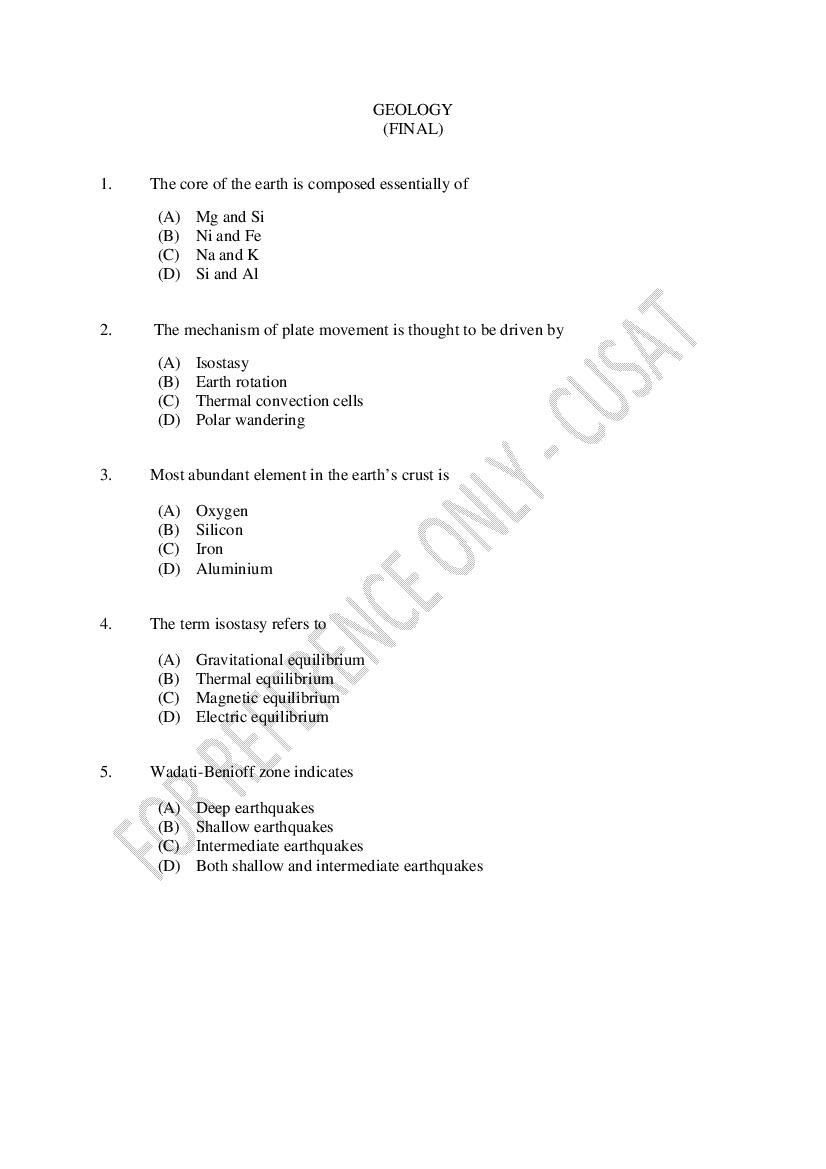
(FINAL)
1. The core of the earth is composed essentially of
(A) Mg and Si
(B) Ni and Fe
(C) Na and K
(D) Si and Al
2. The mechanism of plate movement is thought to be driven by
(A) Isostasy
(B) Earth rotation
(C) Thermal convection cells
(D) Polar wandering
3. Most abundant element in the earth’s crust is
(A) Oxygen
(B) Silicon
(C) Iron
(D) Aluminium
4. The term isostasy refers to
(A) Gravitational equilibrium
(B) Thermal equilibrium
(C) Magnetic equilibrium
(D) Electric equilibrium
5. Wadati-Benioff zone indicates
(A) Deep earthquakes
(B) Shallow earthquakes
(C) Intermediate earthquakes
(D) Both shallow and intermediate earthquakes
Page 2
(A) Crust
(B) Mantle
(C) Core
(D) Lithosphere
7. Which method is used to date relatively recent geological events?
(A) K-Ar method
(B) U-Pb method
(C) Carbon-14 method
(D) The-Pb method
8. The terrestrial planet is
(A) high dense rocky body
(B) low dense gaseous body
(C) water body
(D) None of the above
9. Sial and sima are separated by
(A) Conrad discontinuity
(B) Mohorovic discontinuity
(C) Lehman discontinuity
(D) Gutenberg discontinuity
10. Which are the two major constituents of atmosphere?
(A) Oxygen and Carbon
(B) Nitrogen and Carbon
(C) Oxygen and Nitrogen
(D) Argon and Oxygen
11. Aeolin topography is created by
(A) rivers
(B) glaciers
(C) wind
(D) oceans
Page 3
(A) deflation
(B) abrasion
(C) corrosion
(D) attrition
13. Varve deposits are formed by
(A) glacial
(B) river
(C) wind
(D) None of the above
14. Ring of fire is observed around
(A) Indian ocean
(B) Pacific ocean
(C) Atlantic ocean
(D) Red sea
15. Which of the following rivers does NOT form delta?
(A) Krishna
(B) Narmada
(C) Godavari
(D) Mississippi
16. Stalagmites are formed in
(A) Shales
(B) Limestones
(C) Sand stones
(D) Granites
17. Lonar lake is formed by
(A) Volcanic crator
(B) Meteoritic impact
(C) Karst lake
(D) By glacial action
Page 4
(A) 41 km
(B) 31 km
(C) 21 km
(D) 11 km
19. Which drainage pattern signifies an area lacking structural control?
(A) Trellis
(B) Dendritic
(C) Rectangular
(D) Radial
20. Uvala is
(A) convergence of sink holes
(B) horizontal passages
(C) vertical passages
(D) deposit at cave floor
21. Dhands are small lakes of
(A) River origin
(B) Glacial origin
(C) Aeolin origin
(D) None of the above
22. The term ‘firm’ indicates
(A) Compact ice
(B) Massive ice mass
(C) Granular ice mass
(D) Melted ice
23. Choose the example of tectonic lake
(A) Caspian sea
(B) Dead sea
(C) Baikal lake
(D) All of the above
Page 5
(A) connecting morines
(B) connecting hills
(C) connecting spits
(D) connecting mountains
25. Travertine or tufa is calcareous deposits formed by
(A) Hot springs
(B) Geysers
(C) Fumaroles
(D) None of the above
26. ‘Butterfly twinning’ is present in
(A) Rutile
(B) Gypsum
(C) Pyrite
(D) Diamond
27. Leucoxene is an alteration product of
(A) Tourmaline
(B) Talc
(C) Sphene
(D) Gypsum
28. In Mohs scale of hardness, how many minerals are silicates?
(A) 4
(B) 5
(C) 6
(D) 3
29. Tsunamis are
(A) gravity waves
(B) gravitational waves
(C) magnetic waves
(D) seismic waves
Page 6
(A) 6
(B) 7
(C) 8
(D) 9
31. ‘Schillerization’ is shown by
(A) Plagioclase
(B) Diamond
(C) Hypersthene
(D) Quartz
32. In double-chain structure the ratio of silicon to oxygen is
(A) 1:2
(B) 4:11
(C) 2:7
(D) 4:10
33. Chemical formula of ‘Sylvite’
(A) NaCl
(B) HCl
(C) KCl
(D) HNO3
34. Molybdenite is a/an …………. of molybdenum
(A) Oxide
(B) Sulphide
(C) Carbonate
(D) Chloride
35. Chlorite belongs to
(A) Soro silicates
(B) Phyllo silicates
(C) Ino silicates
(D) Neso silicates
Page 7
(A) Corundum
(B) Beryl
(C) Calcite
(D) Quartz
37. Peridot is gem variety of
(A) Galena
(B) Olivine
(C) Quartz
(D) Diamond
38. Fayalite crystallizes in which crystal system?
(A) Monoclinic
(B) Triclinic
(C) Orthorhombic
(D) Cubic
39. Mn-Al garnet is
(A) Pyrope
(B) Almandine
(C) Spessartite
(D) Uvarovite
40. Which is the gem variety of spodumene?
(A) Diallage
(B) Omphacite
(C) Kunzite
(D) Hiddenite
41. Garnet is
(A) Isotropic
(B) Anisotropic
(C) Both isotropic and anisotropic
(D) None of the above
Page 8
(A) 1.34
(B) 1.44
(C) 1.54
(D) 1.64
43. Optical sign can be determined by
(A) Quartz plate
(B) Mica plate
(C) Gypsum plate
(D) All of the above
44. Rutile is a source of
(A) Titanium dioxide
(B) Tungsten
(C) Manganese
(D) Iron
45. ‘Mineral wool’ is a substitute for
(A) Talc
(B) Gypsum
(C) Asbestos
(D) Galena
46. Iron-cross twin is observed in
(A) Pyrite
(B) Gypsum
(C) Feldspar
(D) Staurolite
47. How many cleavage sets are present in Quartz?
(A) 2 sets
(B) 1 set
(C) 3 sets
(D) No cleavage
Page 9
(A) 4
(B) 5
(C) 6
(D) 8
49. Emerald is a variety of
(A) Olivine
(B) Beryl
(C) Quartz
(D) Topaz
50. Which of the following minerals cannot be used as an abrasive?
(A) Garnet
(B) Corundum
(C) Quartz
(D) Gypsum
51. Bowen’s reaction series indicate the ………….. process of magma
(A) fractional crystallization
(B) gravity separation
(C) liquid immiscibility
(D) filter pressing
52. Which rock contains relatively high percentage of silica?
(A) Basalt
(B) Andesite
(C) Trachyte
(D) Rhyolite
53. Which one is not a discordant igneous body?
(A) Dyke
(B) Batholith
(C) Sill
(D) Pluton
Page 10
(A) Basalt
(B) Dolerite
(C) Granite
(D) Andesite
55. Dolerite shows …………….. texture
(A) Seriate
(B) Allotriomorphic
(C) Pandidiomorphic
(D) Ophitic
56. Dacite is volcanic equivalent of
(A) Granite
(B) Diorite
(C) Syenite
(D) Granodiorite
57. Rocks having particles of gravel size are
(A) Arenaceous
(B) Rudaceous
(C) Argillaceous
(D) Calcareous
58. Mantle xenoliths are observed in
(A) Kimberlite
(B) Granulite
(C) Granite
(D) Pegmatite
59. Choose correct pair of plutonic rock and its volcanic equivalent
(A) Gabbro-Trachyte
(B) Granite-Rhyolite
(C) Syenite-Andesite
(D) Grandiorite-Basalt
Page 11
(A) Limestone
(B) Shales
(C) Conglomerate
(D) Sandstones
61. Chemical composition of chalcopyrite is
(A) CuS
(B) Cu2S
(C) CuFeS2
(D) CuCO3
62. Rain prints are observed in
(A) Igneous rocks
(B) Sedimentary rocks
(C) Metamorphic rocks
(D) All of the above
63. Sandstone consisting of 60% quartz and 30% feldspars are called
(A) Grit
(B) Conglomerate
(C) Greywacke
(D) Arkose
64. Chemical composition of Witherite is
(A) CaCO3
(B) BaCO3
(C) MgCO3
(D) PbCO3
65. Satinspar is a variety of
(A) Gypsum
(B) Calcite
(C) Talc
(D) Orthoclase
Page 12
(A) reducing environment
(B) oxidising environment
(C) neutral environment
(D) None of the above
67. Shingle is characteristic of …………….. environment
(A) Terrestrial
(B) Abyssal
(C) Neurotic
(D) Littoral
68. What is the most abundant chemically or biochemically precipitated rock?
(A) Limestone
(B) Rock salt
(C) Gypsum
(D) Chert
69. Eclogites are composed of
(A) Hypersthene and almandine
(B) Omphacite and pyrope
(C) Hypersthene and pyrope
(D) Omphacite and almandine
70. Retrograde metamorphism is also known as
(A) Diaphthoresis
(B) Addictive metamorphism
(C) Injective metamorphism
(D) None of the above
71. What is the main difference between limestone and dolomite?
(A) Alumina content
(B) Lime content
(C) Magnesia content
(D) Soda content
Page 13
(A) Malonate
(B) Marble
(C) Signature
(D) Mark
73. A rock composed of ore mineral and silicates formed by contact metamorphism of
Carbonate rocks is called
(A) Gondite
(B) Skarn
(C) Tactics
(D) Charnockite
74. Psammitic rocks are
(A) Gravel rocks
(B) Aranaceous rocks
(C) Argillaceous rocks
(D) Rudaceous rocks
75. “Aureole” is observed in
(A) Dynamic metamorphism
(B) Plutonic metamorphism
(C) Regional metamorphism
(D) Contact metamorphism
76. The deformation caused by stress is called
(A) Tension
(B) Strain
(C) Compression
(D) Torsion
77. Authigenesis is found in
(A) Igneous rocks
(B) Sedimentary rocks
(C) Metamorphic rocks
(D) All of the above
Page 14
(A) Box fold
(B) Chevron fold
(C) Fan fold
(D) Drag fold
79. Columnar jointing generally develops in …………… rocks
(A) Granitic
(B) Syndetic
(C) Dioritic
(D) Basaltic
80. Transform fault is a
(A) strike-slip fault
(B) reverse fault
(C) normal fault
(D) thrust fault
81. In a recumbent fold, the axial plane is nearly
(A) vertical
(B) horizontal
(C) inclined > 40°
(D) inclined < 40°
82. Stress is proportional to strain, this is the statement for
(A) Young’s modulus
(B) Bulk modulus
(C) Body’s law
(D) Hooke’s law
83. Which of the following indicate faulting?
(A) Slicken slides
(B) Breccia
(C) Grooves
(D) All of the above
Page 15
(A) Foliation
(B) Lineation
(C) Cleavage
(D) Bedding
85. In which type of unconformity the older rocks are of plutonic origin?
(A) Angular unconformity
(B) Disconformity
(C) Non conformity
(D) Local unconformity
86. Plumose marking is associated with
(A) Faults
(B) Joints
(C) Folds
(D) Unconformities
87. The time involved in formation of local unconformity is
(A) Long
(B) Moderate
(C) Short
(D) Not depends on time
88. The age of Bagh beds is
(A) Cretaceous
(B) Triassic
(C) Jurassic
(D) Permian
89. Nallamalai Group is famous for
(A) Iron
(B) Manganese
(C) Mica
(D) Copper and Lead
Page 16
(A) NNW-SSE
(B) NW-SE
(C) E-W
(D) NNE-SSW
91. The age of Muth Quartzite is
(A) Cambrian
(B) Silurian
(C) Ordovician
(D) Devonian
92. Talchir beds are of …………… origin
(A) Glacial
(B) Arid
(C) Marine
(D) Fluvial
93. The strike of Eastern Ghats is
(A) E-W
(B) NE-SW
(C) NW-SE
(D) N-S
94. Glossopteris flora was dominant in
(A) Permo-carboniferous period
(B) Devonian period
(C) Jurassic period
(D) Triassic period
95. The composition of Deccan traps is
(A) Granitic
(B) Andesite
(C) Dioritic
(D) Basaltic
Page 17
(A) Black carton soil
(B) Laterite soil
(C) Red soil
(D) Alluvial soil
97. One of the youngest tectonic mountains in Indian subcontinent is
(A) Aravallis
(B) Western ghats
(C) Himalayas
(D) Eastern ghats
98. Devonian is the age of
(A) Reptiles
(B) Graptolites
(C) Mammals
(D) Fish
99. Pakhal group is equivalent to
(A) Vindyans
(B) Dharwas
(C) Cuddapahs
(D) Cambrian
100. The Karewars are found in
(A) Gujarat
(B) Kashmir
(C) Assam
(D) Kerala
101. Sinistral coiling is found in
(A) Pupilla
(B) Physa
(C) Natica
(D) Cypraea
Page 18
(A) Peduncle
(B) Umbo
(C) Cardinal
(D) Lunule
103. The gastropod shells are made up of
(A) one valve
(B) two equal valves
(C) two unequal valves
(D) All of the above
104. The remains of organisms are better preserved in
(A) on land
(B) in the marine sediments
(C) in the tectonic areas
(D) in river environments
105. The age of “spirifer” of phylum brachiopod is
(A) Ordovician
(B) Silurian to Permian
(C) Cambrian to Ordovician
(D) Permian only
106. Which of the following groups of fossils became extinct at the permo-triassic
boundary?
(A) Graptolites
(B) Ammonites
(C) Trilobites
(D) Dinosaurs
107. Which of the following is found below “CCD”?
(A) Foraminifera
(B) Radiolarian
(C) Ostracods
(D) Coccolithopore
Page 19
(A) Jurassic
(B) Cretaceous
(C) Permian
(D) Triassic
109. The corona is the part of ……………shell
(A) Ammonoid
(B) Echinoids
(C) Trilobite
(D) Bivalve
110. Ichnofossil is a
(A) Trace fossil
(B) Living fossil
(C) Index fossil
(D) None of the above
111. What kind of imprints are mold and cast fossils?
(A) both are negative
(B) negative and positive
(C) both are positive
(D) None of the above
112. Which of the following is an upper Gondwana fossil?
(A) Ptilophyllum
(B) Glossopteris
(C) Gangamopteries
(D) Sigillaria
113. Hydrothermal deposits are mostly
(A) Syngeneic
(B) Residual
(C) Epigenetic
(D) Placer
Page 20
(A) Siderite
(B) Hematite
(C) Limonite
(D) All of the above
115. “Gossan” is a
(A) Ferruginous residue
(B) Siliceous residue
(C) Calcareous residue
(D) Organic residue
116. The path finder element of gold is
(A) As
(B) Mo
(C) Se
(D) SO4
117. Chalcopyrite is the ore mineral of
(A) Al
(B) Fe
(C) Cu
(D) At
118. Which rock is important source of diamond?
(A) Gabbro
(B) Eclogite
(C) Basalt
(D) Kimberlite
119. Which of the following is highest rank of coal?
(A) Peat
(B) Bituminous
(C) Lignite
(D) Anthracite
Page 21
(A) Gangue
(B) Carat
(C) Tenor
(D) Pitch
121. Brown coal is another term for
(A) Peat
(B) Bituminous
(C) Lignite
(D) Anthracite
122. The major source of power generation in India is
(A) Petroleum
(B) Atomic
(C) Coal
(D) Wind
123. Which of the following is “heavy spar”?
(A) Baryte
(B) Apatite
(C) Calcite
(D) Orthoclase
124. Hydrothermal deposits formed under temperature 50° C – 200° C are known as
(A) Mesothermal
(B) Epithermal
(C) Hypothermal
(D) Telethermal
125. Chromite deposits occur in
(A) Basic rocks
(B) Acidic rocks
(C) Ultrabasic rocks
(D) Potash rocks
Page 22
(A) Hydrogen
(B) Nitrogen
(C) Hydrogen and Carbon
(D) Carbon
127. Which type of ore deposit is Diamond?
(A) Early magmatic disseminated
(B) Early magmatic segregation
(C) Late magmatic disseminated
(D) Late magmatic segregation
128. “Digboi” oil field is located in
(A) Assam
(B) Bombay
(C) Gujarat
(D) K-G basin
129. Which one of the following is NOT a source rock of petroleum?
(A) Shale
(B) Limestone
(C) Silt
(D) Sandstone
130. Talchir coal fields are located in
(A) Bihar
(B) Andhra Pradesh
(C) Odisha
(D) Maharashtra
131. “Manganite” is an ore mineral of
(A) Mg
(B) Fe
(C) Mn
(D) Cu
Page 23
lodestone?
(A) Punalur
(B) Chalingal
(C) Angadipuram
(D) Akkulam
133. Koderma mica-belt is situated in
(A) Bihar
(B) Odisha
(C) Andhra Pradesh
(D) Rajasthan
134. “Siderites” are
(A) Iron meteorites
(B) Stony meteorites
(C) Stony-Iron meteorites
(D) Copper meteorites
135. Magma is characterized by
(A) composition
(B) mobility
(C) temperature
(D) All of the above
136. Which is the most stable mineral in the weathering environment?
(A) Quartz
(B) Hornblende
(C) Feldspar
(D) Olivine
137. Sea water is
(A) slightly alkaline
(B) slightly acidic
(C) neutral
(D) None of the above
Page 24
(A) Permeability
(B) Porosity
(C) Specific yield
(D) Effective porosity
139. Secondary porosity is resulted
(A) during the formation of rocks
(B) after formation of rocks
(C) before formation of rocks
(D) both during and after formation of rocks
140. Clay is an example of
(A) Aquifer
(B) Aquiclude
(C) Aquitard
(D) Aquifuse
141. Isohyet is connecting equal
(A) temperature
(B) depth
(C) thickness
(D) rainfall
142. In which configuration the spacing between electrodes is kept equal?
(A) Wenner
(B) Schlumberger
(C) Both Wenner and Schlumberger
(D) None of the above
143. Space Application Centre (SAC) located in
(A) Hyderabad
(B) Bangalore
(C) Nagpur
(D) Ahmedabad
Page 25
(A) stibnite
(B) cinnabar
(C) orpiment
(D) realgar
145. Generally aerial photographs are taken
(A) horizontally
(B) vertically
(C) at an angle of 45°
(D) at an angle of 75°
146. The subsurface location where earthquake occur is known as
(A) Focus
(B) Mesocentre
(C) Epicentre
(D) Isocentre
147. P and S waves are
(A) body waves
(B) love waves
(C) surface waves
(D) None of the above
148. “ZnS” is composition of
(A) Sphalerite
(B) Anglesite
(C) Cerrusite
(D) Smithsonite
149. Lithospheric plate is composed of
(A) Crust
(B) Crust and upper Mantle
(C) Mantle
(D) All of the above
Page 26
(A) Sphalerite
(B) Pitchblende
(C) Wolframite
(D) Casitterite
Page 27
Subject Name: GEOLOGY
SI No. Key SI No. Key SI No. Key SI No. Key SI No. Key
1 B 31 C 61 C 91 D 121 C
2 C 32 B 62 B 92 A 122 C
3 A 33 C 63 D 93 B 123 A
4 A 34 B 64 B 94 A 124 B
5 A 35 B 65 A 95 D 125 C
6 B 36 A 66 A 96 A 126 C
7 C 37 B 67 D 97 C 127 A
8 A 38 C 68 A 98 D 128 A
9 A 39 C 69 B 99 C 129 D
10 C 40 D 70 A 100 B 130 C
11 C 41 A 71 C 101 B 131 C
12 A 42 C 72 B 102 B 132 B
13 A 43 D 73 B 103 A 133 A
14 B 44 A 74 B 104 B 134 A
15 B 45 C 75 D 105 B 135 D
16 B 46 A 76 B 106 C 136 A
17 B 47 D 77 B 107 B 137 A
18 C 48 C 78 A 108 D 138 B
19 B 49 B 79 D 109 B 139 B
20 A 50 D 80 A 110 A 140 B
21 C 51 A 81 B 111 B 141 D
22 C 52 D 82 D 112 A 142 A
23 D 53 C 83 D 113 C 143 D
24 C 54 C 84 B 114 D 144 B
25 A 55 D 85 C 115 A 145 B
26 B 56 D 86 B 116 A 146 A
27 C 57 B 87 C 117 C 147 A
28 A 58 A 88 A 118 D 148 A
29 A 59 D 89 D 119 D 149 B
30 D 60 D 90 A 120 C 150 B
Document Details
| Board / Org | Cochin University |
| Exam | CUSAT Common Admission Test |
| Type | Question Paper |
| Pages | 27 |
| Updated | 09 Jun 2026 |