ISC Class 11 Specimen Paper for History
Finished viewing? Save it for later —
Download ISC Class 11 Specimen Paper for History (PDF · 3 pages)About ISC Class 11 Specimen Paper for History
ISC Class 11 Specimen Paper for History is available here for free download. Published by CISCE for Class 11, this sample paper can be viewed online or downloaded as a PDF (3 pages). Candidates preparing for Class 11 can use ISC Class 11 Specimen Paper for History to understand the exam pattern, the type of questions asked, and the overall difficulty level.
Frequently Asked Questions
How can I download ISC Class 11 Specimen Paper for History?
Open this page and click the Download button to save ISC Class 11 Specimen Paper for History as a PDF. It is completely free on AglaSem Docs.
Is ISC Class 11 Specimen Paper for History free to download?
Yes. ISC Class 11 Specimen Paper for History can be viewed online and downloaded as a PDF free of cost on AglaSem Docs.
How many pages does ISC Class 11 Specimen Paper for History have?
ISC Class 11 Specimen Paper for History contains 3 pages, which you can read online or download together as a single PDF.
Where can I find more Class 11 study material?
You can find more Class 11 question papers, sample papers, syllabus, and answer keys on AglaSem Docs.
ISC Class 11 Specimen Paper for History – Text
Read the full text of this sample paper below — useful to quickly search, copy and reference the content online without downloading the PDF.
📄 View text version (3 pages)
Page 1
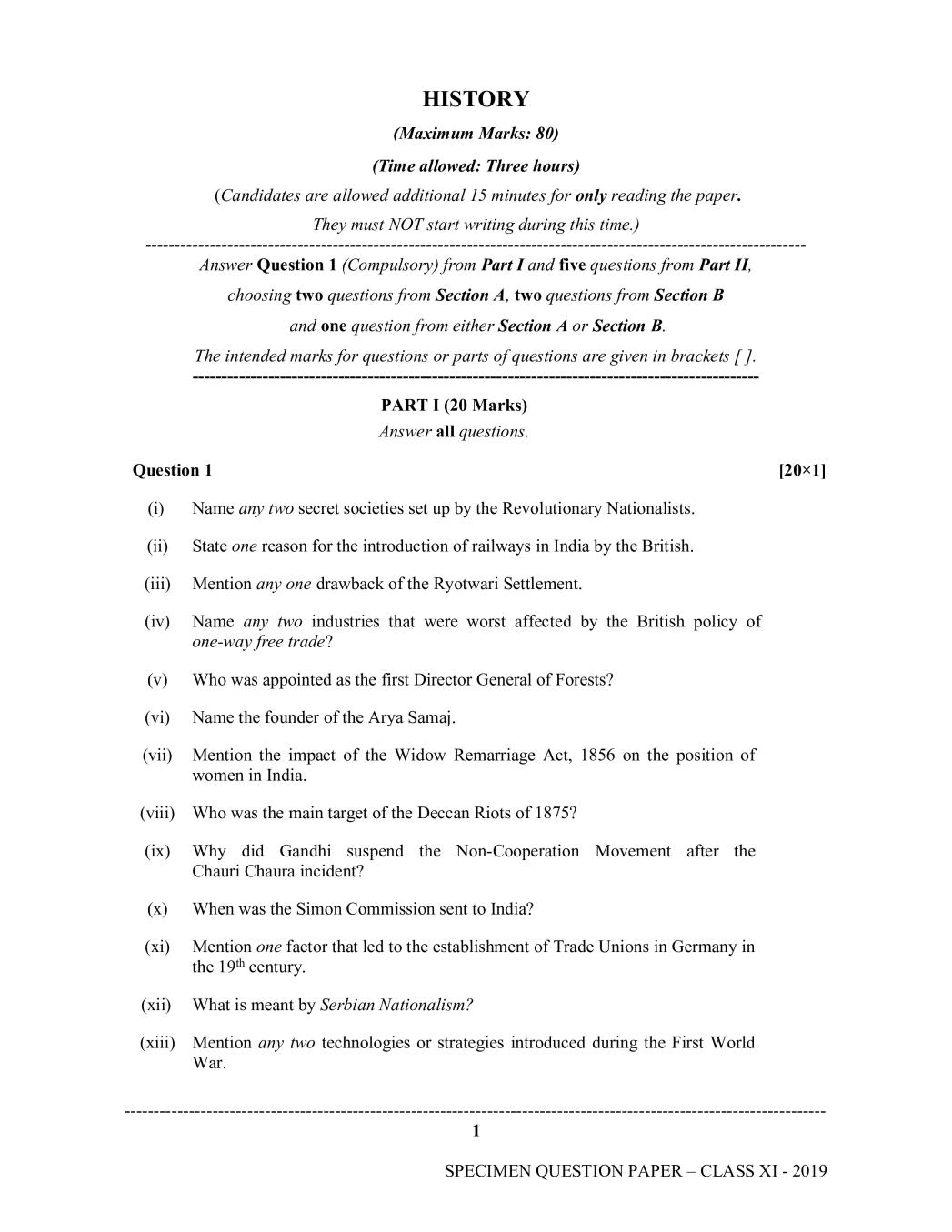
(Maximum Marks: 80)
(Time allowed: Three hours)
(Candidates are allowed additional 15 minutes for only reading the paper.
They must NOT start writing during this time.)
-----------------------------------------------------------------------------------------------------------------
Answer Question 1 (Compulsory) from Part I and five questions from Part II,
choosing two questions from Section A, two questions from Section B
and one question from either Section A or Section B.
The intended marks for questions or parts of questions are given in brackets [ ].
-------------------------------------------------------------------------------------------------
PART I (20 Marks)
Answer all questions.
Question 1 [20×1]
(i) Name any two secret societies set up by the Revolutionary Nationalists.
(ii) State one reason for the introduction of railways in India by the British.
(iii) Mention any one drawback of the Ryotwari Settlement.
(iv) Name any two industries that were worst affected by the British policy of
one-way free trade?
(v) Who was appointed as the first Director General of Forests?
(vi) Name the founder of the Arya Samaj.
(vii) Mention the impact of the Widow Remarriage Act, 1856 on the position of
women in India.
(viii) Who was the main target of the Deccan Riots of 1875?
(ix) Why did Gandhi suspend the Non-Cooperation Movement after the
Chauri Chaura incident?
(x) When was the Simon Commission sent to India?
(xi) Mention one factor that led to the establishment of Trade Unions in Germany in
the 19th century.
(xii) What is meant by Serbian Nationalism?
(xiii) Mention any two technologies or strategies introduced during the First World
War.
1
Page 2
(xv) With reference to the Great Depression, define the term speculation.
(xvi) In the context of the rise of Communism in Russia, state who were the
Mensheviks.
(xvii) Why was Italy disappointed with the Paris Peace Conference?
(xviii) Why was the Enabling Law (1933) passed?
(xix) In the context of Hitler’s domestic policy, what is meant by the term
Final Solution?
(xx) Why did Japan attack Manchuria in 1931?
PART II (60 Marks)
Answer five questions in all, choosing two questions from Section A, two questions from
Section B and one question from either Section A or Section B.
SECTION A
Question 2
(a) Give an account of the Anti-Partition Movement in Bengal from 7th August, [6]
1905 to 16th October, 1905.
(b) How did the Swadeshi and Boycott Movement aggravate the differences between [6]
the Moderates and Assertives ?
Question 3
Critically examine the Colonial Forest Policy adopted by the British. [12]
Question 4
With reference to the Social and Religious Reform Movements in India, discuss the
contribution of the following:
(a) The Brahmo Samaj. [6]
(b) The Aligarh Movement [6]
Question 5
(a) Briefly discuss the causes and events of the Munda Uprising (1899-1900). [6]
(b) Explain the consequences and significance of the uprising. [6]
2
Page 3
With reference to the Civil Disobedience Movement discuss the following:
(a) The Gandhi-Irwin Pact. [6]
(b) The Communal Award and The Poona Pact. [6]
SECTION B
Question 7
Explain how the following factors led to the outbreak of World War I:
(a) Aggressive Nationalism. [6]
(b) Armament Race. [6]
Question 8
Stalin believed that Russia was fifty or hundred years behind the advanced countries and
this distance had to be covered in ten years. In this context, critically review the following
policies adopted by Stalin:
(a) Collectivization of agriculture. [6]
(b) Five Year Plans introduced by Stalin. [6]
Question 9
Trace the rise of Mussolini to power in Italy from 1921 to 1922. [12]
Question 10
With reference to Nazism in Germany, discuss the following:
(a) The weaknesses of the Weimar Republic. [6]
(b) The reasons for Hitler’s popularity. [6]
Question 11
In the context of the rise of militarism in Japan in the 1930s, explain the following:
(a) The World Economic Crisis (1929). [6]
(b) The declaration of a “New Order in East Asia”. [6]
3