CUSAT CAT 2023 Question Paper Life Science
Finished viewing? Save it for later —
Download CUSAT CAT 2023 Question Paper Life Science (PDF · 27 pages)About CUSAT CAT 2023 Question Paper Life Science
CUSAT CAT 2023 Question Paper Life Science is available here for free download. Published by Cochin University for CUSAT Common Admission Test, this question paper can be viewed online or downloaded as a PDF (27 pages). Candidates preparing for CUSAT Common Admission Test can use CUSAT CAT 2023 Question Paper Life Science to understand the exam pattern, the type of questions asked, and the overall difficulty level.
Frequently Asked Questions
How can I download CUSAT CAT 2023 Question Paper Life Science?
Open this page and click the Download button to save CUSAT CAT 2023 Question Paper Life Science as a PDF. It is completely free on AglaSem Docs.
Is CUSAT CAT 2023 Question Paper Life Science free to download?
Yes. CUSAT CAT 2023 Question Paper Life Science can be viewed online and downloaded as a PDF free of cost on AglaSem Docs.
How many pages does CUSAT CAT 2023 Question Paper Life Science have?
CUSAT CAT 2023 Question Paper Life Science contains 27 pages, which you can read online or download together as a single PDF.
Where can I find more CUSAT Common Admission Test study material?
You can find more CUSAT Common Admission Test question papers, sample papers, syllabus, and answer keys on AglaSem Docs.
CUSAT CAT 2023 Question Paper Life Science – Text
Read the full text of this question paper below — useful to quickly search, copy and reference the content online without downloading the PDF.
📄 View text version (27 pages)
Page 1
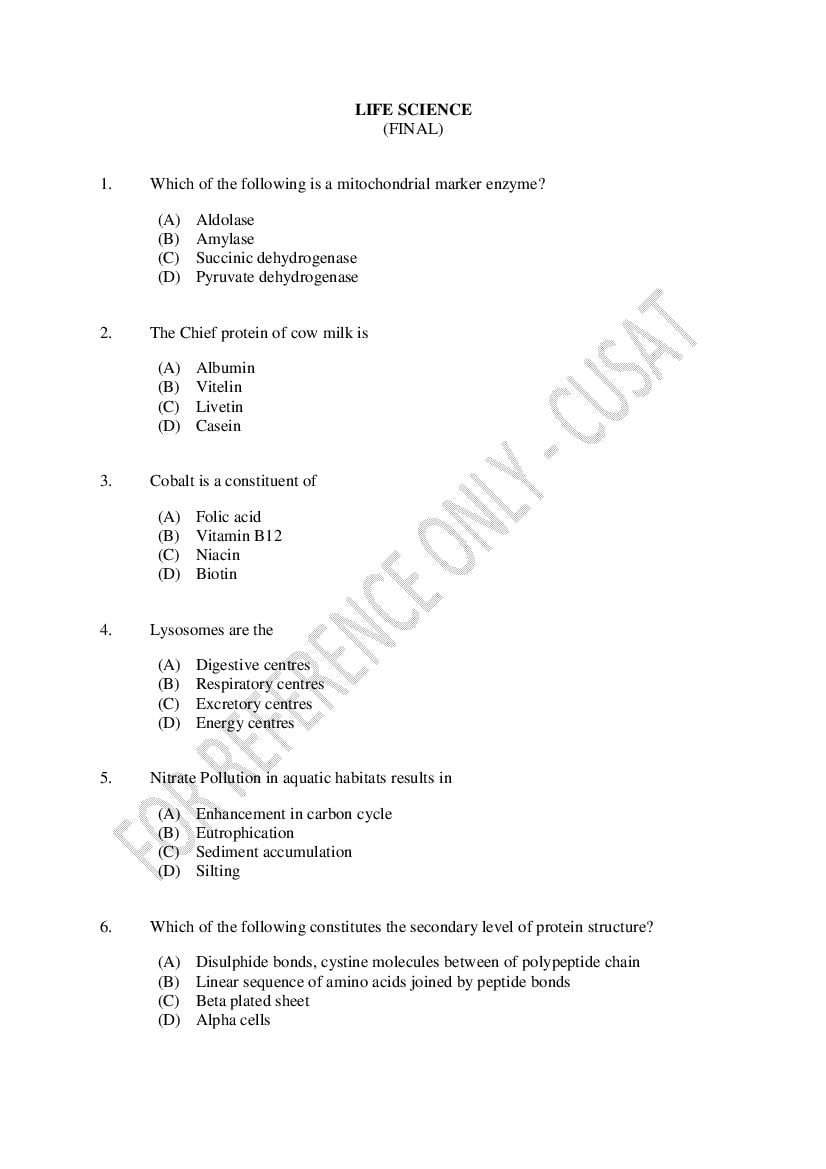
(FINAL)
1. Which of the following is a mitochondrial marker enzyme?
(A) Aldolase
(B) Amylase
(C) Succinic dehydrogenase
(D) Pyruvate dehydrogenase
2. The Chief protein of cow milk is
(A) Albumin
(B) Vitelin
(C) Livetin
(D) Casein
3. Cobalt is a constituent of
(A) Folic acid
(B) Vitamin B12
(C) Niacin
(D) Biotin
4. Lysosomes are the
(A) Digestive centres
(B) Respiratory centres
(C) Excretory centres
(D) Energy centres
5. Nitrate Pollution in aquatic habitats results in
(A) Enhancement in carbon cycle
(B) Eutrophication
(C) Sediment accumulation
(D) Silting
6. Which of the following constitutes the secondary level of protein structure?
(A) Disulphide bonds, cystine molecules between of polypeptide chain
(B) Linear sequence of amino acids joined by peptide bonds
(C) Beta plated sheet
(D) Alpha cells
Page 2
(A) mRNA’s
(B) Ribonucleases
(C) Ribozymes
(D) Ribonucleotides
8. The chromatin is made up of repetitive units known as
(A) Chromosomes
(B) Chromonemata
(C) Nucleosomes
(D) Nucleotides
9. Photophosphorylation occurs in
(A) Plastids
(B) Mitochondria
(C) Cytoplasm
(D) Cell Membrane
10. The characteristic strength of woody tissues is due to
(A) The secondary cell wall
(B) Hemi cellulose
(C) The middle lamellae
(D) The primary cell wall
11. Cell fractionation is the most appropriate procedure for preparing ................. for study
(A) isolated cells which are normally found tightly attached to neighbouring cells
(B) cells without a functional cytoskeleton
(C) isolated organelles
(D) the basic macromolecules
12. Which of the following cell organelles stores calcium important for muscle
contraction?
(A) Mitochondria
(B) Smooth ER
(C) The Golgi Apparatus
(D) Contractile Vacuole
Page 3
(A) Facilitated diffusion
(B) Active transport
(C) Cell – Cell recognition
(D) Signal – Transduction pathways
14. In which phase of mitosis does the chromosomes move towards the poles?
(A) Prophase
(B) Metaphase
(C) Telophase
(D) Anaphase
15. What kind of white blood cells defend against parasitic invaders?
(A) Basophils
(B) Monocytes
(C) Eosinophils
(D) Neutrophils
16. Synopsis occurs during
(A) Anaphase – I
(B) Prophase – I
(C) Cytokinesis
(D) Prophase – II
17. Taxol, an anticancerous drug, effects
(A) inhibiting polymerization of tubulin
(B) inhibiting depolymerisation of tubulin
(C) polymerization of Actin
(D) favouring depolymerisation of tubula
18. Polytene chromosome is generated due to
(A) Failure of DNA replication
(B) Repeated DNA replication without segregation of chromosomes
(C) Pairing of homologous chromosomes
(D) Due to extensive transcription process
Page 4
(A) pyrimidine dimers
(B) trinucleotide expansion
(C) suppresser mutants
(D) All of the above
20. Biodiversity hotspot is a region with significant levels of biodiversity that is
(A) in abundance
(B) endemic and under threat
(C) located in areas of high temperature
(D) located at high altitudes
21. Using volunteers in a statistical study represents
(A) Truly random sampling
(B) Purposive sampling
(C) Stratified sampling
(D) Non-random sampling
22. Leaf sheath colouration, height, grain colour, aroma of rice are examples of
(A) Biological markers
(B) Morphological markers
(C) Cytological markers
(D) Biochemical markers
23. In biological nomenclature if a specific epithet exactly repeats generic name, then it is
called
(A) Synonym
(B) Basionym
(C) Tautonym
(D) Homonym
24. Which one of the following is NOT included in the family Orchidaceae?
(A) Bulbophyllum
(B) Rhynia
(C) Cypripedium
(D) Vanilla
Page 5
(A) Nucellus
(B) Endosperm
(C) Tapetum
(D) Endothecium
26. The precursor for the Biosynthesis of auxin is
(A) Tryptophan
(B) Phenylalanine
(C) Hydroxylamine
(D) Indole acetic acid
27. Which one of the following accumulates under both drought and salinity stress in
plants?
(A) Proline
(B) Glycine
(C) Tryptophan
(D) Methionine
28. Which one of the following destabilizes Hardy - Weinberg Law in a population?
(A) Absence of natural selection
(B) Random mating of individuals in the population
(C) Migration of individuals from one population to another
(D) Absence of mutation in the population
29. Circadian rhythm in animals is controlled by
(A) Zeitgeber
(B) Cerebral cortex
(C) Medulla
(D) Pituitary gland
30. The number of chromosomes in a normal human sperm is
(A) 24
(B) 22
(C) 46
(D) 23
Page 6
(A) Selective permeability and active transport
(B) Selective permeability and partial transport
(C) Active transport and permeability
(D) Passive transport and permeability
32. Cell cycle is controlled by
(A) Phosphatases
(B) Cyclins
(C) r RNA Genes
(D) Transferases
33. Panmictic population is also called as
(A) Endemic population
(B) Inbreeding Population
(C) Cosmopolitan population
(D) Random population
34. The Probes for DNA Fingerprinting are
(A) unknown single stranded labelled DNA
(B) unknown double stranded labelled DNA
(C) known single stranded labelled DNA
(D) known double stranded unlabelled DNA
35. Beetles belong to the order
(A) Diptera
(B) Lepidoptera
(C) Hemiptera
(D) Coleoptera
36. The entropy of a thermodynamic system refers to
(A) heat given off by the reaction
(B) tendency of a system to randomness
(C) maximum energy of the transition states
(D) effect of temperature on the reaction velocities
Page 7
produce haploid plants?
(A) Tomato
(B) Potato
(C) Carrot
(D) Datura
38. A non directed physico chemical interaction between heavy metal ions and microbial
surface is called
(A) Biotransformation
(B) Bioconversion
(C) Biosorption
(D) Biomining
39. Formation of diverse species from a single ancestor is called
(A) Mutualism
(B) Commensalism
(C) Speciation
(D) Adaptive radiation
40. The functional unit of vertebrate excretory system is
(A) Kidney
(B) Urinary bladder
(C) Neuron
(D) Nephron
41. Darwinian fitness of an organism is the measure of
(A) survival
(B) physical fitness
(C) adaptation to the environment
(D) number of viable offspring
42. Structurally, galactose and glucose are
(A) epimer
(B) anomere
(C) aliomers
(D) not related in structure
Page 8
(A) has fewer base pairs per turn than B-DNA
(B) is favoured by alternate GC base pairs
(C) tends to be found at the 3' ends of genes
(D) is the most common conformation of DNA
44. The CO2 acceptor in C3 plants is
(A) PEP
(B) PGA
(C) RuBP
(D) NADP
45. Which of the following spores of Puccinia graminis infect Berberis vulgaris?
(A) Basidiospores
(B) Teliospores
(C) Uredospores
(D) Ascospores
46. Localized clusters of cambium like cells in the callus is referred as
(A) Cybrids
(B) Meristemoids
(C) Embryoids
(D) Lutoids
47. The requirement of long day length or low temperature treatment for flowering can be
substituted by
(A) Gibberellins
(B) Coumarins
(C) 2, 4 – D
(D) Morphactins
48. Why do fats give more energy than carbohydrates?
(A) Fats have carboxyl group
(B) Fats are more reduced than carbohydrates
(C) Fats are larger than carbohydrates
(D) Fats have more number of bonds than carbohydrates
Page 9
(A) Tonoplast
(B) Amyloplast
(C) Cytoplast
(D) Elioplast
50. Identify the correct statement with reference to “Apoptosis”
(A) It does not lead to the elimination of cells
(B) Its a process of programmed cell death that occurs in multicellular organisms
(C) The process of apoptosis is not blocked in cancer cells
(D) It occurs only in animal cells
51. Epinephrine is made from
(A) Tryptophan
(B) Threonine
(C) Tyrosine
(D) Aspartic acid
52. Which of the following is a product of Aldolase reaction?
(A) 3-Phosphoglycerate
(B) 2-Phosphoglycerate
(C) Glyceraldehyde 3-phosphate
(D) Glyceraldehyde 2-phosphate
53. The compound which is not a member of the electron transport chain is
(A) NAD
(B) Cytochrome C
(C) Ubiquinone
(D) Carnitine
54. Chloramphenicol inhibits
(A) cell wall synthesis in bacteria
(B) protein synthesis in 70S ribosome
(C) protein synthesis in 80S ribosomes
(D) DNA replication
Page 10
(A) Unsaturated
(B) Polyunsaturated
(C) Monosaturated
(D) Saturated
56. In which process does oil glands in mammalian skins secrete oils?
(A) Apocrine secretion
(B) Active transport
(C) Holocrine secretion
(D) Endocrine secretion
57. Single celled algae enclosed in two part silica cell walls are referred as
(A) Diatoms
(B) Dinoflagellate
(C) Coelentrate
(D) Blue green algae
58. How many pair(s) of polypeptide chains is/are joined together by disulphide bonds, in
each antibody molecule?
(A) 1
(B) 2
(C) 3
(D) 4
59. Which of the following is NOT a part of Neuron?
(A) Synapse
(B) Axon
(C) Nissl bodies
(D) Dendrite
60. Which of the following is NOT a fat soluble vitamin?
(A) Vitamin D
(B) Vitamin K
(C) Vitamin A
(D) Vitamin C
Page 11
(A) Amine
(B) Amide
(C) Ketone
(D) Carboxylic acid
62. Cellulose, pectin and hemicellulose together form
(A) Primary cell wall
(B) Cell membrane
(C) Plasma membrane
(D) Nuclear pore complex
63. Turgor pressure becomes equal to wall pressure when
(A) water leaves the cell
(B) water enters the cell
(C) no exchange of water takes place
(D) solute goes from cell into water
64. Green muffler is used against which of the following types of pollution?
(A) Water
(B) Air
(C) Soil
(D) Noise
65. Tetradynamous stamens are found in the family of
(A) Solanaceae
(B) Liliaceae
(C) Cruciferae
(D) Malvaceae
66. Mycorrhiza exhibits the phenomenon of
(A) Symbiosis
(B) Parasitism
(C) Antagonism
(D) Endethism
Page 12
(A) Integral membrane proteins
(B) Steroids
(C) Phospholipid
(D) All of the above
68. Peripheral proteins are attached to the biological membranes primarily by
(A) ionic interaction
(B) hydrophobic interaction
(C) covalent bond
(D) helical domain
69. With respect to their surrounding membranes system, which of the following is the
odd one out?
(A) Mitochondria
(B) Chloroplast
(C) Endoplasmic reticulum
(D) Nucleus
70. Transcription in bacteria is performed by the enzyme
(A) DNA-dependent RNA polymerase
(B) DNA-dependent DNA polymerase
(C) RNA-dependent RNA polymerase
(D) RNA-dependent DNA polymerase
71. A protein that contains the TATA-binding protein subunit is
(A) Permease
(B) Laccase
(C) Trasncription factor IID
(D) CAAT box
72. RUBISCO is concentrated in which of the following parts of the cell?
(A) Mitochondria
(B) Stroma of Chloroplast
(C) Grana of Chloroplast
(D) Lysosome
Page 13
(A) Calcium
(B) Magnesium
(C) Potassium
(D) Manganese
74. Bidirectional translocation of solutes takes place in
(A) parenchyma
(B) xylem
(C) phloem
(D) cambium
75. Which of the following elements plays an important role in biological nitrogen
fixation?
(A) Copper
(B) Molybdenum
(C) Zinc
(D) Manganese
76. Minerals absorbed by root move to the leaf through
(A) xylem
(B) phloem
(C) sieve tubes
(D) cambium
77. Which of the following statements about the electron transport chain is CORRECT?
(A) The electron transport chain is made of a chain of electron carriers with
decreasing electron affinity
(B) The electron transport chain is made of a chain of electron carriers with
increasing redox potential
(C) The electron transport chain is made of a chain of electron carriers with
decreasing oxidising power
(D) The electron transferred from carrier to carrier in the electron transport chain
gain energy
Page 14
and the newly synthesized strand containing the mismatched bases?
(A) Thymine in the parental strand of the helix is methylated at GATC
(B) Thymine in the new strand of the helix is methylated at GATC
(C) Guanine in the parental strand of the helix is methylated at GATC
(D) Guanine in the new strand of the helix is methylated at GATC
79. ‘RNAi’ stands for which of the following?
(A) RNA intron
(B) RNA interference
(C) RNA insertion
(D) RNA inducer
80. Which cellular organelle is involved in the initiation of intrinsic pathway of
apoptosis?
(A) Nucleus
(B) Mitochondria
(C) Endoplasmic reticulum
(D) Lysozomes
81. In which phase of the cell cycle does DNA replication take place?
(A) G1 phase
(B) G2 phase
(C) S phase
(D) M phase
82. Which of the following is a protease inhibitor controlling blood clotting?
(A) Thrombin
(B) Plasmin
(C) Antithrombin
(D) Plasminogen
83. Cytochrome P450 is located in which part of the cell?
(A) Mitochondrial inner membrane
(B) Cytoplasm
(C) Mitochondrial matrix
(D) Endoplasmic reticulum
Page 15
(A) Protostele
(B) Dictyostele
(C) Solenostele
(D) Siphenostele
85. Number of chromosomes in Down’s syndrome is
(A) 46
(B) 47
(C) 48
(D) 49
86. Human blood is a viscous fluid due to
(A) Platelets in plasma
(B) Proteins in blood
(C) Sodium in serum
(D) RBC inblood
87. The general structure of all the following amino acids are same except for
(A) Lysine
(B) Glycine
(C) Proline
(D) Alanine
88. Which of the following amino acids is NOT optically active?
(A) Arginine
(B) Lysine
(C) Cysteine
(D) Glycine
89. The secondary structure of a protein is stabilized by
(A) Van der Waals force
(B) Hydrogen bonding
(C) Covalent bond
(D) Hydrophobic bond
Page 16
(A) 3.6
(B) 4.6
(C) 3.0
(D) 2.5
91. Which type of curve shows the oxygen binding capacity of haemoglobin?
(A) Exponential curve
(B) Sigmoidal curve
(C) Linear curve
(D) Hyperbolic curve
92. In which form of iron (Fe) does myoglobin bind to oxygen?
(A) Fe
2+
(B) Fe
3+
(C) Fe
4+
(D) Fe
93. In non-cyclic photophosphorylation, the final electron acceptor is
+
(A) ADP
+
(B) NAD
+
(C) NADP
+
(D) NADPH
94. When the stomata are found more on the lower surface than on the upper surface, they
are classified as
(A) Apple type
(B) Potato type
(C) Oat type
(D) Water-lily type
95. Which of the following types of protein could be coded by a tumor suppressor gene?
(A) A protein which forms a part of a growth factor signalling pathway
(B) A protein which codes for a DNA repair enzyme
(C) A protein which helps prevent apoptosis
(D) A protein which controls progression through the cell cycle
Page 17
(A) Nucleus
(B) Mitochondria
(C) Endoplasmic reticulum
(D) Lysosomes
97. Which of the following is a nuclear receptor?
(A) Epidermal growth factor receptor
(B) 5-HT receptor
(C) Aminobutyric acid receptor
(D) Oestrogen receptor
98. The most common cystic fibrosis mutation consists of
(A) deletion
(B) duplication
(C) substitution
(D) insertion
99. The kind of geometry adopted by the atoms in a molecule of water is
(A) Linear
(B) Tetrahedral
(C) Octahedral
(D) Trigonal planar
100. Numerical taxonomy is also referred as
(A) statistical taxonomy
(B) phenetics
(C) computer aided taxonomy
(D) number taxonomy
101. Which of the following tissues provides flexibility to plant parts?
(A) Parenchyma
(B) Collenchyma
(C) Sclerenchyma
(D) Aerenchyma
Page 18
(A) Brinjal
(B) Bajra
(C) Sugarcane
(D) Potato
103. The flowers are unisexual in
(A) Papaya
(B) Sunflower
(C) Hibiscus
(D) Mustard
104. Caspases are involved in which of the following?
(A) Atrophy
(B) Necrosis
(C) Bleeding
(D) Apoptosis
105. The sporangium derived from a single cell is called
(A) Leptosporangiate
(B) Eusporangiate
(C) Heterosporangiate
(D) None of the above
106. Colchicum autumnale belongs to
(A) Solanaceae
(B) Asteraceae
(C) Liliaceae
(D) Leguminosae
107. A specific character of C4 plants is the presence of
(A) Bulliform cells
(B) Kranz anatomy
(C) Parallel venation
(D) Isobilateral leaf
Page 19
(A) Ferredoxin
(B) Lecithin
(C) Cytochrome
(D) Plastoquinone
109. Which of the following possesses both 5'-3' and 3'-5' exonuclease activity?
(A) Kornberg enzyme
(B) DNA polymerase III
(C) Taq DNA polymerase
(D) Helicase
110. The cells of tunica undergo anticlinal division and give rise to
(A) epidermis
(B) cortex
(C) endodermis
(D) pericycle
111. Which of the following enzymes catalyses a non-reversible reaction in glycolysis?
(A) phosphofructokinase
(B) enolase
(C) triose phosphate isomerase
(D) phosphohexose isomerase
112. Which enzyme cleaves c-c bond in glycolysis?
(A) Aldolase
(B) Enolase
(C) Kinase
(D) Phosphoglycerase
113. Which of the following helps in maintaining the shape of the eye?
(A) Neuroglia
(B) Aqueous humor
(C) Vitreous humor
(D) Perikaryon
Page 20
(A) HeLa
(B) WISH
(C) L
(D) MRC-5
115. Which of the following is NOT an endocrine gland?
(A) Hypothalamus
(B) Pituitary
(C) Parathyroid
(D) Pancreas
116. Homozygosity and heterozygosity of an individual can be determined by
(A) Back cross
(B) Test cross
(C) Self-fertilization
(D) Epistasis
117. Pyrenoids are the centres of formation of
(A) Fats
(B) Starch
(C) Enzymes
(D) Proteins
118. The spores of diatoms resulting from syngamy are called
(A) Autospores
(B) Auxospores
(C) Androspores
(D) Zygospores
119. Powdery mildews of crops is caused by
(A) Bacteria
(B) Ascomycetes
(C) Phycomycetes
(D) Basidiomycetes
Page 21
(A) Biciliate
(B) Biciliate and sickle shaped
(C) Multiciliate
(D) Multiciliate and sickle shaped
121. The largest bryophyte is
(A) Funaria
(B) Marchantia
(C) Megaceros
(D) Dowsonia
122. In gymnosperms, the ovules typically are
(A) Bitegmic and anatropous
(B) Bitegmic and orthotropous
(C) Unitegmic and orthotropous
(D) Unitegmic and anatropous
123. Lambda phage viruses belong to
(A) Styloviridae
(B) Corticoviridae
(C) Microviridae
(D) Pedoviridae
124. The phage used in phage display technique is
(A) T7
(B) M13
(C) ƛ-phage
(D) ɸ6
125. The waxy substance associated with the cell wall of cork cells is
(A) Lignin
(B) Hemicellulose
(C) Cutin
(D) Suberin
Page 22
(A) Closed, conjoint, endarch
(B) Open, conjoint, endarch
(C) Closed, conjoint, exarch
(D) Open, conjoint, exarch
127. In C3 and C4 plants, primary carboxylation takes place with the help of
(A) PEP carboxylse and pyruvate carboxylase
(B) RuBP carboxylase and PEP carboxylase
(C) PEP carboxylase and RuBP carboxylase
(D) RuBP carboxylase and pyruvate carboxylase
128. What is the end product of Calvin Cycle?
(A) PGA
(B) ADP+NADP
(C) RuBP
(D) PGAL
129. Identify the best and efficient cryoprotectant
(A) DMSO
(B) Glycerate
(C) Ethyl acetate
(D) Calcium ions
130. Plants growing under direct sunlight are known as
(A) Heliophytes
(B) Sciophytes
(C) Psamophytes
(D) Hydrophytes
131. Which of the following bacteria has an unusual polypeptide capsule?
(A) Haemophilu influenza
(B) Klebsiella pneumoniae
(C) Streptococcus pneumoniae
(D) Bacillus anthracis
Page 23
(A) Reduvid bug
(B) Tsetse fly
(C) Mosquitoes
(D) Human
133. Which toxin causes spastic paralysis of hard muscles?
(A) Diphtheria toxin
(B) Botulinum toxin
(C) Tetanus toxin
(D) Cholera toxin
134. The larval form of Taenia solium is called
(A) Cysticercus cellulose
(B) Cysticercus bovis
(C) Hydatid cyst
(D) Cysticercus equine
135. Which of the following substances will NOT stimulate an immune response by its
own?
(A) Antigen
(B) Hapten
(C) Miligen
(D) Antibody
136. Nitrous acid converts Adenine into
(A) Hypoxanthine
(B) Thymine
(C) Xanthine
(D) 5-Bromo Uracil
137. The region where RNA polymerase binds to promoter in prokaryotes is called
(A) Pribnow box
(B) Homeobox
(C) Hogness box
(D) Shine-Dalgarno box
Page 24
(A) BAC
(B) Lambda phage
(C) YAC
(D) M13 phage
139. Among the following, the one that is NOT a greenhouse gas is
(A) Sulphur dioxide
(B) Methane
(C) Nitrous oxide
(D) Ozone
140. Which color of the light has the longest wavelength?
(A) Violet
(B) Red
(C) Blue
(D) Green
141. Which one of the following Phyla is characterised by the absence of true coelom?
(A) Mollusca
(B) Echinodermata
(C) Nematoda
(D) Annelida
142. Characteristic feature of Phylum Ctenophora is the presence of
(A) Comb plates
(B) Choanocytes
(C) Flame cells
(D) Cnidoblasts
143. The most abundant lipids in cell membrane are
(A) Glycolipids
(B) Phospholipids
(C) Sphingolipids
(D) Mucolipids
Page 25
(A) Inhibition of cell division
(B) Cell wall formation
(C) Cell membrane formation
(D) Initiation of cell division
145. Massive amount of YOLK present in vegetal region of the egg makes it
(A) Oligolecithal
(B) Telolecithal
(C) Meiolecithal
(D) Centrolecithal
146. Classification of Phylum Porifera is based on
(A) Canal System
(B) Spicules
(C) Shape of choanocyte
(D) Ascocytes
147. African sleeping sickness or Gambian fever is caused by
(A) Entamoeba
(B) Leishmania
(C) Trypanosoma
(D) Trichomonas
148. The arrangement and distribution of feathers on birds is known as
(A) Plumage
(B) Pterolysis
(C) Aptera
(D) Pterylate
149. Holandric genes are called as
(A) Y linked genes
(B) X linked genes
(C) Sex linked genes
(D) Autosomal genes
Page 26
known as
(A) Bottle neck effect
(B) Edge effect
(C) Pasteur effect
(D) Junction effect
Page 27
Subject Name: 611 LIFE SCIENCE
SI No. Key SI No. Key SI No. Key SI No. Key SI No. Key
1 C 31 A 61 A 91 B 121 D
2 D 32 B 62 A 92 B 122 C
3 B 33 D 63 A 93 C 123 A
4 A 34 C 64 D 94 B 124 B
5 B 35 D 65 C 95 D 125 D
6 C 36 B 66 A 96 B 126 B
7 C 37 D 67 D 97 D 127 B
8 C 38 C 68 A 98 A 128 C
9 A 39 D 69 C 99 B 129 A
10 A 40 D 70 A 100 B 130 A
11 C 41 D 71 C 101 B 131 D
12 B 42 A 72 B 102 A 132 B
13 C 43 B 73 B 103 A 133 C
14 D 44 C 74 C 104 D 134 A
15 C 45 A 75 B 105 A 135 B
16 B 46 B 76 A 106 C 136 A
17 B 47 A 77 B 107 B 137 A
18 B 48 B 78 D 108 B 138 C
19 B 49 A 79 B 109 A 139 A
20 B 50 B 80 B 110 A 140 B
21 D 51 C 81 C 111 A 141 C
22 B 52 C 82 C 112 A 142 A
23 C 53 D 83 D 113 C 143 B
24 B 54 B 84 A 114 D 144 D
25 C 55 B 85 B 115 A 145 B
26 A 56 C 86 B 116 B 146 B
27 A 57 A 87 C 117 B 147 C
28 C 58 B 88 D 118 B 148 B
29 A 59 A 89 B 119 B 149 A
30 D 60 D 90 A 120 C 150 B
Document Details
| Board / Org | Cochin University |
| Exam | CUSAT Common Admission Test |
| Type | Question Paper |
| Pages | 27 |
| Updated | 22 Jul 2026 |