JKBOSE 12th Class Model Paper History
Finished viewing? Save it for later —
Download JKBOSE 12th Class Model Paper History (PDF · 3 pages)About JKBOSE 12th Class Model Paper History
JKBOSE 12th Class Model Paper History is available here for free download. Published by JKBOSE for Class 12, this sample paper can be viewed online or downloaded as a PDF (3 pages). Candidates preparing for Class 12 can use JKBOSE 12th Class Model Paper History to understand the exam pattern, the type of questions asked, and the overall difficulty level.
Frequently Asked Questions
How can I download JKBOSE 12th Class Model Paper History?
Open this page and click the Download button to save JKBOSE 12th Class Model Paper History as a PDF. It is completely free on AglaSem Docs.
Is JKBOSE 12th Class Model Paper History free to download?
Yes. JKBOSE 12th Class Model Paper History can be viewed online and downloaded as a PDF free of cost on AglaSem Docs.
How many pages does JKBOSE 12th Class Model Paper History have?
JKBOSE 12th Class Model Paper History contains 3 pages, which you can read online or download together as a single PDF.
Where can I find more Class 12 study material?
You can find more Class 12 question papers, sample papers, syllabus, and answer keys on AglaSem Docs.
JKBOSE 12th Class Model Paper History – Text
Read the full text of this sample paper below — useful to quickly search, copy and reference the content online without downloading the PDF.
📄 View text version (3 pages)
Page 1
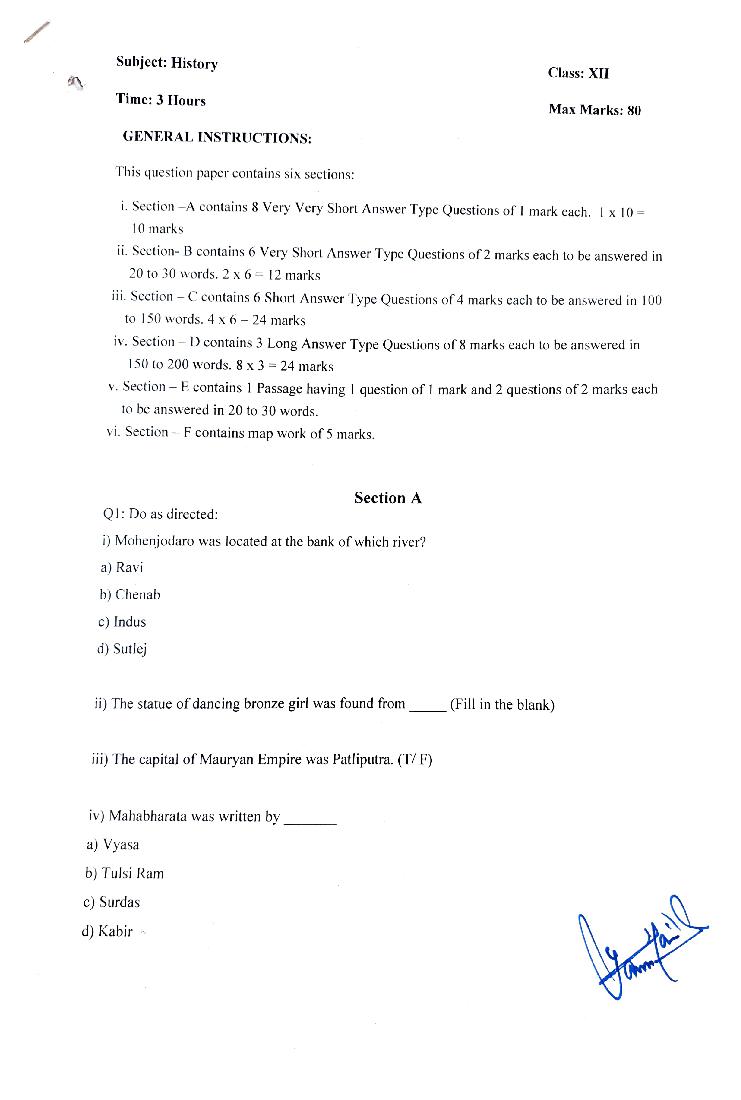
Time: 3 Hours
Max Marks: 80
GENERAL INSTRUCTIONS:
This question paper contains six sections:
i. Section -A contains 8 Very Very Short Answer Type Questions of 1mark each. I x 10=
10 marks
i. Section- B contains 6 Very Short Answer Type Questions of 2marks each to be answered in
20 to 30 words. 2x6= 12 marks
iii. Section Ccontains 6 Short Answer Type Questions of 4marks each to be answered in 100
to 150 vords. 4 x 6=24 marks
iv. Section-Dcontains 3Long Answer Type Questions of8 marks each to be answered in
150to 200words. 8 x 3 = 24 marks
v. Section - Econtains 1Passage having Iquestion of I mark and 2questions of 2 marks each
to be answered in 20 to 30 words.
vi. Section F contains map work of 5 marks.
Section A
Ql: Do as directed:
i) Mohenjodaro was located at the bank of which river?
a) Ravi
b) Chenab
c) Indus
d) Sutlej
ii) The statue of dancing bronze girlwas found from (Fill in the blank)
iii) The capital of Mauryan Empire was Patliputra. (T/ F)
iv) Mahabharata was written by
a) Vyasa
b) Tulsi Ram
c) Surdas
d) Kabir
Page 2
a)623 B.C
b) 644 B.C
c) 650 B.C
d) 660 B.C
vi) The Permanent settlement act was introduced in India by
vii)The revolt of 1857 in Jhansi was led by Rani Lakshmi bai (True/ False)
vii) Quit India Movement was started in the year
a) 1940
b) 1941
c) 1942
d) 1943
ix)The Constitution of India was drafted by
X) The Controversial Rifle which led to immediate cause of Revolt of 1857 was:
a) AK-47
b)AK-56
c) Insas
d) Enfield
PART-B
Q2: Very Short Answer Type Questions (02 Marks each)
i)Who was Kautliya?
ii)Name any two rivers of Indus Valley Civilization.
iii) Who was Krishna Deva Raye?
iv) What is meant by Permanent Settlement?
v) What was "Objective Resolution'?
vi) Rehela and Kitab- ul -Hind were written bywhom?
Page 3
Q3: Describe the salient features of Mahajanapadas.
Q4: Summarize the central teaching of Jainism.
Q5: What were the elementsof the practice of Sati' that drew the attention of Bernier?
Q6: Why was the Jotedar a powerful figure in many arcas of rural Bengal?
Q7: Who were Alvars and Nayamars?
Q8: Discuss in brief Quit India Movement.
Section D
Q9: Describe some of the distinctive features of Mohenjodaro.
OR
Discuss the main features of Mauryan Administration.
Q10: Discuss whether the term 'Royal Centre' is an appropriate description for the part of the
cityfor which it is used.
OR
Discuss the extent to which Bernier's account enables to understand the rural society.
Q11: Inwhat way did Mahatma Gandhi transformed the nature of National Movement?
OR
What were the causes of the revolt of 1857?
Section E
Read the following extract carefully and answer the questions that follow:
VIRSHAIVA MOVEMENT
Q12: The 12" century witnessed the emergence of a new movement in Karnataka, led by a
Brahvana named Basavanna (1106-68) who was a minister in the court of aKalachuri ruler. His
followers were known as Virshaiva (heroes of Shiva) or Lingayats (wearers of the linga)
Lingayats continue to be an important community in the region to date. They worship Shiva in
his manifestation as a linga, and menusually wear a small linga in a silver case on aloop strung
over the left shoulder. Those who are reversed include the Jangama or Wandering monks.
Lingayats believe that on death the devotee willbe united with Shiva and will not return to this
world. Therefore they do not practise funerary rites such as cremation, prescribed in the
Dharamshatras. Instead, they ceremonially bury their dead.
i) Who was the founder of Virshaiva Sect?
ii) Discuss certain beliefs of Lingayats.
iii) In which form did Lingayats used to worship Shiva?
Section F
MAP WORK (05 Marks)
Q13: On the outline map of India, locate and label the followings places.
Do any five.
i) Lothal
i) Mohenjodaro
iii) New Delhi
iv) Hampi
v) Kalibangan