aglasem.com
Schools Admission Mock Test Playground
ClassChoose class
StateSelect state

MBOSE Class 11 Question Paper 2019 for History
Meghalaya Board of School of Education (MBOSE) Previous Year question Paper is available here. You can con read or download MBOSE Class 11 Question Paper 2019 for History PDF More Detail
MBOSE Class 11 Question Paper 2019 for History - Page 1 of 6

Finished viewing? Save it for later —

Download MBOSE Class 11 Question Paper 2019 for History (PDF · 6 pages)
Downloaded 22 times

About MBOSE Class 11 Question Paper 2019 for History

MBOSE Class 11 Question Paper 2019 for History is available here for free download. Published by Meghalaya Board for Class 11, this question paper can be viewed online or downloaded as a PDF (6 pages). Candidates preparing for Class 11 can use MBOSE Class 11 Question Paper 2019 for History to understand the exam pattern, the type of questions asked, and the overall difficulty level.

Frequently Asked Questions

How can I download MBOSE Class 11 Question Paper 2019 for History?

Open this page and click the Download button to save MBOSE Class 11 Question Paper 2019 for History as a PDF. It is completely free on AglaSem Docs.

Is MBOSE Class 11 Question Paper 2019 for History free to download?

Yes. MBOSE Class 11 Question Paper 2019 for History can be viewed online and downloaded as a PDF free of cost on AglaSem Docs.

How many pages does MBOSE Class 11 Question Paper 2019 for History have?

MBOSE Class 11 Question Paper 2019 for History contains 6 pages, which you can read online or download together as a single PDF.

Where can I find more Class 11 study material?

You can find more Class 11 question papers, sample papers, syllabus, and answer keys on AglaSem Docs.

MBOSE Class 11 Question Paper 2019 for History – Text

Read the full text of this question paper below — useful to quickly search, copy and reference the content online without downloading the PDF.

📄 View text version (6 pages)

Page 1

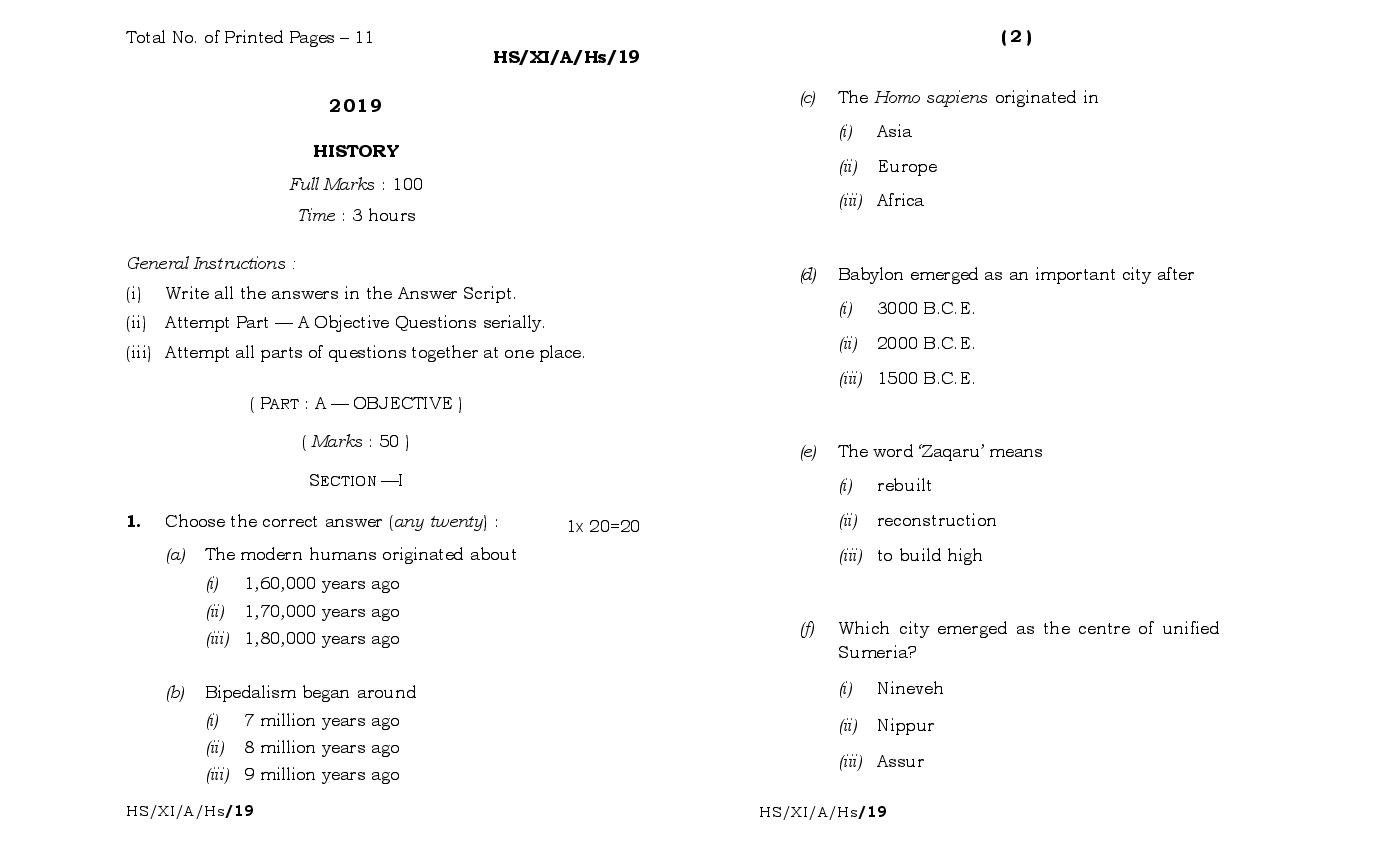
Total No. of Printed Pages – 11 (2)
HS/XI/A/Hs/19

(c) The Homo sapiens originated in
2019
(i) Asia
HISTORY
(ii) Europe
Full Marks : 100
(iii) Africa
Time : 3 hours

General Instructions :
(d) Babylon emerged as an important city after
(i) Write all the answers in the Answer Script.
(i) 3000 B.C.E.
(ii) Attempt Part –– A Objective Questions serially.
(ii) 2000 B.C.E.
(iii) Attempt all parts of questions together at one place.
(iii) 1500 B.C.E.
( PART : A –– OBJECTIVE )

( Marks : 50 )
(e) The word ‘Zaqaru’ means
SECTION ––I (i) rebuilt

1. Choose the correct answer (any twenty) : 1x 20=20 (ii) reconstruction

(a) The modern humans originated about (iii) to build high
(i) 1,60,000 years ago
(ii) 1,70,000 years ago
(f) Which city emerged as the centre of unified
(iii) 1,80,000 years ago
Sumeria?

(b) Bipedalism began around (i) Nineveh
(i) 7 million years ago (ii) Nippur
(ii) 8 million years ago
(iii) Assur
(iii) 9 million years ago

HS/XI/A/Hs/19 HS/XI/A/Hs/19

Page 2

(3) (4)

(g) The ancient form of modern paper was called (k) The code of law promulgated by the Mongols
was
(i) strip
(i) baj
(ii) paper
(iii) papyri (ii) yasa

(iii) yam

(h) The Roman administration was

(i) urban-centric (l) The feudal lord gave the knights a piece of

(ii) semi-urban centric (i) land

(iii) rural-centric (ii) gold

(iii) paper

(i) ‘Dome of the Rock’–Al–Aqsa Mosque was built
in
(m) The first order in the feudal society were the
(i) Jerusalem
(i) clergy
(ii) Cairo
(ii) knights
(iii) Baghdad
(iii) guilds

(j) A new tradition of Arab medicine that
flourished, was called (n) The ideology which emphasized temporal
outlook rather than spiritual was called
(i) Unani
(i) temperamental change
(ii) Siddha
(ii) liberalism
(iii) Ayurveda
(iii) humanism

HS/XI/A/Hs/19 HS/XI/A/Hs/19

Page 3

(5) (6)

(o) The Europeans had learnt paper making from (s) The U.S. President known for a champion of
the economic and social justice was
(i) Arabs (i) Andrew Jackson
(ii) Mongols (ii) John Marshall
(iii) Chinese
(iii) John F. Kennedy

(p) ‘Hammock’ was one of the specialities that
attracted the (t) The population of England and Wales doubled
during the period.
(i) Asians
(i) 1751–1821
(ii) Europeans
(ii) 1752–1822
(iii) Africans
(iii) 1753–1823

(q) The Inca and his family were called
(u) The Industrial Revolution was first started in
(i) Children of the moon
(i) America
(ii) Children of the stars (ii) Britain
(iii) Children of the sun (iii) France

(r) Who plundered the gold of the Incas with the
(v) The ‘novenas’ of England were
help of 180 men?
(i) priest and kings
(i) Hernando
(ii) merchants and businessmen
(ii) Pedro Alvares Cabral
(iii) workers and slaves
(iii) Francisco Pizarro

HS/XI/A/Hs/19 HS/XI/A/Hs/19

Page 4

(7) (8)

(w) Who invented the ‘Spinning Jenny’ ? (b) Upper Palaeolithic art was first discovered in
the last quarter of the eighteenth century.
(i) John Kay

(ii) Samuel Crompton (c) Sumeria was deficient in supplies of wood and
stone.
(iii) James Hargreaves
(d) Literacy in Mesopotamia was widespread.

(x) Under the rule of the Shoguns, Japan was (e) Caesar eventually became a title of all Roman
divided into more than Emperors.
(i) 240 domains
(f) Constantine established a second capital at
(ii) 250 domains Byzacium.
(iii) 260 domains
(g) The central part of Western Arabia where Islam
was born is called Hijaz.
(y) At the end of 1965, Mao started a new movement
in China called the (h) The fourth and fifth centuries were periods of
urban expansion in the Islamic World
(i) Long March
(i) Genghis Khan did not know how to read or
(ii) New Democracy
write.
(iii) Cultural Revolution
(j) Feudalism is a system of administration.

2. State whether the following statements are ‘True’ or (k) Martin Luther was a French monk.
‘False’ (any ten). 1x10=10
(l) Michelangelo was the most famous architect of
(a) Language is the key to understand the Homo
the sixteenth century.
sapiens.

HS/XI/A/Hs/19 HS/XI/A/Hs/19

Page 5

(9) ( 10 )

(m) The Mayan script employed 500 characters. (h) What were the Calmecac?

(n) The Inca nation was a confederation of tribes. (i) Define ‘Gold Rush’.

(o) The ‘daimyos’ exercised real state power from (j) What do you mean by Industrial Revolution?
the 12th century.

(k) Mention two negative effects of the Industrial
Revolution.
SECTION – II

( Marks : 20 ) (l) Who were the Daimyos?

(m) Who was Commodore Perry?
3. Answer any ten questions in 2 or 3 sentences. 2x10=20
(n) Who was Sun-Yet Sen?
(a) What are fossils?
(o) What was Deng Xiaoping’s ‘Four Modernizations’?
(b) What are the pre-requisites of tool making?

(c) What is the Cuneiform script? ( PART : B ––DESCRIPTIVE )

( Marks : 50 )
(d) What are Ziggurats?

Answer question No. 8 and any 3 from the rest.
(e) Define ‘Late Antiquity’.

(f) State the peculiar features of the Roman 1. Specify the brief stages of human evolution. 12
monarchy.
2. Write an essay on the status of urbanization and
(g) Who were the Mongols? commerce during the Abbasid rule. 6 + 6 = 12

HS/XI/A/Hs/19 HS/XI/A/Hs/19

Page 6

( 11 )

3. How did Genghis Khan bring about unity between
various groups of the Steppe people? 12

4. What were the ‘three orders’? Describe the role of
the clergy in the feudal society. 2 + 10 = 12

5. Give an account of the Inca civilization. 12

6. Specify the main stages of change in the lives of the
natives of America and Australia from the 17 th
century. 12

7. Examine the major factors that existed before the
Meiji Restoration, which facilitated Japan to
modernise rapidly. 12

8. Write short notes on any two of the following : 7 x 2 =14

(a) The Hadza people
(b) Legacy of Writing
(c) Crusades
(d) Copernicus
(e) Tupinamba society
(f) Luddism
(g) Opium War.



HS/XI/A/Hs/19

Document Details

Board / OrgMeghalaya Board
ExamClass 11
TypeQuestion Paper
Pages6
Updated15 Jul 2026