MBOSE Class 10 Question Paper 2023 for Social Science
Finished viewing? Save it for later —
Download MBOSE Class 10 Question Paper 2023 for Social Science (PDF · 16 pages)About MBOSE Class 10 Question Paper 2023 for Social Science
MBOSE Class 10 Question Paper 2023 for Social Science is available here for free download. Published by Meghalaya Board for Class 10, this question paper can be viewed online or downloaded as a PDF (16 pages). Candidates preparing for Class 10 can use MBOSE Class 10 Question Paper 2023 for Social Science to understand the exam pattern, the type of questions asked, and the overall difficulty level.
Frequently Asked Questions
How can I download MBOSE Class 10 Question Paper 2023 for Social Science?
Open this page and click the Download button to save MBOSE Class 10 Question Paper 2023 for Social Science as a PDF. It is completely free on AglaSem Docs.
Is MBOSE Class 10 Question Paper 2023 for Social Science free to download?
Yes. MBOSE Class 10 Question Paper 2023 for Social Science can be viewed online and downloaded as a PDF free of cost on AglaSem Docs.
How many pages does MBOSE Class 10 Question Paper 2023 for Social Science have?
MBOSE Class 10 Question Paper 2023 for Social Science contains 16 pages, which you can read online or download together as a single PDF.
Where can I find more Class 10 study material?
You can find more Class 10 question papers, sample papers, syllabus, and answer keys on AglaSem Docs.
MBOSE Class 10 Question Paper 2023 for Social Science – Text
Read the full text of this question paper below — useful to quickly search, copy and reference the content online without downloading the PDF.
📄 View text version (16 pages)
Page 1
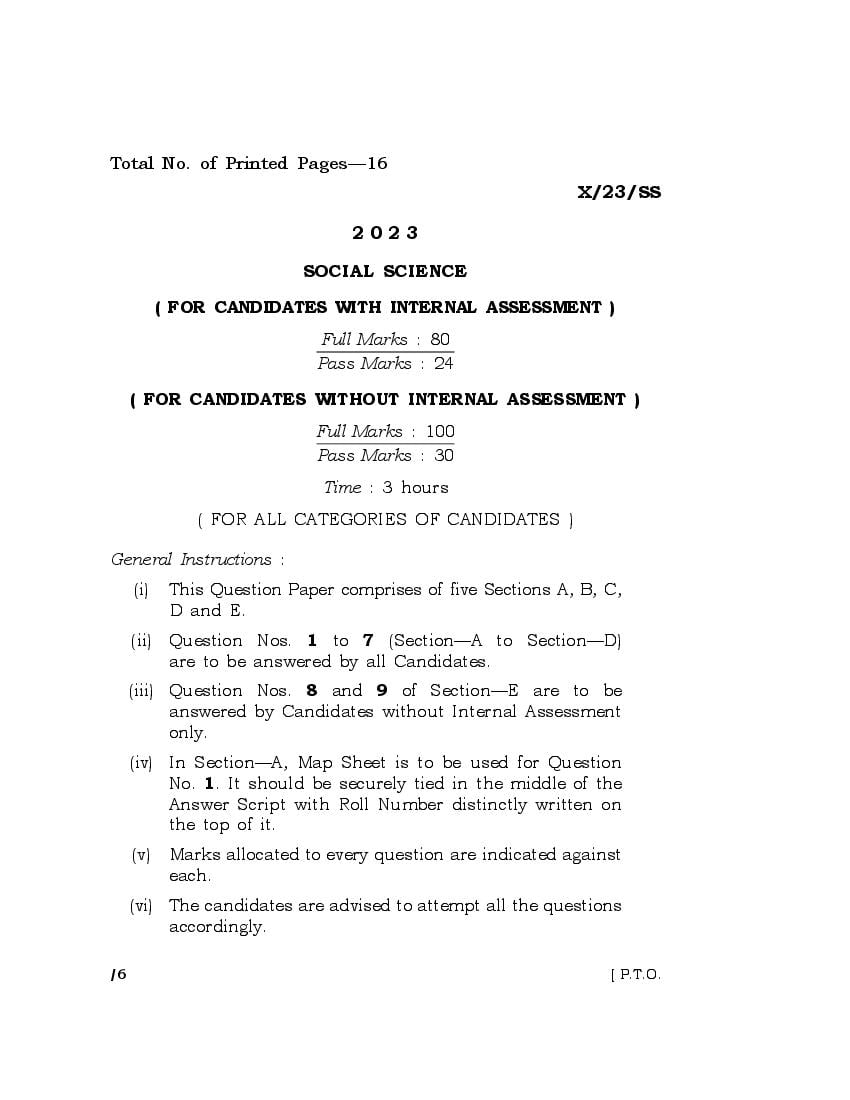
X/23/SS
2023
SOCIAL SCIENCE
( FOR CANDIDATES WITH INTERNAL ASSESSMENT )
Full Marks : 80
Pass Marks : 24
( FOR CANDIDATES WITHOUT INTERNAL ASSESSMENT )
Full Marks : 100
Pass Marks : 30
Time : 3 hours
( FOR ALL CATEGORIES OF CANDIDATES )
General Instructions :
(i) This Question Paper comprises of five Sections A, B, C,
D and E.
(ii) Question Nos. 1 to 7 (Section—A to Section—D)
are to be answered by all Candidates.
(iii) Question Nos. 8 and 9 of Section—E are to be
answered by Candidates without Internal Assessment
only.
(iv) In Section—A, Map Sheet is to be used for Question
No. 1. It should be securely tied in the middle of the
Answer Script with Roll Number distinctly written on
the top of it.
(v) Marks allocated to every question are indicated against
each.
(vi) The candidates are advised to attempt all the questions
accordingly.
/6 [ P.T.O.
Page 2
SECTION—A
( Marks : 4 )
1. In the same outline map of India supplied to you, locate
and label the following (choose any two from each
Group) :
GROUP—I 1×2=2
(a) The place where the Indian National Congress finally
adopted the Non-Cooperation Programme in 1920
(b) The Hindustan Socialist Republican Association
(HSRA) was founded here in 1928
(c) The place from where the Armenian and Persian
merchants carried coarser cotton cloth to
Afghanistan
(d) The place where Colaba is situated
GROUP—II 1×2=2
(a) The State where Hirakud Dam is located
(b) One major Iron and Steel Plant in the Eastern Part
of India
(c) The oldest artificial port of India
(d) The tallest and biggest of the monoliths is located
here (Meghalaya)
X/23/SS/6 [ Contd.
Page 3
[ For Visually Handicapped (Blind) Students
only in lieu of the above questions ]
GROUP—I
Answer any two of the following : 1×2=2
(a) In which place did the Indian National Congress
finally adopt the Non-Cooperation Programme in
1920?
(b) In which place was the Hindustan Socialist
Republican Association (HSRA) founded in 1928?
(c) From where did the Armenian and Persian merchants
carry coarser cotton cloth to Afghanistan?
(d) Where is Colaba situated?
GROUP—II
Answer any two of the following : 1×2=2
(a) Name the State where Hirakud Dam is located.
(b) Name one major Iron and Steel Plant in the Eastern
Part of India.
(c) Which is the oldest artificial port of India?
(d) Name the place in Meghalaya where the biggest and
tallest monolith is located.
X/23/SS/6 [ P.T.O.
Page 4
SECTION—B
( Marks : 12 )
2. Choose and rewrite the most appropriate answer from
the given options (any twelve) : 1×12=12
(a) Who did establish a secret society known as
‘Young Italy’?
(i) Count Camillo Cavour
(ii) Giuseppe Garibaldi
(iii) Giuseppe Mazzini
(iv) Otto von Bismarck
(b) Which invention(s) fuelled the Industrial Revolution
in the 18th century?
(i) Spinning Jenny by James Hargreaves
(ii) Richard Arkwright’s Water Frame
(iii) Steam Engine by James Watt
(iv) All of the above
(c) The Bombay Improvement Trust was established in
1898 which focused on
(i) land reclamation
(ii) clearing poor homes out of the city centre
(iii) settling disputes
(iv) building a great wall to prevent floods
X/23/SS/6 [ Contd.
Page 5
(d) Who is credited with the invention of movable-type
printing in Europe and mechanical printing globally?
(i) Marco Polo
(ii) Manocchio
(iii) Richard M. Hoe
(iv) Johannes Gutenberg
(e) Which type of soil is used intensively for growing
crops?
(i) Black soil
(ii) Alluvial soil
(iii) Red and yellow soil
(iv) Laterite soil
(f) Which State in India has the largest area under
permanent forest that constitutes almost 75 percent
of the State’s total forest area?
(i) Maharashtra
(ii) Madhya Pradesh
(iii) Uttar Pradesh
(iv) Meghalaya
(g) The largest Bauxite producing State in India is
(i) Jharkhand
(ii) Odisha
(iii) Maharashtra
(iv) Rajasthan
X/23/SS/6 [ P.T.O.
Page 6
(h) Which of the following countries is ranked as the
fifth largest telecom network in the world?
(i) China
(ii) Japan
(iii) India
(iv) Germany
(i) Which of the following factors does not help to
promote democracy?
(i) Freedom of press
(ii) Economic security
(iii) Strong opposition or dissent
(iv) Extreme poverty
(j) The highest local government institution working in
larger urban area is called
(i) Municipal Corporation
(ii) Municipal Council
(iii) Gram Panchayat
(iv) None of the above
(k) ‘A group fighting against bonded labour’ is an
example of
(i) sectional interest group
(ii) public interest group
(iii) movement group
(iv) Both (i) and (ii)
X/23/SS/6 [ Contd.
Page 7
(l) Violence against children may take place in
(i) homes
(ii) schools
(iii) orphanages
(iv) All of the above
(m) The economy is classified into public and private
sector on the basis of
(i) employment conditions
(ii) ownership
(iii) nature of economic activity
(iv) number of workers employed
(n) Which among the following is a supplementary
notion of development?
(i) National income
(ii) Per capita income
(iii) Infant mortality rate
(iv) None of the above
(o) Which of the following is a negative effect of
globalization on Indian economy?
(i) Consumers have a greater choice
(ii) Indian companies have raised the quality of their
products
(iii) The growth has only been confined to the service
sector
(iv) MNCs have increased their investment in India
X/23/SS/6 [ P.T.O.
Page 8
(p) The headquarters of Indian Standards Institution
(ISI) is located in
(i) Chennai
(ii) Bhubaneswar
(iii) New Delhi
(iv) Kolkata
SECTION—C
( Marks : 24 )
(Short Answer-type Questions)
3. Answer any twelve questions : 2×12=24
(a) What was the meaning of the word ‘liberalism’ for
the new middle classes? Mention any two ideas
supported by the liberals in the field of politics
during the 19th century. 1+1=2
(b) What was Simon Commission? Why was it considered
as an insult to Indians when it arrived in India
in 1928? 1+1=2
(c) ‘‘During the First World War years, industrial
production in India had boomed.’’ Support the
statement with two points. 2
(d) Highlight any two innovations that have improved
the printing technology from nineteenth century
onwards. 2
X/23/SS/6 [ Contd.
Page 9
(e) Differentiate between biotic and abiotic resources
with one example each. 1+1=2
(f) What is thermal electricity? Name two thermal power
plants in South India. 1+½+½=2
(g) Identify any two reasons for stagnation of food grain
production in India for the last few years. 1+1=2
(h) Why does Meghalaya import food grains from other
States despite the large percentage of population
engaged in agriculture? 2
(i) ‘‘Casteism has not totally disappeared from the
minds of Indians.’’ Give two arguments in favour of
the statement. 1+1=2
(j) Examine the relation between pressure groups and
political parties. 2
(k) ‘‘No party system is ideal for all countries and all
situations.’’ Comment. 2
(l) How does the Voter Education Channel motivate the
voters to exercise their right to vote? 2
(m) ‘‘Good health contributes to economic development
of a country.’’ Give two points to support the
statement. 1+1=2
X/23/SS/6 [ P.T.O.
Page 10
(n) Why are the poor households still dependent on
informal sources of credit in rural India? ½×4=2
(o) What is the investment made by an MNC called?
Mention one way a local company benefits from
MNCs. 1+1=2
(p) Who is considered as ‘the Father of Consumer
Movement’? When is the World Consumer Rights
Day celebrated? 1+1=2
SECTION—D
( Marks : 40 )
( Long Answer-type Questions )
PART—I
4. Answer any three of the following questions : 4×3=12
(a) ‘‘ The female form became an allegory of a nation.’’
Elaborate the statement by describing the method
used by artists in France and Germany during the
18th and 19th centuries in portraying a nation. 2+2=4
(b) Large sections of Muslims and Dalits did not respond
to the call for a united struggle during the Civil
Disobedience Movement. Explain. 2+2=4
(c) What steps were taken by the East India Company
to ensure regular supplies of cotton and silk textiles
from the Indian weavers? 4
X/23/SS/6 [ Contd.
Page 11
(d) How did the people of all classes entertain
themselves in their leisure time in Urban Britain
after industrialization? 4
(e) ‘‘ The Vernacular Press Act of 1878 allows the
colonial government to have more authority over
publishing.’’ Justify the statement. 4
PART—II
5. Answer any three of the following questions : 4×3=12
(a) What is soil erosion? Explain any two farming
techniques which can be used in India to prevent
soil erosion. 1+3=4
(b) In recent years, multipurpose projects and large
dams have come under great scrutiny and
opposition. Explain. 4
(c) Human beings have inflicted great damage on our
forest and wildlife. Discuss any four causes for the
depletion of flora and fauna in India. 4
(d) It is an equatorial crop. Identify the crop. Discuss
the geographical condition required for the growth of
this crop. Also, mention two leading producing
States of this crop in India. ½+2½+1=4
(e) ‘‘Manufacturing sector is considered as the central
dynamic force of development in general and
economic development in particular.’’ Justify the
statement. 4
X/23/SS/6 [ P.T.O.
Page 12
PART—III
6. Answer any two of the following questions : 4×2=8
(a) Which is the most common type of party system in
democracy? Highlight any three features of this
party system. 1+3=4
(b) What are political reforms? Discuss any three
guidelines that should be kept in mind while
devising ways and means for political reforms in
India. 1+3=4
(c) ‘‘A significant development in the field of voters’
awareness creation has been the launching of ‘vote
for India campaign’.’’ Describe the impact of this
campaign in order to promote democratic values
among the Indians. 4
(d) State any four rights and entitlements given to
persons with disabilities as per the Rights of Persons
with Disabilities Act, 2016. 4
PART—IV
7. Answer any two of the following questions : 4×2=8
(a) Workers in the organized sectors are vulnerable
people who need protection. Highlight the problem
faced by them and suggest any two measures to
improve their conditions. 2+2=4
X/23/SS/6 [ Contd.
Page 13
(b) What are the two serious effects of economic
development? What has been today’s global concern
with regards to economic development? 2+2=4
(c) Why do you think that the share of formal sector
credit is higher for the richer households compared
to the poorer households? 4
(d) Globalization has been facilitated by several factors.
Explain any two factors which enabled globalization
process in India. 2+2=4
SECTION—E
( Marks : 20 )
[ For Candidates without Internal Assessment ]
8. Choose the right option : 1×12=12
(a) The modern form of Nationalism received its great
boost during (Russian/French) Revolution.
(b) (Baba Ram Chandra/Alluri Sitarama Raju) was the
leader of Peasant Movement in Awadh.
X/23/SS/6 [ P.T.O.
Page 14
(c) The first Indian city to get smoke nuisance legislation
in 1863 was (Calcutta/Bombay).
(d) Rooftop water harvesting has become a common
practice in (Punjab/Meghalaya).
(e) (Magnetite/Limonite) is a finest iron ore.
(f) (Public/Private) sector is owned and operated by
individual or a group of individuals.
(g) The Central Goverment has exclusive powers
to make laws on the subjects mentioned in the
(State List/Union List).
(h) The pressure groups that seek to promote interest
of a particular section are called (public interest/
sectional interest) groups.
(i) The Protection of Children against Sexual Offences
(POCSO) Bill was passed in (2015/2012).
(j) (Primary/Tertiary) activities themselves do not
produce goods, but support for the production
process.
X/23/SS/6 [ Contd.
Page 15
(k) In India (the State Bank of India/the Reserve Bank
of India) issues currency on behalf of the
government.
(l) The Consumer Protection Act (COPRA) was enacted
in (1968/1986).
9. Answer any eight of the following questions in one word
or in one sentence each : 1×8=8
(a) Which treaty did force France to give up Alsace and
Lorraine to Prussia?
(b) Who was known as the Frontier Gandhi?
(c) What are Chawls?
(d) What is gross cropped area?
(e) State any two cropping seasons of India.
(f) Nongkhnum, the second biggest river island of Asia,
is located in which State of India?
(g) Which political party does draw inspiration from the
teachings of Dr. B. R. Ambedkar?
(h) What is the full form of NOTA in the Electronic
Voting Machine?
X/23/SS/6 [ P.T.O.
Page 16
(i) How many disabilities have been covered under the
Rights of Persons with Disabilities Act, 2016?
(j) What is life expectancy?
(k) What are the modern forms of money?
(l) What is liberalization?
X/23/SS/6 K23—52760
Document Details
| Board / Org | Meghalaya Board |
| Exam | Class 10 |
| Type | Question Paper |
| Pages | 16 |
| Updated | 22 Jul 2026 |