MBOSE Class 10 Question Paper 2023 for Science
Finished viewing? Save it for later —
Download MBOSE Class 10 Question Paper 2023 for Science (PDF · 23 pages)About MBOSE Class 10 Question Paper 2023 for Science
MBOSE Class 10 Question Paper 2023 for Science is available here for free download. Published by Meghalaya Board for Class 10, this question paper can be viewed online or downloaded as a PDF (23 pages). Candidates preparing for Class 10 can use MBOSE Class 10 Question Paper 2023 for Science to understand the exam pattern, the type of questions asked, and the overall difficulty level.
Frequently Asked Questions
How can I download MBOSE Class 10 Question Paper 2023 for Science?
Open this page and click the Download button to save MBOSE Class 10 Question Paper 2023 for Science as a PDF. It is completely free on AglaSem Docs.
Is MBOSE Class 10 Question Paper 2023 for Science free to download?
Yes. MBOSE Class 10 Question Paper 2023 for Science can be viewed online and downloaded as a PDF free of cost on AglaSem Docs.
How many pages does MBOSE Class 10 Question Paper 2023 for Science have?
MBOSE Class 10 Question Paper 2023 for Science contains 23 pages, which you can read online or download together as a single PDF.
Where can I find more Class 10 study material?
You can find more Class 10 question papers, sample papers, syllabus, and answer keys on AglaSem Docs.
MBOSE Class 10 Question Paper 2023 for Science – Text
Read the full text of this question paper below — useful to quickly search, copy and reference the content online without downloading the PDF.
📄 View text version (23 pages)
Page 1
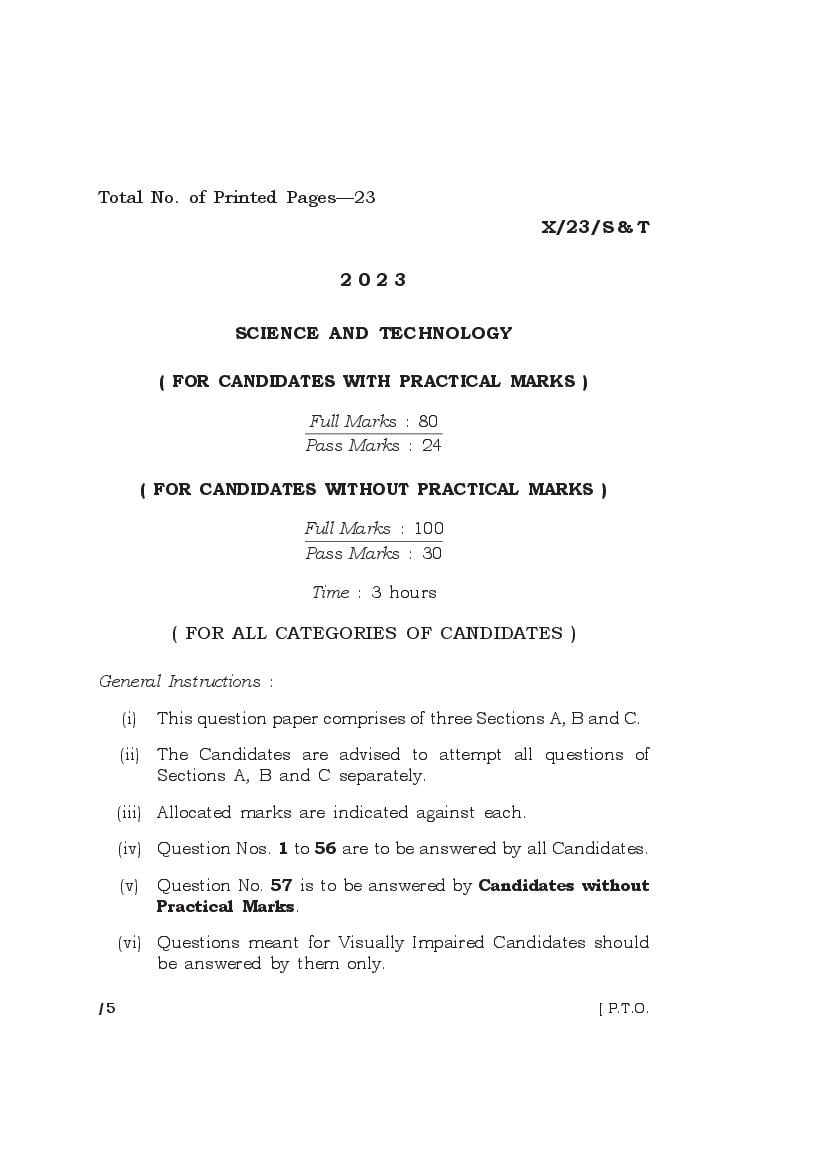
X/23/S & T
2023
SCIENCE AND TECHNOLOGY
( FOR CANDIDATES WITH PRACTICAL MARKS )
Full Marks : 80
Pass Marks : 24
( FOR CANDIDATES WITHOUT PRACTICAL MARKS )
Full Marks : 100
Pass Marks : 30
Time : 3 hours
( FOR ALL CATEGORIES OF CANDIDATES )
General Instructions :
(i) This question paper comprises of three Sections A, B and C.
(ii) The Candidates are advised to attempt all questions of
Sections A, B and C separately.
(iii) Allocated marks are indicated against each.
(iv) Question Nos. 1 to 56 are to be answered by all Candidates.
(v) Question No. 57 is to be answered by Candidates without
Practical Marks.
(vi) Questions meant for Visually Impaired Candidates should
be answered by them only.
/5 [ P.T.O.
Page 2
SECTION—A
( PHYSICS )
( Marks : 26 )
Choose and write the correct answer from the following
(any four) : 1×4=4
1. When the rays of light diverging from a point, after
reflection either actually meet or appear to meet at some
other point, then that point is called
(A) shadow
(B) reference point
(C) image
(D) point of incidence
2. Insulation of each electric wire is given a specific colour.
Which colour represents live electrical wire according to
the New International Convention?
(A) Yellow
(B) Blue
(C) Brown
(D) Green
3. The electric charge on an electron is
(A) 6 ⋅ 25 × 10 −18 C
(B) 1 ⋅ 6 × 10 −19 C
(C) 1 ⋅ 6 × 10 −18 C
(D) 6 ⋅ 25 × 10 −19 C
X/23/S & T/5 [ Contd.
Page 3
4. Which of the following is a conductor?
(A) Glass
(B) Chloroform
(C) Copper
(D) Air
5. The danger signals installed at the top of tall buildings
are red in colour because the red light
(A) is scattered the most by smoke or fog
(B) is least scattered by smoke or fog
(C) is absorbed the most by smoke or fog
(D) moves fastest in air
6. The part of the human eye that controls the amount of
light entering the eye is
(A) cornea
(B) retina
(C) choroid
(D) iris
7. When a newspaper is seen through a lens, its print
appears smaller. The nature of the lens is
(A) convex
(B) concave
(C) double-convex
(D) concavo-convex
X/23/S & T/5 [ P.T.O.
Page 4
8. The most important safety method used for protecting
home appliances from short circuiting or overloading is
(A) earthing
(B) use of fuse
(C) use of stabilizers
(D) use of electric meter
Answer the following short answer-type questions (any four ) :
2×4=8
9. (a) What is meant by electromagnetic induction? 1
(b) On what principle does an electric generator work? 1
10. (a) What do you understand by the term ‘Power of lens’? 1
(b) A convex lens has a focal length of 40 cm. Calculate
its power. 1
11. (a) Define electric current. 1
(b) State the relation between the electric current, the
charge moving through a conductor and the time in
seconds. 1
12. What is presbyopia? Write any one cause of this defect.
1+1=2
13. What is the difference between Dispersion and Scattering
of light? 1+1=2
14. Name the factors which determine the electric resistance
of a conductor. ½×4=2
15. Write two characteristics of magnetic field lines. 1+1=2
X/23/S & T/5 [ Contd.
Page 5
16. Define luminous body. Give any two examples of luminous
bodies. 1+½+½=2
Answer the following short answer-type questions : 3×3=9
Answer either Part—A or Part—B from each question
Part—A
17. (a) State Snell’s laws of refraction of light. 2
(b) Why is a plane mirror not useful as a rear view
mirror? 1
Part—B
(c) Observe the given diagram and answer the following
questions :
(i) Name the points C and F. ½+½=1
(ii) State the nature of the image. ½+½=1
(iii) What is the size and position of the image? ½+½=1
[ For Visually Impaired Candidates only
in lieu of Question No. 17(c) ]
(c) List three common characteristics of light. 3
X/23/S & T/5 [ P.T.O.
Page 6
Part—A
18. (a) What is the electric potential at a point in an electric
field when 24 J of work is done in moving a charge
of 84 C from infinity? 2
(b) Name a device and the form of energy responsible for
generating continuous electric current. ½+½=1
Part—B
(c) Derive the mathematical expression of Ohm’s law.
Write the SI unit of resistance. 1+½=1½
(d) State three reasons why an electric circuit breaks. 1½
Part—A
19. (a) Give three differences between an electromagnet and
a permanent magnet. 3
Part—B
(b) In the statement of Fleming’s Left-Hand Rule, what
do the following represent? 1+1+1=3
(i) The direction of the forefinger
(ii) The direction of the middle finger
(iii) The direction of the thumb
Answer the following long answer-type question : 5
Answer either Part—A or Part—B or Part—C
Part—A
20. (a) Why does the sky appear blue? 2
X/23/S & T/5 [ Contd.
Page 7
(b) State three characteristics of an image formed in a
plane mirror. 3
Part—B
(c) State the difference between overloading and short
circuiting. 1+1=2
(d) Why does a glass prism cause dispersion of white
light but not a glass slab? Explain with a diagram.
2+1=3
[ For Visually Impaired Candidates only
in lieu of Question No. 20(d) ]
(d) (i) What is lateral displacement? 1
(ii) How is lateral displacement produced by an
optical slab related to—
1. thickness of the optical slab;
2. angle of incidence? 1+1=2
Part—C
(e) Between retina and iris, which controls the amount
of light entering the eye? 1
(f) Name two types of nerve ending in the retina and
also mention its characteristics. 2
(g) Give two functions of aqueous humour. 2
X/23/S & T/5 [ P.T.O.
Page 8
SECTION—B
( CHEMISTRY )
( Marks : 26 )
Choose and write the correct answer from the following
(any three) : 1×3=3
21. When two elements or compounds react chemically to
form a single new compound, the chemical reaction is
called
(A) combination reaction
(B) decomposition reaction
(C) displacement reaction
(D) oxidation reaction
22. The acid present in sour milk or curd is
(A) acetic acid
(B) lactic acid
(C) formic acid
(D) uric acid
23. Endothermic reactions proceed with the
(A) evolution of heat energy
(B) absorption of heat energy
(C) evolution of light energy
(D) absorption of light energy
X/23/S & T/5 [ Contd.
Page 9
24. The law of octaves for the classification of elements was
stated by
(A) Mendeleev
(B) Dobereiner
(C) Niels Bohr
(D) Newlands
25. Which of the following acid-base indicators will turn blue
in basic or alkaline solutions?
(A) Methyl orange
(B) Phenolphthalein
(C) Blue litmus
(D) Red litmus
26. Which of the following forms the basis of the Modern
Periodic Table?
(A) Atomic mass
(B) Atomic number
(C) Number of nucleons
(D) Atomic radius
X/23/S & T/5 [ P.T.O.
Page 10
Answer the following short answer-type questions (any three) :
2×3=6
27. (a) Define chemical equation. 1
(b) Balance the following chemical reaction : 1
Fe + H 2O → Fe 3O 4 + H 2
28. Elements A and B have atomic numbers 16 and 20
respectively. Write the electronic configuration of A and
B, and find out the groups to which they belong in the
Periodic Table. ½+½+½+½=2
29. White silver chloride when left exposed to sunlight
changes to grey. Write the chemical reaction involved
and also mention the type of the chemical reaction. 1+1=2
30. Why are covalent compounds generally poor conductors
of electricity? 2
31. In the Modern Periodic Table, which are the metals
among the first ten elements? 2
32. (a) Write the general formula of alkenes. 1
(b) Give the names of two alkenes, one having three
carbon atoms and the other having four carbon
atoms. ½+½=1
Answer the following short answer-type questions : 3×4=12
Answer either Part—A or Part—B from each question
Part—A
33. (a) (i) Aluminium and zinc are high up in the metal
activity series, yet they resist corrosion. Why? 1
X/23/S & T/5 [ Contd.
Page 11
(ii) Give one example of chemical decomposition
reaction that is carried out by—
1. Electric energy;
2. Heat energy. 1+1=2
Part—B
(b) (i) What is the colour of ferrous sulphate crystals? ½
(ii) What is the change of colour on further heating? ½
(iii) Name the products formed on strongly heating of
ferrous sulphate crystals. What type of chemical
reaction occurs in this change? 1½+½=2
Part—A
34. (a) (i) Define water of crystallisation. 1
(ii) Write the chemical name and chemical formula
of a salt containing seven water of
crystallisation. ½+½=1
(iii) Give an example for the reaction of a metal
carbonate and an acid. 1
Part—B
(b) (i) How is bleaching powder prepared? Write the
chemical equation. 1+1=2
(ii) Give any two uses of bleaching powder other
than washing of clothes. ½+½=1
X/23/S & T/5 [ P.T.O.
Page 12
Part—A
35. (a) (i) Name the following : ½×4=2
1. A non-metal which is the hardest substance
2. A metal which is liquid at room temperature
3. A metal which can be cut with a knife
4. A non-metal that has lustre
(ii) State the reason why aluminium oxide is called
an amphoteric oxide. 1
Part—B
(b) In the given diagram of electrorefining of copper, the
different parts are labelled as A, B, C and D. Observe
carefully and answer the following questions :
Electrorefining of copper
(i) Which part is the anode? What is it made of ?
½+½=1
(ii) Which part is the cathode? What is it made of ?
½+½=1
(iii) Which part is the acidified copper sulphate
solution? ½
(iv) Which part is the anode mud? ½
X/23/S & T/5 [ Contd.
Page 13
[ For Visually Impaired Candidates only
in lieu of Question No. 35(b) ]
(b) State three differences in the physical properties of
metals and non-metals. 3
Part—A
36. (a) (i) Define functional group. 1
(ii) Give the names of the following functional
groups : ½×4=2
|
— OH, — COOH, — CHO, — C ==O
Part—B
(b) (i) How is ethene prepared from ethanol? (Equation
is not required.) What is the role of concentrated
sulphuric acid in the above preparation? 1½+½=2
(ii) What is methylated spirit? 1
Answer the following long answer-type question : 5
Answer either Part—A or Part—B or Part—C
Part—A
37. (a) An element, which is placed in 2nd group and 3rd
period of the Periodic Table, burns in the presence of
oxygen to form a basic oxide.
(i) Identify the element.
(ii) Write the electronic configuration and valency.
(iii) Write the balanced equation when it burns in
the presence of air. 1+(½+½)+1=3
X/23/S & T/5 [ P.T.O.
Page 14
(b) Which bases are called alkalis? Give an example of
an alkali. 1+1=2
Part—B
(c) State three differences between calcination and
roasting. 3
(d) (i) Define ore. 1
(ii) Name any two methods for concentration of ore.
½+½=1
Part—C
(e) Write the definition of salt. 1
(f) Classify the following salts as normal, acid and
basic salts : ½×3=1½
(i) KCl
(ii) CH3COONa
(iii) FeSO4
(g) Name a molecule of an element that has—
(i) single covalent bond;
(ii) double covalent bond;
(iii) triple covalent bond. ½×3=1½
(h) Give the names of two chemical substances present
in the soda-acid fire extinguisher. ½+½=1
X/23/S & T/5 [ Contd.
Page 15
SECTION—C
( BIOLOGY )
( Marks : 28 )
Choose and write the correct answer from the following
(any three) : 1×3=3
38. First step of respiration is
(A) formation of pyruvate
(B) formation of oxygen
(C) formation of glucose
(D) formation of carbon dioxide
39. The mode of reproduction in spirogyra is
(A) multiple fission
(B) fragmentation
(C) binary fission
(D) budding
40. Which of the following endocrine glands secretes growth
hormone?
(A) Adrenal
(B) Testes
(C) Ovary
(D) Pituitary
X/23/S & T/5 [ P.T.O.
Page 16
41. Which part of the alimentary canal receives bile from the
liver?
(A) Stomach
(B) Small intestine
(C) Large intestine
(D) Oesophagus
42. Posture and balance of the body is controlled by
(A) cerebrum
(B) cerebellum
(C) medulla
(D) pons
43. Which among the following diseases is not sexually
transmitted?
(A) Syphilis
(B) Hepatitis
(C) HIV-AIDS
(D) Gonorrhoea
X/23/S & T/5 [ Contd.
Page 17
Answer the following short answer-type questions (any four) :
2×4=8
44. Give the names of the three pairs of salivary glands in
humans. Where do they open? 1½+½=2
45. Give reasons for the following : 1+1=2
(a) The lung alveoli are covered with blood capillaries.
(b) The wall of the trachea is supported by cartilage
rings.
46. State the functions of sensory neuron and connector
neuron. 1+1=2
47. What constitute the autonomic nervous system? Name
the two subsystems in which it is subdivided. 1+½+½=2
48. In a complete flower, identify the following : ½×4=2
(a) Part that produces pollen grain
(b) Part that transfers male gamete to the female gamete
(c) Part that is sticky to trap the pollen grain
(d) Part that develops into a fruit
49. What is binary fission? Name two organisms which
reproduce by this method. 1+½+½=2
50. (a) What is a gene? 1
(b) What do you mean by monohybrid cross? 1
51. Explain why the wings of a bird and the wings of a bat
are not considered to be homologous. 2
X/23/S & T/5 [ P.T.O.
Page 18
Answer the following short answer-type questions : 3×4=12
Answer either Part—A or Part—B from each question
Part—A
52. (a) Give three differences between aerobic and
anaerobic respiration. 3
Part—B
(b) (i) Enumerate two functions of gastric HCl. 2
(ii) Name the pancreatic enzyme which digests
proteins. 1
Part—A
53. (a) (i) What do you understand by genotype and
phenotype? 1+1=2
(ii) What is the common name and the scientific
name of the plant on which Mendel performed
his experiment? ½+½=1
Part—B
(b) Distinguish between external fertilisation and
internal fertilisation giving an example of each.
1½+1½=3
Part—A
54. (a) Draw the diagram of a neuron and label the
following on it : 1+½+½+½+½=3
Nucleus, Dendrites, Cell body and Axon
X/23/S & T/5 [ Contd.
Page 19
[ For Visually Impaired Candidates only
in lieu of Question No. 54(a) ]
(a) Name the plant hormone which helps or promotes
(i) cell division, (ii) growth of the stem and
(iii) ripening of fruits. 1+1+1=3
Part—B
(b) How are nastic movements different from tropic
movements in plants? (Three points only) 1+1+1=3
Part—A
55. (a) (i) What are fossils? What do you mean by relative
dating? 1+1=2
(ii) Name an animal having very simple and
photosensitive eyes. 1
Part—B
(b) (i) Define sexual reproduction. 1
(ii) List two functions performed by the testes in
human beings. ½+½=1
(iii) What changes are observed in the uterus if
fertilisation does not occur? 1
X/23/S & T/5 [ P.T.O.
Page 20
Answer the following long answer-type question : 5
Answer either Part—A or Part—B or Part—C
Part—A
56. (a) (i) In the given diagram, name the parts (1), (2), (3),
(4), (5) and (6) : ½×6=3
X/23/S & T/5 [ Contd.
Page 21
[ For Visually Impaired Candidates only
in lieu of Question No. 56(a)(i) ]
(i) Enumerate three functions of blood. 3
(a) (ii) What are stomata? Write two functions of
stomata. 1+½+½=2
Part—B
(b) (i) What is nutrition? Name the four main types of
heterotrophic nutrition. 1+½×4=3
(ii) Name the four elements of xylem. ½×4=2
Part—C
(c) Explain dental plaque and its harmful effects. 2
(d) What do you mean by pollination? Explain its types.
1+2=3
[ For Candidates without Practical Marks ]
57. I. Answer any three of the following questions : 2×3=6
(a) State any two uses of convex mirror. 1+1=2
(b) What is potential difference? Also give its SI
unit. 1+1=2
(c) (i) Define the term ‘refractive index’. 1
(ii) What is the speed of light in vacuum? 1
X/23/S & T/5 [ P.T.O.
Page 22
(d) What do you understand by the term ‘reflection
of light’? 2
(e) What is lens? Name two broad classes of lens.
1+1=2
(f) Give two uses of electromagnet. 2
II. Answer any three of the following questions : 2×3=6
(a) What is neutralisation reaction? Give one
example. 1+1=2
(b) What is a strong acid? Give two examples.
1+½+½=2
(c) Write two differences between metals and
non-metals. 1+1=2
(d) How does the number of valence electrons vary
on moving (i) down a group and (ii) across a
period? 1+1=2
(e) (i) What is organic chemistry? 1
(ii) Name the functional group present in the
given compound : 1
CH3CH2OH
(f) Give two differences between soap and
synthetic detergent. 1+1=2
X/23/S & T/5 [ Contd.
Page 23
III. Answer any four of the following questions : 2×4=8
(a) Give two differences between respiration and
breathing. 1+1=2
(b) What are the two important functions
performed by lymph? 1+1=2
(c) (i) Name the nitrogenous wastes in human
beings. 1½
(ii) What name is given to the process of
artificial removal of nitrogenous wastes
from the blood? ½
(d) Define heredity. Name the scientist who is
referred to as the ‘father of genetics’. 1+1=2
(e) Explain the following terms : 1+1=2
(i) Placenta
(ii) Gestation
(f) Mention two functions of the large intestine. 1+1=2
(g) Write the full forms of the following : 1+1=2
(i) DNA
(ii) AIDS
(h) What is a bisexual flower? Give two examples.
1+½+½=2
HHH
X/23/S & T/5 K23—55900
Document Details
| Board / Org | Meghalaya Board |
| Exam | Class 10 |
| Type | Question Paper |
| Pages | 23 |
| Updated | 22 Jul 2026 |