MBOSE Class 11 Question Paper 2020 for History
Finished viewing? Save it for later —
Download MBOSE Class 11 Question Paper 2020 for History (PDF · 6 pages)About MBOSE Class 11 Question Paper 2020 for History
MBOSE Class 11 Question Paper 2020 for History is available here for free download. Published by Meghalaya Board for Class 11, this question paper can be viewed online or downloaded as a PDF (6 pages). Candidates preparing for Class 11 can use MBOSE Class 11 Question Paper 2020 for History to understand the exam pattern, the type of questions asked, and the overall difficulty level.
Frequently Asked Questions
How can I download MBOSE Class 11 Question Paper 2020 for History?
Open this page and click the Download button to save MBOSE Class 11 Question Paper 2020 for History as a PDF. It is completely free on AglaSem Docs.
Is MBOSE Class 11 Question Paper 2020 for History free to download?
Yes. MBOSE Class 11 Question Paper 2020 for History can be viewed online and downloaded as a PDF free of cost on AglaSem Docs.
How many pages does MBOSE Class 11 Question Paper 2020 for History have?
MBOSE Class 11 Question Paper 2020 for History contains 6 pages, which you can read online or download together as a single PDF.
Where can I find more Class 11 study material?
You can find more Class 11 question papers, sample papers, syllabus, and answer keys on AglaSem Docs.
MBOSE Class 11 Question Paper 2020 for History – Text
Read the full text of this question paper below — useful to quickly search, copy and reference the content online without downloading the PDF.
📄 View text version (6 pages)
Page 1
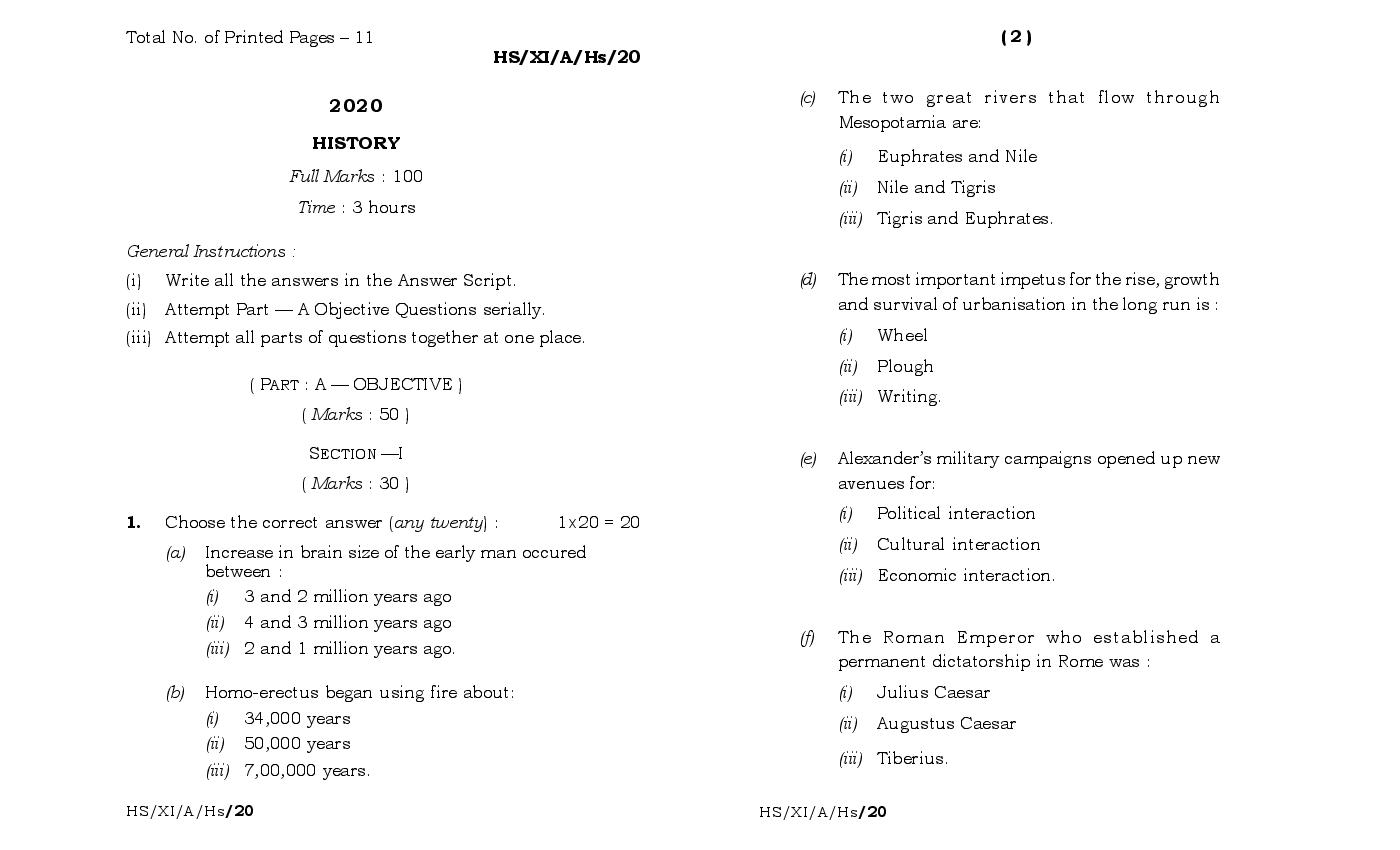
HS/XI/A/Hs/20
(c) The two great rivers that flow through
2 02 0
Mesopotamia are:
HISTORY
(i) Euphrates and Nile
Full Marks : 100
(ii) Nile and Tigris
Time : 3 hours
(iii) Tigris and Euphrates.
General Instructions :
(i) Write all the answers in the Answer Script. (d) The most important impetus for the rise, growth
(ii) Attempt Part –– A Objective Questions serially. and survival of urbanisation in the long run is :
(iii) Attempt all parts of questions together at one place. (i) Wheel
(ii) Plough
( PART : A –– OBJECTIVE )
(iii) Writing.
( Marks : 50 )
SECTION ––I (e) Alexander’s military campaigns opened up new
( Marks : 30 ) avenues for:
1. Choose the correct answer (any twenty) : (i) Political interaction
1 x20 = 20
(a) Increase in brain size of the early man occured (ii) Cultural interaction
between : (iii) Economic interaction.
(i) 3 and 2 million years ago
(ii) 4 and 3 million years ago
(f) The Roman Emperor who established a
(iii) 2 and 1 million years ago.
permanent dictatorship in Rome was :
(b) Homo-erectus began using fire about: (i) Julius Caesar
(i) 34,000 years (ii) Augustus Caesar
(ii) 50,000 years
(iii) Tiberius.
(iii) 7,00,000 years.
HS/XI/A/Hs/20 HS/XI/A/Hs/20
Page 2
(g) The Islamic Calendar was established during (k) The biggest land-owners of medieval Europe
the Caliphate of : were :
(i) Abu Bakr (i) church
(ii) Abdal Malik (ii) landlords
(iii) Umar. (iii) traders.
(h) A new tradition of Arab medicine that flourished (l) Free peasants had to pay a direct tax called :
was called :
(i) taille
(i) Unani
(ii) tithe
(ii) Siddha
(iii) labour rent.
(iii) Ayurveda.
(m) Historians called the new approach to the
(i) The Steppe-dwellers were mainly : knowledge of man and nature the :
(i) Pastoralists (i) Modern Revolution
(ii) Agriculturalists (ii) Industrial Revolution
(iii) Warriors. (iii) Scientific Revolution.
(j) Genghis Khan’s first target was: (n) Madonna, the mother of Jesus, is the greatest
work of :
(i) Japan
(i) Giotto
(ii) China
(ii) Dante
(iii) Korea.
(iii) Raphael.
HS/XI/A/Hs/20 HS/XI/A/Hs/20
Page 3
(o) The Shamans played an important role as (s) The Aborigines arrived in Australia from :
healers in the :
(i) Kenya
(i) Aztec society
(ii) New Guinea
(ii) Inca society
(iii) Ghana
(iii) Arawaks society.
(p) The artificial islands or Chinampas were (t) Which among the following symbolised British
developed by which society ? Industrialisation?
(i) Arawaks (i) Iron industry
(ii) Aztecs (ii) Coal industry
(iii) Incas. (iii) Textile industry.
(q) Eldorado, the land of silver and gold belonged (u) The French engineer who constructed the Suez
to the : Canal in 1869 was :
(i) Inca Kingdom (i) Clermont
(ii) Aztec Kingdom (ii) James Brindley
(iii) Mayan Kingdom. (iii) Ferdinand-de-Lessepes.
(r) The name ‘Indian’ was first applied to the natives
(v) Luddism was a movement against the :
of America by :
(i) Kings
(i) Christopher Columbus
(ii) Machines
(ii) Captain Cook
(iii) Employment of women and children.
(iii) Tasman.
HS/XI/A/Hs/20 HS/XI/A/Hs/20
Page 4
(w) The greatest historian of early China was : (b) The script evolved by the Sumerians is known
as the Pictographic script.
(i) Lian Qichao
(ii) Sima Qian (c) The Roman woman enjoyed considerable legal
rights.
(iii) Naito Konan.
(d) The Arabian Peninsula became the centre of a
new religious movement- Islam.
(x) Japan was opened to the outside world after
the treaty with : (e) The defeat in Egypt put an end to the western
(i) Commodore Perry expansion of the Mongols.
(ii) Marco Polo (f) The term ‘serfs’ is a word commonly used for
nobles in the Roman Empire.
(iii) Luis Frots.
(g) Secularism was the keynote of Humanism.
(y) The Manchu Monarchy of China was overthrown
by the Republic under the leadership of : (h) Human sacrifice was an important part of Aztec
religion.
(i) Mao Zedong
(i) British East India Company was formed in 1700.
(ii) Chiang Kaishek
(iii) Sun-Yat-Sen. (j) After 1861-65 Civil war, the northern states won
and slavery was abolished.
2. State whether the following statements are ‘True’ or (k) U. S. President, Andrew Jackson was kind to
‘False’ (any ten). 1x10=10 the Cherokees, the native people of America.
(a) Researchers have come to the conclusion that
the humans have descended from the Asian (l) Richard Arkwright invented the Water Frame
apes. in 1769.
HS/XI/A/Hs/20 HS/XI/A/Hs/20
Page 5
(m) Industrial Revolution did not bring any change (g) Who were called the ‘three orders’?
in the position of women.
(h) What was the ‘Black Death’?
(n) Japan was the first country to introduce
compulsory education.
(i) Who was Martin Luther?
(o) Mao Zedong fled to Taiwan in 1949 and
established the Republic of China. (j) Name the two schools established by the Aztecs.
(k) What was the Notational system of the Mayans?
SECTION – II
(l) Define the term ‘Settlers’.
( Marks : 20 )
(m) Give two reasons why Industrial Revolution
began first in England.
3. Answer any ten questions in 2 or 3 sentences. 2x10=20
(n) Who were the Samurai?
(a) Who was Charles Darwin?
(o) Name the ‘four great needs’ of the people
(b) What are mammals?
identified by the Kuomintang Party.
(c) Who was Gilgamesh?
( PART : B ––DESCRIPTIVE )
(d) What is Pax Romana?
( Marks : 50 )
(e) What is meant by Abbasid Revolution?
Answer question No. 8 and any 3 from the rest.
(f) What were the reasons for the success of
Genghis Khan? 1. Who were the Homo sapiens? Describe the various
ways how the early humans obtained food. 4 + 8 = 12
HS/XI/A/Hs/20 HS/XI/A/Hs/20
Page 6
2. Describe the position and role of slaves in Roman
society and economy. Mention the factors which led
to the decline of slavery. 6 + 6 = 12
3. Discuss the scientific and cultural achievements of
the Abbasid dynasty? 12
4. What were the Crusades? Explain the effects. 6 + 6 = 12
5. Examine the salient features of art and architecture
during the Renaissance period. 12
6. Who were the Aborigines? What happened to them
after the Europeans established their settlements
in Australia. 4 + 8 = 12
7. What led to the rise of Modern China? 12
8. Write short notes on any two of the following : 7 x 2 =14
(a) Upper Palaeolithic Art.
(b) Urbanisation in Mesopotamia.
(c) Augustus Caesar.
(d) Causes of success of Genghis Khan.
(e) Features of Feudalism.
(f) Impact of Industrial Revolution.
(g) New Education system under the Meijis of
Japan.
HS/XI/A/Hs/20
Document Details
| Board / Org | Meghalaya Board |
| Exam | Class 11 |
| Type | Question Paper |
| Pages | 6 |
| Updated | 30 Apr 2026 |