MAHA SET 2025 Paper II Chemical Sciences Set A Question Paper
Finished viewing? Save it for later —
Download MAHA SET 2025 Paper II Chemical Sciences Set A Question Paper (PDF · 44 pages)About MAHA SET 2025 Paper II Chemical Sciences Set A Question Paper
MAHA SET 2025 Paper II Chemical Sciences Set A Question Paper is available here for free download. Published by Maharashtra Exams for MAHA SET, this question paper can be viewed online or downloaded as a PDF (44 pages). Candidates preparing for MAHA SET can use MAHA SET 2025 Paper II Chemical Sciences Set A Question Paper to understand the exam pattern, the type of questions asked, and the overall difficulty level.
Frequently Asked Questions
How can I download MAHA SET 2025 Paper II Chemical Sciences Set A Question Paper?
Open this page and click the Download button to save MAHA SET 2025 Paper II Chemical Sciences Set A Question Paper as a PDF. It is completely free on AglaSem Docs.
Is MAHA SET 2025 Paper II Chemical Sciences Set A Question Paper free to download?
Yes. MAHA SET 2025 Paper II Chemical Sciences Set A Question Paper can be viewed online and downloaded as a PDF free of cost on AglaSem Docs.
How many pages does MAHA SET 2025 Paper II Chemical Sciences Set A Question Paper have?
MAHA SET 2025 Paper II Chemical Sciences Set A Question Paper contains 44 pages, which you can read online or download together as a single PDF.
Where can I find more MAHA SET study material?
You can find more MAHA SET question papers, sample papers, syllabus, and answer keys on AglaSem Docs.
MAHA SET 2025 Paper II Chemical Sciences Set A Question Paper – Text
Read the full text of this question paper below — useful to quickly search, copy and reference the content online without downloading the PDF.
📄 View text version (45 pages)
Page 1
MAHA SET 2025 Paper
II Chemical Sciences
Set A Question Paper
EXAM YEAR TYPE
MAHA SET 2025 Question Paper
Notes · Sample Papers · Previous Year Papers · Mock Tests
Page 2
.co s e m
s em l a
a ag
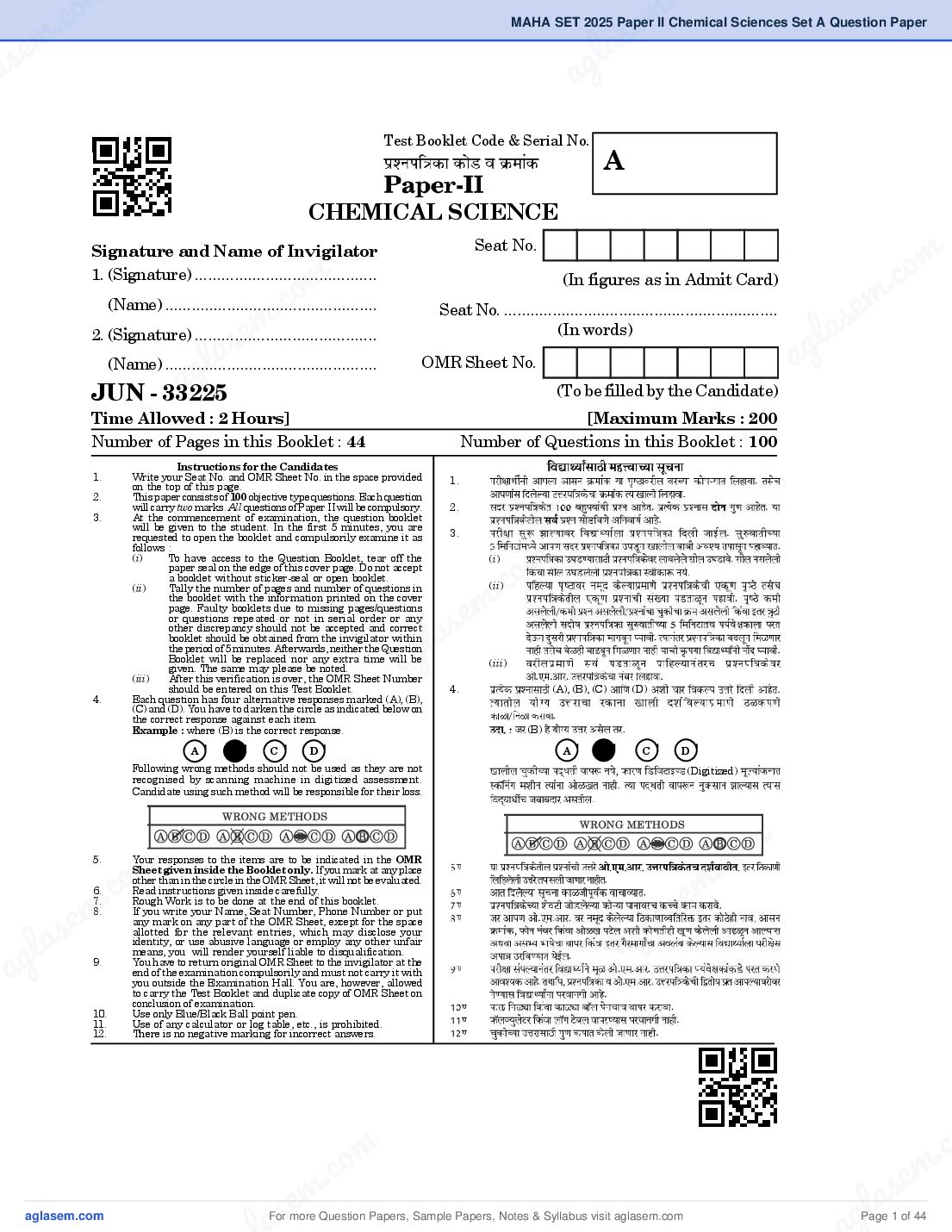
Test Booklet Code & Serial No.
A
CHEMICAL SCIENCE
Seat No.
m
co
Signature and Name of Invigilator
m .
c. o
1. (Signature) ......................................... (In figures as in Admit Card)
em
(Name) ................................................
em
Seat No. ..............................................................
l as
s
2. (Signature) .........................................
la
(In words)
ag
JUN - 33225 a g
(Name) ................................................ OMR Sheet No.
(To be filled by the Candidate)
Time Allowed : 2 Hours] [Maximum Marks : 200
Number of Pages in this Booklet : 44 Number of Questions in this Booklet : 100
Instructions for the Candidates
1. Write your Seat No. and OMR Sheet No. in the space provided 1.
on the top of this page.
2. This paper consists of 100 objective type questions. Each question
will carry two marks. All questions of Paper II will be compulsory. 2.
3. At the commencement of examination, the question booklet
will be given to the student. In the first 5 minutes, you are
requested to open the booklet and compulsorily examine it as 3.
m
follows :
.co
(i) To have access to the Question Booklet, tear off the (i)
paper seal on the edge of this cover page. Do not accept
a booklet without sticker-seal or open booklet.
m
(ii) Tally the number of pages and number of questions in (ii)
e
the booklet with the information printed on the cover
s
page. Faulty booklets due to missing pages/questions
a
or questions repeated or not in serial order or any
l
other discrepancy should not be accepted and correct
ag
booklet should be obtained from the invigilator within
the period of 5 minutes. Afterwards, neither the Question
Booklet will be replaced nor any extra time will be (iii)
given. The same may please be noted.
(iii) After this verification is over, the OMR Sheet Number
should be entered on this Test Booklet. 4. (A), (B), (C) (D)
4. Each question has four alternative responses marked (A), (B),
(C) and (D). You have to darken the circle as indicated below on
the correct response against each item.
Example : where (B) is the correct response. (B)
A C D A C D
Following wrong methods should not be used as they are not (Digitized)
recognised by scanning machine in digitized assessment.
Candidate using such method will be responsible for their loss.
m
5.
m .co
.co
Your responses to the items are to be indicated in the OMR
m
Sheet given inside the Booklet only. If you mark at any place
e
other than in the circle in the OMR Sheet, it will not be evaluated.
s
6. Read instructions given inside carefully.
e m 7. Rough Work is to be done at the end of this booklet.
la
s
8. If you write your Name, Seat Number, Phone Number or put
la g
any mark on any part of the OMR Sheet, except for the space
a
allotted for the relevant entries, which may disclose your
g
identity, or use abusive language or employ any other unfair
a
means, you will render yourself liable to disqualification.
9. You have to return original OMR Sheet to the invigilator at the
end of the examination compulsorily and must not carry it with
you outside the Examination Hall. You are, however, allowed
to carry the Test Booklet and duplicate copy of OMR Sheet on
conclusion of examination.
10. Use only Blue/Black Ball point pen.
11. Use of any calculator or log table, etc., is prohibited.
12. There is no negative marking for incorrect answers.
m . c
c. o s e m
s em
For more Question Papers, Sample Papers, Notes & Syllabus visit
gl a
Page 1 of 44
Page 3
For more Question Papers, Sample Papers, Notes & Syllabus visit Page 2 of 44
Page 4
.co s e m
s em l a
a ag
Chemical Science
Paper II
Time Allowed : 120 Minutes] [Maximum Marks : 200
m
om
Note : This paper contains Hundred (100) multiple choice questions. Each question
. co
. c
carrying Two (2) marks. Attempt All questions.
e m
m a
e measured in derivative thermogravimetric analysis (DTG) gisl : s
1.
l as
The property
a
a g
(A) Change in weight (B) Rate of change in weight
(C) Heat evolved (D) Change in temperature
2. The species that contain a vacant dx2 – y2 orbital is :
o m
c
(A) [Ni(en)3]2+ (en = NH2CH2CH2NH2) .(B) [NiCl4]2–
e m
l as
(C) [Ni(CN)4]2– ag (D) [Ni(CO)4]
3. FeCl2 . 4H2O and FeCl3 . 6H2O can be distinguished by 57Fe Mössbauer
spectroscopy. The INCORRECT statement from the following is :
m
.co
(A) Both compounds are high spin
m
c. o (B) Quadrupole splitting of FeCl . 4H O is higher than that
s e mof FeCl . 6H O
e m l a
las
2 2 3 2
ag
ag (C) Both compounds show the same isomer shift
(D) The isomer shift of FeCl2 . 4H2O is higher than that of FeCl3 . 6H2O
3
m . c
c. o s e m
s em
For more Question Papers, Sample Papers, Notes & Syllabus visit
gl a
Page 3 of 44
Page 5
ion (ii) [CrO4]2– is an intense yellow due to :
(A) d-d transitions in (i) and (ii)
(B) d-d transition in (i) and charge transfer transition in (ii)
(C) Charge transfer transition in (i) and d-d transition in (i)
(D) Charge transfer in (i) and (ii)
5. The major product of the following reaction in :
C (CF )
(Ph3P)4 Pt ¾¾¾¾¾
2 3 4
®
PPh3
C(CF3)2 (CF3)2C C(CF3)2
Ph3P Pt Pt
(A) C(CF3)2 (B)
(CF3)2C C(CF3)2
PPh3
PPh3
C(CF3)2 (CF3)2C C(CF3)2
(C) (Ph3P)2 Pt (D) Pt
C(CF3)2 (CF3)2C C(CF3)2
PPh3
4
For more Question Papers, Sample Papers, Notes & Syllabus visit Page 4 of 44
Page 6
.co s e m
s em l a
a ag
6. The structures of tetrasulphur tetranitride (a) and tetrathiazyl tetrafluoride
(b) are given below. The statement that correctly describes the structures is :
m
om . co
. c e m
eS m F F
l as
l as ag
g
N S S N S
a 1.63 A 1.66 A
N N N N
1.54 A
S N S S N S
F F
(a) (b)
m
.co
(A) Both, (a) and (b), show extensive delocalization
e m
l as rule and is more stable than (b)
ag
(B) Compound (a) satisfies Hückel
(C) Compound (b) satisfies Hückel rule and is more stable than (a)
(D) Both are aromatic ring systems
3
m
7. In an axially symmetric field, the first NQR transition energy for I = is :
.co
2
m
m .co s e m
s e (A)
– e 2Q q
(B)
+ e2Qq
g la
g la 4 4
a
a
+ e2Qq – e2Q q
(C) (D)
2 20
5
m . c
c. o s e m
s em
For more Question Papers, Sample Papers, Notes & Syllabus visit
gl a
Page 5 of 44
Page 7
æ 19 1ö
room temperature are çè F; I = ø÷ :
2
(A) Two, a doublet and a triplet
(B) Two, doublets
(C) Two, a singlet and a doublet
(D) One, quartet
9. Between NF3 and NH3 :
(A) NF3 has a higher bond angle than NH3 due to long N–F bond distance
(B) NF3 has a higher bond angle than NH3 due to an ionic N-F bond
(C) NF3 has a higher bond angle than NH3 because NH3 is less basic than NF3
(D) NH3 has a higher bond angle than NF3 because NF3 is less basic than NH3
10. Identify (X) and (Y) in the following transformation
Sn(n – Bu)2 LDA (X) CH2Cl2 /MeLi (Y)
(A) X = Sn(n – Bu)2 Y = Sn(n – Bu)2
(B) X = Sn(n – Bu)2 Y = Sn(n – Bu)2
(C) X = Sn = CH2 Y = Sn = CH2
(D) X = Sn(n – Bu)2 Y = Sn
6
For more Question Papers, Sample Papers, Notes & Syllabus visit Page 6 of 44
Page 8
.co s e m
s em l a
a ag
11. The oxyacids of sulphur having direct S-S bonds are :
m
om
(A) H2S2O3, H2S2O4, H2S2O7 (B) H2S2O3, H2S2O4, H2S2O6
. co
. c e m
e m as
as (D) H2S2O4, H2S2O6, H2S2O8 gl
l
(C) H2S2O6, H2S2O7, H2S2O8
g a
a
12. The point group of Cis – [PtCl (NH ) ] is : 2 32
(A) C 2 h (B) C 2 v
(C) D2h (D) Td
m
.co
13. Covalent multinuclear bonds are found in the solid state structures of :
e m (B) HgMe
(A) MeLi
l as 2
(C) WMe 6
ag (D) PbMe4
14. Alkali metals form strong complexes with cryptate ligands. The structure of
one such crypt given below is of :
m
m .co
m .co s e m
s e g la
g la a
a
(A) 4.2.2 crypt (B) 6.2.2 crypt
(C) 2.2.2 crypt (D) 8.6.2 crypt
7
m . c
c. o s e m
s em
For more Question Papers, Sample Papers, Notes & Syllabus visit
gl a
Page 7 of 44
Page 9
pH = 7. Calculate the number of uncomplexed Fe3+ ions in a litre of 1 M solution
in water at pH = 7.
(A) 1049 (B) Less than 1
(C) 10 (D) 10 7
16. Analysis of four different samples of an alloy yielded 12.12, 12.14, 12.10 and
12.22% of metal. The mean deviation of the result is :
(A) –0.0750 (B) 0.0375
(C) 0.1500 (D) 0.0255
17. The set containing all linear polyhalogen compounds is :
(A) I3– , Cl3– , BrCl2– (B) ICl2– , I3+ , Cl3+
(C) I3+ , Cl3+ , BrCl2– (D) Cl3– , BrCl2+ , ICl2–
18. The radionuclide 229Th belongs to the :
(A) Thorium decay series (B) Uranium decay series
(C) Actinium decay series (D) Neptunium decay series
19. A par t icu lar m et al com plex h as an elect r on ic con figu r at i on of np1 nf1. The number
of microstates possible in an isolated gaseous state for this metal complex
is :
(A) 14 (B) 6
(C) 20 (D) 84
8
For more Question Papers, Sample Papers, Notes & Syllabus visit Page 8 of 44
Page 10
.co s e m
s em l a
a ag
20. If valence shell electron configuration of vanadium is 3d34s2 and that of uranium
is 5f36d17s2, then both [vo2]+ and (uo2)2+ will have :
o m
m . c
(A) Same number
. co of d-electrons and bent shape for both s e m
e m l a
la
(B) Same s number of d-electrons with bent shape for [vo ]
a g
+ and linear shape
g
2
a for [uo2] 2+
(C) Same number of d-electrons and linear shape for both
(D) Different oxidation states with linear shape for both
m
21. For the reaction with [Cr(OH2)6]2+, the inner-sphere redox reaction proceeds
m .co
e
the fastest for :
l as
(A) [Co(NH3)6]3+
ag (B) [CoF(NH3)5]2+
(C) [Co(NCS)(NH3)5]2+ (D) [CoI(NH3)5]2+
22. The polypyrrole ring present in vitamin B12 is :
(A) Porphyrin (B) Chlorin
m
m
c. o (C) Protoporphyrin (D) Corrin
m.co
m s e
s e 23. The spin only magnetic moment of [Co(NH3)6]Cl3 is g: la
g la a
a (A) Zero B.M. (B) 4.90 B.M.
(C) 5.48 B.M. (D) 1.73 B.M.
9
m . c
c. o s e m
s em
For more Question Papers, Sample Papers, Notes & Syllabus visit
gl a
Page 9 of 44
Page 11
similar process, trans-Platin will react with thiourea to yield : In
(A) Cis-Pt (Th)2Cl2 (B) Trans-Pt (Th)2Cl2
(C) Trans-[Pt(NH3)2(Th)2]Cl2 (D) Cis-[Pt(NH3)2(Th)2]Cl2
25. The t2g orbital is filled and has a bonding character in an octahedral environment
of :
(A) [TiF6]2–
(B) [Co(NH3)6]3+
(C) [Zn(en)3]2+ (en = NH2 . CH2CH2 NH2)
(D) Cr(CO)6
26. A radical containing two equivalent protons shows a three-line EPR spectrum
with an intensity of 1 : 2 : 1. The spectral lines are observed at 3302 G,
3325 G and 3348 G. The hyperfine coupling constant of the proton is :
(A) 25 G (B) 48 G
(C) 23 G (D) 63 G
27. The metal ions that are commonly present at the active site of hydrolytic
enzymes is :
(A) Zn2+, Mg2+, Ca2+ (B) Zn2+, Cu2+, Co2+
(C) Co2+, Fe2+, Mn2+ (D) Mn2+, Ni2+, Mg2+
28. The effective magnetic moment (µeff) of the [Ti(H2O)6]2+ species is :
(A) 0 (B) 2.83 BM
(C) 3.42 BM (D) 3.92 BM
10
For more Question Papers, Sample Papers, Notes & Syllabus visit Page 10 of 44
Page 12
.co s e m
s em l a
a ag
29. Correct statement regarding the electronic transitions of f-block elements is :
(A) f-f transition bands are broad
(B) There is large d-f orbital mixing
m
om
(C) The transitions are Laporte allowed
. co
. c e m
e l as
(D) There is a little coupling of electronic transitions with molecular vibrations
m
s g
30. Semiconductors are class of crystalline solids that show electrical conductivity
a
l conductors and insulators. The correct set of semiconductors froma the
g
between
a representations Cat zero K and room temperature given below is :
pictorial
m
m .co
s e
l a
ag
m
m P = intrinsic semiconductor; Q = p-type semiconductor;
c. o (A) semiconductor m R = n-type .co
s e
m (B) P = p-type semiconductor; Q = intrinsic semiconductor;
e l a
las ag R = n-type
ag semiconductor
(C) P = n-type semiconductor; Q = p-type semiconductor; R = intrinsic
semiconductor
(D) P = intrinsic semiconductor; Q = n-type semiconductor; R = p-type
semiconductor
11
m . c
c. o s e m
s em
For more Question Papers, Sample Papers, Notes & Syllabus visit
gl a
Page 11 of 44
Page 13
(A) Two doublets (B) Two singlets
(C) One doublet and one singlet (D) One doublet and one triplet
32. Complete the following reaction by suggesting the appropriate substrates
(I & II) :
O
O
H2N DCC
OH Protection I & II HOBt BOCN N OMe
H H
O
H2N OH
O
O
O
BOCN
H2N
H OH
(A) OMe
I
II
BOCN OH H2N OMe
(B) H
O
O
I II
O
(C) BOCN OH H2N
H OMe
O
I II
OH H2N OMe
BOCN
(D) H
O O
I II
12
For more Question Papers, Sample Papers, Notes & Syllabus visit Page 12 of 44
Page 14
.co s e m
s em l a
a ag
33. Suggest most suitable conditions for the following selective conversion :
m
om . co
c m
O O
m . s e
s e g l a
g l a O Ph O
aPh
a CN CN
(A) H2, Pd–C (Catalyst) (B) H2, RhCl [PPh3]3 (Catalyst)
m
.co
(C) H2, PtO2 (Catalyst) (D) H2, Raney Ni
e m
s the following reaction :
34. What major product is isolated afrom
l
ag
+
NMe3
m
m
c. o (A) m .co
m s e
e la
(B)
las ag
ag
(C) (D)
13
m . c
c. o s e m
s em
For more Question Papers, Sample Papers, Notes & Syllabus visit
gl a
Page 13 of 44
Page 15
O O
N O nBuLi, –75ºC
ClCH2CH = CH2
(A) The new stereogenic center formed will have ‘S’ configuration
(B) The new stereogenic center formed will have ‘R’ configuration
(C) Both the diastereomers formed are in equal amount
(D) The product formed will have no new chiral center
36. The major product of the following reaction is :
COOH I2, AcOH
D
Me
I
I
O
O
O O
(A) (B)
CH3
CH3
I I
O
O
O
(C) (D) O
CH3
14
For more Question Papers, Sample Papers, Notes & Syllabus visit Page 14 of 44
Page 16
.co s e m
s em l a
a ag
37. Predict the major product of the following reaction :
m
om
NH2
. co
. c HONO
e m
em l as
l as ag
ag OH
OH
(A) (B)
O
(C) (D)
m
.co
HO
e m
l a
38. The major product of the following reaction is :s
ag CH
3
H2
?
H3C N Pd/c
O
CH3 CH3
m
m .co
.co
(A) (B)
H3C N H3C N
e m
e m
O O
las
las g
aCH
ag CH3 3
NH2
(C) (D)
H3C N
O H3C O
15
m . c
c. o s e m
s em
For more Question Papers, Sample Papers, Notes & Syllabus visit
gl a
Page 15 of 44
Page 17
OMe O
H (i) BH, THF
O
(ii) PhBr, Pd(PPh3)4 Cat
Na2CO3, DME
OMe OMe Ph
Ph
(A) (B)
OMe
OMe
(C) (D)
Ph
Ph
40. The major product formed in the following reaction is :
Br2
?
CCl4
Br
(A) (B)
H H
Br Br
Br
(C) (D)
Br
16
For more Question Papers, Sample Papers, Notes & Syllabus visit Page 16 of 44
Page 18
.co s e m
s em l a
a ag
41. The major product formed in the following reaction is :
m
co
Br (i) NaNH2/Liq. NH3
. cH C om (ii) Furan
em .
em l as
s g
3
g l a a
a
O O
(A) (B)
H3C H3C
O O
(C) (D)
H3C
o mH C
.c
3
e m
l as reaction is :
42. The major product of the following
ag
(i) I2, AgOAc/AcOH
(ii) KOH, Water
OH OH
HO HO
m
m .co
.co
(A) (B)
e m
e m las
las OH ag
OH
ag HO HO
(C) (D)
17
m . c
c. o s e m
s em
For more Question Papers, Sample Papers, Notes & Syllabus visit
gl a
Page 17 of 44
Page 19
principle :
1. MeMgBr O 1. PhCH2SH
THF KOH, THF
I + +
II
2. H3O O 2. H3O
(A) I = HO Me
O
II = Ph S OH
O
(B) I = HO OH
Me
Me
II = PhR S OH
O O
(C) I = Me OH
II = PhR S OH
O
HO Me
(D) I =
O
OH
II = Ph S OH
S
Ph
18
For more Question Papers, Sample Papers, Notes & Syllabus visit Page 18 of 44
Page 20
.co s e m
s em l a
a ag
44. Predict the major product of the following reaction :
m
om . co
. c em
em l as
s
CL
l a ag
ag NaN3
DMF, 20ºC
S
CL
m
.co
N3
em
N3
l as
(A) S ag (B) S
N 3
N3
m
m .co
.co
N3
N3
e m
e m las
las ag
ag (C) S (D) S
N3
N3
19
m . c
c. o s e m
s em
For more Question Papers, Sample Papers, Notes & Syllabus visit
gl a
Page 19 of 44
Page 21
Br NaOEt
EtOH
Br O
(A) (B)
COOEt
COOEt
(C) (D)
COOEt O
46. The correct order for stretching frequency of carbonyl group of the following
molecules is :
O O O
O CH3
CH3 O — CH CH2 CH3 CH2 CH
I II III
(A) II > I > III (B) I > II > III
(C) III > I > II (D) I > III > II
20
For more Question Papers, Sample Papers, Notes & Syllabus visit Page 20 of 44
Page 22
.co s e m
s em l a
a ag
47. The 19F-NMR spectrum of CF2Br — CBr2CN at – 98°C shows :
(A) Two doublets
m
m . co
c. o
(B) Two singlets
s em
em and a singlet
(C) Twosdoublets g l a
g la a
(D) a Two singlets and one doublet
48. The correct sequence of pericyclic reactions to achieve the given multistep
conversion is :
Ph
Ph H
m
.co H
s em
l a H H H
CO Meag
CO2H
2 H
(A) (i) Disrotatory 8pe– electrocyclization, (ii) conrotatory 6pe– electrocyclization,
(iii) Intramolecular p4s + p2s cycloaddition.
(B) (i) Conrotatory 8pe electrocyclization, (ii) disrotatory 6pe electrocyclization,
m
.co
(iii) Intramolecular p4s + p2s cycloaddition.
m
c. o (C) (i) Disrotatory 8pe electrocyclization, (ii) Intramolecular
s e m p4s + p2s
s em g l a
la a
ag
cycloaddition, (iii) Conrotatory 6p e electrocyclization
(D) (i) Conrotatory 8pe electrocyclization, (ii) Intramolecular p4s + p2s
cycloaddition, (iii) Disrotatory 6pe electrocyclization
21
m . c
c. o s e m
s em
For more Question Papers, Sample Papers, Notes & Syllabus visit
gl a
Page 21 of 44
Page 23
O
hn
(A) O (B) O
(C) O (D)
O
50. Suggest most appropriate reagent/conditions for the following conversion :
O
COOH COOH
(A) m-CPBA; CH2Cl2 (B) DMDO; CH2Cl2
(C) CF3COOOH; ACOH (D) H2O2; NaOH
22
For more Question Papers, Sample Papers, Notes & Syllabus visit Page 22 of 44
Page 24
.co s e m
s em l a
a ag
51. Predict the reagents for the following transformation :
m
co
O O
. c om em .
e m I II
l as
l as ag
ag
O
(A) I = DMDO, II = H2O2 (B) I = H2O2, II = mCPBA
(C) I = H2O2, II = MnO2 (D) I = mCPBA, II = O3
m
.co
52. Predict the major product of the following reaction :
e m
O
l as Mg Cl
–
Pd(dha)2,
MeO a+g dPPf
THF, –40ºC
N Cl
O
O
MeO
(A) (B)
N N
m
m .co
m .co OH as
e m
s e l
g la ag
a (C) (D) N
23
m . c
c. o s e m
s em
For more Question Papers, Sample Papers, Notes & Syllabus visit
gl a
Page 23 of 44
Page 25
(A) (B) +
+
+
(C) (D)
+
54. The correct order of the acidity between pairs of compounds given below is :
O O O O
O O O O
O O
MeO OMe
P Q R S
(A) Q > P and R > S (B) P > Q and R > S
(C) P > Q and S > R (D) Q > P and S > R
24
For more Question Papers, Sample Papers, Notes & Syllabus visit Page 24 of 44
Page 26
.co s e m
s em l a
a ag
55. Predict which one of the following compounds is antiaromatic ?
m
om . co
. c em
em l as
(A)
l as (B)
ag
ag
(C) (D)
m
m .co
s e
56. Which of the following dienes lisa least suitable for Diels-Alder reaction with
maleic anhydride ? ag
(A) (B)
m
m .co
m .co s e m
s e g la
g la a
a (C) (D)
25
m . c
c. o s e m
s em
For more Question Papers, Sample Papers, Notes & Syllabus visit
gl a
Page 25 of 44
Page 27
BnSH
Pd(PPh3)4 5 mol%
THF, 23°C
OAc
(A) (B)
S–Bn S–Bn
(C) S–Bn (D)
SBn
58. In a stable conformer of the following compound :
Me
OH
iPr
(A) Equatorial – iPr, –CH3, –OH groups
(B) Equatorial – iPr and –CH3 groups; Axial –OH group
(C) Equatorial – iPr group; axial –CH3 and –OH groups
(D) Equatorial –iPr and – OH groups; axial – CH3 group
26
For more Question Papers, Sample Papers, Notes & Syllabus visit Page 26 of 44
Page 28
.co s e m
s em l a
a ag
59. Assign the chiral descriptors for the following molecule :
m
co
Br C6 D 5
. c om C6H5
em .
em CO2Et
l as
s
Ph
l a ag
g
(A) a S, E (B) R, E
(C) S, Z (D) R, Z
60. Absolute configuration of the chiral centres (C–2, C–4) and prochirality
descriptors (HA and HB) in the following compound is :
m
m .co
s e
COOH
l a
aHg 2 OH
HA 3 HB
4
H OH
COOH
m
m .co
.co
(A) 2R, 4S; HA : Pro-s; HB : Pro-r
e m
e m las
las (B) 2R, 4R; HA : Pro-s; HB : Pro-r
ag
ag (C) 2S, 4S; HA : Pro-r; HB : Pro-s
(D) 2S, 4R; HA : Pro-s; HB : Pro-r
27
m . c
c. o s e m
s em
For more Question Papers, Sample Papers, Notes & Syllabus visit
gl a
Page 27 of 44
Page 29
(A) Uncompetative inhibition (B) Competative inhibition
(C) Non-competative inhibition (D) Without any inhibition
28
For more Question Papers, Sample Papers, Notes & Syllabus visit Page 28 of 44
Page 30
.co s e m
s em l a
a ag
62. For the first order consecutive reaction :
m
om . co
. c K1
A ¾¾¾ K2
® B ¾¾¾ ® C
e m
em l as
a s
lof the following statement is incorrect ? ag
a g
Which
(A) [A] decreases exponential with time
(B) [C] increases with inverse exponential function with time
m
(C) [B] is always greater than [C]
m .co
s e
l a
a1g and K2
(D) The tmax depends on K
63. A given reaction is fitted into the following Arrhenius form :
é 104.4 (kJ.mol –1 ) ù
K2 = 6.0 × 10¹⁴ (S–1). exp ê– ú
m
ë RT û
m
c. o Value of the rate constant at very high temperature would mbe : .co
s e
s em g l a
la a
ag (A) 3.0 × 10⁴ S–1 (B) 5.8 × 10¹⁴ S–1
(C) 18.0 × 10¹⁰ S–1 (D) 9.0 × 10⁴ S–1
29
m . c
c. o s e m
s em
For more Question Papers, Sample Papers, Notes & Syllabus visit
gl a
Page 29 of 44
Page 31
k
¾¾¾
1
E + S ¬¾¾ ® ES
¾ k –1
k2
ES ¾¾® E + P
E + I ƒ EI
... (I º inhibitor) I < I < I
1 2 3
The following behaviors are noted :
Orders of the reaction, at point ‘A’ and point ‘B’ marked on the graph would
be :
(A) One and two (B) Two and zero
(C) Zero and one (D) One and zero
30
For more Question Papers, Sample Papers, Notes & Syllabus visit Page 30 of 44
Page 32
.co s e m
s em l a
a ag
65. The following half cell represents, normal hydrogen electrode (NHE) :
(A) Pt|H+ (a = 1)|H2(g) (1 atm) m
om . co
. c em
(B) Pt|H+ (1M H2SO4)|H2(g) (1 atm)
m
e l as
as
l (1M HCl)|H2(g) (1 atm) ag
g
(C) Pt|H +
a
(D) Pt|H+ (1M H3PO4)|H2(g) (1 atm))
66. If, we discharge the electrochemical cell rapidly, then :
(A) Maximum enthalpy is converted to useful work
m
(B) Small amount of entropy is generated
m .co
(C) Cell is expected to deliver a s e
g l maximum energy density
a
(D) The cell will give out maximum entropy
67. Eº value for various ions are as follows :
Eº(Mn O4– ) = +1.51 V
E°(Ag/Ag+) = +0.7996 V
m
m Eº(Au/Au+) = +1.692 V .co
m .co s e m
s e la
Eº(Zn/Zn2+) = –0.761 V
g
g la a :
a
Based on this data, permaganate can be used to oxidize
(A) Au, Ag, Zn (B) Au, Ag
(C) Zn, Ag (D) Zn, Au
31
m . c
c. o s e m
s em
For more Question Papers, Sample Papers, Notes & Syllabus visit
gl a
Page 31 of 44
Page 33
h dY n h æ dY ö
x Px Y = x * i dx and Px x Y = i çè Y + x dx ø÷
n
(A)
h æ dY ö n xh dY
(B)
n
x Px Y = ç Y + x ÷ and Px x Y =
i è dx ø i dx
n xh dY
(C) x Px Y = Px xY = i dx
n h dY
(D) x Px Y = i dx
69. A ratio of relative probability of finding an electron in hydrogen atom in the
volume region 1.0 pm3 at r = a0 w.r.t. the probability r = 0 (nucleus) is :
(A) 5.1 (B) 6.0
(C) 7.1 (D) 1.0
70. For the particle in 1-D box, the value of quantum number n = 0 is ruled out
because :
(A) The energy of the particle becomes diverging at n = 0
(B) The wave function becomes divergent at n = 0
(C) Particle starts following classical mechanics principle
(D) It implies Y = 0, everywhere in the box
32
For more Question Papers, Sample Papers, Notes & Syllabus visit Page 32 of 44
Page 34
.co s e m
s em l a
a ag
71. A crystal is spatial periodic arrangement of large number of atom/ions. When
size of crystal is reduced to nano-meter range the diffraction peaks :
m
om . co
. c em
(A) Sharpen
e m
(B) Broaden
l as
as
l change in HWFM ag
(C) g
a No (D) Splits
72. Vapour pressure of 0.5 molal solution of non-volatile solute in organic solvent
at 30ºC would be :
(Given : vapour pressure of pure organic solvent is 100 torr; the molecular weight
m
of organic solvent is 100 g mol–1).
m .co
s e
l a
(A) 125.50 torr
ag (B) 90.25 torr
(C) 100.25 torr (D) 119.95 torr
73. Molar conductance of 0.01 M acetic acid was found to be 16 × 10–4 S m2 mol–1
at 30ºC. Molar conductance of H+ and CH3COO– ions at infinite dilution are
m
m 350 × 10–4 S m2 mol–1 and 50 × 10–4 S m2 mol–1, respectively at same .co
m .co s e m
s e la
temperature. What percentage of acetic acid is dissociated at that concentration ?
g
g la a
a (A) 0.040 (B) 0.055
(C) 0.072 (D) 0.080
33
m . c
c. o s e m
s em
For more Question Papers, Sample Papers, Notes & Syllabus visit
gl a
Page 33 of 44
Page 35
crystal structure :
If this crystal would have been FCC, the following peaks would have
missing :
(A) A, B, C, F, G H (B) B D, F H A
(C) A B E F H (D) F G H C D
75. The variation of Cp with pressure at constant temperature is given by :
æ ¶2 V ö æ ¶2S ö
(A) –T ç 2÷ (B) T ç 2÷
è ¶T ø P è ¶T ø P
æ ¶S ö æ ¶2P ö
(C) Tç ÷ (D) T ç 2÷
è ¶T ø P è ¶T ø V
34
For more Question Papers, Sample Papers, Notes & Syllabus visit Page 34 of 44
Page 36
.co s e m
s em l a
a ag
76. Consider the reaction :
3
m
H2S(g) + O2(g) ƒ SO2(g) + H2O(g), DHº = 518.62 kJ
m
2
. c o
. co of increase of temperature and pressure on the reaction ? sem
What is the effect
s em and advancement of reaction, respectively g l a
la a
(A) Retardation
g
(B) a Retardation of reaction in both cases
(C) Advancement of reaction in both cases
(D) No effect of increase in pressure and retardation due to increased
temperature
m
.co
77. According to the phase diagram given below, the composition of the layer ‘a’
m
s e
a
relative to the layer ‘b’ at point ‘c’ is :
l
ag
m
m .co
m .co s e m
s e g la
g la a
a (A)
ac
bc
(B)
bc
ac
ac bc
(C) (D)
ab ab
35
m . c
c. o s e m
s em
For more Question Papers, Sample Papers, Notes & Syllabus visit
gl a
Page 35 of 44
Page 37
distinguishable particles is :
(A) 56 (B) 14
(C) 35 (D) 126
79. In terms of partition function, the free energy is given by :
(A) –NkT ln q + PV
(B) –NkT ln q
d
(C) –NkT ln q
dt
(D) NkT2 ln q + PV
80. The pH of the mixture of 800 ml of 0.1 M HCl and 200 ml of 0.3 M NaOH
is close to :
(A) 1.10 (B) 6.90
(C) 13.3 (D) 1.70
36
For more Question Papers, Sample Papers, Notes & Syllabus visit Page 36 of 44
Page 38
.co s e m
s em l a
a ag
81. The spectra shown below is due to :
m
om . co
. c em
em l as
l as ag
ag
o m
c
. polyatomic molecule
m
(A) Perpendicular vibrations in a linear
e
l as
ag
(B) Vibrational-rotational transitions in a diatomic molecule
(C) Effect of nuclear spin homonuclear diatomic molecule
(D) Breakdown of Born-Oppenheimer approximation
82. For a molecule to be Raman active :
m
m .co
.co
(A) Dipole moment of molecule must change during molecular transitions
e m
e m las
las (B) It must have polarizability
ag
ag (C) Molecular motion must cause some change in molecular polarizability
(D) It must have non-zero dipole moment
37
m . c
c. o s e m
s em
For more Question Papers, Sample Papers, Notes & Syllabus visit
gl a
Page 37 of 44
Page 39
what can be stated about the population in first excited rotational level at
25ºC ?
(Given : kT = 4.1 × 10⁻²¹ J)
(A) All the molecules are in ground energy level
(B) All the molecules are in excited energy level
(C) Equal population in ground and excited level
(D) Slightly high population in ground level compared to excited level
84. A compound shows a peak at 240 Hz down field relative to reference peak on
N M R i n st r u m en t w or k i n g at 60 M H z. W h at i s t h e ch em i cal sh i ft ( t) of the
compound ?
(A) 6 ppm (B) 7 ppm
(C) 3 ppm (D) 4 ppm
85. For a free radical containing two equivalent protons, lines occur at 330.2 mT,
332.5 mT and 334.8 mT. What is the hyperline coupling constant for each
proton ?
(A) 4.6 mT (B) 2.3 mT
(C) 2.3 T (D) –4.6 mT
38
For more Question Papers, Sample Papers, Notes & Syllabus visit Page 38 of 44
Page 40
.co s e m
s em l a
a ag
86. In which state Be3+ will have same orbital radius as that of ground state of
m
hydrogen atom ?
om . co
. c e m
em l as
(A) n = 1
l as (B) n = 0 ag
ag
(C) n = 2 (D) n = 3
87. The term representing electron-nucleus interaction in Hamiltonian operator for
m
.co
many electron atom is proportional to :
e m – Ze
e2
s (B) å r
2
år a
(A)
l
ag
i ij i i
2
Ze Ze
(C) år (D) –
rij
i i
88. The secular determinant for a heteronuclear diatomic molecule is :
(A) ( aA – E) (aB – E) – b2 = 0 m
m
c. o (B) (a– E)2 – (b – ES)2 = 0 m .co
m s e
s e g la
g la a
a (C) (a – E)2 – b2 = 0
(D) (aA – E) (aB – E) – (b – ES)2 = 0
39
m . c
c. o s e m
s em
For more Question Papers, Sample Papers, Notes & Syllabus visit
gl a
Page 39 of 44
Page 41
weights is that :
(A) Mw is sensitive to low molecular weight species
(B) Mn is sensitive to high molecular weight species
(C) Mw is sensitive to high molecular weight and Mn is sensitive to low
molecular weight
(D) Mn / Mw gives information of polydispersivity
V
90. If the fraction of surface sites occupied by an adsorbate is given by V , the
m
equation for adsorption isotherm is :
1 1 1 V 1 1
(A) = + (B) = +
Vm PbVm V Vm Vm Pb
1 1 1 V 1
(C) = + (D) =1+
V PbVm Vm Vm PbV
91. Sharp absorbance in case of silver and gold nanoparticles observed in UV-vis
spectroscopy is attributed to :
(A) Lattice phonon vibrations
(B) Oscillation of free electrons on metal surface
(C) Size quantization effect
(D) Interaction among nanoparticles
40
For more Question Papers, Sample Papers, Notes & Syllabus visit Page 40 of 44
Page 42
.co s e m
s em l a
a ag
92. Major source of post-industrial CO2 emission other than vehicular emission is/
are from :
m
om . co
c m
(A) Paper industry (B) Textile industry
m . s e
s e
(C) Cement and steel industry
g l a
(D) Pharmaceutical industry
l a a
93. Foraagbutadiene molecule, the energy values of levels obtained by using HMO
theory are :
(1) a – 1.6 b
(2) a + 1.6 b
m
.co
(3) a + 0.6 b
(4) a – 0.6 b
e m
l as
ag the order of increasing energy ?
What is the sequence of levels in
(A) (1), (2), (3), (4) (B) (3), (2), (4), (1)
(C) (2), (3), (4), (1) (D) (4), (3), (1), (2)
94. The total multiplicity of the R-S term 5I4 is :
m
.co
(A) 65 (B) 13
m
c. o (C) 9 (D) 18
s e m
e m la
las 95. [NO2]+ has a shape similar to : ag
ag
(A) SO2 (B) SiO2
(C) H2O (D) O3
41
m . c
c. o s e m
s em
For more Question Papers, Sample Papers, Notes & Syllabus visit
gl a
Page 41 of 44
Page 43
is :
(A) 4 (B) 6
(C) 3 (D) 2
æ 1ö
97. Hyperfine lines expected in the EPR spectrum of tetranuclear rhodium çèI = ø÷
2
complex :
(A) 5 (B) 2
(C) 4 (D) 3
98. Catalytic converters are used for reduction and oxidation reactions to reduce
harmful emissions. The reduction of nitrogen oxides uses the following metal
based catalyst :
(A) Pt; Rh (B) Ni; Pt
(C) Fe; Pd (D) Co; Ni
99. Ketoconazole is commonly used as :
(A) Antibacterial (B) Antitubercular
(C) Antifungal (D) Antimalarial
100. Which of the following molecule is a prodrug ?
(A) Vancomycin (B) Aspirin
(C) Amphotericin B (D) Pencillin G
42
For more Question Papers, Sample Papers, Notes & Syllabus visit Page 42 of 44
Page 44
.co s e m
s em l a
a ag
ROUGH WORK
m
om . co
. c em
em l as
l as ag
ag
m
m .co
s e
l a
ag
m
m .co
m .co s e m
s e g la
g la a
a
43
m . c
c. o s e m
s em
For more Question Papers, Sample Papers, Notes & Syllabus visit
gl a
Page 43 of 44
Page 45
44
For more Question Papers, Sample Papers, Notes & Syllabus visit Page 44 of 44
Document Details
| Board / Org | Maharashtra Exams |
| Exam | MAHA SET |
| Type | Question Paper |
| Pages | 44 |
| Updated | 17 Nov 2026 |