DUET Question Paper 2020 for DU MSc Environmental Studies
Finished viewing? Save it for later —
Download DUET Question Paper 2020 for DU MSc Environmental Studies (PDF · 17 pages)About DUET Question Paper 2020 for DU MSc Environmental Studies
DUET Question Paper 2020 for DU MSc Environmental Studies is available here for free download. Published by NTA for DUET, this question paper can be viewed online or downloaded as a PDF (17 pages). Candidates preparing for DUET can use DUET Question Paper 2020 for DU MSc Environmental Studies to understand the exam pattern, the type of questions asked, and the overall difficulty level.
Frequently Asked Questions
How can I download DUET Question Paper 2020 for DU MSc Environmental Studies?
Open this page and click the Download button to save DUET Question Paper 2020 for DU MSc Environmental Studies as a PDF. It is completely free on AglaSem Docs.
Is DUET Question Paper 2020 for DU MSc Environmental Studies free to download?
Yes. DUET Question Paper 2020 for DU MSc Environmental Studies can be viewed online and downloaded as a PDF free of cost on AglaSem Docs.
How many pages does DUET Question Paper 2020 for DU MSc Environmental Studies have?
DUET Question Paper 2020 for DU MSc Environmental Studies contains 17 pages, which you can read online or download together as a single PDF.
Where can I find more DUET study material?
You can find more DUET question papers, sample papers, syllabus, and answer keys on AglaSem Docs.
DUET Question Paper 2020 for DU MSc Environmental Studies – Text
Read the full text of this question paper below — useful to quickly search, copy and reference the content online without downloading the PDF.
📄 View text version (17 pages)
Page 1
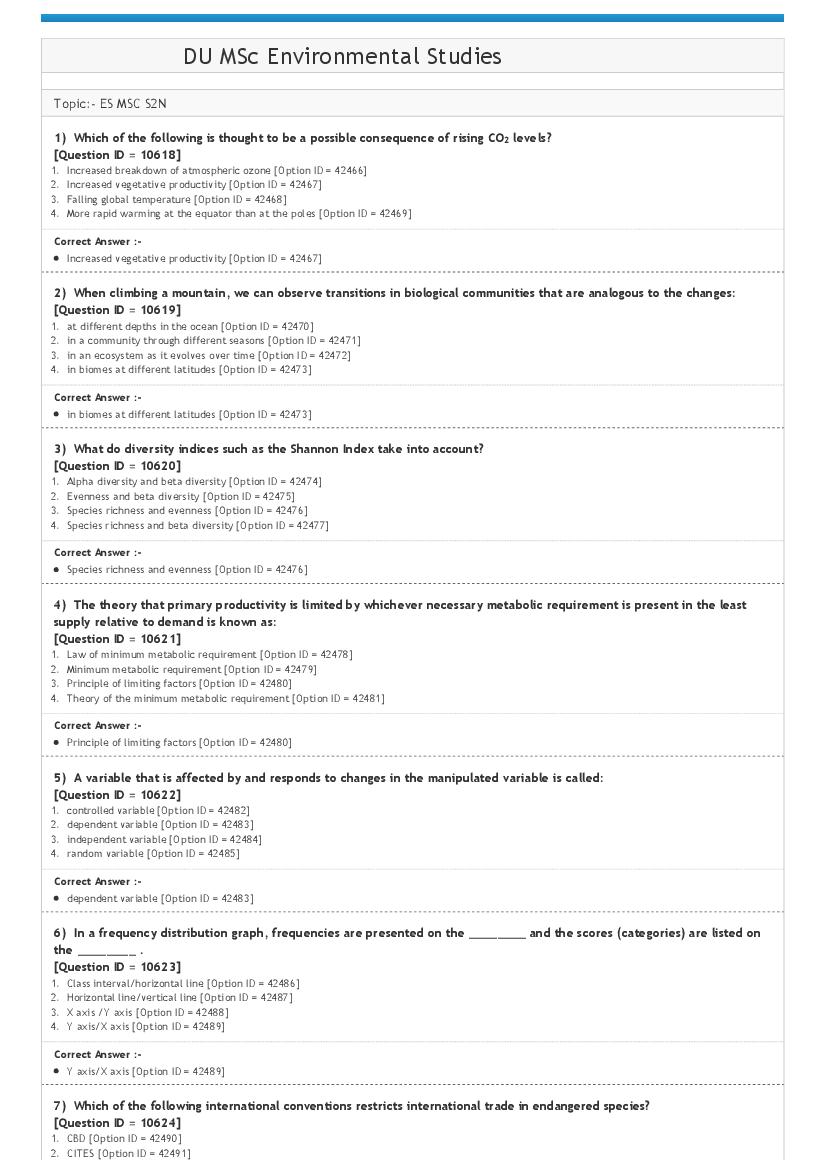
Topic:‐ ES MSC S2N
1) Which of the following is thought to be a possible consequence of rising CO2 levels?
[Question ID = 10618]
1. Increased breakdown of atmospheric ozone [Option ID = 42466]
2. Increased vegetative productivity [Option ID = 42467]
3. Falling global temperature [Option ID = 42468]
4. More rapid warming at the equator than at the poles [Option ID = 42469]
Increased vegetative productivity [Option ID = 42467]
2) When climbing a mountain, we can observe transitions in biological communities that are analogous to the changes:
[Question ID = 10619]
1. at different depths in the ocean [Option ID = 42470]
2. in a community through different seasons [Option ID = 42471]
3. in an ecosystem as it evolves over time [Option ID = 42472]
4. in biomes at different latitudes [Option ID = 42473]
in biomes at different latitudes [Option ID = 42473]
3) What do diversity indices such as the Shannon Index take into account?
[Question ID = 10620]
1. Alpha diversity and beta diversity [Option ID = 42474]
2. Evenness and beta diversity [Option ID = 42475]
3. Species richness and evenness [Option ID = 42476]
4. Species richness and beta diversity [Option ID = 42477]
Species richness and evenness [Option ID = 42476]
4) The theory that primary productivity is limited by whichever necessary metabolic requirement is present in the least
supply relative to demand is known as:
[Question ID = 10621]
1. Law of minimum metabolic requirement [Option ID = 42478]
2. Minimum metabolic requirement [Option ID = 42479]
3. Principle of limiting factors [Option ID = 42480]
4. Theory of the minimum metabolic requirement [Option ID = 42481]
Principle of limiting factors [Option ID = 42480]
5) A variable that is affected by and responds to changes in the manipulated variable is called:
[Question ID = 10622]
1. controlled variable [Option ID = 42482]
2. dependent variable [Option ID = 42483]
3. independent variable [Option ID = 42484]
4. random variable [Option ID = 42485]
dependent variable [Option ID = 42483]
6) In a frequency distribution graph, frequencies are presented on the ________ and the scores (categories) are listed on
the ________ .
[Question ID = 10623]
1. Class interval/horizontal line [Option ID = 42486]
2. Horizontal line/vertical line [Option ID = 42487]
3. X axis /Y axis [Option ID = 42488]
4. Y axis/X axis [Option ID = 42489]
Y axis/X axis [Option ID = 42489]
7) Which of the following international conventions restricts international trade in endangered species?
[Question ID = 10624]
1. CBD [Option ID = 42490]
2. CITES [Option ID = 42491]
Page 2
4. UNEP [Option ID = 42493]
CITES [Option ID = 42491]
8) An ecological footprint is:
[Question ID = 10625]
1. a measure of the earth's biological capacity [Option ID = 42494]
2. amount of wilderness available on earth [Option ID = 42495]
3. amount of biologically productive land and water a person uses [Option ID = 42496]
4. a measure of a person's contribution to creating a sustainable environment [Option ID = 42497]
amount of biologically productive land and water a person uses [Option ID = 42496]
9) What is the difference between an endangered species and a threatened species?
[Question ID = 10626]
1. A threatened species may still be abundant now but likely to become endangered in the near future [Option ID = 42498]
2. A threatened species is at the brink of extinction now and an endangered species is likely to be at the brink in the near future [Option ID = 42499]
3. A threatened species is becoming endangered specifically because of human activities [Option ID = 42500]
4. There is no difference. The two terms are interchangeable [Option ID = 42501]
A threatened species may still be abundant now but likely to become endangered in the near future [Option ID = 42498]
10) When a doctor uses a stethoscope to count your pulse rate, she is gathering information by using the__________ :
[Question ID = 10627]
1. empirical method [Option ID = 42502]
2. method of intuition [Option ID = 42503]
3. method of authority [Option ID = 42504]
4. rational method [Option ID = 42505]
empirical method [Option ID = 42502]
11) The maximum per capita rate of increase achieved by a species under ideal environmental conditions is called the:
[Question ID = 10628]
1. inherent rate of increase [Option ID = 42506]
2. inherent growth rate [Option ID = 42507]
3. intrinsic growth rate [Option ID = 42508]
4. intrinsic rate of increase [Option ID = 42509]
intrinsic rate of increase [Option ID = 42509]
12) What is the Lotka‐Volterra competition model based on?
[Question ID = 10629]
1. Exponential population growth equation [Option ID = 42510]
2. Life table equation [Option ID = 42511]
3. Logistic population growth equation [Option ID = 42512]
4. Realized per capita growth rate equation [Option ID = 42513]
Logistic population growth equation [Option ID = 42512]
13) The best measure of central tendency for an extremely skewed distribution of scores would be ________.
[Question ID = 10630]
1. cannot be determined [Option ID = 42514]
2. the mean [Option ID = 42515]
3. the median [Option ID = 42516]
4. the mode [Option ID = 42517]
the median [Option ID = 42516]
14) Trade winds are the prevailing pattern of surface winds. The factors determining patterns of these winds are:
[Question ID = 10631]
1. gravitational field of Planet Earth
[Option ID = 42518]
2. rotational pattern of Earth
[Option ID = 42519]
Page 3
[Option ID = 42520]
4. All of tthese
[Option ID = 42521]
uneven surface temperature
[Option ID = 42520]
15) Which of the following shows the correct order of soil texture from larger to smaller diameters?
[Question ID = 10632]
1. Gravel, sand, clay, and silt [Option ID = 42522]
2. Gravel, sand, silt, and clay [Option ID = 42523]
3. Gravel, silt, sand, and clay [Option ID = 42524]
4. Sand, gravel, silt, and clay [Option ID = 42525]
Gravel, sand, silt, and clay [Option ID = 42523]
16) All members in which of the following groups have the greatest number of characteristics in common?
[Question ID = 10633]
1. Class [Option ID = 42526]
2. Genus [Option ID = 42527]
3. Phylum [Option ID = 42528]
4. Species [Option ID = 42529]
Species [Option ID = 42529]
17) What does the system of binomial nomenclature that assigns a unique name to each organism describe?
[Question ID = 10634]
1. Family and species [Option ID = 42530]
2. Genus and family [Option ID = 42531]
3. Order and family [Option ID = 42532]
4. Species and genus [Option ID = 42533]
Species and genus [Option ID = 42533]
18) Wings of birds and insects have the same function but they do not share the same evolutionary origin. Bird and insect
wings are considered to be which of the following?
[Question ID = 10635]
1. Analogous [Option ID = 42534]
2. Homologous [Option ID = 42535]
3. Phylogenetic [Option ID = 42536]
4. Taxonomic [Option ID = 42537]
Analogous [Option ID = 42534]
19) Which of the following animal phyla is most likely to leave fossils?
[Question ID = 10636]
1. Annelida [Option ID = 42538]
2. Cnidaria [Option ID = 42539]
3. Chordata [Option ID = 42540]
4. Nematoda [Option ID = 42541]
Chordata [Option ID = 42540]
20) Which of the following systems is active under stress?
[Question ID = 10637]
1. Complete autonomic nervous system [Option ID = 42542]
2. Parasympathetic nervous system [Option ID = 42543]
3. Sympathetic nervous system [Option ID = 42544]
4. Somatic nervous system [Option ID = 42545]
Sympathetic nervous system [Option ID = 42544]
21) Migration of fish from fresh water to marine water for reproduction is known as:
[Question ID = 10638]
1. Anadromous [Option ID = 42546]
Page 4
3. Catadromous [Option ID = 42548]
4. Potamodromous [Option ID = 42549]
Catadromous [Option ID = 42548]
22) How does pupa survive through its life cycle?
[Question ID = 10639]
1. Caudal flaps [Option ID = 42550]
2. Feeding through the water [Option ID = 42551]
3. Feeding through the proboscis [Option ID = 42552]
4. Through food accumulated in the larval stage [Option ID = 42553]
Through food accumulated in the larval stage [Option ID = 42553]
23) Melatonin is synthesized from which of the following?
[Question ID = 10640]
1. Histamine [Option ID = 42554]
2. Melanine [Option ID = 42555]
3. Tyrosine [Option ID = 42556]
4. Tryptophan [Option ID = 42557]
Tryptophan [Option ID = 42557]
24) The slogan ‘Taking Action for living planet’ was used by:
[Question ID = 10641]
1. UNESCO
[Option ID = 42558]
2. United Nations Environment Programme
[Option ID = 42559]
3. World bank
[Option ID = 42560]
4. World Wide Fund for Nature
[Option ID = 42561]
World Wide Fund for Nature
[Option ID = 42561]
25) The Guinness Book of World Records has declared __________ as the largest river island in the world.
[Question ID = 10642]
1. Bananal [Option ID = 42562]
2. Marajo [Option ID = 42563]
3. Majuli [Option ID = 42564]
4. Nongkhnum [Option ID = 42565]
Majuli [Option ID = 42564]
26) In an experiment, we manipulate a/an ___________ variable to observe an effect on a/an____________ variable.
[Question ID = 10643]
1. dependent, another dependent [Option ID = 42566]
2. dependent, independent [Option ID = 42567]
3. independent, another independent [Option ID = 42568]
4. independent, dependent [Option ID = 42569]
independent, dependent [Option ID = 42569]
27) Rooted plants are found only in the __________ zone of a lake.
[Question ID = 10644]
1. limnetic [Option ID = 42570]
2. littoral [Option ID = 42571]
3. nektonic [Option ID = 42572]
4. pelagic [Option ID = 42573]
littoral [Option ID = 42571]
Page 5
[Question ID = 10645]
1. Everything affects everything else
[Option ID = 42574]
2. Humans have only one environment
[Option ID = 42575]
3. The environment is a closed system
[Option ID = 42576]
4. All of these
[Option ID = 42577]
Everything affects everything else
[Option ID = 42574]
29) Exponential growth is characterized by which of the following?
[Question ID = 10646]
1. 1) Growth at a constant rate
[Option ID = 42578]
2. 2) Growth at constant N
[Option ID = 42579]
3. 3) Both (1) and (2)
[Option ID = 42580]
4. 4) None of these
[Option ID = 42581]
1) Growth at a constant rate
[Option ID = 42578]
30) In terms of a population, what does “age structure” refer to?
[Question ID = 10647]
1. Per capita production of goods and services by age
[Option ID = 42582]
2. The proportion of the population in different age groups
[Option ID = 42583]
3. The rate of population growth
[Option ID = 42584]
4. All of these
[Option ID = 42585]
The proportion of the population in different age groups
[Option ID = 42583]
31) The processes responsible for formation and change of Earth's materials are collectively known as the:
[Question ID = 10648]
1. Atmospheric cycle [Option ID = 42586]
2. Continental cycle [Option ID = 42587]
3. Geologic cycle [Option ID = 42588]
4. Hydrologic cycle [Option ID = 42589]
Geologic cycle [Option ID = 42588]
32) In the context of biochemical cycles, what does “flux” refer to?
[Question ID = 10649]
1. A state of disturbance from natural conditions [Option ID = 42590]
2. Loss of matter or energy from the Earth system [Option ID = 42591]
3. The loss of water vapour through the pores of plants [Option ID = 42592]
4. The transfer of material or energy from one reservoir to another [Option ID = 42593]
Page 6
33) Atmospheric levels of carbon dioxide and oxygen are affected by the short‐term carbon cycle and which of the
following long‐term cycle?
[Question ID = 10650]
1. Carbonate‐silicate cycle [Option ID = 42594]
2. Carbon‐phosphate cycle [Option ID = 42595]
3. Carbon‐silicate cycle [Option ID = 42596]
4. Carbon‐sulphate cycle [Option ID = 42597]
Carbonate‐silicate cycle [Option ID = 42594]
34) What are the two fundamental processes that must be studied to understand ecosystem structure and functioning?
[Question ID = 10651]
1. Flow of energy and cycling of chemical elements
[Option ID = 42598]
2. Photosynthesis and respiration
[Option ID = 42599]
3. Waste decomposition and cycling of energy
[Option ID = 42600]
4. All of these
[Option ID = 42601]
Flow of energy and cycling of chemical elements
[Option ID = 42598]
35) What are the species that are most abundant or otherwise most important in an ecological community called?
[Question ID = 10652]
1. Common [Option ID = 42602]
2. Dominant [Option ID = 42603]
3. Pioneer [Option ID = 42604]
4. Predominant [Option ID = 42605]
Dominant [Option ID = 42603]
36) Which of the following processes lead to biological evolution?
[Question ID = 10653]
1. Migration and genetic drift
[Option ID = 42606]
2. Mutation
[Option ID = 42607]
3. Natural selection
[Option ID = 42608]
4. All of these
[Option ID = 42609]
All of these
[Option ID = 42609]
37) What are the dominant plants in a fresh water biome called?
[Question ID = 10654]
1. Eichhornia sp.
[Option ID = 42610]
2. Phytoplankton
[Option ID = 42611]
3. Spirogryra
[Option ID = 42612]
4. Vallisneria sp.
[Option ID = 42613]
Page 7
[Option ID = 42611]
38) In general what percentage of energy received by green plants from the sun is converted into new plant tissues?
[Question ID = 10655]
1. less than 5 [Option ID = 42614]
2. less than 10 [Option ID = 42615]
3. less than 15 [Option ID = 42616]
4. less than 25 [Option ID = 42617]
less than 5 [Option ID = 42614]
39) What are the main components of Integrated Pest Management (IPM)?
[Question ID = 10656]
1. Biological control
[Option ID = 42618]
2. Land culture
[Option ID = 42619]
3. Chemical control
[Option ID = 42620]
4. All of these
[Option ID = 42621]
All of these
[Option ID = 42621]
40) The dose of a toxin at which a specified percentage of test population dies is known as:
[Question ID = 10657]
1. control [Option ID = 42622]
2. lethal dose [Option ID = 42623]
3. placebo dose [Option ID = 42624]
4. toxic dose [Option ID = 42625]
lethal dose [Option ID = 42623]
41) Why is natural gas considered a better fossil fuel than oil?
[Question ID = 10658]
1. Burning natural gas is cleaner than burning oil [Option ID = 42626]
2. Gas commands a higher price than oil [Option ID = 42627]
3. Gas is easier to transport [Option ID = 42628]
4. Gas is a renewable resource [Option ID = 42629]
Burning natural gas is cleaner than burning oil [Option ID = 42626]
42) Direct conversion of electricity using sunlight without an intermediate fluid medium is accomplished by which of the
following?
[Question ID = 10659]
1. Li‐ion battery
[Option ID = 42630]
2. Photochemical cell
[Option ID = 42631]
3. Photovoltaic cell
[Option ID = 42632]
4. All of these
[Option ID = 42633]
Photovoltaic cell
[Option ID = 42632]
43) Long‐term plans expect to finish the clean‐up work at Chernobyl by which of the following year?
Page 8
1. 2020 [Option ID = 42634]
2. 2025 [Option ID = 42635]
3. 2036 [Option ID = 42636]
4. 2065 [Option ID = 42637]
2065 [Option ID = 42637]
44) What is saltwater intrusion?
[Question ID = 10661]
1. Excessive withdrawal of groundwater
[Option ID = 42638]
2. Invasion of saltwater into freshwater supplies
[Option ID = 42639]
3. Natural outflow of water from a natural spring
[Option ID = 42640]
4. All of these
[Option ID = 42641]
Invasion of saltwater into freshwater supplies
[Option ID = 42639]
45) Which of the following compounds absorb earthshine in the wavelengths that typically pass through the atmospheric
window?
[Question ID = 10662]
1. Carbon dioxie [Option ID = 42642]
2. Chloroflourocarbons [Option ID = 42643]
3. Ozone [Option ID = 42644]
4. Water vapour [Option ID = 42645]
Chloroflourocarbons [Option ID = 42643]
46) About what percentage of the solar energy is reflected back by ice?
[Question ID = 10663]
1. 10 – 25% [Option ID = 42646]
2. 30 – 45% [Option ID = 42647]
3. 60 – 75% [Option ID = 42648]
4. 80 – 95% [Option ID = 42649]
80 – 95% [Option ID = 42649]
47) Sulphur dioxide emissions are predominantly caused by which of the following?
[Question ID = 10664]
1. 1) Burning coal
[Option ID = 42650]
2. 2) Automobile emissions
[Option ID = 42651]
3. 3) Both (1) and (2)
[Option ID = 42652]
4. 4) Photochemical smog
[Option ID = 42653]
3) Both (1) and (2)
[Option ID = 42652]
48) What is the residence time of CFCs in the atmosphere?
[Question ID = 10665]
1. 10 years [Option ID = 42654]
2. 100 years [Option ID = 42655]
3. 1000 years [Option ID = 42656]
4. 10000 years [Option ID = 42657]
Page 9
49) Which of the following is a type of evaporite?
[Question ID = 10666]
1. 1) Marine
[Option ID = 42658]
2. 2) Nonmarine
[Option ID = 42659]
3. 3) Both (1) and (2)
[Option ID = 42660]
4. 4) None of these
[Option ID = 42661]
3) Both (1) and (2)
[Option ID = 42660]
50) How does urbanization affect a local hydrologic system?
[Question ID = 10667]
1. By increasing storm runoff
[Option ID = 42662]
2. By increasing infiltration into groundwater
[Option ID = 42663]
3. By intercepting storm runoff before it reaches streams
[Option ID = 42664]
4. All of these
[Option ID = 42665]
By increasing storm runoff
[Option ID = 42662]
51) Which of the following radiations is not affected by stratospheric ozone and is transmitted to the surface of the earth?
[Question ID = 10668]
1. UV‐A
[Option ID = 42666]
2. UV‐B
[Option ID = 42667]
3. UV‐C
[Option ID = 42668]
4. All of the above
[Option ID = 42669]
UV‐A
[Option ID = 42666]
52) Which of the following set of gases are emitted at municipal landfill sites?
[Question ID = 10669]
1. CH4,H2S, CO2, NH4 [Option ID = 42670]
2. NH4, CO, SO2, CH4 [Option ID = 42671]
3. NH4, H2S, CO [Option ID = 42672]
4. SO2 and CH4 [Option ID = 42673]
CH4,H2S, CO2, NH4 [Option ID = 42670]
53) Which of the following is true for flows through the boundaries of a closed thermodynamic system?
[Question ID = 10670]
1. Energy flows but matter does not [Option ID = 42674]
2. Energy and Matter flow [Option ID = 42675]
3. Matter flows but energy does not [Option ID = 42676]
Page 10
Energy flows but matter does not [Option ID = 42674]
54) The largest soil type found in India is:
[Question ID = 10671]
1. Alpine soil [Option ID = 42678]
2. Clayey soil [Option ID = 42679]
3. Red soil [Option ID = 42680]
4. Black soil [Option ID = 42681]
Red soil [Option ID = 42680]
55) Polychlorinated biphenyls (PCBs) can cause:
[Question ID = 10672]
1. cancers of liver and stomach
[Option ID = 42682]
2. foetal deformities
[Option ID = 42683]
3. nervous disorder
[Option ID = 42684]
4. All of the above
[Option ID = 42685]
All of the above
[Option ID = 42685]
56) The Climate Change Action Plan of the Government of India has identified ________ as a priority for exploitation.
[Question ID = 10673]
1. Nuclear energy [Option ID = 42686]
2. Solar energy [Option ID = 42687]
3. Thermal energy [Option ID = 42688]
4. Wind energy [Option ID = 42689]
Solar energy [Option ID = 42687]
57) t‐distribution in a large population approaches:
[Question ID = 10674]
1. chi‐square distribution
[Option ID = 42690]
2. binomial distribution
[Option ID = 42691]
3. normal distribution
[Option ID = 42692]
4. Poisson distribution
[Option ID = 42693]
normal distribution
[Option ID = 42692]
58) As per the Bureau of Indian Standards (BIS), the total dissolved solids in a sample of domestic drinking water must not
exceed:
[Question ID = 10675]
1. 100 ppm
[Option ID = 42694]
2. 250 ppm
[Option ID = 42695]
3. 500 ppm
[Option ID = 42696]
Page 11
[Option ID = 42697]
500 ppm
[Option ID = 42696]
59) The organic component of a water supply can be best assessed by measuring:
[Question ID = 10676]
1. BOD [Option ID = 42698]
2. COD [Option ID = 42699]
3. DO [Option ID = 42700]
4. TOC [Option ID = 42701]
TOC [Option ID = 42701]
60) _______ is a superbug that is credited with the ability to clean up oil spills.
[Question ID = 10677]
1. Bacillus subtilis
[Option ID = 42702]
2. Bacillus denitrificans
[Option ID = 42703]
3. Pseudomonas putida
[Option ID = 42704]
4. Rhizobium olivera
[Option ID = 42705]
Pseudomonas putida
[Option ID = 42704]
61) Hospitals employ red coloured containers to dump______________ .
[Question ID = 10678]
1. discarded laboratory cultures [Option ID = 42706]
2. discarded sharps [Option ID = 42707]
3. human anatomical waste [Option ID = 42708]
4. housekeeping waste [Option ID = 42709]
discarded laboratory cultures [Option ID = 42706]
62) _____________ facilitates cellulose degradation in termite gut.
[Question ID = 10679]
1. Citrobacter
[Option ID = 42710]
2. Enterococcus
[Option ID = 42711]
3. Enterobacter
[Option ID = 42712]
4. Trichonympha
[Option ID = 42713]
Trichonympha
[Option ID = 42713]
63) Baseline studies in an Environmental Impact Assessment refer to:
[Question ID = 10680]
1. identification of the best available project options [Option ID = 42714]
2. the anthropogenic profile of the project area [Option ID = 42715]
3. the floral and faunal status of the proposed project area [Option ID = 42716]
4. the prevalent environmental setting of the proposed project area [Option ID = 42717]
the prevalent environmental setting of the proposed project area [Option ID = 42717]
Page 12
[Question ID = 10681]
1. Equatorial orbit
[Option ID = 42718]
2. Geo‐synchronous orbit
[Option ID = 42719]
3. Sun synchronous orbit
[Option ID = 42720]
4. All of these
[Option ID = 42721]
Sun synchronous orbit
[Option ID = 42720]
65) Surface winds around the mid latitude are usually:
[Question ID = 10682]
1. Cyclonic [Option ID = 42722]
2. Geostrophic [Option ID = 42723]
3. Sungeostrophic [Option ID = 42724]
4. Typhoonic [Option ID = 42725]
Geostrophic [Option ID = 42723]
66) After the official notification of an Environmental Impact Assessment, public hearing must be held within how many
days?
[Question ID = 10683]
1. 10 days [Option ID = 42726]
2. 20 days [Option ID = 42727]
3. 30 days [Option ID = 42728]
4. 40 days [Option ID = 42729]
30 days [Option ID = 42728]
67) Lincoln index is a statistical measure used to estimate which of the following?
[Question ID = 10684]
1. Total dominance [Option ID = 42730]
2. Total frequency [Option ID = 42731]
3. Total population density [Option ID = 42732]
4. Total population density [Option ID = 42733]
Total population density [Option ID = 42732]
68) The nature of food web at the developmental stage of a succession is:
[Question ID = 10685]
1. linear, predominantly detritus [Option ID = 42734]
2. linear, predominantly grazing [Option ID = 42735]
3. web like, predominantly detritus [Option ID = 42736]
4. web like, predominantly grazing [Option ID = 42737]
linear, predominantly grazing [Option ID = 42735]
69) Isogons are the points that join beds of:
[Question ID = 10686]
1. equal dip amount [Option ID = 42738]
2. equal thickness [Option ID = 42739]
3. opposite strike direction [Option ID = 42740]
4. same strike direction [Option ID = 42741]
equal dip amount [Option ID = 42738]
70) A drowned river valley estuary is formed when:
[Question ID = 10687]
1. a barrier island or sand bar separates a section of the coast where fresh water enters. [Option ID = 42742]
2. sea level rose at the end of the last glacial age invading low lands and rivers. [Option ID = 42743]
Page 13
4. land sinks due to movements of the crust. [Option ID = 42745]
sea level rose at the end of the last glacial age invading low lands and rivers. [Option ID = 42743]
71) Which of the following bio‐fuels is produced from acidification and distillation of woody crops?
[Question ID = 10688]
1. Ethanol [Option ID = 42746]
2. Esters [Option ID = 42747]
3. Methanol [Option ID = 42748]
4. Producer gas [Option ID = 42749]
Methanol [Option ID = 42748]
72) A good automobile fuel in addition to having high calorific value should have:
[Question ID = 10689]
1. high ignition temperature [Option ID = 42750]
2. high viscosity [Option ID = 42751]
3. low ignition temperature [Option ID = 42752]
4. moderate ignition temperature [Option ID = 42753]
moderate ignition temperature [Option ID = 42753]
73) Aquifers that extend continuously from the land surface through material of high permeability are:
[Question ID = 10690]
1. aquitards [Option ID = 42754]
2. aquicludes [Option ID = 42755]
3. confined aquifers [Option ID = 42756]
4. unconfined aquifers [Option ID = 42757]
unconfined aquifers [Option ID = 42757]
74) The process of splitting bigger hydrocarbon into smaller hydrocarbon molecules is called:
[Question ID = 10691]
1. cracking [Option ID = 42758]
2. combustion [Option ID = 42759]
3. pyrolysis [Option ID = 42760]
4. thermal decomposition [Option ID = 42761]
cracking [Option ID = 42758]
75) The sequence for ease of decomposition of organic compounds in soil is:
[Question ID = 10692]
1. Crude protein – Starch – Fat – Lignin – Hemicellulose [Option ID = 42762]
2. Fat – Starch – Lignin – Hemicellulose – Crude protein [Option ID = 42763]
3. Lignin – Hemicellulose – Starch – Crude protein – Fat [Option ID = 42764]
4. Starch – Crude protein – Hemicellulose – Fat – Lignin [Option ID = 42765]
Starch – Crude protein – Hemicellulose – Fat – Lignin [Option ID = 42765]
76) Raunkiaer’s normal biological spectrum for phanerogamic flora of the world exhibits which one of the following
sequences of occurrence of different life forms?
[Question ID = 10693]
1. Phanerophytes, Chaemophytes, Hemicryptophytes, Cryptophytes, Therophytes [Option ID = 42766]
2. Phanerophytes, Hemicryptophytes, Cryptophytes, Chaemophytes, Therophytes [Option ID = 42767]
3. Phanerophytes, Hemicryptophytes, Therophytes, Chaemophytes, Cryptophytes [Option ID = 42768]
4. Phanerophytes, Hemicryptophytes, Therophytes, Cryptophytes, Chaemophytes [Option ID = 42769]
Phanerophytes, Hemicryptophytes, Therophytes, Chaemophytes, Cryptophytes [Option ID = 42768]
77) Which of the following categories of earthworms is most suitable for wasteland reclamation?
[Question ID = 10694]
1. Epigeic [Option ID = 42770]
2. Anecic [Option ID = 42771]
3. Endogeic [Option ID = 42772]
4. None of the above [Option ID = 42773]
Page 14
78) The Keystone predator species maintain diversity in a community by:
[Question ID = 10695]
1. allowing immigration of other predators [Option ID = 42774]
2. competitively excluding other predators [Option ID = 42775]
3. coevolving with their prey [Option ID = 42776]
4. preying on community’s dominant species [Option ID = 42777]
preying on community’s dominant species [Option ID = 42777]
79) The power to declare an area as a sanctuary or national park of central Government in India’s Wildlife (Protection) Act
1972 is under:
[Question ID = 10696]
1. Section 38 [Option ID = 42778]
2. Section 39 [Option ID = 42779]
3. Section 18 [Option ID = 42780]
4. Section 27 [Option ID = 42781]
Section 38 [Option ID = 42778]
80) As per the Water (Prevention & Control of Pollution) 1974 Act of India, the entire National Capital Territory of Delhi has
been declared as ____________ under Section 19.
[Question ID = 10697]
1. Water pollution control area
[Option ID = 42782]
2. Water pollution prevention area
[Option ID = 42783]
3. Water pollution prevention control area
[Option ID = 42784]
4. None of these
[Option ID = 42785]
Water pollution prevention control area
[Option ID = 42784]
81) Noise pollution was inserted as a type of pollution in the Air (Prevention & Control of Pollution) Act in:
[Question ID = 10698]
1. 1981 [Option ID = 42786]
2. 1982 [Option ID = 42787]
3. 1987 [Option ID = 42788]
4. 2000 [Option ID = 42789]
1987 [Option ID = 42788]
82) Islets of Langerhans are present in which of the following organs?
[Question ID = 10699]
1. Intestines [Option ID = 42790]
2. Lymph Nodes [Option ID = 42791]
3. Pancreas [Option ID = 42792]
4. Thyroid [Option ID = 42793]
Pancreas [Option ID = 42792]
83) The loss of genetic variation when a population is established by a small number of individuals from a larger population
is called:
[Question ID = 10700]
1. Founder’s Effect
[Option ID = 42794]
2. Pleiotropy
[Option ID = 42795]
3. Settler’s Effect
Page 15
4. None of these
[Option ID = 42797]
Founder’s Effect
[Option ID = 42794]
84) Echolocation in Bats and Cetaceans (Whales and Dolphins) is an example of which of the following?
[Question ID = 10701]
1. Convergent Evolution [Option ID = 42798]
2. Divergent Evolution [Option ID = 42799]
3. Homeostasis [Option ID = 42800]
4. Parallel Evolution [Option ID = 42801]
Convergent Evolution [Option ID = 42798]
85) Which of the following is not a pesticide?
[Question ID = 10702]
1. Dieldrin
[Option ID = 42802]
2. Dichlorodiphenyldichloroethane (DDD)
[Option ID = 42803]
3. Lindane
[Option ID = 42804]
4. Phosgene
[Option ID = 42805]
Phosgene
[Option ID = 42805]
86) Which of the following atmospheric phenomenon is responsible for the blue colour of the sky during clear sunny days?
[Question ID = 10703]
1. Electromagnetic scattering [Option ID = 42806]
2. Geometric scattering [Option ID = 42807]
3. Mie scattering [Option ID = 42808]
4. Rayleigh scattering [Option ID = 42809]
Rayleigh scattering [Option ID = 42809]
87) Blue baby syndrome is caused by contamination from which of the following chemical substances?
[Question ID = 10704]
1. Ammonia [Option ID = 42810]
2. Fluoride [Option ID = 42811]
3. Mercury [Option ID = 42812]
4. Nitrates [Option ID = 42813]
Nitrates [Option ID = 42813]
88) Ant bites are rich in which of the following acids?
[Question ID = 10705]
1. Formic acid [Option ID = 42814]
2. Hydrochloric acid [Option ID = 42815]
3. Tartaric acid [Option ID = 42816]
4. Trifluoromethanesulfonic acid [Option ID = 42817]
Formic acid [Option ID = 42814]
89) Which of the following is not a food preservation technique?
[Question ID = 10706]
1. Curing
[Option ID = 42818]
2. Jellying
Page 16
3. Irradiation
[Option ID = 42820]
4. Oxygenation
[Option ID = 42821]
Oxygenation
[Option ID = 42821]
90) Which of the following compounds are generally responsible for the phenomenon of Bioluminescence?
[Question ID = 10707]
1. Cytokinin [Option ID = 42822]
2. Lactiferin [Option ID = 42823]
3. Luciferin [Option ID = 42824]
4. Somatostatin [Option ID = 42825]
Luciferin [Option ID = 42824]
91) Which of the following scientists discovered Jumping Genes?
[Question ID = 10708]
1. Alec Jeffreys [Option ID = 42826]
2. Barbara McClintock [Option ID = 42827]
3. Elizabeth Winifred Jones [Option ID = 42828]
4. Har Gobind Khorana [Option ID = 42829]
Barbara McClintock [Option ID = 42827]
92) Which type of seed dispersal primarily occurs during the night?
[Question ID = 10709]
1. Anemochory [Option ID = 42830]
2. Chiropterochory [Option ID = 42831]
3. Malacochory [Option ID = 42832]
4. Ornithochory [Option ID = 42833]
Chiropterochory [Option ID = 42831]
93) As per the ‘latitudinal gradient of species diversity’, the species richness or biodiversity:
[Question ID = 10710]
1. increases from the poles to the tropics [Option ID = 42834]
2. increases from tropics to the poles [Option ID = 42835]
3. shows patchy pattern with respect to latitude [Option ID = 42836]
4. shows no pattern with respect to latitude [Option ID = 42837]
increases from the poles to the tropics [Option ID = 42834]
94) Which among the following is a criterion for a region to be considered as Biodiversity Hotspot?
[Question ID = 10711]
1. It must have at least 1500 vascular plants as endemics [Option ID = 42838]
2. It must have 50% or less of its original natural vegetation [Option ID = 42839]
3. It must have at least 1000 endemic vascular plant species [Option ID = 42840]
4. It must have all of its known species in the threatened list [Option ID = 42841]
It must have at least 1500 vascular plants as endemics [Option ID = 42838]
95) Who proposed the concept of Biodiversity Hotspots?
[Question ID = 10712]
1. A G Tansley [Option ID = 42842]
2. E O Wilson [Option ID = 42843]
3. Norman Myers [Option ID = 42844]
4. Richard Dawkins [Option ID = 42845]
Norman Myers [Option ID = 42844]
96) The branch of biology that specifically deals with the study of amphibians is known as:
[Question ID = 10713]
1. Batrachology [Option ID = 42846]
Page 17
3. Ichthyology [Option ID = 42848]
4. Mycology [Option ID = 42849]
Batrachology [Option ID = 42846]
97) Which among the following represents living fossils?
[Question ID = 10714]
1. Ctenophores
[Option ID = 42850]
2. Ginkgo biloba
[Option ID = 42851]
3. Horseshoe Crabs
[Option ID = 42852]
4. All of these
[Option ID = 42853]
All of these
[Option ID = 42853]
98) During ecological succession, a k‐selected population tends to dominate in:
[Question ID = 10715]
1. early stages
[Option ID = 42854]
2. pioneer stages
[Option ID = 42855]
3. mature stages
[Option ID = 42856]
4. seral stages
[Option ID = 42857]
mature stages
[Option ID = 42856]
99) Aerial roots are not found in which of the following plant/tree?
[Question ID = 10716]
1. Avicennia germinans
[Option ID = 42858]
2. Rhizophora mangle
[Option ID = 42859]
3. Ficus benghalensis
[Option ID = 42860]
4. Daucus carota
[Option ID = 42861]
Daucus carota
[Option ID = 42861]
100) Lion‐tailed macaques and Malabar pied hornbills are only found in the evergreen forests of Western Ghats. Such
species are called:
[Question ID = 10717]
1. Endemic [Option ID = 42862]
2. Restricted [Option ID = 42863]
3. Survivors [Option ID = 42864]
4. Threatened [Option ID = 42865]
Endemic [Option ID = 42862]
Document Details
| Board / Org | NTA |
| Exam | DUET |
| Type | Question Paper |
| Pages | 17 |
| Updated | 22 Jul 2026 |