CUSAT CAT 2023 Question Paper Mathematics PG
Finished viewing? Save it for later —
Download CUSAT CAT 2023 Question Paper Mathematics PG (PDF · 36 pages)About CUSAT CAT 2023 Question Paper Mathematics PG
CUSAT CAT 2023 Question Paper Mathematics PG is available here for free download. Published by Cochin University for CUSAT Common Admission Test, this question paper can be viewed online or downloaded as a PDF (36 pages). Candidates preparing for CUSAT Common Admission Test can use CUSAT CAT 2023 Question Paper Mathematics PG to understand the exam pattern, the type of questions asked, and the overall difficulty level.
Frequently Asked Questions
How can I download CUSAT CAT 2023 Question Paper Mathematics PG?
Open this page and click the Download button to save CUSAT CAT 2023 Question Paper Mathematics PG as a PDF. It is completely free on AglaSem Docs.
Is CUSAT CAT 2023 Question Paper Mathematics PG free to download?
Yes. CUSAT CAT 2023 Question Paper Mathematics PG can be viewed online and downloaded as a PDF free of cost on AglaSem Docs.
How many pages does CUSAT CAT 2023 Question Paper Mathematics PG have?
CUSAT CAT 2023 Question Paper Mathematics PG contains 36 pages, which you can read online or download together as a single PDF.
Where can I find more CUSAT Common Admission Test study material?
You can find more CUSAT Common Admission Test question papers, sample papers, syllabus, and answer keys on AglaSem Docs.
CUSAT CAT 2023 Question Paper Mathematics PG – Text
Read the full text of this question paper below — useful to quickly search, copy and reference the content online without downloading the PDF.
📄 View text version (36 pages)
Page 1
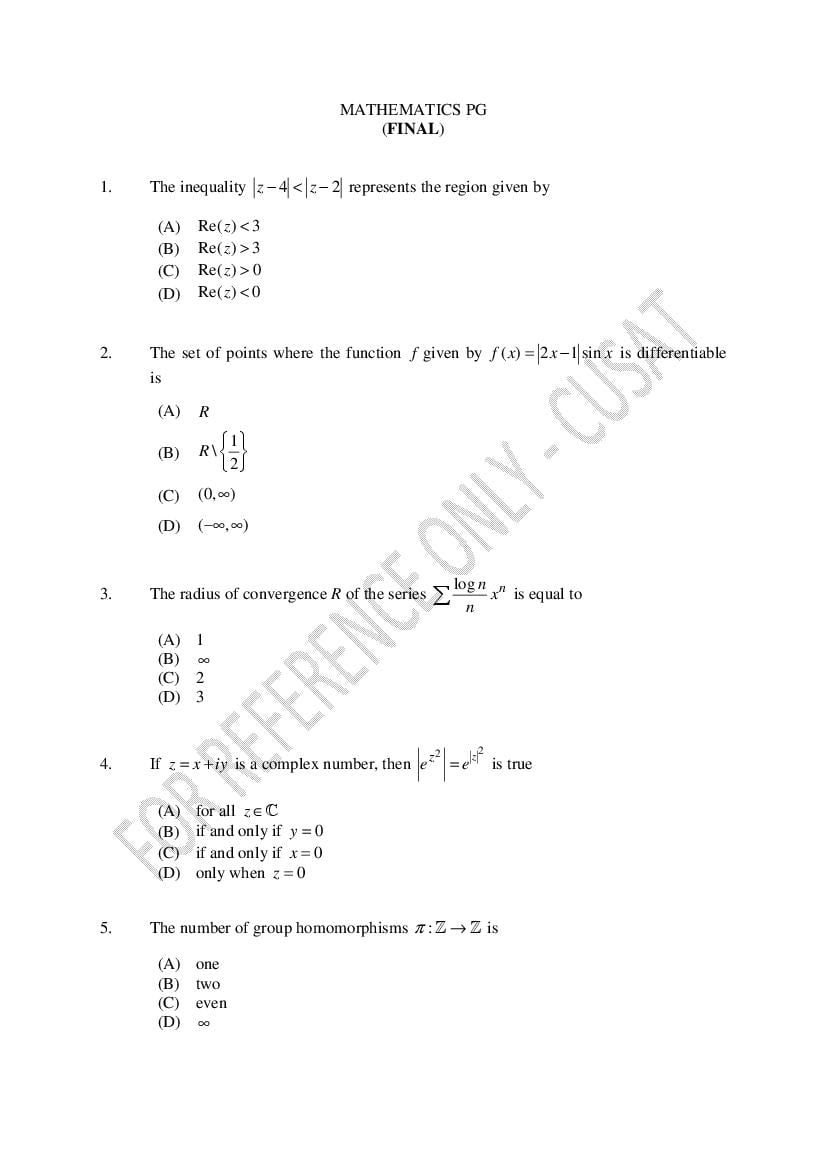
(FINAL)
1. The inequality z − 4 < z − 2 represents the region given by
(A) Re( z ) < 3
(B) Re( z ) > 3
(C) Re( z ) > 0
(D) Re( z ) < 0
2. The set of points where the function f given by f ( x) = 2 x − 1 sin x is differentiable
is
(A) R
1
(B) R\
2
(C) (0, ∞)
(D) (−∞, ∞)
log n n
3. The radius of convergence R of the series ∑ x is equal to
n
(A) 1
(B) ∞
(C) 2
(D) 3
2 2
If z = x + iy is a complex number, then e z = e
z
4. is true
(A) for all z ∈ ℂ
(B) if and only if y = 0
(C) if and only if x = 0
(D) only when z = 0
5. The number of group homomorphisms π : ℤ → ℤ is
(A) one
(B) two
(C) even
(D) ∞
Page 2
1
(A)
x2
(B) x2
sin x
(C)
x
(D) sin x
7. If f ( z ) = cos x ( cosh y + a sinh y ) + i sin x ( cosh y + b sinh y ) satisfies the C-R
equation, then
(A) a = 1, b = −1
(B) a = i , b = −1
(C) a = i, b = −i
(D) a = −1, b = −1
1 1 3
8. If the eigen value of A = 1 5 1 are −2, 3, 6, then the eigen values of AT are
3 1 1
−1 1 1
(A) , ,
2 3 6
(B) −2, 3, 6
(C) 2, −3, −6
1 −1 −1
(D) , ,
2 3 6
1 1 1 1
9. lim + + ... + =
n→∞ n 1+ 3 3+ 5 2n − 1 + 2 n + 1
1
(A)
2
(B) 2
(C) 2 +1
1
(D)
2 +1
Page 3
(A) every Cauchy sequence is convergent
(B) every Cauchy sequence in R is convergent
(C) every Cauchy sequence in R is bounded
(D) a sequence of real numbers is unbounded
11. Given x = 25, y = 22, σ x = 4, σ y = 5, γ = 0.8. Then the regression line of y on x is
(A) x+ y+3= 0
(B) x− y+3= 0
(C) x− y −3 = 0
(D) −x + y + 3 = 0
π
12. The derivative of f ( tan x ) with respect to g ( sec x ) at x = where f '(1) = 2 and
4
g' ( 2 ) = 4 is
1
(A)
3
(B) 3
(C) 2 +1
1
(D)
2
13. A metric space is totally bounded if and only if every sequence has a
(A) subsequence
(B) bounded subsequence
(C) Cauchy subsequence
(D) infinite subsequence
ℤ
14. The order of the coset 4 in the quotient ring is
6ℤ
(A) 6
(B) 5
(C) 3
(D) 1
Page 4
(A) a straight line
(B) a circle
(C) an ellipse
(D) a pair of straight lines
16. Let G be a group and o(G ) < 400 . If G has subgroups of order 45 and 75, then O(G )
is equal to
(A) 135
(B) 150
(C) 225
(D) 300
1 0 −1 0 i 0 −i 0
17. Let the matrices , , , form a group with respect to
0 0 0 0 0 0 0 0
matrix multiplication. Then which of the statement about the group is TRUE?
(A) The group has no element of order 4
(B) The group has an element of order 3
(C) The group is non-commutative
(D) There exists a non-identity element which is its own inverse
18. The variance of the first n natural numbers is
(A) n2 − 1
n(n + 1)
(B)
12
n2 − 1
(C)
12
n(n − 1)
(D)
2
19. The function f ( z ) = xy + iy is
(A) nowhere analytic
(B) analytic every where
(C) analytic only at origin
(D) analytic except at the origin
Page 5
(A) κ ( G ) ≤ λ ( G ) ≤ δ ( G )
(B) κ (G ) ≤ δ (G ) ≤ λ (G )
(C) λ (G ) ≤ δ (G ) ≤ κ (G )
(D) λ (G ) ≤ κ (G ) ≤ δ (G )
21. The order of an element ‘a’ in a group G is 30. Then the order of a18 is equal to
(A) 3
(B) 5
(C) 6
(D) 8
22. Angle of intersection between two polar curves given by r = a (1 + sin θ ) and
r = a (1 − sin θ ) is
π
(A)
4
π
(B)
2
π
(C)
3
(D) 0
z+2
23. The value of ∫ dz where C is the semicircle z = 2eiθ , 0 ≤ θ ≤ π is
C z
(A) −4 + 4π i
(B) −4 + 2π i
(C) −4 − 2π i
(D) −4 − 4π i
24. Let f : G → H be a group homomorphism with kernel K. If the orders of G, H and K
are 75, 45 and 15 respectively, then the order of the image f (G ) is
(A) 3
(B) 5
(C) 15
(D) 45
Page 6
(A) ℤ2
(B) S3
(C) ℤ2 × ℤ2
(D) ℤ 2 × S4
26. What is the envelope of straight lines given by x cos b + y sin b = a sec b, where b is
the parameter?
(A) y 2 + 4a ( a − x ) = 0
(B) y + 4ax = 0
(C) y + 4a ( a − x) = 0
(D) y 2 = 4a ( a − x )
0
∫ x .e dx =
5 x
27.
−∞
(A) 1
(B) 199
(C) −5!
(D) 5!
a a
28. The set A = : a ∈ ℝ with usual addition and multiplication of matrices is
a a
(A) a commutative ring but not an integral domain
(B) an integral domain
(C) a field
(D) a non-commutative ring
n!
29. Let an = n . Then ( an ) converges to
n
(A) 1
1
(B)
e
(C) 0
(D) e
Page 7
The value of ∆10 (1 − x ) 1 − 1x 2 1 − 3 x3 1 − 4 x 4 is equal to
(A) 24
(B) 10!
(C) 24! × 10!
(D) 24 × 10!
31. The length of one arc of the cycloid x = (θ − sin θ ), y = a (1 + cos θ ) is
(A) a
(B) 4a
(C) 8a
(D) 2a
32. Let x, y, z be three vectors in a vector space V such that x + y + z = 0 and U = x, y
and W = y, z . Then
(A) U ⊂W
(B) W ⊂U
(C) U =W
(D) U ∩ W = {0}
33. Let R be the region bounded by x axis, ordinate x = 2a and the curve x 2 = 4ay.
Then ∫∫ xy dy dx
R
a4
(A)
3
a4
(B)
6
a3
(C)
3
a2
(D)
6
Page 8
34. The value of + 2 + 3 + 4 + ... is equal to
5 5 5 5
(A) 1
12
(B)
7
(C) 0
7
(D)
12
35. Let T be a linear transformation on a finite dimensional vector space V. Then
(A) Rank (T) = Nullity (T)
(B) Rank (T) = dim (V)
(C) Rank (T) > dim (V)
(D) Rank (T) ≤ dim (V)
36. The value of ∫ tan z dz , where C is z = 2, is
C
(A) −2π i
(B) 4π i
(C) 2π i
(D) −4π i
37. For any group G, let Aut(G) denote the group of automorphisms of G. Which of the
following is TRUE?
(A) If G is finite, then Aut(G) is finite
(B) If G is cyclic, then Aut(G) is cyclic
(C) If G is infinite, then Aut(G) is infinite
(D) If Aut(G) is isomorphic to Aut(H), where G and H are two groups, then G is
isomorphic to H
38. Let M and N be matrices such that MN = M and NM = N. Then M 2 N 2 =
(A) MN
(B) M
(C) N
(D) −MN
Page 9
(A) subset of ℕ is open in ℕ
(B) singleton set is closed in ℕ
(C) open set in ℕ is an open interval
(D) closed set in ℕ is a closed interval
40. The p − r equation of r = a sin θ is
(A) ap = r
(B) ap = r 2
(C) ap = − r 2
1
(D) ap = 2
r
(−1)n x n
41. The series ∑ converges if x belongs to
n
(A) ( −1,1]
(B) (1,1]
(C) ( −1,0]
(D) ( 0,1)
42. Let A be a 4 × 4 invertible real matrix. Which of the following is NOT necessarily
TRUE?
(A) The rows of A form a basis of ℝ 4
(B) Null space of A contains only the 0 vector
(C) A has 4 distinct eigen values
(D) Image of the linear transformations x → Ax on ℝ 4 is ℝ 4
Page 10
43. lim + + ... + =
n→∞ 2
2n + 1 2n 2 + 2 2n 2 + n
1
(A)
2
1
(B)
2
(C) 1
(D) ∞
1 2 3 4 5 6 7 8
44. The order of the permutation in the symmetric group
6 7 8 5 4 1 3 2
S12 is
(A) 2
(B) 3
(C) 4
(D) 12
1 f '( z ) ( z 2 + 1)
45. The value of ∫
2π i C f ( z )
dz , where C is z = 4 and f ( z ) = 2
is
( z + 2z + a )
2
(A) −2
(B) 0
(C) 2
(D) 1
dy
46. A solution of the differential equation = e x + y + x 2e y is
dx
y3
(A) ex − e y + =C
3
x3
(B) ex + e y + =C
3
x3
(C) e x + e− y + =C
3
y3
(D) e x + e− y + =C
3
Page 11
x is 5 and the correlation coefficient is −0.5. Then the standard deviation of y is
(A) 15
(B) 15
15
(C)
2
2
(D)
15
48. The order of the group U(20) where U ( n ) is the group of units of ℤ n , is
(A) 6
(B) 8
(C) 10
(D) 16
4 8 4
49. Which of the following matrix has the same row space as the matrix 3 6 1 ?
2 4 0
1 2 0
(A) 0 0 1
1 1 0
(B) 0 0 1
0 1 0
(C) 0 0 1
1 0 0
(D) 0 1 0
Page 12
(A) n ( p − 2)
n
(B)
n−2
n ( p − 2)
(C)
n−2
np − 2
(D)
n−2
51. Let M ( ℝ ) be the ring of n × n matrices over ℝ. Which of the following is TRUE for
every n ≥ 2?
(A) There exist matrices A, B ∈ M n ( ℝ ) such that AB − BA = I n , where I n denotes
the identity n × n matrix
(B) If A, B ∈ M n ( ℝ ) and AB = BA , then A is diagonalizable over ℝ and if and
only if B is diagonalizable over ℝ
(C) AB and BA have same minimal polynomial
(D) If A, B ∈ M n ( ℝ ) and AB and BA have same eigen values in ℝ
dy
52. The general solution of the given differential equation (8 x + 7) + 2 y = x is
dx
1
(A) 1 4 8x + 7 5
c1 + −
8x + 7 40 16
1
(B) 1 4 8x + 7 7
c1 + −
8x + 7 80 16
1
(C) 1 4 8x + 7 7
c1 + −
8x + 7 40 8
1
(D) 1 4 8x + 7 7
c1 + −
8x + 7 40 16
Page 13
53. The image of the circle z − 3i = 3 under the map w = is
z
(A) the real axis in the w-plane
(B) the circle passing through origin
(C) the straight line in the w-plane
(D) a straight line in the w-plane passing through origin
∞ ( n + 1) x n
54. The series ∑ ; x > 0, is
n =1 n3
(A) convergent if x > 1
(B) divergent if x < 1
(C) convergent if x ≤ 1 and divergent if x > 1
(D) convergent if x > 1 and divergent if x < 1
55. The automorphism group of ℤ is isomorphic to
(A) S3
(B) ℤ3
(C) ℤ2
(D) ℤ
56. The sequence {sn } defined by sn+1 = 7 + sn , s1 = 7 converges to a
(A) positive root of x 2 − x − 7 = 0
(B) negative root of x 2 − x − 7 = 0
(C) positive root of x 2 + x − 7 = 0
(D) negative root of x 2 + x − 7 = 0
π
57. The radius of the curvature of y = sin x at x = is
2
(A) −1
(B) 1
(C) 0
π
(D)
2
Page 14
of S 4 to ℤ 2 . Then ker ϕ is
(A) S3
(B) ℤ3
(C) ℤ4
(D) A4
59. If a, b be two real numbers with a > 0 and b > 0, then there exists a positive integer n
such that
(A) na > b
(B) na < b
(C) na = b
(D) na ≠ b
a n+1 + b n+1
60. If 0 < a < b, then lim is equal to
n→∞ a n + b n
(A) 0
(B) a
(C) b
(D) a b
r
61. The vector 3
is
r
(A) only solenoidal
(B) only irrotational
(C) both solenoidal and irrotational
(D) neither solenoidal nor irrotational
Page 15
w = 0, i, −i respectively is
z −2
(A) w=i
2 − 3i
z+2
(B) w=i
2 − 3i
z+2
(C) w=i
2 + 3i
z−2
(D) w=i
2 + 3i
63. Let V be the set of all polynomials of degree ≤ n in ℝ [ x ] . Then the dimension of V is
(A) 1
(B) n
(C) n − 1
(D) n + 1
64. If f ( x ) = abcx , then ∆f ( x ) is equal to
(A) ( )
abcx bch − 1
(B) ab ( b − 1)
cx h
(C) ab ( a − 1)
cx ch
(D) ab ( a − 1)
cx h
2
65.
(
)
Area enclosed by the curve π 4 x − 2 + y 2 = 8 is
(A) 16
(B) 8
(C) 4
(D) 2
Page 16
66. If p = i − 2 j + 3k and q = 3i + 3 j + k , then ( p − q ) is equal to
(A) p−q
(B) p+q
2 2
(C) p −q
2
(D) ( p + q)
67. ( )
The value of the line integral ∫ 2 xy 2 dx + 2 x 2 ydy + dz along a path joining the origin
C
and the point (1,1,1) is
(A) 0
(B) 2
(C) 4
(D) 6
68. Automorphism group of the group ( ℤ 8 , +8 ) is isomorphic to
(A) Klein’s 4-group
(B) ℤ 3
(C) ℤ 4
(D) ℤ2
ze z
69. The residue of f ( z ) = 3
at z = 1 is
( z − 1)
e
(A)
2
3e
(B)
2
3
(C)
2
(D) e
Page 17
70. The largest negative integer which satisfies the inequality > 0 is
( x − 2)( x − 3)
(A) −4
(B) −3
(C) −1
(D) −2
71. If the roots of the equation 9 x 2 + 4ax + 4 = 0 are imaginary, then
(A) a ∈ (−3,3)
(B) a ∈ (−∞, −3) ∪ (3, ∞)
(C) a ∈ (2, 3)
(D) a ∈ (3, ∞)
72. The number of maximal ideals in ( ℤ 8 , +8 , ⋅8 ) is
(A) 1
(B) 6
(C) 2
(D) 4
cos θ − sin θ
73. The characteristic roots of are
− sin θ cos θ
(A) −1, −1
(B) 1, 1
(C) cos θ ± sin θ
(D) cos θ ± i sin θ
74. Every group of order 33 is
(A) abelian but not cyclic
(B) cyclic but not abelian
(C) non-abelian
(D) cyclic
Page 18
1 1
2
75. lim x→0 3x + − 2 x − =
x x
(A) 36
(B) 10
(C) 3
(D) 2
x
76. The number of points of intersection of y = x and y = ke , where k ≤ 0 , is
(A) ∞
(B) k
(C) 2
(D) 1
∞ 1
77. The value of ∑ 2
is
n =1 4n −1
1
(A)
2
(B) 1
(C) 0
(D) −1
78. The mean of four numbers is 37. The mean of the smallest three of them is 34. If the
range of the data is 15, then the mean of the largest three is
(A) 41
(B) 38
(C) 40
(D) 39
79. If u ( x, y ) = ax 2 − y 2 + xy is harmonic, then
(A) a = −1
(B) a =1
(C) a=0
(D) a=2
Page 19
1 1 1
80. lim 1 + 2 + 3 + ... + n n =
2 3
n→∞ n
(A) 0
(B) 2
(C) 4
(D) 1
81. Let f : ( −1,1) → ℝ be a differentiable function with f (0) = −1 and f '(0) = 1. Let
2
g ( x) = f ( 2 f ( x) + 2 ) . Then g '(0) =
(A) −4
(B) 0
(C) 2
(D) 4
82. The number of vertices in a polyhedron which has 30 edges on 12 faces, is
(A) 12
(B) 15
(C) 20
(D) 24
83. The function f ( x) = tan x − x
(A) increases in ( −∞, ∞ )
(B) decreases in ( −∞, ∞ )
(C) never decreases
(D) never increases
2
84. The function f ( z ) = z is differentiable
(A) in the unit disc z = 1
(B) at z = 0
(C) whole complex plane
(D) in the straight line z + z = 4
Page 20
(A) e
1
(B)
e
(C) 0
(D) ∞
86. The moment generating function of a standard normal variate is
2 2
(A) µt + t σ
e 2
µt
(B) e2
t
(C) e 2
t2
(D)
e2
∫ tan ( sin )
−1
87. x dx =
(A) − 1 − x2 + c
(B) − 1 + x2 + c
(C) x2 + c
(D) − x2 + c
88. In V3 ( R ) , let S = L {(1,1,1)} and T = L {( −1, −1, −1)} . Then dim ( S ∩ T ) is
(A) 2
(B) 1
(C) 0
(D) 3
89. The zero of f ( z ) = z 2 sin z at z = 0 is of order
(A) >3
(B) 2
(C) 3
(D) 1
Page 21
(A) 0
(B) 1
(C) 2
(D) ∞
91. The number of roots of the equation x = x 2 + x − 4 is
(A) 0
(B) 1
(C) 2
(D) 4
2
2d y dy
92. Particular integral of the differential equation x 2
+ 4x + 2 y = e x is
dx dx
(A) x −2e x
(B) x 2e x
(C) x −2e− x
(D) x 2e− x
a +b b+c c+a
xa xb xc dy
93. Let f ( x) = b ⋅ c ⋅ a . Then =
x x x dx
(A) x abc
(B) x a =b+c
(C) 1
(D) 0
1
94. The number of points of discontinuity of the function f ( x) = is
log x
(A) 3
(B) 2
(C) 1
(D) 0
Page 22
95. The equations of common tangents to y 2 = 4ax and ( x + a ) + y 2 = a 2 are
x
(A) y= + a
3
a
(B) y = ± 3 +
3
x
(C) y = ± + 3a
3
a
(D) y= 3−
3
96. If M is a discrete metric space, then the open ball B ( a, 2 ) is
(A) {a}
(B) M
(C) φ
(D) {2}
x −1 y − 2 z + 3
97. The point of intersection of the line = = with plane
2 3 4
2 x + 4 y − z + 1 = 0 is
10 3 5
(A) , ,
3 2 3
10 −3 5
(B) , ,
3 2 3
10 5 3
(C) , ,
3 3 2
10 −3 −5
(D) , ,
3 2 3
Page 23
(A) log 1 − ∆f ( x )
(B) log 1 + ∆f ( x )
∆f ( x )
(C) log 1 +
f ( x)
∆f ( x )
(D) log 1 −
f ( x)
99. The values of k for which the number of distinct common normals of
2
( x − 2 ) = 4 ( y − 3) and x 2 + y 2 − 2 x − ku − c = 0 , ( c > 0 ) is 3, lie in
(A) ( 2, ∞ )
(B) ( 4, ∞ )
(C) ( 2, 4 )
(D) (10, ∞ )
z
100. The value of ∫ dz is
(
z =2 9 − z
2
) ( z + i)
(A) π
π
(B)
2
π
(C)
5
π
(D)
3
Page 24
are making angles α and β with x-axis, where tan α tan β = 2, lies on the curve
(A) ( )
y y 2 − 2ax = 0
(B) y ( y + 2ax ) = 0
2
(C) y ( y − 4ax ) = 0
2
(D) y ( y − ax ) = 0
2
102. The eccentricity of an ellipse whose pair of conjugate diameters are y = x and
3y = −2x , is
2
(A)
3
1
(B)
3
1
(C)
3
2
(D)
3
103. If the line ax + by + c = 0 is a normal to the curve xy = 1, then
(A) a > 0, b > 0
(B) a > 0, b < 0
(C) a = 0, b ≠ 0
(D) a ≠ 0, b = 0
1
104. If g is the inverse of f and f '( x) = , then g '( x) is equal to
1 + x3
3
(A) 1 + [ g ( x)]
−1
(B)
2x 2
1
(C)
( )
2 1 + x2
(D) 2 (1 + x )
2
Page 25
105. The series x+ x + x + ... converges, if
3 3⋅5 3⋅ 5⋅ 7
(A) x<2
(B) x=2
(C) x=0
(D) x>0
f '(1) f "(1) f "'(1) f n (1)
106. If f ( x) = x n , then the value of f (1) − + − + ... + (−1)n is
1! 2! 3! n!
(A) 2n
(B) 2n−1
(C) 0
(D) 1
107. If the function y defined by the equation xy − log y = 1 satisfies
( )
x yy "+ y '2 − y "+ kyy ' = 0, then the value of k is
(A) −3
(B) 3
(C) 1
(D) −1
108. Let f be a differentiable function satisfying f ( x) + f ( y ) + f ( z ) + f ( x) f ( y ) f ( z ) = 14
for all x, y, z ∈ R. Then
(A) f '( x) < 0 for all x ∈ R
(B) f '( x) > 0 for all x ∈ R
(C) f '( x) ≠ 0 for all x ∈ R
(D) f '( x) = 0 for all x ∈ R
1
109. lim − cot x is equal to
x→0 x
(A) −1
(B) 0
(C) 1
(D) ∞
Page 26
(A) 45°
(B) 90°
(C) 30°
(D) 60°
tan x −π
111. If f ( x) = x , then f ' is equal to
6
1 3
π 2 3 4 6
(A) − log
6 π 3 π
1 3
π −2 3 4 6
(B) + log
6 π 3 π
1 3
π 2 3 4 6
(C) + log
6 π 3 π
1 3
π −2 3 4 6
(D) − log
6 π 3 π
n r3 − 8
112. lim ∏ 3 =
n→∞
r =3 r + 8
7
(A)
2
2
(B)
7
(C) 1
(D) −1
113. For ℝ with usual metric, interior of ℚ is
(A) ℝ \ ℚ
(B) ℝ
(C) set of irrationals
(D) the empty set
Page 27
(A) ek
(B) e− k
(C) log e k
1
(D) log e
k
ax 2 + 1, x ≤ 1
115. If f ( x) = is differentiable at x = 1, then
2
x + ax + b, x > 1
(A) a = 1, b = 1
(B) a = 1, b = 0
(C) a = 2, b = 0
(D) a = 2, b = 1
8 x 2 +3
2 x2 + 3
116. lim 2 =
x→∞ 2 x + 5
(A) e8
(B) e−8
(C) e4
(D) e−4
π
117. Let f '(sin x) < 0 and f "(sin x) > 0 for all x ∈ 0, and g ( x) = f (sin x) + f (cos x),
2
then g ( x) is decreasing in
π
(A) 0,
4
π
(B) 0,
2
π π
(C) ,
4 2
π π
(D) ,
6 2
Page 28
sin xdx
118. ∫ 1 + x8 is less than
10
(A) 10−7
(B) 10−11
(C) 10−10
(D) 10−9
119. In a discrete metric space, the only connected subsets are
(A) finite sets
(B) whole sets
(C) singleton sets
(D) all subsets
8
120. If the ordinate x = a divides the area bounded by x-axis, part of the curve y = 1 + 2
x
and the ordinate x = 2, x = 4 into two equal parts, then ‘ a ’ is equal to
(A) 2
(B) 2 2
(C) 3 2
(D) 2
121. The centre of curvature of y = x 2 at origin is
(A) ( 0, 0 )
1
(B) 0,
2
(C) ( −1, 0 )
1
(D) 0,
4
122. A curve pass through the point (0, 1) and the gradient at (x, y) on it is y(xy − 1). The
equation of the curve is
(A) y(x − 1) = 1
(B) y(x + 1) = 1
(C) x(y − 1) = 1
(D) x(y + 1) = 1
Page 29
to
(A) {( x, y, z ) : x, y, z ∈ ℝ}
(B) {( 0, y, z ) : y, z ∈ ℝ}
(C) {( 0, 0, 0 )}
(D) {( 0, 0, z ) : z ∈ ℝ}
124. A ray of light coming from origin after reflection at the point P ( x, y ) of any curve
becomes parallel to x-axis. The equation of the curve may be
(A) y2 = x
(B) y2 = 2x +1
(C) y2 = 4x
(D) y2 = 4x +1
x2 y 2
125. The eccentricity of the ellipse + = 1 is changed at the rate of 0.1units s. The
4 3
time at which it will touch the auxiliary circle is
(A) 2s
(B) 3s
(C) 5s
(D) 6s
126. The general solution of the differential equation ( 2 x − y + 1) dx + ( 2 y − x + 1) dy = 0 is
(A) x 2 + y 2 + xy − x + y = c
(B) x 2 + y 2 − xy + x + y = c
(C) x 2 − y 2 + 2 xy − x + y = c
(D) x 2 − y 2 − 2 xy + x − y = c
Page 30
127. The value of ∆ tan −1 with h = 1 is equal to
n
1
(A) tan −1 2
2n
1
(B) tan −1
2n
1
(C) tan −1 2
n
1
(D) tan −1
n
128. ( )
The radius of the circle given by r = 5 and r . i + j + k = 3 3 is
(A) 1
(B) 2
(C) 3
(D) 4
129. Consider the set X = { z ∈ ℂ : z > 1} ∪ {i} . Then X in ℂ is
(A) open but not closed
(B) closed but not open
(C) neither open nor closed
(D) both open and closed
130. Let f : ℝ → ℝ be a continuous map and A = { x ∈ ℝ : f ( x ) = 0}. Then A is
(A) closed
(B) compact
(C) bounded
(D) open
cos z
131. The integral ∫ z3
dz equals
z =2
(A) π i
(B) −π i
(C) 2π i
(D) −2π i
Page 31
(A) ℤ
(B) φ
(C) ℝ
(D) ℚ
1
133. Let f ( z ) = . Then f is
z
(A) not continuous on { z ∈ C : 0 < z ≤ 1}
(B) continuous but not uniformly continuous on { z ∈ C : 0 < z ≤ 1}
(C) uniformly continuous on { z ∈ C : 0 < z ≤ 1}
(D) no where continuous
134. The set of discontinuities of function f : ℝ → ℝ defined by f ( x ) = [ x ]
( [ x ] is the integral part of x), is
(A) ℕ
(B) φ
(C) ℚ
(D) ℤ
dz
135. The value of ∫ , where C : z = 1, is
z+2
(A) 0
(B) −π 2
(C) π 2
(D) 2π i
0 α 3
136. Let A = be such that A + A = 0. Then
β 0
(A) αβ = 2
(B) αβ ≠ 1
(C) αβ = −1
(D) αβ ≠ 0
Page 32
π
θ=
6
π
(A)
12
π
(B)
6
π
(C)
4
π
(D)
2
138. ( )
Let V be the set of all 3 × 3 real matrices such that A = aij with a11 + a22 + a33 = 0.
Then dimension of V as a real vector space is
(A) 3
(B) 7
(C) 8
(D) 9
3
139. The dimension of the subspace of R spanned by (−3, 0, 1), (1, 2, 1) and (3, 0,−1) is
(A) 3
(B) 2
(C) 1
(D) 0
140. The tangent at points on the curve xy = 20 which are parallel to the line 5 x + y = 1, are
(A) ( 2,10 ) , ( 2, −10 )
(B) ( 2,10 ) , ( −2, −10 )
(C) (10, 2 ) , (10, 2 )
(D) ( 3, 4 ) , ( 4,3)
Page 33
141. The function f ( x) = is
0, x ∈ ℝ \ ℚ
(A) continuous everywhere
(B) continuous nowhere
(C) continuous at x = 1
(D) continuous at x = 0
142. In V3 ( ℝ ) , let v1 = (1, 0,1) , v2 (1,3,1) , v3 = ( 3, 2,1) . Let {w1, w2 , w3} be the
orthonormal basis obtained from {v1, v2 , v3} for V3 ( ℝ ) . Then w2 is
(A) ( 0,3, 0 )
(B) ( 3,3, 0 )
(C) (1,3,1)
(D) (1, 0,1)
∞ 1
143. The series g ( z ) = ∑ 2 sin n2π z is
n =1 n
(A) not absolutely convergent
(B) uniformly convergent
(C) convergent but not uniformly convergent
(D) no where convergent
1
1+ x x
144. lim log
x→0+ 1− x
(A) exists and is equal to 0
(B) exists and is equal to 1
(C) exists and is equal to 2
(D) does not exist
3
145. If f ( x) = 1 + , then
2 + sin 2 x
π
(A) f is periodic with period
2
(B) f is periodic with period π
(C) f is periodic with period 2π
(D) f is not periodic
Page 34
146. The set of linearly independent solutions of the differential equation 4
− =0
dx dx 2
is
(A) {1, x, e x , e− x }
−x −x
(B) {1, x, e , xe }
(C) {1, x, e , xe }
x x
−x
(D) {1, x, e , xe }
x
147. Which of the following function is uniformly continuous?
(A) f ( x ) = sin 2 x, x ∈ ℝ
1
(B) f ( x) = , x ∈ ( 0,1)
x
(C) f ( x ) = x2 , x ∈ ℝ
1
(D) f ( x ) = x2 + , x ∈ ℝ
x
148. The orthogonal trajectories of the rectangular hyperbola xy = a 2 is
(A) x2 + y2 = c2
(B) x2 = c2 y 2
(C) x = c2 y2
(D) x2 − y 2 = c2
149. The probability that a single toss of a die will result in a number less than 4 if the toss
resulted in an odd number, is
1
(A)
3
2
(B)
3
(C) 1
1
(D)
2
Page 35
150. If A = −2 3 −1 , the sum and product of the eigen values of A are
2 −1 3
(A) 32, 12
(B) 12, −32
(C) 12, 32
(D) −12, −32
Page 36
Subject Name: MATHEMATICS
SI No. Key SI No. Key SI No. Key SI No. Key SI No. Key
1 B 31 C 61 A 91 C 121 B
2 B 32 C 62 B 92 A 122 B
3 A 33 A 63 D 93 D 123 D
4 B 34 D 64 A 94 A 124 B
5 D 35 D 65 C 95 C 125 C
6 A 36 D 66 D 96 B 126 B
7 D 37 A 67 B 97 B 127 A
8 B 38 A 68 A 98 C 128 D
9 A 39 B 69 B 99 D 129 C
10 A 40 B 70 D 100 C 130 A
11 D 41 A 71 A 101 C 131 B
12 D 42 C 72 A 102 B 132 A
13 C 43 B 73 C 103 B 133 B
14 C 44 C 74 D 104 A 134 D
15 B 45 A 75 B 105 A 135 A
16 C 46 C 76 D 106 C 136 C
17 D 47 B 77 A 107 B 137 A
18 C 48 B 78 D 108 D 138 C
19 A 49 A 79 B 109 B 139 B
20 A 50 C 80 D 110 D 140 B
21 B 51 D 81 A 111 B 141 B
22 B 52 B 82 C 112 B 142 A
23 B 53 C 83 C 113 D 143 B
24 B 54 C 84 B 114 D 144 C
25 C 55 C 85 B 115 C 145 B
26 D 56 A 86 D 116 B 146 A
27 C 57 A 87 A 117 A 147 A
28 A 58 D 88 B 118 A 148 D
29 D 59 A 89 C 119 C 149 B
30 D 60 C 90 B 120 B 150 C
Document Details
| Board / Org | Cochin University |
| Exam | CUSAT Common Admission Test |
| Type | Question Paper |
| Pages | 36 |
| Updated | 22 Jul 2026 |