Telangana Class 10 Syllabus Science (Physical)
Finished viewing? Save it for later —
Download Telangana Class 10 Syllabus Science (Physical) (PDF · 5 pages)About Telangana Class 10 Syllabus Science (Physical)
Telangana Class 10 Syllabus Science (Physical) is available here for free download. Published by Telangana Board for Class 10, this syllabus can be viewed online or downloaded as a PDF (5 pages). Candidates preparing for Class 10 can use Telangana Class 10 Syllabus Science (Physical) to understand the exam pattern, the type of questions asked, and the overall difficulty level.
Frequently Asked Questions
How can I download Telangana Class 10 Syllabus Science (Physical)?
Open this page and click the Download button to save Telangana Class 10 Syllabus Science (Physical) as a PDF. It is completely free on AglaSem Docs.
Is Telangana Class 10 Syllabus Science (Physical) free to download?
Yes. Telangana Class 10 Syllabus Science (Physical) can be viewed online and downloaded as a PDF free of cost on AglaSem Docs.
How many pages does Telangana Class 10 Syllabus Science (Physical) have?
Telangana Class 10 Syllabus Science (Physical) contains 5 pages, which you can read online or download together as a single PDF.
Where can I find more Class 10 study material?
You can find more Class 10 question papers, sample papers, syllabus, and answer keys on AglaSem Docs.
Telangana Class 10 Syllabus Science (Physical) – Text
Read the full text of this syllabus below — useful to quickly search, copy and reference the content online without downloading the PDF.
📄 View text version (5 pages)
Page 1
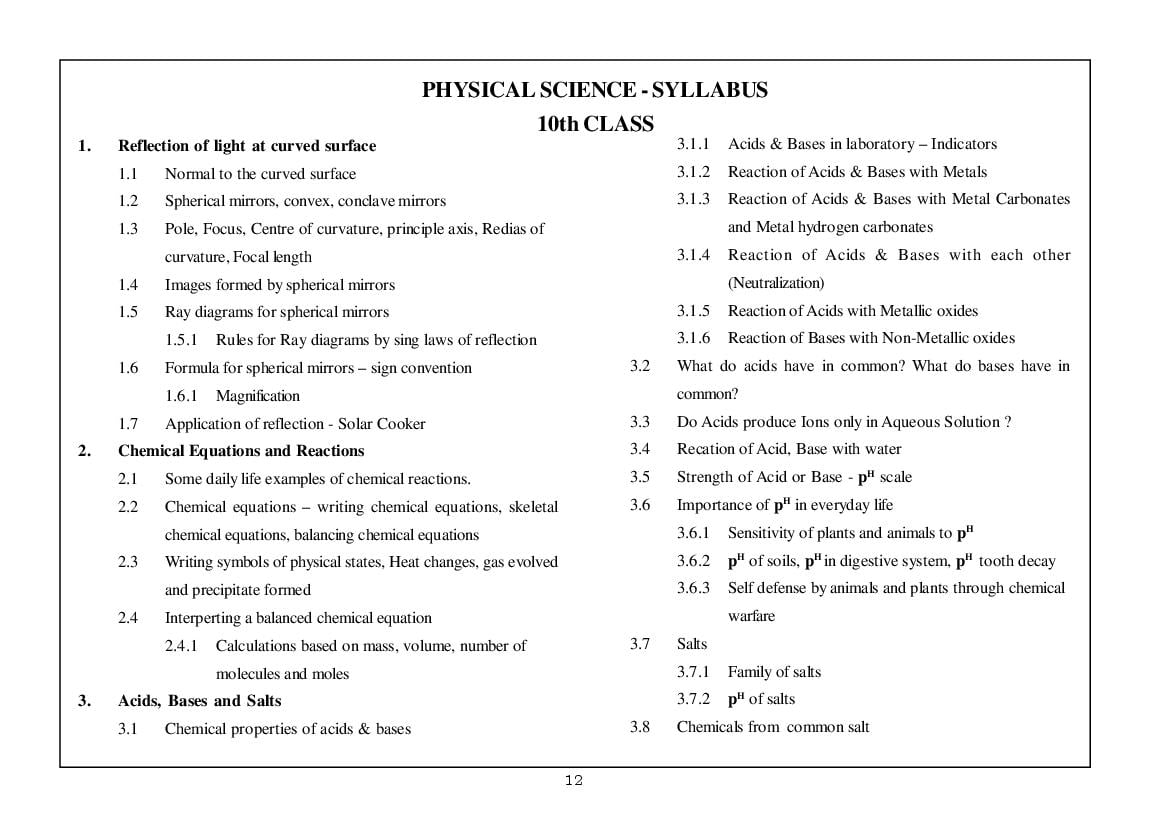
10th CLASS
1. Reflection of light at curved surface 3.1.1 Acids & Bases in laboratory – Indicators
1.1 Normal to the curved surface 3.1.2 Reaction of Acids & Bases with Metals
1.2 Spherical mirrors, convex, conclave mirrors 3.1.3 Reaction of Acids & Bases with Metal Carbonates
1.3 Pole, Focus, Centre of curvature, principle axis, Redias of and Metal hydrogen carbonates
curvature, Focal length 3.1.4 Reaction of Acids & Bases with each other
1.4 Images formed by spherical mirrors (Neutralization)
1.5 Ray diagrams for spherical mirrors 3.1.5 Reaction of Acids with Metallic oxides
1.5.1 Rules for Ray diagrams by sing laws of reflection 3.1.6 Reaction of Bases with Non-Metallic oxides
1.6 Formula for spherical mirrors – sign convention 3.2 What do acids have in common? What do bases have in
1.6.1 Magnification common?
1.7 Application of reflection - Solar Cooker 3.3 Do Acids produce Ions only in Aqueous Solution ?
2. Chemical Equations and Reactions 3.4 Recation of Acid, Base with water
2.1 Some daily life examples of chemical reactions. 3.5 Strength of Acid or Base - pH scale
2.2 Chemical equations – writing chemical equations, skeletal 3.6 Importance of pH in everyday life
chemical equations, balancing chemical equations 3.6.1 Sensitivity of plants and animals to pH
2.3 Writing symbols of physical states, Heat changes, gas evolved 3.6.2 pH of soils, pH in digestive system, pH tooth decay
and precipitate formed 3.6.3 Self defense by animals and plants through chemical
2.4 Interperting a balanced chemical equation warfare
2.4.1 Calculations based on mass, volume, number of 3.7 Salts
molecules and moles 3.7.1 Family of salts
3. Acids, Bases and Salts 3.7.2 pH of salts
3.1 Chemical properties of acids & bases 3.8 Chemicals from common salt
Page 2
3.8.2 Preparation of Sodium Hydroxide, Bleaching powder, 5.4.1 Rerective Index of Prism
Baking soda, Washing soda and uses 5.4.2 Derivation of formula for Rerective Index of Prism
3.8.3 Removing of water of crystallization 5.5 Dispersion
3.8.4 Plaster of Paris 5.5.1 Rainbow
5.6 Scattering of light
4. Refraction of light at curved surface
4.1 Refraction of light at curved surface 6. Structure of atom
4.1.1 Image formatioon - Dervation of curved surface formula 6.1 Spectrum
4.2 Lenses 6.1.1 Wave nature of light
4.2.1 Focal length of the lens 6.2 Electromagnetic Spectrum
4.3 Rules for Ray diagram 6.2.1 Planck’s theory
4.4 Images formed by the lenses 6.3 Bohr’s model of Hydrogen atom and its limitations
4.5 Formula derived for thin lenses 6.3.1 Bohr - Sommerfeld model of an Atom
4.6 Focal length of lens depends on surrounding medium 6.4 Quantum mechanical model of an Atom
6.4.1 Quantum numbers
4.7 Lens maker formula
6.4.2 Main shells, Sub-shells and orbitals in different sub-
5. Human eye and colourful world
shells
5.1 Least distance of distinct vision, Angle of vision
6.4.3 Shapes of s, p & d orbitals
5.2 Structure of human Eye - Focal length of human Eye lens,
6.5 Electronic Configuration of elements in their atoms
accommodation
6.6 n
l x rule, Energies of electronic energy levels (n+l) rule ; Aufbau
5.3 Common accommodation defects of vision -
Principal, Paulis principal, Hund’s Rule of maximum multiplicity,
Myopia, Hypermetropia, presbyopia
Stable configurations.
5.3.1 Power of lens
Page 3
7.1 Need for arrangement of elements in an organized manner 8.5 Valence shell electron pair repulsion theory
7.1.1 Historical background of classification of elements 8.6 Valence bond theory – examples like H2, Cl2, H2O, BF3,
7.2 Doberieners Triads - Limitations CH4, NH3, C2H6, C2H4, C2H2 etc
7.3 Newland’s law of Octaves 8.7 Hybridisation and explaination of H2O, BF3, CH4, NH3 etc.,
7.4 Mendeleev’s Periodic Table (Periodic law, Achievements & molecules
Limitations) 8.8 Properties of Ionic and Covalent Compounds
7.5 Modern Periodic Table. 9. Electric Current
7.5.1 Position of Elements in Modern Periodic Table 9.1 Electric curretnt
Groups
Q
Periods 9.1.1 I=
t
Metals and Non-metals 9.1.2 I = nqAVd
7.5.2 Trends in Modern Periodic Table (Valency, Atomic 9.2 Potential difference
size, Ionization Energy, Electron Affinity, Electro- 9.3 How a battery or a cell works
negativity, Metallic & Non-metallic properties) 9.3.1 EMF
8. Chemical Bonding 9.4 Ohms law and its limitations, resistance, specific resistance,
8.1 Chemical bond definition (brief explaination) factors influencing resistance, electric shock
8.1.1 Lewis Symbols (or) Lewis Dot Structures 9.5 Electric Circuts
8.2 Electronic theory of Valence by Lewis and Kossel 9.5.1 Series and parallel connection of resistances
8.2.1 Octet Rule 9.5.2 Kirchoff’s Laws
8.3 Ionic and Covalent bonds: examples with Lewis Dot formulae 9.6 Electric power
8.3.1 The arrangement of Ions in Ionic componds 9.7 Safety fuses
8.3.2 Factors affecting the formation of cation and anion
Page 4
10.1 Oersted Experment 11.2.2 Extraction of Crude metal from the ore
10.2 Magnetic field – field lines Extracting metals low in the activity series
10.2.1 Magnetic Flux - Magnetic Flux density Extracting metal in the middle of the activity series
10.3 Magnetic field due to currents Extracting metal in the top of the activity series
10.3.1 Due to current carrying straight wire 11.2.3 Refining metals (purification of the crude metal)
10.3.2 Due to circular loop Electrolytic refining
10.3.3 Solenoid Distillation
10.4 Magnetic force on moving charge and current carrying wire Poling
10.4.1 Right hand rule Liquation
10.5 Electric motor 11.3 Corrosion – Prevension of Corrosion
10.6 Electromagnetic induction – Faraday’s law (including magnetic 11.4 Important Processes used in metallurgy
flux) – Lenz law 11.4.1 Smelting
10.6.1 Derivation of Faraday’s law 11.4.2 Rosting
10.6.2 Applications of Faraday’s law of electromagnetic 11.4.3 Calcination
induction
11.5 Flux
10.7 Generators and Alternating – Direct Currents
11.6 Furnace
11. Principles of Metallurgy
12. Carbon and its compounds
11.1 Occurance of Metals in nature
12.1 Introduction of Carbon compounds
11.2 Extractions of metals from the Ores – activity series and related
12.2 Promotion of an Electron – Bonding in Carbon including
metallurgy, flow chart of steps involved in the extraction of
Hybridization
metals from ore.
Page 5
Amorphous Forms 12.10.3Addition reactions
Crystalline Forms (Diamond, Graphite, C60 and Nano tubes) 12.10.4Substitution reactions
12.4 Versatile nature of carbon 12.11 Important carbon compounds
12.4.1 Catenation and tetravalency 12.11.1 Ethanol
12.5 Hydrocarbons 12.11.2 Properties of Ethanol – General properties, reaction of
12.5.1 Open and Closed Chain Hydrocarbons ethanol with sodium, reaction with hot concentrated
12.5.2 Saturated and Unsturated Hydrocarbons sulphuric acid.
12.6 Bonding of carbon with other elements 12.11.3 Ethanoic acid
12.6.1 Functional groups in carbon compounds 12.11.4 Properties of Ethanoic acid – General properties,
12.7 Isomerism Reaction with a base, sodium hydroxide, sodium
12.8 Homologous series (Alkanes, Alkenes and Alkynes) carbonate and sodium hydrogen carbonate
12.9 Nomenclature of Carbon compounds 12.12 Esterification reactions
12.10 Chemical properties of carbon compounds 12.13 Soaps – Saponification, Micelles
12.10.1Combustion reactions 12.13.1 Cleansing action of Soap
Document Details
| Board / Org | Telangana Board |
| Exam | Class 10 |
| Type | Syllabus |
| Pages | 5 |
| Updated | 22 Jul 2026 |