CUSAT CAT 2023 Question Paper Microbiology
Finished viewing? Save it for later —
Download CUSAT CAT 2023 Question Paper Microbiology (PDF · 35 pages)About CUSAT CAT 2023 Question Paper Microbiology
CUSAT CAT 2023 Question Paper Microbiology is available here for free download. Published by Cochin University for CUSAT Common Admission Test, this question paper can be viewed online or downloaded as a PDF (35 pages). Candidates preparing for CUSAT Common Admission Test can use CUSAT CAT 2023 Question Paper Microbiology to understand the exam pattern, the type of questions asked, and the overall difficulty level.
Frequently Asked Questions
How can I download CUSAT CAT 2023 Question Paper Microbiology?
Open this page and click the Download button to save CUSAT CAT 2023 Question Paper Microbiology as a PDF. It is completely free on AglaSem Docs.
Is CUSAT CAT 2023 Question Paper Microbiology free to download?
Yes. CUSAT CAT 2023 Question Paper Microbiology can be viewed online and downloaded as a PDF free of cost on AglaSem Docs.
How many pages does CUSAT CAT 2023 Question Paper Microbiology have?
CUSAT CAT 2023 Question Paper Microbiology contains 35 pages, which you can read online or download together as a single PDF.
Where can I find more CUSAT Common Admission Test study material?
You can find more CUSAT Common Admission Test question papers, sample papers, syllabus, and answer keys on AglaSem Docs.
CUSAT CAT 2023 Question Paper Microbiology – Text
Read the full text of this question paper below — useful to quickly search, copy and reference the content online without downloading the PDF.
📄 View text version (34 pages)
Page 1
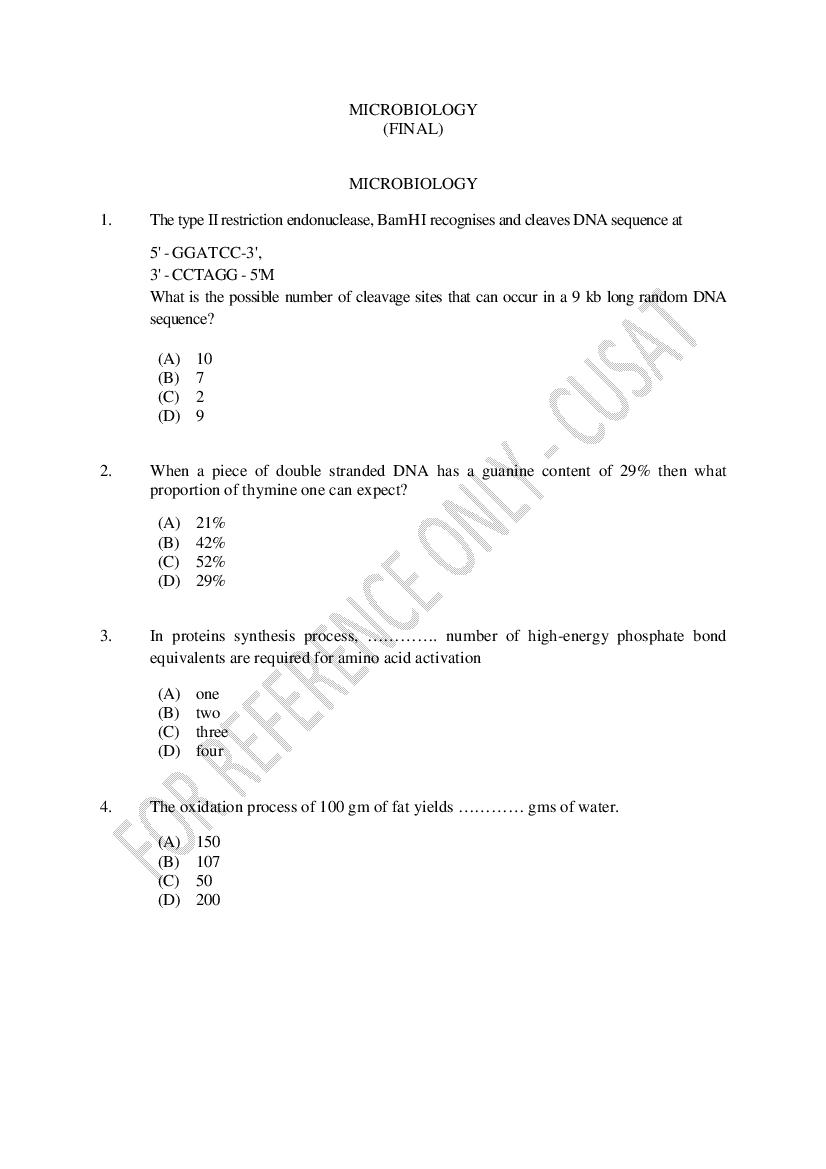
(FINAL)
MICROBIOLOGY
1. The type II restriction endonuclease, BamHI recognises and cleaves DNA sequence at
5' - GGATCC-3',
3' - CCTAGG - 5'M
What is the possible number of cleavage sites that can occur in a 9 kb long random DNA
sequence?
(A) 10
(B) 7
(C) 2
(D) 9
2. When a piece of double stranded DNA has a guanine content of 29% then what
proportion of thymine one can expect?
(A) 21%
(B) 42%
(C) 52%
(D) 29%
3. In proteins synthesis process, …………. number of high-energy phosphate bond
equivalents are required for amino acid activation
(A) one
(B) two
(C) three
(D) four
4. The oxidation process of 100 gm of fat yields ………… gms of water.
(A) 150
(B) 107
(C) 50
(D) 200
Page 2
thought that multicellularity and the consequent demands for cell communications
arose independently in these two lineages. This evolutionary viewpoint accounts well
for the much different mechanisms that plants and animals use for cell
communications. Fungi use signalling mechanisms and components that are very
similar to those used by animals. Which of the dendrogram given below supports the
stated observation?
(A)
(B)
(C)
(D) Difficult to interpret the best supportive observation from the given images
6. The term accuracy over precision is
(A) The closeness of a measured value to the real or actual value
(B) The number of significant or noteworthy figures used in a measurement
(C) A measure of how frequently an experimental value can be repeated
(D) Both terms possess same meaning
7. There are 30% adenines among the bases in a DNA fragment measuring 13.6 nm in
length. The number of pentose, nitrogen base pairs, phosphate groups and hydrogen
bonds in this DNA fragment are respectively.
(A) 52, 20, 20, 40
(B) 40, 80, 80, 96
(C) 20, 40, 52, 40
(D) 80, 40, 80, 96
Page 3
very polar in nature
(A) They have a high degree of symmetry
(B) The electro negativities of carbon and hydrogen are similar
(C) They contain carbon, which is nonpolar
(D) More than one of the above
9. If it takes 15 mL of 2.4 M NaOH to neutralize 250 mL of HCl with an unknown
concentration, what was the original concentration of the acid?
(A) 1M
(B) 0.0144 M
(C) 1.44 M
(D) 0.144 M
10. Radioisotopes are frequently used in the study of cells. Assume a culture of E. coli is
grown in a culture medium containing radioactive sulphur. At the end of 48 hours you
would expect to find the radioactive label located in
(A) enzymes
(B) phospholipids
(C) DNA
(D) RNA
11. Groups of potentially interbreeding natural populations which are reproductively
isolated from other such groups is referred as
(A) Kingdom
(B) Genus
(C) Species
(D) All of the above
12. Identify the serological test used to investigate and diagnose microbial infections in
detecting lower level of antibody (µg/mL) with the highest sensitivity
(A) Complement fixation test
(B) Hemagglutination inhibition test and immunofluorescence
(C) Agglutination
(D) Gel diffusion and Ring precipitation
Page 4
(A) Producing ethyl alcohol
(B) Giving flavour and odour
(C) Leavening
(D) Conditioning the dough to make it workable and helping the dough rise
14. In common bacterial growth curve, the log phase indicates
(A) Exponential increase in bacterial cell number and exponential increase in
bacterial biomass
(B) Exponential increase in the number of bacterial cells and linear increase in
bacterial biomass
(C) Linear increase in the number of bacterial cells and linear increase in bacterial
biomass
(D) Linear increase in the number of bacterial cells and exponential increase in
bacterial biomass
15. What type of radiation is best for destroying microbes in food?
(A) Ultraviolet rays
(B) Infrared rays
(C) Microwaves
(D) Gamma rays
16. Assume that you are a frontline health worker and you have come across a case where
a cricket team of a high school had visited a fast food mall. Within 4 hours after
eating food, 13 of 19 players complained of a diarrheal illness, 7 of whom were
vomiting heavily and 3 others were treated for intractable vomiting by the local
emergency department. There were also 9 individual cases confirmed besides the high
school team. Give the right judgment for the stated situation
(A) Local water contamination
(B) A common organism must be identified to make that judgement
(C) Food-borne illness
(D) Unrelated viral illness
17. Which of the following Gram-positive aerobic bacteria forms endospores?
(A) Clostridium botulinum
(B) Bacillus subtilis
(C) Staphylococcus aureus
(D) Streptomyces griseus
Page 5
(A) Zygospores
(B) Conidia
(C) Ascospores
(D) Basidiospores
19. Which compound is found in the envelopes of Gram-positive bacteria, but not in
Gram-negatives?
(A) Porin proteins
(B) Lipid A
(C) Peptidoglycan
(D) Teichoic acid
20. Which among the following are called as filamentous bacteria?
(A) Spirochetes
(B) Actinomycetes
(C) Vibrios
(D) Mycoplasmas
Page 6
secnidazole plus mebendazole, and quinacrine is shown in above graph. The stools
samples of the cohort adult Cuban patients (456) having signs and/or symptoms
expressive of gastrointestinal infection were examined for Giardia intestinalis
(flagellated parasitic microorganism) through microscopic examination of faecal wet-
mount samples. Giardiasis (diarrheal disease) is typically treated with several
antiparasitic drugs to interrupt the biological cycle of the parasite. The tablets
containing metronidazole (250 mg), secnidazole (500 mg), tinidazole (500 mg),
mebendazole (100 mg) and quinacrine (100 mg) were given. Based on the treatment
outcomes, following conclusions are correct except one. Identify the exception
(A) High-dose mebendazole + secnidazole was well tolerated and cured therefore
encouraging and suggests that the combination can be a highly effective
treatment
(B) Quinacrine was well tolerated and cured highest percentage of patients as
compared with secnidazole and tinidazole
(C) All six different classes of drugs treatment of giardiasis are universally
effective
(D) Treatment with secnidazole and tinidazole cured an additional 24% and 27% of
patients that failed metronidazole treatment, respectively. The data might be
the correct, however cannot be intercepted from the given figure
22. ………….. is one of the best methods to preserve microbial cultures upto 10-15 years
(A) Lyophilization
(B) With water
(C) Glycerol addition
(D) Refrigeration
Page 7
(A) 80S ribosomes are distributed in cytoplasm
(B) Cell wall contains peptidoglycan as major component
(C) Chromosomes do not contain histones
(D) Nucleus is not bounded by nuclear membrane
24. Identify the statement that is not true for bacterial endospores
(A) They are metabolically inactive
(B) They highly resistant structures produced by some bacteria as a defensive
strategy against unfavourable environmental conditions
(C) The bacteria can remain in this suspended spore state until conditions become
favourable and can germinate and return to their vegetative state
(D) In the Schaeffer-Fulton`s method, vegetative cells will be green, and
endospores will be pink
25. Which of the following statements about chromosomes is false?
(A) Eukaryotic organisms usually have a species-specific number of chromosomes
(B) Bacteria almost always have multiple copies of a specific gene on their
chromosome
(C) In eukaryotes, chromosomes often come in pairs, with members of a
chromosome pair carrying the same genes
(D) Prokaryotic cells usually have a single chromosome
26. An organism, when viewed under a compound microscope with an objective lens of
40 X and eye piece of 10 X magnification measured 2000 µ in length. The same
organism when observed under a dissection microscope with a lens of 10 X
magnification, would measure.
(A) 10 µ
(B) 400 µ
(C) 50 µ
(D) 40 µ
27. The ability to maintain conditions inside a living cell that are different from the
conditions in the surrounding environment is called
(A) homeostasis
(B) evolution
(C) the cell theory
(D) metabolism
Page 8
nigrosin or India ink
(A) Positive capsule stain does not require a mordant to precipitate the capsule
(B) Counterstaining with dyes like crystal violet or methylene blue, where bacterial
cell wall does not takes up the dye
(C) Black capsules appear with colourless cells against dark background
(D) Contrast a translucent, darker colored, background with an unstained capsule
29. Addition of salt to a culture medium only allows the salt-tolerant bacteria to grow.
This is an example of a
(A) Enriched media
(B) Selective media
(C) Differential media
(D) Chemically defined media
30. Fifty-four colonies grew in nutrient agar from 1.0 mL of sample withdrawn from a
-5
solution diluted to 10 in a standard plate count procedure. How many cells were in
the original sample?
(A) 5,400,000
(B) 5,400
(C) 2,700,000
(D) 540,000
31. In a clinical laboratory, technician had collected stool samples of a patient where he
could isolate Gram-positive and Gram-negative bacteria. Physician suspects Gram-
negative, lactose-fermenters as the causative agent. From the options mentioned
below, suggest the most powerful, selective and differentiating medium to identify the
pathogens to take an advantage of biochemical properties of target organisms
(A) Mannitol salt agar
(B) MacConkey agar
(C) Nutrient agar
(D) Blood agar
32. Transmission electron microscopy is best for high magnification viewing of
(A) internal structure of fixed cells
(B) internal structure of live, motile cells
(C) surface structure of fixed cell
(D) surface membranes of live, motile cells
Page 9
inhibition is it?
(A) Concerted feedback control
(B) Co-operative feedback control
(C) Cumulative feedback control
(D) Sequential feedback control
34. The third amino acid in the peptidoglycan crosslinking chain is either diaminopimelic
acid or lysine because this amino acid must
(A) have a large R-side chain to fill space in the cell wall
(B) have a free amino group for peptide bond formation
(C) be positively charged for a salt bridge to form
(D) be hydrophillic
35. How many chiral carbons are present in open chain form of D-Galactose?
(A) Chiral carbon absent
(B) 5
(C) 3
(D) 4
36. All given sentences about passive transport are true except
(A) It is facilitated by Membrane Proteins
(B) It is thermodynamically unfavourable
(C) The transported species always moves down its electrochemical gradient
(D) The transported species is not accumulated above the equilibrium
concentration
37. Which one of the following is not a non-polar solvent?
(A) Toluene
(B) Chloroform
(C) Ethanol
(D) Benzene
Page 10
(A) Both have coiled shape
(B) Both function mainly in energy storage
(C) Both have the same molecular weight
(D) Both are homopolysaccharides
39. Glucose is the most abundant monosaccharide which is also used as an energy source.
How many stereocenters are present in linear and cyclic structures of glucose
respectively
(A) 5 and 5
(B) 5 and 4
(C) 4 and 5
(D) 4 and 4
40. What is the concentration in moles/liter of the hydrogen ion, if pH of a solution is 7?
7
(A) 7 × 10
(B) 7 × 10
−7
7
(C) 1 × 10
(D) 1 × 10
−7
41. If the distance between two consecutive base pairs is 0.34 nm and the total number of
base pairs of a DNA double helix in a Amoeba dubia is 6.7×10⁹ bp, then the length of
the DNA is approximately
(A) 3.9 m
(B) 2.2 m
(C) 3.1 m
(D) 1.9 m
42. Antifoaming agents are added during fermentation process to prevent the foam
formation. Following are the characteristics of the antifoam agents except
(A) Most of the antifoam agents are insoluble in water
(B) They are surface active agents
(C) They are highly viscous
(D) They help to rupture the air bubbles and break down the surface foam
Page 11
(A) 1st carbon
(B) 2nd carbon
(C) 3rd carbon
(D) None of the above
44. Match the following
Column A Column B
(1) Biocontrol agent (i) Rhizobium spp.
(2) Citrus canker disease (ii) Trichoderma spp.
(3) Nitrogen fixation (iii) Escherichia coli
(4) Faecal pollution indicator (iv) Xanthomonas spp.
(A) (1)-(ii), (2)-(iv), (3)-(i), (4)-(iii)
(B) (1)-(iii), (2)-(iv), (3)-(i), (4)-(ii)
(C) (1)-(ii), (2)-(i), (3)-(iv), (4)-(iii)
(D) (1)-(i), (2)-(ii), (3)-(iii), (4)-(iv)
45. Select the correct option using information given below
I Bioaugmentation: It is the addition of microorganisms that have the ability to
biodegrade recalcitrant molecules in the polluted environment
II Biosorption: It is the removal/binding of desired substances from aqueous
solution by biological material
III Bioremediation: A process of detoxifying or degrading contaminants present in
the soil, wastewater, or industrial sludge by biological means
(A) I and II are true
(B) Only I is true
(C) I, II and III are true
(D) II and III are true
46. Which of the following processes produces hydrogen sulfide?
(A) Anaerobic respiration
(B) Oxygenic photosynthesis
(C) Anoxygenic photosynthesis
(D) Chemoautotrophy
Page 12
(A) Polymyxin
(B) Rifamycin
(C) Cycloserine
(D) Acyclovir
48. An E. coli cell which carries a lambda prophage is immune to a lytic infection by a
second lambda virus because
(A) the second virus cannot adsorb to the cell
(B) The second virus cannot inject its DNA
(C) Proteins from prophage's lytic genetic program prevent replication of second
virus
(D) Proteins from prophage's lysogenic genetic program prevent replication of
second virus
49. Identify the following cofactor
(A) Pyrimidine nucleotide
(B) Pyridoxal phosphate
(C) Pantothenic acid
(D) Thiamine
50. Which of the following is considered as one of the essential amino acid for humans?
(A) Lysine
(B) Proline
(C) Cysteine
(D) Asparagine
51. Which of the following reactions is not a part of Calvin cycle?
(A) Ribulose 1, 5 - bisphosphate to 3 - Phosphoglycerate
(B) 3 - Phosphoglycerate to 1, 3- Bisphosphoglycerate
(C) 1, 3 - Bisphosphoglycerate to 3 - Phosphoglycerate
(D) 3 - Phosphoglycerate to Glyceraldehyde 3-Phosphate
Page 13
Column A Column B
(1) Eadie-Hofstee plot (i) [S]/ν is plotted against [S]
(2) Hanes–Woolf plot (ii) 1/v is plotted against 1/[S]
(3) Lineweaver and Burk plot (iii) v is plotted against v/[S]
(A) (1)-(iii), (2)-(ii), (3)-(i)
(B) (1)-(iii), (2)-(i), (3)-(ii)
(C) (1)-(i), (2)-(iii), (3)-(ii)
(D) (1)-(i), (2)-(ii), (3)-(iii)
53. What percentage solution of sodium hypochlorite (bleach) is recommended as a
routine laboratory disinfectant?
(A) 5%
(B) 10 %
(C) 15 %
(D) 20 %
54. Match the following amino acids with their characteristic.
Column A Column B
(1) Positively charged R group (i) Glutamate
(2) Negatively charged R group (ii) Leucine
(3) Polar uncharged R group (iii) Tyrosine
(4) Aromatic R group (iv) Threonine
(v) Methionine
(vi) Histidine
(A) (1)-(iv), (2)-(i), (3)-(vi), (4)-(iv)
(B) (1)-(vi), (2)-(i), (3)-(v), (4)-(iii)
(C) (1)-(iv), (2)-(i), (3)-(ii), (4)-(iii)
(D) (1)-(vi), (2)-(i), (3)-(iv), (4)-(iii)
55. A buffer solution of pka7.5 would have buffering capacity in the range of
(A) pH 6.5 to 8.5
(B) pH less than 7.5
(C) pH more than 7.5
(D) pH 7
Page 14
(A) Enantiomers
(B) Mirror image isomers
(C) Racemic mixtures
(D) Epimers
57. An enzyme catalyzed reaction would achieve maximum rate when
(A) KM becomes equal to substrate concentration (KM = S)
(B) KM of an enzyme is lower than the substrate concentration (KM<<S)
(C) KM of an enzyme is higher than the substrate concentration (KM>>S)
(D) KM of an enzyme is half of the substrate concentration (KM 1/2 S).
58. Which class of the immunoglobulin will increase in case of an allergic reaction?
(A) IgM
(B) IgE
(C) IgG
(D) IgA
59. The difference between oxidative phosphorylation and substrate level phosphorylation
is
(A) ADP is directly phosphorylated to ATP in substrate level phosphorylation
(B) Substrate level phosphorylation does not produce any ATP
(C) Oxidative phosphorylation takes place in glycolysis
(D) ATPs are generated by transferring electron through the electron transfer chain
60. Which eukaryotic RNA polymerase makes tRNAs?
(A) RNA polymerase III
(B) RNA polymerase II
(C) All type of polymerases I, II, III
(D) RNA polymerase I
61. In the reaction, C6H12O6+ 6O2 → 6CO2 + 6H2O + energy, which component is being
oxidized?
(A) C6H12O6
(B) H2O
(C) O2
(D) CO2
Page 15
approximately …………. Codons.
(A) 40
(B) 120
(C) 360
(D) 1200
63. Electron Transport chain contains the following components :
I. Cytochrome C-oxidase;
II. Succinate/COQ oxidoreductase;
III. NADH : COQ oxidoreductase;
IV. Coenzyme Q: cytochrome oxidoreductase.
Choose the correct sequence of the components in which they occur in electron
transport chain:
(A) II, III, IV, I
(B) I, IV, III, II
(C) IV, III, II, I
(D) III, II, IV, I
64. A solution with a pH of 6 has ………… than a solution with a pH of 9
(A) 3 times more H+
(B) 1000 times more H+
(C) 1000 times less H+
(D) 3 times less H+
65. Toxoids are often prepared from toxins. Identify the correct statement.
(A) Toxoids are immunogenic and non-toxic
(B) Toxoids are toxic and immunogenic
(C) Toxoids are non-immunogenic and non-toxic
(D) None of the statements are true
66. Which of the following is not true about bacterial flagella?
(A) They spin like wheels, either clockwise or counter-clockwise
(B) They use cytoplasmic ATP as their primary energy source
(C) They are constructed largely of a single protein called flagellin
(D) Most of their length consists of a hollow, rigid protein tube
Page 16
67. In a population, of 1 × 10 bacterial cells, if there is 50% killing, ………… number of
cells would remain viable
(A) 50
4
(B) 1 × 10
8
(C) 0.5 × 10
8
(D) 0.2 × 10
68. An important virulence factor of coagulase-positive staphylococci is Protein A. How
does Protein A aid in virulence?
(A) Hydrolyzes secretory IgA
(B) Binds the Fc region of IgG, decreases opsonization (Phagocytosis)
(C) Extracts iron from plasma proteins
(D) Binds Factor H, prevents activation of complement
69. In the extracellular medium, DNA-degrading enzymes would likely be preventing the
transfer of DNA by
(A) natural transformation
(B) conjugal transfer of a self-transmissible plasmid
(C) generalized phage transduction
(D) specialized phage transduction
70. The magnitude of BOD of waste water is related to
(A) bacterial count
(B) amount of inorganic material
(C) amount of organic material
(D) bacterial count along with inorganic material
71. The blue-white screening is a technique that allows the rapid and convenient detection
of recombinant bacteria in vector-based molecular cloning experiments. In this
screening process, clones that metabolize X-gal turn
(A) Red
(B) Green
(C) Blue
(D) Colourless
Page 17
available. How much volume of stock solution is required to prepare the desired
solution
(A) 10.3 mL
(B) 30 mL
(C) 9.20 mL
(D) 80 mL
73. Following graph shows the effect of residual limiting substrate concentration on the
specific growth rate of a bacterium. Looking at the graph choose the correct answer
(A) Zone A to B is equivalent to the exponential phase in batch culture
(B) Zone C to A is equivalent to the deceleration phase in batch culture
(C) Zone C to A is equivalent to the exponential phase in batch culture
(D) Both (A) and (B) above
74. Cold agglutinin test is useful for the diagnosis of
(A) Haemophilus influenzae
(B) Neisseria menigitidis
(C) Cryptococcus neoformans
(D) None of the above
75. A girl who pricked her finger while pruning some rose bushes develops a local
pustule that progresses to an ulcer. Several nodules then develop along the local
lymphatic drainage. The most likely agent is
(A) Aspergillus fumigatus
(B) Sporothrix schenckii
(C) Cryptococcus neoformans
(D) Candida albicans
Page 18
76. Agar, which is the solidifying agent in many bacterial culture media, is part of the cell
wall of
(A) Chlorophyta
(B) Chrysophyta
(C) Pyrrophyta
(D) Rhodophyta
77. Phytoalexins are produced by
(A) algae in response to light
(B) algae as a part of defense
(C) plant in response to light
(D) plant as a part of defense
78. Frustules made of silica are characteristic of
(A) Euglenoids
(B) Diatoms
(C) Sea weed
(D) Spirullina
79. The breakdown of glucose occurs by the process known as
(A) Embden – Meyerhol – Parnas pathway
(B) Cori cycle
(C) Krebs – Henseleit cycle
(D) Krebs cycle
80. The …………. is the vegetative body of algae
(A) Mycelium
(B) Plasmodium
(C) Pseudoplasmodium
(D) Thallus
81. Members of this phylum establish a successful symbiotic relationship with the roots
of trees. Identify.
(A) Ascomycota
(B) Deuteromycota
(C) Basidiomycota
(D) Glomeromycota
Page 19
(A) Plant growth producing rhizome
(B) Plant growth promoting rhizobacteria
(C) Pests growth producing rhizome
(D) Pest growth promoting rhizobacteria
83. Wounds in plants are healed by the activity of
(A) Apical meristem
(B) Lateral meristem
(C) Secondary meristem
(D) Intercalary meristem
84. Bulliform cells are found in the leaves of
(A) Sunflower
(B) Wheat
(C) Potato
(D) Tinospora
85. Largest botanical garden in India is at
(A) Ooty
(B) Bangalore
(C) Kolkata
(D) Wayanad
86. Testa of a seed is produced from
(A) Hilum
(B) Ovary wall
(C) Funicle
(D) Outer integument of ovule
87. A gymnospermic plant
(A) produces flowers
(B) possess no vascular tissues
(C) produces seeds in cones
(D) None of the above
Page 20
(A) Indole acetic acid
(B) Phenoxy acetic acid
(C) Naphthalene acetic acid
(D) Both Indole acetic acid and Phenoxy acetic acid
89. Which of the following is not an insectivorous plant?
(A) Nepenthes
(B) Utricularia
(C) Drosera
(D) Dichanthium
90. The basal cell of Oedogonium that anchors the filamentous plant body to the
substratum is called
(A) Rhizoids
(B) Haustoria
(C) Holdfast
(D) Roots
91. In lichens, paraphyses arise from the base of …………….. and grow upwards
(A) Hypothecium
(B) Epithecium
(C) Ascocarp
(D) None of the above
92. Xanthomonas citri causes a disease called
(A) Banana bunchy top
(B) Citrus canker
(C) White rust
(D) None of the above
93. A characteristic feature of bryophytes is
(A) A dominant and parasitic sporophyte
(B) A dominant and spore producing gametophyte
(C) A small sporophyte phase, which is dependent on the gametophyte
(D) Sporophytes stay for a long duration
Page 21
(A) Bast fibres
(B) Companion cells
(C) Phloem parenchyma
(D) Sieve cells
95. Megasporangium in Gymnosperms is also called as
(A) Macrosporangiate
(B) Nucellus
(C) Microsporangium
(D) Male strobili
96. Choose the non-endospermic seed
(A) Pea
(B) Maize
(C) Rice
(D) Wheat
97. In a photosynthesis experiment, plant growth will be best when exposed to
(A) Red and Blue lights
(B) Yellow and orange lights
(C) Green light
(D) Blue and green lights
98. Cellular totipotency was demonstrated by
(A) Theodore Schwann
(B) F. C. Steward
(C) Reinert
(D) Robert Hooke
ZOOLOGY
99. A rare and endangered animal in Silent Valley is
(A) Tiger
(B) Musk deer
(C) Rhinosores
(D) Lion-tailed macaque
Page 22
(A) Estrogen
(B) Insulin
(C) Oxytocin
(D) Androgen
101. Klinefelter’s syndrome is caused by
(A) YYY
(B) XYY
(C) XXX
(D) XXY
102. Trisomy of chromosome 18 in humans results in
(A) Down’s syndrome
(B) Burkitt’s syndrome
(C) Edward’s syndrome
(D) Turners syndrome
103. Bats belong to the class
(A) Reptilia
(B) Amphibia
(C) Aves
(D) Mammalia
104. Which is the first transgenic animal developed for producing AAT in milk?
(A) Goat
(B) Sheep
(C) Cow
(D) Buffalo
105. Leydig cells secrete
(A) Growth hormone
(B) Estrogen
(C) Androgen
(D) Gonadotrophin
Page 23
(A) Internal ossicles
(B) Malleus and incus
(C) Cochlea
(D) Corpus callosum
107. The cells in your skin have a different shape and different function from the cells in
your liver because the two types of cells have different
(A) DNA
(B) Proteins
(C) Lipids
(D) Carbohydrates
108. Absorption of most nutrients from the digestive tract occurs in the
(A) Liver
(B) Stomach
(C) Pancreas
(D) Small intestine
109. A person with type AB blood has
(A) A antigens and B antibodies
(B) Both (A) and (B) antigens and A and B antibodies
(C) No A or B antigens but both A and B antibodies
(D) Both (A) and (B) antigens but no A or B antibodies
110. Movement of cancer cells to a new site where a secondary tumour begins is called
(A) Anaplasia
(B) Metastasis
(C) Promotion
(D) Vascularization
111. The artery that provides oxygen and nutrients to heart tissue is the
(A) carotid
(B) systemic
(C) coronary
(D) pulmonary
Page 24
(A) Trypsin
(B) Pepsin
(C) Glucokinase
(D) Carboxypeptidase
113. The cell wall in Gram-positive bacteria is made up of
(A) Peptidoglycans
(B) Polysaccharides
(C) Proteins
(D) Lipopolysaccharides
114. The attachment of mammalian embryo to the uterine wall is called as
(A) Incubation
(B) Implantation
(C) Induction
(D) Immobilisation
115. Circular DNA molecules are present in
(A) Mitochondria
(B) Lysosomes
(C) Golgi complex
(D) Peroxisomes
116. The identification of chromosomes of a species based on the morphological features is
known as
(A) Karyotyping
(B) HLA typing
(C) Karyology
(D) Cytokinesis
117. The first successful experiment on animal cloning was performed by
(A) Bateson and Punnet
(B) Korenberg and Nirenberg
(C) John Gurdon
(D) Ian Wilmut
Page 25
(A) Reptiles
(B) Amphioxus
(C) Frog
(D) Eutherian mammals
119. A transplant that occurs between identical twins is called
(A) Isograft
(B) Autograft
(C) Allograft
(D) Zenograft
120. Which of the following is a non-poisonous snake?
(A) Cobra
(B) Pit viper
(C) Viper
(D) Sand boa
Page 26
121.
Figure represents the percentage of cotton hectares planted with Bt cotton
producing one toxin (gray) or two toxins (black) in four countries. All Bt cotton
produced Cry1Ac. Identify the statement which is NOT TRUE from the given
following options.
(A) In Australia and India, all two-toxin cotton produced are Cry1Ac and Cry2Ab
(B) In the United States from 2004 to 2012, 86% of two-toxin cotton produced
Cry1Ac and Cry2Ab and 14% produced Cry1Ac and Cry1F
(C) The ranking of each country in terms of 2012 cotton production (percentage of
world production) was 1 for Solutioned States, 2 for China, 3 for Australia and
4 for India
(D) In china, all two-toxin cotton produced Cry1Ac and not Cry2Ab
122. Arrange in a sequence the given protocol for DNA fingerprinting:
(a) Denaturating DNA
(b) Blotting
(c) Extraction of DNA
(d) Fragmenting DNA
(e) Separation of DNA fragments by electrophoresis
(f) Hybridisation with the probe
(g) Exposure on film to make a DNA fingerprint
(A) a c b d e f g
(B) c d e a b f g
(C) a c d e b f g
(D) c e d b a f g
Page 27
(A) Copper and strontium
(B) Magnesium and MgCl2
(C) Silver with AgCl2 or Mercury with calomel
(D) Cesium chloride and salts of calcium
124. …………. treatment is less toxic and widely used as fusagens to agglutinate cells in
PTC (Plant Tissue Culture)
(A) High pH
(B) Polyethylene glycol (PEG)
(C) High calcium
(D) High temperature
125. An Hfr strain of E. coli contains
(A) A vector of yeast or bacterial origin which is used to make many copies of a
particular DNA sequence
(B) A bacterial chromosome with a Transposon
(C) A bacterial chromosome with the F factor inserted
(D) A plasmid co integrating with another plasmid
126. Putrefaction process is a
(A) Anaerobic decomposition of protein & produces foul smelling compounds
(B) Analysis of proteins
(C) Synthesis of proteins
(D) Denaturation of proteins
Page 28
polyacrylamide gel electrophoresis and digested them with trypsin. When the masses
of the peptides were measured by MALDI-TOF mass spectroscopy, the peptides from
the two proteins were found to be identical except one. For this peptide, the mass–to-
charge (m/z) values differed by 80. Can you suggest a possible difference between
two peptides that might account for the observed m/z difference?
(A) An m/z difference of 80 corresponds to a phosphate
(B) An m/z difference of 80 corresponds to a difference in amino acid sequences
(C) An m/z difference of 80 corresponds to a change in amino acid position
(D) An m/z difference of 80 is due to degradation of protein
128. The Cdc16, Cdc23, Cdc27 mutants displayed identical phenotypes, which suggested
that the encoded proteins work together to execute common functions. Investigators
hypothesized that they exist in a multi-protein complex. What technique would you
use to test this hypothesis most rapidly?
(A) X-ray diffraction
(B) Ion exchange chromatography
(C) Nuclear magnetic resonance
(D) Co-immunoprecipitation
129. Which of the following techniques would serve best as the basis for a rapid, highly
sensitive blood test to detect circulating cancer cells that carry Bcr-Abl gene?
(A) DNA sequencing
(B) PCR analysis
(C) Flow cytometry
(D) Western blotting
Page 29
the cDNA was introduced into Pseudomonas and Clostridium species; the colonies
that they formed were florescent and non -florescent respectively. What could be the
possible reason behind these pertinent observations that provided important insight
into how GFP becomes fluorescent?
(A) When bacteria grow anaerobically, they express large amount of GFP that
fluoresces
(B) GFP forms insoluble protein aggregates
(C) In absence of oxygen, GFP does not become fluorescent
(D) Fluoresce by GFP is a concentration independent mechanism
131. Predict which of the following organisms will have the highest percentage of
unsaturated fatty acids in their membranes?
(A) Antarctic fish
(B) Thermophilic bacteria
(C) Human being
(D) Desert iguana
132. Which of the phospholipids listed below is present in very small quantities in the
plasma membranes of mammalian cells?
(A) Phosphatidylcholine
(B) Phosphatidylethanolamine
(C) Phosphatidylinositol
(D) Phosphatidylserine
133. Suppose you are working on a newly discovered lithotroph (isolated from deep
beneath the Earth’s surface, living on rocks under anaerobic conditions, surviving on
CO2 as their sole source of carbon) and are trying to determine what it uses as a source
of electrons for reducing CO2 and for producing energy. Which one of the following
conditions must be met for a molecule to serve as a useful electron donor?
(A) Oxidation of the molecule occurs with a decrease in free energy
(B) Oxidation of the molecule occurs with an increase in free energy
(C) Reduction of the molecule occurs with a decrease in free energy
(D) Reduction of the molecule occurs with an increase in free energy
Page 30
symmetrical “head to head” dimer. Each of the two subunits of the dimer recognizes a
particular short sequence of nucleotides in DNA. If the sequence of nucleotides
recognised by one subunit is represented as sequences in DNA representing the bind
site for the Cro dimer by an arrow ( ), so that the “head” of the arrow
corresponds to DNA recognized by the head of the subunit, which of the following is
correct
(A)
(B)
(C)
(D)
135. How might a chromosomal rearrangement contribute to development of leukaemia?
(A) By creating a point mutation in Ras, increasing the GTPase activity
(B) By fusing a highly active promoter to a tumor suppressor gene
(C) By deleting the promoter that controls expression of an oncogene
(D) By deleting exons encoding a domain that inhibits kinase activity
136. The investigators hypothesized that the viral protein was transported between the
Golgi stacks inside vesicles. An alternative hypothesis, however, was that the viral
protein was released from one Golgi apparatus and taken up by the other, without
being packaged into vesicles. Which of the following experiments would best
distinguish these two hypothesis?
(A) Add protease to the system and determine whether the viral protein is degraded
(B) Determine whether transport still occurs when cadherin is removed from the
extract
(C) Test for association of GlcNAc-modified viral protein with membranes by
centrifugation
Test whether transport between Golgi stacks is blocked by addition of
(D)
detergent.
137. To isolate yeast mutants that cannot traverse the cell division cycle, what kind of
mutation did the investigators need to obtain?
(A) Null mutation
(B) Gain-of-function mutation
(C) Loss-of-function mutation
(D) Conditional mutation
Page 31
proteolytic destruction, cell extracts were passed over an ion-exchange column. The
ion-exchange column was then washed with buffer and eluted with high salt. This
resulted in two fractions: proteins that bound to the column (bound fraction) and
proteins that flowed through the column (unbound protein). No proteolytic activity
could be detected in either of these fractions, even though the starting extract had
robust activity. What researcher should do the next?
(A) Carry out additional purification steps and test for the activity
(B) Combine bound and unbound fractions and test for the activity
(C) Improve the sensitivity of the assay used to detect proteolysis
(D) Use a gel-filtration column instead of an ion-exchange column
139. Which of the following is an equilibrium method that can be used to accurately
determine DNA-protein dissociation constants?
(A) Site directed mutagenesis
(B) Chromatin immunoprecipitation
(C) Footprinting
(D) Electrophoretic mobility shift assay
140. In gas chromatography, the concentration of a substance can be determined by
(A) comparison of the area under the peak produced by the substance with the
areas under the peaks produced by standard solutions
(B) calculation of the area under the curve of the substance
(C) comparison of the area under the curve of the substance with that of a standard
(D) measurement of the height of the peak produced by the substance
141. The Atomic Force microscopy images are generated by
(A) Deflection of laser by Cantilever
(B) Laser scanning
(C) Optical scanning
(D) Cantilever probe
142. The threat or menace of antibiotic resistance worsened after extensive use of broad
spectrum antibiotics to treat secondary bacterial infections in patients suffering with
COVID-19. Which antibiotics play an important role in the treatment in COVID-19
cases?
(A) ceftriaxone/cefotaxime plus macrolide
(B) empirical antibiotics
(C) ampicillin/amoxicillin plus clavulanic acid or sulbactam
(D) no antibiotic has yet been adequately defined, and no criteria have been
established for antibiotic treatment, type and duration
Page 32
ampicillin. MIC of AgNPs and ampicillin against Staphylococcus aureus was found to
be 128 and 64 µg/mL respectively. When both agents were used together the MIC
value was found to be 8 µg/mL. The therapy used here in treating drug resistant S.
aureus infections can be termed as
(A) Combinatorial treatment
(B) Photodynamic light therapy
(C) Synergistic combinations and targeted therapy
(D) Both (A) and (C) has same meaning
ENVIRONMENTAL SCIENCE
144. Which one of the following is a wrong statement?
(A) Ozone in upper part of atmosphere is harmful to animals
(B) Most of the forests have been lost in tropical areas
(C) Greenhouse effect is a natural phenomenon
(D) Eutrophication is a natural phenomenon in freshwater bodies
145. …………. is an example of non-ionizing radiation
(A) X rays
(B) α rays
(C) UV
(D) β rays
146. Littoral zone in a lake, river or sea is the
(A) The zone below where light penetration stops and also algae grow
(B) The depth above the light compensation point
(C) Around the edge where light penetrates to the bottom
(D) The deepest part of the lake, river or sea which is often anaerobic
147. For a time difference of three hours, the longitudinal distance will be equal to
(A) 45°
(B) 30°
(C) 60°
(D) 15°
Page 33
Figure represents ten-year trends of contamination rates with organochlorine
pesticides (OCPs) of organic and conventional fruits and vegetables. A total of 67,154
samples (1,097 organic and 66,057 conventional) were examined. From the given
figure following interpretations are CORRECT EXCEPT ONE
(A) The rates of contamination appeared to be 3-fold higher in organic than in
conventional produce
(B) The lowest percent of frequency of OCPs detection was found in the year 1993
for conventionally grown foods
(C) Occurrence of banned OCPs was more frequent among organic vegetables
(D) Around 10 to 15% of OCPs were detected in organically grown produce
149.
Identify the correct names for the life cycle stages of the butterfly
(A) 1. Egg 2. Butterfly 3. Pupa 4. Larva
(B) 1. Pupa 2. Butterfly 3. Egg 4. Larva
(C) 1. Larva 2. Butterfly 3. Egg 4. Pupa
(D) 1. Egg 2. Butterfly 3. Larva 4. Pupa
150. The biochemical oxygen demand is computed by
(A) Dissolved oxygen / Dilution factor
(B) Dissolved oxygen + Dilution factor
(C) Dissolved oxygen – Dilution factor
(D) Dissolved oxygen * Dilution factor
Page 35
Subject Name: MICROBIOLOGY
SI No. Key SI No. Key SI No. Key SI No. Key SI No. Key
1 C 31 B 61 A 91 C 121 C
2 A 32 A 62 B 92 B 122 B
3 B 33 D 63 D 93 C 123 C
4 B 34 B 64 B 94 B 124 B
5 A 35 D 65 A 95 B 125 C
6 A 36 B 66 B 96 A 126 A
7 D 37 C 67 C 97 A 127 A
8 B 38 D 68 B 98 B 128 D
9 D 39 C 69 A 99 D 129 B
10 A 40 D 70 C 100 A 130 C
11 C 41 B 71 C 101 D 131 A
12 B 42 C 72 A 102 C 132 C
13 A 43 B 73 D 103 D 133 C
14 A 44 A 74 A 104 B 134 B
15 D 45 C 75 B 105 C 135 D
16 B 46 C 76 D 106 C 136 A
17 B 47 D 77 D 107 B 137 D
18 B 48 D 78 B 108 D 138 B
19 D 49 B 79 A 109 D 139 C
20 B 50 A 80 D 110 B 140 A
21 C 51 C 81 D 111 C 141 A
22 A 52 B 82 B 112 C 142 D
23 A 53 B 83 D 113 A 143 A
24 D 54 D 84 D 114 B 144 A
25 B 55 A 85 C 115 A 145 C
26 C 56 D 86 D 116 A 146 C
27 A 57 B 87 C 117 C 147 A
28 D 58 B 88 C 118 A 148 D
29 B 59 A 89 D 119 A 149 B
30 A 60 A 90 C 120 D 150 D
Document Details
| Board / Org | Cochin University |
| Exam | CUSAT Common Admission Test |
| Type | Question Paper |
| Pages | 35 |
| Updated | 22 Jul 2026 |