AIBE 20 Question Paper
Finished viewing? Save it for later —
Download AIBE 20 Question Paper (PDF · 25 pages)About AIBE 20 Question Paper
AIBE 20 Question Paper is available here for free download. Published by BCI for AIBE, this question paper can be viewed online or downloaded as a PDF (25 pages). Candidates preparing for AIBE can use AIBE 20 Question Paper to understand the exam pattern, the type of questions asked, and the overall difficulty level.
Frequently Asked Questions
How can I download AIBE 20 Question Paper?
Open this page and click the Download button to save AIBE 20 Question Paper as a PDF. It is completely free on AglaSem Docs.
Is AIBE 20 Question Paper free to download?
Yes. AIBE 20 Question Paper can be viewed online and downloaded as a PDF free of cost on AglaSem Docs.
How many pages does AIBE 20 Question Paper have?
AIBE 20 Question Paper contains 25 pages, which you can read online or download together as a single PDF.
Where can I find more AIBE study material?
You can find more AIBE question papers, sample papers, syllabus, and answer keys on AglaSem Docs.
AIBE 20 Question Paper – Text
Read the full text of this question paper below — useful to quickly search, copy and reference the content online without downloading the PDF.
📄 View text version (25 pages)
Page 1
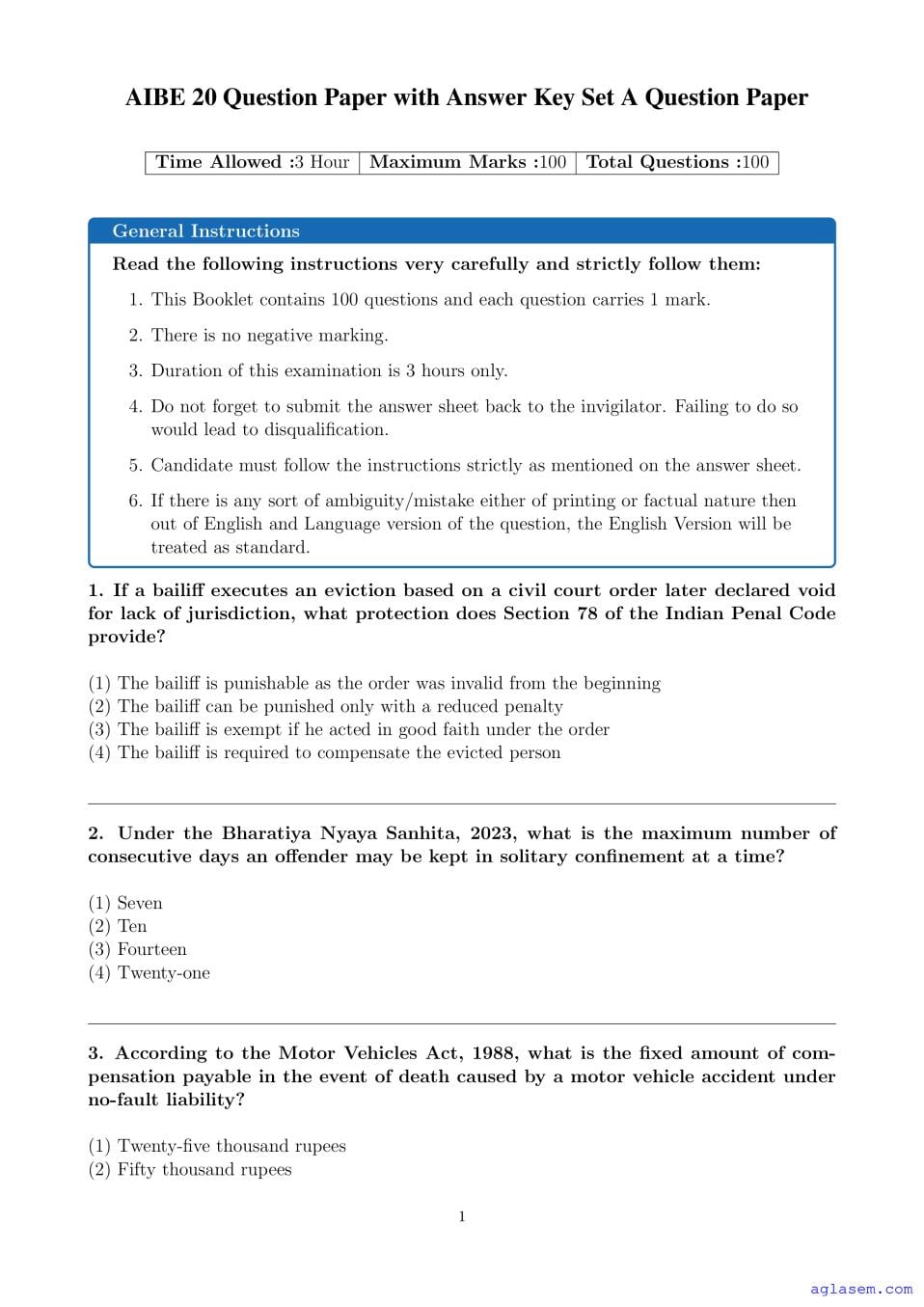
Time Allowed :3 Hour Maximum Marks :100 Total Questions :100
General Instructions
Read the following instructions very carefully and strictly follow them:
1. This Booklet contains 100 questions and each question carries 1 mark.
2. There is no negative marking.
3. Duration of this examination is 3 hours only.
4. Do not forget to submit the answer sheet back to the invigilator. Failing to do so
would lead to disqualification.
5. Candidate must follow the instructions strictly as mentioned on the answer sheet.
6. If there is any sort of ambiguity/mistake either of printing or factual nature then
out of English and Language version of the question, the English Version will be
treated as standard.
1. If a bailiff executes an eviction based on a civil court order later declared void
for lack of jurisdiction, what protection does Section 78 of the Indian Penal Code
provide?
(1) The bailiff is punishable as the order was invalid from the beginning
(2) The bailiff can be punished only with a reduced penalty
(3) The bailiff is exempt if he acted in good faith under the order
(4) The bailiff is required to compensate the evicted person
2. Under the Bharatiya Nyaya Sanhita, 2023, what is the maximum number of
consecutive days an offender may be kept in solitary confinement at a time?
(1) Seven
(2) Ten
(3) Fourteen
(4) Twenty-one
3. According to the Motor Vehicles Act, 1988, what is the fixed amount of com-
pensation payable in the event of death caused by a motor vehicle accident under
no-fault liability?
(1) Twenty-five thousand rupees
(2) Fifty thousand rupees
1
Page 2
(4) Seventy-five thousand rupees
4. Assertion (A): An employee can be deemed to be in continuous service for one
year only if he has worked for 365 days in the preceding twelve months without
any interruption.
Reason (R): Under the Payment of Gratuity Act, 1972, continuous service may
also include periods of interruption due to sickness, accident, leave, lay-off, strike,
or lock-out not caused by the employee’s fault.
(1) Both (A) and (R) are true, and (R) is the correct explanation of (A)
(2) Both (A) and (R) are true, but (R) is not the correct explanation of (A)
(3) (A) is true, but (R) is false
(4) (A) is false, but (R) is true
5. Statement 1: Under the Indian Penal Code, if a person harbours an offender
who has escaped custody for an offence punishable with imprisonment up to 3
years, he shall be punished with imprisonment up to 7 years.
Statement 2: The law provides an exception for harbouring or concealing by the
husband or wife of the offender.
(1) Both Statements 1 and 2 are false
(2) Only Statement 1 is true
(3) Only Statement 2 is true
(4) Both the Statements are true
6. If a person attempts an offence punishable with a maximum of 10 years impris-
onment, what is the maximum years of imprisonment that can be imposed under
Section 62 of the Bharatiya Nyaya Sanhita, 2023?
(1) Five years
(2) Seven years
(3) Ten years
(4) Three years
7. A juvenile aged 14 years is brought before the court for an offence not punish-
able with death or imprisonment for life. Under which provision of the Code of
Criminal Procedure, 1973, will the case primarily fall?
(1) Section 27
(2) Section 125
2
Page 3
(4) Section 482
8. Under Section 290(1) of Bharatiya Nagarik Suraksha Sanhita, 2023, within how
many days from the date of framing of charge can an accused file an application
for plea bargaining?
(1) 15
(2) 30
(3) 45
(4) 60
9. Under the Bharatiya Nyaya Sanhita, 2023, if a person is ordered to pay a fine
of 4,000 but fails to do so, what is the maximum simple imprisonment the court
may impose on the defaulter?
(1) One year
(2) Two months
(3) Four months
(4) Six months
10. According to Section 18 of the Bharatiya Nagarik Suraksha Sanhita, 2023,
what is the minimum period of practice as an advocate required to be considered
eligible for appointment as a Public Prosecutor or Additional Public Prosecutor?
(1) 3 years
(2) 5 years
(3) 7 years
(4) 10 years
11. Under the Indian Evidence Act, 1872, when can facts that are otherwise irrel-
evant be considered relevant?
(1) Only when they prove the guilt of the accused directly
(2) Only when they form part of a dying declaration
(3) When they are inconsistent with a fact in issue or relevant fact
(4) When they are part of an admission made in writing
12. What condition must be satisfied for prior evidence to be relevant under Sec-
3
Page 4
(1) The evidence must have been recorded in the presence of a jury
(2) The proceeding was between the same parties or their representatives in interest
(3) The evidence must have been published in a government gazette
(4) The evidence must have been corroborated by expert opinion
13. During a court trial, the defence lawyer objects to certain papers being admit-
ted as evidence. The judge states that only public documents under the Indian
Evidence Act, 1872 can be accepted without strict proof. Which category of doc-
uments falls under public documents?
(1) Draft agreements between individuals
(2) Personal diaries of government officials
(3) Internal notes of a private company
(4) Judicial and executive acts of public officers
14. Which condition must be satisfied for things said or done by one conspirator
to be admissible against another under the Bharatiya Sakshya Adhiniyam, 2023?
(1) The statement must be made after the conspiracy has ended
(2) The statement must involve unrelated matters of personal benefit
(3) There must be reasonable ground to believe a conspiracy exists
(4) There must be proof that each conspirator personally committed the act
15. As per Section 30 of the Code of Criminal Procedure, 1973, if a Magistrate
sentenced a person to two years’ imprisonment and a fine, what is the maximum
imprisonment he may impose in default of payment of the fine?
(1) 1 year
(2) 2 years
(3) 6 months
(4) 3 months
16. As per the Constitution of India, after the 86th Constitutional Amendment,
which directive principle was modified to ensure early childhood care and educa-
tion below the age of six?
(1) Article 39
(2) Article 41
(3) Article 47
4
Page 5
17. According to the Code of Civil Procedure, 1908, who can direct the Court that
passed the decree to take security when an execution order is challenged in appeal?
(1) Only the High Court exercising writ jurisdiction
(2) The Appellate Court hearing the appeal
(3) The District Registrar of Property Records
(4) The Police Authority of the concerned jurisdiction
18. Under the Code of Civil Procedure, 1908, how many High Court Judges con-
stitute the judicial membership of the Rule Committee?
(1) Three Judges of the High Court
(2) Two Judges of the High Court
(3) Four Judges of the High Court
(4) Five Judges of the High Court
19. According to the Copyright Act, 1957, what is ordinarily the maximum pun-
ishment for copyright infringement under Section 63?
(1) Imprisonment up to three years and fine up to two lakh rupees
(2) Imprisonment up to two years and fine up to one lakh rupees
(3) Imprisonment up to five years and fine up to five lakh rupees
(4) Imprisonment up to seven years and fine up to five lakh rupees
20. As per the Constitution of India, a linguistic community in India seeks to pre-
serve its unique script and literature. Which constitutional provision guarantees
the right to conserve the same?
(1) Article 28(1)
(2) Article 29(1)
(3) Article 30(2)
(4) Article 32
21. Under Section 58 of the Code of Civil Procedure, 1908, what is the maximum
period of detention in civil prison for a decree amount exceeding 5,000?
(1) Six weeks
5
Page 6
(3) Three months
(4) Six months
22. Which of the following situations falls within Section 58(1)(b) of the Code of
Civil Procedure, 1908?
(1) Decree for 1,800, detention up to three months
(2) Decree for 3,500, detention up to six weeks
(3) Decree for 6,200, detention up to six months
(4) Decree for 10,000, detention up to one year
23. A civil suit is filed against Ajay, and the court issues summons requiring him
to appear. After receiving the summons, Ajay consults his lawyer to understand
the timeline for filing his written statement of defence under the Code of Civil
Procedure, 1908. Within how many days from the date of service of summons
must he submit his written statement?
(1) Thirty days
(2) Fifteen days
(3) Sixty days
(4) Ninety days
24. How long does the registered address furnished under Section 14A(1) of the
Code of Civil Procedure, 1908, remain valid if not changed?
(1) Six years after final determination of the cause
(2) Three years after the institution of the suit
(3) Two years after final determination of the cause
(4) Five years from the date of decree
25. According to Section 25(a) of the Arbitration and Conciliation Act, 1996, what
happens if the claimant fails to submit his statement of claim without sufficient
cause?
(1) The tribunal adjourns the case indefinitely
(2) The tribunal imposes a penalty but continues proceedings
(3) The tribunal assumes the claim is admitted
(4) The tribunal terminates the proceedings
6
Page 7
Special Marriage Act, 1954, what is the time limit for solemnizing the marriage
after its decision?
(1) One month
(2) Two months
(3) Six months
(4) Three months
27. What is the maximum term of imprisonment prescribed under Section 31 of
the Protection of Women from Domestic Violence Act, 2005 for breach of protec-
tion order?
(1) Six months
(2) One year
(3) Two years
(4) Three years
28. Under which provision of the Indian Constitution can a Public Interest Litiga-
tion (PIL) be filed directly in the Supreme Court?
(1) Article 21
(2) Article 32
(3) Article 226
(4) Article 14
29. Under the Land Acquisition Act, 1894, what is the minimum period that must
elapse between the publication of notice and the appearance of persons interested
before the Collector?
(1) Not less than 7 days
(2) Not less than 60 days
(3) Not less than 15 days
(4) Not less than 30 days
30. Under which provision can a citizen file a public case in the Court of Magistrate
regarding issues of public interest?
(1) Section 302 of the Indian Penal Code
(2) Section 144 of Code of Criminal Procedure, 1973
(3) Section 133 of Code of Criminal Procedure, 1973
7
Page 8
31. According to Section 44AA(2)(i) of the Income-tax Act, 1961, a person carrying
on business must maintain books of account if income from business or profession
exceeds:
(1) 1,20,000
(2) 50,000
(3) 5,00,000
(4) 10,00,000
32. Under the Patents Act, 1970, which situation prevents a patent application
from being published even after expiry of the prescribed period?
(1) When the applicant has filed a request for early examination
(2) When secrecy direction is imposed under Section 35
(3) When the patent has already been granted by the Controller
(4) When the applicant has requested for an extension of time
33. Given below are two statements — Assertion (A) and Reason (R):
Assertion (A): Any person having an interest in a newspaper declared forfeited
may apply to the High Court to set aside the declaration within two months of its
publication in the Official Gazette.
Reason (R): The Special Bench of the High Court to hear such applications must al-
ways consist of exactly three judges, regardless of the strength of that High Court.
In the context of the above assertion and reason under the Code of Criminal Pro-
cedure, 1973, which one is correct?
(1) Both (A) and (R) are true, and (R) is the correct explanation of (A)
(2) Both (A) and (R) are true, but (R) is not the correct explanation of (A)
(3) (A) is true, but (R) is false
(4) (A) is false, but (R) is true
34. Read the statements below and choose the correct option:
Statement 1: Under the Bharatiya Sakshya Adhiniyam, 2023, admissions are gen-
erally relevant and may be proved against the person making them, but cannot
ordinarily be proved by or on behalf of that person.
Statement 2: An admission can still be proved on behalf of the person making it
if it relates to the existence of a state of mind or body, made at or about the time
when such condition existed, and is supported by conduct showing its truthfulness.
8
Page 9
(2) Only Statement 1 is true
(3) Only Statement 2 is true
(4) Both the Statements are true
35. Which type of allowance qualifies for deduction under Section 16(ii) of the
Income-tax Act, 1961?
(1) House Rent Allowance granted by private companies
(2) Entertainment Allowance granted to government employees
(3) Transport Allowance provided to all salaried persons
(4) Leave Travel Allowance given for domestic travel
36. Read the given statements and choose the correct option.
Statement 1: Under the Negotiable Instruments Act, 1881, a negotiable instrument
made, drawn, accepted, or transferred without consideration creates no obligation
of payment between the parties to the transaction.
Statement 2: According to the same Act, if the consideration for which a negotiable
instrument was issued fails in part, the holder in immediate relation is entitled to
recover only the proportionate amount corresponding to the consideration actually
received.
(1) Both Statements 1 and 2 are false
(2) Only Statement 1 is true
(3) Only Statement 2 is true
(4) Both the Statements are true
37. Under the Environment (Protection) Act, 1986, when an offence is committed
by a company, every person in charge and responsible at the time is deemed guilty,
unless he proves lack of knowledge or due diligence.
Conclusions:
I. A company as well as its responsible officers may be held liable for environmental
offences under the Act.
II. An officer of a company can never escape liability once the company is found
guilty of an offence.
Which one of the following is correct?
(1) Only Conclusion I follows
(2) Only Conclusion II follows
(3) Both Conclusions I and II follow
(4) Neither Conclusion I nor II follows
9
Page 10
nual value of an income from house property is allowed as a standard deduction?
(1) 20
(2) 40
(3) 30
(4) 50
39. After a government notification is issued for acquiring farmland under the
Land Acquisition Act, 1894, the owner notices decreasing income from crops until
possession is taken. What type of loss is compensable?
(1) Loss due to falling land prices in the market
(2) Loss due to cancellation of tenant agreements
(3) Loss of employment in nearby areas
(4) Bona fide diminution of profits due to acquisition process
40. According to Section 35A of the Code of Civil Procedure, 1908, what is the
maximum amount a Court can award as compensatory costs in ordinary cases?
(1) 2,000
(2) 10,000
(3) 5,000
(4) 3,000
41. According to the Indian Contract Act, 1872, when is the communication of an
acceptance complete against the proposer?
(1) When the acceptor prepares the letter of acceptance
(2) When it is dispatched beyond the control of the acceptor
(3) When it is delivered to the office of the proposer party
(4) When the proposer acknowledges receipt in his records
42. Rahul rents a shop in the city for running a retail business. The landlord
decides to terminate the lease. As the lease is not for agriculture or manufactur-
ing and there is no special contract, how many days’ notice is required under the
Transfer of Property Act, 1882?
(1) Five days’ notice
10
Page 11
(3) Forty-five days’ notice
(4) Sixty days’ notice
43. According to the Negotiable Instruments Act, 1881, what is the maximum
sentence of imprisonment that a Magistrate may pass in a summary trial under
Section 143?
(1) Six months’ imprisonment
(2) Two years’ imprisonment
(3) One year’s imprisonment
(4) Three years’ imprisonment
44. A Statement is followed by Conclusions I and II.
Statement: Under Section 157 of the Companies Act, 2013, a company must,
within fifteen days of receiving intimation under Section 156, furnish the Direc-
tor Identification Number (DIN) of its directors to the Registrar. Failure attracts
penalties.
Conclusions:
I. If a company fails to furnish the DIN, it can be penalized.
II. Every officer of the company in default is also liable for penalties.
Which one is correct?
(1) Only Conclusion I follows
(2) Only Conclusion II follows
(3) Both Conclusions I and II follow
(4) Neither Conclusion I nor II follows
45. Read the statements related to the Information Technology Act, 2000 and
choose the correct option.
Statement 1: A Digital Signature Certificate may be suspended by the Certifying
Authority on the request of the subscriber, authorized representative, or in public
interest.
Statement 2: A Digital Signature Certificate can remain suspended indefinitely
without giving the subscriber any opportunity of being heard.
(1) Both Statements 1 and 2 are false
(2) Only Statement 1 is true
(3) Only Statement 2 is true
(4) Both the Statements are true
11
Page 12
Statement: According to the Child and Adolescent Labour (Prohibition and Reg-
ulation) Act, 1986, the Government credits 15,000 to the Rehabilitation Fund for
each child or adolescent for whom fine has been recovered from the employer. This
amount may be deposited or invested, and the interest is also payable to the child
or adolescent.
Conclusions:
I. The child or adolescent is entitled not only to the credited amount but also to
the interest accrued on it.
II. The Government is not required to deposit any money other than what is col-
lected as fines from the employer.
Which one is correct?
(1) Only Conclusion I follows
(2) Only Conclusion II follows
(3) Both Conclusions I and II follow
(4) Neither Conclusion I nor II follows
47. Given below are two statements, labelled Assertion (A) and Reason (R).
Assertion (A): The Bharatiya Nyaya Sanhita, 2023 prescribes the death penalty
for certain forms of gang rape.
Reason (R): The purpose of this provision is to make all sexual offences non-
bailable.
Which one is correct?
(1) Both (A) and (R) are true, and (R) is the correct explanation of (A)
(2) Both (A) and (R) are true, but (R) is not the correct explanation of (A)
(3) (A) is true, but (R) is false
(4) (A) is false, but (R) is true
48. Given below are two statements, labelled Assertion (A) and Reason (R).
Assertion (A): Under the Bharatiya Nagarik Suraksha Sanhita, 2023, if the pro-
claimed person appears within the period specified in the proclamation, the Court
shall release the attached property.
Reason (R): Under the same law, attachment is intended to compel appearance,
not to permanently deprive a person of his property.
Which one is correct?
(1) Both (A) and (R) are true, and (R) is the correct explanation of (A)
(2) Both (A) and (R) are true, but (R) is not the correct explanation of (A)
(3) (A) is true, but (R) is false
(4) (A) is false, but (R) is true
12
Page 13
Statement 1: An arbitration agreement must be in writing and may exist in con-
tracts, letters, telex, telegrams, or electronic communications.
Statement 2: An arbitration agreement may be implied solely from conduct with-
out any written record.
(1) Only Statement 1 is true
(2) Only Statement 2 is true
(3) Both Statements 1 and 2 are true
(4) Neither Statement 1 nor 2 is true
50. A Statement is followed by two Conclusions, I and II.
Statement: Under the Advocates Act, 1961, if the term of a State Bar Council
expires without an election, the Bar Council of India forms a Special Committee
that functions until a new Council is elected. Elections must be held within six
months unless extended by the Bar Council of India.
Conclusions:
I. The Special Committee can handle pending disciplinary matters of the State Bar
Council.
II. The Bar Council of India may extend the six-month period for holding elections
for recorded reasons.
Which one is correct?
(1) Only Conclusion I follows
(2) Only Conclusion II follows
(3) Both Conclusions I and II follow
(4) Neither Conclusion I nor II follows
51. Read the given statements and choose the correct option.
Statement 1: Under the Income-tax Act, 1961, a deduction equal to 30% of the
annual value is allowed while computing income from house property.
Statement 2: Where the property has been acquired or constructed with borrowed
capital, the maximum deduction for interest payable on such capital is capped at
2,00,000, subject to conditions.
(1) Both Statements 1 and 2 are false
(2) Only Statement 1 is true
(3) Only Statement 2 is true
(4) Both the Statements are true
52. Given below are two statements, labelled Assertion (A) and Reason (R).
Assertion (A): Under the Hindu Succession Act, 1956, a daughter in a Joint Hindu
13
Page 14
right, just like a son.
Reason (R): This provision grants daughters the same rights, liabilities, and dis-
abilities in coparcenary property as those of sons.
(1) Both (A) and (R) are true, and (R) is the correct explanation of (A)
(2) Both (A) and (R) are true, but (R) is not the correct explanation of (A)
(3) (A) is true, but (R) is false
(4) (A) is false, but (R) is true
53. As per the Indian Contract Act, 1872, an acceptance must be absolute and
unqualified. What is the legal effect if an offeree’s response introduces a new term?
(1) It becomes a valid acceptance, and the new term is incorporated as a mere suggestion.
(2) It operates as a valid acceptance if the new term is not a material alteration.
(3) It constitutes a counter-proposal, thereby rejecting the original proposal.
(4) It suspends the original proposal until the new term is accepted or rejected by the proposer.
54. The Indian Contract Act, 1872, provides for specific situations where an agree-
ment without consideration is not void. Which of the following is valid despite lack
of consideration?
(1) A oral promise by ’A’ to pay ’B’ 5,000 for a service voluntarily rendered last month
(2) A written and registered promise by a husband, out of natural love and affection, to transfer
property to his wife
(3) A promise to subscribe 1 lakh to a public charitable fund
(4) A promise made by a minor upon attaining majority to pay a debt incurred during his
minority
55. In the context of delegated legislation, which judicial doctrine prevents a leg-
islature from conferring “uncontrolled legislative power” on the administration?
(1) Ultra Vires
(2) Excessive Delegation
(3) Conditional Legislation
(4) Separation of Powers
56. For a petition for nullity of marriage under the Hindu Marriage Act, 1955, on
the ground that consent was obtained by fraud, what is a statutory bar to granting
the decree?
14
Page 15
(2) The petitioner has lived with the respondent as husband and wife after the discovery of the
fraud
(3) The fraud relates to the social status of the respondent’s family
(4) The parties have not attempted reconciliation through a counselling center
57. In the absence of an agreement between the parties, the arbitration proceedings
are said to have commenced under Section 21 of the Arbitration and Conciliation
Act, 1996:
(1) on the date of appointment of arbitrator
(2) on the date the arbitration agreement is signed
(3) on the date the request for reference is received by the respondent
(4) on the date the arbitral tribunal issues notice
58. Which of the following public interest litigations expanded Article 21 of the In-
dian Constitution to include the right to enjoyment of pollution-free water and air?
(1) Subhash Kumar v. State of Bihar, (1991) 1 SCC 598
(2) Nilabati Behera v. State of Orissa, (1993) 2 SCC 746
(3) Sheela Barse v. Union of India, (1986) 3 SCC 596
(4) Olga Tellis v. Bombay Municipal Corporation, (1985) 3 SCC 545
59. Which Public Interest Litigation case resulted in the Supreme Court of India
laying down the principle of ’Absolute Liability’ ?
(1) M.C. Mehta v. Union of India, AIR 1987 SC 1086
(2) M.C. Mehta v. Union of India, 1988 SCR (2) 530
(3) M.C. Mehta v. Kamal Nath, (1997) 1 SCC 388
(4) M.C. Mehta v. Union of India, AIR 1997 SC 734
60. In which of the following cases did the Supreme Court of India hold that the
rule of nemo judex in causa sua is subject to the doctrine of necessity?
(1) Sahni Silk Mills (P) Ltd. v. Employees’ State Insurance Corporation, (1994) 5 SCC 346
(2) In Re: Delhi Laws Act, AIR 1951 SC 332
(3) J. Mohapatra & Co. v. State of Orissa, (1984) 4 SCC 103
(4) Union of India v. G. Ganayutham, (1997) 7 SCC 463
15
Page 16
applicable on a subsequent suit, the former suit must satisfy the following condi-
tions:
I. has been finally decided.
II. can only be instituted prior to the subsequent suit.
III. relates to the same matter directly and substantially in issue in the subsequent suit.
IV. is between the same parties, or between parties under whom they or any of them claim.
Select the correct answer.
(1) I, II and III
(2) II, III and IV
(3) I, III and IV
(4) I, II, III and IV
62. Where the decree is for payment of money, execution by detention in prison
shall not be ordered unless the Court is satisfied that:
I. the judgment-debtor is likely to abscond or leave jurisdiction.
II. the judgment-debtor has dishonestly transferred property before the suit.
III. the decree is for a sum for which the judgment-debtor was in a fiduciary capacity to ac-
count.
IV. the judgment-debtor has or had the means to pay substantial amount but neglected to pay.
Select the correct answer.
(1) I, II and III
(2) II, III and IV
(3) I, III and IV
(4) I, II, III and IV
63. As per the Code of Civil Procedure, 1908, a decree ex parte can be set aside
against a defendant if:
I. summons was not duly served.
II. defendant was prevented by sufficient cause from appearing when suit was called on.
III. there was irregularity in summons though defendant had notice of hearing date.
IV. without notice being served on the opposite party.
Select the correct answer.
(1) I and II
(2) II and III
(3) I and IV
(4) I, II, III and IV
64. When is a confession made by a person in police custody admissible under the
16
Page 17
(1) Only if it is made voluntarily in writing
(2) Only if made in the immediate presence of a Magistrate
(3) Only if supported by two independent witnesses
(4) Only if recorded after the charge sheet is filed
65. Which Section of The Bharatiya Sakshya Adhiniyam, 2023 pertains to opinions
of experts?
(1) Section 38
(2) Section 39
(3) Section 36
(4) Section 46
66. Which of the following statements is incorrect as per The Bharatiya Sakshya
Adhiniyam, 2023?
(1) A contracts, in writing, with B, for the delivery of indigo upon certain terms. The contract
mentions the fact that B had paid A the price of other indigo contracted for, verbally, on an-
other occasion. Oral evidence is offered that no payment was made for the other indigo. The
evidence is admissible.
(2) B agrees absolutely in writing to pay B one thousand rupees on 1st March, 2023. The fact
that, at the same time, an oral agreement was made that the money should not be paid till
31st March, 2023, can be proved.
(3) A enters into a written contract with B to work certain mines, the property of B, upon
certain terms. A was induced to do so by a misrepresentation of B as to their value. This fact
may be proved.
(4) A orders goods from B by a letter in which nothing is said as to the time of payment, and
accepts the goods on delivery. B sues A for the price. A may show that the goods were supplied
on credit for a term still unexpired.
67. As per the Hindu Marriage Act, 1955, two persons are said to be within the
“degrees of prohibited relationship” if:
I. one is a lineal ascendant of the other, including relationship by adoption.
II. one was the wife or husband of a lineal ascendant or descendant of the other, including
relationship by half blood or full blood.
III. one was the wife of the brother or of the father’s or mother’s brother or of the grandfather’s
or grandmother’s brother of the other.
IV. the two are brother and sister, uncle and niece, aunt and nephew, or children of two broth-
ers and sisters.
Select the correct answer.
17
Page 18
(2) III and IV
(3) II, III and IV
(4) I, II, III and IV
68. Which Article of the Constitution of India lays down the fundamental duty of
every citizen to protect and improve the natural environment?
(1) Article 48A
(2) Article 39A
(3) Article 51A(g)
(4) Article 51A(h)
69. The grounds for decree for dissolution of marriage under Section 2 of the Dis-
solution of Muslim Marriages Act, 1939 are:
I. whereabouts of the husband have not been known for two years.
II. husband has been sentenced to imprisonment for a period of five years.
III. husband has failed to perform marital obligations for two years without reasonable cause.
IV. husband has neglected or failed to maintain his wife for one year.
Select the correct answer.
(1) III and IV
(2) I and II
(3) I, II, III and IV
(4) None of these
70. As per the Information Technology Act, 2000, an “intermediary” means any
person who receives, stores, transmits, or provides service with respect to elec-
tronic records on behalf of another person, and includes:
I. telecom service providers.
II. search engines.
III. cyber cafes.
IV. online-auction sites.
Select the correct answer.
(1) I and IV
(2) I and II
(3) I, II and IV
(4) I, II, III and IV
71. Under Section 37 of the Arbitration and Conciliation Act, 1996, which of the
18
Page 19
(1) Refusing to refer parties to arbitration under Section 8
(2) Refusing to appoint arbitrator under Section 11
(3) Refusing to grant any measure under Section 9
(4) Refusing to grant an interim measure under Section 17
72. Under Section 9A of the Advocates Act, 1961, a legal aid committee consti-
tuted by a Bar Council shall consist of:
(1) Not exceeding thirteen but not less than nine members
(2) Not exceeding eleven but not less than seven members
(3) Not exceeding nine but not less than five members
(4) Not exceeding seven but not less than three members
73. Which Section of the Advocates Act, 1961 provides for the disciplinary powers
of the Bar Council of India?
(1) Section 35
(2) Section 36
(3) Section 37
(4) Section 38
74. Match List I (General Defences in Tort) with List II (Leading Cases) and select
the correct answer:
List I List II
i. Act of God 1. Vaughan v Taff Vale Rail Co. (1860) 5 H & N 679
ii. Consent (Volenti non fit injuria) 2. Kirk v Gregory (1876) 1 Ex. D. 55
iii. Statutory Authority 3. Nichols v. Marsland (1876) 2 Ex. D. 1
iv. Necessity 4. Hall v. Brooklands Auto Racing Club (1933) 1 KB 205
(A) i-1; ii-2; iii-3; iv-4
(B) i-2; ii-3; iii-4; iv-1
(C) i-3; ii-4; iii-1; iv-2
(D) i-3; ii-1; iii-4; iv-2
75. The Central Consumer Protection Council, as provided under Section 3(2) of
the Consumer Protection Act, 2019, shall consist of:
(1) A Chairperson and ten other members, or a Chairperson and such other members as may
19
Page 20
(2) A Chairperson and five other members
(3) A Chairperson and such other members as may be prescribed
(4) A Chairperson and ten other members
76. In which of the following cases did the Supreme Court of India hold that the
Preamble is not part of the Constitution?
(1) In re: The Kerala Education Bill, 1957, AIR 1958 SC 956
(2) Kesavananda Bharati v. State of Kerala, AIR 1973 SC 1461
(3) In re: The Berubari Union and Exchange of Enclaves, AIR 1960 SC 845
(4) Minerva Mills Ltd. v. Union of India, AIR 1980 SC 1789
77. Which Article of the Constitution of India relates to laws made by Parliament
to give effect to treaties and international agreements?
(1) Article 249
(2) Article 251
(3) Article 253
(4) Article 255
78. In which of the following judgments was the issue of ‘Right to Privacy’ dis-
cussed by the Supreme Court of India?
I. Kharak Singh v. State of Uttar Pradesh (1963)
II. PUCL v. Union of India (1997)
III. Justice K.S. Puttaswamy v. Union of India (2017)
IV. M.P. Sharma v. Satish Chandra (1954)
(1) II, III and IV
(2) II and III
(3) Only III
(4) I, II, III and IV
79. Which action is required if territory is ceded to any other country by the Union
of India?
(1) Executive action only
(2) Presidential proclamation
(3) Executive action + Parliamentary enactment
(4) Parliamentary enactment + Executive action
20
Page 21
ered a judicial precedent?
(1) No, because it is not considered a judgment
(2) Yes, because it is a judgment
(3) No, because it is not pronounced in open court
(4) Yes, because it is pronounced in open court
81. In a criminal trial of defamation, the trial court (High Court in this case)
has restrained the publication of any news about the case. Which of the following
constitutional powers has the High Court exercised while passing the given order?
(1) Power to issue the writ of mandamus
(2) Power to issue the writ of prohibition
(3) Inherent power
(4) Residuary power
82. Which provision was used by the Supreme Court to declare ‘Right to Informa-
tion’ a fundamental right for all citizens of India?
(1) Article 19(1)(b) of the Constitution
(2) Article 19(1)(a) of the Constitution
(3) Right to Information Act, 2005
(4) Article 19(1)(a) and the RTI Act collectively
83. Which Schedule of the Constitution deals with ‘Validation of certain Acts Reg-
ulations’ ?
(1) Schedule IX
(2) Schedule III
(3) Schedule V
(4) Schedule X
84. Consider the following statements about Article 32 of the Constitution and
select the correct answer:
I. The Article is silent about the locus standi regarding who may approach the Court.
21
Page 22
III. The Article creates scope for even a sixth type of writ.
(1) I is false
(2) II is false
(3) III is false
(4) All statements are true
85. Under Articles 129 and 215, Supreme Court and High Courts are Courts of
Record with contempt powers. What is true about the lower judiciary in this con-
text?
(1) Lower judiciary has to bear with its contempt
(2) Lower judiciary must complain to the Supreme Court
(3) Lower judiciary can itself punish for contempt
(4) The concerned High Court can deal with contempt against the lower judiciary
86. The Supreme Court of India in R.K. Anand v. Registrar, Delhi High Court
(2009) 8 SCC 106 held an advocate guilty of misconduct for:
(1) threatening judges and use of abusive language during proceedings.
(2) filing false affidavits and making reckless allegations against judges.
(3) interfering in a criminal trial by attempting to influence a witness.
(4) circulating scandalous pamphlets against a sitting Chief Justice.
87. Match List I with List II and select the correct answer using the codes given
below:
List I List II
i. Legitimacy of children of void and voidable marriages 1. Section 10, The Hindu Marriage Act, 1955
ii. Punishment of bigamy 2. Section 12, The Hindu Marriage Act, 1955
iii. Judicial separation 3. Section 17, The Hindu Marriage Act, 1955
iv. Voidable marriages 4. Section 16, The Hindu Marriage Act, 1955
(A) i-3; ii-4; iii-1; iv-2
(B) i-4; ii-3; iii-2; iv-1
(C) i-4; ii-3; iii-1; iv-2
(D) i-1; ii-2; iii-4; iv-3
88. Under the Indian Contract Act, 1872, what happens if the principal debtor
leaves part of the debt unpaid and there are two or more co-sureties?
22
Page 23
(2) The debtor’s family becomes liable for the unpaid amount.
(3) The co-sureties share the unpaid portion in equal contribution.
(4) The entire unpaid portion is to be paid by the surety first approached.
89. Under the Specific Relief Act, 1963, when can a defendant in possession of
movable property be compelled to deliver it to the plaintiff ?
(1) When the property is held as agent or trustee of the plaintiff
(2) When the property is held as mortgaged asset of the plaintiff
(3) When the property is held as lessee or sub-tenant of the plaintiff
(4) When the property is held as co-owner in common with the plaintiff
90. Read the following statements and choose the correct option:
Statement 1: Under the Administrative Tribunals Act, 1985, a Joint Administrative Tribunal
for two or more States exercises the same jurisdiction, powers, and authority as an Adminis-
trative Tribunal for those States.
Statement 2: For the purposes of contempt, a Tribunal exercises powers similar to those of a
High Court, and references to “High Court” in the Contempt of Courts Act, 1971 are construed
to include such Tribunals.
(1) Both Statements 1 and 2 are false
(2) Only Statement 1 is true
(3) Only Statement 2 is true
(4) Both the Statements are true
91. Given below are two statements, one labelled as Assertion (A) and the other
as Reason (R).
Assertion (A): A Money Bill can be introduced only in the House of the People
(Lok Sabha) and not in the Council of States (Rajya Sabha).
Reason (R): The Council of States may only make recommendations on a Money
Bill within 14 days, but the House of the People may accept or reject them, and
in either case, the Bill is deemed to be passed.
(1) Both (A) and (R) are true, and (R) is the correct explanation of (A).
(2) Both (A) and (R) are true, but (R) is not the correct explanation of (A).
(3) (A) is true, but (R) is false.
(4) (A) is false, but (R) is true.
92. A company registered under the Companies Act, 2013, is required to file a
declaration of commencement of business before starting operations. The direc-
tors ignore this obligation, and the firm commences business without filing the
23
Page 24
for such non-compliance?
(1) 25,000
(2) 50,000
(3) 75,000
(4) 1,00,000
93. If multiple offences carry different punishments but it is unclear which one has
been committed, how does Section 72 of the Indian Penal Code ensure proportional
justice?
(1) By imposing punishment for the offence with the lowest prescribed term
(2) By applying punishment equal to the average of all possible offences
(3) By leaving the choice of punishment to the prosecuting authority
(4) By suspending the punishment until clarification is made
94. Mr. X owns a bakery where he employs Y, a 16-year-old adolescent. At first,
X gives Y every Sunday off as his weekly holiday. After two months, X decides to
change the weekly holiday to Wednesday and pastes a notice about this change in
the bakery wall. According to the Child and Adolescent Labour (Prohibition and
Regulation) Act, 1986, this change is:
(1) valid, since employers can change the holidays anytime by giving notice
(2) invalid, since weekly holidays cannot be altered before completion of at least three months
(3) valid, since the adolescent is given a full day of rest every week
(4) invalid, only if the notice is not displayed in the establishment
95. Which person will not be treated as a consumer under the definition of the
Consumer Protection Act, 2019?
(1) A person who purchases a refrigerator on instalments for home use.
(2) A person who buys a television, partly paid and partly promised, for family use.
(3) A person who purchases goods for the purpose of resale or for any commercial purpose.
(4) A person who uses furniture bought by a relative with the latter’s consent.
96. Given below are two statements, one labelled as Assertion (A) and the other
labelled as Reason (R). Assertion (A): The President of India has the power to grant
pardons, reprieves, respites, or remissions of punishment, or to suspend, remit, or
commute the sentence of any person convicted of an offence in cases where the
punishment is by a Court Martial or where the sentence is death. Reason (R):
24
Page 25
Governor to commute or remit a death sentence under State law.
(1) Both (A) and (R) are true, and (R) is the correct explanation of (A).
(2) Both (A) and (R) are true, but (R) is not the correct explanation of (A).
(3) (A) is true, but (R) is false.
(4) (A) is false, but (R) is true.
97. Under the Protection of Women from Domestic Violence Act, 2005, a Mag-
istrate may issue a protection order to prevent the respondent from committing
acts of domestic violence. Which of the following conclusions follow?
(1) Only Conclusion I follows
(2) Only Conclusion II follows
(3) Both Conclusions I and II follow
(4) Neither Conclusion I nor II follows
98. According to the Motor Vehicles Act, 1988, which factor determines the juris-
diction of the licensing authority in applying for a driving license?
(1) The place where the applicant has family ancestral property.
(2) The place where the applicant has held a bank account for more than a year.
(3) The place where the applicant votes in local body elections.
(4) The place where the applicant ordinarily resides or carries on business.
99. If a convict sentenced to life imprisonment is being considered for remission
under Section 57 of the Indian Penal Code, what equivalent term of years is applied
by the Court?
(1) Ten years of imprisonment
(2) Twenty years of imprisonment
(3) Forty years of imprisonment
(4) Fifty years of imprisonment
100. According to the Payment of Gratuity Act, 1972, under what circumstance
is the completion of five years of continuous service not mandatory for payment of
gratuity to an employee?
(1) Voluntary resignation by the employee
(2) Dismissal of the employee due to misconduct
(3) Death or disablement of the employee due to accident or disease
(4) Transfer of the employee within the same organisation
25
Document Details
| Board / Org | BCI |
| Exam | AIBE |
| Type | Question Paper |
| Pages | 25 |
| Updated | 24 Sep 2026 |