DUET Question Paper 2020 for DU MSc Food and Nutrition
Finished viewing? Save it for later —
Download DUET Question Paper 2020 for DU MSc Food and Nutrition (PDF · 17 pages)About DUET Question Paper 2020 for DU MSc Food and Nutrition
DUET Question Paper 2020 for DU MSc Food and Nutrition is available here for free download. Published by NTA for DUET, this question paper can be viewed online or downloaded as a PDF (17 pages). Candidates preparing for DUET can use DUET Question Paper 2020 for DU MSc Food and Nutrition to understand the exam pattern, the type of questions asked, and the overall difficulty level.
Frequently Asked Questions
How can I download DUET Question Paper 2020 for DU MSc Food and Nutrition?
Open this page and click the Download button to save DUET Question Paper 2020 for DU MSc Food and Nutrition as a PDF. It is completely free on AglaSem Docs.
Is DUET Question Paper 2020 for DU MSc Food and Nutrition free to download?
Yes. DUET Question Paper 2020 for DU MSc Food and Nutrition can be viewed online and downloaded as a PDF free of cost on AglaSem Docs.
How many pages does DUET Question Paper 2020 for DU MSc Food and Nutrition have?
DUET Question Paper 2020 for DU MSc Food and Nutrition contains 17 pages, which you can read online or download together as a single PDF.
Where can I find more DUET study material?
You can find more DUET question papers, sample papers, syllabus, and answer keys on AglaSem Docs.
DUET Question Paper 2020 for DU MSc Food and Nutrition – Text
Read the full text of this question paper below — useful to quickly search, copy and reference the content online without downloading the PDF.
📄 View text version (17 pages)
Page 1
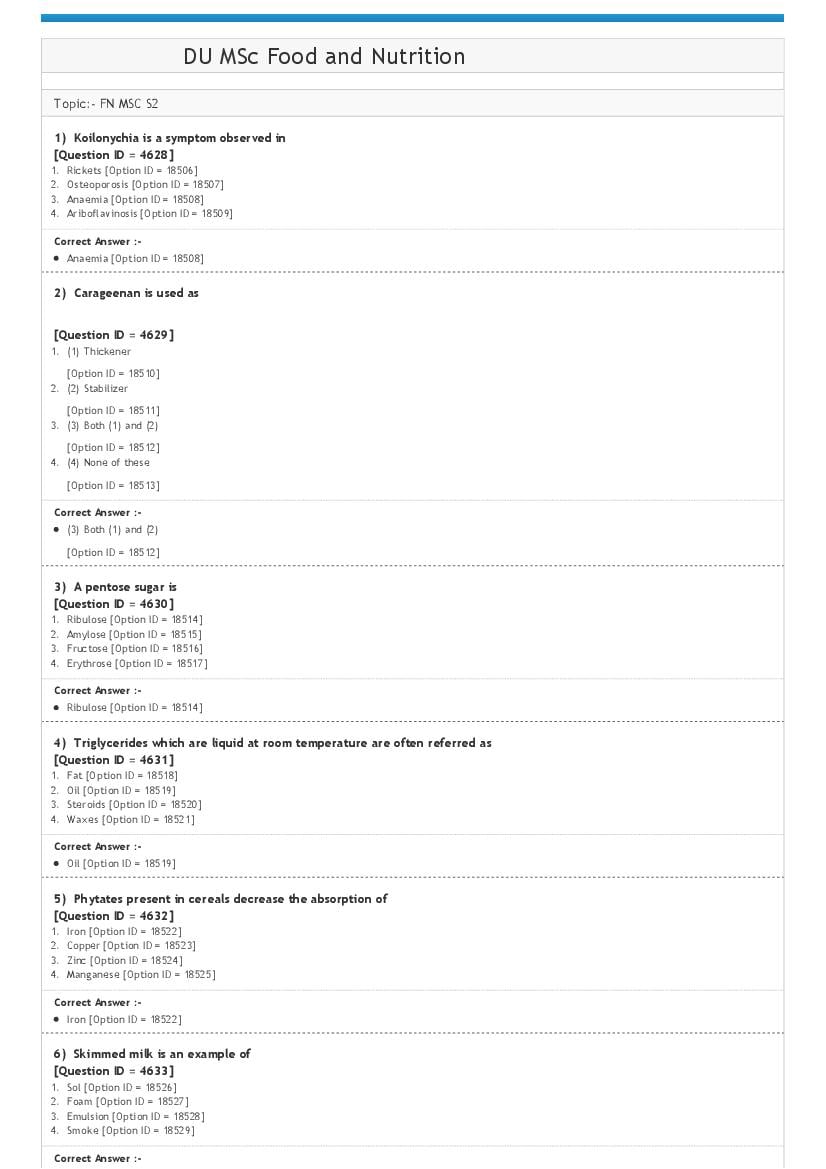
Topic:‐ FN MSC S2
1) Koilonychia is a symptom observed in
[Question ID = 4628]
1. Rickets [Option ID = 18506]
2. Osteoporosis [Option ID = 18507]
3. Anaemia [Option ID = 18508]
4. Ariboflavinosis [Option ID = 18509]
Anaemia [Option ID = 18508]
2) Carageenan is used as
[Question ID = 4629]
1. (1) Thickener
[Option ID = 18510]
2. (2) Stabilizer
[Option ID = 18511]
3. (3) Both (1) and (2)
[Option ID = 18512]
4. (4) None of these
[Option ID = 18513]
(3) Both (1) and (2)
[Option ID = 18512]
3) A pentose sugar is
[Question ID = 4630]
1. Ribulose [Option ID = 18514]
2. Amylose [Option ID = 18515]
3. Fructose [Option ID = 18516]
4. Erythrose [Option ID = 18517]
Ribulose [Option ID = 18514]
4) Triglycerides which are liquid at room temperature are often referred as
[Question ID = 4631]
1. Fat [Option ID = 18518]
2. Oil [Option ID = 18519]
3. Steroids [Option ID = 18520]
4. Waxes [Option ID = 18521]
Oil [Option ID = 18519]
5) Phytates present in cereals decrease the absorption of
[Question ID = 4632]
1. Iron [Option ID = 18522]
2. Copper [Option ID = 18523]
3. Zinc [Option ID = 18524]
4. Manganese [Option ID = 18525]
Iron [Option ID = 18522]
6) Skimmed milk is an example of
[Question ID = 4633]
1. Sol [Option ID = 18526]
2. Foam [Option ID = 18527]
3. Emulsion [Option ID = 18528]
4. Smoke [Option ID = 18529]
Page 2
7) Normal BMI range for adults according to WHO is
[Question ID = 4634]
1. 18.5 ‐ 24.9 kg/m2 [Option ID = 18530]
2. 18.5 ‐ 21.9 kg/m2 [Option ID = 18531]
3. 18 ‐ 23 kg/m2 [Option ID = 18532]
4. 18 ‐ 25 kg/m2 [Option ID = 18533]
18.5 ‐ 24.9 kg/m2 [Option ID = 18530]
8) Intake of dietary fibre is encouraged in
[Question ID = 4635]
1. Constipation
[Option ID = 18534]
2. Diabetes
[Option ID = 18535]
3. Metabolic syndrome
[Option ID = 18536]
4. All of these
[Option ID = 18537]
All of these
[Option ID = 18537]
9) The allosteric inhibitor of an enzyme
[Question ID = 4636]
1. Activates the enzyme by binding to the allosteric site [Option ID = 18538]
2. Binds to the active site [Option ID = 18539]
3. Participates in feedback regulation [Option ID = 18540]
4. Denatures the enzyme [Option ID = 18541]
Participates in feedback regulation [Option ID = 18540]
10) An enzyme lacking its cofactor is called
[Question ID = 4637]
1. Apoenzyme
[Option ID = 18542]
2. Holoenzyme
[Option ID = 18543]
3. Prosthetic group
[Option ID = 18544]
4. None of these
[Option ID = 18545]
Apoenzyme
[Option ID = 18542]
11) Which one of the following statements concerning glycolysis is correct?
[Question ID = 4638]
1. The presence of oxygen is required for conversion of glucose to lactate [Option ID = 18546]
2. The regulated reactions are also the irreversible reactions [Option ID = 18547]
3. Glucokinase does not play any role in hepatic glucose metabolism [Option ID = 18548]
4. Conversion of glucose to lactate yields net production of two ATP and two NADH molecules [Option ID = 18549]
The regulated reactions are also the irreversible reactions [Option ID = 18547]
12) Complete destruction of microorganisms is achieved when exposed to
[Question ID = 4639]
1. 151oC wet heat for 2 seconds
Page 3
2. 151oC wet heat for 20 seconds
[Option ID = 18551]
3. 121oC wet heat for 15 min
[Option ID = 18552]
4. 121oC wet heat for 10 min
[Option ID = 18553]
121oC wet heat for 15 min
[Option ID = 18552]
13) β‐carotene in the body is converted into retinol in
[Question ID = 4640]
1. Liver [Option ID = 18554]
2. Pancreas [Option ID = 18555]
3. Gall bladder [Option ID = 18556]
4. Intestine [Option ID = 18557]
Liver [Option ID = 18554]
14) Heat sensitive liquid is commonly concentrated at low temperature using
[Question ID = 4641]
1. Kettle evaporators [Option ID = 18558]
2. Film evaporators [Option ID = 18559]
3. Flash evaporators [Option ID = 18560]
4. Vacuum evaporators [Option ID = 18561]
Vacuum evaporators [Option ID = 18561]
15) Principal substance present in garlic is
[Question ID = 4642]
1. Gingerol [Option ID = 18562]
2. Aldehyde‐cumino [Option ID = 18563]
3. Allicin [Option ID = 18564]
4. Eugenol [Option ID = 18565]
Allicin [Option ID = 18564]
16) Water activity acts as
[Question ID = 4643]
1. An intrinsic factor
[Option ID = 18566]
2. A processing factor
[Option ID = 18567]
3. A growth factor
[Option ID = 18568]
4. All of these
[Option ID = 18569]
All of these
[Option ID = 18569]
17) Dysphagia is a symptom that means
[Question ID = 4644]
1. Loss of appetite [Option ID = 18570]
2. Excessive leanness [Option ID = 18571]
3. Fatty diarrhoea [Option ID = 18572]
4. Difficulty in swallowing [Option ID = 18573]
Difficulty in swallowing [Option ID = 18573]
18) Which of the following statement is not true for antioxidants
[Question ID = 4645]
Page 4
2. Antioxidants cause oxidation enhancing reactive oxygen species [Option ID = 18575]
3. Antioxidants are free radicals that causes cell damage [Option ID = 18576]
4. Vitamin A, C and E are examples of natural antioxidants [Option ID = 18577]
Antioxidants are free radicals that causes cell damage [Option ID = 18576]
19) Firm gel must contain
[Question ID = 4646]
1. High amount of amylose [Option ID = 18578]
2. High amount of amylopectin [Option ID = 18579]
3. Less amount of amylose [Option ID = 18580]
4. Less amount of amylopectin [Option ID = 18581]
High amount of amylose [Option ID = 18578]
20) Assertion: Enzymes are biocatalysts that accelerate rate of reaction.
Reason: Enzymes lower the activation energy of a reaction
[Question ID = 4647]
1. Assertion is correct but reason is incorrect
[Option ID = 18582]
2. Assertion and reason both are correct
[Option ID = 18583]
3. Assertion is incorrect and reason is correct
[Option ID = 18584]
4. Assertion and reason both are incorrect
[Option ID = 18585]
Assertion and reason both are correct
[Option ID = 18583]
21) The general formula for monosccharides is
[Question ID = 4648]
1. CnH 2nOn [Option ID = 18586]
2. C2nH nOn [Option ID = 18587]
3. CnH 2O2n [Option ID = 18588]
4. CH2nOn [Option ID = 18589]
CnH 2nOn [Option ID = 18586]
22) Ketosis occurs due to
[Question ID = 4649]
1. Increased proteolysis [Option ID = 18590]
2. Increased lipolysis [Option ID = 18591]
3. Decreased proteolysis [Option ID = 18592]
4. Decreased lipolysis [Option ID = 18593]
Increased lipolysis [Option ID = 18591]
23) Gluten‐free diet is given to individuals suffering from which of the following diseases?
[Question ID = 4650]
1. Alzheimer’s disease [Option ID = 18594]
2. Parkinson’s Disease [Option ID = 18595]
3. Celiac disease [Option ID = 18596]
4. Irritable Bowel Disease [Option ID = 18597]
Celiac disease [Option ID = 18596]
24) What does the protein content of enteric formulas range between?
[Question ID = 4651]
1. 0 ‐ 12% of total energy [Option ID = 18598]
2. 4 ‐ 32% of total energy [Option ID = 18599]
3. 6 ‐ 42% of total energy [Option ID = 18600]
4. 8 ‐ 62% of total energy [Option ID = 18601]
Page 5
25) Assertion: Essential fatty acids linoleic acid and linolenic acid help in reduction of CVDs.
Reason: Essential fatty acids can be synthesized within the body and are not necessary to be taken in the diet.
[Question ID = 4652]
1. Assertion is correct but reason is incorrect
[Option ID = 18602]
2. Assertion and reason both are correct
[Option ID = 18603]
3. Assertion is incorrect but reason is correct
[Option ID = 18604]
4. Assertion and reason both are incorrect
[Option ID = 18605]
Assertion is correct but reason is incorrect
[Option ID = 18602]
26) If the dispersed phase is gas and the continuous phase is liquid, the dispersion will be known as
[Question ID = 4653]
1. Sol [Option ID = 18606]
2. Emulsion [Option ID = 18607]
3. Foam [Option ID = 18608]
4. Aerosol [Option ID = 18609]
Foam [Option ID = 18608]
27) Fermentation by yeasts is favoured at a pH of
[Question ID = 4654]
1. 3.2 ‐ 4.5 [Option ID = 18610]
2. 4 ‐ 4.5 [Option ID = 18611]
3. 3.8 ‐ 4.3 [Option ID = 18612]
4. 2.5 ‐ 3.2 [Option ID = 18613]
4 ‐ 4.5 [Option ID = 18611]
28) Sugars in dry condition or their syrups, when heated, undergo a number of reactions, leading to the formation of
unsaturated polymers with brown colour. This process is known as
[Question ID = 4655]
1. Maillard Reaction
[Option ID = 18614]
2. Caramelization
[Option ID = 18615]
3. Putrefaction
[Option ID = 18616]
4. None of these
[Option ID = 18617]
Caramelization
[Option ID = 18615]
29) Triglycerides from animal sources contain a higher percentage of
[Question ID = 4656]
1. 1. Saturated fatty acids
[Option ID = 18618]
2. 2. Monounsaturated fatty acids
[Option ID = 18619]
3. 3. Polyunsaturated fatty acids
[Option ID = 18620]
Page 6
[Option ID = 18621]
1. Saturated fatty acids
[Option ID = 18618]
30) For a consumer panel, a group of ________ members is considered the minimum.
[Question ID = 4657]
1. Not less than 50 [Option ID = 18622]
2. Not less than 75 [Option ID = 18623]
3. Not less than 100 [Option ID = 18624]
4. Not less than 150 [Option ID = 18625]
Not less than 100 [Option ID = 18624]
31) In glucose the orientation of the —H and —OH groups around the carbon atom 5 adjacent to the terminal primary
alcohol carbon determines
[Question ID = 4658]
1. D or L series
[Option ID = 18626]
2. Dextro or levorotatory
[Option ID = 18627]
3. α and β anomers
[Option ID = 18628]
4. Epimers
[Option ID = 18629]
D or L series
[Option ID = 18626]
32) Under anaerobic conditions the glycolysis of one mole of glucose yields _______ mole(s) of ATP.
[Question ID = 4659]
1. One [Option ID = 18630]
2. Two [Option ID = 18631]
3. Eight [Option ID = 18632]
4. Thirty [Option ID = 18633]
Two [Option ID = 18631]
33) Pyruvate dehydrogenase complex and α‐ketoglutarate dehydrogenase complex enzymes require the following for their
oxidative decarboxylation reactions
[Question ID = 4660]
1. CoASH and Lipoic acid
[Option ID = 18634]
2. NAD+ and FAD
[Option ID = 18635]
3. CoASH and TPP
[Option ID = 18636]
4. CoASH, TPP, NAD+, FAD, Lipoate
[Option ID = 18637]
CoASH, TPP, NAD+, FAD, Lipoate
[Option ID = 18637]
34) During glycolysis the following enzyme acts on Fructose 1,6‐bisphosphate
[Question ID = 4661]
1. Enolase [Option ID = 18638]
2. Phosphofructokinase [Option ID = 18639]
3. Aldolase [Option ID = 18640]
4. Phosphoglycerate mutase [Option ID = 18641]
Page 7
35) Tricarboxylic acid cycle to be continuous requires the regeneration of
[Question ID = 4662]
1. Pyruvic acid [Option ID = 18642]
2. Oxaloacetic acid [Option ID = 18643]
3. α‐oxoglutaric acid [Option ID = 18644]
4. Malic acid [Option ID = 18645]
Oxaloacetic acid [Option ID = 18643]
36) The magnitude of stimulus at which a transition occurs from no sensation to sensation is
[Question ID = 4663]
1. Recognition threshold
[Option ID = 18646]
2. Stimulus threshold
[Option ID = 18647]
3. Terminal threshold
[Option ID = 18648]
4. None of these
[Option ID = 18649]
Stimulus threshold
[Option ID = 18647]
37) Jam should not contain less than
[Question ID = 4664]
1. 70 percent soluble solids [Option ID = 18650]
2. 69.5 percent soluble solids [Option ID = 18651]
3. 68.5 percent soluble solids [Option ID = 18652]
4. 65.5 percent soluble solids [Option ID = 18653]
68.5 percent soluble solids [Option ID = 18652]
38) “+F” logo stands for
[Question ID = 4665]
1. Organic Food [Option ID = 18654]
2. Fortified Food [Option ID = 18655]
3. Genetically Modified Food [Option ID = 18656]
4. Vegan Food [Option ID = 18657]
Fortified Food [Option ID = 18655]
39) The outermost layer of hen’s egg is
[Question ID = 4666]
1. Shell [Option ID = 18658]
2. Bloom [Option ID = 18659]
3. Vitelline Membrane [Option ID = 18660]
4. Challazae [Option ID = 18661]
Bloom [Option ID = 18659]
40) In a cereal grain, the layer of cells located just under the bran is
[Question ID = 4667]
1. Scutellum [Option ID = 18662]
2. Endosperm [Option ID = 18663]
3. Aleurone layer [Option ID = 18664]
4. Germ [Option ID = 18665]
Aleurone layer [Option ID = 18664]
41) Formula for estimation of nitrogen content of dietary protein is
[Question ID = 4668]
Page 8
2. Nitrogen (g) = Protein (g)/4.25 [Option ID = 18667]
3. Nitrogen (g) = Protein (g)/3.35 [Option ID = 18668]
4. Nitrogen (g) = Protein (g)/6.25 [Option ID = 18669]
Nitrogen (g) = Protein (g)/6.25 [Option ID = 18669]
42) Which of the following conditions would be present if an individual is suffering from metabolic syndrome?
[Question ID = 4669]
1. High levels of HDL, low levels of serum triglyceride, low blood pressure, underweight [Option ID = 18670]
2. Dyslipidemia, elevated blood pressure, impaired glucose tolerance, central obesity [Option ID = 18671]
3. High levels of HDL, low levels of serum triglyceride, impaired glucose tolerance, central obesity [Option ID = 18672]
4. High levels of serum triglycerides and HDL, low blood pressure, underweight [Option ID = 18673]
Dyslipidemia, elevated blood pressure, impaired glucose tolerance, central obesity [Option ID = 18671]
43) Substrate level phosphorylation in TCA cycle is in the step of
[Question ID = 4670]
1. Isocitrate dehydrogenase [Option ID = 18674]
2. Malate dehydrogenase [Option ID = 18675]
3. Phosphoglycerate kinase [Option ID = 18676]
4. Succinate thiokinase [Option ID = 18677]
Succinate thiokinase [Option ID = 18677]
44) The committed step of glycolysis is catalysed by
[Question ID = 4671]
1. Phosphofructokinase‐I [Option ID = 18678]
2. Pyruvate kinase [Option ID = 18679]
3. Hexokinase [Option ID = 18680]
4. Glucokinase [Option ID = 18681]
Phosphofructokinase‐I [Option ID = 18678]
45) Which one of the following statements concerning the peptide shown below is correct?
Gly‐Cys‐Glu‐Ser‐Asp‐Cys‐Val‐Leu
[Question ID = 4672]
1. The peptide is able to form an internal disulfide bond [Option ID = 18682]
2. The peptide contains majority of acidic amino acids [Option ID = 18683]
3. The peptide contains an amino acid with secondary amino group [Option ID = 18684]
4. The peptide contains glutamine [Option ID = 18685]
The peptide is able to form an internal disulfide bond [Option ID = 18682]
46) A peptide bond
[Question ID = 4673]
1. Is ionized at physiological pH [Option ID = 18686]
2. Is stable to heating in strong acids [Option ID = 18687]
3. Is cleaved by agents like organic solvents and high concentrations of urea [Option ID = 18688]
4. Occurs mostly in the trans configuration [Option ID = 18689]
Occurs mostly in the trans configuration [Option ID = 18689]
47) The method in which nutrient requirements for different functions are assessed individually and then added to arrive
at the total daily requirement is called
[Question ID = 4674]
1. Factorial Approach [Option ID = 18690]
2. Balance Studies [Option ID = 18691]
3. Depletion‐Repletion Studies [Option ID = 18692]
4. Nutrient turnover Studies [Option ID = 18693]
Factorial Approach [Option ID = 18690]
48) Enlargement in cell size is referred to as
[Question ID = 4675]
1. Hyperplasia [Option ID = 18694]
2. Hypertrophy [Option ID = 18695]
Page 9
4. Hyperinflation [Option ID = 18697]
Hypertrophy [Option ID = 18695]
49) Idiosyncratic reactions are
[Question ID = 4676]
1. (1) Reactions associated with release of histamine and other mediators
[Option ID = 18698]
2. (2) Adverse reactions to foods that occur through unknown mechanism
[Option ID = 18699]
3. (3) Both (1) and (2)
[Option ID = 18700]
4. (4) None of these
[Option ID = 18701]
(2) Adverse reactions to foods that occur through unknown mechanism
[Option ID = 18699]
50) Which of the following are liver function tests?
[Question ID = 4677]
1. Serum bilirubin
[Option ID = 18702]
2. Alanine Aminotransferases
[Option ID = 18703]
3. Serum Globulin
[Option ID = 18704]
4. All of these
[Option ID = 18705]
All of these
[Option ID = 18705]
51) According to JNC‐7 classification of high blood pressure (Stage 1), the cut‐off for systolic and diastolic blood pressure is
[Question ID = 4678]
1. SBP<120, DBP<80
[Option ID = 18706]
2. SBP=120‐139 or DBP>80
[Option ID = 18707]
3. SBP=120‐139 or DBP=80‐89
[Option ID = 18708]
4. SBP=140‐159 or DBP=90‐99
[Option ID = 18709]
SBP=140‐159 or DBP=90‐99
[Option ID = 18709]
52) In which of the following non‐probability sampling techniques does the researcher ask the study participants to identify
other potential participants?
[Question ID = 4679]
1. Snowball [Option ID = 18710]
2. Convenience [Option ID = 18711]
3. Purposive [Option ID = 18712]
4. Quota [Option ID = 18713]
Snowball [Option ID = 18710]
53) What is the normal pH of blood?
Page 10
1. 7.15 ‐ 7.25
[Option ID = 18714]
2. 7.20 ‐ 7.30
[Option ID = 18715]
3. 7.35 ‐ 7.45
[Option ID = 18716]
4. 7.50 ‐ 7.55
[Option ID = 18717]
7.35 ‐ 7.45
[Option ID = 18716]
54) Sulphur containing amino acid is
[Question ID = 4681]
1. Methionine [Option ID = 18718]
2. Leucine [Option ID = 18719]
3. Valine [Option ID = 18720]
4. Asparagine [Option ID = 18721]
Methionine [Option ID = 18718]
55) Select the correct statement about secondary structure of proteins.
[Question ID = 4682]
1. The α‐helix is composed of more than one polypeptide chain.
[Option ID = 18722]
2. β‐Sheets are present in the antiparallel form only.
[Option ID = 18723]
3. β‐bends often contain proline.
[Option ID = 18724]
4. The α‐helix is stabilized primarily by ionic interactions between the side chains of amino acids.
[Option ID = 18725]
β‐bends often contain proline.
[Option ID = 18724]
56) The following enzyme of urea cycle is present in cytosol
[Question ID = 4683]
1. Argininosuccinic acid synthetase
[Option ID = 18726]
2. Argininosuccinase
[Option ID = 18727]
3. Arginase
[Option ID = 18728]
4. All of these
[Option ID = 18729]
All of these
[Option ID = 18729]
57) The transaminase activity needs the coenzyme
[Question ID = 4684]
1. ATP [Option ID = 18730]
2. Pyridoxal phosphate [Option ID = 18731]
3. Niacin [Option ID = 18732]
4. Riboflavin [Option ID = 18733]
Pyridoxal phosphate [Option ID = 18731]
Page 11
[Question ID = 4685]
1. Palmitic acid [Option ID = 18734]
2. Oleic acid [Option ID = 18735]
3. Linoleic acid [Option ID = 18736]
4. Elaidic acid [Option ID = 18737]
Palmitic acid [Option ID = 18734]
59) The number of double bonds in arachidonic acid is
[Question ID = 4686]
1. One [Option ID = 18738]
2. Two [Option ID = 18739]
3. Four [Option ID = 18740]
4. Six [Option ID = 18741]
Four [Option ID = 18740]
60) Instrument used for texture evaluation
[Question ID = 4687]
1. Baker’s Jelmeter
[Option ID = 18742]
2. Bostwick Consistometer
[Option ID = 18743]
3. Barbender Farinograph
[Option ID = 18744]
4. All of these
[Option ID = 18745]
All of these
[Option ID = 18745]
61) Name the SNF resource book for School
[Question ID = 4688]
1. Pink Book [Option ID = 18746]
2. Yellow Book [Option ID = 18747]
3. Orange Book [Option ID = 18748]
4. Green Book [Option ID = 18749]
Yellow Book [Option ID = 18747]
62) Symbol for irradiated foods is called
[Question ID = 4689]
1. Agmark [Option ID = 18750]
2. Silk mark [Option ID = 18751]
3. Gamma [Option ID = 18752]
4. Radura [Option ID = 18753]
Radura [Option ID = 18753]
63) An emulsifier added to the system would _________ the interfacial tension.
[Question ID = 4690]
1. Reduce
[Option ID = 18754]
2. Increase
[Option ID = 18755]
3. Break
[Option ID = 18756]
4. None of these
[Option ID = 18757]
Page 12
[Option ID = 18754]
64) Polyhydroxy alcohols are used as
[Question ID = 4691]
1. Anticaking agents [Option ID = 18758]
2. Humectants [Option ID = 18759]
3. Oxidizing agents [Option ID = 18760]
4. Maturing agent [Option ID = 18761]
Humectants [Option ID = 18759]
65) The fat content of double toned milk should be
[Question ID = 4692]
1. 0.5% [Option ID = 18762]
2. 3.5% [Option ID = 18763]
3. 1.5% [Option ID = 18764]
4. 2.5% [Option ID = 18765]
1.5% [Option ID = 18764]
66) β‐Oxidation of fatty acids requires all the following coenzymes except
[Question ID = 4693]
1. CoA [Option ID = 18766]
2. FAD [Option ID = 18767]
3. NAD [Option ID = 18768]
4. NADP [Option ID = 18769]
NADP [Option ID = 18769]
67) Ketone bodies are synthesized in
[Question ID = 4694]
1. Adipose tissue [Option ID = 18770]
2. Liver [Option ID = 18771]
3. Muscles [Option ID = 18772]
4. Brain [Option ID = 18773]
Liver [Option ID = 18771]
68) The integrator between urea and TCA cycle is
[Question ID = 4695]
1. Fumarate [Option ID = 18774]
2. Malate [Option ID = 18775]
3. Pyruvate [Option ID = 18776]
4. Citrate [Option ID = 18777]
Fumarate [Option ID = 18774]
69) Conversion of pyruvic acid to acetyl CoA takes place in the
[Question ID = 4696]
1. Mitochondria [Option ID = 18778]
2. Cytosol [Option ID = 18779]
3. Ribosomes [Option ID = 18780]
4. Nucleus [Option ID = 18781]
Mitochondria [Option ID = 18778]
70) Given below are two statements, one is labelled as Assertion A and the other is labelled as Reason R
Assertion A : Citric acid cycle is only a catabolic pathway.
Reason R : This is because it reduces acetyl groups to carbon‐dioxide.
In light of the above statements, choose the correct answer from the options given below
[Question ID = 4697]
1. Assertion is correct but reason is incorrect [Option ID = 18782]
2. Assertion is incorrect but reason is correct [Option ID = 18783]
3. Both assertion and reason are correct [Option ID = 18784]
4. Both assesrtion and reason are incorrect [Option ID = 18785]
Page 13
71) Vitamin B1 coenzyme (TPP) is involved in
[Question ID = 4698]
1. Oxidative decarboxylation [Option ID = 18786]
2. Hydroxylation [Option ID = 18787]
3. Transamination [Option ID = 18788]
4. Carboxylation [Option ID = 18789]
Oxidative decarboxylation [Option ID = 18786]
72) Deficiency of Vitamin A causes
[Question ID = 4699]
1. Xerophthalmia [Option ID = 18790]
2. Hypoprothrombinemia [Option ID = 18791]
3. Megaloblastic anemia [Option ID = 18792]
4. Pernicious anemia [Option ID = 18793]
Xerophthalmia [Option ID = 18790]
73) At the age of one year, a normal infant shows the following increase in body size
[Question ID = 4700]
1. Birth weight is doubled and height increases by 25cm [Option ID = 18794]
2. Birth weight is doubled and height increases by 50cm [Option ID = 18795]
3. Birth weight is tripled and height increases by 50cm [Option ID = 18796]
4. Birth weight is tripled and height increases by 25cm [Option ID = 18797]
Birth weight is tripled and height increases by 25cm [Option ID = 18797]
74) Weight of a reference Indian adult woman is taken as
[Question ID = 4701]
1. 60 kg [Option ID = 18798]
2. 65 kg [Option ID = 18799]
3. 50 kg [Option ID = 18800]
4. 55 kg [Option ID = 18801]
55 kg [Option ID = 18801]
75) Which of the following has the best chemical score
[Question ID = 4702]
1. Wheat [Option ID = 18802]
2. Egg [Option ID = 18803]
3. Milk [Option ID = 18804]
4. Soyabean [Option ID = 18805]
Egg [Option ID = 18803]
76) Niacin is also derived from which of the following essential amino acids?
[Question ID = 4703]
1. Tryptophan [Option ID = 18806]
2. Leucine [Option ID = 18807]
3. Isoleucine [Option ID = 18808]
4. Lysine [Option ID = 18809]
Tryptophan [Option ID = 18806]
77) Given below are two statements, one is labelled as Assertion A and the other is labelled as Reason R
Assertion A : Food intolerance is an immune system response.
Reason R : An allergen is a molecule that elicits an immune response.
In light of the above statements, choose the correct answer from the options given below
[Question ID = 4704]
1. Assertion is correct but reason is incorrect [Option ID = 18810]
2. Assertion is incorrect but reason is correct [Option ID = 18811]
3. Both assertion and reason are correct [Option ID = 18812]
Page 14
Assertion is incorrect but reason is correct [Option ID = 18811]
78) Which of the following changes in body composition are associated with ageing in older adults?
A. Decreased bone mass
B. Increased muscle mass
C. Increased body fat
D. Decreased BMR
Choose the correct answer from the options given below:
[Question ID = 4705]
1. A, B and C only [Option ID = 18814]
2. A, B and D only [Option ID = 18815]
3. B, C and D only [Option ID = 18816]
4. A, C and D only [Option ID = 18817]
A, C and D only [Option ID = 18817]
79) Which of the following is not an anthropometric measurement?
[Question ID = 4706]
1. Skinfold thickness [Option ID = 18818]
2. Waist circumference [Option ID = 18819]
3. Blood pressure [Option ID = 18820]
4. Mid upper arm circumference [Option ID = 18821]
Blood pressure [Option ID = 18820]
80) Which of the following is a direct short‐term intervention given by our National Nutrition Policy 1993?
[Question ID = 4707]
1. Nutrition surveillance [Option ID = 18822]
2. Ensuring food security [Option ID = 18823]
3. Fortification of essential foods [Option ID = 18824]
4. Prevention of food adulteration [Option ID = 18825]
Fortification of essential foods [Option ID = 18824]
81) Characteristic features of Cretinism do not include
[Question ID = 4708]
1. Mental retardation [Option ID = 18826]
2. Deaf Mutism [Option ID = 18827]
3. Spastic paralysis [Option ID = 18828]
4. Oedema [Option ID = 18829]
Oedema [Option ID = 18829]
82) During fever, BMR of an individual
[Question ID = 4709]
1. Increases [Option ID = 18830]
2. Decreases [Option ID = 18831]
3. Remains unaltered [Option ID = 18832]
4. Becomes zero [Option ID = 18833]
Increases [Option ID = 18830]
83) Hypothesis refers to
[Question ID = 4710]
1. The outcome of a study
[Option ID = 18834]
2. A conclusion drawn from a study
[Option ID = 18835]
3. A form of bias in the study
[Option ID = 18836]
4. A tentative statement about the relationship among variables in the study
Page 15
A tentative statement about the relationship among variables in the study
[Option ID = 18837]
84) Energy cost of an individual activity per minute to the energy cost of basal metabolic rate per minute is called
[Question ID = 4711]
1. SDA [Option ID = 18838]
2. PAR [Option ID = 18839]
3. BMR [Option ID = 18840]
4. PAL [Option ID = 18841]
PAR [Option ID = 18839]
85) Propionyl CoA formed on oxidation of fatty acids having an odd number of carbon atoms is converted into
[Question ID = 4712]
1. Acetyl CoA [Option ID = 18842]
2. Butyryl CoA [Option ID = 18843]
3. D‐methylmalonyl CoA [Option ID = 18844]
4. Acetoacetyl CoA [Option ID = 18845]
D‐methylmalonyl CoA [Option ID = 18844]
86) Which of the following does not have phosphorous?
[Question ID = 4713]
1. Riboflavin [Option ID = 18846]
2. NAD+ [Option ID = 18847]
3. TPP [Option ID = 18848]
4. CoASH [Option ID = 18849]
Riboflavin [Option ID = 18846]
87) A kinase is an enzyme that
[Question ID = 4714]
1. Removes phosphate groups of substrate [Option ID = 18850]
2. Adds a phosphate group to the substrate [Option ID = 18851]
3. Uses NADH to change the oxidation state of the substrate [Option ID = 18852]
4. Removes water from a double bond [Option ID = 18853]
Adds a phosphate group to the substrate [Option ID = 18851]
88) During each cycle of β‐oxidation
[Question ID = 4715]
1. One carbon atom is removed from the carboxyl end of the fatty acid [Option ID = 18854]
2. One carbon atom is removed from the methyl end of the fatty acid [Option ID = 18855]
3. Two carbon atoms are removed from the carboxyl end of the fatty acid [Option ID = 18856]
4. Two carbon atoms are removed from the methyl end of the fatty acid [Option ID = 18857]
Two carbon atoms are removed from the carboxyl end of the fatty acid [Option ID = 18856]
89) What is FIFO?
[Question ID = 4716]
1. First In First Out [Option ID = 18858]
2. First Information For Organization [Option ID = 18859]
3. Figure In Figure Out [Option ID = 18860]
4. First Index First Observed [Option ID = 18861]
First In First Out [Option ID = 18858]
90) HACCP is directed towards ensuring
[Question ID = 4717]
1. Food Safety [Option ID = 18862]
2. Food Quality [Option ID = 18863]
3. Food Security [Option ID = 18864]
4. Food Sustainability [Option ID = 18865]
Page 16
91) Methods of tenderizing meat are
[Question ID = 4718]
1. Grinding
[Option ID = 18866]
2. Use of proteolytic enzymes
[Option ID = 18867]
3. Cold room storage
[Option ID = 18868]
4. All of these
[Option ID = 18869]
All of these
[Option ID = 18869]
92) Casal’s necklace is a symptom of deficiency of
[Question ID = 4719]
1. Thiamine [Option ID = 18870]
2. Niacin [Option ID = 18871]
3. Vitamin B6 [Option ID = 18872]
4. Vitamin B12 [Option ID = 18873]
Niacin [Option ID = 18871]
93) Following are the features of a good research except
[Question ID = 4720]
1. Data are collected systematically [Option ID = 18874]
2. The research purpose is clearly defined [Option ID = 18875]
3. The research design is ambiguously planned [Option ID = 18876]
4. Findings are presented systematically [Option ID = 18877]
The research design is ambiguously planned [Option ID = 18876]
94) Which of the following are the modifiable risk factors in cardiovascular disease?
[Question ID = 4721]
1. Hypertension, Physical inactivity, Obesity, Atherogenic diet [Option ID = 18878]
2. Hypertension, Physical inactivity, Gender, Age [Option ID = 18879]
3. Obesity, Atherogenic diet, Heredity, Hypertension [Option ID = 18880]
4. Obesity, Gender, Age, Heredity [Option ID = 18881]
Hypertension, Physical inactivity, Obesity, Atherogenic diet [Option ID = 18878]
95) CCP stands for
[Question ID = 4722]
1. Critical Count Point [Option ID = 18882]
2. Critical Control Point [Option ID = 18883]
3. Crisis Count Point [Option ID = 18884]
4. Crisis Control Point [Option ID = 18885]
Critical Control Point [Option ID = 18883]
96) Gluconeogenesis is inhibited in presence of
[Question ID = 4723]
1. Glucagon [Option ID = 18886]
2. Insulin [Option ID = 18887]
3. Glucocorticoids [Option ID = 18888]
4. Adrenaline [Option ID = 18889]
Insulin [Option ID = 18887]
97) Fluorosis is characterized by
[Question ID = 4724]
1. Cardiomyopathy [Option ID = 18890]
2. Mottling of teeth [Option ID = 18891]
Page 17
4. Alopecia [Option ID = 18893]
Mottling of teeth [Option ID = 18891]
98) Freezing point of milk is
[Question ID = 4725]
1. ‐0.55oC
[Option ID = 18894]
2. +0.55oC
[Option ID = 18895]
3. ‐5.5oC
[Option ID = 18896]
4. +5.5oC
[Option ID = 18897]
‐0.55oC
[Option ID = 18894]
99) Braising is a combination of
[Question ID = 4726]
1. Roasting and Stewing [Option ID = 18898]
2. Grilling and Stewing [Option ID = 18899]
3. Pressure cooking and Roasting [Option ID = 18900]
4. Boiling and Simmering [Option ID = 18901]
Roasting and Stewing [Option ID = 18898]
100) Which one of the following is characteristic of low insulin levels?
[Question ID = 4727]
1. Increased glycogen synthesis [Option ID = 18902]
2. Decreased gluconeogenesis [Option ID = 18903]
3. Decreased glycogenolysis [Option ID = 18904]
4. Increased formation of 3‐hydroxybutyrate [Option ID = 18905]
Increased formation of 3‐hydroxybutyrate [Option ID = 18905]
Document Details
| Board / Org | NTA |
| Exam | DUET |
| Type | Question Paper |
| Pages | 17 |
| Updated | 22 Jul 2026 |