UGC NET 2021 Question Paper Buddhist Jaina Gandhian Shift 1
Finished viewing? Save it for later —
Download UGC NET 2021 Question Paper Buddhist Jaina Gandhian Shift 1 (PDF · 61 pages)About UGC NET 2021 Question Paper Buddhist Jaina Gandhian Shift 1
UGC NET 2021 Question Paper Buddhist Jaina Gandhian Shift 1 is available here for free download. Published by NTA for UGC NET, this question paper can be viewed online or downloaded as a PDF (61 pages). Candidates preparing for UGC NET can use UGC NET 2021 Question Paper Buddhist Jaina Gandhian Shift 1 to understand the exam pattern, the type of questions asked, and the overall difficulty level.
Frequently Asked Questions
How can I download UGC NET 2021 Question Paper Buddhist Jaina Gandhian Shift 1?
Open this page and click the Download button to save UGC NET 2021 Question Paper Buddhist Jaina Gandhian Shift 1 as a PDF. It is completely free on AglaSem Docs.
Is UGC NET 2021 Question Paper Buddhist Jaina Gandhian Shift 1 free to download?
Yes. UGC NET 2021 Question Paper Buddhist Jaina Gandhian Shift 1 can be viewed online and downloaded as a PDF free of cost on AglaSem Docs.
How many pages does UGC NET 2021 Question Paper Buddhist Jaina Gandhian Shift 1 have?
UGC NET 2021 Question Paper Buddhist Jaina Gandhian Shift 1 contains 61 pages, which you can read online or download together as a single PDF.
Where can I find more UGC NET study material?
You can find more UGC NET question papers, sample papers, syllabus, and answer keys on AglaSem Docs.
UGC NET 2021 Question Paper Buddhist Jaina Gandhian Shift 1 – Text
Read the full text of this question paper below — useful to quickly search, copy and reference the content online without downloading the PDF.
📄 View text version (61 pages)
Page 1
Topic:‐ GP_Set2_C
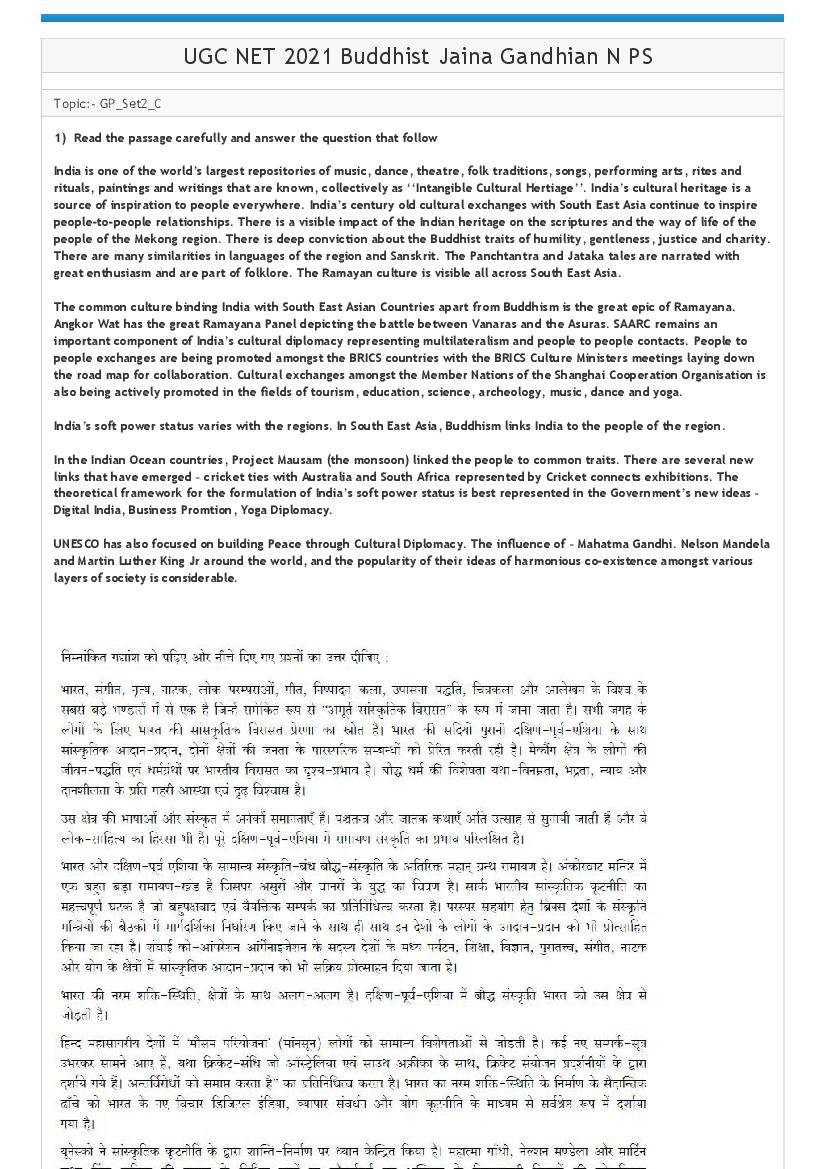
1) Read the passage carefully and answer the question that follow
India is one of the world’s largest repositories of music, dance, theatre, folk traditions, songs, performing arts, rites and
rituals, paintings and writings that are known, collectively as ‘‘Intangible Cultural Hertiage’’. India’s cultural heritage is a
source of inspiration to people everywhere. India’s century old cultural exchanges with South East Asia continue to inspire
people‐to‐people relationships. There is a visible impact of the Indian heritage on the scriptures and the way of life of the
people of the Mekong region. There is deep conviction about the Buddhist traits of humility, gentleness, justice and charity.
There are many similarities in languages of the region and Sanskrit. The Panchtantra and Jataka tales are narrated with
great enthusiasm and are part of folklore. The Ramayan culture is visible all across South East Asia.
The common culture binding India with South East Asian Countries apart from Buddhism is the great epic of Ramayana.
Angkor Wat has the great Ramayana Panel depicting the battle between Vanaras and the Asuras. SAARC remains an
important component of India’s cultural diplomacy representing multilateralism and people to people contacts. People to
people exchanges are being promoted amongst the BRICS countries with the BRICS Culture Ministers meetings laying down
the road map for collaboration. Cultural exchanges amongst the Member Nations of the Shanghai Cooperation Organisation is
also being actively promoted in the fields of tourism, education, science, archeology, music, dance and yoga.
India’s soft power status varies with the regions. In South East Asia, Buddhism links India to the people of the region.
In the Indian Ocean countries, Project Mausam (the monsoon) linked the people to common traits. There are several new
links that have emerged – cricket ties with Australia and South Africa represented by Cricket connects exhibitions. The
theoretical framework for the formulation of India’s soft power status is best represented in the Government’s new ideas –
Digital India, Business Promtion, Yoga Diplomacy.
UNESCO has also focused on building Peace through Cultural Diplomacy. The influence of – Mahatma Gandhi. Nelson Mandela
and Martin Luther King Jr around the world, and the popularity of their ideas of harmonious co‐existence amongst various
layers of society is considerable.
Page 2
(A) Ramayan
(B) Multilateral engagements
(C) Business Promotion
(D) People to people contacts
Choose the correct answer from the options given below :
(1) (A) and (D) only (2) (A), (C) and (D) only
(3) (B), (C) and (D) only (4) (B) and (D) only
[Question ID = 3557][Question Description = Q46_GP_20NOV_S2_SHAAN_Shift2]
1. 1
[Option ID = 13691]
2. 2
[Option ID = 13692]
3. 3
[Option ID = 13693]
4. 4
[Option ID = 13694]
2) Read the passage carefully and answer the question that follow
India is one of the world’s largest repositories of music, dance, theatre, folk traditions, songs, performing arts, rites and
rituals, paintings and writings that are known, collectively as ‘‘Intangible Cultural Hertiage’’. India’s cultural heritage is a
source of inspiration to people everywhere. India’s century old cultural exchanges with South East Asia continue to inspire
people‐to‐people relationships. There is a visible impact of the Indian heritage on the scriptures and the way of life of the
Page 3
There are many similarities in languages of the region and Sanskrit. The Panchtantra and Jataka tales are narrated with
great enthusiasm and are part of folklore. The Ramayan culture is visible all across South East Asia.
The common culture binding India with South East Asian Countries apart from Buddhism is the great epic of Ramayana.
Angkor Wat has the great Ramayana Panel depicting the battle between Vanaras and the Asuras. SAARC remains an
important component of India’s cultural diplomacy representing multilateralism and people to people contacts. People to
people exchanges are being promoted amongst the BRICS countries with the BRICS Culture Ministers meetings laying down
the road map for collaboration. Cultural exchanges amongst the Member Nations of the Shanghai Cooperation Organisation is
also being actively promoted in the fields of tourism, education, science, archeology, music, dance and yoga.
India’s soft power status varies with the regions. In South East Asia, Buddhism links India to the people of the region.
In the Indian Ocean countries, Project Mausam (the monsoon) linkded the people to common traits. There are several new
links that have emerged – cricket ties with Australia and South Africa represented by Cricket connects exhibitions. The
theoretical framework for the formulation of India’s soft power status is best represented in the Government’s new ideas –
Digital India, Business Promtion, Yoga Diplomacy.
UNESCO has also focused on building Peace through Cultural Diplomacy. The influence of – Mahatma Gandhi. Nelson Mandela
and Martin Luther King Jr around the world, and the popularity of their ideas of harmonious co‐existence amongst various
layers of society is considerable.
The common thread binding India and South East Asian Countries is/are
(A) Buddist tenets
(B) Yoga
(C) Cricket
(D) Ramayan
(E) Sanskrit
Choose the correct answer from the options given below :
Page 4
(3) (A) and (D) only (4) (A), (B), (D) and (E) only
[Question ID = 3558][Question Description = Q47_GP_20NOV_S2_SHAAN_Shift2]
1. 1 [Option ID = 13695]
2. 2 [Option ID = 13696]
3. 3 [Option ID = 13697]
4. 4 [Option ID = 13698]
3) Read the passage carefully and answer the question that follow
India is one of the world’s largest repositories of music, dance, theatre, folk traditions, songs, performing arts, rites and
rituals, paintings and writings that are known, collectively as ‘‘Intangible Cultural Hertiage’’. India’s cultural heritage is a
source of inspiration to people everywhere. India’s century old cultural exchanges with South East Asia continue to inspire
people‐to‐people relationships. There is a visible impact of the Indian heritage on the scriptures and the way of life of the
people of the Mekong region. There is deep conviction about the Buddhist traits of humility, gentleness, justice and charity.
There are many similarities in languages of the region and Sanskrit. The Panchtantra and Jataka tales are narrated with
great enthusiasm and are part of folklore. The Ramayan culture is visible all across South East Asia.
The common culture binding India with South East Asian Countries apart from Buddhism is the great epic of Ramayana.
Angkor Wat has the great Ramayana Panel depicting the battle between Vanaras and the Asuras. SAARC remains an
important component of India’s cultural diplomacy representing multilateralism and people to people contacts. People to
people exchanges are being promoted amongst the BRICS countries with the BRICS Culture Ministers meetings laying down
the road map for collaboration. Cultural exchanges amongst the Member Nations of the Shanghai Cooperation Organisation is
also being actively promoted in the fields of tourism, education, science, archeology, music, dance and yoga.
India’s soft power status varies with the regions. In South East Asia, Buddhism links India to the people of the region.
In the Indian Ocean countries, Project Mausam (the monsoon) linkded the people to common traits. There are several new
links that have emerged – cricket ties with Australia and South Africa represented by Cricket connects exhibitions. The
theoretical framework for the formulation of India’s soft power status is best represented in the Government’s new ideas –
Digital India, Business Promtion, Yoga Diplomacy.
UNESCO has also focused on building Peace through Cultural Diplomacy. The influence of – Mahatma Gandhi. Nelson Mandela
and Martin Luther King Jr around the world, and the popularity of their ideas of harmonious co‐existence amongst various
layers of society is considerable.
Page 5
(1) Digital India (2) Skill India
(3) Business Promotion (4) Yoga Diplomacy
[Question ID = 3559][Question Description = Q48_GP_20NOV_S2_SHAAN_Shift2]
1. 1 [Option ID = 13699]
2. 2 [Option ID = 13700]
3. 3 [Option ID = 13701]
4. 4 [Option ID = 13702]
4) Read the passage carefully and answer the question that follow
India is one of the world’s largest repositories of music, dance, theatre, folk traditions, songs, performing arts, rites and
rituals, paintings and writings that are known, collectively as ‘‘Intangible Cultural Hertiage’’. India’s cultural heritage is a
source of inspiration to people everywhere. India’s century old cultural exchanges with South East Asia continue to inspire
people‐to‐people relationships. There is a visible impact of the Indian heritage on the scriptures and the way of life of the
people of the Mekong region. There is deep conviction about the Buddhist traits of humility, gentleness, justice and charity.
There are many similarities in languages of the region and Sanskrit. The Panchtantra and Jataka tales are narrated with
great enthusiasm and are part of folklore. The Ramayan culture is visible all across South East Asia.
The common culture binding India with South East Asian Countries apart from Buddhism is the great epic of Ramayana.
Angkor Wat has the great Ramayana Panel depicting the battle between Vanaras and the Asuras. SAARC remains an
important component of India’s cultural diplomacy representing multilateralism and people to people contacts. People to
people exchanges are being promoted amongst the BRICS countries with the BRICS Culture Ministers meetings laying down
the road map for collaboration. Cultural exchanges amongst the Member Nations of the Shanghai Cooperation Organisation is
also being actively promoted in the fields of tourism, education, science, archeology, music, dance and yoga.
India’s soft power status varies with the regions. In South East Asia, Buddhism links India to the people of the region.
In the Indian Ocean countries, Project Mausam (the monsoon) linkded the people to common traits. There are several new
links that have emerged – cricket ties with Australia and South Africa represented by Cricket connects exhibitions. The
theoretical framework for the formulation of India’s soft power status is best represented in the Government’s new ideas –
Digital India, Business Promtion, Yoga Diplomacy.
UNESCO has also focused on building Peace through Cultural Diplomacy. The influence of – Mahatma Gandhi. Nelson Mandela
and Martin Luther King Jr around the world, and the popularity of their ideas of harmonious co‐existence amongst various
layers of society is considerable.
Page 6
(A) Archeology
(B) Folklore
(C) Tourism
(D) Yoga
(E) Education
Choose the correct answer from the options given below :
(1) (A), (C), (D) and (E) only (2) (A), (B), (C) and (E) only
(3) (A), (B) and (E) only (4) (B), (C), (D) and (E) only
[Question ID = 3560][Question Description = Q49_GP_20NOV_S2_SHAAN_Shift2]
Page 7
2. 2 [Option ID = 13704]
3. 3 [Option ID = 13705]
4. 4 [Option ID = 13706]
5) Read the passage carefully and answer the question that follow
India is one of the world’s largest repositories of music, dance, theatre, folk traditions, songs, performing arts, rites and
rituals, paintings and writings that are known, collectively as ‘‘Intangible Cultural Hertiage’’. India’s cultural heritage is a
source of inspiration to people everywhere. India’s century old cultural exchanges with South East Asia continue to inspire
people‐to‐people relationships. There is a visible impact of the Indian heritage on the scriptures and the way of life of the
people of the Mekong region. There is deep conviction about the Buddhist traits of humility, gentleness, justice and charity.
There are many similarities in languages of the region and Sanskrit. The Panchtantra and Jataka tales are narrated with
great enthusiasm and are part of folklore. The Ramayan culture is visible all across South East Asia.
The common culture binding India with South East Asian Countries apart from Buddhism is the great epic of Ramayana.
Angkor Wat has the great Ramayana Panel depicting the battle between Vanaras and the Asuras. SAARC remains an
important component of India’s cultural diplomacy representing multilateralism and people to people contacts. People to
people exchanges are being promoted amongst the BRICS countries with the BRICS Culture Ministers meetings laying down
the road map for collaboration. Cultural exchanges amongst the Member Nations of the Shanghai Cooperation Organisation is
also being actively promoted in the fields of tourism, education, science, archeology, music, dance and yoga.
India’s soft power status varies with the regions. In South East Asia, Buddhism links India to the people of the region.
In the Indian Ocean countries, Project Mausam (the monsoon) linkded the people to common traits. There are several new
links that have emerged – cricket ties with Australia and South Africa represented by Cricket connects exhibitions. The
theoretical framework for the formulation of India’s soft power status is best represented in the Government’s new ideas –
Digital India, Business Promtion, Yoga Diplomacy.
UNESCO has also focused on building Peace through Cultural Diplomacy. The influence of – Mahatma Gandhi. Nelson Mandela
and Martin Luther King Jr around the world, and the popularity of their ideas of harmonious co‐existence amongst various
layers of society is considerable.
The passage highlights
Page 8
(2) The role of culture for peace and harmonious relations with other countries
(3) India’s cultural hegemony
(4) India’s relations with BRICS countries
[Question ID = 3561][Question Description = Q50_GP_20NOV_S2_SHAAN_Shift2]
1. 1 [Option ID = 13707]
2. 2 [Option ID = 13708]
3. 3 [Option ID = 13709]
4. 4 [Option ID = 13710]
Topic:‐ GP_Set2_A
1)
Page 9
company?
(1) 119 : 145 (2) 116 : 135
(3) 119 : 135 (4) 119 : 130
[Question ID = 3562][Question Description = Q01_GP_20NOV_S2_SHAAN_Shift2]
1. 1 [Option ID = 13711]
2. 2 [Option ID = 13712]
3. 3 [Option ID = 13713]
4. 4 [Option ID = 13714]
2)
If 35% of the PCs sold by Company HP during November were sold at a discount, then how many PCs of Company HP during
that month were sold without a discount?
(1) 882 (2) 1635
(3) 1638 (4) 885
Page 10
1. 1 [Option ID = 13715]
2. 2 [Option ID = 13716]
3. 3 [Option ID = 13717]
4. 4 [Option ID = 13718]
3)
If the dealer earned a profit of Rs. 433 on each PC sold of Company DELL during October, then what was his total profit
earned on the PCs of that company during the same month?
(1) 6,49,900 (2) 6,45,900
(3) 6,49,400 (4) 6,49,500
[Question ID = 3564][Question Description = Q03_GP_20NOV_S2_SHAAN_Shift2]
Page 11
2. 2 [Option ID = 13720]
3. 3 [Option ID = 13721]
4. 4 [Option ID = 13722]
4)
The number of PCs sold of Company HP during July is approximately what percent (%) of the number of PCs sold of Company
HP during December?
(1) 110% (2) 140%
(3) 150% (4) 130%
[Question ID = 3565][Question Description = Q04_GP_20NOV_S2_SHAAN_Shift2]
1. 1 [Option ID = 13723]
2. 2 [Option ID = 13724]
3. 3 [Option ID = 13725]
4. 4 [Option ID = 13726]
5)
Page 12
(1) 10000 (2) 15000
(3) 10500 (4) 9500
[Question ID = 3566][Question Description = Q05_GP_20NOV_S2_SHAAN_Shift2]
1. 1
[Option ID = 13727]
2. 2
[Option ID = 13728]
3. 3
[Option ID = 13729]
4. 4
[Option ID = 13730]
Page 13
1) In which level of teaching promotion of critical thinking is the hall mark?
(1) Memory level (2) Understanding level
(3) Reflective level (4) Autonomous development level
[Question ID = 3567][Question Description = Q06_GP_20NOV_S2_SHAAN_Shift2]
1. 1 [Option ID = 13731]
2. 2 [Option ID = 13732]
3. 3 [Option ID = 13733]
4. 4 [Option ID = 13734]
2) The key behaviour of an effective teacher is marked by which of the following features? (A) Structuring (B) Teacher
task orientation (C) Instructional Variety (D) Lesson clarity (E) Probing Choose the correct answer from the options given
below :
(1) (A), (B) and (C) only (2) (A), (C) and (D) only
(3) (B), (C) and (D) only (4) (C), (D) and (E) only
[Question ID = 3568][Question Description = Q07_GP_20NOV_S2_SHAAN_Shift2]
1. 1
[Option ID = 13735]
2. 2
[Option ID = 13736]
3. 3
[Option ID = 13737]
4. 4
[Option ID = 13738]
3) Match List I with List II gives their characteristic features.
List I List II
(Modes of Evaluation) (Characteristic Features)
(A) Formative Evaluation (I) Compares one student with another student
(B) Summative Evaluation (II) Compares the progress of a student against prespecified standards
(C) Criterion‐referenced Evaluation (III) Used primarily for motivational and monitoring purposes of learning
(D) Norm‐referenced Evaluation (IV) Used primarily for gradation of progress made
Choose the correct answer from the options given below :
(1) (A)‐(IV), (B)‐(III), (C)‐(I), (D)‐(II) (2) (A)‐(III), (B)‐(IV), (C)‐(II), (D)‐(I)
Page 14
[Question ID = 3569][Question Description = Q08_GP_20NOV_S2_SHAAN_Shift2]
1. 1 [Option ID = 13739]
2. 2 [Option ID = 13740]
3. 3 [Option ID = 13741]
4. 4 [Option ID = 13742]
4) Given below are two statements :
Statement I : One of the basic principles of progressive view of teaching is that education should be life itself rather than a
preparation for living.
Statement II : According to reconstructionist view of education the new social order must be ‘genuinely democratic’.
In the light of the above statements, Choose the correct answer from the options given below :
(1) Both Statement I and Statement II are true. (2) Both Statement I and Statement II are false.
(3) Statement I is true but Statement II is false. (4) Statement I is false but Statement II is true.
[Question ID = 3570][Question Description = Q09_GP_20NOV_S2_SHAAN_Shift2]
1. 1 [Option ID = 13743]
2. 2 [Option ID = 13744]
3. 3 [Option ID = 13745]
4. 4 [Option ID = 13746]
5) Given below are two statements : One is labeled as Assertion A and the other is labeled as Reason R.
Assertion (A) : ‘Teaching’ involves critical and creative interchanges between teacher and learner and hence it is different
from ‘instruction’ and ‘training’.
Page 15
In the light of the above statements, Choose the most appropriate answer from the options given below :
(1) Both (A) and (R) are correct and (R) is the correct explanation of (A). (2) Both (A) and (R) are correct but (R) is NOT
the correct explanation of (A).
(3) (A) is correct but (R) is not correct. (4) (A) is not correct but (R) is correct.
[Question ID = 3571][Question Description = Q10_GP_20NOV_S2_SHAAN_Shift2]
1. 1 [Option ID = 13747]
2. 2 [Option ID = 13748]
3. 3 [Option ID = 13749]
4. 4 [Option ID = 13750]
6) In which of the following researches, attempts are made to establish context‐free generalizations?
(1) Phenomenology (2) Grounded theory
(3) Symbolic interactionism (4) Experimental Studies
[Question ID = 3572][Question Description = Q11_GP_20NOV_S2_SHAAN_Shift2]
1. 1 [Option ID = 13751]
2. 2 [Option ID = 13752]
3. 3 [Option ID = 13753]
4. 4 [Option ID = 13754]
7) Identify the main features of ‘qualitative research’ from the following :
(A) It is concerned with understanding the phenomena from the participant’s perspective
(B) It assumes that there are social facts with a single objective reality
(C) Researcher becomes immersed in the situation, present or past
(D) Researcher is detached from the study to avoid bias
(E) There is greater flexibility in both the methods and research process
Choose the correct answer from the options given below :
(1) (A), (C) and (E) only (2) (A), (B) and (C) only
(3) (B), (C) and (D) only (4) (C), (D) and (E) only
Page 16
1. 1 [Option ID = 13755]
2. 2 [Option ID = 13756]
3. 3 [Option ID = 13757]
4. 4 [Option ID = 13758]
8) Match List I with List II :
List I List II
Methods of research Features emphasized
(A) Experimental (I) Primary and secondary sources tapped with emphasis on internal criticism
(B) ExPost Facto (II) Status of facts and conditions are ascertained
(C) Descriptive (III) A variable is manipulated to see its effect on other variable
(D) Historical (IV) The differences are noted and factors causal or otherwise are determined
Choose the correct answer from the options given below :
(1) (A)‐(I), (B)‐(II), (C)‐(III), (D)‐(IV) (2) (A)‐(II), (B)‐(I), (C)‐(IV), (D)‐(III)
(3) (A)‐(III), (B)‐(IV), (C)‐(II), (D)‐(I) (4) (A)‐(IV), (B)‐(III), (C)‐(I), (D)‐(II)
[Question ID = 3574][Question Description = Q13_GP_20NOV_S2_SHAAN_Shift2]
1. 1 [Option ID = 13759]
2. 2 [Option ID = 13760]
3. 3 [Option ID = 13761]
4. 4 [Option ID = 13762]
9) Given below are two statements :
Statement I : Data analysis in research being a technical job, ‘research ethics’ does not matter.
Statement II : ICT is helpful almost at all stages of research.
In the light of the above statements, Choose the correct answer from the options given below :
(1) Both Statement I and Statement II are true. (2) Both Statement I and Statement II are false.
(3) Statement I is true but Statement II is false. (4) Statement I is false but Statement II is true.
Page 17
1. 1 [Option ID = 13763]
2. 2 [Option ID = 13764]
3. 3 [Option ID = 13765]
4. 4 [Option ID = 13766]
10) Given below are two statements : One is labeled as Assertion A and the other is labeled as Reason R.
Assertion (A) : When Null Hypothesis (H0) is rejected, researcher’s hypothesis (H1) is accepted.
Reason (R) : Null Hypothesis (H0) is a chance hypothesis and as such (H1) being true, the researcher’s hypothesis lies in the
domain of acceptability.
In the light of the above statements, Choose the most appropriate answer from the options given below :
(1) Both (A) and (R) are correct and (R) is the correct explanation of (A). (2) Both (A) and (R) are correct but (R) is NOT
the correct explanation of (A).
(3) (A) is correct but (R) is not correct. (4) (A) is not correct but (R) is correct.
[Question ID = 3576][Question Description = Q15_GP_20NOV_S2_SHAAN_Shift2]
1. 1 [Option ID = 13767]
2. 2 [Option ID = 13768]
3. 3 [Option ID = 13769]
4. 4 [Option ID = 13770]
11) Which of the following is an exclusive example of Non‐verbal cue that includes the pitch, rate, volume and use of
pauses?
(1) Linear Model of Communication (2) Interactional Model
(3) Non‐Verbal Cues (4) Para‐Language
[Question ID = 3577][Question Description = Q16_GP_20NOV_S2_SHAAN_Shift2]
1. 1 [Option ID = 13771]
2. 2 [Option ID = 13772]
3. 3 [Option ID = 13773]
4. 4 [Option ID = 13774]
Page 18
Assertion (A) : In the context of communication, the perceptual process creates, semantic‐noise also called word‐noise.
Reason (R) : The various meanings either cannotative or denotative are sources of semantic noise.
In the light of the above statements, Choose the most appropriate answer from the options given below :
(1) Both (A) and (R) are correct and (R) is the correct explanation of (A).
(2) Both (A) and (R) are correct but (R) is NOT the correct explanation of (A).
(3) (A) is correct but (R) is not correct.
(4) (A) is not correct but (R) is correct.
[Question ID = 3578][Question Description = Q17_GP_20NOV_S2_SHAAN_Shift2]
1. 1
[Option ID = 13775]
2. 2
[Option ID = 13776]
3. 3
[Option ID = 13777]
4. 4
[Option ID = 13778]
13) Given below are two statements :
Statement I : Appropriate word choice is an essential of effective oral communication.
Statement II : Facial expression and postures fall under visual communication.
In the light of the above statements, Choose the correct answer from the options given below :
(1) Both Statement I and Statement II are true. (2) Both Statement I and Statement II are false.
(3) Statement I is true but Statement II is false. (4) Statement I is false but Statement II is true.
Page 19
1. 1 [Option ID = 13779]
2. 2 [Option ID = 13780]
3. 3 [Option ID = 13781]
4. 4 [Option ID = 13782]
14) Identify the barriers to communication from the list given below :
(A) Time and distance
(B) By‐passed instructions
(C) Encoding of thoughts and ideas
(D) Decoding of thoughts and ideas
(E) Logical sequence
Choose the correct answer from the options given below :
(1) (A) and (B) only (2) (B) and (C) only
(3) (C) and (D) only (4) (D) and (E) only
[Question ID = 3580][Question Description = Q19_GP_20NOV_S2_SHAAN_Shift2]
1. 1
[Option ID = 13783]
2. 2
[Option ID = 13784]
3. 3
[Option ID = 13785]
4. 4
[Option ID = 13786]
15) Match List I with List II :
List I List II
Types of Communication Main features
(A) Downward Communication (I) Grows primarily to meet organizational/member’s need for communication
(B) Upward Communication (II) It forms a useful link in decision making for task coordination
(C) Horizontal Communication (III) Provides management with feedback about current issues and problems
(D) Grapevine Communication (IV) It is the most common communication system in an organization
Choose the correct answer from the options given below :
(1) (A)‐(I), (B)‐(II), (C)‐(IV), (D)‐(III) (2) (A)‐(II), (B)‐(I), (C)‐(III), (D)‐(IV)
(3) (A)‐(III), (B)‐(IV), (C)‐(I), (D)‐(II) (4) (A)‐(IV), (B)‐(III), (C)‐(II), (D)‐(I)
Page 20
1. 1 [Option ID = 13787]
2. 2 [Option ID = 13788]
3. 3 [Option ID = 13789]
4. 4 [Option ID = 13790]
16) If the cost price is 25% of selling price, then what is the profit percentage?
(1) 100 (2) 200
(3) 300 (4) 400
[Question ID = 3582][Question Description = Q21_GP_20NOV_S2_SHAAN_Shift2]
1. 1 [Option ID = 13791]
2. 2 [Option ID = 13792]
3. 3 [Option ID = 13793]
4. 4 [Option ID = 13794]
17) A seller mixes 26 kg rice of a price of Rs. 20/kg, with 30 kg of different variety rice of a price of Rs. 36/kg. He sells
both the mixed rices at Rs. 30/kg. What will be the profit in percentage?
(1) 5% (2) 10%
(3) 15% (4) 20%
[Question ID = 3583][Question Description = Q22_GP_20NOV_S2_SHAAN_Shift2]
1. 1 [Option ID = 13795]
2. 2 [Option ID = 13796]
3. 3 [Option ID = 13797]
4. 4 [Option ID = 13798]
18) A milk man purchases milk at Rs. X per litre and sells it at Rs. 2X per litre. Still he mixes 2 litres of water with every 6
litre of pure milk. What is his profit percentage?
(1) 33.33 (2) 66.66
(3) 133.33 (4) 166.66
[Question ID = 3584][Question Description = Q23_GP_20NOV_S2_SHAAN_Shift2]
1. 1 [Option ID = 13799]
2. 2 [Option ID = 13800]
3. 3 [Option ID = 13801]
Page 21
19) The average monthly income of P and Q is Rs. 5,050/‐. The average montly income of Q and R is Rs. 6,250/‐ and that
of P and R is Rs. 5,200. What will be the monthly income of P?
(1) Rs. 3,000/‐ (2) Rs. 3,500/‐
(3) Rs. 4,000/‐ (4) Rs. 4,500/‐
[Question ID = 3585][Question Description = Q24_GP_20NOV_S2_SHAAN_Shift2]
1. 1 [Option ID = 13803]
2. 2 [Option ID = 13804]
3. 3 [Option ID = 13805]
4. 4 [Option ID = 13806]
20) The average of 4 terms is 20, and the first term is 1/3rd of sum of the remaining 3 terms. What will be the value of
first term?
(1) 15 (2) 20
(3) 25 (4) 30
[Question ID = 3586][Question Description = Q25_GP_20NOV_S2_SHAAN_Shift2]
1. 1 [Option ID = 13807]
2. 2 [Option ID = 13808]
3. 3 [Option ID = 13809]
4. 4 [Option ID = 13810]
21)
Page 22
1. 1 [Option ID = 13811]
2. 2 [Option ID = 13812]
3. 3 [Option ID = 13813]
4. 4 [Option ID = 13814]
22)
[Question ID = 3588][Question Description = Q27_GP_20NOV_S2_SHAAN_Shift2]
1. 1 [Option ID = 13815]
2. 2 [Option ID = 13816]
Page 23
4. 4 [Option ID = 13818]
23)
[Question ID = 3589][Question Description = Q28_GP_20NOV_S2_SHAAN_Shift2]
1. 1 [Option ID = 13819]
2. 2 [Option ID = 13820]
3. 3 [Option ID = 13821]
4. 4 [Option ID = 13822]
24) ‘‘All radically egalitarian societies are societies that do not preserve individual liberties’’.
Which of the following statements is true with reference to the above statement?
(1) ‘‘No radically egalitarian societies are societies that preserve individual liberties’’ is obverse of the given statement and
it is logically equivalent.
(2) ‘‘No radically egalitarian societies are societies that preserve individual liberties’’ is obverse of the given statement and
it is not logically equivalent.
(3) ‘‘Some radically egalitarian societies are societies that preserve individual liberties’’ is converse of the given statement
and it is logically equivalent.
(4) ‘‘Some radically egalitarian societies are not societies that preserve individual liberties’’ is converse of the given
statement and it is logically equivalent.
Page 24
1. 1 [Option ID = 13823]
2. 2 [Option ID = 13824]
3. 3 [Option ID = 13825]
4. 4 [Option ID = 13826]
25) Two propositions are contradictories if :
(1) One is denial or negation of the other
(2) If they can both be true but cannot both be false
(3) If they have different subject and predicate term and differ from each other in both quality and quantity
(4) If they have the same subject and predicate terms but differ from each other only in quantity but not in quality
[Question ID = 3591][Question Description = Q30_GP_20NOV_S2_SHAAN_Shift2]
1. 1 [Option ID = 13827]
2. 2 [Option ID = 13828]
3. 3 [Option ID = 13829]
4. 4 [Option ID = 13830]
26) What is the binary equivalent of the decimal number 67.625?
(1) 1000010.110 (2) 1000011.110
(3) 1000010.101 (4) 1000011.101
[Question ID = 3592][Question Description = Q31_GP_20NOV_S2_SHAAN_Shift2]
1. 1
[Option ID = 13831]
2. 2
[Option ID = 13832]
3. 3
[Option ID = 13833]
4. 4
[Option ID = 13834]
27) Identify the correct order of the following different types of computer components ranked from fastest to slowest in
terms of access time.
(A) RAM
(B) Optical Drive
(C) CPU Cache
(D) SSD
Choose the correct answer from the options given below :
(1) (B), (D), (A), (C) (2) (C), (D), (A), (B)
(3) (A), (B), (C), (D) (4) (C), (A), (D), (B)
Page 25
1. 1 [Option ID = 13835]
2. 2 [Option ID = 13836]
3. 3 [Option ID = 13837]
4. 4 [Option ID = 13838]
28) Given below are two statements :
Statement I : The abbreviation ‘MOOC’ stands for ‘Massive Open Online Courses’.
Statement II : The abbreviation ‘SWAYAM’ stands for ‘Study Webs of Active‐Learning for Young Academic Minds’,
In the light of the above statements, Choose the correct answer from the options given below :
(1) Both Statement I and Statement II are true. (2) Both Statement I and Statement II are false.
(3) Statement I is true but Statement II is false. (4) Statement I is false but Statement II is true.
[Question ID = 3594][Question Description = Q33_GP_20NOV_S2_SHAAN_Shift2]
1. 1 [Option ID = 13839]
2. 2 [Option ID = 13840]
3. 3 [Option ID = 13841]
4. 4 [Option ID = 13842]
29) Which of the following statements are related to the role of ICT in citizen services?
(A) Access to public documents
(B) On‐line payments
(C) Better medical education across the country
Choose the correct answer from the options given below :
(1) (A), (B) and (C) (2) (A) and (C) only
(3) (B) and (C) only (4) (A) and (B) only
Page 26
1. 1 [Option ID = 13843]
2. 2 [Option ID = 13844]
3. 3 [Option ID = 13845]
4. 4 [Option ID = 13846]
30) Match List I with List II :
List I List II
(Computer Terms) (Description)
(A) HTML (I) Semantic Web
(B) Web 2.0 (II) Use of Internet to make phone calls
(C) Web 3.0 (III) Language used to create web pages
(D) VOIP (IV) Collaborative web
Choose the correct answer from the options given below :
(1) (A)‐(III), (B)‐(IV), (C)‐(I), (D)‐(II) (2) (A)‐(III), (B)‐(I), (C)‐(IV), (D)‐(II)
(3) (A)‐(II), (B)‐(IV), (C)‐(I), (D)‐(III) (4) (A)‐(IV), (B)‐(III), (C)‐(I), (D)‐(II)
[Question ID = 3596][Question Description = Q35_GP_20NOV_S2_SHAAN_Shift2]
1. 1 [Option ID = 13847]
2. 2 [Option ID = 13848]
3. 3 [Option ID = 13849]
4. 4 [Option ID = 13850]
31) Given below are two statements :
Statement I : Noise Pollution has an adverse impact on hearing ability as well as psychological well being of a person.
Statement II : Human perception of noise levels is linear.
In the light of the above statements, Choose the correct answer from the options given below :
(1) Both Statement I and Statement II are true. (2) Both Statement I and Statement II are false.
(3) Statement I is true but Statement II is false. (4) Statement I is false but Statement II is true.
Page 27
1. 1 [Option ID = 13851]
2. 2 [Option ID = 13852]
3. 3 [Option ID = 13853]
4. 4 [Option ID = 13854]
32) Which country is in the process of setting up the largest integrated solar‐wind energy park of 30 GW capacity?
(1) China (2) India
(3) Australia (4) Saudi Arabia
[Question ID = 3598][Question Description = Q37_GP_20NOV_S2_SHAAN_Shift2]
1. 1 [Option ID = 13855]
2. 2 [Option ID = 13856]
3. 3 [Option ID = 13857]
4. 4 [Option ID = 13858]
33) Given below are two statements : One is labeled as Assertion A and the other is labeled as Reason R.
Assertion (A) : There has to be an integrated approach to achieve the targets of Sustainable Development Goals (SDGs).
Reason (R) : Many of the SDGs are interconnected.
In the light of the above statements, Choose the most appropriate answer from the options given below :
(1) Both (A) and (R) are correct and (R) is the correct explanation of (A).
(2) Both (A) and (R) are correct but (R) is NOT the correct explanation of (A).
(3) (A) is correct but (R) is not correct.
(4) (A) is not correct but (R) is correct.
[Question ID = 3599][Question Description = Q38_GP_20NOV_S2_SHAAN_Shift2]
1. 1
[Option ID = 13859]
2. 2
Page 28
3. 3
[Option ID = 13861]
4. 4
[Option ID = 13862]
34) Given below are two statements : One is labeled as Assertion A and the other is labeled as Reason R.
Assertion (A) : Mankind’s interaction with Earth has led to a highly complex and diverse ecosystem to an increasingly
degraded environment.
Reason (R) : Many of the changes taking place in Earth’s environment are irreversible.
In the light of the above statements, Choose the most appropriate answer from the options given below :
(1) Both (A) and (R) are true and (R) is the correct explanation of (A).
(2) Both (A) and (R) are true but (R) is NOT the correct explanation of (A).
(3) (A) is true but (R) is false.
(4) (A) is false but (R) is true.
[Question ID = 3600][Question Description = Q39_GP_20NOV_S2_SHAAN_Shift2]
1. 1
[Option ID = 13863]
2. 2
[Option ID = 13864]
3. 3
[Option ID = 13865]
4. 4
[Option ID = 13866]
35) What percentage of India’s land is vulnerable to earthquakes?
(1) ~ 57% (2) ~ 42%
(3) ~ 37% (4) ~ 28%
[Question ID = 3601][Question Description = Q40_GP_20NOV_S2_SHAAN_Shift2]
1. 1 [Option ID = 13867]
2. 2 [Option ID = 13868]
3. 3 [Option ID = 13869]
4. 4 [Option ID = 13870]
Page 29
(1) Monocultural values (2) Multicultural values
(3) Regionalisation (4) Self centredness
[Question ID = 3602][Question Description = Q41_GP_20NOV_S2_SHAAN_Shift2]
1. 1 [Option ID = 13871]
2. 2 [Option ID = 13872]
3. 3 [Option ID = 13873]
4. 4 [Option ID = 13874]
37) CBCS stands for
(1) Choice Based Central Schemes (2) Choice Based Credit System
(3) Central Board of Credit Schemes (4) Credit Board of Central Sponsors
[Question ID = 3603][Question Description = Q42_GP_20NOV_S2_SHAAN_Shift2]
1. 1 [Option ID = 13875]
2. 2 [Option ID = 13876]
3. 3 [Option ID = 13877]
4. 4 [Option ID = 13878]
38) COVID‐19 acronym stands for
(1) Corona Virus Disease 2019
(2) Corona Virus Disease strain 19
(3) Corona Virus Disaster 2019
(4) Corona Virus Disease 2020
[Question ID = 3604][Question Description = Q43_GP_20NOV_S2_SHAAN_Shift2]
1. 1
[Option ID = 13879]
2. 2
[Option ID = 13880]
3. 3
[Option ID = 13881]
4. 4
[Option ID = 13882]
39) NITI Aayog is
(1) National Institution for Transforming India (2) National Institute of Technology Integration
(3) National Institute of Technological Innovation (4) National Institute of Transformation and Innovation
Page 30
1. 1 [Option ID = 13883]
2. 2 [Option ID = 13884]
3. 3 [Option ID = 13885]
4. 4 [Option ID = 13886]
40) Match List I with List II :
List I List II
(Days Celebrated) (When)
(A) Earth Day (I) 24 January
(B) UNO Day (II) 5th June
(C) Environment Day (III) 24th October
(D) International Day of Education (IV) 22nd April
Choose the correct answer from the options given below :
(1) (A)‐(I), (B)‐(III), (C)‐(II), (D)‐(IV) (2) (A)‐(IV), (B)‐(III), (C)‐(I), (D)‐(II)
(3) (A)‐(II), (B)‐(IV), (C)‐(I), (D)‐(III) (4) (A)‐(IV), (B)‐(III), (C)‐(II), (D)‐(I)
[Question ID = 3606][Question Description = Q45_GP_20NOV_S2_SHAAN_Shift2]
1. 1 [Option ID = 13887]
2. 2 [Option ID = 13888]
3. 3 [Option ID = 13889]
4. 4 [Option ID = 13890]
Topic:‐ New_60 Buddhist _B
1) Read the given passage and answer the questions that follow
The 20th century is witnessing a resurgence of Buddhism in many parts of Asia. In Japan, the resurgence of Buddhism began
long ago in 1868, when the disestablishment of Buddhism at the commencement of the Meiji Era and the mild form of
persecution which for some years overtook the religion and its adherents acted as a stimulus. A few years later Buddhism
again raised its head in Ceylon, where the activities of Meggetuwatte, Gunananda, H. Sumangala and Col. H. S. Olcott
precipitated a landslide in the direction of the national religion. Buddhist revival in India began as an organised movement
in 1891 when Anāgārika Dharmapala founded the Mahabodhi Society. In China, the Buddhist awakening began with the
work of His Eminence T'ai‐Hsu, while the resurgence of the Dharma in Burma is associated with the name of another great
saint Ledi Sayadaw.
नीचे िदए गए ग ांश के आधार पर प ो के उ र द (प 91 ‐95)
बीसव सदी म एिशया के बहत से भाग म बौ धम का पुन थान हआ है जापान म इस पुन थान क शु आत बहत पहले सन 1868 म हई जब मेजी युग के
Page 31
आिधप य कायम कर िलया, उ ीपक का काम िकया कुछ वष बाद सीलोन म बौ धम का नए िसरे से पादुभाव हआ जहाँ मे गेतूब े, गुणानंद, एच सुमग
ं ला और
कनल एच एस ओलकॉट इ यािद ारा िकये गए कायकलाप क बौ धम को रा धम बनाने म मह वपूण भूिमका रही भारत म बौ धम का पुन थान एक
संगिठत आंदोलन के प म 1891 म तब आर भ हआ, जब अनाग रक धमपाल ने महाबोिध सोसाइटी क थापना क चीन म बौ धम के पुन थान क शु आत
महामिहम ताई ‐शू के काय से हई जबिक बमा म धम के पित जाग कता का स ब ध एक दूसरे महान संत लोडी सयादाव के कारण हआ
Match List I with List II
List I List II
A. China I. H. S. Olcott
B. Ceylon II. Ledi Sayadaw
C. India III. T'ai‐Hsu
D. Burma IV. Anāgārika Dharmapala
Choose the correct answer from the options given below:
सूची ‐I को सूची ‐II से सुमेिलत क िजए :
सूची ‐I सूची ‐II
A. चीन I. कनल एच. एस. ओलकॉट
B. सीलोन II. लोडी सयादाव
C. भारत III. ताई ‐शू
D. बमा IV. अनाग रक धमपाल
नीचे िदए गए िवक प म से सही उ र चुिनए :
[Question ID = 6510][Question Description = S2_qSNz_PG_BJG_Q91]
1. A ‐ III, B ‐ IV, C ‐ I, D ‐ II/A ‐ III, B ‐ IV, C ‐ I, D ‐ II [Option ID = 25503]
2. A ‐ II, B ‐ IV, C ‐ III, D ‐I/A ‐ II, B ‐ IV, C ‐ III, D ‐ I [Option ID = 25504]
3. A ‐ III, B ‐ I, C ‐ IV, D ‐ II/A ‐ III, B ‐ I, C ‐ IV, D ‐ II [Option ID = 25505]
4. A ‐ IV, B ‐ II, C ‐ I, D ‐ III/A ‐ IV, B ‐ II, C ‐ I, D ‐ III [Option ID = 25506]
2) Read the given passage and answer the questions that follow
The 20th century is witnessing a resurgence of Buddhism in many parts of Asia. In Japan, the resurgence of Buddhism began
long ago in 1868, when the disestablishment of Buddhism at the commencement of the Meiji Era and the mild form of
persecution which for some years overtook the religion and its adherents acted as a stimulus. A few years later Buddhism
again raised its head in Ceylon, where the activities of Meggetuwatte, Gunananda, H. Sumangala and Col. H. S. Olcott
precipitated a landslide in the direction of the national religion. Buddhist revival in India began as an organised movement
in 1891 when Anāgārika Dharmapala founded the Mahabodhi Society. In China, the Buddhist awakening began with the
work of His Eminence T'ai‐Hsu, while the resurgence of the Dharma in Burma is associated with the name of another great
saint Ledi Sayadaw.
नीचे िदए गए ग ांश के आधार पर प ो के उ र द (प 91 ‐95)
बीसव सदी म एिशया के बहत से भाग म बौ धम का पुन थान हआ है जापान म इस पुन थान क शु आत बहत पहले सन 1868 म हई जब मेजी युग के
आर भ म बौ धम को िकनारे कर तथा बौ धम के अनुयाियय को अिभयोजन का ह का व प जो कुछ वष तक धम और इसक अनुषंगी गितिविधय पर अपना
आिधप य कायम कर िलया, उ ीपक का काम िकया कुछ वष बाद सीलोन म बौ धम का नए िसरे से पादुभाव हआ जहाँ मे गेतूब े, गुणानंद, एच सुमग
ं ला और
कनल एच एस ओलकॉट इ यािद ारा िकये गए कायकलाप क बौ धम को रा धम बनाने म मह वपूण भूिमका रही भारत म बौ धम का पुन थान एक
संगिठत आंदोलन के प म 1891 म तब आर भ हआ, जब अनाग रक धमपाल ने महाबोिध सोसाइटी क थापना क चीन म बौ धम के पुन थान क शु आत
महामिहम ताई ‐शू के काय से हई जबिक बमा म धम के पित जाग कता का स ब ध एक दूसरे महान संत लोडी सयादाव के कारण हआ
Identify the country where resurgence of Buddhism was first noticed in the 20th century.
उस देश क पहचान क िजए जहाँ बौ धम का पुन थान 20 व सदी म पहली बार द य हआ‐
[Question ID = 6511][Question Description = S2_qSNz_PG_BJG_Q92]
1. China/चीन [Option ID = 25507]
2. Burma/बमा [Option ID = 25508]
3. Japan/जापान [Option ID = 25509]
4. Ceylon/सीलोन [Option ID = 25510]
3) Read the given passage and answer the questions that follow
The 20th century is witnessing a resurgence of Buddhism in many parts of Asia. In Japan, the resurgence of Buddhism began
long ago in 1868, when the disestablishment of Buddhism at the commencement of the Meiji Era and the mild form of
persecution which for some years overtook the religion and its adherents acted as a stimulus. A few years later Buddhism
again raised its head in Ceylon, where the activities of Meggetuwatte, Gunananda, H. Sumangala and Col. H. S. Olcott
precipitated a landslide in the direction of the national religion. Buddhist revival in India began as an organised movement
Page 32
work of His Eminence T'ai‐Hsu, while the resurgence of the Dharma in Burma is associated with the name of another great
saint Ledi Sayadaw.
नीचे िदए गए ग ांश के आधार पर प ो के उ र द (प 91 ‐95)
बीसव सदी म एिशया के बहत से भाग म बौ धम का पुन थान हआ है जापान म इस पुन थान क शु आत बहत पहले सन 1868 म हई जब मेजी युग के
आर भ म बौ धम को िकनारे कर तथा बौ धम के अनुयाियय को अिभयोजन का ह का व प जो कुछ वष तक धम और इसक अनुषंगी गितिविधय पर अपना
आिधप य कायम कर िलया, उ ीपक का काम िकया कुछ वष बाद सीलोन म बौ धम का नए िसरे से पादुभाव हआ जहाँ मे गेतूब े, गुणानंद, एच सुमग
ं ला और
कनल एच एस ओलकॉट इ यािद ारा िकये गए कायकलाप क बौ धम को रा धम बनाने म मह वपूण भूिमका रही भारत म बौ धम का पुन थान एक
संगिठत आंदोलन के प म 1891 म तब आर भ हआ, जब अनाग रक धमपाल ने महाबोिध सोसाइटी क थापना क चीन म बौ धम के पुन थान क शु आत
महामिहम ताई ‐शू के काय से हई जबिक बमा म धम के पित जाग कता का स ब ध एक दूसरे महान संत लोडी सयादाव के कारण हआ
Identify the personality who has NOT played a role in the emergence of Buddhism as the national religion of Ceylon.
उस यि क पहचान क िजए िजसने बौ धम को सीलोन का रा धम बनाने म कोई भूिमका नह िनभाई‐
[Question ID = 6512][Question Description = S2_qSNz_PG_BJG_Q93]
1. Meggetuwatte/मे गेतूब े [Option ID = 25511]
2. Gunananda/गुणानंद [Option ID = 25512]
3. H. Sumangala/एच. सुमगं ला [Option ID = 25513]
4. Anāgārika Dharmapala/अनाग रक धमपाल [Option ID = 25514]
4) Read the given passage and answer the questions that follow
The 20th century is witnessing a resurgence of Buddhism in many parts of Asia. In Japan, the resurgence of Buddhism began
long ago in 1868, when the disestablishment of Buddhism at the commencement of the Meiji Era and the mild form of
persecution which for some years overtook the religion and its adherents acted as a stimulus. A few years later Buddhism
again raised its head in Ceylon, where the activities of Meggetuwatte, Gunananda, H. Sumangala and Col. H. S. Olcott
precipitated a landslide in the direction of the national religion. Buddhist revival in India began as an organised movement
in 1891 when Anāgārika Dharmapala founded the Mahabodhi Society. In China, the Buddhist awakening began with the
work of His Eminence T'ai‐Hsu, while the resurgence of the Dharma in Burma is associated with the name of another great
saint Ledi Sayadaw.
नीचे िदए गए ग ांश के आधार पर प ो के उ र द (प 91 ‐95)
बीसव सदी म एिशया के बहत से भाग म बौ धम का पुन थान हआ है जापान म इस पुन थान क शु आत बहत पहले सन 1868 म हई जब मेजी युग के
आर भ म बौ धम को िकनारे कर तथा बौ धम के अनुयाियय को अिभयोजन का ह का व प जो कुछ वष तक धम और इसक अनुषंगी गितिविधय पर अपना
आिधप य कायम कर िलया, उ ीपक का काम िकया कुछ वष बाद सीलोन म बौ धम का नए िसरे से पादुभाव हआ जहाँ मे गेतूब े, गुणानंद, एच सुमग
ं ला और
कनल एच एस ओलकॉट इ यािद ारा िकये गए कायकलाप क बौ धम को रा धम बनाने म मह वपूण भूिमका रही भारत म बौ धम का पुन थान एक
संगिठत आंदोलन के प म 1891 म तब आर भ हआ, जब अनाग रक धमपाल ने महाबोिध सोसाइटी क थापना क चीन म बौ धम के पुन थान क शु आत
महामिहम ताई ‐शू के काय से हई जबिक बमा म धम के पित जाग कता का स ब ध एक दूसरे महान संत लोडी सयादाव के कारण हआ
Given below are two statements
Statement I: The resurgence of Buddism was noticed in Japan during the Meiji Era.
Statement II: The persecution of Buddhist during the Meiji Era acted as a stimulus for the resurgence of Buddhism in Japan.
In light of the above statements, choose the correct answer from the options given below
नीचे दो कथन िदए गए ह :
कथन ‐ I : जापान म बौ धम का पुन थान मेजी काल म द य हआ
कथन ‐ II : बौ पर जो अ याचार मेजी काल म हआ वह जापान म बौ धम के पुन थान म परे क रहा
उपयु कथन के आलोक म िन निलिखत िवक प म से सही उ र चुन :
[Question ID = 6513][Question Description = S2_qSNz_PG_BJG_Q94]
1. Both Statement I and Statement II are true/कथन I और II दोन सही ह [Option ID = 25515]
2. Both Statement I and Statement II are false/कथन I और II दोन गलत ह [Option ID = 25516]
3. Statement I is true but Statement II is false/कथन I स य है, िक तु कथन II गलत है [Option ID = 25517]
4. Statement I is false but Statement II is true/कथन I अस य है, िक तु कथन II सही है [Option ID = 25518]
5) Read the given passage and answer the questions that follow
Page 33
long ago in 1868, when the disestablishment of Buddhism at the commencement of the Meiji Era and the mild form of
persecution which for some years overtook the religion and its adherents acted as a stimulus. A few years later Buddhism
again raised its head in Ceylon, where the activities of Meggetuwatte, Gunananda, H. Sumangala and Col. H. S. Olcott
precipitated a landslide in the direction of the national religion. Buddhist revival in India began as an organised movement
in 1891 when Anāgārika Dharmapala founded the Mahabodhi Society. In China, the Buddhist awakening began with the
work of His Eminence T'ai‐Hsu, while the resurgence of the Dharma in Burma is associated with the name of another great
saint Ledi Sayadaw.
नीचे िदए गए ग ांश के आधार पर प ो के उ र द (प 91 ‐95)
बीसव सदी म एिशया के बहत से भाग म बौ धम का पुन थान हआ है जापान म इस पुन थान क शु आत बहत पहले सन 1868 म हई जब मेजी युग के
आर भ म बौ धम को िकनारे कर तथा बौ धम के अनुयाियय को अिभयोजन का ह का व प जो कुछ वष तक धम और इसक अनुषंगी गितिविधय पर अपना
आिधप य कायम कर िलया, उ ीपक का काम िकया कुछ वष बाद सीलोन म बौ धम का नए िसरे से पादुभाव हआ जहाँ मे गेतूब े, गुणानंद, एच सुमग
ं ला और
कनल एच एस ओलकॉट इ यािद ारा िकये गए कायकलाप क बौ धम को रा धम बनाने म मह वपूण भूिमका रही भारत म बौ धम का पुन थान एक
संगिठत आंदोलन के प म 1891 म तब आर भ हआ, जब अनाग रक धमपाल ने महाबोिध सोसाइटी क थापना क चीन म बौ धम के पुन थान क शु आत
महामिहम ताई ‐शू के काय से हई जबिक बमा म धम के पित जाग कता का स ब ध एक दूसरे महान संत लोडी सयादाव के कारण हआ
The Buddhist awakening in China began with the work of
चीन म बौ धम का पुन थान िन निलिखत म से िकसके काय से आर भ हआ?
[Question ID = 6514][Question Description = S2_qSNz_PG_BJG_Q95]
1. Col. H. S. Olcott/कनल एच एस ओलकॉट [Option ID = 25519]
2. Anāgārika Dharmapala/अंग रक धमपाल [Option ID = 25520]
3. Ledi Sayadaw/लेदी सयादाव [Option ID = 25521]
4. T'ai‐Hsu/ताई ‐शू [Option ID = 25522]
Topic:‐ New_60 Buddhist _C
1) Read the given passage carefully and answer the questions that follow
Man, the individual, is the centre of Gandhi's system of thought. The objective is the moral and spiritual development of
man. Man is primarily his consciousness, his capacity to be self‐conscious and his built‐in potentiality to judge between good
and evil, between what will help him in his evolution to higher levels of being and what will obstruct his path. This gives
him leverage, not only to aspire after higher levels but to endeavour to attain the same. Gandhi believed in this self‐effort
and the path he outlined lay through ethical, moral and spiritual discipline. The keynote of his ethics is love, which means
near‐identity of interest with every sentient being: this love has to be expressed in the form of service and sacrifice. His
ethics in relation to material things and property consisted in his concept of trusteeship. Every human being is a trustee not
only of his faculties and attainments but of everything he comes by. And trusteeship consists not only in using his powers
and goods properly but in using them selflessly and for the well‐being of all others.
िन निलिखत ग ांश को यानपूवक पिढ़ए और प के उ र दीिजये (प 96 ‐ 100)
मानव, एक यि प म, गाँधी क िवचार यव था का कद है इसका उ े य मानव के नैितक और आ याि मक िवकास का संवधन है मानव पमुखतः चैत य
पाणी है, िजसके पास व‐चेतन बनने के मता और अ छे और बुरे म अंतर करने क उसक अ तिनिहत शि , उसके मानव होने के उ चतर तर तक िवकास
करने के सहायक त व का बोध एवं या उसके माग म बाधक ह गे, इसका ान मौजूद है
यह न केवल उसे उ चतर ल य क पाि के िलए पो साहन देता है बि क उसे ल य पाि हेतु पयास करने को पे रत भी करता है
गाँधी अपने व‐पयास म भरोसा रखते थे और जो माग उ ह ने रेखांिकत िकया था वह नीितगत, नैितक एवं आ याि मक अनुशासन पर आधा रत था उनक नीित
क मु य िवशेषता है पमे , िजसका आशय प येक सचेतन पाणी के िहत म सा यता थािपत करना; और पम े को सेवा तथा उ सग के प म य िकया जाना
होता है भौितक व तु ओ ं और संपि के स ब ध म उनक नीित ट टीिशप क संक पना म िनिहत है प येक मानव एक यासी होता है, जो न केवल अपने गुण
और पाि य का बि क उन सभी त व का भी यासी होता है जो उसने अिजत िकया हो जबिक 'ट टीिशप' म न केवल उसक शि य और सामिगय का उिचत
उपयोग िनिहत है, बि क उनका िनः वाथ उपयोग सभी यि य के िहत के िलए करना भी शािमल है
A leverage is given to man to attain such heights
पो साहन िकसी यि को इन ऊंचाइय को पा करने के िलए िदया जाता है‐
[Question ID = 6515][Question Description = S2_qSNz_PG_BJG_Q96]
1. Ethical development/आचारगत िवकास [Option ID = 25523]
2. Moral development/नैितक िवकास [Option ID = 25524]
3. Spiritual development/आ याि मक िवकास [Option ID = 25525]
4. Moral and Spiritual development/नैितक और आ याि मक िवकास [Option ID = 25526]
Page 34
Man, the individual, is the centre of Gandhi's system of thought. The objective is the moral and spiritual development of
man. Man is primarily his consciousness, his capacity to be self‐conscious and his built‐in potentiality to judge between good
and evil, between what will help him in his evolution to higher levels of being and what will obstruct his path. This gives
him leverage, not only to aspire after higher levels but to endeavour to attain the same. Gandhi believed in this self‐effort
and the path he outlined lay through ethical, moral and spiritual discipline. The keynote of his ethics is love, which means
near‐identity of interest with every sentient being: this love has to be expressed in the form of service and sacrifice. His
ethics in relation to material things and property consisted in his concept of trusteeship. Every human being is a trustee not
only of his faculties and attainments but of everything he comes by. And trusteeship consists not only in using his powers
and goods properly but in using them selflessly and for the well‐being of all others.
िन निलिखत ग ांश को यानपूवक पिढ़ए और प के उ र दीिजये (प 96 ‐ 100)
मानव, एक यि प म, गाँधी क िवचार यव था का कद है इसका उ े य मानव के नैितक और आ याि मक िवकास का संवधन है मानव पमुखतः चैत य
पाणी है, िजसके पास व‐चेतन बनने के मता और अ छे और बुरे म अंतर करने क उसक अ तिनिहत शि , उसके मानव होने के उ चतर तर तक िवकास
करने के सहायक त व का बोध एवं या उसके माग म बाधक ह गे, इसका ान मौजूद है
यह न केवल उसे उ चतर ल य क पाि के िलए पो साहन देता है बि क उसे ल य पाि हेतु पयास करने को पे रत भी करता है
गाँधी अपने व‐पयास म भरोसा रखते थे और जो माग उ ह ने रेखांिकत िकया था वह नीितगत, नैितक एवं आ याि मक अनुशासन पर आधा रत था उनक नीित
क मु य िवशेषता है पमे , िजसका आशय प येक सचेतन पाणी के िहत म सा यता थािपत करना; और पम े को सेवा तथा उ सग के प म य िकया जाना
होता है भौितक व तु ओ ं और संपि के स ब ध म उनक नीित ट टीिशप क संक पना म िनिहत है प येक मानव एक यासी होता है, जो न केवल अपने गुण
और पाि य का बि क उन सभी त व का भी यासी होता है जो उसने अिजत िकया हो जबिक 'ट टीिशप' म न केवल उसक शि य और सामिगय का उिचत
उपयोग िनिहत है, बि क उनका िनः वाथ उपयोग सभी यि य के िहत के िलए करना भी शािमल है
Centre of Gandhi's system of thought was
गाँधी के िवचार‐ यव था का कद था‐
[Question ID = 6516][Question Description = S2_qSNz_PG_BJG_Q97]
1. Man only/केवल पु ष [Option ID = 25527]
2. Woman only/केवल मिहला [Option ID = 25528]
3. Individual/ यि [Option ID = 25529]
4. Children/ब चे [Option ID = 25530]
3) Read the given passage carefully and answer the questions that follow
Man, the individual, is the centre of Gandhi's system of thought. The objective is the moral and spiritual development of
man. Man is primarily his consciousness, his capacity to be self‐conscious and his built‐in potentiality to judge between good
and evil, between what will help him in his evolution to higher levels of being and what will obstruct his path. This gives
him leverage, not only to aspire after higher levels but to endeavour to attain the same. Gandhi believed in this self‐effort
and the path he outlined lay through ethical, moral and spiritual discipline. The keynote of his ethics is love, which means
near‐identity of interest with every sentient being: this love has to be expressed in the form of service and sacrifice. His
ethics in relation to material things and property consisted in his concept of trusteeship. Every human being is a trustee not
only of his faculties and attainments but of everything he comes by. And trusteeship consists not only in using his powers
and goods properly but in using them selflessly and for the well‐being of all others.
िन निलिखत ग ांश को यानपूवक पिढ़ए और प के उ र दीिजये (प 96 ‐ 100)
मानव, एक यि प म, गाँधी क िवचार यव था का कद है इसका उ े य मानव के नैितक और आ याि मक िवकास का संवधन है मानव पमुखतः चैत य
पाणी है, िजसके पास व‐चेतन बनने के मता और अ छे और बुरे म अंतर करने क उसक अ तिनिहत शि , उसके मानव होने के उ चतर तर तक िवकास
करने के सहायक त व का बोध एवं या उसके माग म बाधक ह गे, इसका ान मौजूद है
यह न केवल उसे उ चतर ल य क पाि के िलए पो साहन देता है बि क उसे ल य पाि हेतु पयास करने को पे रत भी करता है
गाँधी अपने व‐पयास म भरोसा रखते थे और जो माग उ ह ने रेखांिकत िकया था वह नीितगत, नैितक एवं आ याि मक अनुशासन पर आधा रत था उनक नीित
क मु य िवशेषता है पमे , िजसका आशय प येक सचेतन पाणी के िहत म सा यता थािपत करना; और पम े को सेवा तथा उ सग के प म य िकया जाना
होता है भौितक व तु ओ ं और संपि के स ब ध म उनक नीित ट टीिशप क संक पना म िनिहत है प येक मानव एक यासी होता है, जो न केवल अपने गुण
और पाि य का बि क उन सभी त व का भी यासी होता है जो उसने अिजत िकया हो जबिक 'ट टीिशप' म न केवल उसक शि य और सामिगय का उिचत
उपयोग िनिहत है, बि क उनका िनः वाथ उपयोग सभी यि य के िहत के िलए करना भी शािमल है
The concept of trusteeship consisted of
ट टीिशप िस ांत म अ तिनिहत है‐
[Question ID = 6517][Question Description = S2_qSNz_PG_BJG_Q98]
Page 35
2. Moral Relations/नैितक स ब ध [Option ID = 25532]
3. Spiritual Relations/आ याि मक स ब ध [Option ID = 25533]
4. Political Relations/राजनीितक स ब ध [Option ID = 25534]
4) Read the given passage carefully and answer the questions that follow
Man, the individual, is the centre of Gandhi's system of thought. The objective is the moral and spiritual development of
man. Man is primarily his consciousness, his capacity to be self‐conscious and his built‐in potentiality to judge between good
and evil, between what will help him in his evolution to higher levels of being and what will obstruct his path. This gives
him leverage, not only to aspire after higher levels but to endeavour to attain the same. Gandhi believed in this self‐effort
and the path he outlined lay through ethical, moral and spiritual discipline. The keynote of his ethics is love, which means
near‐identity of interest with every sentient being: this love has to be expressed in the form of service and sacrifice. His
ethics in relation to material things and property consisted in his concept of trusteeship. Every human being is a trustee not
only of his faculties and attainments but of everything he comes by. And trusteeship consists not only in using his powers
and goods properly but in using them selflessly and for the well‐being of all others.
िन निलिखत ग ांश को यानपूवक पिढ़ए और प के उ र दीिजये (प 96 ‐ 100)
मानव, एक यि प म, गाँधी क िवचार यव था का कद है इसका उ े य मानव के नैितक और आ याि मक िवकास का संवधन है मानव पमुखतः चैत य
पाणी है, िजसके पास व‐चेतन बनने के मता और अ छे और बुरे म अंतर करने क उसक अ तिनिहत शि , उसके मानव होने के उ चतर तर तक िवकास
करने के सहायक त व का बोध एवं या उसके माग म बाधक ह गे, इसका ान मौजूद है
यह न केवल उसे उ चतर ल य क पाि के िलए पो साहन देता है बि क उसे ल य पाि हेतु पयास करने को पे रत भी करता है
गाँधी अपने व‐पयास म भरोसा रखते थे और जो माग उ ह ने रेखांिकत िकया था वह नीितगत, नैितक एवं आ याि मक अनुशासन पर आधा रत था उनक नीित
क मु य िवशेषता है पमे , िजसका आशय प येक सचेतन पाणी के िहत म सा यता थािपत करना; और पम े को सेवा तथा उ सग के प म य िकया जाना
होता है भौितक व तु ओ ं और संपि के स ब ध म उनक नीित ट टीिशप क संक पना म िनिहत है प येक मानव एक यासी होता है, जो न केवल अपने गुण
और पाि य का बि क उन सभी त व का भी यासी होता है जो उसने अिजत िकया हो जबिक 'ट टीिशप' म न केवल उसक शि य और सामिगय का उिचत
उपयोग िनिहत है, बि क उनका िनः वाथ उपयोग सभी यि य के िहत के िलए करना भी शािमल है
The trustee can be
यासी हो सकता है‐
[Question ID = 6518][Question Description = S2_qSNz_PG_BJG_Q99]
1. Some with the limit of 10 individuals/10 यि य क अवसीमा वाले [Option ID = 25535]
2. A few with more knowledge/अिधक ान वाले कुछ लोग [Option ID = 25536]
3. Every human being/प येक यि [Option ID = 25537]
4. A few with specialization/िवशेषता वाले कुछ लोग [Option ID = 25538]
5) Read the given passage carefully and answer the questions that follow
Man, the individual, is the centre of Gandhi's system of thought. The objective is the moral and spiritual development of
man. Man is primarily his consciousness, his capacity to be self‐conscious and his built‐in potentiality to judge between good
and evil, between what will help him in his evolution to higher levels of being and what will obstruct his path. This gives
him leverage, not only to aspire after higher levels but to endeavour to attain the same. Gandhi believed in this self‐effort
and the path he outlined lay through ethical, moral and spiritual discipline. The keynote of his ethics is love, which means
near‐identity of interest with every sentient being: this love has to be expressed in the form of service and sacrifice. His
ethics in relation to material things and property consisted in his concept of trusteeship. Every human being is a trustee not
only of his faculties and attainments but of everything he comes by. And trusteeship consists not only in using his powers
and goods properly but in using them selflessly and for the well‐being of all others.
िन निलिखत ग ांश को यानपूवक पिढ़ए और प के उ र दीिजये (प 96 ‐ 100)
मानव, एक यि प म, गाँधी क िवचार यव था का कद है इसका उ े य मानव के नैितक और आ याि मक िवकास का संवधन है मानव पमुखतः चैत य
पाणी है, िजसके पास व‐चेतन बनने के मता और अ छे और बुरे म अंतर करने क उसक अ तिनिहत शि , उसके मानव होने के उ चतर तर तक िवकास
करने के सहायक त व का बोध एवं या उसके माग म बाधक ह गे, इसका ान मौजूद है
यह न केवल उसे उ चतर ल य क पाि के िलए पो साहन देता है बि क उसे ल य पाि हेतु पयास करने को पे रत भी करता है
गाँधी अपने व‐पयास म भरोसा रखते थे और जो माग उ ह ने रेखांिकत िकया था वह नीितगत, नैितक एवं आ याि मक अनुशासन पर आधा रत था उनक नीित
क मु य िवशेषता है पमे , िजसका आशय प येक सचेतन पाणी के िहत म सा यता थािपत करना; और पम े को सेवा तथा उ सग के प म य िकया जाना
होता है भौितक व तु ओ ं और संपि के स ब ध म उनक नीित ट टीिशप क संक पना म िनिहत है प येक मानव एक यासी होता है, जो न केवल अपने गुण
और पाि य का बि क उन सभी त व का भी यासी होता है जो उसने अिजत िकया हो जबिक 'ट टीिशप' म न केवल उसक शि य और सामिगय का उिचत
उपयोग िनिहत है, बि क उनका िनः वाथ उपयोग सभी यि य के िहत के िलए करना भी शािमल है
The functions of trusteeship should be
Page 36
[Question ID = 6519][Question Description = S2_qSNz_PG_BJG_Q100]
1. To use the powers for their own well being/अपनी भलाई के िलए शि य का पयोग करना [Option ID = 25539]
2. To use goods for their own use/अपने उपयोग के िलए सामिगय का उपयोग करना [Option ID = 25540]
3. To use the powers selflessly for others/अ य लोग के िलए शि य का िनः वाथ पयोग करना [Option ID = 25541]
4. To use the powers and goods for others' well‐being/अ य लोग के िलए शि य तथा सामिगय का उपयोग करना [Option ID = 25542]
Topic:‐ New_60 Buddhist _A
1) The main stupa in Bharhut is located at:
भरहत के मु य तूप यहाँ अवि थत है‐
[Question ID = 6520][Question Description = S2_qSNz_PG_BJG_Q01]
1. Hill of Gupteshvara/गु े र क पहाड़ी [Option ID = 25543]
2. Lal Pahar/लाल पहाड़ [Option ID = 25544]
3. Circumambulation path/पदि णा पथ [Option ID = 25545]
4. High eminence of the foot of the Hill/पहाड़ी क तलहटी के उ नत तल पर [Option ID = 25546]
2) In the Buddhist Mahavihara of India and Tibet, the two deers at the gate symbolize:
भारत और ित बत के बौ िवहार म उनके पवेश ार पर दो िहरण का अंकन प रचायक है‐
[Question ID = 6521][Question Description = S2_qSNz_PG_BJG_Q02]
1. Presence of holy spirit/पिवत आ माओं क उपि थित [Option ID = 25547]
2. Second sermon by the Buddha/बु का ि तीय उपदेश [Option ID = 25548]
3. First sermon or Dhammachakrapravartana/पथम उपदेश अथवा धमचक पवतन [Option ID = 25549]
4. Enlightenment at Bodhgaya/बोधगया म बोधपाि [Option ID = 25550]
3) Among the following, the term 'Manushi Buddha' applies to:
िन निलिखत म "मानुषी बु " पद लागू होता है‐
[Question ID = 6522][Question Description = S2_qSNz_PG_BJG_Q03]
1. Kanakmuni in Bhumisparsh Mudra/भूिम पश मुदा म कनकमुिन [Option ID = 25551]
2. Vipasyin in Dhyani Mudra/ यानी मुदा म िवप यी [Option ID = 25552]
3. Sakyamuni in Gyan Mudra/ ान मुदा म शा यमुिन [Option ID = 25553]
4. Krakuchhanda in Vara Mudra/वर मुदा म ककुछंद [Option ID = 25554]
4) Among the most basic and persuasive discourses attributed to the Buddha are:
बु के मूलभूत और सव यापी उपदेश का शेय जाता है‐
[Question ID = 6523][Question Description = S2_qSNz_PG_BJG_Q04]
1. Karma and compassion/कम और क णा [Option ID = 25555]
2. Ignorance and rebirth/अिव ा और पुनज म [Option ID = 25556]
3. Karma and rebirth/कम और पुनज म [Option ID = 25557]
4. Mindfulness and right intention/ मृित और स यक् संक प [Option ID = 25558]
5) The seal of one of the ancient Mahāvihāras mentions Śri‐Dharmapāladeva‐Mahāvihāriya Ārya‐Bhikṣusaṁgha. Identify
the Mahāvihāra.
पाचीन महािवहार म से एक मुहर पर "शी धमपालदेव‐महािवहारीय‐आय‐िभ ुसंघ" अंिकत है इस महािवहार क पहचान कर‐
[Question ID = 6524][Question Description = S2_qSNz_PG_BJG_Q05]
1. Nālandā/नालंदा [Option ID = 25559]
2. Vikramaśilā/िवकमिशला [Option ID = 25560]
3. Odantapurā/ओद तपुरा [Option ID = 25561]
4. Somapurā/सोमपुरा [Option ID = 25562]
6) Identify the place where gold coin of King Huviṣka was found amongst the relics as mentioned by Cunnigham.
कि नंघम ारा उ ृत उस थान क पहचान कर जहाँ के भ नावशेष म राजा हिव क के सोने का िस का पाया गया था‐
[Question ID = 6525][Question Description = S2_qSNz_PG_BJG_Q06]
Page 37
2. Lumbini/लुि बनी [Option ID = 25564]
3. Sarnath/सारनाथ [Option ID = 25565]
4. Sanci/साँची [Option ID = 25566]
7) Identify the place where Fa‐hien found the stupas of Sudatta and Angulimala.
उस थान क पहचान कर जहाँ फािहयान ने सुद और अंगिु लमाल के तूप को देखा था‐
[Question ID = 6526][Question Description = S2_qSNz_PG_BJG_Q07]
1. Sāvatthi/साव थी [Option ID = 25567]
2. Rājagaha/राजगह [Option ID = 25568]
3. Isipattana/इिसप न [Option ID = 25569]
4. Kusinārā/कुसीनारा [Option ID = 25570]
8) Identify the school which held the view that there is more happiness than unhappiness in life.
उस संपदाय क पहचान कर िजसका मानना है िक जीवन म दुःख क तुलना म आनंद अिधक है‐
[Question ID = 6527][Question Description = S2_qSNz_PG_BJG_Q08]
1. Akriyavāda/अिकयावाद [Option ID = 25571]
2. Jainism/जैन धम [Option ID = 25572]
3. Buddhism/बौ धम [Option ID = 25573]
4. Lokāyata/लोकायत [Option ID = 25574]
9) In the opening verses of Hevajra Tantra, Buddha is residing in‐
हेवज‐तंत के आरंिभक पद म बु का िनवास है‐
[Question ID = 6528][Question Description = S2_qSNz_PG_BJG_Q09]
1. Vagina of Vajrayogini/वजयोिगनी क योिन म [Option ID = 25575]
2. Sarnath/सारनाथ म [Option ID = 25576]
3. Inside the womb of Maya/माया क कुि म [Option ID = 25577]
4. Indian Monastry/भारतीय बौ िवहार म [Option ID = 25578]
10) The Sect of Tibetan Buddhism distinguishes Six Bardos as‐
ित बती बौ धम का संपदाय जो छः बारदो (अंतराभव) मे अंतर भेद करता है‐
[Question ID = 6529][Question Description = S2_qSNz_PG_BJG_Q10]
1. Nying Ma/ञीङ्‐मा [Option ID = 25579]
2. Kargyud/कार युद [Option ID = 25580]
3. Sakya/सा या [Option ID = 25581]
4. Gelug/गे‐लुग [Option ID = 25582]
11) Identify the Tibetan scholar who served as the dvāra‐pala of Vikramaśitā Mahāvihara.
उस ित बती िव ान क पहचान क िजये िज ह ने िवकमिशला महािवहार म ारपाल के प म सेवा क थी
[Question ID = 6530][Question Description = S2_qSNz_PG_BJG_Q11]
1. Naropa/नरोपा [Option ID = 25583]
2. Tilopa/ितलोपा [Option ID = 25584]
3. Sarahpada/सरहपाद [Option ID = 25585]
4. Milarepa/िमला‐रेपा [Option ID = 25586]
12) Identify the place where Ājīvaka School was founded
आजीवक संपदाय क थापना के थान क पहचान कर‐
[Question ID = 6531][Question Description = S2_qSNz_PG_BJG_Q12]
1. Magadha/मगध [Option ID = 25587]
2. Kośala/कोशल [Option ID = 25588]
3. Vajji/वि ज [Option ID = 25589]
4. Aṅga/अंग [Option ID = 25590]
13) Identify from the following the kind of Namokāra‐Mahāmantra
िन निलिखत म से णमोकार महामंत के पकार को पहचािनये‐
[Question ID = 6532][Question Description = S2_qSNz_PG_BJG_Q13]
1. Devatā/देवता [Option ID = 25591]
2. Arihanta/अ रहंत [Option ID = 25592]
3. Bodhisatta/बोिधस [Option ID = 25593]
4. Yaksha/य [Option ID = 25594]
Page 38
जैन परंपरा म मो माग के िलए ये आव यक है‐
[Question ID = 6533][Question Description = S2_qSNz_PG_BJG_Q14]
1. Triratna/ितर न [Option ID = 25595]
2. Sapta‐Vyasana/स यसन [Option ID = 25596]
3. Asṭa Mūlaguņa/अ मूलगुण [Option ID = 25597]
4. Aṇuvrata/अणुवत [Option ID = 25598]
15) Chairman of First Vācanā was‐
पथम वाचना के अ य थे‐
[Question ID = 6534][Question Description = S2_qSNz_PG_BJG_Q15]
1. Sthūla‐Bhadra/ थूलभद [Option ID = 25599]
2. Skandil/ कि दल [Option ID = 25600]
3. Kṣamāśramaṇa/ माशमण [Option ID = 25601]
4. BhadraBāhu/भदबाह [Option ID = 25602]
16) One of the following is related with Samyakacārita
इनमे से एक िस ांत स य चा रत से स बंिधत है
[Question ID = 6535][Question Description = S2_qSNz_PG_BJG_Q16]
1. Pañcavrata/पंचवृत [Option ID = 25603]
2. Matigñāna/मित ान [Option ID = 25604]
3. Srutjñāna/शत
ु ान [Option ID = 25605]
4. Avadhijñāna/अविध ान [Option ID = 25606]
17) Vallabhi is famous for‐
व लभी इसके िलए पिस है‐
[Question ID = 6536][Question Description = S2_qSNz_PG_BJG_Q17]
1. First Vācanā/पथम वाचना [Option ID = 25607]
2. Second Vācanā/ि तीय वाचना [Option ID = 25608]
3. Third Vācanā/तृतीय वाचना [Option ID = 25609]
4. Fourth Vācanā/चतुथ वाचना [Option ID = 25610]
18) These Bhāvanās are related to Ahimsā for mental purification in Jainism‐
जैन धम म अिहंसा से स बंिधत ये भावनाएं मानिसक शुि के िलए संयोिजत ह‐
[Question ID = 6537][Question Description = S2_qSNz_PG_BJG_Q18]
1. Aūṣadhi, Śāstra, Abhaya and Āhāra/औषिध, शा त, अभय और आहार [Option ID = 25611]
2. Dravyārthika and Paryāyārthika/द यािथक और पयायािथक [Option ID = 25612]
3. Maitrī, Karuṇā and Asteya/मैती, क णा और अ तेय [Option ID = 25613]
4. Maitrī, Pramoda, Karuṇā and Mādhyastha Bhavā/मैती, पमोद, क णा और मा य थभाव [Option ID = 25614]
19) The main subject matter of "Sāgāra‐Dharmāmṛtām" text is:
"सागार‐धमामृत"ं ग थ पमुख प से इस िवषय का ग थ है‐
[Question ID = 6538][Question Description = S2_qSNz_PG_BJG_Q19]
1. Householder's Code of Conduct/गृह थाचार [Option ID = 25615]
2. Monk's Code of Conduct/शमणाचार [Option ID = 25616]
3. Poetics/का य शा त [Option ID = 25617]
4. Astrological description/ योितष िववेचन [Option ID = 25618]
20) "Prakrit Bharati Academy", a Jain Institute in Rajasthan is located at:
जैन सं थान "पाकृत भारती अकादमी" राज थान म यहाँ अवि थत है‐
[Question ID = 6539][Question Description = S2_qSNz_PG_BJG_Q20]
1. Jaipur/जयपुर [Option ID = 25619]
2. Udaipur/उदयपुर [Option ID = 25620]
3. Kota/कोटा [Option ID = 25621]
4. Ladnun/लाडनूँ [Option ID = 25622]
21) Identify the Jain Muni who promoted Jainism abroad
Page 39
[Question ID = 6540][Question Description = S2_qSNz_PG_BJG_Q21]
1. Ācharya Jṅāna Sagar/आचाय ान सागर [Option ID = 25623]
2. Ācharya Nathamal Muni/आचाय नथमल मुिन [Option ID = 25624]
3. Ācharya Rayana Sāgar/आचाय रयण सागर [Option ID = 25625]
4. Ācharya Shushīl Munī/आचाय सुशील मुिन [Option ID = 25626]
22) Identify who can become Parmatmā.
जो परमा मा बन सकते ह उनक पहचान क िजए
[Question ID = 6541][Question Description = S2_qSNz_PG_BJG_Q22]
1. Every human being has a power to achieve it./प येक जीव म ये शि है [Option ID = 25627]
2. Materialistic soul becomes 'परमा मा'/जो भौितक सुख चाहने वाला यि है, वो परमा मा होता है [Option ID = 25628]
3. Only those who are born in upper caste./जो उ च कुल म पैदा होता है [Option ID = 25629]
4. Only Kings can achieve it./मात राजा इसे पा कर सकते ह [Option ID = 25630]
23) Identify the king who had won various islands crossing the oceans.
उस राजा क पहचान क िजए िजसने समुद पार अनेक ीप पर िवजय पा क ‐
[Question ID = 6542][Question Description = S2_qSNz_PG_BJG_Q23]
1. Khārvel/खारवेल [Option ID = 25631]
2. Prasenjit/पसेनिजत [Option ID = 25632]
3. Ajātāsatru/अजातशतु [Option ID = 25633]
4. Kumārpāl/कुमारपाल [Option ID = 25634]
24) Identify from the following the kind of Manahparayaya Jñāna.
मनःपयय ान के भेद क पहचान क िजए‐
[Question ID = 6543][Question Description = S2_qSNz_PG_BJG_Q24]
1. Ṛiju‐Vipulamati/ऋजु‐िवपुलमित [Option ID = 25635]
2. Kshyopaśam Nimittah Ṣaḍa Vikalȧpah/ योपशम िनिम ः षडिवक पः [Option ID = 25636]
3. Dvaneka‐dvādasa Bhedaṁ/ नेक‐ ादस भेदं [Option ID = 25637]
4. Avagrahavāya‐dhāraṇā/अवगहवाय‐धारणा [Option ID = 25638]
25) On the pattern of Phoenix Settlement, Gandhiji started another cooperative venture known as Tolstoy Farm, near:
फ़ िन स सेटलमट क पणाली पर गांधीजी ने अ य असहयोग पकरण शु िकया िजसे इसके िनकट टॉल टॉय फाम के नाम से जाना जाता है
[Question ID = 6544][Question Description = S2_qSNz_PG_BJG_Q25]
1. Natal/नाटाल [Option ID = 25639]
2. Johannesburg/जोहांसबग [Option ID = 25640]
3. Pretoria/पटे ो रया [Option ID = 25641]
4. Charlestown/चा सटाउन [Option ID = 25642]
26) From the following books of Sir Edwin Arnold, the translation in English verse of the Gita is:
सर एडिवन अन ड क िन निलिखत पु तक म से गीता का अंगेजी अनुवाद है‐
[Question ID = 6545][Question Description = S2_qSNz_PG_BJG_Q26]
1. The Light of Asia/लाइट ऑफ़ एिशया [Option ID = 25643]
2. The Song Celestial/द सांग केलिे टयल [Option ID = 25644]
3. Pearls of Faith/प स ऑफ़ फे थ [Option ID = 25645]
4. The Great Renunciation/द गटे रनंिसएशन [Option ID = 25646]
27) Gandhi maintained faith in:
गाँधी ने इस पर िव ास बनाये रखा‐
[Question ID = 6546][Question Description = S2_qSNz_PG_BJG_Q27]
1. Bolshevism/बो शेिवकवाद [Option ID = 25647]
2. Communalism/सा पदाियकता [Option ID = 25648]
3. Factionalism/गुटबंदीवाद [Option ID = 25649]
4. Hinduism/िहंदध
ु म [Option ID = 25650]
28) During his stay in London, Gandhi chiefly moved among
लंदन पवास के दौरान गांधीजी मु यतः इसके साथ िवचरण करते थे‐
[Question ID = 6547][Question Description = S2_qSNz_PG_BJG_Q28]
Page 40
2. Vegetarians, Coolies, Saints/शाकाहारी, कुली, संत [Option ID = 25652]
3. Reformers, Clergymen, Saints/सुधारवादी, पादरी, संत [Option ID = 25653]
4. Vegetarians, Coolies, Clergymen/शाकाहारी, कुली, पादरी [Option ID = 25654]
29) Swarajaya, according to Gandhi, is:
गांधीजी के अनुसार वरा य है‐
[Question ID = 6548][Question Description = S2_qSNz_PG_BJG_Q29]
1. Rule of Self/ वयं का शासन [Option ID = 25655]
2. Rule of Law/िविध का शासन [Option ID = 25656]
3. Rule of others/अ य का शासन [Option ID = 25657]
4. Rule of Love/ यार का शासन [Option ID = 25658]
30) The advanced philosophy of Gandhiji on decentralization is 'Oceanic Circle', which literally means:
िवके दीकरण पर गांधीजी का उ नत दशन है "ओशिनक सिकल", िजसका शाि दक अथ है‐
[Question ID = 6549][Question Description = S2_qSNz_PG_BJG_Q30]
1. Circles within circles/सिकल के अंतगत सिकल [Option ID = 25659]
2. Circles outside circles/सिकल के बाहर सिकल [Option ID = 25660]
3. Formation, beginning from the upper level to the lowest level/उ च तर से िन न तर तक का िनमाण [Option ID = 25661]
4. A bigger circle/एक वृहद् सिकल [Option ID = 25662]
31) In the Gandhian Model of Sustainable Development, the following is NOT its part:
िन निलिखत म से सतत िवकास के गाँधीवादी मॉडल का भाग नह है‐
[Question ID = 6550][Question Description = S2_qSNz_PG_BJG_Q31]
1. Appropriate Technology/उपयु पौ ोिगक [Option ID = 25663]
2. Renewable Energy Sources/नवकरणीय ऊजा तोत [Option ID = 25664]
3. Sylviculture (or tree plantation)/िसि वक चर (अथवा वृ ारोपण) [Option ID = 25665]
4. Use of chemical fertilizers and pesticides for sustainable agriculture/सतत कृिष के िलए रसायन, रासायिनक उवरक और क टनाशक का पयोग [Option ID = 25666]
32) Mahatma Gandhi's effort was to spiritualise politics by:
महा मा गाँधी का पयास इसके मा यम से राजनीित को आ याि मक प देना था‐
[Question ID = 6551][Question Description = S2_qSNz_PG_BJG_Q32]
1. Struggle to uproot non‐violence/अिहंसा को िनमूल करने के िलए संघष [Option ID = 25667]
2. Struggle to uproot brotherhood/भाईचारे को िनमूल करने के िलए संघष [Option ID = 25668]
3. Struggle to uproot integration/एक करण को िनमूल करने के िलए संघष [Option ID = 25669]
4. Struggle to uproot rebellion, fraud and cruelty/धोखाधड़ी और क ू र ता को िनमूल करने के िलए संघष [Option ID = 25670]
33) The aim of Satyagraha is NOT
स यागह का ल य नह है‐
[Question ID = 6552][Question Description = S2_qSNz_PG_BJG_Q33]
1. Political mobilization of the masses./जनसमूह का राजनीितक धवु ीकरण [Option ID = 25671]
2. Passive support of the majority./बहमत का परो समथन [Option ID = 25672]
3. Abstinence./ याग [Option ID = 25673]
4. "Violent" struggle./िहंसक संघष [Option ID = 25674]
34) Identify the correct statements.
A. Gandhi advised Congress to enter the Interim Government.
B. The second phase of Gandhiji's tour through the village of Noakhali commenced in February 1947.
C. On April 15, 1947, a communique was issued from Delhi releasing the joint appeal from Gandhiji and MA Jinnah
denouncing the use of force to achieve political gains.
D. Gandhi stood against mechanization in factories.
Choose the correct answer from the options given below:
सही कथन का िचि हत क िजए‐
A. गाँधी ने कांगेस को यह सुझाव िदया िक वे अंत रम सरकार म शािमल ह
B. गांधीजी का दूसरे चरण का दौरा नोआखली गांव से फरवरी 1947 म शु हआ
C. 15 अपैल 1947 को िद ली से गांधीजी और मो. अ. िज ना के ारा राजनीितक लाभ के िलए बल पयोग क िनंदा करते हए एक िव ि जारी क गयी
Page 41
नीचे िदए गए िवक प म से सही उ र चुन :
[Question ID = 6553][Question Description = S2_qSNz_PG_BJG_Q34]
1. A and B only/
केवल A और B
[Option ID = 25675]
2. B and C only/केवल B और C [Option ID = 25676]
3. C and D only/केवल C और D [Option ID = 25677]
4. A and D only/केवल A और D [Option ID = 25678]
35) In 1931, the Resolution on Fundamental Rights and Economic Programme was adopted by the Indian National Congress
at:
सन 1931 म भारतीय रा ीय कांगेस ारा मौिलक अिधकार और आिथक कायकम स ब धी संक प वीकृत हआ‐
[Question ID = 6554][Question Description = S2_qSNz_PG_BJG_Q35]
1. Bombay/ब बई म [Option ID = 25679]
2. Karachi/कराची म [Option ID = 25680]
3. Ahmedabad/अहमदाबाद म [Option ID = 25681]
4. Poona/पुणे म [Option ID = 25682]
36) Arrange in chronological order of their occurrence.
A. Hindustan Socialist Republic Association
B. Workers and Peasant Party
C. Kakori train robbery
D. All India Trade Union Congress
Choose the correct answer from the options given below
िन निलिखत को उनके घिटत होने के आधार पर कालकमानुसार यवि थत क िजये
A. िहंदु तान सोशिल ट रपि लक एसोिसएशन
B. वकस एंड पीजे स पाट
C. काकोरी रेल डकैती
D. ऑल इंिडया टेड यूिनयन कांगेस
नीचे िदए गए िवक प म से सही उ र चुन :
[Question ID = 6555][Question Description = S2_qSNz_PG_BJG_Q36]
1. A, B, C, D [Option ID = 25683]
2. D, C, B, A [Option ID = 25684]
3. A, C, B, D [Option ID = 25685]
4. A, D, C, B [Option ID = 25686]
37) Given below are two statements, one is labelled as Assertion A and the other is labelled as Reason R
Assertion A: A state's principal threat "may no longer be another state, but rather a shadowy sub‐state or even trans‐state
network of individuals, weapons and financing."
Reason R: In the future, wars would not be fought by armies of rival nations, "but by groupings such as terrorists, guerillas,
bandits or robbers."
In light of the above statements, choose the correct answer from the options given below
नीचे दो कथन िदए गए ह : एक को अिभकथन (A) और दूसरे को तक (R) कहा गया है
अिभकथन (A) : िकसी रा य का मु य खतरा अब दूसरा रा य नह हो सकता है बि क कोई छाया पी उप‐रा य अथवा यि य , हिथयार और िव पोषण का
रा येतर नेटवक से भी खतरा हो सकता है
तक (R) : भिव य म यु पित दं ी रा क सेना ारा नह लड़ा जायेगा बि क आतंकवादी, गु र ला, डाकुओं या लुटरे जैसे समूह ारा लड़ा जाएगा
उपयु कथन के आलोक म िन नांिकत िवक प म से सही उ र चुन :
[Question ID = 6556][Question Description = S2_qSNz_PG_BJG_Q37]
1. Both A and R are true and R is the correct explanation of A/(A) और (R) दोन सही ह और (R), (A) क सही या या है [Option ID = 25687]
2. Both A and R are true but R is NOT the correct explanation of A/(A) और (R) दोन सही ह पर तु (R), (A) क सही या या नह है [Option ID = 25688]
3. A is true but R is false/(A) सही है पर तु (R) सही नह है [Option ID = 25689]
4. A is false but R is true/(A) सही नह है पर तु (R) सही है [Option ID = 25690]
Page 42
Statement I: Peace education involves the process of teaching people about the threats of violence and strategies of peace.
Statement II: Peace education is oriented towards the values associated with peaceful and harmonious co‐existence.
In light of the above statements, choose the correct answer from the options given below
नीचे दो कथन िदए गए ह :
कथन ‐ I : शांित‐िश ा म लोग को िहंसा के खतरे और शांित क नीितय के बारे म िशि त करने क पिकया शािमल है
कथन ‐ II : शांित‐िश ा शांितपूण और स ावपूण सह‐अि त व से सहयोिजत मू य के पित उ मुख है
उपयु कथन के आलोक म िन निलिखत िवक प म से सही उ र चुन :
[Question ID = 6557][Question Description = S2_qSNz_PG_BJG_Q38]
1. Both Statement I and Statement II are true/कथन I और II दोन सही ह [Option ID = 25691]
2. Both Statement I and Statement II are false/कथन I और II दोन गलत ह [Option ID = 25692]
3. Statement I is true but Statement II is false/कथन I स य है, िक तु कथन II गलत है | [Option ID = 25693]
4. Statement I is false but Statement II is true/कथन I अस य है, िक तु कथन II सही है [Option ID = 25694]
39) Given below are two statements, one is labelled as Assertion A and the other is labelled as Reason R
Assertion A: The need for peace as well as aggression, arises from the very conditions of man's existence in this phenomenal
world.
Reason R: Stability is a necessary condition for salubrious and fruitful social existence.
In light of the above statements, choose the most appropriate answer from the options given below
नीचे दो कथन िदए गए ह : एक को अिभकथन (A) और दूसरे को तक (R) कहा गया है
अिभकथन (A) : शांित और आकमण क आव यकता इस यमान जगत् म मनु य के अि त व क दशा से ही उ प न होती है
तक (R) : उ म और फलदायी सामािजक अि त व के िलए थािय व आव यक शत है
उपयु कथन के आलोक म िन नांिकत िवक प म से सही उ र चुन :
[Question ID = 6558][Question Description = S2_qSNz_PG_BJG_Q39]
1. Both A and R are correct and R is the correct explanation of A/(A) और (R) दोन सही ह और (R), (A) क सही या या है [Option ID = 25695]
2. Both A and R are correct but R is NOT the correct explanation of A/(A) और (R) दोन सही ह पर तु (R), (A) क सही या या नह है [Option ID = 25696]
3. A is correct but R is not correct/(A) सही है पर तु (R) सही नह है [Option ID = 25697]
4. A is not correct but R is correct/(A) सही नह है पर तु (R) सही है [Option ID = 25698]
40) The Abraham Accords (Aug 13, 2020) was signed between:
अबाहम समझौता (अग त 13, 2020) इनके बीच हआ था‐
[Question ID = 6559][Question Description = S2_qSNz_PG_BJG_Q40]
1. Israel, United Arab Emirates and Jordan/इजरायल, संयु अरब अमीरात और जॉडन [Option ID = 25699]
2. Jordan, Egypt and Bahrain/जॉडन, िम त और बहरीन [Option ID = 25700]
3. Israel, United Arab Emirates and Bahrain/इजरायल, संयु अरब अमीरात और बहरीन [Option ID = 25701]
4. Bahrain, Qatar and Israel/बहरीन, क़तर और इजरायल [Option ID = 25702]
41) Identify the meaning of Śīla as per Buddhist philosophy.
A. Right Volition (cetanā)
B. Associated mental states (cetasika)
C. Mental control (saṃvara)
D. Non‐transgression of the Course of Conduct (avitikkama)
E. Wisdom (Paññā)
Choose the correct answer from the options given below
बौ दशन के अनुसार शील के अथ क अपनी समझ के अनुसार पहचान क िजए‐
A. राइट वॉिलशन (चेतना)
B. एसोिसएटेड मे टल टेटस (चेतिसक)
C. मे टल क टोल (संवर)
D. नॉन‐टॅ सगेशन ऑफ़ द कोस ऑफ़ कंड ट (अिवि कम)
Page 43
नीचे िदए गए िवक प म से सही उ र चुन :
[Question ID = 6560][Question Description = S2_qSNz_PG_BJG_Q41]
1. A, B, D and E only/
केवल A, B, D और E
[Option ID = 25703]
2. A, B, C and D only/केवल A, B, C और D [Option ID = 25704]
3. A, C, D and E only/केवल A, C, D और E [Option ID = 25705]
4. B, C, D and E only/केवल B, C, D और E [Option ID = 25706]
42) Identify the exponents of yogacāra or vijñanavādin
A. Asanga
B. Bhāvaviveka
C. Dignāga
D. Dharmakirti
E. Aryadeva
Choose the correct answer from the options given below:
योगाचार अथवा िव ानवादी आचाय क पहचान कर‐
A. असंग
B. भाव िववेक
C. िद नाग
D. धमक ित
E. आयदेव
नीचे िदए गए िवक प म से सही उ र चुन :
[Question ID = 6561][Question Description = S2_qSNz_PG_BJG_Q42]
1. A, B and C only/
केवल A, B और C
[Option ID = 25707]
2. B, C and D only/केवल B, C और D [Option ID = 25708]
3. C, D and E only/केवल C, D और E [Option ID = 25709]
4. A, C and D only/केवल A, C और D [Option ID = 25710]
43) Identify the components of the eightfold path.
A. Right Speech
B. Right Effort
C. Right Path
D. Right Determination
Choose the correct answer from the options given below:
अ ांिगक माग के अंग क पहचान कर‐
A. स यक् वाक्
B. स यक् यायाम
C. स यक् माग
D. स यक् संक प
नीचे िदए गए िवक प म से सही उ र चुन :
[Question ID = 6562][Question Description = S2_qSNz_PG_BJG_Q43]
1. A, C and D only/
केवल A, C और D
[Option ID = 25711]
2. A, B and C only/केवल A, B और C [Option ID = 25712]
3. B, C and D only/केवल B, C और D [Option ID = 25713]
4. A, B and D only/केवल A, B और D [Option ID = 25714]
Page 44
A. Rupa
B. Vedanā
C. Ākāsa
D. Saṃskāra
Choose the correct answer from the options given below:
वैभािषक दशन के अनुसार सं कृत धम ह‐
A. प
B. वेदना
C. आकाश
D. सं कार
नीचे िदए गए िवक प म से सही उ र चुन :
[Question ID = 6563][Question Description = S2_qSNz_PG_BJG_Q44]
1. A, B and C only/
केवल A, B और C
[Option ID = 25715]
2. A, C and D only/केवल A, C और D [Option ID = 25716]
3. A, B and D only/केवल A, B और D [Option ID = 25717]
4. B, C and D only/केवल B, C और D [Option ID = 25718]
45) Which of the following are correct about the Stūpa?
A. In all, the remains of the Buddha were divided into ten parts.
B. Brahmana Drona was one of the beneficiaries.
C. Mauryas of Pipplivana took the pieces of coal from the funeral pyre.
D. A Bhrahmana from Kośambi was also one of the beneficiaries.
Choose the correct answer from the options given below:
तूप के बारे म सही िवक प क पहचान कर‐
A. बु के अवशेष को कुल दस भाग म बाँटा गया है
B. बा ण दोण लाभािथय म से एक था
C. िप पलीवन के मौय िचता पर से कोयले उठा कर ले गए
D. कौशा बी का एक बा ण भी लाभािथय म से एक था
नीचे िदए गए िवक प म से सही उ र चुन :
[Question ID = 6564][Question Description = S2_qSNz_PG_BJG_Q45]
1. A, B and D only/
केवल A, B और D
[Option ID = 25719]
2. B, C and D only/केवल B, C और D [Option ID = 25720]
3. A, B and C only/केवल A, B और C [Option ID = 25721]
4. A, C and D only/केवल A, C और D [Option ID = 25722]
46) The Buddhist monuments discovered at Sarnath are:
A. Dhammekha Stūpa
B. Dharmarajika Stūpa
C. Mālagaṅdhakuti
D. Dharmacakkajina Vihara
E. Asokan Pillar
Choose the correct answer from the options given below:
सारनाथ म पा बौ मारक ह‐
A. ध मेख तूप
Page 45
C. मूलगंधकुटी
D. ध मच किजन िवहार
E. अशोक त भ
नीचे िदए गए िवक प म से सही उ र चुन :
[Question ID = 6565][Question Description = S2_qSNz_PG_BJG_Q46]
1. A, B and C only/
केवल A, B और C
[Option ID = 25723]
2. A, B, C and D only/केवल A, B, C और D [Option ID = 25724]
3. B, C, D and E only/केवल B, C, D और E [Option ID = 25725]
4. A, B, C, D and E/A, B, C, D और E [Option ID = 25726]
47) Identify the correct options:
A. Buddhadatta summarized Buddhaghosa's commentaries on the Abhidhammapitaka.
B. Buddhadatta has not compiled Adhimmāvatāra
C. Both Buddhaghosa and Buddhadatta studied at Mahāvihāra in Anurādhapura
D. Buddhadatta followed Buddhaghosa blindly
E. Buddhadatta worte Vinayā‐viniccaya
Choose the correct answer from the options given below:
सही िवक प क पहचान क िजए‐
A. बु द ने बु घोष के अिभध मिपटक के टीका का सारांशकरण िकया
B. बु द ने अिभध मावतार नह िलखा
C. बु घोष और बु द दोन ने अनुराधापुर के महािवहार म िश ा गहण क
D. बु द ने बु घोष का अ रशः अनुपालन िकया
E. बु द ने िवनय िविन य क रचना क
नीचे िदए गए िवक प म से सही उ र चुन :
[Question ID = 6566][Question Description = S2_qSNz_PG_BJG_Q47]
1. A, B and C only/
केवल A, B और C
[Option ID = 25727]
2. A, C and E only/केवल A, C और E [Option ID = 25728]
3. B, C and D only/केवल B, C और D [Option ID = 25729]
4. C, D and E only/केवल C, D और E [Option ID = 25730]
48) Jain artistic temples were found at
A. Khajurāho
B. Vārānasī
C. Delavādā
D. Rajgraha
Choose the correct answer from the options given below:
जैन कलायु मंिदर यहाँ पाए जाते ह‐
A. खजुराहो
B. वाराणसी
C. देलवाड़ा
D. राजगृह
नीचे िदए गए िवक प म से सही उ र चुन :
[Question ID = 6567][Question Description = S2_qSNz_PG_BJG_Q48]
1. A and B only/
केवल A और B
[Option ID = 25731]
Page 46
3. A and C only/केवल A और C [Option ID = 25733]
4. B and D only/केवल B और D [Option ID = 25734]
49) Which of the following are included in the Svetāmbara sect?
A. Sthānakavāsi
B. Mūrtipūjaka
C. Bīsapanthī
D. Taraṇapanthī
E. Kānjipanthī
Choose the correct answer from the options given below:
े ा बर संपदाय म यह सि मिलत ह‐
त
A. थानकवासी
B. मूितपूजक
C. बीसपंथी
D. तारणपंथी
E. कांजीपंथी
नीचे िदए गए िवक प म से सही उ र चुन :
[Question ID = 6568][Question Description = S2_qSNz_PG_BJG_Q49]
1. A and B only/
केवल A और B
[Option ID = 25735]
2. A and C only/केवल A और C [Option ID = 25736]
3. B and C only/केवल B और C [Option ID = 25737]
4. C and D only/केवल C और D [Option ID = 25738]
50) Identify from the following places which are related to Lord Parshva
A. Girinar ‐ Junagarh
B. Śravaṇabelagolā
C. Sammed ‐ Shikhar
D. Vaiśālī
E. Vārāṇasī
Choose the correct answer from the options given below:
िन निलिखत म से उन थान को पहचाने जो भगवान पा से स बंिधत ह‐
A. िग रनार‐जूनागढ़
B. शवणबेलगोला
C. स मेद‐िशखर
D. वैशाली
E. वाराणसी
नीचे िदए गए िवक प म से सही उ र चुन :
[Question ID = 6569][Question Description = S2_qSNz_PG_BJG_Q50]
1. A and B only/
केवल A और B
[Option ID = 25739]
2. A, B and D only/केवल A, B और D [Option ID = 25740]
3. C and E only/केवल C और E [Option ID = 25741]
4. C, D and E only/केवल C, D और E [Option ID = 25742]
51) According to Jainism, which of the following are NOT included in charity?
A. Medicine (Auṣadhi)
B. Vegetarianism (Śȧkāhāra)
C. Food (Āhāra)
Page 47
E. Fearlessness (Abhaya)
Choose the correct answer from the options given below:
जैन धम के अनुसार दान म ये सि मिलत नह ह‐
A. औषिध
B. शाकाहार
C. आहार
D. यान
E. अभय
नीचे िदए गए िवक प म से सही उ र चुन :
[Question ID = 6570][Question Description = S2_qSNz_PG_BJG_Q51]
1. A, B and C only/
केवल A, B और C
[Option ID = 25743]
2. B and E only/केवल B और E [Option ID = 25744]
3. C, D and E only/केवल C, D और E [Option ID = 25745]
4. B and D only/केवल B और D [Option ID = 25746]
52) Varanasi is famous in Jain tradition for
A. Pārśvanātha Vidyāśrama Research Institute
B. Prakrit Research Institute
C. Apabharnsa Akademy
D. Syādavād Mahāvidyalaya
E. Jain Visva Bharti
Choose the correct answer from the options given below:
जैन परंपरा म वाराणसी इसिलए पिस है‐
A. पा नाथ िव ाशम शोध सं थान
B. पाकृत शोध सं थान
C. अपभंश अकादमी
D. या ाद महािव ालय
E. जैन िव भारती
नीचे िदए गए िवक प म से सही उ र चुन :
[Question ID = 6571][Question Description = S2_qSNz_PG_BJG_Q52]
1. A and B only/
केवल A और B
[Option ID = 25747]
2. A and D only/केवल A और D [Option ID = 25748]
3. A and C only/केवल A और C [Option ID = 25749]
4. A and E only/केवल A और E [Option ID = 25750]
53) According to Jainism, the following statements about the universe are NOT correct.
A. Universe runs on its own.
B. It has its own cosmic laws.
C. All substances change their forms continuously.
D. There is a creator.
E. God is the destroyer.
Choose the correct answer from the options given below:
ब ा ड के स दभ म जैन परंपरा के अनुसार ये कथन सही नह ह‐
A. ब ा ड वयं संचािलत है
Page 48
C. सभी द य क पयाय िनरंतर बदलती रहती है
D. इसका कोई िनमाता है
E. ई र संहारक है
नीचे िदए गए िवक प म से सही उ र चुन :
[Question ID = 6572][Question Description = S2_qSNz_PG_BJG_Q53]
1. A and B only/
केवल A और B
[Option ID = 25751]
2. A and C only/केवल A और C [Option ID = 25752]
3. D and E only/केवल D और E [Option ID = 25753]
4. B and D only/केवल B और D [Option ID = 25754]
54) Identify the similarities between Science and Jainism.
A. Plants have Jiva.
B. Eating before sunset is hygienic
C. Materialistic pleasures are achieved by virtue of the previous birth.
D. Suffering is achieved by the sins of the previous birth.
Choose the correct answer from the options given below:
जैन दशन एवं िव ान म समानता क पहचान क िजये
A. वृ म जीवन है
B. सूया त के पूव भोजन करना वा यपद है
C. भौितक सुख क पाि पूवज म के पु य से होती है
D. दुःख क पाि पूवज म के पाप से होती है
नीचे िदए गए िवक प म से सही उ र चुन :
[Question ID = 6573][Question Description = S2_qSNz_PG_BJG_Q54]
1. A and B only/केवल A और B [Option ID = 25755]
2. A and C only/केवल A और C [Option ID = 25756]
3. B and C only/केवल B और C [Option ID = 25757]
4. C and D only/केवल C और D [Option ID = 25758]
55) Identify important events related to Jain Tirthankaras.
A. Garbha Kalyāṇak
B. Dāna Kalyāṇak
C. Vivāha Kalyāṇak
D. Tapa Kalyāṇak
Choose the correct answer from the options given below:
जैन तीथकर क मह वपूण घटनाओं को पहचािनए‐
A. गभ क याणक
B. दान क याणक
C. िववाह क याणक
D. तप क याणक
नीचे िदए गए िवक प म से सही उ र चुन :
[Question ID = 6574][Question Description = S2_qSNz_PG_BJG_Q55]
1. A and B only/
केवल A और B
[Option ID = 25759]
2. A and C only/केवल A और C [Option ID = 25760]
3. A and D only/केवल A और D [Option ID = 25761]
4. B and C only/केवल B और C [Option ID = 25762]
56) Justice depends upon values like
Page 49
B. Violence
C. Liberty
D. Fraternity
E. Non‐cooperation
Choose the correct answer from the options given below:
याय इन मू य पर िनभर होता है‐
A. स य
B. िहंसा
C. वतंतता
D. ब धु व
E. असहयोग
नीचे िदए गए िवक प म से सही उ र चुन :
[Question ID = 6575][Question Description = S2_qSNz_PG_BJG_Q56]
1. A and B only/केवल A और B [Option ID = 25763]
2. A, B and C only/केवल A, B और C [Option ID = 25764]
3. A, B, C and D only/केवल A, B, C और D [Option ID = 25765]
4. A, B and E only/केवल A, B और E [Option ID = 25766]
57) Bread Labour according to Gandhi is:
A. to earn their daily bread by supervising others
B. to earn their daily bread by the sweat of their own brow
C. humility inherent in labour
D. to earn their daily bread by the sweat of others
Choose the correct answer from the options given below:
गाँधी के अनुसार जीिवकोपाजन शम (ब ेड लेबर) है‐
A. अ य यि य का पय वे ण करके दैिनक आजीिवका अिजत करना
B. अपना पसीना बहाकर दैिनक आजीिवका अिजत करना
C. शम म अंतिनिहत िवनमता
D. अ य यि य के पसीने से अपनी आजीिवका अिजत करना
नीचे िदए गए िवक प म से सही उ र चुन :
[Question ID = 6576][Question Description = S2_qSNz_PG_BJG_Q57]
1. A and B only/केवल A और B [Option ID = 25767]
2. B and C only/केवल B और C [Option ID = 25768]
3. C and D only/केवल C और D [Option ID = 25769]
4. A and C only/केवल A और C [Option ID = 25770]
58) True Civilization is:
A. that mode of conduct which points out to man, the path of duty
B. performance of duty and observance of morality are convertible terms
C. to observe morality is to attain mastery over the mind and our passions
D. to know about the use of rights only
E. performance of duty and observance of morality are inconvertible terms
Choose the correct answer from the options given below:
वा तिवक अथ म स यता है‐
A. आचरण क वह िविध िजसम यि के क य‐पथ का उ लेख होता है
B. कत य िन पादन और नैितकता प रवतनीय पद ह
C. नैितकता का पालन मि त क और वासनाओं को अपने वश म करने के िनिम है
Page 50
E. कत य िन पादन और नैितकता का अनुपालन अप रवतनीय पद ह
नीचे िदए गए िवक प म से सही उ र चुन :
[Question ID = 6577][Question Description = S2_qSNz_PG_BJG_Q58]
1. A, B and C only/
केवल A, B और C
[Option ID = 25771]
2. A, C and E only/केवल A, C और E [Option ID = 25772]
3. B, C and D only/केवल B, C और D [Option ID = 25773]
4. C, D and E only/केवल C, D और E [Option ID = 25774]
59) Which of the following represent Gandhi's views on the training for non‐violence
A. Non‐violence does not require any outward training
B. Non‐violence cannot be learnt by staying at home, it needs enterprise
C. It is essential to learn violence before we can learn non‐violence
D. Non‐violence requires all types of training
Choose the correct answer from the options given below:
िन न म से कौन अिहंसा के िलए पिश ण पर गांधी के िवचार का िन पण है
A. अिहंसा म िकसी बाहरी पिश ण क आव यकता नह होती
B. घर पर रहकर अिहंसा नह सीखी जा सकती इसके िलए उ म क आव यकता पड़ती है
C. अिहंसा के अिधगम से पूव िहंसा सीखना अ याव यक है
D. अिहंसा म सभी पकार का पिश ण अपेि त है
नीचे िदए गए िवक प म से सही उ र चुन :
[Question ID = 6578][Question Description = S2_qSNz_PG_BJG_Q59]
1. A and B only/केवल A और B [Option ID = 25775]
2. B and C only/केवल B और C [Option ID = 25776]
3. C and D only/केवल C और D [Option ID = 25777]
4. A and D only/केवल A और D [Option ID = 25778]
60) Gandhiji's suggestions on prohibition include which of the following?
A. All existing liquor shops should be, wherever possible, converted into refreshment and recreation rooms.
B. Violent action against the addicts.
C. Causes of the habit in typical areas should be carefully investigated and dealt with.
D. Not to establish intimate personal contact with the addicts.
Choose the correct answer from the options given below:
िनषेध के िलए गाँधी का सुझाव है‐
A. सभी िव मान शराब क दुकान को, जहाँ कह भी संभव हो, जलपान और मनोरंजन क म प रवितत िकया जाना चािहए
B. यसिनय के िव िहंसक कायवाई
C. पभािवत ेत म यसन के कारण का यानपूवक अ वेषण और इसका िनपटान िकया जाना चािहए
D. यसिनय के साथ आ त रक वैयि क संपक कायम करना नह चािहए
नीचे िदए गए िवक प म से सही उ र चुन :
[Question ID = 6579][Question Description = S2_qSNz_PG_BJG_Q60]
1. A and B only/केवल A और B [Option ID = 25779]
2. A and C only/केवल A और C [Option ID = 25780]
3. C and D only/केवल C और D [Option ID = 25781]
4. B and D only/केवल B और D [Option ID = 25782]
61) Identify the correct statements with respect to Gandhiji.
A. The Congress will die a natural and deserved death if and when it substitutes reason and moral influence by goondaism
B. If the heads of the Congress committees are indifferent or supine; the corruption cannot be dealt with
C. The Congressmen are weak
Page 51
Choose the correct answer from the options given below:
गाँधी के स दभ म सभी कथन को िचि हत क िजए‐
A. जब भी कांगेस तक और नैितकता के थान पर गुड
ं ागद का सहारा लेगी तभी यह वतः और मा यमृ यु को पा हो जाएगी
B. यिद कांगेस सिमितय के पधान उदासीन या िनि कय रहगे तो भ ाचार का िनवारण नह हो सकता है
C. कांगेस के लोग दुबल ह
D. कांगेस क िवचारधारा समाजवादी थी
नीचे िदए गए िवक प म से सही उ र चुन :
[Question ID = 6580][Question Description = S2_qSNz_PG_BJG_Q61]
1. A and B only/केवल A और B [Option ID = 25783]
2. B and C only/केवल B और C [Option ID = 25784]
3. C and D only/केवल C और D [Option ID = 25785]
4. A and D only/केवल A और D [Option ID = 25786]
62) Greenpeace is an independent campaign organisation that uses
A. Violent creative confrontation to expose global environmental problems
B. Force solution for a green and peaceful future
C. Champions nuclear disarmament
D. Bans small arms
Choose the correct answer from the options given below:
गीनपीस एक वतंत प से मुिहम चलाने वाला संगठन है िजसम ये पयोग िकये जाते ह ‐
A. वैि क पयावरणीय सम याओं को उजागर करने के िलए िहंसक सृजना मक टकराव
B. ह रत और शांितपूण भिव य के िलए समाधान पर बल देना
C. परमाणु िनर तीकरण को आगे बढ़ाना
D. छोटे अ त का पितषेध
नीचे िदए गए िवक प म से सही उ र चुन :
[Question ID = 6581][Question Description = S2_qSNz_PG_BJG_Q62]
1. A and B only/केवल A और B [Option ID = 25787]
2. B and C only/केवल B और C [Option ID = 25788]
3. C and D only/केवल C और D [Option ID = 25789]
4. A and D only/केवल A और D [Option ID = 25790]
63) The goal of Greenpeace is to fulfil its mission through
A. Whistle‐blowing
B. Awareness raising
C. Political lobbying
D. Trade
Choose the correct answer from the options given below:
गीनपीस का ल य इनके मा यम से अपने िमशन को पूरा करना है‐
A. सूचना पदान करना (आवाज़ उठाना)
B. जाग कता का िनमाण
C. राजनीितक प ‐जुटाव
D. यापार
नीचे िदए गए िवक प म से सही उ र चुन :
[Question ID = 6582][Question Description = S2_qSNz_PG_BJG_Q63]
1. A, B and C only/
केवल A, B और C
[Option ID = 25791]
Page 52
3. B, C and D only/केवल B, C और D [Option ID = 25793]
4. A, B and D only/केवल A, B और D [Option ID = 25794]
64) Identify the correct statements
A. A large number of women actively took part in the Bardoli Satyagraha
B. The women gave Vallabh Bhai Patel the moniker 'Sardar'
C. The movement was very successful
D. The movement raised the problem of Hali Pratha (bonded labour system)
Choose the correct answer from the options given below:
सही कथन को िचि हत क िजए‐
A. बारदोली स यागह म बड़ी सं या म मिहलाओं ने िह सा िलया था
B. मिहलाओं ने व लभ भाई पटेल को 'सरदार' क उपािध दी
C. आंदोलन अ यिधक सफल रहा
D. इस आंदोलन ने हाली पथा (बंधुआ मज़दूर यव था) का मु ा उठाया था
नीचे िदए गए िवक प म से सही उ र चुन :
[Question ID = 6583][Question Description = S2_qSNz_PG_BJG_Q64]
1. A and B only/केवल A और B [Option ID = 25795]
2. B and C only/केवल B और C [Option ID = 25796]
3. C and D only/केवल C और D [Option ID = 25797]
4. A and D only/केवल A और D [Option ID = 25798]
65) Identify the correct statements
A. The Quit India Movement was most powerful in Kheḍa, Surat, Baruch and Baroda in Gujarat
B. Congress had a very weak hold in these four districts
C. The movement started with labour strikes, hartals and rioting
D. Vallabh Bhai Patel himself was believed to have prepared a blueprint for sabotage activities
Choose the correct answer from the options given below:
सही कथन को िचि हत कर‐
A. भारत छोड़ो आंदोलन गुजरात के खेड़ा, सूरत, भ च और बड़ौदा म चरम पर था
B. कांगेस क इन चार िजल म बहत कमज़ोर ि थित थी
C. इस आंदोलन क शु आत शिमक क हड़ताल और दंग से हई
D. ऐसा माना जाता है िक व लभ भाई पटेल ने वयं इसक िवफलता क परेखा तैयार क थी
नीचे िदए गए िवक प म से सही उ र चुन :
[Question ID = 6584][Question Description = S2_qSNz_PG_BJG_Q65]
1. A, B and C only/
केवल A, B और C
[Option ID = 25799]
2. B, C and D only/केवल B, C और D [Option ID = 25800]
3. A, B and D only/केवल A, B और D [Option ID = 25801]
4. A, C and D only/केवल A, C और D [Option ID = 25802]
66) Match List I with List II
List I List II
A. Vaibhāṣika I. Śāntarakṣita
B. Mādhyamika II. Asanga
C. Vijñānavādi III. Buddhadeva
D. Sautrāntika IV. Śubhagupta
Choose the correct answer from the options given below:
सूची ‐I को सूची ‐II से सुमेिलत क िजए :
सूची ‐I सूची ‐II
Page 53
B. मा यिमक II. असंग
C. िव ानवादी III. बु देव
D. सौतांितक IV. शुभगु
नीचे िदए गए िवक प म से सही उ र चुिनए :
[Question ID = 6585][Question Description = S2_qSNz_PG_BJG_Q66]
1. A ‐ II, B ‐ III, C ‐ IV, D ‐ I [Option ID = 25803]
2. A ‐ III, B ‐ I, C ‐ II, D ‐ IV [Option ID = 25804]
3. A ‐ IV, B ‐ I, C ‐ II, D ‐ III [Option ID = 25805]
4. A ‐ I, B ‐ II, C ‐ III, D ‐ IV [Option ID = 25806]
67) Match List I with List II
List I List II
A. Yaśa I. Openly declared Dasavathūni to be unlawful
B. Revata II. Elected president to settle the issue of Dasavathūni
C. SabbakāmiIII. Suggested that monks proceed to Vaisali in order to settle the dispute
D. Ajita IV. Appointed seat regulator
Choose the correct answer from the options given below:
सूची ‐I को सूची ‐II से सुमेिलत क िजए :
सूची ‐I सूची ‐II
A. य स I. दसव थूनी को खुले तौर पर अवैध घोिषत िकया गया
B. रेवत II. दसव थूनी के मामले के िनपटान हेतु अ य िनवािचत हए
C. स बकामी III. मामले के िनपटान हेतु िभ कु को वैशाली जाने का परामश िदया
D. अिजत IV. आसन‐िनयामक के प म िनयु हए
नीचे िदए गए िवक प म से सही उ र चुिनए :
[Question ID = 6586][Question Description = S2_qSNz_PG_BJG_Q67]
1. A ‐ I, B ‐ III, C ‐ II, D ‐ IV [Option ID = 25807]
2. A ‐ I, B ‐ II, C ‐ III, D ‐ IV [Option ID = 25808]
3. A ‐ I, B ‐ III, C ‐ IV, D ‐ II [Option ID = 25809]
4. A ‐ IV, B ‐ III, C ‐ II, D ‐ I [Option ID = 25810]
68) Match List I with List II
List I List II
A. Cessation of suffering (Dukh Nirodha) I. Collection of the words of the Buddha
B. Kangyur II. Four Noble Truths
C. Feeling (Vedanā) III. Nying Ma
D. Ter IV. Dependent origination (Pratityasamutpāda)
Choose the correct answer from the options given below:
सूची ‐I को सूची ‐II से सुमेिलत क िजए :
सूची ‐I सूची ‐II
A. सेसेशन ऑफ़ सिफ ं ग (दुःख िनरोध) I. बु वचन का संगह
B. कां यूर II. चार आय स य
C. फ िलंग (वेदना) III. ञीङ्‐ मा
D. तेर IV. िडपडट ओ रिजनेशन (पती यसमु पाद)
नीचे िदए गए िवक प म से सही उ र चुिनए :
[Question ID = 6587][Question Description = S2_qSNz_PG_BJG_Q68]
1. A ‐ II, B ‐ III, C ‐ IV, D ‐ I [Option ID = 25811]
2. A ‐ III, B ‐ IV, C ‐ I, D ‐ II [Option ID = 25812]
3. A ‐ II, B ‐ I, C ‐ IV, D ‐ III [Option ID = 25813]
4. A ‐ I, B ‐ II, C ‐ III, D ‐ IV [Option ID = 25814]
69) Match List I with List II
List I List II
A. Ācārya Kundakunda I. Sanamatitarka
B. Ācārya Umāsvāmi II. Aśtaśati
C. Ācārya Siddhasena III. Tatvarthasutra
D. Ācārya Akalanka IV. Samayasāra
Choose the correct answer from the options given below:
Page 54
सूची ‐I सूची ‐II
A. आचाय कु दकु द I. स मिततक
B. आचाय उमा वामी II. अ शती
C. आचाय िस सेन III. त वाथसूत
D. आचाय अकलंक IV. समयसार
नीचे िदए गए िवक प म से सही उ र चुिनए :
[Question ID = 6588][Question Description = S2_qSNz_PG_BJG_Q69]
1. A ‐ I, B ‐ II, C ‐ III, D ‐ IV [Option ID = 25815]
2. A ‐ II, B ‐ I, C ‐ IV, D ‐ III [Option ID = 25816]
3. A ‐ III, B ‐ IV, C ‐ II, D ‐ I [Option ID = 25817]
4. A ‐ IV, B ‐ III, C ‐ I, D ‐ II [Option ID = 25818]
70) Match List I with List II
List I List II
A. Puggalajīvāṇa ṭhāṇasahayārī I. Ajīva
B. Puggalajīvāṇa gamaṇasahayārī II. Bandha
C. Prakṛti‐Sthiti‐Anubhāga‐Pradeśa III. Adharma
D. Puggaladhammo Adhamma‐Āyāsaṃ IV. Dharma
Choose the correct answer from the options given below:
सूची ‐I को सूची ‐II से सुमेिलत क िजए :
सूची ‐I सूची ‐II
A. पु गलजीवाण ठाणसहयारी I. अजीव
B. पु गलजीवाण गमणसहयारी II. बंध
C. पकृित‐ि थित‐अनुभाग‐प देश III. अधम
D. पु गलध मो अध म‐आयासं IV. धम
नीचे िदए गए िवक प म से सही उ र चुिनए :
[Question ID = 6589][Question Description = S2_qSNz_PG_BJG_Q70]
1. A ‐ II, B ‐ IV, C ‐ I, D ‐ III [Option ID = 25819]
2. A ‐ IV, B ‐ III, C ‐ II, D ‐ I [Option ID = 25820]
3. A ‐ III, B ‐ IV, C ‐ II, D ‐ I [Option ID = 25821]
4. A ‐ II, B ‐ III, C ‐ IV, D ‐ I [Option ID = 25822]
71) Match List I with List II
List I List II
A. Parśvanath Vidyapeeth Research Institute, Varanasi I. Tulsi Prajña
B. Veer Sevā Mandir, Delhi II. Prakrit Vidya
C. Jain Vishva Bharati Institute, Ladnun III. Anekant
D. Kund‐Kund Bharati, Delhi IV. Śramaṇa
Choose the correct answer from the options given below:
सूची ‐I को सूची ‐II से सुमेिलत क िजए :
सूची ‐I सूची ‐II
A. पा नाथ िव ापीठ शोध सं थान, वाराणसी I. तुलसी प ा
B.वीर सेवा मंिदर, िद ली II.पाकृत िव ा
C. जैन िव भारती सं थान, लाडनूं III. अनेकांत
D.कु द‐कु द भारती, िद ली IV. शमण
नीचे िदए गए िवक प म से सही उ र चुिनए :
[Question ID = 6590][Question Description = S2_qSNz_PG_BJG_Q71]
1. A ‐ II, B ‐ IV, C ‐ I, D ‐ III [Option ID = 25823]
2. A ‐ IV, B ‐ III, C ‐ I, D ‐ II [Option ID = 25824]
3. A ‐ III, B ‐ IV, C ‐ II, D ‐ I [Option ID = 25825]
4. A ‐ II, B ‐ III, C ‐ IV, D ‐ I [Option ID = 25826]
72) Match List I with List II
List I List II
A. Sati System I. Vidyasagar
B. Devadāsī System II. Durgaram Mehtaji
C. Widow remarriage III. Raja Ram Mohan Roy
D. Denial of Education to women IV. R. Venkata Ratnam Naidu
Page 55
सूची ‐I को सूची ‐II से सुमेिलत क िजए :
सूची ‐I सूची ‐II
A. सती पथा I. िव ासागर
B. देवदासी पथा II. दुगा राम मेहता जी
C. िवधवा पुनिववाह III. राजा राम मोहन रॉय
D. मिहलाओं को िश ा से वंिचत िकया जाना IV. आर वकट र नम नायडू
नीचे िदए गए िवक प म से सही उ र चुिनए :
[Question ID = 6591][Question Description = S2_qSNz_PG_BJG_Q72]
1. A ‐ II, B ‐ I, C ‐ III, D ‐ IV [Option ID = 25827]
2. A ‐ III, B ‐ IV, C ‐ I, D ‐ II [Option ID = 25828]
3. A ‐ I, B ‐ III, C ‐ II, D ‐ IV [Option ID = 25829]
4. A ‐ IV, B ‐ II, C ‐ III, D ‐ I [Option ID = 25830]
73) Match List I with List II
List I List II
A. Gandhi on Women I. Kaka Kalelkar
B. Gandhi's Emissary II. Pushpa Joshi
C. Stray Glimpses of Bapu III. Sudhir Ghosh
D. Bapu Meri Nazar Mein IV. Jawahar Lal Nehru
Choose the correct answer from the options given below:
सूची ‐I को सूची ‐II से सुमेिलत क िजए :
सूची ‐I सूची ‐II
A. गाँधी ऑन वीमेन I. काका केलकर
B. गांिधयन एिमसरी II. पु पा जोशी
C. टे ि ल सेस ऑफ़ बापू III. सुधीर घोष
D. बापू मेरी नज़र म IV. जवाहर लाल नेह
नीचे िदए गए िवक प म से सही उ र चुिनए :
[Question ID = 6592][Question Description = S2_qSNz_PG_BJG_Q73]
1. A ‐ I, B ‐ IV, C ‐ III, D ‐ II [Option ID = 25831]
2. A ‐ IV, B ‐ I, C ‐ II, D ‐ III [Option ID = 25832]
3. A ‐ II, B ‐ III, C ‐ I, D ‐ IV [Option ID = 25833]
4. A ‐ III, B ‐ II, C ‐ IV, D ‐ I [Option ID = 25834]
74) Match List I with List II
List I List II
A. Dr. Amartya Sen I. Peoples' Security
B. Juan Somania II. Welfare Economics
C. Dr. Mehbub‐ul‐Haq III. Nobel Prize for Environment
D. Gretchen C. Daily IV. Human Security
Choose the correct answer from the options given below:
सूची ‐I को सूची ‐II से सुमेिलत क िजए :
सूची ‐I सूची ‐II
A. डॉ टर अम य सेन I. पीप स िस यो रटी (लोक सुर ा)
B. जुआन सोमािनया II. वेलफेयर इकोनॉिम स (क याण अथशा त)
C. डॉ टर मेहबूब‐उल‐हक़ III. पयावरण के िलए नोबेल पुर कार
D. गेशन सीo डेली IV. मानव सुर ा ( मू न िस यो रटी)
नीचे िदए गए िवक प म से सही उ र चुिनए :
[Question ID = 6593][Question Description = S2_qSNz_PG_BJG_Q74]
1. A ‐ I, B ‐ II, C ‐ III, D ‐ IV [Option ID = 25835]
2. A ‐ II, B ‐ III, C ‐ IV, D ‐ I [Option ID = 25836]
3. A ‐ IV, B ‐ III, C ‐ II, D ‐ I [Option ID = 25837]
4. A ‐ II, B ‐ I, C ‐ IV, D ‐ III [Option ID = 25838]
75) Match List I with List II
List I List II
A. William James I. "More (nuclear weapons) is better."
B. Johan Galtung II. "Universal civilization"
Page 56
D. V. S. Naipaul IV. Structural Violence
Choose the correct answer from the options given below:
सूची ‐I को सूची ‐II से सुमेिलत क िजए :
सूची ‐I सूची ‐II
A. िविलयम जे स I. "अिधक (नािभक य श त) बेहतर है "
B. जोहन गलतुग ं II. "सावभौिमक स यता"
C. केनथ े वा ज़ III. शांित मनोिव ान (पीस साइकोलॉजी)
D. वी. एस. नॉयपॉल IV. संरचना मक िहंसा ( ट चरल वायलस)
नीचे िदए गए िवक प म से सही उ र चुिनए :
[Question ID = 6594][Question Description = S2_qSNz_PG_BJG_Q75]
1. A ‐ I, B ‐ II, C ‐ III, D ‐ IV [Option ID = 25839]
2. A ‐ III, B ‐ IV, C ‐ I, D ‐ II [Option ID = 25840]
3. A ‐ IV, B ‐ III, C ‐ II, D ‐ I [Option ID = 25841]
4. A ‐ II, B ‐ I, C ‐ IV, D ‐ III [Option ID = 25842]
76) Arrange the names of the following Dalai Lamas of Tibet in chronological order (from former to latter)
A. Tsangyang Gyatso
B. Nagwang Lobsang Gyatso
C. Thinlay Gyatso
D. Sonam Gyatso
E. Yontan Gyatso
Choose the correct answer from the options given below
कालकमानुसार ित बत के दलाई लामाओं के नाम को यवि थत कर
A. सां यांग या सो
B. नागवा ग लोबसांग या सो
C. ठीन‐ले या सो
D. सोनम या सो
E. योनतन या सो
नीचे िदए गए िवक प म से सही उ र चुन :
[Question ID = 6595][Question Description = S2_qSNz_PG_BJG_Q76]
1. A, B, C, D, E [Option ID = 25843]
2. B, C, D, E, A [Option ID = 25844]
3. C, D, E, A, B [Option ID = 25845]
4. D, E, B, A, C [Option ID = 25846]
77) Major Rock Edicts have been discovered in Modern India. Arrange the following in chronological order (from first to
last)
A. Sopārā
B. Kālsi
C. Jangada
D. Dhauli
E. Girnār
Choose the correct answer from the options given below
आधुिनक भारत म मु य िशलालेख िमले ह इनके खोज के कालकम को यवि थत कर (पहले से अंत तक)‐
A. सोपारा
B. कालसी
C. जौगढ़
D. धौिल
E. िगरनार
Page 57
[Question ID = 6596][Question Description = S2_qSNz_PG_BJG_Q77]
1. E, B, C, A, D [Option ID = 25847]
2. A, B, C, E, D [Option ID = 25848]
3. E, D, C, B, A [Option ID = 25849]
4. A, B, C, D, E [Option ID = 25850]
78) Arrange the following pioneer Indian Bhikkhus chronologically in order of the year of their accepting monkhood.
A. Jagdish Kāshyap
B. Dharmanand Kosambi
C. Mahavira
D. Anand Kausalyayan
E. Bodhānanda
Choose the correct answer from the options given below
िन निलिखत अगणी भारतीय िभ ु ओ ं को उनके िभ ु बनने के वष के कालकमानुसार यवि थत कर‐
A. जगदीश का यप
B. धमानंद कोसांबी
C. महावीर
D. आनंद कौश यायन
E. बोधान द
नीचे िदए गए िवक प म से सही उ र चुन :
[Question ID = 6597][Question Description = S2_qSNz_PG_BJG_Q78]
1. C, E, A, B, D [Option ID = 25851]
2. C, B, E, D, A [Option ID = 25852]
3. C, A, B, E, D [Option ID = 25853]
4. C, D, E, A, B [Option ID = 25854]
79) Identify the correct sequence (first to last) of Namokar Mantra
A. Ācārya
B. Upādhyāyā
C. Sādhū
D. Arihant
E. Siddha
Choose the correct answer from the options given below
णमोकार मंत का सही कम (पार भ से अंत तक) पहचािनए‐
A. आचाय
B. उपा याय
C. साधु
D. अ रहंत
E. िस
नीचे िदए गए िवक प म से सही उ र चुन :
[Question ID = 6598][Question Description = S2_qSNz_PG_BJG_Q79]
1. A, B, C, D, E [Option ID = 25855]
2. E, D, C, B, A [Option ID = 25856]
3. D, C, A, B, E [Option ID = 25857]
4. D, E, A, B, C [Option ID = 25858]
80) Identify the correct chronological order from the earliest to the more recent
A. Yaśovijaya
B. Jinasena
Page 58
D. Samanta Bhadra
E. Kundakundācārya
Choose the correct answer from the options given below
कालकमानुसार पाचीन से अ तन क सही पहचान क िजए‐
A. यशोिवजय
B. िजनसेन
C. उमा वामी
D. समंत भद
E. कु दकु दाचाय
नीचे िदए गए िवक प म से सही उ र चुन :
[Question ID = 6599][Question Description = S2_qSNz_PG_BJG_Q80]
1. A, B, C, D, E [Option ID = 25859]
2. E, D, C, B, A [Option ID = 25860]
3. A, B, C, E, D [Option ID = 25861]
4. B, C, D, E, A [Option ID = 25862]
81) Identify the correct sequence from the first to the last
A. Antarāya Karma
B. Darśanāvaraṇa Karma
C. Mohanīya Karma
D. Nāma Karma
E. Vedanīya Karma
Choose the correct answer from the options given below
पथम से अंितम के कम म सही कम को पहचािनए‐
A. अंतराय कम
B. दशनावरण कम
C. मोहनीय कम
D. नाम कम
E. वेदनीय कम
नीचे िदए गए िवक प म से सही उ र चुन :
[Question ID = 6600][Question Description = S2_qSNz_PG_BJG_Q81]
1. B, E, D, A, C [Option ID = 25863]
2. B, E, C, D, A [Option ID = 25864]
3. A, B, D, C, E [Option ID = 25865]
4. E, A, B, C, D [Option ID = 25866]
82) Arrange the following in chronological order from the earliest to the latest
A. 21 days fast in Aga Khan Palace
B. Death of Kasturba Gandhi on Feb 22
C. Awarded 'Kaiser‐i‐Hind' medal
D. Began fast for 14 days
E. Studied the Bhagwad Gita and Ruskin's Unto This Last
Choose the correct answer from the options given below
िन निलिखत को पाचीनतम से आधुिनकतम के आधार पर कालकमानुसार यवि थत क िजए‐
A. आगा खान महल म 21 िदन का अनशन
B. 22 फरवरी को क तूरबा गाँधी का िनधन
Page 59
D. 14 िदन का अनशन आर भ िकया
E. भगव ीता और रि कन क कृित "अ टू िदस ला ट" का अ ययन िकया
नीचे िदए गए िवक प म से सही उ र चुन :
[Question ID = 6601][Question Description = S2_qSNz_PG_BJG_Q82]
1. A, B, C, D, E [Option ID = 25867]
2. B, C, D, A, E [Option ID = 25868]
3. E, D, C, A, B [Option ID = 25869]
4. E, D, A, B, C [Option ID = 25870]
83) Arrange the following in chronological order from the earliest to the latest
A. Indian Opinion
B. Boer War
C. Zulu Rebellion
D. Chauri Chaura Incident
E. Satyagraha Ashram
Choose the correct answer from the options given below
िन निलिखत को पाचीनतम से नवीनतम के आधार पर कालकमानुसार यवि थत क िजए‐
A. भारतीय मत
B. बोएर यु
C. जुलू िवदोह
D. चौरी‐चौरा का ड
E. स यागह आशम
नीचे िदए गए िवक प म से सही उ र चुन :
[Question ID = 6602][Question Description = S2_qSNz_PG_BJG_Q83]
1. A, B, C, D, E [Option ID = 25871]
2. B, A, C, E, D [Option ID = 25872]
3. C, D, A, B, E [Option ID = 25873]
4. D, E, C, A, B [Option ID = 25874]
84) Arrange the following in chronological order of their occurrence (from the earliest to the most recent)
A. Cripps Mission
B. Linlithgow's Statement
C. Shimla Conference
D. August Offer
Choose the correct answer from the options given below
िन निलिखत को उनके घिटत होने के आधार पर कालकमानुसार यवि थत क िजए (पहले से बाद के कम म)‐
A. िक स िमशन
B. िलंगिलथगो का बयान
C. िशमला समझौता
D. अग त प ताव
नीचे िदए गए िवक प म से सही उ र चुन :
[Question ID = 6603][Question Description = S2_qSNz_PG_BJG_Q84]
1. A, B, C, D [Option ID = 25875]
2. A, C, D, B [Option ID = 25876]
3. B, D, A, C [Option ID = 25877]
4. D, A, C, B [Option ID = 25878]
85) Arrange the following in chronological order of their occurrence from the earliest to most recent
A. Dandi March
Page 60
C. Gandhi‐Irwin Pact
D. Liaquat‐Nehru Pact
Choose the correct answer from the options given below
िन निलिखत को उनके घिटत होने के आधार पर कालकमानुसार यवि थत क िजए (पहले से बाद के कम म)‐
A. डांडी याता
B. पूना समझौता
C. गाँधी‐इरिवन समझौता
D. िलयाकत‐नेह समझौता
नीचे िदए गए िवक प म से सही उ र चुन :
[Question ID = 6604][Question Description = S2_qSNz_PG_BJG_Q85]
1. A, B, C, D [Option ID = 25879]
2. A, C, B, D [Option ID = 25880]
3. B, A, D, C [Option ID = 25881]
4. D, C, B, A [Option ID = 25882]
86) Given below are two statements, one is labelled as Assertion A and the other is labelled as Reason R
Assertion A: Right mental resolve is the foundation of all the great achievements provided it is based on the right view.
Reason R: If one believes in racial, social or communal discrimination, one's determination is sure to prove baneful to the
world.
In light of the above statements, choose the most appropriate answer from the options given below
नीचे दो कथन िदए गए ह : एक को अिभकथन (A) और दूसरे को तक (R) कहा गया है
अिभकथन (A) : स मा संक प सभी महान उपलि धय का आधार है यिद वह स यक् दशन पर आधा रत हो
तक (R) : यिद कोई न लीय, सामािजक अथवा सा पदाियक भेद‐भाव म िव ास करता है तो उसका संक प संसार के िलए अव यमेव अिभशाप िस होगा
उपयु कथन के आलोक म िन नांिकत िवक प म से सही उ र चुन :
[Question ID = 6605][Question Description = S2_qSNz_PG_BJG_Q86]
1. Both A and R are correct and R is the correct explanation of A/(A) और (R) दोन सही ह और (R), (A) क सही या या है [Option ID = 25883]
2. Both A and R are correct but R is NOT the correct explanation of A/(A) और (R) दोन सही ह पर तु (R), (A) क सही या या नह है [Option ID = 25884]
3. A is correct but R is not correct/(A) सही है पर तु (R) सही नह है [Option ID = 25885]
4. A is not correct but R is correct/(A) सही नह है पर तु (R) सही है [Option ID = 25886]
87) Given below are two statements, one is labelled as Assertion A and the other is labelled as Reason R
Assertion A: Tirthankara Mahāvira has said that every soul has the potential for infinite knowledge, infinite bliss and infinite
spiritual prowess. Considered from this point of view, every living being is the same.
Reason R: Every living being of the world whether man, woman, animal or bird wants to live with honour. Nobody wants to
die of violence or accident. Therefore, we must honour all forms of life as equal to our own life and protect them.
In light of the above statements, choose the most appropriate answer from the options given below
नीचे दो कथन िदए गए ह : एक को अिभकथन (A) और दूसरे को तक (R) कहा गया है
अिभकथन (A) : तीथकर महावीर ने कहा था िक प येक आ मा म अनंत ान, अनंत सुख और अनंत शि िव मान है इस ि से प येक पाणी समान ह
तक (R) : संसार के सभी पाणी, पशु‐ प ी, नारी‐पु ष, सभी म स मानपूवक जीिवत रहने क इ छा है दुघटना या िहंसा से कोई मरना नह चाहता अतः अपनी
आ मा के सामान इन सबके जीवन को भी आदर और सुर ा देनी होगी
उपयु कथन के आलोक म िन नांिकत िवक प म से सही उ र चुन :
[Question ID = 6606][Question Description = S2_qSNz_PG_BJG_Q87]
1. Both A and R are correct and R is the correct explanation of A/(A) और (R) दोन सही ह और (R), (A) क सही या या है [Option ID = 25887]
2. Both A and R are correct but R is NOT the correct explanation of A/(A) और (R) दोन सही ह पर तु (R), (A) क सही या या नह है [Option ID = 25888]
3. A is correct but R is not correct/(A) सही है पर तु (R) सही नह है [Option ID = 25889]
4. A is not correct but R is correct/(A) सही नह है पर तु (R) सही है [Option ID = 25890]
88) Given below are two statements
Statement I: Worship is the daily activity of households in Jainism; useful for social welfare.
Page 61
In light of the above statements, choose the most appropriate answer from the options given below
नीचे दो कथन िदए गए ह :
कथन ‐ I : जैन धम म पूजा, शावक ारा क जाने वाली दैिनक िकया समाज क याण के िलए उपयोगी है
कथन ‐ II : लोक और आ मा जैन धम म ई र ारा िनिमत है
उपयु कथन के आलोक म िन निलिखत िवक प म से सही उ र चुन :
[Question ID = 6607][Question Description = S2_qSNz_PG_BJG_Q88]
1. Both Statement I and Statement II are correct/कथन I और II दोन सही ह [Option ID = 25891]
2. Both Statement I and Statement II are incorrect/कथन I और II दोन गलत ह [Option ID = 25892]
3. Statement I is correct but Statement II is incorrect/कथन I स य है, िक तु कथन II गलत है [Option ID = 25893]
4. Statement I is incorrect but Statement II is correct/कथन I अस य है, िक तु कथन II सही है [Option ID = 25894]
89) Given below are two statements
Statement I: True economics never militates against the highest ethical standard just as all true ethics, to be worth its
name, must at the same time be also good economics.
Statement II: True economics stands for social justice, it promotes the good of all equally, including the weakest and is
indispensable for a decent life.
In light of the above statements, choose the correct answer from the options given below
नीचे दो कथन िदए गए ह :
कथन ‐ I : यथाथ अथशा त म उ चतम नीितगत मानक का कभी भी िवरोध नह होता है, ठीक उसी पकार जैसे सभी स य आचार, अपने नाम के अनु प होने के
साथ ही यह अ छा अथशा त है
कथन ‐ II : यथाथ अथशा त का अिभपाय सामािजक याय से है; इसम सवािधक कमज़ोर यि य सिहत सविहत को बढ़ावा िदया जाता है और िश जीवन के
िलए यह अिनवाय है
उपयु कथन के आलोक म िन निलिखत िवक प म से सही उ र चुन :
[Question ID = 6608][Question Description = S2_qSNz_PG_BJG_Q89]
1. Both Statement I and Statement II are true/कथन I और II दोन सही ह [Option ID = 25895]
2. Both Statement I and Statement II are false/कथन I और II दोन गलत ह [Option ID = 25896]
3. Statement I is true but Statement II is false/कथन I स य है, िक तु कथन II गलत है [Option ID = 25897]
4. Statement I is false but Statement II is true/कथन I अस य है , िक तु कथन II सही है [Option ID = 25898]
90) Given below are two statements, one is labelled as Assertion A and the other is labelled as Reason R
Assertion A: Peace psychology seeks to develop theory and practices that prevent violence and conflicts and mitigate their
impact on society.
Reason R: Peace psychology seeks to study and develop viable methods of promoting peace.
In light of the above statements, choose the correct answer from the options given below
नीचे दो कथन िदए गए ह : एक को अिभकथन (A) और दूसरे को तक (R) कहा गया है
अिभकथन (A) : शांित मनोिव ान का आशय ऐसे िस ांत और प ितयां िवकिसत करना है िजनसे िहंसा और टकराव क सके तथा सामाज म उनके दु पभाव म
कमी आये
तक (R) : शांित मनोिव ान शांित को बढ़ावा देने के िलए यवहाय प ितय का अ ययन और उ ह िवकिसत करता है
उपयु कथन के आलोक म िन नांिकत िवक प म से सही उ र चुन :
[Question ID = 6609][Question Description = S2_qSNz_PG_BJG_Q90]
1. Both A and R are true and R is the correct explanation of A/(A) और (R) दोन सही ह और (R), (A) क सही या या है [Option ID = 25899]
2. Both A and R are true but R is NOT the correct explanation of A/(A) और (R) दोन सही ह पर तु (R), (A) क सही या या नह है [Option ID = 25900]
3. A is true but R is false/(A) सही है पर तु (R) सही नह है [Option ID = 25901]
4. A is false but R is true/(A) सही नह है पर तु (R) सही है [Option ID = 25902]
Document Details
| Board / Org | NTA |
| Exam | UGC NET |
| Type | Question Paper |
| Pages | 61 |
| Updated | 22 Jul 2026 |