IBSAT 2023 Sample Paper
Finished viewing? Save it for later —
Download IBSAT 2023 Sample Paper (PDF · 82 pages)About IBSAT 2023 Sample Paper
IBSAT 2023 Sample Paper is available here for free download. Published by IBS for IBSAT, this sample paper can be viewed online or downloaded as a PDF (82 pages). Candidates preparing for IBSAT can use IBSAT 2023 Sample Paper to understand the exam pattern, the type of questions asked, and the overall difficulty level.
Frequently Asked Questions
How can I download IBSAT 2023 Sample Paper?
Open this page and click the Download button to save IBSAT 2023 Sample Paper as a PDF. It is completely free on AglaSem Docs.
Is IBSAT 2023 Sample Paper free to download?
Yes. IBSAT 2023 Sample Paper can be viewed online and downloaded as a PDF free of cost on AglaSem Docs.
How many pages does IBSAT 2023 Sample Paper have?
IBSAT 2023 Sample Paper contains 82 pages, which you can read online or download together as a single PDF.
Where can I find more IBSAT study material?
You can find more IBSAT question papers, sample papers, syllabus, and answer keys on AglaSem Docs.
IBSAT 2023 Sample Paper – Text
Read the full text of this sample paper below — useful to quickly search, copy and reference the content online without downloading the PDF.
📄 View text version (82 pages)
Page 1
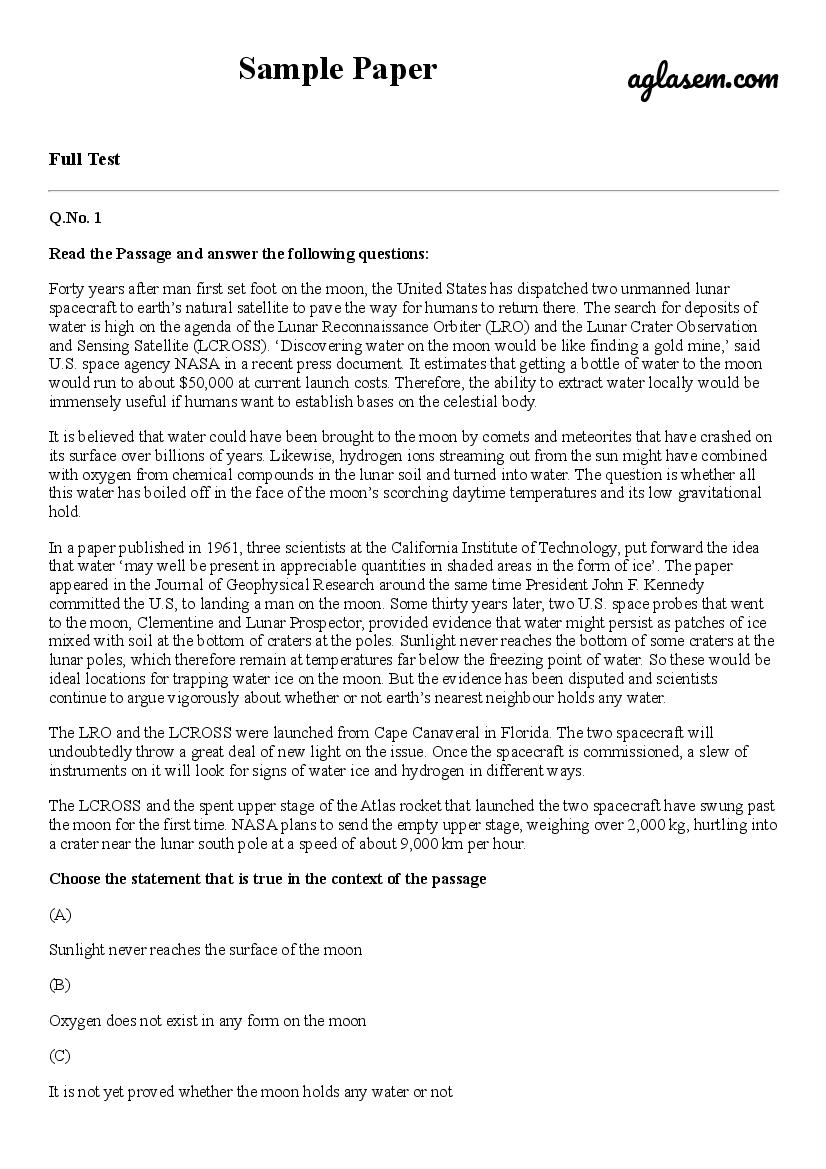
Full Test
Q.No. 1
Read the Passage and answer the following questions:
Forty years after man first set foot on the moon, the United States has dispatched two unmanned lunar
spacecraft to earth’s natural satellite to pave the way for humans to return there. The search for deposits of
water is high on the agenda of the Lunar Reconnaissance Orbiter (LRO) and the Lunar Crater Observation
and Sensing Satellite (LCROSS). ‘Discovering water on the moon would be like finding a gold mine,’ said
U.S. space agency NASA in a recent press document. It estimates that getting a bottle of water to the moon
would run to about $50,000 at current launch costs. Therefore, the ability to extract water locally would be
immensely useful if humans want to establish bases on the celestial body.
It is believed that water could have been brought to the moon by comets and meteorites that have crashed on
its surface over billions of years. Likewise, hydrogen ions streaming out from the sun might have combined
with oxygen from chemical compounds in the lunar soil and turned into water. The question is whether all
this water has boiled off in the face of the moon’s scorching daytime temperatures and its low gravitational
hold.
In a paper published in 1961, three scientists at the California Institute of Technology, put forward the idea
that water ‘may well be present in appreciable quantities in shaded areas in the form of ice’. The paper
appeared in the Journal of Geophysical Research around the same time President John F. Kennedy
committed the U.S, to landing a man on the moon. Some thirty years later, two U.S. space probes that went
to the moon, Clementine and Lunar Prospector, provided evidence that water might persist as patches of ice
mixed with soil at the bottom of craters at the poles. Sunlight never reaches the bottom of some craters at the
lunar poles, which therefore remain at temperatures far below the freezing point of water. So these would be
ideal locations for trapping water ice on the moon. But the evidence has been disputed and scientists
continue to argue vigorously about whether or not earth’s nearest neighbour holds any water.
The LRO and the LCROSS were launched from Cape Canaveral in Florida. The two spacecraft will
undoubtedly throw a great deal of new light on the issue. Once the spacecraft is commissioned, a slew of
instruments on it will look for signs of water ice and hydrogen in different ways.
The LCROSS and the spent upper stage of the Atlas rocket that launched the two spacecraft have swung past
the moon for the first time. NASA plans to send the empty upper stage, weighing over 2,000 kg, hurtling into
a crater near the lunar south pole at a speed of about 9,000 km per hour.
Choose the statement that is true in the context of the passage
(A)
Sunlight never reaches the surface of the moon
(B)
Oxygen does not exist in any form on the moon
(C)
It is not yet proved whether the moon holds any water or not
Page 2
The LRO and the LCROSS were launched in 1961
Q.No. 2
In the given question, a part of the given sentence has been underlined as this part may have an error. The
first option is the same as the underlined part in the given sentence. Choose this option if you think that the
underlined part has no error. Otherwise, choose the option that rectifies the error in the underlined part of the
given sentence.
Although the stock market seems to offer the possibility of great personal gain, you must understand that to
invest in stocks is accepting the risk of financial ruin as well.
(A)
is accepting the risk of financial ruin as well
(B)
is to accept the risk of financial ruin as well
(C)
is to accepting the risk as well as financial ruin
(D)
are accepting the risk of financial ruin as well
Q.No. 3
A sum of money invested for a certain number of years at 8% p.a. simple interest grows to Rs.180. The same
sum of money invested for the same number of years at 4% p.a. simple interest grows to Rs.120 only. For
how many years was the sum invested.
(A)
25 years
(B)
30 years
(C)
33 years
(D)
40 years
Q.No. 4
Page 3
If the profit share of Kiran in 3 rd year profit of RS 15,000 is RS 2,500 and Karan and Rahul invested for 5
months each, what is the ratio of profits between Karan, Kiran and Rahul respectively?
(A)
4:5:3
(B)
11 : 13 : 16
(C)
15 : 30 : 22
(D)
20 : 7 : 15
Q.No. 5
Read the Passage and answer the following questions:
Forty years after man first set foot on the moon, the United States has dispatched two unmanned lunar
spacecraft to earth’s natural satellite to pave the way for humans to return there. The search for deposits of
water is high on the agenda of the Lunar Reconnaissance Orbiter (LRO) and the Lunar Crater Observation
and Sensing Satellite (LCROSS). ‘Discovering water on the moon would be like finding a gold mine,’ said
U.S. space agency NASA in a recent press document. It estimates that getting a bottle of water to the moon
would run to about $50,000 at current launch costs. Therefore, the ability to extract water locally would be
immensely useful if humans want to establish bases on the celestial body.
It is believed that water could have been brought to the moon by comets and meteorites that have crashed on
its surface over billions of years. Likewise, hydrogen ions streaming out from the sun might have combined
with oxygen from chemical compounds in the lunar soil and turned into water. The question is whether all
Page 4
hold.
In a paper published in 1961, three scientists at the California Institute of Technology, put forward the idea
that water ‘may well be present in appreciable quantities in shaded areas in the form of ice’. The paper
appeared in the Journal of Geophysical Research around the same time President John F. Kennedy
committed the U.S, to landing a man on the moon. Some thirty years later, two U.S. space probes that went
to the moon, Clementine and Lunar Prospector, provided evidence that water might persist as patches of ice
mixed with soil at the bottom of craters at the poles. Sunlight never reaches the bottom of some craters at the
lunar poles, which therefore remain at temperatures far below the freezing point of water. So these would be
ideal locations for trapping water ice on the moon. But the evidence has been disputed and scientists
continue to argue vigorously about whether or not earth’s nearest neighbour holds any water.
The LRO and the LCROSS were launched from Cape Canaveral in Florida. The two spacecraft will
undoubtedly throw a great deal of new light on the issue. Once the spacecraft is commissioned, a slew of
instruments on it will look for signs of water ice and hydrogen in different ways.
The LCROSS and the spent upper stage of the Atlas rocket that launched the two spacecraft have swung past
the moon for the first time. NASA plans to send the empty upper stage, weighing over 2,000 kg, hurtling into
a crater near the lunar south pole at a speed of about 9,000 km per hour.
Why is it necessary to extract water locally on the moon?
(A)
To carry on further research
(B)
It is highly expensive to carry a bottle of water to the moon
(C)
It would be greatly useful to humans if they want to set up bases on the moon
(D)
It will become easy for the astronauts to stay there for a longer time
Q.No. 6
Read the Passage and answer the following questions:
Forty years after man first set foot on the moon, the United States has dispatched two unmanned lunar
spacecraft to earth’s natural satellite to pave the way for humans to return there. The search for deposits of
water is high on the agenda of the Lunar Reconnaissance Orbiter (LRO) and the Lunar Crater Observation
and Sensing Satellite (LCROSS). ‘Discovering water on the moon would be like finding a gold mine,’ said
U.S. space agency NASA in a recent press document. It estimates that getting a bottle of water to the moon
would run to about $50,000 at current launch costs. Therefore, the ability to extract water locally would be
immensely useful if humans want to establish bases on the celestial body.
It is believed that water could have been brought to the moon by comets and meteorites that have crashed on
its surface over billions of years. Likewise, hydrogen ions streaming out from the sun might have combined
with oxygen from chemical compounds in the lunar soil and turned into water. The question is whether all
this water has boiled off in the face of the moon’s scorching daytime temperatures and its low gravitational
hold.
In a paper published in 1961, three scientists at the California Institute of Technology, put forward the idea
that water ‘may well be present in appreciable quantities in shaded areas in the form of ice’. The paper
appeared in the Journal of Geophysical Research around the same time President John F. Kennedy
Page 5
to the moon, Clementine and Lunar Prospector, provided evidence that water might persist as patches of ice
mixed with soil at the bottom of craters at the poles. Sunlight never reaches the bottom of some craters at the
lunar poles, which therefore remain at temperatures far below the freezing point of water. So these would be
ideal locations for trapping water ice on the moon. But the evidence has been disputed and scientists
continue to argue vigorously about whether or not earth’s nearest neighbour holds any water.
The LRO and the LCROSS were launched from Cape Canaveral in Florida. The two spacecraft will
undoubtedly throw a great deal of new light on the issue. Once the spacecraft is commissioned, a slew of
instruments on it will look for signs of water ice and hydrogen in different ways.
The LCROSS and the spent upper stage of the Atlas rocket that launched the two spacecraft have swung past
the moon for the first time. NASA plans to send the empty upper stage, weighing over 2,000 kg, hurtling into
a crater near the lunar south pole at a speed of about 9,000 km per hour.
What would be the best place for trapping the ice water on the moon?
(A)
Near the poles
(B)
In shaded areas
(C)
From any part of the moon
(D)
Bottom of craters at the poles
Q.No. 7
Three numbers are in the ratio of 2 : 5 : 6 and their L.C.M. is 1080. What is their H.C.F. ?
(A)
24
(B)
36
(C)
48
(D)
64
Q.No. 8
The following line-graph gives the number of vehicles (in thousands) manufactured by two companies over
the years.
Page 6
maximum?
(A)
2001
(B)
2002
(C)
2003
(D)
2004
Q.No. 9
In the given question choose the word which is the exact OPPOSITE of the given words.
RELINQUISH
(A)
Abdicate
(B)
Renounce
(C)
Possess
(D)
Deny
Q.No. 10
Page 7
information. You have to decide if the information given in the statements is sufficient for answering
the problem. Indicate your answer as:
Who saves more, Mr. A or Mr. B?
Statement 1: The ratio of the incomes of A and B is 5 : 6
Statement 2: The ratio of expenditures of A and B is 6 : 5
(A)
If the data in statement (1) alone is sufficient to answer the question
(B)
If the data in statement (2) alone is sufficient to answer the question
(C)
If the data in both the statements together are needed to answer the question
(D)
If either statement (1) alone or statement (2) alone is sufficient to answer the question
Q.No. 11
In the given question, each word is followed by four options. Choose the option which is the closest
synonym of the given words. While choosing your answer, keep in mind the finer distinctions in the meaning
and usage of certain words.
BALEFUL
(A)
Noxious
(B)
Illicit
(C)
Open
(D)
Ambivalent
Q.No. 12
The following line-graph gives the number of vehicles (in thousands) manufactured by two companies over
the years.
Page 8
(A)
8,000
(B)
8,500
(C)
9,500
(D)
10,000
Q.No. 13
What is the sum of all the terms of an arithmetic progression if its first, second and last terms are 5, 8 and 74
respectively?
(A)
948
(B)
888
(C)
768
(D)
724
Q.No. 14
Page 9
The profit earned at the end of the 1 st year is RS 67,000. If Karan has invested only for 3 months, Kiran for
5 months and Rahul for 4 months, what is the profit share of Karan at the end of the year?
(A)
Rs 12, 550
(B)
Rs 13,750
(C)
Rs 15,000
(D)
Rs 18,750
Q.No. 15
Two trains A and B start simultaneously from stations X and Y towards each other respectively. After
meeting at a point between X and Y, train A reaches station Y in 9 hours and train B reaches station X in 4
hours. If the speed of train A is 36 km/hr, what is the speed of train B?
(A)
24 km/hr
(B)
54 km/hr
(C)
81 km/hr
Page 10
16 km/hr
Q.No. 16
In the given question choose the word which is the exact OPPOSITE of the given words.
ENORMOUS
(A)
Soft
(B)
Average
(C)
Tiny
(D)
Weak
Q.No. 17
There are 5 Rock songs, 6 Carnatic songs and 3 Indi pop songs. How many different albums can be formed
using the above collection if the albums should contain at least 1 Rock song and 1 Carnatic song?
(A)
15624
(B)
16384
(C)
6144
(D)
240
Q.No. 18
In the given question, the first two words are related in a particular manner. You have to choose a word from
the options so that a new pair of words is formed where the relation is the same as that of the first pair of
words. You are required to consider the secondary meaning of certain words while choosing an answer.
Dog : Poodle:: Fashion house :
(A)
Simpsons
(B)
Page 11
(C)
Armani
(D)
Riga
Q.No. 19
Fill in the blanks with the words that best fit the meaning of the sentence as a whole:
Fate smiles …………those who untiringly grapple with stark ……………of life.
(A)
of ……….. problems
(B)
over …….suggestions
(C)
on…….. realities
(D)
for ……..difficulties
Q.No. 20
Choose a suitable one-word substitute for the given phrase from the options under the question.
To adjust to a situation or environment
(A)
Adopt
(B)
Influence
(C)
Adapt
(D)
Comply
Q.No. 21
In the given question, each sentence is divided into three parts (a), (b), and (c). Find out which part of the
sentence contains an error. If there is no error, mark your answer as (d).
Page 12
(a) When I went to Maniram's house
(B)
(b) his mother told me that
(C)
(c) he was gone out of the country.
(D)
(d) No error
Q.No. 22
When a number is divided by 44, it leaves a remainder of 12. What will be the remainder when the number is
divided by 11?
(A)
0
(B)
1
(C)
11
(D)
12
Q.No. 23
The following line-graph gives the number of vehicles (in thousands) manufactured by two companies over
the years.
Page 13
2002?
(A)
101.25%
(B)
122.5%
(C)
146.25%
(D)
162.5%
Q.No. 24
In the given question, each word is followed by four options. Choose the option which is the closest
synonym of the given words. While choosing your answer, keep in mind the finer distinctions in the meaning
and usage of certain words.
RENDEZVOUS
(A)
Avoidance
(B)
Yield
(C)
Surrender
(D)
Engagement
Q.No. 25
Choose the option that best expresses the meaning of the given idiom/phrase.
He was all at sea when he began his new job
(A)
Happy
(B)
Sad
(C)
Puzzled
Page 14
Triumphant
Q.No. 26
A metallic hollow sphere is melted and transformed to a cone of diameter 12 cm. The internal and external
diameters of the hollow sphere are 6 cm and 12 cm respectively. What is the height of the cone?
(A)
15 cm
(B)
18 cm
(C)
21 cm
(D)
24 cm
Q.No. 27
A question given below has a problem and two statements numbered (1) and (2) giving certain
information. You have to decide if the information given in the statements is sufficient for answering
the problem. Indicate your answer as:
How many people are reading only newspaper ‘The Hindu’?
Statement 1: Number of people reading the newspaper ‘Deccan Chronicle’ are 2500 and the number of
people reading either ‘The Hindu’ or ‘Deccan Chronicle’ or both are 3900
Statement 2: Number of people reading both ‘The Hindu’ and ‘Deccan Chronicle’ 300 and the no. of people
reading ‘The Hindu’ are 1700
(A)
If the data in statement (1) alone is sufficient to answer the question
(B)
If the data in statement (2) alone is sufficient to answer the question
(C)
If the data in both the statements together are needed to answer the question
(D)
If either statement (1) alone or statement (2) alone is sufficient to answer the question
Q.No. 28
A question given below has a problem and two statements numbered (1) and (2) giving certain
information. You have to decide if the information given in the statements is sufficient for answering
the problem. Indicate your answer as:
Page 15
Statement 1: In January 1997 the card was worth ` 100, 000
Statement 2: Over the ten years 1987-1997, the card steadily eased in value by 10% each 12 months
(A)
If the data in statement (1) alone is sufficient to answer the question
(B)
If the data in statement (2) alone is sufficient to answer the question
(C)
If the data in both the statements together are needed to answer the question
(D)
If either statement (1) alone or statement (2) alone is sufficient to answer the question
Q.No. 29
The following bar graph gives the yearly investments of three people in a certain business for various years.
Kiran lends the profit earned by him for 2 years ar 6% of compound interest. If the profit is Rs 17500 for the
third year and all have invested the amount for complete year, what is the compound interest earned by
Kiran?
(A)
Rs 854.33
(B)
Rs 901.25
(C)
Rs 954.67
(D)
Page 16
Q.No. 30
Choose a suitable one-word substitute for the given phrase from the options under the question.
To give ones consent
(A)
Deliver
(B)
Accede
(C)
Surpass
(D)
Consign
Q.No. 31
In the given question, each word is followed by four options. Choose the option which is the closest
synonym of the given words. While choosing your answer, keep in mind the finer distinctions in the meaning
and usage of certain words.
ASTUTE
(A)
Asinine
(B)
Ignorant
(C)
Naive
(D)
Shrewd
Q.No. 32
Read the Passage and answer the following questions:
‘Human life has meaning only to that degree and as long as it is lived in the service of humanity’.
So said Wole Soyinka, the Nigerian Nobel Laureate, in his book of prison notes titled, The Man Died.
Soyinka has lived a meaningful life. As a poet, dramatist, novelist, essayist and literary critic, his
contribution to literature has been immense. Soyinka is more than a writer. An outspoken social critic,
political activist and tireless crusader against tyranny, he is the conscience of Africa.
Born in a Yoruba family in Abeokuta, Soyinka is the inheritor of the best of both the worlds. His family was
Christian. In the book, Ake: The Years of Childhood, he recalls the influences of his Christian home. His
Page 17
literary career was laid. But it was his grandfather who initiated young Soyinka into the rituals and religious
beliefs of his people.
Soyinka’s creative art is anchored in his culture. With all his pride in the culture of his people, Soyinka was
no blind worshipper of Africa’s past. This was startlingly proved by his play, A Dance of the Forests, written
for the Independence celebrations of Nigeria in 1960. As sadistic and megalomaniac dictators emerged in
independent African nations, Soyinka’s moral fervour deepened. Soyinka has been severe also in his
criticism of his countrymen. His hilarious comedies and brilliant political satires like Opera Wonyosi have
brought to light evils and signs of decadence in Nigerian society. In the midst of the violence and chaos that
marked the history of independent Nigeria, Soyinka kept his sanity. His deep moral outrage, however, drove
him to take enormous personal risks. Soyinka was arrested and held in solitary confinement for more than
two years. Soyinka produced some of his best works in prison. After he was being released, he chose to go
on voluntary exile for a long period. The bedrock of Soyinka’s unwavering social commitment is his deep
love for Africa. When he received the Nobel Prize for Literature in 1986, Soyinka held out the Prize in the
direction of the African continent. This touching gesture was an acknowledgment of his belief that the Prize
was an affirmation of African culture, literature and art that had long been trampled by the colonial powers.
In his Nobel Prize acceptance speech, Soyinka eloquently affirmed the African values. He called for the
political will to dismantle all structures of racism and human inequality. The speech echoed his statement in
The Man Died, ‘For me justice is the prime condition of humanity.’ It was in recognition of this passionate
commitment that in 1994, UNESCO made Soyinka its Goodwill Ambassador for the promotion of African
culture and human rights.
Soyinka’s popular work, Opera Wonyosi, throws light on the
(A)
Rich traditions and ritual practices of Nigerian society
(B)
Evils and signs of decadence in Nigerian society
(C)
Varied and rich cultural past of Nigeria
(D)
Evils and structures of racism that existed in Nigeria
Q.No. 33
Read the Passage and answer the following questions:
The Alaska pipeline starts at the frozen edge of the Arctic Ocean. It stretches southward across the largest
and northernmost state in the United States, ending at a remote ice-free seaport village nearly 800 miles from
where it begins. It is massive in size and extremely complicated to operate.
The steel pipe crosses windswept plains and endless miles of delicate tundra that tops the frozen ground. It
weaves through crooked canyons, climbs sheer mountains, plunges over rocky crags, makes its way through
thick forests, and passes over or under hundreds of rivers and streams. The pipe is 4 feet in diameter, and up
to 2 million barrels (or 84 million gallons) of crude oil can be pumped through it daily.
Resting on H-shaped steel racks called "bents," long sections of the pipeline follow a zigzag course high
above the frozen earth. Other long sections drop out of sight beneath spongy or rocky ground and return to
the surface later on. The pattern of the pipeline's up-and-down route is determined by the often harsh
Page 18
rock, or permafrost (permanently frozen ground).
A little more than half of the pipeline is elevated above the ground. The remainder is buried
anywhere from 3 to 12 feet, depending largely upon the type of terrain and the properties of the
soil.
One of the largest in the world, the pipeline cost approximately $8 billion and is by far the biggest and most
expensive construction project ever undertaken by private industry. In fact, no single business could raise
that much money, so 8 major oil companies formed a consortium in order to share the costs. Each company
controlled oil rights to particular shares of land in the oil fields and paid into the pipeline-construction fund
according to the size of its holdings. Today, despite enormous problems of climate, supply shortages,
equipment breakdowns, labor disagreements, treacherous terrain, a certain amount of mismanagement, and
even theft, the Alaska pipeline has been completed and is operating.
Which of the following determined the percentage of the construction costs each member of the
consortium would pay?
(A)
Area of oil field land each company owned
(B)
Tenure of the ownership of the company on the oil fields
(C)
Number of employees worked for each company
(D)
Number of oil wells located on the company’s land
Q.No. 34
In the given question, each sentence is divided into four parts (a), (b), (c) and (d). Find out which part of the
sentence contains an error. If there is no error, mark your answer as (d).
(A)
(a) Included in
(B)
(b) the parcel was a coat,
(C)
(c) a shirt, a tie and a toy for our son.
(D)
(d) No error
Q.No. 35
In the given question, the first two words are related in a particular manner. You have to choose a word from
the options so that a new pair of words is formed where the relation is the same as that of the first pair of
Page 19
Goods : Warehouse:: Films:
(A)
Studio
(B)
Garage
(C)
Dockyard
(D)
Archives
Q.No. 36
A question given below has a problem and two statements numbered (1) and (2) giving certain
information. You have to decide if the information given in the statements is sufficient for answering
the problem. Indicate your answer as:
How many adults ride bicycles in city A if all adults in City A either ride bicycles or drive cars?
Statement 1: 85% of the 10,000 adults in city A drive cars
Statement 2: 8500 adults in city A drive cars.
(A)
If the data in statement (1) alone is sufficient to answer the question
(B)
If the data in statement (2) alone is sufficient to answer the question
(C)
If the data in both the statements together are needed to answer the question
(D)
If either statement (1) alone or statement (2) alone is sufficient to answer the question
Q.No. 37
For what values of ‘m’ is f(x) = 0, if(x)=x2 + (2m+1)x +m2 +7 where x is a real number?
(A)
m<0
(B)
m=0
Page 20
m ≥ 27/4
(D)
m>0
Q.No. 38
Read the Passage and answer the following questions:
The Alaska pipeline starts at the frozen edge of the Arctic Ocean. It stretches southward across the largest
and northernmost state in the United States, ending at a remote ice-free seaport village nearly 800 miles from
where it begins. It is massive in size and extremely complicated to operate.
The steel pipe crosses windswept plains and endless miles of delicate tundra that tops the frozen ground. It
weaves through crooked canyons, climbs sheer mountains, plunges over rocky crags, makes its way through
thick forests, and passes over or under hundreds of rivers and streams. The pipe is 4 feet in diameter, and up
to 2 million barrels (or 84 million gallons) of crude oil can be pumped through it daily.
Resting on H-shaped steel racks called "bents," long sections of the pipeline follow a zigzag course high
above the frozen earth. Other long sections drop out of sight beneath spongy or rocky ground and return to
the surface later on. The pattern of the pipeline's up-and-down route is determined by the often harsh
demands of the arctic and subarctic climate, the tortuous lay of the land, and the varied compositions of soil,
rock, or permafrost (permanently frozen ground).
A little more than half of the pipeline is elevated above the ground. The remainder is buried
anywhere from 3 to 12 feet, depending largely upon the type of terrain and the properties of the
soil.
One of the largest in the world, the pipeline cost approximately $8 billion and is by far the biggest and most
expensive construction project ever undertaken by private industry. In fact, no single business could raise
that much money, so 8 major oil companies formed a consortium in order to share the costs. Each company
controlled oil rights to particular shares of land in the oil fields and paid into the pipeline-construction fund
according to the size of its holdings. Today, despite enormous problems of climate, supply shortages,
equipment breakdowns, labor disagreements, treacherous terrain, a certain amount of mismanagement, and
even theft, the Alaska pipeline has been completed and is operating.
In the third Para, The phrase "Resting on" is closest in meaning to
(A)
Consisting of
(B)
Supported by
(C)
Passing under
(D)
Protected with
Q.No. 39
Page 21
2 2
(23.5 + 11.5) − (23.5 − 11.5)
11.5 × 47.0
is
(A)
1
(B)
2
(C)
4
(D)
8
Q.No. 40
The following bar graph gives the yearly investments of three people in a certain business for
various years.
What is the % of incline/decline in the total investment of Kiran and Rahul in 3 rd year when compared to 1
st year?
(A)
25.94%
(B)
Page 22
(C)
29.83%
(D)
30.43%
Q.No. 41
Choose the option that best expresses the meaning of the given idiom/phrase.
Those who work by fits and starts seldom show good results.
(A)
Rarely
(B)
Disinterestedly
(C)
Regularly
(D)
Irregularly
Q.No. 42
In the given question, each word is followed by four options. Choose the option which is the closest antonym
of the given words. While choosing your answer, keep in mind the finer distinctions in the meaning and
usage of certain words.
EQUIVOCATE
(A)
Quibble
(B)
Eschew
(C)
Confront
(D)
Shuffle
Q.No. 43
Read the Passage and answer the following questions:
‘Human life has meaning only to that degree and as long as it is lived in the service of humanity’.
Page 23
Soyinka has lived a meaningful life. As a poet, dramatist, novelist, essayist and literary critic, his
contribution to literature has been immense. Soyinka is more than a writer. An outspoken social critic,
political activist and tireless crusader against tyranny, he is the conscience of Africa.
Born in a Yoruba family in Abeokuta, Soyinka is the inheritor of the best of both the worlds. His family was
Christian. In the book, Ake: The Years of Childhood, he recalls the influences of his Christian home. His
father was a schoolmaster. In his well-stocked library, where young Wole spent hours, the foundation of a
literary career was laid. But it was his grandfather who initiated young Soyinka into the rituals and religious
beliefs of his people.
Soyinka’s creative art is anchored in his culture. With all his pride in the culture of his people, Soyinka was
no blind worshipper of Africa’s past. This was startlingly proved by his play, A Dance of the Forests, written
for the Independence celebrations of Nigeria in 1960. As sadistic and megalomaniac dictators emerged in
independent African nations, Soyinka’s moral fervour deepened. Soyinka has been severe also in his
criticism of his countrymen. His hilarious comedies and brilliant political satires like Opera Wonyosi have
brought to light evils and signs of decadence in Nigerian society. In the midst of the violence and chaos that
marked the history of independent Nigeria, Soyinka kept his sanity. His deep moral outrage, however, drove
him to take enormous personal risks. Soyinka was arrested and held in solitary confinement for more than
two years. Soyinka produced some of his best works in prison. After he was being released, he chose to go
on voluntary exile for a long period. The bedrock of Soyinka’s unwavering social commitment is his deep
love for Africa. When he received the Nobel Prize for Literature in 1986, Soyinka held out the Prize in the
direction of the African continent. This touching gesture was an acknowledgment of his belief that the Prize
was an affirmation of African culture, literature and art that had long been trampled by the colonial powers.
In his Nobel Prize acceptance speech, Soyinka eloquently affirmed the African values. He called for the
political will to dismantle all structures of racism and human inequality. The speech echoed his statement in
The Man Died, ‘For me justice is the prime condition of humanity.’ It was in recognition of this passionate
commitment that in 1994, UNESCO made Soyinka its Goodwill Ambassador for the promotion of African
culture and human rights.
What is the passage about?
(A)
It is a tribute on Wole Soyinka
(B)
It is a review of his literary works
(C)
It is his autobiography
(D)
It is about his life in prison
Q.No. 44
The following pie chart gives the success rate of international teams playing cricket for the period 2001-08
and the table below the chart gives the number of matches won by each team during the period.
Page 24
the given period (no match ended in a tie)?
(A)
266
(B)
976
(C)
1875
(D)
2975
Q.No. 45
In the question, different parts of a sentence/passage have been jumbled. Choose the option that represents
the best sequence to make the sentence/passage coherent and meaningful. Ignore punctuation marks.
P. for many years, he had worked with great labour and
Q. Pygmalion was a sculptor who lived on the island of Cyprus
Page 25
S. that he carved out of senseless blocks of marble and wood were perfect and somewhocametolook at them
were deceived
(A)
QSPR
(B)
QSRP
(C)
QPRS
(D)
QRPS
Q.No. 46
If the expressions px4 - 3x3 + 15 and 4x2 + 7x - p when divided by (x – 3) leave the same remainders, then
the value of p is
(A)
1.4
(B)
1.5
(C)
2.1
(D)
2.4
Q.No. 47
In the given question, the first two words are related in a particular manner. You have to choose a word from
the options so that a new pair of words is formed where the relation is the same as that of the first pair of
words. You are required to consider the secondary meaning of certain words while choosing an answer.
Dictionary : Lexicographer :: Evolution :
(A)
Biologist
(B)
Paleontologist
(C)
Page 26
(D)
Historian
Q.No. 48
In the question, different parts of a sentence/passage have been jumbled. Choose the option that represents
the best sequence to make the sentence/passage coherent and meaningful. Ignore punctuation marks.
P. 196 leprosy Endemic districts of
Q. National leprosy eradication Programme
R. our Country had greatly benefitted
S. As a result of the implementation of the
(A)
QPSR
(B)
QSRP
(C)
SRPQ
(D)
SQPR
Q.No. 49
A question given below has a problem and two statements numbered (1) and (2) giving certain
information. You have to decide if the information given in the statements is sufficient for answering
the problem. Indicate your answer as:
A ship was moving towards lighthouse on the shore with uniform speed. A man standing on the lighthouse
observes the ship. Eight minutes later, he finds that the angle of depression was 45°. In how much time does
the ship reach the lighthouse?
Statement 1: Initially, the man standing on the lighthouse observes the ship at an angle of depression of 30°
Statement 2: The speed of the ship was 6 km/h and the height of the lighthouse is 300 m
(A)
If the data in statement (1) alone is sufficient to answer the question
(B)
If the data in statement (2) alone is sufficient to answer the question
(C)
If the data in both the statements together are needed to answer the question
Page 27
If either statement (1) alone or statement (2) alone is sufficient to answer the question
Q.No. 50
In the given question, a part of the given sentence has been underlined as this part may have an error. The
first option is the same as the underlined part in the given sentence. Choose this option if you think that the
underlined part has no error. Otherwise, choose the option that rectifies the error in the underlined part of the
given sentence.
Although today it is cost-effective to make perfumes with synthetic ingredients, they used to make the classic
fragrances from flowers only and other natural essences.
(A)
they used to make the classic fragrances from flowers only
(B)
the classic fragrances used to be made from flowers
(C)
the classic fragrances used to be made by them only from flowers
(D)
the classic fragrances used to be made from flowers only
Q.No. 51
Read the Passage and answer the following questions:
Forty years after man first set foot on the moon, the United States has dispatched two unmanned lunar
spacecraft to earth’s natural satellite to pave the way for humans to return there. The search for deposits of
water is high on the agenda of the Lunar Reconnaissance Orbiter (LRO) and the Lunar Crater Observation
and Sensing Satellite (LCROSS). ‘Discovering water on the moon would be like finding a gold mine,’ said
U.S. space agency NASA in a recent press document. It estimates that getting a bottle of water to the moon
would run to about $50,000 at current launch costs. Therefore, the ability to extract water locally would be
immensely useful if humans want to establish bases on the celestial body.
It is believed that water could have been brought to the moon by comets and meteorites that have crashed on
its surface over billions of years. Likewise, hydrogen ions streaming out from the sun might have combined
with oxygen from chemical compounds in the lunar soil and turned into water. The question is whether all
this water has boiled off in the face of the moon’s scorching daytime temperatures and its low gravitational
hold.
In a paper published in 1961, three scientists at the California Institute of Technology, put forward the idea
that water ‘may well be present in appreciable quantities in shaded areas in the form of ice’. The paper
appeared in the Journal of Geophysical Research around the same time President John F. Kennedy
committed the U.S, to landing a man on the moon. Some thirty years later, two U.S. space probes that went
to the moon, Clementine and Lunar Prospector, provided evidence that water might persist as patches of ice
mixed with soil at the bottom of craters at the poles. Sunlight never reaches the bottom of some craters at the
lunar poles, which therefore remain at temperatures far below the freezing point of water. So these would be
ideal locations for trapping water ice on the moon. But the evidence has been disputed and scientists
continue to argue vigorously about whether or not earth’s nearest neighbour holds any water.
The LRO and the LCROSS were launched from Cape Canaveral in Florida. The two spacecraft will
undoubtedly throw a great deal of new light on the issue. Once the spacecraft is commissioned, a slew of
Page 28
The LCROSS and the spent upper stage of the Atlas rocket that launched the two spacecraft have swung past
the moon for the first time. NASA plans to send the empty upper stage, weighing over 2,000 kg, hurtling into
a crater near the lunar south pole at a speed of about 9,000 km per hour.
It can be inferred from the passage that the moon’s
(A)
Upper crust contains hydrogen
(B)
Daytime temperatures are very high
(C)
Soil can hardly hold water
(D)
Surface is covered with ice
Q.No. 52
Read the Passage and answer the following questions:
There are millions of children in India, who cannot, for a variety of reasons, be protected by their parents and
adult family. The parents maybe dead, or alcoholic, or violent and abusive, or in jail, or lost, or have
abandoned their child. They may also be themselves destitute, homeless, gravely ill or disabled, and
therefore unable to care for their children without support. The child, who has no home or settled place or
abode and any ostensible means of subsistence maybe at risk in other ways as well: due to riots, natural
disasters, war and militant conflict; disabilities and incurable terminal ailments, with no one who can support
or look after the child; when a child is grossly abused or tortured; is inducted into drug abuse or trafficking;
child marriage and child labor. In all such situations, it is the State, which is both morally and legally
responsible to protect, nurture and raise each child.
However, at present, the State in India invests miniscule resources in child protection. India today is a
youthful nation: 19 percent of the children in the world live within its boundaries, and more than one-third of
the population is below 18 years. Accounting for the largest number of children in work, and the second
largest number of children affected by HIV, India arguably has the highest number of children facing
exploitation and neglect in the world. But the investment on child protection was a shocking 0.034 per cent
of the budget.
Traditionally, public authorities have tried to accomplish their duty of protecting children who are at risk
mainly by locking away large numbers of these children in State-run, closed institutions for many years until
the child grows to adulthood, and soon after the child comes of age by abruptly discharging the child without
any further support into the larger society. Private and religious charities also sometimes run orphanages for
such children, but they are usually run on similar custodial principles of raising the child in confined and
overly disciplined environments. For children who conflict with the law, there are statutory ‘special homes’
to which they are usually confined in conditions similar to jails. For many years, these children also shared
adult jails, and many illegally continue to do so.
It is both absurd and heartless for children to be locked up only because they have no one to protect them. It
is argued that this is done for the sake of the child: if the child was free in the community, the State would be
unable to protect the child from abuse, and therefore she is locked up for her own good. This is quite
illogical. The State must find ways to protect the child who is in need of care in ways that respect the child’s
Page 29
education, health care, recreation, love and security.
What is the central theme of this passage?
(A)
It makes a comparative study about State-run homes and orphanages run by private organizations
(B)
It draws conclusions on a study based on ‘children’s jails’
(C)
It critically analyses the deplorable conditions in State-run homes
(D)
It focuses on the child, who is in need of State support
Q.No. 53
12 11 10
P3 + P3 + P4
=?
15
P3
(A)
752/237
(B)
732/247
(C)
724/237
(D)
735/273
Q.No. 54
The difference between a two-digit number and the number obtained by interchanging the digits is 54. What
is the difference between the sum and difference of the digits of the number if the ratio between the digits of
the number is 3 : 1?
(A)
4
(B)
5
(C)
6
Page 30
8
Q.No. 55
In the question, different parts of a sentence/passage have been jumbled. Choose the option that represents
the best sequence to make the sentence/passage coherent and meaningful. Ignore punctuation marks.
P. Breakthroughs in communications technology,
Q. There has been a great change
R. Throughout the entire communications industry
S. In the past, it has been observed that with each new wave of
(A)
PQRS
(B)
SPQR
(C)
RSQP
(D)
PSQR
Q.No. 56
Fill in the blanks with the words that best fit the meaning of the sentence as a whole:
In the decade after the revolution, the new government seemed to ______ and was never quite ______; this
period ultimately led to a second revolution in which the current ruling party took power.
(A)
fortify ... faltering
(B)
waver ... flimsy
(C)
coagulate ... tenable
(D)
totter ... stable
Q.No. 57
Rs.5,887 is divided between A and B, such that A’s share at the end of 9 years is equal to B’s share at the end
of 11 years, compounded annually at the rate of 5%. What is the share of A?
Page 31
Rs. 2,800
(B)
Rs. 2,000
(C)
Rs. 3,087
(D)
Rs. 2,087
Q.No. 58
What is the least decimal value that should be added to 0.000510 to make it a perfect cube?
(A)
0.02
(B)
0.0002
(C)
0.00002
(D)
0.000002
Q.No. 59
I have some marbles of equal size. If I arrange them in the form of a solid square, then 12 marbles are left
and if the number of marbles on each side of the square is increased by 1 then I fall short of 21 marbles. How
many marbles do I have ?
(A)
124
(B)
218
(C)
268
(D)
320
Q.No. 60
Choose the option that best expresses the meaning of the given idiom/phrase.
Page 32
(A)
Suffered
(B)
Confessed
(C)
Donated
(D)
Took off his shirt
Q.No. 61
If 184 / {42 + 25 [ 38 – (12 * x ) ] } = 92, the value of x is
(A)
3/10
(B)
33/10
(C)
4/10
(D)
42/10
Q.No. 62
The following pie chart gives the success rate of international teams playing cricket for the period 2001-08
and the table below the chart gives the number of matches won by each team during the period.
Page 33
(A)
3:5
(B)
272 : 231
(C)
312 : 319
(D)
503 : 476
Q.No. 63
A question given below has a problem and two statements numbered (1) and (2) giving certain
information. You have to decide if the information given in the statements is sufficient for answering
the problem. Indicate your answer as:
What is the area of a rectangle PQRS?
Statement 1: Semi-perimeter of ∆PRQ is 18 cm
Page 34
(A)
If the data in statement (1) alone is sufficient to answer the question
(B)
If the data in statement (2) alone is sufficient to answer the question
(C)
If the data in both the statements together are needed to answer the question
(D)
If either statement (1) alone or statement (2) alone is sufficient to answer the question
Q.No. 64
Read the Passage and answer the following questions:
There are millions of children in India, who cannot, for a variety of reasons, be protected by their parents and
adult family. The parents maybe dead, or alcoholic, or violent and abusive, or in jail, or lost, or have
abandoned their child. They may also be themselves destitute, homeless, gravely ill or disabled, and
therefore unable to care for their children without support. The child, who has no home or settled place or
abode and any ostensible means of subsistence maybe at risk in other ways as well: due to riots, natural
disasters, war and militant conflict; disabilities and incurable terminal ailments, with no one who can support
or look after the child; when a child is grossly abused or tortured; is inducted into drug abuse or trafficking;
child marriage and child labor. In all such situations, it is the State, which is both morally and legally
responsible to protect, nurture and raise each child.
However, at present, the State in India invests miniscule resources in child protection. India today is a
youthful nation: 19 percent of the children in the world live within its boundaries, and more than one-third of
the population is below 18 years. Accounting for the largest number of children in work, and the second
largest number of children affected by HIV, India arguably has the highest number of children facing
exploitation and neglect in the world. But the investment on child protection was a shocking 0.034 per cent
of the budget.
Traditionally, public authorities have tried to accomplish their duty of protecting children who are at risk
mainly by locking away large numbers of these children in State-run, closed institutions for many years until
the child grows to adulthood, and soon after the child comes of age by abruptly discharging the child without
any further support into the larger society. Private and religious charities also sometimes run orphanages for
such children, but they are usually run on similar custodial principles of raising the child in confined and
overly disciplined environments. For children who conflict with the law, there are statutory ‘special homes’
to which they are usually confined in conditions similar to jails. For many years, these children also shared
adult jails, and many illegally continue to do so.
It is both absurd and heartless for children to be locked up only because they have no one to protect them. It
is argued that this is done for the sake of the child: if the child was free in the community, the State would be
unable to protect the child from abuse, and therefore she is locked up for her own good. This is quite
illogical. The State must find ways to protect the child who is in need of care in ways that respect the child’s
right to a happy and free childhood, while at the same time ensuring her protection, and her rights to food,
education, health care, recreation, love and security.
Pick out the word which is a close synonym of ‘ostensible’ as used in the passage.
(A)
Page 35
(B)
Rigid
(C)
Contemptible
(D)
Apparent
Q.No. 65
If g(x)=x/(1+x) , then what is the value of g{g[g(x)]} ?
(A)
x/(1+2x)
(B)
x/(1+3x)
(C)
x/(1+4x)
(D)
x/(1+5x)
Q.No. 66
In the given question choose the word which is the exact OPPOSITE of the given words.
ARTIFICIAL
(A)
Red
(B)
Natural
(C)
Truthful
(D)
Solid
Q.No. 67
The present age of a father is twice the present age of his son. After 6 years, his age would be times his
son’s age. After further 6 years, the son’s age would be how many times his father’s age ?
Page 36
5/3
(B)
3/2
(C)
2/3
(D)
3/5
Q.No. 68
A question given below has a problem and two statements numbered (1) and (2) giving certain
information. You have to decide if the information given in the statements is sufficient for answering
the problem. Indicate your answer as:
In △ PQR, PQ = PR = 10 cm. What is the area of the triangle?
Statement 1: QR = 10√3 cm
Statement 2: If RP is extended to S, ∠QPS = 60°
(A)
If the data in statement (1) alone is sufficient to answer the question
(B)
If the data in statement (2) alone is sufficient to answer the question
(C)
If the data in both the statements together are needed to answer the question
(D)
If either statement (1) alone or statement (2) alone is sufficient to answer the question
Q.No. 69
A question given below has a problem and two statements numbered (1) and (2) giving certain
information. You have to decide if the information given in the statements is sufficient for answering
the problem. Indicate your answer as:
The fourth proportion of a, b and d is 4 and the fourth proportion of a, b and c is 8. What is the value of ‘b’?
Statement 1: The triplet c, d, e are in continued proportion
Statement 2: The triplets a, b, c and b, c, d are in continued proportion
(A)
If the data in statement (1) alone is sufficient to answer the question
Page 37
If the data in statement (2) alone is sufficient to answer the question
(C)
If the data in both the statements together are needed to answer the question
(D)
If either statement (1) alone or statement (2) alone is sufficient to answer the question
Q.No. 70
Choose the option that best expresses the meaning of the given idiom/phrase.
Why should you always be the one to cast the first stone?
(A)
to be deeply involved
(B)
to praise first of all
(C)
to be the first to find fault
(D)
to start a fight
Q.No. 71
The unit digit in the product of (256 x 124 x 21* x 127) is 2. What is the digit in the place of *?
(A)
8
(B)
6
(C)
4
(D)
2
Q.No. 72
Choose the option that best expresses the meaning of the given idiom/phrase.
Because of his misbehavior, he is bound to face the music.
(A)
Page 38
(B)
Get reprimanded
(C)
Feel sorry
(D)
Listen to the music
Q.No. 73
In the given question, each word is followed by four options. Choose the option which is the closest antonym
of the given words. While choosing your answer, keep in mind the finer distinctions in the meaning and
usage of certain words.
AVANT-GARDE
(A)
Conservative
(B)
Radical
(C)
Innovative
(D)
Cordial
Q.No. 74
Fill in the blanks with the words that best fit the meaning of the sentence as a whole:
If you …………… goods into the country, they may be ...... by the customs authority.
(A)
get …………punished
(B)
send………….fined
(C)
transport ……………jailed
(D)
smuggle ………….confiscated
Q.No. 75
Page 39
There are millions of children in India, who cannot, for a variety of reasons, be protected by their parents and
adult family. The parents maybe dead, or alcoholic, or violent and abusive, or in jail, or lost, or have
abandoned their child. They may also be themselves destitute, homeless, gravely ill or disabled, and
therefore unable to care for their children without support. The child, who has no home or settled place or
abode and any ostensible means of subsistence maybe at risk in other ways as well: due to riots, natural
disasters, war and militant conflict; disabilities and incurable terminal ailments, with no one who can support
or look after the child; when a child is grossly abused or tortured; is inducted into drug abuse or trafficking;
child marriage and child labor. In all such situations, it is the State, which is both morally and legally
responsible to protect, nurture and raise each child.
However, at present, the State in India invests miniscule resources in child protection. India today is a
youthful nation: 19 percent of the children in the world live within its boundaries, and more than one-third of
the population is below 18 years. Accounting for the largest number of children in work, and the second
largest number of children affected by HIV, India arguably has the highest number of children facing
exploitation and neglect in the world. But the investment on child protection was a shocking 0.034 per cent
of the budget.
Traditionally, public authorities have tried to accomplish their duty of protecting children who are at risk
mainly by locking away large numbers of these children in State-run, closed institutions for many years until
the child grows to adulthood, and soon after the child comes of age by abruptly discharging the child without
any further support into the larger society. Private and religious charities also sometimes run orphanages for
such children, but they are usually run on similar custodial principles of raising the child in confined and
overly disciplined environments. For children who conflict with the law, there are statutory ‘special homes’
to which they are usually confined in conditions similar to jails. For many years, these children also shared
adult jails, and many illegally continue to do so.
It is both absurd and heartless for children to be locked up only because they have no one to protect them. It
is argued that this is done for the sake of the child: if the child was free in the community, the State would be
unable to protect the child from abuse, and therefore she is locked up for her own good. This is quite
illogical. The State must find ways to protect the child who is in need of care in ways that respect the child’s
right to a happy and free childhood, while at the same time ensuring her protection, and her rights to food,
education, health care, recreation, love and security.
It becomes an obligation for the State to take moral and legal responsibility in the case of children
(A)
Whose parents are seriously ill
(B)
Who are orphaned or abandoned
(C)
Whose parents are destitute and homeless
(D)
All the above
Q.No. 76
Read the Passage and answer the following questions:
Forty years after man first set foot on the moon, the United States has dispatched two unmanned lunar
spacecraft to earth’s natural satellite to pave the way for humans to return there. The search for deposits of
Page 40
and Sensing Satellite (LCROSS). ‘Discovering water on the moon would be like finding a gold mine,’ said
U.S. space agency NASA in a recent press document. It estimates that getting a bottle of water to the moon
would run to about $50,000 at current launch costs. Therefore, the ability to extract water locally would be
immensely useful if humans want to establish bases on the celestial body.
It is believed that water could have been brought to the moon by comets and meteorites that have crashed on
its surface over billions of years. Likewise, hydrogen ions streaming out from the sun might have combined
with oxygen from chemical compounds in the lunar soil and turned into water. The question is whether all
this water has boiled off in the face of the moon’s scorching daytime temperatures and its low gravitational
hold.
In a paper published in 1961, three scientists at the California Institute of Technology, put forward the idea
that water ‘may well be present in appreciable quantities in shaded areas in the form of ice’. The paper
appeared in the Journal of Geophysical Research around the same time President John F. Kennedy
committed the U.S, to landing a man on the moon. Some thirty years later, two U.S. space probes that went
to the moon, Clementine and Lunar Prospector, provided evidence that water might persist as patches of ice
mixed with soil at the bottom of craters at the poles. Sunlight never reaches the bottom of some craters at the
lunar poles, which therefore remain at temperatures far below the freezing point of water. So these would be
ideal locations for trapping water ice on the moon. But the evidence has been disputed and scientists
continue to argue vigorously about whether or not earth’s nearest neighbour holds any water.
The LRO and the LCROSS were launched from Cape Canaveral in Florida. The two spacecraft will
undoubtedly throw a great deal of new light on the issue. Once the spacecraft is commissioned, a slew of
instruments on it will look for signs of water ice and hydrogen in different ways.
The LCROSS and the spent upper stage of the Atlas rocket that launched the two spacecraft have swung past
the moon for the first time. NASA plans to send the empty upper stage, weighing over 2,000 kg, hurtling into
a crater near the lunar south pole at a speed of about 9,000 km per hour.
What is the apt title of the passage?
(A)
Weather Conditions on the Moon
(B)
Searching for Water on the Moon
(C)
Moon – A Gold Mine for Many
(D)
Mission LCROSS
Q.No. 77
A train is moving with a speed of 48 km/h. A passenger in the train observes that a goods train of length 250
m, moving in opposite direction, takes 10 seconds to pass him. What is the speed of the goods train?
(A)
36 km/h
(B)
38 km/h
Page 41
40 km/h
(D)
42 km/h
Q.No. 78
Read the Passage and answer the following questions:
The Alaska pipeline starts at the frozen edge of the Arctic Ocean. It stretches southward across the largest
and northernmost state in the United States, ending at a remote ice-free seaport village nearly 800 miles from
where it begins. It is massive in size and extremely complicated to operate.
The steel pipe crosses windswept plains and endless miles of delicate tundra that tops the frozen ground. It
weaves through crooked canyons, climbs sheer mountains, plunges over rocky crags, makes its way through
thick forests, and passes over or under hundreds of rivers and streams. The pipe is 4 feet in diameter, and up
to 2 million barrels (or 84 million gallons) of crude oil can be pumped through it daily.
Resting on H-shaped steel racks called "bents," long sections of the pipeline follow a zigzag course high
above the frozen earth. Other long sections drop out of sight beneath spongy or rocky ground and return to
the surface later on. The pattern of the pipeline's up-and-down route is determined by the often harsh
demands of the arctic and subarctic climate, the tortuous lay of the land, and the varied compositions of soil,
rock, or permafrost (permanently frozen ground).
A little more than half of the pipeline is elevated above the ground. The remainder is buried
anywhere from 3 to 12 feet, depending largely upon the type of terrain and the properties of the
soil.
One of the largest in the world, the pipeline cost approximately $8 billion and is by far the biggest and most
expensive construction project ever undertaken by private industry. In fact, no single business could raise
that much money, so 8 major oil companies formed a consortium in order to share the costs. Each company
controlled oil rights to particular shares of land in the oil fields and paid into the pipeline-construction fund
according to the size of its holdings. Today, despite enormous problems of climate, supply shortages,
equipment breakdowns, labor disagreements, treacherous terrain, a certain amount of mismanagement, and
even theft, the Alaska pipeline has been completed and is operating.
The author mentions all of the following as important in determining the pipeline's route EXCEPT the
(A)
climate
(B)
lay of the land itself
(C)
local vegetation
(D)
kind of soil and rock
Page 42
Choose a suitable one-word substitute for the given phrase from the options under the question.
A humorist who uses irony and sarcasm
(A)
Optimist
(B)
Philanthropist
(C)
Satirist
(D)
Cynic
Q.No. 80
In the given question, each sentence is divided into three parts (a), (b) and (c). Find out which part of the
sentence contains an error. If there is no error, mark your answer as (d).
(A)
(a) This is one of the reason
(B)
(b) why the industry flourished in such rich countries
(C)
(c) as Japan and Britain.
(D)
(d) No error
Q.No. 81
A question given below has a problem and two statements numbered (1) and (2) giving certain
information. You have to decide if the information given in the statements is sufficient for answering
the problem. Indicate your answer as:
Two painters were painting an advertising board. At 12 O’clock, they had painted half the board. At what
time will the board be fully painted?
Statement 1: The first painter can completely paint the board in 12 hours
Statement 2: The second painter can completely paint the board in 8 hours
(A)
If the data in statement (1) alone is sufficient to answer the question
(B)
Page 43
(C)
If the data in both the statements together are needed to answer the question
(D)
If either statement (1) alone or statement (2) alone is sufficient to answer the question
Q.No. 82
In the given question, each word is followed by four options. Choose the option which is the closest antonym
of the given words. While choosing your answer, keep in mind the finer distinctions in the meaning and
usage of certain words.
EFFICACY
(A)
Virtue
(B)
Power
(C)
Caliber
(D)
Enervation
Q.No. 83
In the given question choose the word which is the exact OPPOSITE of the given words.
COMMISSIONED
(A)
Started
(B)
Closed
(C)
Finished
(D)
Terminated
Q.No. 84
A question given below has a problem and two statements numbered (1) and (2) giving certain
information. You have to decide if the information given in the statements is sufficient for answering
the problem. Indicate your answer as:
Page 44
four is the oldest?
Statement 1: The ratio of ages of B and C is the duplicate of the inverse ratio of the ages of A and B.
Statement 2: The ratio of the ages of C and D is the triplicate of the sub duplicate ratio of ages of C and B.
(A)
If the data in statement (1) alone is sufficient to answer the question
(B)
If the data in statement (2) alone is sufficient to answer the question
(C)
If the data in both the statements together are needed to answer the question
(D)
If either statement (1) alone or statement (2) alone is sufficient to answer the question
Q.No. 85
In the given question, a part of the given sentence has been underlined as this part may have an error. The
first option is the same as the underlined part in the given sentence. Choose this option if you think that the
underlined part has no error. Otherwise, choose the option that rectifies the error in the underlined part of the
given sentence.
We are enclosing a letter received from one of our shareholder complained about not receiving of the
dividend.
(A)
One of our shareholders complained about not receiving of the dividend.
(B)
One of our shareholders having complaining of not receiving of the dividend.
(C)
One of our shareholders complaining about not receiving the dividend.
(D)
One of ours shareholders having complaint for not receiving the dividend.
Q.No. 86
In the question, different parts of a sentence/passage have been jumbled. Choose the option that represents
the best sequence to make the sentence/passage coherent and meaningful. Ignore punctuation marks.
P. All this was made possible by the invention of the heart-lung machine.
Q. Now-a-days surgeons are able to stop a patient’s heart and carry out complicated operations.
R. If the heart stops we die in about five minutes.
S. The heart is the pump of life
Page 45
SPQR
(B)
PRSQ
(C)
SRQP
(D)
RPSQ
Q.No. 87
Read the Passage and answer the following questions:
‘Human life has meaning only to that degree and as long as it is lived in the service of humanity’.
So said Wole Soyinka, the Nigerian Nobel Laureate, in his book of prison notes titled, The Man Died.
Soyinka has lived a meaningful life. As a poet, dramatist, novelist, essayist and literary critic, his
contribution to literature has been immense. Soyinka is more than a writer. An outspoken social critic,
political activist and tireless crusader against tyranny, he is the conscience of Africa.
Born in a Yoruba family in Abeokuta, Soyinka is the inheritor of the best of both the worlds. His family was
Christian. In the book, Ake: The Years of Childhood, he recalls the influences of his Christian home. His
father was a schoolmaster. In his well-stocked library, where young Wole spent hours, the foundation of a
literary career was laid. But it was his grandfather who initiated young Soyinka into the rituals and religious
beliefs of his people.
Soyinka’s creative art is anchored in his culture. With all his pride in the culture of his people, Soyinka was
no blind worshipper of Africa’s past. This was startlingly proved by his play, A Dance of the Forests, written
for the Independence celebrations of Nigeria in 1960. As sadistic and megalomaniac dictators emerged in
independent African nations, Soyinka’s moral fervour deepened. Soyinka has been severe also in his
criticism of his countrymen. His hilarious comedies and brilliant political satires like Opera Wonyosi have
brought to light evils and signs of decadence in Nigerian society. In the midst of the violence and chaos that
marked the history of independent Nigeria, Soyinka kept his sanity. His deep moral outrage, however, drove
him to take enormous personal risks. Soyinka was arrested and held in solitary confinement for more than
two years. Soyinka produced some of his best works in prison. After he was being released, he chose to go
on voluntary exile for a long period. The bedrock of Soyinka’s unwavering social commitment is his deep
love for Africa. When he received the Nobel Prize for Literature in 1986, Soyinka held out the Prize in the
direction of the African continent. This touching gesture was an acknowledgment of his belief that the Prize
was an affirmation of African culture, literature and art that had long been trampled by the colonial powers.
In his Nobel Prize acceptance speech, Soyinka eloquently affirmed the African values. He called for the
political will to dismantle all structures of racism and human inequality. The speech echoed his statement in
The Man Died, ‘For me justice is the prime condition of humanity.’ It was in recognition of this passionate
commitment that in 1994, UNESCO made Soyinka its Goodwill Ambassador for the promotion of African
culture and human rights.
According to the author’s opinion, all the following words describe Soyinka except that he is a/the
(A)
Frank social critic
Page 46
Champion of human rights
(C)
Political activist
(D)
Megalomaniac
Q.No. 88
A question given below has a problem and two statements numbered (1) and (2) giving certain
information. You have to decide if the information given in the statements is sufficient for answering
the problem. Indicate your answer as:
Is the two-digit integer, with digits r (first) and m (second), a multiple of 7?
Statement 1: r + m = 13
Statement 2: r is divisible by 3.
(A)
If the data in statement (1) alone is sufficient to answer the question
(B)
If the data in statement (2) alone is sufficient to answer the question
(C)
If the data in both the statements together are needed to answer the question
(D)
If either statement (1) alone or statement (2) alone is sufficient to answer the question
Q.No. 89
The following pie chart gives the success rate of international teams playing cricket for the period 2001-08
and the table below the chart gives the number of matches won by each team during the period.
Page 47
(A)
845
(B)
967
(C)
1024
(D)
1122
Q.No. 90
Simplify:
√ √
⎷ 26 + √
111 − 130 − 73 + √ 64
Page 48
6
(B)
8
(C)
10
(D)
12
Q.No. 91
Read the Passage and answer the following questions:
‘Human life has meaning only to that degree and as long as it is lived in the service of humanity’.
So said Wole Soyinka, the Nigerian Nobel Laureate, in his book of prison notes titled, The Man Died.
Soyinka has lived a meaningful life. As a poet, dramatist, novelist, essayist and literary critic, his
contribution to literature has been immense. Soyinka is more than a writer. An outspoken social critic,
political activist and tireless crusader against tyranny, he is the conscience of Africa.
Born in a Yoruba family in Abeokuta, Soyinka is the inheritor of the best of both the worlds. His family was
Christian. In the book, Ake: The Years of Childhood, he recalls the influences of his Christian home. His
father was a schoolmaster. In his well-stocked library, where young Wole spent hours, the foundation of a
literary career was laid. But it was his grandfather who initiated young Soyinka into the rituals and religious
beliefs of his people.
Soyinka’s creative art is anchored in his culture. With all his pride in the culture of his people, Soyinka was
no blind worshipper of Africa’s past. This was startlingly proved by his play, A Dance of the Forests, written
for the Independence celebrations of Nigeria in 1960. As sadistic and megalomaniac dictators emerged in
independent African nations, Soyinka’s moral fervour deepened. Soyinka has been severe also in his
criticism of his countrymen. His hilarious comedies and brilliant political satires like Opera Wonyosi have
brought to light evils and signs of decadence in Nigerian society. In the midst of the violence and chaos that
marked the history of independent Nigeria, Soyinka kept his sanity. His deep moral outrage, however, drove
him to take enormous personal risks. Soyinka was arrested and held in solitary confinement for more than
two years. Soyinka produced some of his best works in prison. After he was being released, he chose to go
on voluntary exile for a long period. The bedrock of Soyinka’s unwavering social commitment is his deep
love for Africa. When he received the Nobel Prize for Literature in 1986, Soyinka held out the Prize in the
direction of the African continent. This touching gesture was an acknowledgment of his belief that the Prize
was an affirmation of African culture, literature and art that had long been trampled by the colonial powers.
In his Nobel Prize acceptance speech, Soyinka eloquently affirmed the African values. He called for the
political will to dismantle all structures of racism and human inequality. The speech echoed his statement in
The Man Died, ‘For me justice is the prime condition of humanity.’ It was in recognition of this passionate
commitment that in 1994, UNESCO made Soyinka its Goodwill Ambassador for the promotion of African
culture and human rights.
UNESCO made Soyinka its Goodwill Ambassador
(A)
As a recognition for his unwavering social commitment
(B)
Page 49
(C)
For promoting African culture and human rights
(D)
To honor him for his patriotic fervor
Q.No. 92
A bag contains 800 coins of 20p denomination, 600 coins of 25p denomination and 300 coins of 50p
denomination. If 5% of 20p coins, 10% of 25p coins and 15% of 50p coins are removed, then how much
amount (in rupees) is removed from the bag?
(A)
Rs. 36.20
(B)
Rs. 42.25
(C)
Rs. 45.50
(D)
Rs. 54.50
Q.No. 93
The following pie chart gives the success rate of international teams playing cricket for the period 2001-08
and the table below the chart gives the number of matches won by each team during the period.
Page 50
number of matches lost by these two teams?
(A)
1031
(B)
1156
(C)
1381
(D)
1541
Q.No. 94
A question given below has a problem and two statements numbered (1) and (2) giving certain
information. You have to decide if the information given in the statements is sufficient for answering
the problem. Indicate your answer as:
What is the numerical value of 5p2 +15 - 5qr ?
Statement 1: p = 2 and q = 3
Statement 2: q, p and r are in geometric progression
(A)
If the data in statement (1) alone is sufficient to answer the question
(B)
If the data in statement (2) alone is sufficient to answer the question
(C)
If the data in both the statements together are needed to answer the question
(D)
If either statement (1) alone or statement (2) alone is sufficient to answer the question
Page 51
Read the Passage and answer the following questions:
The Alaska pipeline starts at the frozen edge of the Arctic Ocean. It stretches southward across the largest
and northernmost state in the United States, ending at a remote ice-free seaport village nearly 800 miles from
where it begins. It is massive in size and extremely complicated to operate.
The steel pipe crosses windswept plains and endless miles of delicate tundra that tops the frozen ground. It
weaves through crooked canyons, climbs sheer mountains, plunges over rocky crags, makes its way through
thick forests, and passes over or under hundreds of rivers and streams. The pipe is 4 feet in diameter, and up
to 2 million barrels (or 84 million gallons) of crude oil can be pumped through it daily.
Resting on H-shaped steel racks called "bents," long sections of the pipeline follow a zigzag course high
above the frozen earth. Other long sections drop out of sight beneath spongy or rocky ground and return to
the surface later on. The pattern of the pipeline's up-and-down route is determined by the often harsh
demands of the arctic and subarctic climate, the tortuous lay of the land, and the varied compositions of soil,
rock, or permafrost (permanently frozen ground).
A little more than half of the pipeline is elevated above the ground. The remainder is buried
anywhere from 3 to 12 feet, depending largely upon the type of terrain and the properties of the
soil.
One of the largest in the world, the pipeline cost approximately $8 billion and is by far the biggest and most
expensive construction project ever undertaken by private industry. In fact, no single business could raise
that much money, so 8 major oil companies formed a consortium in order to share the costs. Each company
controlled oil rights to particular shares of land in the oil fields and paid into the pipeline-construction fund
according to the size of its holdings. Today, despite enormous problems of climate, supply shortages,
equipment breakdowns, labor disagreements, treacherous terrain, a certain amount of mismanagement, and
even theft, the Alaska pipeline has been completed and is operating.
The passage primarily discusses the pipeline's
(A)
operating costs
(B)
employees
(C)
consumers
(D)
construction
Q.No. 96
Read the Passage and answer the following questions:
There are millions of children in India, who cannot, for a variety of reasons, be protected by their parents and
adult family. The parents maybe dead, or alcoholic, or violent and abusive, or in jail, or lost, or have
abandoned their child. They may also be themselves destitute, homeless, gravely ill or disabled, and
therefore unable to care for their children without support. The child, who has no home or settled place or
abode and any ostensible means of subsistence maybe at risk in other ways as well: due to riots, natural
disasters, war and militant conflict; disabilities and incurable terminal ailments, with no one who can support
Page 52
child marriage and child labor. In all such situations, it is the State, which is both morally and legally
responsible to protect, nurture and raise each child.
However, at present, the State in India invests miniscule resources in child protection. India today is a
youthful nation: 19 percent of the children in the world live within its boundaries, and more than one-third of
the population is below 18 years. Accounting for the largest number of children in work, and the second
largest number of children affected by HIV, India arguably has the highest number of children facing
exploitation and neglect in the world. But the investment on child protection was a shocking 0.034 per cent
of the budget.
Traditionally, public authorities have tried to accomplish their duty of protecting children who are at risk
mainly by locking away large numbers of these children in State-run, closed institutions for many years until
the child grows to adulthood, and soon after the child comes of age by abruptly discharging the child without
any further support into the larger society. Private and religious charities also sometimes run orphanages for
such children, but they are usually run on similar custodial principles of raising the child in confined and
overly disciplined environments. For children who conflict with the law, there are statutory ‘special homes’
to which they are usually confined in conditions similar to jails. For many years, these children also shared
adult jails, and many illegally continue to do so.
It is both absurd and heartless for children to be locked up only because they have no one to protect them. It
is argued that this is done for the sake of the child: if the child was free in the community, the State would be
unable to protect the child from abuse, and therefore she is locked up for her own good. This is quite
illogical. The State must find ways to protect the child who is in need of care in ways that respect the child’s
right to a happy and free childhood, while at the same time ensuring her protection, and her rights to food,
education, health care, recreation, love and security.
It is evident that the institutions mentioned in the passage are devoid of
(A)
Minimum infrastructure
(B)
Safety arrangements
(C)
Love and affection
(D)
Community interaction
Q.No. 97
Read the Passage and answer the following questions:
The Alaska pipeline starts at the frozen edge of the Arctic Ocean. It stretches southward across the largest
and northernmost state in the United States, ending at a remote ice-free seaport village nearly 800 miles from
where it begins. It is massive in size and extremely complicated to operate.
The steel pipe crosses windswept plains and endless miles of delicate tundra that tops the frozen ground. It
weaves through crooked canyons, climbs sheer mountains, plunges over rocky crags, makes its way through
thick forests, and passes over or under hundreds of rivers and streams. The pipe is 4 feet in diameter, and up
to 2 million barrels (or 84 million gallons) of crude oil can be pumped through it daily.
Resting on H-shaped steel racks called "bents," long sections of the pipeline follow a zigzag course high
above the frozen earth. Other long sections drop out of sight beneath spongy or rocky ground and return to
Page 53
demands of the arctic and subarctic climate, the tortuous lay of the land, and the varied compositions of soil,
rock, or permafrost (permanently frozen ground).
A little more than half of the pipeline is elevated above the ground. The remainder is buried
anywhere from 3 to 12 feet, depending largely upon the type of terrain and the properties of the
soil.
One of the largest in the world, the pipeline cost approximately $8 billion and is by far the biggest and most
expensive construction project ever undertaken by private industry. In fact, no single business could raise
that much money, so 8 major oil companies formed a consortium in order to share the costs. Each company
controlled oil rights to particular shares of land in the oil fields and paid into the pipeline-construction fund
according to the size of its holdings. Today, despite enormous problems of climate, supply shortages,
equipment breakdowns, labor disagreements, treacherous terrain, a certain amount of mismanagement, and
even theft, the Alaska pipeline has been completed and is operating.
How many companies shared the costs of constructing the pipeline?
(A)
3
(B)
4
(C)
8
(D)
12
Q.No. 98
The following bar graph gives the yearly investments of three people in a certain business for various years.
Page 54
investments of Kiran and Karan in the 2 nd year?
(A)
2:1
(B)
3:2
(C)
4:3
(D)
5:7
Q.No. 99
The following pie chart gives the success rate of international teams playing cricket for the period 2001-08
and the table below the chart gives the number of matches won by each team during the period.
What is the ratio between number of matches won by Sri Lanka and West Indies?
(A)
Page 55
(B)
3:2
(C)
5:4
(D)
7:9
Q.No. 100
In the given question, each word is followed by four options. Choose the option which is the closest
synonym of the given words. While choosing your answer, keep in mind the finer distinctions in the meaning
and usage of certain words.
CALUMNIATE
(A)
Accuse
(B)
Compliment
(C)
Denounce
(D)
Flatter
Q.No. 101
In the given question, each word is followed by four options. Choose the option which is the closest
synonym of the given words. While choosing your answer, keep in mind the finer distinctions in the meaning
and usage of certain words.
JANUS-FACED
(A)
Predictable
(B)
Deceitful
(C)
Forthright
(D)
Unipolar
Page 56
In the given question, each sentence is divided into four parts (a), (b), (c) and (d). Find out which part of the
sentence contains an error. If there is no error, mark your answer as (d).
(A)
(a) If the streets would have been clearly marked
(B)
(b) it would not have taken us
(C)
(c) so long to find his house
(D)
(d) No error
Q.No. 103
In the given question, each sentence is divided into four parts (a), (b), (c) and (d). Find out which part of the
sentence contains an error. If there is no error, mark your answer as (d).
(A)
(a) This letter along with
(B)
(b) these invoices and the statements
(C)
(c) of monthly sales are to be typed today.
(D)
(d) No error
Q.No. 104
A trader sells 90 quintals of rice at a profit of 8% and 50 quintals at a profit of 10%. If he had sold the total
quantity at a profit of 9%, he would have received Rs.60 more than he actually did. How much did the trader
pay per quintal of rice?
(A)
Rs.150
(B)
Rs.140
Page 57
Rs.160
(D)
Rs.170
Q.No. 105
Mr.X purchased an article. The profit earned by selling it for Rs. 1,025 is equal to the loss incurred when the
same article is sold for Rs. 675. At what price, should Mr.X sell the article such that he attains a gain of
50%?
(A)
Rs. 1,350
(B)
Rs. 1,275
(C)
Rs. 1,425
(D)
Rs. 1,560
Q.No. 106
In the given question choose the word which is the exact OPPOSITE of the given words.
EXODUS
(A)
Influx
(B)
Home-coming
(C)
Return
(D)
Restoration
Q.No. 107
In the figure below, two circles, with centres X and Y, touch each other externally at point Z. P is a point on
the tangent to the circles at Z. If PQ and PR are tangents, then what is the value of ∠QZX + ∠RZY ? (Figure
not drawn to scale)
Page 58
90°
(B)
64°
(C)
46°
(D)
36°
Q.No. 108
Two completely filled vessels, one in the shape of a prism and the other in the shape of a pyramid hold water
such that the prism holds 400 litres more than the pyramid. After evaporation of 100 litres of water from
each, the water left in the prism is twice that in the pyramid. How many litres of water did the prism hold
when it was full?
(A)
650 litres
(B)
700 litres
(C)
900 litres
(D)
1,000 litres
Q.No. 109
A box consists of ‘a’ number of apples and ‘c’ number of cherries. Three more cherries and four more apples
are added in the box. If a particular fruit is to be selected at random from the box, then what is the probability
of picking up an apple from the box?
(A)
(c+3)/(a+c)
Page 59
(a+7)/(a+c+7)
(C)
(a+4)/(a+c+7)
(D)
(c+4)/(a+c+7)
Q.No. 110
The following line-graph gives the number of vehicles (in thousands) manufactured by two companies over
the years.
What was the average number of vehicles manufactured by company A over the given period? (Round off to
nearest integer)
(A)
1,08,000
(B)
1,12,000
(C)
1,20,000
(D)
1,26,000
Q.No. 111
A question given below has a problem and two statements numbered (1) and (2) giving
certain information. You have to decide if the information given in the statements is
sufficient for answering the problem. Indicate your answer as:
Among five friends A, B, C, D and E, who is the shortest?
Page 60
Statement 2: D is shorter than A but taller than B, who is taller than E
(A)
If the data in statement (1) alone is sufficient to answer the question
(B)
If the data in statement (2) alone is sufficient to answer the question
(C)
If the data in both the statements together are needed to answer the question
(D)
If either statement (1) alone or statement (2) alone is sufficient to answer the question
Q.No. 112
Read the Passage and answer the following questions:
‘Human life has meaning only to that degree and as long as it is lived in the service of humanity’.
So said Wole Soyinka, the Nigerian Nobel Laureate, in his book of prison notes titled, The Man Died.
Soyinka has lived a meaningful life. As a poet, dramatist, novelist, essayist and literary critic, his
contribution to literature has been immense. Soyinka is more than a writer. An outspoken social critic,
political activist and tireless crusader against tyranny, he is the conscience of Africa.
Born in a Yoruba family in Abeokuta, Soyinka is the inheritor of the best of both the worlds. His family was
Christian. In the book, Ake: The Years of Childhood, he recalls the influences of his Christian home. His
father was a schoolmaster. In his well-stocked library, where young Wole spent hours, the foundation of a
literary career was laid. But it was his grandfather who initiated young Soyinka into the rituals and religious
beliefs of his people.
Soyinka’s creative art is anchored in his culture. With all his pride in the culture of his people, Soyinka was
no blind worshipper of Africa’s past. This was startlingly proved by his play, A Dance of the Forests, written
for the Independence celebrations of Nigeria in 1960. As sadistic and megalomaniac dictators emerged in
independent African nations, Soyinka’s moral fervour deepened. Soyinka has been severe also in his
criticism of his countrymen. His hilarious comedies and brilliant political satires like Opera Wonyosi have
brought to light evils and signs of decadence in Nigerian society. In the midst of the violence and chaos that
marked the history of independent Nigeria, Soyinka kept his sanity. His deep moral outrage, however, drove
him to take enormous personal risks. Soyinka was arrested and held in solitary confinement for more than
two years. Soyinka produced some of his best works in prison. After he was being released, he chose to go
on voluntary exile for a long period. The bedrock of Soyinka’s unwavering social commitment is his deep
love for Africa. When he received the Nobel Prize for Literature in 1986, Soyinka held out the Prize in the
direction of the African continent. This touching gesture was an acknowledgment of his belief that the Prize
was an affirmation of African culture, literature and art that had long been trampled by the colonial powers.
In his Nobel Prize acceptance speech, Soyinka eloquently affirmed the African values. He called for the
political will to dismantle all structures of racism and human inequality. The speech echoed his statement in
The Man Died, ‘For me justice is the prime condition of humanity.’ It was in recognition of this passionate
commitment that in 1994, UNESCO made Soyinka its Goodwill Ambassador for the promotion of African
culture and human rights.
In which of the following books did Wole Soyinka recall the influences of his christian home?
Page 61
Ake:The Years of Childhood
(B)
A Dance of the Forests
(C)
Opera Wonyosi
(D)
The Man Died
Q.No. 113
Choose a suitable one-word substitute for the given phrase from the options under the question.
Specialist in tumors and cancer
(A)
Orthopedist
(B)
Orthodontist
(C)
Obstetrician
(D)
Oncologist
Q.No. 114
A question given below has a problem and two statements numbered (1) and (2) giving certain
information. You have to decide if the information given in the statements is sufficient for answering
the problem. Indicate your answer as:
What is the value of ‘x’?
Statement 1: x2+x-6
Statement 2: 12x4+7x3-61x2+70x-24=0
(A)
If the data in statement (1) alone is sufficient to answer the question
(B)
If the data in statement (2) alone is sufficient to answer the question
(C)
Page 62
(D)
If either statement (1) alone or statement (2) alone is sufficient to answer the question
Q.No. 115
Fill in the blanks with the words that best fit the meaning of the sentence as a whole:
The new education policy provides a useful ...... for the planners to remove ……………..
(A)
Breakup…………..literacy
(B)
Breakthrough……………..illiteracy
(C)
break-in…………………unscholarliness
(D)
breakaway……………incomprehension
Q.No. 116
Read the Passage and answer the following questions:
There are millions of children in India, who cannot, for a variety of reasons, be protected by their parents and
adult family. The parents maybe dead, or alcoholic, or violent and abusive, or in jail, or lost, or have
abandoned their child. They may also be themselves destitute, homeless, gravely ill or disabled, and
therefore unable to care for their children without support. The child, who has no home or settled place or
abode and any ostensible means of subsistence maybe at risk in other ways as well: due to riots, natural
disasters, war and militant conflict; disabilities and incurable terminal ailments, with no one who can support
or look after the child; when a child is grossly abused or tortured; is inducted into drug abuse or trafficking;
child marriage and child labor. In all such situations, it is the State, which is both morally and legally
responsible to protect, nurture and raise each child.
However, at present, the State in India invests miniscule resources in child protection. India today is a
youthful nation: 19 percent of the children in the world live within its boundaries, and more than one-third of
the population is below 18 years. Accounting for the largest number of children in work, and the second
largest number of children affected by HIV, India arguably has the highest number of children facing
exploitation and neglect in the world. But the investment on child protection was a shocking 0.034 per cent
of the budget.
Traditionally, public authorities have tried to accomplish their duty of protecting children who are at risk
mainly by locking away large numbers of these children in State-run, closed institutions for many years until
the child grows to adulthood, and soon after the child comes of age by abruptly discharging the child without
any further support into the larger society. Private and religious charities also sometimes run orphanages for
such children, but they are usually run on similar custodial principles of raising the child in confined and
overly disciplined environments. For children who conflict with the law, there are statutory ‘special homes’
to which they are usually confined in conditions similar to jails. For many years, these children also shared
adult jails, and many illegally continue to do so.
It is both absurd and heartless for children to be locked up only because they have no one to protect them. It
is argued that this is done for the sake of the child: if the child was free in the community, the State would be
Page 63
illogical. The State must find ways to protect the child who is in need of care in ways that respect the child’s
right to a happy and free childhood, while at the same time ensuring her protection, and her rights to food,
education, health care, recreation, love and security.
What have been the State authorities doing all these years?
(A)
They have been strictly supervising the State-run homes and similar charitable organizations which give
shelter to homeless children
(B)
They have been keeping huge numbers of neglected children in State-run homes and would suddenly send
them out into the society as soon as they become adults
(C)
They have been trying to bring reformation in the minds of children who display socially unacceptable
behavior
(D)
They have been running schools with the prime motto of sending out young offenders as changed persons
Q.No. 117
The following line-graph gives the number of vehicles (in thousands) manufactured by two companies over
the years.
What was the difference between the number of vehicles manufactured by the company B in 2003 and
2004?
(A)
21,000
(B)
20,000
(C)
Page 64
(D)
16,000
Q.No. 118
Choose a suitable one-word substitute for the given phrase from the options under the question.
Wistfully sentimental
(A)
Romantic
(B)
Nostalgic
(C)
Patriotic
(D)
Rustic
Q.No. 119
Read the Passage and answer the following questions:
Forty years after man first set foot on the moon, the United States has dispatched two unmanned lunar
spacecraft to earth’s natural satellite to pave the way for humans to return there. The search for deposits of
water is high on the agenda of the Lunar Reconnaissance Orbiter (LRO) and the Lunar Crater Observation
and Sensing Satellite (LCROSS). ‘Discovering water on the moon would be like finding a gold mine,’ said
U.S. space agency NASA in a recent press document. It estimates that getting a bottle of water to the moon
would run to about $50,000 at current launch costs. Therefore, the ability to extract water locally would be
immensely useful if humans want to establish bases on the celestial body.
It is believed that water could have been brought to the moon by comets and meteorites that have crashed on
its surface over billions of years. Likewise, hydrogen ions streaming out from the sun might have combined
with oxygen from chemical compounds in the lunar soil and turned into water. The question is whether all
this water has boiled off in the face of the moon’s scorching daytime temperatures and its low gravitational
hold.
In a paper published in 1961, three scientists at the California Institute of Technology, put forward the idea
that water ‘may well be present in appreciable quantities in shaded areas in the form of ice’. The paper
appeared in the Journal of Geophysical Research around the same time President John F. Kennedy
committed the U.S, to landing a man on the moon. Some thirty years later, two U.S. space probes that went
to the moon, Clementine and Lunar Prospector, provided evidence that water might persist as patches of ice
mixed with soil at the bottom of craters at the poles. Sunlight never reaches the bottom of some craters at the
lunar poles, which therefore remain at temperatures far below the freezing point of water. So these would be
ideal locations for trapping water ice on the moon. But the evidence has been disputed and scientists
continue to argue vigorously about whether or not earth’s nearest neighbour holds any water.
The LRO and the LCROSS were launched from Cape Canaveral in Florida. The two spacecraft will
undoubtedly throw a great deal of new light on the issue. Once the spacecraft is commissioned, a slew of
instruments on it will look for signs of water ice and hydrogen in different ways.
Page 65
the moon for the first time. NASA plans to send the empty upper stage, weighing over 2,000 kg, hurtling into
a crater near the lunar south pole at a speed of about 9,000 km per hour.
The main objective of sending the LRO and the LCROSS to the moon is to
(A)
Find out if sunlight ever reaches some craters at the lunar poles
(B)
Carry on complete research about the moon
(C)
Establish bases on the celestial body
(D)
Search for deposits of water
Q.No. 120
In the given question, the first two words are related in a particular manner. You have to choose a word from
the options so that a new pair of words is formed where the relation is the same as that of the first pair of
words. You are required to consider the secondary meaning of certain words while choosing an answer.
Convict: Imprisonment :: Exile:
(A)
Settlement
(B)
Resentment
(C)
Abandonment
(D)
Banishment
Q.No. 121
Read the Passage and answer the following questions:
Forty years after man first set foot on the moon, the United States has dispatched two unmanned lunar
spacecraft to earth’s natural satellite to pave the way for humans to return there. The search for deposits of
water is high on the agenda of the Lunar Reconnaissance Orbiter (LRO) and the Lunar Crater Observation
and Sensing Satellite (LCROSS). ‘Discovering water on the moon would be like finding a gold mine,’ said
U.S. space agency NASA in a recent press document. It estimates that getting a bottle of water to the moon
would run to about $50,000 at current launch costs. Therefore, the ability to extract water locally would be
immensely useful if humans want to establish bases on the celestial body.
Page 66
its surface over billions of years. Likewise, hydrogen ions streaming out from the sun might have combined
with oxygen from chemical compounds in the lunar soil and turned into water. The question is whether all
this water has boiled off in the face of the moon’s scorching daytime temperatures and its low gravitational
hold.
In a paper published in 1961, three scientists at the California Institute of Technology, put forward the idea
that water ‘may well be present in appreciable quantities in shaded areas in the form of ice’. The paper
appeared in the Journal of Geophysical Research around the same time President John F. Kennedy
committed the U.S, to landing a man on the moon. Some thirty years later, two U.S. space probes that went
to the moon, Clementine and Lunar Prospector, provided evidence that water might persist as patches of ice
mixed with soil at the bottom of craters at the poles. Sunlight never reaches the bottom of some craters at the
lunar poles, which therefore remain at temperatures far below the freezing point of water. So these would be
ideal locations for trapping water ice on the moon. But the evidence has been disputed and scientists
continue to argue vigorously about whether or not earth’s nearest neighbour holds any water.
The LRO and the LCROSS were launched from Cape Canaveral in Florida. The two spacecraft will
undoubtedly throw a great deal of new light on the issue. Once the spacecraft is commissioned, a slew of
instruments on it will look for signs of water ice and hydrogen in different ways.
The LCROSS and the spent upper stage of the Atlas rocket that launched the two spacecraft have swung past
the moon for the first time. NASA plans to send the empty upper stage, weighing over 2,000 kg, hurtling into
a crater near the lunar south pole at a speed of about 9,000 km per hour.
How is the moon referred to in the passage?
I. A gold mine
II. A celestial body
III. Earth’s natural satellite
IV. Earth’s nearest neighbor
(A)
(I) and (II) above
(B)
(II) and (III) above
(C)
(II) and (IV) above
(D)
(II), (III) and (IV) above
Q.No. 122
The area of a rectangular field is 432 sq.m. If the perimeter of the field is 8 times the measure of one of its
sides then what is the measure of the shorter side of the field?
(A)
12 m
(B)
Page 67
(C)
24 m
(D)
36 m
Q.No. 123
Read the Passage and answer the following questions:
There are millions of children in India, who cannot, for a variety of reasons, be protected by their parents and
adult family. The parents maybe dead, or alcoholic, or violent and abusive, or in jail, or lost, or have
abandoned their child. They may also be themselves destitute, homeless, gravely ill or disabled, and
therefore unable to care for their children without support. The child, who has no home or settled place or
abode and any ostensible means of subsistence maybe at risk in other ways as well: due to riots, natural
disasters, war and militant conflict; disabilities and incurable terminal ailments, with no one who can support
or look after the child; when a child is grossly abused or tortured; is inducted into drug abuse or trafficking;
child marriage and child labor. In all such situations, it is the State, which is both morally and legally
responsible to protect, nurture and raise each child.
However, at present, the State in India invests miniscule resources in child protection. India today is a
youthful nation: 19 percent of the children in the world live within its boundaries, and more than one-third of
the population is below 18 years. Accounting for the largest number of children in work, and the second
largest number of children affected by HIV, India arguably has the highest number of children facing
exploitation and neglect in the world. But the investment on child protection was a shocking 0.034 per cent
of the budget.
Traditionally, public authorities have tried to accomplish their duty of protecting children who are at risk
mainly by locking away large numbers of these children in State-run, closed institutions for many years until
the child grows to adulthood, and soon after the child comes of age by abruptly discharging the child without
any further support into the larger society. Private and religious charities also sometimes run orphanages for
such children, but they are usually run on similar custodial principles of raising the child in confined and
overly disciplined environments. For children who conflict with the law, there are statutory ‘special homes’
to which they are usually confined in conditions similar to jails. For many years, these children also shared
adult jails, and many illegally continue to do so.
It is both absurd and heartless for children to be locked up only because they have no one to protect them. It
is argued that this is done for the sake of the child: if the child was free in the community, the State would be
unable to protect the child from abuse, and therefore she is locked up for her own good. This is quite
illogical. The State must find ways to protect the child who is in need of care in ways that respect the child’s
right to a happy and free childhood, while at the same time ensuring her protection, and her rights to food,
education, health care, recreation, love and security.
Pick out the statement, which is true.
(A)
India accounts for the largest number of children engaged in work
(B)
The author feels that it is quite reasonable to keep the neglected children in jails to ensure their safety
(C)
Orphanages run by private charities do not enforce strict discipline on the inmates
Page 68
A huge amount in the Indian budget is reserved for child protection
Q.No. 124
In the given question, a part of the given sentence has been underlined as this part may have an error. The
first option is the same as the underlined part in the given sentence. Choose this option if you think that the
underlined part has no error. Otherwise, choose the option that rectifies the error in the underlined part of the
given sentence.
Most departmental stores offer customers the option that you may exchange your purchases within ten days
(A)
That you may exchange your
(B)
To exchanging the
(C)
Of exchanging your
(D)
Of exchanging their
Q.No. 125
Read the Passage and answer the following questions:
There are millions of children in India, who cannot, for a variety of reasons, be protected by their parents and
adult family. The parents maybe dead, or alcoholic, or violent and abusive, or in jail, or lost, or have
abandoned their child. They may also be themselves destitute, homeless, gravely ill or disabled, and
therefore unable to care for their children without support. The child, who has no home or settled place or
abode and any ostensible means of subsistence maybe at risk in other ways as well: due to riots, natural
disasters, war and militant conflict; disabilities and incurable terminal ailments, with no one who can support
or look after the child; when a child is grossly abused or tortured; is inducted into drug abuse or trafficking;
child marriage and child labor. In all such situations, it is the State, which is both morally and legally
responsible to protect, nurture and raise each child.
However, at present, the State in India invests miniscule resources in child protection. India today is a
youthful nation: 19 percent of the children in the world live within its boundaries, and more than one-third of
the population is below 18 years. Accounting for the largest number of children in work, and the second
largest number of children affected by HIV, India arguably has the highest number of children facing
exploitation and neglect in the world. But the investment on child protection was a shocking 0.034 per cent
of the budget.
Traditionally, public authorities have tried to accomplish their duty of protecting children who are at risk
mainly by locking away large numbers of these children in State-run, closed institutions for many years until
the child grows to adulthood, and soon after the child comes of age by abruptly discharging the child without
any further support into the larger society. Private and religious charities also sometimes run orphanages for
such children, but they are usually run on similar custodial principles of raising the child in confined and
overly disciplined environments. For children who conflict with the law, there are statutory ‘special homes’
to which they are usually confined in conditions similar to jails. For many years, these children also shared
adult jails, and many illegally continue to do so.
Page 69
is argued that this is done for the sake of the child: if the child was free in the community, the State would be
unable to protect the child from abuse, and therefore she is locked up for her own good. This is quite
illogical. The State must find ways to protect the child who is in need of care in ways that respect the child’s
right to a happy and free childhood, while at the same time ensuring her protection, and her rights to food,
education, health care, recreation, love and security.
It may be inferred from the passage that it is the right of every child to have a/an
(A)
Luxurious life
(B)
Special identity in the society
(C)
Individual status
(D)
Happy and free childhood
Q.No. 126
In the given question, each word is followed by four options. Choose the option which is the closest antonym
of the given words. While choosing your answer, keep in mind the finer distinctions in the meaning and
usage of certain words.
IMPERVIOUS
(A)
Fortunate
(B)
Modest
(C)
Susceptible
(D)
Obvious
Q.No. 127
In the given question, a part of the given sentence has been underlined as this part may have an error. The
first option is the same as the underlined part in the given sentence. Choose this option if you think that the
underlined part has no error. Otherwise, choose the option that rectifies the error in the underlined part of the
given sentence.
Since the past twenty years, thousands of magnificent United States elms have been killed by infestations of
the tiny European bark beetle.
(A)
Page 70
(B)
Since twenty years have passed
(C)
During the past twenty years
(D)
Twenty years ago
Q.No. 128
In the question, different parts of a sentence/passage have been jumbled. Choose the option that represents
the best sequence to make the sentence/passage coherent and meaningful. Ignore punctuation marks.
P. the masses particularly Harijans, students
Q. small and marginal farmers and urban middle class
R. agricultural and industrial workers
S. there is a revival of confidence among
(A)
SRQP
(B)
PQRS
(C)
SPQR
(D)
SPRQ
Q.No. 129
If the mean of 5 observations x, (x + 1), (x + 3), (2x + 1) and (2x + 3) is 11.4, then the mean of last three
observations is
(A)
18
(B)
16
(C)
15
(D)
Page 71
Q.No. 130
Two sets are such that, set A = {2, 4, 5, 6} and set B = {3, 4, 5, 6, 8}. Two integers are selected at random,
one from set A and one from set B. What is the probability that the sum of the two integers will be equal to
10?
(A)
0.2
(B)
0.3
(C)
0.4
(D)
0.6
Q.No. 131
Read the Passage and answer the following questions:
There are millions of children in India, who cannot, for a variety of reasons, be protected by their parents and
adult family. The parents maybe dead, or alcoholic, or violent and abusive, or in jail, or lost, or have
abandoned their child. They may also be themselves destitute, homeless, gravely ill or disabled, and
therefore unable to care for their children without support. The child, who has no home or settled place or
abode and any ostensible means of subsistence maybe at risk in other ways as well: due to riots, natural
disasters, war and militant conflict; disabilities and incurable terminal ailments, with no one who can support
or look after the child; when a child is grossly abused or tortured; is inducted into drug abuse or trafficking;
child marriage and child labor. In all such situations, it is the State, which is both morally and legally
responsible to protect, nurture and raise each child.
However, at present, the State in India invests miniscule resources in child protection. India today is a
youthful nation: 19 percent of the children in the world live within its boundaries, and more than one-third of
the population is below 18 years. Accounting for the largest number of children in work, and the second
largest number of children affected by HIV, India arguably has the highest number of children facing
exploitation and neglect in the world. But the investment on child protection was a shocking 0.034 per cent
of the budget.
Traditionally, public authorities have tried to accomplish their duty of protecting children who are at risk
mainly by locking away large numbers of these children in State-run, closed institutions for many years until
the child grows to adulthood, and soon after the child comes of age by abruptly discharging the child without
any further support into the larger society. Private and religious charities also sometimes run orphanages for
such children, but they are usually run on similar custodial principles of raising the child in confined and
overly disciplined environments. For children who conflict with the law, there are statutory ‘special homes’
to which they are usually confined in conditions similar to jails. For many years, these children also shared
adult jails, and many illegally continue to do so.
It is both absurd and heartless for children to be locked up only because they have no one to protect them. It
is argued that this is done for the sake of the child: if the child was free in the community, the State would be
unable to protect the child from abuse, and therefore she is locked up for her own good. This is quite
illogical. The State must find ways to protect the child who is in need of care in ways that respect the child’s
Page 72
education, health care, recreation, love and security.
According to the passage, ‘special homes’ are statutorily run for
(A)
Orphans and children affected by natural disasters and riots
(B)
Children with incurable terminal ailments
(C)
Destitute children and children who are addicted to drugs
(D)
Juvenile delinquents
Q.No. 132
Fill in the blanks with the words that best fit the meaning of the sentence as a whole:
This partly, explains how the Iyer family has been able to ...... its lavish lifestyle in recent times, despite the
fact that all its assets have been......
(A)
keep………..removed
(B)
give……… attached
(C)
Develop…….. Liquidated
(D)
keep up…….. destroyed
Q.No. 133
Read the Passage and answer the following questions:
Forty years after man first set foot on the moon, the United States has dispatched two unmanned lunar
spacecraft to earth’s natural satellite to pave the way for humans to return there. The search for deposits of
water is high on the agenda of the Lunar Reconnaissance Orbiter (LRO) and the Lunar Crater Observation
and Sensing Satellite (LCROSS). ‘Discovering water on the moon would be like finding a gold mine,’ said
U.S. space agency NASA in a recent press document. It estimates that getting a bottle of water to the moon
would run to about $50,000 at current launch costs. Therefore, the ability to extract water locally would be
immensely useful if humans want to establish bases on the celestial body.
It is believed that water could have been brought to the moon by comets and meteorites that have crashed on
its surface over billions of years. Likewise, hydrogen ions streaming out from the sun might have combined
with oxygen from chemical compounds in the lunar soil and turned into water. The question is whether all
Page 73
hold.
In a paper published in 1961, three scientists at the California Institute of Technology, put forward the idea
that water ‘may well be present in appreciable quantities in shaded areas in the form of ice’. The paper
appeared in the Journal of Geophysical Research around the same time President John F. Kennedy
committed the U.S, to landing a man on the moon. Some thirty years later, two U.S. space probes that went
to the moon, Clementine and Lunar Prospector, provided evidence that water might persist as patches of ice
mixed with soil at the bottom of craters at the poles. Sunlight never reaches the bottom of some craters at the
lunar poles, which therefore remain at temperatures far below the freezing point of water. So these would be
ideal locations for trapping water ice on the moon. But the evidence has been disputed and scientists
continue to argue vigorously about whether or not earth’s nearest neighbour holds any water.
The LRO and the LCROSS were launched from Cape Canaveral in Florida. The two spacecraft will
undoubtedly throw a great deal of new light on the issue. Once the spacecraft is commissioned, a slew of
instruments on it will look for signs of water ice and hydrogen in different ways.
The LCROSS and the spent upper stage of the Atlas rocket that launched the two spacecraft have swung past
the moon for the first time. NASA plans to send the empty upper stage, weighing over 2,000 kg, hurtling into
a crater near the lunar south pole at a speed of about 9,000 km per hour.
What is the belief about the existence of water on the moon?
(A)
It is brought by comets and meteorites
(B)
It is formed through chemical reaction
(C)
It is present in considerable quantities in shaded areas
(D)
All the above
Q.No. 134
Read the Passage and answer the following questions:
‘Human life has meaning only to that degree and as long as it is lived in the service of humanity’.
So said Wole Soyinka, the Nigerian Nobel Laureate, in his book of prison notes titled, The Man Died.
Soyinka has lived a meaningful life. As a poet, dramatist, novelist, essayist and literary critic, his
contribution to literature has been immense. Soyinka is more than a writer. An outspoken social critic,
political activist and tireless crusader against tyranny, he is the conscience of Africa.
Born in a Yoruba family in Abeokuta, Soyinka is the inheritor of the best of both the worlds. His family was
Christian. In the book, Ake: The Years of Childhood, he recalls the influences of his Christian home. His
father was a schoolmaster. In his well-stocked library, where young Wole spent hours, the foundation of a
literary career was laid. But it was his grandfather who initiated young Soyinka into the rituals and religious
beliefs of his people.
Soyinka’s creative art is anchored in his culture. With all his pride in the culture of his people, Soyinka was
no blind worshipper of Africa’s past. This was startlingly proved by his play, A Dance of the Forests, written
for the Independence celebrations of Nigeria in 1960. As sadistic and megalomaniac dictators emerged in
independent African nations, Soyinka’s moral fervour deepened. Soyinka has been severe also in his
Page 74
brought to light evils and signs of decadence in Nigerian society. In the midst of the violence and chaos that
marked the history of independent Nigeria, Soyinka kept his sanity. His deep moral outrage, however, drove
him to take enormous personal risks. Soyinka was arrested and held in solitary confinement for more than
two years. Soyinka produced some of his best works in prison. After he was being released, he chose to go
on voluntary exile for a long period. The bedrock of Soyinka’s unwavering social commitment is his deep
love for Africa. When he received the Nobel Prize for Literature in 1986, Soyinka held out the Prize in the
direction of the African continent. This touching gesture was an acknowledgment of his belief that the Prize
was an affirmation of African culture, literature and art that had long been trampled by the colonial powers.
In his Nobel Prize acceptance speech, Soyinka eloquently affirmed the African values. He called for the
political will to dismantle all structures of racism and human inequality. The speech echoed his statement in
The Man Died, ‘For me justice is the prime condition of humanity.’ It was in recognition of this passionate
commitment that in 1994, UNESCO made Soyinka its Goodwill Ambassador for the promotion of African
culture and human rights.
Which of the following pairs has synonymous words?
(A)
Inequality and Racism
(B)
Fervour and Independence
(C)
Gesture and Acknowledgment
(D)
Foundation and Bedrock
Q.No. 135
Read the Passage and answer the following questions:
‘Human life has meaning only to that degree and as long as it is lived in the service of humanity’.
So said Wole Soyinka, the Nigerian Nobel Laureate, in his book of prison notes titled, The Man Died.
Soyinka has lived a meaningful life. As a poet, dramatist, novelist, essayist and literary critic, his
contribution to literature has been immense. Soyinka is more than a writer. An outspoken social critic,
political activist and tireless crusader against tyranny, he is the conscience of Africa.
Born in a Yoruba family in Abeokuta, Soyinka is the inheritor of the best of both the worlds. His family was
Christian. In the book, Ake: The Years of Childhood, he recalls the influences of his Christian home. His
father was a schoolmaster. In his well-stocked library, where young Wole spent hours, the foundation of a
literary career was laid. But it was his grandfather who initiated young Soyinka into the rituals and religious
beliefs of his people.
Soyinka’s creative art is anchored in his culture. With all his pride in the culture of his people, Soyinka was
no blind worshipper of Africa’s past. This was startlingly proved by his play, A Dance of the Forests, written
for the Independence celebrations of Nigeria in 1960. As sadistic and megalomaniac dictators emerged in
independent African nations, Soyinka’s moral fervour deepened. Soyinka has been severe also in his
criticism of his countrymen. His hilarious comedies and brilliant political satires like Opera Wonyosi have
brought to light evils and signs of decadence in Nigerian society. In the midst of the violence and chaos that
marked the history of independent Nigeria, Soyinka kept his sanity. His deep moral outrage, however, drove
him to take enormous personal risks. Soyinka was arrested and held in solitary confinement for more than
Page 75
on voluntary exile for a long period. The bedrock of Soyinka’s unwavering social commitment is his deep
love for Africa. When he received the Nobel Prize for Literature in 1986, Soyinka held out the Prize in the
direction of the African continent. This touching gesture was an acknowledgment of his belief that the Prize
was an affirmation of African culture, literature and art that had long been trampled by the colonial powers.
In his Nobel Prize acceptance speech, Soyinka eloquently affirmed the African values. He called for the
political will to dismantle all structures of racism and human inequality. The speech echoed his statement in
The Man Died, ‘For me justice is the prime condition of humanity.’ It was in recognition of this passionate
commitment that in 1994, UNESCO made Soyinka its Goodwill Ambassador for the promotion of African
culture and human rights.
Choose the statement that is true about Soyinka in the context of the passage.
(A)
He was kept in solitary confinement for more than a decade
(B)
He is the nominated member of UNESCO
(C)
He was expelled from his country for his rebellious nature
(D)
He has lived a purposeful life
Q.No. 136
A question given below has a problem and two statements numbered (1) and (2) giving certain
information. You have to decide if the information given in the statements is sufficient for answering
the problem. Indicate your answer as:
Ravi sells twice as many 20ticketsasV ∈ ay, and V ∈ aysellsthree × asmany 10 tickets as
Ravi. How many tickets did Ravi sell? Tickets are either 10 or 20.
Statement 1: Vinay sold a total of 35 tickets
Statement 2: Together Ravi and Vinay sold 70 tickets for ` 1000
(A)
If the data in statement (1) alone is sufficient to answer the question
(B)
If the data in statement (2) alone is sufficient to answer the question
(C)
If the data in both the statements together are needed to answer the question
(D)
If either statement (1) alone or statement (2) alone is sufficient to answer the question
Page 76
In the given question, the first two words are related in a particular manner. You have to choose a word from
the options so that a new pair of words is formed where the relation is the same as that of the first pair of
words. You are required to consider the secondary meaning of certain words while choosing an answer.
Trousers :Belt :: Bridge:
(A)
Cables
(B)
Tracks
(C)
Poles
(D)
Girders
Q.No. 138
Read the Passage and answer the following questions:
Forty years after man first set foot on the moon, the United States has dispatched two unmanned lunar
spacecraft to earth’s natural satellite to pave the way for humans to return there. The search for deposits of
water is high on the agenda of the Lunar Reconnaissance Orbiter (LRO) and the Lunar Crater Observation
and Sensing Satellite (LCROSS). ‘Discovering water on the moon would be like finding a gold mine,’ said
U.S. space agency NASA in a recent press document. It estimates that getting a bottle of water to the moon
would run to about $50,000 at current launch costs. Therefore, the ability to extract water locally would be
immensely useful if humans want to establish bases on the celestial body.
It is believed that water could have been brought to the moon by comets and meteorites that have crashed on
its surface over billions of years. Likewise, hydrogen ions streaming out from the sun might have combined
with oxygen from chemical compounds in the lunar soil and turned into water. The question is whether all
this water has boiled off in the face of the moon’s scorching daytime temperatures and its low gravitational
hold.
In a paper published in 1961, three scientists at the California Institute of Technology, put forward the idea
that water ‘may well be present in appreciable quantities in shaded areas in the form of ice’. The paper
appeared in the Journal of Geophysical Research around the same time President John F. Kennedy
committed the U.S, to landing a man on the moon. Some thirty years later, two U.S. space probes that went
to the moon, Clementine and Lunar Prospector, provided evidence that water might persist as patches of ice
mixed with soil at the bottom of craters at the poles. Sunlight never reaches the bottom of some craters at the
lunar poles, which therefore remain at temperatures far below the freezing point of water. So these would be
ideal locations for trapping water ice on the moon. But the evidence has been disputed and scientists
continue to argue vigorously about whether or not earth’s nearest neighbour holds any water.
The LRO and the LCROSS were launched from Cape Canaveral in Florida. The two spacecraft will
undoubtedly throw a great deal of new light on the issue. Once the spacecraft is commissioned, a slew of
instruments on it will look for signs of water ice and hydrogen in different ways.
The LCROSS and the spent upper stage of the Atlas rocket that launched the two spacecraft have swung past
the moon for the first time. NASA plans to send the empty upper stage, weighing over 2,000 kg, hurtling into
a crater near the lunar south pole at a speed of about 9,000 km per hour.
Page 77
(A)
A large number
(B)
The assembled parts
(C)
The automated components
(D)
A restricted number
Q.No. 139
Read the Passage and answer the following questions:
‘Human life has meaning only to that degree and as long as it is lived in the service of humanity’.
So said Wole Soyinka, the Nigerian Nobel Laureate, in his book of prison notes titled, The Man Died.
Soyinka has lived a meaningful life. As a poet, dramatist, novelist, essayist and literary critic, his
contribution to literature has been immense. Soyinka is more than a writer. An outspoken social critic,
political activist and tireless crusader against tyranny, he is the conscience of Africa.
Born in a Yoruba family in Abeokuta, Soyinka is the inheritor of the best of both the worlds. His family was
Christian. In the book, Ake: The Years of Childhood, he recalls the influences of his Christian home. His
father was a schoolmaster. In his well-stocked library, where young Wole spent hours, the foundation of a
literary career was laid. But it was his grandfather who initiated young Soyinka into the rituals and religious
beliefs of his people.
Soyinka’s creative art is anchored in his culture. With all his pride in the culture of his people, Soyinka was
no blind worshipper of Africa’s past. This was startlingly proved by his play, A Dance of the Forests, written
for the Independence celebrations of Nigeria in 1960. As sadistic and megalomaniac dictators emerged in
independent African nations, Soyinka’s moral fervour deepened. Soyinka has been severe also in his
criticism of his countrymen. His hilarious comedies and brilliant political satires like Opera Wonyosi have
brought to light evils and signs of decadence in Nigerian society. In the midst of the violence and chaos that
marked the history of independent Nigeria, Soyinka kept his sanity. His deep moral outrage, however, drove
him to take enormous personal risks. Soyinka was arrested and held in solitary confinement for more than
two years. Soyinka produced some of his best works in prison. After he was being released, he chose to go
on voluntary exile for a long period. The bedrock of Soyinka’s unwavering social commitment is his deep
love for Africa. When he received the Nobel Prize for Literature in 1986, Soyinka held out the Prize in the
direction of the African continent. This touching gesture was an acknowledgment of his belief that the Prize
was an affirmation of African culture, literature and art that had long been trampled by the colonial powers.
In his Nobel Prize acceptance speech, Soyinka eloquently affirmed the African values. He called for the
political will to dismantle all structures of racism and human inequality. The speech echoed his statement in
The Man Died, ‘For me justice is the prime condition of humanity.’ It was in recognition of this passionate
commitment that in 1994, UNESCO made Soyinka its Goodwill Ambassador for the promotion of African
culture and human rights.
Pick out the synonym of ‘hilarious’ as used in the passage.
(A)
Amusing
Page 78
Deadly
(C)
Awful
(D)
Boisterous
Q.No. 140
In the given question, each word is followed by four options. Choose the option which is the closest antonym
of the given words. While choosing your answer, keep in mind the finer distinctions in the meaning and
usage of certain words.
NASCENT
(A)
Fragrant
(B)
Withering
(C)
Pubescent
(D)
Detestable
Answer Sheet
Q.No Answer
Q.No. 1 (C)
Q.No. 2 (B)
Q.No. 3 (A)
Q.No. 4 (D)
Q.No. 5 (C)
Q.No. 6 (D)
Q.No. 7 (B)
Q.No. 8 (B)
Q.No. 9 (C)
Q.No. 10 (C)
Q.No. 11 (A)
Q.No. 12 (D)
Page 79
Q.No. 14 (C)
Q.No. 15 (B)
Q.No. 16 (C)
Q.No. 17 (A)
Q.No. 18 (C)
Q.No. 19 (C)
Q.No. 20 (C)
Q.No. 21 (D)
Q.No. 22 (B)
Q.No. 23 (D)
Q.No. 24 (D)
Q.No. 25 (C)
Q.No. 26 (C)
Q.No. 27 (D)
Q.No. 28 (C)
Q.No. 29 (B)
Q.No. 30 (B)
Q.No. 31 (D)
Q.No. 32 (B)
Q.No. 33 (A)
Q.No. 34 (B)
Q.No. 35 (D)
Q.No. 36 (A)
Q.No. 37 (D)
Q.No. 38 (B)
Q.No. 39 (B)
Q.No. 40 (D)
Q.No. 41 (D)
Q.No. 42 (C)
Q.No. 43 (A)
Q.No. 44 (D)
Q.No. 45 (C)
Q.No. 46 (B)
Q.No. 47 (A)
Q.No. 48 (D)
Q.No. 49 (D)
Q.No. 50 (B)
Page 80
Q.No. 52 (D)
Q.No. 53 (D)
Q.No. 54 (C)
Q.No. 55 (B)
Q.No. 56 (D)
Q.No. 57 (C)
Q.No. 58 (D)
Q.No. 59 (C)
Q.No. 60 (B)
Q.No. 61 (B)
Q.No. 62 (D)
Q.No. 63 (C)
Q.No. 64 (D)
Q.No. 65 (B)
Q.No. 66 (B)
Q.No. 67 (D)
Q.No. 68 (D)
Q.No. 69 (B)
Q.No. 70 (C)
Q.No. 71 (C)
Q.No. 72 (B)
Q.No. 73 (A)
Q.No. 74 (D)
Q.No. 75 (D)
Q.No. 76 (B)
Q.No. 77 (D)
Q.No. 78 (C)
Q.No. 79 (C)
Q.No. 80 (A)
Q.No. 81 (C)
Q.No. 82 (D)
Q.No. 83 (D)
Q.No. 84 (C)
Q.No. 85 (C)
Q.No. 86 (C)
Q.No. 87 (D)
Q.No. 88 (C)
Page 81
Q.No. 90 (A)
Q.No. 91 (C)
Q.No. 92 (C)
Q.No. 93 (D)
Q.No. 94 (D)
Q.No. 95 (D)
Q.No. 96 (C)
Q.No. 97 (C)
Q.No. 98 (C)
Q.No. 99 (C)
Q.No. 100 (A)
Q.No. 101 (B)
Q.No. 102 (A)
Q.No. 103 (C)
Q.No. 104 (A)
Q.No. 105 (B)
Q.No. 106 (A)
Q.No. 107 (C)
Q.No. 108 (C)
Q.No. 109 (C)
Q.No. 110 (B)
Q.No. 111 (C)
Q.No. 112 (A)
Q.No. 113 (D)
Q.No. 114 (C)
Q.No. 115 (B)
Q.No. 116 (B)
Q.No. 117 (B)
Q.No. 118 (B)
Q.No. 119 (D)
Q.No. 120 (D)
Q.No. 121 (D)
Q.No. 122 (A)
Q.No. 123 (A)
Q.No. 124 (D)
Q.No. 125 (D)
Q.No. 126 (C)
Page 82
Q.No. 128 (D)
Q.No. 129 (D)
Q.No. 130 (A)
Q.No. 131 (D)
Q.No. 132 (D)
Q.No. 133 (D)
Q.No. 134 (D)
Q.No. 135 (D)
Q.No. 136 (B)
Q.No. 137 (A)
Q.No. 138 (A)
Q.No. 139 (A)
Q.No. 140 (B)
Document Details
| Board / Org | IBS |
| Exam | IBSAT |
| Type | Sample Paper |
| Pages | 82 |
| Language | english |
| Updated | 15 Jul 2026 |