CUSAT CAT 2023 Question Paper Mvoc Software Applications Development
Finished viewing? Save it for later —
Download CUSAT CAT 2023 Question Paper Mvoc Software Applications Development (PDF · 36 pages)About CUSAT CAT 2023 Question Paper Mvoc Software Applications Development
CUSAT CAT 2023 Question Paper Mvoc Software Applications Development is available here for free download. Published by Cochin University for CUSAT Common Admission Test, this question paper can be viewed online or downloaded as a PDF (36 pages). Candidates preparing for CUSAT Common Admission Test can use CUSAT CAT 2023 Question Paper Mvoc Software Applications Development to understand the exam pattern, the type of questions asked, and the overall difficulty level.
Frequently Asked Questions
How can I download CUSAT CAT 2023 Question Paper Mvoc Software Applications Development?
Open this page and click the Download button to save CUSAT CAT 2023 Question Paper Mvoc Software Applications Development as a PDF. It is completely free on AglaSem Docs.
Is CUSAT CAT 2023 Question Paper Mvoc Software Applications Development free to download?
Yes. CUSAT CAT 2023 Question Paper Mvoc Software Applications Development can be viewed online and downloaded as a PDF free of cost on AglaSem Docs.
How many pages does CUSAT CAT 2023 Question Paper Mvoc Software Applications Development have?
CUSAT CAT 2023 Question Paper Mvoc Software Applications Development contains 36 pages, which you can read online or download together as a single PDF.
Where can I find more CUSAT Common Admission Test study material?
You can find more CUSAT Common Admission Test question papers, sample papers, syllabus, and answer keys on AglaSem Docs.
CUSAT CAT 2023 Question Paper Mvoc Software Applications Development – Text
Read the full text of this question paper below — useful to quickly search, copy and reference the content online without downloading the PDF.
📄 View text version (36 pages)
Page 1
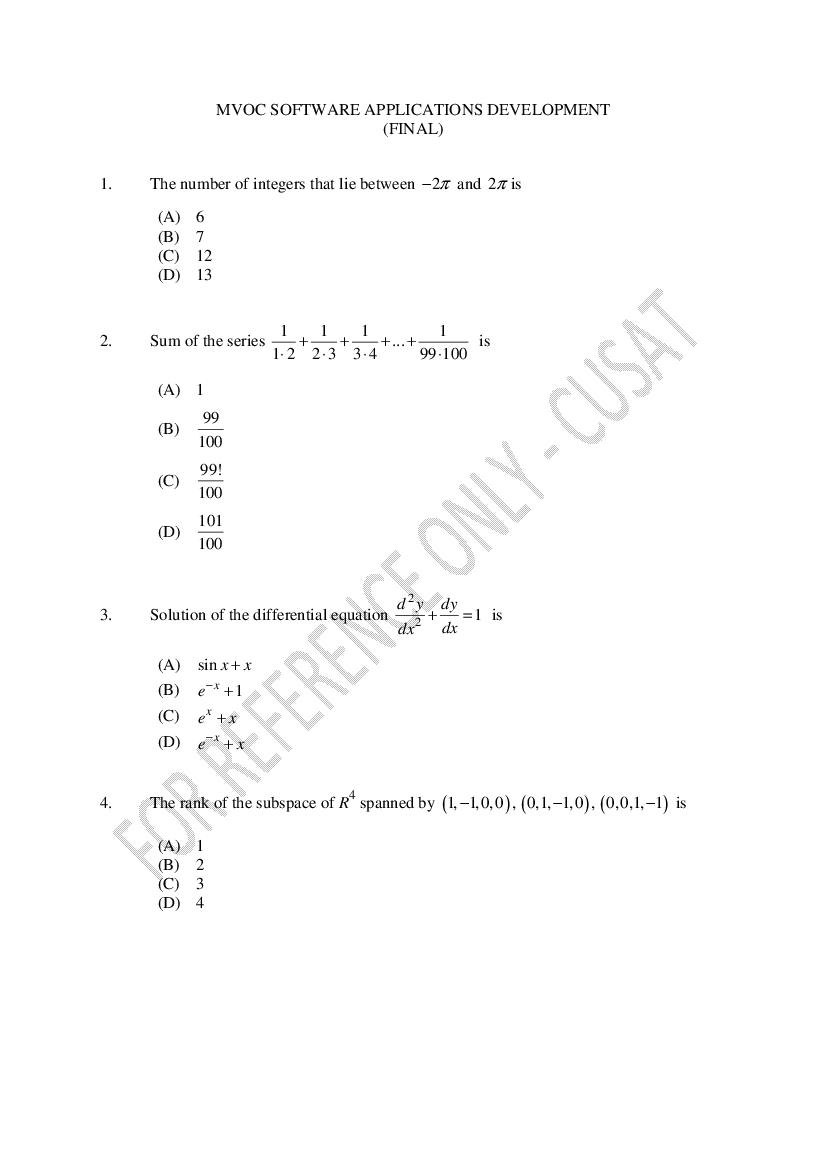
(FINAL)
1. The number of integers that lie between −2π and 2π is
(A) 6
(B) 7
(C) 12
(D) 13
1 1 1 1
2. Sum of the series + + + ... + is
1⋅ 2 2 ⋅ 3 3 ⋅ 4 99 ⋅100
(A) 1
99
(B)
100
99!
(C)
100
101
(D)
100
d 2 y dy
3. Solution of the differential equation + = 1 is
dx 2 dx
(A) sin x + x
(B) e− x + 1
(C) ex + x
(D) e− x + x
4
4. The rank of the subspace of R spanned by (1, −1, 0, 0 ) , ( 0,1, −1, 0 ) , ( 0,0,1, −1) is
(A) 1
(B) 2
(C) 3
(D) 4
Page 2
(A) ( 0, 1)
(B) ( 0, 2 )
3
(C) 0,
2
(D) ( 0, 3 )
6. The number of points (x, y) with integer coordinates that satisfy the inequalities
x ≥ 0, y ≥ 0, x + y ≤ 10 is
(A) 45
(B) 55
(C) 66
(D) 100
∞
7. The value of ∫ x 4e− x dx is
0
(A) 1
(B) 6
(C) 24
(D) 0
5 6!
8. The value of ∑ is
j =0 j !( 6 − j ) !
(A) 31
(B) 32
(C) 63
(D) 64
9. The length of the side of the largest square that fits inside a circle of radius one is
1
(A)
2
(B) 1
(C) 2
(D) 2
Page 3
probability of getting at least two heads is
15
(A)
64
63
(B)
64
1
(C)
3
57
(D)
64
11. For any sets A, B and C, ( A ∪ B ) ∩ ( A ∪ C ) =
(A) A∪(B ∩C)
(B) ( A ∪ B) ∪ C
(C) A∩(B ∪C)
(D) ( A ∩ B) ∩ C
12. The domain of the real-valued function ( x − a )( x − b )( x − c ) when a < b < c is
(A) ( −∞, a ] ∪ [b, c ]
(B) [ a , b ] ∪ [ c, ∞ )
(C) ( −∞, a ] ∪ [ c, ∞ )
(D) [ a, c ]
Page 4
1 p
if x is rational and x = in lowest terms
f ( x) = q q
0 otherwise
Then the set
{ x ∈ ℝ | f is continuous at x}
is equal to
(A) φ (the empty set)
(B) ℚ
(C) ℝ − ℚ
(D) ℝ
x
14. The number of real solutions for the equation sin x = is
3
(A) 0
(B) 1
(C) 2
(D) 3
2 r2 r2
15. The sum of the series r + + + ... is
1+ r2 1+ r2 2
( )
(A) 1
(B) (1 + r 2 )
−1
(C) (1 + r 2 )
−1
(D) (1 − r 2 )
16. ( )
lim n n x − 1 for x > 0 =
n→∞
(A) e x
(B) 1
(C) x
(D) log x
Page 5
17. lim =
x→0 x2
(A) 0
1
(B)
2
(C) 1
(D) 2
18. The remainder when 1! + 2! + 3! + ... + 10! is divided by 4 is
(A) 0
(B) 1
(C) 2
(D) 3
19. ( )( )( )( )
The expression (1 + 2 ) 1 + 22 1 + 24 1 + 28 1 + 216 is equal to
(A) 217 − 1
(B) 233 − 232
(C) 216 + 28 + 24 + 22 + 2
(D) 232 − 1
20. The degree of a polynomial p ( x ) satisfying p ( p ( x ) ) = p ( x ) is
(A) 1
(B) 2
(C) 3
(D) 4
21. The number of real roots of the equation x3 − 2 x 2 + 3x − 7 = 0 is
(A) 0
(B) 1
(C) 2
(D) 3
Page 6
these students into 5 pairs is
(A) 10!
10!
(B)
5!5!
(C) 45
(D) 1× 3 × 5 × 7 × 9
23. Suppose f ( x ) is a polynomial, and a and b are distinct numbers. Then the remainder
when f ( x ) is divided by x 2 − ( a + b ) x + ab is
f ( a ) − f (b )
(A) ( a − b )( b − x ) − (a − x) + f (a)
a−b
f ( a ) − f (b )
(B) ( x − a) + f (a)
a −b
f ( a ) − f (b)
(C)
a −b
f ( a ) − f (b)
(D) + xf ( a )
a −b
th
24. The determinant of the 10 × 10 matrix whose ( i, j ) entry is max ( i, j ) is
(A) 0
(B) 1
(C) −10
(D) 10
25. Which of the following matrices has no real eigenvector?
1 0
(A)
0 1
0 1
(B)
1 0
0 1
(C)
−1 0
−1 0
(D)
0 1
Page 7
(A) 4
(B) 5
(C) 6
(D) ∞
( a + 1)( a + 2b ) ∈ ℕ . Then
27. Let S = ( a, b ) ∈ ℕ 2 |
2
(A) S = φ
(B) S is a finite subset of ℕ 2
(C) S is a infinite proper subset of ℕ 2
(D) S = ℕ 2
n
k 3 −1
28. lim ∏ 3
=
n→∞
k =2 k + 1
(A) 0
(B) 1
2
(C)
3
3
(D)
2
n n
29. Let T : R → R be the linear transformation given by T ( ei ) = ei +1 for i = 1,..., n − 1,
T ( en ) = e1. Then the characteristic polynomial of the matrix of T is
n
(A) ( t − 1)
(B) 1 − t n
(C) 1 + t + ... + t n
(D) t n − 1
30. The number of non-negative integer solutions of the equation x1 + x2 + x3 = 5 is
(A) 10
(B) 15
(C) 18
(D) 21
Page 8
(A) reflexive relation
(B) symmetric relation
(C) transitive relation
(D) invalid relation
32. What is the condition for an equivalence relation if two cities are related within a
country?
(A) The two cities should have a one-way connection
(B) The two cities should have a two-way connection
(C) The two cities should be in different countries
(D) No equivalence relation will exist between two cities
33. Five node splitting operations occurred when an entry is inserted into a B-tree. Then
how many nodes are written?
(A) 14
(B) 7
(C) 11
(D) 5
34. What is the space complexity of searching in a heap?
(A) O(log n)
(B) O(n)
(C) O(1)
(D) O(n log n)
35. Given an array of element 5, 7, 9, 1, 3, 10, 8, 4. Which of the following are the correct
sequences of elements after inserting all the elements in a min-heap?
(A) 1, 3, 4, 5, 7, 8, 9, 10
(B) 1, 4, 3, 9, 8, 5, 7, 10
(C) 1, 3, 4, 5, 8, 7, 9, 10
(D) 1, 3, 7, 4, 8, 5, 9, 10
36. Which of the following is used in hash tables to determine the index of any input
record?
(A) hash function
(B) hash linked list
(C) hash tree
(D) hash chaining
Page 9
collision?
(A) Open addressing
(B) Chaining using doubly linked list
(C) Linear probing
(D) Double hashing
38. What is the worst case time complexity of inserting a node in a doubly linked list?
(A) O(n log n)
(B) O(log n)
(C) O(n)
(D) O(1)
39. Evaluate the postfix expression ab + cd/- where a = 5, b = 4, c = 9, d = 3
(A) 23
(B) 15
(C) 6
(D) 10
40. Which application of stack is used to ensure that the pair of parentheses is properly
nested?
(A) Balancing symbols
(B) Reversing a stack
(C) Conversion of an infix to postfix expression
(D) Conversion of an infix to prefix expression
41. Which of the following is NOT a stable sorting algorithm?
(A) Bubble Sort
(B) Insertion Sort
(C) Selection Sort
(D) Quick Sort
42. Which of the following data structures uses LIFO (Last In First Out) principle?
(A) Queue
(B) Stack
(C) Linked List
(D) Array
Page 10
(A) Linear Search
(B) Binary Search
(C) Depth-First Search
(D) Breadth-First Search
44. Which of the following is an example of a Greedy algorithm?
(A) Depth-First Search
(B) Dijkstra's Algorithm
(C) Kruskal's Algorithm
(D) Prim's Algorithm
45. What is the time complexity of searching an element in an unsorted array?
(A) O(1)
(B) O(log n)
(C) O(n)
2
(D) O(n )
46. Which statement is true for stacks?
(A) Elements are stored in a first-in-first-out (FIFO) order
(B) Insertion and deletion can be performed at both ends
(C) Insertion and deletion are performed in a last-in-first-out (LIFO) order
(D) None of the above
47. In the following which is NOT a queue?
(A) Priority queue
(B) Circular queue
(C) Double-ended queue
(D) Depth-first queue
48. What is the maximum height of a binary search tree with n nodes?
(A) n
(B) log n
(C) n log n
(D) 2n
Page 11
(A) A tree with n nodes has n − 1 edges
(B) A tree can have multiple roots
(C) A binary tree can have at most three children for each node
(D) None of the above
50. Which of the following is true for graphs?
(A) A graph can be directed or undirected
(B) A graph cannot have cycles
(C) A graph cannot have self-loops
(D) None of the above
51. Which of the following algorithms is used to find the shortest path in a weighted
graph?
(A) Depth-first search
(B) Breadth-first search
(C) Dijkstra's algorithm
(D) Prim's algorithm
52. In the following one of the page replacement algorithm is NOT a valid. Find it ?
(A) FIFO
(B) LRU
(C) OPT
(D) MFU
53. Which of the following scheduling algorithms provides better response time?
(A) Priority scheduling
(B) Round Robin scheduling
(C) FCFS scheduling
(D) SJF scheduling
54. The most efficient I/O scheduling algorithm is ……………….
(A) FCFS
(B) SCAN
(C) C-SCAN
(D) LOOK
Page 12
(A) SMTP
(B) FTP
(C) HTTPS
(D) Telnet
56. Identify the protocol used for email transmission?
(A) TCP
(B) HTTP
(C) SMTP
(D) POP
57. Which device is used to connect multiple computers on a LAN?
(A) Router
(B) Switch
(C) Hub
(D) Modem
58. Identify the device used to connect multiple networks?
(A) Router
(B) Modem
(C) Hub
(D) Switch
59. Name the most widely used protocol on the internet for transmitting data between
web servers and clients?
(A) HTTP
(B) FTP
(C) SMTP
(D) DNS
60. Which protocol used to translate domain names into IP addresses?
(A) DNS
(B) HTTP
(C) SMTP
(D) FTP
Page 13
Mahatma Gandhi believed that industrialisation was no answer to the problems that
plague the mass of India's poor and that villagers should be taught to be self-sufficient
in food, weave their own cloth from cotton and eschew the glittering prizes that the
20th century so temptingly offers. Such an idyllic and rural paradise did not appear to
those who inherited the reins of political power.
61. The meaning of ‘glittering prizes that the 20th century so temptingly offers’ is
(A) pursuit of a commercialised material culture
(B) replacement of rural by urban interests
(C) complete removal of poverty
(D) absence of violence and corruption
62. The basis of 'an idyllic and rural paradise' is
(A) rapid industrialisation of villages
(B) self-sufficiency in food clothes and simplicity of the lifestyle
(C) bringing to the villages the glittering prizes of the 20th century
(D) supporting those holdings powerful political positions
63. Which one of the following best illustrates the relationship between the phrases?
(i) 'eschew the glittering prizes'
(ii) 'idyllic and rural paradise'
(A) unless you do (i), you cannot have (ii)
(B) (i) and (ii) are identical in meaning
(C) first of all you must have (ii) in order to do (i)
(D) the meaning of (i) is directly opposite to (ii)
64. Mahatma Gandhi's views opposed industrialisation of villages because it would
(A) help the poor and not the rich
(B) take away the skill of the villagers
(C) affect the culture of the Indians
(D) undermine self-sufficiency and destroy the beauty of life of the villager
Page 14
(A) those who did not believe in the industrialisation of the country
(B) those who called him the Father of Nation
(C) those who inherited political powers after independence
(D) those who believed that villages should be self-sufficient in food and cloth
Direction: Read the passage and answer the following questions.
Nehru's was a many sided personality. He enjoyed reading and writing books as much
as he enjoyed fighting political and social evils or residing tyranny. In him, the
scientist and the humanist were held in perfect balance. While he kept looking at
special problems from a scientific standpoint. He never forgot that we should nourish
the total man. As a scientist, he refused to believe in a benevolent power interested in
men's affairs. But, as a self proclaimed non-believer, he loved affirming his faith in
life and the beauty of nature. He adored children. Unlike Wordsworth, he did not see
them trailing clouds of glory from the recent sojourn in heaven. He saw them as a
blossoms of promise and renewal, the only hope for mankind.
66. Nehru thought that children
(A) were tailing clouds of glory
(B) held promise for a better future
(C) were like flowers to be loved and admired
(D) held no hope for mankind
67. Nehru enjoyed
(A) reading and writing books
(B) fighting political and social evils
(C) resisting tyranny
(D) doing all the above and much more
68. Which of the statements reflects Nehru’s point of view?
(A) Humanism is more important than science
(B) Science is supreme and humanism is subordinate to it
(C) Science and humanism are equally important
(D) There is no ground between science and humanism
Page 15
(A) a supernatural power of god
(B) beauty of nature
(C) the spirit of science
(D) the total man
70. A 'many-side personality' means a
(A) complex personality
(B) secretive person
(C) person having varied interests
(D) capable person
Direction: Read the passage and answer the following questions.
Nationalism, of course, is a curious phenomenon which at a certain stage in a
country's history gives life, growth and unity but, at the same time, it has a tendency
to limit one, because one thinks of one's country as something different from the rest
of world. One's perspective changes and one is continuously thinking of one's own
struggles and virtues and failing to the exclusion of other thoughts. The result is that
the same nationalism which is the symbol of growth for a people becomes a symbol
of the cessation of that growth in mind. Nationalism, when it becomes successful
sometimes goes on spreading in an aggressive way and becomes a danger
internationally. Whatever line of thought you follow, you arrive at the conclusion that
some kind of balance must be found. Otherwise something that was good can turn
into evil. Culture, which is essentially good become not only static but aggressive and
something that breeds conflict and hatred when looked at from a wrong point of view.
How are you to find a balance, I don't know. Apart from the political and economic
problems of the age, perhaps, that is the greatest problem today because behind it
there is tremendous search for something which it cannot find. We turn to economic
theories because they have an undoubted importance. It is folly to talk of culture or
even of god when human beings starve and die. Before one can talk about anything
else one must provide the normal essentials of life to human beings. That is where
economies comes in. Human beings today are not in mood to tolerate this suffering
and starvation and inequality when they see that the burden is not equally shared.
Others profit while they only bear the burden.
71. The greatest problem in the middle of the passage refers to the question how to
(A) mitigate hardship to human beings
(B) contain the dangers of aggressive nationalism
(C) share the economic burden equally
(D) curb international hatred
Page 16
(A) selfish
(B) self-centred
(C) indifferent
(D) dangerous
73. Suitable title for this passage can be
(A) Nationalism breeds unity
(B) Nationalism - a road to world unity
(C) Nationalism is not enough
(D) Nationalism and national problems
74. 'Others' in the last sentence refers to
(A) other people
(B) other nations
(C) other communities
(D) other neighbours
75. Aggressive nationalism
(A) breeds threat to international relations
(B) leads to stunted growth
(C) endangers national unity
(D) isolates a country
Direction (Question 76 to 79): Read the passage and answer the following questions.
Many sociologists have argued that there is functional relationship between
education and economic system. They point to the fact that mass formal education
began in industrial society. They note that the expansion of the economies of
industrial societies is accompanied by a corresponding expansion of their educational
systems. They explain this correspondence in terms of the needs of industry for
skilled and trained manpower, needs which are met by the educational system. Thus,
the provision of mass elementary education in Britain in 1870 can be seen as a
response to the needs of industry for a literate and numerate workforce at a time when
industrial processes were becoming more complex and the demand for technical skills
was steadily growing.
Page 17
(A) its expansion needs sound learning
(B) it relies heavily on expertise
(C) it promotes a competitive spirit
(D) its operations need intricate technical knowledge
77. The author argues that
(A) formal education can be traced to industrial society
(B) industrial society is responsible for expansion of education at mass level
(C) industrial society gave rise to vocational education
(D) industrial society changed the pattern of education
78. The observation of the Sociologists are based on a study of
(A) the statistical data available in a historical context
(B) economic system of the 19th century
(C) the correlation between industry and education in a historical context
(D) growth of industry during 19th century
79. The Sociologists referred to in the passage say that the relationship between industry
and elementary education was one
(A) based on mutual need
(B) based entirely on the need of the industry
(C) based entirely on economic need
(D) based on some inexplicable historical forces
80. Direction: Choose the word which is most nearly the opposite in meaning as the
word shown in bold letters below
Lofty
(A) Deserted
(B) Imposing
(C) Solitary
(D) Lowly
Page 18
word shown in bold letters below
Indigenous
(A) Local
(B) Domestic
(C) Island
(D) Foreign
82. Direction: Choose the word which is most nearly the opposite in meaning as the
word shown in bold letters below
Intrepid
(A) Audacious
(B) Acquired
(C) Evident
(D) Bashful
83. Choose the best alternative for the underlined part of the sentence, by identifying the
error in it, if any
The woodland sub-species were in isolation from contact with humans longer than
either their marsh cousins or the tree-dwelling sub-species
(A) in isolation from contact with humans longer than
(B) isolated from contact with humans longer than
(C) in isolation from contact with humans longer than were
(D) isolated from contact with humans longer than were
84. Direction: Fill in the blanks
Her talk was so interesting that Rajeev was…………..
(A) pent up
(B) all ears
(C) very tense
(D) listening
Page 19
any)
The speaker left the scene before long
(A) The speaker
(B) left the scene
(C) before long
(D) No error
86. Direction: Choose the phrase that best expresses the meaning of the underlined idiom
It was a red-letter day in the history of the world
(A) A day remembered for some joyful event
(B) A day noted for bloodshed
(C) A day of warmth and love
(D) A day of dispute
87. Direction: Choose the appropriate question tag
We haven’t finished our work yet, …………
(A) did we?
(B) don’t we?
(C) haven’t we?
(D) have we?
88. Direction: Choose the word which is most nearly the same in meaning as the word
given in bold letters
Reconnaissance
(A) Investigation
(B) Death
(C) Recognizable
(D) Adoption
89. Direction: Choose the word which is most nearly the same in meaning as the word
given in bold letters
Nimble
(A) Clumsy
(B) Honest
(C) Needless
(D) Agile
Page 20
given in bold letters
Proliferation
(A) Explosion
(B) Devastation
(C) Discomfiture
(D) Abundance
91. How many triangles are there in the below given figure?
(A) 13
(B) 32
(C) 21
(D) 24
92. X introduces Y saying ‘He is the husband of the granddaughter of the father of my
father’. How is Y related to X?
(A) Brother
(B) Uncle
(C) Co-brother
(D) Brother-in-law
93. Complete the analogy.
Paisa : Rupee :: ? : Kilometre
(A) Metre
(B) Hectometre
(C) Quintal
(D) Decametre
Page 21
regarding that particular circumstance. Choose an answer based on the given
information
The school principal has received complaints from parents about bullying in the
school yard during recess. He wants to investigate and end this situation as soon as
possible, so he has asked the recess aides to watch closely. Which situation should the
recess aides report to the principal?
(A) A girl is sitting glumly on a bench reading a book and not interacting with her
peers
(B) Four girls are surrounding another girl and seem to have possession of her
backpack
(C) Two boys are playing a one-on-one game of basketball and are arguing over
the last basket scored
(D) Three boys are huddled over a handheld video game, which isn't supposed to
be on school grounds
95. Direction: Fill in the blanks
SCD, TEF, UGH, …………., WKL
(A) CMN
(B) UJI
(C) VIJ
(D) IJT
96. Direction: Complete the following series by choosing the correct option from the
given alternatives
ZA5, Y4B, XC6, W3D, ………….
(A) E7 V
(B) V2E
(C) VE5
(D) VE7
97. If ‘air’ is called ‘green’, ‘green’ is called ‘red’, ‘red’ is called ‘sea’, ‘sea’ is called
‘blue’, ‘blue’ is called ‘water’ and ‘water’ is called ‘pink’, then what is the color of
grass?
(A) Green
(B) Air
(C) Red
(D) Pink
Page 22
• A B C D E F are sitting in a row
• E and F are in the center, A and B are at the ends
• C is sitting on the left of A
Who is sitting three places on the right of D?
(A) B
(B) C
(C) A
(D) D
99. The angle between the hour hand and minute hand of a clock at 3:40 pm is
(A) 120°
(B) 110°
(C) 130°
(D) 105°
100. January 1, 1995 was Sunday. What day of the week lies on January 1, 1996?
(A) Sunday
(B) Monday
(C) Wednesday
(D) Saturday
101. Which of the following words does NOT belong in the group?
(A) Acorn
(B) Pecan
(C) Hazelnut
(D) Olive
102. Which of the following words does NOT belong in the group?
(A) Pine
(B) Birch
(C) Oak
(D) Ash
103. Which of the following words does NOT belong in the group?
(A) Laptop
(B) Tablet
(C) Smartphone
(D) Desktop
Page 23
(A) Summer
(B) Autumn
(C) Winter
(D) Spring
105. What is the next number in the following sequence?
1, 1, 2, 3, 5, 8, ..........
(A) 10
(B) 11
(C) 12
(D) 13
106. What is the missing number in the following sequence?
2, 4, 6, 8, ………., 12, 14, 16
(A) 7
(B) 9
(C) 10
(D) 11
107. What is the missing number in the following sequence?
7, 14, 28, 56, …….., 224
(A) 80
(B) 112
(C) 120
(D) 168
108. What is the next number in the following sequence?
1, 4, 9, 16, 25, ……….
(A) 36
(B) 49
(C) 64
(D) 81
Page 24
3, 5, 9, 17, ………., 65
(A) 27
(B) 33
(C) 33.5
(D) 33.75
110. What is the next number in the following sequence?
2, 6, 18, 54, ………...
(A) 150
(B) 162
(C) 170
(D) 180
111. What is the missing number in the following sequence?
4, 8, 16, 32, ………., 128
(A) 48
(B) 64
(C) 72
(D) 96
112. If A = {1, 2, 3, 4, 5} and B = {3, 4, 5, 6, 7}, what is A ∩ B?
(A) {3, 4, 5}
(B) {1, 2, 3, 4, 5, 6, 7}
(C) {1, 2, 6, 7}
(D) {}
113. If A = {a, b, c, d} and B = {c, d, e, f}, what is A ∩ B?
(A) {c, d}
(B) {a, b, c, d, e, f}
(C) {}
(D) {a, b, e, f}
114. If A = {a, b, c, d} and B = {c, d, e, f}, what is B − A?
(A) {e, f}
(B) {c, d, e, f}
(C) {a, b, c, d}
(D) {}
Page 25
does the ball cost?
(A) $0.10
(B) $0.05
(C) $0.15
(D) $0.20
116. If all socks are either black or white and 70% of socks are black, what is the minimum
percentage of socks that must be chosen randomly to guarantee at least one pair of
matching socks?
(A) 50%
(B) 60%
(C) 70%
(D) 71%
117. If 2x + 3 = 11, what is the value of x?
(A) 2
(B) 4
(C) 6
(D) 8
118. A train travels 400 km in 5 hours. What is its average speed in kilometers per hour?
(A) 80 km/h
(B) 100 km/h
(C) 120 km/h
(D) 140 km/h
119. If a number is divisible by 3 and by 5, it is also divisible by
(A) 2
(B) 4
(C) 6
(D) 10
120. In a group of 30 people, 20 are men and 10 are women. What percentage of the group
are women?
(A) 10%
(B) 20%
(C) 30%
(D) 40%
Page 26
(A) .NET Framework
(B) Java Virtual Machine
(C) Both .NET Framework and Java Virtual Machine
(D) None of the above
122. HTML headings are defined with the ………….. tags
(A) <head1> to <head6>
(B) <p1> to <p6>
(C) <h1> to <h6>
(D) <h1> to <h3>
123. SQL ………….. can be used to delete or drop existing databases in a SQL schema
(A) CREATE DATABASE
(B) RENAME DATABASE
(C) DROP DATABASE
(D) SELECT DATABASE
124. What does AVG() function returns?
(A) First value of the column
(B) Last value of the column
(C) Sum of rows of the table
(D) Average value of the column
125. What is the output of the following code snippet?
#include <stdio.h>
int main() {
int a = 10, b = 5;
printf("%d", a+b);
return 0;
}
(A) 10
(B) 5
(C) 15
(D) Error
Page 27
condition is met?
(A) if statement
(B) for loop
(C) switch statement
(D) while loop
127. Which control structure is used to execute a block of code only if a certain condition
is met?
(A) if statement
(B) for loop
(C) switch statement
(D) while loop
128. Which keyword is used to pass a parameter by reference in a function?
(A) const
(B) static
(C) extern
(D) pointer
129. Which function is used to write a string to standard output in C?
(A) scanf
(B) getchar
(C) gets
(D) puts
130. Which operator is used to get the memory address of a variable in C?
(A) *
(B) %
(C) &
(D) #
131. Which of the following expressions is equivalent to p[2] where p is an array of
integers?
(A) *(p + 2)
(B) *(2 + p)
(C) p−2
(D) p+2
Page 28
(A) strcat
(B) strlen
(C) strcmp
(D) strchr
133. Which of the following functions can be used to copy one string to another in C?
(A) strcpy
(B) strlen
(C) strcmp
(D) strchr
134. Which keyword is used to define a structure in C?
(A) class
(B) typedef
(C) struct
(D) union
135. Which of the following operators is used to access a member of a structure in C?
(A) .
(B) ->
(C) *
(D) []
136. What is the output of the following code snippet?
#include <stdio.h>
int main() {
int a = 5, b = 10;
if (a > b) {
printf("a is greater than b");
} else {
printf("b is greater than a");
}
return 0;
}
(A) a is greater than b
(B) b is greater than a
(C) 5
(D) 10
Page 29
#include <stdio.h>
int main() {
int a = 10;
printf("%d", a++);
return 0;
}
(A) 10
(B) 11
(C) Error
(D) None of the above
138. What is the output of the following code snippet?
#include <stdio.h>
int main() {
int i;
for (i = 0; i < 5; i++) {
printf("%d", i);
}
return 0;
}
(A) 01234
(B) 12345
(C) 43210
(D) Error
Page 30
#include <stdio.h>
int main() {
int a = 10, b = 20, c = 30;
int result = 0;
if (a < b && a < c) {
result = a;
}
else if (b < a && b < c) {
result = b;
}
else {
result = c;
}
printf("The smallest number is %d", result);
return 0;
}
(A) The program outputs the largest number among the given integers
(B) The program outputs the smallest number among the given integers
(C) The program outputs an error due to missing semicolons
(D) The program outputs the sum of the given integers
140. What is the output of the following C code?
#include <stdio.h>
int main() {
int x = 10;
while (x++ < 15) {
printf("%d", x);
}
return 0;
}
(A) 10 11 12 13 14
(B) 11 12 13 14 15
(C) 11 13 15
(D) 10 12 14
Page 31
#include <stdio.h>
int main() {
int x = 5, y = 10;
int *p = &x, *q = &y;
*p = *q;
printf("%d %d", x, y);
return 0;
}
(A) 5 10
(B) 10 10
(C) 10 5
(D) The code contains an error
142. What is the output of the following C code?
#include <stdio.h>
int main()
{
int i = 1, j = 2, k;
k = i + j * 3;
printf("%d", k);
return 0;
}
(A) 7
(B) 9
(C) 11
(D) 17
Page 32
#include <stdio.h>
int main()
{
int a = 5;
if (a > 3)
{
printf("Hello");
}
else
{
printf("World");
}
return 0;
}
(A) Hello
(B) World
(C) 5
(D) None of the above
144. What is the output of the following C code?
#include <stdio.h>
int main()
{
int x = 10, y = 15, z;
z = x++ + --y;
printf("%d", z);
return 0;
}
(A) 23
(B) 24
(C) 25
(D) 26
Page 33
#include <stdio.h>
int main()
{
int i = 0, j = 1;
while (i < 5)
{
j += i;
i++;
}
printf("%d", j);
return 0;
}
(A) 6
(B) 10
(C) 15
(D) 16
146. What is the output of the following code snippet?
int main() {
int x = 10;
if (x == 5 || x == 10) {
printf("x is either 5 or 10");
}
else {
printf("x is neither 5 nor 10");
}
return 0;
}
(A) x is either 5 or 10
(B) x is neither 5 nor 10
(C) Compilation error
(D) Runtime error
Page 34
int main() {
int x = 5;
int y = 10;
int z = x + y;
printf("The sum of %d and %d is %d", x, y, z);
return 0;
}
(A) The sum of 5 and 10 is 15
(B) The sum of x and y is z
(C) The sum of %d and %d is % d
(D) Compilation error
148. What is the output of the following C program?
#include <stdio.h>
int main() {
int a = 5;
int b = 2;
float c = a / b;
printf("%f", c);
return 0;
}
(A) 2.000000
(B) 2.500000
(C) 2.000000e+00
(D) 2.500000e+00
149. What is the output of the following code snippet?
int main() {
int i;
for (i = 0; i < 5; i++) {
printf("%d ", i);
}
return 0;
}
(A) 01234
(B) 12345
(C) 0123
(D) Compilation error
Page 35
#include <stdio.h>
int main() {
int x = 5, y = 10, z;
z = x++ * --y;
printf("%d", z);
return 0;
}
(A) 45
(B) 40
(C) 50
(D) 55
Page 36
Subject Name: M VOC MOBILE PHONE APPLICATION DEVELOPMENT
SI No. Key SI No. Key SI No. Key SI No. Key SI No. Key
1 D 31 B 61 A 91 D 121 A
2 B 32 B 62 B 92 D 122 C
3 D 33 C 63 D 93 D 123 C
4 C 34 B 64 B 94 B 124 D
5 D 35 A 65 C 95 C 125 C
6 C 36 A 66 B 96 D 126 D
7 C 37 B 67 D 97 C 127 A
8 C 38 C 68 C 98 C 128 D
9 C 39 C 69 A 99 C 129 D
10 D 40 A 70 C 100 B 130 C
11 A 41 D 71 B 101 D 131 A
12 B 42 B 72 B 102 B 132 A
13 C 43 B 73 C 103 D 133 A
14 D 44 C 74 A 104 A 134 C
15 B 45 C 75 D 105 D 135 A
16 D 46 C 76 D 106 B 136 B
17 B 47 D 77 A 107 D 137 A
18 B 48 A 78 D 108 B 138 A
19 D 49 A 79 B 109 B 139 B
20 A 50 A 80 D 110 B 140 B
21 B 51 C 81 D 111 B 141 B
22 D 52 C 82 D 112 A 142 C
23 B 53 B 83 B 113 A 143 A
24 D 54 D 84 B 114 A 144 B
25 C 55 C 85 D 115 A 145 C
26 B 56 C 86 A 116 D 146 A
27 D 57 B 87 D 117 B 147 A
28 C 58 A 88 A 118 A 148 A
29 D 59 A 89 D 119 D 149 A
30 D 60 A 90 D 120 B 150 A
Document Details
| Board / Org | Cochin University |
| Exam | CUSAT Common Admission Test |
| Type | Question Paper |
| Pages | 36 |
| Updated | 22 Jul 2026 |