UGC NET 2021 Question Paper Buddhist Jaina Gandhian Shift 2
Finished viewing? Save it for later —
Download UGC NET 2021 Question Paper Buddhist Jaina Gandhian Shift 2 (PDF · 84 pages)About UGC NET 2021 Question Paper Buddhist Jaina Gandhian Shift 2
UGC NET 2021 Question Paper Buddhist Jaina Gandhian Shift 2 is available here for free download. Published by NTA for UGC National Eligibility Test, this question paper can be viewed online or downloaded as a PDF (84 pages). Candidates preparing for UGC National Eligibility Test can use UGC NET 2021 Question Paper Buddhist Jaina Gandhian Shift 2 to understand the exam pattern, the type of questions asked, and the overall difficulty level.
Frequently Asked Questions
How can I download UGC NET 2021 Question Paper Buddhist Jaina Gandhian Shift 2?
Open this page and click the Download button to save UGC NET 2021 Question Paper Buddhist Jaina Gandhian Shift 2 as a PDF. It is completely free on AglaSem Docs.
Is UGC NET 2021 Question Paper Buddhist Jaina Gandhian Shift 2 free to download?
Yes. UGC NET 2021 Question Paper Buddhist Jaina Gandhian Shift 2 can be viewed online and downloaded as a PDF free of cost on AglaSem Docs.
How many pages does UGC NET 2021 Question Paper Buddhist Jaina Gandhian Shift 2 have?
UGC NET 2021 Question Paper Buddhist Jaina Gandhian Shift 2 contains 84 pages, which you can read online or download together as a single PDF.
Where can I find more UGC National Eligibility Test study material?
You can find more UGC National Eligibility Test question papers, sample papers, syllabus, and answer keys on AglaSem Docs.
UGC NET 2021 Question Paper Buddhist Jaina Gandhian Shift 2 – Text
Read the full text of this question paper below — useful to quickly search, copy and reference the content online without downloading the PDF.
📄 View text version (84 pages)
Page 1
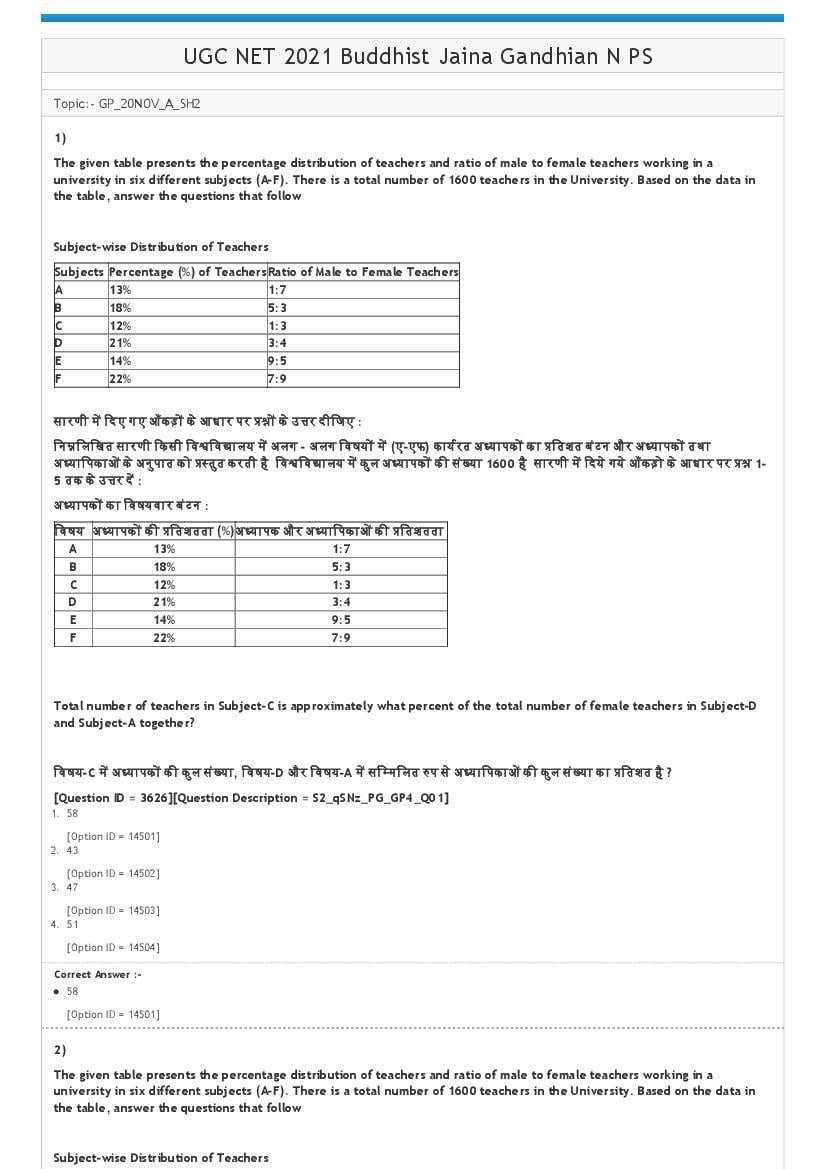
Topic:‐ GP_20NOV_A_SH2
1)
The given table presents the percentage distribution of teachers and ratio of male to female teachers working in a
university in six different subjects (A‐F). There is a total number of 1600 teachers in the University. Based on the data in
the table, answer the questions that follow
Subject‐wise Distribution of Teachers
Subjects Percentage (%) of TeachersRatio of Male to Female Teachers
A 13% 1:7
B 18% 5:3
C 12% 1:3
D 21% 3:4
E 14% 9:5
F 22% 7:9
सारणी म द ए ग ए आँ क ड़ के आ ध ा र पर के उ र दीिजए :
िन िलिखत सारणी क स ी िव िव ालय म अलग ‐ अलग िवषय म (ए‐एफ) काय रत अ यापक क ा ितशत बं ट न औ र अ यापक त थ ा
अ यािपका के अनु प ात क ो तु त करती है िव िव ालय म कु ल अ यापक क सं या 1600 है सारणी म दये गये आँ क ड़ो के आ ध ा र पर 1‐
5 त क के उ र द :
अ यापक क ा िवषयवार बं ट न :
िवषय अ यापक क ितशतता (%)अ यापक औ र अ यािपका क ितशतता
A 13% 1:7
B 18% 5:3
C 12% 1:3
D 21% 3:4
E 14% 9:5
F 22% 7:9
Total number of teachers in Subject‐C is approximately what percent of the total number of female teachers in Subject‐D
and Subject‐A together?
िवषय‐C म अ यापक क कु ल सं या, िवषय‐D औ र िवषय‐A म सि मिलत प से अ यािपका क कु ल सं या क ा ितशत है ?
[Question ID = 3626][Question Description = S2_qSNz_PG_GP4_Q01]
1. 58
[Option ID = 14501]
2. 43
[Option ID = 14502]
3. 47
[Option ID = 14503]
4. 51
[Option ID = 14504]
58
[Option ID = 14501]
2)
The given table presents the percentage distribution of teachers and ratio of male to female teachers working in a
university in six different subjects (A‐F). There is a total number of 1600 teachers in the University. Based on the data in
the table, answer the questions that follow
Subject‐wise Distribution of Teachers
Page 2
A 13% 1:7
B 18% 5:3
C 12% 1:3
D 21% 3:4
E 14% 9:5
F 22% 7:9
सारणी म द ए ग ए आँ क ड़ के आ ध ा र पर के उ र दीिजए :
िन िलिखत सारणी क स ी िव िव ालय म अलग ‐ अलग िवषय म (ए‐एफ) काय रत अ यापक क ा ितशत बं ट न औ र अ यापक त थ ा
अ यािपका के अनु प ात क ो तु त करती है िव िव ालय म कु ल अ यापक क सं या 1600 है सारणी म दये गये आँ क ड़ो के आ ध ा र पर 1‐
5 त क के उ र द :
अ यापक क ा िवषयवार बं ट न :
िवषय अ यापक क ितशतता (%)अ यापक औ र अ यािपका क ितशतता
A 13% 1:7
B 18% 5:3
C 12% 1:3
D 21% 3:4
E 14% 9:5
F 22% 7:9
What is the difference between the total number of teachers in Subject‐F and the total number of male teachers in
Subject‐A and Subject‐B together?
िवषय‐F म कु ल अ यापक क सं या औ र िवषय‐A त थ ा िवषय‐B म सि मिलत प से अ यापक क सं या के ब ी च कतना अं त र है ?
[Question ID = 3627][Question Description = S2_qSNz_PG_GP4_Q02]
1. 192
[Option ID = 14505]
2. 182
[Option ID = 14506]
3. 146
[Option ID = 14507]
4. 136
[Option ID = 14508]
192
[Option ID = 14505]
3)
The given table presents the percentage distribution of teachers and ratio of male to female teachers working in a
university in six different subjects (A‐F). There is a total number of 1600 teachers in the University. Based on the data in
the table, answer the questions that follow
Subject‐wise Distribution of Teachers
Subjects Percentage (%) of TeachersRatio of Male to Female Teachers
A 13% 1:7
B 18% 5:3
C 12% 1:3
D 21% 3:4
E 14% 9:5
F 22% 7:9
सारणी म द ए ग ए आँ क ड़ के आ ध ा र पर के उ र दीिजए :
िन िलिखत सारणी क स ी िव िव ालय म अलग ‐ अलग िवषय म (ए‐एफ) काय रत अ यापक क ा ितशत बं ट न औ र अ यापक त थ ा
Page 3
5 त क के उ र द :
अ यापक क ा िवषयवार बं ट न :
िवषय अ यापक क ितशतता (%)अ यापक औ र अ यािपका क ितशतता
A 13% 1:7
B 18% 5:3
C 12% 1:3
D 21% 3:4
E 14% 9:5
F 22% 7:9
What is the difference between the number of female teachers in Subject‐F and the number of male teachers in Subject‐
C?
िवषय‐F म अ यािपका क सं या औ र िवषय‐C म अ यापक क सं या के ब ी च कतना अं त र है ?
[Question ID = 3628][Question Description = S2_qSNz_PG_GP4_Q03]
1. 156
[Option ID = 14509]
2. 160
[Option ID = 14510]
3. 150
[Option ID = 14511]
4. 153
[Option ID = 14512]
156
[Option ID = 14509]
4)
The given table presents the percentage distribution of teachers and ratio of male to female teachers working in a
university in six different subjects (A‐F). There is a total number of 1600 teachers in the University. Based on the data in
the table, answer the questions that follow
Subject‐wise Distribution of Teachers
Subjects Percentage (%) of TeachersRatio of Male to Female Teachers
A 13% 1:7
B 18% 5:3
C 12% 1:3
D 21% 3:4
E 14% 9:5
F 22% 7:9
सारणी म द ए ग ए आँ क ड़ के आ ध ा र पर के उ र दीिजए :
िन िलिखत सारणी क स ी िव िव ालय म अलग ‐ अलग िवषय म (ए‐एफ) काय रत अ यापक क ा ितशत बं ट न औ र अ यापक त थ ा
अ यािपका के अनु प ात क ो तु त करती है िव िव ालय म कु ल अ यापक क सं या 1600 है सारणी म दये गये आँ क ड़ो के आ ध ा र पर 1‐
5 त क के उ र द :
अ यापक क ा िवषयवार बं ट न :
िवषय अ यापक क ितशतता (%)अ यापक औ र अ यािपका क ितशतता
A 13% 1:7
B 18% 5:3
C 12% 1:3
D 21% 3:4
E 14% 9:5
F 22% 7:9
Page 4
िव िव ालय म अ यापक क कु ल सं या कतनी है ?
[Question ID = 3629][Question Description = S2_qSNz_PG_GP4_Q04]
1. 696
[Option ID = 14513]
2. 702
[Option ID = 14514]
3. 712
[Option ID = 14515]
4. 668
[Option ID = 14516]
696
[Option ID = 14513]
5)
The given table presents the percentage distribution of teachers and ratio of male to female teachers working in a
university in six different subjects (A‐F). There is a total number of 1600 teachers in the University. Based on the data in
the table, answer the questions that follow
Subject‐wise Distribution of Teachers
Subjects Percentage (%) of TeachersRatio of Male to Female Teachers
A 13% 1:7
B 18% 5:3
C 12% 1:3
D 21% 3:4
E 14% 9:5
F 22% 7:9
सारणी म द ए ग ए आँ क ड़ के आ ध ा र पर के उ र दीिजए :
िन िलिखत सारणी क स ी िव िव ालय म अलग ‐ अलग िवषय म (ए‐एफ) काय रत अ यापक क ा ितशत बं ट न औ र अ यापक त थ ा
अ यािपका के अनु प ात क ो तु त करती है िव िव ालय म कु ल अ यापक क सं या 1600 है सारणी म दये गये आँ क ड़ो के आ ध ा र पर 1‐
5 त क के उ र द :
अ यापक क ा िवषयवार बं ट न :
िवषय अ यापक क ितशतता (%)अ यापक औ र अ यािपका क ितशतता
A 13% 1:7
B 18% 5:3
C 12% 1:3
D 21% 3:4
E 14% 9:5
F 22% 7:9
Which is the ratio of the number of female teachers in Subject‐E to the number of male teachers in Subject‐D?
िवषय‐E म अ यािपका क सं या के ितशत क ा अनु प ात िवषय‐D म अ यापक क सं या क ा कतना है ?
[Question ID = 3630][Question Description = S2_qSNz_PG_GP4_Q05]
1. 5 : 9
[Option ID = 14517]
2. 2 : 9
[Option ID = 14518]
3. 3 : 7
[Option ID = 14519]
4. 5 : 3
[Option ID = 14520]
Page 5
[Option ID = 14517]
Topic:‐ GP_20NOV_B_SH2
1) The variability or flexibility of delivery during the presentation of a lesson by a teacher is called as
ए क अ यापक ारा पाठ के तु त ीकरण के दौरान तु ि त के प रवत नशीलता अथवा न यता क ो क स प म जाना जाता है ?
[Question ID = 3631][Question Description = S2_qSNz_PG_GP4_Q06]
1. Thinking curriculum/ चतन पा म [Option ID = 14521]
2. Instructional variety/नैिमि क िविवधता [Option ID = 14522]
3. Comprehension/समझ [Option ID = 14523]
4. Procedural knowledge/ या मक ान [Option ID = 14524]
Thinking curriculum/ चतन पा म [Option ID = 14521]
2) Ministry of Education, Government of India's, SWAYAM platform for offering MOOCs has how many quadrants for
designing courses?
भारत सरकार के ि श ा मं ालय ारा सं च ािलत एम.ओ.ओ. स ी . (MOOCs) दान करने हे त ु वयं (SWAYAM) मं च के कोस क ो बनाने (िडजाइ नग)
के िलए कतने चतु थ क है ?
[Question ID = 3632][Question Description = S2_qSNz_PG_GP4_Q07]
1. 2 Quadrants/2 चतुथक [Option ID = 14525]
2. 4 Quadrants/4 चतुथक [Option ID = 14526]
3. 6 Quadrants/6 चतुथक [Option ID = 14527]
4. 8 Quadrants/8 चतुथक [Option ID = 14528]
2 Quadrants/2 चतुथक [Option ID = 14525]
3) Given below are two statements
Statement I: All components of working memory are in place by the age of 4 in a child as a development stage
Statement II: If a child does not continue to pay attention to information, the activation level weakens and finally drops so
low that the information cannot be reactivated and it disappears altogether
In light of the above statements, choose the most appropriate answer from the options given below
नीचे द ो क थ न द ए ग ए ह :
क थ न ‐ I : िवकास क अव था के प म 4 वष क उ के बालक म याशील मृ ि त के स भ ी घ ट क अपने थ ा न पर होते ह
क थ न ‐ II : सू च ना के ित य द ए क बालक लगातार यान न ह दे त ा, त ो उ े र ण तर कमजोर होता है औ र अ त म इ त न ा ि ग र जाता है क
सू च ना क ो पु न ः उ े रत न ह कया ज ा स क त ा औ र य ह पू ण प से िवलु ह ो जाता है
उपरो क थ न के आलोक म , नीचे द ए ग ए िवक प म से स ह ी उ र क ा चयन क िजए :
[Question ID = 3633][Question Description = S2_qSNz_PG_GP4_Q08]
1. Both Statement I and Statement II are correct/कथन I और II दोन सही ह [Option ID = 14529]
2. Both Statement I and Statement II are incorrect/कथन I और II दोन गलत ह [Option ID = 14530]
3. Statement I is correct but Statement II is incorrect/कथन I सही है, क तु कथन II गलत है [Option ID = 14531]
4. Statement I is incorrect but Statement II is correct/कथन I गलत है, क तु कथन II सही है [Option ID = 14532]
Both Statement I and Statement II are correct/कथन I और II दोन सही ह [Option ID = 14529]
4) Match List I with List II
Neural system of BrainType of Memory
A. Conscious I. Implicit Memory
B. Unconscious II. Procedural Memory
C. Motor skills III. Explicit Memory
D. Own experiences IV. Episodic Memory
Choose the correct answer from the options given below:
सू च ी ‐I क ो सू च ी ‐II से सु म े ि लत क िजए :
Page 6
(मि त क क ा यू र ॉन सं ब ं ध ी तं ) ( मृ ि त कार)
A. चे त न I. अं त निहत मृ ि त
B. अचे त न II. काय िविधक मृ ि त
C. पे श ीय कौशल (म ो ट र ि क स) III. सु मृ ि त
D. आ मानु भ व IV. सां य ोिगक मृ ि त
नीचे द ए ग ए िवक प म से स ह ी उ र चु ि नए :
[Question ID = 3634][Question Description = S2_qSNz_PG_GP4_Q09]
1. A ‐ IV, B ‐ III, C ‐ I, D ‐ II [Option ID = 14533]
2. A ‐ III, B ‐ I, C ‐ II, D ‐ IV [Option ID = 14534]
3. A ‐ I, B ‐ II, C ‐ IV, D ‐ III [Option ID = 14535]
4. A ‐ II, B ‐ IV, C ‐ III, D ‐ I [Option ID = 14536]
A ‐ IV, B ‐ III, C ‐ I, D ‐ II [Option ID = 14533]
5) Cognitive domain for behavioural objectives comprises which of these objectives?
A. Evaluation
B. Valuing
C. Comprehension
D. Precision
E. Knowledge
Choose the correct answer from the options given below:
वहारवादी उ े य के िलए सं ाना मक े म इ न उ े य क ो समािव कया जाता है :
A. मू यां क न
B. मू य िनधा रण करना
C. स म झ
D. यथाथ ता
E. ान
नीचे द ए ग ए िवक प म से स ह ी उ र चु न :
[Question ID = 3635][Question Description = S2_qSNz_PG_GP4_Q10]
1. A, B and C only/केवल A, B, C
[Option ID = 14537]
2. B, C and D only/केवल B, C, D
[Option ID = 14538]
3. A, C and E only/केवल A, C, E
[Option ID = 14539]
4. C, D and E only/केवल C, D, E
[Option ID = 14540]
A, B and C only/केवल A, B, C
[Option ID = 14537]
6) During research when we avoid speculative and metaphysical approaches and instead concentrate on studying
observable facts, it is called:
श ो ध के दौरान ज ब ह म मीमां स ा मक औ र ताि वक दृ ि कोण से बचते ह औ र े णीय त य पर यान के ि त करते ह त ो इसे िन िलिखत म से
य ा क ह ा जाता है :
[Question ID = 3636][Question Description = S2_qSNz_PG_GP4_Q11]
1. Feminism/नारीवाद [Option ID = 14541]
2. Ethnomethodology/नृजाितिव ान [Option ID = 14542]
3. Constructionism/संरचना मकता [Option ID = 14543]
4. Positivism/िन या मकता [Option ID = 14544]
Page 7
7) In research, the combination of different methods, study groups, local and temporal settings, and different theoretical
perspectives in dealing with a phenomenon is called:
क स ी प रघटना के सं ब ं ध म काय करते स म य श ो ध म िविभ प ितय , अ ययन समू ह थानीय औ र अ थायी िव यास के सं य ोजन क ो कहते ह :
[Question ID = 3637][Question Description = S2_qSNz_PG_GP4_Q12]
1. Triangulation/ि भुजन [Option ID = 14545]
2. Content analysis/िवषय साम ी िव ेषण [Option ID = 14546]
3. Corpus/कापस [Option ID = 14547]
4. Mediation/म य थता [Option ID = 14548]
Triangulation/ि भुजन [Option ID = 14545]
8) Identify the CORRECT sequence of steps for the centroid method of factor analysis
A. Work out the sum of coefficients in each column of the correlation matrix
B. Compute a matrix of correlation
C. Obtain the Sum (T) of columns
D. Divide the sum of each column by the square root of (T)
Choose the correct answer from the options given below
फै टर िव े ष ण क के क प ित के िलए क द म के सही म क पहचान कर :
A. सहसं ब ं ध मै स के ये क क ा ल म म गु ण ां क क ा योगफल िनकाल
B. सहसं ब ं ध के मै स क गणना कर
C. कालम क ा योगफल (T) ा कर
D. ये क क ा ल म के योगफल क ो (T) के वग मू ल से िवभािजत कर
नीचे द ए ग ए िवक प म से स ह ी उ र चु न :
[Question ID = 3638][Question Description = S2_qSNz_PG_GP4_Q13]
1. A, C, D, B [Option ID = 14549]
2. C, B, A, D [Option ID = 14550]
3. B, A, C, D [Option ID = 14551]
4. B, C, A, D [Option ID = 14552]
A, C, D, B [Option ID = 14549]
9) Match List I with List II for scale construction techniques
List I List II
A.
I. Number of individual items are developed into
Arbitrary
a test which is given to a group of respondents
approach
B.
Consensus II. Scale is developed on an ad‐hoc basis
approach
C. Item III. Chosen on the basis of their conforming to
Analysis some ranking of items with ascending and
approach descending discriminating power
D.
IV. Panel of Judges evaluate the items chosen
Cumulative
for inclusion in the instrument
scales
Choose the correct answer from the options given below:
सू च ी ‐I क ो सू च ी ‐II से सु म े ि लत क िजए :
सू च ी ‐I सू च ी ‐II
A. यादृ ि छक I. अलग‐अलग म द क सं या क ो ए क पाठ म िवकिसत कया जाता
Page 8
B. सव स मत
II. तदथ आ ध ा र पर पै म ाने क ो िवकिसत कया जाता है
दृ ि कोण
C. म द
III. आरोही औ र अवरोही िवभे द कारी श ि स ि ह त कु छ म द क
िव े ष ण
े ण ीकरण क अनु पता के आ ध ा र पर चयिनत
दृ ि कोण
D. सं च यी IV. िलखत म शािमल करने के िलए चु न ी ग ई म द क ा मू यां क न
पै म ाना करने के िलए िनणा यक क ा पै न ल
नीचे द ए ग ए िवक प म से स ह ी उ र चु ि नए :
[Question ID = 3639][Question Description = S2_qSNz_PG_GP4_Q14]
1. A ‐ III, B ‐ II, C ‐ I, D ‐ IV
[Option ID = 14553]
2. A ‐ II, B ‐ IV, C ‐ I, D ‐ III
[Option ID = 14554]
3. A ‐ I, B ‐ III, C ‐ II, D ‐ IV
[Option ID = 14555]
4. A ‐ IV, B ‐ I, C ‐ III, D ‐ II
[Option ID = 14556]
A ‐ III, B ‐ II, C ‐ I, D ‐ IV
[Option ID = 14553]
10) Given below are two statements
Statement I: The base of the binary number system is 2.
Statement II: Binary addition is just like decimal addition except that the rules are much simpler.
In light of the above statements, choose the correct answer from the options given below
नीचे द ो क थ न द ए ग ए ह :
क थ न ‐ I : ि आधारी सं या णाली क ा आ ध ा र 2 है
क थ न ‐ II : ि आधारी य ो ग, दशमलव ज ो ड़ के स म ा न ह ी होता है िसवाय इसके क ि न य म काफ सरल ह
उपरो क थ न के आलोक म , नीचे द ए ग ए िवक प म से स ह ी उ र क ा चयन क िजए :
[Question ID = 3640][Question Description = S2_qSNz_PG_GP4_Q15]
1. Both Statement I and Statement II are true/कथन I और II दोन स य ह [Option ID = 14557]
2. Both Statement I and Statement II are false/कथन I और II दोन अस य ह [Option ID = 14558]
3. Statement I is true but Statement II is false/कथन I स य है , क तु कथन II अस य है [Option ID = 14559]
4. Statement I is false but Statement II is true/कथन I अस य है , क तु कथन II स य है [Option ID = 14560]
Both Statement I and Statement II are true/कथन I और II दोन स य ह [Option ID = 14557]
11) More and more informal exchanges within a group to resolve conflicts is an example of
टकराव क ा स म ा ध ा न करने के िलए ए क समू ह के भीतर अिधक से अिधक अनौपचा रक आ द ा न‐ दान उदाहरण है ‐
[Question ID = 3641][Question Description = S2_qSNz_PG_GP4_Q16]
1. Vertical communication/उ वाधर सं ष
े ण का [Option ID = 14561]
2. Horizontal communication/ ैितज सं ष े ण का [Option ID = 14562]
3. Risk communication/जोिखम सं षे ण का [Option ID = 14563]
4. Personal communication/वैयि क सं ष े ण का [Option ID = 14564]
Vertical communication/उ वाधर सं ष
े ण का [Option ID = 14561]
12) Which of the following are identified as verbal communication skills?
A. Use of aggressive language
B. Assertiveness
C. Opening feedback channels
Page 9
E. Use of affirmative words
Choose the correct answer from the options given below:
िन िलिखत म से कसक पहचान वािचक सं े ष ण कौशल के प म क जाती है
A. आ ा म क भाषा क ा योग
B. आ िहता
C. फ डबै क के चै न ल क ा ावधान
D. वयं क ो े य दे न ा
E. वीकारा मक श द क ा योग
नीचे द ए ग ए िवक प म से स ह ी उ र चु न :
[Question ID = 3642][Question Description = S2_qSNz_PG_GP4_Q17]
1. A, B and C only/केवल A, B और C [Option ID = 14565]
2. B, C and D only/केवल B, C और D [Option ID = 14566]
3. C, D and E only/केवल C, D और E [Option ID = 14567]
4. B, C and E only/केवल B, C और E [Option ID = 14568]
A, B and C only/केवल A, B और C [Option ID = 14565]
13) Given below are two statements
Statement I: Body language is the basis of deceptive communication.
Statement II: Non‐verbal cues have their own shared meanings.
In light of the above statements, choose the correct answer from the options given below
नीचे द ो क थ न द ए ग ए ह :
क थ न ‐ I : सां क े ि तक भाषा, ामक भाषा क ा आ ध ा र होती है
क थ न ‐ II : गै र‐वािचक सं क े त क ा अपना स ा झ ा अथ होता है
उपरो क थ न के आलोक म , नीचे द ए ग ए िवक प म से स ह ी उ र क ा चयन क िजए :
[Question ID = 3643][Question Description = S2_qSNz_PG_GP4_Q18]
1. Both Statement I and Statement II are true/कथन I और II दोन स य ह [Option ID = 14569]
2. Both Statement I and Statement II are false/कथन I और II दोन अस य ह [Option ID = 14570]
3. Statement I is true but Statement II is false/कथन I स य है , क तु कथन II अस य है [Option ID = 14571]
4. Statement I is false but Statement II is true/कथन I अस य है , क तु कथन II स य है [Option ID = 14572]
Both Statement I and Statement II are true/कथन I और II दोन स य ह [Option ID = 14569]
14) Identify the CORRECT sequence of categories of grapevine communication
A. Cluster chain
B. Probability chain
C. Gossip chain
D. Single strand chain
Choose the correct answer from the options given below
जन वाद सं े ष ण क े ि णय के स ह ी म क पहचान कर :
A. समू ह ृ ं ख ला
B. सं भ ा ता ृ ं ख ला
C. गपशप ृ ं ख ला
D. एकल ां ड ृ ं ख ला
नीचे द ए ग ए िवक प म से स ह ी उ र चु न :
[Question ID = 3644][Question Description = S2_qSNz_PG_GP4_Q19]
1. A, B, C, D [Option ID = 14573]
2. B, C, D, A [Option ID = 14574]
Page 10
4. C, D, A, B [Option ID = 14576]
A, B, C, D [Option ID = 14573]
15) Match List I with List II
List I List II
Categories of communication Features
A. Lateral I. Touch communication
B. Haptics II. Between equals
C. Semantics III. Interpretation of signs
D. Semiotics IV. Concerned with meanings
Choose the correct answer from the options given below:
सू च ी ‐I क ो सू च ी ‐II से सु म े ि लत क िजए :
सू च ी ‐I सू च ी ‐II
(सं े ष ण े ि णयाँ) (िवशे ष ताएँ)
A. पा क I. सं े ष ण पश
B. पश ि व ा न II. स म क के ब ी च सं े ष ण
C. अथ पू र क III. सं क े त क ा या
D. सां क े ि तक IV. अ थ से सं ब ं ि धत
नीचे द ए ग ए िवक प म से स ह ी उ र चु ि नए :
[Question ID = 3645][Question Description = S2_qSNz_PG_GP4_Q20]
1. A ‐ II, B ‐ I, C ‐ IV, D ‐ III [Option ID = 14577]
2. A ‐ III, B ‐ II, C ‐ I, D ‐ IV [Option ID = 14578]
3. A ‐ IV, B ‐ III, C ‐ II, D ‐ I [Option ID = 14579]
4. A ‐ I, B ‐ IV, C ‐ III, D ‐ II [Option ID = 14580]
A ‐ II, B ‐ I, C ‐ IV, D ‐ III [Option ID = 14577]
16) What comes next in the following sequence?
8, 6, 4.5, 3.5, ___
8, 6, 4.5, 3.5 के अनु म म अगला क ौ न‐स ा अं क होगा ?
[Question ID = 3646][Question Description = S2_qSNz_PG_GP4_Q21]
1. 1/1 [Option ID = 14581]
2. 2/2 [Option ID = 14582]
3. 2.5/2.5 [Option ID = 14583]
4. 3/3 [Option ID = 14584]
1/1 [Option ID = 14581]
17) X has one and a quarter times as many as Y, and Z has one and a quarter times as many as X. Altogether, they have 61.
How many do Z, Y and X have, respectively?
X के प ा स Y क ा स व ा गु न ा है औ र Z के प ा स X क ा स व ा गु न ा है ये स भ ी के प ा स सि मिलत प से 61 ह Z, Y औ र X के प ा स मशः कतने ह ?
[Question ID = 3647][Question Description = S2_qSNz_PG_GP4_Q22]
1. 25, 16, 20/25, 16, 20 [Option ID = 14585]
2. 20, 16, 12/20, 16, 12 [Option ID = 14586]
3. 25, 20, 16/25, 20, 16 [Option ID = 14587]
4. 16, 20, 25/16, 20, 25 [Option ID = 14588]
25, 16, 20/25, 16, 20 [Option ID = 14585]
18) Showing the man in a photo, Kavita said, "He is the brother of my uncle's daughter".
How is the man realted to Kavita?
ए क फोटो म ए क ि क ो दखाते ए किवता ने क ह ा, व ह मे र े चाचा क बे ट ी क ा भाई है उ स ि से किवता क ा य ा र ता है ?
[Question ID = 3648][Question Description = S2_qSNz_PG_GP4_Q23]
Page 11
2. Cousin/चचेरा भाई (किजन) [Option ID = 14590]
3. Uncle/चाचा [Option ID = 14591]
4. Son/पु [Option ID = 14592]
Nephew/भतीजा [Option ID = 14589]
19) Given below are two statements
Statement I: In one minute, the minute hand of a clock gains 5° over the hour hand.
Statement II: If both the minute and hour hands start moving together from the same position, both the hands will coincide
after 64 minutes.
In light of the above statements, choose the correct answer from the options given below
नीचे द ो क थ न द ए ग ए ह :
क थ न ‐ I : ए क ि म न ट म क स ी दीवार घ ड ी क ि म न ट क सु ई, घं ट े क सु ई से 5° आगे ब ढ़ जाती है
क थ न ‐ II : य द ि म न ट औ र घं ट े क सु इ याँ ए क ह ी ि थित म आगे ब ढ़ न ा शु करती ह त ो द ो न सु इ याँ 64 ि म न ट ब ा द ए क, दू स रे से िमल गी
उपरो क थ न के आलोक म , नीचे द ए ग ए िवक प म से स ह ी उ र क ा चयन क िजए :
[Question ID = 3649][Question Description = S2_qSNz_PG_GP4_Q24]
1. Both Statement I and Statement II are true/कथन I और II दोन स य ह [Option ID = 14593]
2. Both Statement I and Statement II are false/कथन I और II दोन अस य ह [Option ID = 14594]
3. Statement I is true but Statement II is false/कथन I स य है , क तु कथन II अस य है [Option ID = 14595]
4. Statement I is false but Statement II is true/कथन I अस य है , क तु कथन II स य है [Option ID = 14596]
Both Statement I and Statement II are true/कथन I और II दोन स य ह [Option ID = 14593]
20)
[Question ID = 3650][Question Description = S2_qSNz_PG_GP4_Q25]
1. A and B only/केवल A और B [Option ID = 14597]
2. B and C only/केवल B और C [Option ID = 14598]
3. A and C only/केवल A और C [Option ID = 14599]
4. A only/केवल A [Option ID = 14600]
A and B only/केवल A और B [Option ID = 14597]
21) In the context of uses of language, which of the following is the fallacy that pertains to the relationship between a
person's beliefs and his circumstances?
िन िलिखत म से क ौ न‐स ा तक द ो ष है ज ो ि के िव ास औ र प रि थितय के ब ी च सं ब ं ध क ो करता है
[Question ID = 3651][Question Description = S2_qSNz_PG_GP4_Q26]
1. Argumentum and Baculum (force)/आगुमटम एंड बैकुलम (शि ) [Option ID = 14601]
2. Argumentum ad Hominem (circumstantial)/आगुमटम एंड होिमनेम (प रि थितज य) [Option ID = 14602]
3. Argumentum ad lgnorantiam (ignorance)/आगुमटम एंड इ ोर टयन (अ ानता) [Option ID = 14603]
Page 12
Argumentum and Baculum (force)/आगुमटम एंड बैकुलम (शि ) [Option ID = 14601]
22) If 'Some members are not voters' is false in a square of the opposition of proposition, which of the following code can
be correctly picked
A. 'All members are voters' is false
B. 'Some members are voters' is true
C. 'All members are voters' is true
D. 'No members are voters' is true
Choose the correct answer from the options given below:
तक वा य के िवरोधी वग म य द "कु छ सद य मतदाता न ह ह " अस य है, त ो िन िलिखत म से क स कू ट क ो स ह ी म ा न ा ज ा स क त ा है
A. "स भ ी सद य मतदाता ह " अस य ह
B. "कु छ सद य मतदाता ह " स य है
C. "स भ ी सद य मतदाता है" स य है
D. "क ो ई सद य मतदाता न ह ह " स य है
नीचे द ए ग ए िवक प म से स ह ी उ र चु न :
[Question ID = 3652][Question Description = S2_qSNz_PG_GP4_Q27]
1. A and D only/केवल A और D [Option ID = 14605]
2. A and B only/केवल A और B [Option ID = 14606]
3. B and C only/केवल B और C [Option ID = 14607]
4. C and D only/केवल C और D [Option ID = 14608]
A and D only/केवल A और D [Option ID = 14605]
23) Which of the following codes correctly represents the figure and mood of the argument?
All businessmen are self‐confident
No self‐confident men are religious
Therefore, No religious men are businessmen
Choose the correct answer from the options given below
िन िलिखत क ौ न‐स ा कू ट तक वा य के आकार औ र कार क ो स ह ी प म तु त करता है :
सभी ापारी आ म‐िव ासी होते है
आ म‐िव ास रिहत क ो ई भ ी ि ध ा म क न ह होता
इसिलए क ो ई भ ी ध ा म क ि ापारी न ह होता
[Question ID = 3653][Question Description = S2_qSNz_PG_GP4_Q28]
1. AEE ‐ I
[Option ID = 14609]
2. AEE ‐ II
[Option ID = 14610]
3. AEE ‐ III
[Option ID = 14611]
4. AEE ‐ IV
[Option ID = 14612]
AEE ‐ I
[Option ID = 14609]
24) The knowing self knows objects through the instrumentality of the sense organs (Indriyas) but the existence of Indriya
is proved by
Page 13
[Question ID = 3654][Question Description = S2_qSNz_PG_GP4_Q29]
1. Anumana Pramana/अनुमान माण ारा [Option ID = 14613]
2. Śabda pramana/श द माण ारा [Option ID = 14614]
3. Arthapatti Pramana/अथापि ारा [Option ID = 14615]
4. Upamana Pramana/उपमान माण ारा [Option ID = 14616]
Anumana Pramana/अनुमान माण ारा [Option ID = 14613]
25) Which form of knowledge is NOT derived through the instrumentality of other knowledge?
ा न के क स व प क ो अ य ा न क सहायता से ा नह कया जाता है
[Question ID = 3655][Question Description = S2_qSNz_PG_GP4_Q30]
1. Perception/ य [Option ID = 14617]
2. Inference/अनुमान [Option ID = 14618]
3. Word‐testimony/श द माण [Option ID = 14619]
4. Comparison/उपमान [Option ID = 14620]
Perception/ य [Option ID = 14617]
26) In respect of computer software, features of a typical operating system include:
A. The interface‐allowing communication between the user and the computer
B. Memory management‐allocating internal memory (RAM) to programs and data in use and retrieving and storing data on
the external memory devices
C. Resource handling‐controlling peripheral devices (input and output devices) and handling user requests for peripheral
devices
D. Internet access‐providing connectivity to the services on the Internet
Choose the correct answer from the options given below:
कं यू ट र सॉ टवे अ र के सं ब ं ध म क स ी ितिनिधक आपरे टग ि स ट म क िवशे ष ता म िन िलिखत शािमल होते है
A. द इं ट रफे स ‐ यो ा व कं यू ट र के ब ी च सं े ष ण क अनु म ित दे त ा है
B. मे म ोरी बं ध न ‐ योग ह ो रहे ो ाम औ र आं क ड़ के िलए आतं रक मे म ोरी (आ र ए ए म) क ा आवं ट न औ र बा मे म ोरी डे व ाइसे स पर आं क ड़
क पु न ः ाि व भं ड ारण
C. सं स ाधन सं भ ालना ‐ प रधीय डे व ाइस (इनपु ट व आउटपु ट डे व ाइस) क ो िनयं ि त करना व प रघीय डे व ाइस के िलए यो ा अनु र ोध क ो
सं भ ालना
D. इं ट रने ट प ं च ‐ इं ट रने ट पर से व ा के िलये सं प क दान करना
नीचे द ए ग ए िवक प म से स ह ी उ र चु न :
[Question ID = 3656][Question Description = S2_qSNz_PG_GP4_Q31]
1. A, C and D only/केवल A, C और D [Option ID = 14621]
2. B, C and D only/केवल B, C और D [Option ID = 14622]
3. A, B and C only/केवल A, B और C [Option ID = 14623]
4. A, B and D only/केवल A, B और D [Option ID = 14624]
A, C and D only/केवल A, C और D [Option ID = 14621]
27) Match List I with List II
List I List II
(Description) (Appropriate Technical Term)
A. Authoring language used to create
documents to be viewed on the World I. Browser
Wide Web
B. Computer that responds to requests
to provide information and services II. HTTP
over the Internet
C. Defines how messages are
transmitted and formatted over the III. HTML
Page 14
D. Software that enables users to
access/view documents and other IV. Internet server
resources on the Internet
Choose the correct answer from the options given below:
सू च ी ‐I क ो सू च ी ‐II से सु म े ि लत क िजए :
सू च ी ‐I सू च ी ‐II
(िववरण) (उपयु तकनीक प द)
A. डॉ यु म ट बनाने के िलए ल वे ज िलखना िजसे व ड
I. ाउजर
व ा इ ड वे ब पर दे ख ा जाए
B. इं ट रने ट पर सू च नाएँ एवं से व ाएँ दे न े के िलए क ए ग ए
II. एच.टी.टी.पी.
आ ह क ा उ र दे न े वाले कं यू ट र
C. इं ट रने ट पर ां स िमट एवं फॉम ट होने वाले मै स े ज े ज
III. एच.टी.एम.एल.
क ो प रभािषत करना
D. ऐ स ा सॉ टवे य र ज ो योगक ा क ो इं ट रने ट पर
डॉ यू म ट औ र दू स रे सं स ाधन क ो ऐ से स/दे ख ने के यो य IV. इं ट रने ट सव र
बनाता ह ो
नीचे द ए ग ए िवक प म से स ह ी उ र चु ि नए :
[Question ID = 3657][Question Description = S2_qSNz_PG_GP4_Q32]
1. A ‐ III, B ‐ IV, C ‐ I, D ‐ II
[Option ID = 14625]
2. A ‐ I, B ‐ IV, C ‐ II, D ‐ III
[Option ID = 14626]
3. A ‐ IV, B ‐ III, C ‐ I, D ‐ II
[Option ID = 14627]
4. A ‐ III, B ‐ IV, C ‐ II, D ‐ I
[Option ID = 14628]
A ‐ III, B ‐ IV, C ‐ I, D ‐ II
[Option ID = 14625]
28) Arrange the following optical storage devices in decreasing order of their storage capacity
A. DVD
B. CD‐ROM
C. Blu‐Ray
Choose the correct answer from the options given below
टोरे ज कै प े ि सटी के घटते म म िन ां कत टोरे ज िडवाइसे स क ो वि थत क िजए:
A. डी.वी.डी.
B. सी.डी. ‐ र ौ म
C. लू रे
नीचे द ए ग ए िवक प म से स ह ी उ र चु न :
[Question ID = 3658][Question Description = S2_qSNz_PG_GP4_Q33]
1. C, B, A [Option ID = 14629]
2. C, A, B [Option ID = 14630]
3. B, C, A [Option ID = 14631]
4. A, C, B [Option ID = 14632]
C, B, A [Option ID = 14629]
29) Given below are two statements
Statement I: An operating system controls peripherals, and allocates memory and processor time.
Page 15
In light of the above statements, choose the correct answer from the options given below
नीचे द ो क थ न द ए ग ए ह :
क थ न ‐ I : ए क ऑपरे टग ि स ट म पे रफे र स क ो िनयि त करता है, औ र मे म ोरी औ र ोसे स र स म य क ा आवं ट न करता है
क थ न ‐ II : ए क ऑपरे टग ि स ट म इं ट रने ट ऐ से स दान करता है
उपरो क थ न के आलोक म , नीचे द ए ग ए िवक प म से स ह ी उ र क ा चयन क िजए :
[Question ID = 3659][Question Description = S2_qSNz_PG_GP4_Q34]
1. Both Statement I and Statement II are true/कथन I और II दोन स य ह [Option ID = 14633]
2. Both Statement I and Statement II are false/कथन I और II दोन अस य ह [Option ID = 14634]
3. Statement I is true but Statement II is false/कथन I स य है , क तु कथन II अस य है [Option ID = 14635]
4. Statement I is false but Statement II is true/कथन I अस य है , क तु कथन II स य है [Option ID = 14636]
Both Statement I and Statement II are true/कथन I और II दोन स य ह [Option ID = 14633]
30) Which of the following is the appropriate GUI (Graphical User Interface) component used to select one from multiple
alternatives?
िन ां कत म से क ौ न उपयु जी.यू . आई. ( ै फकल यू ज र इं ट रफे स) घ ट क है ज ो ब िवक प म से ए क क ो चु न ने म योग कया जाता है
[Question ID = 3660][Question Description = S2_qSNz_PG_GP4_Q35]
1. Scroll bar/ ॉल बार [Option ID = 14637]
2. Push button/पुश बटन [Option ID = 14638]
3. Progress bar/ ो से बार [Option ID = 14639]
4. Radio button/रेिडयो बटन [Option ID = 14640]
Scroll bar/ ॉल बार [Option ID = 14637]
31) Which one among the following diseases is NOT caused due to exposure to ultra‐violet radiation?
िन िलिखत म से क ौ न‐स ा र ो ग परा बै ग नी िव करण भावन के कारण न ह होता है ?
[Question ID = 3661][Question Description = S2_qSNz_PG_GP4_Q36]
1. Bronchitis/ ासनली शोथ [Option ID = 14641]
2. Melanoma/मेलानोमा [Option ID = 14642]
3. Ocular damage/ने ित [Option ID = 14643]
4. Erythema/ व ि मा [Option ID = 14644]
Bronchitis/ ासनली शोथ [Option ID = 14641]
32) Match List I with List II
List I List II
Class of water
Example/Explanation
pollutants
A. Disease‐causing I. Organic wastes decomposed by aerobic
agents bacteria
B. Oxygen depleting
II. Acids, salts, compounds of toxic metals
wastes
C. Inorganic plant
III. Bacteria, protozoa, worms etc.
nutrients
D. Water‐soluble IV. Water‐soluble nitrates and phosphate cause
inorganic chemicals excessive growth of algae etc
Choose the correct answer from the options given below:
सू च ी ‐I क ो सू च ी ‐II से सु म े ि लत क िजए :
सू च ी ‐I सू च ी ‐II
ज ल दू ष क क ा वग उदाहरण / ा या
I. वायु ज ीवी जीवाणु ारा ि व घ ट त काब िनक
A. रोगजनक कारक
अपिश
Page 16
II. अ ल,लवण, िवषा धातु के यौिगक
वाले अपिश
C. पौध के अकाब िनक
III. जीवाणु, जीवाणु ( ोटोजोआ) कृ ि म इ या द
पोषक त व
D. ज ल म घु ल नशील IV. ज ल म घु ल नशील नाइ े ट औ र फॉ फे ट शै व ाल
अकाब िनक रसायन इ या द क अ ि त वृ ि करते ह
नीचे द ए ग ए िवक प म से स ह ी उ र चु ि नए :
[Question ID = 3662][Question Description = S2_qSNz_PG_GP4_Q37]
1. A ‐ I, B ‐ IV, C ‐ II, D ‐ III
[Option ID = 14645]
2. A ‐ II, B ‐ III, C ‐ I, D ‐ IV
[Option ID = 14646]
3. A ‐ III, B ‐ I, C ‐ IV, D ‐ II
[Option ID = 14647]
4. A ‐ IV, B ‐ II, C ‐ III, D ‐ I
[Option ID = 14648]
A ‐ I, B ‐ IV, C ‐ II, D ‐ III
[Option ID = 14645]
33) Given below are two statements
Statement I: Nitrification results in an increase in effluent ammonia toxicity
Statement II: Denitrification reduces nitrate to nitrogen gas using bacteria
In light of the above statements, choose the most appropriate answer from the options given below
नीचे द ो क थ न द ए ग ए ह :
क थ न ‐ I : बिहः ाव क अमोिनया िवषा ता म वृ ि नाइ ीकरण क ा प रणाम है
क थ न ‐ II : िवनाइ ीकरण म जीवाणु क ा योग क र नाइ े ट क ो नाइ ोजन गै स म अपचियत करते ह
उपरो क थ न के आलोक म , नीचे द ए ग ए िवक प म से स ह ी उ र क ा चयन क िजए :
[Question ID = 3663][Question Description = S2_qSNz_PG_GP4_Q38]
1. Both Statement I and Statement II are correct/कथन I और II दोन सही ह [Option ID = 14649]
2. Both Statement I and Statement II are incorrect/कथन I और II दोन गलत ह [Option ID = 14650]
3. Statement I is correct but Statement II is incorrect/कथन I सही है , क तु कथन II गलत है [Option ID = 14651]
4. Statement I is incorrect but Statement II is correct/कथन I गलत है , क तु कथन II सही है [Option ID = 14652]
Both Statement I and Statement II are correct/कथन I और II दोन सही ह [Option ID = 14649]
34) Flotation is a unit operation, used in wastewater treatment to
A. Remove the lighter suspended solids
B. Concentrate biological sludge
C. Remove oil and grease
D. Remove the temporary hardness of the water
Choose the correct answer from the options given below:
लवन ए क इकाई या है िजसका उपयोग अपिश ज ल से य ा शु करने म कया जाता है:
A. ह षत िनलं ि बत ठ ो स पदाथ क ो हटाने म
B. सां जै ि वक य गाढ़े क चड़ के िलए
C. ते ल औ र ी स ( ी ज) क ो हटाने म
D. ज ल के अ थायी कठोरता क ो हटाने म
नीचे द ए ग ए िवक प म से स ह ी उ र चु न :
[Question ID = 3664][Question Description = S2_qSNz_PG_GP4_Q39]
1. A, B and C only/केवल A, B और C [Option ID = 14653]
Page 17
3. A, B and D only/केवल A, B और D [Option ID = 14655]
4. A, B, C and D/A, B, C और D [Option ID = 14656]
A, B and C only/केवल A, B और C [Option ID = 14653]
35) Match List I with List II
List I List II
Ozone depleting substanceName
A. C3HF7 I. HCFC
B. C2FH3Cl2 II. Halons
C. C2F4Cl2 III. HFC
D. CF3Br IV. CFC
Choose the correct answer from the options given below:
सू च ी ‐I क ो सू च ी ‐II से सु म े ि लत क िजए :
सू च ी ‐I सू च ी ‐II
ओ ज ोन र त पदाथ नाम
A. C3HF7 I. HCFC
B. C2FH3Cl2 II. है ल ो स
C. C2F4Cl2 III. HFC
D. CF3Br IV. CFC
नीचे द ए ग ए िवक प म से स ह ी उ र चु ि नए :
[Question ID = 3665][Question Description = S2_qSNz_PG_GP4_Q40]
1. A ‐ I, B ‐ III, C ‐ II, D ‐ IV [Option ID = 14657]
2. A ‐ III, B ‐ I, C ‐ IV, D ‐ II [Option ID = 14658]
3. A ‐ II, B ‐ IV, C ‐ III, D ‐ I [Option ID = 14659]
4. A ‐ IV, B ‐ II, C ‐ I, D ‐ III [Option ID = 14660]
A ‐ I, B ‐ III, C ‐ II, D ‐ IV [Option ID = 14657]
36) The country which has the highest number of higher education institutions is:
व ह दे श जहाँ पर उ ि श ा सं थान क सवा िधक सं या है :
[Question ID = 3666][Question Description = S2_qSNz_PG_GP4_Q41]
1. India/भारत [Option ID = 14661]
2. China/चीन [Option ID = 14662]
3. USA/यु.एस.ए. [Option ID = 14663]
4. Russia/ स [Option ID = 14664]
India/भारत [Option ID = 14661]
37) Arrange the following in chronological order of their occurrence
A. Hartog Commission
B. Sadler Commission
C. Macaulay's Minutes
D. Sargent plan
E. Wood's Despatch
Choose the correct answer from the options given below
िन िलिखत क ो उनके ग ठ न म काल मानु स ार वि थत क िजए
A. हाट ग आ य ो ग
B. से ड लर आ य ो ग
C. मै क ाले काय वृ त (ि म न स)
D. साज ट योजना ( लान)
E. वु ड िड पै च
नीचे द ए ग ए िवक प म से स ह ी उ र चु न :
Page 18
1. C, E, A, B, D [Option ID = 14665]
2. C, E, B, A, D [Option ID = 14666]
3. C, E, B, D, A [Option ID = 14667]
4. C, B, E, A, D [Option ID = 14668]
C, E, A, B, D [Option ID = 14665]
38) Which of the following are NOT statutory bodies?
A. NAAC
B. NMC
C. NCERT
D. AICTE
E. NCTE
Choose the correct answer from the options given below:
िन िलिखत म से क ौ न से सां ि विधक िनकाय ह :
A. NAAC
B. NMC
C. NCERT
D. AICTE
E. NCTE
नीचे द ए ग ए िवक प म से स ह ी उ र चु न :
[Question ID = 3668][Question Description = S2_qSNz_PG_GP4_Q43]
1. A and B only/केवल A और B [Option ID = 14669]
2. C and D only/केवल C और D [Option ID = 14670]
3. A and C only/केवल A और C [Option ID = 14671]
4. D and E only/केवल D और E [Option ID = 14672]
A and B only/केवल A और B [Option ID = 14669]
39) UGC is established for:
A. Promoting research and innovations in higher education in the country
B. Coordination, determination and maintenance of standards of university education
C. Increasing access to higher education in the country
D. Disbursing grants to the universities and colleges
E. Serving as a vital link between the Union and State governments and institutions of higher learning
Choose the correct answer from the options given below:
यू ज ी स ी क थापना क स उ े य के िलए ई है ?
A. दे श म उ ि श ा म अनु स ं ध ान औ र नव वत न क ो बढ़ावा दे न ा
B. िव िव ालयी ि श ा के म ा न क क ा सम वयन, िनधा रण औ र दे ख भाल
C. दे श म उ ि श ा त क प ँ च क ो बढ़ाना
D. िव िव ालय औ र कॉले ज क ो अनु द ान क ा िवतरण करना
E. सं घ त थ ा रा य सरकार औ र उ ि श ा अिधगम सं थान के ब ी च मह वपू ण क ड़ ी के प म से व ा दान करना
नीचे द ए ग ए िवक प म से स ह ी उ र क ा चयन क िजए :
[Question ID = 3669][Question Description = S2_qSNz_PG_GP4_Q44]
1. A, C and E only/केवल A, C और E [Option ID = 14673]
2. A, B and C only/केवल A, B और C [Option ID = 14674]
3. A, B, C and D only/केवल A, B, C और D [Option ID = 14675]
4. B, D and E only/केवल B, D और E [Option ID = 14676]
A, C and E only/केवल A, C और E [Option ID = 14673]
Page 19
List I List II
A. AICTE I. Promotes research in Philosophy
B. ICHR II. Promotes research in History
C. ICPR III. Promotion of quality in Technical Education
D. ICSSR IV. Promotes research in Social Sciences
Choose the correct answer from the options given below:
सू च ी ‐I क ो सू च ी ‐II से सु म े ि लत क िजए :
सू च ी ‐I सू च ी ‐II
A. AICTE I. दश नशा म अनु स ं ध ान क ो बढ़ाना
B. ICHR II. इितहास म अनु स ं ध ान क ो बढ़ाना
C. ICPR III. तकनीक ि श ा क गु ण व ा क ो बढ़ावा दे न ा
D. ICSSR IV. सामािजक िव ान म अनु स ं ध ान क ो बढ़ाना
नीचे द ए ग ए िवक प म से स ह ी उ र चु ि नए :
[Question ID = 3670][Question Description = S2_qSNz_PG_GP4_Q45]
1. A ‐ III, B ‐ II, C ‐ I, D ‐ IV [Option ID = 14677]
2. A ‐ III, B ‐ II, C ‐ IV, D ‐ I [Option ID = 14678]
3. A ‐ II, B ‐ III, C ‐ I, D ‐ IV [Option ID = 14679]
4. A ‐ IV, B ‐ II, C ‐ III, D ‐ I [Option ID = 14680]
A ‐ III, B ‐ II, C ‐ I, D ‐ IV [Option ID = 14677]
Topic:‐ GP_20NOV_C_SH2
1) Read the given passage and answer the questions that follow
Social exclusion is a multi‐dimensional concept conceived to capture different aspects of social disadvantage‐economic,
social, political and cultural‐that exist in multiple variations across nations. Stripped to its essence, the term focuses on the
groups excluded in economic, social and cultural terms as well as on the mechanisms that work to relegate them to the
status of social outsiders. Originating mainly in the writings of French sociologists, the concept is receiving growing scholarly
attention in Western Europe. The emergence of the term, in fact, reflects an attempt to reconceptualise the changing
nature of social disadvantage in post‐industrial societies in the face of major technological change and economic
restructuring. The West, for example, has been experiencing an intensifying process of social integration that is occurring
because of long‐term unemployment, increasing migration and the rolling back of the welfare state. Consequently, new
vulnerable social groups have been emerging and are labelled in different ways: 'the new industrial poor', 'immigrants',
'ethnic groups', 'single parents', among others. Interest in social exclusion has grown in relation to the growth of new social
problems in the west. Two important issues are worth considering here. First, does the concept add anything new which
cannot be provided by analysis within a more conventional framework of, say, poverty, inequality, deprivation and so on.
Second and more important, can this concept be extended beyond a European perspective to a development setting? Can it
be exported from the North to the South, from a situation where the majority are well‐off to a situation where the majority
are poor? Clearly, a great deal of attention has been paid, in development analysis, to related issues such as poverty,
inequality, deprivation, entitlements and capabilities.
दये ग ए ग ां श क ो पढ़ औ र नीचे द ए ग ए के उ र द :
सामािजक बिह कार ए क ब ‐ आ य ा म ी अवधारणा है ज ो स पू ण दे श म ि व ि व ध प म अि त ववान आ थ क, सामािजक, राजनीितक औ र
सां कृ ि तक ‐ सामािजक किमय के िविभ पहलु क ो स म ा ि व करने क धारणा है इसके स व के िलए खु ल े ए; य ह श द, उ न समू ह ज ो आ थ क,
सामािजक औ र सां कृ ि तक प से बिह कृ त समू ह पर यान क त करता है औ र स ा थ ह ी य ह श द सामािजक प से बाहरी लोग क ो उ न क
ि थित से बाहर िनकालने क ा काय करने वाले तं पर यान क त करता है ाँ स के स म ा ज शाि य के ले ख म मु य प उ भू त य ह अवधारणा
पि मी यू र ोप म बढ़ते ए प म िव ान क ा यान ा क र रही है इ स श द क उ पि , वा तव म मु य तकनीक बदलाव औ र आ थ क
पु न स रचना के चलते उ र ‐ आ ोिगक स म ा ज म सामािजक क म ी के बदलते व प क ो पु न अवधारणा बनाने के ए क यास क ो द शत करती है
उदाहरण के िलए पि म सामािजक िवख डन क ए क घनीभू त होती या क ा अनु भ व क र रहा है ज ो इसिलए ह ो रहा है य क वहां लं ब े स म य क
बे र ोजगारी, ब ढ़ त ा अ वासन औ र क याणकारी रा य से पीछे हटने क गितिविधयाँ पायी ज ा रही है फल व प नये सु भ े सामािजक समू ह क ा
उ व ह ो रहा है औ र वे दू स र के ब ी च म िविभ प म जाने जाते ह ; 'न व औ ोिगक गरीब', 'अ वासी', 'नृ ज ातीय समू ह', 'एकल अिभभावक'
पि म म न य ी सामािजक सम या के वृ ि के सं ब ं ध म सामािजक बिह कार म ि च ब ढ़ ग य ी है यहाँ द ो मह वपू ण मु े मू यवान िवचार के
ह थ म य ा अवधारणा म न य ा शािमल होता है ज ो िव े ष ण ारा गरीबी, असमानता, वं च न इ या द के जै स े अिधक परं प रागत े म वक के त ह त
न ह दान कया ज ा स क त ा दू स रा औ र अिधक मह वपू ण , क य ा इ स अवधारणा क ा यू र ोपीय प र े य से िवकास व था (से टग) के अित र
िव ता रत कया ज ा सके ग ा ? य ा य ह उ र क तरफ से दि ण क तरफ ज ा सके ग ा, ए क ऐ स ी ि थित िजसम ब सं यक ल ो ग ध न ी ह से ए क ऐ स ी
ि थित िजसम ब सं यक ल ो ग गरीब ह ो ? प प से गरीबी, असमानता, वं च न हकदारी औ र म त ा वाले सं ब ं ि धत मु पर िवकास िव े ष ण म
ापक प से यान दया ग य ा है
The concept of social exclusion is multidimensional because of:
Page 20
[Question ID = 3671][Question Description = S2_qSNz_PG_GP4_Q46]
1. multiple groups to focus on/िविवध समूह पर क त [Option ID = 14681]
2. variations in deprivations/वंचना के व प म िभ ता [Option ID = 14682]
3. the prevalent notion about social outsiders/सामािजक प से बाहरी लोग के बारे म चिलत अवधारणा [Option ID = 14683]
4. social statuses across nations/संपण
ू देश म सामािजक ि थित [Option ID = 14684]
multiple groups to focus on/िविवध समूह पर क त [Option ID = 14681]
2) Read the given passage and answer the questions that follow
Social exclusion is a multi‐dimensional concept conceived to capture different aspects of social disadvantage‐economic,
social, political and cultural‐that exist in multiple variations across nations. Stripped to its essence, the term focuses on the
groups excluded in economic, social and cultural terms as well as on the mechanisms that work to relegate them to the
status of social outsiders. Originating mainly in the writings of French sociologists, the concept is receiving growing scholarly
attention in Western Europe. The emergence of the term, in fact, reflects an attempt to reconceptualise the changing
nature of social disadvantage in post‐industrial societies in the face of major technological change and economic
restructuring. The West, for example, has been experiencing an intensifying process of social integration that is occurring
because of long‐term unemployment, increasing migration and the rolling back of the welfare state. Consequently, new
vulnerable social groups have been emerging and are labelled in different ways: 'the new industrial poor', 'immigrants',
'ethnic groups', 'single parents', among others. Interest in social exclusion has grown in relation to the growth of new social
problems in the west. Two important issues are worth considering here. First, does the concept add anything new which
cannot be provided by analysis within a more conventional framework of, say, poverty, inequality, deprivation and so on.
Second and more important, can this concept be extended beyond a European perspective to a development setting? Can it
be exported from the North to the South, from a situation where the majority are well‐off to a situation where the majority
are poor? Clearly, a great deal of attention has been paid, in development analysis, to related issues such as poverty,
inequality, deprivation, entitlements and capabilities.
दये ग ए ग ां श क ो पढ़ औ र नीचे द ए ग ए के उ र द :
सामािजक बिह कार ए क ब ‐ आ य ा म ी अवधारणा है ज ो स पू ण दे श म ि व ि व ध प म अि त ववान आ थ क, सामािजक, राजनीितक औ र
सां कृ ि तक ‐ सामािजक किमय के िविभ पहलु क ो स म ा ि व करने क धारणा है इसके स व के िलए खु ल े ए; य ह श द, उ न समू ह ज ो आ थ क,
सामािजक औ र सां कृ ि तक प से बिह कृ त समू ह पर यान क त करता है औ र स ा थ ह ी य ह श द सामािजक प से बाहरी लोग क ो उ न क
ि थित से बाहर िनकालने क ा काय करने वाले तं पर यान क त करता है ाँ स के स म ा ज शाि य के ले ख म मु य प उ भू त य ह अवधारणा
पि मी यू र ोप म बढ़ते ए प म िव ान क ा यान ा क र रही है इ स श द क उ पि , वा तव म मु य तकनीक बदलाव औ र आ थ क
पु न स रचना के चलते उ र ‐ आ ोिगक स म ा ज म सामािजक क म ी के बदलते व प क ो पु न अवधारणा बनाने के ए क यास क ो द शत करती है
उदाहरण के िलए पि म सामािजक िवख डन क ए क घनीभू त होती या क ा अनु भ व क र रहा है ज ो इसिलए ह ो रहा है य क वहां लं ब े स म य क
बे र ोजगारी, ब ढ़ त ा अ वासन औ र क याणकारी रा य से पीछे हटने क गितिविधयाँ पायी ज ा रही है फल व प नये सु भ े सामािजक समू ह क ा
उ व ह ो रहा है औ र वे दू स र के ब ी च म िविभ प म जाने जाते ह ; 'न व औ ोिगक गरीब', 'अ वासी', 'नृ ज ातीय समू ह', 'एकल अिभभावक'
पि म म न य ी सामािजक सम या के वृ ि के सं ब ं ध म सामािजक बिह कार म ि च ब ढ़ ग य ी है यहाँ द ो मह वपू ण मु े मू यवान िवचार के
ह थ म य ा अवधारणा म न य ा शािमल होता है ज ो िव े ष ण ारा गरीबी, असमानता, वं च न इ या द के जै स े अिधक परं प रागत े म वक के त ह त
न ह दान कया ज ा स क त ा दू स रा औ र अिधक मह वपू ण , क य ा इ स अवधारणा क ा यू र ोपीय प र े य से िवकास व था (से टग) के अित र
िव ता रत कया ज ा सके ग ा ? य ा य ह उ र क तरफ से दि ण क तरफ ज ा सके ग ा, ए क ऐ स ी ि थित िजसम ब सं यक ल ो ग ध न ी ह से ए क ऐ स ी
ि थित िजसम ब सं यक ल ो ग गरीब ह ो ? प प से गरीबी, असमानता, वं च न हकदारी औ र म त ा वाले सं ब ं ि धत मु पर िवकास िव े ष ण म
ापक प से यान दया ग य ा है
The new reflection on social exclusion has emerged from
सामािजक बिह कार पर न व ‐ चतन कहाँ से उ प आ है ?
[Question ID = 3672][Question Description = S2_qSNz_PG_GP4_Q47]
1. The industrialisation process in Europe/यूरोप म औ ोगीकरण या [Option ID = 14685]
2. The arrival of new scholarship in sociology/समाजशा म नये पांिड य ( कालरिशप) का आगमन [Option ID = 14686]
3. The technological impact on societies/समाज पर तकनीक भाव [Option ID = 14687]
4. The changes in the nature of social inclusion/सामािजक समावेशन के व प म बदलाव [Option ID = 14688]
The industrialisation process in Europe/यूरोप म औ ोगीकरण या [Option ID = 14685]
3) Read the given passage and answer the questions that follow
Social exclusion is a multi‐dimensional concept conceived to capture different aspects of social disadvantage‐economic,
social, political and cultural‐that exist in multiple variations across nations. Stripped to its essence, the term focuses on the
groups excluded in economic, social and cultural terms as well as on the mechanisms that work to relegate them to the
status of social outsiders. Originating mainly in the writings of French sociologists, the concept is receiving growing scholarly
attention in Western Europe. The emergence of the term, in fact, reflects an attempt to reconceptualise the changing
Page 21
restructuring. The West, for example, has been experiencing an intensifying process of social integration that is occurring
because of long‐term unemployment, increasing migration and the rolling back of the welfare state. Consequently, new
vulnerable social groups have been emerging and are labelled in different ways: 'the new industrial poor', 'immigrants',
'ethnic groups', 'single parents', among others. Interest in social exclusion has grown in relation to the growth of new social
problems in the west. Two important issues are worth considering here. First, does the concept add anything new which
cannot be provided by analysis within a more conventional framework of, say, poverty, inequality, deprivation and so on.
Second and more important, can this concept be extended beyond a European perspective to a development setting? Can it
be exported from the North to the South, from a situation where the majority are well‐off to a situation where the majority
are poor? Clearly, a great deal of attention has been paid, in development analysis, to related issues such as poverty,
inequality, deprivation, entitlements and capabilities.
दये ग ए ग ां श क ो पढ़ औ र नीचे द ए ग ए के उ र द :
सामािजक बिह कार ए क ब ‐ आ य ा म ी अवधारणा है ज ो स पू ण दे श म ि व ि व ध प म अि त ववान आ थ क, सामािजक, राजनीितक औ र
सां कृ ि तक ‐ सामािजक किमय के िविभ पहलु क ो स म ा ि व करने क धारणा है इसके स व के िलए खु ल े ए; य ह श द, उ न समू ह ज ो आ थ क,
सामािजक औ र सां कृ ि तक प से बिह कृ त समू ह पर यान क त करता है औ र स ा थ ह ी य ह श द सामािजक प से बाहरी लोग क ो उ न क
ि थित से बाहर िनकालने क ा काय करने वाले तं पर यान क त करता है ाँ स के स म ा ज शाि य के ले ख म मु य प उ भू त य ह अवधारणा
पि मी यू र ोप म बढ़ते ए प म िव ान क ा यान ा क र रही है इ स श द क उ पि , वा तव म मु य तकनीक बदलाव औ र आ थ क
पु न स रचना के चलते उ र ‐ आ ोिगक स म ा ज म सामािजक क म ी के बदलते व प क ो पु न अवधारणा बनाने के ए क यास क ो द शत करती है
उदाहरण के िलए पि म सामािजक िवख डन क ए क घनीभू त होती या क ा अनु भ व क र रहा है ज ो इसिलए ह ो रहा है य क वहां लं ब े स म य क
बे र ोजगारी, ब ढ़ त ा अ वासन औ र क याणकारी रा य से पीछे हटने क गितिविधयाँ पायी ज ा रही है फल व प नये सु भ े सामािजक समू ह क ा
उ व ह ो रहा है औ र वे दू स र के ब ी च म िविभ प म जाने जाते ह ; 'न व औ ोिगक गरीब', 'अ वासी', 'नृ ज ातीय समू ह', 'एकल अिभभावक'
पि म म न य ी सामािजक सम या के वृ ि के सं ब ं ध म सामािजक बिह कार म ि च ब ढ़ ग य ी है यहाँ द ो मह वपू ण मु े मू यवान िवचार के
ह थ म य ा अवधारणा म न य ा शािमल होता है ज ो िव े ष ण ारा गरीबी, असमानता, वं च न इ या द के जै स े अिधक परं प रागत े म वक के त ह त
न ह दान कया ज ा स क त ा दू स रा औ र अिधक मह वपू ण , क य ा इ स अवधारणा क ा यू र ोपीय प र े य से िवकास व था (से टग) के अित र
िव ता रत कया ज ा सके ग ा ? य ा य ह उ र क तरफ से दि ण क तरफ ज ा सके ग ा, ए क ऐ स ी ि थित िजसम ब सं यक ल ो ग ध न ी ह से ए क ऐ स ी
ि थित िजसम ब सं यक ल ो ग गरीब ह ो ? प प से गरीबी, असमानता, वं च न हकदारी औ र म त ा वाले सं ब ं ि धत मु पर िवकास िव े ष ण म
ापक प से यान दया ग य ा है
The post‐industrial society and economic restructuring have contributed for
उ र ‐ औ ोिगक स म ा ज औ र आ थ क पु न स रचना ने कसके िलए योगदान दया है ?
[Question ID = 3673][Question Description = S2_qSNz_PG_GP4_Q48]
1. The reconsideration of employment issue/रोजगार मु े पर पुन वचार [Option ID = 14689]
2. Strategies aimed at social integration/सामािजक एक करण हेतु लि त रणनीितयाँ [Option ID = 14690]
3. Fragmentation of welfare state/क याणकारी रा य का िबखराव [Option ID = 14691]
4. Social disintegration into new deprived groups/नव वंिचत समूह म सामािजक िवख डन [Option ID = 14692]
The reconsideration of employment issue/रोजगार मु े पर पुन वचार [Option ID = 14689]
4) Read the given passage and answer the questions that follow
Social exclusion is a multi‐dimensional concept conceived to capture different aspects of social disadvantage‐economic,
social, political and cultural‐that exist in multiple variations across nations. Stripped to its essence, the term focuses on the
groups excluded in economic, social and cultural terms as well as on the mechanisms that work to relegate them to the
status of social outsiders. Originating mainly in the writings of French sociologists, the concept is receiving growing scholarly
attention in Western Europe. The emergence of the term, in fact, reflects an attempt to reconceptualise the changing
nature of social disadvantage in post‐industrial societies in the face of major technological change and economic
restructuring. The West, for example, has been experiencing an intensifying process of social integration that is occurring
because of long‐term unemployment, increasing migration and the rolling back of the welfare state. Consequently, new
vulnerable social groups have been emerging and are labelled in different ways: 'the new industrial poor', 'immigrants',
'ethnic groups', 'single parents', among others. Interest in social exclusion has grown in relation to the growth of new social
problems in the west. Two important issues are worth considering here. First, does the concept add anything new which
cannot be provided by analysis within a more conventional framework of, say, poverty, inequality, deprivation and so on.
Second and more important, can this concept be extended beyond a European perspective to a development setting? Can it
be exported from the North to the South, from a situation where the majority are well‐off to a situation where the majority
are poor? Clearly, a great deal of attention has been paid, in development analysis, to related issues such as poverty,
inequality, deprivation, entitlements and capabilities.
दये ग ए ग ां श क ो पढ़ औ र नीचे द ए ग ए के उ र द :
सामािजक बिह कार ए क ब ‐ आ य ा म ी अवधारणा है ज ो स पू ण दे श म ि व ि व ध प म अि त ववान आ थ क, सामािजक, राजनीितक औ र
सां कृ ि तक ‐ सामािजक किमय के िविभ पहलु क ो स म ा ि व करने क धारणा है इसके स व के िलए खु ल े ए; य ह श द, उ न समू ह ज ो आ थ क,
सामािजक औ र सां कृ ि तक प से बिह कृ त समू ह पर यान क त करता है औ र स ा थ ह ी य ह श द सामािजक प से बाहरी लोग क ो उ न क
ि थित से बाहर िनकालने क ा काय करने वाले तं पर यान क त करता है ाँ स के स म ा ज शाि य के ले ख म मु य प उ भू त य ह अवधारणा
Page 22
पु न स रचना के चलते उ र ‐ आ ोिगक स म ा ज म सामािजक क म ी के बदलते व प क ो पु न अवधारणा बनाने के ए क यास क ो द शत करती है
उदाहरण के िलए पि म सामािजक िवख डन क ए क घनीभू त होती या क ा अनु भ व क र रहा है ज ो इसिलए ह ो रहा है य क वहां लं ब े स म य क
बे र ोजगारी, ब ढ़ त ा अ वासन औ र क याणकारी रा य से पीछे हटने क गितिविधयाँ पायी ज ा रही है फल व प नये सु भ े सामािजक समू ह क ा
उ व ह ो रहा है औ र वे दू स र के ब ी च म िविभ प म जाने जाते ह ; 'न व औ ोिगक गरीब', 'अ वासी', 'नृ ज ातीय समू ह', 'एकल अिभभावक'
पि म म न य ी सामािजक सम या के वृ ि के सं ब ं ध म सामािजक बिह कार म ि च ब ढ़ ग य ी है यहाँ द ो मह वपू ण मु े मू यवान िवचार के
ह थ म य ा अवधारणा म न य ा शािमल होता है ज ो िव े ष ण ारा गरीबी, असमानता, वं च न इ या द के जै स े अिधक परं प रागत े म वक के त ह त
न ह दान कया ज ा स क त ा दू स रा औ र अिधक मह वपू ण , क य ा इ स अवधारणा क ा यू र ोपीय प र े य से िवकास व था (से टग) के अित र
िव ता रत कया ज ा सके ग ा ? य ा य ह उ र क तरफ से दि ण क तरफ ज ा सके ग ा, ए क ऐ स ी ि थित िजसम ब सं यक ल ो ग ध न ी ह से ए क ऐ स ी
ि थित िजसम ब सं यक ल ो ग गरीब ह ो ? प प से गरीबी, असमानता, वं च न हकदारी औ र म त ा वाले सं ब ं ि धत मु पर िवकास िव े ष ण म
ापक प से यान दया ग य ा है
The scholarship on social exclusion has gone beyond
सामािजक बिह कार पां ि ड य ( कॉलरिशप) इसके परे ज ा चु क ा है :
[Question ID = 3674][Question Description = S2_qSNz_PG_GP4_Q49]
1. The reach of governments/सरकार क प च ँ [Option ID = 14693]
2. The conventional thinking/परंपरागत सोच [Option ID = 14694]
3. The normal issues of deprivation/वंचना के सामा य मु े [Option ID = 14695]
4. Common perspectives of inclusion/समावेशन के सामा य प र े य [Option ID = 14696]
The reach of governments/सरकार क प च
ँ [Option ID = 14693]
5) Read the given passage and answer the questions that follow
Social exclusion is a multi‐dimensional concept conceived to capture different aspects of social disadvantage‐economic,
social, political and cultural‐that exist in multiple variations across nations. Stripped to its essence, the term focuses on the
groups excluded in economic, social and cultural terms as well as on the mechanisms that work to relegate them to the
status of social outsiders. Originating mainly in the writings of French sociologists, the concept is receiving growing scholarly
attention in Western Europe. The emergence of the term, in fact, reflects an attempt to reconceptualise the changing
nature of social disadvantage in post‐industrial societies in the face of major technological change and economic
restructuring. The West, for example, has been experiencing an intensifying process of social integration that is occurring
because of long‐term unemployment, increasing migration and the rolling back of the welfare state. Consequently, new
vulnerable social groups have been emerging and are labelled in different ways: 'the new industrial poor', 'immigrants',
'ethnic groups', 'single parents', among others. Interest in social exclusion has grown in relation to the growth of new social
problems in the west. Two important issues are worth considering here. First, does the concept add anything new which
cannot be provided by analysis within a more conventional framework of, say, poverty, inequality, deprivation and so on.
Second and more important, can this concept be extended beyond a European perspective to a development setting? Can it
be exported from the North to the South, from a situation where the majority are well‐off to a situation where the majority
are poor? Clearly, a great deal of attention has been paid, in development analysis, to related issues such as poverty,
inequality, deprivation, entitlements and capabilities.
दये ग ए ग ां श क ो पढ़ औ र नीचे द ए ग ए के उ र द :
सामािजक बिह कार ए क ब ‐ आ य ा म ी अवधारणा है ज ो स पू ण दे श म ि व ि व ध प म अि त ववान आ थ क, सामािजक, राजनीितक औ र
सां कृ ि तक ‐ सामािजक किमय के िविभ पहलु क ो स म ा ि व करने क धारणा है इसके स व के िलए खु ल े ए; य ह श द, उ न समू ह ज ो आ थ क,
सामािजक औ र सां कृ ि तक प से बिह कृ त समू ह पर यान क त करता है औ र स ा थ ह ी य ह श द सामािजक प से बाहरी लोग क ो उ न क
ि थित से बाहर िनकालने क ा काय करने वाले तं पर यान क त करता है ाँ स के स म ा ज शाि य के ले ख म मु य प उ भू त य ह अवधारणा
पि मी यू र ोप म बढ़ते ए प म िव ान क ा यान ा क र रही है इ स श द क उ पि , वा तव म मु य तकनीक बदलाव औ र आ थ क
पु न स रचना के चलते उ र ‐ आ ोिगक स म ा ज म सामािजक क म ी के बदलते व प क ो पु न अवधारणा बनाने के ए क यास क ो द शत करती है
उदाहरण के िलए पि म सामािजक िवख डन क ए क घनीभू त होती या क ा अनु भ व क र रहा है ज ो इसिलए ह ो रहा है य क वहां लं ब े स म य क
बे र ोजगारी, ब ढ़ त ा अ वासन औ र क याणकारी रा य से पीछे हटने क गितिविधयाँ पायी ज ा रही है फल व प नये सु भ े सामािजक समू ह क ा
उ व ह ो रहा है औ र वे दू स र के ब ी च म िविभ प म जाने जाते ह ; 'न व औ ोिगक गरीब', 'अ वासी', 'नृ ज ातीय समू ह', 'एकल अिभभावक'
पि म म न य ी सामािजक सम या के वृ ि के सं ब ं ध म सामािजक बिह कार म ि च ब ढ़ ग य ी है यहाँ द ो मह वपू ण मु े मू यवान िवचार के
ह थ म य ा अवधारणा म न य ा शािमल होता है ज ो िव े ष ण ारा गरीबी, असमानता, वं च न इ या द के जै स े अिधक परं प रागत े म वक के त ह त
न ह दान कया ज ा स क त ा दू स रा औ र अिधक मह वपू ण , क य ा इ स अवधारणा क ा यू र ोपीय प र े य से िवकास व था (से टग) के अित र
िव ता रत कया ज ा सके ग ा ? य ा य ह उ र क तरफ से दि ण क तरफ ज ा सके ग ा, ए क ऐ स ी ि थित िजसम ब सं यक ल ो ग ध न ी ह से ए क ऐ स ी
ि थित िजसम ब सं यक ल ो ग गरीब ह ो ? प प से गरीबी, असमानता, वं च न हकदारी औ र म त ा वाले सं ब ं ि धत मु पर िवकास िव े ष ण म
ापक प से यान दया ग य ा है
The concept of social exclusion is now
सामािजक बिह कार क आजकल अवधारणा है :
[Question ID = 3675][Question Description = S2_qSNz_PG_GP4_Q50]
1. The focus theme of Europeans/यूरोपीय लोग पर क त िवषय (थीम) [Option ID = 14697]
2. An issue of developmental capability/िवकासा मक साम य का मु ा [Option ID = 14698]
3. A commodity for export from the North to the South/उ र से दि ण क तरफ िनयात के िलए व तु [Option ID = 14699]
4. Universal in character, going beyond the western hemisphere/वैि क व प वाली, पि मी गोलाध से बाहर जाती ई [Option ID = 14700]
Page 23
Topic:‐ 60Buddhist_A_New
1)
[Question ID = 5746][Question Description = Q01_Buddhist_SHAAN_NOV21]
1. 1 [Option ID = 22171]
2. 2 [Option ID = 22172]
3. 3 [Option ID = 22173]
4. 4 [Option ID = 22174]
1 [Option ID = 22171]
2) The person called Bhovādī brahmin by the buddha in Dhammapada is
(1) A brahmin born from the womb of a brahmin mother and free from all moral defilements
(2) A brahmin born from the womb of a brahmin mother and not free from all moral defilements
(3) A brahmin born from the womb of a brahmin mother and not performing his rites and rituals
(4) A brahmin born from the womb of a brahmin mother and performing his rites and rituals
[Question ID = 5747][Question Description = Q02_Buddhist_SHAAN_NOV21]
1. 1 [Option ID = 22175]
2. 2 [Option ID = 22176]
3. 3 [Option ID = 22177]
4. 4 [Option ID = 22178]
1 [Option ID = 22175]
3) The Sātvāhana king Gautamiputra Yajna Sātakarṇi built a monastery for Nāgārjuna at Sriparvata, now known as
Nāgārjuna‐konda. The above account is available from the writings of
(1) Āryadeva (2) Hiuen Tsang
(3) I‐Tsing (4) Fa‐Hisen
Page 24
1. 1 [Option ID = 22179]
2. 2 [Option ID = 22180]
3. 3 [Option ID = 22181]
4. 4 [Option ID = 22182]
1 [Option ID = 22179]
4)
[Question ID = 5749][Question Description = Q04_Buddhist_SHAAN_NOV21]
1. 1 [Option ID = 22183]
2. 2 [Option ID = 22184]
3. 3 [Option ID = 22185]
4. 4 [Option ID = 22186]
1 [Option ID = 22183]
5) Dhanyakataka is identified with
(1) Nāgarjunakoṇḍa (2) Bhattiprolu
(3) Jaggayyapeṭa (4) Amarāvati
[Question ID = 5750][Question Description = Q05_Buddhist_SHAAN_NOV21]
1. 1 [Option ID = 22187]
2. 2 [Option ID = 22188]
3. 3 [Option ID = 22189]
4. 4 [Option ID = 22190]
1 [Option ID = 22187]
6) Identify the Bhikkhu who was born and attained parinirvāṇa at Nalanda
(1) Ānanda (2) Saviputta
(3) Moggalāna (4) Mahākassapa
Page 25
1. 1 [Option ID = 22191]
2. 2 [Option ID = 22192]
3. 3 [Option ID = 22193]
4. 4 [Option ID = 22194]
1 [Option ID = 22191]
7)
[Question ID = 5752][Question Description = Q07_Buddhist_SHAAN_NOV21]
1. 1 [Option ID = 22195]
2. 2 [Option ID = 22196]
3. 3 [Option ID = 22197]
4. 4 [Option ID = 22198]
1 [Option ID = 22195]
8)
[Question ID = 5753][Question Description = Q08_Buddhist_SHAAN_NOV21]
1. 1 [Option ID = 22199]
2. 2 [Option ID = 22200]
3. 3 [Option ID = 22201]
4. 4 [Option ID = 22202]
1 [Option ID = 22199]
9)
Page 26
1. 1 [Option ID = 22203]
2. 2 [Option ID = 22204]
3. 3 [Option ID = 22205]
4. 4 [Option ID = 22206]
1 [Option ID = 22203]
10) Among the following, the person contributed to buddhist bio‐ethics is
(1) Geshe wangyal (2) Khenpo Konchog Gyaltsen
(3) Jeffery Hopkins (4) Damien Keown
[Question ID = 5755][Question Description = Q10_Buddhist_SHAAN_NOV21]
1. 1 [Option ID = 22207]
2. 2 [Option ID = 22208]
3. 3 [Option ID = 22209]
4. 4 [Option ID = 22210]
1 [Option ID = 22207]
11)
[Question ID = 5756][Question Description = Q11_Buddhist_SHAAN_NOV21]
1. 1 [Option ID = 22211]
2. 2 [Option ID = 22212]
3. 3 [Option ID = 22213]
4. 4 [Option ID = 22214]
1 [Option ID = 22211]
12) Things are devoid of intrinsic nature because
(1) They do not exist in their causes and conditions and exist other than those
(2) Things are void because they are devoid of intrinsic nature
(3) Things do not exist in their causes and conditions or combination of the both, they exist other than these two
(4) Things exist and it is logically not possible to prove it
Page 27
1. 1 [Option ID = 22215]
2. 2 [Option ID = 22216]
3. 3 [Option ID = 22217]
4. 4 [Option ID = 22218]
1 [Option ID = 22215]
13) Identify the deity worshiped in Jain tradition
(1) Kuguru (2) Kudeva
(3) Kuśāstra (4) Vitarāgī
[Question ID = 5758][Question Description = Q13_Buddhist_SHAAN_NOV21]
1. 1 [Option ID = 22219]
2. 2 [Option ID = 22220]
3. 3 [Option ID = 22221]
4. 4 [Option ID = 22222]
1 [Option ID = 22219]
14)
[Question ID = 5759][Question Description = Q14_Buddhist_SHAAN_NOV21]
1. 1 [Option ID = 22223]
2. 2 [Option ID = 22224]
3. 3 [Option ID = 22225]
4. 4 [Option ID = 22226]
1 [Option ID = 22223]
15) According to Jain tradition Vaishali is famous for
(1) Birthplace of Lord Risabhadeva (2) Birthplace of Lord Ajitanātha
(3) Birthplace of Lord Neminātha (4) Birthplace of Lord Mahāvira
[Question ID = 5760][Question Description = Q15_Buddhist_SHAAN_NOV21]
Page 28
2. 2 [Option ID = 22228]
3. 3 [Option ID = 22229]
4. 4 [Option ID = 22230]
1 [Option ID = 22227]
16)
[Question ID = 5761][Question Description = Q16_Buddhist_SHAAN_NOV21]
1. 1 [Option ID = 22231]
2. 2 [Option ID = 22232]
3. 3 [Option ID = 22233]
4. 4 [Option ID = 22234]
1 [Option ID = 22231]
17) Identify the characteristic of the sect which follow ‘sky is the only attire’
(1) Sthanakavasi (2) Taraṇapanthi
(3) Digambara (4) Svetamdar
[Question ID = 5762][Question Description = Q17_Buddhist_SHAAN_NOV21]
1. 1 [Option ID = 22235]
2. 2 [Option ID = 22236]
3. 3 [Option ID = 22237]
4. 4 [Option ID = 22238]
1 [Option ID = 22235]
18) This one is not included in cycle of time
(1) Sukhamā ‐ Sukhama (2) Adukhamā ‐ Asukhamā
(3) Sukhamā ‐ Dukhamā (4) Dukhamā ‐ Dukhamā
[Question ID = 5763][Question Description = Q18_Buddhist_SHAAN_NOV21]
1. 1 [Option ID = 22239]
2. 2 [Option ID = 22240]
3. 3 [Option ID = 22241]
4. 4 [Option ID = 22242]
Page 29
19) The characteristic of ‘Āsrava’ element in Jainism consist of
(1) Destruction of Karmās (2) Continued existence of Karmās
(3) Advent of Karmās (4) To stop the advent of Karmās
[Question ID = 5764][Question Description = Q19_Buddhist_SHAAN_NOV21]
1. 1 [Option ID = 22243]
2. 2 [Option ID = 22244]
3. 3 [Option ID = 22245]
4. 4 [Option ID = 22246]
1 [Option ID = 22243]
20) In the Jaina theory of Karma, the word ‘‘Ghāti’’ refers to
(1) Nāma Karma (2) Vedaniya Karma
(3) Gotra Karma (4) Antarāya Karma
[Question ID = 5765][Question Description = Q20_Buddhist_SHAAN_NOV21]
1. 1
[Option ID = 22247]
2. 2
[Option ID = 22248]
3. 3
[Option ID = 22249]
4. 4
[Option ID = 22250]
1
[Option ID = 22247]
21) The Dṛṣtivāda Sūtra is preserved in this tradition
(1) Vedic (2) Śwetāmbara
(3) Buddhist (4) Digambara
[Question ID = 5766][Question Description = Q21_Buddhist_SHAAN_NOV21]
1. 1 [Option ID = 22251]
2. 2 [Option ID = 22252]
3. 3 [Option ID = 22253]
Page 30
1 [Option ID = 22251]
22) The name of Saptabhaṅgī principle of Jainism is included in
(1) Nikṣepa (2) Syādvāda
(3) Anekāntavāda (4) Pramāṇavāda
[Question ID = 5767][Question Description = Q22_Buddhist_SHAAN_NOV21]
1. 1 [Option ID = 22255]
2. 2 [Option ID = 22256]
3. 3 [Option ID = 22257]
4. 4 [Option ID = 22258]
1 [Option ID = 22255]
23) In Jainism, the characteristic of ‘Ākāśa’ substance is constituent of
(1) To give space to all substances of the world
(2) The right path for salvation
(3) To give multi‐dimensional view point related to substance
(4) To stop incoming Karmās
[Question ID = 5768][Question Description = Q23_Buddhist_SHAAN_NOV21]
1. 1 [Option ID = 22259]
2. 2 [Option ID = 22260]
3. 3 [Option ID = 22261]
4. 4 [Option ID = 22262]
1 [Option ID = 22259]
24) The sixth Bhaṅga of Saptabhaṅga is
(1) Syād‐Asti‐Avaktavyam (2) Syād‐Nāsti‐Avaktavyam
(3) Syād‐Asti‐Nāsti‐Avaktavyam (4) Syād‐Avaktavyam
[Question ID = 5769][Question Description = Q24_Buddhist_SHAAN_NOV21]
1. 1
[Option ID = 22263]
2. 2
Page 31
3. 3
[Option ID = 22265]
4. 4
[Option ID = 22266]
1
[Option ID = 22263]
25) In Porbandar, during Gandhi’s elementary schooling, boys would learn in their school, the alphabets by drawing letters
on 9 wooden board on which fine dust was strewn, known as
(1) Dhoolishala (2) Shikshala
(3) Pathshala (4) Madhushala
[Question ID = 5770][Question Description = Q25_Buddhist_SHAAN_NOV21]
1. 1 [Option ID = 22267]
2. 2 [Option ID = 22268]
3. 3 [Option ID = 22269]
4. 4 [Option ID = 22270]
1 [Option ID = 22267]
26) The book on Vegetarianism by Anna Kingsford roused in Gandhiji interest in the philosophy of vegetarianism was
(1) A plea for Vegetarianism (2) The Perfect way in Diet
(3) The Ethics of Diet (4) The Epic fast
[Question ID = 5771][Question Description = Q26_Buddhist_SHAAN_NOV21]
1. 1 [Option ID = 22271]
2. 2 [Option ID = 22272]
3. 3 [Option ID = 22273]
4. 4 [Option ID = 22274]
1 [Option ID = 22271]
27) In Hindu Dharma and Buddhism that Ahimsa Parmodharmah is
(1) The Ultimate Rule (2) The Relative Rule
(3) The Mixed Rule (4) The Absolute Rule
Page 32
1. 1 [Option ID = 22275]
2. 2 [Option ID = 22276]
3. 3 [Option ID = 22277]
4. 4 [Option ID = 22278]
1 [Option ID = 22275]
28) Maganlal Gandhi suggested the word ‘Sadagraha’ which was changed later by Gandhiji to ‘Satyagraha’, meaning
(1) firmness to truth (2) firmness in a good cause
(3) wedded to truth (4) constant – absolute loyalty to truth
[Question ID = 5773][Question Description = Q28_Buddhist_SHAAN_NOV21]
1. 1 [Option ID = 22279]
2. 2 [Option ID = 22280]
3. 3 [Option ID = 22281]
4. 4 [Option ID = 22282]
1 [Option ID = 22279]
29) Khadi gets pride of place in the plan for
(1) Village Resurgence (2) Urban Resurgence
(3) For both Rural and Urban (4) None of the above
[Question ID = 5774][Question Description = Q29_Buddhist_SHAAN_NOV21]
1. 1 [Option ID = 22283]
2. 2 [Option ID = 22284]
3. 3 [Option ID = 22285]
4. 4 [Option ID = 22286]
1 [Option ID = 22283]
30) According to Gandhi the main reason for the Labour‐Capital trouble is;
(1) the desire to accumulate wealth on the part of employers
(2) the desire to accumulate wealth on the part of labourers
(3) the desire to accumulate wealth both on the part of employers and labourers
(4) the desire to accumulate wealth both on the part of employers and labourers for specific time only
Page 33
1. 1 [Option ID = 22287]
2. 2 [Option ID = 22288]
3. 3 [Option ID = 22289]
4. 4 [Option ID = 22290]
1 [Option ID = 22287]
31) Gandhi was a bitter critic of Casteism while he stood for the Varna Vyavastha because it is based on traditional pattern
of vocations :
(1) to educate society ; to protect weak ; to produce from land and business ; and to serve through physical labour and skills
(2) justice ; equality ; truth ; and Physical labour
(3) to educate society ; to speak truth ; to accumulate wealth ; and to focus on ends and means
(4) physical labour and skills ; to serve poor ; to educate society ; and to love others
[Question ID = 5776][Question Description = Q31_Buddhist_SHAAN_NOV21]
1. 1 [Option ID = 22291]
2. 2 [Option ID = 22292]
3. 3 [Option ID = 22293]
4. 4 [Option ID = 22294]
1 [Option ID = 22291]
32) Gandhiji regarded constructive programme as the truthful and non‐violent way of winning complete independence
(Poorna Swaraj) was woven around the concept of
(1) Gram Swaraj (2) Panchayat Samiti
(3) Zila Parishad (4) Hind Swaraj
[Question ID = 5777][Question Description = Q32_Buddhist_SHAAN_NOV21]
1. 1 [Option ID = 22295]
2. 2 [Option ID = 22296]
3. 3 [Option ID = 22297]
4. 4 [Option ID = 22298]
1 [Option ID = 22295]
33) The Nagorno‐Karabakh conflict is an ethnic and territorial conflict between
Page 34
(3) Azerbaijan and Turkey (4) Georgia and Turkey
[Question ID = 5778][Question Description = Q33_Buddhist_SHAAN_NOV21]
1. 1 [Option ID = 22299]
2. 2 [Option ID = 22300]
3. 3 [Option ID = 22301]
4. 4 [Option ID = 22302]
1 [Option ID = 22299]
34) The Karachi session of the Indian National Congress was presided over by
(1) Gopal Krishna Gokhale (2) Sardar Vallabhai Patel
(3) Motilal Nehru (4) Bàl Gangadhar Tilak
[Question ID = 5779][Question Description = Q34_Buddhist_SHAAN_NOV21]
1. 1 [Option ID = 22303]
2. 2 [Option ID = 22304]
3. 3 [Option ID = 22305]
4. 4 [Option ID = 22306]
1 [Option ID = 22303]
35) The Just War theory, does not deal with the
(1) Justification of how and why wars are fought
(2) The Justification can be either theoretical or historical
(3) The theoretical aspect is concerned with ethically justifying war and warfare
(4) Economic rationalism
[Question ID = 5780][Question Description = Q35_Buddhist_SHAAN_NOV21]
1. 1 [Option ID = 22307]
2. 2 [Option ID = 22308]
3. 3 [Option ID = 22309]
4. 4 [Option ID = 22310]
1 [Option ID = 22307]
36) The peasants of the Champaran district of North Bihar protested against the
Page 35
(3) Colonial rulers (4) British Army
[Question ID = 5781][Question Description = Q36_Buddhist_SHAAN_NOV21]
1. 1 [Option ID = 22311]
2. 2 [Option ID = 22312]
3. 3 [Option ID = 22313]
4. 4 [Option ID = 22314]
1 [Option ID = 22311]
37) The Indian National movement was fully committed to a policy based on
(1) Representative democracy (2) Foreign policy goals
(3) Economic revivalism (4) Electoral gains
[Question ID = 5782][Question Description = Q37_Buddhist_SHAAN_NOV21]
1. 1 [Option ID = 22315]
2. 2 [Option ID = 22316]
3. 3 [Option ID = 22317]
4. 4 [Option ID = 22318]
1 [Option ID = 22315]
38) The Westphalian concept of nation state is NOT based on the fundamental assumption(s) of
(1) Global order is anarchical in nature
(2) States are always engaged in the struggle for power
(3) National interest of the States is always pursued in terms of acquisition of power
(4) Human security is an important component
[Question ID = 5783][Question Description = Q38_Buddhist_SHAAN_NOV21]
1. 1 [Option ID = 22319]
2. 2 [Option ID = 22320]
3. 3 [Option ID = 22321]
4. 4 [Option ID = 22322]
1 [Option ID = 22319]
39) The author of ‘On War and Justice’ is
Page 36
(3) Paul Ramsey (4) Thomas Acquinas
[Question ID = 5784][Question Description = Q39_Buddhist_SHAAN_NOV21]
1. 1 [Option ID = 22323]
2. 2 [Option ID = 22324]
3. 3 [Option ID = 22325]
4. 4 [Option ID = 22326]
1 [Option ID = 22323]
40) Gandhiji was persuaded to go to Champaran to look unto the appalling conditions of the farmers by
(1) Vallabhbhai Patel (2) Rajkumar Shukla
(3) K. Kelappan (4) Periyar E.V. Ramaswamy
[Question ID = 5785][Question Description = Q40_Buddhist_SHAAN_NOV21]
1. 1 [Option ID = 22327]
2. 2 [Option ID = 22328]
3. 3 [Option ID = 22329]
4. 4 [Option ID = 22330]
1 [Option ID = 22327]
41)
Page 37
1. 1 [Option ID = 22331]
2. 2 [Option ID = 22332]
3. 3 [Option ID = 22333]
4. 4 [Option ID = 22334]
1 [Option ID = 22331]
42) As described in Samaññaphala sutta, the common rules between Acelakas and Niganthanatputta are
(A) Not to kill
(B) To Have white cloths
(C) Not to tell lie
(D) Not to take whatever is not given
(E) Not to wear cloths
Choose the correct answer from the options given below:
(1) (A), (B) and (C) only
(2) (A), (B) and (D) only
(3) (A), (B) and (E) only
(4) (A), (C) and (D) only
Page 38
1. 1 [Option ID = 22335]
2. 2 [Option ID = 22336]
3. 3 [Option ID = 22337]
4. 4 [Option ID = 22338]
1 [Option ID = 22335]
43) Read the following carefully:
(A) The oldest stupa in brick is the ramnant at piprāhwā
(B) The earliest stūpas show a rectangular base
(C) Dagoba is only the area where the relic is deposted
(D) The stūpa itself represents Mount Meru
Choose the most appropriate answer from the options given below:
(1) (A), (B), (C) only
(2) (B), (C), (D) only
(3) (A), (C), (D) only
(4) (A), (B), (D) only
[Question ID = 5788][Question Description = Q43_Buddhist_SHAAN_NOV21]
1. 1 [Option ID = 22339]
2. 2 [Option ID = 22340]
3. 3 [Option ID = 22341]
4. 4 [Option ID = 22342]
1 [Option ID = 22339]
44) According to the Mahavagga, the noble truths of suffering are
(A) Birth, Old Age, Disease and despair
(B) Sorrow, lamentation, Pain, deject and despair
(C) Not getting what is wanted and getting what is unwanted
(D) Not getting what one wants grouping
Page 39
Choose the correct answer from the options given below:
(1) (A), (B), (C), (D) only
(2) (B), (C), (D), (E) only
(3) (A), (B), (D), (E) only
(4) (A), (C), (D), (E) only
[Question ID = 5789][Question Description = Q44_Buddhist_SHAAN_NOV21]
1. 1 [Option ID = 22343]
2. 2 [Option ID = 22344]
3. 3 [Option ID = 22345]
4. 4 [Option ID = 22346]
1 [Option ID = 22343]
45) Read the following carefully:‐
(A) Kosala was one of the powerful kingdom during the Buddha’s time
(B) Kosala was rated to successively by Mahākosala, Pasenadi and Vidudabha
(C) King of Kosala was lord over the two republics and three tribal areas
(D) South – West of Kosala was kingdom of Avanti
(E) Ajātasattu was married to a sister of king Pasenadi of Kosala
Choose the correct answer from the options given below :
(1) (A), (B) and (D) only
(2) (C), (D) and (E) only
(3) (B), (C) and (E) only
(4) (A), (B) and (C) only
Page 40
1. 1
[Option ID = 22347]
2. 2
[Option ID = 22348]
3. 3
[Option ID = 22349]
4. 4
[Option ID = 22350]
1
[Option ID = 22347]
46) Identify the three characteristics (trilakhanas) of the Dhamma as per Dhammapada
(A) Imper Mamonce (Anitya)
(B) Suffering (Dukkha)
(C) Enlightenment (Nirvāva)
(D) Non‐substance (Anatta)
Choose the correct answer from the options given below:
(1) (A), (B) and (D) only
(2) (A, (B) and (C) only
(3) (B), (C) and (D) only
(4) (A), (C) and (D) only
Page 41
1. 1 [Option ID = 22351]
2. 2 [Option ID = 22352]
3. 3 [Option ID = 22353]
4. 4 [Option ID = 22354]
1 [Option ID = 22351]
47) The law of Buddha, as per Dhammapada include:
(A) Abstinence from all Evil
(B) Leaving the household
(C) Fulfilment of all good
(D) Purification of mind
Choose the most appropriate answer from the options given below:
(1) (A), (B) and (C) only
(2) (A), (B) and (D) only
(3) (A), (C) and (D) only
(4) (B), (C) and (D) only
[Question ID = 5792][Question Description = Q47_Buddhist_SHAAN_NOV21]
1. 1 [Option ID = 22355]
2. 2 [Option ID = 22356]
3. 3 [Option ID = 22357]
4. 4 [Option ID = 22358]
1 [Option ID = 22355]
48)
Page 42
1. 1 [Option ID = 22359]
2. 2 [Option ID = 22360]
3. 3 [Option ID = 22361]
4. 4 [Option ID = 22362]
1 [Option ID = 22359]
49)
Page 43
1. 1 [Option ID = 22363]
2. 2 [Option ID = 22364]
3. 3 [Option ID = 22365]
4. 4 [Option ID = 22366]
1 [Option ID = 22363]
50) These are the teachings of Jainism
(A) Ahiṅsā
(B) Iśvaravāda
(C) Anckāntavāda
(D) Anātmavāda
Choose the correct answer from the options given below:
(1) (A) and (B) only
(2) (A) and (C) only
(3) (A) and (D) only
(4) (B) and (C) only
Page 44
1. 1 [Option ID = 22367]
2. 2 [Option ID = 22368]
3. 3 [Option ID = 22369]
4. 4 [Option ID = 22370]
1 [Option ID = 22367]
51) Mohanīya Karma is divided into these parts:‐
(A) 2
(B) 8
(C) 15
(D) 28
(E) 30
Choose the correct answer from the options given below:
(1) (A) and (D) only
(2) (C) and (D) only
(3) (A), (B) and (C) only
(4) (B), (C) and (D) only
[Question ID = 5796][Question Description = Q51_Buddhist_SHAAN_NOV21]
1. 1 [Option ID = 22371]
2. 2 [Option ID = 22372]
3. 3 [Option ID = 22373]
4. 4 [Option ID = 22374]
1 [Option ID = 22371]
Page 45
[Question ID = 5797][Question Description = Q52_Buddhist_SHAAN_NOV21]
1. 1 [Option ID = 22375]
2. 2 [Option ID = 22376]
3. 3 [Option ID = 22377]
4. 4 [Option ID = 22378]
1 [Option ID = 22375]
53)
Page 46
1. 1 [Option ID = 22379]
2. 2 [Option ID = 22380]
3. 3 [Option ID = 22381]
4. 4 [Option ID = 22382]
1 [Option ID = 22379]
54) According to Jain History, which of the following are true?
(A) Kankālī tīla was found in Mathura
(B) Delvāda temple is Situated at Mathura
(C) L.D. Institute of Indology is located in the city of Ahmedabad
(D) Sramanvelgolā is Situated at U.P.
Choose the most appropriate answer from the options given below:
(1) (A) and (B) only
(2) (B) and (C) only
(3) (A) and (C) only
(4) (C) and (D) only
Page 47
1. 1 [Option ID = 22383]
2. 2 [Option ID = 22384]
3. 3 [Option ID = 22385]
4. 4 [Option ID = 22386]
1 [Option ID = 22383]
55) The famous Prakrit Research institute are Situated at
(A) Vaishali
(B) Shravanabelagola
(C) Nalanda
(D) Mumbai
(E) Delhi
Choose the most appropriate answer from the options given below:
(1) (A) and (B) only
(2) (A) and (C) only
(3) (B) and (C) only
(4) (D) and (E) only
[Question ID = 5800][Question Description = Q55_Buddhist_SHAAN_NOV21]
1. 1 [Option ID = 22387]
2. 2 [Option ID = 22388]
3. 3 [Option ID = 22389]
4. 4 [Option ID = 22390]
Page 48
56) In the High School, Headmaster Dorabji Edulji Gimi had made gymnastics and cricket compulsory for boys of the upper
standards Gandhi disliked both because
(A) Shyness was one of the reasons for his aloofness
(B) Keen desire to serve as a nurse to his father
(C) He had a false notion that gymnastics had nothing to do with education
(D) Carelessness was one of the reasons for dislikeness
Choose the correct answer from the options given below:
(1) (A) and (B) only
(2) (A), (B) and (C) only
(3) (B), (C) and (D) only
(4) (B) and (D) only
[Question ID = 5801][Question Description = Q56_Buddhist_SHAAN_NOV21]
1. 1 [Option ID = 22391]
2. 2 [Option ID = 22392]
3. 3 [Option ID = 22393]
4. 4 [Option ID = 22394]
1 [Option ID = 22391]
57) Gandhi was convinced that permanent good can never be the outcome of
(A) Untruth
(B) Non‐violence
(C) Truth
(D) Violence
Choose the correct answer from the options given below:
(1) (A) and (B) only
(2) (B) and (C) only
(3) (A) and (D) only
(4) (C) and (D) only
Page 49
1. 1 [Option ID = 22395]
2. 2 [Option ID = 22396]
3. 3 [Option ID = 22397]
4. 4 [Option ID = 22398]
1 [Option ID = 22395]
58) End and means synthesis according to Gandhi is
(A) End justifies means
(B) Ends and means are inseperable
(C) Means justifies End
(D) Ends and means are two separate things
Choose the correct answer from the options given below:
(1) (A) and (B) only
(2) (A) and (D) only
(3) (B) and (C) only
(4) (C) and (D) only
Page 50
1. 1 [Option ID = 22399]
2. 2 [Option ID = 22400]
3. 3 [Option ID = 22401]
4. 4 [Option ID = 22402]
1 [Option ID = 22399]
59) Gandhi gave us an unfailing ‘Talisman’ for right action whenever you are in doubt or when the self becomes too much
with you apply the following test
(A) Recall the face of the poorest and the weakest man whom you may have seen
(B) Ask yourself if the step you contemplate is going to be of any use to him
(C) Recall the face of rich and brave man whom you may have seen
(D) Ask yourself if the step you contemplate is going to be of any use to yourself
Choose the correct answer from the options given below:
(1) (A) and (D) only
(2) (A) and (B) only
(3) (C) and (D) only
(4) (C) and (B) only
[Question ID = 5804][Question Description = Q59_Buddhist_SHAAN_NOV21]
1. 1 [Option ID = 22403]
2. 2 [Option ID = 22404]
3. 3 [Option ID = 22405]
4. 4 [Option ID = 22406]
1 [Option ID = 22403]
60) Article 29 of the Universal Declaration of Human Rights acknowledges that the individual owes certain duties to the
community through
which alone the free and full development of his personality is possible. The units imposed by these duties
Page 51
(B) Can only be for the purposes of securing due recognition
(C) Respect for the Rights of others
(D) Respect for their own Rights
Choose the most appropriate answer from the options given below:
(1) (A), (B) and (D) only
(2) (A), (B) and (C) only
(3) (A) and (C) only
(4) (B) and (D) only
[Question ID = 5805][Question Description = Q60_Buddhist_SHAAN_NOV21]
1. 1 [Option ID = 22407]
2. 2 [Option ID = 22408]
3. 3 [Option ID = 22409]
4. 4 [Option ID = 22410]
1 [Option ID = 22407]
61) The dimensions of human security are
(A) Personal and physical security
(B) Nuclear security
(C) Military security
(D) Ethnic and cultural security
Choose the correct answer from the options given below:
(1) (A) and (B) only
(2) (B) and (C) only
(3) (C) and (D) only
(4) (A) and (D) only
Page 52
1. 1 [Option ID = 22411]
2. 2 [Option ID = 22412]
3. 3 [Option ID = 22413]
4. 4 [Option ID = 22414]
1 [Option ID = 22411]
62) Peace keeping provides
(A) Security
(B) Political and peace‐building support
(C) Agricultural guidance on irrigation
(D) Economic development
Choose the correct answer from the options given below:
(1) (A) and (B) only
(2) (C) and (D) only
(3) (B) and (D) only
(4) (A) and (C) only
Page 53
1. 1 [Option ID = 22415]
2. 2 [Option ID = 22416]
3. 3 [Option ID = 22417]
4. 4 [Option ID = 22418]
1 [Option ID = 22415]
63) Human security visualizes a new global order
(A) Founded on values and norms intended to develop global humanism
(B) It aims to solve the population’s basic needs within the framework of globalization and interdependence
(C) Territorial sovereignity is an important component of human security
(D) Ethnicity, religion, governance issues can be dealt with military capacity
Choose the correct answer from the options given below:
(1) (A) and (B) only
(2) (B) and (C) only
(3) (C) and (D) only
(4) (A) and (D) only
[Question ID = 5808][Question Description = Q63_Buddhist_SHAAN_NOV21]
1. 1 [Option ID = 22419]
2. 2 [Option ID = 22420]
3. 3 [Option ID = 22421]
4. 4 [Option ID = 22422]
1 [Option ID = 22419]
64) Identify the correct statements in the khilafat movement,
(A) Gandhi saw a splendid opportunity to unite the Hindus and the Muslims in a common struggle against the British.
Page 54
(C) For the younger generations of the Hindus and Muslims there was no basic contradiction between Muslim identity and
Indian nationalism.
(D) The Khilafat movement primarily consisted of elite class.
Choose the correct answer from the options given below:
(1) (A) and (B) only
(2) (B) nad (C) only
(3) (C) and (D) only
(4) (A) and (C) only
[Question ID = 5809][Question Description = Q64_Buddhist_SHAAN_NOV21]
1. 1 [Option ID = 22423]
2. 2 [Option ID = 22424]
3. 3 [Option ID = 22425]
4. 4 [Option ID = 22426]
1 [Option ID = 22423]
65) Identify the correct statements
(A) The Champaran Satyagraha was marked by sporadic violence, looting and arson.
(B) Gandhi’s relationship with champaran peasants was strong.
(C) The Karadhi session of the congress favoured development of large scale industry under state ownership.
(D) Gandhi had proclaimed to smash all planters.
Choose the most appropriate answer from the options given below:
(1) (A) and (B) only
(2) (B) and (D) only
(3) (A) and (C) only
(4) (B) and (C) only
Page 55
1. 1 [Option ID = 22427]
2. 2 [Option ID = 22428]
3. 3 [Option ID = 22429]
4. 4 [Option ID = 22430]
1 [Option ID = 22427]
66) Match List I with List II :
List I List II
(A) Ājivaka (I) Pūrana Kassapa
(B) Akriyāvāda (II) Makkhali Gosāla
(C) Kāyavāda (III) Pakudha Kātyāyana
(D) Lokāyata (IV) Ajita Keśakambálī
Choose the correct answer from the options given below:
(1) (A) – (II), (B) – (III), (C) – (IV), (D) – (I)
(A) – (I), (B) – (II), (C) – (IV), (D) –
(2)
(III)
(A) – (I), (B) – (II), (C) – (III), (D) –
(3)
(IV)
(A) – (II), (B) – (I), (C) – (III), (D) –
(4)
(IV)
Page 56
1. 1
[Option ID = 22431]
2. 2
[Option ID = 22432]
3. 3
[Option ID = 22433]
4. 4
[Option ID = 22434]
1
[Option ID = 22431]
67)
[Question ID = 5812][Question Description = Q67_Buddhist_SHAAN_NOV21]
1. 1 [Option ID = 22435]
2. 2 [Option ID = 22436]
3. 3 [Option ID = 22437]
4. 4 [Option ID = 22438]
Page 57
68) Match List I with List II :
List I List II
(I) All things are devoid of intrinsic
(A) Pratityasamut pāda
nature
(II) Origin of non existent depending
(B) Ā layavijñāna
on reasons and causes
(III) All visible phenomena are
(C) Chandra kirti
nothing external but of our own mind
(D) Nāgārjuna (IV) Mādhyamika kārikā
Choose the correct answer from the options given below:
(A) – (I), (B) – (II), (C) – (III), (D) –
(1)
(IV)
(2) (A) – (II), (B) – (III), (C) – (IV), (D) – (I)
(A) – (III), (B) – (IV), (C) – (I), (D) –
(3)
(II)
(A) – (IV), (B) – (I), (C) – (II), (D) –
(4)
(III)
[Question ID = 5813][Question Description = Q68_Buddhist_SHAAN_NOV21]
1. 1 [Option ID = 22439]
2. 2 [Option ID = 22440]
3. 3 [Option ID = 22441]
4. 4 [Option ID = 22442]
1 [Option ID = 22439]
69)
Page 58
1. 1 [Option ID = 22443]
2. 2 [Option ID = 22444]
3. 3 [Option ID = 22445]
4. 4 [Option ID = 22446]
1 [Option ID = 22443]
70) Match List I with List II :
List I List II
(A) Haribhadra Sūri (I) Jain Tarka Bhāśā
(B) Virsena (II) Ādipurana
(C) Jinasena (III) Dhavalā Tīkā
(D) Yaśovijaya (IV) Śada‐darśana Samuccaya
Choose the correct answer from the options given below:
(A) – (II), (B) – (I), (C) – (III), (D) –
(1)
(IV)
(A) – (I), (B) – (II), (C) – (IV), (D) –
(2)
(III)
(3) (A) – (IV), (B) – (III), (C) – (II), (D) – (I)
(A) – (III), (B) – (IV), (C) – (I), (D) –
(4)
(II)
Page 59
1. 1 [Option ID = 22447]
2. 2 [Option ID = 22448]
3. 3 [Option ID = 22449]
4. 4 [Option ID = 22450]
1 [Option ID = 22447]
71) Match List I with List II :
List I List II
(A) Guṇavrata (I) Proṣadha
(B) Aṇuvrata (II) Stages of Householder
(C) Śikṣ āvrata (III) Satya
(D) Pratimās (IV) Bhogopabhoga
Choose the correct answer from the options given below:
(1) (A) – (III), (B) – (IV), (C) – (II), (D) – (I)
(A) – (II), (B) – (I), (C) – (IV), (D) –
(2)
(III)
(A) – (III), (B) – (IV), (C) – (I), (D) –
(3)
(II)
(A) – (IV), (B) – (III), (C) – (I), (D) –
(4)
(II)
[Question ID = 5816][Question Description = Q71_Buddhist_SHAAN_NOV21]
1. 1 [Option ID = 22451]
2. 2 [Option ID = 22452]
3. 3 [Option ID = 22453]
4. 4 [Option ID = 22454]
Page 60
72) Match List I with List II :
List I List II
(A) On the duty of Civil
(I) Krishna Kripalani
Disobedience
(B) The Kingdom of God is within
(II) Henry David Thoreau
you
(C) Unto this last (III) Leo Tolstoy
(D) All men are Brothers (IV) John Ruskin
Choose the correct answer from the options given below:
(A) – (I), (B) – (IV), (C) – (II), (D) –
(1)
(III)
(A) – (III), (B) – (II), (C) – (I), (D) –
(2)
(IV)
(3) (A) – (II), (B) – (III), (C) – (IV), (D) – (I)
(A) – (IV), (B) – (I), (C) – (III), (D) –
(4)
(II)
[Question ID = 5817][Question Description = Q72_Buddhist_SHAAN_NOV21]
1. 1 [Option ID = 22455]
2. 2 [Option ID = 22456]
3. 3 [Option ID = 22457]
4. 4 [Option ID = 22458]
1 [Option ID = 22455]
73) Match List I with List II :
List I List II
(A) Social Exclusion and Justice in
(I) Nico Slate
India
(B) The position of women in Hindu
(II) Mersch Lauterpachts
Civilization
(C) An International Bill of Rights of
(III) A.S. Altekar
man
(D) Gandhi’s Search for Perfect Diet (IV) P.S. Krishnan
Choose the correct answer from the options given below:
Page 61
(1)
(IV)
(2) (A) – (IV), (B) – (III), (C) – (II), (D) – (I)
(A) – (III), (B) – (IV), (C) – (I), (D) –
(3)
(II)
(A) – (II), (B) – (I), (C) – (IV), (D) –
(4)
(III)
[Question ID = 5818][Question Description = Q73_Buddhist_SHAAN_NOV21]
1. 1 [Option ID = 22459]
2. 2 [Option ID = 22460]
3. 3 [Option ID = 22461]
4. 4 [Option ID = 22462]
1 [Option ID = 22459]
74) Match List I with List II :
List I List II
(A) United Nation (I) Nuclear Disarmament
(B) Green Peace International (II) International Peace and Security
(C) International Campaign for
(III) Sustainable Development goal
Abolition of Nuclear Weapons (ICAN)
(D) Security Council (IV) Environmentalism
Choose the correct answer from the options given below:
(A) – (I), (B) – (III), (C) – (II), (D) –
(1)
(IV)
(2) (A) – (II), (B) – (IV), (C) – (III), (D) – (I)
(A) – (III), (B) – (IV), (C) – (I), (D) –
(3)
(II)
(A) – (IV), (B) – (II), (C) – (I), (D) –
(4)
(III)
Page 62
1. 1 [Option ID = 22463]
2. 2 [Option ID = 22464]
3. 3 [Option ID = 22465]
4. 4 [Option ID = 22466]
1 [Option ID = 22463]
75) Match List I with List II :
List I List II
(A) India after Gandhi : The History of the World’s Largest Democracy (I) Bankimchandra Chattopadhyay
(B) Passage to India (II) Larry Collins and Dominique Lapierre
(C) Anandamath (III) EM Forster
(D) Freedom at Midnight (IV) Ramchandra Guha
Choose the correct answer from the options given below:
(1) (A) – (I), (B) – (II), (C) – (III), (D) – (IV)
(2) (A) – (II), (B) – (IV), (C) – (I), (D) – (III)
(3) (A) – (III), (B) – (I), (C) – (II), (D) – (IV)
(4) (A) – (IV), (B) – (III), (C) – (I), (D) – (II)
Page 63
1. 1 [Option ID = 22467]
2. 2 [Option ID = 22468]
3. 3 [Option ID = 22469]
4. 4 [Option ID = 22470]
1 [Option ID = 22467]
76) Arrange the following kings in chronological order based on ascending the throne of Magadh.
(A) Bhātiya
(B) Bimbisāra
(C) Ajātasatru
(D) Udayibhaddà
(E) Anuruddhaka
Choose the correct answer from the options given below:
(1) (A), (B), (D), (C), (E)
(2) (A), (B), (C), (D), (E)
(3) (B), (C), (D), (E), (A)
(4) (B), (C), (D), (A), (E)
[Question ID = 5821][Question Description = Q76_Buddhist_SHAAN_NOV21]
1. 1 [Option ID = 22471]
2. 2 [Option ID = 22472]
3. 3 [Option ID = 22473]
4. 4 [Option ID = 22474]
1 [Option ID = 22471]
77) Arrange the following chapters of Dhammapada in order of their occurance in the book
(A) Sukhvaggo
(B) Pāpavaggo
(C) Cittavoggo
Page 64
(E) Buddhavoggo
Choose the correct answer from the options given below:
(1) (A), (B), (C), (D), (E)
(2) (B), (D), (E), (A), (C)
(3) (C), (B), (D), (E), (A)
(4) (D), (E), (A), (B), (C)
[Question ID = 5822][Question Description = Q77_Buddhist_SHAAN_NOV21]
1. 1 [Option ID = 22475]
2. 2 [Option ID = 22476]
3. 3 [Option ID = 22477]
4. 4 [Option ID = 22478]
1 [Option ID = 22475]
78) Arrange the following in chronlogical order based on the life events of Atisa Dipaṅkara
(A) Tibet
(B) Nālandā
(C) Odantapurā
(D) Vikramaśilā
(E) Sahor, Eastern India
Choose the correct answer from the options given below:
(1) (B), (C), (D), (E), (A)
(2) (E), (B), (C), (D), (A)
(3) (E), (C), (D), (B), (A)
(4) (A), (B), (C), (D), (E)
Page 65
1. 1 [Option ID = 22479]
2. 2 [Option ID = 22480]
3. 3 [Option ID = 22481]
4. 4 [Option ID = 22482]
1 [Option ID = 22479]
79)
Page 66
1. 1 [Option ID = 22483]
2. 2 [Option ID = 22484]
3. 3 [Option ID = 22485]
4. 4 [Option ID = 22486]
1 [Option ID = 22483]
80) Arrange the following in chronological order from earliest to the more recent :
(A) Siddha‐Hema‐ Śabdanuśāsana
(B) Jaina Tarkabhāṣā
(C) Aṣṭapāhuda
(D) Sammaisuttaṃ
(E) Dhūrtākhyāna
Choose the correct answer from the options given below:
(1) (C), (E), (D), (B), (A)
(2) (C), (D), (E), (A), (B)
(3) (B), (C), (E), (D), (A)
(4) (A), (C), (D), (B), (E)
[Question ID = 5825][Question Description = Q80_Buddhist_SHAAN_NOV21]
1. 1
[Option ID = 22487]
2. 2
[Option ID = 22488]
3. 3
[Option ID = 22489]
4. 4
[Option ID = 22490]
1
Page 67
81) Identify the correct sequence from first to last
(A) Saṁvara
(B) Mokṣa
(C) Āsrava
(D) Jīva
(E) Nirjarā
Choose the correct answer from the options given below:
(1) (B), (E), (A), (C), (D)
(2) (A), (C), (D), (E), (B)
(3) (D), (A), (C), (E), (B)
(4) (D), (C), (A), (E), (B)
[Question ID = 5826][Question Description = Q81_Buddhist_SHAAN_NOV21]
1. 1 [Option ID = 22491]
2. 2 [Option ID = 22492]
3. 3 [Option ID = 22493]
4. 4 [Option ID = 22494]
1 [Option ID = 22491]
82) Arrange the following conventions on race, women, migrant worker, disabled people and children which have been
added to the international instruments since 1960 s in a chronological order from 1st to 5th
(A) ICRMW
(B) CEDAW
(C) ICCERD
(D) CAT
(E) CRC
Page 68
(1) (C), (D), (B), (A), (E)
(2) (B), (A), (E), (D), (C)
(3) (C), (B), (D), (E), (A)
(4) (A), (B), (C), (E), (D)
[Question ID = 5827][Question Description = Q82_Buddhist_SHAAN_NOV21]
1. 1 [Option ID = 22495]
2. 2 [Option ID = 22496]
3. 3 [Option ID = 22497]
4. 4 [Option ID = 22498]
1 [Option ID = 22495]
83) Arrange the following in chronological order from the earliest to the latest
(A) Green pamphlet
(B) Transvaal British Indian Association
(C) Phoenix settlement
(D) Zulla Rebellion
(E) Natal Indian congress
Choose the correct answer from the options given below:
(1) (A), (B), (C), (D), (E)
(2) (B), (A), (D), (C), (E)
(3) (D), (A), (E), (B), (C)
(4) (E), (A), (B), (C), (D)
Page 69
1. 1 [Option ID = 22499]
2. 2 [Option ID = 22500]
3. 3 [Option ID = 22501]
4. 4 [Option ID = 22502]
1 [Option ID = 22499]
84) Arrange the following in a chronological order of their occurrence
(A) Berlin deadline crisis
(B) Suez crisis
(C) Sino‐Soviet mssuri River conflict
(D) Cub an missile crisis
(E) Berlin Wall blocade
Choose the correct answer from the options given below:
(1) (A), (B), (C), (D), (E)
(2) (C), (A), (D), (B), (E)
(3) (D), (E), (C), (A), (B)
(4) (B), (A), (E), (D), (C)
Page 70
1. 1 [Option ID = 22503]
2. 2 [Option ID = 22504]
3. 3 [Option ID = 22505]
4. 4 [Option ID = 22506]
1 [Option ID = 22503]
85) Arrange the following in a chronological order in order of their occurrence
(A) Operation parakram
(B) Kargil conflict
(C) Overt nuclearization of Southern Asia
(D) Parliament attack
(E) Mumbai attacks
Choose the correct answer from the options given below:
(1) (A), (B), (C), (D), (E)
(2) (B), (D), (A), (E), (C)
(3) (C), (B), (D), (A), (E)
(4) (D), (B), (E), (C), (A)
[Question ID = 5830][Question Description = Q85_Buddhist_SHAAN_NOV21]
1. 1 [Option ID = 22507]
2. 2 [Option ID = 22508]
3. 3 [Option ID = 22509]
4. 4 [Option ID = 22510]
1 [Option ID = 22507]
86) Given below are two statements One is labelled as Assertion A and the other is labelled as Reason R
Assertion A : Initially the remains of the Buddha were divided into Eight parts
Reason R : Later a manager from Mauryas came for their share of remains, and there was nothing left, he took the pieces
of coal which
Mauryas began to revere and placed in a stupa
Page 71
choose the most appropriate answer from the options given below:
(1) Both A and R are correct and R is the correct explanation of A
(2) Both A and R are correct and R is NOT the correct explanation of A
(3) A is correct but R is not correct
(4) A is not correct but R is correct
[Question ID = 5831][Question Description = Q86_Buddhist_SHAAN_NOV21]
1. 1 [Option ID = 22511]
2. 2 [Option ID = 22512]
3. 3 [Option ID = 22513]
4. 4 [Option ID = 22514]
1 [Option ID = 22511]
87) Given below are two statements One is labelled as Assertion A and the other is labelled as Reason R
Assertion A : The statement that things are void must also be void since it is included in all things
Reason R : The voidness of the statement is established because of its being devoid of intrinsic nature
In the light of the above statements,
choose the most appropriate answer from the options given below:
(1) Both A and R are correct and R is the correct explanation of A
(2) Both A and R are correct and R is NOT the correct explanation of A
(3) A is correct but R is not correct
(4) A is not correct but R is correct
Page 72
1. 1 [Option ID = 22515]
2. 2 [Option ID = 22516]
3. 3 [Option ID = 22517]
4. 4 [Option ID = 22518]
1 [Option ID = 22515]
88) Given below are two statements:
Statement I : Vegetarianism is related with Ahimsā
Statement II : The meaning of ‘Syāt’ in the word syādvāda is known as definitely
In the light of the above statements,
choose the most appropriate answer from the options given below:
(1) Both Statement I and Statement II are correct.
(2) Both Statement I and Statement II are incorrect.
(3) Statement I is correct but Statement II is incorrect
(4) Statement I is incorrect but Statement II is correct
[Question ID = 5833][Question Description = Q88_Buddhist_SHAAN_NOV21]
1. 1 [Option ID = 22519]
2. 2 [Option ID = 22520]
3. 3 [Option ID = 22521]
4. 4 [Option ID = 22522]
1 [Option ID = 22519]
89) Given below are two statements:
Statement I : The good of the individual is contained in the good of all
Page 73
earning their livelihood from their work
In the light of the above statements,
choose the most appropriate answer from the options given below:
(1) Both Statement I and Statement II are true.
(2) Both Statement I and Statement II are false.
(3) Statement I is true but Statement II is false
(4) Statement I is false but Statement II is true
[Question ID = 5834][Question Description = Q89_Buddhist_SHAAN_NOV21]
1. 1 [Option ID = 22523]
2. 2 [Option ID = 22524]
3. 3 [Option ID = 22525]
4. 4 [Option ID = 22526]
1 [Option ID = 22523]
90) Given below are two statements:
Statement I : Structural violence is a permanent state of violence which is embedded in the social, political and economic
structures that make up a society.
Statement II : Due to its camouflaged nature, structural violence is also known as indirect violence.
In the light of the above statements,
choose the most appropriate answer from the options given below:
(1) Both Statement I and Statement II are true.
(2) Both Statement I and Statement II are false.
(3) Statement I is true but Statement II is false
(4) Statement I is false but Statement II is true
Page 74
1. 1 [Option ID = 22527]
2. 2 [Option ID = 22528]
3. 3 [Option ID = 22529]
4. 4 [Option ID = 22530]
1 [Option ID = 22527]
Topic:‐ 60Buddhist_B_New
1)
The objection that because of the voidness of the statement, it is not possible to establish the voidness of all thing is
Choose the correct option from below
(1) Not valid
(2) Is valid
(3) Neither valid nor not valid
(4) Valid in combination of cause and condition
Page 75
1. 1
[Option ID = 22531]
2. 2
[Option ID = 22532]
3. 3
[Option ID = 22533]
4. 4
[Option ID = 22534]
1
[Option ID = 22531]
2)
The things do exist nowhere because
(A) They do not exist in their causes and conditions
(B) They exist other than the combination of their causes and conditions
(C) They exist in the combination of their causes and condition
(D) Things do not exist in the combination of their causes and condition
(E) They donot exist other than the combination of their causes and condition
(1) (A), (B) and (D) only
(2) (A), (D) and (E) only
(3) (A), (C), (D) only
Page 76
[Question ID = 5837][Question Description = Q92_Buddhist_SHAAN_NOV21]
1. 1 [Option ID = 22535]
2. 2 [Option ID = 22536]
3. 3 [Option ID = 22537]
4. 4 [Option ID = 22538]
1 [Option ID = 22535]
3)
Given below are two statement :
One is labelled as Assertion A and the other is labelled as Reason R
Assertion A : All things are devoid of an intrinsic nature
Page 77
In the light of the above statements, choose the most appropriate answer from the options given below:
(1) Both A and R are correct and R is the correct explanation of A
(2) Both A and R are correct but R is NOT the correct explanation of A
(3) A is correct but R is not correct
(4) A is not correct but R is correct
[Question ID = 5838][Question Description = Q93_Buddhist_SHAAN_NOV21]
1. 1 [Option ID = 22539]
2. 2 [Option ID = 22540]
3. 3 [Option ID = 22541]
4. 4 [Option ID = 22542]
1 [Option ID = 22539]
4)
Choose the correct option from below :
(1) Things do not exist in their cause and condition and exist other than those
Page 78
(3) The cause or the condition or the combination of the both, things exist other than these two
(4) Thing exist but it is not logically possible to prove it
[Question ID = 5839][Question Description = Q94_Buddhist_SHAAN_NOV21]
1. 1 [Option ID = 22543]
2. 2 [Option ID = 22544]
3. 3 [Option ID = 22545]
4. 4 [Option ID = 22546]
1 [Option ID = 22543]
5)
Given below are two statements :
Statement I : Whether in the causes and the conditions, or combination of both causes and the conditions, or in a different
thing, there exist an intrinstic nature of thing, whatever may be
Statement II : If the statement does not exists in the combination of its causes and conditions, or independently of them,
then the voidness of the things are established
In the light of the above statements, choose the most appropriate answer from the options given below:
(1) Both Statement I and Statement II are correct.
(2) Both Statement I and Statement II are incorrect.
(3) Statement I is correct but Statement II is incorrect
(4) Statement I is incorrect but Statement II is correct
Page 79
1. 1
[Option ID = 22547]
2. 2
[Option ID = 22548]
3. 3
[Option ID = 22549]
4. 4
[Option ID = 22550]
1
[Option ID = 22547]
Topic:‐ 60Buddhist_C_New
1)
Page 80
(A) Jñānacetanāyukta
(B) Karma‐Mukta
(C) Nityānityarūpa
(D) Sukha‐Dukha separe
(E) Kartā‐Bhoktārūpa
Choose the most appropriate answer from the options given below
(1) (A), (C) and (D) only
(2) (A), (B) and (E) only
(3) (A), (C) and (E) only
(4) (A), (C) and (D) only
[Question ID = 5841][Question Description = Q96_Buddhist_SHAAN_NOV21]
1. 1 [Option ID = 22551]
2. 2 [Option ID = 22552]
3. 3 [Option ID = 22553]
4. 4 [Option ID = 22554]
1 [Option ID = 22551]
2)
Page 81
(1) Soul and knowledge
(2) Dharma and Adharma
(3) Six substances
(4) Seven elements
[Question ID = 5842][Question Description = Q97_Buddhist_SHAAN_NOV21]
1. 1 [Option ID = 22555]
2. 2 [Option ID = 22556]
3. 3 [Option ID = 22557]
4. 4 [Option ID = 22558]
1 [Option ID = 22555]
3)
Page 82
(1) There is to beginning and end
(2) Nityānitya instead of Guṇa
(3) Nitya instead of paryāya
(4) Consits of utpāda‐vyaya‐Dhrauvya
[Question ID = 5843][Question Description = Q98_Buddhist_SHAAN_NOV21]
1. 1 [Option ID = 22559]
2. 2 [Option ID = 22560]
3. 3 [Option ID = 22561]
4. 4 [Option ID = 22562]
1 [Option ID = 22559]
4)
Page 83
(1) 3
(2) 5
(3) 7
(4) 9
[Question ID = 5844][Question Description = Q99_Buddhist_SHAAN_NOV21]
1. 1
[Option ID = 22563]
2. 2
[Option ID = 22564]
3. 3
[Option ID = 22565]
4. 4
[Option ID = 22566]
1
[Option ID = 22563]
5)
Page 84
(1) Jñānātmaka
(2) Anādi‐Ananta
(3) Guṇa‐paryāyarūpa
(4) Sukha‐Dukha kā Bhokta
[Question ID = 5845][Question Description = Q100_Buddhist_SHAAN_NOV21]
1. 1 [Option ID = 22567]
2. 2 [Option ID = 22568]
3. 3 [Option ID = 22569]
4. 4 [Option ID = 22570]
1 [Option ID = 22567]
Document Details
| Board / Org | NTA |
| Exam | UGC National Eligibility Test |
| Type | Question Paper |
| Pages | 84 |
| Updated | 22 Jul 2026 |