aglasem.com
Schools Admission Mock Test Playground
ClassChoose class
StateSelect state

TS Inter 1st Year Model Paper 2021 Botany
Get here TS Inter 2nd Year Model Paper 2021 Botany PDF for English Medium students. More Detail
TS Inter 1st Year Model Paper 2021 Botany - Page 1 of 2

Finished viewing? Save it for later —

Download TS Inter 1st Year Model Paper 2021 Botany (PDF · 2 pages)
Downloaded 17 times

About TS Inter 1st Year Model Paper 2021 Botany

TS Inter 1st Year Model Paper 2021 Botany is available here for free download. Published by Telangana Board for Class 11, this sample paper can be viewed online or downloaded as a PDF (2 pages). Candidates preparing for Class 11 can use TS Inter 1st Year Model Paper 2021 Botany to understand the exam pattern, the type of questions asked, and the overall difficulty level.

Frequently Asked Questions

How can I download TS Inter 1st Year Model Paper 2021 Botany?

Open this page and click the Download button to save TS Inter 1st Year Model Paper 2021 Botany as a PDF. It is completely free on AglaSem Docs.

Is TS Inter 1st Year Model Paper 2021 Botany free to download?

Yes. TS Inter 1st Year Model Paper 2021 Botany can be viewed online and downloaded as a PDF free of cost on AglaSem Docs.

How many pages does TS Inter 1st Year Model Paper 2021 Botany have?

TS Inter 1st Year Model Paper 2021 Botany contains 2 pages, which you can read online or download together as a single PDF.

Where can I find more Class 11 study material?

You can find more Class 11 question papers, sample papers, syllabus, and answer keys on AglaSem Docs.

TS Inter 1st Year Model Paper 2021 Botany – Text

Read the full text of this sample paper below — useful to quickly search, copy and reference the content online without downloading the PDF.

📄 View text version (2 pages)

Page 1

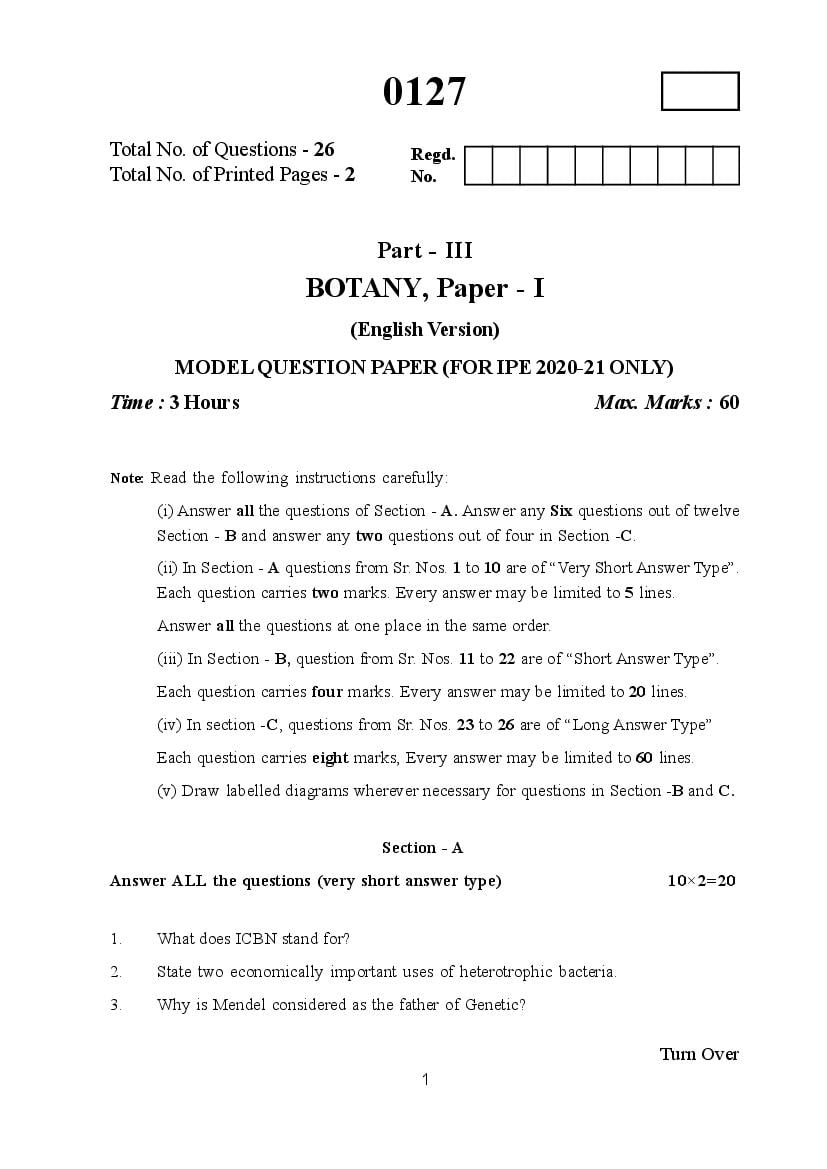
0127 Total No. of Questions - 26 Regd. Total No. of Printed Pages - 2 No. Part - III BOTANY, Paper - I (English Version) MODEL QUESTION PAPER (FOR IPE 2020-21 ONLY) Time : 3 Hours Max. Marks : 60 Note: Read the following instructions carefully: (i) Answer all the questions of Section - A. Answer any Six questions out of twelve Section - B and answer any two questions out of four in Section -C. (ii) In Section - A questions from Sr. Nos. 1 to 10 are of “Very Short Answer Type”. Each question carries two marks. Every answer may be limited to 5 lines. Answer all the questions at one place in the same order. (iii) In Section - B, question from Sr. Nos. 11 to 22 are of “Short Answer Type”. Each question carries four marks. Every answer may be limited to 20 lines. (iv) In section -C, questions from Sr. Nos. 23 to 26 are of “Long Answer Type” Each question carries eight marks, Every answer may be limited to 60 lines. (v) Draw labelled diagrams wherever necessary for questions in Section -B and C. Section - A Answer ALL the questions (very short answer type) 10×2=20 1. What does ICBN stand for? 2. State two economically important uses of heterotrophic bacteria. 3. Why is Mendel considered as the father of Genetic? Turn Over 1

Page 2

4. What is meant by epipetalous Condition? Give one Example. 5. Define placentation. What type of placentation is found in Dianthus? 6. What is Omega Taxonomy? 7. Write the floral formula of Solanum plant. 8. What is middle lamella made of ? What is its functional significance? 9. Give one example for each of amino acids, sugars, nucleotides and fatty acids. 10. Define population and community. Section - B 6×4=24 Answer any SIX questions (short answer type) 11. Explain Binomial Nomenclature. 12. Give a brief account of Dinoflagellates. 13. Differentiate between red algae and brown algae. 14. Describe any four type of placentations found in flowering plants. 15. Describe any two special types of Inflorescence. 16. Discuss the arrangement of floral members in relation to their insertion on thalamus. 17. Give an account of floral diagram. 18. Describe the essential organs of Solanaceae. 19. Write brief account on polysaccharides. 20. Explain prophase I of meiosis. 21. Enumerate the morphological adaptations of xerophytes. 22. Enumerate the morphological adaptations of hydrophytes. Section - C 2×8=16 Answer any TWO questions (Long answer type) 23. With neat labelled diagram, describe the parts of a mature angiospermic embryosac. Mention the role of synergids. 24. Write a brief account on agents of pollination. 25. Describe the structure of the following with the help of labelled diagram. (a) Nucleus (b) Centrosome 26. Describe the T.S. of Dicot root. 2

Document Details

Board / OrgTelangana Board
ExamClass 11
TypeSample Paper
Pages2
Languageenglish
Updated30 Apr 2026